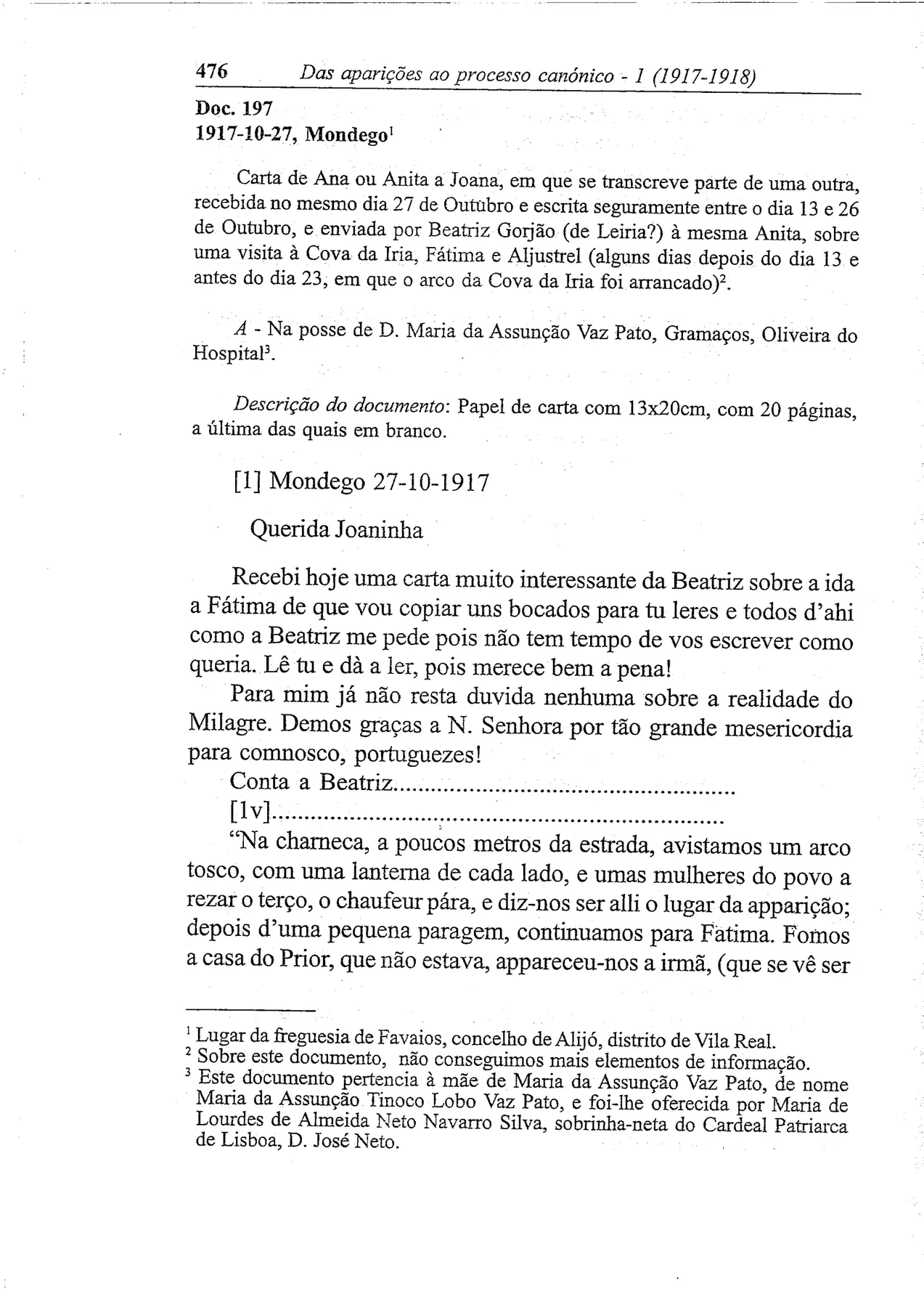
“On the heath, a few metres from the road, we caught sight of a rough arch, with a lantern on each side, and some women of the people saying the rosary; the chauffeur stopped and told us that was the place of the apparition; after a short stop, we went on to Fátima. We went to the house of the Parish Priest, who was not in; his sister came out to us (who is evidently of a humble family but very likeable); she told us that she too had seen the signs in the sun . We told her we would like to see the children and she sent a little boy to show us their house. We left Fátima [2], which seemed to us a very small place; the best house we saw was the Parish Priest's, which is very modest, with an old-fashioned porch. Shops, I don't even know whether there are any there!
As I told you, we left Fátima and went on on foot (because there is no road) to Aljustrel, the village of the 3 children. On the way we met a caravan, and walking beside one of the donkeys was the eldest of the little girls; we asked her to stop, but she, being a child, was eager to go on to Ourem. She spoke little with us; she kept telling us to go and see Jacintha (the smallest), who would tell us everything, and she pointed to the hamlet, which could already [2v] be seen from there. Some women who were there said that the smallest one never spoke, not even to them, but I, remembering Maria Delphina's inspirations and finding the little girl's insistence extraordinary, was convinced straight away that she would make an exception for us, and so it turned out.
When we were about to leave, little Jacintha appeared; she is 7 years old and an absolute darling; we sat there on the ground passing the little girl from lap to lap. We asked her what Our Lady looked like and how she was dressed: and the little girl, without the slightest hesitation and wanting to show it in person, stood up and said that Our [3] Lady was her own height; she drew her skirt in a little at the bottom to explain that Our Lady wore her dress a little narrower at the bottom, then with great efforts she tried to make her little skirt reach her feet, showing that the dress was long.
She then explained that Our Lady wore no veil, but a mantle that fell from her head down to, going by the little one's gesture, 3 or 4 fingers above the tunic; she was all in white (without the blue sash), her hands raised; the little girl, to explain better, took the rosary from my hands, threading it into her own little hand between the thumb, raised her hands imitating the gesture of Our Lady of Lourdes and, parting them a little, then [3v] said: when she spoke she was like this: She had on her head something of many colours. The eldest girl and the little boy whom we met later gave us the same explanation. A poor little woman asked her whether, among so many ladies as she saw on the 13th and among so many who have visited her, she had found any as beautiful as the lady from Heaven; the little girl said she had never seen any so beautiful, and the little boy, whom we later asked the same thing, said: that there was none so beautiful in the world. We asked her to tell us how the first apparition had been: The little one explained that they were minding the she-[4]ep that belong to the family of Lucia (the other seer) on Tio Abobora's land; suddenly they saw a flash of lightning and were afraid, very afraid; when they were on their knees praying, they saw the Lady on the Holm Oak, and at once another flash of lightning; the flock went into the chickling peas and the woman who owned them shouted from afar — “turn those sheep back for me” — but the lady said: (the little girl tried to make her voice sweeter) “don't turn the sheep back, for they won't eat anything.
Then Lucia asked: “Who are you?” — “I am the Mother of Heaven” — “What do you want of us?” - “That you come here on this day for 6 months; at the end of the 6 months I will say what I want. Say the rosary.” — [4v]
Then the owner of the chickling peas appeared, whom his wife had gone to fetch; he came to scold because he is very nasty, but he didn't scold at all because he saw that the chickling peas had not been eaten. And here you have what I find most admirable: something happens to three little children who were minding sheep; such a simple scene, that of the chickling peas, takes place in the hills in the middle of the heath. The children are from a tiny hamlet that could almost be called a cluster of farmsteads, where there are no shops or trade of any kind; this hamlet belongs to the parish of Fatima, but Fatima, as I have already said, is also a very small place; the road ends there [5], so it is not on the way to anywhere; certainly few people go there; no advertisements are put in the newspapers; and in 6 months the news spreads everywhere, and in spite of the rain and the lack of transport some 30:000 people gather there, according to some; 50:000 according to others! — but let us take up the thread again, — “ The little girl then speaks of the end of the war and of the end of the world if there were no faith (don't be alarmed, there is still plenty). It is these two points that I find doubtful; would Our Lady really have spoken of the end of the war and of the world, or were the children confused by so many questions as they have been asked? — Our Lady [5v] told them a secret. The mothers, poor things, ignorant as they are, have done everything possible to find it out. According to what they say, the administrator has already promised 20.000 if they told it to him, but there is no way of wresting the secret from them. I heard the little boy say that not even if they were given the whole world would they tell it. When they are asked whether it is bad, they say it is good for everyone. — On the last day Our Lady also said that she was the Virgin of the Rosary, and that she wanted the people to build her a chapel there — But this is far from being the most important part; imagine our impression when the little one, carrying on talking, [6] tells us that on the last day (13 October) St. Joseph and the Child Jesus appeared to her!! So it was the Holy Family. Our first impression was one of doubt and alarm: was everything going to collapse from the foundations?! But some neighbours who were there told us that the 3 children had several times already spoken of St. Joseph and the Child Jesus. — The little one then explained that St. Joseph had come to give peace to the world, and with her hand she made the sign of the cross many times, imitating the gesture of Bishops when they walk along blessing the faithful. She told us that the Child Jesus and St. Joseph were just like some little holy images she had at home. There was [6v] someone who offered to go and fetch the image, but the little girl answered that she also had pictures on the wall. Remembering Maria Delphina once more, I seemed to understand that it would be a good idea for us to go to her house. I suggested it, and we went on to the tiny hamlet of Aljustrel. We arrived at the little ones' house; it is small and belongs to very humble but clean people — The little ones' mother came out to us, a woman of the people, very likeable and seeming very good. Neither she nor her husband accepts money; they think, and rightly, that people might judge there was some self-interest involved, and besides, thank God, we don't go [7] hungry” — we have (in her own words) potatoes for the whole year”. On the 13th someone put into the hand of one of the little ones a 500rs coin; the child, not knowing what it was, as it was wrapped in a piece of paper, went and took it to the mother, who in distress asked aloud who would own up to having given the 500rs. — Nobody answered; and the five tostões are still there wrapped in the same paper in the corner of the drawer. She won't touch it: that money is not hers.
She also told us that one day the little ones came into her house saying they had seen the Lady from Heaven; when she answered that they were dreaming and that they were not worthy [7v] of that, the little girl insisted and described to her Mother what she had seen, and told what she had already told us on the way! but let us return to the thread: the little one says she had some pictures at home, but she didn't even look at them: she went to a box and took out a group of the Holy family, saying: “see?” St. Joseph and the Child Jesus were as they are here: but here St. Joseph has his eyes closed, and there he had his eyes open. — Wanting to see whether she would get muddled, we told her that since St. Joseph and the Child were as they are there, Our Lady on the last day must also have been like that one, with a veil and a coloured mantle; we asked this several times, and she always answered that Our Lady was not like th-[fl. 8]at one, but in white and with the rosary. We further said that, being the Holy family, they must all have been together, to which she always answered no. Our Lady was on the holm oak, and St. Joseph and the Child Jesus near the Sun. — We made the same experiment with the little boy, who always answered like his sister. — It is therefore beyond doubt that the 6 apparitions of Our Lady can be confirmed without confirming that of the Holy Family. The eldest little girl, before leaving for Ourem, also spoke to us of St. Joseph and the Child Jesus. However, this is very little known, and we ourselves have told few people, because this being a much more extraordinary fact (which [8v] I think has not yet happened anywhere in the world)18, we are afraid that it will astonish many “people” and that they may not believe. Imagine therefore my astonishment when a girl who had been in Alemquer came here yesterday and told me told me that a man from Alemquer, very unbelieving and one of the worst there, having gone to Fatima, came back deeply impressed, describing to everyone the extraordinary things he saw, and that he states he saw the Child Jesus and St. Joseph. — Nobody believes him, poor man, because over there nobody knows that the Holy Family really appeared. — Can Our Lady have granted that man that great grace for his [9] conversion? — Emilio Infante21 and Nazareth22 were at Fatima on the 13th; Emilio fell to his knees weeping, and says that if he knew there was to be another apparition he would not miss it, even if he had to get as much rain as he got now! — The signs in the sun were seen in the surroundings of Leiria, Batalha, etc... In Leiria everyone believes.
We said the rosary at the place of the apparition with the children and some thirty people. The rosary was led by a man of the people; I have seldom heard anyone pray so well and with such devotion, and always with hands raised, as they say. — Then some women appeared with enormous bunches of heather, which they left at the place of the apparition: [9v] with what devotion they had been gathered! Our Lady must have liked them very much!
Na charneca, a poucos metros da estrada, avistamos um arco tosco, com uma lanterna de cada lado, e umas mulheres do povo a rezar o terço, o chaufeur pára, e diz-nos ser alli o lugar da apparição; depois d'uma pequena paragem, continuamos para Fatima. Fomos a casa do Prior, que não estava, appareceu-nos a irmã, (que se vê ser de familia humilde mas muito sympathica); disse-nos ter visto tambem os signaes no sol. Dissemos lhe que gostariamos de ver as crianças e ella mandou um rapazito ensinar-nos a casa d'elles. Deixamos Fátima [2] que nos pareceu um logar muito pequeno; a casa melhor que vimos foi a do Prior, que é muito modesta, com um alpendre à antiga. Lojas nem sei se lá existe alguma!
Como te disse deixamos Fatima, e continuamos a pé (porque não ha estrada) para Aljustrel, a terra das 3 creanças. No caminho encontramos uma caravana, e a pé junto a um dos burros ia a mais velha das pequenas; pedimos que parasse, mas ella, como creança que é, estava desejando continuar para Ourem. Pouco fallou comnosco, dizia-nos que fossemos ter com a Jacintha (a mais pequena) que ella contaria tudo e apontava para o lugar que já se [2v] avistava d'alli. Umas mulheres que alli estavam disseram que a mais pequena nunca fallava, nem mesmo a ellas, mas eu lembrando-me das inspirações da Maria Delphina e achando estraordinaria a insistencia da pequena, desde logo me convenci que ella abriria excepção para nós, e assim aconteceu.
Quando estavamos para partir apparece a pequena Jacintha; tem 7 annos e é um verdadeiro apetite, nós alli ficamos sentadas no chão passando a pequena de collo para collo. Perguntamos-lhe como era e como estava vestida N. Senhora: e a pequena sem a mais pequena exitação e querendo explicar ao vivo, põe-se em pé e diz que N. [3] Senhora era da sua altura; aperta um pouco a saia em baixo para explicar que N. Senhora trazia o vestido um pouco mais estreito em baixo, depois com grandes esforços tenta chegar a saita d'ella aos pés mostrando que o vestido era comprido.
Explica depois que N. Senhora não trazia veu, mas um manto que lhe cahia da cabeça até, segundo o gesto da pequenita, a 3 ou 4 dedos acima da tunica; estava toda de branco (sem a facha azul) as mãos erguidas a pequena para melhor explicar, tirou-me o terço das mãos enfiando-o na mãozita d'ella entre o dedo pulgar, levantou as mãos imitando o gesto de N. Senhora de Lourdes e separando-as um pouco en-[3v]seguida disse: quando fallava ficava assim: Tinha na cabeça uma coisa de muitas côres. A mesma explicação nos deu a mais velha e o pequenito que depois encontramos. Uma mulherzita perguntou-lhe se em tantas senhoras que viu no dia 13 e entre tantas que a teem visitado, encontrou alguma tão bonita como a senhora do Ceu, a pequena disse que tão bonita nunca viu nenhuma, e o pequeno a quem depois perguntamos o mesmo disse: que tão bonita não havia nenhuma no mundo. Pedimos que nos contasse como tinha sido a primeira apparição: A pequenita explicou que andavam a guardar as ove-[4]lhas que pertencem à familia da Lucia (a outra vidente) na terra do Tio Abobora de repente viram um relampago e tiveram medo, muito mêdo, quando estavam de joelhos a rezar, viram a Senhora na Azinheira e logo outro relampago, o rebanho foi para os chicharros e a dona d'elles gritava de longe — “volta-me essas ovelhas” — mas a senhora disse: (a pequena tentou tornar a vóz mais doce) “não voltem as ovelhas que ellas não comem nada.
Então a Lucia perguntou: “Quem é Vocemecê?” — “Eu sou a Mãe do Céu” — “O que quer à gente?” - “Que aqui vanham n'este dia durante 6 mezes, no fim dos 6 mezes direi o que quero. Rezem o terço.” — [4v]
Depois appareceu o dono dos chicharros, que a mulher foi chamar, vinha ralhar porque é muito mau, mas não ralhou nada porque viu que os chicharos não estavam comidos. E, aqui tens o que eu acho mais admiravel; passa-se um caso com tres creancinhas que guardavam ovelhas; uma scena tão simples do[s] chicharos passa-se na serra no meio da charneca. As creanças são d'um logarsito que quasi se lhe póde chamar uns casaes onde não ha lojas nem commercio de especie alguma; este logar pertence à freguezia de Fatima, mas Fatima é tambem como já disse um logar muito pequeno; a estrada acaba alli [5] não está portanto em caminho para parte nenhuma, de certo alli vae pouca gente, não se fazem reclames nos jornaes, e em 6 mezes a noticia espalha-se por toda a parte, e apezar da chuva e da falta de transportes junta-se alli umas 30:000 pessoas, segundo uns; 50:000 segundo outros! — mas vamos retomar o fio, — “A pequena falla depois do fim da guerra e do fim do mundo caso não houvesse fé (não te assustes ainda ha muita). São estes dois pontos que eu acho duvidoso[s]; fallaria realmente N. Senhora no fim da guerra e do mundo, ou estariam as creanças confundidas com tantas perguntas que lhes têem feito? — N. Senhora [5v] disse-lhes um segredo. As mães, coitadas como ignorantes que são, têem feito todo o possivel para o saber. Segundo dizem, o administrador já prometeu 20.000 se lh'o dissessem, mas não ha meio de lhes arrancar o segredo. Ao pequeno ouvi dizer que nem que lhe dessem o mundo inteiro o diriam. Quando lhes perguntam se é mau, dizem que é bom para todos. — N. Senhora no ultimo dia disse mais ser a Virgem do Rosario, e querendo o povo lhe eregisse alli uma capella — Mas isto está bem longe de ser a parte mais importante; calcula a nossa impresssão quando a pequenita continuando a conversar [6] nos diz que no ultimo dia (13 Outubro) lhe appareceu S. José e o Menino Jesus!! Tratava-se portanto da Sagrada Familia. A nossa primeira impressão foi de duvida e de susto, iria cahir tudo pela base?! Mas umas vizinhas que alli estavam, disseram-nos que as 3 creanças já por vezes tinham fallado em S. José e no Menino Jesus. — A pequenita então explicou que S. José tinha vindo dar a paz ao mundo, e com a mão repetiu muitas vezes o signal da cruz, imitando o gesto dos Bispos quando vão andando e abençoando os fieis. Disse-nos que o Menino Jesus e S. José eram eguaes a uns santinhos que tinha em casa. Houve [6v] alguem que se offereceu para ir buscar o santo mas a pequena respondeu que tambem tinha quadros na parede. Lembrando-me outra vez da Maria Delphina, pareceu-me comprehender que seria conveniente irmos a casa d'ella. Dei a ideia, e continuamos para o pequenino lugar de Aljustrel. Chegamos a casa dos pequenitos é pequena e de gente muito humilde mas limpa — Apareceu-nos a mãe dos pequenitos uma mulher do povo, muito sympathica e parecendo muito boa. Tanto ella como o marido não aceitam dinheiro, pensam e bem, que poderiam julgar haver alli qualquer interesse, e depois graças a Deus não pas-[7]samos fóme” — temos, (segundo a sua expressão,) batatas para todo o anno”. No dia 13 houve alguém que metteu na mão d’um dos pequenos, uma moeda de 500rs, a creança não sabendo do que se tratava, pois estava embrulhada n’um papel, foi leval-a à mãe, que afflicta perguntou em vóz alta quem se accusava de ter dado os 500rs. — Ninguém respondeu; e os cinco tostões lá estão embrulhados no mesmo papel ao canto da gaveta. Não lhe quer tocar: aquella dinheiro não é d’ella.
Contou-nos mais, que os pequenos um dia lhe entraram em casa dizendo que tinham visto a Senhora do Ceu; respondendo ella que elles estavam a sonhar e que não eram dignos [7v] d’isso a pequena insistindo, fez à Mãe a discripção do que tinha visto, e contou o que já nos tinha dito no caminho! mas voltemos ao fio: a pequenita diz que tinha em casa uns quadros, mas nem para elles olhou: foi a uma caixa e tirou um grupo da Sagrada familia dizendo: “vêem?” S. José e o Menino Jesus estavam como estão aqui: mas aqui S. José está com os olhos fechados, e lá estávam com os olhos abertos. — Querendo nós ver se ella se atrapalhava, dissemos-lhe que uma vez que o S. José e o Menino estavam como alli estão, N. Senhora no ultimo dia tambem devia estar como aquella de veu e manto de côres; perguntamos isto varias vezes, respondendo ella sempre que N. Senhora não estava como a-[fl. 8]quella, mas sim de branco e com o terço. Dissemos mais que sendo a Sagrada familia devia estar toda junta, ao que ella respondia sempre que não. N. Senhora estava na azinheira, e S. José e o Menino Jesus, perto do Sol. — A mesma experiencia fizemos com o pequeno respondendo sempre como a irmã. — É portanto fóra de duvida que se póde confirmar as 6 aparições de N. Senhora, sem se confirmar a da S. Familia. A pequena mais velha antes de partir para Ourem tambem nos fallou de S. José e do Menino Jesus. No emtanto isto está muito pouco espalhado, e nós mesmo a pouca gente temos dito porque sendo este um facto muito mais extraordinario (que [8v] me parece ainda não aconteceu em parte nenhuma do mundo)18, temos medo que isso vá fazer espanto a muita “gente” e possam não acreditar. Calcula por isso o meu espanto quando vindo hontem aqui uma rapariga que esteve em Alemquer, me disse disse, que tendo ido a Fatima um homem de Alemquer muito incredulo e dos peores de lá, veiu impressionadissimo e descrevendo a toda a gente as coisas extraordinarias que viu e que affirma ter visto o Menino Jesus e S. José. — Ninguém o acredita, coitado, porque para lá ninguém sabe que realmente apareceu a Sagrada Familia. — Terá N. Senhora concedido a esse homem, essa grande graça para a sua [9] conversão? — O Emilio Infante21 e Nazareth22 estiveram em Fatima no dia 13; o Emilio cahiu de joelhos a chorar, e diz que se soubesse que havia outra apparição não faltaria lá, ainda que tivesse que apanhar tanta chuva como apanhou agora! — Os signaes no sol foram vistos nos arredores de Leiria, Batalha, etc... Em Leiria todos acreditam.
Rezamos o terço no logar da apparição com as creanças e umas trinta pessoas. O terço foi recitado por um homem do povo; poucas vezes tenho ouvido rezar tão bem e com tanta devoção e sempre de mãos erguidas como elles dizem. — Apareceram depois umas mulheres com enormes ramos de urzes, que deixaram no logar da apparição: [9v] com que devoção foram apanhadas! N. Senhora muito deve ter gostado d’ellas!
Editor's notes (6)
1 Hamlet in the parish of Favaios, council of Alijó, district of Vila Real.
2 We have not been able to obtain further information about this document.
3 This document belonged to the mother of Maria da Assunção Vaz Pato, named Maria da Assunção Tinoco Lobo Vaz Pato, and was given to her by Maria de Lourdes de Almeida Neto Navarro Silva, great-niece of the Cardinal Patriarch of Lisbon, Dom José Neto.
18 The author did not close the parenthesis, but from the sense of the sentence we think it should be closed here.
21 We think this is Emílio Infante da Câmara (grandson). Cf. DCF, vol. 1, Doc. 28, of 30 December 1917, note 20.
22 Maria da Nazaré Almeida Centeno. Wife of Emílio Infante da Câmara. Cf. DCF, vol. 1, Doc. 28, of 30 December 1917, note 20.
1 Lugar da freguesia de Favaios, concelho de Alijó, distrito de Vila Real.
2 Sobre este documento, não conseguimos mais elementos de informação.
3 Este documento pertencia à mãe de Maria da Assunção Vaz Pato, de nome Maria da Assunção Tinoco Lobo Vaz Pato, e foi-lhe oferecida por Maria de Lourdes de Almeida Neto Navarro Silva, sobrinha-neta do Cardeal Patriarca de Lisboa, D. José Neto.
18 A autora não fechou o parênteses, mas pelo sentido da frase, pensamos que se deve fechar aqui.
21 Pensamos que seja Emílio Infante da Câmara (neto). Cf. DCF, vol. 1, Doc. 28, de 30 de Dezembro de 1917, nota 20.
22 Maria da Nazaré Almeida Centeno. Esposa de Emílio Infante da Câmara. Cf. DCF, vol. 1, Doc. 28, de 30 de Dezembro de 1917, nota 20.