Events /

Other 1917 events

Sightings on other days, distant observers, the felling of the holm oak, visits to the seers.

67 passagesSaw it: 38Partly: 6Saw nothing: 2Present: 21Filter and search these →

Leonor de Avelar e Silva Constâncio

Pilgrimwidow, Catholic lady staying at Caldas da Rainha
Other 1917First-handSaw itLater recollection
English

I went back to Fatima on 19 October; I went to see the children and speak with them. With us went a priest who had already interrogated them several times, those interrogations being most interesting.

Contrary to what had happened to some people, I liked the children immensely; they are robust, healthy, cheerful, frank and likeable, with an ease of manner proper to their age. They did not run away from us, but received us kindly. We were present at a lengthy interrogation, made of each child separately. They answer frankly, promptly, and with the greatest simplicity. Nevertheless one can see that they do not much like being interrogated, that it bores them, and that they answer only because they feel obliged to.

Português (original)

Voltei á Fatima no dia 19 de Outubro, fui vêr as creanças e fallar com ellas. Foi comnosco um sacerdote que já por vezes as tinha interrogado, sendo interessantissimos esses interrogatorios.

Ao contrario do que succedera a algumas pessôas, agradaram-me immenso as creanças, que são robustas, sadias, alegres, francas e sympathicas, com uma desinvoltura propria da sua idade. Não fugiram de nós, antes nos receberam amavelmente. Assistimos a um demorado interrogatorio, feito a cada creança separadamente. Respondem francamente, promptamente, e com a maior singeleza. No entanto vê-se que gostam pouco de ser interrogadas, que isso as massa, e que só respondem, por se acharem obrigadas a isso.

13 May13 Jun13 JulOther 1917First-handSaw itInterrogationFigures / visionsSeers' words overheard
English

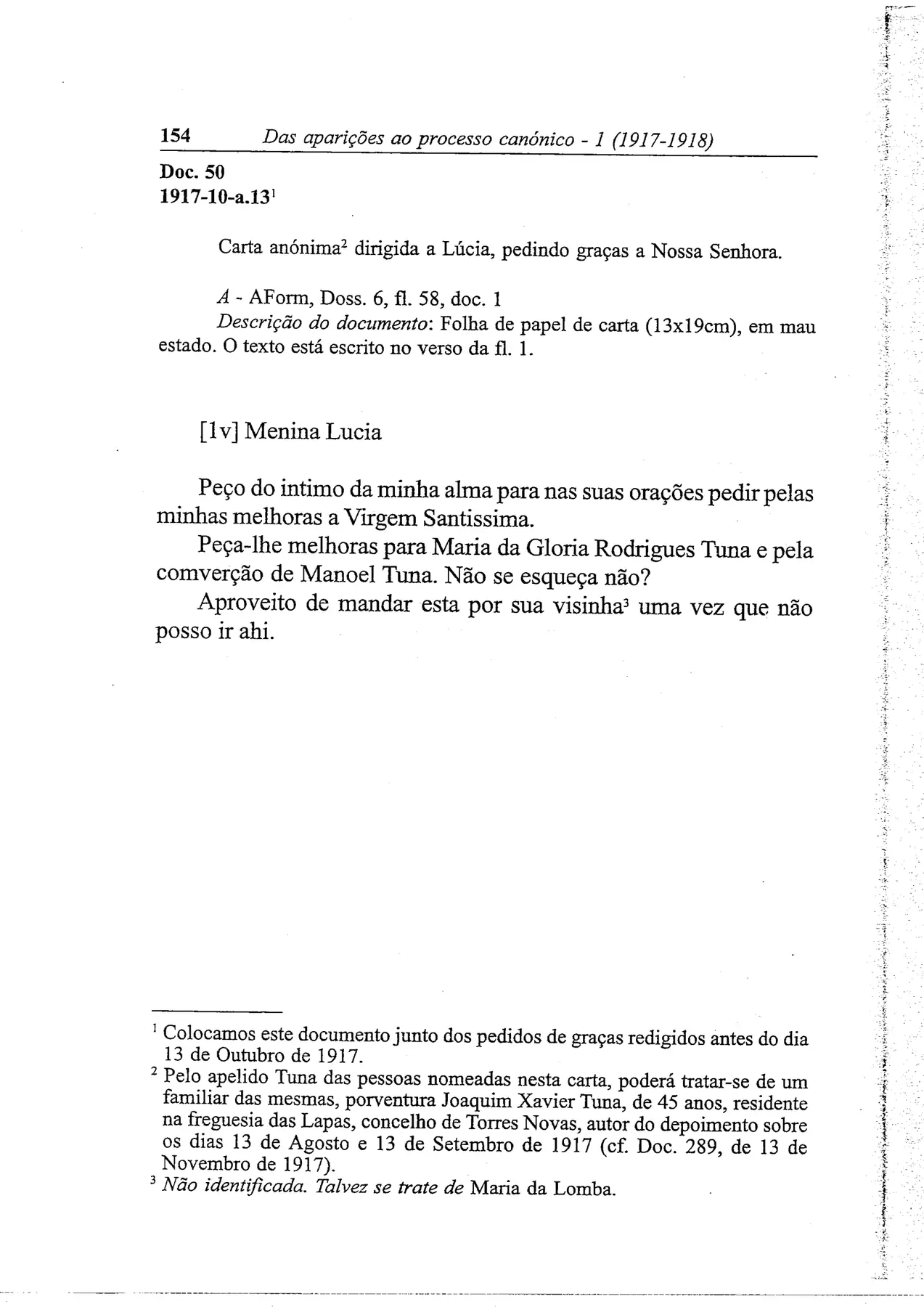
On 14 July 1917 Jacinta, aged 7, daughter of Manuel Pedro Marto, appeared before me; questioned about the vision, she said:

That she had seen a small woman 4 times, once in her house at night and three times at the Cova da Iria at midday; she says she was the size of Albina, daughter of António Rosa of Casa Velha2; at home she saw her at the edge of the attic trapdoor, not saying anything; her mother and brothers and sisters were asleep and it was night; at the Cova da Iria she saw her standing on top of a holm-oak shrub3; she was dressed in white stockings and clothes all of gold; she wore no shoes; the skirt was white and all gold and came down to her knees; the gold was in cords running across, and on the cords in little points; a white jacket all of gold; a mantle over her head was white and all gold; her hands raised to her waist, and they opened, parting them when she spoke to Lúcia; she did not hear her say anything, she heard her speak (now she says yes, now she says no); she did not hear her say how many times she would come here; on leaving, the sky opened and her feet stayed caught and her body already hidden; she heard a very pious voice and remembers only hearing that people (they) would go to heaven; she says she saw lightning, but now she says it was once, now more than once, now before, now after; she had some white beads in her hands, held between the thumb and forefinger of both hands; she did not see earrings; she wore a thin gold chain around her neck.

Português (original)

No dia 14 de julho de 1917 apareceu na minha presença Jacinta de 7 anos de idade, filha de Manuel Pedro Marto; interrogada sobre a visão, disse:

Que tinha visto uma mulher pequena 4 vezes, uma em sua casa à noite e três na Cova da Iria ao meio dia; diz ser do tamanho da Albina, filha de António Rosa da Casa Velha2; em casa viu-a à borda do alçapão do sótão, não dizendo nada; estava a mãe e irmãos a dormir e era de noite; na Cova da Iria viu-a em pé em cima duma carrasqueira3; vinha vestida com meias brancas e fato todo dourado; não trazia sapatos; a saia era branca e toda dourada e dava-lhe pelos joelhos; o dourado era aos cordões a atravessar e nos cordões aos biquinhos; casaco branco todo dourado; um manto pela cabeça era branco e todo dourado; as mãos erguidas à cintura e abriam, separando-as quando falava à Lúcia; não lhe ouviu dizer nada, ouviu falar (ora diz que sim, ora diz que não), não ouviu dizer quantas vezes cá vinha; à saída abria-se o céu e ficavam os pés entalados e o corpo já escondido; ouviu uma fala muito piedosa e só se lembra de ouvir que a gente (elas) ia para o céu; diz ter visto relâmpago mas ora diz ser uma vez ora mais duma, ora antes, ora depois; trazia umas contas brancas nas mãos, seguras entre o dedo polegar e indicador das duas mãos; não viu brincos; trazia um cordão de ouro delgado ao pescoço.

Editor's notes (2)

2 She was born on 3 December 1901. She was the daughter of António Ferreira Rosa, of Aljustrel, brother of José Ferreira Rosa (first husband of Olímpia de Jesus, mother of Francisco and Jacinta) and of Maria Rosa (Lúcia's mother).

3 The carrasqueira (holm-oak shrub), so often mentioned, is a young holm oak, of small size. Azinheira (holm oak): Quercus rotundifolia, Lam., a tree of the beech family (Fagaceae), with a broad, rounded and dense crown, and evergreen leaves, very leathery, small, toothed and spiny in the juvenile state, with five to eight pairs of veins. The fruit is popularly called "azinha", "boleta" or "bolota".

2 Nasceu a 3 de dezembro de 1901. Era filha de António Ferreira Rosa, de Aljustrel, irmão de José Ferreira Rosa (primeiro marido de Olímpia de Jesus, mãe de Francisco e Jacinta) e de Maria Rosa (mãe de Lúcia).

3 A carrasqueira, tantas vezes referida, é uma azinheira nova, de pequeno porte. Azinheira: Quercus rotundifolia, Lam., árvore da família das fagáceas, de copa ampla arredondada e densa, de folhas persistentes, muito coriáceas, pequenas, dentado-espinhosas no estado juvenil, com cinco a oito pares de nervuras. Ao fruto se dá popularmente o nome de “azinha”, “boleta” ou “bolota”.

DCF Seleção, Doc. 3 (= DCF I, Doc. 3) · interrogation · 14 Jul 1917 (2 months later)View scanLink

Carlos de Azevedo Mendes

Professionalyoung lawyer from Soudos (Torres Novas), later deputy
Other 1917First-handLetter
English

A lively lunch. I explained the reason for my visit. We exchanged impressions. The day before, the little girls had been at the parish priest's house for the priests to question them. They maintained all their usual statements, which, together with the little girls' attitude, impressed them. It was not sufficient reason for them to form a judgement, but they all agreed that there was something extraordinary. What?

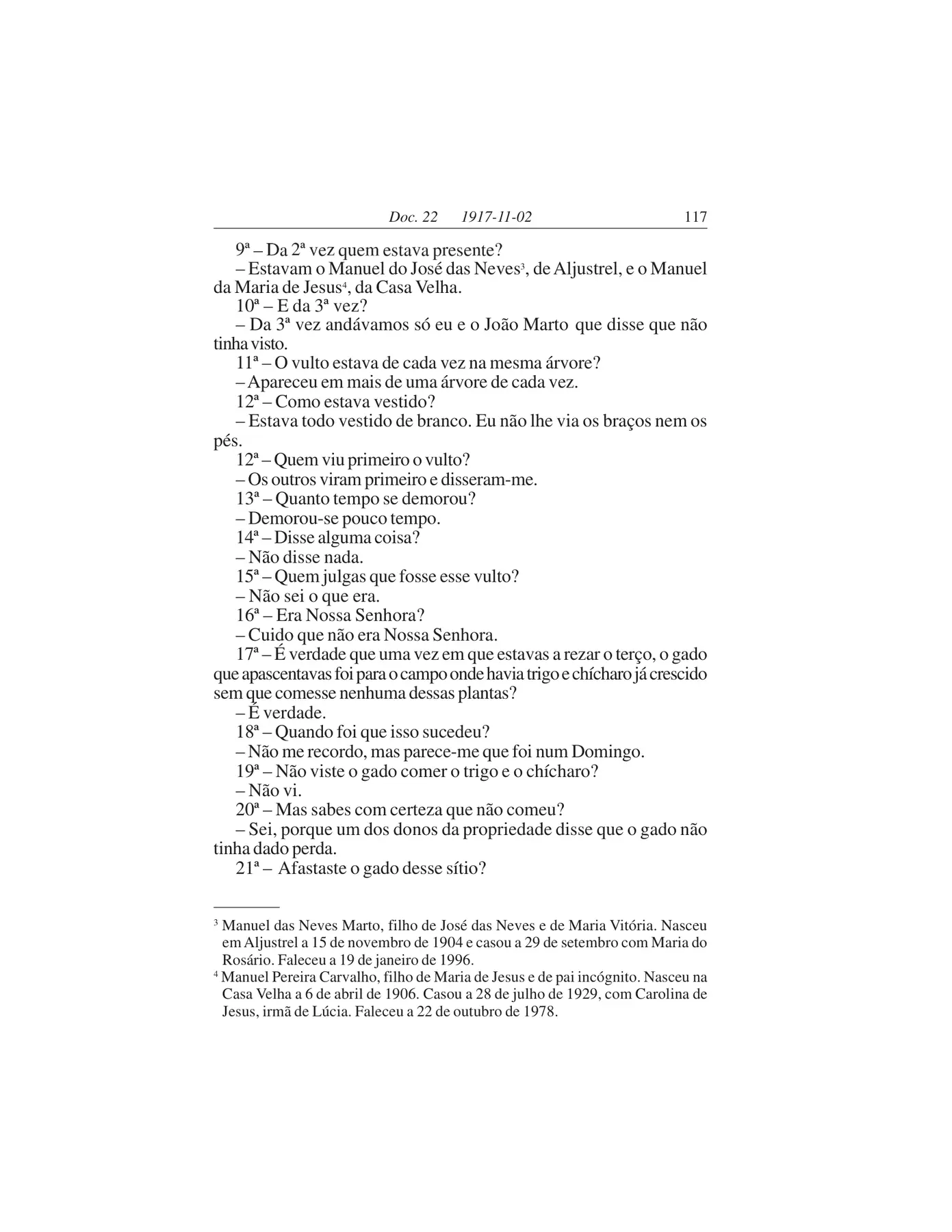
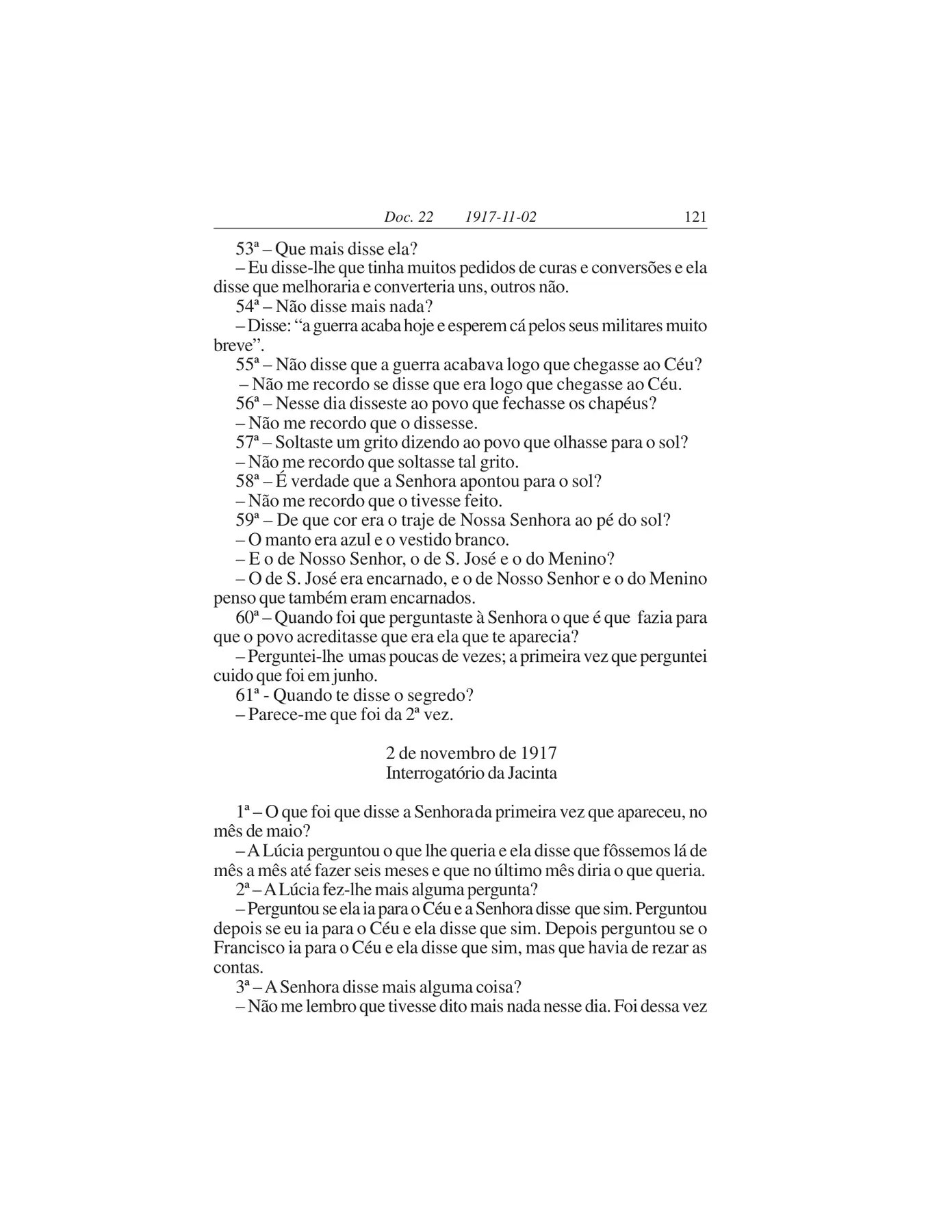
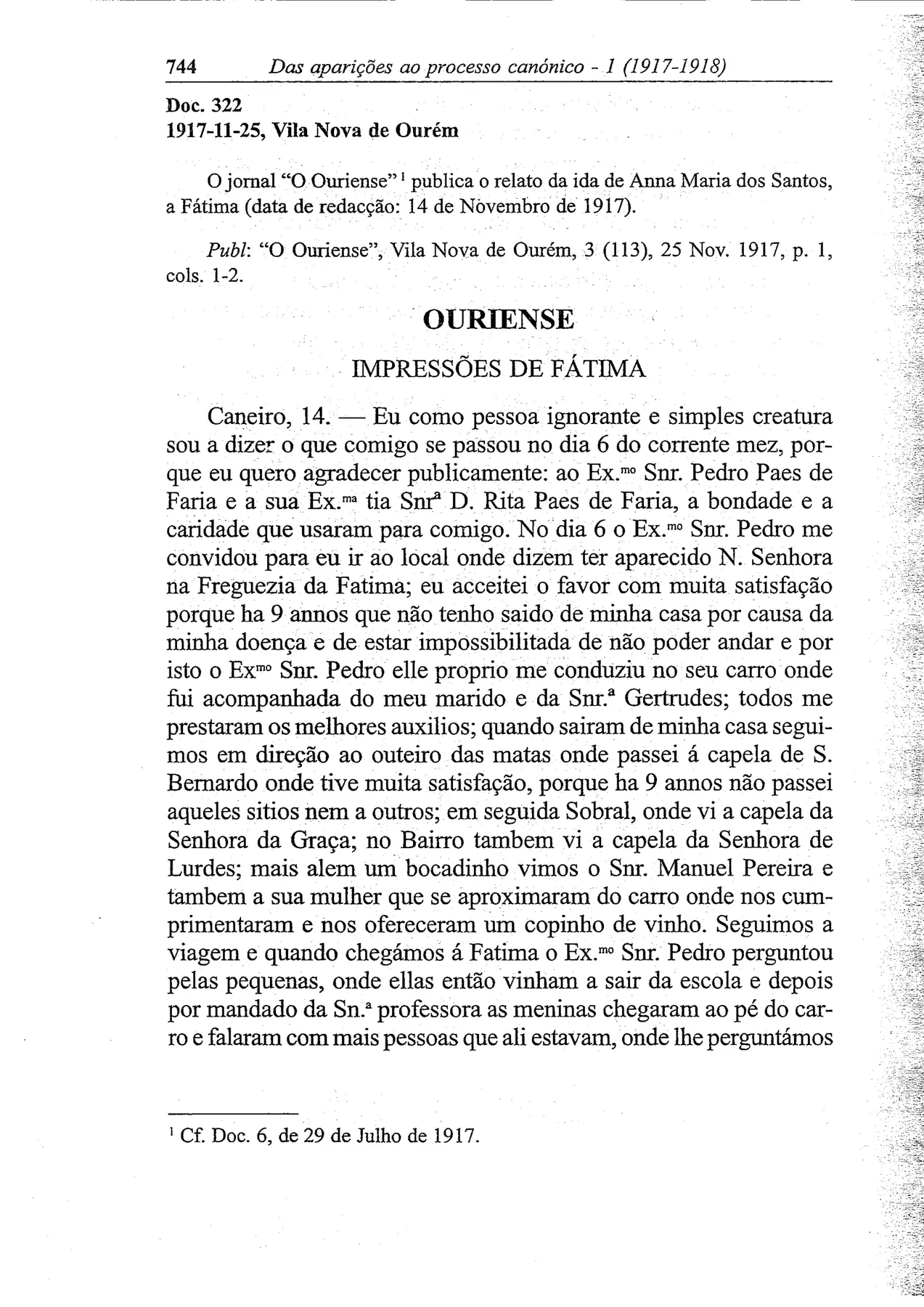
Let us await the course of events, and may the will of God be made manifest. Lunch ended. The parish priest assigns his servant to us as our orderly, with the greatest and best recommendations to the mother of the little girls. An intense curiosity gripped me. The Mother of the two youngest, after the parish priest's message, receives me with the best of smiles. We went into the parlour. The mother, a lean little old woman, with brisk manners, every inch an active woman. She begins her explanations. Only Jacinta (aged 7) and Francisco (going on 9) were her children; Lúcia (going on 11) is her niece. Jacinta was at Lúcia's house. She sent for her at once.

Francisco had come back with the little flock and, while dinner was not yet ready, had gone to join his Father cutting brushwood. I am alone with the mother.

She tells me of her apprehensions on account of the stir the little girls have caused. “If only we were deserving!!!...”. “But just imagine, even my brother (Lúcia's father) does not care about the Church and is a man for wine!!!...”.

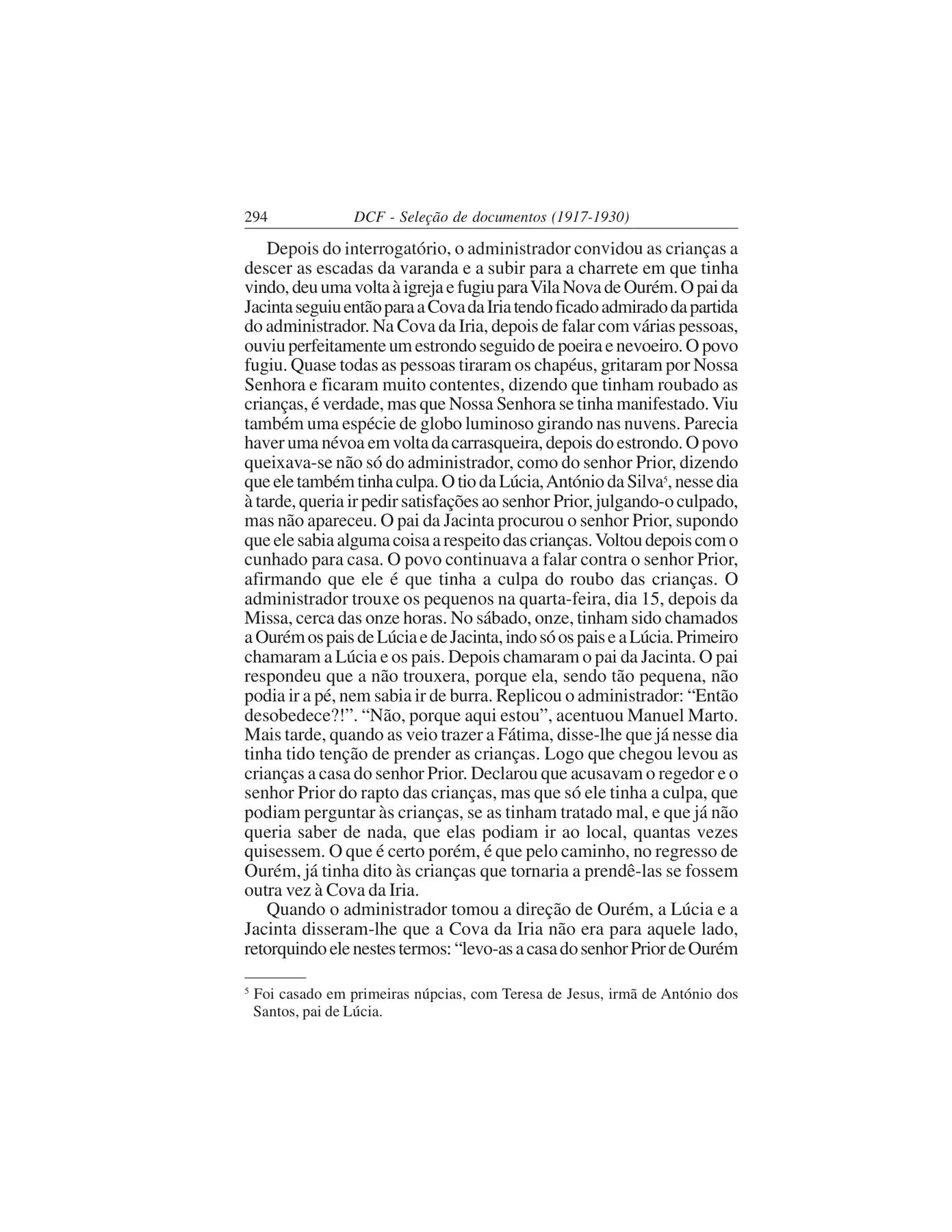
She told me about the visit of the Administrator and the imprisonment of the little girls. Well, she went on talking until Jacinta arrived. Lúcia had gone to take her Father his dinner and would be coming soon. The little mite did not want to come without her cousin (they are inseparable); her sister had to bring her piggyback. Very tiny, very shy, she came edging up to me. I was seated; to see her better I sat her on top of a chest, with me beside her. I then observed her quite at my ease. The Vicar had told me she was an Angel. I wanted to form my own opinion too. I assure you, Prazeres, she is an angel, but a very, very lovely angel!!!... Many times I thought, and a few times I said, that if my Prazeres saw her and spoke with her, she would not run off with her only if it were impossible!!!... A kerchief with a red floral pattern wrapped round her head with the ends tied behind. An oldish kerchief, already torn... A little jacket, which was not remarkable for its cleanliness either, a reddish skirt, but very full, in the fashion of the region.

There you have the dress of our little angel. I would like to describe her little face to you, but I really believe I shall not manage to tell you anything even approximate!!!...

The kerchief, the way she wore it, set off her features even more: eyes of an enchanting liveliness, an angelic expression, of a goodness that captivates us, in an extraordinary whole which, I do not know why, draws us.

Very bashful, we could hardly hear the little she said in reply to my questions. She was missing her Lúcia. She was not at ease!!... After I had entertained her for some time, talking and... (don't laugh!!) playing, Francisco arrived. Cap pulled down over his head, very short jacket, waistcoat showing his shirt, tight trousers, in short a man in miniature. A fine boy's face!... A lively look and an impish face!!... With a self-assured air he answers my questions. Jacinta begins to gain confidence. Shortly afterwards Lúcia arrives. You cannot imagine Jacinta's joy when she saw her!!... She laughed all over, ran to her and never let go of her again!!!... It was a lovely picture. Lúcia on one side, no, Lúcia in the middle, on one side Francisco and on the other, very close to her and with her little head right against her, Jacinta.

Lúcia does not have features that impress us. Only her look is lively. Her features are ordinary. The type of the region. At first she too was withdrawn. But soon I have them at their ease and then, without embarrassment, they answer and satisfy my curiosity. After convincing myself that my interrogation was complete, I ask them whether they would go with me to pray the rosary at the place of the apparition. If their mother lets them, they will go. I obtain the permission myself. No sooner had the mother given it than little Jacinta went off at once to make her toilette... She put on a clean kerchief, another jacket and a little apron!!!... You are anxiously awaiting my impression, aren't you?... Well, here it is, my little girl. As I told you, I examined, or rather questioned, the three separately. They all say the same without the slightest variation. The main point that I deduced from everything they tell me is “– that the apparition wants the devotion of the Rosary to be spread –”. All the little ones always say that the one who appears to them is the Lady. They do not know who she is... Only after the 6 times, on 13 October, will she tell them who she is and what she wants!!... The naturalness and ingenuousness with which they speak and tell what they saw is admirable and impressive.

Lúcia sees the Lady, speaks with her and hears her. Jacinta sees the Lady, hears her, but does not speak with Her. Francisco sees the Lady, but neither speaks to her nor hears her!!!... This difference is interesting, don't you think, Prazeres??... But besides being interesting it even has a great deal of the extraordinary about it!!... To hear the little ones, to see them in their simplicity, to examine them as a whole, impresses us in an extraordinary way, and leads me to conclude that in everything they tell me there is something supernatural. Being with them strikes us with great intensity... Today, Prazeres, it is my conviction that there is an extraordinary fact which our reason cannot reach. What is it?... With still greater anxiety I await the coming 13th. What is certain is that we feel at ease with the little ones and even lose the sense of time. There is an attraction that I do not know how to explain... One of the children's most intense impressions is that of the Lady's beauty. The boy, to express his admiration, told me she was “ever so pretty”!!!... I showed him your portrait and asked: is she prettier? “Much prettier!!...”. The Lady comes all in white with gold. She does not wear any blue sash as was said. Whether she is Our Lady of Peace.... Do you remember what she said at the 2nd apparition?... That they should learn to read... Little Jacinta told me “that she was already on the row of A's”!!...

While the little girls had something to eat, I talked with the Father. They made me eat bread with cheese and grapes!!... So as not to disappoint them I did as they wished and in return offered him some of my cigarettes!!...

It also seemed interesting to me to hear the parents, so everything went splendidly. They only know what the children say; their knowledge today goes no further than mine!!!...

After their meal we went to the place with the little ones to pray the rosary. Only they accompanied us. It is still a good way from their house. On the way I asked them:

- Couldn't I get a leaf from the holm-oak shrub?
- It has nothing left now, but I have some at home, they tell me.
- And won't you get me one??...
- Yes, sir.

After we had seen who would go and fetch it, we waited for Francisco to go back home.

The two little mites were playing. They were playing “pontos”: throwing a stone towards a certain spot, the one who landed closest won. It was interesting to watch them play. They argued, but always without getting heated and with the greatest friendliness. Francisco arrives; he no longer had any, but he brought some of Lúcia's!!... (What joy for my little girl!!!!...). A little sprig with only two whole leaves. I kept it. My Prazeres will have her little leaf... If there had been nothing more, this would have been enough for me to be satisfied with the outing!!!...

On the way we laughed!!... The “little ones”, by now very much at their ease and like friends we had known for a long time, played with us all along the way!!... They would stay behind to see whether we knew the way, they laughed; in short we were already... friends!!!...

Thus, now at her ease, how... lovely Jacinta was... Lúcia, despite her less regular features, captivates us by her whole manner, which has a certain something that charms us...

We arrived at the place. Near the road, on a slope, in a magnificent spot, from which one can see very easily from a long way off. The holm-oak shrub (small holm oak) is reduced to its simplest expression. Around it a stone wall. Surrounding it an arch of greenery. On top of the wall, pots of sweet basil and other flowers. The three kneel. Lúcia, who is in the middle, begins to recite the rosary. The recollection, the fervour with which she prays, impresses us. The offering of the rosary is interesting. It is for the soldiers who are at war. With what devotion, Prazeres, the rosary is prayed there... I believe I have never prayed it with such attention!!!... At the end I asked the little girls' permission to keep a sprig of basil. Afterwards they all offered me a little piece!!... I kept the little sprig for you, Prazeres. I also kept another little leaf, which I will bring you later. Such keepsakes are too precious to entrust to the post, so your Carlos will be the bearer. The prayer they say the Lady taught them is simple; it is as follows:

“O my Jesus, forgive me.

Deliver me from the fire of hell

Take all the little souls to heaven, especially those most in need.”

Could you want greater simplicity? I found it interesting that the Lady should have taught it but not recommended that they pray it.

With regret I saw that I had to leave the little ones. It was 6 o'clock. We had left the parish priest's house at 4!!!... After dinner the parish priest also read me the interrogation he had made of the children.

On the way back I also had for company the Vicar and a parish priest from around here. My haste in the morning, before speaking with the little girls, turned afterwards into leisureliness. It was 8 o'clock when we left Fátima.

Português (original)

O almoço animado. Expliquei o motivo da minha ida. Trocámos impressões. Na véspera as Pequenas tinham estado na casa do Prior, para os padres as interrogarem. Mantiveram todas as suas afirmações de sempre, o que juntamente com a atitude das Pequenas, os impressionou. Não era razão suficiente para poderem formar um juízo, mas todos concordavam, que havia algo de extraordinário. O quê?

Esperemos a sequência dos factos, e que a vontade de Deus se manifeste. O almoço terminou. O Prior destaca como nosso oficial às ordens o seu criado com as maiores e melhores recomendações para a mãe das pequenas. Uma curiosidade intensa me prendia. A Mãe dos dois mais pequenos, depois do recado do prior recebe-me com o melhor dos sorrisos. Entrámos para a sala. A mãe, uma velhota seca, modos desembaraçados, todo de mulher ativa. Começa as suas explicações. Só a Jacinta (de 7 anos) e o Francisco (que vai em 9) eram seus filhos, a Lúcia (que vai em 11) é sua sobrinha. A Jacinta estava em casa da Lúcia. Mandou logo chamá-la.

O Francisco tinha chegado com o gadito e enquanto o jantar não chega fôra para junto do Pai roçar o matito. Estou só com a mãe.

Fala-me nas suas apreensões por causa do alvoroço que as Pequenas têm causado. “Ainda se nós fôssemos merecedores!!!...”. “Mas calcule que até o meu irmão (pai de Lúcia) não se importa com a Igreja e é um homem de vinho!!!...”.

Contou-me a visita do Administrador e a prisão das pequenas. Enfim foi falando até que chegou a Jacinta. A Lúcia tinha ido levar o jantar ao Pai, vinha já. A pequerrucha não queria vir sem a prima (são inseparáveis), foi preciso a irmã trazê-la às cavalitas. Muito pequerrucha, muito encolhidita foi chegando para ao pé de mim. Estava sentado, para melhor a apreciar sentei-a em cima de uma arca e eu ao pé. Observei-a então muito à vontade. O Vigário tinha-me dito que era um Anjo. Quis também formular opinião. Afirmo-te Prazeres, é um anjo, mas um anjo muito muito Amor!!!... Muitas vezes o pensei e algumas o disse, se a minha Prazeres a visse e falasse com ela, só a não raptaria, se não lhe fosse possível!!!... Um lenço com ramagem encarniçada embrulhado na cabeça com as pontas atadas atrás. Lenço velhito e já roto... Um casaquito, que também não primava muito pela limpeza, uma saia sobre o encarnado, mas com uma roda enorme à moda da terra.

Aqui tens o traje do nosso anjito. Queria descrever-te a carita, mas, creio bem, que nada conseguirei dizer-te, aproximado ao menos!!!...

O lenço da maneira como o usava ainda mais lhe realçava as feições: os olhos de uma vivacidade encantadora, uma expressão angélica, de uma bondade que nos seduz, num todo extraordinário, que não sei porquê, nos atrai.

Muito envergonhadita com dificuldade ouvíamos o pouco que falava em resposta a minhas perguntas. Faltava-lhe a sua Lúcia. Não estava bem!!... Depois de durante algum tempo a ter entretido, conversando e... (não te rias!!) brincando, chegou o Francisco. Carapuço enterrado pela cabeça, jaleca muito curta, colete deixando ver a camisa, calças justas, enfim um homem em miniatura. Bela cara de rapaz!... Olhar vivo e cara agarotada!!... Com ar desempenado responde a minhas perguntas. A Jacinta começa a ganhar confiança. Pouco depois chega a Lúcia. Não imaginas a alegria da Jacinta, quando a viu!!... Toda ela riu, correu para ela e nunca mais a largou!!!... Era um quadro lindo. A Lúcia num lado, não, a Lúcia ao centro, de um lado o Francisco e do outro, muito junto dela e com a cabecita mesmo em cima dela, a Jacinta.

A Lúcia não tem feições que nos impressionem. Só o olhar é vivo. As feições são vulgares. O tipo da região. Ao princípio também retraída. Mas em breve as tenho à vontade e então, sem embaraços, respondem e vão satisfazendo a minha curiosidade. Depois de me convencer que estaria completo o meu interrogatório, peço-lhes, se iriam comigo rezar o terço ao local da aparição. Se a mãe deixar, vão. Eu mesmo alcanço a licença. Apenas a mãe a deu, a Jacintita foi logo fazer a sua toilette... Pôs um lenço lavado, um outro casaco e um aventalito!!!... Esperas com ansiedade a minha impressão, não é verdade?... Pois vamos a ela, minha Filhinha. Como te disse examinei ou antes interroguei os três em separado. Todos dizem o mesmo sem a mais leve alteração. A base principal, que de tudo o que me dizem, eu deduzi é “– que a aparição quer que se espalhe a devoção do Terço –”. Todos os pequenos dizem sempre, que, quem lhes aparece, é a Senhora. Não sabem quem é... Só depois das 6 vezes, no dia 13 de Outubro, lhes diz quem é e o que quer!!... A naturalidade e ingenuidade, com que falam e contam o que viram é admirável e impressionante.

A Lúcia vê a Senhora, fala com ela e ouve-a. A Jacinta vê a Senhora, ouve-a, mas não fala com Ela. O Francisco vê a Senhora, mas não lhe fala, nem a ouve!!!... É interessante esta diferença, não achas Prazeres??... Mas além de interessante tem até mesmo muito de extraordinário!!... Ouvir as petizas, vê-las na sua simplicidade, examinar-lhes o seu todo, impressiona-nos de uma maneira extraordinária, e leva-me a concluir, que em tudo o que me dizem, alguma coisa existe de sobrenatural. Estar com elas choca-nos com uma forte intensidade... Hoje, Prazeres, é convicção minha que há um facto extraordinário, que a nossa razão não alcança. Qual?... Com ansiedade mais crescente ainda espero o próximo dia 13. O que é certo, é que nos sentimos bem junto das pequenas e chegamos a perder a noção do tempo. Há uma atração, que não sei como explicar... Uma das impressões mais intensas das crianças é a da beleza da Senhora. O rapaz para exprimir a sua admiração dizia-me que era “muito bonitica”!!!... Mostrei-lhe o teu retrato e perguntei: é mais bonita? “Muito mais!!...”. A Senhora vem toda de branco com ouro. Não traz nenhuma faixa azul como se dizia. Se é a Senhora da Paz.... Já te recordaste, o que disse na 2ª aparição?... Que aprendessem a ler... Dizia-me a Jacintita “que já ia na carreira do A”!!...

Enquanto as pequenas tomaram alguma coisa, conversei com o Pai. Fizeram-me comer pão com queijo e uvas!!... Para os não desconsolar fiz-lhe a vontade e ofereci-lhe em troca cigarros dos meus!!...

Também me parecia interessante ouvir os pais, por isso tudo correu às mil maravilhas. Só sabem o que as crianças dizem; os conhecimentos deles hoje não vão mais longe, que os meus!!!...

Depois da refeição deles fomos ao local com os petizes rezar o terço. Só eles nos acompanhavam. É ainda um bocado bom da casa deles. Pelo caminho perguntei-lhes:

- Não poderei arranjar uma folha da carrasqueira?
- Ela já não tem nada, mas eu tenho lá em casa, dizem-me eles.
- E não me arranjam uma??...
- Sim senhor.

Depois de vermos quem a iria buscar, esperamos que o Francisco voltasse a casa.

As duas pequerruchas brincavam. Jogavam os “pontos”; atirando com uma pedra para um certo sítio, ganhava quem mais perto ficasse. Era interessante vê-las brincar. Discutiam, mas sempre sem se alterarem e com a maior amizade. O Francisco chega, já não tinha nenhuma, mas trouxe das da Lúcia!!... (Que alegria para a minha Filhinha!!!!...). Um ramito só com duas folhas inteiras. Guardei-o. A minha Prazeres terá a sua folhita... Se mais não houvera isto me chegava para me dar por satisfeito com o passeio!!!...

Pelo caminho rimo-nos!!... Os “petizes” já muito à vontade e como amigos de há muito conhecidos foram todo o caminho brincando connosco!!... Ficavam para trás para ver se conhecíamos o caminho, riam-se, enfim éramos já... amigos!!!...

Assim já à vontade como a Jacinta era...amor... A Lúcia, apesar das feições menos corretas, prende-nos pelo seu todo, que tem um não sei quê, que nos encanta...

Chegámos ao local. Perto da estrada, numa encosta, em local magnífico, onde se pode ver muito à vontade de muito longe. A carrasqueira (pequena azinheira) está reduzida à expressão mais simples. Em volta um muro de pedra. Rodeando-a um arco de verdura. Em cima do muro, vasos com manjericos e outras flores. Os três ajoelham. A Lúcia, que está no meio, começa a recitar o terço. O recolhimento, o fervor com que ela vai rezando, impressiona-nos. O oferecimento do terço é interessante. É pelos soldados, que estão em guerra. Com que devoção, Prazeres, se reza ali o terço... Creio que nunca o rezei com tanta atenção!!!... No fim pedi licença às pequenas para guardar um ramito de manjerico. Todas elas depois me ofereceram um bocadito!!... Guardei o um raminho para ti, Prazeres. Guardei também uma outra folhita, que depois te levarei. São preciosas em demasia tais recordações para as confiar ao correio, por isso o teu Carlos será o portador. A oração, que dizem a Senhora lhes ensinou é simples, é a seguinte:

“Ó meu Jesus perdoai-me.

Livrai-me do fogo do inferno

Levai as alminhas todas para o céu, principalmente as que mais precisarem.”

Queres maior simplicidade? Achei interessante que a Senhora a tivesse ensinado, mas não lhe recomendasse que a rezassem.

Com saudades via que tinha de deixar as pequenas. Eram 6 horas. Tínhamos saído de casa do Prior às 4!!!... No fim do jantar o Prior ainda me leu o interrogatório, que tinha feito às crianças.

[…]

À volta tinha mais por companhia o Vigário e um Prior aqui dos meus lados. As minhas pressas de pela manhã, antes de falar com as pequenas, deram depois em vagares. Eram 8 horas quando deixámos Fátima.
13 JunOther 1917First-handSaw itInterrogationFigures / visionsSeers' words overheard
English

On Saint Anthony's day (13 June). On this day there was a feast at Fátima which Lúcia's mother (and I do not know whether Francisco's and Jacinta's too) wanted them to attend, but in obedience to what she had recommended to them the month before, they left the feast to go to the place of the apparition, where they met some people unknown to them and only some 3 or 4 they knew. At more or less the same hour as the month before, the same vision appears to them in the same way, and this time she told them to keep going there in the following months; to learn to read; and she told them a secret, which she forbade them to reveal to anyone whatsoever. – Some days later, being near the place of the apparition with their flock, the three of them thought of going to pray the rosary at the place of the apparition, but for that it was necessary either to leave the flock, with the risk of its going and damaging the nearby crops, or for at least one of them to stay on guard and not go to pray the rosary; they decided all to go and pray the rosary and leave the flock, which immediately went into a field of maize, cabbages, chickling peas and other vegetables. A woman who was nearby, seeing the sheep in that field, calls the shepherds, who did not answer her, so she herself went to turn the sheep, which, as soon as she turned her back, immediately went back there. The rosary over, the three went to their flock, to turn it from the place where it was and see the damage it had done, but great was their amazement when they saw that nothing had been damaged, which was confirmed by the owner himself, who, being told that the flock had been in his field, went the next day to see the damage there, and found that no damage at all had been done to him.

Português (original)

No dia de Santo António (a 13 de junho). Neste dia houve uma festa na Fátima à qual a mãe da Lúcia (e não sei se também a do Francisco e da Jacinta queria que fossem assistir, mas em obediência ao que lhe tinha recomendado no mês anterior, deixaram a festa para irem ao local da aparição, onde se encontraram com algumas pessoas desconhecidas e apenas umas 3 ou 4 conhecidas. Um pouco mais ou menos pela mesma hora do mês anterior aparece-lhes a mesma visão pela mesma forma e desta vez disse-lhes que continuassem a ir ali nos meses seguintes; que aprendessem a ler; e disse-lhes um segredo, que lhes proibiu revelar fosse a quem fosse. – Dias depois próximo do sítio da aparição andando os três com o seu gado, pensaram em ir rezar o terço no local da aparição, mas para isso era forçoso, ou abandonarem o gado, com perigo de ir danificar as searas próximas, ou um pelo menos ficar em guarda e não ir rezar o terço; resolveram ir todos rezar o terço e abandonar o gado, que imediatamente foi para uma terra de milho, couves, chicharos e outros legumes. Uma mulher que por ali próximo andava, ao ver as ovelhas naquela seara, chama os pastores que não lhe responderam pelo que ela mesma foi virar as ovelhas, que ao voltar as costas imediatamente para lá voltaram. Terminado o terço foram os três para o seu gado, virá-lo do sítio em que andava e observar o prejuízo que tinha causado, mas qual não foi o seu espanto quando viram que nada tinha sido danificado o que foi confirmado pelo próprio dono que sendo-lhe dito que o gado tinha andado na sua fazenda foi ao outro dia para observar o prejuízo que lá tinha, constatando que prejuízo algum lhe tinha causado.

DCF Seleção, Doc. 9 (= DCF I, Doc. 45) · interrogation · 17 Sep 1917 (3 months later)View scanLink

Manuel Nunes Formigão

ClergyAcademicpriest investigating the apparitions
Other 1917First-handArticle by witnessSceptic2 km away
English

"With the aim of completing the impressions gathered on the thirteenth of this present month of September, and of furnishing myself with the indispensable elements to found, as far as possible, a correct judgement on the events which in the last five months have been unfolding three kilometres to the south of the village of Fatima, at the place called Cova da Iria, I went for the second time last Thursday, the twenty-seventh4, to that picturesque village, gracefully perched on one of the spurs of the majestic Serra d'Ayre.

It was three o'clock in the afternoon when I alighted from the carriage that had brought me from Torres Novas by way of Villa Nova d'Ourem to the humble settlement whose name is today pronounced as a promise of heavenly blessings and graces by tens of thousands of lips from one end of Portugal to the other. The reverend Parish Priest, whom I sought out at once, was not at home: he had gone out of the parish and was not due back until night.

Sorry not to be able to exchange a few words with him on the subject that had brought me there, I resolved to go to the house of the children favoured with apparitions of the Most Holy Virgin and to hear from their own mouths the detailed account of the strange events, the news of which has day after day been attracting to Fatima countless people of all classes and social conditions.

Two kilometres from the parish church and the presbytery, in an insignificant little hamlet called Aljustrel, belonging to the parish, stand the modest dwellings of the seers' families.

The two younger children were away. I went to the house of the eldest, where the mother invited me to come in and sit down, an invitation I accepted. In reply to a question of mine about the whereabouts of her daughter, whom I was looking for, she told me that she was gathering grapes on a small property belonging to her, two kilometres away.

Someone at once offered to go and call her at the mother's bidding. Meanwhile the two younger children, who had come back from the fields, learning from the neighbours that I wished to speak to them, came to me.

They are brother and sister, a boy and a girl. The girl arrived first.

Her name is Jacinta de Jesus, she is seven years old and is the daughter of Manuel Pedro Marto and Olympia de Jesus. Rather tall for her age, a little slender without one being able to call her thin, with a well-proportioned face, a dark complexion, modestly dressed, her skirt coming down to her ankles, she has the look of a healthy child, showing perfect normality in her whole physical and moral make-up. Surprised by the presence of strangers who had accompanied me and whom she did not expect to find, at first she shows great embarrassment, answering in monosyllables and in an almost imperceptible tone of voice the questions I put to her. Moments later her brother appears, a boy nine years of age, who comes with a certain ease into the room where they were, keeping his cap on his head, no doubt because he did not remember that he ought to uncover. A sign his sister made to him to that effect went unnoticed by him. I invited him to sit on a chair beside me, and he obeyed immediately and without any reluctance.

[…]

The questioning of Francisco concluded, I called Jacinta aside, who was playing in the street with other children, had her sit on a little stool beside me and subjected her too to an interrogation, succeeding in obtaining from her answers as complete and detailed as her brother's.

[…]

To this question the child first answers that they were in the right hand, but then, owing to a deliberate and captious insistence on my part, she appears perplexed and confused, not knowing how to say precisely which of her own hands corresponded to the hand in which the Apparition held the rosary.

Português (original)

No intuito de completar as impressões colhidas no dia treze do corrente mez de Setembro e habilitar-me com os elementos indispensaveis para fundamentar tanto quanto possivel um juizo acertado ácerca dos acontecimentos que nos ultimos cinco mezes se teem desenrolado a tres kilometros ao sul da aldeia de Fatima, no local denominado Cova da Iria, fui pela segunda vez na quinta-feira ultima, vinte e sete4 áquella pittoresca aldeia, graciosamente alcandorada num dos contrafortes da magestosa serra d'Ayre.

Eram tres horas da tarde quando me apeei do trem que de Torres Novas me conduzira por Villa Nova d'Ourem á humilde povoação cujo nome é hoje pronunciado como uma promessa de bençãos e graças celestes por dezenas de milhares de labios de um extremo ao outro de Portugal. O reverendo Parocho, a quem logo procurei, não estava em casa: tinha sahido para fóra da freguezia e só á noite devia voltar.

Pesaroso por não poder trocar com elle algumas palavras sobre o assumpto que allí me levava, resolvi ir a casa das creanças favorecidas com aparições da Virgem Santissima e ouvir da boca dellas a narrativa pormenorizada dos estranhos successos, cuja noticia tem attrahido dia a dia á Fatima um sem numero de pessoas de todas as classes e condições sociaes.

Á distância de dois kilometros da egreja parochial e do presbyterio, num insignificante logarejo chamado Aljustrel, pertencente á freguezia, ficam situadas as modestas habitações das familias dos videntes.

As duas creanças mais novas estavam ausentes. Dirigi-me a casa da mais velha, onde a mãe me convidou a entrar e sentar-me, convite a que accedi. A uma pergunta minha sobre o paradeiro da filha, que eu procurava, respondeu-me que ella andava a vindimar numa pequena propriedade que lhe pertencia e que ficava a dois kilometros distante.

Alguem se prestou logo a ir chamá-la de ordem da mãe. Entretanto as duas creanças mais novas que tinham regressado do campo sabendo pelas visinhas que eu lhes desejava falar vieram ter comigo.

São dois irmãos, um menino e uma menina. Chegou primeiro a menina.

Chama-se Jacinta de Jesus, tem sete annos de idade e é filha de Manuel Pedro Marto e de Olympia de Jesus. Bastante alta para a sua idade, um pouco delgada sem se poder dizer magra, de rosto bem proporcionado, tez morena, modestamente vestida, descendo-lhe a sáia até a altura dos artelhos, o seu aspecto é de uma creança saudavel, accusando perfeita normalidade no seu todo physico e moral. Surprehendida com a presença de pessoas estranhas que me tinham acompanhado e que não esperava encontrar, a principio mostra um grande embaraço, respondendo por monosylabos e num tom de voz quasi imperceptivel ás perguntas que eu lhe dirijo. Momentos depois apparece o irmão, rapaz de nove annos de idade, que entra com um certo desembaraço no quarto onde estavam, conservando o barrete na cabeça, decerto por não se lembrar de que devia descobrir-se. Um sinal que a irmã lhe fez nesse sentido não foi percebido por elle. Convidei-o a sentar-se numa cadeira ao meu lado, obedecendo imediatamente e sem nenhuma reluctancia.

[…]

Concluido o interrogatorio do Francisco, chamei de parte a Jacinta, que andava a brincar na rua com outras creanças, fi-la sentar num banquinho ao pé de mim e submeti-a tambem a um interrogatorio logrando obter della respostas completas e minuciosas como as do irmão.

[…]

A esta pergunta a creança responde primeiro que estavam na mão direita, mas em seguida, devido a uma insistencia propositada e capciosa da minha parte, mostra-se perplexa e confusa, não sabendo precisar bem qual das suas mãos correspondia á mão que a Apparição segurava o rosario.

Editor's notes (1)

4 Twenty-seventh of September 1917.

4 Vinte e sete de Setembro de 1917.

Manuel Nunes Formigão

ClergyAcademicpriest, professor at Santarém seminary and lyceum
Other 1917First-handInterrogationSceptic2 km away
English

With the aim of completing the impressions gathered on the 13th of this month of September and of equipping myself with the elements indispensable for grounding a judgement, as sound as possible, on the events that over the last five months have been unfolding three kilometres south of the village of Fátima, at the place called Cova da Iria, I went for the second time last Thursday, the 27th, to that picturesque village, gracefully perched on one of the spurs of the majestic Serra de Aire. It was three o'clock in the afternoon when I alighted from the carriage that had brought me from Torres Novas, by way of Vila Nova de Ourém, to the humble settlement whose name is today uttered as a sweet hope of heavenly blessings and graces by tens of thousands of lips, from one end of Portugal to the other. The Rev. Parish Priest, whom I sought out at once, was not at home: he had gone out of the parish and was not due back until the evening. Sorry not to be able to exchange a few words with him on the matter that had brought me there, I decided to go to the home of the children who say they have been favoured with apparitions of the Most Holy Virgin and to hear from their own mouths the detailed account of the strange events, the news of which has drawn to Fátima, day after day, countless people of every class and social condition.

Two kilometres from the parish church and the presbytery, in an insignificant little hamlet called Aljustrel, belonging to the parish,

--- the modest dwellings of the seers' families stand close to one another. The two younger children were away.

I went to the home of the eldest, where her mother invited me to come in and sit down, an invitation I accepted. To a question of mine about the whereabouts of the daughter I was looking for, she replied that she was out picking grapes on a small property belonging to her, two kilometres away.

Someone at once offered to go and fetch her at the mother's bidding. Meanwhile, the two younger children, who had come back from the fields, learning from the neighbours that I wished to speak to them, came to me. They were brother and sister, a boy and a girl.

The girl arrived first. Her name is Jacinta de Jesus, she is seven years old and is the daughter of Manuel Pedro Marto and Olímpia de Jesus3. Rather tall for her age, somewhat slender without being thin, with a well-proportioned face and a dark complexion, modestly dressed, her skirt coming down to her ankles, she has the look of a healthy child, showing perfect normality in her whole physical and moral make-up. Taken aback by the presence of strangers, who had accompanied me and whom she did not expect to find, at first she shows great embarrassment, answering the questions I put to her in monosyllables and in an almost inaudible voice. A few moments later her brother appears, a boy of nine, who enters the room where we were with a certain self-assurance, keeping his cap on his head, no doubt because he did not remember that he ought to take it off. A sign his sister made to him to uncover his head went unnoticed by him. I invited him to sit on a chair beside me, and he obeyed at once without any reluctance. I began without delay to question him about what he had seen and heard since last May at the Cova da Iria on the 13th of each month during the time of the apparition. The following short dialogue took place between him and me.

[…]

Half an hour after the interrogation of Jacinta de Jesus had ended, Lúcia de Jesus appears. She was coming, as I said, from a small property of her family's, two kilometres away, where she had been picking grapes. Taller and better nourished than the other two children, of fairer complexion, sturdy and healthy, she presents herself before me with an ease that contrasts singularly with Jacinta's bashfulness and excessive timidity. Simply dressed like her, her attitude does not betray, nor does her face express, any feeling of vanity or of confusion.

Sitting down, at a nod from me, on a chair beside me, she most willingly lends herself to being questioned about the events of which she is the chief protagonist, notwithstanding that she feels visibly tired and dejected, owing to the incessant visits she receives and the repeated and prolonged inquiries to which she is subjected.

Daughter of António dos Santos4, aged 50, and of Maria Rosa, aged 48, she has one brother and four sisters, all older than she: Maria5, 26, already married, Teresa6, 24, Manuel7, 22, Glória8, 20, and Carolina9, 15. She turned ten on 22 March of this year10.

---

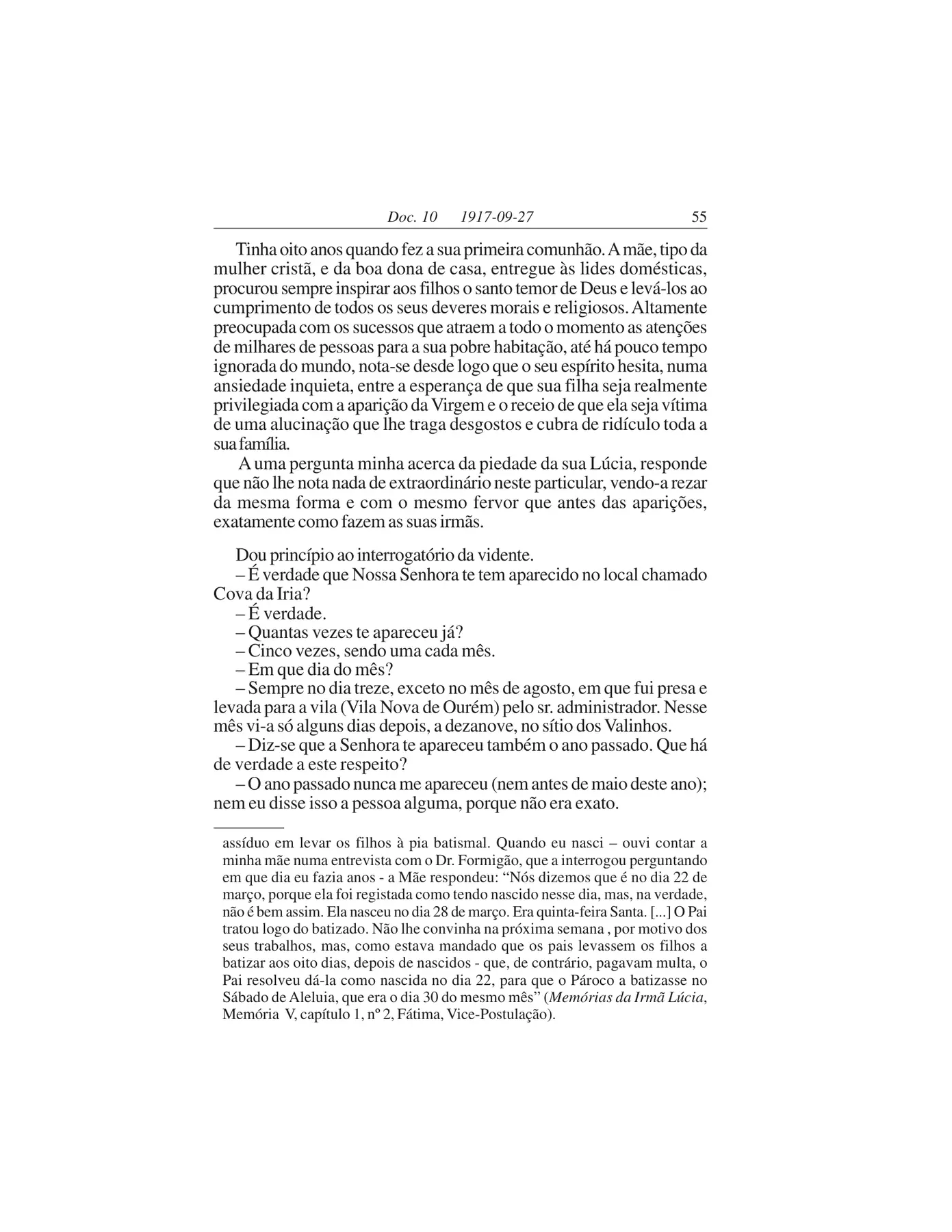
She was eight years old when she made her first communion. Her mother, the type of the Christian woman and good housewife, devoted to her domestic chores, has always sought to instil in her children the holy fear of God and to bring them to fulfil all their moral and religious duties. Deeply preoccupied by the events that at every moment draw the attention of thousands of people to her poor dwelling, until recently unknown to the world, one notices at once that her mind wavers, in restless anxiety, between the hope that her daughter is really privileged with the apparition of the Virgin and the fear that she is the victim of a hallucination that will bring her sorrow and cover her whole family with ridicule.

To a question of mine about her Lúcia's piety, she replies that she notices nothing extraordinary about her in this respect, seeing her pray in the same way and with the same fervour as before the apparitions, exactly as her sisters do.

Português (original)

No intuito de completar as impressões colhidas no dia 13 do corrente mês de Setembro e habilitar-me com os elementos indispensáveis para fundamentar um juízo, tanto quanto possível, acertado acerca dos acontecimentos que nos últimos cinco meses se têm desenrolado a três quilómetros ao sul da aldeia de Fátima, no local denominado Cova da Iria, fui pela segunda vez na quinta-feira última, 27, àquela pitoresca aldeia, graciosa alcandorada num dos contrafortes da majestosa serra de Aire. Eram três horas da tarde quando me apeei do trem que de Torres Novas me conduziu por Vila Nova de Ourém à humilde povoação, cujo nome é hoje pronunciado como uma esperança fagueira de bênçãos e graças celestes por dezenas de milhares de lábios, de um extremo ao outro de Portugal. O rev.do Pároco a quem logo procurei, não estava em casa: tinha saído para fora da freguesia e só à noite devia voltar. Pesaroso por não poder trocar algumas palavras com ele sobre o assunto que ali me levava, resolvi ir a casa das crianças que se dizem favorecidas com aparições da Virgem Santíssima e ouvir da boca delas a narração pormenorizada dos estranhos sucessos cuja notícia tem atraído dia a dia à Fátima um sem número de pessoas de todas as classes e condições sociais.

À distância de dois quilómetros da igreja paroquial e do presbitério, num insignificante lugarejo chamado Aljustrel, pertencente à freguesia, ficam situadas perto uma da outra, as modestas habitações das famílias dos videntes. As duas crianças mais novas estavam ausentes.

Dirigi-me a casa da mais velha, onde a mãe me convidou a entrar e sentar-me, convite a que acedi. A uma pergunta minha sobre o paradeiro da filha que eu procurava, respondeu-me que ela andava a vindimar numa pequena propriedade que lhe pertencia e que ficava dois quilómetros distante.

Alguém se prestou logo a ir chamá-la de ordem da mãe. Entretanto, as duas crianças mais novas, que tinham regressado do campo, sabendo pelos vizinhos que eu lhes desejava falar, vieram ter comigo. Eram dois irmãos, um menino e uma menina.

Chegou primeiro a menina. Chama-se Jacinta de Jesus, tem sete anos de idade e é filha de Manuel Pedro Marto e de Olímpia de Jesus3. Bastante alta para a sua idade, um pouco delgada sem se poder dizer magra, de rosto bem proporcionado, tez morena, modestamente vestida, descendo-lhe a saia até à altura dos artelhos, o seu aspeto é o de uma criança saudável, acusando perfeita normalidade no seu todo físico e moral. Surpreendida com a presença de pessoas estranhas, que me tinham acompanhado e que não esperava encontrar, a princípio mostra um grande embaraço, respondendo, por monossílabos, e num tom de voz quase impercetível, às perguntas que eu lhe dirijo. Momentos depois aparece o irmão, rapaz de nove anos de idade, que entra com um certo desembaraço no quarto, onde estávamos, conservando o barrete na cabeça, decerto por não se lembrar de que o devia tirar. Um sinal que a irmã lhe fez para se descobrir não foi percebido por ele. Convidei-o a sentar-se numa cadeira ao meu lado, obedecendo imediatamente sem nenhuma relutância. Principiei sem demora a interrogá-lo sobre o que tinha visto e ouvido desde maio último na Cova da Iria no dia 13 de cada mês durante o tempo da aparição. Estabeleceu-se entre mim e ele o curto diálogo que segue.

[…]

Meia hora depois de terminado o interrogatório de Jacinta de Jesus, aparece Lúcia de Jesus. Vinha, como disse de uma pequena propriedade de sua família, situada a dois quilômetros de distância, onde tinha estado a vindimar. Mais alta e mais nutrida que as outras duas crianças, de tez mais clara, robusta e saudável, apresenta-se diante de mim com um desembaraço que contrasta singularmente com o acanhamento e a timidez excessiva da Jacinta. Singelamente vestida como esta, a sua atitude não denota e o seu rosto não traduz nenhum sentimento de vaidade nem de confusão.

Sentando-se, a um aceno meu, numa cadeira, ao meu lado, presta-se da melhor vontade a ser interrogada sobre os acontecimentos de que ela é a principal protagonista, sem embargo de se sentir visivelmente fatigada e abatida, mercê das visitas incessantes que recebe e dos inquéritos repetidos e prolongados a que é submetida.

Filha de António dos Santos4, de 50 anos de idade, e de Maria Rosa, de 48 anos, tem um irmão e quatro irmãs, todos mais velhos do que ela: Maria5, de 26 anos, já casada, Teresa6, de 24, Manuel7, de 22, Glória8, de 20, e Carolina9, de 15. Completou dez anos de idade em 22 de março do corrente ano10.

Tinha oito anos quando fez a sua primeira comunhão. A mãe, tipo da mulher cristã, e da boa dona de casa, entregue às lides domésticas, procurou sempre inspirar aos filhos o santo temor de Deus e levá-los ao cumprimento de todos os seus deveres morais e religiosos. Altamente preocupada com os sucessos que atraem a todo o momento as atenções de milhares de pessoas para a sua pobre habitação, até há pouco tempo ignorada do mundo, nota-se desde logo que o seu espírito hesita, numa ansiedade inquieta, entre a esperança de que sua filha seja realmente privilegiada com a aparição da Virgem e o receio de que ela seja vítima de uma alucinação que lhe traga desgostos e cubra de ridículo toda a sua família.

A uma pergunta minha acerca da piedade da sua Lúcia, responde que não lhe nota nada de extraordinário neste particular, vendo-a rezar da mesma forma e com o mesmo fervor que antes das aparições, exatamente como fazem as suas irmãs.

Editor's notes (10)

1 Lúcia's mother. She was born at Perulheira, parish of S. Mamede, council of Batalha, on 6 July 1869 and died at Aljustrel on 16 July 1942.

2 Born in Tomar on 1 January 1883. He was a professor at the Seminary and the Liceu of Santarém. In 1922 he was appointed by Dom José Alves Correia da Silva, Bishop of Leiria, a member of the Canonical Commission for the study of the events of Fátima, and was the author of the Report presented to Dom José in 1930. In 1926 he founded the Congregation of the Reparatrix Sisters of Our Lady of Sorrows of Fátima. He died at Fátima on 30 January 1958.
3 Born at Aljustrel on 31 May 1869. She married José Ferreira da Rosa on 6 February 1888 and was widowed in 1895. Of this marriage two sons were born, António Ferreira Rosa and Manuel Ferreira Rosa. On 11 February 1898 she married Manuel Pedro Marto. She died at Aljustrel on 3 April 1957.

4 Born on 3 January 1868 at Aljustrel; he married Maria Rosa on 19 November 1890. He died on 31 July 1919.

5 Maria dos Anjos, born 13 August 1891. She married António dos Santos Valinho on 23 August 1916. She died on 26 August 1986.

6 Teresa de Jesus was born on 22 May 1893. She married José da Lomba. She died on 29 November 1972.

7 Manuel dos Santos was born on 22 August 1895. He married Emília de Jesus de Oliveira on 21 June 1922. He died in Brazil on 30 April 1977.

8 Glória de Jesus was born on 5 October 1898. She married Francisco Inácio Vieira on 6 July 1922. She died on 6 August 1971.

9 Carolina de Jesus was born on 17 October 1902. She married Manuel Pereira Carvalho on 28 July 1929. She died on 31 March 1992.

10 According to a statement by Lúcia herself, on 23 February 1989, her date of birth was 28 March 1907 and not 22 March: "My father was very

1 Mãe de Lúcia. Nasceu na Perulheira, freguesia de S. Mamede, concelho da Batalha, a 6 de julho de 1869 e faleceu, em Aljustrel, a 16 de julho de 1942.

2 Nasceu em Tomar a 1 de janeiro de 1883. Foi professor do Seminário e do Liceu de Santarém. Em 1922, foi nomeado, por D. José Alves Correia da Silva, Bispo de Leiria, membro da Comissão Canónica para o estudo dos acontecimentos de Fátima, sendo o autor do Relatório, apresentado a D. José em 1930. Em 1926, fundou a Congregação das Religiosas Reparadoras de Nossa Senhora Dores de Fátima. Faleceu, em Fátima, a 30 de janeiro de 1958.
3 Nasceu em Aljustrel a 31 de maio de 1869. Casou com José Ferreira da Rosa, a 6 de fevereiro de 1888, ficando viúva em 1895. Deste matrimónio nasceram dois filhos, António Ferreira Rosa e Manuel Ferreira Rosa. A 11 de fevereiro de 1898, casou com Manuel Pedro Marto. Faleceu, em Aljustrel, a 3 de abril de 1957.

4 Nasceu a 3 de janeiro de 1868, em Aljustrel; casou a 19 de novembro de 1890 com Maria Rosa. Faleceu a 31 de julho de 1919.

5 Maria dos Anjos, nasceu 13 de agosto de 1891. Casou a 23 de agosto de 1916 com António dos Santos Valinho. Faleceu a 26 de agosto de 1986.

6 Teresa de Jesus nasceu a 22 de maio de 1893. Casou com José da Lomba. Faleceu a 29 de novembro de 1972.

7 Manuel dos Santos nasceu a 22 de agosto de 1895. Casou com Emília de Jesus de Oliveira, a 21 de junho de 1922. Faleceu, no Brasil, a 30 de abril de 1977.

8 Glória de Jesus nasceu a 5 de outubro de 1898. Casou com Francisco Inácio Vieira, a 6 de julho de 1922. Faleceu a 6 de agosto de 1971.

9 Carolina de Jesus nasceu a 17 de outubro de 1902. Casou com Manuel Pereira Carvalho, a 28 de julho de 1929. Faleceu a 31 de março de 1992.

10 Segundo declaração da própria Lúcia, a 23 de fevereiro de 1989, o dia de nascimento foi a 28 de março de 1907 e não a 22 de março: “Meu pai era muito

13 May13 Jun13 Jul13 Aug13 SepOther 1917First-handSaw itInterrogationFigures / visionsSeers' words overheard
English

Is it true that Our Lady has appeared to you at the place called Cova da Iria?

– It is true.

– How many times has she appeared to you already?

– Five times, once each month.

– On what day of the month?

– Always on the thirteenth, except in the month of August, when I was arrested and taken to the town (Vila Nova de Ourém) by the administrator. That month I saw her only some days later, on the nineteenth, at the place called Valinhos.

– It is said that the Lady also appeared to you last year. What truth is there in this?

– Last year she never appeared to me (nor before May of this year); nor did I say that to anyone, because it was not true.

[…]

Where does she come from? From the east?
- I don't know; I don't see her come from anywhere; she appears over the holm-oak shrub, and it is when she withdraws that she goes off in the direction where the sun rises.
- How long does she stay? A long time or a short time?
- A short time.
- Long enough to say an Our Father and a Hail Mary, or more?
- More, quite a lot more, but not always the same length of time (perhaps not enough to pray the rosary).
- The first time you saw her, weren't you frightened?
- I was, so much so that I wanted to run away, with Jacinta and Francisco, but She told us not to be afraid, because she would not harm us. She said: "don't be afraid, for I won't harm you."
- How is she dressed?
- She has a white dress, which comes down to a little below the middle of the leg, and her head is covered by a mantle of the same colour and the same length as the dress.
- Does the dress have no trimmings?
- On it, at the front, two golden cords can be seen, which come down from the neck and are joined by a tassel, also golden, at the level of the middle of the body.
- Does she have a belt or a ribbon?
- She doesn't.
- Does she wear earrings?
- She wears small rings, yellow in colour.
- Which hand holds the beads?
- The right hand.
- Were they a five-decade rosary or a full rosary?
- I didn't notice properly.
- Did they end with a cross?
- They ended with a white cross, and the beads were white too. The chain was white too.
- Did you ever ask her who she was?
- I did, but she declared she would only say so on 13 October.
- Didn't you ask her where she came from?
- I asked where she was from, and she answered me that she was from Heaven.
- And when did you ask her that question?
- The second time, on the thirteenth of June.
- Did she ever smile or look sad?

-
- She never smiled nor looked sad, but was always serious.
- Did she recommend you and your cousins to say any prayers?
- She recommended us to pray the rosary in honour of Our Lady of the Rosary, in order to obtain peace for the world.
- Did she express a wish that many people should be present at the Cova da Iria on the thirteenth of each month?
- She said nothing about that.
- Is it true that she told you a secret, forbidding you to reveal it to anyone whatever?
- It is true.
- Does it concern only you or your companions too?
- All three of us.
- Can't you disclose it at least to your confessor?
- (At this question she kept silent, seeming somewhat perplexed, and I thought I should not insist by repeating the question).
- It is said that, to rid yourself of the administrator's importunities, on the day you were arrested, you told him, as if it were the secret, something that was not, thus deceiving him and boasting afterwards of having played that trick on him: is it true?
- It is not; the administrator really did want me to reveal the secret to him, but as I could not tell it to anyone, I did not tell him, even though he insisted with me a great deal to that end. What I did was to tell everything the Lady said to me, except the secret, and perhaps for that reason the administrator was left thinking that I had revealed the secret to him as well. I did not want to deceive him.
- Did the Lady tell you to learn to read?
- She did, yes, the second time she appeared.
- But if the Lady said she would take you to Heaven next October, what use would it be to you to learn to read?
- That is not true: the Lady never said she would take me to Heaven in October, and I never asserted that she had told me such a thing.
- What did the Lady declare should be done with the money the people leave at the Cova da Iria at the foot of the holm-oak shrub?
- She said we should put it on two litters, I, Jacinta and two more girls carrying one of them, and Francisco, with three more boys, the other, to the parish church. Part of that money would be for the worship and feast of Our Lady of the Rosary and the other part towards a new chapel.
- Where does she want the chapel to be built? At the Cova da Iria?
- I don't know: she didn't say.

- Are you very happy that Our Lady has appeared to you?
- I am.
- On the thirteenth of October will Our Lady come alone?
- St. Joseph will come too with the Child, and peace will be granted to the world.
- And did she make any other revelation?
- She declared that on the 13th she will make all the people believe that she really appears.
- Why do you quite often lower your eyes and stop gazing at the Lady?
- It is because she sometimes dazzles.
- Did she teach you any prayer?
- She did; and she wants us to recite it after each mystery of the rosary.
- Do you know that prayer by heart?
- I do.
- Say it then...
- O my Jesus, forgive us, deliver us from the fire of hell, take all the little souls to Heaven, especially those that most need it

Português (original)

É verdade que Nossa Senhora te tem aparecido no local chamado Cova da Iria?

– É verdade.

– Quantas vezes te apareceu já?

– Cinco vezes, sendo uma cada mês.

– Em que dia do mês?

– Sempre no dia treze, exceto no mês de agosto, em que fui presa e levada para a vila (Vila Nova de Ourém) pelo sr. administrador. Nesse mês vi-a só alguns dias depois, a dezanove, no sítio dos Valinhos.

– Diz-se que a Senhora te apareceu também o ano passado. Que há de verdade a este respeito?

– O ano passado nunca me apareceu (nem antes de maio deste ano); nem eu disse isso a pessoa alguma, porque não era exato.

[…]

Donde é que ela vem? Das bandas do nascente?
- Não sei; não a vejo vir de parte alguma; aparece sobre a carrasqueira, e quando se retira é que toma a direção donde nasce o sol.
- Quanto tempo se demora? Muito ou pouco?
- Pouco tempo.
- O suficiente para se recitar um Padre Nosso e uma Avé Maria, ou mais?
- Mais, bastante mais, mas nem sempre o mesmo tempo (talvez não chegasse para rezar o terço).
- Da primeira vez que a viste não ficaste assustada?
- Fiquei, e tanto assim que quis fugir, com a Jacinta e o Francisco, mas Ela disse-nos que não tivéssemos medo, porque não nos faria mal. Disse: “não tenham medo que eu não vos faço mal.”
- Como é que está vestida?
- Tem um vestido branco, que desce até um pouco abaixo do meio da perna, e cobre-lhe a cabeça um manto, da mesma cor, e do mesmo comprimento que o vestido.
- O vestido não tem enfeites?
- Veem-se nele, na parte anterior, dois cordões dourados, que descem do pescoço e se reúnem por uma borla, também dourada, à altura do meio do corpo.
- Tem algum cinto ou alguma fita?
- Não tem.
- Usa brincos nas orelhas?
- Usa umas argolas pequenas e de cor amarela.
- Qual das mãos segura as contas?
- A mão direita.
- Eram um terço ou um rosário?
- Não reparei bem.
- Terminavam por uma cruz?
- Terminavam por uma cruz branca, sendo as contas também brancas. A cadeia era também branca.
- Perguntaste-lhe alguma vez quem era?
- Perguntei, mas declarou que só o diria a 13 de outubro.
- Não lhe perguntaste de onde vinha?
- Perguntei de onde era, e ela respondeu-me que era do Céu.
- E quando foi que lhe fizeste essa pergunta?
- Da segunda vez, a treze de junho.
- Sorriu-se alguma vez ou mostrou-se triste?

-
- Nunca se sorriu nem se mostrou triste, mas sempre séria.
- Recomendou-te, e aos teus primos, que rezassem algumas orações?
- Recomendou-nos que rezássemos o terço em honra de Nossa Senhora do Rosário, a fim de se alcançar a paz para o mundo.
- Mostrou desejos de que no dia treze de cada mês estivessem presentes muitas pessoas na Cova da Iria?
- Não disse nada a esse respeito.
- É certo que te disse um segredo, proibindo que o revelasses a quem quer que fosse?
- É certo.
- Diz respeito só a ti ou também aos teus companheiros?
- A todos três.
- Não o podés manifestar ao menos ao teu confessor?
- (A esta pergunta guardou silêncio, parecendo um tanto enleada e julguei não dever insistir, repetindo a pergunta).
- Consta que, para te veres livre das importunações do sr. administrador, no dia em que foste presa, lhe contaste, como se fosse o segredo uma coisa que o não era, enganando-o assim e gabando-te depois de lhe teres feito essa partida: é verdade?
- Não é; o sr. administrador quis realmente que eu lhe revelasse o segredo, mas como eu não o podia dizer a ninguém, não lhe disse, apesar de ter insistido muito comigo para esse fim. O que fiz foi contar tudo o que a Senhora me disse, exceto o segredo, e talvez por esse motivo o sr. administrador ficasse julgando que eu lhe tinha revelado também o segredo. Não o quis enganar.
- A Senhora mandou que aprendesses a ler?
- Mandou, sim, da segunda vez que apareceu.
- Mas se a Senhora disse que te levaria para o Céu no mês de outubro próximo, para que te serviria aprenderes a ler?
- Não é verdade isso: a Senhora nunca disse que me levaria para o Céu em outubro, e eu nunca afirmei que ela me tivesse dito tal coisa.
- O que declarou a Senhora que se devia fazer ao dinheiro que o povo deposita na Cova da Iria ao pé da carrasqueira?
- Disse que o devíamos colocar em dois andores, levando eu, a Jacinta e mais duas meninas um deles, e o Francisco, com mais três rapazes, o outro, para a igreja da freguesia. Parte desse dinheiro seria destinado ao culto e festa da Senhora do Rosário e a outra parte para ajuda de uma capela nova.
- Onde quer ela que seja edificada a capela? Na Cova da Iria?
- Não sei: ela não o disse.

- Estás muito contente por Nossa Senhora te ter aparecido?
- Estou.
- No dia treze de outubro Nossa Senhora virá só?
- Vem também S. José com o menino, e será concedida a paz ao mundo.
- E fez mais alguma revelação?
- Declarou que no dia 13 fará com que todo o povo acredite que ela realmente aparece.
- Por que razão não raro baixas os olhos deixando de fitar a Senhora?
- É que ela às vezes cega.
- Ensinou-te alguma oração?
- Ensinou; e quer que a recitemos depois de cada mistério do rosário.
- Sabes de cor essa oração?
- Sei.
- Diz lá...
- Ó meu Jesus, perdoai-nos, livrai-nos do fogo do inferno, levai as alminhas todas para o Céu, principalmente aquelas que mais dele precisarem

Beatriz Gorjão

Pilgrimlady visitor (possibly of Leiria)
Other 1917First-handSaw itLetterCrowd sceneSeers' words overheard
English

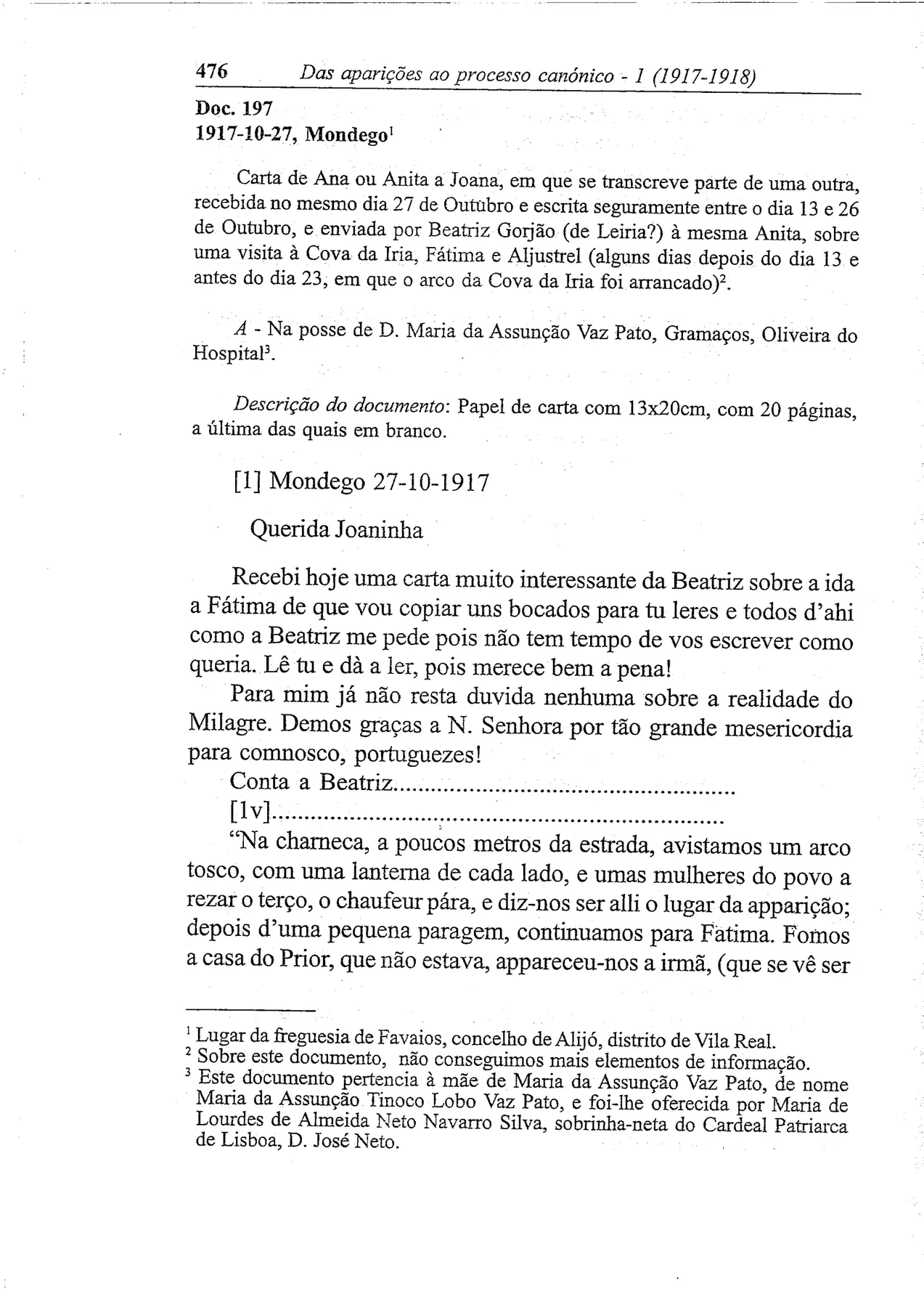
“On the heath, a few metres from the road, we caught sight of a rough arch, with a lantern on each side, and some women of the people saying the rosary; the chauffeur stopped and told us that was the place of the apparition; after a short stop, we went on to Fátima. We went to the house of the Parish Priest, who was not in; his sister came out to us (who is evidently of a humble family but very likeable); she told us that she too had seen the signs in the sun . We told her we would like to see the children and she sent a little boy to show us their house. We left Fátima [2], which seemed to us a very small place; the best house we saw was the Parish Priest's, which is very modest, with an old-fashioned porch. Shops, I don't even know whether there are any there!
As I told you, we left Fátima and went on on foot (because there is no road) to Aljustrel, the village of the 3 children. On the way we met a caravan, and walking beside one of the donkeys was the eldest of the little girls; we asked her to stop, but she, being a child, was eager to go on to Ourem. She spoke little with us; she kept telling us to go and see Jacintha (the smallest), who would tell us everything, and she pointed to the hamlet, which could already [2v] be seen from there. Some women who were there said that the smallest one never spoke, not even to them, but I, remembering Maria Delphina's inspirations and finding the little girl's insistence extraordinary, was convinced straight away that she would make an exception for us, and so it turned out.

When we were about to leave, little Jacintha appeared; she is 7 years old and an absolute darling; we sat there on the ground passing the little girl from lap to lap. We asked her what Our Lady looked like and how she was dressed: and the little girl, without the slightest hesitation and wanting to show it in person, stood up and said that Our [3] Lady was her own height; she drew her skirt in a little at the bottom to explain that Our Lady wore her dress a little narrower at the bottom, then with great efforts she tried to make her little skirt reach her feet, showing that the dress was long.

She then explained that Our Lady wore no veil, but a mantle that fell from her head down to, going by the little one's gesture, 3 or 4 fingers above the tunic; she was all in white (without the blue sash), her hands raised; the little girl, to explain better, took the rosary from my hands, threading it into her own little hand between the thumb, raised her hands imitating the gesture of Our Lady of Lourdes and, parting them a little, then [3v] said: when she spoke she was like this: She had on her head something of many colours. The eldest girl and the little boy whom we met later gave us the same explanation. A poor little woman asked her whether, among so many ladies as she saw on the 13th and among so many who have visited her, she had found any as beautiful as the lady from Heaven; the little girl said she had never seen any so beautiful, and the little boy, whom we later asked the same thing, said: that there was none so beautiful in the world. We asked her to tell us how the first apparition had been: The little one explained that they were minding the she-[4]ep that belong to the family of Lucia (the other seer) on Tio Abobora's land; suddenly they saw a flash of lightning and were afraid, very afraid; when they were on their knees praying, they saw the Lady on the Holm Oak, and at once another flash of lightning; the flock went into the chickling peas and the woman who owned them shouted from afar — “turn those sheep back for me” — but the lady said: (the little girl tried to make her voice sweeter) “don't turn the sheep back, for they won't eat anything.

Then Lucia asked: “Who are you?” — “I am the Mother of Heaven” — “What do you want of us?” - “That you come here on this day for 6 months; at the end of the 6 months I will say what I want. Say the rosary.” — [4v]

Then the owner of the chickling peas appeared, whom his wife had gone to fetch; he came to scold because he is very nasty, but he didn't scold at all because he saw that the chickling peas had not been eaten. And here you have what I find most admirable: something happens to three little children who were minding sheep; such a simple scene, that of the chickling peas, takes place in the hills in the middle of the heath. The children are from a tiny hamlet that could almost be called a cluster of farmsteads, where there are no shops or trade of any kind; this hamlet belongs to the parish of Fatima, but Fatima, as I have already said, is also a very small place; the road ends there [5], so it is not on the way to anywhere; certainly few people go there; no advertisements are put in the newspapers; and in 6 months the news spreads everywhere, and in spite of the rain and the lack of transport some 30:000 people gather there, according to some; 50:000 according to others! — but let us take up the thread again, — “ The little girl then speaks of the end of the war and of the end of the world if there were no faith (don't be alarmed, there is still plenty). It is these two points that I find doubtful; would Our Lady really have spoken of the end of the war and of the world, or were the children confused by so many questions as they have been asked? — Our Lady [5v] told them a secret. The mothers, poor things, ignorant as they are, have done everything possible to find it out. According to what they say, the administrator has already promised 20.000 if they told it to him, but there is no way of wresting the secret from them. I heard the little boy say that not even if they were given the whole world would they tell it. When they are asked whether it is bad, they say it is good for everyone. — On the last day Our Lady also said that she was the Virgin of the Rosary, and that she wanted the people to build her a chapel there — But this is far from being the most important part; imagine our impression when the little one, carrying on talking, [6] tells us that on the last day (13 October) St. Joseph and the Child Jesus appeared to her!! So it was the Holy Family. Our first impression was one of doubt and alarm: was everything going to collapse from the foundations?! But some neighbours who were there told us that the 3 children had several times already spoken of St. Joseph and the Child Jesus. — The little one then explained that St. Joseph had come to give peace to the world, and with her hand she made the sign of the cross many times, imitating the gesture of Bishops when they walk along blessing the faithful. She told us that the Child Jesus and St. Joseph were just like some little holy images she had at home. There was [6v] someone who offered to go and fetch the image, but the little girl answered that she also had pictures on the wall. Remembering Maria Delphina once more, I seemed to understand that it would be a good idea for us to go to her house. I suggested it, and we went on to the tiny hamlet of Aljustrel. We arrived at the little ones' house; it is small and belongs to very humble but clean people — The little ones' mother came out to us, a woman of the people, very likeable and seeming very good. Neither she nor her husband accepts money; they think, and rightly, that people might judge there was some self-interest involved, and besides, thank God, we don't go [7] hungry” — we have (in her own words) potatoes for the whole year”. On the 13th someone put into the hand of one of the little ones a 500rs coin; the child, not knowing what it was, as it was wrapped in a piece of paper, went and took it to the mother, who in distress asked aloud who would own up to having given the 500rs. — Nobody answered; and the five tostões are still there wrapped in the same paper in the corner of the drawer. She won't touch it: that money is not hers.

She also told us that one day the little ones came into her house saying they had seen the Lady from Heaven; when she answered that they were dreaming and that they were not worthy [7v] of that, the little girl insisted and described to her Mother what she had seen, and told what she had already told us on the way! but let us return to the thread: the little one says she had some pictures at home, but she didn't even look at them: she went to a box and took out a group of the Holy family, saying: “see?” St. Joseph and the Child Jesus were as they are here: but here St. Joseph has his eyes closed, and there he had his eyes open. — Wanting to see whether she would get muddled, we told her that since St. Joseph and the Child were as they are there, Our Lady on the last day must also have been like that one, with a veil and a coloured mantle; we asked this several times, and she always answered that Our Lady was not like th-[fl. 8]at one, but in white and with the rosary. We further said that, being the Holy family, they must all have been together, to which she always answered no. Our Lady was on the holm oak, and St. Joseph and the Child Jesus near the Sun. — We made the same experiment with the little boy, who always answered like his sister. — It is therefore beyond doubt that the 6 apparitions of Our Lady can be confirmed without confirming that of the Holy Family. The eldest little girl, before leaving for Ourem, also spoke to us of St. Joseph and the Child Jesus. However, this is very little known, and we ourselves have told few people, because this being a much more extraordinary fact (which [8v] I think has not yet happened anywhere in the world)18, we are afraid that it will astonish many “people” and that they may not believe. Imagine therefore my astonishment when a girl who had been in Alemquer came here yesterday and told me told me that a man from Alemquer, very unbelieving and one of the worst there, having gone to Fatima, came back deeply impressed, describing to everyone the extraordinary things he saw, and that he states he saw the Child Jesus and St. Joseph. — Nobody believes him, poor man, because over there nobody knows that the Holy Family really appeared. — Can Our Lady have granted that man that great grace for his [9] conversion? — Emilio Infante21 and Nazareth22 were at Fatima on the 13th; Emilio fell to his knees weeping, and says that if he knew there was to be another apparition he would not miss it, even if he had to get as much rain as he got now! — The signs in the sun were seen in the surroundings of Leiria, Batalha, etc... In Leiria everyone believes.

We said the rosary at the place of the apparition with the children and some thirty people. The rosary was led by a man of the people; I have seldom heard anyone pray so well and with such devotion, and always with hands raised, as they say. — Then some women appeared with enormous bunches of heather, which they left at the place of the apparition: [9v] with what devotion they had been gathered! Our Lady must have liked them very much!

Português (original)

Na charneca, a poucos metros da estrada, avistamos um arco tosco, com uma lanterna de cada lado, e umas mulheres do povo a rezar o terço, o chaufeur pára, e diz-nos ser alli o lugar da apparição; depois d'uma pequena paragem, continuamos para Fatima. Fomos a casa do Prior, que não estava, appareceu-nos a irmã, (que se vê ser de familia humilde mas muito sympathica); disse-nos ter visto tambem os signaes no sol. Dissemos lhe que gostariamos de ver as crianças e ella mandou um rapazito ensinar-nos a casa d'elles. Deixamos Fátima [2] que nos pareceu um logar muito pequeno; a casa melhor que vimos foi a do Prior, que é muito modesta, com um alpendre à antiga. Lojas nem sei se lá existe alguma!
Como te disse deixamos Fatima, e continuamos a pé (porque não ha estrada) para Aljustrel, a terra das 3 creanças. No caminho encontramos uma caravana, e a pé junto a um dos burros ia a mais velha das pequenas; pedimos que parasse, mas ella, como creança que é, estava desejando continuar para Ourem. Pouco fallou comnosco, dizia-nos que fossemos ter com a Jacintha (a mais pequena) que ella contaria tudo e apontava para o lugar que já se [2v] avistava d'alli. Umas mulheres que alli estavam disseram que a mais pequena nunca fallava, nem mesmo a ellas, mas eu lembrando-me das inspirações da Maria Delphina e achando estraordinaria a insistencia da pequena, desde logo me convenci que ella abriria excepção para nós, e assim aconteceu.

Quando estavamos para partir apparece a pequena Jacintha; tem 7 annos e é um verdadeiro apetite, nós alli ficamos sentadas no chão passando a pequena de collo para collo. Perguntamos-lhe como era e como estava vestida N. Senhora: e a pequena sem a mais pequena exitação e querendo explicar ao vivo, põe-se em pé e diz que N. [3] Senhora era da sua altura; aperta um pouco a saia em baixo para explicar que N. Senhora trazia o vestido um pouco mais estreito em baixo, depois com grandes esforços tenta chegar a saita d'ella aos pés mostrando que o vestido era comprido.

Explica depois que N. Senhora não trazia veu, mas um manto que lhe cahia da cabeça até, segundo o gesto da pequenita, a 3 ou 4 dedos acima da tunica; estava toda de branco (sem a facha azul) as mãos erguidas a pequena para melhor explicar, tirou-me o terço das mãos enfiando-o na mãozita d'ella entre o dedo pulgar, levantou as mãos imitando o gesto de N. Senhora de Lourdes e separando-as um pouco en-[3v]seguida disse: quando fallava ficava assim: Tinha na cabeça uma coisa de muitas côres. A mesma explicação nos deu a mais velha e o pequenito que depois encontramos. Uma mulherzita perguntou-lhe se em tantas senhoras que viu no dia 13 e entre tantas que a teem visitado, encontrou alguma tão bonita como a senhora do Ceu, a pequena disse que tão bonita nunca viu nenhuma, e o pequeno a quem depois perguntamos o mesmo disse: que tão bonita não havia nenhuma no mundo. Pedimos que nos contasse como tinha sido a primeira apparição: A pequenita explicou que andavam a guardar as ove-[4]lhas que pertencem à familia da Lucia (a outra vidente) na terra do Tio Abobora de repente viram um relampago e tiveram medo, muito mêdo, quando estavam de joelhos a rezar, viram a Senhora na Azinheira e logo outro relampago, o rebanho foi para os chicharros e a dona d'elles gritava de longe — “volta-me essas ovelhas” — mas a senhora disse: (a pequena tentou tornar a vóz mais doce) “não voltem as ovelhas que ellas não comem nada.

Então a Lucia perguntou: “Quem é Vocemecê?” — “Eu sou a Mãe do Céu” — “O que quer à gente?” - “Que aqui vanham n'este dia durante 6 mezes, no fim dos 6 mezes direi o que quero. Rezem o terço.” — [4v]

Depois appareceu o dono dos chicharros, que a mulher foi chamar, vinha ralhar porque é muito mau, mas não ralhou nada porque viu que os chicharos não estavam comidos. E, aqui tens o que eu acho mais admiravel; passa-se um caso com tres creancinhas que guardavam ovelhas; uma scena tão simples do[s] chicharos passa-se na serra no meio da charneca. As creanças são d'um logarsito que quasi se lhe póde chamar uns casaes onde não ha lojas nem commercio de especie alguma; este logar pertence à freguezia de Fatima, mas Fatima é tambem como já disse um logar muito pequeno; a estrada acaba alli [5] não está portanto em caminho para parte nenhuma, de certo alli vae pouca gente, não se fazem reclames nos jornaes, e em 6 mezes a noticia espalha-se por toda a parte, e apezar da chuva e da falta de transportes junta-se alli umas 30:000 pessoas, segundo uns; 50:000 segundo outros! — mas vamos retomar o fio, — “A pequena falla depois do fim da guerra e do fim do mundo caso não houvesse fé (não te assustes ainda ha muita). São estes dois pontos que eu acho duvidoso[s]; fallaria realmente N. Senhora no fim da guerra e do mundo, ou estariam as creanças confundidas com tantas perguntas que lhes têem feito? — N. Senhora [5v] disse-lhes um segredo. As mães, coitadas como ignorantes que são, têem feito todo o possivel para o saber. Segundo dizem, o administrador já prometeu 20.000 se lh'o dissessem, mas não ha meio de lhes arrancar o segredo. Ao pequeno ouvi dizer que nem que lhe dessem o mundo inteiro o diriam. Quando lhes perguntam se é mau, dizem que é bom para todos. — N. Senhora no ultimo dia disse mais ser a Virgem do Rosario, e querendo o povo lhe eregisse alli uma capella — Mas isto está bem longe de ser a parte mais importante; calcula a nossa impresssão quando a pequenita continuando a conversar [6] nos diz que no ultimo dia (13 Outubro) lhe appareceu S. José e o Menino Jesus!! Tratava-se portanto da Sagrada Familia. A nossa primeira impressão foi de duvida e de susto, iria cahir tudo pela base?! Mas umas vizinhas que alli estavam, disseram-nos que as 3 creanças já por vezes tinham fallado em S. José e no Menino Jesus. — A pequenita então explicou que S. José tinha vindo dar a paz ao mundo, e com a mão repetiu muitas vezes o signal da cruz, imitando o gesto dos Bispos quando vão andando e abençoando os fieis. Disse-nos que o Menino Jesus e S. José eram eguaes a uns santinhos que tinha em casa. Houve [6v] alguem que se offereceu para ir buscar o santo mas a pequena respondeu que tambem tinha quadros na parede. Lembrando-me outra vez da Maria Delphina, pareceu-me comprehender que seria conveniente irmos a casa d'ella. Dei a ideia, e continuamos para o pequenino lugar de Aljustrel. Chegamos a casa dos pequenitos é pequena e de gente muito humilde mas limpa — Apareceu-nos a mãe dos pequenitos uma mulher do povo, muito sympathica e parecendo muito boa. Tanto ella como o marido não aceitam dinheiro, pensam e bem, que poderiam julgar haver alli qualquer interesse, e depois graças a Deus não pas-[7]samos fóme” — temos, (segundo a sua expressão,) batatas para todo o anno”. No dia 13 houve alguém que metteu na mão d’um dos pequenos, uma moeda de 500rs, a creança não sabendo do que se tratava, pois estava embrulhada n’um papel, foi leval-a à mãe, que afflicta perguntou em vóz alta quem se accusava de ter dado os 500rs. — Ninguém respondeu; e os cinco tostões lá estão embrulhados no mesmo papel ao canto da gaveta. Não lhe quer tocar: aquella dinheiro não é d’ella.

Contou-nos mais, que os pequenos um dia lhe entraram em casa dizendo que tinham visto a Senhora do Ceu; respondendo ella que elles estavam a sonhar e que não eram dignos [7v] d’isso a pequena insistindo, fez à Mãe a discripção do que tinha visto, e contou o que já nos tinha dito no caminho! mas voltemos ao fio: a pequenita diz que tinha em casa uns quadros, mas nem para elles olhou: foi a uma caixa e tirou um grupo da Sagrada familia dizendo: “vêem?” S. José e o Menino Jesus estavam como estão aqui: mas aqui S. José está com os olhos fechados, e lá estávam com os olhos abertos. — Querendo nós ver se ella se atrapalhava, dissemos-lhe que uma vez que o S. José e o Menino estavam como alli estão, N. Senhora no ultimo dia tambem devia estar como aquella de veu e manto de côres; perguntamos isto varias vezes, respondendo ella sempre que N. Senhora não estava como a-[fl. 8]quella, mas sim de branco e com o terço. Dissemos mais que sendo a Sagrada familia devia estar toda junta, ao que ella respondia sempre que não. N. Senhora estava na azinheira, e S. José e o Menino Jesus, perto do Sol. — A mesma experiencia fizemos com o pequeno respondendo sempre como a irmã. — É portanto fóra de duvida que se póde confirmar as 6 aparições de N. Senhora, sem se confirmar a da S. Familia. A pequena mais velha antes de partir para Ourem tambem nos fallou de S. José e do Menino Jesus. No emtanto isto está muito pouco espalhado, e nós mesmo a pouca gente temos dito porque sendo este um facto muito mais extraordinario (que [8v] me parece ainda não aconteceu em parte nenhuma do mundo)18, temos medo que isso vá fazer espanto a muita “gente” e possam não acreditar. Calcula por isso o meu espanto quando vindo hontem aqui uma rapariga que esteve em Alemquer, me disse disse, que tendo ido a Fatima um homem de Alemquer muito incredulo e dos peores de lá, veiu impressionadissimo e descrevendo a toda a gente as coisas extraordinarias que viu e que affirma ter visto o Menino Jesus e S. José. — Ninguém o acredita, coitado, porque para lá ninguém sabe que realmente apareceu a Sagrada Familia. — Terá N. Senhora concedido a esse homem, essa grande graça para a sua [9] conversão? — O Emilio Infante21 e Nazareth22 estiveram em Fatima no dia 13; o Emilio cahiu de joelhos a chorar, e diz que se soubesse que havia outra apparição não faltaria lá, ainda que tivesse que apanhar tanta chuva como apanhou agora! — Os signaes no sol foram vistos nos arredores de Leiria, Batalha, etc... Em Leiria todos acreditam.

Rezamos o terço no logar da apparição com as creanças e umas trinta pessoas. O terço foi recitado por um homem do povo; poucas vezes tenho ouvido rezar tão bem e com tanta devoção e sempre de mãos erguidas como elles dizem. — Apareceram depois umas mulheres com enormes ramos de urzes, que deixaram no logar da apparição: [9v] com que devoção foram apanhadas! N. Senhora muito deve ter gostado d’ellas!

Editor's notes (6)

1 Hamlet in the parish of Favaios, council of Alijó, district of Vila Real.

2 We have not been able to obtain further information about this document.

3 This document belonged to the mother of Maria da Assunção Vaz Pato, named Maria da Assunção Tinoco Lobo Vaz Pato, and was given to her by Maria de Lourdes de Almeida Neto Navarro Silva, great-niece of the Cardinal Patriarch of Lisbon, Dom José Neto.

18 The author did not close the parenthesis, but from the sense of the sentence we think it should be closed here.

21 We think this is Emílio Infante da Câmara (grandson). Cf. DCF, vol. 1, Doc. 28, of 30 December 1917, note 20.

22 Maria da Nazaré Almeida Centeno. Wife of Emílio Infante da Câmara. Cf. DCF, vol. 1, Doc. 28, of 30 December 1917, note 20.

1 Lugar da freguesia de Favaios, concelho de Alijó, distrito de Vila Real.

2 Sobre este documento, não conseguimos mais elementos de informação.

3 Este documento pertencia à mãe de Maria da Assunção Vaz Pato, de nome Maria da Assunção Tinoco Lobo Vaz Pato, e foi-lhe oferecida por Maria de Lourdes de Almeida Neto Navarro Silva, sobrinha-neta do Cardeal Patriarca de Lisboa, D. José Neto.

18 A autora não fechou o parênteses, mas pelo sentido da frase, pensamos que se deve fechar aqui.

21 Pensamos que seja Emílio Infante da Câmara (neto). Cf. DCF, vol. 1, Doc. 28, de 30 de Dezembro de 1917, nota 20.

22 Maria da Nazaré Almeida Centeno. Esposa de Emílio Infante da Câmara. Cf. DCF, vol. 1, Doc. 28, de 30 de Dezembro de 1917, nota 20.

Manuel Gonçalves Júnior

Villager30-year-old farmer of Montelo, Formigão's host's son
13 Jun13 Jul13 AugOther 1917First-handSaw itInterrogationCloud / smoke columnSun changing colourColours on people & landscapeLight dimmingThunder / noiseSeers' words overheard
English

On 13 July some companions of his, with bad intent, got him drunk with the aim of leading him to commit some folly at the place of the apparitions. And indeed, although, as always, he let his daughter go to that place, he ordered the people to withdraw. He is the owner of the heath where the holm-oak shrub that serves as pedestal for the Apparition stands. The people, seeing him in a state of drunkenness, paid no heed to this order and a man pushed him, making him fall.

[…]

At first the people did not want to go to the Cova da Iria. Nobody believed the children. On the thirteenth of June, the day of the second apparition, there was a feast at the parish church in honour of St. Anthony. At the Cova da Iria there were only some sixty people at the time of the apparition. Francisco and Jacinta's parents had gone early in the morning to Porto de Mós to the fair called "of the thirteenth", in order to buy oxen, and got back after nightfall. In their absence their house filled with people who wanted to see the children and ask them questions. At present a large part of the people think the children are telling the truth. For my part, I am convinced of it.

[…]

The signs are many. In August almost all who were present saw those signs. A cloud came down to the holm-oak shrub. In July the same was noticed. There was no dust at the place. The cloud made the air dusty, so that it looked misty.

– Was there any other sign?

– In the sky, near the sun, white clouds are seen which turn successively bright red (blood-coloured), pink and yellow. The people take on this last colour. The light of the sun diminishes considerably in intensity.

A rumbling was also felt in July and in August.

[…]

She prays the rosary. When she addresses the Lady, she speaks aloud.

I heard her myself in June, because I was nearby. Some people claim they hear the sound of the answers.

10a – Is the place of the apparitions much frequented on the other days too by pious people or by the curious?

– It is much frequented, above all on Sundays. The greatest concourse is at night. Many people go there, from far and near, and still more from outside the parish. They pray the rosary and sing hymns in honour of the Virgin.

Português (original)

No dia 13 de julho alguns companheiros dele, mal intencionados, embriagaram-no no intuito de o levarem a praticar desatinos no local das aparições. Efetivamente, embora, como sempre, deixasse ir a filha àquele local, mandou retirar o povo. Ele é o proprietário da charneca onde está a carrasqueira que serve de pedestal à Aparição. O povo, vendo-o em estado de embriaguez, não se importou com essa intimação e um homem empurrou-o, fazendo-o cair.

[…]

A princípio o povo não queria ir à Cova da Iria. Ninguém acreditava nas crianças. Em treze de junho, dia da segunda aparição, havia festa na igreja da freguesia em honra de Santo António. Na Cova da Iria estavam apenas, à hora da aparição, umas sessenta pessoas. Os pais do Francisco e da Jacinta tinham ido de manhã cedo para Porto de Mós à feira chamada dos treze, com o fim de comprar bois, e chegaram já de noite. Na sua ausência a residência encheu-se-lhes de gente, que queria ver as crianças e fazer-lhes perguntas. Presentemente uma grande parte do povo julga que as crianças falam verdade. Pela minha parte, estou convencido disso.

[…]

Os sinais são muitos. Em agosto quase todos os que estavam presentes viram esses sinais. Uma nuvem baixou até à carrasqueira. Em julho notou-se o mesmo. Não havia poeira no local. A nuvem empoou os ares, que pareciam enevoados.

– Houve mais algum sinal?

– Veem-se no céu, próximo do sol, umas nuvens brancas que se tornam sucessivamente vermelhas vivas (cor de sangue), cor de rosa e amarelas. O povo torna-se desta última cor. A luz do sol diminui bastante de intensidade.

Sentiu-se também um rumor em julho e em agosto.

[…]

Reza o terço. Quando se dirige à Senhora, fala alto.

Eu próprio a ouvi em junho, porque estava próximo. Algumas pessoas afirmam que ouvem o som das respostas.

10a – O local das aparições é muito frequentado também nos outros dias por pessoas piedosas ou por curiosos?

– É muito frequentado, sobretudo aos domingos. A maior concorrência é à noite. Vão ali muitas pessoas, de longe e de perto, e mais ainda de fora da freguesia. Rezam o terço e entoam cânticos em honra da Virgem.

DCF Seleção, Doc. 11 (= DCF I, Doc. 12) · interrogation · 11 Oct 1917 (4 months later)View scans (2)Link

Maria Rosa

Seer's familyVillagermother of Lúcia
13 May13 Jun13 Jul13 Aug13 SepOther 1917First-handInterrogationSceptic2 km awayCrowd scene
English

How did you learn that the Lady appeared to your daughter the first time? Was it she who told you?

– I came to know of that fact through the family of the other children, because Lúcia advised her companions to say nothing for fear they would be scolded. Only after being questioned by me did she say what she had seen.

3a – Did you never scold your daughter for going to the Cova da Iria? Did you always give her complete freedom to go there on the 13th of each month?

– I never forbade her to go to that place. Sometimes I asked her if she wanted to go and she answered yes, other times she herself said she would go, if I gave her leave.

4a – Do the three children usually go to the place of the apparitions alone or do they go accompanied by other children?

– They go alone. Other children almost always go too, but accompanied by their parents, and they stay beside them; they do not join Lúcia and her cousins.

5a – Did the children tend livestock? To whom did it belong?

– Lúcia tended a small flock of sheep and her cousins another. Those flocks belonged to their respective families. Sometimes they put the animals together, but only because they wanted to. The sheep Lúcia tended I have already sold.

6a – How have the children been dressed when they go?

– The first time they were shabbily turned out, as shepherds almost always are. The other times, on the 13th of each month, they go dressed in light-coloured clothes and wear a white kerchief on their heads.

[…]

When the children were arrested by the administrator of Vila Nova de Ourém, did anyone go to demand that they be returned to their parents?

– A brother of Francisco and Jacinta went to talk to them at the administrator's house. The administrator's wife asked whether he had come to fetch the children, to which he answered no. The administrator himself brought them back to Fátima.
11a – Have many people come to see your daughter?

– Many people have come almost every day.

Português (original)

Como soube que a Senhora apareceu à sua filha da primeira vez? Foi ela que lhe contou?

– Tive conhecimento desse facto pela família das outras crianças, porque a Lúcia aconselhou os seus companheiros a não dizerem nada com receio de que lhes ralhassem. Só depois de interrogada por mim é que disse o que tinha visto.

3a – Nunca repreendeu sua filha por ir à Cova da Iria? Deu-lhe sempre inteira liberdade de lá ir, no dia 13 de cada mês?

– Nunca a proibi de ir a esse sítio. Umas vezes perguntava-lhe se queria ir e ela respondia afirmativamente, outras vezes ela mesma dizia que ia, se eu lhe desse licença.

4a – As três crianças costumam ir sozinhas ao local das aparições ou vão acompanhadas de outras crianças?

– Vão sós. Quase sempre vão também outras crianças, mas acompanhadas dos pais e ficam ao pé deles, não se juntam com a Lúcia e os primos dela.

5a – As crianças guardavam gado? A quem é que ele pertencia?

– A Lúcia guardava um pequeno rebanho de ovelhas e os primos outro. Pertenciam esses rebanhos às respetivas famílias. Às vezes juntavam o gado, mas unicamente porque queriam. As ovelhas que a Lúcia guardava, já as vendi.

6a – Como é que as crianças têm ido vestidas?

– Da primeira vez iam mal arranjadas, como andam quase sempre os pastores. Das outras vezes, no dia 13 de cada mês, vão vestidas de fato claro e levam um lenço branco na cabeça.

[…]

Quando as crianças foram presas pelo administrador de Vila Nova de Ourém foi alguém reclamar que as restituissem aos pais?

– Um irmão do Francisco e da Jacinta foi falar com elas a casa do administrador. A senhora do administrador perguntou se ia buscar as crianças, ao que ele respondeu negativamente. O próprio administrador as veio trazer à Fátima.
11a – Tem vindo muita gente ver sua filha?

– Tem vindo muita gente quase todos os dias.

DCF Seleção, Doc. 11 (= DCF I, Doc. 12) · interrogation · 11 Oct 1917 (5 months later)View scans (2)Link

Maria Francisca d'Assis

Aristocrat16-year-old daughter of the Count of Nova Goa
Other 1917First-handLetter30 km awayCrowd scene
English

On Friday we went to Thomar and from the windows of the Misses Mousinho7 we saw [2] carriages go by full of people, very quiet and thoughtful, and one could see they were in the grip of a serious feeling. Many people on foot and on donkeys were following the same road. Some must have been from the hills, from very far away; the men had hats like Father's, Alentejo-style, but bigger, and cudgels curled over at the top like those of the shepherds of old. We saw nothing more.

Português (original)

Na sexta feira fomos a Thomar e das janelas das senhoras Mousinhos7 vimos [2] passar carros cheios de gente muito calada e pensativa, vendo-se que ia dominada por um sentimento serio. Muitas pessoas a pé e em burros seguiam pelo mesmo caminho. Algumas deviam ser das serras, de muito longe; os homens tinham chapeus como o do Pai, à alemtejana, mas maiores, e cacetes revirados em cima como os dos antigos pastores. Não vimos mais nada.
Editor's notes (1)

7 They were two sisters, Dona Júlia and Dona Beatriz. They lived in Várzea Pequena, Tomar, in an old house on the corner of the road leading to Ourém, from which all the traffic on the road can easily be watched. They had another sister, Dona Matilde, married to General Leão, who lived in Levada, Tomar. An uncle of these ladies, José Isidro, had still lived in the Convent of Christ and worn the habit.
7 Eram duas irmãs, D. Júlia e D. Beatriz. Viviam na Várzea Pequena, Tomar, numa casa antiga, que faz esquina para a estrada que segue para Ourém e donde facilmente se pode assistir a todo o movimento da estrada. Tinham mais uma irmã, D. Matilde, casada com o General Leão, que vivia na Levada, Tomar. Um tio destas senhoras, José Isidro, ainda viveu no Convento de Cristo e usou hábito.

DCF III-1, Doc. 83 · letter · 15 Oct 1917View scans (2)Link

Domingos Pinto Coelho

ProfessionalJournalistCatholic lawyer and journalist (A Ordem), Miguelist leader
Other 1917First-handSaw itArticle by witnessScepticTravelled from afarSun changing colourSun spinning
English

One doubt remained to us, however.

Was what we had seen in the sun something exceptional? Or would it be reproduced in analogous circumstances?

Now precisely this analogy of circumstances presented itself to us yesterday. We were able to see the sun half veiled by clouds, as on Saturday. And sincerely: — we saw the same successions of colours, the same rotary movement, etc.

Português (original)

Uma duvida nos restava, porém.

O que viramos no sol era cousa excepcional? Ou reproduzir-se-hia em circumstancias analogas?

Ora precisamente esta analogia de circumstancias proporcionou-se-nos hontem. Pudemos ver o sol meio toldado de nuvens, como no sabbado. E sinceramente: — vimos as mesmas successões de cores, o mesmo movimento rotativo, etc.

Maria da Conceição Stokler Parente

Pilgrimeducated Catholic lady
Other 1917First-handSaw itLetterSeers' words overheard
English

Yesterday we went to interview the seers. Lucia, who is the only one who speaks with Our Lady, was in the church, where she had gone with her mother to hear

Mass and receive communion. She made her first communion at 7. She is very gentle. She told us — all the while playing with our hands or our lorgnettes — that Our Lady wants the rosary to be prayed every day; that we should ask much pardon for our sins, because Our Lord is very much offended; and that a little chapel should be raised to her in that place. She presents herself under the invocation of Our Lady of the Rosary. She is dressed in white; barefoot; a white mantle on her head and some beads, also white, in her right hand. She announced the end of the war as imminent — the seer says “today” — and that our soldiers are coming back soon. Our Lady told her a secret, which she has been urged to divulge but persists in not telling. She answered a man: — Our Lady told me not to tell anyone; and you are someone.

Português (original)

Fômos hontem entrevistar os videntes. A Lucia que é a unica que falla com Nossa Senhora, estava na igreja, onde tinha ido com a mãe para ouvir missa e commungar. Recebeu a primeira communhão aos 7 annos. É muito meiga. Disse-nos — a brincar sempre com as nossas mãos ou os nossos lorgnons — que Nossa Senhora quer que se reze o terço todos os dias; que peçamos muito perdão dos nossos peccados, porque Nosso Senhor está muito offendido; e que se lhe levante n'aquelle logar uma capellinha. Apresenta-se sob a invocação de Nossa Senhora do Rosario. Veste de branco; descalça; manto branco na cabeça e umas contas tambem brancas na mão direita. Annunciou para já — a vidente diz “hoje” — a cessação da guerra, e que os nossos militares veem brevemente. Nossa Senhora disse-lhe um segredo, que ella tem sido instada a divulgar, mas que persiste em não dizer. Respondeu a um homem: — Nossa Senhora disse-me que não dissesse a ninguem; e vocemecê é alguem.

Editor's notes (2)

5 The author must be referring to José Rino and Capitolina Guimarães Rino, of Alcobaça, who were at the Cova da Iria that day and recounted the phenomena of 13 September 1917, with the same details, to Luís Vasconcelos, later baron of Alvaiázere (Cf. DCF, vol. 1, Doc. 28, of 30 December 1917, note 25).

6 We believe this refers to José Rino's "limousine" (cf. DCF, vol. 1, Doc. 28, of 30 December 1917, note 27).

5 A autora deve referir-se a José Rino e Capitolina Guimarães Rino, de Alcobaça, que estiveram na Cova da Iria, nesse dia, e contaram, com os mesmos pormenores, a Luís Vasconcelos, depois barão de Alvaiazere, os fenómenos de 13 de Setembro de 1917 (Cf. DCF, vol. 1, Doc. 28, de 30 de Dezembro de 1917, nota 25).

6 Cremos que se trata da "limousine" de José Rino (cf. DCF, vol. 1, Doc. 28, de 30 de Dezembro de 1917, nota 27).

Domingos Pinto Coelho

ProfessionalJournalistCatholic lawyer and journalist (A Ordem)
13 OctOther 1917First-handSaw itArticle by witnessScepticTravelled from afarRain stopping
English

Now what did we say about the Fátima affair? That we, the obscure author of these lines, had not observed any fact that would lead us to suppose the supernatural. But not only is this a personal and unauthoritative point of view; we also have no wish whatever to dispute the observations, different from ours, that other people may have made.

We would desire nothing more than to witness facts to which no natural explanation could be fitted.

Great was our disappointment when on Sunday, as we said, we ascertained the emptiness of what had seemed marvellous to us the day before: all the more so as we had been greatly impressed by the coincidence of the rain, after three consecutive hours, stopping almost exactly at the hour when the children were praying, the sun then appearing among the clouds.

Português (original)

Ora que dissémos nós ácerca do caso de Fátima? Que nós, obscuramente auctor d’estas linhas, não tínhamos observado facto algum que nos levasse a suppôr o sobrenatural. Mas não só se trata d’um modo de vêr pessoal e desautorizado, senão que, por fórma alguma, queremos contestar as observações que outras pessoas tenham feito, diversas das nossas.

Nada desejariamos mais do que presenciar factos a que nenhuma explicação natural se ajustasse.

Grande foi o desapontamento, quando no domingo, como dissémos, verificámos a inanidade do que na véspera nos parecera maravilhoso: tanto mais quanto grandemente nos impresionára a coincidência de ter a chuva, de três horas consecutivas, cessado quasi precisamente á hora em que as crianças oravam, aparecendo então o sol entre as nuvens.

Editor's notes (4)

3 French philosopher and politician. Born in 1753. He was a propagator of the doctrine of theophilanthropy. He was a member of the Directory in 1795. He died in 1824.

4 A board of five members to which the French Constitution entrusted executive power between 1795 and 1799.

5 Charles Maurice de Talleyrand-Périgors. Born in Paris in 1754. He was Bishop of Autun when the Revolution broke out in 1789. He embraced the new ideas and was elected deputy to the States General. In 1792 he abandoned the ecclesiastical life, going to England as France's diplomatic representative. He returned in 1796 and was chosen as Minister of the Directory. He played a prominent role at the Congress of Vienna (1814-1815), at which he managed to prevent the dismemberment of France. He was president of the Council for a few months (1815), then withdrew from politics until 1830. In that year he was appointed ambassador in London, remaining there until his death in 1838, reconciled with the Church.

6 Cf. De Civ. Dei, XXII, 8. ML 41, 760.

3 Filósofo e político francês. Nasceu em 1753. Era propagador da doutrina da teofilanropia. Foi membro do Directório em 1795. Faleceu em 1824.

4 Junta de cinco membros a que a Constituição Francesa entregou o poder executivo entre 1795 e 1799.

5 Charles Maurice de Talleyrand-Périgors. Nasceu em Paris em 1754. Era Bispo de Autun, quando surgiu a Revolução, em 1789. Adere às novas ideias e é eleito deputado dos Estados Gerais. Em 1792 abandona a vida eclesiástica, indo para Inglaterra como representante diplomático da França. Regressa em 1796 e é escolhido para Ministro do Directório. Desempenhou um papel de relevo no Congresso de Viena (1814-1815), no qual consegue evitar o desmembramento da França. Foi presidente do Conselho alguns meses (1815), afastando-se depois da política até 1830. Nesse ano foi nomeado embaixador em Londres, conservando-se ali até morrer, em 1838, reconciliado com a Igreja.

6 Cf. De Civ. Dei, XXII, 8. ML 41, 760.

DCF III-1, Doc. 109 · press · 17 Oct 1917 (4 days later)View scans (4)Link

Manuel Nunes Formigão

ClergyAcademicpriest, professor at Santarém
Other 1917First-handInterrogationSceptic
English

After midday I set off by motor car for Fátima by the road through Mendiga, Reguengo de Fetal and Porto de Mós. I reached Fátima at 3 o'clock in the afternoon. At the Cova da Iria, beside the holm oak of the apparitions, some pious country women, kneeling, are devoutly praying the rosary. The holm oak, reduced to its trunk, which is little more than a span high, is wrapped in branches of wild plants and flowers. The devotion of the pilgrims, who wished to keep a memento of the bush that served as a pedestal for the Virgin during the apparitions, has almost completely destroyed it. Everything else remained in the same state as it was seen on the 11th, two days before the last apparition. I then went to the house of Jacinta's family, where the three seers were, being subjected to an interrogation by Fr. José Ferreira de Lacerda, parish priest of Milagres and director of the Catholic weekly “O Mensageiro” of Leiria, and at present ensign-chaplain of the Portuguese expeditionary corps, who had come to his home district on leave and wished, before returning to France, to see and speak with the children of Aljustrel. Fr. Lacerda was accompanied by another priest from Leiria and by the parish priest of Fátima. The number of the children's visitors increases from day to day. They come at all hours, from the most distant and opposite parts of the country. The children feel quite worn down. Lúcia above all, because she is questioned at greater length, is profoundly exhausted, and it can be seen that her excessive tiredness forces her to answer the questions put to her without the attention and reflection that would be desirable. She sometimes answers almost mechanically, and it frequently happens that she does not remember certain circumstances of the apparitions well, contrary to what happened before 13 October. If care is not taken to spare the children the fatigue of frequent and lengthy inquiries, their health runs the risk of suffering a profound shock.

Português (original)

Depois do meio-dia parti de automóvel para a Fátima pela estrada da Mendiga, Reguengo de Fetal e Porto de Mós. Cheguei a Fátima às 3 horas da tarde. Na Cova da Iria, junto da azinheira das aparições, algumas piedosas mulheres do campo, ajoelhadas, rezam devotamente o terço. A azinheira reduzida ao tronco, que tem pouco mais de um palmo de altura, está envolta em ramos de plantas campestres e flores. A devoção dos peregrinos, que desejavam conservar uma recordação do arbusto, que servia de pedestal à Virgem durante as aparições, aniquilou-o quase completamente. Tudo o mais se conservava no mesmo estado em que se via no dia 11, antevéspera da última aparição. Dirigi-me em seguida a casa da família da Jacinta, onde se encontravam os três videntes, que estavam sendo submetidos a um interrogatório pelo Pe. José Ferreira de Lacerda, pároco dos Milagres e diretor do semanário católico “O Mensageiro”, de Leiria, e atualmente alferes-capelão do corpo expedicionário português, o qual tinha vindo à sua terra em gozo de licença e quis, antes de regressar a França, ver e falar com as crianças de Aljustrel. Acompanhavam o Pe. Lacerda outro sacerdote de Leiria e o pároco da Fátima. O número de visitantes das crianças aumenta de dia para dia. Vêm a toda a hora, dos pontos mais distantes e opostos do país. As crianças sentem-se bastante abatidas. A Lúcia sobretudo, devido a ser interrogada mais detidamente, acha-se profundamente exausta, notando-se que o cansaço excessivo a obriga a responder às perguntas que lhe são feitas sem a atenção e a reflexão que era para desejar. Responde às vezes quase maquinalmente, ocorrendo com frequência não se recordar bem de certas circunstâncias das aparições, ao contrário do que sucedia antes do dia 13 de outubro. Se não há cuidado em poupar as crianças à fadiga das inquirições frequentes e demoradas, a sua saúde corre risco de sofrer um profundo abalo.

Domingos Pinto Coelho

ProfessionalJournalistCatholic lawyer and monarchist leader, writer for A Ordem
13 OctOther 1917First-handSaw nothingArticle by witnessScepticTravelled from afar
English

"Now what did we say about the Fátima affair? That we, obscure author of these lines, had not observed any fact that would lead us to suppose the supernatural. But not only is it a personal and unauthoritative point of view, but in no way do we wish to dispute the observations that other people may have made, different from our own".

The transcription is verbatim.

[…]

In my article of Tuesday, after narrating the second observation I had made, on the Sunday, of the appearance of the sun seen through clouds, I added the warning, given me by a doctor, that it was dangerous to stare at the sun, cases of blindness produced by that imprudence not being rare.

Português (original)

Ora o que dissémos nós ácerca do caso de Fátima? Que nós, obscuro auctor d'estas linhas, não tínhamos observado facto algum que nos levasse a suppôr o sobrenatural. Mas não só se trata d'um modo de vêr pessoal e desautorizado, senão que por fórma alguma, queremos contestar as observações que outras pessoas tenham feito, diversas das nossas".

É textual a transcrição.

[…]

No meu artigo de terça-feira, depois de narrar a segunda observação que fizera, no domingo, sobre os aspectos do sol visto atravez de nuvens, accrescentei a prevenção, que um medico me fizera, de que era perigoso fitar o sol, não sendo raros os casos de cegueira produzidos por essa imprudencia.

Editor's notes (1)

1 This is Domingos Pinto Coelho. Cf. Doc. 97, of 16 October 1917, note 3.

1 Trata-se do Domingos Pinto Coelho. Cf. Doc. 97, de 16 de Outubro de 1917, nota 3.

DCF III-1, Doc. 162 · press · 23 Oct 1917 (10 days later)View scans (4)Link

Manuel Nunes Formigão

ClergyAcademicpriest, canon; Santarém
Other 1917First-handPartlyLetterSceptic
English

Germans is where they do not go, the heroic paysanos. They did not even dare to go to Fatima by day, the brave fellows.

Português (original)

Hontem á noite sahiu d'aqui secretamente para a Fatima um automovel com carbonarios, entre os quaes um certo Fialho, e alli pela calada da noite, como salteadores, arrancaram a armação de madeira, e trouxeram-na juntamente com a cruz, o arco de verdura e um quadro de Nossa Senhora, não trazendo tambem a carrasqueira porque restava apenas uma pequena parte do tronco d'ella, que não sei se se trouxeram. Ao front bater-se com os allemaes é que elles não vão, os heroicos paysanos. Nem sequer á Fatima se atreveram a ir de dia, os valentes.

Editor's notes (2)

51 May God 52 enlighten Bastos53 and forgive Pinto Coelho, who, 54 despite his good intentions, has been a blunderer and has done harm55 in immense measure56 with 57 his 58 excessive and imprudent zeal.

59 Last night 60 a motor car with Carbonari, among them a certain Fialho, left here secretly for Fatima61, and there, in the dead of night, like 62 highwaymen, 63 they tore up the wooden frame 64 and brought it back together with the cross, the arch of greenery and65 a picture of Our Lady, not bringing the holm-oak shrub as well because only a small part of its trunk remained, which I do not know whether 66 they brought. To the front 67 to fight the

51 Riscou Se.

59 Riscou um.

DCF III-1, Doc. 166 · letter · 24 Oct 1917View scans (4)Link

unnamed Santarém correspondent of Diário de Notícias

Journalistjournalist, Diário de Notícias
Other 1917First-handPartlyPress report60 km away
English

"The miracle of Fátima – During last night some people who had themselves driven to Fátima in a motor car went to the place where the much-talked-of phenomenon of the thirteenth of this month took place, with which the press has been so much occupied, and, armed with an a-[22v]xe, cut down the oak tree under which the three children (shepherdesses) presented themselves on that day. They brought away the tree as well as a table on which some believers had set up a modest altar, on which were found the photograph of a religious image (Our Lady), an arch over it made of myrtle branches, two tin lanterns, and two crosses, one of wood and the other of cane wrapped in tissue paper. All these objects, as well as two pots with plants, entered this city at nine o'clock today and are on exhibition on a first floor in the largo do Seminário. The car, at the moment of leaving the said place, had a "breakdown", and the "chauffeur" and his companions had the fright of their lives, fearing to be found there. The case must have caused a great sensation in the minds of the believers and good Catholics of Fátima and its surroundings. It was rumoured that admission would be charged for viewing the branches of the tree and the images, and that the proceeds would go to benefit the School Canteens of this city, but we know that the board of this charitable institution refuses any sum coming from that source.

Português (original)

O milagre da Fátima – Durante a noite de ontem, algumas pessoas que se fizeram transportar num automóvel a Fátima, foram ao local onde se deu o tão afamado fenómeno do dia treze do corrente mês, e de que tanto a imprensa se tem ocupado e, munidos dum ma-[22v]chado, cortaram a carvalheira, sob a qual as três crianças (pastoras) se apresentaram naquele dia. Trouxeram a árvore assim como uma mesa, sobre a qual alguns crentes haviam armado um modesto altar, onde foi encontrada a fotografia duma imagem religiosa (Nossa Senhora), um arco que a encimava, feito de rama de murteira, duas lanternas de folha, duas cruzes, sendo uma de madeira e outra de cana, envolta em papéis de seda. Todos estes objetos, assim como dois vasos com plantas, deram entrada nesta cidade às nove horas de hoje, encontrando-se em exposição num primeiro andar do largo do Seminário. O automóvel, na ocasião da partida do referido local, teve uma “pane”, não ganhando o “chauffeur” e seus companheiros para o susto, receosos de serem ali encontrados. O caso deve ter produzido grande sensação no espírito dos crentes e bons católicos da Fátima e suas cercanias. Constou que iam ser pagas as entradas para a visita aos ramos da árvore e imagens e que o apuro reverteria em benefício das Cantinas Escolares desta cidade, mas sabemos que a direção desta instituição de caridade recusa qualquer quantia que daí provenha.

Domingos Pinto Coelho

ProfessionalJournalistCatholic lawyer, writer for A Ordem (A. de F.)
13 OctOther 1917First-handSaw itArticle by witnessScepticTravelled from afarRain stoppingCrowd scene
English

That the effects of the sun on the 13th seemed marvellous and strongly impressed the multitude, we already noted in the articles of the 16th and 17th.

And there we also pointed out the coincidence of the phenomenon taking place on the day and at the hour announced (with a difference of only a few moments), and of the rain, which until then had been falling for hours on end with a persistence fit to try one's patience, stopping at that moment.

[…]

Or are they even commonly observed, given certain favourable circumstances in the sky, as seemed to us to result from Sunday's observation?

Português (original)

Que os effeitos do sol no dia 13 pareceram maravilhosos e impressionaram fortemente a multidão, constatámol-o nós já nos artigos de 16 e 17.

E ahi salientámos tambem a coincidencia do phenomeno se produzir no dia e á hora annunciada (com differença apenas de alguns momentos) e de, até então, a chuva ter cahido horas a fio, com uma persistencia de impacientar, cessando por essa occasião.

[…]

Ou são até de observação corrente, dadas certas circumstancias favoraveis no céu, como nos pareceu que resultava da observação de domingo?

DCF III-1, Doc. 184 · press · 25 Oct 1917 (12 days later)View scans (2)Link

unnamed Santarém correspondent of O Século

Journalistjournalist, O Século
Other 1917First-handSaw itPress report60 km away
English

Last night many common people organised a parade in the manner of a procession, with some drums at the front and, following, the branches of the famous tree of the apparition of the Virgin at Fátima. In the same parade were carried the myrtle arch, the lit lanterns, the cross and other objects that the believers had placed on the improvised altar. The followers chanted picturesque 'litanies' and, at a measured pace, went through the main streets of the city, dispersing in the praça Sá da Bandeira, from which it had set out, many of the demonstrators then gathering in front of a window in the rua Direita from which a bucket of water had been thrown, which caught some demonstrators and one of the policemen who had joined the parade, and they stayed there for some time in a hostile attitude towards the owner of the house, until a corporal and a guard of the civic police appeared, asking the demonstrators to disperse, which they then did.

Português (original)

A noite passada muitos populares organizaram um cortejo à laia de procissão, levando à frente uns tambores e a seguir os ramos da célebre árvore da aparição da Virgem em Fátima. Pelo mesmo cortejo eram conduzidos o arco de murta, as lanternas acesas, a cruz e mais objetos que os crentes tinham colocado no improvisado altar. O acompanhamento entoava pitorescas ‘ladainhas’, e, num passo cadenciado, percorreu as principais ruas da cidade, dispersando na praça Sá da Bandeira, de onde tinha saído, indo muitos dos manifestantes depois juntar-se defronte duma janela, na rua Direita, de onde tinha sido lançado um balde de água, que apanhou alguns manifestantes e um dos polícias que no cortejo se tinham incorporado, e ali permaneceram algum tempo, em atitude hostil ao dono da casa, até que um cabo e um guarda da polícia cívica apareceram, pedindo aos manifestantes para dispersarem o que depois fizeram.

unnamed Santarém correspondent of Diário de Notícias

Journalistjournalist, Diário de Notícias
Other 1917First-handSaw itPress report60 km away
English

To the Minister of the Interior – At nine o'clock last night a group of common people put on a parade through the three main streets of the city, some of them carrying, in procession, the objects brought a few days ago from Fátima, where the much-talked-of phenomenon of the thirteenth of this month took place. One of the men carried the holm-oak shrub, another, attended by two more dressed up as clerics, carried a cross under an umbrella, and finally some others carried the print of a religious image, topped by an arch of myrtle and flanked by two lanterns. To the ringing of a bell and the roll of a drum, about a hundred common people chanted a litany, and a [23] bucket of water was thrown over them and over a civil policeman as they were passing near the Lemos jeweller's shop.

The lady who threw the water was fined by the police, but her husband decided not to pay the fine and to make a scandal in court.

Português (original)

Ao Sr. Ministro do interior – As nove horas da noite de ontem, um grupo de populares exibiu um cortejo pelas três principais ruas da cidade, conduzindo alguns deles, processionalmente, os objetos há dias trazidos da Fátima, onde se deu o afamado fenómeno do dia treze do corrente mês. Um dos populares conduzia a carrasqueira, um outro, acolitado por mais dois, figurando de eclesiásticos, conduziam, sob um chapéu de sol, uma cruz e, por fim, uns outros transportavam a estampa duma imagem religiosa, sendo encimada por um arco de murtinheira, ladeada por duas lanternas. Ao som do badalar duma campainha e do rufar dum tambor, cerca de cem populares entoavam uma ladainha, sendo sobre os mesmos e um polícia civil lançado um [23] balde de água, quando passavam próximo da ourivesaria Lemos.

A senhora que lançou a água foi multada pela polícia, mas o marido resolveu não pagar a multa e fazer escândalo no tribunal.

Maria de Jesus d'Oriol Pena Raposo

AristocratCatholic lady of Torres Novas
Other 1917First-handSaw itLetterSeers' words overheard
English

I received your letter just as I was getting into the automobile to leave for Fatima; so, passing through Torres Novas, I was able to receive the money, which I handed personally to the Rdo Parish Priest of Fatima, not without strong protest on his part; he showed me an official letter containing all the instructions of the Exmo Archbishop of Mytilene on this matter, among them the express recommendation not to accept donations; that he should rather let [1v] persons of recognised probity keep them in their possession, but never himself.

After much arguing, and proving to him that it was nothing of mine, I left the money with him, telling him to hand it over to His Exmo Lordship the Archbishop if he thought fit, and I wrote its origin and provenance on the outside6. I am more and more favourably impressed by the simplicity and sincerity of that good Parish Priest, to whom I read Your Exa's letter, and he told me at once that the book he knew there was in the family's house was the "Missão Abreviada", where indeed in the 12th instruction there is a short notice about the apparition of La Salette. The eldest little girl told me that it was only long after [2] Our Ly appeared to her that they had told her about it, and the other children knew nothing whatever of the matter. The mother reads a little; the little girl now goes to school and I could not get her to agree to come with us to the place without her mother's permission. The parish priest had to send to the house to ask for it. Lucia is worn out with audiences and questionings which begin at break of day and go on far into the night. The parish priest told me that if they had martyred him like that with questions he would already be mad. He says that the little girl, above all when she sees Priests, just wants to run away, so much do they batter her with questions and repetitions.

It was the little boy, who is the brother of little Jacintha and cousin of Lucia, [2v] who yesterday8 left me an excellent impression: a very bright look, a very cheerful face, very much at ease; he confirmed (he was interviewed by us alone) that Lucia had said at the moment of the miracle: Look at the Sun . But Lucia says, and maintained, that she did not remember either Our Ly having said it to her or her having repeated it. But the fact is that several other trustworthy people who were beside her affirm it. I believe the little girl gets confused, from being so exhausted and tired.

What she confirms is that Our Ly told her that the war would end that day when She reached Heaven and that very soon the soldiers would return to their families. [3] She says she is not quite sure whether Our Ly told her she was Our Ly of the Rosary or whether she wanted the Chapel to Our Ly of the Rosary; it was one of the two.

The secret: she did not tell her to tell it to anyone, and they continue as tenacious as ever in keeping it.

-79). The addition and former parish priest of Fatima is in the handwriting of the bishop of Leiria. We believe that this note refers precisely to the money handed to the parish priest of Fátima on 26 October 1917.

The little boy, when the people with me offered him everything they could think of, refused everything and ended by saying very enthusiastically: "Not even if you gave me the world". His father, who is also the little girl's father, is a firm believer; the Parish Priest says that if he sins, it is by excess; but Lucia's father is indeed an alcoholic and not very religious; the little girl says he prays sometimes, but he cares little about it, I believe.

[3v] It is certain that some Carbonários from Santarem went to Fatima on the night of the 22nd to the 23rd and brought back from there what remained of the holm-oak shrub, which I saw cut down12; and little Lucia even cut off for me, with a little penknife, a few small slivers from what remained of the stump, which is not even a span above the ground. They took the arch, the bench, the lanterns, in short everything they found there, and on the 24th they held a farce of a procession, which outraged all Catholics.

Português (original)

Recebi a sua carta quando ia metter-me no automovel para partir para a Fatima; assim, poude na passagem por Torres Novas receber o dinheiro que entreguei em mão ao Rdo Prior de Fatima, não sem grande protesto da parte d'este, que me mostrou um officio contendo todas as instrucções do Exmo Arcebispo de Mytilene sobre esse assumpto e entre ellas a recommendação expressa de não receber donativos; que deveria de preferencia deixar [1v]que pessoas de reconhecida probidade guardassem em seu poder, mas nunca elle.

Depois de muito argumentar e provando-lhe que se não tratava de nada meu, lá lhe deixei o dinheiro, dizendo-lhe que o entregasse ao Exmo Sr. Arcebispo se assim o entendesse e deixei escripto por fóra a origem e proveniencia6. Cada vez me impressiona melhor a simplicidade e sinceridade d'aquelle bom Parocho a quem li a carta de V. Exa e logo me disse que o livro que sabia havia em caza da familia, era a "Missão Abreviada" aonde effectivamente vem na instrucção 12a uma pequena noticia sobre a apparição de La Salette. A pequena mais velha disse-me que só muito depois de [2]N. Sa lhe aparecer lh'a tinham contado e os outros pequenos, nem pouco mais ou menos sabiam do cazo. A mãe lê alguma cousa; a pequena anda agora na eschola e não consegui que nos quizesse acompanhar ao local sem licença da mãe. Foi preciso o prior mandar-lh'a pedir a caza. A Lucia está estafada d'audiencias e inquirições que começam ao romper d'alva e acabam noute fóra. Disse-me o prior que se o tivessem martyrisado assim a elle com perguntas, já estaria doudo. Diz que a pequena sobretudo quando vêem Padres, já a sua vontade é fugir, tanto a massacam com perguntas e repetições.

O rapazinho, que é irmão da pequenina Jacintha e primo da Lucia, [2v] é que hontem8 me deixou uma optima impressão: olhar muito brilhante, cara muito alegre, muito á vontade, confirmou (a sós é que foi entrevistado por nós) que a Lucia dissera no momento do milagre: Olhem para o Sol. Mas a Lucia diz e sustentou que se não lembrava, nem de N. Sa lh'o ter dito, nem de ella o têr repetido. Mas o facto é que mais pessoas fidedignas que estavam ao pé d'ella o affirmam. Eu creio que a pequena se perturba, à força de exgotada e cansada.

O que ella confirma é ter-lhe N. Sa dito que a guerra acabava n'aquelle dia quando Ella chegasse ao Céu e que muito breve os militares voltariam para as suas famílias. [3] Diz que não está bem certa se N. Sa lhe disse que era N. Sa Rosario ou se queria a Capella a N. Sa do Rosario, que foi uma das cousas.

O segredo, não lhe disse que o dissesse a ninguem e continuam na mesma tenacidade em o guardar.

-79). O aditamento e antigo parocho de Fatima é letra do bispo de Leiria. Cremos que este apontamento se refere precisamente ao dinheiro entregue ao párroco de Fátima, a 26 de Outubro de 1917.

O pequeno, offerecendo-lhe as pessoas que iam commigo tudo quanto se lembraram, e recusando tudo, acabou por dizer muito entusiasmado: "Nem que me dêem o mundo". O pae d'este e da pequenina é muito crente, diz o Parocho que se pecca, é por exagero; mas o da Lucia, esse é effectivamente alcoolico e pouco religioso; a pequena diz que elle reza ás vezes, mas pouco se importa com isso, creio.

[3v] É certo alguns carbonarios de Santarem terem ido á Fatima na noute de 22 para 23 e trazerem de lá o que restava da carrasqueira; que eu vi cortada12; e até a pequena Lucia, com uma navalhinha me cortou umas lascasinhas do que restava do troço que não chega a ter um palmo fóra da terra. Levaram o arco, o banco, as lanternas, emfim tudo o que lá encontraram e no dia 24 fizeram uma farça de procissão, que indignou todos os catholicos.

Editor's notes (4)

1 Parish of Riachos, council of Torres Novas.

6 In the Episcopal Archive of Leiria there is an undated handwritten note by Father Manuel Marques Ferreira, parish priest of Maceira (from June 1920 to February 1927), but certainly later than the arrival of Dom José Alves Correia da Silva in the diocese of Leiria (5 August 1920), in which is recorded: "Money which I have in my possession intended for the expenses to be incurred in the construction of the Chapel in honour of Our Lady, of the Cova da Iria at Fatima. Handed over by Dona Maria de Jesus Raposo of Torres Novas, the proceeds of a collection after a lecture given by Dr. Garrett fº (Granja): 50:500 [...] Fr. Manuel Marques Ferreira Prior of Maceira and former parish priest of Fatima -" (AEL, L1-

8 26 October 1917.

12 The Author was at the place of the apparitions. We believe it was precisely on 26 October that the photograph of the seers and six other people was taken (Doc. 186, of 26 October 1917).

1 Freguesia de Riachos, concelho de Torres Novas.

6 No Arquivo Episcopal de Leiria, encontra-se um apontamento manuscrito do padre Manuel Marques Ferreira, pároco de Maceira (de Junho de 1920 a Fevereiro de 1927), não datado, mas seguramente posterior à entrada de D. José Alves Correia da Silva na diocese de Leiria (5 de Agosto de 1920), no qual se regista: "Dinheiro que tenho em meu poder destinado às despezas a fazer na construção da Capella em honra de N. Senhora, da Cova da Iria em Fatima. Entregue por D. Maria de Jesus Raposo de Torres Novas, produto d'uma quette, apoz uma conferencia feita por Dr. Garrett fº (Granja): 50:500 [...] Pe. Manuel Marques Ferreira Prior de Maceira e antigo parocho de Fatima -" (AEL, L1-

8 Dia 26 de Outubro de 1917.

12 A Autora esteve no local das aparições. Cremos que foi precisamente no dia 26 de Outubro, que foi tirada a fotografia aos videntes e outras seis pessoas (Doc. 186, de 26 de Outubro de 1917).

DCF III-1, Doc. 198 · letter · 27 Oct 1917View scans (4)Link

Francisco da Silva Reis

Officialregedor (parish administrator) of Fátima
Other 1917First-handSaw itNoteCrowd scene
English

I acknowledge receipt of Your Excy's Official letter of 29 October last, no. 1165, in which Your Excy instructs me to inform you by whom the cutting of the holm-oak shrubs was done, one of them being the one they said served as a pedestal for Our Lady; of these said holm-oak shrubs, at the time of the cutting there was nothing left but the trunk, as a consequence of the great gathering of people who came together on the 13th of each month, and everyone wanted8 to take a relic, and so there was nothing left of them but the trunk, but that same trunk must have been 5 to 7 centimetres in diameter near the ground; they gave it the name of holm-oak shrub because it was a shoot from the root of the holm oak, still considered worthless today.

Português (original)

Acuso a receção do Officio de V. Excia. de 29 de Outubro findo, e no 1165, em que V Excia me manda informar-me por quem foi feito o corte das carrasqueiras, sendo uma délas a que disiam ser a que servia de pedestal a Nossa Senhora; essas ditas carrasqueiras na ocasião do corte já não havia senão o tronco em consequencia do grande ajuntamento de povo que se juntava nos dias 13 de cada mez, e todos crião8 levar uma reliquia e por isso ja não tinhão senão o tronco, mas esse mesmo tronco devia ter de diâmetro junto da terra 5 a 7 centímetros; davão-lhe o nome de carrasqueira por ser rebento da raiz da asinheira hoje ainda considerado sem valor.

Editor's notes (1)

8 crião is a drafting error, instead of queriam. The official letter of the Regedor of Fátima contains other minor errors which we refrain from correcting.

8 crião é um erro de redacção, em vez de queriam. O officio do Regedor de Fátima contém outros erros menores que nos abstemos de corrigir.

DCF III-1, Doc. 245 · official · 1 Nov 1917View scans (4)Link
13 MayOther 1917First-handSaw itInterrogation
English

Is it true that once, when you were saying the rosary, the flock you were grazing went into the field where there was wheat and chickling peas already grown, without eating any of those plants?
– It is true.
- 18th – When did that happen?
– I don't remember, but I think it was on a Sunday.
- 19th – Didn't you see the flock eat the wheat and the chickling peas?
– I didn't.
- 20th – But do you know for certain that it didn't eat them?
– I know, because one of the owners of the property said the flock had done no damage.
- 21st – Did you drive the flock away from that place?

---

– We drove it away after saying the rosary.

22nd – Whom did the property belong to?

23rd – It belonged to José Matias and to Francisco António5, of Casa Velha. They are two adjoining plots.

24th – Why didn't you drive the flock away as soon as you saw it going into the sown field?

– I didn't drive it away at once because I wanted to say the rosary.

25th – Weren't you afraid it would eat what had been sown?

– I thought it was eating it, but I let it be.

26th – So didn't you know that it was your duty to take the flock away immediately so that it would cause no damage?

– I have already confessed that fault.

Português (original)

É verdade que uma vez em que estavas a rezar o terço, o gado que apascentavas foi para o campo onde havia trigo e chícharo já crescido sem que comesse nenhuma dessas plantas?
– É verdade.
- 18a – Quando foi que isso sucedeu?
– Não me recordo, mas parece-me que foi num Domingo.
- 19a – Não viste o gado comer o trigo e o chícharo?
– Não vi.
- 20a – Mas sabes com certeza que não comeu?
– Sei, porque um dos donos da propriedade disse que o gado não tinha dado perda.
- 21a – Afastaste o gado desse sítio?

– Afastámo-lo depois de rezar o terço.

22a – A quem pertencia a propriedade?

23a – Pertencia ao José Matias e a Francisco António5, da Casa Velha. São dois talhões pegados.

24a – Porque não afastaste o gado logo que o viste ir para o campo semeado?

– Não afastei logo porque queria rezar o terço.

25a – Não receavas que ele comesse o que estava semeado?

– Pensava que ele comia, mas deixei-o andar.

26a – Então não sabias que a tua obrigação era retirares imediatamente o gado para que ele não causasse dano?

– Já me confessei dessa falta.

Editor's notes (3)

3 Manuel das Neves Marto, son of José das Neves and of Maria Vitória. He was born in Aljustrel on 15 November 1904 and married Maria do Rosário on 29 September. He died on 19 January 1996.

4 Manuel Pereira Carvalho, son of Maria de Jesus and of an unknown father. He was born at Casa Velha on 6 April 1906. He married Carolina de Jesus, Lúcia's sister, on 28 July 1929. He died on 22 October 1978.

5 Francisco António, born in 1873 and married to Jacinta de Jesus, then living at Casa Velha.

3 Manuel das Neves Marto, filho de José das Neves e de Maria Vitória. Nasceu em Aljustrel a 15 de novembro de 1904 e casou a 29 de setembro com Maria do Rosário. Faleceu a 19 de janeiro de 1996.

4 Manuel Pereira Carvalho, filho de Maria de Jesus e de pai incógnito. Nasceu na Casa Velha a 6 de abril de 1906. Casou a 28 de julho de 1929, com Carolina de Jesus, irmã de Lúcia. Faleceu a 22 de outubro de 1978.

5 Francisco António, nascido em 1873 e casado com Jacinta de Jesus, então residente na Casa Velha.

DCF Seleção, Doc. 22 (= DCF I, Doc. 17) · interrogation · 2 Nov 1917 (6 months later)View scans (2)Link
13 MayOther 1917First-handSaw itInterrogationSeers' words overheard
English

What was it the Lady said the first time she appeared, in the month of May?

– Lúcia asked what she wanted of her and she said we were to go there month after month until it made six months, and that in the last month she would say what she wanted.

2nd – Did Lúcia ask her any more questions?

– She asked whether she was going to Heaven and the Lady said yes. Then she asked whether I was going to Heaven and she said yes. Then she asked whether Francisco was going to Heaven and she said yes, but that he would have to say his beads.

3rd – Did the Lady say anything else?

– I don't remember her saying anything else that day. It was that time that the flock went into the chickling peas.

Português (original)

O que foi que disse a Senhora da primeira vez que apareceu, no mês de maio?

– A Lúcia perguntou o que lhe queria e ela disse que fôssemos lá de mês a mês até fazer seis meses e que no último mês diria o que queria.

2a – A Lúcia fez-lhe mais alguma pergunta?

– Perguntou se ela ia para o Céu e a Senhora disse que sim. Perguntou depois se eu ia para o Céu e ela disse que sim. Depois perguntou se o Francisco ia para o Céu e ela disse que sim, mas que havia de rezar as contas.

3a – A Senhora disse mais alguma coisa?

– Não me lembro que tivesse dito mais nada nesse dia. Foi dessa vez que o gado foi para os chicharos.

DCF Seleção, Doc. 22 (= DCF I, Doc. 17) · interrogation · 2 Nov 1917 (6 months later)View scans (2)Link

Anna Maria dos Santos

Pilgriminvalid woman (housebound for 9 years)
Other 1917First-handArticle by witnessSeers' words overheard
English

On the 6th the Ex.mo Mr Pedro invited me to go to the place where they say Our Lady appeared in the Parish of Fatima; I accepted the favour with great satisfaction because for 9 years I have not left my house because of my illness and being unable to walk, and so the Ex.mo Mr Pedro himself drove me in his carriage, where I was accompanied by my husband and by Snr.a Gertrudes; all of them gave me the best of help; when they left my house we went in the direction of the hill of the woods, where I passed the chapel of S. Bernardo, which gave me great satisfaction, because for 9 years I had not passed those places or any others; then Sobral, where I saw the chapel of Our Lady of Grace; at Bairro I also saw the chapel of Our Lady of Lourdes; a little further on we saw Mr Manuel Pereira and his wife too, who came up to the carriage, where they greeted us and offered us a little glass of wine. We went on with the journey and when we reached Fatima the Ex.mo Mr Pedro asked after the little girls, who just then were coming out of school, and then, on the Sn.a schoolmistress's orders, the girls came up to the carriage and spoke with other people who were there, where we asked them about Our Lady and they always affirmed the same thing, that they saw her, heard her and spoke with her: after we heard what they said, the Ex.mo Mr Pedro invited them to go in the carriage as far as opposite the hamlet of Ajustrel, where they went, accompanied by my husband, to ask, in obedience to their parents, for leave to go in our company to the place where the little girls say Our Lady appeared, where there was a little stretch where the carriage could not go, but I, because I wanted it so much, and with the help of the Most Holy Virgin Mary and with the efforts of Snr.a Gertrudes and of my husband, got there with great difficulty. I cannot explain what I felt inside my heart when I found myself in that place. My tears ran down one after another. However much I wanted to hold them back it could not be. Then the three little ones arrived, in the company of the Ex.mo Mr Pedro and some other people who came with us, and then the girl Lucia said the rosary in public with a faith and devotion that I cannot explain. Then the prayer for Peace was said and another to the Most Holy Virgin. I, in remembrance of my journey, left there an image of Our Lady of Lourdes; from there we went to the carriage, which was a little way off; the Ex.mo Mr Pedro had all three children go in the carriage as far as opposite the hamlet of Ajustrel, and when they got there they said goodbye to us with many kisses and greetings. On the way back, when we reached Fatima, we got down from the carriage, and I went into that Church, which I had not entered for 15 years; I was accompanied by Snr.a Gertrudes, and we prostrated ourselves in adoration of the Blessed Sacrament for a few minutes; then we came out, and the Rev.mo Parish Priest Manoel Marques Ferreira and his sister too came up to us and greeted us, which we also did with great pleasure; then we got into the carriage, continuing the journey, and we got home at 17 hours, all well. For my part, I did not come back with my sufferings increased, thanks be to God for ever.

Português (original)

No dia 6 o Ex.mo Snr. Pedro me convidou para eu ir ao local onde dizem ter aparecido N. Senhora na Freguezia da Fatima; eu acceitei o favor com muita satisfação porque ha 9 annos que não tenho saído de minha casa por causa da minha doença e de estar impossibilitada de não poder andar e por isto o Ex.mo Snr. Pedro elle proprio me conduziu no seu carro onde fui acompanhada do meu marido e da Snr.a Gertrudes; todos me prestaram os melhores auxilios; quando saíram de minha casa seguimos em direção ao outeiro das matas onde passei á capela de S. Bernardo onde tive muita satisfação, porque ha 9 annos não passei aqueles sitios nem a outros; em seguida Sobral, onde vi a capela da Senhora da Graça; no Bairro tambem vi a capela da Senhora de Lurdes; mais alem um bocadinho vimos o Snr. Manuel Pereira e tambem a sua mulher que se aproximaram do carro onde nos cumprimentaram e nos ofereceram um copinho de vinho. Seguimos a viagem e quando chegámos á Fatima o Ex.mo Snr. Pedro perguntou pelas pequenas, onde ellas então vinham a sair da escola e depois por mandado da Sn.a professora as meninas chegaram ao pé do carro e falaram com mais pessoas que ali estavam, onde lhe perguntámos com respeito a N. Senhora e ellas afirmaram sempre a mesma cousa, que a viram, ouviram e falaram com ella: depois de ouvirmos o que ellas diziam, o Ex.mo Snr. Pedro as convidou para irem no carro até de frente do lugar de Ajustrel, onde ellas seguiram acompanhadas do meu marido para irem pedir em obediencia aos paes para lhes dar licença para irem na nossa companhia ao sitio onde as pequenas dizem ter aparecido N. Senhora, onde havia um bocadinho de não poder ir o carro, mas eu por ter tanta vontade e com o auxilio da Santissima Virgem Maria e com os esforços da Snr.a Gertrudes e do meu marido, lá cheguei com muito custo. Não posso explicar o que senti dentro do meu coração, quando me encontrei n'aquelle sitio. Minhas lagrimas corriam fio a fio. Por mais que eu quizesse reprimil-as não podia ser. Depois chegaram os três pequeninos, na companhia do Ex.mo Snr. Pedro e mais algumas pessoas que nos acompanharam, e em seguida a menina Lucia resou o terço em publico com uma fé e devoção que eu não posso explicar. Em seguida resou-se a oração da Paz e outra á Virgem Santissima. Eu, em lembrança da minha viagem, lá deixei uma imagem da Senhora de Lurdes; de lá dirigimos para o carro que estava além um bocadinho; o Ex.mo Snr. Pedro mandou ir os meninos todos três no carro até de frente do lugar de Ajustrel, e quando lá chegaram despediram-se de nós com muitos beijos e saudações. De volta, quando chegámos á Fatima, descemo-nos do carro, onde entrei n'aquella Igreja, que já havia 15 annos que então não tinha entrado, fui acompanhada da Snr.a Gertrudes onde nos prostrámos em adoração ao S. Sacramento por alguns minutos; depois saímos, aproximando-se de nós o Rev.mo Snr. Prior Manoel Marques Ferreira e tambem a mana, que nos cumprimentaram, o que nós fizemos tambem com muito gosto, depois subimos para o carro continuando a viagem, chegámos a casa ás 17 horas, todos bem. Eu, da minha parte, não vim com os meus soffrimentos aumentados, graças a Deus para sempre.

Francisco da Silva Reis

OfficialRegedor (parish magistrate) of Fátima
Other 1917First-handSaw itLetter
English

I acknowledge receipt of Your Excia's letter No. 1233, in which Your Excia tells me that the agricultural regent told you that it was nine and not one holm-oak shrub that were cut down; I had had enquiries made, and was told that it was one, but now I went personally to check and really saw that it was the nine and not one, as I had informed Your Ex

Português (original)

Acuso a receção do ofício de V Excia Nº 1233, em que V. Excia me diz que o regente agrícola, lhe disse que eram nove e não uma carrasqueira as cortadas eu tinha mandado indagar, e disseram-me que era uma, mas agora fui pessoalmente verificar e realmente vi que eram as nove e não uma como tinha informado V Ex

DCF III-1, Doc. 310 · official · 19 Nov 1917View scans (2)Link

António dos Santos

Seer's familyVillagerfarmer, father of the seer Lúcia, owner of the Cova da Iria plot
Other 1917First-handPartlyInterrogation
English

Questioned about the cutting of the holm-oak shrubs or holm oaks, he declared: That on his property at the Cóva da Iria, at the spot where his daughter Lucia said a Saint had appeared to her, three small holm oaks were cut, two of them cut with a saw or handsaw, and the third with an axe or billhook, they not having been cut on the \_\_\_\_\_ thirteenth of October last but some days later6, he being unaware, however, of the exact day, and not knowing either who was the person or persons who cut them7. That the loss he suffered is reckoned at two or three escudos. That he has no witnesses of the fact.

Português (original)

Perguntado acerca do córte das carrasqueiras ou azinheiras, declarou: Que na sua propriedade, da Cóva da Iria, no local aonde sua filha Lucia dizia lhe aparecera uma Santa, foram cortadas trez azinheiras pequenas, sendo duas cortadas a sérra ou serróte, e a terceira com machado ou podôa, não tendo sido cortadas no dia \_\_\_\_\_ treze de Outubro findo mas sim dias depois6, egnorando comtudo o dia certo, e não sabendo tambem quem foi a pessôa ou pessôas que as cortaram7. Que o prejuiso que sofreu é calculado em dois ou trez escudos. Que não tem testemunhas do facto.

Editor's notes (3)

5 Stamp at the top of the page.

6 As we already know, the cutting was done on the night of 22 to 23 October (cf. Doc. 169, of 24 October 1917).

7 The other six holm oaks that are mentioned (cf. Doc. 310, of 19 November 1917) must have belonged to neighbouring properties.

5 Carimbo ao cimo da página.

6 Como já sabemos, o corte foi feito na noite de 22 para 23 de Outubro (cf. Doc. 169, de 24 de Outubro de 1917).

7 As outras seis azinheiras de que se fala (cf. Doc. 310, de 19 de Novembro de 1917), deviam pertencer a propriedades vizinhas.

DCF III-1, Doc. 329 · interrogation · 29 Nov 1917View scans (4)Link

O Mundo reporter with the Registo Civil mission

Journalistanticlerical journalist / free-thought propagandist
Other 1917First-handPress reportScepticTravelled from afarCrowd scene
English

Smiling at the tonsured one's ridiculous trick, the excursionists went on to the Cova da Iria, the theatre chosen for the miracle. Despite the great distance and the difficulties of transport, and despite the priest's trick as well, there was no lack of people to listen to the speakers, Messrs. Augusto José Vieira, Conceição Vasques, Machado Toledo and Artur Santos, who reported a telegram of adherence from the Democratic Republican Centre of Leiria. All the speakers stressed that they had not come there to offend or disrespect the sincere beliefs of anyone whatever, but only to castigate the clerical speculation of the swindlers of the people and to convince the people that whoever talks to them of miracles and apparitions has no other aim than to dupe them the better to enslave them. Warm cheers for the Republic, enthusiastically returned, were raised beside the crude contraption built there of wooden laths, for show. In the distance, poor fanaticised women were singing the *Bemdito!

[…]

The return was made by way of Aljustrel, with the aim of seeing the miracle-working children, above all the seer Lucia, which was not achieved, as she had gone with the priest to Ortiga, and the others were refused by their mother, naturally coached to do so by the priest.

Português (original)

Sorrindo do ridiculo truc do tonsurado, os excursionistas seguiram para a Cova da Iria, teatro escolhido para o milagre. Apesar da grande distancia e das dificuldades de transporte, e apesar ainda do truc do padre, não faltou quem escutasse os oradores srs. Augusto José Vieira, Conceição Vasques, Machado Toledo e Artur Santos, que deu conta de um telegrama de adesão do Centro Republicano Democrático de Leiria. Todos os oradores frizaram que não iam ali ofender nem desrespeitar as crenças sinceras de quem quer que fosse, mas apenas verberar a especulação clerical dos burlões do povo e convencer este de que quem lhe fala em milagres e aparições só tem em vista ludibriá-lo para melhor o escravizar. Soltaram-se calorosos vivas á Republica, entusiasticamente correspondidos, junto á grosseira caranguejola ali construida de ripas de madeira, para armar ao efeito. Ao longe, pobres mulheres fanatizadas, cantavam o *Bemdito!

[…]

O regresso fez-se por Aljustrel, no intuito de ver as crianças milagreiras, sobretudo a vidente Lucia, o que se não conseguiu, por ter ido com o padre para a Ortiga e as outras foram negadas pela mãe, naturalmente industriada para isso pelo padre.

C.

Journalistlocal Catholic press correspondent, Liberdade
Other 1917First-handPress reportCrowd scene
English

The next day they went in two carriages to Fátima, accompanied by troops (such was their fear!) and civic guards, and there, at the very place where the apparitions seem to have occurred, and before the numerous audience (14 people, including the speakers!), it seems they said little or nothing, for lack of a quorum, having closed the session without needing to put their hats on, because they already had them on their heads before they began. And so, consigned to contempt, the best slap in the face the people could give them, they went back to Villa Nova crestfallen and rancorous, with little desire to get into another such venture, which might cost them dearer, since this time they only got a few stones thrown at them, which did them no harm.

Português (original)

No dia seguinte, foram em dois carros até á Fátima, acompanhados de tropa, (tal era o medo!) e guardas civicos, e ahi, no proprio local onde parece ter havido as aparições, e perante o numeroso auditorio, (14 pessoas, incluidos os oradores!) parece que pouco ou nada fallaram, por falta de numero, tendo encerrado a sessão, sem ser preciso pôr os chapeus, porque já os tinham na cabeça, antes de começarem. E, assim, votados ao desprezo, a melhor bofetada que o povo lhes podia dar, voltaram cabisbaixos e rancorosos para Villa Nova, com pouca vontade de se metterem n'outra, que lhes poderá custar mais cara, pois que desta vez só apanharam com algumas pedradas, que não os molestaram.

unnamed Ourém correspondent of O Mensageiro

Journalistjournalist, O Mensageiro (Leiria Catholic weekly)
13 OctOther 1917First-handPartlyPress reportCrowd scene
English

The case of the apparition of the Virgin to the three shepherds at the place of Vale da Iria is causing our free-thinkers serious qualms. A trio of them took it into their heads to come to Vila Nova de Ourém to see whether they could get some followers, and, in comradeship with the administrator of the council, the master tinsmith, they appeared on the first, after much advertisement, at the Republican Centre, to speak to the crowds against the miracle of Fátima. Both this lecture and a rally were advertised in some newspapers of the capital and in leaflets distributed in this town and throughout the council on market day and already on the previous Sunday. What is known, however, is that for the miracle, or whatever they care to call it, no invitations were needed, and at the place of the apparition of the Virgin, on the thirteenth of October, upwards of fifty [24] thousand people gathered, with no need for the intervention of the authorities to keep order, nor for military force, despite the great number of motor cars, carriages of various kinds, bicycles, etc., etc., and without the slightest accident. Consider now the much-advertised rally at the place of the apparition of the Virgin, which never took place, because only the famous speakers turned up, accompanied by the administrator of the council and by six more individuals from here, and guarded by a detachment of the republican guard from this town and others come from Tomar and Torres Novas, who were obliged to go to the place at Fátima, given the speakers' awareness of the seriousness of the role they were about to play! So then, Ministers of the Interior and of War, are the republican troops diverted from their duties to guard the backs of the republican gentlemen? It was a real fiasco, already the lecture at the Centre, and much greater at the place at Fátima, where the speakers had to give up, since the people of the council, out of contempt, did not go to the place, despite all the invitations made to them, for only eight people turned up there to hear them, apart from a great number of women who, on their arrival, struck up the Bendito and at once turned their backs on them. Here, then, is the parallel between the thirteenth of October and the second of December. That is why we say to them: try another trade, you and whoever invited you, after the flop you suffered and the fright, when on the way back to this town you were treated to a few stones, for which reason the sergeant commanding the detachment had to open fire."

Português (original)

O caso da aparição da Virgem aos três pastores no sítio do Vale da Iria está causando sérios engulhos aos nossos livres-pensadores. Um terno deles lembrou-se de vir até Vila Nova de Ourém ver se conseguia arranjar adeptos, e, de camaradagem com o administrador do concelho, o mestre funileiro, apareceram no dia um, no fim de muito anunciados, no Centro Republicano, para falar às turbas contra o milagre da Fátima. Tanto essa conferência como um comício, fizeram-nos anunciar em alguns jornais da capital e em panfletos distribuídos nesta vila e por todo o concelho, no dia de mercado e já no domingo anterior. O que se sabe, porém, é que para o milagre, ou como lhe queiram chamar, não foi preciso convites e no local da aparição da Virgem, no dia treze de outubro, reuniram-se para cima de cinquenta [24] mil pessoas, não tendo sido precisa a intervenção da autoridade para manter a ordem, nem força militar, não obstante a grande quantidade de automóveis, carros de diversas qualidades, bicicletas, etc., etc., não havendo o mais pequeno desastre. Haja agora em vista o tão anunciado comício, no local da aparição da Virgem, que não chegou a efetuar-se porque só apareceram os célebres oradores, acompanhados do administrador do concelho e por mais seis indivíduos daqui, e guardados por uma força de guarda republicana desta vila e outras vindas de Tomar e de Torres Novas, que foram obrigados a ir ao local da Fátima, visto a consciência da seriedade e do papel que iam desempenhar os oradores! Então, srs. ministros do Interior e da Guerra, as tropas republicanas desviam-se dos seus serviços para guardar as costas aos srs. republicanos? Foi um verdadeiro fiasco, já a conferência no Centro, e muito maior no lugar de Fátima, onde os oradores tiveram de desistir, visto que o povo do concelho, por desprezo, não concorreu ao local, não obstante tanto convite que lhe foi feito, pois que ali só apareceram oito pessoas para os ouvirem, à exceção de grande número de mulheres que à sua chegada entoaram o Bendito, voltando-lhes logo as costas. Eis pois, o paralelo entre os dias treze de outubro e dois de dezembro. Por isso lhes dizemos: outro ofício, e a quem vos convidou, para a sensaboria que apanharam e o susto, quando no trajeto de regresso a esta vila foram mimoseados com algumas pedradas, pelo que o sargento comandante da força teve que fazer fogo.”

DCF Seleção, Doc. 120 (= DCF II, Doc. 9) · official · 20 Dec 1917 (2 months later) · also in DCF III-1, Doc. 335View scans (2)Link

Luís António Vieira de Magalhães e Vasconcelos

ProfessionalAristocratlawyer and civil registrar of Vila Nova de Ourém (later Baron of Alvaiázere)
13 OctOther 1917First-handSaw itSworn depositionScepticCrowd sceneRain stoppingPale / silver discSun changing colourColours on people & landscape
English

It was in this frame of mind that, on the 13th of October last, I went for the first time to the place of the apparitions. I was curious; I was not a pilgrim. On the day before and the day before that, and even during the night, I saw an enormous multitude pass through this town on their way to Fátima. From far-off lands came bands of country people, most of them barefoot, who, full of faith and devotion, passed through this town singing religious hymns such as the "Bendito" and the "Queremos Deus". Some I spoke with had already come fourteen leagues, dying of hunger and fatigue, but they seemed hopeful and happy. These were certainly the pilgrims. Vehicles of every kind, from the rickety cart to the perfumed "limousine", also passed through the town in an endless line. These latter were perhaps for the most part the curious, the "onlookers". I was informed that on the Torres Novas and Leiria roads the throng was the same. As I said above, on the 13th I set off for the place of the apparitions early in the morning, at about eight o'clock. I was accompanied by my brothers António and Fernando.

As soon as we left here, the rain began to fall copiously, turning the roads into one continuous quagmire. The wind blew hard, especially on the heights of the serra of Fátima. On the roads there was still an enormous throng. We passed through the village of Fátima and went on along the road connecting that village with the town of Batalha. The rain went on falling in torrents. At a distance of about one kilometre we saw a multitude of many thousands of people, crowded mostly on the hillocks. Were there thirty thousand people, fifty thousand? No one could say for certain. We stopped. Hundreds of carriages and motor cars completely blocked the muddy road. At the bottom of the valley, amid the crowd, I managed to make out some rough posts of light-coloured wood resembling a trapeze, topped by a small cross, as I later observed from closer up. The rain was now less heavy. The sun was still hidden among thick greyish clouds. Around the trapeze I mentioned was gathered a large group. It was the spot indicated by the shepherd girls, on which all attention was concentrated. The landscape at that point is wild and has nothing of interest. Hills for the most part covered with stone and heather. A few small oaks and holm oaks alternate with a sparse pine wood lying towards the east. Here and there, low walls of loose stone, almost collapsed, mark some boundary. On that occasion I met a good many people of my acquaintance, both from Lisbon and from various places far from here. Almost all of them asked my opinion, perhaps with particular interest, knowing that I lived in this region. To all of them I answered, smiling incredulously, that it was all a "blague". "That as a Catholic I had no objection to believing in the possibility of a miracle, but that precisely because I was a Catholic I did not believe, so long as that miracle was not worked in an evident, unmistakable way. That the clergy of the council themselves were also doubtful, so I understood". Among other people, I remember that I said this to the wife of Mr Emílio Infante da Câmara3, of Vale de Figueira, and to her sons Emílio4 and José5, to Dr. Gualdim de Queirós6, of Cernache de Bonjardim, to Mr José Rino7 of Alcobaça and to his wife, Dona Capitolina Guimarães Rino8. I tried to get close to the spot where the shepherd girls were, which was next to the trapeze I mentioned earlier, some two hundred metres from the road, but I could not, so compact was the circle of people formed around them. So I was not able to see or hear them on that occasion; I could only make out that they were praying. I went back up to the road, and approached Mr José Rino and his wife, who were by their "limousine" talking with various people. It was then that these good friends of mine, who have known me since

---

I was a child asked my opinion, which I gave them in the way I have set out above. They were almost indignant and told me "that for them there was not the slightest doubt that it was a miracle, since they had already been there before, on the 13th of September last, and had witnessed extraordinary luminous phenomena in the sun, precisely at the hour indicated by the little shepherds; that the clergy were not well informed and that, if I doubted, I should wait". As insisting would have been unseemly, I kept quiet, but I remained absolutely convinced that I would see nothing. I then recalled, as I had already recalled several times, that principle of Gustave Le Bon which comes down to the hypnotic current that dominates it. I had to be on my guard, not let myself be influenced. This friend of mine, taking out his watch, said to me: there are five minutes to go; at one o'clock look at the sun, that was the hour announced by the little shepherds, then you can tell me.

This surprised me, for where I intended to look, and where I thought everyone would look, was at the spot where the shepherd girls were. I had heard that they had said that on that day something would happen after which no one could doubt. The sky at that moment was leaden in colour. The rain had stopped. The sun could not be seen, covered by the clouds, and no one would have said it would appear again on that day, so rainy and so harsh. At one o'clock precisely, I hear a great clamour. These friends of mine shout to me: look, look, but at first I saw only clouds racing lightly and leaving the sun uncovered. Suddenly I see an intensely rose-coloured rim encircle the sun, which resembled a disc of dull silver, as someone has already said, while at the same time it gave me the impression that it was moving from its original position. Diaphanous, vaporous clouds, somewhat purple, somewhat orange, drifted past. At various points along the horizon, contrasting with the leaden colour of the sky, I also saw rose-coloured and yellow patches. The clamour grew ever louder. This did not last seconds: it lasted perhaps minutes. On observing these manifestations, which I did not doubt for a moment were due to the Infinite Omnipotence of God, an indescribable feeling took hold of me. I know only that I shouted, I believe, I believe, I believe, and that the tears fell from my eyes, amazed, enraptured, before this demonstration of Divine Power. I know too that I did not feel the slightest shadow of fear or terror. Had I not been a Catholic, I would have been converted at that moment. I also remember that I did not kneel, but most of the people fell to their knees, heedless of the enormous mire. So these phenomena escape the foresight of science, yet do not escape the foresight of some little shepherd girls of the serra, who announce them with a truly mathematical precision?!... And besides, being so dazzling, so marvellous?!

I went to look for my brothers, who told me they had witnessed the same, as did the other people I met, their descriptions of what they had observed in the sun varying somewhat. To the people to whom I had described the case as a "blague" I told what I had seen and that I was now absolutely convinced we were facing a miracle. The king of stars was now shining intensely and did not stop shining again that day, nor did it rain again.

Português (original)

Foi nestas disposições de espírito que eu, no dia 13 de outubro, próximo passado, pela primeira vez me dirigi para o local das aparições. Era curioso; não era um romeiro. Na véspera e antevéspera desse dia, e mesmo durante a noite, eu vi uma enorme multidão atravessar esta vila em direção à Fátima. De longes terras vinham ranchos de camponeses, na sua maior parte descalços, que cheios de fé e devoção atravessavam esta terra, entoando cânticos religiosos como o “Bendito” e o “Queremos Deus”. Alguns com quem falei já vinham de catorze léguas de distância, mortos de fome e de fadiga, mas mostravam-se esperançados e contentes. Estes eram por certo os romeiros. Veículos de toda a espécie, desde a carroça desconjuntada até à “limusine” perfumada, atravessavam também a terra numa fila interminável. Estes últimos eram talvez na sua maior parte os curiosos, os “mirones”. Tive informações de que nas estradas de Torres Novas e de Leiria a concorrência foi igual. Como atrás deixei dito, no dia 13 parti para o local das aparições, logo de manhã, às oito horas, aproximadamente. Acompanhavam-me meus irmãos António e Fernando.

Logo à saída daqui, a chuva começou caíndo copiosamente, tornando as estradas num contínuo lamaçal. O vento soprava rijo, principalmente nas alturas da serra da Fátima. Pelas estradas continuava ainda enorme concorrência. Passámos ao lugar da Fátima e seguimos pela estrada que liga este lugar com a vila da Batalha. A chuva continuava caindo torrencialmente. À distância de um quilómetro, aproximadamente, vimos uma multidão de muitos milhares de pessoas que de preferência se aglomerava nos outeiros. Seriam trinta mil pessoas, seriam cinquenta mil? Ninguém o poderia dizer ao certo. Parámos. Centenas de carros e automóveis, pejavam por completo a estrada enlameada. No fundo do vale, por entre a multidão, consegui divisar uns toscos postes de madeira clara que se assemelhavam a um trapézio, os quais eram encimados por uma pequena cruz, segundo depois observei de mais perto. A chuva era agora menos intensa. O sol continuava escondido entre grossas nuvens pardacentas. Em volta do trapézio a que me referi, aglomerava-se um numeroso grupo. Era o local indicado pelas pastoras, no qual se concentravam todas as atenções. A paisagem naquele ponto é agreste e nada tem de interessante. Montes na maior parte cobertos de pedra e urze. Alguns carvalhos e azinheiras de pequeno porte alternam com um pinhal escasso que fica para os lados do nascente. Aqui e além, baixas paredes de pedra solta, quase desmoronadas, afirmam alguma estrema. Encontrei nessa ocasião, bastantes pessoas das minhas relações tanto de Lisboa como de vários pontos afastados daqui. Quase todas perguntavam a minha opinião, talvez com particular interesse, por saberem que vivia nesta região. A todas respondi, sorrindo incredulamente, que tudo era uma “blague”. “Que como católico, me não repugnava acreditar na possibilidade de um milagre mas que por isso mesmo que era católico, é que não acreditava, enquanto esse milagre se não operasse por uma forma evidente, inconfundível. Que o próprio clero do concelho duvidava também, segundo me constava”. Entre outras pessoas, lembro-me que disse isso à esposa do Snr. Emílio Infante da Câmara3, de Vale de Figueira e a seus filhos Emílio4 e José5, ao Dr. Gualdim de Queirós6, de Cernache de Bonjardim, ao Snr. José Rino7 de Alcobaça e a sua esposa, a Senhora Dona Capitolina Guimarães Rino8. Tentei aproximar-se do ponto onde estavam as pastoras que era junto do trapézio a que me referi anteriormente, a uns duzentos metros da estrada, mas não o consegui, tão compacto era o círculo de gente que se formava em volta delas. Assim não as consegui ver nem ouvir nessa ocasião; percebi apenas que oravam. Voltei para cima, para a estrada, e aproximei-me do Snr. José Rino e de sua esposa que estavam junto da sua “limusine” conversando com várias pessoas. Foi então que estes meus bons amigos que desde criança me conhecem pediram a minha opinião que lhes manifestei pela forma que anteriormente expus. Mostraram-se quase indignados e disseram-me “que para eles não restava a menor dúvida de que se tratava de um milagre, pois que eles já anteriormente, no dia 13 de setembro último, ali tinham estado e tinham presenciado no sol extraordinários fenômenos luminosos, precisamente à hora indicada pelas pastorinhas; que o clero não estava bem informado e que, se eu duvidava, que esperasse”. Como insistir seria inconveniência, calei-me, mas fiquei absolutamente convencido de que nada veria. Recordei então, como já por várias vezes tinha recordado aquele princípio de Gustave Le Bon que se resume à corrente hipnótica que a domina. Era preciso precaver-me, não me deixar influenciar. Esse meu amigo, tirando o relógio disse-me: faltam cinco minutos, à uma hora olhe para o sol, foi a hora anunciada pelas pastorinhas, depois me dirá.

Isto surpreendeu-me pois que para onde eu tencionava olhar e para onde eu julgava que todos olhariam era para o local onde se encontravam as pastoras. Constava-me que elas tinham afirmado que nesse dia se daria uma coisa que depois disso ninguém poderia duvidar. O céu nesse momento estava duma cor plúmbea. A chuva tinha parado. O sol não se via, encoberto pelas nuvens, e ninguém diria que ele tornaria mais a aparecer nesse dia tão chuvoso e tão desabrido. À uma hora em ponto, ouço um grande clamor. Esses meus amigos gritam-me: olhe, olhe, mas eu a princípio apenas via nuvens correndo ligeiras deixarem o sol a descoberto. De repente vejo uma orla intensamente cor-de-rosa, circundar o sol que se assemelhava a um disco de prata fosca, como já alguém disse, ao mesmo tempo que me dava a impressão de que este se deslocava da sua primitiva posição. Nuvens diáfanas, vaporosas, um tanto roxas, um tanto alaranjadas, perpassavam. Em vários pontos da linha do horizonte, contrastando com a cor plúmbea do céu, eu vi também manchas cor-de-rosa e amarelas. O clamor cada vez era maior. Isto não durou segundos: durou talvez minutos. Ao observar estas manifestações, que não duvidei um momento fossem devidas à Infinita Omnipotência de Deus, uma indiscreta impressão se apoderou de mim. Sei apenas que gritei, creio, creio, creio, e que as lágrimas caíam dos meus olhos, maravilhado, extasiado, perante essa demonstração do Poder Divino. Sei também que não senti a menor sombra de receio ou terror. Se não fosse católico, nesse momento ter-me-ia convertido. Lembro-me também que não ajoelhei mas a maior parte das pessoas caíram de joelhos sem se importarem com o enorme lamaçal. Então estes fenômenos escapam à previsão da ciência e não escapam à previsão de umas pequenas pastorinhas da serra, que os anunciam com uma precisão verdadeiramente matemática?!... Demais, sendo eles tão deslumbrantes, tão maravilhosos?!

Fui procurar meus irmãos que me disseram ter presenciado o mesmo, assim como as restantes pessoas que encontrei, variando um tanto as descrições do que observaram no sol. Às pessoas a quem tinha classificado o caso de “blague” disse-lhes o que vira e que estava agora absolutamente convencido de que estávamos em face de um milagre. O astro-rei brilhava agora intensamente e não mais deixou de brilhar nesse dia, assim como não tornou a chover.

Editor's notes (6)

3 Emílio Infante da Câmara was born in Vale de Figueira in 1888 and died on 29 January 1949. Son of Emílio Infante da Câmara and Emília César de Mac-Mahon. He married Emília Mota.

4 Emílio Infante da Câmara (grandson), bachelor graduated in law, married in 1915 to Maria da Nazaré Almeida Centeno.

5 José Infante da Câmara, married to Maria Luísa Schwalbach Ribeiro da Silva.

6 Gualdim António de Queirós e Melo, son of Higino Oto de Queirós e Melo and of Maria Violante. Born in Cernache do Bonjardim on 22 October 1867. He married Maria do Céu Matos on 4 January 1899. He died on 2 September 1961.

7 José Pereira da Silva Rino, a native of Alcobaça and a landowner and farmer there.

8 Capitolina Guimarães Rino, daughter of Joaquim Ferreira de Araújo Guimarães. This lady acquired at Fátima, on 13 October 1917, a print with the photograph of the three seers, which is now at the Fátima Shrine.

3 Emílio Infante da Câmara nasceu em Vale de Figueira em 1888 e faleceu a 29 de janeiro de 1949. Filho de Emílio Infante da Câmara e de Emília César de Mac-Mahon. Casou com Emília Mota.

4 Emílio Infante da Câmara (neto), bacharel formado em direito, casado em 1915 com Maria da Nazaré Almeida Centeno.

5 José Infante da Câmara casado com Maria Luísa Schwalbach Ribeiro da Silva.

6 Gualdim António de Queirós e Melo, filho de Higino Oto de Queirós e Melo e de Maria Violante. Nasceu em Cernache do Bonjardim, a 22 de outubro de 1867. Casou com Maria do Céu Matos, a 4 de janeiro de 1899. Faleceu a 2 de setembro de 1961.

7 José Pereira da Silva Rino, natural de Alcobaça e aí proprietário e lavrador.

8 Capitolina Guimarães Rino, filha de Joaquim Ferreira de Araújo Guimarães. Esta senhora adquiriu em Fátima, no dia 13 de outubro de 1917, uma estampa com a fotografia dos três videntes, que atualmente se encontra no Santuário de Fátima.

DCF Seleção, Doc. 32 (= DCF I, Doc. 28) · deposition · 30 Dec 1917 (3 months later)View scans (4)Link

Luís António Vieira de Magalhães e Vasconcelos

ProfessionalAristocratlawyer and civil registrar of Vila Nova de Ourém
Other 1917First-handSaw itSworn depositionScepticSeers' words overheard
English

Some weeks later I went back to the place of the apparitions to interview the shepherd girls. I wished to meet these children. I was accompanied by my mother, the Baroness of Alvaiázere9, my sister, Maria Celeste10, and my close friend the Count of Juncal11, and his Ex.ma Wife, who were then our guests. Near the Church of Fátima we stopped and asked to be told where the little shepherd girls were. We were told they must be at the place of the apparitions and that the little shepherd boy who went with them, and to whom the Virgin also appeared, was close by and that they would go and call him. A little later he appeared. He was a child of ten to twelve, dressed in country fashion, quite cheerful and carefree, it seemed. We invited the boy to come with us, which he at once agreed to, jumping, smiling, into the motor car that was taking us. We asked him several questions, but he smiled more than he spoke, appearing much dazzled by the various parts of the car. Near the spot, in front of a rather old wooden table on which a Crucifix had been placed, several people were praying. There was the trunk of the cut-down holm oak and the wooden posts I mentioned, from which hung two tin lanterns. We knelt and prayed too.

---

Little Lúcia, the one to whom the Virgin appeared, was talking some distance away with some strangers. We waited for them to leave her and went up to her. She was a child of about twelve, with coarse features and a very sallow complexion. She was poorly dressed, in country fashion, with a small red paper flower on her breast and in her hands a small box in which some coins jingled. They had a sad and sombre air. She told us of the apparition of the Virgin in the way already known to all. That the Virgin had told her "that we had greatly offended God and that we should amend our lives". "That we should build a little chapel there and that it should be given the name of the Lady of the Rosary". "That the war would soon end". When my sister asked her what she had seen in the sun at the time of the miracle, she answered "that she had seen St. Joseph". I also asked her whether she had not feared that the miracle would not happen, since the people might kill her thinking she was deceiving everyone; she told me with some energy "that she knew the miracle would happen and that for that reason she had not even thought of such a danger". She also told us she had previously heard tell of the miracles of Our Lady of Lourdes. A woman who said she was her aunt helped her at times with the answers and made various remarks about a secret they had and revealed to no one, although they had already been made various tempting promises and had even been threatened that they would be thrown into a well or burned if they did not reveal it. They also told us that the alms they received were for building a chapel and that another woman who was there was the custodian of these alms. We were also told there that the little girl was extremely tired by the constant series of questions that everyone asked her. The said little girl sometimes seemed to me absorbed, at other times distracted. I must state that the impression she left on me was not good, or at least was very different from what I had expected. A child full of logic, coherence and perspicacity would also have been cause for suspicion. Whether, despite these appearances, there stood a creature chosen by God for so astounding a revelation, I cannot say. On the way back, we stopped again near the Church of Fátima; there we managed to speak to the other little girl, whose name I do not remember. She climbed onto the running board of the motor car that was taking us, but we could not get a word out of her, however hard we tried. She had a very jovial look and expressive eyes. She must have been seven or eight years old.

Português (original)

Algumas semanas depois voltei ao local das aparições para entrevistar as pastoras. Desejava conhecer essas crianças. Acompanharam-me minha mãe, a Baronesa de Alvaiázere9, minha irmã, Maria Celeste10, e o meu particular amigo Conde do Juncal11, e sua Ex.ma Mulher, que então eram nossos hóspedes. Junto da Igreja da Fátima parámos e pedimos que nos dissessem onde se encontravam as pastorinhas. Disseram-nos que deviam estar no local das aparições e que o pastorinho que as acompanhava e a quem a Virgem também aparecia que estava ali próximo e que o iam chamar. Pouco depois apareceu este. Era uma criança de dez a doze anos, trajando à moda do campo, bastante alegre e despreocupado, ao que parecia. Convidámos o pequeno a acompanhar-nos ao que ele se prontificou logo, saltando sorridente para o automóvel que nos conduzia. Fizemos-lhe várias perguntas mas ele sorria mais do que falava, mostrando-se muito deslumbrado com as várias peças do automóvel. Junto do local, em frente de uma mesa de madeira bastante velha, onde estava colocado um Crucifixo, várias pessoas oravam. Lá estava o tronco da azinheira cortada e os tais postes de madeira dos quais pendiam duas lanternas de lata. Ajoelhamos e rezámos também.

A pequena Lúcia, aquela a quem a Virgem aparecia, conversava a certa distância com alguns forasteiros. Esperámos que estes a deixassem e aproximámo-nos dela. Esta era uma criança dos seus doze anos, de feições grosseiras e de cor muito macilenta. Estava vestida pobremente, à moda do campo, tendo ao peito uma pequena flor de papel vermelho e nas mãos um pequeno cofre, onde tilintavam algumas moedas. Tinham um ar tristonho e sombrio. Narrou-nos a aparição da Virgem da forma que já é de todos conhecida. Que a Virgem lhe dissera “que nós tínhamos ofendido muito a Deus e que nos emendássemos”. “Que fizessemos ali uma capelinha e que lhe pusessem o nome da Senhora do Rosário”. “Que a guerra acabaria em breve”. Perguntando-lhe minha irmã o que vira ela no sol na ocasião do milagre, respondeu “que vira S. José”. Perguntei-lhe também se ela não tinha receado que se não desse o milagre pois que o povo a poderia matar julgando que ela estivesse enganando todos, disse-me com certa energia “que sabia que o milagre se daria e que por isso nem em tal perigo tinha pensado”. Disse-nos também que já tinha anteriormente ouvido contar os milagres da Senhora de Lourdes. Uma mulher que dizia ser tia dela auxiliava-a algumas vezes nas respostas e fazia várias considerações sobre um segredo que elas tinham e que a ninguém o revelavam embora já lhes tivessem feito vários prometimentos sedutores e até as tivessem ameaçado de que as deitariam a um poço ou de que as queimariam se elas o não revelassem. Disseram-nos ainda que as esmolas que recebiam eram para a construção de uma capela e que dessas esmolas era depositária outra mulher que ali se encontrava. Informaram-nos também ali que a pequena se encontrava fatigadíssima com a constante série de perguntas que toda a gente lhe fazia. A referida pequena, umas vezes me parecia concentrada, outras vezes me parecia distraída. Devo declarar que a impressão que me deixou não foi boa, ou foi pelo menos muito diferente da que eu esperava. Uma criança cheia de lógica, de coência e de perspicácia seria também de recear. Se apesar dessas aparências estava ali uma criatura escolhida por Deus para uma tão assombrosa revelação, não posso eu dizê-lo. No regresso, parámos novamente junto da Igreja da Fátima; ali conseguimos falar à outra pequena, cujo nome não me recorda. Subiu ao estribo do automóvel que nos conduzia mas não conseguimos arrancar-lhe uma palavra por mais diligências que empregámos para esse fim. Tinha este aspeto muito jovial e uns olhos expressivos. Devia ter sete ou oito anos de idade.

Editor's notes (3)

9 Maria José da Câmara Faria Serpa Magalhães. She died on 1 January 1934.

10 Maria Celeste da Câmara e Vasconcelos, born on 22 March 1897. She died, unmarried, on 16 September 1977.

11 Pedro Sande Mexia Aires de Campo Vieira da Mota, second son of the Counts of Ameal. He married twice: first to Maria Albina Cochofel da Silva Correia; second, to Maria Luísa Tavraes Aires de Campos.

9 Maria José da Câmara Faria Serpa Magalhães. Faleceu a 1 de janeiro de 1934.

10 Maria Celeste da Câmara e Vasconcelos, nascida a 22 de março de 1897. Faleceu, solteira, a 16 de setembro de 1977.

11 Pedro Sande Mexia Aires de Campo Vieira da Mota, segundo filho dos Condes do Ameal. Casou duas veze: a primeira com Maria Albina Cochofel da Silva Correia; a segunda, com Maria Luísa Tavraes Aires de Campos.

Maria do Carmo

Villager47-year-old poor woman of Arnal, Maceira (Leiria), cured invalid
13 Aug13 Sep13 OctOther 1917First-handSworn depositionCure
English

Maria do Carmo, forty-seven years of age, a native of the place of Arnal, parish of Maceira, council of Leiria, married to Joaquim dos Santos, had for five years been suffering from a rather serious illness which showed all the characteristic symptoms of tuberculosis. In the first phase of the illness she felt, from time to time, pains, not very strong ones, in the head, the stomach and the intestines. At the beginning of 1916 the pains grew extraordinarily worse. They were continuous and hard to bear. She then felt them in her back and, with even greater intensity, in her chest. At the same time she began to suffer from shortness of breath. Her hands, her feet and her belly swelled enormously. It was suspected that she had a tumour in the uterus. She was wasting away and growing thin before one's eyes. Three months later she did not look the same person, for from being well-nourished she had become extremely thin. She could not put any somewhat heavy object on her head because of the torments it caused her. She often felt like vomiting, though she did not vomit.

When she took any food, and while digestion lasted, the headaches increased. The stomach pains hardly let her sleep. So as not to be worse, she ate very little.

She lived exclusively or almost exclusively on milk.

A deep, dry cough tormented her chest ceaselessly. Her saliva often tasted of blood. All the neighbours were persuaded that the unfortunate woman was tubercular. She herself would not let her children come near her for fear of contagion. One individual who knew perfectly well the gravity of the illness, talking one day with some friends and seeing her pass close by, told them in a tone of voice that left no room for doubt that she was irremediably lost and would not live more than fifteen days. This was in the middle of July of last year. In vain did she seek relief for her ailments in the resources of medicine. Poor as she was, and there being no doctor except some kilometres away, at Batalha, she went there only once with her husband to consult the distinguished and skilful physician Dr. Padrão. The remedies this practitioner prescribed brought her no relief at all.

In these circumstances she harboured no illusions about the gravity of her condition and resignedly awaited death. At that time there was spreading from place to place, from one end of the country to the other, the consoling news that the Most Holy Virgin, since the previous month of May, had been appearing every month on the thirteenth to some humble little children who pastured livestock at a place commonly called “Cova da Iria”, belonging to the parish of Fatima, council of Villa Nova d'Ourem, seven leagues away from Maceira. A gleam of gentle hope suddenly lit up her downcast and embittered spirit. Full of faith, she invokes the Mother of God and, to obtain through her intercession the cure she so longed for, she makes a vow to go to Fatima four times on foot, barefoot. She chose the thirteenth of August to begin fulfilling her vow. But her husband, a God-fearing man for that matter, considering such an undertaking sheer recklessness, opposed her going. “We are poor,” he said to his wife, “we haven't the means to hire a carriage in which you could make the journey without danger and with a chance of getting there alive. Be patient, but I won't let you go”.

Indeed, her state of weakness was so great that she grew enormously tired when she walked, however little. About two hundred metres from the house where they live she owns a small plot of land. For a long time she had rarely gone there, and when she did, she needed to sit down countless times by the side of the path to rest. Her daughters did all the housework, their mother directing and allotting the various tasks, unable to help them as she wished, for her strength was failing. She insisted so much with her husband, however, that he, seeing her unshakeable confidence, gave in to her persistent entreaties and made up his mind to go with her. At last the thirteenth of August came, so ardently awaited. At one o'clock in the morning of that day the sick woman sets out in the company of her husband, who continued to regard such a journey as recklessness and madness. She rested several times on the way.

It was nine o'clock in the morning when she reached the place of the apparitions. She was quite exhausted, she felt a great deal of pain; she was, in her own words, all one pain. A few moments later, to her great surprise, she felt notable relief.

She sat down in the shade of a large, leafy holm oak, where she took some food, and stayed there until three o'clock in the afternoon, then setting off again. On the way back the pains were less intense and she did not feel as tired as on the way there.

From day to day the improvement became more and more marked. Meanwhile she began to take solid food, but her main food continued to be milk. On the thirteenth of September she went back to Fatima for the second time, the journey not causing her as much discomfort as on the thirteenth of August. Each time she went there she prayed the rosary both going and coming back, neither talking nor paying attention to the conversations of the people who accompanied her.

From that day on she improved still more.

She was already doing a little work in the house and went with less difficulty to the farm. On the thirteenth of October she set out early in the morning as on the other occasions, but before reaching Fatima she was caught by the memorable torrential rain that marked that autumn day. Although she got completely wet, the rain soaking the clothes she wore, she felt perfectly well at the place of the apparitions. The pains disappeared never to return. The swelling of the belly and of the upper and lower limbs likewise disappeared as if by enchantment. Having returned home, from that day until today she eats everything, at any hour of the day or night, and however indigestible the food may be, she feels not the slightest discomfort. She has not again felt shortness of breath. She works hard and can carry heavy loads on her head as before her illness. She has never had a cough again. She is plump, feels strong and enjoys excellent health. Never at any time in her life does she remember having been so well. On the thirteenth of November she went to Fatima again in order to give thanks for her cure to the Virgin of the Rosary

Português (original)

Maria do Carmo, de quarenta e sete annos de edade, natural do logar do Arnal, freguesia de Maceira, concelho de Leiria, casada com Joaquim dos Santos, havia cinco annos que soffria de uma enfermidade bastante grave, que apresentava todos os symptomas caracteristicos da tuberculose. Na primeira fase da doença experimentava, de vez em quando, dores, aliás não muito fortes, na cabeça, no estomago e nos intestinos. Em principios de 1916 as dores agravaram-se de um modo extraordinario. Eram continuas e difficeis de supportar. Sentia-as então nas costas e, ainda com mais intensidade, no peito. Ao mesmo tempo começou a padecer de falta d'ár. As mãos, os pés e o ventre incharam-lhe imenso. Suspeitava-se que tivesse um tumor no utero. Definhava e emmagrecia a olhos vistos. Trez meses depois não parecia a mesma pessoa, pois de nutrida que era tornara-se magra em extremo. Não podia pôr á cabeça nenhum objecto um pouco pesado pelas torturas que isso lhe occasionava. Tinha com frequência vontade de vomitar, embora não vomitasse.

Quando tomava algum alimento e enquanto durava a digestão, aumentavam as dores de cabeça. As dores de estomago quasi que não lhe permittiam dormir. Para não passar peor comia muito pouco.

Sustentava-se exclusivamente ou quasi exclusivamente de leite.

Uma tosse funda e secca atormentava-lhe sem cessar o peito. A saliva sabia-lhe muitas vezes a sangue. Todos os visinhos estavam persuadidos de que a infeliz se achava tuberculosa. Ella propria não deixava approximar de si os filhos com medo do contagio. Um individuo que conhecia perfeitamente a gravidade do mal, estando um dia a conversar com alguns amigos e vendo-a passar proximo, disse-lhes num tom de voz que não deixava margem a duvidas que ella estava irremediavelmente perdida, não devendo viver mais de quinze dias. Passava-se isto em meados de julho do anno proximo findo. Debalde procurou lenitivo para os seus incommodos nos recursos da medicina. Pobre como era e não havendo medico senão a alguns kilometros de distancia, na Batalha, só alli foi uma vez com o marido consultar o distincto e habil clinico dr. Padrão. Os remedios que esse facultativo receitou não lhe produziram allivio algum.

Nestas circunstancias não alimentava nenhuma illusões ácerca da gravidade do seu estado e aguardava resignadamente a morte. Por essa occasião corria de terra em terra, de um extremo ao outro do paiz, a nova consoladora de que a Virgem Santissima desde o mez de maio precedente apparecia todos os mezes no dia treze a umas humildes creancinhas que apascentavam gado num local vulgarmente denominado “Cova da Iria” pertencente á freguezia de Fatima, concelho de Villa Nova d'Ourem, a sete leguas de distancia de Maceira. Um clarão de suave esperança illuminou subitamente o seu espirito abatido e amargurado. Cheia de fé, invoca a Mãe de Deus e, para obter por sua intercessão a cura tão suspirada, faz a promessa de ir quatro vezes a Fatima a pé descalça. Escolheu o dia treze de agosto para iniciar o cumprimento da sua promessa. Mas o marido, aliás homem temente a Deus, considerando tal empreza uma verdadeira temeridade, oppoz-se á sua ida. “Nós somos pobres, dizia elle á mulher, não dispomos de recursos para alugar um carro em que possas efectuar a jornada sem perigos e com probabilidade de lá chegares viva. Tem paciencia, mas não te deixo ir”.

Na verdade o seu estado de fraqueza era tão grande que se cansava imenso quando caminhava, por pouco que fôsse. A cerca de duzentos metros da casa de habitação possue um pequeno predio rustico. Havia muito tempo que era raro lá ir e, quando o fazia, precisava de se sentar um sem numero de vezes á beira do caminho para descansar. As filhas faziam toda a lida da casa, indicando e distribuindo a mãe os diversos serviços, sem poder ajudá-las como desejava, por lhe minguarem as forças. Insistiu, porém, tanto com o marido que este, vendo a sua inabalavel confiança, accedeu ás suas porfiadas instancias e resolveu-se a acompanhá-la. Veio finalmente o dia treze de Agosto, tão ardentemente esperado. Á uma hora da madrugada desse dia a doente põe-se a caminho em companhia do marido, que continuava a considerar semelhante jornada como uma temeridade e uma loucura. Descansou varias vezes no percurso.

Eram nove horas da manhã quando chegou ao local das aparições. Estava bastante extenuada, sentia muitas dores, toda ella, segundo a sua propria expressão, era uma dôr. Alguns instantes depois, com grande surpresa, experimentou notaveis allivios.

Sentou-se á sombra de uma grande e copada azinheira, onde tomou algum alimento, e alli se conservou até ás tres horas da tarde, pondo-se então novamente em marcha. No regresso as dores eram menos intensas e não se sentia tão fatigada como á ida.

De dia para dia as melhoras accentuavam-se cada vez mais. Entretanto começou a tomar alimentos solidos, mas o seu principal alimento continuava a ser o leite. Em treze de Setembro voltou pela segunda vez a Fatima, não lhe causando a viagem tanto incommodo como em treze de agosto. De cada vez que lá ia resava o terço do Rosario tanto na ida como na volta, não conversando nem prestando attenção ás conversas das pessoas que a acompanhavam.

A partir desse dia melhorou ainda mais.

Já trabalhava um pouco em casa e ia com menos difficuldade á fazenda. A treze de Outubro partiu de manhã cedo como das outras vezes, mas antes de chegar á Fatima surprehendeu-a a memoravel chuva torrencial que assignalou aquelle dia de outomno. Apesar de se ter molhado toda, ensopando a chuva a roupa que vestia, sentiu-se perfeitamente bem no local das apparições. As dores desappareceram para não mais voltar. A intumescencia do ventre e dos membros superiores e inferiores desappareceu egualmente como que por encanto. Tendo regressado a casa, desde esse dia até hoje come de tudo, a qualquer hora do dia ou da noite, e, por mais indegestos que sejam os alimentos, não experimenta o mais leve incommodo. Não tornou a sentir falta d'ar. Trabalha muito e pode por á cabeça fardos pesados como antes da doença. Nunca mais teve tosse. Está gorda, sente-se forte e gosa de excelente saude. Jámais em tempo algum da sua vida, se lembra de ter passado tão bem. No dia treze de novembro foi de novo á Fatima afim de agradecer a sua cura á Virgem do Rosario

Maria do Carmo

Villagermarried woman of Arnal, Maceira; cure claimant
13 Aug13 Sep13 OctOther 1917First-handSworn depositionCure
English

I, Manuel Antunes Marto2, Parish Priest of the parish of Nossa Senhora da Luz de Maceira, council of Leiria, diocese of Coimbra3, at the request of the most worthy Parish Priest of the parish of Fátima, Manuel Marques Ferreira, summoned to my presence Maria do Carmo, my parishioner, married to Joaquim dos Santos, who deserves my entire confidence and who declared the following: That she had been ill for five years and without hope of improving, for from day to day she felt her strength failing, she was very thin, she had a bad cough, spending whole nights coughing, for which reason she was thought to be tubercular, and she too was convinced of it; convinced to the point of removing the children, her daughters4, from her side, so as not to infect them. And having heard that in the parish of Fátima Our Lady had appeared to some little children, she made a vow to go there on the thirteenth of four consecutive months on foot, praying all the way, to see whether Our Lady would make her better. As soon as she went there the first time, with great difficulty, she felt better, for the way cost her less coming back than going there.

---

---

She went on continually feeling better, and on the thirteenth of November of the year nineteen hundred and seventeen, the day on which she completed her vow, she found herself completely well, attributing her cure to a miracle of Our Lady of Fatima.

Português (original)

Eu Manuel Antunes Marto2, Prior da freguesia de Nossa Senhora da Luz de Maceira, concelho de Leiria, diocese de Coimbra3, a pedido do mui digno Prior da freguesia de Fátima, Manuel Marques Ferreira, chamei à minha presença Maria do Carmo, minha paroquiana, casada com Joaquim dos Santos, que me merece inteira confiança e que declarou o seguinte: Ter andado doente cinco anos e sem esperança de melhorar, pois de dia para dia, sentia faltarem-lhe as forças, andava muito magra, tinha muita tosse, passando noites inteiras a tossir pelo que a julgaram tuberculosa e ela também estava convencida disso; convencida a ponto de retirar as crianças, suas filhas4, de junto de si, para as não contagiar. E constando-lhe que na freguesia da Fátima aparecera Nossa Senhora a umas criancinhas, fez a promessa de lá ir no dia treze de quatro mezes seguidos a pé e rezando todo o caminho a fim de ver se Nossa Senhora a melhorava. Logo que lá foi a primeira vez, com muita dificuldade, sentiu melhoras, pois o caminho custou-lhe menos quando voltou do que quando para lá foi.

Continuou sempre experimentando melhoras e no dia treze de novembro do ano mil novecentos e dezassete, dia em que completou a sua promessa, achou-se completamente boa, atribuindo a sua cura a um milagre de Nossa Senhora de Fatima.

Editor's notes (4)

1 Born in Alcobaça. She married Joaquim dos Santos on 13 January 1897, and went to live at Arnal, parish of Maceira, council of Leiria. She died on 20 January 1982, aged 82.

2 Born on 7 March 1884. He was ordained priest on 18 July 1909. He was curate and parish priest of Maceira, where he died on 7 October 1918, a victim of the influenza epidemic.

3 The parish of Maceira belonged to the diocese of Coimbra during the period in which the diocese of Leiria was suppressed. At the date of this document it had already been restored (17 January 1918). The Parish Priest's slip is due to force of habit.

4 Maria do Carmo had five children: Júlia (b. 1897), Maria (b. 1902), José (b. 1904), Carlos (b. 1917) and Maria do Rosário (b. 1910).

1 Nasceu em Alcobaça. Casou com Joaquim dos Santos, a 13 de janeiro de 1897, ficando a residir no Arnal, freguesia de Maceira, concelho de Leiria. Faleceu a 20 de janeiro de 1982, com 82 anos de idade.

2 Nasceu a 7 de março de 1884. Foi ordenado sacerdote a 18 de julho de 1909. Foi coadjutor e pároco de Maceira, onde faleceu, a 7 de outubro de 1918, vítima da pneumónica.

3 A freguesia de Maceira pertenceu à diocese de Coimbra no período em que a diocese de Leiria esteve extinta. À data deste documento, já estava restaurada (17 de janeiro de 1918). O lapso do Pároco deve-se ao hábito criado.

4 Maria do Carmo teve cinco filhos: Júlia (n. 1897), Maria (n. 1902), José (n. 1904), Carlos (n. 1917) e Maria do Rosário (n. 1910).

DCF Seleção, Doc. 34 (= DCF I, Doc. 38) · deposition · 18 Jun 1918 (10 months later)View scans (2)Link

Pe. Manuel Marques Ferreira

Clergyparish priest of Fátima
Other 1917First-handNoteSeers' words overheard
English

On one occasion – 21 August – I went to her parents' house accompanied by five ladies – Dona Maria de Jesus Raposo, of Torres Novas, and others from the Quinta da Cardiga – one of whom, about fifteen years of age, was dressed in white. On reaching the parents' house I called... Jacinta came, who was alone, and on seeing the unexpected visitors she was embarrassed, as is natural in a child of the people and one who a few days earlier had been returned to her parents from the abduction carried out on her. After a few words of encouragement, I said to her:

– Look, Jacinta, see whether it was one of these ladies that you saw at the Cova da Iria, or whether there is one here like Her whom you saw there.

She raises her little eyes, runs her gaze over all of them, from head to foot, and says:

– It wasn't any of these... the other one is much more beautiful.

I point out to her the one dressed in white, saying to her:

– Then wasn't it this Lady, dressed in white, so beautiful, that you saw up there?!

This Lady, she answered, is very beautiful, but She whom I saw there is much more beautiful.

We went to Lúcia's parents' house and on finding her I asked her the same question, obtaining an identical answer.

Português (original)

Em uma ocasião – dia 21 de agosto – dirigi-

-me a casa dos pais dela acompanhado de cinco senhoras – D. Maria de Jesus Raposo, de Torres Novas, e outras da Quinta da Cardiga – uma das quais, dos seus quinze anos de idade, ia vestida de branco. Ao chegar a casa dos pais chamei... Veio a Jacinta, que estava só, e que ao ver as inesperadas visitas, ficou embaraçada, como é próprio duma criança do povo e de quem poucos dias antes tinha sido restituída aos pais do rapto que lhe haviam feito. Depois de algumas palavras de animação, disse-lhe eu:

– Olha, Jacinta, vê se foi alguma destas senhoras que viste na Cova da Iria, ou se aqui está alguma parecida com A que lá viste.

Ela levanta os olhozitos, percorre-as todas com a vista, dos pés à cabeça, e diz:

– Não foi nenhuma destas... a outra é muito mais bonita.

Faço-lhe notar a que vinha vestida de branco, dizendo-lhe:

– Então não foi esta Senhora, vestida de branco, tão bonita que tu lá viste em cima?!

Esta Senhora, respondeu ela, é muito bonita, mas A que eu lá vi é muito mais bonita.

Dirigimo-nos a casa dos pais da Lúcia e ao encontrar esta, fiz-lhe a mesma pergunta obtendo idêntica resposta.

Other 1917First-handLater recollection
English

We were on our way to the place of the holm-oak shrub and they told us that first we had to go to the Parish Priest's house; we went thinking that he wanted something of us; when we got there we went up onto the veranda waiting [2v] for the orders they would give us; nobody wanted us for anything.

Then they said to us. Get into this carriage so that you get to the place more quickly; first my father said that we would go on foot; but the Administrator told us to get into the carriage again saying that going in the carriage we would be free of the crowd. So on my father's orders I got into the carriage and my cousins instead of going with us to the cova de Iria went to Vila Nova de Ourem. I said this isn't the way over here; but the Administrator answered saying that we were going to Ourem to the Parish Priest's house and afterwards we would come in an automobile and would still get here in time; And as soon as we got to Ourem he locked us in a room promising us that we would not leave there until we told the secret that the [3] Lady had confided to us; and so three days went by threatening us with various punishments and promising us some gold coins but they got nothing out of us. Then they came and put us at the Parish Priest's house.

Português (original)

Ea-mos a caminho para o sitio da carrasqueira e disséram-nos que primeiro tinha-mos de ir a casa do Senhor Prior; formos pençando que êle nos queria alguma coisa; chegando lá subir-mos para a baranda esperando [2v] pelas ordens que nos davam; ninguem nos queria para nada.

Disseram-nos então. Subam para este carro para que cheguem mais de pressa lá ao sitio; primeiro meu pai disse que nós ia mos a pé; mas o Senhor Admenistrador mandou-nos subir de novo para o carro dizendo que indo no carro iamos livres do povo. Então por ordem do meu pai subi para o carro e os meus primos em vez de irem com nosco para a cova de Iria foram para Vila Nova de Ourem. Disse eu não é para aqui para êste lado; mas o Senhor Admenistrador respondeu dizendo que nós iamós a Ourem a casa do Senhor Prior e depois vinhamós num altemovel que ainda cá chegávamos a tempo; E assim que chegamos a Ourem fichou-nos dentro dum quarto prometendu-nos não sair-mos da-li enquanto não dissésse-mos o segredo que a [3] Senhora nos tinha cofiado; e assim se passaram trez dias amiacando-nos com diversos castigos e prometendu-nos algumas peças de oiro mas nada conseguiram de nós. Entam vieram-nos por em casa do Senhor Prior.

Inácio António Marques

Villageryoung man from Chainça (Santa Catarina da Serra), later a post-office employee in Lisbon
Other 1917First-handLetterSceptic120 km awayCure
English

For 12 years I had suffered from my stomach; I vomited everything I ate. I consult the best doctors in the hope of being cured by medicine, but I do so in vain... I have been given up, but the Lisbon hospitals still remain to me as my only resource. I go to the hospital of S. José and am examined by Dr. Damas Mora, director of the Emergency Department of that hospital. As my condition was hardly satisfactory, the same gentleman had me admitted to the Desterro hospital, where he operated on me on 18 December 1917, having as assistants (though I do not remember well) Drs. Hermano Medeiros and Balbino do Rego. Because of the great cold I caught a chill and, whether for that or some other reason, the next day I was burning with fever and had pneumonia.

The doctor on duty is called and, after examining me well, he says that I am irremediably lost. Both my lungs are affected; the fever is always above 40 degrees. They have cupping glasses applied to me, one after another, but it was necessary to take medicines to fight the fever and that is impossible, because nothing can go into my stomach. The operation was one of the most delicate, and consequently I could only expect death. I was almost always delirious, but in the short intervals when I was lucid I thought about my situation and saw that it was critical. I see that I am dying in a hospital without the comfort that the ministers of a religion bring to souls in dark and troubled hours; without seeing at the head of my bed a mother, brothers, sisters, family and friends to encourage and strengthen me. Before I go down into a grave in a cemetery, I want still to write to my mother telling her that I am dying, that she should pray and have prayers said for me, for here I have no one to do it.

That request was made by the reverend parish priest of Santa Catarina, I believe on Christmas Day at the Mass of the Souls. From the world I can expect nothing, and then everything that happened in that blessed Cova comes to my mind, that Virgin who said she was the Consoler of the afflicted.

I know well that I must die, but it is sad not to have the consolation of seeing, in that agonizing moment and painful trance, around my bed, someone to pray and give comfort. Then, encouraged by a great faith, I ask Our Lady of the Rosary of Fátima that, if it were possible for me still one day to go to my home village to see my family, I would hold a feast in her honour and have a sermon preached, and go to the place to say a rosary. The next day I no longer had fever, and two days later my lungs were completely cured. To the doctors it seemed like a dream: when they thought me dead I appeared to them cured. Was it medicine? No, because I took no medicines. So pneumonia and a fever of 40 degrees are cured in three days, and by chance? Has anyone ever survived who, operated on for the stomach, was attacked by pneumonia? Let whoever knows answer.

Português (original)

Havia 12 anos que eu padecia do estômago; vomitava tudo que comia. Consulto os melhores médicos com a esperança de me curar por meio da medicina, mas debalde o faço... Estou desenganado mas restam-me ainda os hospitais de Lisboa como único recurso. Dirijo-me ao hospital de S. José, sou observado pelo sr. dr. Damas Mora, diretor do Banco do mesmo hospital. Como o meu estado fosse pouco satisfatório, o mesmo sr. mandou-me baixar ao hospital do Desterro onde me operou a 18 de dezembro de 1917, tendo como ajudantes (ainda que não me recorde bem) os srs. drs. Hermano Medeiros e Balbino do Rego. Devido ao muito frio constipei-me e, fosse por isso ou por outra causa, no dia seguinte estava ardendo em febre e com uma pneumonia.

É chamado o médico de serviço e, depois de me observar bem, diz que estou irremediavelmente perdido. Tenho os pulmões ambos atacados; a febre está sempre acima de 40 graus. Mandam-me aplicar ventosas, umas após outras, mas era preciso tomar remédios que combatessem a febre e isso é impossível porque no estômago não pode entrar nada. A operação era das mais melindrosas e por conseguinte só podia esperar a morte. Estava quase sempre variado mas, nos pequenos intervalos que tinha lucidez, pensava na minha situação e via que era crítica. Vejo que morro num hospital sem o conforto que os ministros duma religião levam às almas nas negras e atribuladas horas; sem ver à cabeceira do meu leito uma mãe, irmãos, irmãs, pessoas de família e amigos que me animem e fortaleçam. Antes que baixe ao coval de um cemitério, quero ainda escrever a minha mãe dizendo-lhe que morro, que peça e mande pedir por mim, que ali não tenho quem o faça.

Esse pedido foi feito pelo reverendo pároco de Santa Catarina parece-me que em dia de Natal à missa das Almas. Do mundo não posso esperar nada e então vem-me à imaginação tudo o que se passou nessa Cova bendita, dessa Virgem que disse ser a Consoladora dos aflitos.

Bem sei que tenho de morrer mas é triste não ter a consolação de ver nesse momento cruciante e transe doloroso, em volta de meu leito, quem ore e dê conforto. Então animado com uma grande fé peço a Nossa Senhora do Rosário da Fátima que, se possível fosse, eu ainda poder um dia ir à minha terra ver minha família, faria uma festa em sua honra e mandaria pregar um sermão, indo ao local rezar um terço. No dia seguinte já não tinha febre e passados dois dias estava completamente curado dos pulmões. Aos médicos parecia um sonho, quando me julgavam morto aparecia-lhes curado. Foi a medicina? Não, porque não tomei remédios. Então uma pneumonia e febre a 40 graus cura-se em três dias, e por acaso? Já escaparia alguém operado do estômago que fosse atacado por uma pneumonia? Que responda quem souber.

Manuel Pedro Marto

Seer's familyVillagerfather of the seers Francisco and Jacinta
13 AugOther 1917First-handSaw itSworn depositionThunder / noiseCloud / smoke columnStar / luminous globeCrowd scene
English

On the thirteenth of August he went to the field to fetch maize, intending to go to the place at the proper hour, and learned, when he was already on the threshing floor, from Florinda3, that the administrator had meanwhile arrived at his house. It was not yet ten o'clock. He went straight back home and found the administrator and a priest4 whom he did not know. The administrator asked: “Well, Mr Marto, do you know why I've come here today? I want to go up there to the Cova da Iria, to the Miracle, I want to go and see. I'm like Saint Thomas: seeing is believing”. Manuel Marto said: “You do well, Mr Administrator”. The latter declared that he would take the children in his carriage. They were still out with the cattle. Marto asked his wife to call them, because it was time. She did not get to call them, but they came with the cattle. Lúcia, learning that the administrator was at her uncle and aunt's house, went there at once, and he, as soon as he saw her, told her that he would take them in the carriage, to which she replied that they would not go by carriage. The little girl went back home and then came with her father. On that occasion there was talk of a secret. As the road had not been built, the carriage waited at a crossroads. The administrator said that in that case he would wait for them at Fátima to ask them some questions at the house of the parish priest.

The parents of the three children went to the parish priest's house, the administrator not yet being there; he arrived shortly afterwards. They all stayed on the veranda. Only Lúcia was called inside to be questioned by the parish priest in the presence of the administrator.

---

After the interrogation, the administrator invited the children to come down the steps of the veranda and get into the trap in which he had come, drove round the church and fled to Vila Nova de Ourém. Jacinta's father then went on to the Cova da Iria, astonished at the administrator's departure. At the Cova da Iria, after talking with various people, he clearly heard a loud bang followed by dust and mist. The people fled. Almost everyone took off their hats, cried out to Our Lady and were very happy, saying that they had stolen the children, it was true, but that Our Lady had manifested herself. He also saw a sort of luminous globe turning in the clouds. There seemed to be a haze around the holm-oak shrub after the bang. The people complained not only about the administrator but also about the parish priest, saying that he too was to blame. Lúcia's uncle, António da Silva5, wanted that afternoon to go and demand an explanation from the parish priest, believing him guilty, but he did not turn up. Jacinta's father went to see the parish priest, supposing that he knew something about the children. He then went back home with his brother-in-law. The people went on talking against the parish priest, asserting that it was he who was to blame for the abduction of the children. The administrator brought the little ones back on Wednesday the 15th, after Mass, at about eleven o'clock. On Saturday the eleventh, the parents of Lúcia and of Jacinta had been summoned to Ourém, only the fathers and Lúcia going. First they called Lúcia and the parents. Then they called Jacinta's father. The father answered that he had not brought her, because, being so small, she could not go on foot, nor could she ride a donkey. The administrator retorted: “So you're disobeying?!” “No, because here I am,” Manuel Marto stressed. Later, when he came to bring them back to Fátima, he told him that he had already intended to arrest the children on that day. As soon as he arrived he took the children to the parish priest's house. He declared that people were accusing the regedor and the parish priest of the abduction of the children, but that he alone was to blame, that they could ask the children whether they had been ill-treated, and that he no longer wanted anything to do with it, that they could go to the place as often as they liked. What is certain, however, is that on the way back from Ourém he had already told the children that he would arrest them again if they went to the Cova da Iria once more.

Português (original)

Em treze de agosto, foi à fazenda buscar milho com a ideia de lá ir ao local à hora própria, sabendo, quando já estava na eira, pela Florinda3, que o administrador tinha chegado entretanto a sua casa. Ainda não eram dez horas. Voltou logo para casa e encontrou o administrador e um padre4 que não conhecia. O administrador perguntou: “Então, senhor Marto, sabe porque cá venho hoje? Quero lá ir acima à Cova da Iria, ao Milagre, quero ir ver. Sou como S. Tomé, ver e crer”. Manuel Marto disse: “Faz bem, senhor administrador”. Este declarou que levava as crianças no seu carro. Elas ainda andavam com o gado. Marto pediu a sua mulher que as chamasse, porque eram horas. Não chegou a chamá-las, mas elas vieram com o gado. A Lúcia sabendo que o administrador estava em casa dos tios, dirigiu-se logo para lá, e ele, assim que a viu, disse-lhe que as levava de carro, ao que ela retorquiou que não iam de carro. A pequena voltou a casa e depois veio com o pai. Ouviu-se nessa ocasião falar num segredo. Como a estrada não estava feita, o carro ficou à espera numa encruzilhada. O administrador disse que então os esperava na Fátima para lhes fazer umas perguntas em casa do Senhor Prior.

Dirigiram-se os pais das três crianças a casa do Senhor Prior, não estando ainda lá o administrador, que chegou pouco depois. Ficaram todos na varanda. Só a Lúcia foi chamada lá dentro para ser interrogada pelo senhor Prior em presença do administrador.

Depois do interrogatório, o administrador convidou as crianças a descer as escadas da varanda e a subir para a charrete em que tinha vindo, deu uma volta à igreja e fugiu para Vila Nova de Ourém. O pai da Jacinta seguiu então para a Cova da Iria tendo ficado admirado da partida do administrador. Na Cova da Iria, depois de falar com várias pessoas, ouviu perfeitamente um estrondo seguido de poeira e nevoeiro. O povo fugiu. Quase todas as pessoas tiraram os chapéus, gritaram por Nossa Senhora e ficaram muito contentes, dizendo que tinham roubado as crianças, é verdade, mas que Nossa Senhora se tinha manifestado. Viu também uma espécie de globo luminoso girando nas nuvens. Parecia haver uma névoa em volta da carrasqueira, depois do estrondo. O povo queixava-se não só do administrador, como do senhor Prior, dizendo que ele também tinha culpa. O tio da Lúcia, António da Silva5, nesse dia à tarde, queria ir pedir satisfações ao senhor Prior, julgando-o culpado, mas não apareceu. O pai da Jacinta procurou o senhor Prior, supondo que ele sabia alguma coisa a respeito das crianças. Voltou depois com o cunhado para casa. O povo continuava a falar contra o senhor Prior, afirmando que ele é que tinha a culpa do roubo das crianças. O administrador trouxe os pequenos na quarta-feira, dia 15, depois da Missa, cerca das onze horas. No sábado, onze, tinham sido chamados a Ourém os pais de Lúcia e de Jacinta, indo só os pais e a Lúcia. Primeiro chamaram a Lúcia e os pais. Depois chamaram o pai da Jacinta. O pai respondeu que a não trouxera, porque ela, sendo tão pequena, não podia ir a pé, nem sabia ir de burra. Replicou o administrador: “Então desobedece?!”. “Não, porque aqui estou”, acentuou Manuel Marto. Mais tarde, quando as veio trazer a Fátima, disse-lhe que já nesse dia tinha tido tenção de prender as crianças. Logo que chegou levou as crianças a casa do senhor Prior. Declarou que acusavam o regedor e o senhor Prior do rapto das crianças, mas que só ele tinha a culpa, que podiam perguntar às crianças, se as tinham tratado mal, e que já não queria saber de nada, que elas podiam ir ao local, quantas vezes quisessem. O que é certo porém, é que pelo caminho, no regresso de Ourém, já tinha dito às crianças que tornaria a prendê-las se fossem outra vez à Cova da Iria.

Editor's notes (3)

3 Florinda de Jesus, sister of Francisco and Jacinta. Born on 3 August 1902, she died on 20 May 1920, a victim of the pneumonic influenza.

4 Fr. Manuel Carreira Poças.

5 He was married first to Teresa de Jesus, sister of António dos Santos, Lúcia's father.

3 Florinda de Jesus, irmã de Francisco e Jacinta. Nasceu 3 de agosto de 1902 e faleceu a 20 de maio de 1920, vítima da pneumónica.

4 Pe. Manuel Carreira Poças.

5 Foi casado em primeiras núpcias, com Teresa de Jesus, irmã de António dos Santos, pai de Lúcia.

DCF Seleção, Doc. 80 (= DCF II, Doc. 4) · interrogation · 28 Sep 1923 (6 years later)View scans (2)Link

Olímpia de Jesus

Seer's familyVillagermother of the seers Francisco and Jacinta
13 AugOther 1917First-handSworn depositionCrowd scene
English

On the thirteenth of August the Administrator of the Council arrived at Manuel Marto's house early in the morning, and the wife did not know him. He insisted that they get the little ones, who were out with the cattle, ready to go to the Cova da Iria. Olímpia de Jesus said that it was very early, that they were out with the cattle and did not usually go there until noon. The administrator seemed very anxious, because he wanted the seers to come back earlier. They arrived at almost the usual hour and still did not want to go. The mother had sent for them. Lúcia declared that it was still too early. The administrator told Lúcia that they must come to Fátima, to the parish priest's house, to be questioned, and that from there they would go on in the carriage to the Cova da Iria. And so he deceived them. The three children went in the company of their fathers. The mothers stayed at home. Jacinta's mother learned on the way to the Cova da Iria, where she was heading, that the Administrator had taken the children to Ourém. She then turned back and went to tell her sister-in-law, Lúcia's mother, what had happened. “Oh Maria,” she said, “they've gone and taken the youngsters to the Aldeia!” She smiled and said: “Well, they shouldn't go around lying!” “Oh, what will they do to them there!” exclaimed Jacinta's mother. – “Don't be afraid, they won't eat them there!” said Lúcia's mother. At her sister-in-law's house, when they heard the people shouting, she said: “What can be going on there?” Lúcia's mother looked at the sun and said: “The sun looks different”. The people came and told how signs had been seen in the sun and in the sky.

The children arrived on the morning of the fifteenth of August, when the administrator came to bring them back. He said to the children, in the presence of Jacinta's mother: – “Now you can go to the Cova da Iria as often as you like”. The administrator told Jacinta's father that “they said they saw and heard extraordinary things because of an illness they had”.

Português (original)

Em treze de agosto o Administrador do Concelho chegou a casa de Manuel Marto de manhã cedo e a mulher não o conhecia. Ele pediu muito que preparassem os pequenos que andavam com o gado, para irem para a Cova da Iria. Olímpia de Jesus dizia que era muito cedo, que andavam com o gado e que não costumavam ir para lá senão ao meio-dia. O administrador mostrava-se muito aflito, porque queria que os videntes regressassem mais cedo. Chegaram quase às horas do costume e ainda não queriam ir. A mãe tinha-os mandado chamar. A Lúcia declarou que ainda era muito cedo. O administrador disse à Lúcia que haviam de vir à Fátima a casa do senhor Prior para serem interrogados e que dali seguiriam no carro para a Cova da Iria. E assim os enganou. As três crianças foram em companhia dos pais. As mães ficaram em casa. A mãe da Jacinta soube no caminho da Cova da Iria, para onde se dirigia, que o Administrador tinha levado as crianças para Ourém. Voltou então para trás e foi dar parte do sucedido à cunhada, mãe da Lúcia. “Ó Maria, disse ela, então não levaram os cachopos para a Aldeia!” Ela sorriu-se e disse: “Então não andem a mentir!”. “Ai, o que lhes farão por lá!” exclamou a mãe da Jacinta. – “Não tenhas medo que não os comem por lá!”, disse a mãe de Lúcia. Em casa da cunhada quando ouviram o povo a gritar, disse: “O que irá por lá?” A mãe da Lúcia olhou para o sol e disse: “O sol está diferente”. Veio o povo e contou que se tinham visto sinais no sol e no céu.

As crianças chegaram no dia quinze de agosto de manhã em que o administrador as veio trazer. Ele disse às crianças, na presença da mãe da Jacinta: – “Agora podem ir à Cova da Iria quantas vezes quiserem”. Disse o administrador ao pai da Jacinta que “eles diziam ver e ouvir coisas extraordinárias por causa de uma doença que tinham”.

DCF Seleção, Doc. 80 (= DCF II, Doc. 4) · interrogation · 28 Sep 1923 (6 years later)View scans (2)Link

Maria Rosa

Seer's familyVillagermother of the seer Lúcia
13 AugOther 1917First-handSworn depositionSceptic2 km awayCrowd scene
English

On the thirteenth of August Lúcia went out in the morning with the sheep, and when she came back the house was already full of people. She meant to go to the Cova da Iria, as in the previous months, but the administrator took her to Ourém, the news of the arrest being told to the mother by her sister-in-law, who, on her way to the Cova da Iria, heard that the administrator had made off with the children. Lúcia's mother was hurt but did not fret, because she knew they would not eat the children, thinking at the same time that if they were lying they deserved some punishment, and that if they were telling the truth Our Lady would defend them. Afterwards, in the afternoon, many people came trying to comfort her, saying that they were now going away more believing, because it was the first day on which the signs appeared. Jacinta's brothers went by bicycle to see what was going on in Ourém and came back saying that they had seen the children playing on the administrator's veranda, and that he was treating them well. The administrator came to bring them back to Fátima on the fifteenth in a carriage and put them on the parish priest's veranda. Lúcia's mother, who was there, came home with her daughter. The children seemed as cheerful as before and ready to play, saying that they had been asked many questions and that a doctor had come to examine them. The administrator said that the people had an illness from having seen signs, and her brother-in-law Marto told him that in that case a great many people were ill.

Português (original)

Em treze de agosto a Lúcia saiu pela manhã com as ovelhas e quando veio já estava a casa cheia de gente. Estava com tenção de ir à Cova da Iria, como nos meses anteriores, mas o administrador levou-a para Ourém, tendo sido a notícia da prisão comunicada à mãe pela cunhada que, indo para a Cova da Iria, ouviu dizer que o administrador tinha abalado com as crianças. A mãe da Lúcia ficou magoada, mas não se apoquentou porque sabia que não comiam as crianças, pensando ao mesmo tempo que se elas mentiam, mereciam algum castigo e que se diziam a verdade, Nossa Senhora as defenderia. Vieram depois, à tarde muitas pessoas que procuravam confortá-la, dizendo que iam agora mais crentes, porque foi o primeiro dia em que apareceram os sinais. Os irmãos de Jacinta foram de bicicleta observar o que se passava em Ourém e vieram dizer que tinham visto as crianças a brincar na varanda do administrador, que os tratava bem. O administrador veio trazê-los à Fátima no dia quinze num carro e foi pô-las na varanda do senhor Prior. A mãe da Lúcia, que estava lá, veio com a filha para casa. As crianças mostraram-se como dantes contentes e prontas para brincar, dizendo que lhes tinham feito muitas perguntas e que tinha ido um médico examiná-las. O administrador disse que o povo estava com uma doença por ter visto sinais, e o cunhado Marto disse-lhe que então estava muita gente doente.

DCF Seleção, Doc. 80 (= DCF II, Doc. 4) · interrogation · 28 Sep 1923 (6 years later)View scanLink

Maria dos Santos

Villagerresident of Moita, later keeper of the chapel alms
Other 1917First-handSworn depositionCrowd scene
English

On the following Sunday she went with her two eldest daughters to pray the rosary by the holm oak. On the Sunday after that only the daughters went back, and by then a few more people had joined them in praying. On Sundays and even on weekdays people were beginning to pray at the place.

Português (original)

No domingo seguinte foi ela com as duas filhas mais velhas rezar o terço junto da azinheira. No outro domingo voltaram só as filhas e já se juntaram mais algumas pessoas a rezar. Ao domingo e mesmo de semana começava-se a rezar no local.

Manuel António de Paula

Seer's familyVillagernative of Boleiros living in Lisbon, aged 61
13 SepOther 1917First-handPartlySworn depositionTravelled from afarCrowd scene
English

In September he hastened his coming because he was anxious to find out properly and to witness what was happening. On the thirteenth of September he went to the Cova da Iria, but saw nothing except a great many people, whom many reckoned at fifty thousand. He was more or less seven metres away from the children, whom he saw arrive in the midst of a great crowd accompanying them, and he saw them kneeling by the holm oak praying the rosary. At a certain moment the people nearby said that everyone should uncover their heads, because the children had ordered it, Our Lady being present. Where he was, everyone uncovered respectfully. Some were standing, others kneeling. Almost everyone knelt when they gave the order. Some people said they had seen a star. Others lamented that they had seen nothing. Afterwards he went to the children's houses, and first to Jacinta's. There he found many people. Some ladies were questioning Jacinta and asking her to pray that the war might end. So he went to Lúcia's house. She and her parents were there. He spoke with the mother. The house too was so full of people that hardly anyone could move there. He then asked the mother about the outcome. The mother answered that her daughter, after the first apparition, came home at night and told her that she had seen Our Lady at the Cova da Iria. She would not believe it, because her daughter was not what she wished her to be, with merits enough to see Our Lady. She wanted to beat her. Lúcia, afraid of her, began to tell people outside what was happening and would not tell her mother anything more. When her mother found out, she said to her: “So you go around telling people outside that Our Lady appears to you, and you tell me nothing?” The little girl answered: “Well, mother, you wanted to beat me!” Then she asked her daughter how big the Lady was. She said she compared her to a girl from there of fifteen. She was of such beauty that she had never seen the like. A priest from far away asked the father's permission to speak to his daughter, and he said he would not allow it, because he did not believe in the apparitions and they were wearing his daughter out; she was by her father's side, very dejected. He heard that in the end the priest had managed to speak to her after all. Then the deponent went with the father to the house of an aunt of his named Teresa, with whom he wanted to speak, the father accompanying him to show him where she lived. The aunt asked him whether he had seen anything at the Cova da Iria. He answered that he had seen nothing but a white butterfly, to which she said: “There are plenty of those around here; and then, Mr Manuel,” she added, “what will become of us?” “Why?” asked the deponent. “Because people have been passing by here making their comments, threatening and saying that the little ones and their families ought to be prosecuted, because they were deceiving the people.” The deponent spoke to her in this way: “don't worry, because if it is the work of God or of Our Lady, there is no reason to be frightened, because there was not and could not be anything against her”. The father was somewhat worked up, and so he did not speak to him about anything further.

Português (original)

Em setembro apressou a sua vinda por estar ansioso de saber bem e presenciar o que se passava. Em treze de setembro foi à Cova da Iria, mas não viu senão muito povo, que muitos calculavam em cinquenta mil pessoas. Esteve pouco mais ou menos à distância de sete metros das crianças, que viu chegar no meio de uma grande multidão que as acompanhava e viu-as ajoelhadas junto da azinheira a rezar o terço. A certa altura as pessoas que estavam próximo disseram que se descobrissem, porque as crianças o tinham mandado por Nossa Senhora estar presente. Onde ele estava todos se descobriram respeitosamente. Uns estavam de pé, outros de joelhos. Quase todos ajoelharam quando elas deram a ordem. Houve pessoas que disseram ter visto uma estrela. Outros lastimaram-se de não ter visto nada. Em seguida foi a casa das crianças e primeiro à da Jacinta. Ali encontrou muita gente. Umas senhoras estavam interrogando a Jacinta e pedindo-lhe que rezasse para que acabasse a guerra. Por isso foi para casa da Lúcia. Estavam ela e os pais. Falou com a mãe. Também estava a casa tão cheia de povo, que quase ninguém podia lá mover-se. Perguntou então à mãe o resultado. A mãe respondeu que a filha depois da primeira aparição foi para casa à noite e que lhe disse ter visto Nossa Senhora na Cova da Iria. Não quis acreditar porque a filha não era o que ela desejava que fosse, com méritos para ver Nossa Senhora. Quis bater-lhe. A Lúcia com medo dela, começou a dizer por fora o que se passava e não queria contar à mãe mais nada. Como a mãe soubesse, disse-lhe: “Então tu andas a dizer por fora, que Nossa Senhora te aparece e a mim não me dizes nada?” A pequena respondeu: “Então a minha mãe queria-me bater!” Depois perguntou à filha que tamanho a Senhora tinha. Ela disse que a comparava com uma menina dali de quinze anos. Era de uma beleza tal que nunca tinha visto igual. Um sacerdote de longe pediu licença ao pai para falar à filha, e ele disse que não consentia, porque não acreditava nas aparições e davam cabo da filha, que estava ao pé do pai muito sucumbida. Ouviu dizer que por fim sempre tinha conseguido falar-lhe. Depois o depoente dirigiu-se com o pai a casa de uma tia dele, de nome Teresa, com quem queria falar, o qual o acompanhou para lhe indicar onde ela morava. A tia perguntou-lhe se tinha visto alguma coisa na Cova da Iria. Respondeu que não tinha visto senão uma borboleta branca, ao que ela disse: “Isso há por aí muitas; depois senhor Manuel” acrescentou ela, “que será de nós?”. “Porquê?” perguntou o depoente. “Porque passaram por aqui pessoas fazendo os seus comentários, ameaçando e dizendo que os pequenos e as famílias precisavam de ser processados, porque andavam a enganar o povo. O depoente disse-lhe desta maneira: “esteja descansada, porque se for obra de Deus ou de Nossa Senhora, não há razão para se assustarem, porque nada havia nem podia haver contra ela”. O pai estava um pouco exaltado e por isso não lhe falou em mais nada.

DCF Seleção, Doc. 80 (= DCF II, Doc. 4) · interrogation · 28 Sep 1923 (6 years later)View scans (2)Link
13 JunOther 1917First-handSaw itInterrogationFigures / visionsSeers' words overheardCrowd scene
English

Were you there on the thirteenth of the following month? She answered: "On the thirteenth of June it was the feast of Saint Anthony and my mother was not very willing to let me go to the Cova da Iria, because she wanted me to go to the feast of Saint Anthony, but some people who had heard of the Apparition came to fetch me and Jacinta and went with us to the holm-oak shrub, at around noon. Jacinta told her mother that at the Cova da Iria she had seen something very beautiful and, at her mother's insistence, told her what it was; I only told what had happened eight days later, when my mother asked me. That is how it became known.

When we reached the holm-oak shrub, we prayed; and, the prayer over, I saw a flash of lightning, though it was a very hot day, and then the Lady appeared on top of the holm-oak shrub, dressed in the same fashion. I asked her: "What do you want of me?" Her answer was: – "I want you to keep coming here in the other months, to say the rosary every day and to learn to read". As I had been asked to, I asked the Lady to cure a cripple, and she answered that, if he was converted, he would be cured within a year. Then she rose towards the east and disappeared among the clouds and the blue of the sky".

– "Did the people present also see the Lady?" She answered: "The people asked me and I said what I saw, but I do not know whether anyone else saw; afterwards we said the rosary, sang, and went to the feast".

– "After that Apparition were you visited by people who questioned you about it?". She answered: "I was visited by many people, and among them some priests, who pressed me hard with questions and scolded me a great deal, and people in my family said that I was lying, and my mother even beat me with a broom handle".

Português (original)

Estiveste lá no dia treze do mês seguinte? Respondeu: “No dia treze de junho era festa de Santo António e a minha mãe não tinha muita vontade de me deixar ir à Cova da Iria, porque queria que eu fosse à festa de Santo António, mas algumas pessoas que tiveram conhecimento da Aparição foram buscar-me e à Jacinta e acompanharam-nos até à carrasqueira, aí pela volta do meio-dia. A Jacinta contou à mãe que na Cova da Iria tinha visto uma coisa muito bonita e, por insistência dela, disse-lhe o que foi; eu, só passados oito dias, a uma pergunta da minha mãe, disse o que se tinha passado. Foi assim que se soube.

Quando chegámos junto da carrasqueira, rezámos; e, terminada a oração, vi um relâmpago, estando um dia de muito calor, e a seguir apareceu a Senhora em cima da carrasqueira, vestida da mesma moda. Perguntei-lhe: “O que me quer Vossemecê?” A resposta dela foi: – “Quero que continuem a vir aqui nos outros meses, que rezem o terço todos os dias e que aprendam a ler”. Como me tinham recomendado, pedi à Senhora que curasse um entrevado, e ela respondeu que, se ele se convertesse, ficaria curado dentro dum ano. Depois subiu para o lado do nascente e desapareceu entre as nuvens e o azul do céu”.

– “As pessoas presentes também viram a Senhora?” Respondeu: “O povo perguntou-me e eu disse o que vi, mas não sei se mais alguém viu; depois rezámos o terço, cantámos e fomos para a festa”.

– “Depois dessa Aparição foste visitada por pessoas que te interrogassem sobre ela?”. Respondeu: “Fui visitada por muitas pessoas, e entre elas alguns sacerdotes, que me apertaram com perguntas e me ralharam muito, dizendo-me pessoas da minha família que eu mentia, e a minha mãe chegou a bater-me com o cabo duma vassoura”.

DCF Seleção, Doc. 82 (= DCF II, Doc. 8) · interrogation · 8 Jul 1924 (7 years later)View scans (2)Link
13 AugOther 1917First-handSaw itInterrogation12 km away
English

In the month of August, did everything happen in the same way?". She answered: "In the month of August it was different. Before the 13th of August, my cousins and I were summoned to the Administration; my uncle did not take his children there, but I went with my father. The Administrator questioned me and insisted that I reveal the Lady's secret to him, which I did not do; after writing, he sent me away. On the thirteenth we were going to the place of the holm-oak shrub, when we were told that we first had to go to the parish priest's house. So we went, going up onto the veranda of the house. After we had been waiting for some time, the Administrator appeared and told us to get into a carriage, saying that we would get to the Cova da Iria faster that way.

My father said that we would go on foot, but the Administrator insisted it was better for us to go in the carriage, because we would be free of the crowd. Then, on my father's orders, I got into the carriage with my cousins. The carriage turned round and set off in the direction of Vila Nova de Ourém. "It isn't this way", I said, but the Administrator answered that we were going to Ourém to the parish priest's house and that we would still come back in time because we would be coming by motor car. When we reached Ourém, they shut us in a room and said that we would not leave there until we declared the secret that the Lady had confided to us. The next day3, an elderly lady questioned us about the secret; then they took us to the Administration, where we were questioned again, being offered gold coins to reveal the secret. We went back to the Administrator's house, where we had stayed the previous night, and in the afternoon we were questioned again about the secret. They took us to the jail, and threatened that we would stay there if we did not tell it. We went back to the Administration, and since we did not tell the secret, they promised they would fry us in oil. The Administrator had us taken out and told a man to get a cauldron of hot oil ready. Then he called Jacinta, saying she was the first to be burned. She went at once, without saying goodbye. They questioned her and put her in a room. Next they called Francisco; they told him that Jacinta had already been burned and that he would have the same fate if he did not declare the secret. They questioned him and sent him to the same room. Then it was my turn; they said that my cousins had already been burned and that I would have the same fate if I did not tell the secret. Although I thought it was true, I was not afraid. They sent me to join my cousins, and a man said that it would not be long before all three of us were burned. They took us to the Administrator's house, and there we spent that night in the same room. The next day4, it was almost the same thing: interrogations morning and afternoon, with many promises and threats. On the sixteenth5, we went again to the Administration at about ten o'clock, but they got nothing out of us, as on the other occasions. Then the Administrator had us get into a carriage, and left us at the parish priest's house, on the veranda.

Português (original)

No mês de agosto, passou-se tudo da mesma maneira?”. Respondeu: “No mês de agosto foi diferente. Antes do dia 13 de agosto, eu e meus primos fomos chamados à Administração; o meu tio não levou lá os filhos, mas eu fui com meu pai. O senhor Administrador interrogou-me, quis insistentemente que eu lhe revelasse o segredo da Senhora, o que eu não fiz; depois de escrever mandou-me embora. No dia treze iamos para o sítio da carrasqueira, quando nos disseram que primeiro tínhamos de ir a casa do Senhor Prior. Lá fomos, subindo para a varanda da casa. Depois de estarmos algum tempo à espera, apareceu o Senhor Administrador que nos mandou entrar para um carro, dizendo que assim íamos mais depressa para a Cova da Iria.

Meu pai disse que nós iamos a pé, mas o Senhor Administrador teimou que era melhor irmos no carro, porque íamos livres do povo. Então, por ordem de meu pai, subi para o carro com os meus primos. O carro deu uma volta e seguiu na direção de Vila Nova de Ourém. “Não é para este lado”, disse eu, mas o Senhor Administrador respondeu que íamos a Ourém a casa do Senhor Prior e que ainda viríamos a tempo porque vínhamos de automóvel. Quando chegámos a Ourém, fecharam-nos num quarto e disseram que não sairíamos dali enquanto não declarássemos o segredo que a Senhora nos confiou. No dia seguinte3, uma senhora de idade interrogou-nos sobre o segredo; depois levaram-

-nos para a Administração, onde fomos de novo interrogados, oferecendo-nos peças de ouro para revelarmos o segredo. Voltámos para casa do Senhor Administrador, onde tínhamos ficado na noite anterior e de tarde fomos outra vez interrogados sobre o segredo. Levaram-nos à cadeia, e ameaçaram-nos de lá ficar, se o não disséssemos. Tornámos para a Administração, e como não disséssemos o segredo, prometeram que nos iam fritar com azeite. O Senhor Administrador mandou-nos retirar e disse a um homem que aprontasse uma caldeira com azeite quente. Chamou depois a Jacinta, dizendo que era a primeira a ser queimada. Ela foi prontamente, sem se despedir. Interrogaram-na e meteram-na num quarto. Chamaram a seguir o Francisco; disseram-lhe que a Jacinta já estava queimada e que ele teria a mesma sorte se não declarasse o segredo. Interrogaram-no e mandaram-no para o mesmo quarto. Foi depois a minha vez; disseram que os meus primos já estavam queimados e que eu teria a mesma sorte, se não dissesse o segredo. Embora pensasse que era certo, não tive medo. Mandaram-me para ao pé dos meus primos, e um homem disse que não tardaria a sermos queimados todos três. Levaram-nos para casa do Administrador, e lá ficámos aquela noite no mesmo quarto. No dia seguinte4, foi quase a mesma coisa: interrogatórios de manhã e à tarde, com muitas promessas e ameaças. No dia dezasseis5, fomos outra vez à Administração pelas dez horas, mas nada conseguiram de nós, como das outras vezes. Então o Senhor Administrador mandou-nos subir para um carro, e deixou-nos em casa do Senhor Prior, na varanda.

Editor's notes (3)

3 14 August.

4 15 August.

5 Lúcia mistakenly adds a day. The return to Fátima was on 15 August, a holiday, the Assumption of Our Lady.

3 Dia 14 de agosto.

4 Dia 15 de agosto.

5 Lúcia acrescenta, por engano, um dia. O regresso a Fátima foi no dia 15 de agosto, feriado, Assunção de Nossa Senhora.

DCF Seleção, Doc. 82 (= DCF II, Doc. 8) · interrogation · 8 Jul 1924 (7 years later)View scans (2)Link
13 AugOther 1917First-handSaw itInterrogationFigures / visionsSeers' words overheard
English

When we got home, we went straight away with the sheep to a place called Valinho together with Francisco and João. Jacinta had stayed at home. There was a flash of lightning, and I sent João, her brother, to fetch Jacinta. João did not want to go, and I promised him two vinténs to go. When Jacinta arrived, I told her there had been a flash of lightning and that the Lady was probably going to appear. We went down by a short cut, and saw the Lady on top of a holm oak. "What do you want of me?", I asked. She said: – "I want you to keep going to the Cova da Iria for the rest of the months until October and to say the Rosary". I asked further: "What is to be done with the money that was at the Cova da Iria?" Maria do Rosário, from Moita6, had taken charge of it and since neither my parents nor my cousins' parents wanted to keep it, she told me to ask the Lady what should be done with that money. The Lady answered: "Make two litters, for the day of the feast of Our Lady of the Rosary; Francisco is to carry one with three other boys, and the two of you are to carry the other with two other girls". I asked her for the cure of some people, and She said that within a year some would be cured. I also asked her for a miracle so that the people would believe, and She said that in the last month she would make a sign in the sun, so that everyone would believe; that the Child Jesus would come with Saint Joseph to give the blessing to the world, and Our Lady of the Rosary, Our Lady of Sorrows; that Our Lord would come to give peace to the world. Then she disappeared as in the other months towards the east."

– "Did all of you see the Lady?" – She answered: – "Jacinta and I saw and heard; Francisco, as on the other occasions, saw her but did not hear what she said, and João neither saw nor heard anything"

– "Did many people come to your house asking about the Lady?". She answered: "many people came, and even many priests, some of whom called me a fraud".

Português (original)

Chegando a nossa casa, fomos logo com as ovelhas para um sítio chamado Valinho na companhia do Francisco e do João. A Jacinta tinha ficado em casa. Deu um relâmpago, e eu mandei chamar a Jacinta pelo João, irmão dela. O João não queria ir, e eu prometi-lhe dois vinténs para ele ir. Quando chegou a Jacinta, disse-lhe que tinha dado um relâmpago e que provavelmente a Senhora ia aparecer. Descemos por um atalho, e vimos a Senhora em cima duma azinheira. “O que é que Vossemecê me quer?”, perguntei eu. Ela disse: – “Quero que continuem a ir à Cova da Iria o resto dos meses até outubro e que rezem o Terço”. Perguntei mais: “O que se há de fazer ao dinheiro que estava na Cova da Iria?” A Maria do Rosário, da Moita6, tinha tomado conta dele e como nem os meus pais nem os dos meus primos quisessem ficar com ele, disse-me a mim que perguntasse à Senhora o que se havia de fazer desse dinheiro. A Senhora respondeu: “Façam dois andores, no dia da festa da Senhora do Rosário; um leve-o o Francisco com mais três rapazitos, o outro levem-no as duas com mais duas meninas”. Pedi-lhe a cura de algumas pessoas, e Ela disse que dentro dum ano algumas seriam curadas. Pedi-lhe também um milagre para o povo acreditar e Ela disse que no último mês fazia um sinal no sol, que todos haviam de acreditar; que com São José viria o Menino Jesus dar a bênção ao mundo, e Nossa Senhora do Rosário, Nossa Senhora das Dores; que Nosso Senhor viria dar a paz ao mundo. Depois desapareceu como nos outros meses para o lado do nascente.”

– “Viram todos a Senhora?” – Respondeu: – “Eu e a Jacinta vimos e ouvimos; o Francisco como das outras vezes viu-a, mas não ouviu o que ela disse, e o João não viu nem ouviu nada”

– “Foi muita gente a tua casa perguntar pela Senhora?”. Respondeu: “foi muita gente, e até muitos sacerdotes, alguns dos quais me trataram de intrujona”.

Editor's notes (4)

3 14 August.

4 15 August.

5 Lúcia mistakenly adds a day. The return to Fátima was on 15 August, a holiday, the Assumption of Our Lady.

6 This is Maria dos Santos or Maria Carreira, from Moita.

3 Dia 14 de agosto.

4 Dia 15 de agosto.

5 Lúcia acrescenta, por engano, um dia. O regresso a Fátima foi no dia 15 de agosto, feriado, Assunção de Nossa Senhora.

6 Trata-se de Maria dos Santos ou Maria Carreira, da Moita.

DCF Seleção, Doc. 82 (= DCF II, Doc. 8) · interrogation · 8 Jul 1924 (7 years later)View scans (2)Link

Pe. Manuel Marques Ferreira

Clergyparish priest of Fátima (1914-1919)
Other 1917First-handPartlyLater recollection2 km away
English

Regarding persecutions, I remember only – 1st - That one night there were stolen at the Cova da Iria a picture, 2 lanterns and some holm-oak branches cut from various trees – passing them off as the one on which Our Lady appeared – this was taken to Santarém, where it was put on Exhibition, and where they went parodying it through the streets in procession. It seems Artur de Oliveira Santos was not unconnected with this. – 2nd - A rally, which was decided upon in Vila Nova de Ourém, to be held in Fátima at 11 o'clock, on the way out of the parish Mass, of propaganda against the Apparitions and against the faithful going to the Cova da Iria – having learned of it two or three days beforehand, I forewarned the people – I announced, and had it announced at the morning Masses, that the Mass of the day would be at Ortiga, where I went to celebrate it. When the rally-mongers arrived at the time of the Mass, finding no one except the odd

--- onlooker or someone sent by me, they stormed about, asking for me; they had the residence watched by guards, and because I did not go back home that day, they did not find me nor did I see them; – it seems that the house where I took shelter that night was also prowled around at night, by order or with the connivance of Francisco da Silva, who was the local Democrat, and I believe regedor (parish magistrate) too. I do not remember whether at that time Artur de Oliveira Santos was administrator; I believe he was. – 3rd - I received an anonymous letter, from a friendly person, warning me that it had been decided at the political den in Santarém (or, I do not remember, in Torres Novas) to abduct me by night, and the seers too, for which reason I gave notice that I would not go out at night, on account of the traps that were being laid for me, except in extreme cases, when called by persons of recognised trust; and I forewarned the parents of the seers to be on their guard and not to hand over their children to unknown persons or to persons not accompanied by me, or sent on my instructions.

Português (original)

A respeito de perseguições, só me lembro – 1º - Que em certa noite foi roubado na Cova da Iria, um quadro, 2 lanternas e uns ramos de azinheira cortados em vários – fazendo-os passar por aquela onde Nossa Senhora aparecia – isto foi levado para Santarém onde esteve em Exposição, e onde andaram parodiando pelas ruas em procissão. Parece que não foi alheio a isto Artur de Oliveira Santos. – 2º - Um comício, que foi resolvido em Vila Nova de Ourém, para se realizar em Fátima, às 11 horas, à saída da missa paroquial, de propaganda contra as Aparições e a ida dos fiéis à Cova da Iria – tendo eu tido conhecimento dois ou três dias antes, preveni o povo – avisei e mandei avisar às missas da manhã que a missa do dia era na Ortiga, onde fui celebrar. Chegando os comiceiros à hora da Missa não encontrando ninguém a não ser algum mirone ou alguém enviado meu, barafustaram, perguntando por mim, mandaram vigiar, por guardas, a residência, e porque naquele dia não voltei a casa, não me encontraram nem eu os vi; – parece que a casa onde me recolhi aquela noite também foi, de noite, rondada às ordens ou complacência de Francisco da Silva, que era o democrático da terra, creio que Regedor também. Não me lembro se nesta altura era administrador Artur de Oliveira Santos, creio que sim. – 3º - Recebi uma carta anónima, de pessoa amiga, avisando-me que foi resolvido na chafarica em Santarém (ou não me recordo, em Torres Novas) sequestrar-me de noite e aos videntes, pelo que avisei que não saía de noite, em virtude das ciladas, que me estavam armando, a não ser em casos extremos quando chamado por pessoas de reconhecida confiança e aos pais dos videntes preveni-os de que se acautelassem e não entregassem seus filhos a pessoas desconhecidas ou que não fossem acompanhadas por mim, ou por minha indicação.

Editor's notes (1)

1 He was born on 4 February 1903, in the hamlet of Aldeia Nova, parish of Olival, council of Ourém. He entered the Patriarchal Seminary of Santarém in 1914. After the preparatory course, he went to the Gregorian University in Rome in 1919, completing his doctorate in Philosophy in 1922 and his baccalaureate in Theology and Canon Law. Because of ill health, he interrupted his studies in 1924, returning to Portugal, and completed his theological studies in 1926 at the Diocesan Seminary of Leiria. He was ordained priest by Dom José Alves Correia da Silva on 11 July 1926. He founded the weekly "A Voz do Domingo" on 19 March 1933. He was appointed canon of Leiria Cathedral in 1943 and Monsignor in 1983. Always connected with the events of Fátima, he wrote the book "Jacinta" (1938), which had eight editions in Portuguese, and "Fátima à prova" (1946). He was one of the greatest scholars and popularisers of the history and content of the Message of Fátima. He died on 25 September 1984.

1 Nasceu no dia 4 de fevereiro de 1903, no lugar de Aldeia Nova, freguesia do Olival, concelho de Ourém. Entrou no Seminário Patriarcal de Santarém, em 1914. Após o curso de preparatórios, ingressou na Universidade Gregoriana de Roma, em 1919, concluindo o doutoramento em Filosofia em 1922 e o bacharelato em Teologia e Direito Canónico. Por falta de saúde, interrompeu os estudos em 1924, regressando a Portugal e concluiu os estudos teológicos em 1926, no Seminário Diocesano de Leiria. Foi ordenado presbítero por D. José Alves Correia da Silva, a 11 de julho de 1926. Fundou o semanário “A Voz do Domingo”, a 19 de março de 1933. Foi nomeado cónego da Sé de Leiria em 1943 e Monsenhor em 1983. Sempre ligado aos acontecimentos de Fátima, escreveu o livro “Jacinta” (1938), que teve oito edições em português, e “Fátima à prova” (1946). Foi um dos maiores estudiosos e divulgadores da história e do conteúdo da Mensagem de Fátima. Faleceu a 25 de setembro de 1984.

Maria do Carmo Marques da Cruz Meneses

Villagerhostess of Lúcia and Jacinta at Reixida, Cortes (Leiria)
Other 1917First-handLater recollection25 km away
English

to each of the little girls I gave a skirt with little white dots, a light-coloured blouse, a kerchief and an apron. It is in this simple clothing, but without the apron, that a portrait was taken of the little shepherdesses which is going around, widely circulated"

Português (original)

a cada uma das meninas dei uma saia com pintinhas brancas, uma blusa clarinha, um lenço e um avental. É com este simples vestuário, mas sem o avental, que às pastorinhas foi tirado um retrato que anda, por aí, muito espalhado"

Other 1917Second-handSaw itSworn deposition
As told by Manuel Pedro Marto (father of Francisco and Jacinta), sworn deposition to the canonical commission (Dr. Manuel Nunes Formigão, relator)
English

What is certain, however, is that on the way back from Ourém he had already told the children that he would arrest them again if they went to the Cova da Iria once more.

When the administrator took the road to Ourém, Lúcia and Jacinta told him that the Cova da Iria was not in that direction, to which he replied in these terms: “I'm taking you to the house of the parish priest of Ourém

[…]

who wants to question you, and afterwards you'll come by motor car, you'll still arrive in time”. As soon as they arrived, they asked him to take them to the parish priest's house, but the administrator said that first they must eat, to which they agreed.

Português (original)

O que é certo porém, é que pelo caminho, no regresso de Ourém, já tinha dito às crianças que tornaria a prendê-las se fossem outra vez à Cova da Iria.

Quando o administrador tomou a direção de Ourém, a Lúcia e a Jacinta disseram-lhe que a Cova da Iria não era para aquele lado, retorquindo ele nestes termos: “levo-as a casa do senhor Prior de Ourém

[…]

que as quer interrogar e depois vêm em automóvel, que ainda chegam a tempo”. Logo que chegaram, pediram-lhe que as levasse a casa do senhor Prior, mas o administrador disse que primeiro haviam de comer, ao que elas se prestaram.

Other 1917Second-handSaw itSworn deposition
As told by Maria Rosa (mother of Lúcia), sworn deposition to the canonical commission (Dr. Manuel Nunes Formigão, relator)
English

The children seemed as cheerful as before and ready to play, saying that they had been asked many questions and that a doctor had come to examine them.

Português (original)

As crianças mostraram-se como dantes contentes e prontas para brincar, dizendo que lhes tinham feito muitas perguntas e que tinha ido um médico examiná-las.

Unnamed boy

Villagerlocal lad working the char-à-bancs service
Other 1917Second-handSaw nothingPress reportScepticCrowd scene
As told by Avelino de Almeida
English

On jumping down, after a long journey, at about sixteen hours yesterday, at the station of Chão de Maçãs5, where religious people who had come from distant parts to attend the “miracle” also alighted, I asked point-blank a young lad from the regular “char-à-banc” service whether he had already seen the Lady. With his sardonic smile and sidelong look, he did not hesitate to answer me:

— All I ever saw there was stones, carts, motor cars, beasts of burden and people!

Português (original)

Ao saltar, após demorada viagem, pelas dezesseis horas de hontem, na estação de Chão de Maçãs5, onde se apearam também pessoas religiosas vindas de longes terras para assistir ao “milagre”, perguntei, de chofre, a um rapazote do “char-á-bancs” da carreira se já tinha visto a Senhora. Com seu sorriso sardónico e o olhar enviezado, não hesitou em responder-me:

— Eu cá só lá vi pedras, carros, automoveis, cavalgaduras e gente!

Editor's notes (1)

5 Also known as Fátima Station.

5 Também conhecida por Estação de Fátima.

Domingos Pinto Coelho

ProfessionalJournalistCatholic writer for the newspaper A Ordem
Other 1917Second-handSaw itLetterScepticTravelled from afar
As told by Leonor das Dores Salema Manoel
English

Of all these, only the Pintos Coelhos raise doubts or exaggerated prudence, Domingos even coming out and writing in the "Ordem" that the following day he saw the same thing in the sun!

Português (original)

De tudo isto, só põe duvidas ou prudencias exageradas os Pintos Coelhos, sahindo até o Domingos a escrever na "Ordem" que no dia seguinte vio a mesma coisa no sol!

DCF III-1, Doc. 93 · letter · 16 Oct 1917View scans (2)Link

Domingos Pinto Coelho

ProfessionalJournalistlawyer; author of the A Ordem articles (pseud. 'A. de F.')
Other 1917Second-handSaw itLetterScepticTravelled from afar
As told by Maria Joaquina Tavares de Proença de Almeida Garrett
English

The Ordem [1v] shows doubt about the Apparition, suspects the children of suggestion, and declares that on the following day it saw the same phenomenon in the sun, in order to remove from the public mind any idea of a miracle!

Português (original)

A Ordem [1v] mostra duvidar da Apparição suspeita as creanças de sugestão, e declara que no dia seguinte vio no sol o mesmo phenomeno, para tirar do espirito do publico toda a idéia de milagre!

DCF III-1, Doc. 114 · letter · 18 Oct 1917View scans (2)Link

Parents of Maria Benedita Oriol Pena and 'Zinha'

GroupAristocratfamily of the writer
Other 1917Second-handSaw itLetter
As told by Maria Benedita Oriol Pena
English

My Parents and Zinha also went to Fatima yesterday to see them close up and speak with them. They say they are very likeable, but not pretty6; it is the little boy who is a real treat. They are [5v] very poor, and the Mother is a holy woman who has put up with all sorts of trials from her husband, a drunkard of the first order. Neither she nor the Parish Priest has been willing to take charge of the alms, but another little woman has taken that on and they already have well over 100,000.

Português (original)

Os meus Paes e a Zinha foram hontem tambem á Fatima para as verem de perto e falarem com ellas. Dizem que são muito sympathicas, mas não bonitas6; o pequeno é que é d'appetite. São [5v] muito pobres e a Mãe é uma santa mulher que tem aturado as passas do Algarve ao marido, um beberrão de marca. Nem ella nem o Prior teem querido tomar conta das esmolas, mas uma outra mulherzinha encarregou-se d'isso e já teem muito mais de 100.000.

Editor's notes (1)

6 This remark suggests that the author will not have seen the children in person at the time of her trip to Fátima.

6 Esta indicação deixa entrever que a autora não terá visto pessoalmente as crianças por altura da sua ida a Fátima.

DCF III-1, Doc. 116 · letter · 18 Oct 1917View scans (2)Link

Domingos Pinto Coelho

ProfessionalJournalistCatholic lawyer, writer for A Ordem
Other 1917Second-handSaw itPress reportScepticTravelled from afar120 km away
As told by O Mensageiro (editorial)
English

Dr. Pinto Coelho asserts that on the following day he saw (at Cascaes) the same phenomenon that 50 thousand people witnessed in the hills of Fátima amid the greatest emotion. But it is singular that only the illustrious lawyer should see the repetition of the phenomenon (which he says is natural) anew, in contradiction with the astronomer Oom, who denies that it is natural, and that nobody else there should have noticed the sensational occurrence.

Português (original)

O dr. Pinto Coelho afirma que no dia seguinte viu (em Cascaes) o mesmo phenomeno que presencearam 50 mil pessôas na serra de Fátima, em meio da maior emoção. Mas é singular que só o illustre advogado de novo visse a repetição do phenomeno (que diz natural) em contradição com o astronomo Oom, que nega que seja elle natural, e mais ninguem alli désse pelo sensacional acontecimento.

a married couple 'de cathegoria' from Coimbra

GroupPilgrimvisitors of good social standing
Other 1917Second-handSaw itLetterTravelled from afarCrowd scene
As told by Maria Joaquina Tavares de Proença de Almeida Garrett
English

One of these days a gentleman from here went with his wife, people of standing and good sentiments, to visit the place of the Apparition. There were a good many people there praying, and little Lucia was there, but it made a bad impression to see her with a money box asking for alms.

The same family from here who told of the money box also said that the little girl had not impressed them well in answering the questions put to her, saying everything like [2v] a barrel organ or a repeater watch.

She seemed to be repeating a lesson she had been taught, without a certain feeling of piety, and without a real awareness of the grace received.

Português (original)

Um d'estes dias, foi d'aqui um sujeito casado com a mulher, pessoas de cathegoria e bons sentimentos, visitar o local da Apparição. Havia lá bastantes pessoas rezando e a pequena Lucia lá estava, mas causou má impressão vê-la com um mealheiro pedindo esmolas.

[…]

Tambem a mesma familia d'aqui, que contou o facto do mealheiro, disse, que não o impressionara bem a pequena a responder ás perguntas que lhe faziam, dizendo tudo como [2v] realejo, ou relógio de repetição.

Parecendo que repetia uma lição ensinada, sem um certo sentimento de piedade, e sem bem consciencia da graça recebida.

Domingos Pinto Coelho

ProfessionalJournalistCatholic lawyer and writer
Other 1917Second-handSaw itPress reportScepticTravelled from afar
As told by Pe. João Vacondeus
English

This displeasure of those who believe in the revelations to the children and in the miracle of the sun — and they are almost all of those who were at Fátima on the 13th of October last, at one in the afternoon — was not escaped by Mr Dr. Domingos Pinto Coelho, a man of the noblest character, a Catholic of indisputable authority and prestige, because he came forward loyally to confess that he saw the same phenomena in the sun on the following day, and to explain the Catholic attitude to be observed in cases of this kind: prudence, study and expectation.

Português (original)

A esse desagrado dos que acreditam nas revelações ás crianças e no milagre do sol — e são quasi todos os que estiveram em Fátima em 13 d'outubro ultimo, á uma da tarde, não escapou o snr. dr. Domingos Pinto Coelho, caracter dos mais nobres, catholico d'auctoridade e prestigio indiscutíveis, porque veio lealmente confessar que viu no sol, no dia seguinte, os mesmos phenomenos e explicar o conceito catholico a observar em casos d'esta ordem: prudencia, estudo e expectativa.

Bishop of Portalegre and D. Maria de Jesus Raposo

GroupClergyAristocratbishop; Catholic lady (also present at Fátima on 13 Oct)
Other 1917Second-handSaw itLetter20 km awaySun spinningSun changing colour
As told by Gonçalo Xavier de Almeida Garrett
English

The Bishop of Portalegre and Sra D. Maria de Jesus Raposo report that, being with other people in Torres [2] Novas, on the 20th of October last, at about \_\_\_\_? o'clock in the day, they saw the rotating movement of the sun and change of colours.

The same Lady says that these manifestations of the sun were very different from those of Fátima and did not have the importance of the 13th of October last.

Português (original)

Relatam o Sr. Bispo de Portalegre e a Sra D. Maria de Jesus Raposo que estando com outras pessoas em Torres [2] Novas, no dia 20 de Outubro findo pelas \_\_\_\_? horas do dia viram o movimento de rotação do sol e mudança de côres.

Diz a mesma Senhora que essas manifestações do sol foram mui differentes, das de Fátima e não tiveram a importância de 13 de outubro findo.

Maria Francesca Aloisi Fitipaldi

PilgrimNeapolitan woman resident in Leiria, aged 57; cure claimant
13 OctOther 1917Second-handBook20 km awayCrowd sceneCure
As told by Visconde de Montelo (Manuel Nunes Formigão)
English

Maria Francesca Aloisi Fitipaldi, 57 years old, a native of Naples, Italy, and resident for more than nineteen years in Leiria, suffered horribly from various illnesses which made her life almost unbearable (dyspnoea, heart lesion, stomach ulcer, albumin, etc.). She could neither speak, nor lie down, nor leave the house. On 12 October 1917, at night, she saw from one of the windows of her house the crowds heading for Fátima and was very sorry not to be able to go too. Full of faith, she asked Our Lady of Fátima at least to improve her condition so that she could rest a little. Feeling sleepy, she went to bed and slept the whole night. The next morning, when she woke, she found herself perfectly well.

Português (original)

Maria Francesca Aloisi Fitipaldi, de 57 anos, natural de Nápoles, Itália, e residente há mais de dezanove anos em Leiria, sofria horrivelmente de diversas doenças que lhe tornavam quase insuportável a vida (dispneia, lesão do coração, úlcera no estômago, albumina, etc.). Não podia falar, nem deitar-se, nem sair de casa. No dia 12 de outubro de 1917, à noite, viu de uma das janelas de sua casa as multidões que se dirigiam para a Fátima e ficou com imensa pena de não poder ir também. Cheia de fé, pediu a Nossa Senhora de Fátima que ao menos a melhorasse de maneira que pudesse descansar um pouco. Sentindo sono, foi-se deitar e dormiu toda a noite. No dia seguinte de manhã, quando acordou, achou-se perfeitamente bem.

DCF Seleção, Doc. 73 (= DCF IV-2, Doc. 256) · book · 18 Mar 1923 (5 years later)View scanLink

Carolina Carreira

Villageryoungest daughter of Maria dos Santos, aged 12
Other 1917Second-handSaw itSworn depositionFigures / visions
As told by Maria dos Santos (Maria Carreira)
English

At Valinhos Lúcia asked the Lady, at the deponent's request, whether Our

Lady had appeared to anyone else at the Cova da Iria, and the Lady answered that it was not she but an angel, the figure that Carolina, the deponent's youngest daughter, aged twelve, and a little girl of seven from Espite saw on the twenty-eighth of July near the holm oak, of small stature, very beautiful, with fair hair, a figure which Carolina afterwards saw on top of the holm oak.

Português (original)

Nos Valinhos perguntou a Lúcia à Senhora, a pedido da depoente, se Nossa

Senhora tinha aparecido a mais alguém na Cova da Iria, e a Senhora respondeu que não era ela, mas sim um anjo, o vulto que a Carolina, filha mais nova da depoente, de doze anos, e uma pequena de sete anos, de Espite, viram a vinte e oito de julho junto da azinheira, de pequena estatura, muito lindo, de cabelo loiro, vulto que depois a Carolina viu em cima da azinheira.

13 AugOther 1917Second-handSaw itNote12 km away
As told by Canonical commission report (Dr. Manuel Nunes Formigão, relator)
English

As soon as they arrived at Ourém, the children were shut in a room and told that they would not leave it until they declared the secret that the Lady had confided to them. The next day, after being questioned by a lady, they were taken to the council administration and questioned again, someone even offering them gold pieces to reveal the secret. In the afternoon they were again questioned about the secret. They were taken to the jail and threatened that they would be made to stay there if they did not tell it. As they would not tell it, they were threatened that they would be fried in oil. At that point, in the presence of the children, the administrator told an individual who was nearby to get ready a cauldron of hot oil. He then called Jacinta, saying that she was the first to be burned. She went promptly, and Lúcia, in her deposition, adds ingenuously that she went without saying goodbye. They questioned her and put her in a room. Next they called Francisco and told him that Jacinta was already burned and that he would suffer the same fate if he did not declare the secret. They questioned him and sent him to the same room. Then it was Lúcia's turn. They told her that her cousins were already burned and that she would suffer the same fate if she did not tell the secret. Although she thought it was true, the seer was not afraid, as she herself declares. They sent her to join her cousins, and a man said that it would not be long before all three were burned. They were taken [28v] to the administrator's house, and there they spent one more night in the same room. The next day almost the same thing happened: interrogations morning and afternoon, with many promises and threats. On the sixteenth they went again to the administration, at about ten o'clock, but nothing was obtained from the seers, as on the other occasions, until finally the administrator went to take them to the parish residence of Fátima.

Português (original)

Logo que chegaram a Ourém, as crianças são fechadas num quarto e dizem-lhes que não sairiam dali, enquanto não declarassem o segredo que a Senhora lhes tinha confiado. No dia seguinte, depois de interrogadas por uma senhora, são conduzidas à administração do concelho e novamente interrogadas, havendo quem lhes ofereça peças de ouro para revelarem o segredo. À tarde foram outra vez interrogadas sobre o segredo. Levaram-nas à cadeia e ameaçaram-nas de lá as fazerem ficar, se o não dissessem. Como elas o não quisessem dizer, ameaçaram que as iam fritar em azeite. Nessa altura, na presença das crianças, o administrador disse a um indivíduo que estava próximo que aprontasse uma caldeira com azeite quente. Chamou depois a Jacinta, dizendo que era a primeira a ser queimada. Ela foi prontamente, e a Lúcia, no seu depoimento, acrescenta ingenuamente que foi sem se despedir. Interrogaram-na e meteram-na num quarto. Chamaram em seguida o Francisco, disseram-lhe que a Jacinta já estava queimada e que ele teria a mesma sorte, se não declarasse o segredo. Interrogaram-no e mandaram-no para o mesmo quarto. Foi depois a vez da Lúcia. Disseram-lhe que os primos já estavam queimados e que ela teria a mesma sorte, se não dissesse o segredo. Embora pensasse que era certo, a vidente não teve medo, como ela própria declara. Mandaram-na para junto dos primos e um homem disse que não tardariam a ser queimados todos três. Levaram-nos [28v] para casa do administrador e lá ficaram mais uma noite no mesmo quarto. No dia seguinte, sucedeu quase a mesma coisa: interrogatórios de manhã e de tarde, com muitas promessas e ameaças. No dia dezasseis foram outra vez à administração, pelas dez horas, mas nada conseguiram dos videntes, como das outras vezes, até que por fim o administrador os foi levar à residência paroquial de Fátima.

Editor's notes (2)

21 The writer of the report meant to refer to the 1st National Eucharistic Congress, held in Braga from 2 to 6 July 1924.

22 Three months (May, June and July).

21 O relator queria referir-se ao 1º Congresso Eucarístico Nacional, realizado em Braga, de 2 a 6 de julho de 1924.

22 Três meses (maio, junho e julho).

DCF Seleção, Doc. 120 (= DCF II, Doc. 9) · official · 8 Jul 1924 (7 years later)View scans (2)Link
Other 1917Second-handNote2 km away
As told by Canonical commission report (Dr. Manuel Nunes Formigão, relator)
English

In the inquiry to which she was subjected when she was a pupil at the Asilo de Vilar, in Porto, Lúcia de Jesus declared that, after the first apparition, she was visited by many people, and among them some priests, who pressed her with questions and scolded her a great deal, the people of her family telling her that she was lying and [22] her own mother even beating her with a broom handle. She also declared, at another point in the interrogation, that after the thirteenth of August some priests who went to her house to speak to her called her a humbug.

Português (original)

No inquérito a que foi submetida, quando era educanda do Asilo de Vilar, no Porto, Lúcia de Jesus declarou que, depois da primeira aparição, foi visitada por muitas pessoas, e entre elas alguns sacerdotes, que a apertaram com perguntas e lhe ralharam muito, dizendo-lhe pessoas da sua família que ela mentia e [22] chegando a própria mãe a bater-lhe com o cabo duma vassoura. Declarou também, noutra altura do interrogatório, que, depois do dia treze de agosto, alguns sacerdotes que foram a casa dela para lhe falar a trataram de intrujona.

António Lalanda dos Santos

Professionalprimary-school teacher
Other 1917Second-handSaw itNote
As told by Comissão Canónica Diocesana (rapporteur Manuel Nunes Formigão)
English

A learned primary-school teacher6 who, even before the end of the month of October, attended at the place of the apparitions the recitation of the rosary led by Lúcia, declared that he had been unfavourably impressed to see the child's distraction, as he expected her to be recollected and absorbed in an almost ecstatic detachment from all the things of the world at the place where she had had the incomparable good fortune of contemplating the Queen of Heaven.

Português (original)

Um ilustrado professor de instrução primária6, que, ainda antes do fim do mês de outubro, assistiu no local das aparições à recitação do terço presidida pela Lúcia, declarou ter ficado mal impressionado ao ver a distração da criança, que ele esperava que se recolhesse e concentrasse num alheamento quase estático de todas as coisas do mundo no sítio em que tivera a ventura incomparável de contemplar a Rainha do Céu.

Editor's notes (1)

6 This is presumably Professor António Lalanda dos Santos. There is a letter from him to Maria Piedade Ordaz, dated the end of October 1917, describing what he saw on 13 October.

6 Tratar-se-á do Professor António Lalanda dos Santos. Há uma carta deste para Maria Piedade Ordaz, datada de fins de outubro de 1917, descrevendo o que viu no dia 13 de outubro.

Other 1917Second-handSaw itNote
As told by Comissão Canónica Diocesana (rapporteur Manuel Nunes Formigão)
English

A gentleman of high standing who visited the Cova da Iria in the same month stated that he had been surprised to hear Lúcia answer the questions put to her about the apparitions, telling everything without a certain feeling of piety and without being fully aware of the grace received.

Português (original)

Um cavalheiro de elevada categoria que no mesmo mês foi visitar a Cova da Iria, afirmou ter-lhe causado estranheza ouvir a Lúcia responder às perguntas que lhe faziam relativamente às aparições, dizendo tudo sem um certo sentimento de piedade e sem ter bem consciência da graça recebida.

Maria Rosa

Seer's familyVillagermother of Lúcia
13 May13 AugOther 1917Second-handNoteSceptic2 km away
As told by Canonical commission report (Dr. Manuel Nunes Formigão, relator)
English

It was from the family of the other two seers, Francisco and Jacinta, her nephew and niece, that she learned that Our Lady had appeared to her daughter the first time, because Lúcia had advised her companions to say nothing, for fear of being scolded. Lúcia only said what she had seen after being questioned by her mother. At first she did not believe in the children's sincerity. Faced with the crowds flocking to the Cova da Iria on the thirteenth of each month, her wish was to prevent her daughter from going to that place on those days. Only with great reluctance, and guided by the advice of people of authority, who counselled her to leave her daughter free to do as she pleased, did she bring herself to allow her to go. Fearing that her daughter was deceiving the people with false statements, although she did not take her for a liar, she severely reproached her for her conduct, threatening her several times with a beating, and on one occasion, in one of the first months of the apparitions, she even struck her with a slipper, calling her an impostor.

[…]

Lúcia's mother, when she was told that her daughter had been arrested, answered: "If it was from God, God will protect them; if they lied, they won't keep it up!...". And while many people wept with pity or indignation, she kept the serenity of a truly Christian soul.

Português (original)

Foi pela família dos outros dois videntes, Francisco e Jacinta, seus sobrinhos, que ela soube que Nossa Senhora tinha aparecido à filha da primeira vez, porque a Lúcia aconselhou os seus companheiros a não dizerem nada, com receio de que lhes ralhassem. Esta, só depois de interrogada pela mãe, é que disse o que tinha visto.

[…]

A princípio não acreditava na sinceridade das crianças. Perante a concorrência das multidões à Cova da Iria nos dias treze, o seu desejo era obstar a ida de sua filha a esse local em tais dias. Só a muito custo e guiando-se pelos conselhos de pessoas de autoridade, que a aconselhavam a dar liberdade à filha para fazer o que lhe aprouvesse, é que se resolvia a permitir a sua partida. Temendo que a filha andasse a enganar o povo com falsas declarações, embora não a tivesse por mentirosa, exprobava-lhe severamente o seu procedimento, ameaçando-a várias vezes com pancadas, e uma ocasião, num dos primeiros meses das aparições, chegou até a bater-lhe com um chinelo, tratando-a de impostora.

[…]

A mãe da Lúcia, quando lhe disseram que a filha tinha sido presa, respondeu: “Se foi por Deus, Deus os guardará, se mentiram, não continuam!...”. E, enquanto muitas pessoas choravam de pena ou de indignação, ela conservava a serenidade duma alma verdadeiramente cristã.

13 May13 Jun13 Jul13 Aug13 Sep13 OctOther 1917Second-handSaw itLetterFigures / visionsSeers' words overheard
As told by D. José Alves Correia da Silva (Bishop of Leiria)
English

On 13 May 1917, three children of the parish of Fátima, in the vicariate of Ourém, in this Diocese, were pasturing a small flock in a place, then deserted, called Cova da Iria.

The eldest, Lúcia de Jesus, was 10 years of age, Francisco nine and Jacinta sixa. These two were brother and sister and the first was their cousin.

None of them could read or write.

It was getting on towards noon and the children, according to the custom of their region, prayed the rosary (five decades) of Our Lady.

The prayer finished, they were amusing themselves building a tiny house out of loose stones when, suddenly, a flash of lightning, of vivid and brilliant light,

a Jacinta was already seven years old. Jacinta's official date of birth is 11 March 1910.

furrowed the sky. Although the sky was clear and cloudless, the children, fearing a thunderstorm, gathered the livestock and were about to go away. When they reached a point near the spot where the water spouts now stand, however, another flash of lightning blazes and, a few paces away, standing upon a small holm oak at the place where the tiny, poor Chapel of the Apparitions now stands, they see, with amazement, the figure of a Lady of incomparable beauty, wrapped in a dress of the purest whiteness; a mantle edged with gold covers her head and most of her body. Her face, of a heavenly, supernatural beauty, appeared serene, grave and clouded by a slight shadow of sadness. From her hands, joined at the height of her breast, there hung a beautiful rosary ending in a cross.

From the whole figure, surrounded by a splendour brighter than the sun, beams of light radiated.

The children drew near, and a dialogue took place between the Lady and the eldest, the Lady inviting them to go there every 13th day of each month until October.

As appears from the testimony of the children and of many people, the apparitions were six, all on the 13th day of each month, except in August, when it took place a few days later because the administrative authority was holding the children prisoner in Ourém.

The Lady told them that her place is heaven, entrusted to them a secret that they may reveal to no one, taught them a short ejaculatory prayer, recommended the recitation of the Rosary, advised Lúcia to learn to read, insisted on the need for prayer and penance for the war to end, stated that Our Lord is very angry at the sins of men and above all at the sin of the flesh, ordered that a chapel be built there in her honour, and declares that she is the Lady of the Rosary...

Português (original)

A 13 de maio de 1917, três crianças da freguesia da Fátima, vigararia de Ourém, desta Diocese, apascentavam um pequeno rebanho num lugar, então ermo, chamado Cova da Iria.

A mais velha, Lúcia de Jesus, tinha 10 anos de idade, Francisco nove e Jacinta seisa. Estes eram irmãos e a primeira prima deles.

Nenhum sabia ler nem escrever.

Aproximava-se o meio dia e as crianças, conforme o costume da sua terra, rezaram o terço do Rosário de Nossa Senhora.

Terminada a oração, entretinham-se a fazer uma pequenina casa com pedras soltas quando, de repente, um relâmpago, de luz viva e brilhante,

a Jacinta tinha já sete anos. A data oficial do nascimento de Jacinta é 11 de março de 1910.

sulcou o espaço. Apesar de o céu estar diáfano e sem nuvens, as crianças, com receio de alguma trovoada, juntaram o gado e iam retirar-se. Ao chegarem, porém, perto do ponto onde se encontram atualmente as bicas de água, fuzila novo relâmpago e, a poucos passos de distância, de pé sobre uma pequena azinheira no sítio onde está a pequenina e pobre Capela das Aparições, veem, com espanto, o vulto duma Senhora de incomparável formosura, envolvida num vestido de alvura puríssima; um manto, orlado de ouro, cobre-lhe a cabeça e a maior parte do corpo. O rosto, duma beleza celeste, sobrenatural, apresentava-se sereno, grave e toldado duma leve sombra de tristeza. Das mãos, juntas à altura do peito, pendia-lhe, rematado por uma cruz, um lindo rosário.

De todo o vulto, circundado dum esplendor mais brilhante que o sol, irradiavam feixes de luz.

As crianças aproximaram-se, travou-se um diálogo entre a Senhora e a mais velha, convidando-os a irem ali todos os dias 13 de cada mês até outubro.

Como consta do testemunho das crianças e de muitas pessoas, as aparições foram seis, todas no dia 13 de cada mês, exceto em agosto que se realizou alguns dias depois por a autoridade administrativa ter as crianças presas em Ourém.

A Senhora disse-lhes que o seu lugar é o céu, confiou-lhes um segredo que a ninguém poderão revelar, ensinou-lhes uma pequena jaculatória, recomendou a recitação do Rosário, aconselhou a Lúcia a aprender a ler, insistiu na necessidade de oração e penitência para a guerra acabar, afirmou que Nosso Senhor está muito irritado com os pecados dos homens e sobretudo com o pecado da carne, ordenou que se edifique ali uma capela em sua honra e declara que é a Senhora do Rosário...

Editor's notes (3)

15 Mat VII, 15.

16 Mat VII, 16, 18.

17 Jo X, 37, 38.

15 Mat VII, 15.

16 Mat VII, 16, 18.

17 Jo X, 37, 38.

13 May13 Aug13 OctOther 1917Second-handSaw itBookFigures / visionsSeers' words overheard
As told by Dr. Manuel Nunes Formigão (Visconde de Montelo)
English

On the morning of the thirteenth of May 1917, a little boy and two little girls were pasturing, as was their custom, a small flock of sheep belonging to their families, on a property in the serra de Minde situated in the parish of Fátima, council of Vila Nova de Ourém, diocese of Leiria.

The eldest of the three children, named Lúcia de Jesus, was the daughter of António dos Santos, who died the following year1, and of Maria Rosa dos Santos, and was ten years old. The boy and the other girl, who were brother and sister, were called Francisco and Jacinta, the former being nine years old and the latter seven. Their parents were Manuel Pedro Marto and Olímpia de Jesus Marto. They were Lúcia's cousins. The houses of the two families, which, though not rich, nevertheless possessed some means, stood close to each other in the hamlet of Aljustrel, about a kilometre from the parish church of Fátima. None of the children could read or write. Their religious instruction was still very rudimentary. Only Lúcia had made her first communion.

On that memorable day the hour of astronomical noon was approaching. Following their custom, the three children, after spending a good while in innocent games, began to pray the five decades of the Rosary, a devotion very dear to the inhabitants of that parish. They had only just finished reciting it when they suddenly saw the dazzling brightness of a flash of lightning shine in the air a short distance from them, and almost simultaneously there appeared, above the crown of a small holm oak, the radiant and enchanting figure of a [8] woman of extraordinary beauty. Frightened by so unusual and unexpected an occurrence, they thought of running away, but they were at once completely reassured by the kindly attitude of the Apparition, who in a most sweet voice promised that she would do them no harm whatever.

The Apparition seemed to be no more than eighteen years old. Her dress was of the purest snowy whiteness, as was the mantle, edged with gold, that covered her head and most of her body. Her face, of an irreproachable nobility of line and with something supernatural and divine about it, appeared serene and grave and as if clouded

--- by a slight shadow of sadness. From her hands, joined at the height of her breast, hung a lovely rosary finished with a gold cross, whose beads, ermine-white, looked like pearls. From her whole figure, surrounded by a splendour brighter than that of the sun, beams of light radiated, especially from her face, of a loveliness impossible to describe and incomparably superior to any human beauty.

A dialogue took place between the Apparition and Lúcia, which lasted about ten minutes.

Jacinta saw the Apparition and heard distinctly the words she spoke when addressing Lúcia, but she never spoke to her, nor did the Apparition address a word to her. Francisco only saw the Apparition, never hearing what she said to Lúcia, although he was at the same distance and had excellent hearing.

That day the Apparition invited the three little shepherds to return every month on the thirteenth, for six consecutive months, to that spot, commonly known by the name of Cova da Iria and situated a little more than two kilometres from the parish church of Fátima, beside the district road from Vila Nova de Ourém to Batalha.

[…]

The Apparition insistently recommended that everyone should do penance and pray the five decades of the Rosary. She communicated to the children a secret, which they could reveal to no one. She promised them Heaven.

She asked that a chapel be built in her honour on that spot and declared that on the thirteenth of October she would perform a miracle so that all the people would believe that she had really appeared there. On the thirteenth of August, moments before the hour of the apparition, the children were craftily abducted by the administrator of the council, who kept them in his house for two days, threatening them with death if they did not recant or at least reveal the secret the Apparition had entrusted to them.

That month the apparition took place on the nineteenth, at the spot called Valinhos, when the children no longer thought it would happen until the following month. On the thirteenth of October, with about seventy thousand people present from all classes and social conditions and from every part of the country, once the dialogue between Lúcia and the Apparition was over (the Apparition having declared to her that she was the Lady of the Rosary), the seer urged the bystanders to look at the sun.

Português (original)

Na manhã do dia treze de maio de 1917, um menino e duas meninas andavam apascentando, como era seu costume, um pequeno rebanho de ovelhas pertencentes a suas famílias, numa propriedade da serra de Minde situada na freguesia de Fátima, concelho de Vila Nova de Ourém, diocese de Leiria.

A mais velha das três crianças, de nome Lúcia de Jesus, era filha de António dos Santos, que faleceu no ano seguinte1, e de Maria Rosa dos Santos, e contava dez anos de idade. O menino e a outra menina, que eram irmãos, chamavam-se Francisco e Jacinta, tendo aquele nove anos e esta sete anos de idade. Foram seus pais Manuel Pedro Marto e Olímpia de Jesus Marto. Eram primos da Lúcia. As habitações das duas famílias, que, não sendo ricas, possuíam contudo alguns bens de fortuna, ficavam próximas uma da outra, no lugar de Aljustrel, cerca de um quilómetro da igreja paroquial de Fátima. Nenhuma das crianças sabia ler nem escrever. A sua instrução religiosa era ainda muito rudimentar. Só a Lúcia tinha feito a primeira comunhão.

Aproximava-se naquele memorável dia a hora do meio-dia astronómico. Segundo o seu costume, as três crianças, depois de se terem ocupado durante bastante tempo em inocentes divertimentos, puseram-se a rezar o terço do Rosário, devoção muito querida dos habitantes daquela freguesia. Apenas tinham acabado de o recitar, quando viram de repente brilhar no espaço, a pequena distância delas, a claridade fulgurante de um relâmpago e aparecer quase simultaneamente, sobre a copa de uma pequena azinheira, um vulto radioso e encantador de [8] mulher, de extraordinária beleza. Assustadas com um sucesso tão insólito e tão inesperado, pensaram em fugir, mas logo as tranquilizou completamente a atitude benévola da Aparição, que numa voz dulcíssima prometeu que não lhes faria mal algum.

A Aparição parecia não ter mais de dezoito anos de idade. O vestido era de uma alvura puríssima de neve, assim como o manto, orlado de ouro, que lhe cobria a cabeça e a maior parte do corpo. O rosto, de uma nobreza de linhas irrepreensível e que tinha o que quer que fosse de sobrenatural e divino, apresentava-se sereno e grave e como que toldado de uma leve sombra de tristeza. Das mãos, juntas à altura do peito, pendia-lhe, rematado por uma cruz de ouro, um lindo rosário, cujas contas, brancas de arminho, pareciam pérolas. De todo o seu vulto, circundado de um esplendor mais brilhante que o do sol, irradiavam feixes de luz, especialmente do rosto, de uma formosura impossível de descrever e incomparavelmente superior a qualquer beleza humana.

Entre a Aparição e a Lúcia estabeleceu-se um diálogo, que durou cerca de dez minutos.

A Jacinta viu a Aparição e ouvia distintamente as palavras que ela pronunciava, dirigindo-se à Lúcia, mas nunca lhe falou nem a Aparição lhe dirigiu a palavra. O Francisco só via a Aparição, não ouvindo nunca o que ela dizia à Lúcia, apesar de se encontrar à mesma distância e possuir um excelente ouvido.

A Aparição convidou nesse dia os três pastorinhos a voltarem todos os meses no dia treze, durante seis meses consecutivos, àquele local, vulgarmente conhecido pelo nome de Cova da Iria e situado a pouco mais de dois quilómetros da igreja paroquial de Fátima, ao lado da estrada distrital de Vila Nova de Ourém à Batalha.

[…]

A Aparição recomendou insistentemente que todos fizessem penitência e rezassem o terço do Rosário. Comunicou às crianças um segredo, que não podiam revelar a ninguém. Prometeu-lhes o Céu.

Pediu que naquele local se erigisse uma capela em sua honra e declarou que no dia treze de outubro havia de fazer um milagre para que todo o povo acreditasse que ela realmente tinha ali aparecido. Em treze de agosto, momentos antes da hora da aparição, as crianças foram ardilosamente raptadas pelo administrador do concelho, que as reteve em sua casa durante dois dias, ameaçando-as de morte se não se desdissem ou se pelo menos não revelassem o segredo que a Aparição lhes tinha confiado.

Nesse mês a aparição teve lugar no dia dezanove, no sítio chamado dos Valinhos, quando as crianças já não pensavam que ela se verificasse senão no mês seguinte. No dia treze de outubro, estando presentes cerca de setenta mil pessoas de todas as classes e condições sociais e de todos os pontos do país, terminado o diálogo entre a Lúcia e a Aparição, que lhe declarou ser a Senhora do Rosário, a vidente recomendou aos circunstantes que olhassem para o sol.

Editor's notes (1)

1 António dos Santos died on 31 July 1919.

1 António dos Santos faleceu a 31 de julho de 1919.