Witnesses /

Inácio António Marques

Villager

Young man from Chainça (Santa Catarina da Serra), born 9 October 1896 (aged 21 in October 1917), who later lived in Lisbon as a post-office employee.

From Chainça, Santa Catarina da SerraFátima parish (locals)Attitude beforehand: Sceptic7 passages · 13 June 1917, 13 July 1917, 13 August 1917, 13 September 1917, 13 October 1917, Other 1917 events
13 JunFirst-handSaw itLater recollectionScepticCrowd sceneSeers' words overheardCloud / smoke columnLight dimmingThunder / noise
English

The 13th of June arrives and I, eager to know what is happening, make my way to the place in order to find out what truth there is in it.

It was a quarter to 12 when I reach the said Cova and find some 12 people waiting there. I turn to someone and ask: Well, where are these children who see Our Lady here? And a voice answers me: wait, it isn't late yet. A few moments later, here they come, accompanied by a small group. They kneel beside the famous little holm oak and begin to say the rosary. I count the people and see that some 40 are present. When the litany is over, Lúcia says: "Here She comes", and tells them to kneel. She begins asking questions of and answering someone whom my eyes do not see nor my ears hear. It is the second apparition, and once again she states there, before the small number of spectators – for they cannot yet be called believers – that She is telling her that she will come there every month and that 13 October will be the last time, and then she will tell a secret.

---

Lúcia turns her gaze across space as if following with her eyes someone who is rising, and as if in ecstasy she points out the direction she is taking until she is lost in the Infinite. I, as an unbeliever, want to deny even everything I am seeing, but looking at the atmosphere I see that everything is clouded. It seems that two opposing currents of air come together there, raising a cloud of dust. The weather darkens and I seem to hear an underground thunder. I feel that the temperature is almost supernatural and I am afraid to be there. I return home thinking about such a phenomenon and pondering a way to interpret it. My mother asks me what I saw, to which I answered that I don't know, but I am certain that, although there is a mystery, it will come to no good. I do not want to believe, and everywhere I condemn such an apparition.

Português (original)

É chegado o dia 13 de junho e eu desejoso por saber o que se passa encaminho-me para o local a fim de me certificar do que há de verdade.

Eram 11 e 3/4 quando chego à dita Cova e encontro ali na expetativa umas 12 pessoas. Dirijo-me a alguém e pergunto: Então onde estão essas crianças que veem aqui Nossa Senhora? E uma voz me responde: espere que ainda não é tarde. Passados momentos, eis aí vêm elas, acompanhadas dum pequeno grupo. Ajoelham-se junto da célebre azinheirinha e principiam a rezar o terço. Conto as pessoas e vejo que estão presentes umas 40. Terminada a ladainha, a Lúcia diz: “Lá vem Ela”, e manda ajoelhar. Principia interrogando e respondendo a alguém que os meus olhos não veem nem os ouvidos ouvem. É a segunda aparição e mais uma vez ali afirma perante o reduzido número de espetadores – porque ainda se lhes não pode chamar crentes – que Ela lhe está dizendo que vem ali todos os meses e que a 13 de outubro será a última vez e então dirá um segredo.

A Lúcia volve o olhar através do espaço como que a acompanhar com a vista alguém que se eleva e como extasiada vai indicando o rumo que ela leva até se perder no Infinito. Eu como descrente quero negar mesmo até tudo que estou vendo, mas contemplando a atmosfera, vejo que tudo se encontra turvado. Parece que duas correntes de ar opostas se vêm encontrar ali levantando uma nuvem de poeira. O tempo escurece e parece-me estar ouvindo um trovão subterrâneo. Sinto que a temperatura é quase sobrenatural e tenho medo de estar ali. Regresso a casa pensando em tal fenómeno e cogitando uma maneira de o interpretar. Minha mãe pergunta-me o que vi, ao que respondi que não sei, mas tenho a certeza que, embora haja mistério, não vem a ser bom. Não quero crer e condeno em toda a parte tal aparição.

Editor's notes (1)

1 He was born on 9 October 1896 at Chainça. He lived in Lisbon, where he died on 24 October 1983.

1 Nasceu a 9 de outubro de 1896, na Chainça. Residia em Lisboa, onde faleceu, a 24 de outubro de 1983.
DCF Seleção, Doc. 72 · deposition · 23 Nov 1922 (5 years later)View scans (2)Link
13 JulFirst-handSaw itLater recollectionScepticCrowd scene
English

On 13 July there are many more people.

The same phenomena occur as in the previous month. The fame spreads, and now the place is one of the great centres frequented by people of all classes.

Português (original)

No dia 13 de julho há muito mais concorrência.

Dão-se os mesmos fenómenos que no mês passado. A fama alastra e agora o local é um dos grandes centros frequentados por pessoas de todas as classes.

DCF Seleção, Doc. 72 · deposition · 23 Nov 1922 (5 years later)View scanLink
13 AugFirst-handSaw itLater recollectionScepticCrowd sceneSun changing colour
English

On 13 August the crowd grows, and whoever contemplates the Cova, which forms a basin among the small hills or knolls that surround it, sees a touching spectacle.

Pilgrims arrive from everywhere singing hymns, and we feel we are living some happy hours. The hour has passed and the children do not appear; the people wait impatiently when word runs over that mass of people that the administrator of Ourém had taken them away. Protests are heard, and when they are about to start breaking up, an outcry is heard and a wave of heads turns towards the sky, each one stating what he is seeing. I then look at the sky and see the clouds changing colour and running in different directions.

Português (original)

Em 13 de agosto aumenta o povo e quem contempla a Cova, que forma uma bacia dos pequenos montes ou outeiros que a cercam, vê um espetáculo tocante.

De toda a parte chegam peregrinos entoando descantes sentindo-nos viver umas horas felizes. Já passa da hora e as crianças não aparecem; o povo espera impaciente quando corre uma voz por cima daquela massa de povo que o sr. administrador de Ourém as tinha levado. Ouvem-se protestos e, quando vão começar a debandar, ouve-se uma gritaria e uma onda de cabeças volve-se para o céu afirmando cada um o que está vendo. Eu então olho para o céu e vejo as nuvens mudando de cores e correndo em diversos sentidos.

DCF Seleção, Doc. 72 · deposition · 23 Nov 1922 (5 years later)View scanLink
13 SepFirst-handSaw itLater recollectionScepticLight dimmingTemperature dropFalling "flowers"Star / luminous globeSeers' words overheard
English

The 13th of September dawned without a cloud on the horizon. A scorching sun makes us seek the shade. Lúcia says the rosary at the appointed hour. The conversation with the said Lady follows, and as soon as she says: there she goes, the sun darkens to the point that one can see the moon and the stars that encircle the firmament. The heat lessens and a breeze comes to caress our brows. Then, very high up, cutting through the air from East to West, some very small bodies are seen, white as snow. There are those who state they are doves, but one can see perfectly well that they are not birds. On the slope on the east side was the reverend Father Joaquim Ferreira Gonçalves das Neves, parish priest of Santa Catarina da Serra, and I, seeing that he was perhaps looking without seeing anything, go up to him and ask him what he sees, and he answers that he sees nothing. I point out a direction to him and at once he said that he is now seeing it. When the phenomenon was over I find the same gentleman on his knees leading the rosary. This seems to me to be the first minister of the Church who prayed in common in that blessed spot.

Português (original)

O dia 13 de setembro amanheceu sem uma nuvem no horizonte. Um sol abrasador nos faz procurar a sombra. A Lúcia reza o terço à hora indicada. Segue-se a conversação com a dita Senhora e assim que diz: lá vai ela, o sol escurece a pontos de se ver a lua e as estrelas que circundam o firmamento. O calor diminui e uma aragem nos vem mimosear a fronte. Então veem-se lá muito em cima, cortando os ares do Oriente para o Ocidente, uns corpos muito pequeninos, brancos como a neve. Há quem afirme serem pombas mas vê-se perfeitamente que não são aves. Na encosta do lado do nascente estava o reverendo Padre sr. Joaquim Ferreira Gonçalves das Neves, pároco de Santa Catarina da Serra, e eu como vejo que talvez esteja olhando sem ver nada, dirijo-me a ele e pergunto-lhe o que vê, respondendo-me que não vê nada. Indico-lhe uma direção e imediatamente disse que já está vendo. Passado o fenómeno vou encontrar o mesmo senhor de joelhos pedindo o terço. Parece-me ser este o primeiro ministro da Igreja que rezou em comum naquele recinto bendito.

DCF Seleção, Doc. 72 · deposition · 23 Nov 1922 (5 years later)View scans (2)Link
13 OctFirst-handLetterSceptic
English

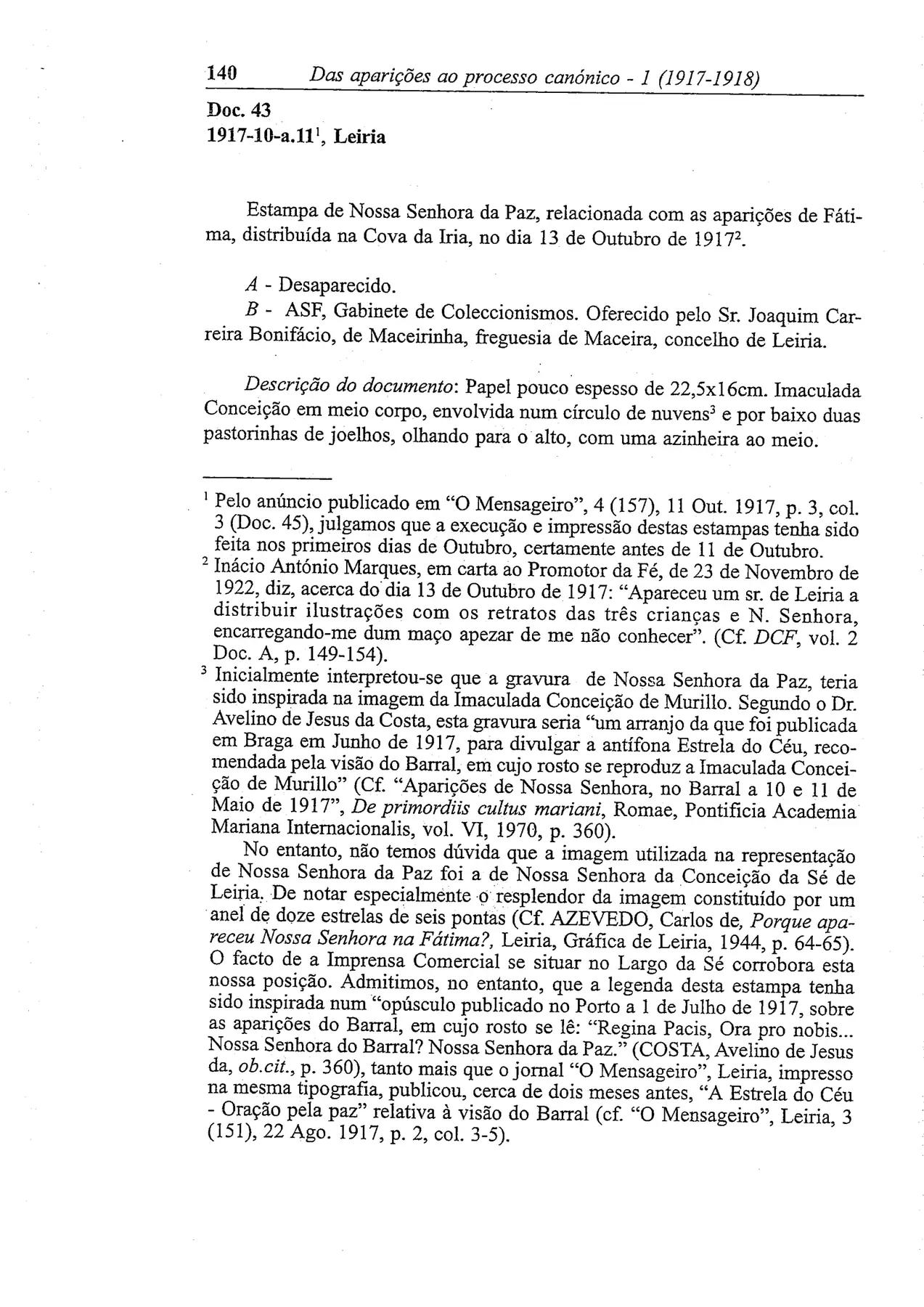
A gentleman from Leiria appeared distributing illustrations with the portraits of the three children and Our Lady, entrusting me with a bundle although he did not know me".

Português (original)

Apareceu um sr. de Leiria a distribuir ilustrações com os retratos das três crianças e N. Senhora, encarregando-me dum maço apezar de me não conhecer".

DCF III-1, Doc. 43 · other · 23 Nov 1922 (5 years later)View scans (2)Link
13 OctFirst-handSaw itLater recollectionScepticCrowd sceneSun spinningClothes drying
English

The 13th of October wakes like a day of heavy winter, although the rain falls slowly. All morning it rains without stopping. The paths and roads are full of people who, coming from distant lands, had not reckoned on rain, since for many months not a drop had fallen. On arriving at the place they lit fires until the hour approached.

[…]

The moment of the apparition arrives and what the whole world knows takes place. The sun spins round on itself and all who were wet appear dry, as I was one of them. A gentleman from Leiria appeared distributing illustrations with the portraits of the three children and of Our Lady, entrusting me with a bundle although he did not know me.

Português (original)

O dia 13 de outubro acorda como um dia de pesada invernía, embora a chuva caia com lentidão. Durante toda a manhã chove sem cessar. Os caminhos e estradas vão repletos de gente que vindas de longes terras não faziam conta que chovesse em virtude de haver muitos meses que nem uma pinga caía. Chegados ao local iam acendendo fogueiras até que se aproximasse a hora.

[…]

Chega-se o momento da aparição e passa-se o que todo o mundo sabe. O sol gira em torno de si mesmo e todos que se encontravam molhados aparecem enxutos como fui eu um deles. Apareceu um sr. de Leiria a distribuir ilustrações com os retratos das três crianças e de Nossa Senhora, encarregando-me dum maço apesar de me não conhecer.

DCF Seleção, Doc. 72 · deposition · 23 Nov 1922 (5 years later)View scanLink
Other 1917First-handLetterSceptic120 km awayCure
English

For 12 years I had suffered from my stomach; I vomited everything I ate. I consult the best doctors in the hope of being cured by medicine, but I do so in vain... I have been given up, but the Lisbon hospitals still remain to me as my only resource. I go to the hospital of S. José and am examined by Dr. Damas Mora, director of the Emergency Department of that hospital. As my condition was hardly satisfactory, the same gentleman had me admitted to the Desterro hospital, where he operated on me on 18 December 1917, having as assistants (though I do not remember well) Drs. Hermano Medeiros and Balbino do Rego. Because of the great cold I caught a chill and, whether for that or some other reason, the next day I was burning with fever and had pneumonia.

The doctor on duty is called and, after examining me well, he says that I am irremediably lost. Both my lungs are affected; the fever is always above 40 degrees. They have cupping glasses applied to me, one after another, but it was necessary to take medicines to fight the fever and that is impossible, because nothing can go into my stomach. The operation was one of the most delicate, and consequently I could only expect death. I was almost always delirious, but in the short intervals when I was lucid I thought about my situation and saw that it was critical. I see that I am dying in a hospital without the comfort that the ministers of a religion bring to souls in dark and troubled hours; without seeing at the head of my bed a mother, brothers, sisters, family and friends to encourage and strengthen me. Before I go down into a grave in a cemetery, I want still to write to my mother telling her that I am dying, that she should pray and have prayers said for me, for here I have no one to do it.

That request was made by the reverend parish priest of Santa Catarina, I believe on Christmas Day at the Mass of the Souls. From the world I can expect nothing, and then everything that happened in that blessed Cova comes to my mind, that Virgin who said she was the Consoler of the afflicted.

I know well that I must die, but it is sad not to have the consolation of seeing, in that agonizing moment and painful trance, around my bed, someone to pray and give comfort. Then, encouraged by a great faith, I ask Our Lady of the Rosary of Fátima that, if it were possible for me still one day to go to my home village to see my family, I would hold a feast in her honour and have a sermon preached, and go to the place to say a rosary. The next day I no longer had fever, and two days later my lungs were completely cured. To the doctors it seemed like a dream: when they thought me dead I appeared to them cured. Was it medicine? No, because I took no medicines. So pneumonia and a fever of 40 degrees are cured in three days, and by chance? Has anyone ever survived who, operated on for the stomach, was attacked by pneumonia? Let whoever knows answer.

Português (original)

Havia 12 anos que eu padecia do estômago; vomitava tudo que comia. Consulto os melhores médicos com a esperança de me curar por meio da medicina, mas debalde o faço... Estou desenganado mas restam-me ainda os hospitais de Lisboa como único recurso. Dirijo-me ao hospital de S. José, sou observado pelo sr. dr. Damas Mora, diretor do Banco do mesmo hospital. Como o meu estado fosse pouco satisfatório, o mesmo sr. mandou-me baixar ao hospital do Desterro onde me operou a 18 de dezembro de 1917, tendo como ajudantes (ainda que não me recorde bem) os srs. drs. Hermano Medeiros e Balbino do Rego. Devido ao muito frio constipei-me e, fosse por isso ou por outra causa, no dia seguinte estava ardendo em febre e com uma pneumonia.

É chamado o médico de serviço e, depois de me observar bem, diz que estou irremediavelmente perdido. Tenho os pulmões ambos atacados; a febre está sempre acima de 40 graus. Mandam-me aplicar ventosas, umas após outras, mas era preciso tomar remédios que combatessem a febre e isso é impossível porque no estômago não pode entrar nada. A operação era das mais melindrosas e por conseguinte só podia esperar a morte. Estava quase sempre variado mas, nos pequenos intervalos que tinha lucidez, pensava na minha situação e via que era crítica. Vejo que morro num hospital sem o conforto que os ministros duma religião levam às almas nas negras e atribuladas horas; sem ver à cabeceira do meu leito uma mãe, irmãos, irmãs, pessoas de família e amigos que me animem e fortaleçam. Antes que baixe ao coval de um cemitério, quero ainda escrever a minha mãe dizendo-lhe que morro, que peça e mande pedir por mim, que ali não tenho quem o faça.

Esse pedido foi feito pelo reverendo pároco de Santa Catarina parece-me que em dia de Natal à missa das Almas. Do mundo não posso esperar nada e então vem-me à imaginação tudo o que se passou nessa Cova bendita, dessa Virgem que disse ser a Consoladora dos aflitos.

Bem sei que tenho de morrer mas é triste não ter a consolação de ver nesse momento cruciante e transe doloroso, em volta de meu leito, quem ore e dê conforto. Então animado com uma grande fé peço a Nossa Senhora do Rosário da Fátima que, se possível fosse, eu ainda poder um dia ir à minha terra ver minha família, faria uma festa em sua honra e mandaria pregar um sermão, indo ao local rezar um terço. No dia seguinte já não tinha febre e passados dois dias estava completamente curado dos pulmões. Aos médicos parecia um sonho, quando me julgavam morto aparecia-lhes curado. Foi a medicina? Não, porque não tomei remédios. Então uma pneumonia e febre a 40 graus cura-se em três dias, e por acaso? Já escaparia alguém operado do estômago que fosse atacado por uma pneumonia? Que responda quem souber.