Events /

13 October 1917

The "miracle of the sun", before a crowd of perhaps 50,000–70,000 in heavy rain.

239 passagesSaw it: 207Partly: 12Saw nothing: 4Present: 16Filter and search these →

Leonor de Avelar e Silva Constâncio

Pilgrimwidow, Catholic lady staying at Caldas da Rainha
13 OctFirst-handSaw nothingLater recollectionCrowd scene
English

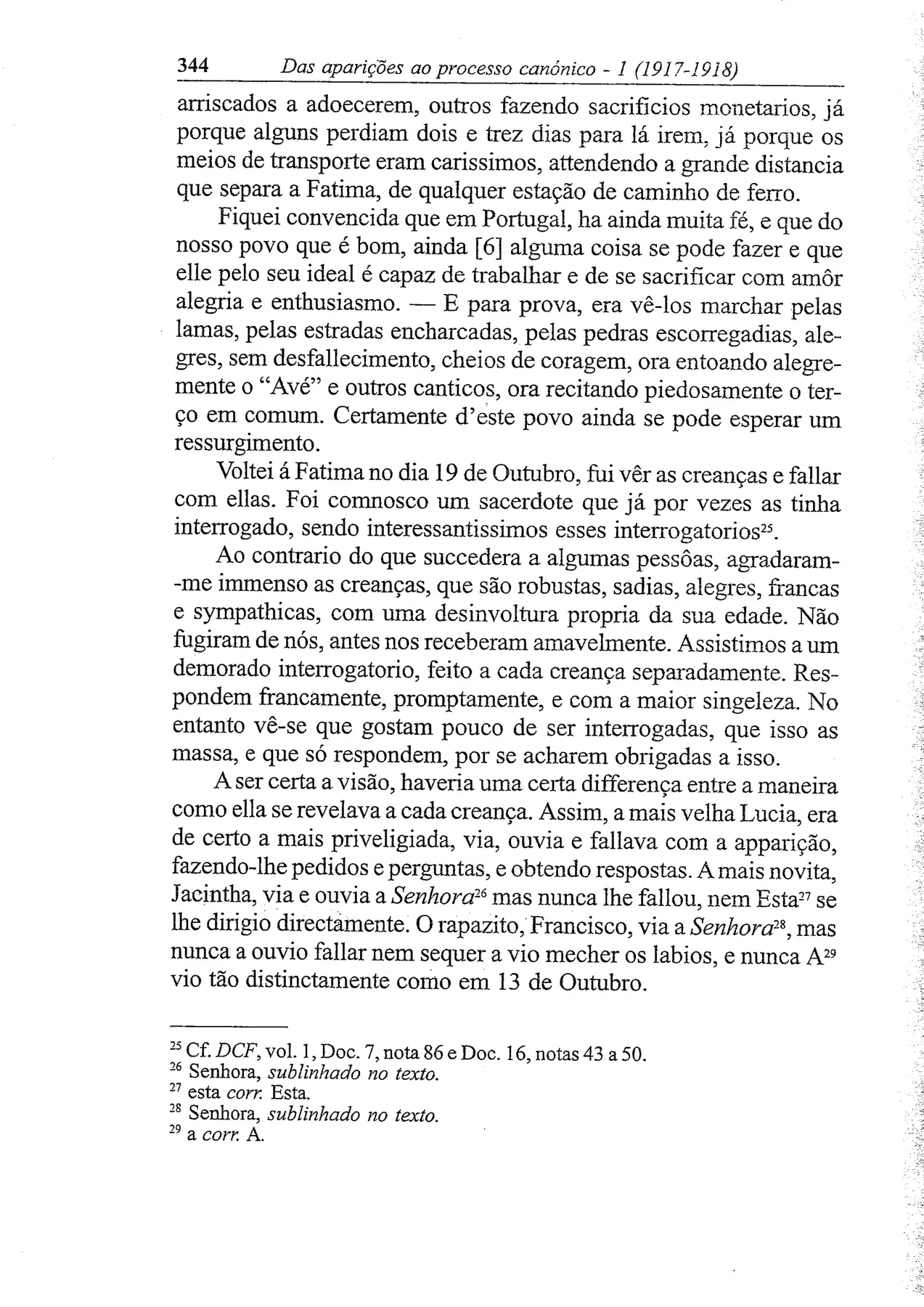
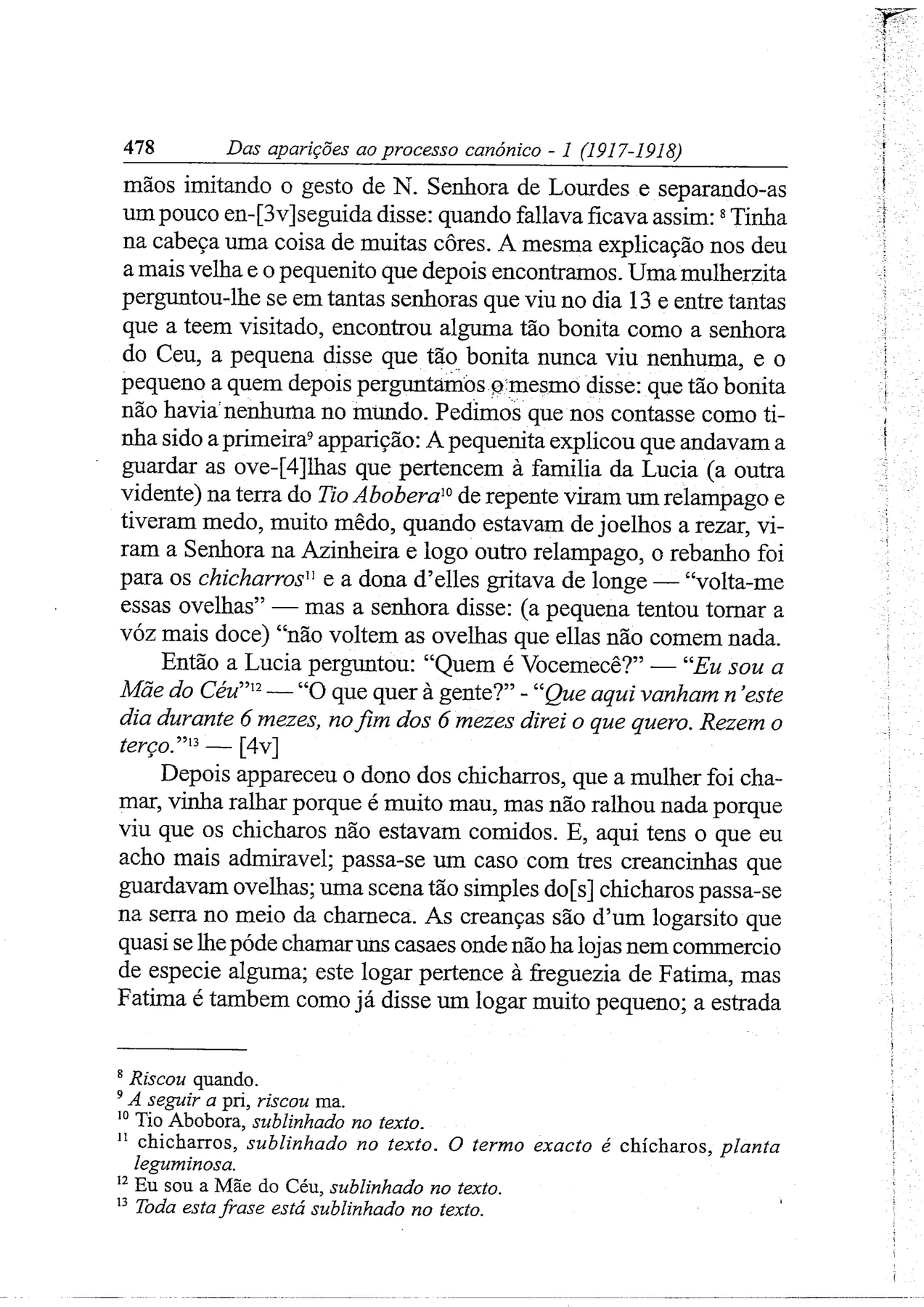
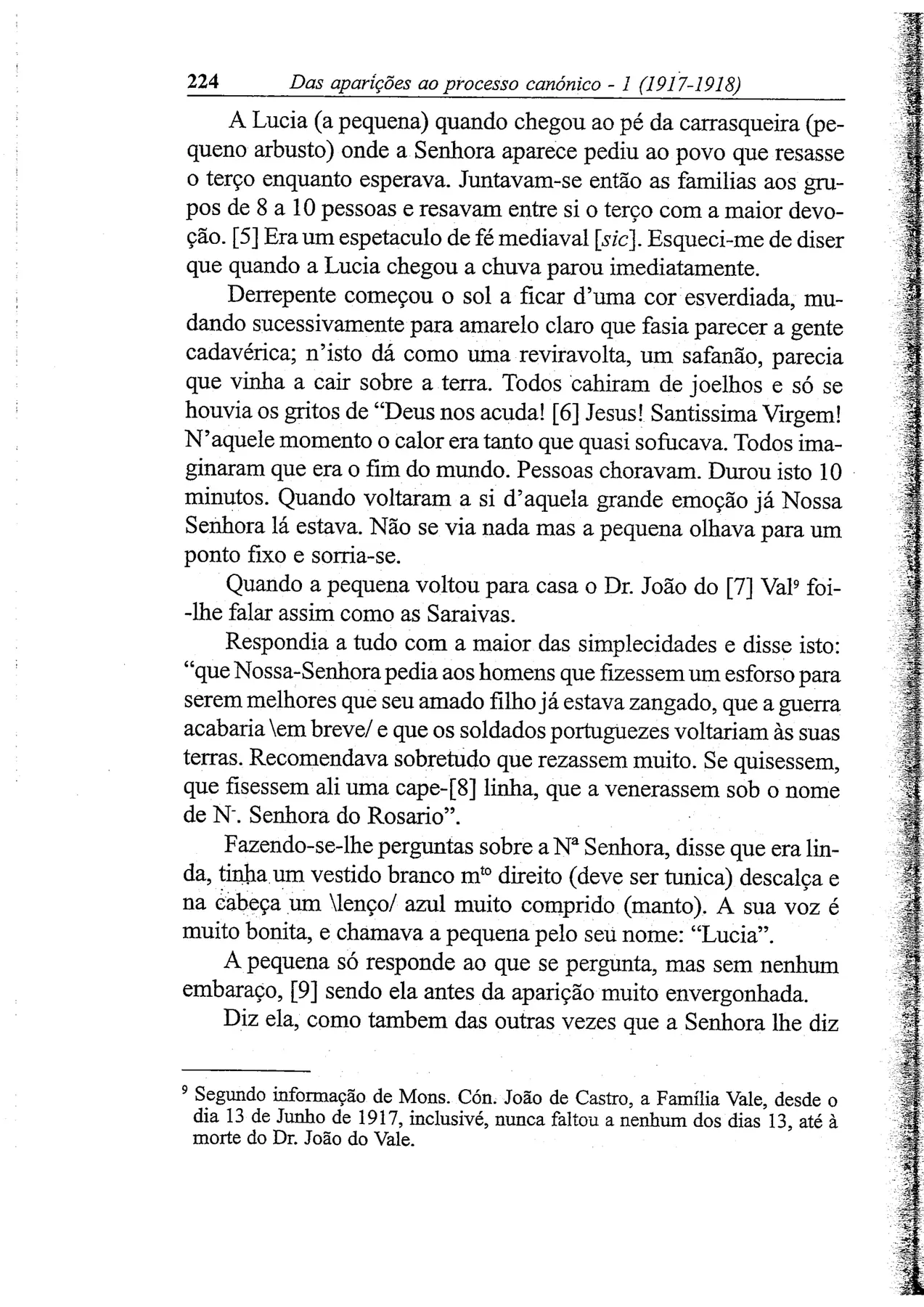
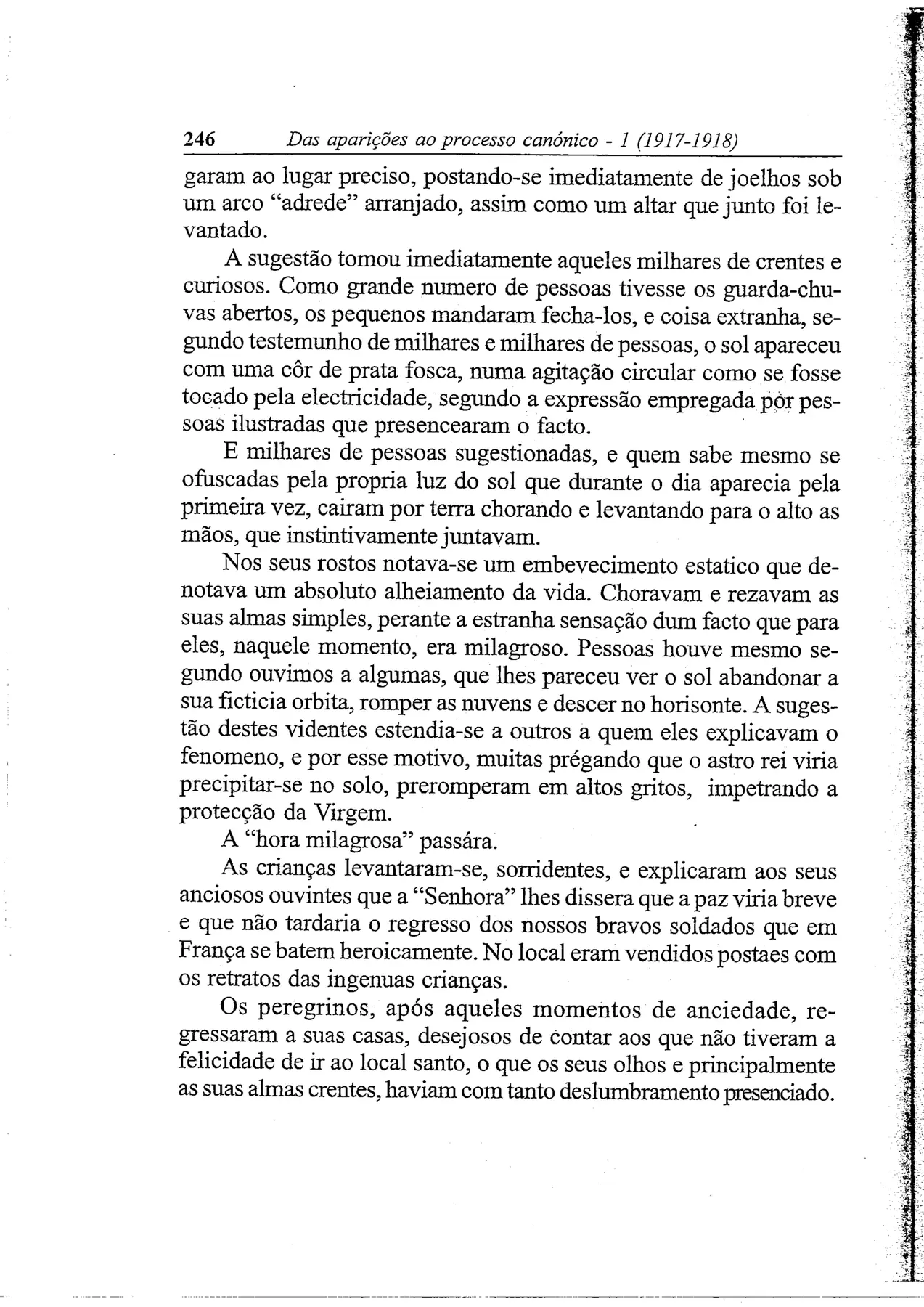
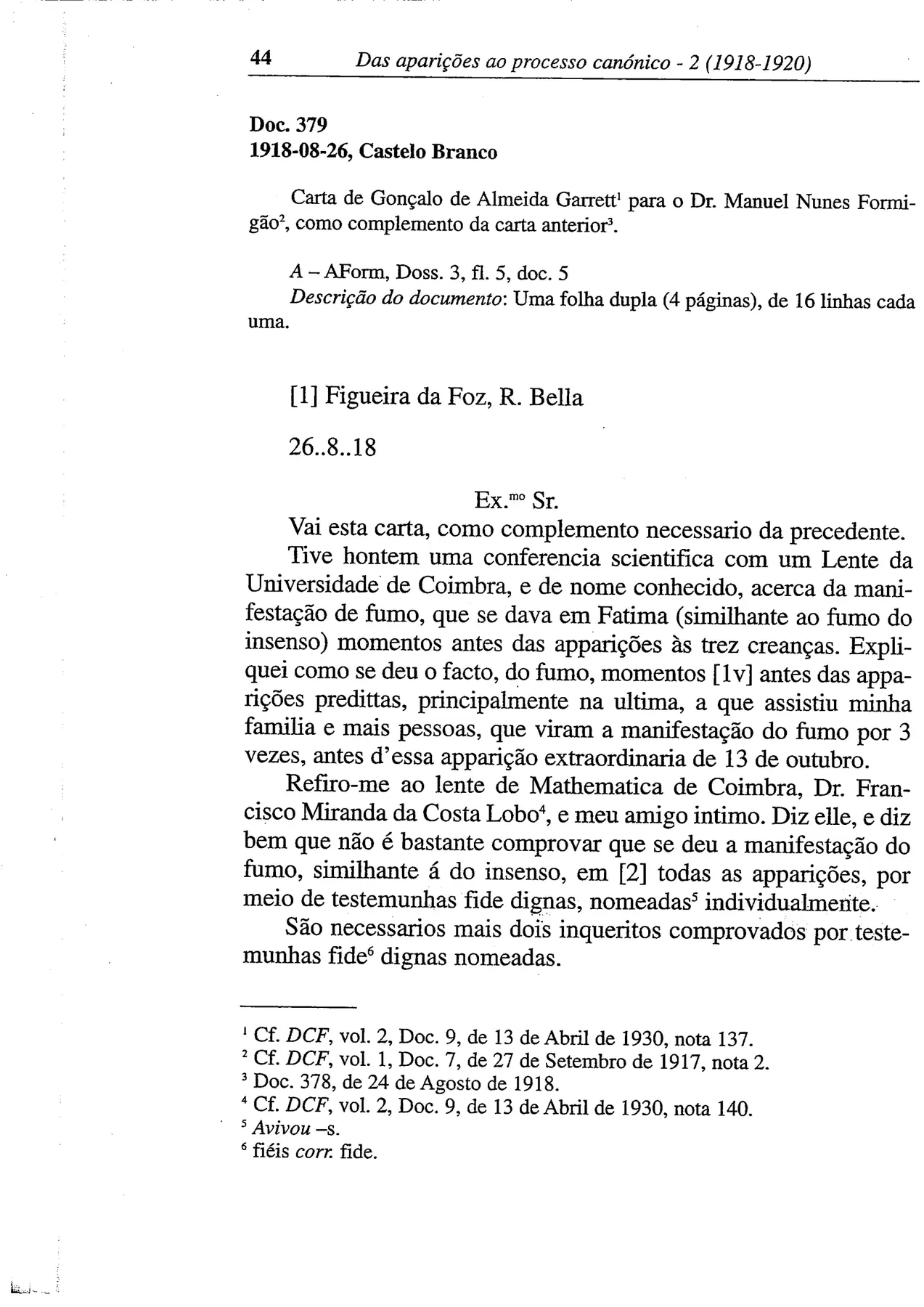
We continued our journey, and finally reached Fatima, but only half an hour after the marvellous phenomenon had taken place, today already known to everyone through the beautiful descriptions published by the "Seculo" and other newspapers.

What an immense vexation not to have seen it!

Having arrived at Fatima I look for people I know, to exchange impressions. They all tell me the same thing, they all saw... But saw what?... I ask them: "We saw the sun, covered as if by a silver plate, in constant rotating movement, giving off red, yellow and purple rays, and seeming to come loose from the sky and approach the earth."

I spoke with the people; they told me the same, though in other words. They told me they had seen Our Lady, St Joseph, the Child Jesus, and what do I know?... the whole heavenly court; at the same time as they had seen the sun dance. I did not believe in so many visions.

It is true that it is possible they thought they had seen; suggestion perhaps. Our people, generally very ignorant, are very credulous, and it would be easy for them to convince themselves that they really saw what they wished to see. It is indeed thanks to this ease of conviction that demagogic doctrines have at times been listened to and believed by them!

In the more educated classes nobody told me they had seen the heavenly apparition, but it is certain that everyone, educated and uneducated, was manifesting their faith. And what a magnificent and imposing manifestation of faith was that of that enormous crowd of about 50 thousand people, almost all brought there by faith, by the desire to make certain of the truth of the facts [5v] they had heard related! In almost every eye there were tears, but tears of the boundless joy that filled their souls. Everyone was convinced that something supernatural had taken place, and they thanked God for still remembering this poor and so guilty Portugal.

Magnificent was the profession of faith of the Engineer Mr João Amado, who, without human respect or fear, proclaims it aloud. His gesture is beautiful, both at that moment and when he humbly accuses himself of being a sinner; beautiful and edifying. Would that he had imitators.

Once again this time we did not manage to speak to the children, whom everyone surrounded trying to speak to them, and as it was getting late we went home.

Português (original)

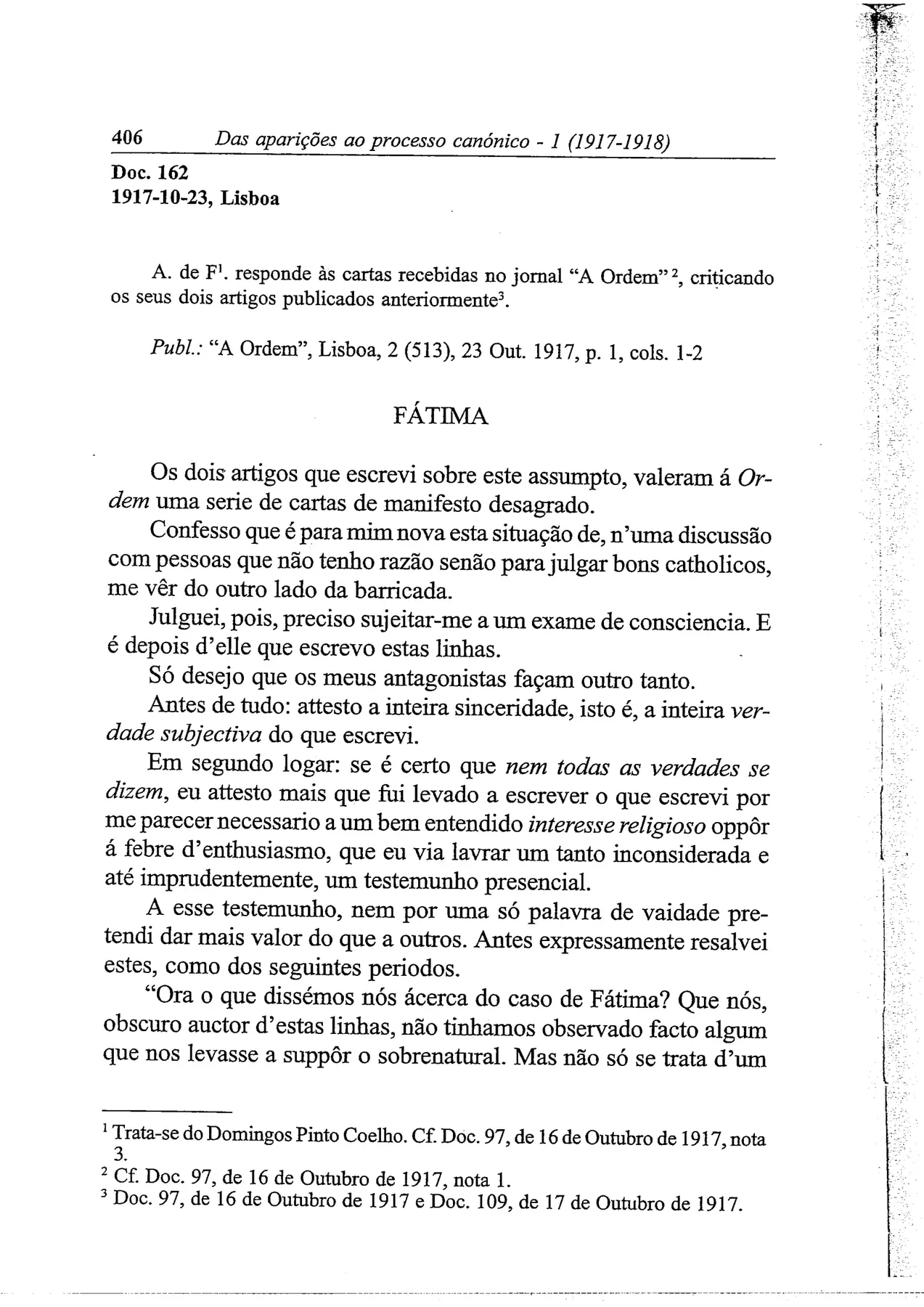
Continuámos a nossa jornada, e chegámos finalmente á Fatima, mas só meia hora depois de se ter dado o maravilhoso phenomeno, hoje já de todos conhecido pelas lindas descrições publicadas pelo "Seculo" e outros jornaes.

Que immenso ferro não o ter eu visto!

Chegada á Fatima procuro ver pessôas conhecidas, para trocar impressões. Todos me dizem o mesmo, todos viram... Mas viram o quê?... lhes pergunto: "Vimos o sol, coberto como que por uma chapa de prata, n'um constante movimento de rotação, despedindo raios vermelhos, amarelos, roxos, e parecendo desprender-se do Céu e aproximar-se da terra."

Fallei com o povo, dizia-me o mesmo, posto que, por outras palavras. Diziam-me ter visto N. Senhora, S. José, o Menino Jesus, e que sei eu?... toda a corte celestial; ao mesmo tempo que tinham visto dançar o sol. Não acreditei em tanta visão.

É certo, que é possível que julgassem ter visto; sugestão talvez. O nosso povo, em geral muito ignorante é muito crédulo, e facil lhe seria o convencer-se de que realmente via, o que desejava ver. É mesmo graças a esta facilidade de convicção que por vezes as doutrinas demagogicas, teem sido ouvidas e acreditadas por elle!

Nas classes mais cultas ninguem me disse ter visto a aparição celeste, mas certo é, que todos, illustrados e não illustrados, manifestavam a sua fé. E que magnifica e imponente manifestação de fé, a d'aquella enorme multidão de cêrca de 50 mil pessoas, quazi todas ali levadas pela fé, pelo desejo de se certificarem da veracidade dos factos [5v] que tinham ouvido narrar! Em quazi todos os olhos haviam lagrimas, mas lagrimas da alegria infinda que lhes ia n'alma. Todos se convenciam que alguma coisa de sobrenatural se havia passado, e agradeciam a Deus, lembrar-se ainda d'este pobre e tão culpado Portugal.

Magnifica a profissão de fé do Eng.eiro Sr. João Amado, que, sem respeitos humanos, nem receios, a proclama bem alto. É lindo o seu gesto, quer n'esse momento, quer quando humildemente se accusa de peccador; lindo e edificante. Oxalá tenha imitadores.

Ainda d'esta vez não conseguimos fallar ás creanças, que todos cercavam procurando fallar-lhes, e como se fazia tarde, voltámos para casa.

13 May13 Jun13 Jul13 Aug13 Sep13 OctFirst-handSaw itInterrogationFigures / visionsSeers' words overheard
English

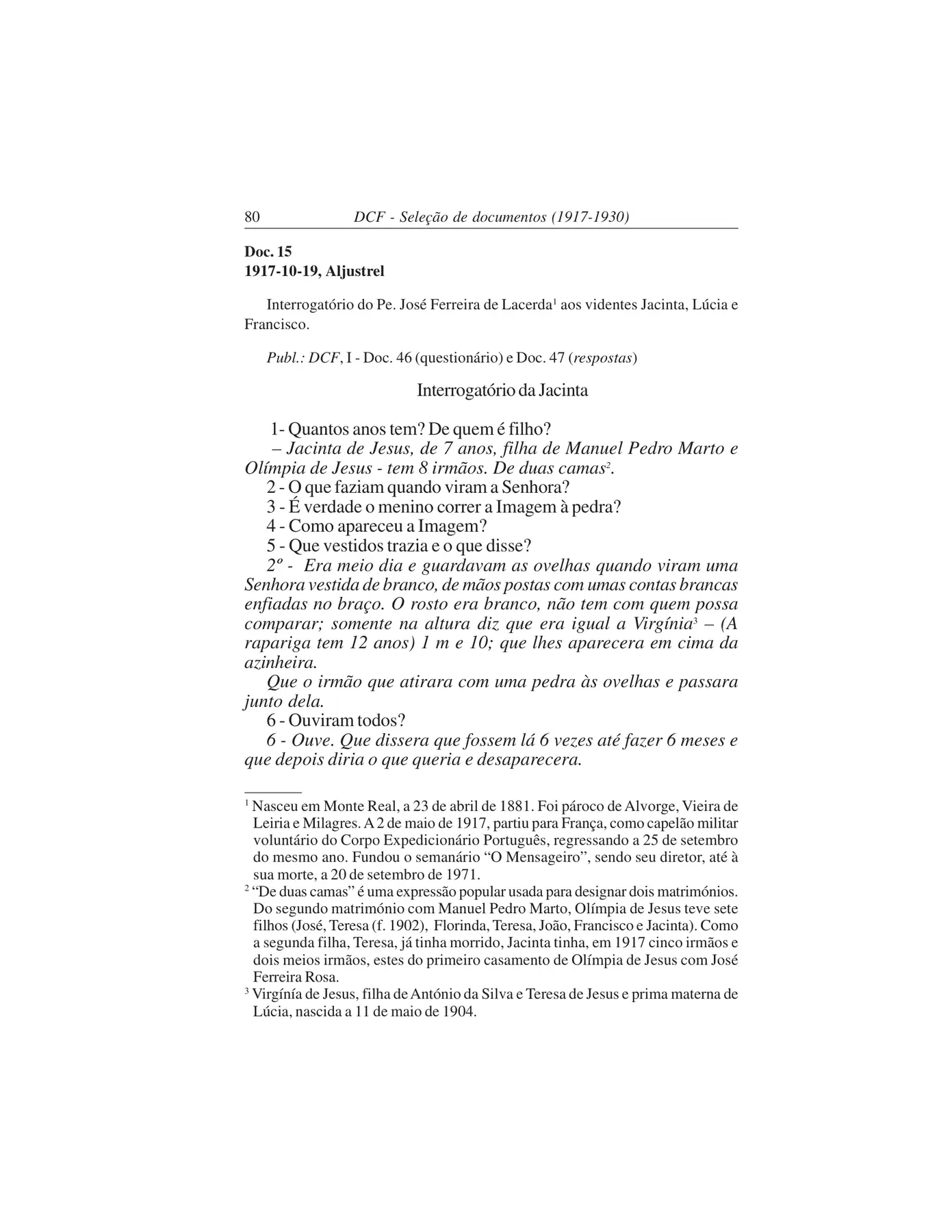
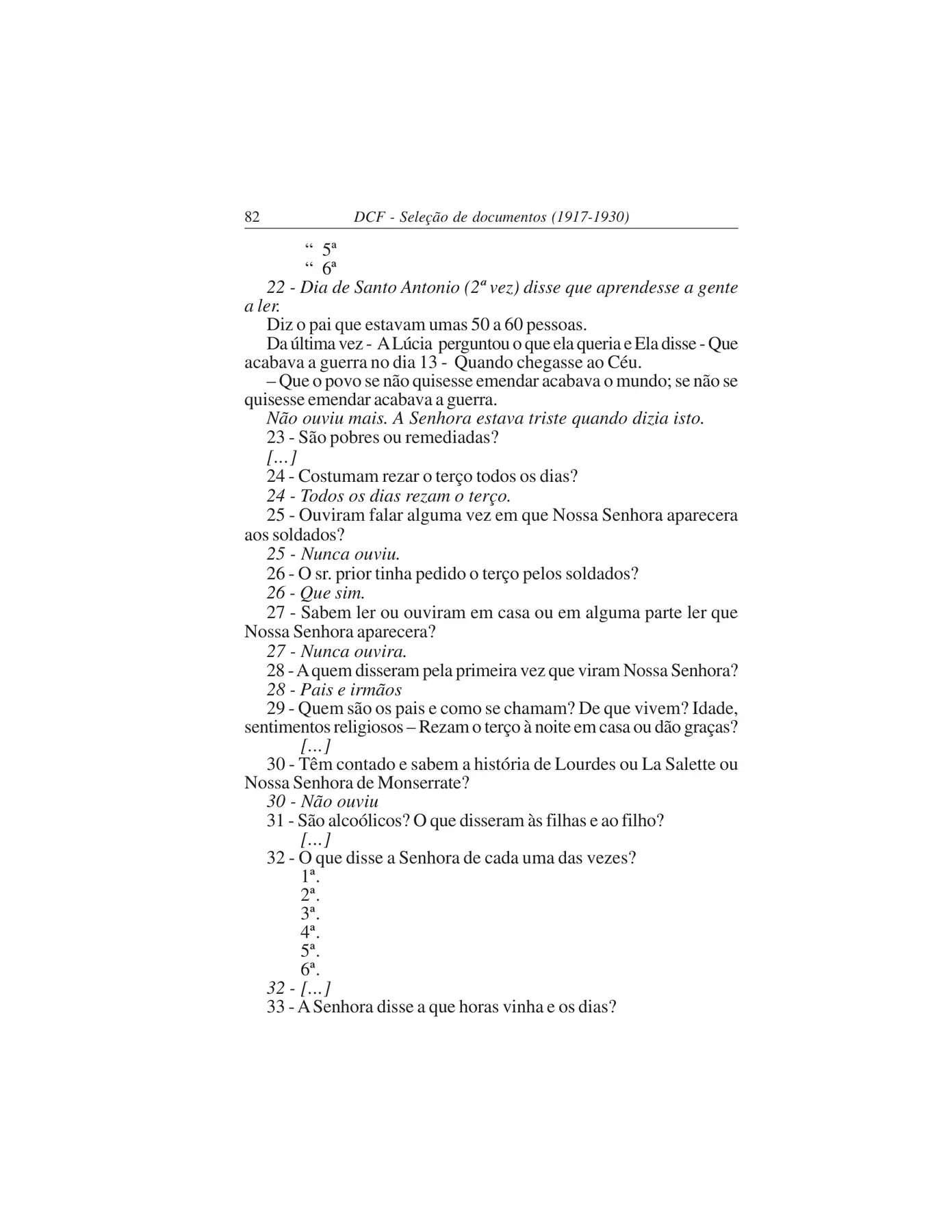
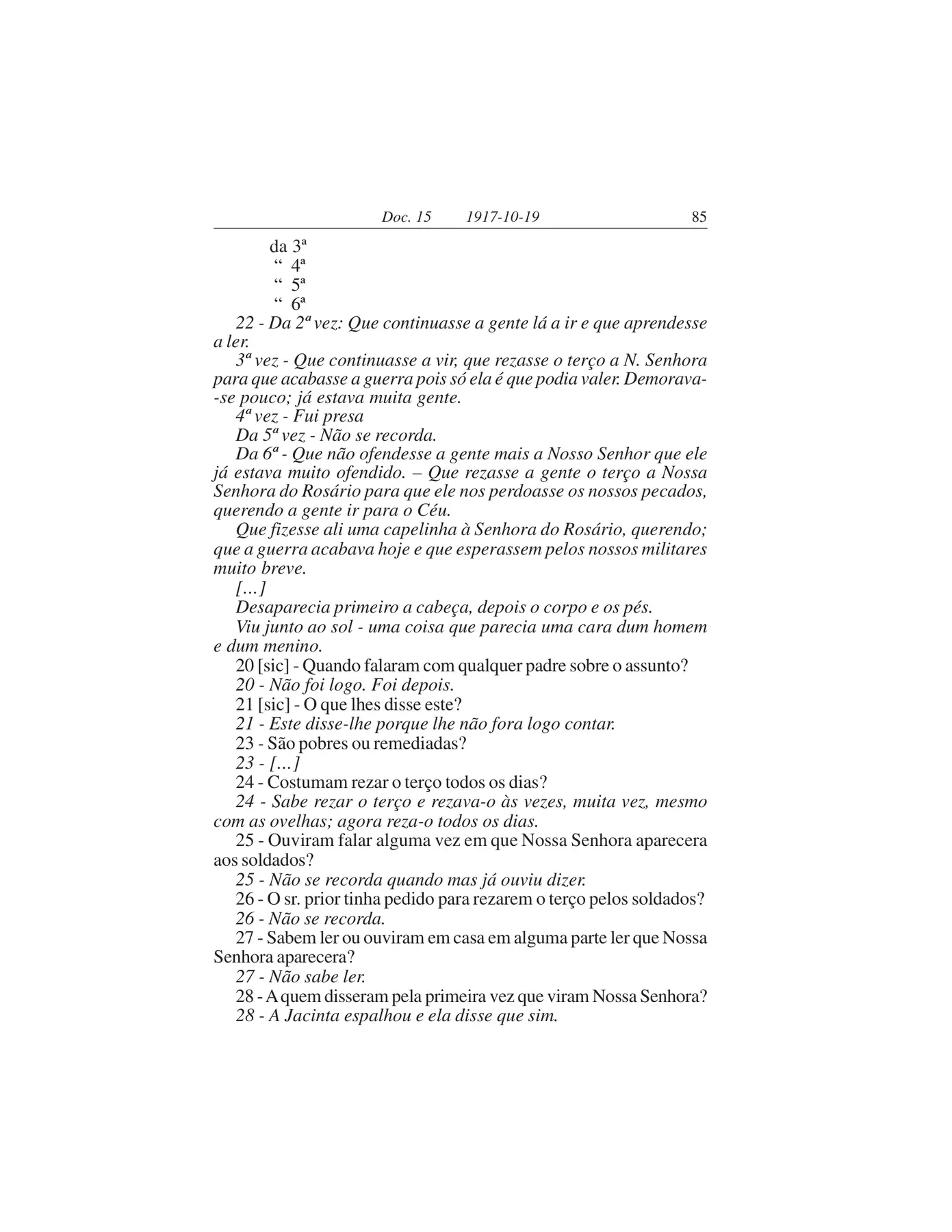
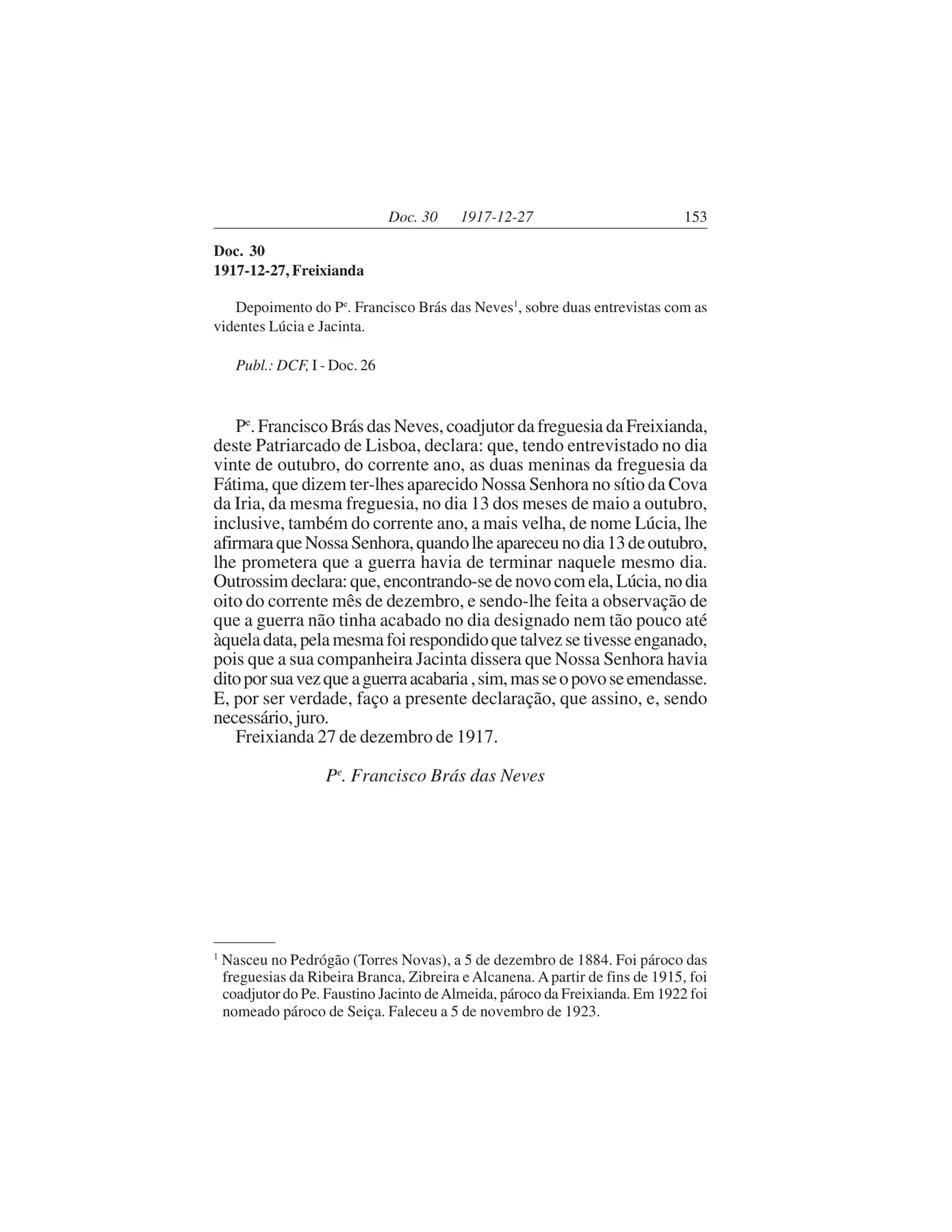
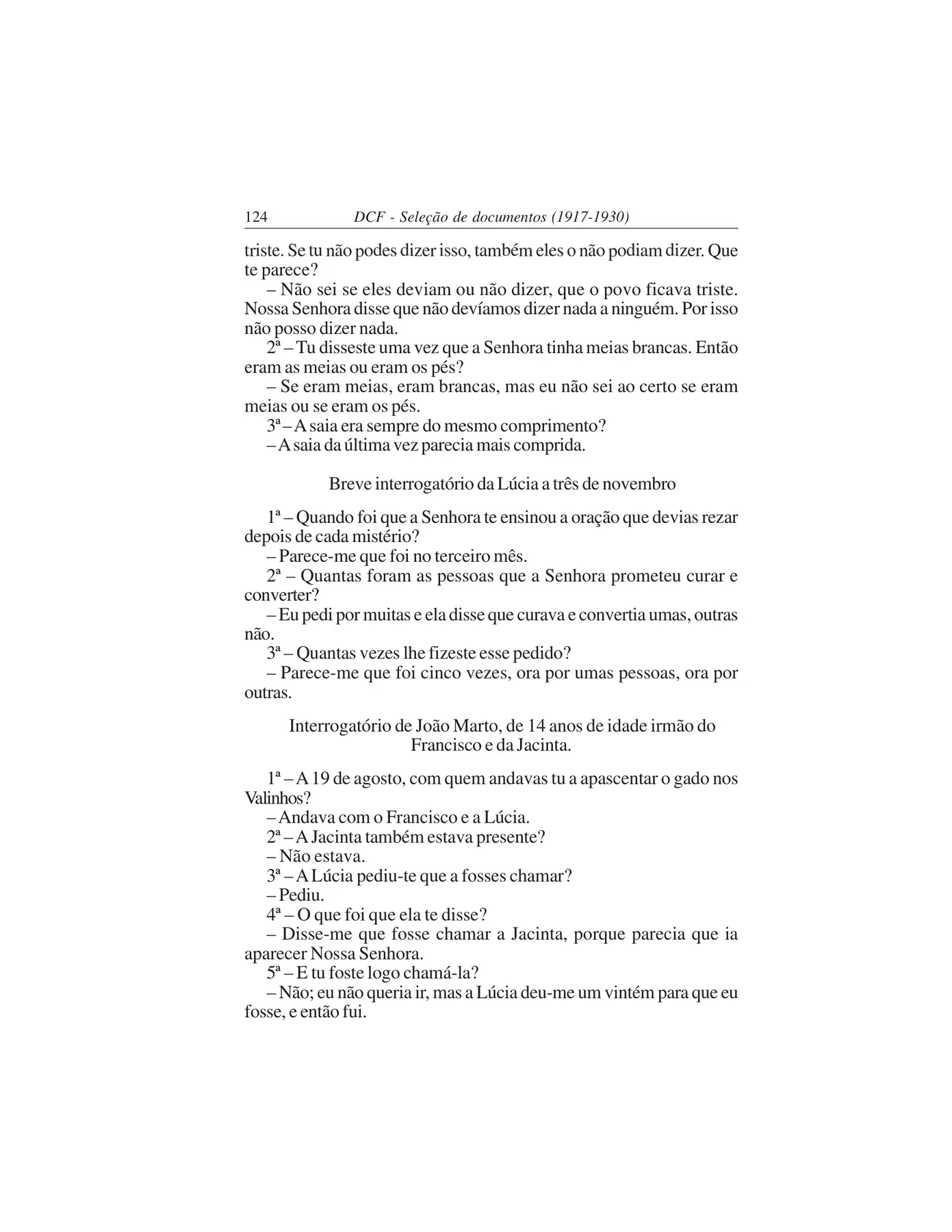
Several times I questioned the seer Jacinta, who always confirmed to me that she saw a Lady at the Cova da Iria on the thirteenth of each month from May to October nineteen hundred and seventeen, except on the thirteenth of August, when she was at the house of the administrator of the council, but that in that month she saw Her on the following Sunday – the nineteenth – at the place called Valinho, where she was called by her brother João at Lúcia's request.

She said that she saw a very beautiful Lady, all dressed in white, with a garment gilded with little cords, with a veil or mantle over her head, the size of F. – she points to a girl of average height, about fourteen years old – and that she had some very white beads hanging from her hands and held between the forefinger and thumb of both hands, which she held raised at her waist, and which she separated from each other, more or less to the width of the shoulders, when she spoke to Lúcia.

When She spoke to Lúcia, she heard a very devout voice, but she does not remember hearing anything said except that they – the seers – were going to Heaven. In the several times I questioned her she never contradicted herself in essentials, though there were, in incidental matters, some contradictions, real or apparent. On one occasion – 21 August – I went to her parents' house accompanied by five ladies – Dona Maria de Jesus Raposo, of Torres Novas, and others from the Quinta da Cardiga – one of whom, about fifteen years of age, was dressed in white. On reaching the parents' house I called... Jacinta came, who was alone, and on seeing the unexpected visitors she was embarrassed, as is natural in a child of the people and one who a few days earlier had been returned to her parents from the abduction carried out on her. After a few words of encouragement, I said to her:

– Look, Jacinta, see whether it was one of these ladies that you saw at the Cova da Iria, or whether there is one here like Her whom you saw there.

She raises her little eyes, runs her gaze over all of them, from head to foot, and says:

– It wasn't any of these... the other one is much more beautiful.

I point out to her the one dressed in white, saying to her:

– Then wasn't it this Lady, dressed in white, so beautiful, that you saw up there?!

This Lady, she answered, is very beautiful, but She whom I saw there is much more beautiful.

We went to Lúcia's parents' house and on finding her I asked her the same question, obtaining an identical answer. As regards the secret, I also could not get her to reveal it to me; she only said that it – the secret – was not bad for them, the seers.

Português (original)

Por várias vezes interroguei a vidente Jacinta que sempre me confirmou que viu uma Senhora na Cova da Iria, nos dias treze de maio a outubro de mil novecentos e dezassete, menos no dia treze de agosto em que se achava em casa do administrador do concelho, mas que nesse mês A viu no domingo seguinte – dia dezanove – no sítio chamado Valinho, onde foi chamada por seu irmão João, a pedido da Lúcia.

Disse que viu uma Senhora muito bonita, toda vestida de branco, com fato dourado aos cordõezinhos, com um véu ou manto pela cabeça, do tamanho de F. – indica uma rapariga de regular estatura e dos seus catorze anos – e que trazia umas contas muito branquinhas penduradas nas mãos e seguras entre os dedos indicador e polegar de ambas as mãos, que tinha erguidas à cintura, e que separava uma da outra, pouco mais ou menos à largura dos ombros, quando falava à Lúcia.

Quando Ela falava para a Lúcia, que ouvia uma voz muito piedosa, mas que não se lembra de ouvir dizer, senão que a gente – elas videntes – ia para o Céu. Pelas várias vezes que a interroguei nunca se contradisse no essencial, havendo todavia coisas acidentais, algumas contradições, verdadeiras ou aparentes. Em uma ocasião – dia 21 de agosto – dirigi-

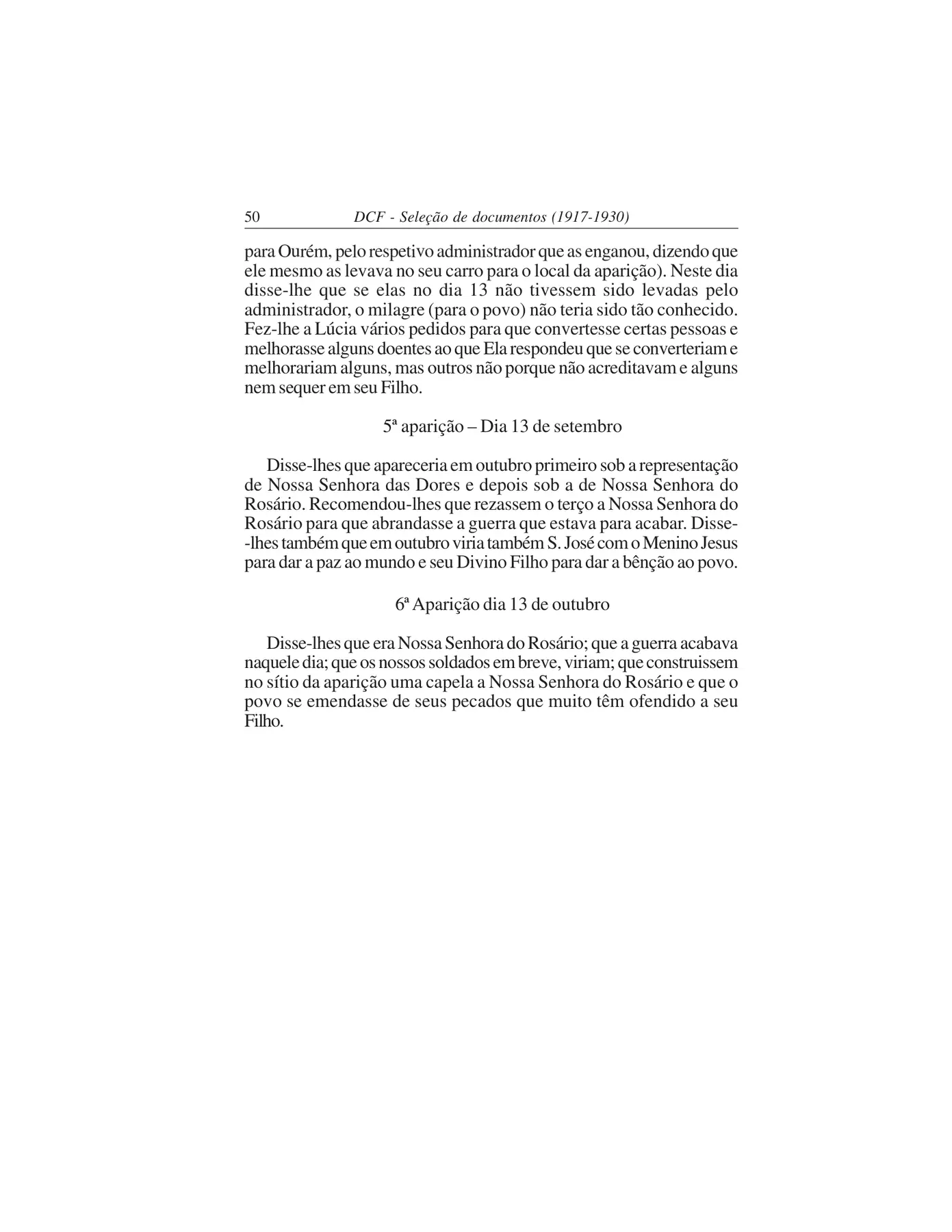
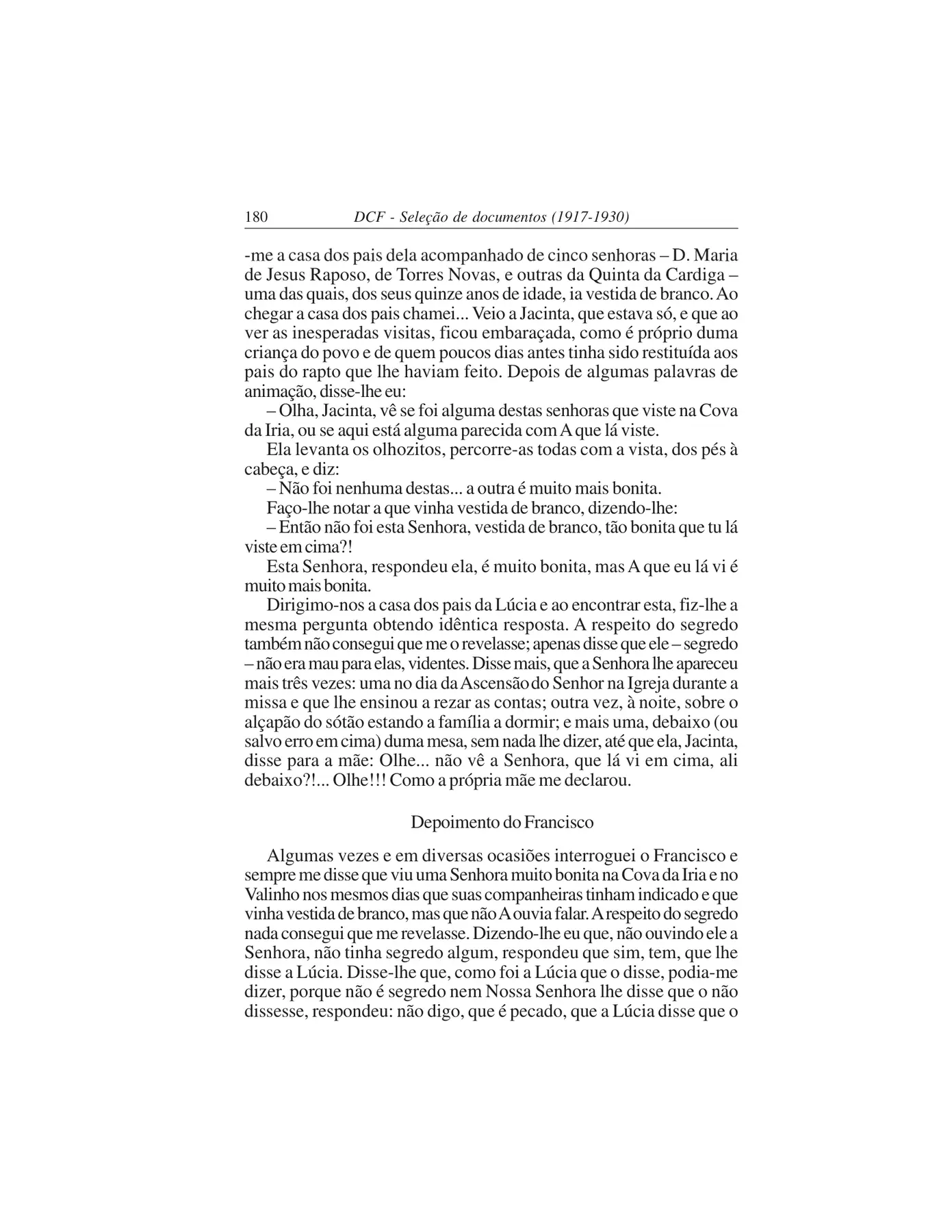
-me a casa dos pais dela acompanhado de cinco senhoras – D. Maria de Jesus Raposo, de Torres Novas, e outras da Quinta da Cardiga – uma das quais, dos seus quinze anos de idade, ia vestida de branco. Ao chegar a casa dos pais chamei... Veio a Jacinta, que estava só, e que ao ver as inesperadas visitas, ficou embaraçada, como é próprio duma criança do povo e de quem poucos dias antes tinha sido restituída aos pais do rapto que lhe haviam feito. Depois de algumas palavras de animação, disse-lhe eu:

– Olha, Jacinta, vê se foi alguma destas senhoras que viste na Cova da Iria, ou se aqui está alguma parecida com A que lá viste.

Ela levanta os olhozitos, percorre-as todas com a vista, dos pés à cabeça, e diz:

– Não foi nenhuma destas... a outra é muito mais bonita.

Faço-lhe notar a que vinha vestida de branco, dizendo-lhe:

– Então não foi esta Senhora, vestida de branco, tão bonita que tu lá viste em cima?!

Esta Senhora, respondeu ela, é muito bonita, mas A que eu lá vi é muito mais bonita.

Dirigimo-nos a casa dos pais da Lúcia e ao encontrar esta, fiz-lhe a mesma pergunta obtendo idêntica resposta. A respeito do segredo também não consegui que me o revelasse; apenas disse que ele – segredo – não era mau para elas, videntes.

DCF Seleção, Doc. 36 (= DCF I, Doc. 31) · official · 21 Aug 1917 (3 months later)View scans (2)Link

Pe. Manuel dos Santos Canastreiro

Clergyparish priest of Benedita
13 OctFirst-handNote20 km awayCrowd scene
English

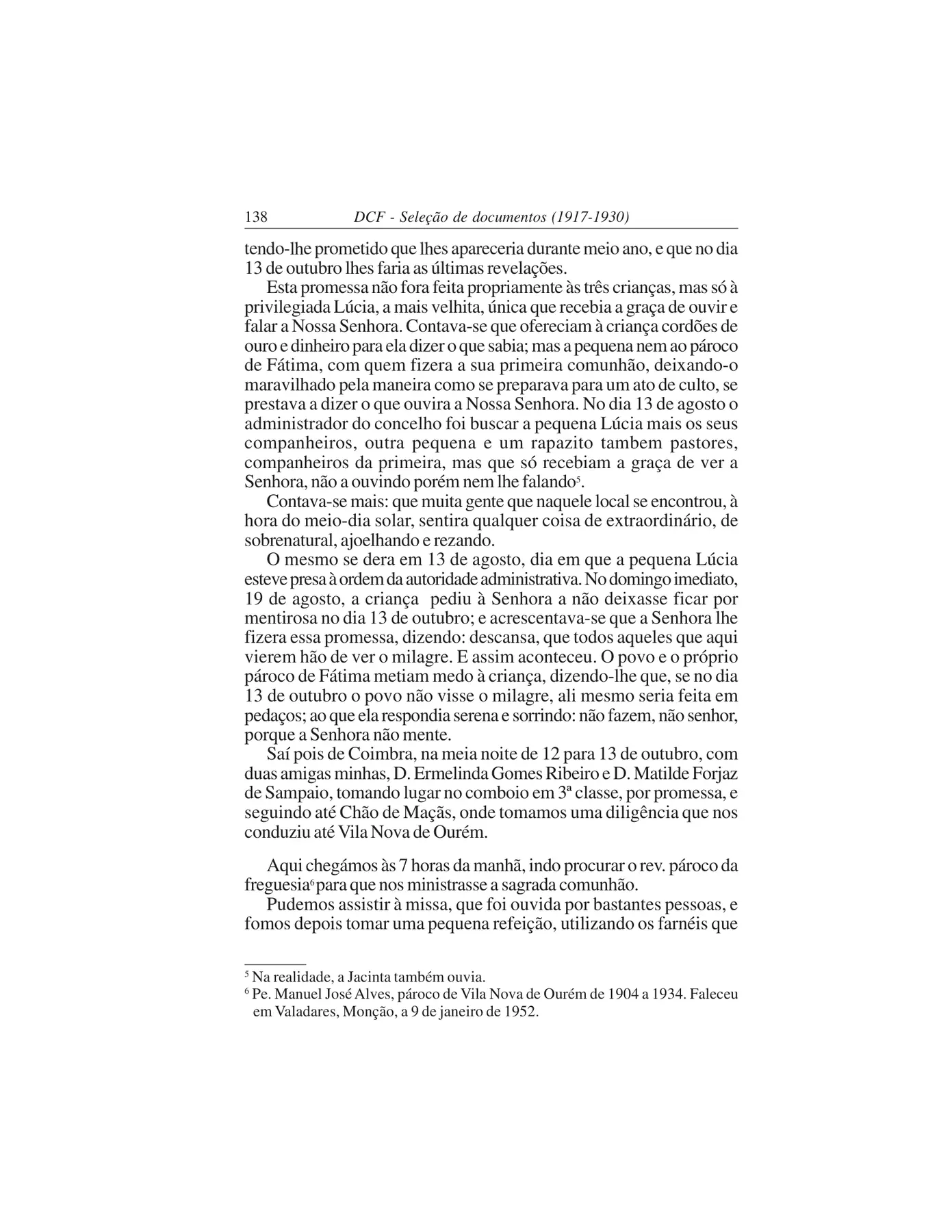
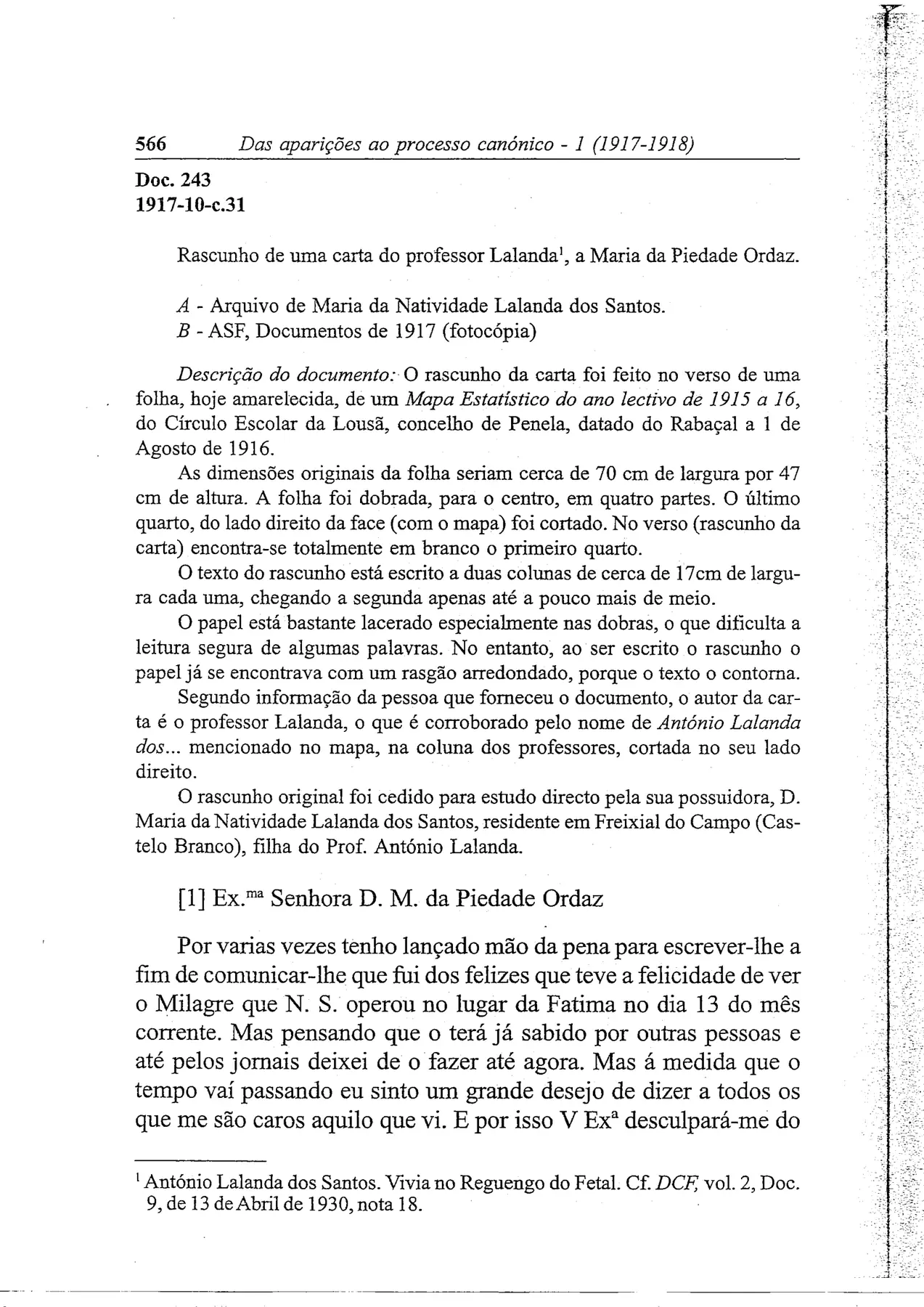
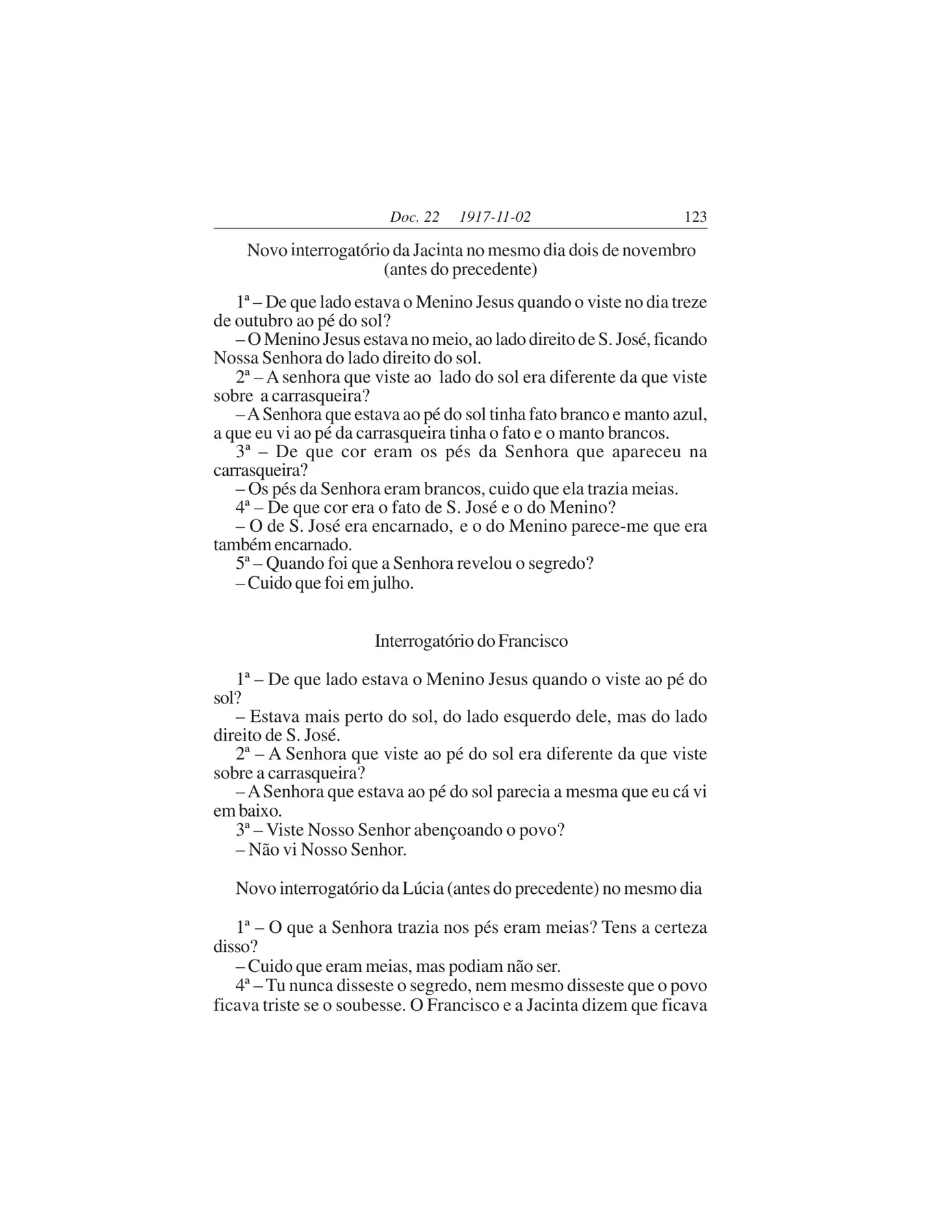
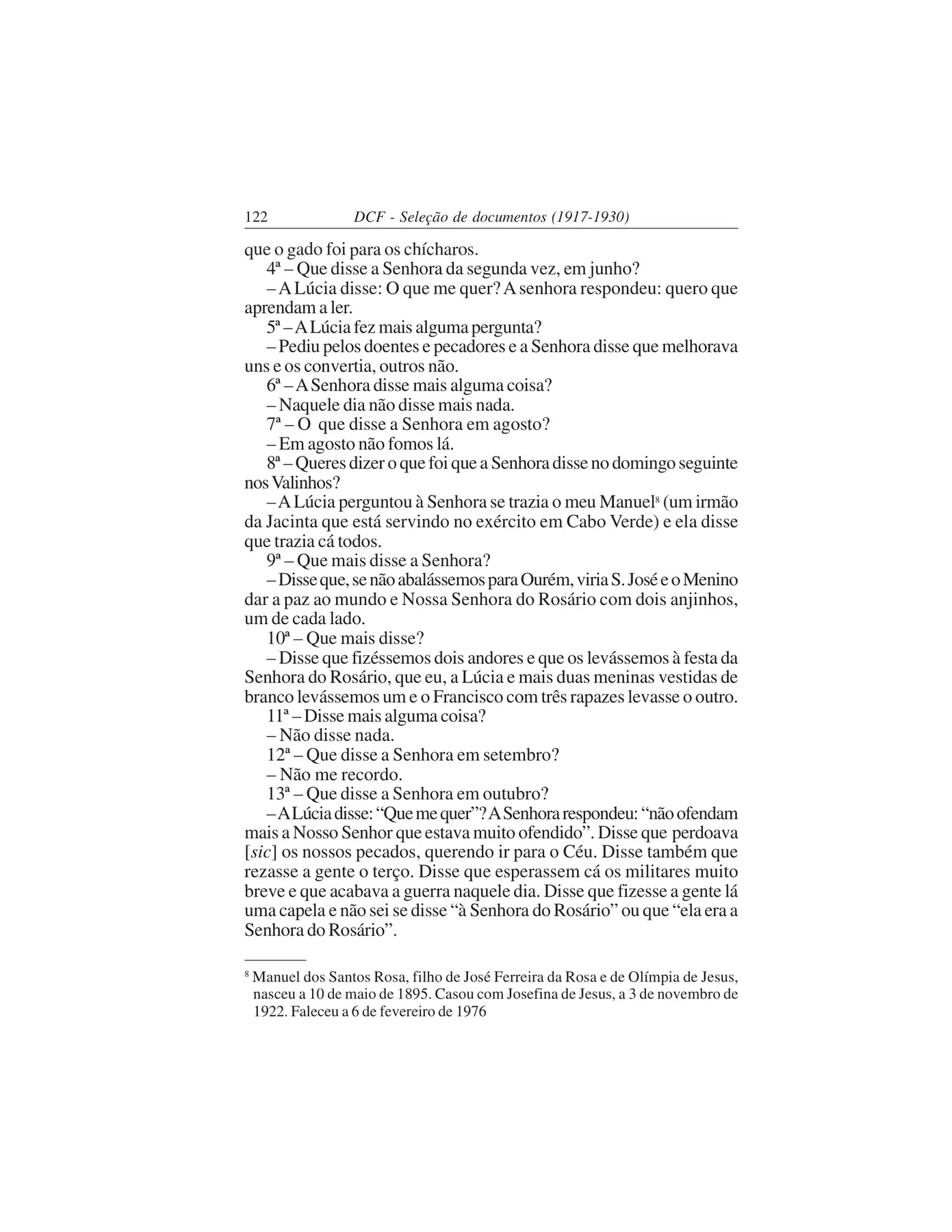
From Benedicta, where I was serving as parish priest, I went to Fátima by carriage, in the company of Fr. Joaquim Antonio do Carmo, his uncle Antonio d’Almeida, and cousins Isabel and Elvira. We left on the 12th at 10 a.m., and reached Batalha at about 4 o'clock in the afternoon. We visited the Monastery. There we already found parishioners of mine, and after our arrival others came. Perhaps a hundred and something of them were there at night. At the inn I made the acquaintance of the Most Excellent Canon Balthasar and his nieces. I slept in a room in which Mr Claudio Ribeiro and Joaquim Paulo, of Turquel, were also quartered”.

Português (original)

Da Benedicta, onde estava a parochiar, fui á Fátima de carro, em companhia do Pe. Joaquim Antonio do Carmo, seu tio Antonio d’Almeida, e primas Isabel e Elvira. Partimos no dia 12 ás 10 h. da manhã, e chegámos á Batalha, pelas 4 horas da tarde. Visitámos o Mosteiro. Já ali encontrámos parochianos meus, e depois da nossa chegada, outros vieram. Talvez, ali se encontravam á noite, uns cento e tantos. Na hospedaria travei relações com o Exº. Snr. Cónego Balthasar e sobrinhas. Dormi n’um quarto, em que se aquartelaram também o Snr. Claudio Ribeiro e Joaquim Paulo, de Turquel”.

DCF III-1, Doc. 51 · photo · Oct 1917 (2 days later)View scans (2)Link

Mariana Pinto Coelho

Aristocratlady, niece of the Marquesa da Ribeira Grande
13 OctFirst-handSaw itLetterTravelled from afarSun fallingHeatSun spinningPale / silver discCrowd sceneSeers' words overheard
English

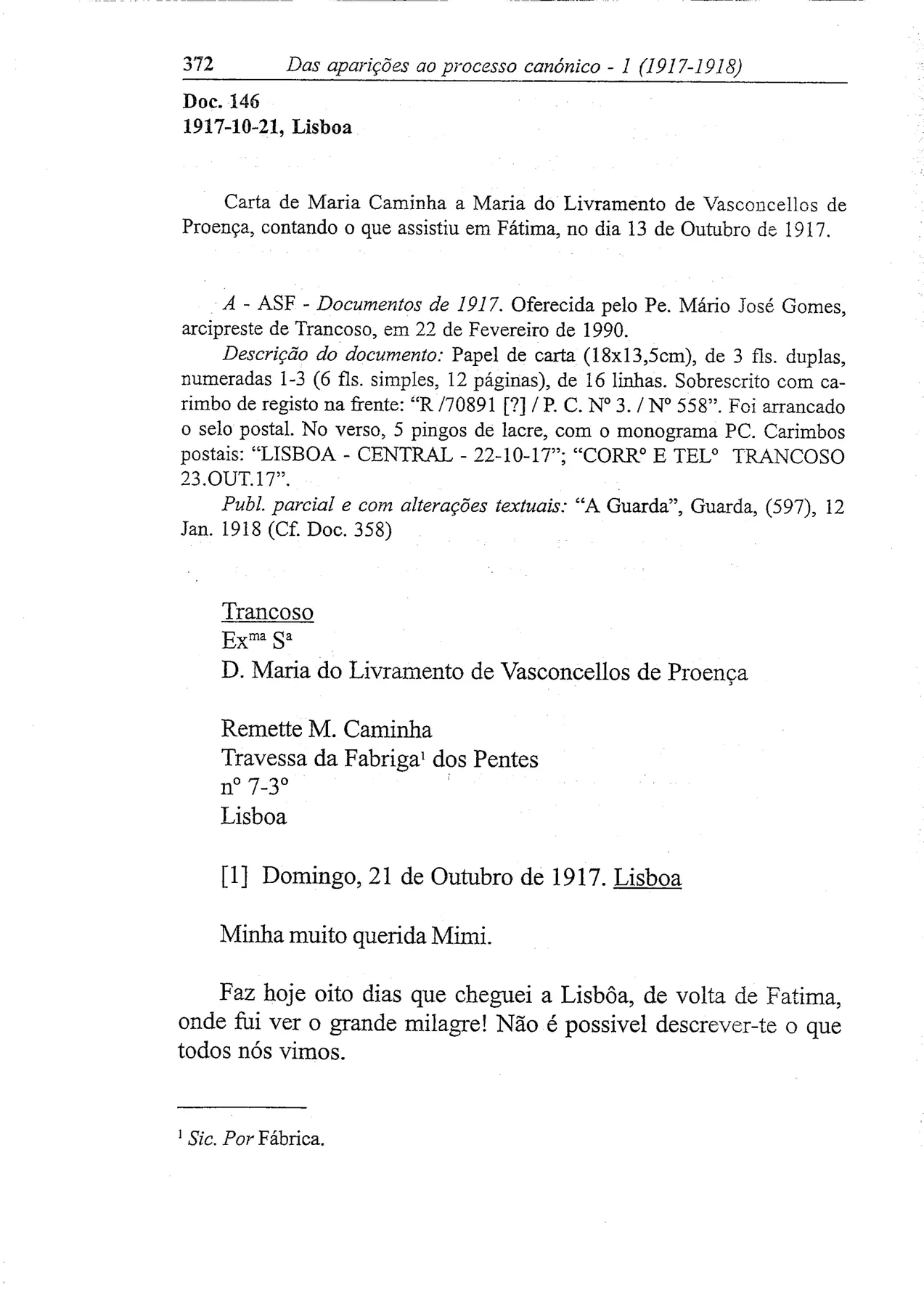
"I come to tell you my impressions of Fátima on the 13th of this month (13 Oct. 1917). They were the greatest of my life, and however many years I may live I shall never forget those delightful moments — I saw so many things! I saw the sun come down towards the earth in an extraordinary way, the heat becoming almost unbearable; I saw it spin round at speed like little firework wheels; I saw the sun like a host.

There are those who say they saw the sun in a great variety of colours; I saw it snow-white, or else dark grey; I saw all this, and what impresses and consoles most, the great manifestation of Faith. I spoke with the eldest little girl, who is not pretty but very likeable, shy and modest; it was necessary to drag [1v] the words out of her, and at the end of it all — speaking to the crowds — she looked like a Priest in the pulpit, with her face transfigured.

Português (original)

Venho contar-lhe as minhas impressões de Fátima, no dia 13 do corrente (13 d'Outº 1917). Foram as maiores e por muitos anos que eu viva, nunca esquecerei aquelles momentos deliciosos — Vi immensas coisas! Vi o sol descer á terra d'uma maneira extraordinaria, chegando a incomodar o calor; vi-o andar á roda com velocidade como as rodinhas de fogo preso; vi o sol como uma hostia.

Há quem diga, que viu o sol de variadissimas côres, eu, vi-o branco de neve, ou então cinzento escuro; vi tudo isto e o que mais impressiona e consola a grande manifestação de Fé. Fallei com a pequena mais velha, que não é bonita mas muito sympathica, vergonhosa e modesta foi preciso arrancar-lhe [1v] as palavras e no fim de tudo, — fallando ás massas — parecia um Padre no pulpito, e com a cara transfigurada.

DCF III-1, Doc. 74 · letter · Oct 1917 (2 days later)View scans (2)Link

Jacinto de Sousa Bento

Villagervillager
13 Jun13 Jul13 Aug13 Sep13 OctFirst-handSaw itNoteCloud / smoke columnLight dimmingTemperature dropThunder / noiseSeers' words overheardCrowd scene
English

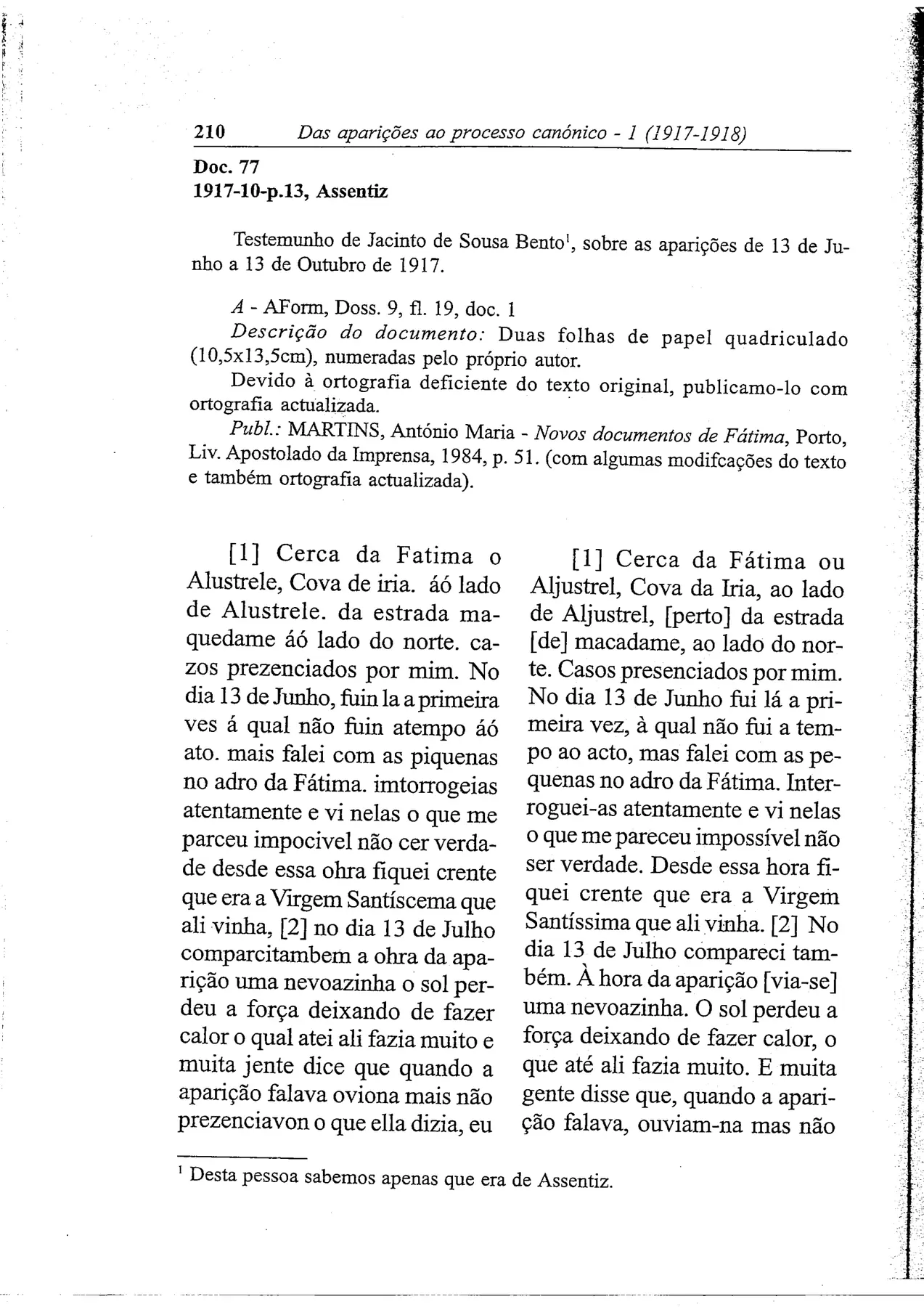
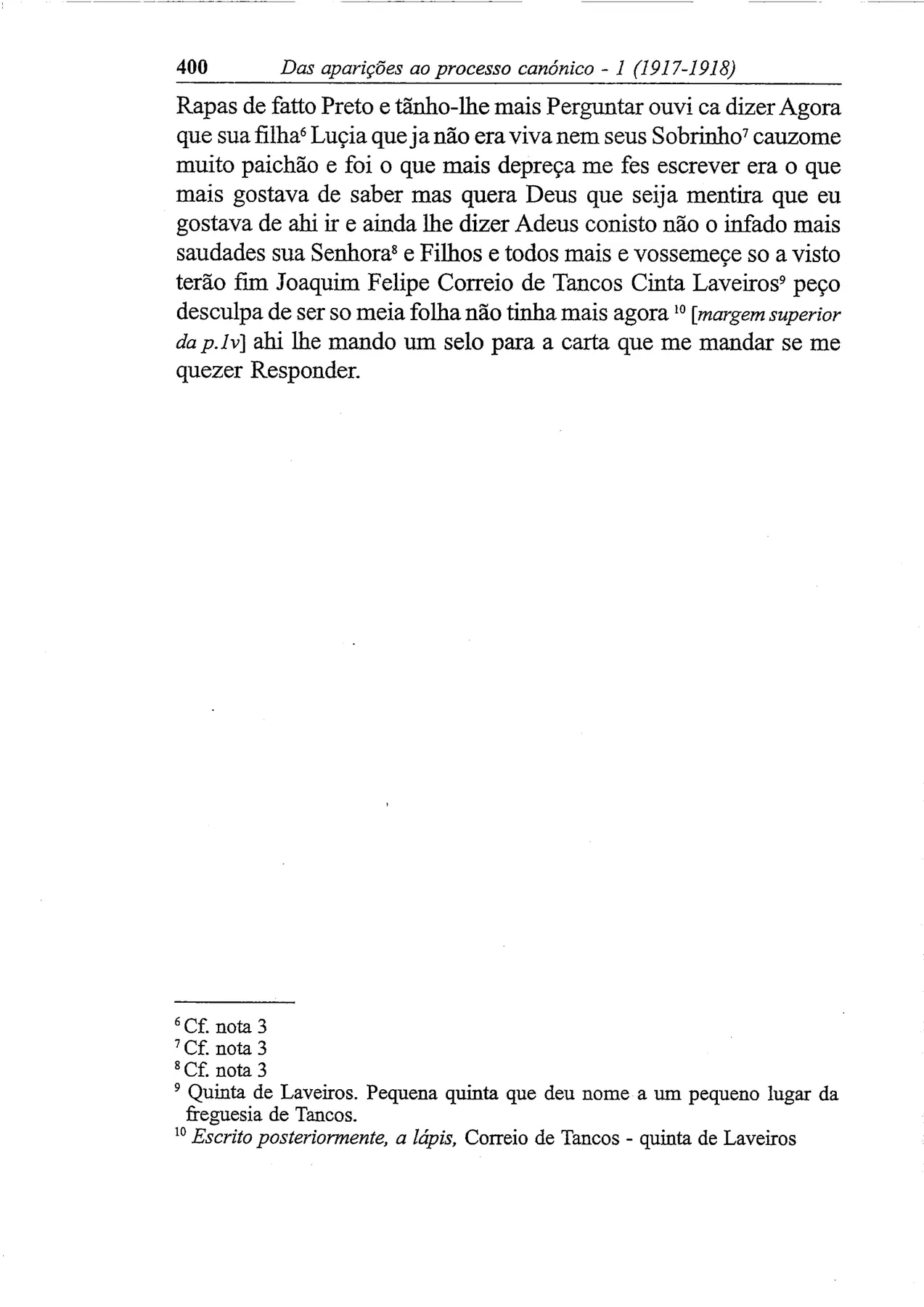
[1] Near Fátima or Aljustrel, Cova da Iria, beside Aljustrel, [near] the road [of] macadam, on the north side. Happenings witnessed by me. On 13 June I went there the first time, when I did not get there in time for the act, but I spoke with the little girls in the churchyard of Fátima. I questioned them attentively and saw in them what seemed to me impossible not to be true. From that hour I became a believer that it was the Most Holy Virgin who came there. [2] On 13 July I was present too. At the hour of the apparition [there could be seen] a little mist. The sun lost its strength, ceasing to give heat, which until then it had been giving a lot. And many people said that, when the apparition spoke, they heard her but did not

[…]

witness [perceive] what She was saying. I only heard when Lúcia said: there She goes! I heard in the air a roar. It seemed the beginning of a thunderclap. [3] On 13 August I was present too. The little girls and the boy were imprisoned. There were a great many people. At the same hours of the apparition the stars and the sun showed the same as the other times; and a most extraordinary sign in the stars. On 13 September I was present too. The sun and the stars made the same figure. The people enthusiastic, looking up into the air, some saying that they saw stars, others that they saw a dove, others that they saw stars running and swallows accompanying them. There was enthusiasm in everyone. Still others that they saw flowers falling. [4] On 13 October it rained almost all morning. At the hour near the apparition it stopped raining. The extraordinary facts that happened in the sun! Everyone witnessed: whoever had their eyes open; whoever closed them saw nothing. And perhaps there were those who saw and said they did not see so as not to give honour to the Mother of Heaven. Whatever mistake there may have been regarding the war, the extraordinary [facts] that happened there are undeniable.

Português (original)

1] Cerca da Fátima ou Aljustrel, Cova da Iria, ao lado de Aljustrel, [perto] da estrada [de] macadame, ao lado do norte. Casos presenciados por mim. No dia 13 de Junho fui lá a primeira vez, à qual não fui a tempo ao acto, mas falei com as pequenas no adro da Fátima. Interroguei-as atentamente e vi nelas o que me pareceu impossível não ser verdade. Desde essa hora fiquei crente que era a Virgem Santíssima que ali vinha. [2] No dia 13 de Julho compareci também. À hora da aparição [via-se] uma nevoazinha. O sol perdeu a força deixando de fazer calor, o que até ali fazia muito. E muita gente disse que, quando a aparição falava, ouviam-na mas não

[…]

presenciavam [percebiam] o que Ela dizia. Eu só ouvi quando a Lúcia disse: lá vai Ela! Ouvi no ar um rugido. Parecia o princípio de um trovão. [3] No dia 13 de Agosto compareci também. As meninas e o menino foram presos. Estava muita gente. Às mesmas horas da aparição os astros e o sol representaram o mesmo das outras vezes; e um sinal extraordinaríssimo nos astros. No dia 13 de Setembro compareci também. O sol e os astros fizeram a mesma figura. O povo entusiasmado a olhar para o ar, dizendo uns que viam estrelas, outros que viam uma pomba, outros que viam estrelas a correr e andorinhas a acompanhar. Era um entusiasmo em todos. Ainda outros que viam flores a cair. [4] No dia 13 de Outubro choveu quase toda a manhã. À hora próxima à aparição deixou de chover. Os factos extraordinários que se deram no sol! Toda a gente presenciou: quem tinha os olhos abertos; quem os fechou não viu nada. E talvez houvesse quem visse e dissesse que não viu para não dar honras à Mãe do Céu. Haja o equívoco que houver com respeito à guerra, os [factos] extraordinários que lá houve são inegáveis.

DCF III-1, Doc. 77 · note · Oct 1917 (4 months later)View scans (2)Link
13 OctFirst-handSaw itArticle by witnessCrowd sceneRain stoppingPale / silver discSun spinningHeatSun falling
English

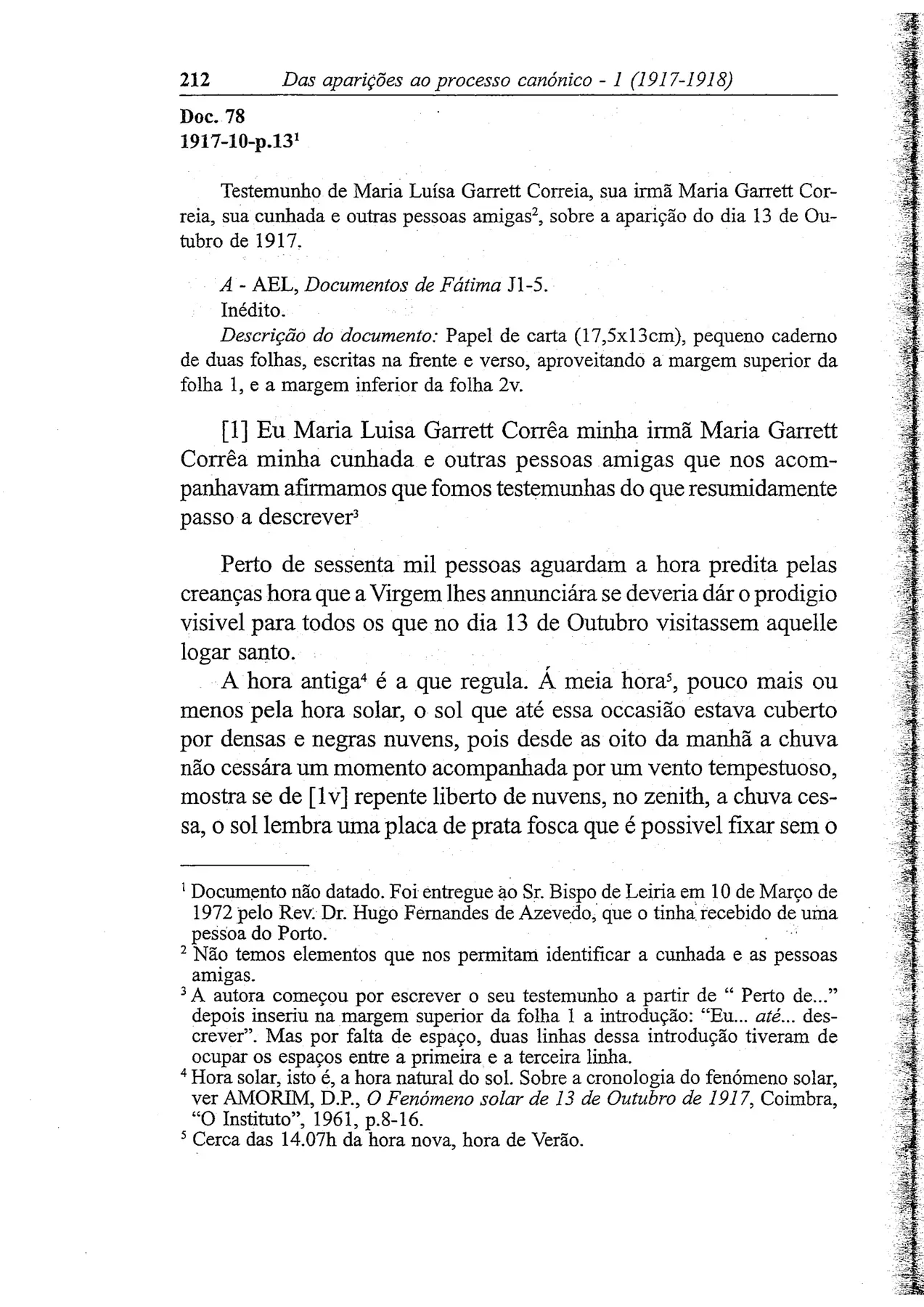
I, Maria Luisa Garrett Corrêa, my sister Maria Garrett Corrêa, my sister-in-law and other friends who were with us affirm that we were witnesses of what I shall now briefly describe3

Nearly sixty thousand people await the hour foretold by the children, the hour at which the Virgin had announced to them that the prodigy visible to all who visited that holy place on 13 October was to take place.

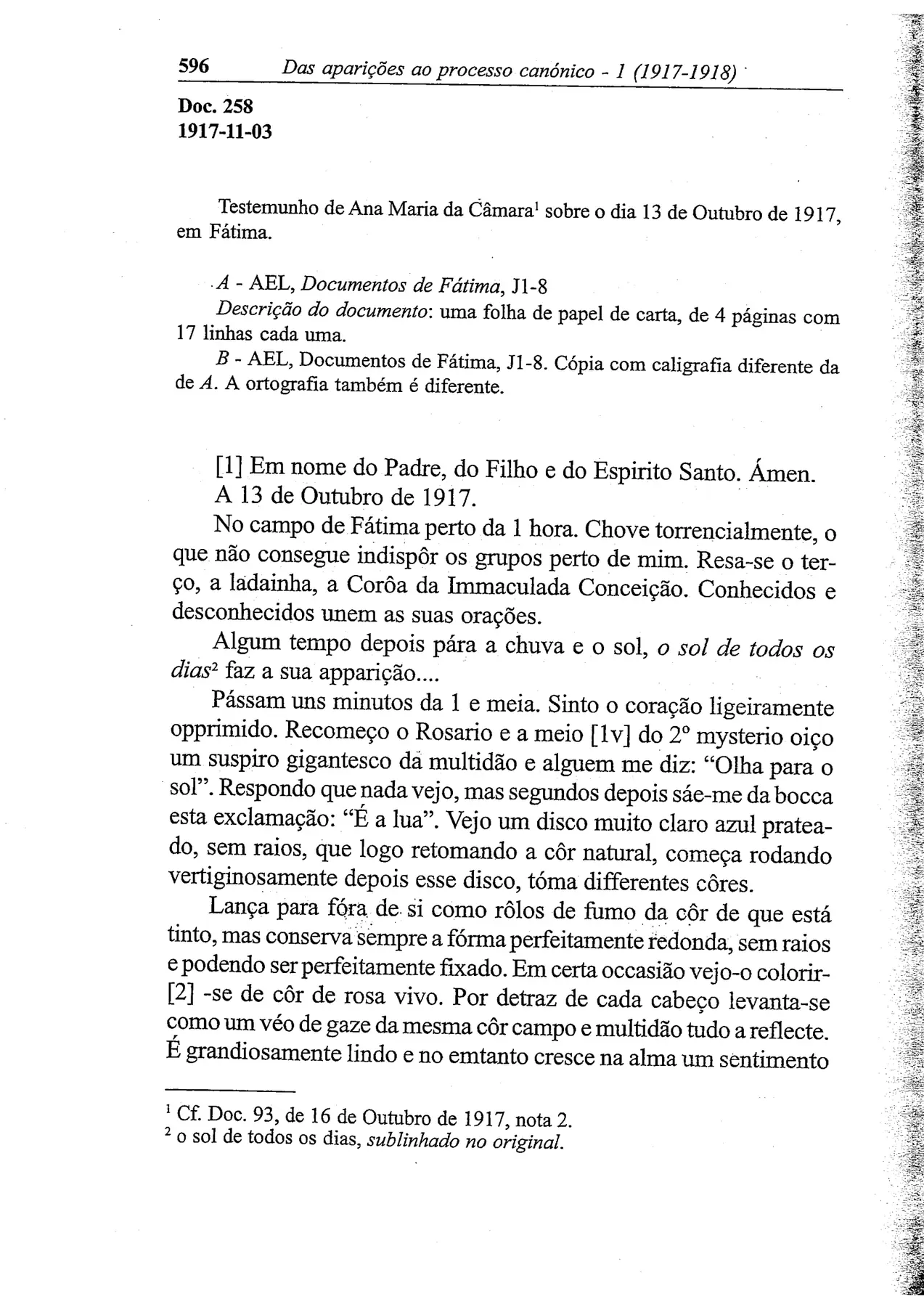
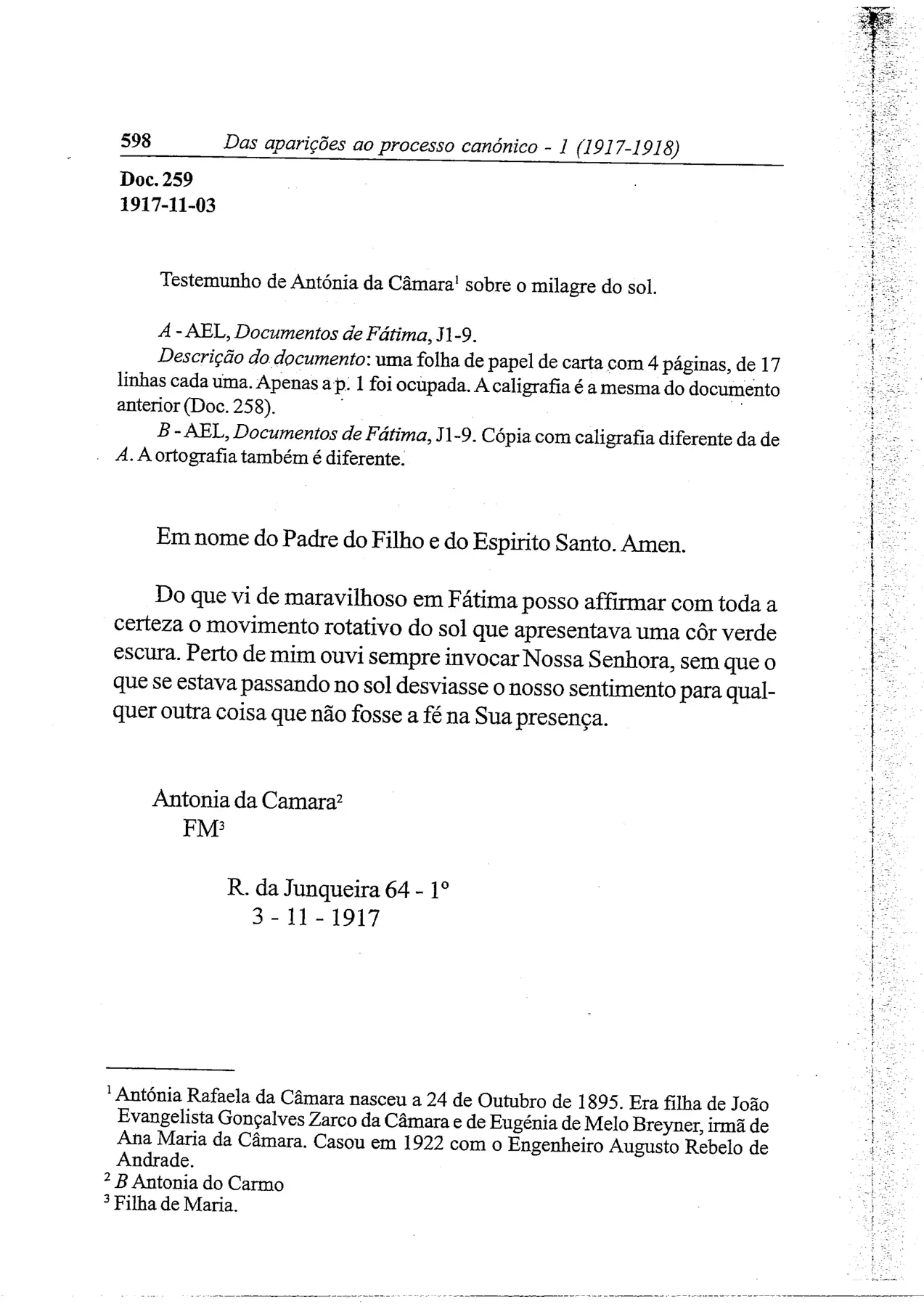
The old time4 is what counts. At half past5, more or less, by solar time, the sun, which until then had been covered by dense black clouds, since from eight in the morning the rain had not stopped for a moment, accompanied by a stormy wind, shows itself [1v] suddenly free of clouds, at the zenith; the rain stops; the sun looks like a plate of dull silver which it is possible to stare at without the slightest effort, and before the astonished eyes of the crowd, while the child, who addresses the Virgin, tells them to kneel and uncover their heads, the sun spins on itself in a dizzying movement, giving off gusts of heat like a lit oven that had been opened; the sun seems to approach the earth in abrupt and rapid movements, successively changes colour, and [2] the landscape turns yellow, then turns purplish, according to the colours taken on by the sun. This phenomenon lasts approximately 10 minutes, during which the crowd, on their knees and with joined hands, cried out for pardon and mercy.

From the place where the Virgin speaks to the little children there rose a white, transparent smoke, which forms a sort of little cloud enveloping the spot between two small oaks6 where the children await the apparition. The eldest little girl, Lucia, [2v] aged 10, asks the Virgin aloud: who are you, ma'am? What do you want, ma'am? The answers are not heard, but when the sun resumes its usual course the child turns to the people and, held up by a man7 who holds her in his arms, repeats the words of the Lady

I am the Virgin of the Rosary; I want a chapel to be built for me here.

Tell the people to mend their ways and stop offending God; tell them that peace is made today and that your soldiers will come back

The two other children, Francisco and Jacyntha, see the Virgin but do not speak to her.

Português (original)

Eu Maria Luisa Garrett Corrêa minha irmã Maria Garrett Corrêa minha cunhada e outras pessoas amigas que nos acompanhavam afirmamos que fomos testemunhas do que resumidamente passo a descrever3

Perto de sessenta mil pessoas aguardam a hora predita pelas creanças hora que a Virgem lhes anunciára se deveria dar o prodígio visível para todos os que no dia 13 de Outubro visitassem aquele lugar santo.

A hora antiga4 é a que regula. Á meia hora5, pouco mais ou menos pela hora solar, o sol que até essa ocasião estava cuberto por densas e negras nuvens, pois desde as oito da manhã a chuva não cessára um momento acompanhada por um vento tempestuoso, mostra-se de [1v] repente liberto de nuvens, no zenith, a chuva cessa, o sol lembra uma placa de prata fosca que é possível fixar sem o mínimo esforço, e aos olhos espantados da multidão, em quanto a creança, que se dirige á Virgem, manda que se ajoelhem e se descubram, o sol gira sobre si mesmo n'um movimento vertiginoso lançando bafaradas de calor como um forno acceso que se houvera aberto, o sol parece aproximar-se da terra em movimentos bruscos e rápidos sucessivamente muda de côr, e [2] a paisagem torna-se amarela depois torna-se arroxeada segundo as côres revestidas pelo sol. Este fenómeno dura aproximadamente 10 minutos durante os quais a multidão de joelhos e de mãos postas clamava perdão e misericórdia.

Do lugar aonde a Virgem falla ás creancinhas elevava-se um fumo branco transparente que forma como uma nuvensinha que envolve o lugar entre dois pequenos carvalhos6 aonde as creanças aguardam a aparição. A pequena mais velha, Lucia, [2v] de 10 anos, pergunta a Virgem em voz alta quem é vocês-mecê? Vocês-mecê o que quer? As respostas não se ouvem, mas quando o sol retoma o seu curso habitual a creança volta-se para o povo e ao colo de um homem7 que a segura nos braços repete as palavras da Senhora

Eu sou a Virgem do Rosario quero que me edifiquem aqui uma capella.

Diz ao povo que se emende de attentar contra Deus diz-lhe que hoje se faz a paz e que os vossos militares hão de voltar

As duas outras creanças Francisco e Jacyntha, vêem a Virgem mas não lhe falam.

Editor's notes (7)

1 Undated document. It was handed to the Bishop of Leiria on 10 March 1972 by the Rev. Dr. Hugo Fernandes de Azevedo, who had received it from a person in Porto.

2 We have no information that would allow us to identify the sister-in-law and the friends.

3 The author began by writing her testimony from "Nearly..."; she then inserted the introduction in the top margin of sheet 1: "I... to... describe". But for lack of space, two lines of that introduction had to occupy the spaces between the first and third lines.

4 Solar time, that is, the natural time of the sun. On the chronology of the solar phenomenon, see AMORIM, D.P., O Fenómeno solar de 13 de Outubro de 1917, Coimbra, "O Instituto", 1961, pp.8-16.

5 About 14.07h new time, summer time.

6 According to the existing documentation these were not oaks, but small holm oaks or holm-oak shrubs

7 This is Dr. Carlos de Azevedo Mendes (cf. DCF, vol. 1, Doc. 56, of p.13 October 1917, note 10, and DCF, vol. 2, Doc. B, of 13 September 1927).

1 Documento não datado. Foi entregue ao Sr. Bispo de Leiria em 10 de Março de 1972 pelo Rev. Dr. Hugo Fernandes de Azevedo, que o tinha recebido de uma pessoa do Porto.

2 Não temos elementos que nos permitam identificar a cunhada e as pessoas amigas.

3 A autora começou por escrever o seu testemunho a partir de "Perto de..." depois inseriu na margem superior da folha 1 a introdução: "Eu... até... descrever". Mas por falta de espaço, duas linhas dessa introdução tiveram de ocupar os espaços entre a primeira e a terceira linha.

4 Hora solar, isto é, a hora natural do sol. Sobre a cronologia do fenómeno solar, ver AMORIM, D.P., O Fenómeno solar de 13 de Outubro de 1917, Coimbra, "O Instituto", 1961, p.8-16.

5 Cerca das 14.07h da hora nova, hora de Verão.

6 Pela documentação existente não se tratava de carvalhos, mas de pequenas azinheiras ou carrasqueiras

7 Trata-se do Dr. Carlos de Azevedo Mendes (cf. DCF, vol. 1, Doc. 56, de p.13 de Outubro de 1917, nota 10 e DCF, vol. 2, Doc. B, de 13 de Setembro de 1927).

DCF III-1, Doc. 78 · note · Oct 1917 (2 days later)View scans (2)Link

Maria Romana

Pilgrimlady correspondent of A Ordem
13 OctFirst-handSaw itLetterScepticRain stoppingCloud / smoke columnPale / silver discSun spinningColours on people & landscapeSun changing colour
English

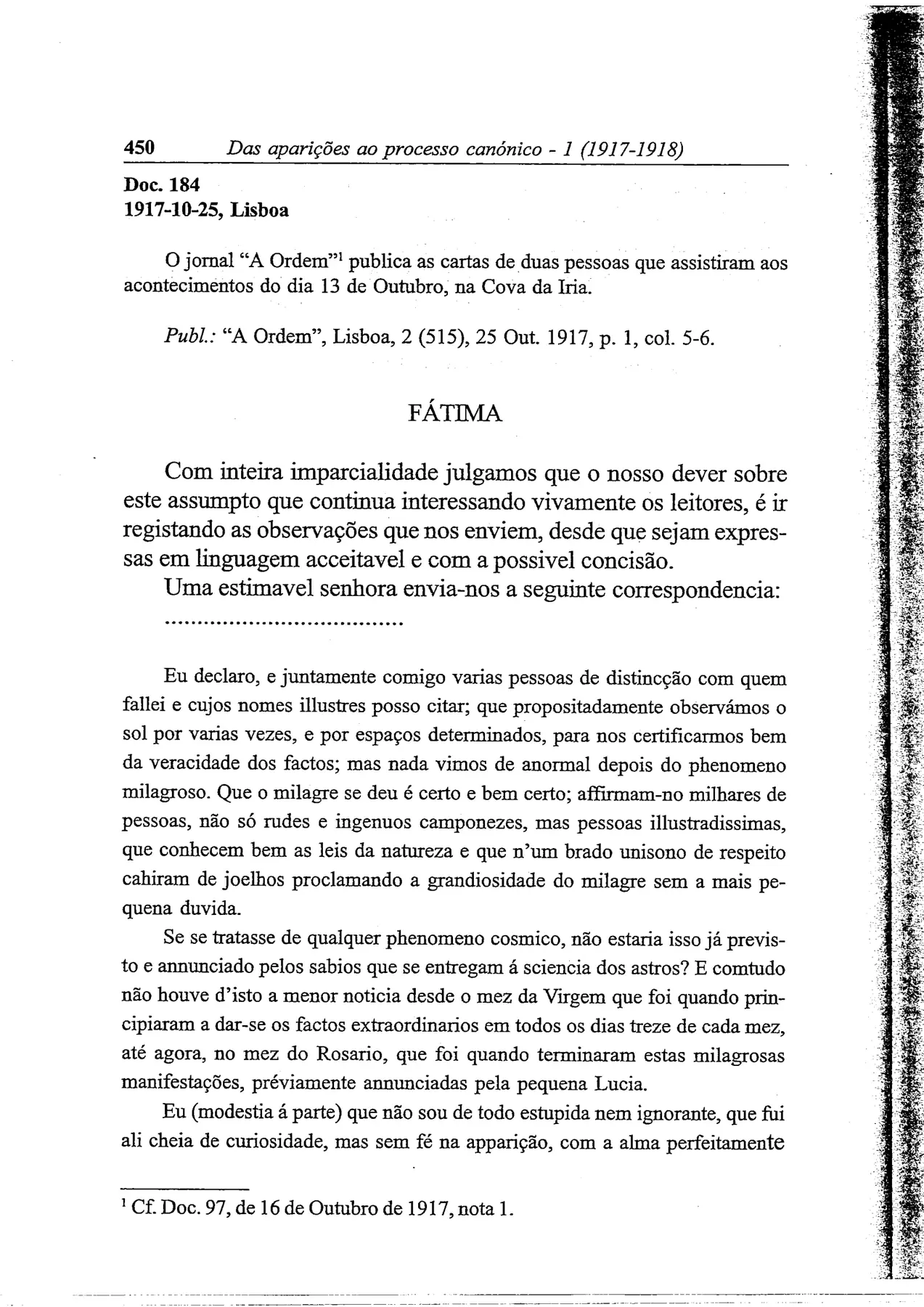
I declare, and together with me several persons of distinction with whom I have spoken and whose illustrious names I can cite, that we deliberately observed the sun several times, and for set periods, in order to make quite sure of the truth of the facts; but we saw nothing abnormal after the miraculous phenomenon. That the miracle took place is certain, quite certain; thousands of people affirm it, not only rough and naive peasants, but highly educated people who know the laws of nature well, and who with a unanimous cry of reverence fell to their knees proclaiming the grandeur of the miracle without the slightest doubt.

If it were some cosmic phenomenon, would it not already have been foreseen and announced by the learned men who devote themselves to the science of the stars? And yet there was not the slightest notice of it from the month of the Virgin, which was when the extraordinary events began to take place on every thirteenth of each month, until now, in the month of the Rosary, which was when these miraculous manifestations ended, announced in advance by little Lucia.

I (modesty aside), who am not altogether stupid or ignorant, who went there full of curiosity but without faith in the apparition, with my soul perfectly indifferent to the grandeur of the mystery, deaf to the voice of the inspired child who bade us in the name of Our Lady to look at the sun, fearing to damage or lose my sight by doing so, as is the general belief, I resisted the suggestion; and only after everyone around me, with ecstatic exclamations, had aroused my curiosity to look, did I brave the selfish fear of losing my sight, and then I looked; and, Blessed be God! I saw! I saw what thousands of people were contemplating!

The rain, which had fallen all night and all morning, fine, persistent and tiresome, completely covering the sky with a grey mantle, suddenly stopped at the hour announced by the little shepherds; the clouds began to tear apart and to open (allow me the comparison) as if it were the curtain of a theatre, to reveal the sun darting and casting its luminous rays on the place where the prophetic children were in ecstasy.

The sun then had the appearance of a globe of dull silver, surrounded by a purplish disc, very dark, as when eclipses are not entirely total.

Then a marvellous thing was seen! The sun spinning hurriedly as if it were a firework wheel: this prodigy was repeated three times in succession.

The prodigy announced by the little ones was taking place, so that all should believe in the apparition of Our Lady!

Then the clouds gradually disappeared from the firmament, which remained clear, serene and blue, as there is none to equal that of this beautiful Portuguese land of ours.

I looked around; the appearance and colours of the landscape were the same as those observed during an eclipse; the same bluish light, sui generis, of that very special electric blue peculiar to phenomena of this nature.

To show clearly how much I avoided letting myself be influenced by suggestion, I will say further that the yellow, red and purple colours that many people said they had seen when they lowered their eyes on to the landscape, or on to the handkerchiefs that the emotion of our tears obliged us to raise to our eyes, were nothing more than the result of our staring at the sun with the naked eye, which always happens in identical circumstances.

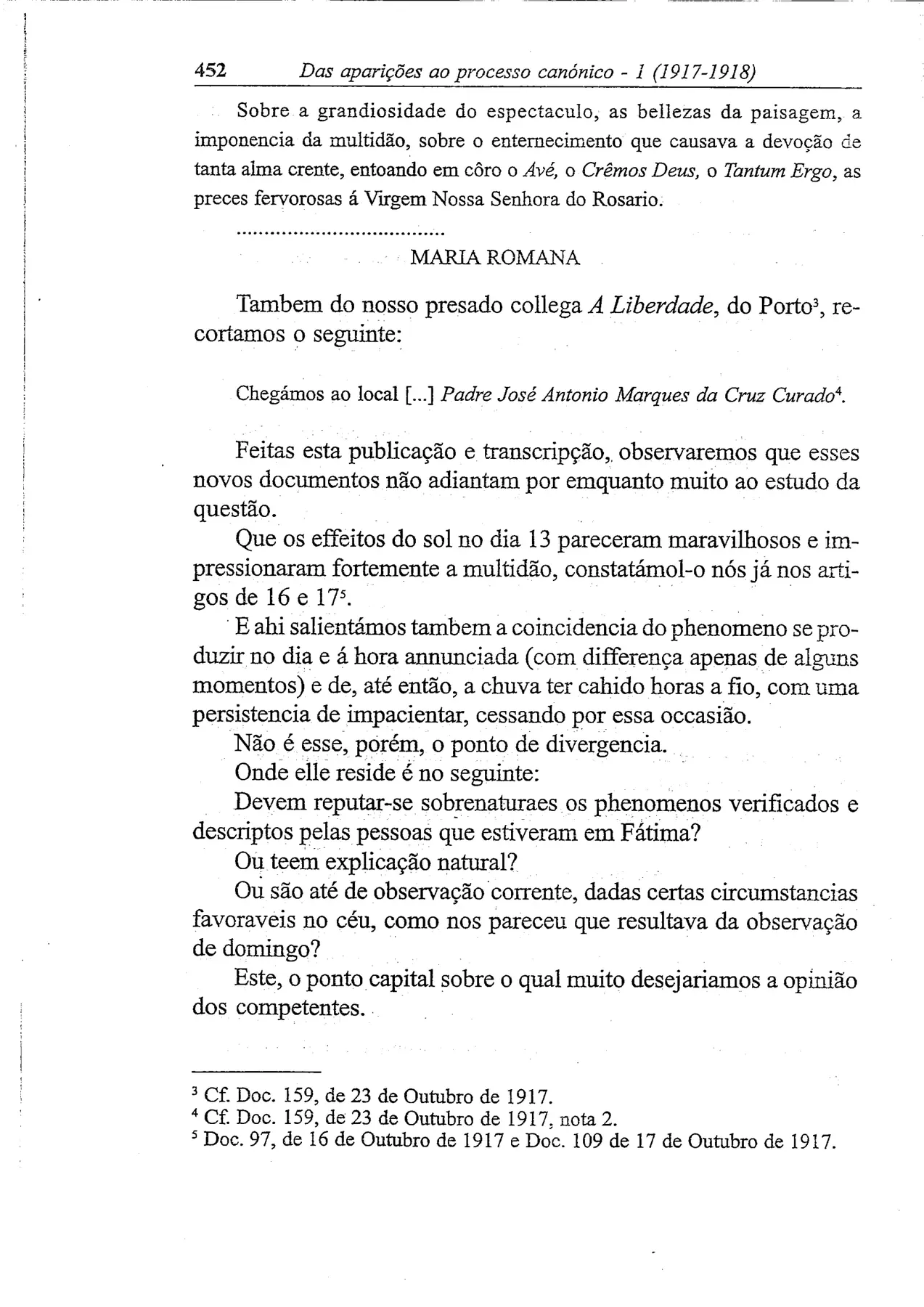
On the grandeur of the spectacle, the beauties of the landscape, the imposing sight of the multitude, on the tenderness caused by the devotion of so many believing souls, singing in chorus the Ave, the Credo, the Tantum Ergo, the fervent prayers to the Virgin Our Lady of the Rosary.

Português (original)

Eu declaro, e juntamente comigo varias pessoas de distincção com quem falei e cujos nomes illustres posso citar; que propositadamente observámos o sol por varias vezes, e por espaços determinados, para nos certificarmos bem da veracidade dos factos; mas nada vimos de anormal depois do fenomeno milagroso. Que o milagre se deu é certo e bem certo; affirmam-no milhares de pessoas, não só rudes e ingenuos camponezes, mas pessoas illustradissimas, que conhecem bem as leis da natureza e que n'um brado unisono de respeito cahiram de joelhos proclamando a grandiosidade do milagre sem a mais pequena duvida.

Se se tratasse de qualquer fenomeno cosmico, não estaria isso já previsto e annunciado pelos sabios que se entregam á sciencia dos astros? E comtudo não houve d'isto a menor noticia desde o mez da Virgem que foi quando principiaram a dar-se os factos extraordinarios em todos os dias treze de cada mez, até agora, no mez do Rosario, que foi quando terminaram estas milagrosas manifestações, previamente annunciadas pela pequena Lucia.

Eu (modestia á parte) que não sou de todo estúpida nem ignorante, que fui ali cheia de curiosidade, mas sem fé na aparição, com a alma perfeitamente alheia á grandiosidade do mysterio, surda ás vozes da inspirada creança que nos mandava em nome de Nossa Senhora olhar para o sol, receando estragar ou perder por isso a vista, segundo é crença geral; resistio á suggestão; e só depois de todos em volta de mim, em exclamações extaticas me despertarem a curiosidade de olhar, arrostei contra o receio egoista de perder a vista, e então olhei; e, Bemdito seja Deus! vi! Vi o que milhares de pessoas estavam contemplando!

A chuva que cahira toda a noite e toda a manhã, miudinha, persistente e enfadonha, cobrindo por completo o céu d'um manto cinzento, cessou de repente á hora annunciada pelos pastorinhos; as nuvens começaram a esfarrapar-se e a abrirem-se (permittam-me a comparação) como se fôra o panno d'um theatro, para deixarem ver o sol dardejando e insidindo os seus raios luminosos sobre o sitio onde se achavam em extasi as propheticas creanças.

O sol apresentava então o aspecto d'um globo de prata fôsca, circundando-o um disco arroxead, muito escuro, como quando os eclipses não são inteiramente totaes.

Viu-se então uma coisa maravilhosa! O sol girando apressadamente como se fôra uma roda de fogo d'artificio: este prodigio repetiu-se por tres vezes consecutivas.

Realisava-se o prodigio annunciado pelos pequenos, para que todos cressem na aparição de Nossa Senhora!

Depois as nuvens foram desaparecendo a pouco e pouco do firmamento, que ficou limpido, sereno e azul como não ha nenhum que se eguale ao d'esta nossa bella terra portugueza.

Olhei em volta; o aspecto e as côres da paisagem eram as mesmas que se observam durante a duração d'um eclipse; a mesma luz azulada, sui generis, d'esse azul electrico especialissimo e particular aos fenomenos d'esta natureza.

Para bem mostrar quanto eu evitei deixar-me suggestionar, direi ainda que as côres amarella, vermelha e rôxa que muitas pessoas diziam ter visto ao baixarem os olhos sobre a paisagem, ou sobre os lenços que a commoção das lagrimas nos obrigava a levar aos olhos, não era mais do que o resultado de estarmos fixando o sol a olho nu, o que sempre acontece em circumstancias identicas.

Sobre a grandiosidade do espectaculo, as bellezas da paisagem, a imponencia da multidão, sobre o enternecimento que causava a devoção de tanta alma crente, entoando em côro o Avé, o Crêmos Deus, o Tantum Ergo, as preces fervorosas á Virgem Nossa Senhora do Rosario.

DCF III-1, Doc. 184 · press · Oct 1917 (2 days later)View scans (4)Link

L. de S.

PilgrimCatholic lady, subscriber of Raio de Luz
13 OctFirst-handSaw itLetterCrowd sceneRain stoppingCloud / smoke columnPale / silver discSun spinningSun falling
English

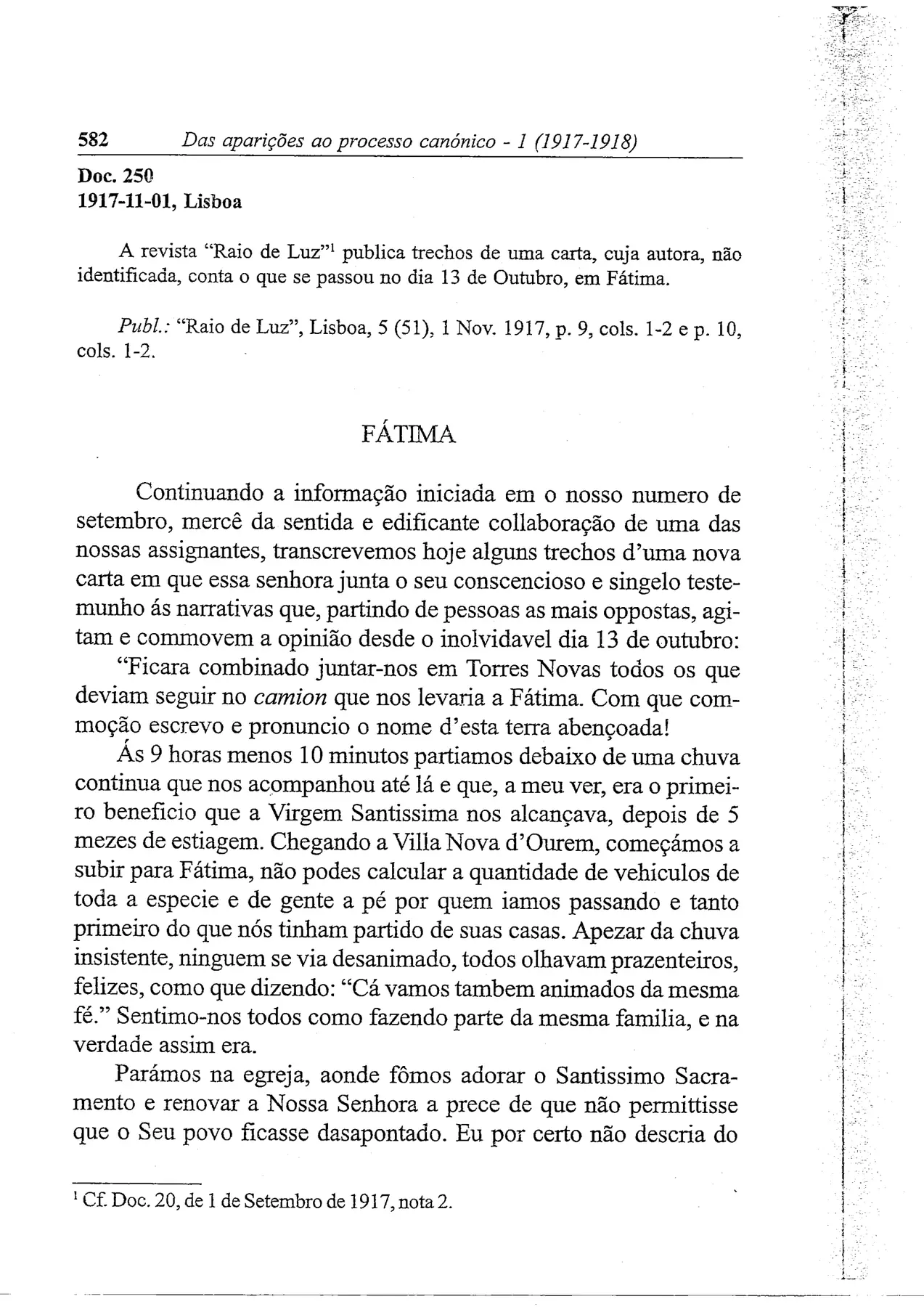
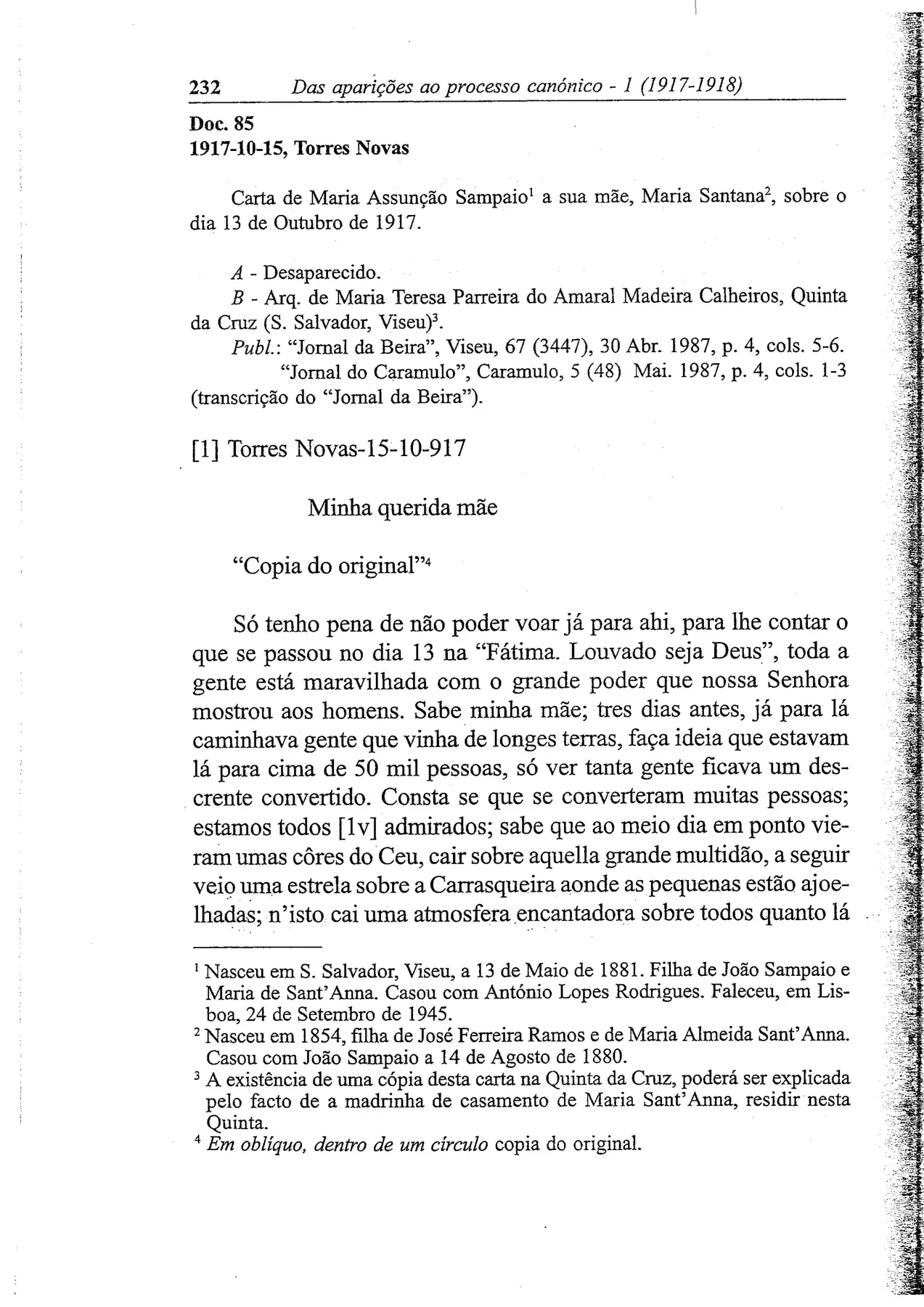
“It had been arranged that all those who were to travel in the camion (lorry) that would take us to Fátima should meet in Torres Novas. With what emotion I write and pronounce the name of this blessed place!

At 10 minutes to 9 we set off in continuous rain which accompanied us all the way there and which, in my view, was the first benefit that the Most Holy Virgin obtained for us, after 5 months of drought. On reaching Villa Nova d’Ourem we began to climb towards Fátima; you cannot imagine the quantity of vehicles of every kind and of people on foot that we kept passing, who had left their homes so much earlier than we had. In spite of the persistent rain, no one looked discouraged; everyone looked cheerful, happy, as if saying: “Here we go too, inspired by the same faith.” We all felt as though we were part of the same family, and so indeed it was.

We stopped at the church, where we went to adore the Blessed Sacrament and renew to Our Lady the prayer that she would not allow Her people to be disappointed. I certainly did not disbelieve in the power of God; I disbelieved that it would be granted to us to see it manifest itself in our favour after being so outraged, so ignored!...

It was noon; we ate something from our provisions, more from reflection than from need. At 1 o'clock we set off for the place... and you can have no idea of the extent of ground occupied by a compact multitude, in the greatest calm and respect; of the quantity of automobiles, carriages, wagons and transport of every kind that filled the road for a stretch of almost a kilometre, scarcely letting through, with difficulty, anyone who ventured to cross it on foot. We stayed inside the camion; nothing else was possible.

The hour was approaching and I was certain that the weather was going to clear. In fact, a little before 2 o'clock the rain stopped, though the sky remained leaden. Suddenly all those people, possessed by indescribable anxiety and some of them perhaps disheartened, began to notice a light mist at the place of the holm-oak shrub, and after a few minutes we saw everyone turning towards the sun. I heard afterwards that Our Lady had said at that instant to Lucia (one of the children): “Tell the People to look at the sun.”

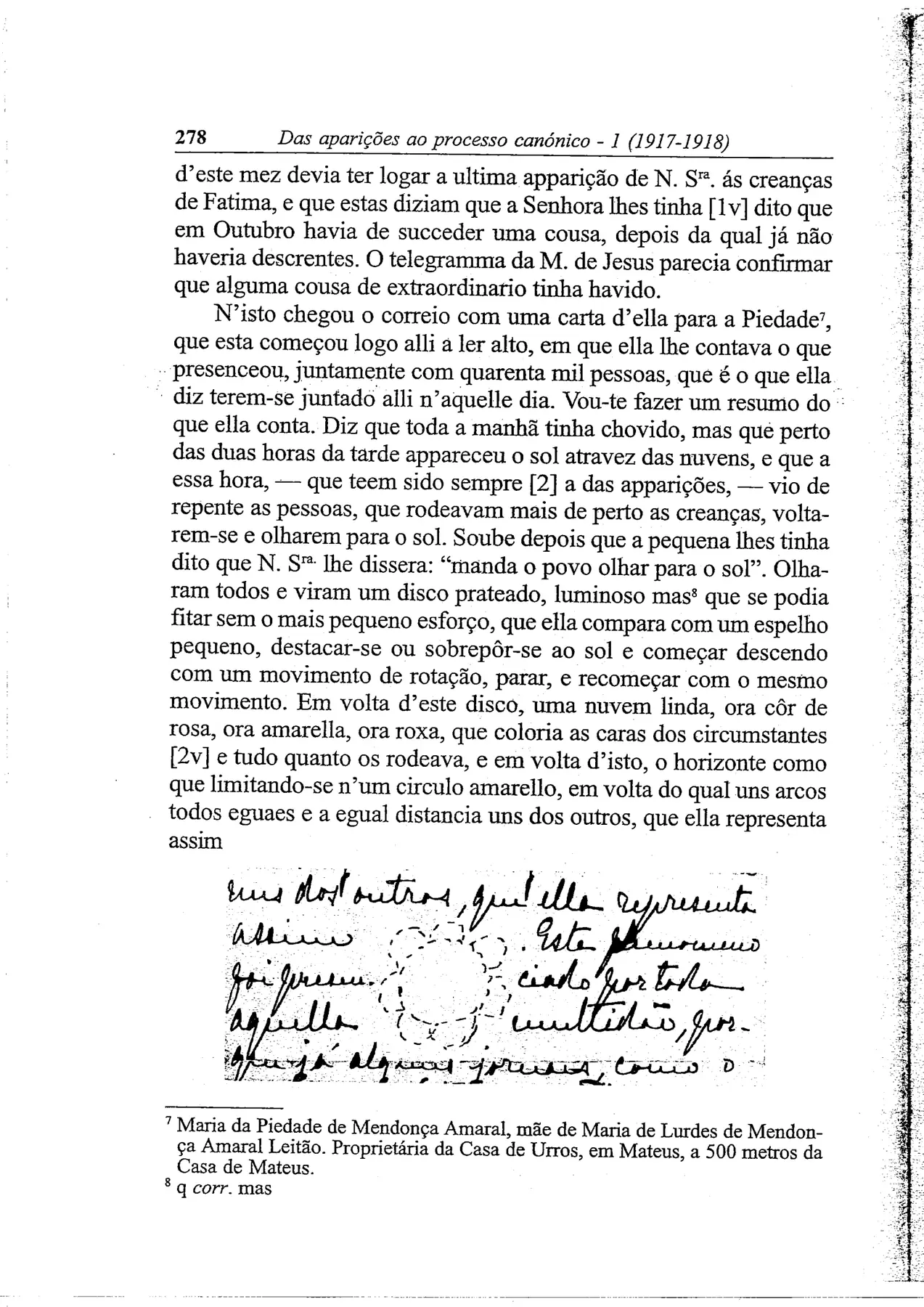
Suddenly a luminous disc the size of a large host, but which everyone could gaze at as one gazes at the moon, seemed to detach itself from the sun (or rather to place itself in front of it), visibly coming down in a continuous rotation which, after a pause, was repeated. A lovely cloud, now fire-coloured, now purple, now pink, now golden, appeared and disappeared in succession, the colour being reflected not only on all the bystanders but on that whole enclosure. The yellow colour above all was very impressive, and it had already been noticed on the other occasions, but less intense. The horizon was bounded in a perfect circle by luminous spots equal in size and in distance from one another, giving somewhat the impression of field fires, but in the yellowish tone that is sometimes seen at sunset. This whole effect was lasting, and the spots I mention appeared one after another. Simply marvellous and astounding!

I had taken a list of the people for whom I wanted to pray especially. It was as if I had guessed that there I would only be able to cry out: “Praised be God, praised be God”; and that without ceasing!

Many people (and people wholly worthy of credit) saw a lovely star moving towards the oak tree with a glow.

I was with the two little girls, who were dressed in white with very simple little crowns on their little heads. They told me that Our Lady appeared to them with St. Joseph and the Child beside her; she said that she was the Lady of the Rosary, that they should pray it a great deal, that this was a warning, but that if they did not repent and went on offending her Divine Son, He would send a great punishment on Portugal.

The two little girls, separately, described the vision in the same way, and Lucia, who, given her young age, should have been out of her wits in the midst of that commotion she found around her, kept telling everyone in a clear voice and without getting flustered, as she passed by (in her father's arms) — what Our Lady had said to her

Português (original)

Ficara combinado juntar-nos em Torres Novas todos os que deviam seguir no camion que nos levaria a Fátima. Com que commoção escrevo e pronuncio o nome d’esta terra abençoada!

Ás 9 horas menos 10 minutos partiamos debaixo de uma chuva continua que nos acompanhou até lá e que, a meu ver, era o primeiro beneficio que a Virgem Santissima nos alcançava, depois de 5 mezes de estiagem. Chegando a Villa Nova d’Ourem, começámos a subir para Fátima, não podes calcular a quantidade de vehiculos de toda a especie e de gente a pé por quem iam passando e tanto primeiro do que nós tinham partido de suas casas. Apezar da chuva insistente, ninguem se via desanimado, todos olhavam prazenteiros, felizes, como que dizendo: “Cá vamos tambem animados da mesma fé.” Sentimo-nos todos como fazendo parte da mesma familia, e na verdade assim era.

Parámos na egreja, aonde fômos adorar o Santissimo Sacramento e renovar a Nossa Senhora a prece de que não permittisse que o Seu povo ficasse dasapontado. Eu por certo não descreia do poder de Deus, descreia de que nos fôsse dado vê-lo manifestar-se em nosso favor depois de tão ultrajado, tão desconhecido!...

Era meio dia, comemos alguma coisa dos nossos farneis, mais por reflexão do que por necessidade. Á 1 hora partimos para o local... e não podes fazer ideia da extensão de terreno ocupada por uma multidão compacta, no maior socego e respeito; da quantidade de automoveis, carruagens, galeras e transportes de toda a especie que enchia a estrada n’uma extensão de quasi um kilometro, mal deixando passar a custo quem se aventurasse a atravessal-a a pé. Estivemos dentro do camion nem era possivel outra coisa.

Aproximava-se a hora e eu tinha a certeza que o tempo ia levantar. Effectivamente um bocadinho antes das 2 horas parou a chuva, conservando-se porem o céu de chumbo. De repente, toda aquella gente possuida de indiscriptivel anciedade e parte d’ella talvez desanimada começou a notar uma ligeira nevoa no sitio da carrasqueira e passando-se alguns minutos vimos todos a voltarem se para o lado do sol. Ouvi depois que Nossa Senhora tinha dito n’esse instante a Lucia (uma das creanças): “Manda o Povo olhar para o sol.”

De repente um disco luminoso do tamanho d’uma hostia grande, mas que todos podiam fitar como se fita a lua, como que se destacou do sol, (ou antes se lhe antepoz) baixando visivelmente n’uma rotação seguida que depois d’uma paragem se repetiu. Uma nuvem linda ora côr de fogo, ora roxa, ora côr de rosa, ora dourada se mostrava e desaparecia sucessivamente reflectindo-se a côr não só em todos os circumstantes como em todo aquelle recinto. A côr amarella sobretudo foi muito impressionante e já das outras vezes se tinha feito notar mas menos intensa. O horizonte, era limitado em circulo perfeito por focos luminosos eguaes em tamanho e distancia uns dos outros dando um pouco a impressão de quémadas mas no tom amarellado que por vezes se nota ao pôr do sol. Todo este effeito foi duradouro e os fócos a que alludo foram surgindo uns apoz outros. Simplesmente maravilhoso e assombroso!

Levei uma lista das pessoas por quem queria pedir especialmente. Parecia que adivinhára que lá só poderia gritar: “Louvado seja Deus, louvado seja Deus”; e isto sem cessar!

Muitos viram (e pessoas de todo o credito) uma estrella linda a caminhar na direcção da carvalheira com clarão.

Estive com as duas pequenitas que iam vestidinhas de branco com umas corôasinhas muito singelas nas cabecinhas. Disséram-me que Nossa Senhora lhes apareceu com S. José e o Menino ao pé, disse que era a Senhora do Rosario, que o rezassem muito, que isto era um aviso mas que se se não arrependessem e continuassem a offender o seu Divino Filho, Este mandaria um grande castigo a Portugal.

As duas pequenas em separado, fizeram a descripção da visão da mesma fórma e a Lucia, que, dado a sua pouca idade deveria estar doida no meio d'aquelle alvoroço de que se via rodeada, ia dizendo a todos em voz clara e sem se alterar, á medida que ia passando (ao collo do pae) — o que Nossa Senhora lhe disséra

DCF III-1, Doc. 250 · press · Oct 1917 (2 days later)View scans (4)Link

Avelino de Almeida

Journalistjournalist, O Século (anticlerical daily)
13 OctFirst-handSaw itLetterScepticTravelled from afarCrowd scene
English

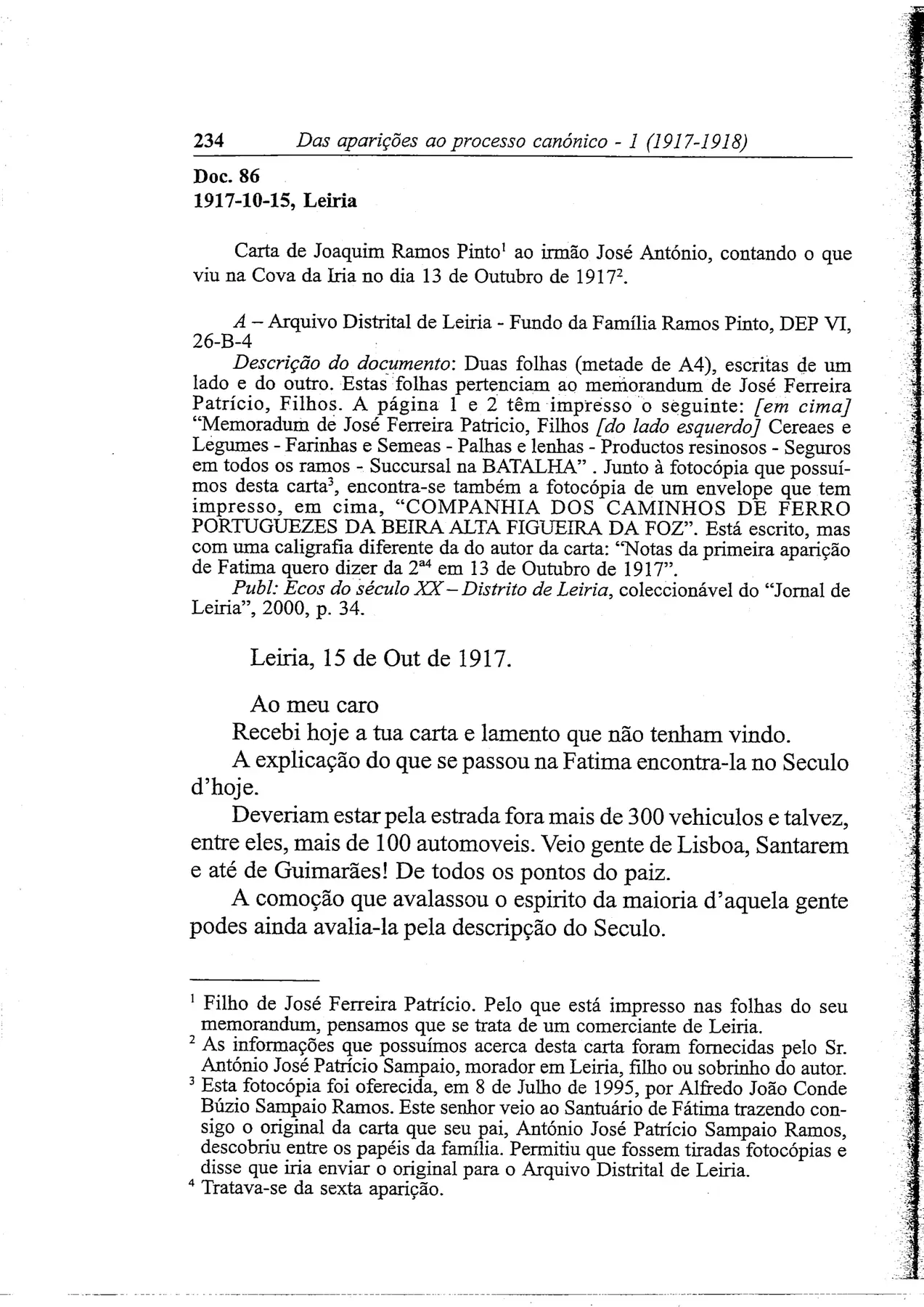
I saw extraordinary things which I shall tell you about later. There must have been some 40,000 people!!!

Português (original)

Vi coisas extraordinárias que depois te contarei. Estariam umas 40.000 pessoas!!!

DCF III-1, Doc. 54 · postcard · 13 Oct 1917View scans (2)Link

Pe. Manuel Pereira da Silva

Clergyparish priest of Monte Redondo
13 OctFirst-handSaw itLetterCrowd sceneSun spinningSun fallingLight dimmingColours on people & landscape
English

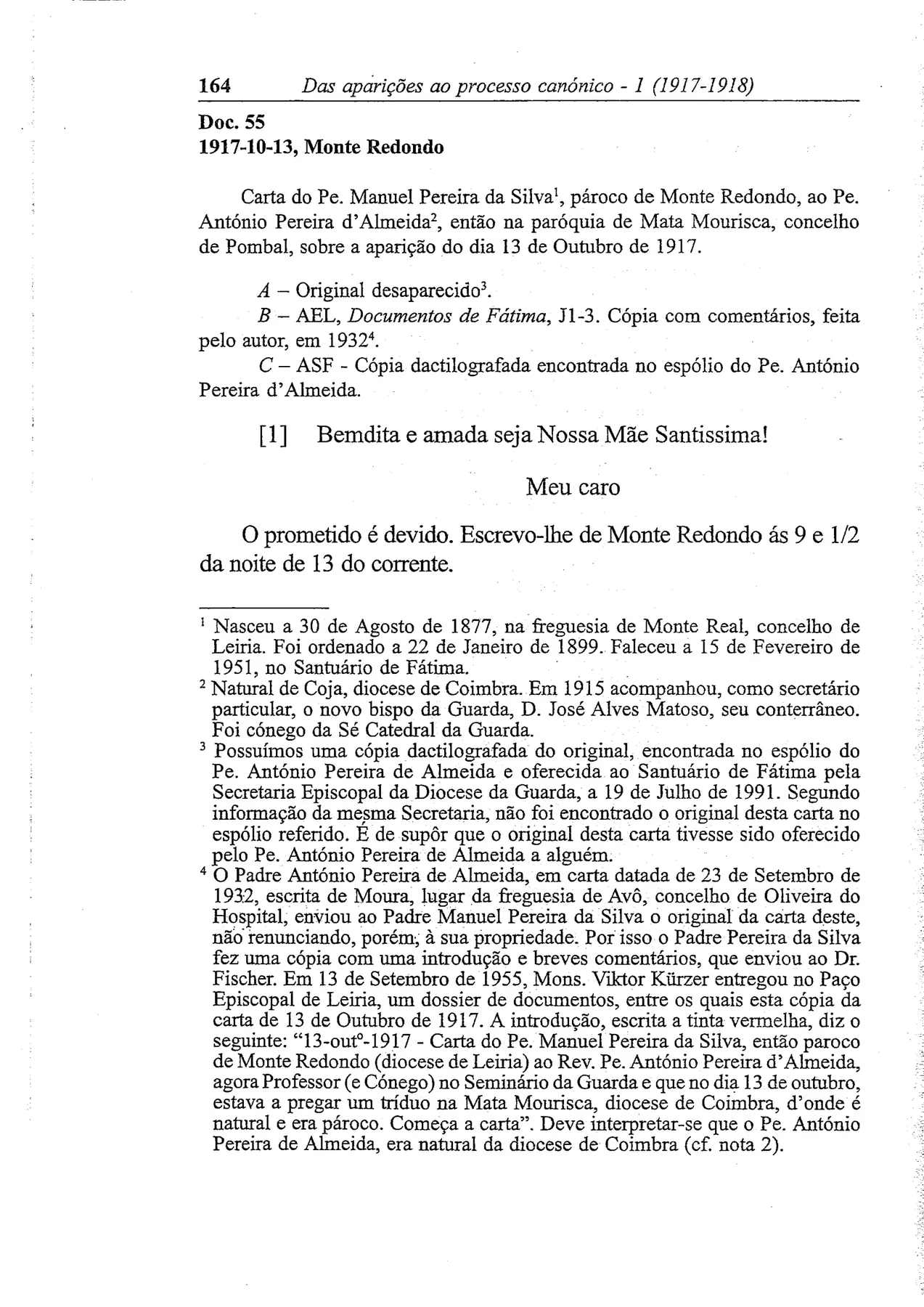
Our Lady has granted my wish. She deigned to give an evident sign of her apparition to the little girls of Fatima.

At noon there were at Fatima more than ninety motor cars, an endless number of carriages of all sizes, shapes and makes, and an enormous multitude of people (a great multitude ... of all nations (?)7 and tongues (?)). Everyone soaked, drenched, dripping, but cheerful.

Around noon the little girls came to the spot and began, as usual, saying the rosary. When it was over, the little ones10 asked Our Lady of the Rosary whether she would give the promised sign. Immediately the sun appeared with its circumference well defined. It comes closer [lv] as if down to the height of the clouds and begins spinning dizzily on itself like a fixed firework wheel, with some intermissions, for more than eight minutes. Everything became almost dark and everyone's features were yellowish. Everyone knelt, even in the mud.

The whole time, here and there, people were singing, praying, etc. Everyone left satisfied. The little girls said that Our Lady of the Rosary appeared. Then (when the sun gave the sign) St. Joseph appeared. The little girls said that he had said that today, or soon, the flag of peace would be raised16; that they should say the rosary, for soon our troops would be here; that they should do penance, that they should change their lives because, otherwise, the world would come to an end.

Português (original)

Nossa Senhora fez-me a vontade. Dignou-se dar signal evidente da sua aparição às pequenas da Fatima.

Ao meio dia estavam na Fatima mais de noventa automoveis, uma infinidade de carros de todos os tamanhos, formas e feitios, e uma multidão enorme de pessoas (multitudo magna ... ex omnibus gentibus (?)7 et linguis (?)). Tudo molhadinho, encharcado, a escorrer mas alegre.

Cerca do meio dia vieram as pequenas ao local e começaram, como de costume, resando o terço. Acabado elle, perguntaram os pequenos10 a N. Senhora do Rosario se dava o tal signal prometido. Imediatamente apareceu o sol com a circunferencia bem definida. Aproxima-se [lv] como que até á altura das nuvens e começa girando sobre si mesmo vertiginosamente como uma roda de fogo prêso, com algumas intermitencias, durante mais de oito minutos. Ficou tudo quasi escuro e as feições de cada um eram amareladas. Tudo ajoelhou mesmo na lama.

Em todo o tempo, aqui e além, cantava-se, rezava-se, etc. Tudo saiu satisfeito. As pequenas disseram que apareceu N. Senhora do Rosario. Depois apareceu (quando o sol deu signal) S. José. As pequenas disseram que este dissera que hoje, ou breve, seria arvorada a bandeira da paz16; que resassem o terço que em breve cá teriam as nossas tropas; que fizessem penitencia, que mudassem de vida porque, de contrario, se acabaria o mundo.

Editor's notes (3)

7 The question marks are in the text.

10 C Acabado êle, perguntaram as pequenas. As can be seen, the Author refers to the seers, Lúcia, Francisco and Jacinta, sometimes as as pequenas and sometimes as os pequenos, an imprecision repeated further on. Equally imprecise is the plural perguntaram (preguntaram), since only Lúcia spoke with the apparition.

16 Fr. Manuel Pereira da Silva again shows how precarious his source of information was when he attributes to St. Joseph (este dissera) the news of the end of the war. Let the reader also note the hesitation over the date. He writes: "today or soon". It can be seen that, on that very day, 13 October, different versions were already going round.

7 As interrogações são do texto.

10 C Acabado êle, perguntaram as pequenas. Como se vê, o Autor trata os videntes, Lúcia, Francisco e Jacinta, ora por as pequenas ora por os pequenos, imprecisão que se repete adiante. Igualmente impreciso é o plural perguntaram (preguntaram), pois só Lúcia falava com a aparição.

16 O Pe. Manuel Pereira da Silva volta a mostrar como era precária a sua fonte de informação, quando atribui a S. José (este dissera) a notícia do fim da guerra. Note também o leitor a hesitação sobre a data. Escreve: "hoje ou em breve". Vê-se que, no mesmo dia 13 de Outubro, corriam já versões diferentes.

DCF III-1, Doc. 55 · letter · 13 Oct 1917View scans (4)Link

Maria Bettina Basto

Pilgrim19-year-old young woman from Lisbon
13 OctFirst-handSaw itNoteTravelled from afarCrowd sceneRain stoppingCloud / smoke columnPale / silver discColours on people & landscapeSun spinning
English

We spent the day in preparations for the journey. We were to leave at 11 p.m., making the journey by night [4v] so as to arrive there in the morning.

Towards night the weather begins to cloud over and shortly afterwards the thunderstorm breaks but what a thunderstorm it was past midnight and nothing can be heard but thunder and the lightning flashes are continuous what to do not leaving is a desolation. Carlos crosses himself and says that like this he is not going we wait asking Our Lady to drive away the thunder-[5]storm. At 2 o'clock the weather is better they decide to leave, the night is pitch dark they harness the mule to the cart; inside they put some low chairs for us, and with some blankets there we settle in. On the front bench go Carlos's wife and her goddaughter17 behind go we two18 Regina19 and Emilia20. Carlos leads the mule by the halter and so we begin the journey.

[5v] Every now and then, the flashes light up the road, the thunderstorm is further away but continues.

So we go on for more than an hour the roads are dreadful the cart keeps jolting it has the advantage of not letting us sleep Emilia makes us laugh constantly.

We have already begun to climb the Serra de Aire the worst of it is that the rain comes back [6] and we have little protection, for the water that falls from the umbrellas soaks the cart and wets the blankets.

Carlos at times climbs on to the bench and goes on guiding the animal the good thing is that he knows the roads very well.

It is beginning to get light the rain is now very fine almost a wet fog as there is now some light [6v] we see trees split by the lightning of the storm here in the hills, it must have been dreadful. Carlos was right to say he would not come; he knows them.

We have gone a long way over these hills, which seem to have no end. Now they say we are near Fatima it is raining in earnest we are already soaked. So as not to get too cold and on the climbs to help the mule we all go on foot, except Emilia who cannot [7] walk much.

At last we arrive at Fatima it is 9 o'clock the weather is a little better, but the sky is completely overcast and threatens more rain a great many people are arriving, by various roads through the hills like us most of them are wet but they all go, I don't even know what for, as nothing has been fixed and it is only because they say the Lady will speak to Lucia today.

[7v] The cart stays in Fatima we ate something, and now we are going on foot to the Cova da Iria which is the place where they say the apparitions have been.

We walk almost an hour when we arrive at the field a stretch considerably lower than the road and where there are only a few holm oaks, there are a good many people waiting, let's see for what!

It is nearly [8] noon they say the little shepherds are going to arrive I would like to see them. The place where the apparitions have already taken place is marked out with some sticks to leave space for the little ones to be freer from the people but we can no longer get very close, for there are a great many people. The ground is so soaked that our feet sink in we are already so muddy. We decide to stay [8v] at a slightly higher point though further away. There is movement in the crowd it is the little shepherds arriving some men clear a way for them I barely see them they go to the place with the sticks it is raining in earnest.

People begin to say that Lucia says to close the umbrellas, that the Lady is coming but it is raining so much nevertheless everyone obeys and we close our umbrellas. Indeed shortly afterwards the rain stops, but we see nothing more. [9] Our eyes search everywhere. Now a small cloud seems to settle on a holm oak by the sticks, the sun appears between clouds, but with no brilliance at all, it looks like the moon and one would say it has a cross in the middle and now, oh wonder the atmosphere is tinged with the colours of the rainbow I see Rita's24 white felt hat orange then green, then bluish then pink [9v]25

[10] and lastly golden; everything is golden what a lovely thing!

Everyone feels fascinated a man near us falls to the ground unconscious suddenly, the sun completely black seems to come loose from the sky and begins to spin round on itself very fast it looks as if it is going to fall a cry is heard from the whole crowd which falls to its knees begging for mercy.

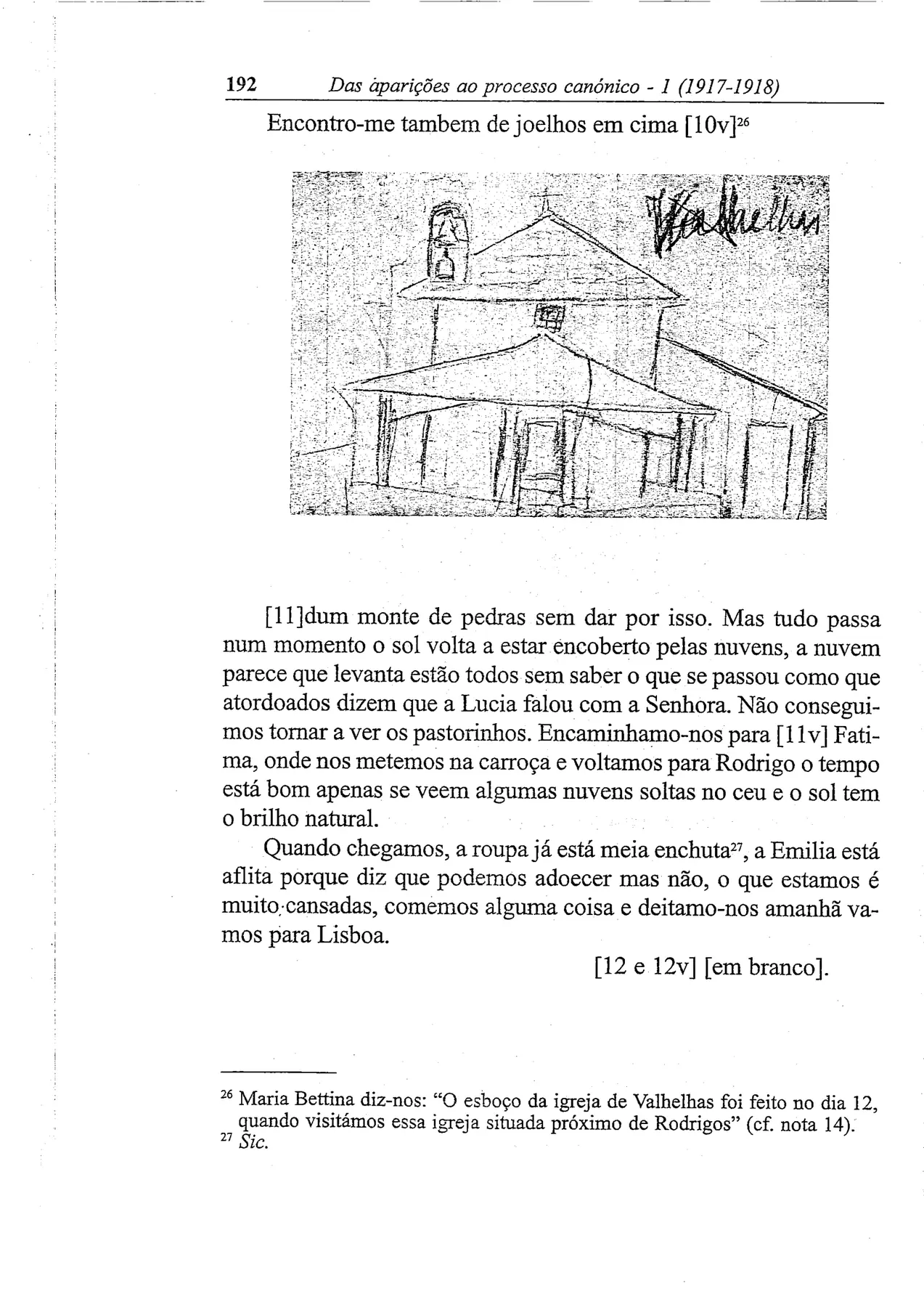
I too find myself on my knees on top [10v]26

[11] of a heap of stones without noticing. But it all passes in a moment the sun is once more hidden by the clouds, the cloud seems to lift everyone is without knowing what has happened as if stunned they say Lucia spoke with the Lady. We do not manage to see the little shepherds again. We make our way to [11v] Fátima, where we get into the cart and return to Rodrigo the weather is fine only a few scattered clouds can be seen in the sky and the sun has its natural brilliance.

Português (original)

Passamos o dia em preparativos para a viagem. Deviamos partir às 11 h da noite fazendo a viagem de noite [4v] para lá chegar de manhã.

Para a noite o tempo começa a toldar-se e pouco depois a trovoada desencadeia-se mas que trovoada era mais de meia noite e não se ouvem senão trovões e as faiscas são continuadas que fazer não partir é uma desolação. O Carlos persigna-se e diz que assim não vai espera-se pedindo a N. Senhora que afaste a tro-[5]voada. Às 2h o tempo está melhor decidem-se a partir, a noite está escurissima prendem a mula à carroça; dentro poem umas cadeiras baixas para nós, e com uns cobertores lá nos instalamos. No banco da frente vai a mulher do Carlos e a afilhada17 a trás vamos nós18 a Regina19 e a Emilia20. O Carlos leva a mula pela arreata e assim começamos a viagem.

[5v] De quando em quando, os clarões iluminam o caminho, a trovoada está mais longe mas continua.

Assim andamos mais de uma hora os caminhos são medonhos a carroça vai sempre aos tombos tem a vantagem de não nos deixar dormir a Emilia faz-nos rir constantemente.

Já começamos a subir a serra de Aire o pior é que a chuva volta [6] e nós temos pouca defesa, pois a agua que cai dos chapeus de chuva encharca a carroça e molha os cobertores.

O Carlos uns bocados sobe para o banco e lá continua a guiar o bicho o que vale é que conhece muito bem os caminhos.

Começa a clarear a chuva, agora é miudinha quasi um nevoeiro molhado como já está alguma luz [6v] vemos arvores rachadas pelas faiscas da trovoada aqui na serra, devia ter sido medonha. Bem dizia o Carlos que não vinha; ele já as conhece.

Muito temos andado por esta serra que parece não ter fim. Agora dizem que estamos perto de Fatima chove a valer já estamos encharcadas. Para não arrefecer muito e nas subidas para ajudar a mula vamos todos a pé, menos a Emilia que não pode [7] andar muito.

Finalmente chegamos a Fatima são 9h o tempo está um pouco melhor, mas o céu está todo coberto e ameaça mais chuva vem chegando muita gente, por vários caminhos da serra como nós veem molhados a maior parte mas todos vão, nem eu sei para quê, pois não está nada marcado e é só porque dizem que a Senhora falará hoje à Lucia.

[7v] A carroça fica em Fatima comemos alguma coisa, e agora vamos a pé para a Cova da Iria que é o lugar onde dizem tem havido as aparições.

Andamos quasi uma hora quando chegamos ao campo uma extensão bastante mais baixa que a estrada e onde há apenas algumas azinheiras, está bastante gente que espera, vamos a ver o quê!

É perto de meio [8] dia dizem que os pastorinhos vão chegar gostava de os ver. O local onde se deram já as aparições está marcado com uns paus para deixar espaço para os pequenos estarem mais livres do povo mas já não podemos aproximar-nos muito, pois está muita gente. A terra está tão encharcada que os pés enterram-se já estamos de tal maneira enlameadas. Resolvemos ficar [8v] num ponto um pouco mais alto embora mais longe. Há movimento na multidão são os pastorinhos que chegam uns homens abrem-lhe caminho mal os vejo vão para o sítio dos paus chove a valer.

Começa a dizer-se que a Lucia diz para fecharem os chapeus, que a Senhora vem mas chove tanto embora todos obedecem e fechamos os chapeus. Com efeito pouco depois a chuva pára, mas não vemos mais nada. [9] Os nossos olhos procuram por toda a parte. Agora uma pequena nuvem parece que pousa sobre uma azinheira ao pé dos paus, o sol aparece entre nuvens, mas sem brilho nenhum, parece a lua e dir-se-ia que tem uma cruz no meio e agora, ó maravilha a atmosfera tinge-se das cores do arco-íris vejo o chapéu de feltro branco da Rita24 cor de laranja depois verde, depois azulado depois rosa [9v]25

[10] e por último doirado; está tudo doirado que coisa linda!

Todos se sentem fascinados um homem perto de nós cai no chão sem sentidos de repente, o sol negro completamente parece que se despega do céu e começa a rodar sobre si mesmo muito depressa parece que vai cair ouve-se um grito de toda a multidão que cai de joelhos pedindo misericórdia.

Encontro-me também de joelhos em cima [10v]26

[11] dum monte de pedras sem dar por isso. Mas tudo passa num momento o sol volta a estar encoberto pelas nuvens, a nuvem parece que levanta estão todos sem saber o que se passou como que atordoados dizem que a Lucia falou com a Senhora. Não conseguimos tornar a ver os pastorinhos. Encaminhamo-nos para [11v] Fátima, onde nos metemos na carroça e voltamos para Rodrigo o tempo está bom apenas se veem algumas nuvens soltas no céu e o sol tem o brilho natural.

Editor's notes (7)

17 Clotilde da Assunção Ferreira, who came to marry Manuel Pinto, of Carvalhal da Aroeira. Died 4 March 1986.

18 That is, the Author and her sister Rita (cf. note 24).

19 Regina Ferreira was orphaned while still small, and went to live in the house of her cousin Isabel da Nóbrega Machado. She died in 1953.

20 Housekeeper in the house of Councillor Augusto Jacques de Magalhães Machado, married to Isabel da Nóbrega Machado, neighbours and friends of the Basto family (cf. notes 3 and 15).

24 Rita, sister of Maria Bettina. She was born on 1 March 1896. She married the sculptor Salvador Barata Feyo (1899-1990). Rita died on 8 August 1969, in Porto.

25 Maria Bettina tells us: "the silhouette I drew was what we imagined to be the figure of the Lady who appeared to the little shepherds".

26 Maria Bettina tells us: "The sketch of the church of Valhelhas was made on the 12th, when we visited that church situated near Rodrigos" (cf. note 14).

17 Clotilde da Assunção Ferreira que veio a casar com Manuel Pinto, do Carvalhal da Aroeira. Falecida a 4 de Março de 1986.

18 Trata-se da Autora e da sua irmã Rita (cf. nota 24).

19 Regina Ferreira ficou órfã, ainda pequena, passando a viver em casa de sua prima Isabel da Nóbrega Machado. Faleceu em 1953.

20 Governanta da casa do conselheiro Augusto Jacques de Magalhães Machado, casado com Isabel da Nóbrega Machado, vizinhos e amigos da família Basto (cf. notas 3 e 15).

24 Rita, irmã de Maria Bettina. Nasceu a 1 de Março de 1896. Casou com o escultor Salvador Barata Feyo (1899-1990). Rita faleceu a 8 de Agosto de 1969, no Porto.

25 Maria Bettina diz-nos: "a silhueta que desenhei foi a que imaginámos ser o vulto da Senhora que aparecia aos pastorinhos".

26 Maria Bettina diz-nos: "O esboço da igreja de Valhelhas foi feito no dia 12, quando visitámos essa igreja situada próximo de Rodrigos" (cf. nota 14).

Manuel Pereira Crespo da Costa Brites

Villagerfarmer and popular poet ('Poeta da Martinela')
13 OctFirst-handPartlyNoteLight dimming
English

I went to Mouta3 to see [the] apparition of O. Lady, together with my sons4; I had dinner, together with Francisco das Boucinhas5, at the house of a nephew of his from Mouta6, and had my afternoon snack at the house of the daughter in Barreiria7; That day it rained all morning; we made this whole pilgrimage in the wet. That night9 Fr. Silva10 came to stay at my house. What was seen of the apparition was only the sun darkening for the space of a quarter of an hour. The girls said that O. Lady said that the war was ending, and that she wanted a chapel there.

Português (original)

Fui à Mouta3 ver [a] aparição de N. Senhora e mais os meus filhos4, jantei e mais o Francisco das Boucinhas5, em caza de um sobrinho d'ele da Mouta6, e merendei em caza da filha na Barreiria7; N'esse dia choveu toda a manhã; fizermos esta romaria toda com agua. N'essa noute9 veio o Pe. Silva10 ficar a minha caza. O que se viu da aparição foi só o sol inscurecer por espaço de um quarto de ora. As meninas disseram que N. Senhora que disse que a guerra que acabava, e que queria ali uma capela.

Editor's notes (8)

1 Hamlet in the parish of Arrabal, council of Leiria.

3 Moita Redonda, the hamlet of the parish of Fátima closest to the Cova da Iria.

4 Manuel Pereira da Costa Brites had seven children. But he is probably referring only to those then unmarried: José, Manuel, António and Cristina.

5 Francisco da Costa Santos, resident at the place called Boucinhas, in the hamlet of Martinela. According to information from Father José da Costa Santos, grandson of Francisco da Costa Santos, his father, also named Francisco da Costa Santos, was at the Cova da Iria on 13 October 1917. According to the testimony of Joaquina Ferreira, who later became the wife of Francisco da Costa Santos (the son), he is one of the people present in the first photograph published in the "Ilustração Portuguesa", Lisbon, II series (610) 29 Oct. 1917, p. 353 (cf. Doc. 67/3, of 13 October 1917).

6 Probably this is Anastácio Ferreira, nicknamed Anastácio da Costa because he lived at the Costa da Moita, a schoolmaster, married for the second time to a woman from Loureira, perhaps a niece of Teresa dos Santos, wife of Francisco da Costa Santos, of Boucinhas.

7 Maria da Costa Santos, resident in the hamlet of Barreiria, parish of Santa Catarina da Serra, council of Leiria. She died on 22 October 1952.

9 This refers to the night of Saturday 13 to Sunday 14 October 1917.

10 Father José da Silva. Born at Casal da Cruz, Caranguejeira, council of Leiria. He was chaplain of Martinela, at least until June 1918. He emigrated to Brazil and then to Africa and died in Nova Lisboa, in 1940 (CARREIRA, José, O Clero da Diocese de Leiria e o seu passado, n.p., n.pub., 1984, p. 378-380).

1 Lugar da freguesia do Arrabal, concelho de Leiria.

3 Moita Redonda, o lugar da freguesia de Fátima mais próximo da Cova da Iria.

4 Manuel Pereira da Costa Brites teve sete filhos. Mas provavelmente, refere-se apenas aos então solteiros: José, Manuel, António e Cristina.

5 Francisco da Costa Santos, residente no sítio das Boucinhas, do lugar da Martinela. Segundo informação do Padre José da Costa Santos, neto de Francisco da Costa Santos, o seu pai, também de nome Francisco da Costa Santos, esteve na Cova da Iria no dia 13 de Outubro de 1917. Por testemunho de Joaquina Ferreira, que veio a ser esposa de Francisco da Costa Santos (filho), este é uma das pessoas presentes na primeira fotografia publicada na "Ilustração Portuguesa", Lisboa, II série (610) 29 Out. 1917, p. 353 (cf. Doc. 67/3, de 13 de Outubro de 1917).

6 Provavelmente, trata-se de Anastácio Ferreira, alcunhado de Anastácio da Costa, por morar na costa da Moita, mestre-escola, casado em segundas núpcias com uma mulher da Loureira, talvez sobrinha de Teresa dos Santos, mulher de Francisco da Costa Santos, das Boucinhas.

7 Maria da Costa Santos, residente no lugar da Barreiria, freguesia de Santa Catarina da Serra, concelho de Leiria. Faleceu a 22 de Outubro de 1952.

9 Refere-se à noite de 13, Sábado, para 14, Domingo, de Outubro de 1917.

10 Padre José da Silva. Nasceu no Casal da Cruz, Caranguejeira, concelho de Leiria. Foi capelão da Martinela, pelo menos até Junho de 1918. Emigrou para o Brasil e depois para África e faleceu em Nova Lisboa, em 1940 (CARREIRA, José, O Clero da Diocese de Leiria e o seu passado, s.l., s.e., 1984, p. 378-380).

13 OctFirst-handSaw itNoteFigures / visionsSeers' words overheard
English

The eldest little girl, Lucia, [2v] aged 10, asks the Virgin aloud: who are you, ma'am? What do you want, ma'am? The answers are not heard, but when the sun resumes its usual course the child turns to the people and, held up by a man7 who holds her in his arms, repeats the words of the Lady

I am the Virgin of the Rosary; I want a chapel to be built for me here.

Tell the people to mend their ways and stop offending God; tell them that peace is made today and that your soldiers will come back

The two other children, Francisco and Jacyntha, see the Virgin but do not speak to her.

Português (original)

A pequena mais velha, Lucia, [2v] de 10 anos, pergunta a Virgem em voz alta quem é vocês-mecê? Vocês-mecê o que quer? As respostas não se ouvem, mas quando o sol retoma o seu curso habitual a creança volta-se para o povo e ao colo de um homem7 que a segura nos braços repete as palavras da Senhora

Eu sou a Virgem do Rosario quero que me edifiquem aqui uma capella.

Diz ao povo que se emende de attentar contra Deus diz-lhe que hoje se faz a paz e que os vossos militares hão de voltar

As duas outras creanças Francisco e Jacyntha, vêem a Virgem mas não lhe falam.

Editor's notes (1)

7 This is Dr. Carlos de Azevedo Mendes (cf. DCF, vol. 1, Doc. 56, of p.13 October 1917, note 10, and DCF, vol. 2, Doc. B, of 13 September 1927).

7 Trata-se do Dr. Carlos de Azevedo Mendes (cf. DCF, vol. 1, Doc. 56, de p.13 de Outubro de 1917, nota 10 e DCF, vol. 2, Doc. B, de 13 de Setembro de 1927).

Avelino de Almeida

Journalistjournalist, special envoy of O Século (anticlerical daily)
13 OctFirst-handSaw itPress reportScepticTravelled from afarCrowd sceneRain stoppingPale / silver discSeers' words overheard
English

On jumping down, after a long journey, at about sixteen hours yesterday, at the station of Chão de Maçãs5, where religious people who had come from distant parts to attend the “miracle” also alighted, I asked point-blank a young lad from the regular “char-à-banc” service whether he had already seen the Lady. With his sardonic smile and sidelong look, he did not hesitate to answer me:

— All I ever saw there was stones, carts, motor cars, beasts of burden and people!

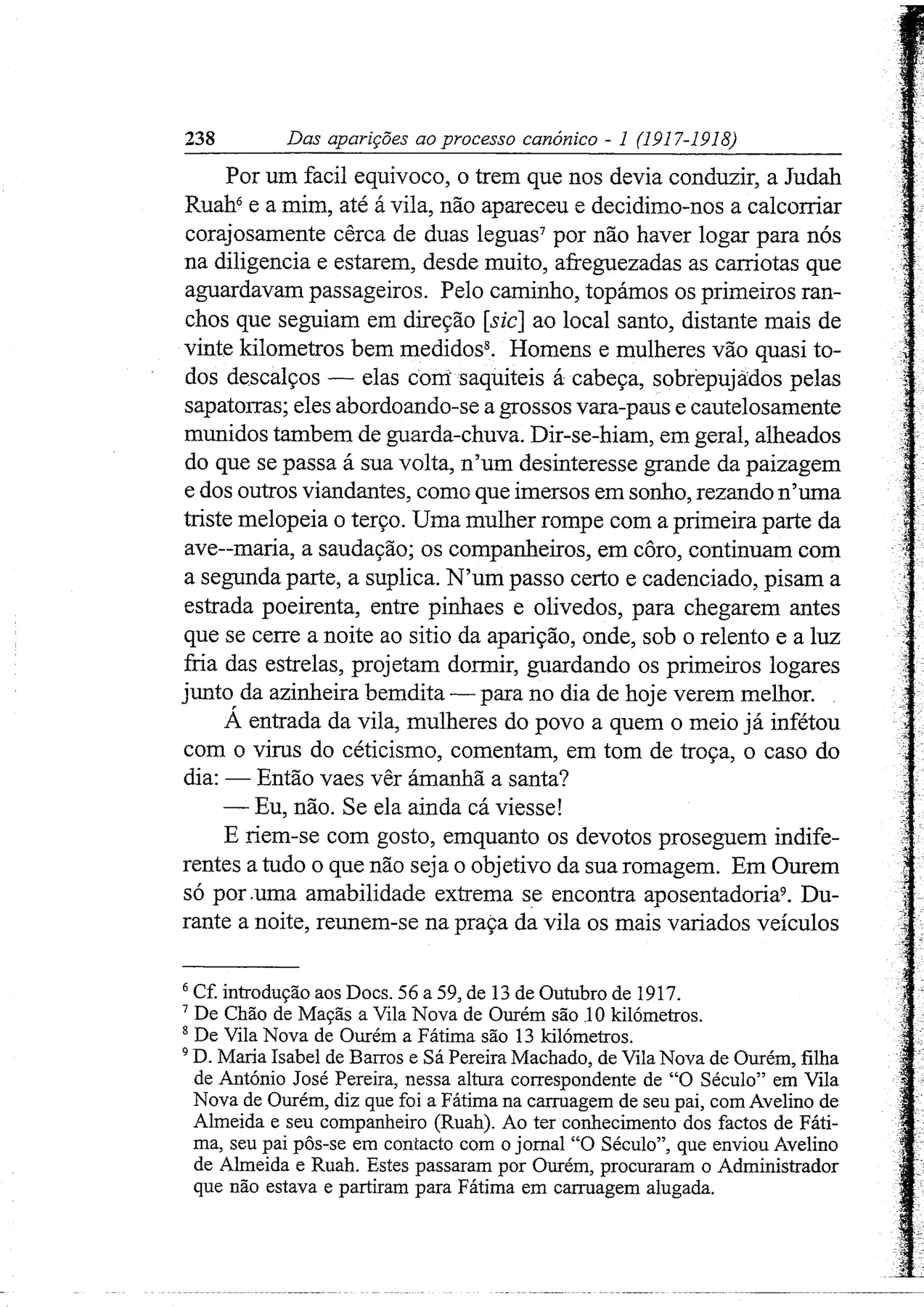
Owing to an easy misunderstanding, the carriage that was to take us, Judah Ruah and me, to the town did not appear, and we decided bravely to tramp some two leagues7, since there was no room for us in the stagecoach and the hired gigs awaiting passengers had long since been taken. On the way we came upon the first bands of people heading in the direction [sic] of the holy place, more than twenty good kilometres away8. Men and women are almost all barefoot — the women with bags on their heads, topped by their heavy shoes; the men leaning on thick staves and cautiously provided with umbrellas too. One would say they were, in general, oblivious to what is going on around them, in great indifference to the landscape and to the other wayfarers, as if immersed in a dream, praying the rosary in a sad chant. A woman starts the first part of the Hail Mary, the salutation; her companions, in chorus, continue with the second part, the supplication. With a sure and measured step they tread the dusty road, between pine woods and olive groves, so as to reach the place of the apparition before night closes in, where, in the open air and under the cold light of the stars, they plan to sleep, keeping the first places next to the blessed holm oak — so as to see better today.

At the entrance to the town, women of the people, whom their surroundings have already infected with the virus of scepticism, comment mockingly on the affair of the day: — So you're going to see the saint tomorrow?

— Me, no. If she came here, now!

And they laugh heartily, while the devout go on indifferent to everything but the aim of their pilgrimage. In Ourem lodging9 is to be found only through extreme kindness. During the night the most varied vehicles gather in the town square carrying believers and the curious, not lacking old ladies dressed in dark clothes, already bowed under the weight of years, but with the burning fire of faith sparkling in their eyes, which spurred them to the courageous act [sic] of abandoning for one day the inseparable little corner of their home. At the break of dawn new bands appear intrepidly and cross, without stopping an instant, the township, whose silence they break with the harmony of the hymns that female voices, very much in tune, intone in violent contrast with the roughness of their types...

The sun rises, but the look of the sky threatens a storm. Black clouds pile up precisely over the Fátima side. Nothing, however, holds back those who converge there by every road, using every means of locomotion. Luxurious motor cars glide by at dizzying speed, sounding their horns; ox carts drag themselves slowly along one side of the road; the wagons, the victorias, the closed calèches, the carts in which seats have been improvised, are loaded to bursting. Almost all carry, along with the more or less modest provisions for Christian mouths, a ration of chaff for the irrational creatures that the "poverello" of Assisi called our brothers and who valiantly do their task... A harness bell jingles here and there, a little cart decked with box can be seen; nevertheless the festive air is discreet, manners are composed and order absolute... Little donkeys jog along the edge of the road, and the cyclists, very numerous, perform prodigies so as not to crash into the carts.

At about ten o'clock the sky becomes completely overcast and before long it began to rain in earnest. The ropes of water, driven by a harsh wind, lash the faces, soaking the macadam and drenching to the bone the walkers who have no hats or any other protection. But nobody grows impatient or gives up going on, and if some take shelter under the crowns of the trees, by the walls of the farms or in the scattered houses that lean out along the road, others continue the march with impressive endurance, among them some ladies whose dresses, clinging to their bodies under the force and persistence of the rain, outline their forms as if they had just come out of the bath!

\*
\ \

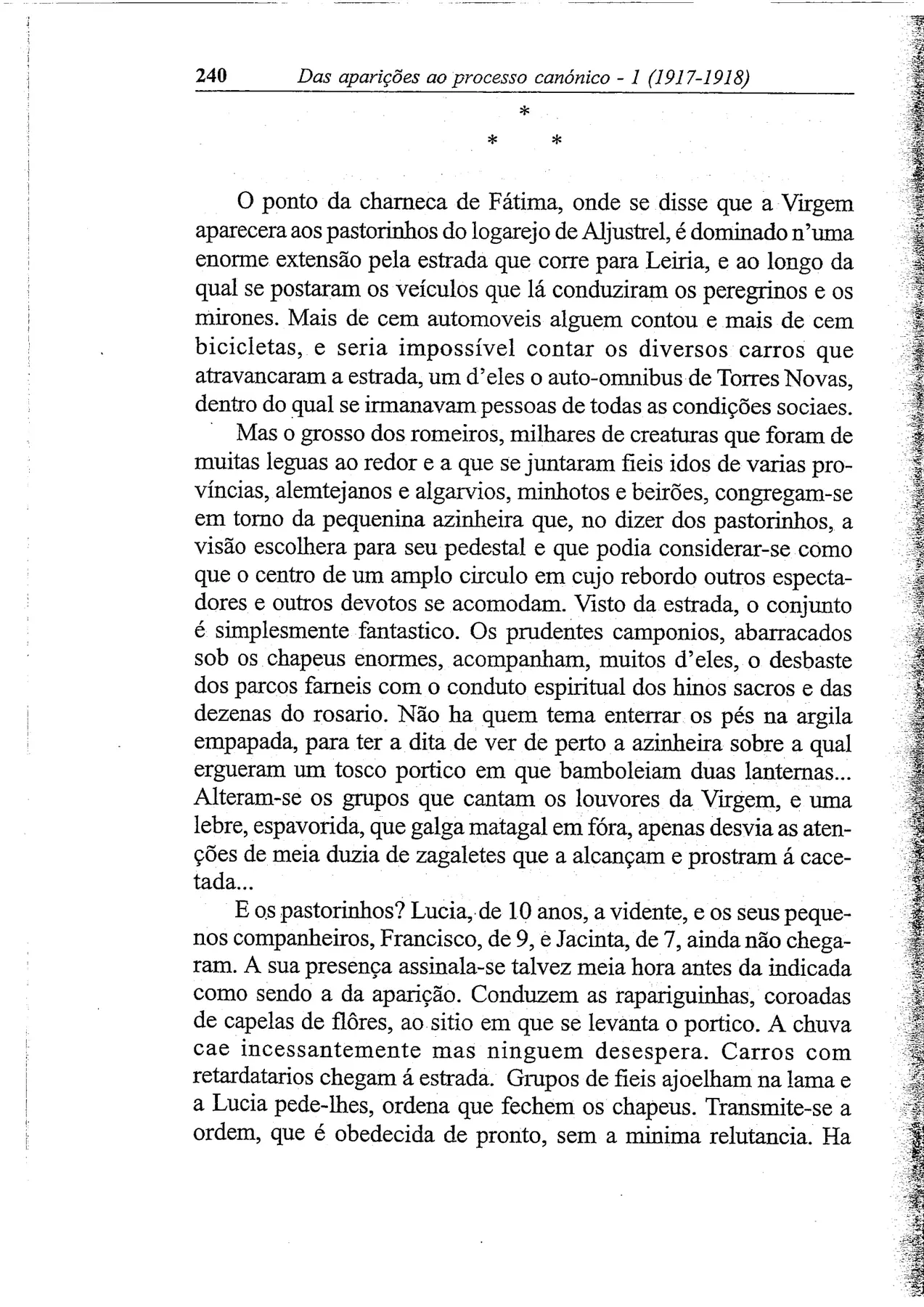
The spot on the heath of Fátima where the Virgin was said to have appeared to the little shepherds from the hamlet of Aljustrel is overlooked over a great stretch by the road that runs to Leiria, along which were drawn up the vehicles that had brought the pilgrims and onlookers there. Someone counted more than a hundred motor cars and more than a hundred bicycles, and it would be impossible to count the various carriages that blocked the road, one of them the motor omnibus from Torres Novas, inside which people of all social conditions mingled as brothers.

But the bulk of the pilgrims, thousands of creatures who had come from many leagues around and who were joined by faithful from various provinces, people from the Alentejo and the Algarve, from the Minho and the Beiras, gather around the little holm oak which, according to the little shepherds, the vision had chosen as its pedestal, and which could be regarded as the centre of a wide circle on whose rim other spectators and other devotees settle themselves. Seen from the road, the whole is simply fantastic. The prudent country folk, sheltering under their enormous umbrellas, many of them accompany the whittling-down of their meagre provisions with the spiritual fare of sacred hymns and decades of the rosary. There is nobody who fears sinking his feet into the sodden clay for the joy of seeing close up the holm oak over which they have raised a rough portico on which two lanterns sway... The groups singing the praises of the Virgin take turns, and a terrified hare, bolting out through the brush, diverts the attention of only half a dozen young shepherd lads, who catch it and lay it low with their cudgels...

And the little shepherds? Lucia, aged 10, the seer, and her little companions, Francisco, aged 9, and Jacinta, aged 7, have not yet arrived. Their presence is noticed perhaps half an hour before the hour given as that of the apparition. The little girls, crowned with garlands of flowers, are led to the place where the portico stands. The rain falls incessantly, but nobody despairs. Carriages with latecomers arrive on the road. Groups of the faithful kneel in the mud, and Lucia asks them, orders them to close their umbrellas. The order is passed on and is obeyed at once, without the least reluctance. There are people, many people, as if in ecstasy; people deeply moved, on whose dry lips prayer has frozen; people astounded, with hands joined and eyes brimming; people who seem to feel, to touch the supernatural... The child asserts that the Lady spoke to her once more, and the sky, still murky, suddenly begins to clear overhead; the rain stops and one senses that the sun is about to flood with light the landscape that the wintry morning made even sadder...

The old time is the one that governs for this crowd, which dispassionate estimates by educated people, wholly free of mystical influences, put at thirty or forty thousand creatures... The miraculous manifestation, the visible sign announced, is about to take place — many pilgrims assure us... And then one witnesses a spectacle unique and unbelievable to anyone who was not a witness of it. From the top of the road, where the carriages are crowded together and where many hundreds of people remain who lacked the courage to venture onto the muddy ground, one sees the whole immense crowd turn towards the sun, which appears free of clouds, at the zenith. The orb looks like a plate of dull silver, and it is possible to gaze at its disc without the least effort. It does not burn, it does not blind. One would say an eclipse was taking place. But behold, a colossal clamour arises, and from the specta-tors who are nearest one hears the cry:

— Miracle, miracle! A marvel, a marvel!

Before the dazzled eyes of that people, whose attitude trans-ports us to biblical times and who, pale with astonishment, bareheaded, gaze at the blue, the sun trembled, the sun made sudden movements never seen before, outside all cosmic laws — the sun “dan-ced”, in the typical expression of the peasants.. Perched on the step of the Torres Novas motor omnibus, an old man whose stature and whose features, at once gentle and energetic, recall those of Paul Déroulède10, recites, facing the sun, in a ringing voice, the Creed from beginning to end. I ask who he is and I am told he is Mr

João Maria Amado de Melo Ramalho da Cunha Vasconcelos12. I then see him turn to those around him who had kept their hats on, vehemently begging them to uncover their heads before so extraordinary a demonstration of the existence of God. Identical scenes are repeated at other points, and a lady cries out, bathed in anguished tears and almost choking:

— What a pity! There are still men who do not uncover their heads before so stupendous a miracle!13

And afterwards they ask one another whether they saw and what they saw. The greater number confess that they saw the trembling, the dancing of the sun; others, however, declare they saw the smiling face of the Virgin herself, swear that the sun spun round on itself like a firework wheel, that it came down almost to the point of burning the earth with its rays... There are those who say they saw it change colour successively...

\*
\ \

It is nearly fifteen hours.

The sky is swept clear of clouds and the sun follows its course with its usual splendour, which nobody dares to face directly. And the little shepherds? Lucia, the one who speaks with the Virgin, announces with theatrical gestures, in the arms of a man14 who carries her from group to group, that the war had ended and that our soldiers were going to come home... Such news, however, does not increase the jubilation of those who hear it. The heavenly sign was everything. There is an intense curiosity to see the two little girls with their garlands of roses; there are those who try to kiss the hands of the "little saints", one of whom, Jacinta, is closer to fainting than to dancing; but what everyone longed for — the sign from heaven — was enough to satisfy them, to root them in their simple charcoal-burner's faith. Street vendors offer portraits of the children on postcards, and other cards showing a soldier of the Portuguese Expeditionary Corps "thinking of the help of his protectress for the salvation of the Fatherland", and even an image of the Virgin as being the figure of the vision... That was good business, and certainly more centavos went into the vendors' pockets and into the alms box for the little shepherds than into the outstretched open hands of the lepers and the blind who, elbowing among the pilgrims, flung their piercing cries into the air...

The dispersal takes place quickly, without difficulty, without a shadow of disorder, without any need for a patrol of the guard to regulate it. The pilgrims who leave most quickly, hurrying off along the road, are those who arrived first, on foot and barefoot, with their shoes on their heads or hanging from their staves. They go, their souls in perpetual adoration, to carry the good news to the hamlets that had not been entirely emptied. And the priests? Some turned up at the spot, smiling, ranking themselves more with the curious spectators than with the pilgrims eager for heavenly favours. Perhaps one or two could not manage to hide the satisfaction that so often shows on the faces of the triumphant... It remains for the competent to have their say on the macabre dance of the sun which today, in Fátima, made hosannas burst from the breasts of the faithful and naturally left impressed — so trustworthy persons assured me — the freethinkers and other people without concerns of a religious nature who flocked to the now celebrated heath.

Português (original)

Ao saltar, após demorada viagem, pelas dezesseis horas de hontem, na estação de Chão de Maçãs5, onde se apearam também pessoas religiosas vindas de longes terras para assistir ao “milagre”, perguntei, de chofre, a um rapazote do “char-á-bancs” da carreira se já tinha visto a Senhora. Com seu sorriso sardónico e o olhar enviezado, não hesitou em responder-me:

— Eu cá só lá vi pedras, carros, automoveis, cavalgaduras e gente!

Por um facil equivoco, o trem que nos devia conduzir, a Judah Ruah e a mim, até á vila, não apareceu e decidimo-nos a calcorriar corajosamente cêrca de duas leguas7 por não haver lugar para nós na diligencia e estarem, desde muito, afreguezadas as cariotas que aguardavam passageiros. Pelo caminho, topámos os primeiros ranchos que seguiam em direção [sic] ao local santo, distante mais de vinte kilometros bem medidos8. Homens e mulheres vão quasi todos descalços — elas com saquiteis á cabeça, sobrepujados pelas sapatorras; eles abordoando-se a grossos vara-paus e cautelosamente munidos tambem de guarda-chuva. Dir-se-hiam, em geral, alheados do que se passa á sua volta, n'um desinteresse grande da paizagem e dos outros viandantes, como que imersos em sonho, rezando n'uma triste melopeia o terço. Uma mulher rompe com a primeira parte da ave--maria, a saudação; os companheiros, em côro, continuam com a segunda parte, a suplica. N'um passo certo e cadenciado, pisam a estrada poeirenta, entre pinhaes e olivedos, para chegarem antes que se cerre a noite ao sitio da aparição, onde, sob o relento e a luz fria das estrelas, projetam dormir, guardando os primeiros lugares junto da azinheira bem dita — para no dia de hoje verem melhor.

Á entrada da vila, mulheres do povo a quem o meio já infétou com o virus do ceticismo, comentam, em tom de troça, o caso do dia: — Então vaes vêr ámanhã a santa?

— Eu, não. Se ela ainda cá viesse!

E riem-se com gosto, enquanto os devotos proseguem indifferentes a tudo o que não seja o objetivo da sua romagem. Em Ourem só por uma amabilidade extrema se encontra aposentadoria9. Durante a noite, reúnem-se na praça da vila os mais variados veículos conduzindo crentes e curiosos sem que faltem velhas damas vestidas de escuro, vergadas já ao peso dos anos, mas faiscando-lhes nos olhos o lume ardente da fé que as animou ao ato [sic] corajoso de abandonar por um dia o inseparavel cantinho da sua casa. Ao romper d'alva, novos ranchos surgem intrepidamente e atravessam, sem pararem um instante, o povoado, cujo silencio quebram com a harmonia dos canticos que vozes femininas, muito afinadas, entoam n'um violento contraste com a rudeza dos tipos...

O sol nasce, mas o cariz do céu ameaça tormenta. As nuvens negras acastelam-se precisamente sobre as bandas de Fátima. Nada, todavia, detem os que por todos os caminhos e servindo-se de todos os meios de locomoção para lá confluem. Os automoveis luxuosos deslisam vertiginosamente, tocando as buzinas; os carros de bois arrastam-se com vagar a um lado da estrada; as galeras, as vitorias, os caleches fechados, as carroças nas quaes se improvisaram assentos vão ajoujados a mais não poderem. Quasi todos levam com os farneis, mais ou menos modestos, para as bocas cristãs a ração de folhelho para os irracionaes que o "poverelo" de Assis chamava nossos irmãos e que cumprem, valorosamente a sua tarefa... Tilinta uma ou outra guiseira, vê-se uma carrocinha adornada de buxo; no emtanto, o ar festivo é discreto, as maneiras são compostas e a ordem absoluta... Burrinhos choutam á margem da estrada e os ciclistas, numerosissimos, fazem prodigios para não esbarrar de encontro aos carros.

Pelas dez horas, o ceu tolda-se totalmente e não tardou que entrasse a chover a bom chover. As cordas de agua, batidas por um vento agreste, fustigam os rostos, encharcando o macadame e re-passando até os ossos os caminhantes desprovidos de chapeus e de quaesquer outros resguardos. Mas ninguem se impacienta ou desiste de proseguir e, se alguns se abrigam sob a copa das arvores, junto dos muros das quintas ou nas distanciadas casas que se debruçam ao longo do caminho, outros continuam a marcha com uma impressionante resistencia, notando-se algumas senhoras cujos vestidos colados aos corpos, por efeito do impeto e da pertinácia da chuva, lhes desenham as fórm as como se tivessem saído do banho!

\ \

O ponto da charneca de Fátima, onde se disse que a Virgem aparecera aos pastorinhos do logarejo de Aljustrel, é dominado n'uma enorme extensão pela estrada que corre para Leiria, e ao longo da qual se postaram os veículos que lá conduziram os peregrinos e os mirones. Mais de cem automoveis alguem contou e mais de cem bicicletas, e seria impossível contar os diversos carros que atravancaram a estrada, um d'eles o auto-omnibus de Torres Novas, dentro do qual se irmanavam pessoas de todas as condições sociaes.

Mas o grosso dos romeiros, milhares de creaturas que foram de muitas leguas ao redor e a que se juntaram fieis idos de varias províncias, alemtejanos e algarvios, minhotos e beirões, congregam-se em torno da pequenina azinheira que, no dizer dos pastorinhos, a visão escolhera para seu pedestal e que podia considerar-se como que o centro de um amplo circulo em cujo rebordo outros espectadores e outros devotos se acomodam. Visto da estrada, o conjunto é simplesmente fantastico. Os prudentes camponios, abarracados sob os chapeus enormes, acompanham, muitos d'eles, o desbaste dos parcos farneis com o conduto espiritual dos hinos sacros e das dezenas do rosario. Não ha quem tema enterrar os pés na argila empapada, para ter a dita de ver de perto a azinheira sobre a qual ergueram um tosco portico em que bamboleiam duas lanternas... Alteram-se os grupos que cantam os louvores da Virgem, e uma lebre, espavorida, que galga matagal em fóra, apenas desvia as atenções de meia duzia de zagaletes que a alcançam e prostram á cacetada...

E os pastorinhos? Lucia, de 10 anos, a vidente, e os seus pequenos companheiros, Francisco, de 9, e Jacinta, de 7, ainda não chegaram. A sua presença assinala-se talvez meia hora antes da indicada como sendo a da aparição. Conduzem as rapariguinhas, coroadas de capelas de flôres, ao sitio em que se levanta o portico. A chuva cae incessantemente mas ninguem desespera. Carros com retardatarios chegam á estrada. Grupos de fieis ajoelham na lama e a Lucia pede-lhes, ordena que fechem os chapeus. Transmite-se a ordem, que é obedecida de pronto, sem a minima relutancia. Ha gente, muita gente, como que em extase; gente comovida, em cujos labios secos a prece paralisou; gente pasmada, com as mãos postas e os olhos borbulhantes; gente que parece sentir, tocar o sobrenatural... A criança afirma que a Senhora lhe falou mais uma vez, e o céu, ainda caliginoso, começa, de subito, a clarear no alto; a chuva pára e presente-se que o sol vae inundar de luz a paizagem que a manhã invernosa tornou ainda mais triste...

A hora antiga é a que regula para esta multidão, que calculos desapaixonados de pessoas cultas e de todo o ponto alheias ás influencias misticas computam em trinta ou quarenta mil creaturas... A manifestação miraculosa, o sinal visivel anunciado está prestes a produzir-se — asseguram muitos romeiros... E assiste-se então a um espetaculo unico e inacreditavel para quem não foi testemunha d'ele. Do cimo da estrada, onde se aglomeram os carros e se conservam muitas centenas de pessoas, a quem escasseou valor para se meter á terra barrenta, vê-se toda a imensa multidão voltar-se para o sol, que se mostra liberto de nuvens, no zenit. O astro lembra uma placa de prata fosca e é possivel fitar-lhe o disco sem o minimo esforço. Não queima, não cega. Dir-se-hia estar-se realisando um eclipse. Mas eis que um alarido colossal se levanta, e aos espectado-res que se encontram mais perto se ouve gritar:

— Milagre, milagre! Maravilha, maravilha!

Aos olhos deslumbrados d'aquele povo, cuja atitude nos trans-porta aos tempos biblicos e que, palido de assombro, com a cabeça descoberta, encara o azul, o sol tremeu, o sol teve nunca vistos movimentos bruscos fóra de todas as leis cosmicas — o sol “bai-lou”, segundo a tipica expressão dos camponezes.. Empoleirado no estribo do auto-omnibus de Torres Novas, um ancião cuja estatura e cuja fisionomia, ao mesmo tempo doce e energica, lembram as de Paul Déroulède10, recita, voltado para o sol, em voz clamorosa, de principio a fim, o Credo. Pergunte quem é e dizem-me ser o sr.

João Maria Amado de Melo Ramalho da Cunha Vasconcelos12. Vejo-o depois dirigir-se aos que o rodeiam, e que se conservaram de chapeu na cabeça, suplicando-lhes, veementemente, que se descubram em face de tão extraordinária demonstração da existência de Deus. Cenas identicas repetem-se n'outros pontos e uma senhora clama, banhada em aflitivo pranto e quasi n'uma sufocação:

— Que lastima! Ainda ha homens que se não descobrem deante de tão estupendo milagre!13

E, a seguir, perguntam uns aos outros se viram e o que viram. O maior numero confessa que viu a tremura, o bailado do sol; outros, porém, declaram ter visto o rosto risonho da propria Virgem, juram que o sol girou sobre si mesmo como uma roda de fogo de artificio, que ele baixou quasi a ponto de queimar a terra com os seus raios... Ha quem diga que o viu mudar sucessivamente de côr...

\ \

São perto de quinze horas.

O ceu está varrido de nuvens e o sol segue o seu curso com o esplendor habitual que ninguem se atreve a encarar de frente. E os pastorinhos? Lucia, a que fala com a Virgem, anuncia, com ademanes teatraes, ao colo de um homem14, que a transporta de grupo em grupo, que a guerra terminára e que os nossos soldados iam regressar... Semelhante nova, todavia, não aumenta o jubilo de quem a escuta. O sinal celeste foi tudo. Ha uma intensa curiosidade em vêr as duas rapariguinhas com suas grinaldas de rosas, ha quem procure oscular as mãos das "santinhas", uma das quaes, a Jacinta, está mais para desmaiar do que para danças, mas aquilo por que todos anciavam — o sinal do ceu — bastou a satisfazê-los, a radical-os na sua fé de carvoeiro. Vendedores ambulantes oferecem os retratos das crianças em bilhetes postaes e outros bilhetes que representam um soldado do Corpo Expedicionario Portuguez "pensando no auxilio da sua protetora para salvação da Patria" e até uma imagem da Virgem como sendo a figura da visão... Bom negocio foi esse e decerto mais centavos entraram na algibeira dos vendedores e no tronco das esmolas para os pastorinhos do que nas mãos estendidas e abertas dos leprosos e dos cegos que, acotovelando-se com os romeiros, atiravam aos ares seus gritos lancinantes...

O dispersar faz-se rapidamente, sem dificuldades, sem sombra de desordem, sem que fosse mister que o regulasse qualquer patrulha da guarda. Os peregrinos que mais depressa se retiram, correndo estrada fóra, são os que primeiro chegaram, a pé e descalços com os sapatos á cabeça ou dependurados nos varapaus. Vão, com a alma em lausperene, levar a boa nova aos logarejos que não se despovoaram de todo. E os padres? Alguns compareceram no local, sorridentes, enfileirando mais com os espectadores curiosos do que com os romeiros avidos de favores celestiaes. Talvez um ou outro não lograsse dissimular a satisfação que no semblante dos triunfadores tantas vezes se traduz... Resta que os competentes digam de sua justiça sobre o macabro bailado do sol que hoje, em Fátima, fez explodir hossanas dos peitos dos fieis e deixou naturalmente impressionados — ao que me asseguraram sujeitos fidedignos os livres pensadores e outras pessoas sem preocupações de natureza religiosa que acorreram á já agora celebrada charneca.
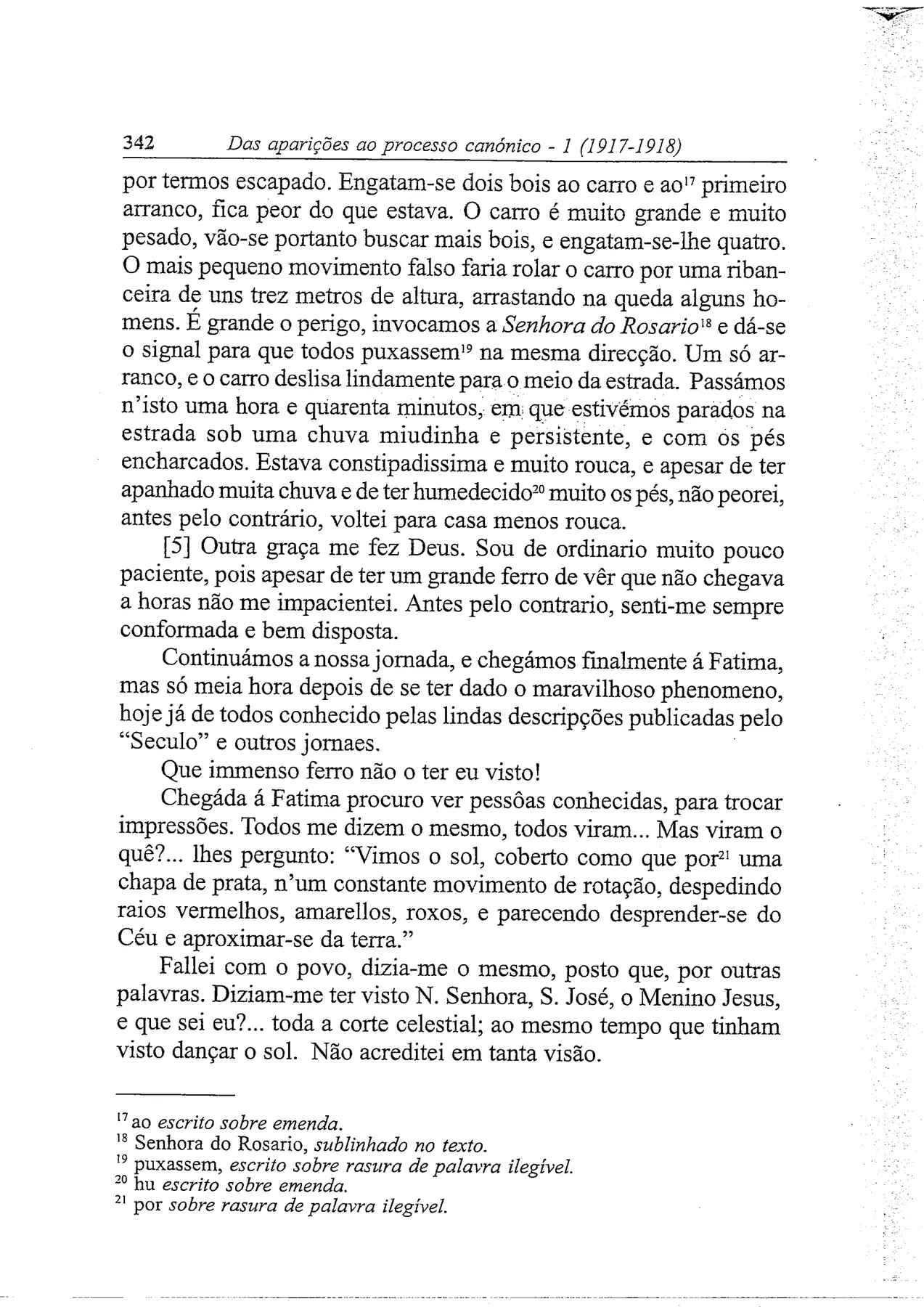
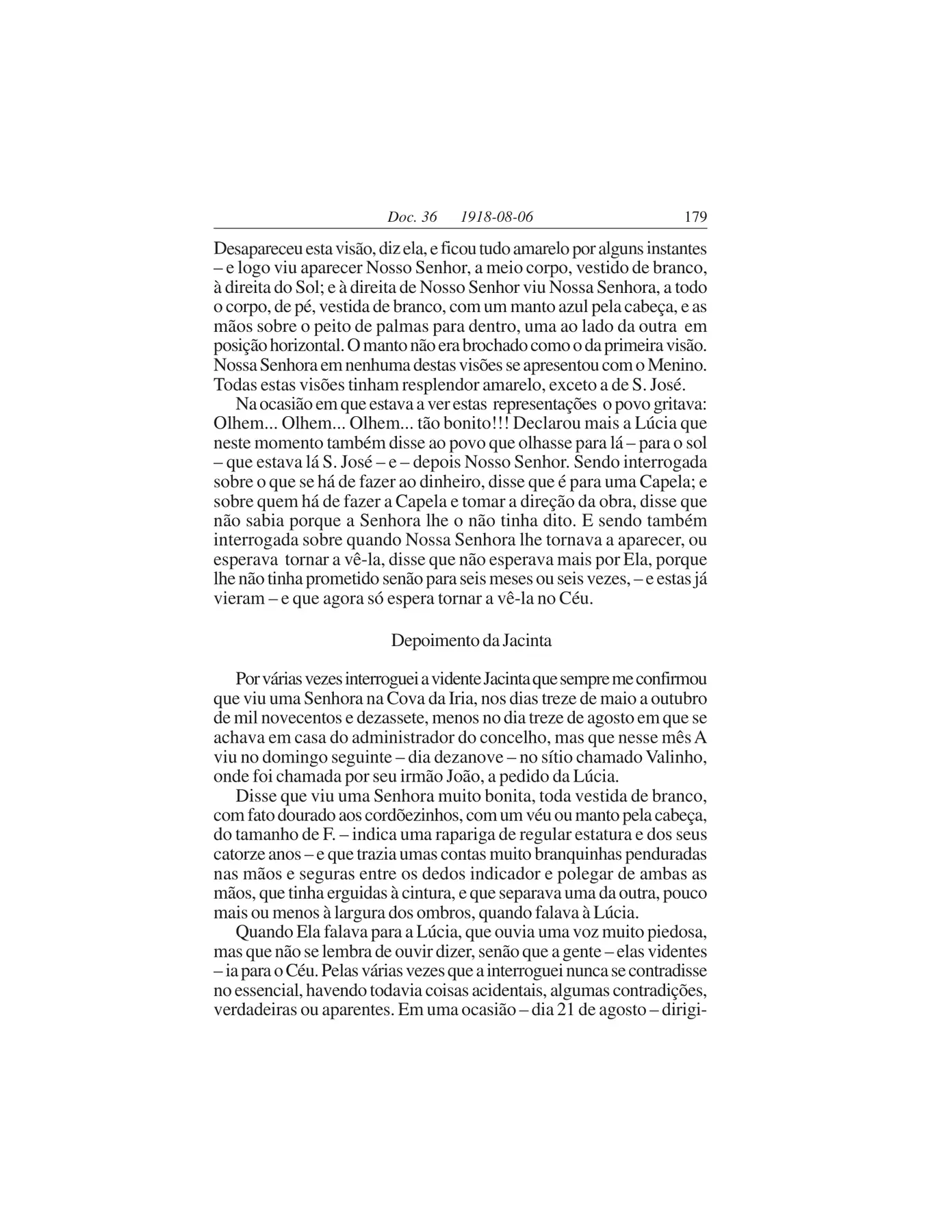
Editor's notes (9)

4 Vila Nova de Ourém.

5 Also known as Fátima Station.

7 From Chão de Maçãs to Vila Nova de Ourém is 10 kilometres.

8 From Vila Nova de Ourém to Fátima is 13 kilometres.

9 Dona Maria Isabel de Barros e Sá Pereira Machado, of Vila Nova de Ourém, daughter of António José Pereira, at that time correspondent of "O Século" in Vila Nova de Ourém, says that she went to Fátima in her father's carriage, with Avelino de Almeida and his companion (Ruah). On learning of the events at Fátima, her father got in touch with the newspaper "O Século", which sent Avelino de Almeida and Ruah. They passed through Ourém, looked for the Administrator, who was not in, and set off for Fátima in a hired carriage.

10 French writer and politician, born in Paris on 2 September 1846. In 1882 he founded the “League of Patriots” and was its president. He was the author of Chant du Soldat (1872) and of Nouveaux Chants du Soldat (1875). He died in Nice on 30 January 1914.

12 According to information from Maria Elisa Cunha Serra, João Vasconcelos went to Fátima in the same carriage as Maria Raposo, herself and other people. Cf. Doc. 117, of 18 October 1917, note 4.

13 Dona Maria Isabel de Barros e Sá Pereira Machado says that at the moment of the miracle she was beside the carriage of the family of the Marquis of Foz. She heard the Marquis say a sentence very similar to this one: "There are still people who do not uncover their heads before so great a miracle".

14 This is Dr. Carlos de Azevedo Mendes (cf. DCF, vol. 1, Doc. 56, of p.13 October 1917, note 10).

4 Vila Nova de Ourém.

5 Também conhecida por Estação de Fátima.

7 De Chão de Maçãs a Vila Nova de Ourém são 10 kilómetros.

8 De Vila Nova de Ourém a Fátima são 13 kilómetros.

9 D. Maria Isabel de Barros e Sá Pereira Machado, de Vila Nova de Ourém, filha de António José Pereira, nessa altura correspondente de "O Século" em Vila Nova de Ourém, diz que foi a Fátima na carruagem de seu pai, com Avelino de Almeida e seu companheiro (Ruah). Ao ter conhecimento dos factos de Fátima, seu pai pôs-se em contacto com o jornal "O Século", que enviou Avelino de Almeida e Ruah. Estes passaram por Ourém, procuraram o Administrador que não estava e partiram para Fátima em carruagem alugada.

10 Escritor e político francês, nasceu em Paris a 2 de Setembro de 1846. Em 1882 fundou e foi o presidente da “Liga dos Patriotas”. Foi o autor de Chant du Soldat (1872) e de Nouveaux Chants du Soldat (1875). Faleceu, em Nice, a 30 de Janeiro de 1914.

12 Segundo informação de Maria Elisa Cunha Serra, João Vasconcelos foi a Fátima na mesma carruagem que Maria Raposo, ela própria e outras pessoas. Cf. Doc. 117, de 18 de Outubro de 1917, nota 4.

13 D. Maria Isabel de Barros e Sá Pereira Machado diz que no momento do milagre estava junto à carruagem da família do Marquês da Foz. Ouviu ao Marquês uma frase muito semelhante a esta: "Ainda há gente que não se descobre perante tão grande milagre".

14 Trata-se do Dr. Carlos de Azevedo Mendes (cf. DCF, vol. 1, Doc. 56, de p.13 de Outubro de 1917, nota 10).

DCF III-1, Doc. 87 · press · 13 Oct 1917View scans (8)Link

Diário de Notícias correspondent

Journalistlocal press correspondent
13 OctFirst-handPartlyPress reportScepticCrowd scenePale / silver discSun spinningSun fallingSeers' words overheard
English

Vila Nova de Ourém, 13.— In spite of the fine, tiresome rain that began to fall first thing in the morning, an extraordinary number of people flocked to the parish of Fátima to witness the extraordinary case of the apparition which since Ascension Thursday has occupied the attention of these people and drawn to that locality thousands and thousands of pilgrims of all social classes and of both sexes.

As early as the day before yesterday3, groups of men and women began to pass through this town, who with all devotion and belief, singing hymns and saying the rosary, were heading for the place where the "miracle" was to be repeated for the last time, according to the statements of the three little shepherds to whom Our Lady deigned to appear several times, as they say, on the 13th of each month since that date.

To give an idea of the influx of people, we shall give a note of the vehicles we were able to count: Carts, 240; bicycles, 135; motor cars, upwards of 100. These statistics represent only the number of vehicles that returned through this town.

The anxiety for the hour of the colloquy, 13.00, was manifest.

Although the rain continued to lash that multitude, nobody budged from the privileged spot. At precisely that same hour the three little shepherds, whose names are Lucia, Jacinta and Francisco, arrived at the exact spot, immediately taking up position on their knees under an arch set up “for the purpose”, as well as an altar that had been erected beside it.

Suggestion immediately took hold of those thousands of believers and curious onlookers. As a great number of people had their umbrellas open, the little ones ordered them to be closed, and, strange to say, according to the testimony of thousands and thousands of people, the sun appeared with the colour of dull silver, in a circular agitation as if it were touched by electricity, to use the expression employed by educated people who witnessed the fact.

And thousands of people, under suggestion, and who knows, perhaps even dazzled by the very light of the sun, which was appearing for the first time that day, fell to the ground weeping and raising on high their hands, which they instinctively joined.

On their faces one could see an ecstatic rapture that de-noted an absolute detachment from life. Their simple souls wept and prayed before the strange sensation of a fact which for them, at that moment, was miraculous. There were even people, as we heard from some of them, to whom it seemed that they saw the sun leave its fictitious orbit, break through the clouds and come down on the horizon. The suggestion of these seers spread to others to whom they explained the phenomenon, and for that reason many, proclaiming that the king-star was going to come crashing down on the ground, burst into loud cries, imploring the protection of the Virgin.

The “miraculous hour” had passed.

The children got up, smiling, and explained to their anxious listeners that the “Lady” had told them that peace would come soon and that the return of our brave soldiers who are fighting heroically in France would not be long delayed. At the site postcards were being sold with portraits of the ingenuous children.

The pilgrims, after those moments of anxiety, returned to their homes, eager to tell those who had not had the good fortune to go to the holy place what their eyes, and above all their believing souls, had witnessed with such wonderment.

Português (original)

Vila Nova de Ourém, 13.— Apesar da chuva miudinha e impertinente que começou a cair logo de manhã, extraordinario numero de pessoas acorreu á freguesia de Fátima para presenciar o caso extraordinario da aparição que desde quinta feira de Ascenção tem ocupado a atenção destes povos e atraído áquela localidade milhares e milhares de peregrinos de todas as classes sociais e sexos.

Já ante-ontem3 começaram a passar por esta vila ranchos de homens e mulheres, que com toda a devoção e crença, entoando canticos e resando o terço, se dirigiam para o local onde o "milagre" se devia repetir pela ultima vez, conforme as declarações dos três pastorinhos, a quem Nossa Senhora se dignou aparecer várias vezes, como eles dizem, nos dias 13 desde aquela data.

Para se poder imaginar a afluencia de pessoas, vamos dar uma nota dos veículos que nos foi possivel contar: Carros, 240; bicicletas, 135; automoveis para cima de 100. Esta estatistica representa apenas o numero de veículos que regressou por esta vila.

A anciedade pela hora do colloquio, 13 horas, era manifesta.

Embora a chuva continuasse a fustigar aquela multidão ninguem arredou pé do local privilegiado. Precisamente aquela mesma hora os três pastorinhos, cujos nomes são Lucia, Jacinta e Francisco, chegaram ao lugar preciso, postando-se imediatamente de joelhos sob um arco “adrede” arranjado, assim como um altar que junto foi levantado.

A sugestão tomou imediatamente aqueles milhares de crentes e curiosos. Como grande numero de pessoas tivesse os guarda-chuvas abertos, os pequenos mandaram fecha-los, e coisa estranha, segundo testemunho de milhares e milhares de pessoas, o sol apareceu com uma côr de prata fosca, numa agitação circular como se fosse tocado pela electricidade, segundo a expressão empregada por pessoas ilustradas que presenciaram o facto.

E milhares de pessoas sugestionadas, e quem sabe mesmo se ofuscadas pela propria luz do sol que durante o dia aparecia pela primeira vez, caíram por terra chorando e levantando para o alto as mãos, que instintivamente juntavam.

Nos seus rostos notava-se um embevecimento estatico que de-notava um absoluto alheimento da vida. Choravam e rezavam as suas almas simples, perante a estranha sensação dum facto que para eles, naquele momento, era milagroso. Pessoas houve mesmo segundo ouvimos a algumas, que lhes pareceu ver o sol abandonar a sua ficticia orbita, romper as nuvens e descer no horisonte. A sugestão destes videntes estendia-se a outros a quem eles explicavam o fenomeno, e por esse motivo, muitas prégando que o astro rei viria precipitar-se no solo, preromperam em altos gritos, impetrando a protecção da Virgem.

A “hora milagrosa” passára.

As crianças levantaram-se, sorridentes, e explicaram aos seus anciosos ouvintes que a “Senhora” lhes dissera que a paz viria breve e que não tardaria o regresso dos nossos bravos soldados que em França se batem heroicamente. No local eram vendidos postaes com os retratos das ingenuas crianças.

Os peregrinos, após aqueles momentos de anciedade, regressaram a suas casas, desejosos de contar aos que não tiveram a felicidade de ir ao local santo, o que os seus olhos e principalmente as suas almas crentes, haviam com tanto deslumbramento presenciado.

Editor's notes (1)

3 11 October 1917, Thursday.

3 Dia 11 de Outubro de 1917, Quinta-feira.

13 OctFirst-handSaw itPress reportFigures / visionsSeers' words overheard
English

One of the little girls says: Our Lady is there already! Close your umbrellas and pray...

[…]

Shortly afterwards the little girls told what Our Lady had said to them:

— The war will end in these days; soon our soldiers will return to Portugal; men must be good to one another; pray the rosary and build a chapel, for I am the Lady of the Rosary.

Português (original)

Diz uma das meninas: *Já lá está Nossa Senhora! Fechem os chapeus e resem...

[…]

Pouco depois as meninas disseram o que Nossa Senhora lhes tinha dito:

— *A guerra acaba por estes dias; brevemente os nossos soldados regressam a Portugal; os homens devem ser bons uns para os outros; rezem o terço e façam uma capela pois que sou a Senhora do Rosario.

Maria Magdalena Trigueiros de Martel Patrício

Journalistpoet and writer, wife of a judge in Pinhel
13 OctFirst-handSaw itArticle by witnessTravelled from afarCrowd sceneRain stoppingPale / silver discSun spinningColours on people & landscape
English

The hamlets, the villages, the nearby towns were emptied of people.

Along the roads, already on the eve, groups of pilgrims were travelling on their way to Fátima.

Fishermen from Vieira4 left their houses of black wood set above the sea, and the labours of stowing away the catch. Through the pinewoods, where the crowberries look like drops of dew in the greenery, across the sands where the sails of the windmills turn, they came on foot, woollen leggings on their muscular legs, warm skirts over their shoulders, on their heads the bag with their provisions, with the short, swaying step that made the hems of their skirts swirl and set fluttering the orange kerchiefs on which their black hats sat. Workmen from Marinha5, farmers from Monte Real6, from Córtes7, from Marrazes8, hill women from far away — from the hills of Soubio9, of Minde10, of Lourçal11, people from everywhere the voice of the miracle had reached, left their houses and fields and came along on horseback, by cart or on foot, crossing the roads, going over hills and through pinewoods, on the long trek along the roads, which for two days were enlivened by the rolling of carts, the jog-trot of donkeys and the clamour of the groups of pilgrims.

Autumn was reddening the harvested vineyards. The north-east wind, cold and cutting, heralding winter, made the transparent poplars on the riverbanks tremble as they paled, longing for the sun, in the yellow tones of old lace.

On the sands the white sails of the windmills were turning. In the pinewoods the green tops of the pines bent in the wind.

The clouds were gradually covering the sky. The mist was piling up in light, soft flakes.

The sea, in the vastness of the beach at Vieira, foamed, roared, rolled itself into high waves, and across the fields its voice could be heard in a sinister clamour!

All night, all the early morning, it rained, a fine, persistent rain that soaked the fields, that saddened the earth, that went on piercing to the bone, with a cold damp, the women, the children, the men and the animals crossing the muddy roads in their hurried march towards the Hill of the Miracle.

The rain fell and fell, soft and stubborn.

The thick skirts of serge and striped cotton dripped and weighed like lead on the waistbands. The caps and the broad hats streamed water onto the new jackets of the Sunday-best suits. The bare feet of the women and the hobnailed boots of the men splashed in the wide puddles of the muddy roads.

But the rain seemed not to wet them; it seemed they did not feel the rain!

They walked on and on, climbing the hill, lit up by faith, in eager longing for the miracle that Our Lady had promised, on the 13th, at one o'clock, by the hour of the Sun, to the simple and pure souls of three children who grazed flocks!

Left behind, lost in the mist, blurred in the transparency of the rain, were pines, poplars, oak shrubs, red patches of vineyards, farmsteads, ploughed fields of dark earth... The fields were deserted. The houses were shut!

There was a strange silence in the fields, deserted of people and flocks; there was an air of expectation and emotion in the attitude of things, of the poor houses as though asleep in the silence, their windows and doors shut to the light!

The hill was high, but it seemed to the walkers that the climb did not tire them!

The hill was sad, ever sadder, with hollowed, black stones, without the cheerfulness of a tree's greenery, but the walkers did not feel the striking and tragic torment of that landscape of sorrow!

The rain began to thin out. It was now only a very light veil of mist that was gradually dissolving, and little by little the hill was growing brighter.

A murmur was drawing near, coming down from the hill. A murmur that seemed like the distant voice of the sea, which had fallen silent in the silence of the fields...

It was hymns taking shape, sung by thousands of mouths.

On the plateau of the hill, covering the slope, filling a valley, one could see an enormous, shifting mass of thousands and thousands of God's creatures, thousands and thousands of souls in prayer!

With raised hands and eyes in ecstasy, they came in the ardent faith of belief. They came to ask Our Lady for the miracle, to ask for the redemption of sins, to ask for a blessing on the bitterness of life!

At one o'clock in the afternoon, by the hour of the sun, the rain stopped.

The sky had a greyish tone of pearl, and a strange brightness lit up the biblical and tragic vastness of the sad landscape, ever sadder...

The sun had something like a veil of transparent gauze, so that eyes could look at it. The grey tone of mother-of-pearl turned as if into a gleaming silver plate, which kept breaking open until the clouds were torn apart and the silvery sun, wrapped in the same grey lightness of gauze, was seen to rotate, spinning round within the circle of the parted clouds!

It was a single cry from every mouth; the thousands and thousands of God's creatures whom faith was lifting up to heaven fell to their knees on the soaked ground!

The light turned blue, an exquisite blue, as if it came through the stained-glass windows of an immense cathedral to spread through that gigantic nave, given its pointed arches by the hands raised in the air...

The blue slowly died away, so that the light seemed filtered through yellow stained glass.

Yellow patches now fell on faces, on white kerchiefs, on the dark, poor serge skirts. They were patches repeated endlessly on the low holm oaks, on the stones, on the hillside.

Everyone was weeping, everyone was praying, hat in hand, under the grandiose and unique impression of the awaited miracle!

They were seconds, they were instants that seemed like hours, so intensely were they lived!

Clouds passed over the vague grey brightness that veiled the sun!

The souls in prayer, whose life had been suspended for a few instants, came back to life.

The clouds were torn to shreds; blue patches of sky appeared. The sun, in the impassive serenity of all time, vaguely lit up the bare hill where Our Lady, through the mouths of three children who grazed flocks, had gathered thousands and thousands of God's creatures!

Português (original)

Despovoaram-se os lugares, as aldeias, as cidades proximas.

Pelas estradas, já nas vespas, seguiam grupos de romeiros a caminho de Fátima.

Pescadores da Vieira4 deixaram as casa de madeira negra assentes sobre o mar, as lides da arrumação da pescaria. Pelos pinhaes, onde as camarinhas parecem gotas de orvalho na verdura, pelos areaes onde giram as vellas dos moinhos, vieram a pé, os coturnos de lã nas pernas musculosas, saias de agazálho sobre as costas, á cabeça o sáco com o farnel, no passo meúdo e meneado, que lhes fazia voltar a rodaria das saias, e agitar os lenços alaranjados onde assentavam os chapeus pretos. Operarios da Marinha5, lavradores de Monte Real6, das Córtes7, dos Marrazes8, serranas de longe — das serras do Soubio9, de Minde10, do Lourçal11, gentes de toda a parte onde chegasse a voz do milagre, deixavam as casas e os campos, e vinham por ahi fóra a cavalo, de carro ou a pé, cruzando as estradas, atravessando montes e pinhaes, de longada pelos caminhos, que durante dois dias se animaram do rodar dos carros, do chouto dos jumentos, do vozear dos grupos dos romeiros.

O outomno avermelhava as vinhas vindimadas. O vento do nordeste, frio e cortante, anunciando o inverno, fazia tremer os choupos transparentes das bordas dos rios, que desmaiavam saúdosos do sol, em tons amarelos de rendas antigas.

Nos areaes giravam as vellas brancas dos moinhos. Nos pinhaes curvavam-se ao vento os cimos verdes dos pinheiros.

As nuvens iam cobrindo o ceu. Amontoava-se o nevoeiro em flócos leves e macios.

O mar, na vastidão da praia da Vieira, espumava, bramia, enrolava-se em ondas altas, e pelos campos ia-se ouvindo, n'um clamor sinistro, a sua voz!

Toda a noite, toda a madrugada choveu, uma chuva miudinha, persistente, que encharcava os campos, que entristecia a terra, que ia trespassando até aos ossos, de uma humidade fria, as mulheres, as creanças, os homens e os animaes, que cruzavam as estradas lamacentas, no caminhar apressado para a Serra do Milagre.

A chuva cahia, cahia, macia e teimosa.

As saias grossas d'estamenha e riscadilho pingavam, pezavam como chumbo, nas fitas das cinturas. Os barretes e os chapeus largos escorriam agua sobre as jaquetas novas dos fatos de vêr a Deus. Os pés descalços das mulheres, as botas ferradas dos homens, chapinhavam nas poças largas do lodaçal das estradas.

Mas a chuva parecia que não molhava, parecia que não sentiam a chuva!

Caminhavam sempre, subindo a serra, illuminados de fé, na ancia do milagre que Nossa Senhora promettera, no dia 13, pela uma hora, a hora do Sol, ás almas simples e puras de trez creanças que apascentavam gados!

Iam ficando para traz, perdidos na nevoa, esfumados na transparencia da chuva, pinheiros, choupos, carvalheiras, manchas vermelhas de vinhas, casaes, campos lavrados de terra escura... Os campos eram desertos. As casas eram fechadas!

Havia um silencio estranho nos campos desertos, de gentes e de gados, havia um ar de espera e de emoção na attitude das cousas, das casas pobres como adormecidas no silencio, janellas e portas fechadas á luz!

A serra era alta, mas parecia aos caminhheiros que os não cançava a subida da serra!

A serra era triste, cada vez mais triste, de pedras escavadas e negras sem a alegria da verdura de uma arvore, mas os caminhheiros não sentiam a tortura impressionante e tragica da paisagem de dôr!

A chuva começou a rarear. Era agora só um veu de nevoa muito leve que se ia desfazendo a pouco e pouco, e pouco a pouco a serra ia aclarando.

Approximava-se um murmurio que vinha descendo do monte. Murmurio que parecia a voz longinqua do mar, que se tinha calado no silencio dos campos...

Eram canticos que se definiam, entoados por milhares de boccas.

No planalto da serra, cobrindo o monte, enchendo um valle, via-se uma mancha enorme e movediça de milhares e milhares de creaturas de Deus, milhares e milhares d'almas em prece!

Mãos erguidas, olhos em extase, vinham na fé ardente da crença. Vinham pedir o milagre a Nossa Senhora, pedir a redempção dos peccados, pedir a benção para as amarguras da vida!

Á uma hora da tarde, hora do sol, parou a chuva.

O céu tinha um tom acinzentado de perola e uma claridade estranha illuminava a vastidão biblica e tragica da paisagem triste, cada vez mais triste...

O sol tinha como um véu de gaze transparente para que os olhos o pudéssem olhar. O tom cinzento da madreperola transformava-se como n'uma chapa de prata luzidia, que se ia rompendo até que as nuvens se rasgaram e o sol prateado, envolvido na mesma leveza cinzenta de gaze, viu-se rodar, a girar em volta do circulo das nuvens afastadas!

Foi um grito só em todas as boccas; cahiram de joelhos na terra encharcada, os milhares e milhares de creaturas de Deus que a fé levantava até ao céu!

A luz azulava-se n'um azul exquisito, como se viesse, atravez dos vitraes de uma cathedral immensa, espalhar-se n'aquella nave gigantesca ogivada pelas mãos que se ergueram no ar...

O azul extinguiu-se lentamente para a luz parecer coada por vitraes amarellos.

Manchas amarellas cahiam agora sobre as caras, sobre os lenços brancos, sobre as saias escuras e pobres das estamenhas. Eram manchas que se repetiam indefinidamente sobre as azinheiras rasteiras, sobre as pedras, sobre a serra.

Tudo chorava, tudo rezava, de chapeu na mão, na impressão grandiosa e unica do milagre esperado!

Foram segundos, foram instantes que pareceram horas, tão vivídos foram!

Passaram nuvens sobre a claridade vaga e cinzenta que velava o sol!

As almas em prece, que tiveram por instantes a vida suspensa, á vida voltaram.

Esfarraparam-se as nuvens, appareceram bocados azues do céu. O sol, na serenidade impassivel de todo o sempre, illuminou vagamente a serra escalvada, onde Nossa Senhora fez juntar, pela bocca de trez creanças que apascentavam gados, milhares e milhares de creaturas de Deus!

Editor's notes (9)

3 This article was later published in PATRICIO, Maria Magdalena Martel - Impressões de arte e de tristeza, Porto, Oficinas da Empreza Lit e Typographia, 1918, p. 63-68

4 Vieira de Leiria, village and parish in the council of Marinha Grande, district of Leiria.

5 Marinha Grande, a council in the district of Leiria.

6 Village and parish in the council and district of Leiria.

7 Village and parish in the council and district of Leiria.

8 Village and parish in the council and district of Leiria.

9 We have not identified this locality.

10 Locality in the council of Alcanena, district of Santarém.

11 Parish in the council of Pombal, district of Coimbra.

3 Este artigo viria a ser publicado em PATRICIO, Maria Magdalena Martel - Impressões de arte e de tristeza, Porto, Oficinas da Empreza Lit e Typographia, 1918, p. 63-68

4 Vieira de Leiria, lugar e freguesia do concelho de Marinha Grande, distrito de Leiria.

5 Marinha Grande, concelho do distrito de Leiria.

6 Lugar e freguesia do concelho e distrito de Leiria.

7 Lugar e freguesia do concelho e distrito de Leiria.

8 Lugar e freguesia do concelho e distrito de Leiria.

9 Não identificámos esta localidade.

10 Localidade do concelho de Alcanena, distrito de Santarém.

11 Freguesia do concelho de Pombal, distrito de Coimbra.

13 OctFirst-handSaw itPress reportFigures / visionsSeers' words overheard
English

This agrees with the answer she gave me when I asked her whether the apparition had taken place during the phenomenon. "No," she answered; "the Lady had already disappeared".

Português (original)

Isto condiz com a resposta que ella me deu, quando lhe perguntei se a aparição tivera logar durante o phenomeno. "Não, respondeu ella; a Senhora já tinha desaparecido".

13 OctFirst-handSaw itLetterFigures / visionsSeers' words overheard
English

Meanwhile the Miracle ends and the children rise from prayer and, carried in the arms of various individuals, the eldest says to the People: Our Lady, who spoke with me for the last time, charges me to tell you: that Peace is made today; that you should go home untroubled, for the rain will not wet you on the way back; that you should pray to Our Lord, whom you have offended much, and that soon the soldiers will come from France, and that she wishes a chapel to be built for her at the place.

[…]

Within the luminous globe a group of persons could be observed moving, which the child says was St Joseph announcing Peace to men; His blessed Son giving him the blessing, and Our Lady of Sorrows.

Within the luminous globe a group of persons could be seen moving, which the child afterwards explained was St Joseph announcing Peace to men, his blessed Son blessing the People, and Our Lady of Sorrows.

Português (original)

Entretanto o Milagre finda e as crianças erguem-se da oração e levadas ao colo de varios individuos a mais velha diz ao Povo: N. Senhora que falou pela ultima vez comigo encarrega-me de dizer-

-vos: que a Paz se faz hoje; que vão descansados para suas Casas que a chuva os não molhará no regresso; que orem a N Senhor quem teem ofendido muito e que em breve virão os soldados da França e que deseja lhe façam uma capela no local.

[…]

Dentro do globo luminoso observava-se um grupo de pessoas que se moviam e que a criança diz ser S. Jose a anunciar a Paz aos homens; Seu bendito Filho a lançar-lhe a benção e N. Senhora das Dôres.

Dentro do globo luminoso viam-se um grupo de pessoas que se moviam, e que depois a criança explicou ser S. José a anunciar a Paz aos homens, seu bendito Filho a abençoar o Povo e N. Senhora das Dôres.

Editor's notes (2)

14 Above e there is another e.

22 supor que is followed by es, probably the beginning of the word está.

14 Por cima de e, encontra-se outro e.

22 supor que está seguido de es, provavelmente o início da palavra está.

DCF III-1, Doc. 243 · letter · 13 Oct 1917View scans (2)Link
13 OctFirst-handSaw itSworn depositionFigures / visionsSeers' words overheard
English

Suddenly Lucia told him to look at the holm-oak shrub. The little girl's face became lovelier than it was, turning rosy, and her lips grew thinner. Then I heard her ask this question: What is it you want? You said that today, which is 13 October, you would tell me what you wanted. She was silent for a moment and then added: “Very well, but if you don't work some mira-[3]cle the people will say it is a lie.” Then she was silent for a little. Next she said: “But what am I to ask? I would ask you to save all these people and take them to Heaven and to cure these sick people.” At that moment many people were asking. I do not know whom the little girl was referring to. She also said the following: “I have come here to speak a good few times now and I never asked you what your name was”. After hearing the answer she said: “it is the Lady of the Rosary.” Then, leaning towards her mother, who was nearby, but without turning towards the people, she said more loudly: “**Our Lady says to look at the sun, that she wants to manifest herself in the heavenly bodies.

Português (original)

De repente a Lucia disse-lhe que olhasse para a carrasqueira. O rosto da menina fez-se mais lindo do que era, tornando-se corada e adelgaçando-se-lhe os beiços. Em seguida ouvi-lhe fazer esta pergunta: O que é que vocemecê quer? Vocemecê disse que no dia de hoje que é 13 de Outubro me diria o que queria. Calou-se um momento e logo acrescentou: “Pois sim, mas se vocemecê não fizer al-[3] gum milagre o povo diz que é mentira.” Depois calou-se por um pouco. Em seguida disse: “Mas o que hei-de eu pedir? Pedia que vocemecê salvasse este povo todo e o levasse para o Ceu e que curasse estes enfermos.” Nesta occasião estava muita gente a pedir. Não sei a quem se referia a pequena. Disse mais o seguinte: “Já aqui vim fallar umas poucas de vezes e nunca lhe perguntei como se chamava”. Depois de ouvir a resposta disse: “é a Senhora do Rosario.” Inclinando-se depois para a mãe, que estava proximo, mas sem se voltar para o povo, disse mais alto: “**Diz Nossa Senhora que olhem para o sol, que ella se quer manifestar nos astros.

DCF III-1, Doc. 294 · deposition · 13 Oct 1917View scans (2)Link
13 OctFirst-handSaw itSworn depositionFigures / visionsSeers' words overheard
English

It is then that Jacintha exclaims: “My mother from Heaven is going away now, look where she's going!” The little boy in turn says: “I can't see her any more! ” Jacintha answered him: “**She's right straight in line with the

Português (original)

É então que a Jacintha exclama: “Já se vae embora a minha mãe do Ceu, olha onde vae ella!” Por sua vez diz o pequeno: “Já a não vejo!” Tornou-lhe a Jacintha: “**Esta mesmo á endireitura do

DCF III-1, Doc. 294 · deposition · 13 Oct 1917View scans (2)Link
13 OctFirst-handSaw itSworn depositionFigures / visionsSeers' words overheard
English

The little boy in turn says: “**I can't see her any more!

Português (original)

Por sua vez diz o pequeno: “**Já a não vejo!

DCF III-1, Doc. 294 · deposition · 13 Oct 1917View scans (2)Link
13 OctFirst-handSaw itLetterFigures / visionsSeers' words overheard
English

Suddenly, Lucia's voice:

– There She is, on the Holm-oak shrub.

An eternal, supernatural sensation, that of knowing the Mother of God to be near us!

Prostrate on the ground, hands raised in [2v] supplication, in the fervent contrition of human wretchedness before the divine greatness, the holiness of Holinesses!

Then I distinctly heard this sentence from Lucia: – Won't you work the miracle today that you promised me? –

And then these simple words of that predestined child, from whom I heard the sentence that destroys all doubts, clears up all the hesitation with which the learned seek to confuse the supernatural with a phenomenon of nature, an illusion that has disturbed the firmness of so many believers!

[3] Look at the Sun –

And only after that exclamation of Lucia's, like an order from Heaven, did the Queen of Angels cause that prodigious miracle to appear, that glorious Sun which illuminated her Apparition with a light that no Christian soul will ever be able to extinguish!

Four more sentences I affirm I heard: – Don't you want anything more of me today? –

And, after the question, as if repeating syllables and words which the Mother of Christ was murmuring to her from Heaven: – Cha - Chapel or Church here? –

[3v] And, for the first time, with a radiant face, and clapping her hands.

– It's Our Lady of the Rosary –

Turning again to Jacintha, and lowering her head from right to left, as if following the same direction as the Immaculate Virgin, she exclaimed:

– She went that way.

Português (original)

De repente, a voz de Lucia:

– Lá está Ella, na Carrasqueira.

Sensação eterna, sobrenatural a de saber a Mãe de Deus, junto de nós!

De rôjo, no chão, mãos erguidas, na [2v] supplica, na contrição fervorosa, da miseria humana, perante a grandeza divina, a santidade das Santidades!

Então distinctamente ouvi esta phrase da Lucia: – Vocemecê não faz hoje o milagre que me prommeteu? –

E a seguir estas singelas palavras dessa creança predestinada, á que ouvi a phrase que destróe todas as duvidas, esclarece toda a hesitação com que os sabios pretendem confundir o sobrenatural, como um phenomeno da natureza, illusão que perturbou a firmeza de tantos crentes!

[3] Olhem para o Sol –

E só depois, dessa exclamação de Lucia, como uma ordem do Céu, é que a Rainha dos Anjos, fez surgir esse prodigioso milagre, esse Sol glorioso que illuminou a sua Apparição, com uma luz, que nenhuma alma christã, poderá apagar!

Mais quatro phrases ainda affirmo ter escutado: – Vocemecê não manda hoje mais nada de mim? –

E, após a pergunta, como que repetindo syllabas e palavras, que, do Céu, lhe murmurava a Mãe de Christo: – Ca - Capella ou Egreja aqui? –

[3v] E, pela primeira vez, com physionomia, radiante, e batendo as mãos.

– É Nossa Senhora do Rosario –

Voltando-se novamente para a Jacintha, e baixando a cabeça da direita para a esquerda, como seguindo a mesma direcção, que a Virgem Immaculada, exclamou:

– Foi para ali.

DCF III-2, Doc. 383 · letter · 13 Oct 1917View scans (2)Link

Maria Joaquina Tavares de Proença de Almeida Garrett

Pilgrimlady, wife of Gonçalo de Almeida Garrett
13 OctFirst-handPartlyLetterTravelled from afarSeers' words overheard
English

Allow me, Your Revce, still under the great impression I felt yesterday at that place where I am convinced supernatural things are happening, to trouble Your Revce in my own name and in that of many pious people who are very interested in the same matter.

Does the little girl maintain what I heard from her, that Our Lady had said the war was ending yesterday

I saw the little girl, but only in passing, and I did not have time to ask her whether Our Lady had spoken about the recitation of the rosary (5 decades) and whether she had told her anything more that she wants done.

Português (original)

Permita-me V. Reva que debaixo ainda da grande impressão que hontem senti n'aquelle local em que estou convencida se passem cousas sobrenaturaes, venha importunar V. Reva em meu nome e no de muitas pessoas piedosas, que estão muito interessadas no mesmo assumpto.

[…]

Sustenta a pequena o que lhe ouvi, que N. Senhora dissera que a guerra acabava hontem

[…]

Eu vi a pequena, mas de fugida e não tive tempo de lhe perguntar se N. Senhora fallara na recitação do terço e se lhe dissera mais alguma cousa que queira se faça.

DCF III-1, Doc. 79 · letter · 14 Oct 1917 (1 day later)View scans (2)Link

Fernando António Souza Coutinho

AristocratStudentstudent at the Colégio Militar (16), son of the Marquis of Funchal, later Count of Funchal
13 OctFirst-handSaw itLetterTravelled from afarRain stoppingPale / silver discSun changing colourColours on people & landscapeCloud / smoke columnSun falling
English

All night long people passed by going to Fátima. At 4 in the morning people who had come in a motor car knocked at the door, and I took the opportunity to leave the house without regrets, walking 12 K. under constant rain and [2v] wind that cut your face; if it hadn't been for the brandy I had with me I don't even know whether I would have reached the place of the miracle.

At 9, the time I arrived, there were already people there who had spent the night in the rain. Until 2 o'clock, the time the miracle was supposed to happen, the heavy rain didn't stop, and everyone, without budging from the spot, got soaked to the bone. Even with a greatcoat and a pillow on my head and a blanket over everything, the water ran down my arms. Until 2 the stream of people and of vehicles of every kind and from every province didn't stop. Motor cars from Spain and France; women who had come on foot from the Algarve and the Alemtejo; fishwives from Lisbôa who must have spent 18 000 on the journey; in short, a thing [3] (2) that neither I nor you have seen in all the days of our lives. The heath of the apparition is like my father's casais, a plain surrounded by hills, and over those hills and valley the people were elbowing each other as at a rally in the Rotunda13.

I and everyone (although the anti-Catholic newspapers play down the number of people) reckoned more than a hundred and something thousand people from every region of the country etc.

In spite of the ceaseless rain, choirs of girls singing sacred songs in tune could be heard on every side.

Until 2 o'clock, the time when the girls to whom Our Lady appeared came, the stream of people from every part of the country didn't stop, with 12 leagues coming and 12 going on foot.

[3v] The little girls knelt down in the middle of the crowd, where there was a rough altar, from which I was only 100 metres away, being very lucky in that. The circle of people round the little girls was a Kilometre long by another wide, and inside it there was a dense mass of people. The rain kept on /going\ on and on; the women's chins were even trembling, they were so wet; at this point the little girls ordered the umbrellas to be closed and the rain stopped immediately.

In the sky, which was completely overcast with clouds, a circle opened, in which the sun could be seen as if it were the moon on a moonlit night, and it h/ad\ a silver halo round it.

[4] The circle then took on in succession the colours blue, red, yellow and green, and at the same time all objects took on that colour. This lasted 1 minute, at the end of which the sky clouded over again. Next, at the moment when Our Lady spoke with the little girls, and for which she came down from the sky, a dark cloud formed round the sun, which everyone could stare at without it hurting their eyes, taking on various colours and seeming to come down on us. Then, when Our Lady went up to heaven, the cloud, which now looked like fire, went up again with the sun, and the cloud began to spin round the sun, while the sun, against the blue background of the sky, still with the silver halo, began to tremble enormously.

[4v] Only by seeing this dazzling /miracle/ can one form an idea of it, and I give you my word of honour that I was convinced it was a miracle, and I have as witnesses the 100 000 people who were present. I also tell you that as soon as the miracle ended, which lasted 15m. in all, the sun was shining in such a way, and as it usually does every day, that nobody, as you know, is capable of staring at it for even 1m. At the same time as this phenomenon was taking place, pious exclamations rose into the air from 100 000 mouths. I, like other people told me they did, had an extraordinary impression, so that at the same time as a wish to know the impossible. When the miracle was over everyone woke up as if from a dream and the impression passed.

[5] (3) Our Lady told the little ones26 that a hermitage was to be built at that place and that the war would end in a short while from now and that the Portuguese would return soon. The man beside me, who didn't believe in anything, was gradually converted while the miracle was happening. At the end of it all everyone wanted to see the little girls, for which I made several efforts, but I got nowhere and very nearly broke an arm. Everyone began to withdraw in the best order without any need for policemen.... I didn't see a single drunk, nor was there even one argument. I questioned several people about what had happened and everyone told me and related it to me in the way I had seen it. For 4 to 5 to 6 hours (only half, because the other half, which was 29 from the west, withdrew by another road) [5v] they filed past as on the avenue on Sundays or as at the exit from the bullring, along the 12-Kilometre road, to such a point that the motor cars kept pace with the carts. I set off for chão de maçãs, covering 22 Kilometres to the sound of the hymns of the girls from Tomar, from the Alemtejo, etc. Vehicles in all must have numbered 1000, since motor cars alone, from the eastern side, numbered over 100.

Português (original)

Durante toda a noite passou gente para Fátima. Ás 4 da manhã pessoas vindas num automovel bateram á porta aproveitando eu a ocasião para sair da casa sem saudades andando 12 K. de baixo de chuva constante e [2v] vento que cortava a cara se não fosse agua ardente que levava nem sei se chegaria ao sitio do milagre.

[…]

Ás 9, hora a que eu cheguei já se encontrava gente que tinha passado a noite á chuva. Até ás 2 horas hora a que devia haver o milagre não parou a chuva grauda tendo toda a gente sem arredar pé do sitio ficado molhada até aos ossos. Eu com capote e almofada na cabeça e manta por cima de tudo corria-me a agua pelos braços a baixo. Até ás 2 não parou a afluencia de gente e de vieculos de todas as especies e todas as provincias. Automoveis de Espanha e França; mulheres vindas a pé do Algarve e Alemtejo Varinas de Lisbôa que gastariam 18 000 na viagem emfim coisa [3] (2) que eu nem tu vimos em dias da nossa vida. A charneca da aparição é no genero dos cassais do meu pae uma planicie circundada de montes e por esses montes e vale as pessôas acotovelavam-se como num comicio na Rotunda13.

Eu e toda a gente (apesar dos jornais anti-catholicos darem para baixo no numero de pessôas calculamos mais de cento e tantas mil pessoas de todas as regioes do pais etc.

Apesar da chuva incessante ouvia-se por todos os lados córos de raparigas afinadas a cantarem cantos sagrados.

Até ás 2 horas hora a que vieram as raparigas a quem aparecia Nossa Senhora não cessou afluencia de gente de todas os sitios do paiz com 12 leguas de vinda e 12 de ida a pé.

[3v] As pequenas ajoelharam-se no meio da turba onde havia um altar tosco e do qual eu estava distante apenas 100 metros tendo por isso muita sorte. O circulo de gente em volta das pequenas tinha um Kilometro de comprido por outro de largo dentro do qual se achava uma denssa maçã de gente. A chuva continu/ava\ sempre sempre as mulheres até tremiam o queixo de molhadas que estavam nisto as pequenas mandaram fechar os chapéus de chuva e a chuva parou imediatamente.

Em o ceu que estava completamente toldado de nuvens abriu-se um circulo onde se via o sol como se fosse a lua num dia de luar e apres/entava\ em volta uma aureola de prata.

[4] O circulo tomou então as cores sucessivamente azul encarnado amarelo e verde ao mesmo tempo todos os objectos tomavam essa côr. Isto durou 1 minuto findo o qual toldou-se de novo o ceu. Em seguida a ocasião em que Nossa Senhora falou com as pequenas e para o que desceu do ceu formou-se uma nuvem escura em volta do sol que toda a gente podia fitar sem lhe doer a vista tomando varias cores e parecendo descer sobre nós. Depois quando Nossa Senhora subiu ao ceu a nuvem agora que parcia fogo subiu de novo com o sol e a nuvem começou a girar em volta do sol em quanto este sobre o fundo azul do ceu sempre com a aureola de prata começou a tremer imenso.

[4v] Só visto este /milagre/ deslumbrante é que se pode fazer ideia e eu dou-te a minha palavra d'honra que me convenci de que era milagre e tenho por testemunhas as 100 000 pessôas que assistiram. Digo-te tambem que logo que acabou o milagre que ao todo teve a duração de 15m. o sol brilhava de tal forma e como costuma todos os dias que ninguem como sabes é capás apenas durante 1m de o fitar. Ao mesmo tempo que se dava tal fenomeno elevava se ao ar de 100 000 bocas exclamações pias. Tendo eu assim como me disseram mais pessôas, uma impressão extraordinaria de modo ao mesmo tempo do que uma vontade saber o impossível. Findo o milagre toda a gente acordou como dum sonho e a impressão passou.

[5] (3) Nossa Senhora disse áos pequenos26 para se fazer uma ermida nesse sitio e que a guerra acabava daqui a pouco tempo e que os Portuguezes voltariam em breve. O homem a meu lado que não acreditava em nada foi-se convertendo a pouco e pouco enquanto o milagre se dava. No fim de tudo toda a gente quiz ver as pequenas para o quê fiz varios esforços mas não consegui nada e quasi por um triz que não partia um braço. Toda a gente começou a retirar na melhor ordem sem ser preciso policias.... Não vi nenhum bebado nem houve sequer uma discussão. Enterroquei varias pessoas sobre o sucedido e toda a gente me dizia e me contava da maneira porque eu tinha visto. Durante 4 a 5 a 6 horas (só a metade porque a outra metade que éra 29 de oeste retirou por outra estrada) [5v]desfilou como na avenida aos domingos ou como a saída da Praça de touros durante a estrada de 12 Kilometros a ponto tal que os automoveis acompanhavam os carros. Fiz-me a caminho de chão de maçãs percorrendo 22 Kilometros ao som dos canticos das raparigas de Tomar do Alemtejo etc. Veículos ao todo deveriam ser 1000 pois que automoveis somente da parte de leste passava de 100 o seu numero.

Editor's notes (2)

13 Rotunda do Marquês de Pombal, in Lisbon, the usual place for political demonstrations at the time.

26 The author hesitates between aos pequenos and ás pequenas.

13 Rotunda do Marquês de Pombal, em Lisboa, local habitual das manifestações políticas da época.
26 O autor hesita entre aos pequenos e ás pequenas.

DCF III-1, Doc. 84 · letter · 15 Oct 1917 (2 days later)View scans (6)Link

Maria Assunção Sampaio

Pilgrimwoman from Viseu living in Torres Novas
13 OctFirst-handSaw itLetterCrowd sceneColours on people & landscapeStar / luminous globeSeers' words overheardSun spinningPale / silver disc
English

You know, mother, three days before, people coming from distant lands were already making their way there; just imagine, there were upwards of 50 thousand people there; just seeing so many people an unbeliever would be converted. It is said that many people were converted; we are all [1v] amazed; you know, at noon on the dot some colours came from the Sky, falling upon that great multitude, then a star came over the Holm-oak shrub where the little girls are kneeling; at this an enchanting atmosphere falls upon all of us who were there and one can tell that it is the Most Holy Virgin who is speaking with the happy girl called Lucia; the blessed girl shouts to the people that our Lady said all the people should look at the sun and all those people begin to cry [2] out "Long live the Virgin of Heaven and earth. Near me they were all on their knees on the ground saying very loudly "Long live Our Lady, and others were admiring the marvels of the sun; you know, the sun set off going round at such a speed that it looked like a wheel of fire, then it stopped, now without brightness; so that all could see better, it remained in view of all in the form of a Sacred Host; then everyone was terrified by "such a miracle", after it was all over the blessed girl Lucia says [2v] that our lady said the war was going to end and that the flags of peace were already in sight (miracle), but our Lady also recommended that she tell the people that they should all pray the rosary every day and build a Church to her at that spot. You know, mother, the girl Lucia was carried in triumph, everyone wanted to hear her and kiss her, and one of them was me; I pushed into a crush and managed to see her.

Português (original)

Sabe minha mãe; tres dias antes, já para lá caminhava gente que vinha de longes terras, faça ideia que estavam lá para cima de 50 mil pessoas, só ver tanta gente ficava um descrente convertido. Consta se que se converteram muitas pessoas; estamos todos [1v] admirados; sabe que ao meio dia em ponto vieram umas côres do Ceu, cair sobre aquella grande multidão, a seguir veio uma estrela sobre a Carrasqueira aonde as pequenas estão ajoelhadas; n'isto cai uma atmosfera encantadora sobre todos quanto lá estavamos e nota-se que é a Santissima Virgem que está falando com a feliz menina chamada Lucia; a ditosa menina grita ao pôvo que a nossa Senhora disse que todo o povo olhe para o sól e toda aquela gente começa a cla-[2]mar "Viva a Virgem do Ceu e da terra. Ao pé de mim estavam todos de joelhos em terra dizendo bem alto "Viva a Nossa Senhora e outros estavam admirando as maravilhas do sól; sabe que o sól pôz-se numa volucidade a andar á róda, que parecia uma roda de fogo, depois parou e já sem brilho; para todos verem melhor, ficou á vista de todos em forma d'uma Sagrada Hóstia; ahi toda a gente ficou aterrada de "tal milagre", depois de tudo passado diz a ditosa menina Lucia [2v] que nossa senhora disse que ia acabar a guerra e que já estavam as bandeiras da páz á vista (milagre) mas tambem a nossa Senhora recomendou que dissesse ao povo para que todos rezassem o terço todos os dias e que lhe fizessem uma Igreja n'aquele sitio. Sabe minha mãe, a menina Lucia andou em triunfo toda a gente a queria ouvir e beijar, e uma fui eu; que me meti num apertão e consegui vê-la.
Editor's notes (4)

1 Born in S. Salvador, Viseu, on 13 May 1881. Daughter of João Sampaio and Maria de Sant'Anna. She married António Lopes Rodrigues. She died in Lisbon on 24 September 1945.

2 Born in 1854, daughter of José Ferreira Ramos and Maria Almeida Sant'Anna. She married João Sampaio on 14 August 1880.

3 The existence of a copy of this letter at the Quinta da Cruz may be explained by the fact that Maria Sant'Anna's matron of honour lived on this estate.

4 Written obliquely, inside a circle: copy of the original.

1 Nasceu em S. Salvador, Viseu, a 13 de Maio de 1881. Filha de João Sampaio e Maria de Sant'Anna. Casou com António Lopes Rodrigues. Faleceu, em Lisboa, 24 de Setembro de 1945.

2 Nasceu em 1854, filha de José Ferreira Ramos e de Maria Almeida Sant'Anna. Casou com João Sampaio a 14 de Agosto de 1880.

3 A existência de uma cópia desta carta na Quinta da Cruz, poderá ser explicada pelo facto de a madrinha de casamento de Maria Sant'Anna, residir nesta Quinta.

4 Em oblíquo, dentro de um circulo copia do original.

DCF III-1, Doc. 85 · letter · 15 Oct 1917 (2 days later)View scans (2)Link

Joaquim Ramos Pinto

Professionalmerchant of Leiria
13 OctFirst-handSaw itLetterCrowd sceneSun spinningRain stoppingSeers' words overheard
English

There must have been more than 300 vehicles along the road and perhaps, among them, more than 100 motor cars. People came from Lisbon, Santarem and even from Guimarães! From every part of the country.

The emotion that overwhelmed the spirit of most of those people you can still judge from the Seculo's description.

It was astounding!

And with good reason.

Let them — the learned — give whatever explanation they like to the phenomenon, but the fact is that a phenomenon was produced — not foreseen — and it was produced precisely on the day and at the hour that those children indicated.

What are we to conclude from this?

I do not know.

The sun had movements of rotation of a dizzying rapidity.

It could be seen going round so that it looked like “a firework wheel”, in the expression of some peasant or other.

And the weather, which was rainy [1v], seeming as if it would be so all day, cleared up precisely at that moment. Coincidence? Perhaps.

But how do the unbelievers explain the fact that that child, seconds before the phenomenon was produced, said “Look at the sun. It's now” .

And the phenomenon was produced. And nobody knew of what nature the phenomenon that was going to be produced was, and all, from the nearest to the farthest — and you understand that, with some 30,000 people there according to the calculations made, there were people very far from one another — all, I repeat, in those brief moments, saw the same phenomenon. Therefore there was no suggestion.

Português (original)

Deveriam estar pela estrada fora mais de 300 vehiculos e talvez, entre eles, mais de 100 automoveis. Veio gente de Lisboa, Santarem e até de Guimarães! De todos os pontos do paiz.

A comoção que avalassou o espirito da maioria d’aquela gente podes ainda avalia-la pela descripção do Seculo.

Foi assombroso!

E o caso não era para menos.

Deem eles — os sabios — a explicação que quiserem ao fenomeno, mas o que é facto é que se produziu um fenomeno — não previsto — e produziu-se precisamente no dia e á hora que aquelas creanças indicaram.

Que deveremos concluir d’aqui?

Não sei.

O sol teve uns movimentos de rotação d’uma rapidez vertiginosa.

Via-se andar à roda que parecia “um rodizio” segundo a expressão d’um qualquer camponio.

E o tempo que estava de chuva [1v] parecendo que seria para todo o dia levantou precisamente n’aquela altura. Coincidencia? Talvez.

Mas como explicam os descrentes o facto d’aquela creança, segundos antes do fenomeno se produzir, ter dito “Olhem para o sol. É agora”.

E o fenomeno produziu-se. E ninguem tinha conhecimento de que natureza era o fenomeno que ia produzir-se e todos, desde o mais proximo ao mais afastado, e comprehendes que estando ali umas 30.000 pessoas segundo os calculos feitos estava gente muito afastada uma da outra, todos, repito n’aqueles breves momentos, viram o mesmo fenomeno. Por isso não houve sugestão.

Editor's notes (4)

1 Son of José Ferreira Patrício. From what is printed on the sheets of his memorandum pad, we think he was a merchant of Leiria.

2 The information we possess about this letter was supplied by Mr António José Patrício Sampaio, resident in Leiria, son or nephew of the author.

3 This photocopy was offered on 8 July 1995 by Alfredo João Conde Búzio Sampaio Ramos. This gentleman came to the Sanctuary of Fátima bringing with him the original of the letter, which his father, António José Patrício Sampaio Ramos, discovered among the family papers. He allowed photocopies to be taken and said he would send the original to the Arquivo Distrital de Leiria.

4 This was the sixth apparition.

1 Filho de José Ferreira Patrício. Pelo que está impresso nas folhas do seu memorandum, pensamos que se trata de um comerciante de Leiria.

2 As informações que possuímos acerca desta carta foram fornecidas pelo Sr. António José Patrício Sampaio, morador em Leiria, filho ou sobrinho do autor.

3 Esta fotocópia foi oferecida, em 8 de Julho de 1995, por Alfredo João Conde Búzio Sampaio Ramos. Este senhor veio ao Santuário de Fátima trazendo consigo o original da carta que seu pai, António José Patrício Sampaio Ramos, descobriu entre os papéis da família. Permitiu que fossem tiradas fotocópias e disse que iria enviar o original para o Arquivo Distrital de Leiria.

4 Tratava-se da sexta aparição.

DCF III-1, Doc. 86 · letter · 15 Oct 1917 (2 days later)View scans (2)Link

Adelaide de Sousa Holstein

AristocratLisbon aristocrat, daughter of the Marquis of Sousa Holstein
13 OctFirst-handSaw itLetterTravelled from afarCrowd sceneColours on people & landscapeRain stoppingSeers' words overheard
English

I had the great happiness of going to Fatima, with the greatest of obstacles right up to the end, but everything was overcome, and I went. I shall never forget it!! There were upwards of 50,000 people, and with what respect and devotion.

Men by the thousands. Of course no one [2] saw Our Ldy except the 3 little ones, but what everyone saw was the golden light that fell on all the people during Our Lady's stay on earth. Imagine, it was raining buckets, but at 2 o'clock on the dot the sun appeared, and then there were the most extraordinary lights possible. Our Lady said that she was the Lady of the Rosary, who came to bring peace, that [3] the war would end this very year and that we would soon have our soldiers back here. That a Chapel should be made for her there, that we should pray the rosary (5 decades) a great deal, and that we should mend our ways because we have greatly offended God!!! You can imagine the impression it all made. The 3 little ones never contradict themselves and are as innocent and simple as can be.

[4] I shall never forget the cry of all those people to Our Ldy, and the devotion with which they prayed.

Português (original)

Tive a grande felicidade d'ir a Fatima, com as maiores das contrariedades até ao fim, mas tudo se venceu, e fui. Nunca me esquecerei!! Estávam para cima de 50.000 pessoas e com que respeito e devoção.

Homens aos milhares. Já se vê ninguém [2] viu Na Sa a não sêr as 3 pequenas, mas o que todos viram foi a luz d'ouro que deu em toda a gente durante a estada de N. S. na terra. Imagina que chovia a potes, mas ás 2 horas em ponto apareceu o sol havendo depois as luzes mais extraordinárias possíveis. N. S. disse que era a Senhora do Rosario que vinha trazer a paz, que [3] ainda este anno acabava a guerra e que breve cá tínhamos os nossos soldados. Que se lhe fizesse ali uma Capella, que rezássemos muito o terço, e que nos emendássemos porque temos ofendido muito a Deus!!! Podes calcular a impressão que tudo fez. As 3 pequenas nunca se contra dizem e são o mais inocentes e simples possível.

[4] O grito de toda aquella gente por Na Sa não me esquecerei e a devoção com que rezávam.

Editor's notes (3)

1 She was born on 29 November 1869, in Lisbon. Daughter of the first Marquesses of Sousa Holstein, paternal granddaughter of the first Dukes of Palmela and maternal granddaughter of the second Counts of Sobral. She lived in the house of her maternal aunt, Dona Maria Margarida, Countess of Mossâmedes. She died, unmarried, on 21 February 1948.

2 She was born on 13 November 1866 in Lisbon. She was the daughter of the first Counts of Mossâmedes. She married on 26 June 1893 Dom Pedro de Mendoça Rolim de Moura Barreto, third son of the third Counts of Azambuja, with offspring referred to in this document as "the little ones". She died in Lisbon on 12 February 1954.

3 Printed. A country estate so called because it had belonged to the Baron of Mossâmedes, an ancestor of the first Count of the same title, who came to be its owner. It is situated in Carcavelos, council of Cascais.

1 Nasceu a 29 de Novembro de 1869, em Lisboa. Filha dos primeiros Marqueses de Sousa Holstein, neta paterna dos primeiro Duques de Palmela e materna dos segundos Condes do Sobral. Residia em casa de sua tia materna, D. Maria Margarida, Condessa de Mossâmedes. Faleceu, solteira, a 21 de Fevereiro de 1948.

2 Nasceu a 13 de Novembro de 1866 em Lisboa. Era filha dos primeiros Condes de Mossâmedes. Casou a 26 de Junho de 1893 com D. Pedro de Mendoça Rolim de Moura Barreto, terceiro filho dos terceiros Condes de Azambuja, com geração referida neste documento por "pequenos". Faleceu em Lisboa a 12 de Fevereiro de 1954.

3 Impresso. Quinta assim chamada por ter pertencido ao Barão de Mossâmedes, antepassado do primeiro Conde do mesmo título, que veio a ser seu proprietário. Fica situada em Carcavelos, concelho de Cascais.

DCF III-1, Doc. 92 · letter · 16 Oct 1917 (3 days later)View scans (4)Link

Leonor das Dores Salema Manoel

Aristocrataristocrat (daughter of the Marquis of Tancos), aged 59
13 OctFirst-handSaw itLetterTravelled from afarPale / silver discSun changing colourSun spinningCrowd scene
English

I firmly believe that That is True; it was in that Faith that I went there; I had moments of affliction and disappointment there, which [1v] did not make me stop believing, they only grieved me greatly! It was when at the solemn moment I saw nothing of what the others were seeing! I saw nothing in the sun then, I saw nothing there that justified all the rest that I was seeing around me, but that spectacle and everything I had been seeing since 10 o'clock in the morning were enough for me to go on believing. But it was a struggle, because at the same time I was sad, a sadness which, without my [2] wanting it, showed on my face, which made an impression on some people. We set off, and when we had already gone a few kilometres by car, Marianna Ribeira5, who had seen everything, who had heard the child's message (I was not close enough to hear the words but I had been able to see that she was talking very animatedly, in contrast with what I had seen before, as I shall tell you later), Marianna says to me: look at the sun, it still isn't normal. [2v] So I look and I saw, I vouch that I saw and I would swear it if necessary. The sun without brilliance, without colour, and I could stare at it. A light white cloud was passing. I said: let me see when the cloud has passed. It passed and I, still staring at it, saw it pass through different colours which I cannot specify, and it became green, a good light green, like parsley green, with a golden ring around it, and spinning. Some very long rays seemed to touch the earth and the sun seemed to be separated from the sky. Then the sky took on some rose-coloured flashes [3] 2/ changed to yellowish around the sun, and further away patches here and there. After some long moments that I cannot specify, it became normal and I could no longer stare at it.

Why did I see there and not see at the place? Could it have happened to anyone else besides me and Geni14, who saw nothing at the place and saw something afterwards, not as much as I was seeing and telling her, whereas Marianna was one of those almost in ecstasy! I do not know; what I know, what I vouch for, is that this happened like this! As we arrived early we went as far as Aljustrel; we went on foot and it was already raining hard. I saw the [3v] little girl, we spoke to her, we asked her some questions, which she did not seem disposed to answer, although she smiled at us in a very simple and good way. Pressed hard, she told, like someone repeating a thing said many times already, the story of the first Apparition just as you sent me word of it. She said nothing more and we did not insist.

[…]

Now, when I pray, I see before me nothing but that rough arch of pine, the two lamps and a few bunches of flowers, and in front of that those people praying the rosary (5 decades) and singing the litany, only because they believed that Our Lady had been there and was going to be there!

Português (original)

Creio firmemente que Aquilo é Verdade, n'essa Fé já para lá fui, tive lá momentos de afflicção e desconsolo, que [1v] não fizeram com que deixasse de acreditar, só me faziam uma grande pena! Foi quando no momento solenne eu não vi nada do que os outros viam! Não vi então nada no sol, não vi nada ali que justificasse tudo o mais que eu via á roda de mim, mas esse espectáculo e tudo o que eu vinha vendo desde as 10 horas da manhã eram o bastante para eu continuar a crêr. Mas era uma luta, porque ao mesmo tempo estava triste, tristeza que sem eu [2] querer me vinha á cára, que a algumas pessôas fez impressão. Puzemos-nos a caminho, e feitos já alguns kilometros d'automovel, a Marianna Ribeira5, que tudo tinha visto, que tinha ouvido o recado da criança (eu não estava bastante perto para ouvir as palavras mas tinha podido vêr que ella vinha fallando muito animada em contraste com o que tinha visto antes como depois te direi) a Marianna diz-me: reparem para o sol que ainda não está normal. [2v] Eu então olho e vi, affianço que vi e juraria se necessario fosse. O sol sem brilho, sem côr e poude fital-o. Ia passando uma ligeira nuvem branca. Eu disse: deixa vêr quando passar a nuvem. Passou e eu sempre a fital-o, vi-o passar por differentes côres que não posso precizar e fez-se verde, bem verde claro, como verde salsa com um aro doirado á roda, e girando. Uns raios muito compridos pareciam tocar na terra e o sol parecia estar separado do ceu. Depois o ceu tomava uns clarões côr de rosa [3] 2/ mudou para amarellado de roda do sol, e mais longe manchas aqui e alem. Passados uns momentos compridos que não sei precizar, ficou normal e não tornei a poder fital-o.
Porque vi ali e não vi lá? Aconteceria a mais alguem alem de mim e da Geni14, que lá não vio nada e alguma coisa vio depois, não tanto como eu ia vendo e lhe dizia, ao passo que a Marianna foi das quazi extasiadas! Não sei, o que sei, o que affianço é que isto assim aconteceu! Como chegassemos cedo fomos até Aljustrel; fomos a pé e já chovia bem. Vi a [3v] pequena, fallamos-lhe, fizemos-lhe algumas perguntas a que ella se não mostrava disposta a responder, comquanto nos sorri com um modo muito simples e bom. Muito instada disse, como quem repete uma coisa já muito dita a historia da primeira Apparição tal qual tu m'a mandaste contar. Nada mais disse e não insistimos.

[…]

Eu agora, quando rezo, não vejo diante de mim senão aquelle tosco arco de pinho, as duas candeias e uns ramos de flôres, e diante d'isso aquelle povo a rezar o terço e a cantar a ladainha, só porque acreditaram que ali tinha estado e ia estar Nossa Senhora!

Editor's notes (5)

1 She was born on 4 April 1858 and was the daughter of the fifth Marquesses of Tancos and eleventh of Atalaya. She died on 6 September 1930. In 1917 she was 59 years old.

2 She was born on 21 January 1881. Daughter of João Evangelista Gonçalves Zarco da Câmara (Ribeira Grande) and of Eugénia de Melo Breyner (Mafra). She was a boarder at the College of the Religious of the Visitation of Holy Mary (Salesias), in Belém, Lisbon. She died on 4 July 1928.

5 Marianna Caetana Rita da Câmara, born on 22 May 1858, married on 16 August 1877 Manuel Maria de Castro Lemos de Magalhães Menezes, Lord of the Casa do Covo. She died on 22 November 1935.

14 Eugénia de Sousa Holstein Brandão de Melo, born on 17 June 1901. Daughter of Isabel de Jesus Maria de Sousa Holstein and António Mimoso Brandão de Melo.

17 Dr. Carlos de Azevedo Mendes.

1 Nasceu a 4 de Abril de 1858, era filha dos quintos Marqueses de Tancos e décimo primeiro de Atalaya. Faleceu a 6 de Setembro de 1930. Em 1917 tinha 59 anos.

2 Nasceu a 21 de Janeiro de 1881. Filha de João Evangelista Gonçalves Zarco da Câmara (Ribeira Grande) e de Eugénia de Melo Breyner (Mafra). Foi educanda no Colégio das Religiosas da Visitação de Santa Maria (Salesias), em Belém, Lisboa. Faleceu a 4 de Julho de 1928.

5 Marianna Caetana Rita da Câmara, nasceu a 22 de Maio de 1858, casou a 16 de Agosto de 1877 com Manuel Maria de Castro Lemos de Magalhães Menezes, Senhor da Casa do Covo. Faleceu a 22 de de Novembro de de 1935.

14 Eugénia de Sousa Holstein Brandão de Melo, nasceu a 17 de Junho de 1901. Filha de Isabel de Jesus Maria de Sousa Holstein e António Mimoso Brandão de Melo.

17 Dr. Carlos de Azevedo Mendes.

DCF III-1, Doc. 93 · letter · 16 Oct 1917 (3 days later)View scans (6)Link

Maria

Pilgrimwoman of Torres Novas, surname unknown
13 OctFirst-handSaw itLetterCure
English

What I saw at Fatima was simply marvellous! What a great miracle I saw, my God! What a great grace was granted me! I tell you nothing of it here because it is impossible to describe. I went with the greatest serenity, which I have always had but even more so after I received my Friend's letter, and I give thanks to God for having gone in that frame of mind. What I was being kept for! What emotion at that moment! I would so like to be with you now; you would understand me so well! I send you a leaf taken from the field where Our Lady of the Rosary, St. Joseph and the Child Jesus appeared; the oak tree4 over which the Apparition takes place has only its trunks left, the leaves had been taken at the other Apparitions. Maria Innocencia was there too, and she heard Lucia speak with Our Lady! A thousand regards from my Mother, who for 4 months had been suffering from fevers and has been completely well since the 13th, despite the enormous soaking she got!

Português (original)

O que vi em Fatima foi simplesmente maravilhoso! Que grande milagre vi meu Deus! Que grande graça me foi concedida! Nada lhe conto aqui por ser impossível descrever. Eu ia com a maior das serenidades, que sempre tive mas mais ainda depois que recebi a carta da minha Amiga e dou graças a Deus por ter ido n'essa disposição. Para o que eu estava guardada! Que commoção de momento! Gostava bem de estar agora comsigo havia de me comprehender tão bem! Mando-lhe uma folha tirada do campo onde apareceu N. S. do Rosario, S. José e o Menino Jesus, a carvalheira4 sobre a qual é feita a Aparição essa está só com os troncos, as folhas tinham sido tiradas das outras Aparições. A Maria Innocencia tambem lá esteve e essa ouviu a Lucia fallar com N. Senhora! Mil lembranças da minha Mãe que ha 4 mezes andava com sessões e está completamente boa desde o dia 13 apesar da enorme molha que apanhou!

Editor's notes (1)

4 It was a holm oak and not an oak tree.

4 Tratava-se de uma azinheira e não de uma carvalheira.

DCF III-1, Doc. 94 · letter · 16 Oct 1917 (3 days later)View scans (2)Link

Domingos Pinto Coelho

ProfessionalJournalistCatholic lawyer and journalist (A Ordem), Miguelist leader
13 OctFirst-handSaw itArticle by witnessScepticTravelled from afarCrowd sceneRain stoppingSun changing colourSun spinningSun fallingHeat
English

As to what, in this last respect, occurred on the recent 13th, a Saturday, we can bear witness, because we were there, not as a pilgrim, be it well noted, but as a curious onlooker.

From 11 to half past one the rain was constant and driven by a strong wind: frankly rough and unpleasant weather, which the enormous multitude of many thousands of people bore in excellent humour, with no other shelter than umbrellas and vehicles — for not a single building is to be seen in the vicinity.

One hour 37 and a half minutes — solar noon — was the announced hour of the vision, with which the phenomena in the sky were expected to coincide.

At that hour it was still raining.

Minutes later the rain lessened, and when it was a quarter to two it stopped completely.

The sun, hidden until then, showed itself between clouds that were moving with some speed. And as their density varied, so the veil they drew over the king of stars was more or less transparent.

Like all that multitude, we then looked at the sun with sustained attention and, through the clouds, we saw it with new aspects: new to us, be it well noted.

Sometimes surrounded by blood-red flames, at other times haloed with softened yellow or purple, at other times seeming to be animated by a very swift rotary motion, at other times again appearing to break away from the sky, to approach the earth and to radiate a strong heat.

Why deny it? These phenomena, which we had never seen, impressed us strongly. In multitudes a collective psychology takes hold. And, broadly speaking, a great wave of faith passed over that multitude, which was deeply moving.

[…]

In short, we came back from Fátima in the same state of mind in which we had gone there - in doubt.

Português (original)

Do que, a este ultimo respeito, occorreu no recente dia 13, sabbado, podemos nós testemunhar, porque lá estivemos, não como peregrino, note-se bem, mas como curioso.

Das 11 á uma e meia a chuva foi constante e impelida por vento forte: um tempo francamente agreste e desagradavel que a enorme multidão de muitos milhares de pessoas supportou d'excelente humor, sem outro abrigo mais que os chapeus de chuva e os vehiculos — pois não se descortina nas immediações uma só edificação.

Uma hora e 37 minutos e meio — o meio dia solar — era a hora annunciada da visão, com a qual se esperava coincidirem os phenomenos no ceu.

A essa hora continuava chovendo.

Minutos depois, a chuva diminuiu e quando era uma e tres quartos cessou por completo.

O sol, até então encoberto, mostrou-se entre nuvens que corriam com certa velocidade. E como era variavel a densidade d'estas, mais ou menos diaphano era o veu que ellas punham sobre o astro-rei.

Como toda aquella multidão, olhámos então para o sol com atenção sustentada e, atravez das nuvens, vimol-o com aspectos novos: novos para nós, note-se bem.

Umas vezes rodeado de chammas encarniçadas, outras vezes aureolado de amarello ou roxo esbatido, outras vezes parecendo animado de velocissimo movimento de rotação, outras vezes, ainda, apparentando destacar-se do ceu, approximar-se da terra e irradiar um forte calor.

Para quê, negal-o? Estes phenomenos que jámais tínhamos visto, impressionaram-nos fortemente. Estabelece-se, nas multidões, uma psychologia colectiva. E, na sua grande generalidade, sobre aquella multidão perpassava uma grande onda de fé, que fortemente commovia.

[…]

Em summa, voltámos de Fátima n'aquelle mesmo estado d'espírito em que para lá fôramos - na duvida.

DCF III-1, Doc. 97 · press · 16 Oct 1917 (3 days later) · also in DCF III-1, Doc. 273View scans (4)Link
13 OctFirst-handSaw itInterrogationSeers' words overheard
English

Lúcia, after saying that she made several requests and that Our Lady answered her that she would grant some and not others, added: "I made no particular request because at that time I was still there making requests".

Português (original)

Lúcia, depois de dizer que fez vários pedidos e que Nossa Senhora lhe respondeu que despacharia uns, outros não, acrescentou: "Não fiz nenhum pedido em particular porque então ainda lá estava a fazer pedidos".

DCF III-1, Doc. 156 · letter · 16 Oct 1917 (3 days later)View scans (2)Link

Maria da Conceição Stokler Parente

Pilgrimeducated Catholic lady, wife of a cavalry officer in Alcobaça
13 OctFirst-handSaw itLetterCrowd sceneRain stoppingSeers' words overheard
English

The 13th of October was awaited by believers and unbelievers, for very different reasons, with indescribable anxiety. It dawned rainy; and the rain kept increasing until it became torrential. I cannot describe to you the appearance the place presented!

The children had gone to the place at the usual hour, and we, who because of the rain had stayed in the motor car6 a long way off, saw very clearly when the people knelt, and we reckoned that this must be when the seer announced the apparition of the Virgin. Hymns are heard. We look: fear and sadness had certainly taken hold of every heart, because the rain fell incessantly and no phenomenon appeared! The hour was getting on, and nothing! We kept looking at the place of the apparition, however, and there we still saw the enormous crowd, which had not withdrawn. It was a sign that the seer was still there. And hope revived. Luiz Alvaiazere, already half unbelieving, also said: Just now, at the spot where the children are, it was being said that the seer had stated that today it would be at one o'clock sharp. Watches are looked at. It was 2 minutes to. Suddenly the rain stops as if by enchantment, the sun breaks through most brilliantly, and there follow things that, were I to live a thousand years, could never be erased from my memory!! What our eyes see is an indescribable marvel! But for me, who am a believer — and today more than ever — the most marvellous thing about this marvel lies in its having been announced by a simple child of 10; and, precisely on the day and at the hour for which she announced it, the phenomenon dazzles us! The learned will know how to explain this; but what they certainly will not know how, will not be able, and will not want to explain, is the supernatural power that produced it. They will perhaps not confess the miracle; but I firmly believe that in their hearts they acknowledge it, because it is indisputable.

[…]

At the moment of the miracle everyone was weeping, and from almost every mouth came the anguished cry of: — My Most Holy Mother, save our Sons! My Our Lady, save Portugal!

Português (original)

O 13 de outubro era esperado por crentes e descrentes, por bem diversas razões, com indscriptível anciedade. Amanheceu de chuva; e esta foi sempre augmentando até que chegou a ser copiosa. Não sei descrever-lhe o aspecto que o logar offerecia!

As creanças tinham ido para o logar á hora do costume, e nós, que por causa da chuva tínhamos ficado no automovel6 a grande distancia, vimos muito bem quando o povo ajoelhou e calculamos que seria quando a vidente annunciou a apparição da Virgem. Ouvem-se canticos. Olhamos: o ceo e a tristeza certamente se haviam apoderado de todos os corações, porque a chuva cahia incessante e nenhum phenomeno se apresentava! A hora adeantava-se, e nada! Olhávamos porém o logar da apparição e lá viamos ainda a enorme multidão, que não se havia retirado. Era signal que a vidente ainda lá se achava. E a esperança renascia. O Luiz Alvaiazere, já meio descrente, tambem disse: Ainda agora, no sitio onde estão as creanças dizia-se que a vidente affirmára que hoje seria á uma hora em ponto. Vêm-se os relógios. Faltavam 2 minutos. De repente, a chuva cessa como por encanto, o sol rompe brilhantissimo, e seguem-se coisas que mil annos que eu viva nunca da minha memoria se poderão apagar!! É uma indscriptível maravilha o que os nossos olhos vêem! Mas para mim que sou crente — e hoje mais do que nunca — o mais maravilhoso d'esta maravilha consiste em ter sido annunciada por uma simples creança de 10 annos; e, precisamente no dia e á hora para que ella a annunciou, o phenomeno deslumbra-nos! Os sábios saberão explicar este; mas o que elles certamente não saberão, não poderão, nem quererão explicar, é o poder sobrenatural que o produziu. Não confessarão talvez o milagre; mas creio bem que nos seus corações o reconhecem, porque é indiscutível.

[…]

Na occasião do milagre tudo chorava, e de quasi todas as bocas saía o angustiado grito de: — Minha Mãe Santissima, salvae os nossos Filhos! Minha Nossa Senhora, salvae Portugal!

Editor's notes (1)

6 We believe this refers to José Rino's "limousine" (cf. DCF, vol. 1, Doc. 28, of 30 December 1917, note 27).

6 Cremos que se trata da "limousine" de José Rino (cf. DCF, vol. 1, Doc. 28, de 30 de Dezembro de 1917, nota 27).

DCF III-1, Doc. 211 · press · 16 Oct 1917 (3 days later)View scans (4)Link

Alcobaça correspondent of O Mensageiro

Journalistlocal newspaper correspondent
13 OctFirst-handSaw itPress report
English

Truly the case was too extraordinary to remain in the silence of oblivion. I went, I saw and I heard more than enough not to allow anyone to contradict or gainsay me in my presence.

Português (original)

Realmente o caso foi extraordinário de mais para ficar no silencio do esquecimento. Fui, vi e ouvi mais do que o suficiente para não permitir que na minha presença alguém me contradiga ou desmintia.

DCF III-1, Doc. 247 · press · 16 Oct 1917 (3 days later)View scans (2)Link
13 OctFirst-handSaw itInterrogationFigures / visionsSeers' words overheard
English

6th Apparition – 13-10-1917 – On 16 October I summoned Lúcia before me and, when questioned, she said that she first saw a flash of lightning, which has always happened: I told the people to be quiet, that the flash had already come; I turned towards the east and saw Our Lady coming down through the air and I said to the people: be quiet, Our Lady is coming now – Do you see her! Do you see her!

The Lady came and settled on top of the roses and silk ribbons that were covering the stumps of the holm-oak shrub.

I asked:

– What do you want of me?

– I want to tell you that you should not offend1 Our Lord any more; that they should pray the rosary to Our Lady; that they should make a little chapel here to the Lady of the Rosary (Lúcia is in doubt whether it was so or whether it was: make a little chapel here, I am the Lady of the Rosary); the war ends this very day; wait for your soldiers here, very soon. All this, Lúcia said, the Lady had said in answer to the 1st question.

– I have many requests, will you grant them all or not?

– Some I will grant, others not.

I did not make any particular request, because at that time I was still there making requests.

– Do you want anything more of me?

– I want nothing more now.

Then she went away, returning by the same path and in the same direction, and I said to the people: look, there she goes! There she goes! There she goes!

The Lady disappeared, and it seems to me it was because my sight could not see any further, but without clouds to hide her.

Then she says that she looked at the sun and that she saw Saint Joseph to the left of the sun, and the Child Jesus; of St. Joseph she only saw from the waist up; he was dressed

--- in white and the Child Jesus was dressed in red. The Child Jesus she saw whole, and he was seated on St. Joseph's left arm. St. Joseph was making crosses with his right hand; she thinks he made some 3 or 4, then disappeared; after St. Joseph disappeared everything was yellow; Our Lord came, but it seemed that she could make out only a dress with a cape; I only saw him from the waist up; the beard was short and the hair I did not see; I did not get to see the hands, I saw only the breast.

Next to Our Lord there was a Lady standing on Our Lord's right, and Our Lord was to the right of the sun. Both had a yellow radiance; she had no child; this Lady was dressed in white and had a blue mantle over her head; she had her hands on her breast, palms towards the breast, one below the other. The skirt was white and long and reached her feet; it seems to her that the white skirt and jacket were not golden; she did not see her as well in the sun as when she was on the holm-oak shrub; then she disappeared.

Together with St. Joseph I saw another image or Lady who was on the right side of the sun; I saw her all dressed in red, the mantle was blue, edged at the neck; she had her hands at her waist with the fingers interlaced; she had no child, she had a yellow radiance; she disappeared with St. Joseph.

At the moment when I was seeing this image the people were shouting: look! look! how lovely!

And I also looked, telling the people to look over there, that St. Joseph was there and afterwards Our Lord.

The Lady of the Holm-Oak Shrub came dressed in white exactly as on the other occasions; I saw neither less nor more; the skirt I think was short as on the other occasions; she said that the money was for a chapel but not all of it, because some should be for a litter; she said she had no idea who should build the chapel or take charge of it.

Português (original)

6ª Aparição – 13-10-1917 – No dia 16 de outubro chamei à minha presença Lúcia e interrogada disse que viu primeiro um relâmpago, o que se tem dado sempre: disse ao povo que se calasse que já tinha dado o relâmpago; voltei-me para o nascente e vi vir Nossa Senhora pelo ar abaixo e disse ao povo: calem-se que já lá vem Nossa Senhora – Veem-na! Veem-na!

A Senhora veio e pôs-se em cima das rosas e fitas de seda que estavam a cobrir os troços da carrasqueira.

Eu perguntei:

– O que é que vossemecê me quer?

– Quero-te dizer que não ofendas1 mais a Nosso Senhor; que rezem o terço a Nossa Senhora; façam aqui uma capelinha à Senhora do Rosário (Lúcia tem dúvida se foi assim se foi: façam aqui uma capelinha, eu sou a Senhora do Rosário); a guerra acaba ainda hoje; esperem cá pelos seus militares, muito breve. Tudo isto disse a Lúcia que a Senhora havia dito em resposta à 1ª pergunta.

– Tenho muitos pedidos, se a Senhora mos despacha todos ou não?

– Uns despacharei, outros não.

Não fiz nenhum pedido em particular porque então ainda lá estava a fazer pedidos.

– Ainda me quer mais alguma coisa?

– Já não quero mais nada.

Depois ela foi-se embora voltando pelo mesmo caminho e na mesma direção e eu disse ao povo: olhem, lá vai ela! Lá vai ela! Lá vai ela!

A Senhora desapareceu e parece-me que foi por a minha vista já não ver mais, mas sem nuvens que a ocultassem.

Depois diz que olhou para o sol e que viu São José à esquerda do sol e o Menino Jesus; de S. José só viu da cintura para cima, vinha vestido de branco e o Menino Jesus vinha vestido de encarnado. O Menino Jesus, viu-o todo e estava assentado no braço esquerdo de S. José. S. José estava a fazer cruzeiros com a mão direita; julga que fez umas 3 ou 4, depois desapareceu; depois de S. José desaparecer estava tudo amarelo; chegou Nosso Senhor mas parecia que não divisava senão um vestido com capa; só o vi da cintura para cima; as barbas eram pequenas e o cabelo não o vi; não cheguei a ver as mãos, vi só o peito.

Junto de Nosso Senhor estava uma Senhora em pé ao lado direito de Nosso Senhor, e Nosso Senhor estava à direita do sol. Ambos tinham resplendor amarelo, não tinha menino; esta Senhora estava vestida de branco e tinha um manto azul pela cabeça; tinha as mãos sobre o peito, de palmas para o peito por baixo uma da outra. A saia era branca e comprida e chegava aos pés; parece-lhe que a saia e casaco brancos não eram dourados; não a via tão bem no sol como quando estava na carrasqueira; depois desapareceu.

Junto com S. José vi outra imagem ou Senhora que estava ao lado direito do sol; vi-a toda vestida de encarnado, o manto era azul debruado ao pescoço; tinha as mãos à cintura com os dedos entrelaçados; não tinha menino, tinha resplendor amarelo; desapareceu com S. José.

Na ocasião em que estava a ver esta imagem estava o povo a gritar: olhem! olhem! tão bonito!

E eu também olhei a dizer ao povo que olhassem para lá, que estava S. José e depois Nosso Senhor.

A Senhora da Carrasqueira vinha vestida de branco exatamente como das outras vezes; não vi nem menos, nem mais; a saia julgo que era curta como das mais vezes; disse que o dinheiro era para uma capela mas não todo, porque algum deve ser para um andor; disse que não tinha ideia de quem devia fazer a capela ou tomar a direção.

Editor's notes (1)

1 In the final draft of this deposition, dated 6 August 1918, it says: “they offend”.

1 Na redação final deste depoimento, datada de 6 de agosto de 1918, diz-se: “ofendam”.

DCF Seleção, Doc. 14 (= DCF I, Doc. 6) · interrogation · 16 Oct 1917 (3 days later)View scans (2)Link
13 OctFirst-handSaw itInterrogationFigures / visionsSeers' words overheardColours on people & landscape
English

On the sixteenth of the current month of October the seer Lúcia appeared before me at the parish residence, accompanied by her mother. I proceeded to question Lúcia, who said that on the thirteenth of the current month, having gone with her cousins Francisco and Jacinta to the place called Cova da Iria, once there she saw at the same hour as the other times a flash of lightning – which has always happened on the thirteenth of each month since May – that she turned towards the east, having told the people to be quiet because the lightning had already come, and then she saw Our Lady come down through the air; and that she said again to the people: be quiet... Our Lady is coming now! Look!... Do you see Her... do you see Her... do you see Her?... And the Lady came and placed her feet on top of the silk ribbons and rose flowers that were covering the little stumps of the holm-oak shrub.

And then she asked Her:

– What is it you want of me?

And the Lady answered:

– I want to tell you that they must not offend Our Lord any more, for he is much offended; that they should say the rosary to Our Lady. Build a Little Chapel here to Our Lady of the Rosary (Lúcia is in doubt whether it was as stated or whether it was: build a Little Chapel here – I am the Lady of the Rosary). The war ends this very day; expect your soldiers here very soon.

– I have many requests, will you grant them all or not?!

– Some I will grant, others not.

– You want nothing more of me now?

– I want nothing more of you now – answered the Lady.

– And I want nothing more of You either. Having said this, the Lady went off by the same way and in the same direction as the other times. And then she turned to the people and said to them:

– Look... there She goes – there She goes – there She goes!... And that she went on rising until she disappeared from sight. Once she was lost from sight, she looked at the sun – but not because She told her to – and saw Saint Joseph, from the waist up, dressed in white, with the child seated on his left arm. Saint Joseph was to the left of the sun and was blessing the people with his right hand. It seems to her that he made three or four signs of the cross over the people. The Child Jesus she saw full-length, dressed in red. And she saw, on the right side of the sun, Our Lady, full-length, dressed in red with a blue mantle over her head, fastened with a brooch at the neck, and her hands at her waist with the fingers interlaced.

This vision disappeared, she says, and everything became yellow for a few moments – and then she saw Our Lord appear, from the waist up, dressed in white, to the right of the Sun; and to the right of Our Lord she saw Our Lady, full-length, standing, dressed in white, with a blue mantle over her head, and her hands on her breast with the palms inwards, one beside the other in a horizontal position. The mantle was not fastened with a brooch like that of the first vision. In none of these visions did Our Lady appear with the Child. All these visions had a yellow radiance, except that of Saint Joseph.

At the moment when she was seeing these representations the people were shouting: Look... Look... Look... how beautiful!!! Lúcia further stated that at this moment she also told the people to look there – at the sun – for Saint Joseph was there – and – afterwards Our Lord. Being asked what is to be done with the money, she said it is for a Chapel; and as to who is to build the Chapel and take charge of the work, she said she did not know because the Lady had not told her. And being also asked when Our Lady would appear to her again, or when she hoped to see her again, she said she was not expecting Her any more, because she had promised her only six months or six times – and these have now come – and that now she only hopes to see her again in Heaven.

Português (original)

No dia dezasseis do corrente mês de outubro compareceu na minha presença, e residência paroquial a vidente Lúcia acompanhada de sua mãe. Procedi ao interrogatório da Lúcia, a qual disse que no dia treze do mês corrente tendo-se dirigido, com seus primos, Francisco e Jacinta, para o local chamado Cova da Iria, uma vez ali viu à mesma hora das outras vezes um relâmpago – o que sempre se tem dado nos dias treze desde maio, – que se voltou para o nascente, tendo dito ao povo que se calasse que já se tinha dado o relâmpago, e logo viu descer Nossa Senhora pelo ar abaixo; e que disse outra vez ao povo: calem-se... que já lá vem Nossa Senhora! Olhem!... Veem-nA... veem-nA... veem-nA?... E a Senhora veio e se pôs com os pés em cima das fitas de seda e flores de rosa, que estavam a cobrir os troncozinhos da carrasqueira.

E então que Lhe perguntou:

– O que é que Vossemecê me quer?

E a Senhora respondeu:

– Quero-te dizer que não ofendam mais a Nosso Senhor que está muito ofendido; que rezem o terço a Nossa Senhora. Façam aqui uma Capelinha à Senhora do Rosário (a Lúcia tem dúvida se foi assim como fica dito ou se foi: façam aqui uma Capelinha – Sou a Senhora do Rosário). A guerra acaba ainda hoje, esperem cá pelos seus militares muito breve.

– Tenho muitos pedidos, se Vossemecê os despacha todos ou não?!

– Uns despacharei, outros não.

– Já me não quer mais nada?

– Já te não quero mais nada – respondeu a Senhora.

– E eu também Lhe não quero mais nada. Dito isto, a Senhora abalou pelo mesmo caminho e na mesma direção das outras vezes. E então se voltou para o povo e lhe disse:

– Olhem... lá vai Ela – lá vai Ela – lá vai Ela!... E que foi subindo até desaparecer da vista. Uma vez perdida de vista, olhou para o sol – mas não por Ela mandar – e viu S. José, a meio corpo, vestido de branco, com o menino assentado no braço esquerdo. S. José estava à esquerda do sol e abençoava o povo com a mão direita. Parece-lhe que fez três ou quatro cruzeiros sobre o povo. O Menino Jesus, viu-O a todo o corpo, vestido de encarnado. E viu, ao lado direito do sol, Nossa Senhora, a todo o corpo, vestida de encarnado com um manto azul pela cabeça, brochado ao pescoço e as mãos à cintura com os dedos entrelaçados.

Desapareceu esta visão, diz ela, e ficou tudo amarelo por alguns instantes – e logo viu aparecer Nosso Senhor, a meio corpo, vestido de branco, à direita do Sol; e à direita de Nosso Senhor viu Nossa Senhora, a todo o corpo, de pé, vestida de branco, com um manto azul pela cabeça, e as mãos sobre o peito de palmas para dentro, uma ao lado da outra em posição horizontal. O manto não era brochado como o da primeira visão. Nossa Senhora em nenhuma destas visões se apresentou com o Menino. Todas estas visões tinham resplendor amarelo, exceto a de S. José.

Na ocasião em que estava a ver estas representações o povo gritava: Olhem... Olhem... Olhem... tão bonito!!! Declarou mais a Lúcia que neste momento também disse ao povo que olhasse para lá – para o sol – que estava lá S. José – e – depois Nosso Senhor. Sendo interrogada sobre o que se há de fazer ao dinheiro, disse que é para uma Capela; e sobre quem há de fazer a Capela e tomar a direção da obra, disse que não sabia porque a Senhora lhe o não tinha dito. E sendo também interrogada sobre quando Nossa Senhora lhe tornava a aparecer, ou esperava tornar a vê-la, disse que não esperava mais por Ela, porque lhe não tinha prometido senão para seis meses ou seis vezes, – e estas já vieram – e que agora só espera tornar a vê-la no Céu.

DCF Seleção, Doc. 36 (= DCF I, Doc. 31) · official · 16 Oct 1917 (3 days later)View scans (2)Link

Maria Bettina Basto

Pilgrimyoung Lisbon woman travelling with a family party
13 OctFirst-handSaw itLetterTravelled from afarCrowd sceneRain stoppingPale / silver discSun changing colourFigures / visionsSun falling
English

I never thought I would be able to see a miracle, and you have no idea of the impression it made on me.

We left here on Thursday for Torres Novas, then we got into a carriage to go as far as the town, then we got on donkeys as far as [1v] Rodrigo, which is a little village where some people Belinha7 knows live; we spent the whole day on this journey, because everything is very far; we stayed there, and on Saturday, at 1h in the morning8, we left for Fatima in a carriage (or rather a cart) in which we were jolted about the whole way, because don't think it's near, for we only got there at half past 10h, and it had been raining since 4; we didn't have a dry thread left on us, but none of that matters, because what we then witnessed I shall never again see. I have never seen so many people. Now ima-[2]gine all those people praying the rosary and then singing, all in the rain. At noon the little shepherdess arrives and asks them to close their umbrellas; at that very instant the rain stops and we see the clouds draw apart and the sun appears to us without brilliance and white, and in the middle a cross like a host; then the clouds turn golden and one sees passing, like a very transparent cloud, the figure of Our Lady; the clouds turn blue, purple and green; the sun seems to come loose from the sky, it spins on itself and disappears, only to appear to us again immediately afterwards, shining as usual; [2v] the clouds move on and it turns into a lovely afternoon. Isn't it extraordinary? This is the main thing; I'll tell you the incidents later.

Português (original)

Nunca pensei que puderia ver um milagre e não fazes ideia a impressão que me fez.

Partimos daqui na quinta feira para Torres Novas depois metemo-nos num carro para ir até á vila depois montamos em burros até [1v] Rodrigo que é uma aldeiazinha onde mora uma gente conhecida da Belinha7, gastamos o dia todo neste caminho, porque tudo é longissimo ahi ficamos e no sabado, á 1h da manhã8 partimos para Fatima num carro (ou melhor numa carroça) onde fomos aos trambulhões todo o caminho porque não julgues que é perto pois só lá chegamos ás 10h e meia, e desde as 4 que chovia não ficamos com um fio enchuto mas tudo isso nada vale porque o que então presenciamos nunca mais verei. Nunca vi tanta gente. Agora ima-[2]gina toda essa gente resando o terço e depois cantando, tudo debaixo de chuva. Ao meio dia chega a pastorinha que pede para fecharem os chapéus no mesmo instante a chuva para e nós vemos as nuvens afastarem-se e o sol aparece-nos sem brilho e branco e no meio uma cruz como uma hostia depois as nuvens tornam-se doiradas e vê-se passar como uma nuvem muito transparente o vulto de N. Senhora as nuvens tornam-se azus rouxas e verdes o sol parece que se desprende do ceu, gira sobre si e desaparece para logo depois nos aparecer brilhante como de costume [2v] as nuvens vão andando e fica uma tarde linda. Não é extraordinario? Isto é o principal as peripecias depois te contarei.

Editor's notes (4)

2 Fernanda Guiot Basto Rosado, Maria Bettina's sister, was spending the summer at the house of some of her husband's uncle and aunt, Manuel Dias Ferreira and Joaquina Dias Ferreira, at the Quinta das Lanças, in Ferreira do Zêzere. She had married Álvaro da Costa Rosado, son of General Garcia Rosado and of a sister of Joaquina Dias Ferreira. She died in May 1978.

4 For the identification of the people who went with Maria Bettina cf. Doc. 69, of 13 October 1917, and Doc. 147, of 21 October 1917.

7 Isabel da Nóbrega Machado. Cf. Doc. 69, of 13 October 1917, note 20.

8 Already 13 October.

2 Fernanda Guiot Basto Rosado, irmã de Maria Bettina, estava a passar o Verão em casa de uns tios do marido, Manuel Dias Ferreira e Joaquina Dias Ferreira, na Quinta das Lanças, em Ferreira do Zêzere. Tinha casado com Álvaro da Costa Rosado, filho do General Garcia Rosado e de uma irmã de Joaquina Dias Ferreira. Faleceu em Maio de 1978.

4 Para a identificação das pessoas que foram com Maria Bettina cf. Doc. 69, de 13 de Outubro de 1917 e Doc. 147, de 21 de Outubro de 1917.

7 Isabel da Nóbrega Machado. Cf. Doc. 69, de 13 de Outubro de 1917, nota 20.

8 Já dia 13 de Outubro.

DCF III-1, Doc. 104 · letter · 17 Oct 1917 (4 days later)View scans (2)Link

Maria de Jesus d'Oriol Pena Raposo

Aristocratlady of Torres Novas (Quinta de Carvalhais)
13 OctFirst-handSaw itLetter
English

I sincerely congratulate myself if in any way I was able to console you with the sight of the privileged child, my dear Lady, and I am still beside myself with the astonishment in which I was left by the stupendous miracle, the unexpected marvel which I had the good fortune to contemplate, being so unworthy of so great a grace!

[…]

It all seems like a dream to me, and it seems to me that I did not give it its due value, that I did not kiss the children with the reverence and emotion due to those who had been in conversation with the Queen of Heaven and earth!

Português (original)

Eu felicito-me sinceramente se d'alguma maneira a poude consolar com a vista da creança priviligiada, minha querida Senhora, e ainda não estou em mim do assombro em que me deixou o milagre estupendo, a maravilha inesperada que tive a dita de contemplar sendo tão indigna de tão grande graça!

[…]

Tudo me parece um sonho e afigura-se-me que não dei o devido valor, que não beijei as creanças com aquella reverencia e comoção devida a quem tinha estado em colloquio com a Rainha do Céo e da terra!

DCF III-1, Doc. 105 · letter · 17 Oct 1917 (4 days later)View scans (2)Link

Maria Rita dos Santos

Pilgrimwoman of Covilhã
13 OctFirst-handSaw itLetterTravelled from afar
English

I was on the heath of Fátima on the 13th last; I witnessed all the marvellous facts that took place at the moment of the apparition; I came home soaked in mud and water, but satisfied [and] happy, as were the people who accom-[1v]panied me.

Português (original)

Estive na charneca da Fátima, no passado dia 13 presenceei todos os factos maravilhosos que se deram no momento da aparição, regressei a casa enxarcada em lama e agua mas satisfeita [e] contente assim como as pessôas que me acom-[1v]panharam.

DCF III-1, Doc. 106 · letter · 17 Oct 1917 (4 days later)View scans (2)Link

Domingos Pinto Coelho

ProfessionalJournalistCatholic lawyer and journalist (A Ordem)
13 OctOther 1917First-handSaw itArticle by witnessScepticTravelled from afarRain stopping
English

Now what did we say about the Fátima affair? That we, the obscure author of these lines, had not observed any fact that would lead us to suppose the supernatural. But not only is this a personal and unauthoritative point of view; we also have no wish whatever to dispute the observations, different from ours, that other people may have made.

We would desire nothing more than to witness facts to which no natural explanation could be fitted.

Great was our disappointment when on Sunday, as we said, we ascertained the emptiness of what had seemed marvellous to us the day before: all the more so as we had been greatly impressed by the coincidence of the rain, after three consecutive hours, stopping almost exactly at the hour when the children were praying, the sun then appearing among the clouds.

Português (original)

Ora que dissémos nós ácerca do caso de Fátima? Que nós, obscuramente auctor d’estas linhas, não tínhamos observado facto algum que nos levasse a suppôr o sobrenatural. Mas não só se trata d’um modo de vêr pessoal e desautorizado, senão que, por fórma alguma, queremos contestar as observações que outras pessoas tenham feito, diversas das nossas.

Nada desejariamos mais do que presenciar factos a que nenhuma explicação natural se ajustasse.

Grande foi o desapontamento, quando no domingo, como dissémos, verificámos a inanidade do que na véspera nos parecera maravilhoso: tanto mais quanto grandemente nos impresionára a coincidência de ter a chuva, de três horas consecutivas, cessado quasi precisamente á hora em que as crianças oravam, aparecendo então o sol entre as nuvens.

Editor's notes (4)

3 French philosopher and politician. Born in 1753. He was a propagator of the doctrine of theophilanthropy. He was a member of the Directory in 1795. He died in 1824.

4 A board of five members to which the French Constitution entrusted executive power between 1795 and 1799.

5 Charles Maurice de Talleyrand-Périgors. Born in Paris in 1754. He was Bishop of Autun when the Revolution broke out in 1789. He embraced the new ideas and was elected deputy to the States General. In 1792 he abandoned the ecclesiastical life, going to England as France's diplomatic representative. He returned in 1796 and was chosen as Minister of the Directory. He played a prominent role at the Congress of Vienna (1814-1815), at which he managed to prevent the dismemberment of France. He was president of the Council for a few months (1815), then withdrew from politics until 1830. In that year he was appointed ambassador in London, remaining there until his death in 1838, reconciled with the Church.

6 Cf. De Civ. Dei, XXII, 8. ML 41, 760.

3 Filósofo e político francês. Nasceu em 1753. Era propagador da doutrina da teofilanropia. Foi membro do Directório em 1795. Faleceu em 1824.

4 Junta de cinco membros a que a Constituição Francesa entregou o poder executivo entre 1795 e 1799.

5 Charles Maurice de Talleyrand-Périgors. Nasceu em Paris em 1754. Era Bispo de Autun, quando surgiu a Revolução, em 1789. Adere às novas ideias e é eleito deputado dos Estados Gerais. Em 1792 abandona a vida eclesiástica, indo para Inglaterra como representante diplomático da França. Regressa em 1796 e é escolhido para Ministro do Directório. Desempenhou um papel de relevo no Congresso de Viena (1814-1815), no qual consegue evitar o desmembramento da França. Foi presidente do Conselho alguns meses (1815), afastando-se depois da política até 1830. Nesse ano foi nomeado embaixador em Londres, conservando-se ali até morrer, em 1838, reconciliado com a Igreja.

6 Cf. De Civ. Dei, XXII, 8. ML 41, 760.

DCF III-1, Doc. 109 · press · 17 Oct 1917 (4 days later)View scans (4)Link

Anonymous reader of Portugal

Pilgrimself-described impartial Lisbon agnostic, letter to an anticlerical Republican paper
13 OctFirst-handSaw nothingLetterScepticTravelled from afarCrowd scene
English

As a curious man I went, therefore, to Fátima on the 13th, to "bear witness" to the miracles that might occur and that had been announced with such loud and clamorous advertising. There was no more impartial spectator in the audience than I, who, as to the existence of God, neither affirm nor deny, because, if He exists, His essence is surely too great and complicated for my short human intelligence to conceive it, and if He does not exist, that fact seems to me reason enough for me not to wear myself out convincing others of that very thing or of the contrary.

I went, then, to Fátima, Mr Editor, and this impulse of my curiosity cost me some money and inconvenience that I now sincerely regret, because the truth is that it was only by reading the report in the

Seculo that I learned of the miracles that occurred, the names of the inspired little shepherds and even the number of people awaiting the revelation from heaven, for my eyes, accustomed to seeing crowds, did not take in the impression of the thousands that the reporter of that newspaper reports. We have fifty thousand men in France and it already seems to us that the whole country is over there. Well, it was through the Seculo that I learned that the sun had “danced”, that Lucia had spoken with the Virgin and that a fellow called Ramalho, who looks like Paul Déroulède, had recited the Creed perched on the step of a motor omnibus. Clearly I feel my curiosity cheated and the money spent wasted, because of all the happenings recounted by the Seculo I observed and can confirm only one: the invitation made to the men to uncover their heads before the evidence of the miracle and the holiness of the little shepherds. A rather sui generis invitation, more like a summons, such as the one addressed to me by one of the believers in these humbly Christian terms: “Take your lid off, you rascal!”

Português (original)

Como curioso fui, portanto, a Fátima, no dia 13, para "dar fé" dos milagres que ocorressem e que com tanto e clamoroso réclamo tinham sido anunciados. Não havia entre a assistencia espectador mais imparcial do que eu que, acêrca da existencia de Deus, não afirmo nem nego, porque, se ele existe, é decerto grande e complicado de mais a sua essencia para que a minha curta inteligencia humana o conceba e se ele não existe esse facto parece-me razão suficiente para que eu me não esfalte a convencer os outros disso mesmo ou do contrario.

Fui, pois, a Fátima, sr. redator, e este impulso da minha curiosidade custou-me algum dinheiro e incomodos que agora sinceramente lamento, porque a verdade é que só pela leitura da reportagem do

Seculo eu tive conhecimento dos milagres ocorridos, dos nomes dos pastorinhos inspirados e até do numero de pessoas que esperavam a revelação do ceu, pois os meus olhos, afeitos a vêr multidões, não fixaram a impressão dos milhares que o redátor daquele jornal denuncia. Cincoenta mil homens temos nós em França e já nos parece que está lá o país em pêso. Pois foi pelo Seculo que eu soube que o sol tinha “bailado”, que a Lucia tinha falado com a Virgem e que um sujeito chamado Ramalho e parecido com Paul Dérouléde recitára o Crédo, empoleirado no estribo dum auto-omnibus. É claro que sinto lograda a minha curiosidade e perdido o dinheiro dispendido, porque de todos os sucessos narrados pelo Seculo só um observei e confirmo: o convite feito aos homens para que se descobrissem perante a evidencia do milagre e a santidad dos pastorinhos. Convite um tanto sui generis, mais parecido com intimação, como o que me foi dirigido por um dos crentes nestes termos humildemente cristãos: “Tire lá a tampa, ó seu malandro!”

DCF III-1, Doc. 111 · press · 17 Oct 1917 (4 days later)View scans (4)Link

Maria Benedita Oriol Pena

Aristocratlady of Quinta de S. Venâncio (Leiria)
13 OctFirst-handSaw itLetterScepticCrowd scene
English

One of the times you came most to mind was on my trip to Fatima. How sorry I was that you could not [2] have witnessed what I saw! I do not know what you will have heard about it, Aunt, but no doubt you are aware that three little shepherds of the Serra, last May, asserted that they had seen Our Lady, who promised to appear to them six more times, the last being in October, and that on that day a sign would be seen in the sky so that all would believe. The apparition was announced for the 13th and already at the beginning of the month there was not in Leiria [2v] or in the other towns of the district a single means of transport available, motor cars having even been hired for 200,000rs. In spite of its being a dreadful day of rain and cold, and in spite of the newspapers not having given it any "publicity", the number of people who gathered at the appointed place is estimated at between 40 and 50 thousand. The order and calm were extraordinary, and in that multitude of people, of every class and every background, many of the men coming from far away [3] with their provisions and their little kegs of wine, there was not a single one who drank a glass too many; I did not see one gesture of annoyance nor hear one ill-sounding word. This alone has something miraculous about it.

We had Aunt Camilla Maldonado staying here and we went with her in her motor car.

The apparition of Our Lady was not an article of faith and I confess I was not much of a believer, but I assure you that I saw, as thousands of people [3v] saw too, there take place in the sky — at the hour fixed by the children — a phenomenon so extraordinary that I do not expect to see its like again in all the days of my life. To describe it in detail would take me very far, and that must wait until we see each other. O Seculo of the 15th has a rather long article on the event, which Your Excias will naturally have seen already. Apart from one or two phrases betraying its origin, it is not badly done, and everything [4] it says there about what was observed in the sky is absolutely true.

The extraordinary colours that the sun displayed were seen by many people (one of them my Aunt Camilla), but those I cannot describe, because when I saw it in that astounding agitation I felt so great an impression that I fell on my knees and could not see anything more.

From the little oak tree beside the spot where the children say they spoke to Our Lady was [4v] picked that little leaf, one of the few that still remained5. All the people wanted them, and the oak, a very small one, did not withstand the assault and was entirely destroyed down to the roots.

Português (original)

Uma das vezes que mais me lembraram foi na minha ida á Fatima. Que pena tive que não tivessem [2] podido presenciar o que eu vi! Não sei o que a Tia terá ouvido a este respeito, mas sem duvida não ignora que trez pastorinhos da Serra, no ultimo mez de maio, afirmaram terem visto Nossa Senhora que lhes prometeu apparecer-lhes ainda seis vezes, sendo a ultima em outubro e que n'esse dia havia de ser visto um signal no ceu para que todos cressem. A apparição estava annunciada para o dia 13 e já no principio do mez não havia em Leiria [2v] e nas outras terras do districto um unico meio de transporte disponivel, tendo-se chegado a alugar automoveis por 200.000rs. Apezar de estar um dia pessimo de chuva e frio, apezar d'os jornaes não terem feito "réclame" nenhum, está avaliado entre 40 a 50 mil o numero de pessoas que se juntaram no local marcado. A ordem, o socego eram extraordinarios e n'aquella multidão de gente, de todas as classes, de todos os meios, vindo muitos dos homens de longe [3] com os seus farneis e os seus pipos de vinho, não houve um unico que bebesse um copo a mais, não vi um gesto d'enfado nem ouvi uma palavra mal-soante. Já isto, só por si, tem o seu quê de milagroso.

Nós tínhamos cá a Tia Camilla Maldonado e fomos com ella no seu automovel.

A apparição de Nossa Senhora não era artigo de fé e confesso que estava pouco crente, mas asseguro que vi, como milhares de pessoas viram [3v] tambem, dar-se no ceu — á hora marcada pelas creanças — um phenomeno tão extraordinario como não espero tornar a ver outro igual em dias de minha vida. Descrevê-lo por miudos levar-me-hia muito longe e isso fica para a vista. O Seculo do dia 15 traz sobre o acontecimento um artigo bastante extenso, que V. Excias naturalmente já viram. Tirado uma ou outra phrase, a denunciar-lhe a origem, não está mal feito e tudo [4] quanto la diz do que se observou no ceu é absolutamente verdade.

As cores extraordinarias que o sol apresentou muitas pessoas as viram (sendo uma d'ellas a minha Tia Camilla) mas eu essas não as posso descrever porque quando o vi n'aquella agitação espantosa, senti uma impressão tão grande que cahi de joelhos e não pode ver mais nada.

Da carvalheirinha junto do sitio onde as creanças dizem ter falado a Nossa Senhora, foi [4v] colhida essa folhinha, uma das poucas que ainda restavam5. Todo o povo as queria e a carvalheira, muito pequena, não resitiu ao assalto e ficou inteiramente destruida até ás raizes.

Editor's notes (1)

5 It is not likely that the leaf referred to belonged to the holm oak, since already in September Dr. Carlos Mendes had had recourse to Lúcia's "reserves", as there were none left on the tree itself.

5 Não é provável que a folha aludida pertencesse à azinheira, uma vez que já em Setembro o Dr. Carlos Mendes tinha recorrido às "reservas" da Lúcia por já não se encontrar nenhuma na origem.

DCF III-1, Doc. 116 · letter · 18 Oct 1917 (5 days later)View scans (2)Link

João Maria Lúcio Serra

Professionalschool inspector in Torres Novas
13 OctFirst-handSaw itLetterScepticCrowd sceneRain stoppingPale / silver discSun changing colourSun spinningColours on people & landscape
English

Invited by Dona Maria de Jesus, who with an exquisite refinement of kindness perhaps also wished to give a supposed unbeliever the opportunity to put his belief to the test, I went to Fátima, a place of Moorish tradition, on the 13th of this month, on which, as had long been announced, there was to be produced the great sign which would have the power to turn unbelievers into believers. The day, unlike those preceding it, dawned rainy and cold.

And my enthusiasm, which was cold too, because it was not stirred by the warmth of an inner conviction, would have yielded to the obstacle [1v] which the harsh and inclement weather set against the journey, had it not occurred to me that withdrawing might hurt Dona Maria de Jesus, who with such obliging kindness had wished to reserve for me one of the much-coveted places4.

The rain, which had given us a truce from our departure from Tôrres, at 9 o'clock, until we got near Vila Nova de Ourem, began to lash us driven by the wind that blew hard, soaking us and chilling us to the bone, all the way to Fátima, in whose parish priest's house we took shelter to dry our clothes and have something to restore us.

Do not think that we were the only ones thus so courageously facing the inclemency of the weather and the fury of the gale without showing any sign of cowardice or weakness. Tens, hundreds, thousands of people of all classes and social conditions did we meet along the long road, using every variety of means of transport, from the downcast donkey with drooping ears to the luxurious and comfortable motor car. In all of them faith in the unknown gave strength and courage, without a cry of revolt, without a gesture of discouragement. The gravity and composure to be seen on every face were a sure guarantee of the fervent belief that drove many, and of the respect that this naive and pure belief imposed on all.

[2] Restored by the comforts and warm welcome of the hospitable home of the good Parish Priest, we went on to the theatre of the sensational and stupendous events, which is a good two kilometres from Fátima.

Meanwhile the rain went on relentlessly and the wind blew hard, and all one could see moving across the sky were the enchanted castles of dense black clouds. On reaching the place, by now memorable, I had the impression of a vast encampment where thousands of people were sheltering in huts roofed with slate. Such was the effect of thousands of open umbrellas...

As the road was flooded with the rain that was falling heavily, we did not get out of the car, and stayed there, where hundreds of carriages and motor cars were lined up over a distance of about a kilometre.

The distance separating us from the famous Holm-oak shrub, which seems to have served as a throne, as it were, for the heavenly Vision, would not have been a hundred metres, and did not hinder observation of what was happening beside it. The multitude, reckoned at many thousands of people, was gathered with an order, a respect, a reverence that made a vivid impression on the minds of the spectators. Voices could be heard even where we were, distinct echoes of religious hymns in which the multitude was strengthening its faith while the solemn hour had not yet come.

[2v] The three children had just arrived, the uncouth and rough protagonists of the grandest and most extraordinary spectacle I have ever been given to witness. On the car's clock the hand pointed to two o'clock: the august moment was approaching for which thousands of hearts rich in faith were yearning. The rain, which had eased off, then stopped altogether; and to the north I make out, in a gap in the sky, the clear blue breaking through the leaden clouds.

To my mind, already moved by what I was witnessing, it occurred that it might well happen that that rainy morning, with its sky laden with greyish clouds, was the mis-en-scène of a grand spectacle about to take place. The hand showed 2h 5m, then 2h 10m, and on earth the silence was broken only by faint echoes repeating the prayers being said beside the Holm-oak shrub. While the multitude awaited in anxious recollection the marvellous event that was to reinvigorate its faith, I was thinking of the most graceful way of extricating myself from the ridicule that the mockery of my friends and everyday companions would not spare me.

Already in some pious souls the fear was arising that the resounding event announced would not happen \take place, when suddenly that whole immense multitude stirred and, with a telling hubbub of amazement and astonishment, raised their heads [3] to the sky, where thousands of eyes contemplated, aghast, the sun in the full blue, visible to all, without the intensity of its rays wounding the retina and hindering vision, crowned with various colours in a movement of swift rotation, which in the picturesque phrase of some recalled a little firework wheel.

The spectators, looking at one another, appeared to each other yellow in colour, and on the reddish-orange horizon, wherever the eyes were fixed, shafts of soft light were seen, seeming to be placed at equal distances, and reflecting on the earth.

Such was the surprising phenomenon that everyone had occasion to observe, and which drew from some a sincere confession of ardent faith, and threw others, in whom the scorching wind of scepticism had withered the flower of belief, into a benevolent expectation.

There were unbelievers there, and some even with traces of atheism, who declared themselves won over before the power that worked such a prodigy.

There you have, my good Isabelinha, what I observed, and with me thousands of people.

[…]

It should also be noted that, the vision over, on the 13th, Lúcia, one of the three children who claim that the Virgin appeared to them, at a given moment turned to the people and tells them that the Virgin had ordered them to look at the sun, where the announced sign was going to be produced. Immediately the sun, which until then had remained covered, appears and shows itself in the manner described.

Português (original)

Convidado pela Senhora D. Maria de Jesus, que num requesito de extremada gentileza quiz tambem por ventura proporcionar a um suposto descrente ensejo para lhe pôr á prova a sua crença, fui á Fátima, lugar de tradição moirisca, no dia 13 do corrente, em que, conforme estava de há muito anunciado, se devia produzir o grande sinal que teria o condão de converter em crentes os descrentes. O dia, ao contrário dos que o antecederam, amanheceu chuvoso e frio.

E o meu entusiasmo, que frio também era porque o não estimulava o calor de uma convicção íntima, teria cedido à contrariedade [1v] que a jornada opunha o tempo agreste e inclemente, se a mente não me acudisse que a desistência poderia magoar a Senhora D. Maria de Jesus que com tão penhorante amabilidade quiz reservar-me um dos muito cobiçados lugares4.

A chuva que nos dera treguas desde a nossa partida de Tôrres, às 9 horas, até chegarmos perto de Vila Nova de Ourem, começou de fustigar-nos batida do vento que soprava rijo, encharcando-nos e enregelando-nos, até à Fátima, em casa de cujo prior nos recolhemos para enxugarmos a roupa e tomarmos alguma coisa que nos confortasse.

Não julgues que éramos nós só que assim tão corajosamente afrontávamos sem dar mostras de cobardia ou fraqueza a intemperie do tempo e a fúria do vendaval. Dezenas, centenas, milhares de pessoas de todas as classes e condições sociais encontrámos nós pelo longo caminho utilizando todos os variados meios de transporte, desde o burro cabisbaixo e de orelhas caídas até ao automóvel luxuoso e cómodo. A todos a fé no desconhecido dava alento e coragem, sem um grito de revolta, sem um gesto de desânimo. A gravidade e a compostura que em todos os rostos se descobria era garantia segura da crença fervorosa que impelia muitos, e do respeito que essa crença ingênua e pura a todos impunha.

[2] Reconfortados com os cómodos e gasalhado do lar hospitaleiro do bom do Prior, seguimos para o teatro dos sensacionais e estupendos acontecimentos, que da Fátima dista uns bons dois quilómetros.

Entretanto a chuva continuava impertinente e o vento soprava rijo, apenas se vendo correr na atmosfera os castelos encantados de nuvens densas e negras. Ao chegarmos ao sítio já agora memorável, eu tive a impressão de um vastíssimo acampamento onde milhares de pessoas se acolhiam em barracas cobertas de ardósia. Tal o efeito de milhares de chapeus de chuva abertos...

Como a estrada estava alagada da chuva que caía abundante, não saímos do auto, e ficámos ali, onde centenas de carros e automóveis estavam alinhados numa extensão aproximada de um quilómetro.

A distância que nos separava da famosa Carrasqueira, que parece ter servido como que de trono à celeste Visão, não mediria cem metros, e não prejudicava a observação do que junto dela se passava. A multidão, em muitos milhares de pessoas computada, aglomerava-se numa ordem, num respeito, num acatamento que impressionavam vivamente o espírito dos espectadores. Até nós vozes se ouviam, distintos ecos de cânticos religiosos em que a multidão retemperava a fé enquanto não chegava a hora solene.

[2v] Acabavam de chegar as três crianças, boçais e rudes protagonistas do espectáculo mais grandioso e extraordinário que ainda me foi dado presenciar. No relógio do auto o ponteiro marcava duas horas: aproximava-se o momento augusto por que milhares de corações ricos de fé anciavam. A chuva, que tinha abrandado, deixou-nos então de todo; e para o norte diviso numa nesga de céu o azul límpido rompendo as nuvens plumbeas.

Ao meu espírito já então comovido com o que presenciava ocorreu que bem poderia suceder que aquela manhã chuvosa, de céu carregado de nuvens pardacentas, fôsse a mis-en-scène de um espectáculo grandioso que estivesse para dar-se. O ponteiro indicou 2h e 5m, depois 2h e 10m e na terra o silêncio era apenas cortado por ecos mal distintos que repetem as orações que junto à Carrasqueira se fazem. Enquanto a multidão aguardava em ansioso recolhimento o acontecimento maravilhoso que havia de revigorar-lhe a fé, eu pensava no modo mais airoso de me sair do ridículo a que não me pouparia a mofa dos meus amigos companheiros de todos os dias.

Já em algumas almas piedosas surgia o receio de que facto estrondoso anunciado não se désse \realizasse, quando de repente toda aquela imensa multidão se agitou e num brouhaha significativo de espanto e assombro levantou a cabeça [3] para o ceu, aonde milhares de olhos contemplaram estarrecidos o sol em pleno azul, visível a todos, sem a intensidade dos raios a ferirem a retina e a dificultarem a visão, coroado de côres várias num movimento de veloz rotação, que na frase pitoresca de alguns lembrava uma rodinha de fogo.

Os espectadores, entreolhando-se, apresentavam-se uns aos outros de côr amarela, e no horizonte vermelho-alaranjado onde quer que os olhos se fitavam viam-se fachos de luz esbatida, parecendo colocados a igual distancia, e reflectindo-se na terra.

Tal foi o fenómeno surpreendente que todos tiveram ocasião de observar, e que a uns arrancou a confissão sincera de fé ardente, e a outros a quem o vento adusto do scepticismo crestou a flôr da crença, lançou n'uma expectativa benévola.

Descrentes lá houve, e alguns até com resaibos de ateísmo, que se declararam rendidos perante o poder que tal prodígio operava.

Aqui tens, minha boa Isabelinha, o que eu observei, e comigo milhares de pessoas.

[…]

Há ainda a notar que, terminada a visão, no dia 13, a Lúcia uma das três crianças que afirmam ter-lhes a Virgem aparecido, em dado momento voltou-se para o povo e diz-lhe que a Virgem mandara que olhassem para o sol onde ia produzir-se o sinal anunciado. Imediatamente o sol, que até então se conservára encoberto, aparece e mostra-se pela fôrma que fica dito.

Editor's notes (3)

1 Born in Castelo Branco. He was a school inspector in Torres Novas. He was invited by Maria de Jesus Raposo to go to Fátima, since she wanted a responsible and trustworthy person with her. He died on 23 November 1919.

2 Isabel de Maria Amado Jara de Carvalho, niece of Lúcio Serra's wife, and therefore his niece by marriage. Daughter of João Maria Amado de Melo Ramalho Pimentel de Almeida da Cunha e Vasconcelos Matamouros and of Isabel Maria de Figueiredo Azevedo Velez Dantas Pereira.

4 The following people went in the motor car: Mariana Dantas, João Amado da Cunha Vasconcelos, Josefina da Cunha Serra, the author's wife, Maria Ermelinda de Vilhena Barbosa and her Mother, Branca Lobo de Moura Vilhena Barbosa, Dr. Formigão, João Serra's daughter, Maria Elisa da Cunha Serra, and the author of this letter.

1 Nasceu em Castelo Branco. Foi Inspector escolar em Torres Novas. Foi convidado por Maria de Jesus Raposo para ir a Fátima, pois ela queria ter consigo uma pessoa responsável e de confiança. Faleceu a 23 de Novembro de 1919.

2 Isabel de Maria Amado Jara de Carvalho, sobrinha da esposa de Lúcio Serra, portanto sua sobrinha, por afinidade. Filha de João Maria Amado de Melo Ramalho Pimentel de Almeida da Cunha e Vasconcelos Matamouros e de Isabel Maria de Figueiredo Azevedo Velez Dantas Pereira.

4 Foram no automóvel as seguintes pessoas: Mariana Dantas, João Amado da Cunha Vasconcelos, Josefina da Cunha Serra, esposa do autor, Maria Ermelinda de Vilhena Barbosa e sua Mãe, Branca Lobo de Moura Vilhena Barbosa, o Dr. Formigão, a filha de João Serra, Maria Elisa da Cunha Serra e o autor desta carta.

DCF III-1, Doc. 117 · letter · 18 Oct 1917 (5 days later)View scans (6)Link

Ignotus

JournalistCatholic contributor to O Mensageiro (Leiria)
13 OctFirst-handSaw itArticle by witnessCrowd scene
English

I am also a believer and I went to Fátima, but I was not dragged there by the religious fanaticism to which Mr Miguel Pinto resorts to explain the extraordinary influx of the faithful and of unbelievers to that place. No. And therefore, Mr Miguel, I here place on record my most vehement protest against the epithet of confidence trick with which he classifies the extraordinary phenomena that I witnessed along with many thousands of people drawn from all social classes.

Yes, Mr Miguel, and in that great manifestation of faith, in which in the end some creatures who had until then been unbelieving joined, I saw all branches of human activity well represented, from the élite of our best society to the humblest and roughest peasants. You can even rest assured that science and lofty thought had many representatives there. Well, Mr Miguel, from one of those people, whom I knew in Coimbra and who was always held in esteem in university circles for his learning and his probity, I heard these words: "In the presence of facts of this nature science has to confess itself powerless to explain such a phenomenon, which astronomy had not foreseen".

Português (original)

Sou tambem crente e fui á Fátima, mas não fui ali arrastado pelo fanatismo religioso a que o sr. Miguel Pinto recorre para explicar a afluencia extraordinaria de fieis e descrentes áquele lugar. Não. E por isso, sr. Miguel aqui lhe deixo consignado o meu mais vehemente protesto contra o epitheto de conto do vigario com que classifica os phenomenos extraordinarios que eu presenciei com muitos milhares de pessoas recrutadas dentre todas as classes sociaes.

Sim, sr. Miguel, e nessa grande manifestação de fé a que por fim se associaram algumas creaturas até então incrédulas, eu vi bem representados todos os ramos de actividade humana, desde a élite da nossa melhor sociedade até aos mais humildes e rudes camponezes. Pode ficar mesmo certo de que a sciencia e o alto pensamento ali tinham muitos representantes. Pois, sr. Miguel, a uma dessas creaturas que eu conheci em Coimbra e que no meio universitario foi sempre considerado pelo seu saber e pela sua probidade, ouvi estas palavras: "Em presença de factos desta natureza a sciencia tem de confessar-se impotente para explicar um phenomeno semelhante e que a astronomia não tinha previsto".

DCF III-1, Doc. 121 · press · 18 Oct 1917 (5 days later)View scans (4)Link

Carlos Silva

Pilgrimletter-writer to O Mensageiro, self-described non-fanatic
13 OctFirst-handSaw itLetterCrowd sceneRain stoppingColours on people & landscapeClothes dryingSeers' words overheard
English

On the eve I went to stay at the house of my friend and correspondent of the Mensagemiro, Antonio Pereira das Neves, at Quinta da Sardinha3, where I was treated by this friend of ours and his ex.ma wife with every kindness, of which I am not worthy. At 4 o'clock I set out on foot for Fátima in order to witness the miraculous apparition which the little girls said would be the last time.

Crossing the serra I had occasion to see the great pilgrimage of devotees who were making their way from all sides to reach the indicated place as quickly as possible. The sight is sublime: women with sacks on their heads, in their gaudy Sunday best, on foot, on horseback, etc..

I would ask where they came from, and... on hearing them name their villages I marvelled that those souls came from so far away to witness what two little children vouched for!...

But how lovely was the winding of so many creatures across the serra! Sublime! This had to be seen to appreciate the effects of so great a pilgrimage.

After going through Loureira4 and Moita5, I make out some 200 metres away the road that runs to Vila Nova de Ourem by way of Reguengo do Fétal6 and other villages. Carriages were already there in great numbers: carts, calèches, automobiles, bicycles, and every kind and shape of vehicle, some of them peculiar, carrying believers and non-believers in what was about to be witnessed.

The rain begins to fall, growing heavier little by little; umbrellas opened and in a short time, whipped by the wind, it soaks the legs of those who were covering themselves with umbrellas and turned into drowned rats those who had not provided against this mishap. Everyone looked up at the sky to see whether there was any hope of the storm passing, but the murk closed in more and more. No one budged from where they were; hymns to the Virgin were heard all the time, and the movement of pilgrims ever greater!

It was one o'clock (official time) and everyone was anxious for the arrival of the little girls. I was near an enormous holm oak, shivering with cold and soaked to the bone. At this, I don't know how, a hare starts up and makes several turns, fleeing from the people chasing it, and succumbs to a blow from a stick, not a single hair reaching each of those who were after it!

I look ahead and see an enormous queue of people accompanying the little girls to the small holm oak where they say Our Lady appeared to them — a holm oak of which there remains only a fragment of the trunk 10 centimetres above the ground, since they have stripped it for souvenirs.

One of the little girls says: Our Lady is there already! Close your umbrellas and pray...

The rain stops, the clouds race along at great speed and the Sun appears, brilliant, spreading its luminous rays over the onlookers.

I don't know how, I see everyone take off their hats and kneel. It was 14 hours and 10 minutes, official time.

I hear various prayers, supplications to the Virgin and Most Holy Mother, and I see the faces of the enormous crowd turn a deep pink, then change to an indigo blue and then to a cadaverous yellow!!

I don't know what this meant, nor did I want to stare at the Sun, so as not to put it down to an optical illusion.

But in front of me there was a lady with a white felt hat, which served me as a mirror of what was happening in the king of the heavenly bodies. This lasted some 20 minutes. Beside me I heard weeping, various supplications, and people saying that the Sun was spinning round and looked like a firework wheel!

Shortly afterwards the little girls told what Our Lady had said to them:

— The war will end in these days; soon our soldiers will return to Portugal; men must be good to one another; pray the rosary and build a chapel, for I am the Lady of the Rosary.

The little girls are carried in triumph through the crowd, returning to their parents' homes, and the onlookers begin to leave for their villages, considering well spent the time they had stood their ground catching all the rain and wind of the serra!

And I was left with a foolish look on my face, staring at all this, unable to explain so imposing a phenomenon.

If it were repeated tomorrow, I would be there again, for I do not regret having witnessed what I had never witnessed before.

What really amazes me is that, though I was all wet moments before, I noticed that I was already dry! Was it a miracle? I don't think so. What I do think is that the same happened to more people.

So many thousands of people together, and so much respect, I have never seen, for no police, republican guard or military force was needed to keep order! Was it a miracle? I don't know.

So many carriages, coaches, carts, automobiles, bicycles, etc. without a single accident! Was it a miracle? I don't know.

What I do know is that the event happened, and that people flocked there from all the most distant parts, brought by the words of two little children and not by advertisements, rockets or bands!

Português (original)

De vespéra fui ficar a casa do meu amigo e correspondente do Mensagemiro Antonio Pereira das Neves, na Quinta da Sardinha3, onde fui tratado por este nosso amigo e sua ex.ma esposa, com todos os carinhos de que não sou digno. Às 4 horas puz pés a caminho da Fátima afim de assistir á aparição milagrosa que as pequenas diziam ser a última vez.

Atravessando a serra tive ocasião de vêr a grande peregrinação de devotos que de todos os lados faziam caminho para mais depressa chegarem ao local indicado. O aspecto é sublime, mulheres com sacas á cabeça, os seus trages garridos e domingueiros, a pé, a cavalo, etc..

Perguntava d'onde eram, e... ao ouvir pronunciar as suas terras admirava-me como aquelas almas vinham de tão longe para presenciar o que duas creancinhas afiançavam!...

Mas que lindo era o serpentear de tantas creaturas pela serra! Sublime! Isto só visto para se poder apreciar os efeitos de tão grande romaria.

Depois de atravessar a Loureira4 e a Moita5, diviso a uns 200 metros a estrada que segue para Vila Nova de Ourem passando pelo Reguengo do Fétal6 e outras povoações. Os carros já ali se encontravam em grande numero, carroças, caléches, automoveis, bicicletas, e toda a qualidade e feitio de veículos, alguns originaes que transportavam crentes e não crentes do que se estava para presenciar.

A chuva começa caindo, engrossando pouco a pouco; os guarda-chuvas abriram-se e em pouco tempo, açoitada pelo vento, enxarca as pernas dos que se tapavam com os chapeus e punha em verdadeiros pintos aqueles que se não tinham prevenido contra este contra-tempo. Todos olhavam para o céu a vêr se haveria esperança do temporal passar, mas cada vez mais fechada a cerração. Ninguém arredou pé de onde estava, ouvindo-se sempre vários canticos á Virgem, e o movimento dos peregrinos cada vez mais!

Era uma hora (oficial) e tudo estava ansioso pela chegada das meninas. Eu estava perto de uma enorme azinheira teritando com frio e enxarcadinho até aos ossos. Nisto, não sei como, levanta-se uma lebre que faz várias evoluções fugindo às pessoas que a perseguiam, sucumbindo a uma paulada, não chegando um pêlo a cada um que a seguia!

Olho em frente e vejo uma enorme bicha de gente que acompanhava as meninas para junto da pequena azinheira, onde elas dizem lhes apareceu N. Senhora, azinheira de que apenas existe um fragmento do tronco de 10 centímetros de fóra da terra, pois que a teem pelado para recordação.

Diz uma das meninas: Já lá está Nossa Senhora! Fechem os chapeus e resem...

A chuva pára, as nuvens correm com grande velocidade e o Sol aparece brilhante, espalhando seus luminosos raios sôbre a assistência.

Não sei como, vejo todos tirarem os seus chapeus e ajoelharem. Eram 14 horas e 10 minutos oficiaes.

Oiço várias preces, suplicas á Virgem e Mãe Santissima e vejo os róstos da enorme assistência de côr de rosa carregado, depois transformou-se para um anilado e em seguida para um amarelo cadaverico!!

Não sei o que isto significava, nem quiz fitar o Sol para não atribuir a ilusão optica.

Mas na minha frente estava uma senhora com um chapéu de feltro branco, que me servia de espelho do que se passava no rei dos astros. Isto durou uns 20 minutos. Ouvia a meu lado chóros, suplicas várias e dizer que o Sol andava de roda que parecia uma roda de fogo de vista!

Pouco depois as meninas disseram o que Nossa Senhora lhes tinha dito:

— A guerra acaba por estes dias; brevemente os nossos soldados regressam a Portugal; os homens devem ser bons uns para os outros; rezem o terço e façam uma capela pois que sou a Senhora do Rosario.

As pequenas são levadas em triunfo por entre a multidão, regressando a casa de seus paes, e a assistencia começa retirando para as suas terras, dando por bem empregado o tempo que estiveram a pé firme apanhando toda a chuva e o vento da serra!

E eu fiquei com cara de palerma a olhar para tudo isto sem saber explicar tão imponente fenómeno.

Se ámanhã se repetisse, eu lá estava caído novamente, pois que não estou arrependido de ter assistido ao que nunca tinha presenciado.

O que é para me fazer admirar é que estando eu todo molhado, momentos antes, reparei que já estava enxuto! Seria milagre? não creio. O que creio é que a mais pessôas sucedeu o mesmo.

Tanto milhar de gente junta e tanto respeito, nunca vi, pois que não foi preciso policia, guarda republicana, nem força militar para conter a ordem! Seria milagre? não sei.

Tanto carro, trens, carroças, automoveis, bicicletas, etc. sem se dar um desastre! Seria milagre? não sei.

O que sei é que o caso deu-se e que de todas as paragens mais longinquas, ali afluíu gente trazida pelos ditos de duas creancinhas e não a reclames, foguetes ou musicas!

Editor's notes (4)

3 Hamlet in the parish of Santa Catarina da Serra, council and district of Leiria.

4 Hamlet in the parish of Santa Catarina da Serra, council and district of Leiria.

5 Hamlet in the parish of Fátima, council of Ourém, district of Santarém.

6 Hamlet and parish of Reguengo do Fetal, council of Batalha, district of Leiria.

3 Lugar da freguesia de Santa Catarina da Serra, concelho e distrito de Leiria.

4 Lugar da freguesia de Santa Catarina da Serra, concelho e distrito de Leiria.

5 Lugar da freguesia de Fátima, concelho de Ourém, distrito de Santarém.

6 Lugar e freguesia do Reguengo do Fetal, concelho da Batalha, distrito de Leiria.

DCF III-1, Doc. 122 · press · 18 Oct 1917 (5 days later) · also in DCF III-2, Doc. 390AView scans (4)Link

Ana Maria da Câmara

AristocratLisbon aristocrat, former pupil of the Visitation nuns
13 OctFirst-handSaw itLetterTravelled from afarCrowd sceneRain stoppingPale / silver discSun changing colourCloud / smoke columnSun spinning
English

I cannot find words to describe what happened. I had to struggle with difficulties of every kind to go to Fátima, but I managed it and I thank God for it.

The site of the Apparitions is in the middle of the heath, and the landscape is as Portuguese as can be.

We arrived towards 10 o'clock7, under torrential rain that soaked us to the bone. The crowd was astounding. The newspapers speak of 50:000 people; I do not doubt there were more. There was no ill humour noticeable about the weather; not a bad word was heard. People were praying aloud and singing. [2v] Towards 1 o'clock I went down from the road into the field and stood close to the very rough little altar set up at the place of the apparition, but I never managed to see the little girls. As soon as they arrived they ordered the umbrellas to be closed, and at once the rain stopped and the sun, the everyday sun, broke through the grey veil that had overcast the sky all morning. We stayed praying. I ask the time. Someone answers me: “It's a little past half past 1”. So we are right at solar noon. A few minutes later I hear something like a gigantic sigh and someone says to me: “Look at the sun”. At first I noticed nothing, but seconds later I see it as if it were the moon, [3] of a very pale silvery blue colour; from then on the sun is tinged green, purple, yellow, blue, but it always remains devoid of rays. It throws off far away rolls, so to speak, of smoke of the colour it is showing, but the shape of the disc is perfect and that disc spins in a dizzying way, and at a certain point the sun came down. Later it shows itself further to the right and then further to the left, or vice versa. At one moment the disc takes on a vivid rose colour; behind each hill there rises something like a veil of the same colour. Fields and crowd, everything reflects it.

There are no words to describe such splendour. I have thought a great deal [3v] about the words of the Church: “Who is she that cometh forth as the morning rising?” And the people? The people weep, shout, implore Our Lady and Jesus in the Blessed Sacrament. There is a mixture of confidence, joy and fear. I feel, like everyone, that we are in the very midst of the supernatural, and I can only say like the others: “Our Lady, help us”. I do not know how long it lasted, but I heard 4 minutes mentioned. It seemed to me much longer.

[…]

At the moment when the sun came down, the clamour of the crowd was much greater; so everyone saw at the same time, and near me a man was exclaiming in terror: "Most Hy Virgin, help us, for we are all dying here. Forgive our sins!"

Português (original)

É-me impossivel encontrar palavras para descrever o que se passou. Tive que luctar com difficuldades de toda a especie para ir a Fátima, mas consegui-o e dou graças a Deus por isso.

O sitio das Apparições é em plena charneca e a paysagem o mais portuguesa possivel.

Chegámos perto das 10h7, debaixo de uma chuva torrencial que nos encharcou até aos ossos. A multidão era espantosa. Os jornaes falam em 50:000 pessôas, não duvido que fossem mais. Não se notava máu humor contra o tempo, não se ouvia uma má palavra. Resava-se alto e cantava-se. [2v] Perto da 1 hora desci da estrada para o campo e fiquei chegada ao altarsinho muito tôsco, levantado no sitio da apparição, mas nunca consegui vêr as pequenitas. Estas logo que chegaram mandaram fechar os chapéos de chuva e logo esta parou e o sol, o sol de todos os dias, rompeu o véu cinzento que toda a manhã tinha toldado o céo. Ficamo-nos a rezar. Pergunto as horas. Alguem me responde: “Passa um bocadinho da 1 e meia”. Estamos portanto em pleno meio dia solar. D’ahi a uns minutos oiço como um suspiro gigantesco e alguem me diz: “Olhe para o sol”. Ao principio nada notei mas segundos depois vejo-o como se fosse a lua [3] d’uma côr azul prateada muito clara d’ahi por deante o sol tinge-se de verde, rôxo, amarello, azul, mas conserva-se sempre desprovido de raios. Atira para longe com rôlos, por assim dizer de fumo da côr que apresenta, mas a fórma do disco é perfeita e esse disco gira de uma maneira vertiginosa e a certa altura o sol desceu. Mais tarde mostra-se mais á direita e depois mais á esquerda, ou vice versa. N’um momento o disco tóma uma côr de rosa vivo; por traz de cada monte levanta-se como um véu da mesma côr. Campos e multidão tudo a reflecte.

Não ha palavras para descrever semelhante esplendor. Muito tenho pensado [3v] nas palavras da Egreja: “Quem é esta que vem raiando como a nascente aurora?” E o povo? O povo chóra, grita, implora N. Senhora e Jesus Sacramentado. Ha uma mistura de confiança, alegria e temor. Sinto como todos que estamos em pleno sobrenatural e só posso dizer como os outros: “Nossa Senhora valei--nos”. Não sei quanto tempo durou, mas ouvi falar em 4 minutos. Pareceu-me muito mais.

[…]

No momento em que o sol desceu, o clamor da multidão foi muito maior; logo, todos viram ao mesmo tempo e perto de mim um homem exclamava aterrorisado: "Virgem SSma valei-nos que morremos aqui todos. Perdoae os nosso pecados!"

Editor's notes (1)

7 From this family, the following went to the Cova da Iria that day: Eugénia de Mello Breyner da Câmara and her children: Vicente da Câmara and his wife Maria Seabra; Emília da Câmara and her husband Alexandre de Proença de Almeida Garrett, civil engineer; the author of the letter; Maria de Jesus da Câmara; Maria Antónia da Câmara; Isabel de Jesus Maria de Sousa Holstein Brandão de Melo and her children, José de Sousa Holstein Brandão de Melo and Eugénia de Sousa Holstein Brandão de Melo.

7 Desta família, foram nesse dia à Cova da Iria: Eugénia de Mello Breyner da Câmara e os filhos: Vicente da Câmara e sua mulher Maria Seabra; Emília da Câmara e seu marido Alexandre de Proença de Almeida Garrett, engenheiro civil; a autora da carta; Maria de Jesus da Câmara; Maria Antónia da Câmara; Isabel de Jesus Maria de Sousa Holstein Brandão de Melo e seus filhos, José de Sousa Holstein Brandão de Melo e Eugénia de Sousa Holstein Brandão de Melo.

DCF III-1, Doc. 125 · letter · 19 Oct 1917 (6 days later)View scans (4)Link
13 May13 Jun13 Jul13 Sep13 OctFirst-handSaw itInterrogationFigures / visionsSeers' words overheard
English

If the vision is true, there would be a certain difference in the way it revealed itself to each child. Thus the eldest, Lucia, was certainly the most privileged; she saw, heard and spoke with the apparition, making requests and asking questions of it, and obtaining answers. The youngest, Jacintha, saw and heard the Lady but never spoke to her, nor did She address her directly. The little boy, Francisco, saw the Lady, but never heard her speak nor even saw her move her lips, and never saw Her as distinctly as on 13 October.

[…]

The children went on their pious pilgrimage to the Cova da Iria every 13th of each month, except in August, when they were arrested. They say they always saw the Lady, that Lucia always spoke with Her, that she asked her for some cures and conversions; that the Lady promised her to cure and convert some, and not others. That she always recommended them to pray the rosary, and told them that she wanted a little Chapel in that place dedicated to Our Lady of the Rosary.

[…]

The children describe the apparition as being a Lady

very beautiful, the most beautiful they had ever seen, (their very words) with hands raised to Heaven, dressed all in white and gold, with a rosary all white hanging from her right arm.

Once Lucia asked the Lady: “Where are you from and where are you going?” and she says the Lady answered her: “I am from Heaven and I am going to Heaven”. And when Lucia asked her whether she, Jacintha and Francisco would also go to Heaven, the Lady answered that she and Jacintha would go, and that Francisco would go too, but would have to pray the rosary more. Since then the little boy has at times prayed ten rosaries a day!

Português (original)

A ser certa a visão, haveria uma certa differença entre a maneira como ella se revelava a cada creança. Assim, a mais velha Lucia, era de certo a mais priveligiada, via, ouvia e fallava com a apparição, fazendo-lhe pedidos e perguntas, e obtendo respostas. A mais novita, Jacintha, via e ouvia a Senhora mas nunca lhe fallou, nem Esta se lhe dirigio directamente. O rapazito, Francisco, via a Senhora, mas nunca a ouvio fallar nem sequer a vio mecher os labios, e nunca A vio tão distinctamente como em 13 de Outubro.

[…]

Lá foram as creanças na sua piedosa romaria todos os dias 13 de cada mez á Cova da Iria, excepto em Agosto, em que foram presas. Dizem que viram sempre a Senhora, que a Lucia fallou sempre com Ella, que lhe pediu algumas curas e conversões; que a Senhora lhe prometeu, curar e converter uns, outros não. Que lhes recommendou sempre que rezassem o terço, e lhes disse que queria n’aquelle sitio uma Capellinha dedicada á Senhora do Rosario.

[…]

As creanças descrevem a aparição, como sendo uma Senhora

muito linda, a mais linda que tivessem visto, (palavras textuaes) de mãos erguidas para o Ceu, toda vestida de branco e ouro, tendo pendente do braço direito um terço todo branco.

Uma vez, a Lucia perguntou á Senhora: “De onde é Vocemecê e para onde vae?” e diz que a Senhora lhe respondeu: “Sou do Céu e vou para o Céu”. E perguntando-lhe a Lucia se ella, a Jacintha e o Francisco tambem irião para o Céu, que a Senhora lhe respondera que ella e a Jacintha irião, e que o Francisco tambem iria, mas teria de rezar mais o terço. Desde então o pequeno, tem por vezes rezado dez terços por dia!

DCF III-1, Doc. 129 · note · 19 Oct 1917 (5 months later)View scans (4)Link
13 May13 OctFirst-handSaw itInterrogationFigures / visionsSeers' words overheard
English

2 - What were they doing when they saw the Lady?

3 - Is it true that the boy chased the Image away with stones?

4 - How did the Image appear?

5 - What clothes was she wearing and what did she say?

2nd - It was midday and they were minding the sheep when they saw a Lady dressed in white, with her hands joined, with some white beads strung over her arm. Her face was white; she has nothing to compare it with; only in height she says she was the same as Virgínia3 – (The girl is 12 years old) 1 m 10; that she had appeared to them on top of the holm oak.

That her brother had thrown a stone at the sheep and had passed close to her.

6 - Did they all hear?

6 - She hears. That she had said they should go there 6 times, until 6 months were up, and that afterwards she would say what she wanted, and she had disappeared.

-
- 7 - Had they been to Mass the previous Sunday? And where?
- 7 - She goes to Mass every Sunday; the day of the apparition was a weekday and she had not been to Mass.
- 8 - Where do they usually go to Mass?
- 8 - She goes to Mass at Fátima
- 9 - How is the Image dressed in the chapel where they usually go to Mass?
- 9 - That she knows that in the church there is the Lady of the Rosary, but she has no beads, nor does she have a white dress.
- 10 - Had they heard any sermon or homily about Our Lady of Lourdes?
- 10 - She does not know.
- 11 - Did they often go to Mass, even on weekdays?
- 11 - She goes to Mass only on Sunday, because her mother does not let her.
- 12 - What did they do after seeing the Lady?
- 12 - They came home only at night and said that they had seen the Lady from Heaven, for that is what she had called herself.
- 13 - What clothes did she wear the 1st time and the other times?
- 13 - Always the same dress.
- 14 - Did she say why she came on the 13th?
- [...]
- 15 - Did they always see the spots on the sun?
- 15 - Only the last time did they see the Child Jesus and Saint Joseph and Our Lady in the sun. But Lúcia saw better.
- 16 - How was she on the Holm oak? Was she smiling or was she sad?
- 16 - She was serious.
- 17 - What colour was her dress and how did she hold her arms?
- 17 - Dress all white, tight at the bottom, hands raised.
- 18 - Were they afraid when they saw the Lady?
- 18 - She was afraid the 1st time; she said that she should not be afraid, that she would do no harm.
- 19 - Whom did they tell that they had seen her?
- 19 - She told her father and brother that she had seen the Lady.
- 20 - When did they speak to any priest about the matter?
- 20 - She did not say.
- 21 - What did he say to them?
- 21 - *She does not remember.

Português (original)

2 - O que faziam quando viram a Senhora?

3 - É verdade o menino correr a Imagem à pedra?

4 - Como apareceu a Imagem?

5 - Que vestidos trazia e o que disse?

2º - Era meio dia e guardavam as ovelhas quando viram uma Senhora vestida de branco, de mãos postas com umas contas brancas enfiadas no braço. O rosto era branco, não tem com quem possa comparar; somente na altura diz que era igual a Virgínia3 – (A rapariga tem 12 anos) 1 m e 10; que lhes aparecera em cima da azinheira.

Que o irmão que atirara com uma pedra às ovelhas e passara junto dela.

6 - Ouviram todos?

6 - Ouve. Que dissera que fossem lá 6 vezes até fazer 6 meses e que depois diria o que queria e desaparecera.

-
- 7 - Tinham ido à missa no domingo anterior? E onde?
- 7 - Vai todos os domingos à missa; no dia da aparição era de semana e não tinha ido à missa.
- 8 - Onde costumam ir à missa?
- 8 - Vai à missa à Fátima
- 9 - Que veste a Imagem da capela onde costumam ir à missa?
- 9 - Que sabe que na igreja existe a Senhora do Rosário mas não tem contas, nem tem um vestido branco.
- 10 - Tinham ouvido algum sermão sobre Nossa Senhora de Lourdes ou prática?
- 10 - Não sabe.
- 11 - Costumavam ir muitas vezes à missa mesmo de semana?
- 11 - Vai à missa só ao domingo; porque a mãe não a deixa.
- 12 - O que fizeram depois de verem a Senhora?
- 12 - Só à noite vieram para casa e disseram que tinham visto a Senhora do Céu, pois assim ela se chamara.
- 13 - Que fatos trazia ela da 1ª vez e das outras vezes?
- 13 - Sempre o mesmo vestido.
- 14 - Disse porque vinha no dia 13?
- [...]
- 15 - Viram sempre as manchas no sol?
- 15 - Só na última vez é que viram no sol o Menino Jesus e São José e Nossa Senhora. Mas a Lúcia viu melhor.
- 16 - Como estava ela na Azinheira? Ria-se ou estava triste?
- 16 - Estava séria.
- 17 - De que cor era o vestido e como trazia os braços?
- 17 - Vestido todo branco, em baixo apertado, mãos erguidas.
- 18 - Tiveram medo quando viram a Senhora?
- 18 - Teve medo da 1ª vez; ela disse que não tivesse medo, que não fazia mal.
- 19 - A quem disseram que a tinham visto?
- 19 - Disse ao pai e irmão que tinha visto a Senhora.
- 20 - Quando falaram com qualquer padre sobre o assunto?
- 20 - Não disse.
- 21 - O que lhes disse este?
- 21 - *Não se lembra.

Editor's notes (3)

1 He was born at Monte Real on 23 April 1881. He was parish priest of Alvorge, Vieira de Leiria and Milagres. On 2 May 1917 he left for France as a volunteer military chaplain with the Portuguese Expeditionary Corps, returning on 25 September of the same year. He founded the weekly "O Mensageiro", and was its director until his death on 20 September 1971.

2 "De duas camas" (from two beds) is a popular expression used to indicate two marriages. From her second marriage, to Manuel Pedro Marto, Olímpia de Jesus had seven children (José, Teresa (d. 1902), Florinda, Teresa, João, Francisco and Jacinta). As the second daughter, Teresa, had already died, in 1917 Jacinta had five brothers and sisters and two half-brothers, the latter from Olímpia de Jesus's first marriage to José Ferreira Rosa.

3 Virgínia de Jesus, daughter of António da Silva and Teresa de Jesus and maternal cousin of Lúcia, born on 11 May 1904.

1 Nasceu em Monte Real, a 23 de abril de 1881. Foi pároco de Alvorge, Vieira de Leiria e Milagres. A 2 de maio de 1917, partiu para França, como capelão militar voluntário do Corpo Expedicionário Português, regressando a 25 de setembro do mesmo ano. Fundou o semanário “O Mensageiro”, sendo seu diretor, até à sua morte, a 20 de setembro de 1971.

2 “De duas camas” é uma expressão popular usada para designar dois matrimónios. Do segundo matrimónio com Manuel Pedro Marto, Olímpia de Jesus teve sete filhos (José, Teresa (f. 1902), Florinda, Teresa, João, Francisco e Jacinta). Como a segunda filha, Teresa, já tinha morrido, Jacinta tinha, em 1917 cinco irmãos e dois meios irmãos, estes do primeiro casamento de Olímpia de Jesus com José Ferreira Rosa.

3 Virgínia de Jesus, filha de António da Silva e Teresa de Jesus e prima materna de Lúcia, nascida a 11 de maio de 1904.

DCF Seleção, Doc. 15 (= DCF I, Doc. 46) · interrogation · 19 Oct 1917 (5 months later)View scans (2)Link
13 OctFirst-handSaw itInterrogationSeers' words overheardFigures / visions
English

The last time - Lúcia asked what she wanted and She said - That the war would end on the 13th - When she reached Heaven.

– That if the people would not mend their ways the world would end; if they would not mend their ways the war would end.

She heard no more. The Lady was sad when she said this.

Português (original)

Da última vez - A Lúcia perguntou o que ela queria e Ela disse - Que acabava a guerra no dia 13 - Quando chegasse ao Céu.

– Que o povo se não quisesse emendar acabava o mundo; se não se quisesse emendar acabava a guerra.

*Não ouviu mais. A Senhora estava triste quando dizia isto.

DCF Seleção, Doc. 15 (= DCF I, Doc. 46) · interrogation · 19 Oct 1917 (6 days later)View scanLink
13 OctFirst-handSaw itInterrogationSeers' words overheardFigures / visions
English

The 6th - That people should not offend Our Lord any more, for he was already much offended. – That people should pray the rosary (5 decades) to Our Lady of the Rosary so that he would forgive us our sins, if we want to go to Heaven.

That a little chapel should be made there to the Lady of the Rosary, if we wished; that the war would end today and that they should expect our soldiers very soon.

[...]

First the head disappeared, then the body and the feet.

She saw next to the sun - something that looked like the face of a man and of a child.

Português (original)

Da 6a - Que não ofendesse a gente mais a Nosso Senhor que ele já estava muito ofendido. – Que rezasse a gente o terço a Nossa Senhora do Rosário para que ele nos perdoasse os nossos pecados, querendo a gente ir para o Céu.

Que fizesse ali uma capelinha à Senhora do Rosário, querendo; que a guerra acabava hoje e que esperassem pelos nossos militares muito breve.

[...]

Desaparecia primeiro a cabeça, depois o corpo e os pés.

*Viu junto ao sol - uma coisa que parecia uma cara dum homem e dum menino.

DCF Seleção, Doc. 15 (= DCF I, Doc. 46) · interrogation · 19 Oct 1917 (6 days later)View scanLink
13 May13 Jun13 Jul13 Aug13 Sep13 OctFirst-handSaw itInterrogationSeers' words overheard
English

33 - She never said at what time she was coming, but we used to go there at that time.

[37]4

[37-] The Lady told her a secret but she will not reveal it.

Português (original)

33 - Nunca disse a que horas vinha mas nós íamos lá àquelas horas.

[37]4

[37-] A Senhora disse-lhe um segredo mas ela não o revelará.

Editor's notes (1)

4 Almost certainly, the author dispensed with asking questions nos. 34 to 36. Just as in the previous interrogation, Fr. Lacerda here too continued the conversation with Lúcia, which produced the following two answers.

4 Quase certamente, o autor dispensou-se de fazer as perguntas nº 34 a 36. Tal como no interrogatório anterior, o Pe. Lacerda também aqui continuou a conversa com a Lúcia, de que resultaram as duas respostas seguintes.

DCF Seleção, Doc. 15 (= DCF I, Doc. 46) · interrogation · 19 Oct 1917 (5 months later)View scanLink
13 May13 OctFirst-handSaw itInterrogationFigures / visions
English

What were they doing when they saw the Lady?

2 - He was minding the flock.

3 - Is it true that the boy chased the Image away with stones?

[3] It was his brother who chased the Lady away last year.

N. B. Jacinta says yes.

4 - How did the Image appear?

5 - What clothes was she wearing and what did she say?

6 - Did they all hear?

4 - It was sunny, they were passing by and he saw a woman dressed in white. He did not see lightning; it was Lúcia who saw it. The sheep were running off into the chickling peas and the maize, but the Lady said they should not worry, that the sheep would not fall over, nor eat. After the apparition they ate.

Lúcia says that the Lady did not say anything, unless it was to Jacinta, because she had already appeared to her.

He (Francisco) saw the Image.

She wore a mantle on her head and her dress was all white.

13 - What clothes did she wear the 1st time and the other times?

[13 -] She always wore the same clothes; she was beautiful.

[...] 15 - Did they always see the spots on the sun?

[15 -] He saw St. Joseph and the Child Jesus in the sun.

[...] 22- What did Our Lady say the 1st time?

the 2nd the 3rd

" 4th

" 5th

" 6th

[22 -] He never heard her speak.

Português (original)

O que faziam quando viram a Senhora?

2 - Guardava o gado.

3 - É verdade o menino correr a Imagem à pedra?

[3] O irmão é que o ano passado correu a Senhora.

N. B. A Jacinta diz que sim.

4 - Como apareceu a Imagem?

5 - Que vestidos trazia e o que disse?

6 - Ouviram todos?

4 - Fazia sol, vinham a passar e viu uma mulher vestida de branco. Não viu relâmpagos; a Lúcia é que viu. As ovelhas fugiam para os chícharos e milho mas a Senhora disse que não se importassem que as ovelhas não tombavam, nem comiam. Depois da aparição comiam.

A Lúcia diz que a Senhora não disse nada, só se foi à Jacinta porque ela lhe tinha já aparecido.

Via (Francisco) a Imagem.

Trazia um manto na cabeça e o vestido era todo branco.

13 - Que fatos trazia ela da 1ª vez e das outras vezes?

[13 -] Trazia sempre o mesmo fato, ela era bonita.

[...] 15 - Viram sempre as manchas no sol?

[15 -] Viu S. José e o Menino Jesus no sol.

[...] 22- O que disse N. Senhora da 1ª vez?

da 2ª da 3ª

“ 4ª

“ 5ª

“ 6ª

*[22 -] Nunca a ouviu falar.

Editor's notes (1)

4 Almost certainly, the author dispensed with asking questions nos. 34 to 36. Just as in the previous interrogation, Fr. Lacerda here too continued the conversation with Lúcia, which produced the following two answers.

4 Quase certamente, o autor dispensou-se de fazer as perguntas nº 34 a 36. Tal como no interrogatório anterior, o Pe. Lacerda também aqui continuou a conversa com a Lúcia, de que resultaram as duas respostas seguintes.

DCF Seleção, Doc. 15 (= DCF I, Doc. 46) · interrogation · 19 Oct 1917 (5 months later)View scans (2)Link
13 Aug13 Sep13 OctFirst-handSaw itInterrogationSeers' words overheardFigures / visionsPale / silver disc
English

On the thirteenth of this month did Our Lady say that the war would end that very day? What were the words she used?

– She said this: “The war ends this very day; expect your soldiers here very soon”.

2nd – Did she say: “expect your military men here” or “expect your soldiers here”?

– She said: “expect the military men here”.

3rd – But look, the war is still going on!... The newspapers report that there has been fighting after the thirteenth!... How is this to be explained, if Our Lady said that the war ended on that day?

– I don't know. I only know that I heard her say the war would end on the 13th. I don't know anything more.

4th – Some people assert that they heard you say on that day that Our Lady had declared that the war would end soon. Is that true?

– I said it just exactly as Our Lady had said it.

5th – On the 27th of last month I went to your house to talk with you, do you remember?

– I remember seeing you here.

6th – Well, on that day you told me that Our Lady had said that on 13 October St Joseph and the Child Jesus would also come, and that after that the war would soon end, not on that day.

– I don't remember well now how She said it. She could have said that; I don't know. Perhaps I didn't understand the Lady properly.

7th – On the thirteenth of this month did you tell the people to look at the sun?

– I don't remember doing that.

8th – Did you tell them to close their umbrellas?

– The month before I did. The last time I don't remember telling them.

9th – Did you know when the sign in the sun was due to begin?

– No.

10th – Did you look at it?

– I did; it seemed to be the moon.

11th – Why did you look at the sun?

– I looked because all those people said to look at the sun.

12th – Did Our Lady say she would pray to her Divine Son for the souls of the soldiers killed in the war?

– No, sir.

13th – Did she say the people would be punished if they did not amend their sins?

– I don't remember if She said it. I think not.

14th – On the 13th you had no doubts, as you do now, about what the Lady said. How are your doubts today to be understood?

– On that day I remembered better; it had been a shorter time before.

15th – What did you see about a year ago? Your mother says that you and other children saw a wrapped-up figure that did not let its face be seen. Why did you tell me last month that it was nothing?

– !...

16th – That time, did you run away?

– I think I ran away.

17th – On the eleventh of this month you would not tell me that on the thirteenth of this month Our Lord blessing the people and Our Lady of Sorrows were to appear. Was it for fear that I would make fun of you, as other people had already done, saying it was impossible? Or was it because many strangers were present and you were shy of saying it in front of so many people? Look, Jacinta has told me everything...

– !...

18th – When did Our Lady tell you that those apparitions would take place on the thirteenth of October?

– It was on the day she appeared at Valinhos or on the other thirteenth. I don't know exactly.

19th – Did you also see Our Lord?

– I saw a figure that seemed to be a man; it looked like Our Lord.

20th – Where was that figure?

– It was beside the sun.

21st – Did you see it bless the people?

– I didn't see; but Our Lady had said that Our Lord would come to bless the people.

22nd – If the people knew the secret that Our Lady revealed to you, would they be sad?

– I think they would be as they are, almost the same.

Português (original)

No dia treze do corrente Nossa Senhora disse que a guerra acabava nesse mesmo dia? Quais foram as palavras que empregou?

– Disse assim: “A guerra acaba ainda hoje; esperem cá pelos seus militares muito em breve”.

2a – Ela disse: “esperem cá pelos seus militares” ou “esperem cá pelos vossos soldados”?

– Disse: “esperem cá pelos militares”.

3a – Mas olha que a guerra ainda continua!... Os jornais noticiam que tem havido combates depois do dia treze!... Como se explica isto, se Nossa Senhora disse que a guerra acabou nesse dia?

– Não sei. Só sei que lhe ouvi dizer que a guerra acabava no dia 13. Não sei mais nada.

4a – Algumas pessoas afirmam que te ouviram dizer nesse dia que Nossa Senhora tinha declarado que a guerra acabava brevemente. É verdade?

– Disse tal e qual como Nossa Senhora tinha dito.

5a – No dia 27 do mês passado fui a tua casa falar contigo, lembra-te?

– Lembro-me de o ver cá.

6a – Pois nesse dia disseste-me que Nossa Senhora tinha dito que no dia 13 de outubro vinham também S. José e o Menino Jesus e que depois disso brevemente acabaria a guerra, não nesse dia.

– Não me recordo já bem como Ela disse. Podia ter dito isso; não sei. Talvez não entendesse bem a Senhora.

7a – No dia treze do corrente mandaste ao povo que olhasse para o sol?

– Não me lembro de assim fazer.

8a – Mandaste fechar os chapéus?

– No outro mês atrás mandei. Da última vez não me lembro de mandar.

9a – Sabias quando devia começar o sinal no sol?

– Não.

10a – Olhaste para ele?

– Olhei; parecia que era a lua.

11a – Porque foi que olhaste para o sol?

– Olhei, porque toda aquela gente disse que olhassem para o sol.

12a – Nossa Senhora disse que pediria a seu Divino Filho pelas almas dos soldados mortos na guerra?

– Não, senhor.

13a – Disse que o povo seria castigado se não se emendasse dos seus pecados?

– Não me lembro se Ela o disse. Parece-me que não.

14a – No dia 13 não tinhas dúvidas como agora acerca do que a Senhora disse. Como se compreendem as tuas dúvidas de hoje?

– Nesse dia lembrava-me melhor, tinha sido há menos tempo.

15a – O que viste há cerca de um ano? Tua mãe diz que tu e outras crianças viram um vulto embrulhado, que não deixava ver o rosto. Porque foi que me disseste o mês passado que não foi nada?

– !...

16a – Dessa vez fugiste?

– Cuido que fugi.

17a – No dia onze deste mês não me quiseste dizer que no dia treze do corrente haviam de aparecer Nosso Senhor abençoando o povo e Nossa Senhora das Dores. Foi com receio de que eu fizesse troça de ti, como outras pessoas já tinham feito, dizendo que isso era impossível? Ou era porque estavam presentes muitas pessoas estranhas e tiveste acanhamento de dizer isso diante e tanta gente? Olha que a Jacinta disse-me tudo...

– !...

18a – Quando foi que Nossa Senhora te disse que se haviam de dar essas aparições no dia treze de outubro?

– Foi no dia em que apareceu nos Valinhos ou no outro dia treze. Não sei bem.

19a – Viste também Nosso Senhor?

– Vi uma figura que parecia ser um homem; parecia Nosso Senhor.

20a – Onde estava essa figura?

– Estava ao lado do sol.

21a – Viste-a abençoar o povo?

– Não vi; mas Nossa Senhora tinha dito que Nosso Senhor viria abençoar o povo.

22a – Se o povo soubesse o segredo que Nossa Senhora te revelou ficava triste?

– Cuido que ficava como está, quase à mesma.

DCF Seleção, Doc. 18 (= DCF I, Doc. 16) · interrogation · 19 Oct 1917 (2 months later)View scans (2)Link
13 OctFirst-handSaw itInterrogationFigures / visionsSun spinningSun changing colourSeers' words overheard
English

On the thirteenth of this month did you see Our Lord blessing the people?
– I didn't see. I saw, but it was Our Lady.
2nd – Did you see Our Lady of Sorrows or Our Lady of Carmel?
– I didn't see. Our Lady looked like the one I saw down here. She was dressed in the same way.
3rd – Didn't you look at the sun?
– I did.
4th – Didn't you see St Joseph and the Child Jesus?
– I did.
5th – Were they far from or near the sun?
– Near the sun.
6th – On which side of the sun was St Joseph?
– He was on the left side.
7th – And on which side was Our Lady?
– On the right side.
8th – Where was the Child Jesus?
– He was next to St Joseph.
9th – On which side?
– I didn't notice which side.
10th – Was the Child big or small?
– He was tiny.
11th – Was he the size of José das Neves's Deolinda1?
– He was just about like her.
12th – When the Lady was on the holm-oak shrub did you hear what she said to Lúcia?
– I didn't hear.
13th – Did you hear the sound of her voice?
– I didn't hear that either.
14th – Did it seem that she wasn't speaking?
– It did.
15th – Didn't you see her move her lips?
– I didn't.
16th – Didn't you see her laugh?
– No, not that either
17th – Did you see the signs in the sun? What did you see?

---

– I looked and saw that the sun was going round. It looked like a firework wheel.

18th – When did the signs appear, before or after the Lady disappeared from the holm-oak shrub?

– It was when the Lady disappeared.

19th – Did you hear Lúcia tell the people to look at the sun?

– I did. She gave a shout for the people to look at the sun.

20th – Was it the Lady who told her to tell the people to look at the sun?

– It was. The Lady pointed with her finger towards where the sun is.

21st – And when did she do that?

– It was when she disappeared.

22nd – Did the signs in the sun begin at once?

– They did.

23rd – What colours did you see in the sun?

– I saw very pretty colours, blue, yellow and others.

Português (original)

Viste no dia treze deste mês Nosso Senhor abençoando o povo?
– Não vi. Vi, mas foi Nossa Senhora.
2a – Viste a Senhora das Dores ou a Senhora do Carmo?
– Não vi. A Nossa Senhora parecia a que eu vi cá em baixo. Estava vestida do mesmo modo.
3a – Não olhaste para o sol?
– Olhei.
4a – Não viste S. José e o Menino Jesus?
– Vi.
5a – Estavam longe ou perto do sol?
– Perto do sol.
6a – De que lado do sol estava S. José?
– Estava do lado esquerdo.
7a – E de que lado estava Nossa Senhora?
– Do lado direito.
8o – Onde estava o Menino Jesus?
– Estava ao pé de S. José.
9o – De que lado?
– Não reparei de que lado.
10a – O Menino era grande ou pequeno?
– Era pequenino.
11a – Era do tamanho da Deolinda do José das Neves1?
– Era assim bem como ela.
12a – Quando a Senhora estava sobre a carrasqueira ouviste o que ela dizia à Lúcia?
– Não ouvia.
13a – Ouvias o som da voz dela?
– Também não ouvia.
14a – Parecia que não falava?
– Parecia.
15a – Não a vias mexer os beiços?
– Não via.
16a – Não a vias rir-se?
– Também não
17a – Viste os sinais no sol? O que foi que viste?

– Olhei e vi que o sol andava à roda. Parecia uma roda de fogo.

18a – Quando foi que apareceram os sinais, antes ou depois da Senhora desaparecer da carrasqueira?

– Foi quando a Senhora desapareceu.

19a – Ouviste a Lúcia avisar o povo para que olhasse para o sol?

– Ouvi. Deu um grito que olhasse o povo para o sol.

20a – Foi a Senhora que a mandou avisar o povo para que olhasse para o sol?

– Foi. A Senhora apontou com o dedo para a banda onde está o sol.

21a – E quando foi que fez isso?

– Foi quando desapareceu.

22a – Os sinais no sol começaram logo?

– Começaram.

23a – Quais foram as cores que viste no sol?

– Vi cores muito bonitas, azul, amarelo e outras.

Editor's notes (1)

1 Deolinda de Jesus. Daughter of José das Neves and Maria Vitória. Born on 12 January 1913.

1 Deolinda de Jesus. Filha de José das Neves e de Maria Vitória. Nasceu a 12 de janeiro de 1913.

DCF Seleção, Doc. 18 (= DCF I, Doc. 16) · interrogation · 19 Oct 1917 (6 days later)View scans (2)Link
13 OctFirst-handSaw itInterrogationFigures / visionsSun spinningSun changing colourSeers' words overheard
English

On the thirteenth of this month did you see near the sun Our Lord, Our Lady of Sorrows and Our Lady of Carmel?

– I didn't see them.

2nd – But on the eleventh of this month you told me they were to appear.

– I did. It was Lúcia who saw another Lady, not me.

3rd – Did you see St Joseph?

– I did. Lúcia said St Joseph was giving peace.

4th – Did you look at the sun?

– I did.

5th – And what did you see?

– I saw the sun red, green and other colours, and I saw that it was going round.

6th – Did you hear Lúcia tell the people to look at the sun?

– I did. She said in a very loud voice to look at the sun. The sun was already going round.

7th – Was it the Lady who told her to tell the people?

– The Lady didn't say anything.

8th – What did the Lady say this last time?

– She said: I come here to tell you that they should not offend Our Lord any more, for he was very much offended; that if the people amended their lives the war would end, if they did not amend the world would end. Lúcia heard what the Lady said better than I did.

9th – Did she say the war would end that day or that it would end soon?

– Our Lady said that when she got to Heaven the war would end.

10th – But the war hasn't ended yet!...

– It'll end, it'll end.

11th – But then when will it end?

– I think it ends on Sunday.

Português (original)

No dia treze do corrente viste ao pé do sol Nosso Senhor, a Senhora das Dores e a Senhora do Carmo?

– Não vi.

2a – Mas a onze deste mês disseste-me que deviam aparecer.

– Disse. A Lúcia é que viu outra Senhora, eu não.

3a – Viste S. José?

– Vi. A Lúcia disse que S. José estava dando a paz.

4a – Olhaste para o sol?

– Olhei.

5a – E o que é que viste?

– Vi o sol encarnado, verde e de outras cores e vi que andava à roda.

6a – Ouviste a Lúcia a avisar o povo para que olhasse para o sol?

– Ouvi. Ela disse numa voz muito alta que olhassem para o sol. O sol já andava à roda.

7a – Foi a Senhora que a mandou avisar o povo?

– A Senhora não disse anda.

8a – O que disse a Senhora desta última vez?

– Disse: Venho aqui para te dizer que não ofendam mais a Nosso Senhor, que estava muito ofendido, que se o povo se emendasse acabava a guerra, se não se emendasse acabava o mundo. A Lúcia ouviu melhor do que eu o que a Senhora disse.

9a – Disse que a guerra acabava nesse dia ou que acabava brevemente?

– Nossa Senhora disse que quando chegasse ao Céu acabava a guerra.

10a – Mas a guerra ainda não acabou!...

– Acaba, acaba.

11a – Mas então quando acaba?

– Cuido que acaba no Domingo.

DCF Seleção, Doc. 18 (= DCF I, Doc. 16) · interrogation · 19 Oct 1917 (6 days later)View scans (2)Link

Maria Augusta Saraiva Vieira de Campos

PilgrimCatholic lady of Coimbra, wife of an army officer; author of a pamphlet
13 OctFirst-handSaw itBookTravelled from afarCrowd sceneRain stoppingHeatPale / silver discSun fallingSun changing colour
English

So I left Coimbra at midnight between 12 and 13 October with two friends of mine, Dona Ermelinda Gomes Ribeiro and Dona Matilde Forjaz de Sampaio, taking seats on the train in 3rd class, in fulfilment of a vow, and going as far as Chão de Maçãs, where we took a stagecoach that brought us to Vila Nova de Ourém.

We arrived there at 7 in the morning, and went to look for the Rev. parish priest of the parish6 so that he might give us holy communion.

We were able to attend Mass, which was heard by a good many people, and afterwards we went to have a small meal, using the provisions we had brought. We had to walk some 18 kilometres, uphill. The difficulty of the road did not dishearten us. We set off along it resolutely, praying the rosary in chorus. The people passing by uncovered their heads as a sign of respect. The concourse of motor cars, carriages of every kind, bicycles and mounts was enormous; and like us, on foot, went a great number of people.

The heat was suffocating, threatening a storm, for many clouds were piling up in the sky.

The passengers of a small carriage that passed us, good people who noticed how tired we felt, offered to carry our travelling bags for us, a favour we gratefully accepted, trusting in their honesty, although we did not know them. A short while later it began to rain, and the rain grew heavier, driven by a stiff and bitterly cold wind, so that we were soon as wet and soaked through as if we were coming out of a bath.

The road seemed to have no end; a zigzag route, many people wet like us, but always walking on, moved by the same desire, the same longing to reach the place of the apparition in time.

At half past twelve we reached the spot, in good spirits in spite of everything. The spectacle was imposing!

Before us lay a small valley, quite arid, without a single house; thousands of umbrellas, open over people's heads, gave the impression of a real encampment. The multitude was packed tight; torrents of water fell on it, and yet nobody withdrew. The ground around the place of the apparition was clayey and waterlogged. At the spot there stood out a sort of rough portico, formed of three dressed beams; here and there small oak bushes, and all around thousands of people of every class and condition.

We took our place among the multitude, beginning to pray the rosary in chorus, singing the Ave of Lourdes, in which the people and the ladies joined, the Queremos Deus, and reciting the prayer of St. Bernard, etc.

The rain did not stop for an instant; people shivered with cold, for the wind was cutting. Meanwhile someone is heard saying: there they come bringing the little shepherd girls.

Indeed some men were carrying in their arms the children, dressed in light blue, with veils of white tulle held in place by wreaths of white roses and green foliage.

I look at my companion, Dona Ermelinda Gomes Ribeiro, and notice in her a look of great suffering. I ask her what is wrong, and she tells me she feels a stitch so sharp that it scarcely lets her breathe. A sick lady, with a fever almost every day, wet as she was, with her feet on the waterlogged ground, and with no means of transport there to take us to a place where she could be cared for, her state distressed me. I thought of massaging her over the pleura, which she accepted; but she was so cold, so wet, that I feared it would do no good.

I confess that by then I had no hope left of seeing the miracle. As the spot was still some distance from the road, we came out to it in search of someone who would charitably give us a place in a motor car or carriage, in which my friend could travel, for I greatly feared she would not stand the journey if she had to make it on foot again.

On the road, which we reached with our skirts covered in red clay, no motor car or carriage would spare us a place, either for payment or as a favour.

Great was our feeling of discouragement when, suddenly, there is heard from every side: Miracle! Look at the sun! The rain had stopped as if by magic; umbrellas were closed; a warmth was felt as if we were entering a heated hothouse, and the disc of the sun began to be seen, to be made out clearly in the greyish layer that covered the whole sky. The heat increased, and the sun seemed to come down, down more and more, showing new and varied hues. We saw what looked like a silvery veil, rounded in shape as if it were the full moon; shortly afterwards it changed to bright purple, then to red, then to emerald green, and finally took on its original colour.

Cries were heard from every side, when there detached itself from the sun something like a snow-white form, shining, without hurting the retina, coming towards us, returning again to the sun, and finally hiding for the third time among the clouds. Everyone wept, and from many mouths were heard prayers, supplications, acts of faith.

Português (original)

Saí pois de Coimbra, na meia noite de 12 para 13 de outubro, com duas amigas minhas, D. Ermelinda Gomes Ribeiro e D. Matilde Forjaz de Sampaio, tomando lugar no comboio em 3ª classe, por promessa, e seguindo até Chão de Maçãs, onde tomamos uma diligência que nos conduziu até Vila Nova de Ourém.

Aqui chegámos às 7 horas da manhã, indo procurar o rev. pároco da freguesia6 para que nos ministrasse a sagrada comunhão.

Pudemos assistir à missa, que foi ouvida por bastantes pessoas, e fomos depois tomar uma pequena refeição, utilizando os farnéis que levamos. Tínhamos de andar uns 18 quilómetros a pé, caminho a subir. A dificuldade do caminho não nos desalentou. Tomámos por ele resolutamente, rezando o terço em coro. O povo que passava descobria-se em sinal de respeito. Era enorme a concorrência de automóveis, carros de todas as espécies, bicicletas, cavalgaduras; e como nós, a pé, seguia grande quantidade de povo.

Fazia um calor sufocante, ameaçando tempestade, pois muitas nuvens se acastelavam no espaço.

Os passageiros de um pequeno carro que passou por nós, gente boa que notou a nossa sensação de fadiga, ofereceram-se para nos levarem as sacas de viagem, favor que aceitámos reconhecidas, confiando na sua seriedade, apesar de não os conhecermos. Passado pouco tempo principiou a chover, e a chuva foi aumentado, tocada por um rígido e frigidíssimo vento, ficando nós em breve tão molhadas e encharcadas de água como se saíssemos de um banho.

A estrada parecia não ter fim; caminho aos zig-zags, muita gente molhada como nós, mas andando sempre, movida pelo mesmo desejo, pela mesma ânsia de chegar a tempo ao lugar da aparição.

Ao meio dia e meia hora, chegámos ao local, bem dispostas apesar de tudo. O espetáculo era imponente!

Apresentava-se-nos um pequeno vale, bastante árido, sem uma única casa; milhares de guarda-chuvas, abertos sobre as cabeças, davam a impressão de um verdadeiro acampamento. A multidão comprimia-se; caíam sobre ela torrentes de água, e contudo ninguém se retirava. O terreno, em volta do local da aparição era barrento e encharcado. No local destacava-se uma espécie de pórtico tosco, formado por três barrotes aparelhados; aqui e acolá pequenos carvalheiros, e em redor milhares de pessoas de todas as classes e condições.

Entre a multidão tomámos lugar, começando a rezar o terço em coro, cantando o Avé de Lourdes, que o povo e as senhoras acompanhavam, o Queremos Deus, recitando a oração de S. Bernardo, etc.

A chuva não parava um instante; tremia-se de frio porque o vento era cortante. Entretanto ouve-se dizer: lá trazem as pastorinhas.

De facto uns homens transportavam ao colo as crianças vestidas de azul claro, com véus de tule branco, seguros por coroas de rosas brancas e folhagem verde.

Reparo na minha companheira, D. Ermelinda Gomes Ribeiro, e noto-lhe uma impressão de grande sofrimento. Pergunto-lhe o que tem, e diz-me que sente uma pontada tão forte que mal a deixa respirar. Senhora doente, com febre quase todos os dias, assim molhada, com os pés sobre a terra encharcada, não tendo ali meio de transporte que nos conduzisse a um lugar onde pudesse tratar-se, o seu estado causou-me aflição. Lembrei-me de lhe fazer uma massagem sobre a pleura, o que aceitou; mas estava tão fria, tão molhada, que receei que nada valesse.

Confesso que já então nenhuma esperança me restava de ver o milagre. Como o local era ainda distante da estrada, viemos até lá à procura de alguém que por caridade nos cedesse um lugar em automóvel ou carro, em que pudesse vir a minha amiga, pois receava bem que não aguentasse o caminho, tendo de fazer novamente a viagem a pé.

Na estrada onde chegámos com as saias cobertas de barro vermelho, nenhum automóvel ou carro nos dispensou um lugar nem pago nem por favor.

Era grande a nossa impressão de desânimo, quando, de repente, se ouve de todos os lados: Milagre! Olhem o sol! Parara como por encanto a chuva; fecharam-se os chapéus; sentiu-se um calor como se entrássemos numa estufa aquecida, e começou a vêr-se o disco do sol, a perceber-se claramente na camada pardacenta que corria todo o céu. O calor aumentava, e o sol parecia descer, descer cada vez mais, apresentando novos e variados cambiantes. Vimos como que um véu prateado, com forma arredondada como se fosse a lua cheia; pouco depois passava para o roxo vivo, depois para o vermelho, depois para o verde-esmeralda e tomava finalmente a cor primitiva.

Ouviam-se gritos de todos os lados, quando se destacava do sol como que uma forma branca de neve, brilhante, sem ferir a retina, vindo para nós, voltando de novo ao sol, e por fim escondendo-se a terceira vez entre as nuvens. Todos choravam e de muitas bocas se ouviam preces, súplicas, atos de fé.

Editor's notes (2)

5 In reality, Jacinta also heard.

6 Fr. Manuel José Alves, parish priest of Vila Nova de Ourém from 1904 to 1934. He died at Valadares, Monção, on 9 January 1952.

5 Na realidade, a Jacinta também ouvia.

6 Pe. Manuel José Alves, pároco de Vila Nova de Ourém de 1904 a 1934. Faleceu em Valadares, Monção, a 9 de janeiro de 1952.

13 OctFirst-handSaw itSworn depositionSeers' words overheard
English

Francisco Brás das Neves, curate of the parish of Freixianda, in this Patriarchate of Lisbon, declares: that, having interviewed on the twentieth of October of the current year the two little girls of the parish of Fátima who say that Our Lady appeared to them at the place called Cova da Iria, in the same parish, on the 13th of the months from May to October inclusive, also of the current year, the elder, named Lúcia, had stated to him that Our Lady, when she appeared to her on 13 October, had promised her that the war would end on that very day. He likewise declares: that, meeting her, Lúcia, again on the eighth of the current month of December, and the observation being made to her that the war had not ended on the day indicated, nor indeed up to that date, she answered that perhaps she had been mistaken, since her companion Jacinta had said that Our Lady had said, for her part, that the war would end, yes, but if the people mended their ways.

Português (original)

Francisco Brás das Neves, coadjutor da freguesia da Freixianda, deste Patriarcado de Lisboa, declara: que, tendo entrevistado no dia vinte de outubro, do corrente ano, as duas meninas da freguesia da Fátima, que dizem ter-lhes aparecido Nossa Senhora no sítio da Cova da Iria, da mesma freguesia, no dia 13 dos meses de maio a outubro, inclusive, também do corrente ano, a mais velha, de nome Lúcia, lhe afirmara que Nossa Senhora, quando lhe apareceu no dia 13 de outubro, lhe prometera que a guerra havia de terminar naquele mesmo dia. Outrossim declara: que, encontrando-se de novo com ela, Lúcia, no dia oito do corrente mês de dezembro, e sendo-lhe feita a observação de que a guerra não tinha acabado no dia designado nem tão pouco até àquela data, pela mesma foi respondido que talvez se tivesse enganado, pois que a sua companheira Jacinta dissera que Nossa Senhora havia dito por sua vez que a guerra acabaria, sim, mas se o povo se emendasse.

DCF Seleção, Doc. 30 (= DCF I, Doc. 26) · deposition · 20 Oct 1917 (7 days later)View scanLink

Maria Caminha

PilgrimLisbon lady, mother of Regina
13 OctFirst-handSaw itLetterTravelled from afarRain stoppingSun changing colourSun fallingSun spinningPale / silver discColours on people & landscape
English

It is a week today since I got back to Lisbon from Fatima, where I went to see the great miracle! It is impossible to describe to you what we all saw.

[…]

It was raining torrentially and everyone stood their ground until 2 o'clock, or solar noon, the moment when the clouds drew apart to the sides leaving the sun uncovered, and immediately rolls of very light clouds began to pass in front of the sun, yellow as gold, purple, carnation-coloured, etc.

At this the sun seemed to come loose and came down [2] all all of a sudden; a moment of terror.

At this it began a rotating movement with an incalculable speed.

Suddenly it is the moon that is there, but that is only a moment; it turns into the Sacred Host, even the cross being visible as if hollowed into that opaque matter the colour of very white wheat flour.

I saw it like that in the void and around it a marvellous crown of those clouds in various colours. A spectacle of astounding beauty, you cannot imagine the delicacy of the tones, with what tenderness God looked upon our land at that moment; we felt ourselves loved to boundless extremes.

Everyone saw it, close on 100 thousand people.

[2v] People took on the colours of the clouds, it was interesting to see; the sun with its light behind seemed to pass its brightness as if through coloured glass.

All this was happening while Our Lady was coming down to earth to speak to little Lucia.

All three children (1 little boy and 2 little girls) see, but only the eldest, 10 years old, speaks.

Our Lady became visible to some people; I was not favoured with that grace; I did not need it in order to believe.

[…]

Around the valley chosen for so many marvels, as a simple ornament and with the greatest symmetry, there followed one after another some patches in the the three preferred colours

[…]

I was enormously moved when I saw so great and so holy a manifestation of faith. What courage and persistence to face such a storm without drawing back, without wine; admirable, in short. There was not one policeman, there was nothing, nothing, but the respect and the holy contentment with which everyone was filled.

At one moment when it was raining [4v] hard, the little girl said to close the umbrellas; the umbrellas were closed and the rain stopped.

Our Lady told Lucia that Saint Joseph came to bless the people, and that all the believers \(\text{present there}) were forgiven up to that moment.

That place was blessed; people and animals, everything was blessed.

At that moment there was a great brightness.

Português (original)

Faz hoje oito dias que cheguei a Lisbôa, de volta de Fatima, onde fui ver o grande milagre! Não é possível descrever-te o que todos nós vimos.

[…]

Chovia torrencialmente e todos a pé firme se conservaram até ás 2 horas ou meio dia solar, momento em que as nuvens se afastaram para os lados deixando o sol a descoberto, e immediatamente começam a passar por diante do sol rolos de nuvens muito leves e amarellas como oiro, rouxas, côr de cravo, etc.

N'isto o sol pareceu desprender-se e desceu [2] de de repente; momento de pavor.

N'isto começa n'um movimento rotatorio com uma rapidez incalculavel.

De repente é a lua que está mas isso é um momento, transforma-se na Sagrada Hostia vendo-se até a cruz como que cavada n'aquella materia opaca côr de farinha de trigo muito alva.

Eu vi assim no vacuo e em roda uma maravilhosa corôa das taes nuvens em varias cores. Espectaculo de espantosa belleza, não imaginas qual era a delicadeza dos tons, com que carinho Deus olhou para a nossa terra n'aquelle momento, sentiamos-nos amados com extremos sem limites.

Todos viram, perto de 100 mil pessoas.

[2v] As pessoas ficavam das cores das nuvens era interessante de ver, o sol com a sua luz por detraz parecia passar a claridade como que atravez de vidros de côres.

Tudo isto se passava em quanto a Nossa Senhora descia á terra a fallar á pequena Lucia.

Todas as trez crianças (1 rapazito e 2 pequenas) veêm, mas só falla a mais velha, 10 annos.

Nossa Senhora tornou-se visivel para algumas pessoas, eu não fui contemplada com essa graça, não me era necessaria para crer.

[…]

Em roda do valle escolhido para tantas maravilhas, succediam-se como simples ornamento e com a maior simetria umas manchas com as as trez côres preferidas

[…]

Tive uma comoção enorme quando vi uma tão grande e tão santa manifestação de fé. Que coragem e persistencia para arrostar com uma tempestade d'aquellas sem recuar, sem vinho, emfim admiravel. Não havia um policia, não houve nada, nada, que não fosse o respeito e o santo contentamento de que todos estavam possuidos.

N'um certo momento em que chovia [4v] muito, a pequenita disse que fechassem os chapeus, fecharam-se os chapeus e a chuva parou.

Nossa Senhora disse à Lucia que São José veio abençoar o povo, e que todos os crentes \(\text{alli presentes}) ficavam perdoados até áquelle momento.

Aquelle logar ficou bento, pessoas e animaes, tudo foi benzido.

N'esse momento houve uma grande claridade.

Editor's notes (6)

2 This must be Regina Ferreira, referred to in Doc. 69, of 13 October 1917, note 19.

3 In Doc. 69, of 13 October 1917, fol. 5, an Emília is mentioned immediately after Regina. It is the same person: Father Francisco dos Santos Costa, a native of Rodrigos, assures us that she was Emília and not Emiliania. It was therefore an error by the author of this letter. Emília was a housemaid of Isabel da Nóbrega Machado, a friend of Fernanda Guiot Correia Basto.

4 Rita, sister of Bettina Basto, two years older, who later died in Porto in 1969 (cf. Doc. 69, of 13 October 1917, note 24).

5 Sister of Rita, author of Doc. 69, of 13 October 1917 (Cf. note 2 of Doc. 69).

6 Rodrigos (cf. Doc. 69, of 13 October 1917, note 14).

15 From the text of Doc. 69, of 13 October 1917 and Doc. 104, of 17 October 1917, it cannot be gathered that Bettina Basto saw Our Lady, but in Doc. 69 (fol. 10v) she drew a drawing with a silhouette which, in 1978, she explained to us was the figure of Our Lady as she imagined it.

2 Deve tratar-se de Regina Ferreira, referida no Doc. 69, de 13 de Outubro de 1917, nota 19.

3 No Doc. 69, de 13 de Outubro de 1917, fl. 5, refere-se uma Emília, imediatamente a seguir a Regina. Trata-se da mesma pessoa: o Padre Francisco dos Santos Costa, natural de Rodrigos, certifica-nos que era Emília e não Emiliania. Foi portanto um erro da autora desta carta. Emília era criada de servir de Isabel da Nóbrega Machado, amiga de Fernanda Guiot Correia Basto.

4 Rita, irmã de Bettina Basto, dois anos mais velha, que veio veio a falecer no Porto em 1969 (cf. Doc. 69, de 13 de Outubro de 1917, nota 24).

5 Irmã de Rita, autora do Doc. 69, de 13 de Outubro de 1917 (Cf. nota 2, do Doc. 69).

6 Rodrigos (cf. Doc. 69, de 13 de Outubro de 1917, nota 14).

15 Do texto do Doc. 69, de 13 de Outubro de 1917 e Doc. 104, de 17 de Outubro de 1917, não se depreende que Bettina Basto tenha visto Nossa Senhora, mas no Doc. 69 (fl. 10v), ela desenhou um desenho com uma silhueta que, em 1978, nos explicou ser o vulto de Nossa Senhora como ela o imaginou.

DCF III-1, Doc. 146 · letter · 21 Oct 1917 (8 days later) · also in DCF III-1, Doc. 358View scans (6)Link

José António Marques da Cruz Curado

ClergyCatholic priest, parish priest of Penacova
13 OctFirst-handSaw itArticle by witnessTravelled from afarCrowd sceneSun changing colourPale / silver discSun spinningSun fallingSeers' words overheard
English

As the "Liberdade" has as yet said nothing on the subject, we shall relate it as an eyewitness. We arrived at the spot four or five minutes before the supposed vision. There were nearly forty thousand people there, come from every part of the country. Someone pointed out to us a spot marked by a flag hoisted on a pole, saying it was there that the three little shepherd girls were stationed, awaiting the apparition. Shortly afterwards the enormous multitude uncovers. All gaze at the sky, still heavy with clouds, in search of the supernatural, of the prodigious sign. It seems the little shepherd girls had knelt, confirming once more that the Virgin had appeared to them.

Perhaps four minutes had passed when the sun, like a fixed firework piece that, once lit, makes a luminous circle amid the darkness of night, drove away almost quickly the clouds that veiled it, also making a circle, and giving us the opportunity to observe a phenomenon that seemed extraordinary to everyone. The sun, now free of clouds, did not cast its rays upon the earth, but seemed wrapped in flames of a pale colour. Suddenly it loses all that light or those flames and there appears to us a plate of dull silver, as the "Seculo" rightly said, with a rapid and clearly visible rotating movement, even seeming to draw nearer to the earth. One could gaze at it indefinitely without discomfort to the eyes.

A little later it caught fire, if I may put it that way, being then seen once more wrapped in pink flames, and again without casting rays upon the earth.

After perhaps a minute it lost its light and flames again, and the plate was seen once more, now very white, with the same very rapid rotating movement.

Yet a third time the sun, which seemed to make abrupt, jerky movements, was wrapped in bluish flames, followed by the loss of light and the rotating movement of the plate. The phenomenon was over.

When the sun afterwards had its light again, our eyes could no longer gaze at its luminous rays. The multitude, kneeling in the mud, drowned in tears, cried out in distress, eyes fixed on the sky and hands raised. Some were calling on Our Lady to help them; others, confessing themselves great sinners, were begging for mercy. The scene was truly impressive.

We were also impressed by the coincidence of the phenomenon with the hour of the vision or supposed apparition. And that impression grew stronger when the Rev. Cardoso, of Portalegre4, who during the vision was beside the little shepherd girls, told us that the eldest, while still on her knees beside the holm-oak shrub, said to all who surrounded her: — Look at the sun now! — the solar phenomenon following immediately.

This agrees with the answer she gave me when I asked her whether the apparition had taken place during the phenomenon. "No," she answered; "the Lady had already disappeared".

The multitude begins to disperse. But a good part follows the little shepherd girls, as the butterfly follows the light. All wish to see them and ask questions, which they answer readily. Postcards with their portraits were sold. And someone even thought of having prints made, on which the little shepherd girl already figures on her knees, with the image of Our Lady above.

All that remains is the trunk of the holm-oak shrub, which the little shepherd girls say served as a pedestal for the Mother of God during the apparitions.

Português (original)

Como a “Liberdade” nada disse ainda sobre tal assumpto, vamos nós referil-o como testemunha presencial. Chegamos ao local quatro ou cinco minutos antes da suposta visão. Havia ahi perto de quarenta mil pessoas vindas de todos os pontos do paiz. Alguem nos indicou um ponto marcado por uma bandeira hasteada n’um pau, dizendo ser alli que estacionavam as tres pastorinhas, aguardando a apparição. Pouco depois a enorme multidão descobre se. Todos fitam o céo ainda carregado de nuvens, em busca do sobrenatural, do signal prodigíoso. Parece que as pastorinhas haviam ajoelhado, confirmando mais uma vez que a Virgem lhes apparecera.

Teriam decorrido talvez quatro minutos, quando o sol, semelhante a peça de fogo prezo que, depois de accesa, faz um circulo luminoso no meio da escuridão da noite, fez affastar quasi rapidamente as nuvens que o toldavam, fazendo tambem um circulo, e dando occasião a que pudéssemos observar um phenomeno, que a todos pareceu extraordinario. O sol, já sem nuvens, não projectava os raios sobre a terra, mas parecia envolvido em chammas de côr desmaiada. De subito, perde toda essa luz ou chammas e apparece-nos uma placa de prata fôsca, como accertadamente disse o "Seculo", tendo um rapido e bem visivel movimento de rotação, parecendo até que se approximava da terra. Podia fixar-se indefinidamente sem incomodar a vista.

Incendiou-se pouco depois, deixem-me dizer assim, vendo-se então de novo envolvido em chammas côr de rosa, e tambem sem projecção de raios sobre a terra.

Passado talvez um minuto, perdeu de novo a luz e chammas, vendo-se outra vez a placa, agora muito branca, com o mesmo movimento de rotação muito rapido.

Ainda uma terceira vez o sol, que parecia ter movimentos bruscos, sacudidos, se envolveu em chammas azuladas, a que se seguiu a pêrda da luz e o movimento rotativo da placa. Terminára o phenomeno.

Quando o sol voltou depois a ter luz já a nossa vista não podia fitar os seus raios luminosos. A multidão, ajoelhada sobre a lama, afogada em prantos, gritava afflictiva, de olhos fitos no céu e de mãos erguidas. Uns clamavam por Nossa Senhora, que lhes valesse; outros, confessando-se grandes peccadores, pediam misericordia. O quadro era deveras impressionante.

Tambem nos impressionou a coincidência do phenomeno com a hora da visão ou suposta aparição. E essa impressão subiu de ponto, quando o rev. Cardoso, de Portalegre4, que durante a visão esteve junto das pastorinhas, nos contou que a mais velha, estando ainda de joelhos junto da carrasqueira, disse para todos que a cercavam: — Olhem agora para o sol! — seguindo-se immediatamente o phenomeno solar.

Isto condiz com a resposta que ella me deu, quando lhe perguntei se a aparição tivera logar durante o phenomeno. "Não, respondeu ella; a Senhora já tinha desaparecido".

A multidão começa a debandar. Mas uma boa parte segue as pastorinhas, como a borboleta segue a luz. Todos desejam vê-las e fazer perguntas, a que ellas respondem de prompto. Venderam-se postaes com os seus retratos. E até houve quem se lembrasse de mandar fazer estampas, nas quaes já figura a pastorinha de joelhos, e no alto a imagem de Nossa Senhora.

Resta apenas o tronco da carrasqueira, que as pastorinhas dizem ter servido de pedestal á Mãe de Deus, durante as aparições.

Editor's notes (3)

2 Born in the parish of Carvoeiro (Mação) on 14 October 1873. He was ordained priest in Portalegre on 16 August 1906. On 8 January 1907 he was given unlimited dimissorial letters for the Diocese of Coimbra, to take charge of the parish Church of Na Sa da Assunção, in Penacova. Cf. DCF, vol. 2, Doc. 4 of 28 September 1917, note 909.

3 A place that is a parish and council in the district of Coimbra.

4 Fr. António Augusto Cardoso, of the diocese of Portalegre. He was nicknamed "Fr. Pistols". According to a statement by Dona Maria de Lourdes Malato Correia, of Portalegre, of 14 November 2000, this priest went to Fátima on 13 October 1917, accompanied by Maria Francisca Mergulhão, Deodata Amélia Malato, Emília Malato de Noronha and a niece of theirs, then aged twenty-seven, Maria da Encarnação Malato Correia, mother of the author of the statement, married to Joaquim da Cruz Correia.

2 Nasceu na paróquia de Carvoeiro (Mação) a 14 de Outubro de 1873. Foi ordenado sacerdote em Portalegre a 16 de Agosto de 1906. A 8 de Janeiro de 1907 foi-lhe passada demissória ilimitada para a Diocese de Coimbra, para ir paroquiar a Igreja de Na Sa da Assunção, de Penacova. Cf. DCF, vol. 2, Doc. 4 de 28 de Setembro de 1917, nota 909.

3 Lugar da freguesia e concelho do distrito de Coimbra.

4 Pe. António Augusto Cardoso, da diocese de Portalegre. Tinha por alcunha "Pe. Pistolas". Segundo um depoimento de D. Maria de Lourdes Malato Correia, de Portalegre, de 14 de Novembro de 2000, este padre foi a Fátima no dia 13 de Outubro de 1917, acompanhado de Maria Francisca Mergulhão, Deodata Amélia Malato, Emília Malato de Noronha e uma sobrinha delas, então com vinte e sete anos, Maria da Encarnação Malato Correia, mãe da autora do depoimento, casada com Joaquim da Cruz Correia.

DCF III-1, Doc. 159 · press · 23 Oct 1917 (10 days later)View scans (4)Link

Domingos Pinto Coelho

ProfessionalJournalistCatholic lawyer and monarchist leader, writer for A Ordem
13 OctOther 1917First-handSaw nothingArticle by witnessScepticTravelled from afar
English

"Now what did we say about the Fátima affair? That we, obscure author of these lines, had not observed any fact that would lead us to suppose the supernatural. But not only is it a personal and unauthoritative point of view, but in no way do we wish to dispute the observations that other people may have made, different from our own".

The transcription is verbatim.

[…]

In my article of Tuesday, after narrating the second observation I had made, on the Sunday, of the appearance of the sun seen through clouds, I added the warning, given me by a doctor, that it was dangerous to stare at the sun, cases of blindness produced by that imprudence not being rare.

Português (original)

Ora o que dissémos nós ácerca do caso de Fátima? Que nós, obscuro auctor d'estas linhas, não tínhamos observado facto algum que nos levasse a suppôr o sobrenatural. Mas não só se trata d'um modo de vêr pessoal e desautorizado, senão que por fórma alguma, queremos contestar as observações que outras pessoas tenham feito, diversas das nossas".

É textual a transcrição.

[…]

No meu artigo de terça-feira, depois de narrar a segunda observação que fizera, no domingo, sobre os aspectos do sol visto atravez de nuvens, accrescentei a prevenção, que um medico me fizera, de que era perigoso fitar o sol, não sendo raros os casos de cegueira produzidos por essa imprudencia.

Editor's notes (1)

1 This is Domingos Pinto Coelho. Cf. Doc. 97, of 16 October 1917, note 3.

1 Trata-se do Domingos Pinto Coelho. Cf. Doc. 97, de 16 de Outubro de 1917, nota 3.

DCF III-1, Doc. 162 · press · 23 Oct 1917 (10 days later)View scans (4)Link

Manuel Nunes Formigão

ClergyAcademicpriest, canon, seminary professor in Santarém
13 OctFirst-handSaw itLetterScepticCrowd scene
English

I went to Fatima and, like everybody, except Pinto Coelho, who, besides being somewhat vain, has a mania for singling himself out in everything, I saw the solar phenomenon and became convinced that it was naturally inexplicable as as fulfilment of a prophecy made six months before and as a miracle in itself, at \least quoad modum

[…]

On 27 September I heard that prediction from the mouths of the children and on 13 October I saw the sign and saw that all the people believed.

Português (original)

Fui á Fatima e, como toda a gente, menos o Pinto Coelho, que, alem de ser um tanto vaidoso, tem a mania de se singularizar em tudo, vi o phenomeno solar e convenci-me de que era naturalmente inexplicavel como como cumprimento de profecia feita seis meses antes e como milagre em si mesmo, ao \menos quoad modum

[…]

Em 27 de Setembro ouvi essa predição da bocca das creanças e a 13 de Outubro vi o signal e vi que todo o povo acreditou.

DCF III-1, Doc. 166 · letter · 24 Oct 1917 (11 days later)View scans (4)Link

Ignotus

JournalistCatholic columnist
13 OctFirst-handSaw itArticle by witness
English

I went, as I have already told you, to Fátima; I witnessed some extraordinary phenomena; what is more: I am inwardly convinced that the supernatural manifested itself there, but as long as Holy Church, infallible teacher of truth, does not do so, I do not come forward to proclaim the reality of the miracle. From this point of view my opinion is indeed a very personal one.

Português (original)

Fui como já lhe disse á Fátima, presenciei alguns phenomenos extraordinarios; mais ainda: estou intimamente convencido de que o sobrenatural ali se manifestou, mas, emquanto a Santa Egreja, mestra infalivel da verdade o não fizer, eu não venho proclamar a realidade do milagre. Sob este ponto de vista a minha opinião é mesmo muito pessoal.

DCF III-1, Doc. 181 · press · 25 Oct 1917 (12 days later)View scans (2)Link

Domingos Pinto Coelho

ProfessionalJournalistCatholic lawyer, writer for A Ordem (A. de F.)
13 OctOther 1917First-handSaw itArticle by witnessScepticTravelled from afarRain stoppingCrowd scene
English

That the effects of the sun on the 13th seemed marvellous and strongly impressed the multitude, we already noted in the articles of the 16th and 17th.

And there we also pointed out the coincidence of the phenomenon taking place on the day and at the hour announced (with a difference of only a few moments), and of the rain, which until then had been falling for hours on end with a persistence fit to try one's patience, stopping at that moment.

[…]

Or are they even commonly observed, given certain favourable circumstances in the sky, as seemed to us to result from Sunday's observation?

Português (original)

Que os effeitos do sol no dia 13 pareceram maravilhosos e impressionaram fortemente a multidão, constatámol-o nós já nos artigos de 16 e 17.

E ahi salientámos tambem a coincidencia do phenomeno se produzir no dia e á hora annunciada (com differença apenas de alguns momentos) e de, até então, a chuva ter cahido horas a fio, com uma persistencia de impacientar, cessando por essa occasião.

[…]

Ou são até de observação corrente, dadas certas circumstancias favoraveis no céu, como nos pareceu que resultava da observação de domingo?

DCF III-1, Doc. 184 · press · 25 Oct 1917 (12 days later)View scans (2)Link

António dos Ramos Mira

Villagermarried man, witness no. 1
13 OctFirst-handSaw itSworn depositionRain stoppingSun spinningSun changing colourColours on people & landscapeLight dimmingHeat
English

1st witness – António dos Ramos Mira3, married, resident in the parish of Reguengo do Fetal, eyewitness of the events that took place at Fátima on the thirteenth of October 1917, sworn on the Holy Gospels, said: that he went to the place of the apparitions in the rain and that a quarter of an hour after the rain stopped he saw that huge multitude of people, crying out loudly and almost all kneeling, turned towards the sun, and that it showed unusual signs, spinning on itself, trembling, observing at the same time that around it there appeared a reddish-yellow colour, which was reflected on the whole multitude and on the horizon, while at the same time there was a weakening of the light and an increase in temperature. The multitude, even the unbelievers, said it was a manifest miracle. It is public knowledge that the little children had said six months before that on that day, at that hour and in that place a miracle would take place; which drew there a multitude of about forty thousand people, who returned home believers. And he said no more and signs his deposition.

Português (original)

1a testemunha – António dos Ramos Mira3, casado, morador na freguesia do Reguengo do Fetal, testemunha presencial dos factos ocorridos em Fátima no dia treze de outubro de 1917, ajuramentado aos Santos Evangelhos, disse: que se dirigiu para o local das aparições no meio de chuva e que um quarto de hora depois de parar a chuva, viu aquela ingente multidão de povo, em grande clamor e quase todo joelhado, voltado para o sol, e que este tinha sinais desusados, girando sobre si, tremendo, observando ao mesmo tempo, que em volta dele, aparecera uma cor amarela-avermelhada, que se refletiu em toda a multidão e no horizonte, havendo ao mesmo tempo um afrouxamento de luz e aumento de temperatura. Dizia a multidão até mesmo os descrentes que era um milagre conhecido. É público que as criancinhas diziam seis meses antes que naquele dia, hora e local se havia de dar milagre; o que fez atrair ali uma multidão de cerca de quarenta mil pessoas, que voltaram crentes para suas casas. E mais não disse e assina o seu depoimento.

Editor's notes (3)

1 He was born in Alqueidão da Serra, Porto de Mós, on 6 June 1866. He was Vicar of Porto de Mós for many years. He died on 20 August 1938.

2 He was born in Reguengo do Fetal on 14 January 1885. He was parish priest of various parishes and was in charge of the parish of Fátima in August 1914. He died on 29 October 1968.

3 He was born on 15 December 1890 in Reguengo do Fetal. Son of António Francisco Mira and Maria Ramos. He married Laura da Piedade Ramos Meneses on 5 September 1911. He died on 15 August 1940.

1 Nasceu no Alqueidão da Serra, Porto de Mós, a 6 de junho de 1866. Foi Vigário de Porto de Mós, durante muitos anos. Faleceu a 20 de agosto de 1938.

2 Nasceu no Reguengo do Fetal, a 14 de janeiro de 1885. Foi pároco de diversas paróquias e esteve como encarregado da paróquia de Fátima em agosto de 1914. Faleceu a 29 de outubro de 1968.

3 Nasceu a 15 de dezembro de 1890, no Reguengo do Fetal. Filho de António Francisco Mira e Maria Ramos. Casou com Laura da Piedade Ramos Meneses, a 5 de setembro de 1911. Faleceu a 15 de agosto de 1940.

DCF Seleção, Doc. 19 (= DCF I, Doc. 21) · deposition · 25 Oct 1917 (12 days later)View scans (2)Link

Anzebino Francisco Mira

Villagermarried man, witness no. 2
13 OctFirst-handSaw itSworn depositionRain stoppingSun spinningSun fallingColours on people & landscape
English

2nd witness – Anzebino Francisco Mira4, married, resident in the hamlet and parish of Reguengo do Fetal, eyewitness of the events that took place at Fátima on the thirteenth of October nineteen hundred and seventeen, sworn on the Holy Gospels, said: that having gone to the place of the apparitions in the pouring rain, the rain stopped between noon and 1 o'clock in the afternoon, and immediately afterwards he saw the sun spinning like a firework wheel, and that it came closer to the great multitude that was present there, and he also saw different colours on the people and on the horizon, and all at the same hour as the events that took place on the thirteenth of the five previous months. And he said no more and signs his deposition.

Português (original)

2ª testemunha – Anzebino Francisco Mira4, casado, morador no lugar e freguesia do Reguengo do Fetal, testemunha presencial dos factos ocorridos em Fátima no dia treze de outubro de mil novecentos e dezassete, ajuramentado aos Santos Evangelhos, disse: que tendo-se dirigido debaixo de água para o local das aparições, parou a chuva entre o meio dia e a 1 hora da tarde e logo a seguir viu o sol, girando como uma roda de fogo e que se aproximou da grande multidão, que ali estava presente, e viu também diferentes cores no povo e no horizonte e tudo à mesma hora dos factos ocorridos nos dias treze dos cinco meses transatos. E mais não disse e assina o seu depoimento.

Editor's notes (1)

4 He was born in Reguengo do Fetal on 10 May 1887. Son of Joaquim Francisco Mira Júnior and of Maria da Rosa. He married Maria Vitória on 8 August 1917. He died on 12 March 1930.

4 Nasceu no Reguengo do Fetal, a 10 de maio de 1887. Filho de Joaquim Francisco Mira Júnior e de Maria da Rosa. Casou com Maria Vitória, a 8 de agosto de 1917. Faleceu a 12 de março de 1930.

DCF Seleção, Doc. 19 (= DCF I, Doc. 21) · deposition · 25 Oct 1917 (12 days later)View scanLink

Manuel Ribeiro de Carvalho

Villagermarried landowner, witness no. 3
13 OctFirst-handSaw itSworn depositionRain stoppingSun spinningSun fallingHeatColours on people & landscape
English

3rd witness – Manuel Ribeiro de Carvalho5, married, landowner, resident in the hamlet of Reguengo do Fetal, questioned about the event that took place on the thirteenth of October of the year nineteen hundred and seventeen at the Cova da Iria of Fátima, said: that about a quarter of an hour, more or less, after the rain stopped, he saw the sun spin on itself, coming closer to the people, and that it gave off a good deal of heat, and at the same time he observed blue and red colour on the horizon. And he said no more and signs his deposition.

Português (original)

3ª testemunha – Manuel Ribeiro de Carvalho5, casado, proprietário, morador no lugar do Reguengo do Fetal, interrogado sobre o facto ocorrido no dia treze de outubro do ano de mil novecentos e dezassete na Cova da Iria de Fátima, disse: que um quarto de hora depois, pouco mais ou menos, de parar a chuva viu que o sol girou sobre si mesmo, aproximando-se do povo, e que lançou bastante calor, e ao mesmo tempo observou a cor azul e encarnada no horizonte. E mais não disse e assina o seu depoimento.

Editor's notes (1)

5 He was born in Reguengo do Fetal on 7 March 1881. Son of Manuel Ribeiro de Carvalho and of Maria de Jesus. He married Vitória de Jesus on 30 November 1903. He died on 13 December 1957.

5 Nasceu no Reguengo do Fetal, a 7 de março de 1881. Filho de Manuel Ribeiro de Carvalho e de Maria de Jesus. Casou com Vitória de Jesus, a 30 de novembro de 1903. Faleceu a 13 de dezembro de 1957.

DCF Seleção, Doc. 19 (= DCF I, Doc. 21) · deposition · 25 Oct 1917 (12 days later)View scanLink

António Maria Menitra

Villagermarried landowner, witness no. 4
13 OctFirst-handSaw itSworn depositionRain stoppingSun changing colourColours on people & landscapeCrowd scene
English

4th witness – António Maria Menitra6, married, landowner, resident in the hamlet of Reguengo do Fetal, questioned about the events that took place on 13 October at Fátima, said: that it having rained torrentially in the morning, a little after noon the rain stopped and he observed that a great multitude of people was looking at the sun on their knees, and he looked too and saw different colours in the sun and on the people. And he said no more and signs his deposition.

Português (original)

4a testemunha – António Maria Menitra6, casado, proprietário, morador no lugar do Reguengo do Fetal, interrogado sobre os factos ocorridos no dia 13 de outubro em Fátima, disse: que tendo chovido torrencialmente de manhã, um pouco depois do meio dia, parou a chuva e observou que uma grande multidão de povo, de joelhos olhava para o sol, e olhou também e viu diferentes cores no sol e no povo. E mais não disse e assina o seu depoimento.

Editor's notes (1)

6 He was born in Reguengo do Fetal on 6 June 1879. Son of José Maria Gomes Menitra and of Joaquina de Jesus. He married Ana Soares. He died on 20 May 1941.

6 Nasceu no Reguengo do Fetal, a 6 de junho de 1879. Filho de José Maria Gomes Menitra e de Joaquina de Jesus. Casou com Ana Soares. Faleceu a 20 de maio de 1941.

DCF Seleção, Doc. 19 (= DCF I, Doc. 21) · deposition · 25 Oct 1917 (12 days later)View scanLink

Romano dos Santos

Villagermarried man, illiterate, witness no. 5
13 OctFirst-handSaw itSworn depositionSeers' words overheardRain stoppingSun changing colourSun spinningCrowd scene
English

5th witness – Romano dos Santos7, married, resident in the hamlet and parish of Alqueidão da Serra, eyewitness of the events that took place on the thirteenth of October 1917, sworn on the Holy Gospels, said: that he heard it said that everyone should kneel, for Our Lady was coming, words which he heard from the multitude and which must have come from the little shepherd girls, who were some distance away. When these words had been said the multitude knelt, the rain having stopped at that moment, and looking at the sun he saw that it was surrounded by different colours and spinning like a firework wheel. He heard the cries of those people, saying it was a manifest miracle. And he said no more and does not sign his deposition because he does not know how.

Português (original)

5a testemunha – Romano dos Santos7, casado, morador no lugar e freguesia do Alqueidão da Serra, testemunha presencial dos factos ocorridos no dia treze de outubro de 1917, ajuramentado aos Santos Evangelhos, disse: que ouviu dizer que ajoelhassem todos que vinha Nossa Senhora, palavras estas que ouviu da multidão e que viriam das pastorinhas, que se achavam distantes. Ditas estas palavras a multidão ajoelhou, tendo a chuva cessado nesta ocasião, e olhando para o sol viu que ele estava cercado de diferentes cores e girando como uma roda de fogo de artifício. Ouviu os clamores daquele povo, dizendo que era um milagre conhecido. E mais não disse e não assina o seu depoimento por não saber.

Editor's notes (1)

7 He was a foundling of the Santa Casa da Misericórdia of Lisbon. He married Joana da Costa Carreira at the age of 28, on 26 November 1893. He died on 5 October 1962.

7 Era exposto da Santa Casa da Misericórdia de Lisboa. Casou com 28 anos, a 26 de novembro de 1893, com Joana da Costa Carreira. Faleceu a 5 de outubro de 1962.

DCF Seleção, Doc. 19 (= DCF I, Doc. 21) · deposition · 25 Oct 1917 (12 days later)View scanLink

Maria da Silva Vieira da Rosa

Villagerunmarried woman, sister of the Vigário, witness no. 6
13 OctFirst-handSaw itSworn depositionRain stoppingSun changing colourSun fallingSun spinningCrowd scene
English

6th witness – Maria da Silva Vieira da Rosa8, single, of full age, resident in Alqueidão da Serra, eyewitness of the events that took place at Fátima on the thirteenth of the current month, sworn on the Holy Gospels, said: that at the moment when the multitude was kneeling,

--- the rain having stopped shortly before, she looked at the sun and saw that it changed into different colours, coming closer and spinning like a firework wheel. Three times she saw this phenomenon. That whole multitude, bathed in tears, cried out to Our Lady. And she said no more and signs her deposition.

Português (original)

6a testemunha – Maria da Silva Vieira da Rosa8, solteira, de maior idade, moradora no Alqueidão da Serra, testemunha presencial dos factos ocorridos em Fátima no dia treze do corrente mês, ajuramentado aos Santos evangelhos, disse: que na ocasião em que a multidão ajoelhava, tendo cessado pouco antes a chuva, olhou para o sol e viu que este se transformou em diferentes cores, aproximando-se e girando como uma roda de fogo. Por três vezes viu este fenómeno. Toda aquela multidão banhada em lágrimas, gritava por Nossa Senhora. E mais não disse e assina o seu depoimento.

Editor's notes (3)

6 He was born in Reguengo do Fetal on 6 June 1879. Son of José Maria Gomes Menitra and of Joaquina de Jesus. He married Ana Soares. He died on 20 May 1941.

7 He was a foundling of the Santa Casa da Misericórdia of Lisbon. He married Joana da Costa Carreira at the age of 28, on 26 November 1893. He died on 5 October 1962.

8 She was born on 22 June 1883 in Alqueidão da Serra. Daughter of Domingos Vieira da Rosa and of Maria da Silva, and sister of the priests Joaquim Vieira da Rosa, António Vieira da Rosa and Francisco Vieira da Rosa. She died, unmarried, on 2 April 1968.

6 Nasceu no Reguengo do Fetal, a 6 de junho de 1879. Filho de José Maria Gomes Menitra e de Joaquina de Jesus. Casou com Ana Soares. Faleceu a 20 de maio de 1941.

7 Era exposto da Santa Casa da Misericórdia de Lisboa. Casou com 28 anos, a 26 de novembro de 1893, com Joana da Costa Carreira. Faleceu a 5 de outubro de 1962.

8 Nasceu a 22 de junho de 1883, no Alqueidão da Serra. Filha de Domingos Vieira da Rosa e de Maria da Silva e irmã dos padres Joaquim Vieira da Rosa, António Vieira da Rosa e Francisco Vieira da Rosa. Faleceu, solteira, a 2 de abril de 1968.

DCF Seleção, Doc. 19 (= DCF I, Doc. 21) · deposition · 25 Oct 1917 (12 days later)View scans (2)Link

Manuel João Sénior

Villagermarried man, illiterate, witness no. 7
13 OctFirst-handSaw itSworn depositionPale / silver discSun spinningSun fallingCrowd scene
English

7th witness – Manuel João Sénior9, married, resident in Alqueidão da Serra, eyewitness of the events that took place on the thirteenth of October 1917 at Fátima, sworn on the Holy Gospels, said: that while a numerous multitude was on its knees, he looked straight at the sun without any discomfort to his sight, and without being burned, and three times he saw it spin like a firework wheel, coming closer, at the hour fixed by the three shepherds. And he said no more and does not sign because he does not know how to write.

Português (original)

7a testemunha – Manuel João Sénior9, casado, morador no Alqueidão da Serra, testemunha ocular dos factos ocorridos no dia treze de outubro de 1917 em Fátima, ajuramentado aos Santos evangelhos, disse: que estando uma numerosa multidão de joelhos, olhou perfeitamente para o sol sem incómodo algum para a vista, e sem queimar, e viu-o por três vezes girar como uma roda de fogo aproximando-se, à hora marcada pelos três pastores. E mais não disse e não assina por não saber escrever.

Editor's notes (1)

9 He was born on 26 June 1853. Son of Manuel Gaspar and of Francisca de Carvalho. He married Francisca Joana on 7 October 1877. He died on 7 October 1938.

9 Nasceu a 26 de junho de 1853. Filho de Manuel Gaspar e de Francisca de Carvalho. Casou com Francisca Joana, a 7 de outubro de 1877. Faleceu a 7 de outubro de 1938.

DCF Seleção, Doc. 19 (= DCF I, Doc. 21) · deposition · 25 Oct 1917 (12 days later)View scanLink

Adriano de Matos

Villagermarried man, witness no. 8
13 OctFirst-handSaw itSworn depositionPale / silver discFigures / visionsSun changing colour
English

8th witness – Adriano de Matos10, married, resident in Alqueidão da Serra, eyewitness of the events that took place at Fátima on 13 October 1917, sworn on the Holy Gospels, said: that he looked straight at the sun without its troubling him, and it seemed to him that he saw Our Lady with the Child Jesus on her left arm, and he saw different colours around the said heavenly body.

Português (original)

8a testemunha – Adriano de Matos10, casado, morador no Alqueidão da Serra, testemunha ocular dos factos ocorridos em Fátima no dia 13 de outubro de 1917, ajuramentado aos Santos Evangelhos, disse: que olhou perfeitamente para o sol sem este o incomodar e representou-se-lhe ver Nossa Senhora com o Menino Jesus no braço esquerdo e viu em roda do dito astro cores diferentes.

Editor's notes (1)

10 He was born on 4 February 1869. Son of António de Matos and of Luciana de Oliveira. He married Doroteia Joana on 8 January 1899. He died on 18 December 1949.

10 Nasceu a 4 de fevereiro de 1869. Filho de António de Matos e de Luciana de Oliveira. Casou com Doroteia Joana, a 8 de janeiro de 1899. Faleceu a 18 de dezembro de 1949.

DCF Seleção, Doc. 19 (= DCF I, Doc. 21) · deposition · 25 Oct 1917 (12 days later)View scanLink

António Vieira Amado

Villagermarried man, witness no. 9
13 OctFirst-handSaw itSworn depositionFigures / visionsSun changing colourSun spinningSeers' words overheardCrowd scene
English

9th witness – António Vieira Amado11, married, resident in Alqueidão da Serra, eyewitness of the events that took place at Fátima

--- on the thirteenth of October nineteen hundred and seventeen, sworn on the Holy Gospels, said: that he saw the sun very clear and within it it seemed to him that he saw three images, and in front of the sun various colours, and it was spinning like a firework wheel, having heard before this that everyone should kneel, for Our Lady was coming, which the multitude obeyed, raising great cries and calling out to Our Lady. And he said no more and signs his deposition.

Português (original)

9a testemunha – António Vieira Amado11, casado, morador no Alqueidão da Serra, testemunha ocular dos factos ocorridos em Fátima no dia treze de outubro de mil novecentos e dezassete, ajuramentado aos Santos Evangelhos, disse: que viu o sol muito claro e dentro representou-se-lhe ver três imagens, e diante do sol, cores diversas e girando como uma roda de fogo, tendo ouvido antes disso que ajoelhassem todos que vinha Nossa Senhora, ao que a multidão obedeceu, soltando grandes clamores e gritando por Nossa Senhora. E mais não disse e assina o seu depoimento.

Editor's notes (3)

9 He was born on 26 June 1853. Son of Manuel Gaspar and of Francisca de Carvalho. He married Francisca Joana on 7 October 1877. He died on 7 October 1938.

10 He was born on 4 February 1869. Son of António de Matos and of Luciana de Oliveira. He married Doroteia Joana on 8 January 1899. He died on 18 December 1949.

11 He was born on 23 December 1889. Son of José Vieira Amado and of Maria de Jesus Parreira. He married Joaquina Carreira. He died on 30 April 1968.

9 Nasceu a 26 de junho de 1853. Filho de Manuel Gaspar e de Francisca de Carvalho. Casou com Francisca Joana, a 7 de outubro de 1877. Faleceu a 7 de outubro de 1938.

10 Nasceu a 4 de fevereiro de 1869. Filho de António de Matos e de Luciana de Oliveira. Casou com Doroteia Joana, a 8 de janeiro de 1899. Faleceu a 18 de dezembro de 1949.

11 Nasceu a 23 de dezembro de 1889. Filho de José Vieira Amado e de Maria de Jesus Parreira. Casou com Joaquina Carreira. Faleceu a 30 de abril de 1968.

DCF Seleção, Doc. 19 (= DCF I, Doc. 21) · deposition · 25 Oct 1917 (12 days later)View scans (2)Link

João Vieira Gomes

Villagermarried man, illiterate, witness no. 10
13 OctFirst-handSaw itSworn depositionSun spinningPale / silver discCrowd scene
English

10th witness – João Vieira Gomes12, married, resident in the parish of Alqueidão da Serra, eyewitness of the events that took place at Fátima on the thirteenth of the current month, sworn on the Holy Gospels, said: that he saw the sun spin like a firework wheel, staring at the sun without discomfort to the organ of sight, the sun trembling and the whole multitude crying out to Our Lady. This event was witnessed by the whole multitude. And if anyone did not see it, it was because he did not want to see. And he said no more and does not sign because he does not know how to write.

Português (original)

10ª testemunha – João Vieira Gomes12, casado, morador na freguesia do Alqueidão da Serra, testemunha ocular dos factos ocorridos em Fátima no dia treze do corrente, ajuramentado aos Santos Evangelhos, disse: que viu o sol girar como uma roda de fogo, fitando o sol sem incómodo para o órgão visual, tremendo ele e gritando toda a multidão por Nossa Senhora. Este facto foi presenciado por toda a multidão. E se alguém não viu foi porque não quis ver. E mais não disse e não assina por não saber escrever.

Editor's notes (1)

12 He was born on 13 November 1871. Son of Manuel Vieira Gomes and of Maria Gomes Correia. He married Ana Carvalho on 7 January 1906. He died on 12 June 1945.

12 Nasceu a 13 de novembro de 1871. Filho de Manuel Vieira Gomes e de Maria Gomes Correia. Casou com Ana Carvalho, a 7 de janeiro de 1906. Faleceu a 12 de junho de 1945.

DCF Seleção, Doc. 19 (= DCF I, Doc. 21) · deposition · 25 Oct 1917 (12 days later)View scanLink

Manuel Carvalho

Villagermarried man, witness no. 11
13 OctFirst-handSaw itSworn depositionSun fallingSun changing colourSun spinningPale / silver discRain stoppingCrowd scene
English

11th witness – Manuel Carvalho13, married, resident in Alqueidão da Serra, eyewitness of the events that took place at Fátima on the thirteenth of October nineteen hundred and seventeen, sworn on the Holy Gospels, said: that he saw the sun come down, as he understood it, take on various colours, spinning like a firework wheel, and that one could look at it without discomfort. The witness noted that, though it had rained all morning, the rain stopped at that hour of the arrival of the children, who, saying the rosary, told the multitude to kneel, estimated at fifty thousand

--- people, who were crying out to Our Lady. And he said no more and signs his deposition.

Português (original)

11ª testemunha – Manuel Carvalho13, casado, morador no Alqueidão da Serra, testemunha ocular dos factos ocorridos em Fátima no dia treze de outubro de mil novecentos e dezassete, ajuramentado aos Santos Evangelhos, disse: que viu o sol baixar, segundo o seu entender, revestir-se de várias cores, girando como uma roda de fogo de artifício, e que se podia sem incómodo ver. Notou a testemunha que chovendo toda a manhã, cessou a chuva àquela hora da chegada das crianças, que rezando o terço mandaram ajoelhar a multidão, calculada em cinquenta mil pessoas, que gritavam por Nossa Senhora. E mais não disse e assina o seu depoimento.

Editor's notes (2)

12 He was born on 13 November 1871. Son of Manuel Vieira Gomes and of Maria Gomes Correia. He married Ana Carvalho on 7 January 1906. He died on 12 June 1945.

13 He was born on 28 June 1866. Son of João Carvalho and of Maria de Jesus. He married Maria do Rosário on 11 February 1900. He died on 13 February 1951.

12 Nasceu a 13 de novembro de 1871. Filho de Manuel Vieira Gomes e de Maria Gomes Correia. Casou com Ana Carvalho, a 7 de janeiro de 1906. Faleceu a 12 de junho de 1945.

13 Nasceu a 28 de junho de 1866. Filho de João Carvalho e de Maria de Jesus. Casou com Maria do Rosário, a 11 de fevereiro de 1900. Faleceu a 13 de fevereiro de 1951.

DCF Seleção, Doc. 19 (= DCF I, Doc. 21) · deposition · 25 Oct 1917 (12 days later)View scans (2)Link

Domingos Pedro

Villagermarried man, illiterate, witness no. 12
13 OctFirst-handSaw itSworn depositionRain stoppingSeers' words overheardSun spinningSun fallingCrowd scene
English

12th witness – Domingos Pedro14, married, resident in the hamlet of Alqueidão da Serra, eyewitness of the events that took place at Fátima on the thirteenth of the current month, sworn on the Holy Gospels, said: he saw the rain stop in which the little children, I mean, the rain stop at the hour when the little children told people to close their umbrellas, and the sun spin like a firework wheel and come down, as he saw it. The multitude knelt at the voice of the little shepherd girls, who said: here comes Our Lady, these phenomena occurring one straight after the other and at the hour fixed six months before. All who witnessed the event considered it miraculous. And he said no more, not signing because he does not know how.

Português (original)

12a testemunha – Domingos Pedro14, casado, morador no lugar do Alqueidão da Serra, testemunha ocular dos factos ocorridos em Fátima no dia treze do corrente, ajuramentado aos Santos Evangelhos, disse: viu cessar a chuva em que as criancinhas, digo, a chuva em hora que as criancinhas mandaram fechar os chapéus, e o sol girar como uma roda de fogo e baixar, segundo o seu modo de ver. A multidão joelhou à voz das pastorinhas, que diziam: lá vem Nossa Senhora, dando-se estes fenómenos em ato contínuo e à hora marcada seis meses antes. Todos os que presenciaram o facto, consideravam-no miraculoso. E mais não disse não assinando por não saber.

Editor's notes (1)

14 Domingos Pedro or Domingos Vieira Pedro. He was born on 3 May 1877. Son of José Vieira Pedro and Francisca Carvalho. He married Maria da Silva on 18 February 1912. He died on 3 August 1963.

14 Domingos Pedro ou Domingos Vieira Pedro. Nasceu a 3 de maio de 1877. Filho de José Vieira Pedro e Francisca Carvalho. Casou com Maria da Silva, a 18 de fevereiro de 1912. Faleceu a 3 de agosto de 1963.

DCF Seleção, Doc. 19 (= DCF I, Doc. 21) · deposition · 25 Oct 1917 (12 days later)View scanLink
13 OctFirst-handSaw itSworn depositionRain stoppingSun spinningSun fallingCrowd sceneSeers' words overheard
English

13th, 14th, 15th and 16th witnesses – Domingos Correia15, Joaquim dos Santos16, Manuel Boal17 and Ezequiel Vieira da Rosa18, married, residents of the parish of Alqueidão da Serra, eyewitnesses of the events that took place at Fátima on the thirteenth of October nineteen hundred and seventeen, sworn on the Holy Gospels, said the same as witness no. 12, since they were together.

Português (original)

13a, 14a, 15a e 16a testemunhas – Domingos Correia15, Joaquim dos Santos16, Manuel Boal17 e Ezequiel Vieira da Rosa18, casados, moradores na freguesia do Alqueidão da Serra, testemunhas oculares dos factos ocorridos em Fátima no dia treze de outubro de mil novecentos e dezassete, ajuramentados aos Santos Evangelhos, disseram o mesmo que a testemunha nº 12, por estarem juntos.

Editor's notes (4)

15 Domingos Correia or Domingos Carreira Correia. He was born on 18 October 1863. Son of José Carreira Correia and of Maria da Silva. He married Ana de Carvalho on 26 January 1890. He died on 25 December 1937.

16 He was a foundling of the Santa Casa da Misericórdia of Lisbon. He married Maria Amado on 13 January 1901. He died on 25 December 1953, aged 78.

17 Manuel da Cunha Boal. He was born on 21 August 1867. He married Maria de São José. He died on 2 June 1959.

18 He was born on 11 November 1888 and died on 2 April 1973.

15 Domingos Correia ou Domingos Carreira Correia. Nasceu a 18 de outubro de 1863. Filho de José Carreira Correia e de Maria da Silva. Casou com Ana de Carvalho, a 26 de janeiro de 1890. Faleceu a 25 de dezembro de 1937.

16 Era exposto da Santa Casa da Misericórdia de Lisboa. Casou com Maria Amado, a 13 de janeiro de 1901. Faleceu a 25 de dezembro de 1953, com 78 anos.

17 Manuel da Cunha Boal. Nasceu a 21 de agosto de 1867. Casou com Maria de São José. Faleceu a 2 de junho de 1959.

18 Nasceu a 11 de novembro de 1888 e faleceu a 2 de abril de 1973.

DCF Seleção, Doc. 19 (= DCF I, Doc. 21) · deposition · 25 Oct 1917 (12 days later)View scanLink

Maria Eugénia Braancamp Sobral da Câmara

Aristocrataristocrat (daughter of the Counts of Sobral), wife of Vasco Cabral da Câmara
13 OctFirst-handSaw itLetterTravelled from afarCrowd sceneRain stoppingColours on people & landscapeCloud / smoke columnPale / silver discSun changing colour
English

Although the newspapers have already told it, I shall repeat what I saw, and what Uncle Vasco and all those who went [1v] with me saw, as well as all those who spoke with us.

I begin by saying that it was an imposing and moving spectacle to see gathered there 50000 people of all ages and all social classes, animated by the same faith, without thinking or worrying about the rain and the dreadful mud, without the slightest accident or disorder, all in the greatest calm, respect and emotion. We did not manage to get near the oak tree because many people had been there since the day before, but we were close, although [2] we could not see the attitude of the little girls, which I very much regret. Shortly before the hour at which Our Lady was to appear, the rain stopped as if by enchantment and the sun came out, and shortly afterwards it was hidden again; it seemed like a warning. Shortly afterwards we noticed something that impressed us: it was seeing the faces of the people in front of us in shadow on the side where the sun was (although hidden) and lit up on the opposite side, that is, where the oak tree was! I do not mean by this that I saw any glow, for that I did not see. While we were no-[2v]ticing this, as well as a certain smoke or mist that could be seen above the heads of the people who were near there, it was impressive to hear the choirs that everyone was intoning from different sides, and little by little everyone uncovered their heads. Suddenly the sun appears again, everyone begins to turn round and to exclaim; we held out for some time, but they insisted so much that we looked and saw that one could gaze at the sun without any effort. It was a white disc, it looked like a host; suddenly it changed into a black disc, sur-[3]rounded by a golden ring, and this black disc begins to spin round on itself, and from time to time to throw out luminous rays, or rather flashes of lightning.

It turned white again and then was covered by a golden cloud! — You cannot imagine the shivers it sent down one's spine; the emotion, how people wept, what exclamations there were!

Português (original)

Apezar dos jornaes já terem contado eu repetirei o que eu vi e o Tio Vasco e todos os que foram [1v] comigo, assim como todos os que comnosco falláram.

Começo por dizer que foi um espectaculo imponente e comevedor ver ali reunidas 50000 pessoas de todas as edades e de todas as classes sociaes animados da mesma fé, sem pensarem, nem se preocuparem com a chuva e horrorosa lama, sem haver o mais pequeno desastre nem desordem tudo no maior socêgo respeito e comoção. Não conseguimos chegar ao pé da carvalheira porque já lá estava muita gente desde a vespéra mas, ficámos perto, embóra [2] não podéssemos ver a attitude das pequenas, do que tenho muita pena. Pouco antes da hora a que devia apparecer Nossa Senhora, parou a chuva como por encanto e descobrio o sol, que pouco depois se tornou a encobrir, parecia um aviso. Pouco depois reparámos n'uma cousa que nos impressionou, foi ver as cáras das pessoas que estavam defronte de nós com sombra do lado de onde estava o sol (embóra encoberto) e illuminadas do lado opposto, isto é onde estava a carvalheira! Não quero dizer com isto que visse nenhum clarão, que isso não vi. Quando estávamos re-[2v]parando n'isso, assim como n'um certo fumo ou nevoeiro que se via por cima das cabeças das pessôas que estavam lá perto, fazia impressão ouvir os côros que entoavam todos de differentes lados, e pouco a pouco todos se fôram descobrindo. De repente torna a apparecer o sol começam todos a virar-se e em exclamações, nós resistimos algum tempo mas tanto insistiram que olhámos e vimos que se podia fitar o sol sem custo nenhum. Estava uma rodella branca, parecia uma hostia de repente transformou-se n'uma rodella prêta, cer-[3]cada por um circulo dourado e essa rodella preta começa a andar de roda sobre si mesmo, e deitando de tempos a tempos raios luminosos ou para melhor dizer relampagos.

Tornou-se outra vez a fazer branca e depois cobrio-se d'uma nuvem doirada! — Não calculas os arrepios que fazia pela espinha; a comoção o que choraram o que eram as exclamações!

Editor's notes (2)

1 Maria Eugénia Braancamp Sobral da Câmara (Eugénia Mello Breyner Braancamp da Câmara), daughter of the Counts of Sobral, Luis de Melo Breyner and Adelaide Braancamp Sobral de Almeida Castelo Branco de Narbonne-Lara. She married Vasco Cabral da Câmara.

2 Maria do Carmo Figueiredo Cabral da Câmara. Daughter of the Counts of Belmonte, José Maria de Figueiredo Cabral da Câmara and Maria das Necessidades de Siqueira.

1 Maria Eugénia Braancamp Sobral da Câmara (Eugénia Mello Breyner Braancamp da Câmara), filha dos Condes de Sobral, Luis de Melo Breyner e Adelaide Braancamp Sobral de Almeida Castelo Branco de Narbonne-Lara. Casou com Vasco Cabral da Câmara.

2 Maria do Carmo Figueiredo Cabral da Câmara. Filha dos Condes de Belmonte, José Maria de Figueiredo Cabral da Câmara e Maria das Necessidades de Siqueira.

DCF III-1, Doc. 196 · letter · 27 Oct 1917 (2 weeks later)View scans (4)Link

Maria de Jesus d'Oriol Pena Raposo

AristocratCatholic lady of Torres Novas
13 OctFirst-handSaw itLetterSun changing colour
English

Which is explained by the varied colours that all of us saw; although at 1st sight the children's explanation may seem strange.

Português (original)

O que se explica pelas côres variadas que todos nós vimos; embora á 1a vista pareça estranha a explicação das creanças.

DCF III-1, Doc. 198 · letter · 27 Oct 1917 (2 weeks later)View scans (2)Link

Avelino de Almeida

Journalistjournalist, O Século (anticlerical daily), former seminarian
13 OctFirst-handSaw itArticle by witnessScepticTravelled from afarCrowd sceneRain stoppingCloud / smoke columnPale / silver discSun spinningZig-zag motion
English

Thus it was that, on the famous and long-awaited day, thousands upon thousands of people flocked to Fátima from near and far, braving all the obstacles and hardships of travel, some trudging leagues in sun and rain, others conveyed in the most varied vehicles, from the almost prehistoric to the most recent and marvellous models of motor car, and many more who endured the discomforts of the third-class carriages of the trains, in which, to cover what are today relatively short distances, long hours and even days and nights are lost! I saw groups of men and women, patiently, as if rapt in a dream, making their way on the eve towards the famous spot, singing sacred hymns and walking barefoot to their rhythm and to the cadenced recitation of the rosary (5 decades), without being troubled, deterred or driven to despair by the almost sudden change in the weather, when the downpours turned the dusty roads into deep mires and the mildness of autumn gave way, for a day, to the harshest rigours of winter... I saw the crowd, now pressed around the little tree of the miracle and stripping it of its branches to keep them as relics, now spread out over the vast heath which the Leiria road crosses and dominates and which the most picturesque and heterogeneous throng of carriages and people cluttered on that memorable day, awaiting the supernatural manifestations in the best of order, without fearing that the wintry weather would spoil them, diminishing their splendour and majesty... I saw that discouragement did not invade souls, that confidence remained alive and ardent despite the unexpected setbacks, that the composure of the crowd, in which country folk were in great abundance, was perfect, and that the children, privileged in their own estimation, were received with demonstrations of the most intense affection by that people, who knelt, uncovered their heads and prayed at their bidding as the hour of the "miracle" approached, the hour of the "perceptible sign", the mystic and longed-for hour of contact between heaven and earth...

And, when I no longer imagined that I would see anything more impressive than that noisy but peaceful crowd, animated by the same obsessive idea and moved by the same powerful yearning, what did I still see that was truly strange on the heath of Fátima? The rain, at the foretold hour, stops falling; the dense mass of clouds break apart, and the king of stars — a disc of dull silver — appear at full zenith and begin dancing in a violent and convulsive dance, which a great number of people imagined to be a serpentine dance, so beautiful and glittering were the colours that successively covered the surface of the sun...

A miracle, as the people cried; a natural phenomenon, as scholars say? I am not concerned now to know, but only to assure you of what I saw...

Português (original)

Foi assim que, no dia celebre e tão anciado, afluíram de perto e de longe a Fátima, arrostando com todos os embaraços e todas as durezas das viagens, milhares e milhares de pessoas, umas que palmilharam leguas ao sol e á chuva, outras que se transportaram em variadissimos vehiculos, desde os quasi pre-historicos até os mais recentes e maravilhosos modelos de automoveis, e ainda muitissimas que suportaram os incomodos das terceiras classes dos comboios, dentro dos quaes, para percorrer hoje relativamente pequenas distancias, se perdem longas horas e até dias e noites! Vi ranchos de homens e de mulheres, pacientemente, como enlevados n'um sonho, dirigirem-se, de vespera, para o sitio famoso, cantando hinos sacros e caminhando descalços ao ritmo d'eles é á recitação cadenciada do terço do Rosario, sem que os importunasse, os demovesse, os desesperasse, a mudança quasi repentina do tempo, quando as bategas de agua transformaram as estradas poeirentas em fundos lamaçães e ás doçuras do outono sucederam, por um dia, os asperrimos rigores do inverno... Vi a multidão, ora comprimida á volta da pequenina arvore do milagre e desbastando-a dos seus ramos para os guardar como reliquias, ora espreada pela vasta charneca que a estrada de Leiria atravessa e domina e que a mais pitoresca e heterogenea concorrência de carros e pessoas atravancou n'aquele dia memoravel, aguardar na melhor ordem as manifestações sobrenaturaes, sem temer que a invernía as prejudicasse, diminuindo-lhes o esplendor e a imponência... Vi que o desalento não invadiu as almas, que a confiança se conservou viva e ardente, a despeito das inesperadas contrariedades, que a compostura da multidão em que superabundavam os camponios foi perfeita e que as crianças, no seu entender privilegiadas, tiveram a acolhel-as as demonstrações do mais intenso carinho por parte d'aquele povo que ajoelhou, se descobriu e rezou a seu mandado ao aproximar-se a hora do "milagre", a hora do "sinal sensível", a hora mistica e suspirada do contacto entre o céu e a terra...

E, quando já não imaginava que via alguma coisa mais impressionante do que essa rumorosa mas pacifica multidão animada pela mesma obcessiva idéa e movida pelo mesmo poderoso anseio, que vi eu ainda de verdadeiramente estranho na charneca de Fátima? A chuva, á hora prenunciada, deixa de cair; a densa massa de nuvens romper-se e o astro-rei —disco de prata fosca— em pleno zenith aparecer e começar dançando n'um bailado violento e convulso, que grande numero de pessoas imaginava ser uma dança serpentina, tão belas e rutilantes côres revestiu sucessivamente a superfície solar...

Milagre, como gritava o povo; fenomeno natural, como dizem sabios? Não curo agora sabel-o, mas apenas de te afirmar o que vi...

Maria José de Lemos Queirós

Aristocratlady from Viseu, signs as 'Uma assinante' of Correio da Beira
13 OctFirst-handSaw itArticle by witnessTravelled from afarCrowd sceneRain stoppingStar / luminous globeSun spinningSun changing colourSun falling
English

The next day, the 13th, we went first thing in the morning to the place of the apparition. Meanwhile, I am pleased to say that Fátima is a small hamlet, quite pretty, of perhaps a hundred and something hearths.

At 8½ the road to the field of the apparition was already lined with carriages, motor cars, carts, donkeys and many people on foot. It must be 2 kilometres from Fátima to the site of the phenomenon.

When we got there, our carriage drew off to the side of the road, as others did, to make way for the traffic. Even at that hour there was an immense crowd. From inside the glazed coupé we faced the very extensive field, looking like a basin, raised at the sides and sunken in the centre, forming an enormous bowl, with groups here and there, and a long valley, which put us in mind of what the Valley of Josaphat must look like!

There, far off, to one side, we could see many people surrounding the place of the apparition, marked by 2 wooden posts with a cross in the centre and 2 lanterns on the posts.

The 13th dawned rainy, with a leaden sky and wind.

At 9 or 9½ it grew darker and rained harder, and it seemed to us the day could not improve. As we saw that the rain was continuing, at 11 o'clock we resolved to leave our hothouse and lookout..., and we went along with the groups towards the place that some little shepherds had announced as the stage of supernatural scenes. At noon the 3 little shepherds arrived. Lúcia, aged 10 or 11, is the one who speaks; the others, Jacinta, the youngest, and Francisco, brother and sister to each other and cousins of Lúcia, said they had seen a very beautiful Lady, dressed all in white, with a cloud at her feet.

A few minutes after the arrival of the little shepherds the rain stopped, and the sky, dark until then, precisely at the hour (it would be 1 in the afternoon) at

--- which the 3 astronomers6 had announced the most phenomenal event that could occur, cleared a little opposite the place of the announced apparition, which made almost all eyes instinctively fix on that same spot.

A truly impressive scene, witnessed by 40:000 to 50:000 people, as many as were approximately estimated!

I do not affirm what I did not see. We did not see Our Lady, nor do we consider ourselves worthy of it. But we saw in the sun, by itself, the affirmation of a phenomenon, of a supernatural occurrence!

How it happened and where it came from, we cannot explain. But the fact occurred, and against facts there are no arguments.

As I have said, at 1 o'clock, in the sky, at the place where the cloud had moved aside, it cleared; and what was our astonishment when a silvery globe appeared, making a small turn and appearing crossed here and there by the clouds! This 3 times, with an interval of perhaps 3 to 4 minutes.

At that moment, behind us, the scene of the little shepherds was taking place beside the holm oak; we stayed 7 or 10 metres from that spot to escape the throng. The eldest of the little shepherdesses at this point imposed silence, and the rest of the scene there was for the 3! After this charming rehearsal or prelude, the King-Star, as though eclipsed by the clouds but not entirely hidden, suddenly breaks out in all its splendour, very different from usual, a very brilliant red cloud or flame that covered it, and after a few moments that globe or sphere was agitated nervously as if driven by electricity. It seemed to swell and to want to plunge down or speak to the earth, to announce an event of rejoicing and terror!

This scene was changed by a yellow, golden cloud; and so this reality, which to mortals had seemed a dream, gradually disappeared! I wish I could describe this unique, marvellous event in polished phrases; I confine myself to narrating it with the simple expression of the truth, as witnessed by us.

[…]

Little did we think that we would witness it at the moment when the nervous sun had held the audience spellbound. It seemed to be coming towards the earth, announcing the miracle and greeting the Queen of Heaven and of the universe, who at those moments was speaking to the 3 little shepherds, as the three children spontaneously and intemerately6 affirm.

I believe, and nothing makes me averse to believing, in view of what I saw. But, as my voice is weak and feeble in the desert, let us hope that other stronger and more authoritative voices will confirm it.

As soon as the King-star had returned to normal, everyone withdrew in the best order and in silence, subdued by the truth of the facts! Mishaps: the vast field of the miracle was all clay, divided into plots by loose stone walls.

As it had rained, it was turned into mud. As soon as I got out of the carriage I sank my boots into the mud and my feet were so heavy that I thought I could not walk! On we went, on and on, until we stopped quite near the holm oak, already cut down and stripped, whose little twigs were given to the devout, just as our brothers who go to the front take keepsakes and relics of the family.

It moved us, however, to see ladies like ourselves in little white shoes, thinking they would find dry, firm ground, where there was only shifting clay! A pity they did not climb higher... treading the mud of the earth with indifference!

[…]

Nor does it surprise us that among thousands of people there should be someone like our coachman, whom, as he had stayed by the carriage at the top of the valley, I asked:

– Well, Mr Manuel, did you like it, and did you see the sun?...

It seems that at that moment he was feeding the horses! A great materialist (though a very good person besides)...

Português (original)

No dia seguinte, dia 13, fomos logo de manhã para o lugar da aparição. Entretanto é-me agradável dizer que Fátima é um pequeno lugarejo, bonitinho, talvez de cento e tantos fogos.

Às 8½, a estrada para o campo da aparição, já ia ladeada de carros, automóveis, carroças, burricos, e muita gente a pé. Devem ser 2 quilómetros de Fátima ao local do fenómeno.

Chegadas ali, o nosso trem retirou-se ao lado da estrada, como fizeram outros, para darem lugar ao trânsito. Já a essa hora estava imensa gente. Dentro do coupé envidraçado defrontávamos com o extensíssimo campo, parecendo um alguidar, levantado nos lados e abatido ao centro, formando a vastíssima bacia, com grupos aqui e além, e um extenso vale, que nos lembrava se deverá parecer com o Vale de Josafá!

Lá, muito ao longe, a um lado, víamos muita gente rodeando o local da aparição, marcado por 2 postes de madeira com uma cruz ao centro e 2 lanternas nos postes.

O dia 13 apresentou-se de chuva, o céu plúmbeo e vento.

Às 9 ou 9½ mais escureceu e mais chovia, parecendo-nos não poder melhorar o dia. Como víssemos que a chuva continuava, às 11 horas, tomámos a resolução de sair da nossa estufa e do mirante..., e seguimos com os ranchos em direção ao local que uns pastorinhos anunciaram como teatro de cenas sobrenaturais. Ao meio dia chegaram os 3 pastorinhos. Lúcia, de 10 a 11 anos, é que fala; os outros, Jacinta, a mais nova, e Francisco, irmãos um do outro e primos de Lúcia, diziam ter visto uma Senhora muito linda, toda vestida de branco com uma nuvem aos pés.

Passados minutos, depois da chegada dos pastorinhos, cessou a chuva, e o céu, até ali escuro, precisamente à hora (seria 1 da tarde) em que os 3 astrónomos6 anunciaram o caso mais fenomenal que se podia dar, em frente ao local da anunciada aparição, o céu aclarou um pouco, o que fez que quase todos os olhares instintivamente fitassem o mesmo local.

Cena verdadeiramente impressionável, presenciada por 40:000 a 50:000 pessoas, tantas foram aproximadamente calculadas!

Não afirmo o que não vi. Não vimos a Nossa Senhora, nem nos consideramos dignas disso. Mas vimos no sol, por si só, a afirmação dum fenómeno, dum caso sobrenatural!

Como foi e donde veio, não sabemos explicar. Mas o facto deu-se e contra factos não há argumentos.

Como já disse, à 1 hora, no céu, lugar onde a nuvem se desviara, aclarou; e qual o nosso espanto, quando apareceu um globo, prateado, fazendo um pequeno giro e aparecendo atravessado aqui e além pelas nuvens! Isto por 3 vezes, com intervalo, talvez, de 3 a 4 minutos.

Nesta ocasião, à nossa retaguarda, dava-se a cena dos pastorinhos junto à azinheira; nós ficámos a 7 ou a 10 metros deste local para escaparmos à turba-multa. A mais velha das pastorinhas impôs nesta altura silêncio e o resto da cena, ali, era para os 3! Depois deste simpático ensaio ou prelúdio ao Astro-Rei, como que eclipsado pelas nuvens, mas não de todo encoberto, de súbito rompe em todo o esplendor, muito diferente do usual, uma nuvem ou chama vermelha brilhantissima que o encobria, e passados momentos aquele globo ou esfera se agitava nervosamente como impelido por eletricidade. Parecia avolumar-se e querer precipitar-se ou falar para a terra, a anunciar um caso de regozijo e pavor!

Mudou este cenário uma nuvem amarela, dourada; e assim foi desaparecendo esta realidade, que aos mortais parecera um sonho! Desejava poder descrever este acontecimento, único, maravilhoso, em frase burilada; limito-me a narrá-lo com a simples expressão da verdade, por nós presenciada.

[…]

Mal diríamos que o havíamos de presenciar no momento em que o sol nervoso tinha suspenso o auditório. Parecia vir para a terra, anunciando o milagre e saudando a Rainha do Céu e do universo, que naqueles momentos falava para os 3 pastorinhos, como as três crianças espontânea e intemeratamente6 afirmam.

Acredito e nada me repugna acreditar, em face do que vi. Mas, como a minha voz é fraca e débil no deserto, esperemos que outras vozes mais fortes e autorizadas o confirmem.

Logo que o astro-rei entrara na sua normalidade, tudo se retirou na melhor ordem e silêncio, subjugado pela verdade dos factos! Peripécias: o vasto campo do milagre era todo de barro, separado em arretos de pedras soltas.

Como choveu, ficou feito em lama. Logo que saí do carro, enterrei as botas na lama e os pés pesavam, que julguei não poder andar! Lá fomos indo, indo até parar bem próximo da azinheira, já cortada e depenada, cujos raminhos davam-se aos devotos, como os nossos irmãos que vão para o front levam lembranças e relíquias da família.

Comoveu-nos, no entanto, ver colegas nossas de sapatinho branco, julgando encontrar terreno seco e firme, onde só era barro movediço! Pena foi não subirem mais alto... calcando indiferentes a lama da terra!

[…]

Também nos não admira que entre milhares de pessoas alguma apareça como o nosso cocheiro, a quem, tendo ficado junto do carro, no alto do vale, perguntei:

– Então, sr. Manuel, gostou e viu o sol?...

Parece que nessa ocasião estava a dar de comer aos cavalos! Grande materialista (sendo aliás muito boa pessoa)...

Editor's notes (2)

5 Joaquina Amélia was born at Casal Menino, Espite, on 24 February 1890 and died on 1 October 1970, in the same place.

6 Confusion with “intimoratamente” (fearlessly, courageously)

5 Joaquina Amélia nasceu em Casal Menino, Espite, a 24 de fevereiro de 1890 e faleceu a 1 de outubro de 1970, no mesmo lugar.

6 Confusão com “intimoratamente” (destemidamente, corajosamente)

DCF Seleção, Doc. 23 (= DCF I, Doc. 41) · press · 30 Oct 1917 (2 weeks later)View scans (4)Link

Isabel de Jesus Maria de Sousa Holstein Brandão de Melo

Aristocrataristocrat (daughter of the Marquesses of Sesimbra), wife of an artillery colonel
13 OctFirst-handPartlyLetterTravelled from afarCrowd sceneRain stoppingPale / silver discSeers' words overheard
English

At last, as 13 Oct. was approaching and I had a great desire, an immense desire, to go to Fatima, the place of the miracle, we arranged, my sister, some cousins and some friends, to go all together. There is no railway as far as the village, and from the village itself to the place of the apparition it is still quite far. So we hired a large motor car and set off bravely from Lisbon at 2 o'clock in the morning, so as to be at the appointed place at noon. We travelled all night, and at 10 o'clock we were at the place of the apparition. There was already an enormous crowd waiting; it has been calculated that more than 50,000 people were there. All through the night and the morning we had met hundreds of carriages, people on foot, on horseback, on donkeys, in short every possible vehicle; and I assure you there were some truly prehistoric ones. It made one laugh a little, but at the same time it was touching to see so many people heading for the same place to attend the apparition of the Virgin. I kept saying that this in itself was already a real miracle: at the voice of these poor children so many thousands of people were leaving their homes, their business, to hasten there, pray and sing hymns. It was pouring with rain, a rain such as we do not often have in October, when the weather is still so fine; and yet not a single person complained; there we were in the rain, waiting! One heard something like the sound of the sea, and it was all those people praying aloud and singing hymns.

At last at noon a great murmur and acclamations are heard. It was the children arriving, accompanied by the local doctor, who has taken them under his protection.

But I was in the middle of telling you about when the children arrived at the place where the Blessed Virgin appears to them. This place is marked by a rustic altar surmounted by a cross and with two lamps lit; it is near an olive tree, or rather it was an olive tree, but nothing remains of it now but a trunk almost level with the ground; people out of devotion have torn off the leaves, the branches, everything.

Father, it is exactly noon and the rain, which was falling in torrents, suddenly stops; the children are kneeling near the cross and praying, their little faces transfigured and covered with tears. Then all of a sudden a clamour is heard rising from thousands of mouths; all the people cry out: "Miracle, miracle, praised be Jesus Christ, praised be the Most Holy Virgin". And the sun, which lets itself be looked at and which looks like a metal disc without rays, begins to turn on itself and to rise and fall several times. That is what was being said beside me, and what thousands of people affirm they saw. I myself did not see it; I was indeed able to look straight at the sun and I was terribly moved to hear everyone proclaim that extraordinary signs were to be seen in the sky. I believe that Our Lord did not find me worthy to see these phenomena, but in my soul I had no need to see them in order to believe in the apparition of the Blessed Virgin to the children. Two of my cousins who were near me were beside themselves and affirmed that they saw the sun exactly like a piece of fireworks spinning dizzily. Well, this lasted a few minutes, then the clouds covered the sun again; the children got up and the whole crowd rushed at them to hear them speak.

I was able to see from afar one of the little girls in the arms of a gentleman. I did not hear what she was saying, but it was reported that she said this: "The Blessed Virgin has blessed everyone, she wants people to pray, to do penance and to build at this spot a chapel in honour of the Virgin of the Rosary.

The alms are so abundant that the chapel is going to be started straight away, and this spot, utterly unknown a few months ago, has suddenly become famous. As I told you, more than 50,000 people were gathered there on 13 Oct.; and all those people left happy and convinced that the Blessed Virgin had deigned to come down for a moment upon our poor Portugal. I, for my part, am sure of it. Tell me, Father, what you make of all this. I am happy to have been able to witness such a manifestation of faith and religion.

Near me an old peasant did nothing but cry out: "Blessed Virgin, my son, my little child, meu filhinho in Portuguese;" It is an expression that cannot be translated well, but which is so touching; no doubt his son is at the war, and the poor old man, feeling the Blessed Virgin so close, was asking her to protect him.

Português (original)

Enfin comme le 13 oct. approchait et que j'avais un grand désir, un immense désir, d'aller à Fatima, l'endroit du miracle, nous avons arrangé, ma soeur, des cousines et des amies, à aller toutes ensemble. Il n'y a point de chemin de fer jusqu'au village, et du village même jusqu'à l'endroit de l'apparition c'est encore assez loin. Nous avons donc loué une grande automobile et sommes parties bravement de Lisbonne à 2 heure du matin, pour etre à l'endroit indiqué à midi. Nous avons voyagé toute la nuit, et à 10 heure[s] nous étions à l'endroit de l'apparition. Il y avait déjà une foule énorme qui attendait; on a calculé qu'il se trouvait là plus de 50.000 personnes. Pendant toute la nuit et la matinée nous avions rencontré des centaines de voitures, des gens à pied, à cheval, à âne, enfin tous les vehicules possibles; et je vous assure qu'il y en avait de véritablement préhistoriques. Cela fesait un peu rire, mais c'était touchant en même temps de voir tant de personnes se diriger au meme endroit pour assister à l'apparition de la Vierge. Moi je disais que c'était déjà là un vrai miracle: à la voix de ces pauvres enfants tant de milliers de personnes laissaient leurs maisons, leurs affaires, pour accourir, prier et chanter des cantiques. Il pleuvait à verse, une pluie comme il n'y a pas souvent chez nous au mois d'octobre où il fait encore si beau; et pourtant pas une personne ne se plaignait; on était là sous la pluie à attendre! on entendait comme le bruit de la mer et c'était tous ces gens qui priaient à haute voix et chantaient des cantiques.

Enfin à midi on entend un grand murmure et des acclamations. C'étaient les enfants qui arrivaient, accompagnés par le docteur de l'endroit qui les a pris sous sa protection.

[…]

Mais j'en étais à raconter quand les enfants sont arrivés à l'endroit où la Ste Vierge leur apparaît. Cet endroit est marqué par un autel rustique surmonté d'une croix et ayant deux lampes allumées; c'est pres d'un olivier, ou plutôt c'était un olivier, mais il n'en reste plus qu'un tronc presque à ras du sol, les gens par dévotion ont arraché les feuilles, les branches, tout.

Mon Père, il est midi précis et la pluie qui tombait par torrents cesse tout d'un coup, les enfants sont agenouillés près de la croix et prient, leur petit visages transfigurés et couverts de larmes. Alors tout d'un coup voilà qu'on entend une clameur qui sort de milliers de bouches; tout le peuple crie: "Miracle, miracle, loué soit Jésus-Christ, louée soit la Très Ste Vierge". Et le soleil qui se laisse fixer et qui semble un disque de métal sans rayons, commence à tourner sur lui-même et à monter et descendre plusieurs fois. Voilà ce qu'on dit à côté de moi, et ce que des milliers de personnes affirment avoir vu. Moi je ne l'ai pas vu; j'ai bien pu fixer le soleil et j'étais terriblement émotionnée d'entendre tout le monde clamer qu'on voit des signes extraordinaires dans le ciel. Je crois que N. S. ne m'a pas trouvée digne de voir ces phénomènes, mais dans mon âme je n'avais pas besoin de les voir pour croire à l'apparition de la Ste Vierge aux enfants. Deux de mes cousines qui étaient près de moi, étaient hors d'elle-même[m]es et affirmaient voir exactement le soleil comme une pièce de feu d'artifice tournant vertigineusement. Enfin cela dura quelques minutes, puis de nouveau les nuages couvrirent le soleil; les enfants se relevèrent et tout ce monde se précipita sur eux pour les entendre parler.

J'ai pu voir de loin l'une des petites filles sur les bras d'un monsieur. Je n'entendis pas ce qu'elle disait, mais on a raconté qu'elle disait ceci: "La Ste Vierge a béni tout le monde, elle veut qu'on prie, qu'on fasse pénitence et qu'on bâtisse en cet endroit une chapelle en l'honneur de la Vierge du Rosaire.

Les aumônes sont si abondantes qu'on va tout de suite commencer la chapelle, et cet endroit tout à fait inconnu il y a quelques mois, est devenu tout d'un coup célèbre. Comme je vous l'ai dit, plus de 50.000 personnes étaient réunies là le 13 Oct.; et tout ce monde-là est parti heureux et convaincu que la Ste Vierge a daigné descendre un moment sur notre pauvre Portugal. Moi, j'en suis sûre. Dites-moi, mon Père ce que vous trouvez de tout cela. Je suis heureuse d'avoir pu assister à une telle manifestation de foi et de religion.

Près de moi un vieux paysan ne faisait que crier: "Ste Vierge, mon fils, mon petit enfant, meu filhinho en portugais;" C'est une expression qu'on ne peut pas bien traduire, mais qui est si touchante; sans doute son fils est à la guerre, et le pauvre vieux sentant la Ste Vierge toute proche, lui demandait de le protéger.

DCF III-1, Doc. 238 · letter · 31 Oct 1917 (3 weeks later)View scans (4)Link

Nascimento e Sousa

Pilgrimlayman, companion of Joaquim Sacristão of Turquel
13 OctFirst-handSaw itLetterCrowd scenePale / silver discSun changing colour
English

I was among the first to arrive there, and among the last to withdraw. I never felt so great a joy and never so pure a satisfaction of soul. From the beginning, and in spite of the continual and troublesome rain, I noticed at once that all of us, in a communion of feelings and ideas, were contented and hopeful; not a gesture of despair or faintness, not a word of displeasure or impropriety. I am certain, my dear friend, that it could have rained or been the worst possible weather and nobody would have budged from there; and in spite of the crowd you saw, it seemed as though we already knew one another, that we were friends and that we all wished for the well-being of the others. Next to me and under our umbrella various people passed, sheltering and talking as if we had known one another for a long time and were old friends.

Among these appeared an old fellow (the father of Joaquim of Maceira) [1v] a good 70 years old, who had already walked five leagues and had to cover them again; I wanted to know whether he was worn out by the journey and the rain, but I could get no other answer from the friendly and likeable man than that “He who could, commanded”, and it seems to me that this summed up, in his “He commands who can”, the opinion of almost all of us who were there; hence our stoicism and perseverance.

For that reason, and in spite of everything, we were expecting something, though some, and I one of them, were anxious and, to tell the truth, somewhat afraid that nothing would happen.

Not everyone has the deep faith of true believers. I will tell you more, my friend: my companion, Joaquim Sacristão of “Turquel”, had in his hand a watch set by the sun, and we watched the time pass quite uneasily.

Now, my friend, let whoever can describe it, I am not capable of it: it would have been 12 hours and thirty-five to forty minutes by my friend's respectable watch when I saw with complete clarity, because the sunlight allowed us to gaze at the sun at will, the sun and the clouds that surrounded it tremble in a hesitation, like someone obeying a superior will and force which at that moment had laid hold of it and forced it to obey. I had the impression of when someone is given a shake and made to listen to us. That there was on that occasion a solar phenomenon, with a greater /or\ lesser display of various colours, have no doubt of it; I saw only a very [2] pronounced yellow, and I seemed to see a black colour beneath the solar disc, but this I do not guarantee.

More I cannot explain to you, though I felt it and still feel it today, so much so that I shall never again spend such pleasant moments.

Did you not notice our joy and satisfaction after the event? We were all asking one another, and only one single person told me he had not seen. Because of what happened before: the correct bearing of so many people, the prayers, the hymns, the confidence in everyone, the faith that showed in their faces, the solar phenomenon that took place, the joy, the friendship that united us all in those moments and even during our stay there, the reverence of the kneeling and fervent crowd, the tears of inner contentment, the fact that there was not the slightest quarrel, theft or accident — because of all this, my friend, and above all because of the solar phenomenon I saw, I believe that there was at Fátima on 13 September 1917 so extraordinary an event that, until science explains it to me, it is solely and exclusively the work of God.

[…]

I saw the children arrive and leave, going as far as near their house, which my family entered.

I did not go in, nor do I agree with so many silly and tire-[2v]some questions that many people who continually sought them out, and still seek them out, put to the poor children.

Otherwise, just some poor peasant girls, awkward in their new clothes and crowns of flowers.

Português (original)

Fui dos primeiros que ali chegou, e dos ultimos a retirar. Nunca senti uma tão grande alegria e nunca tão pura satisfação d'alma. Desde o principio e apesar da chuva contínua e incómoda, notei logo que todos nós, numa comunhão de sentimentos e ideas, nos achávamos satisfeitos e esperançados; nem um gesto de desespero ou desfalecimento nem uma palavra de desagrado ou incorrecção. Tenho a certeza meu Caro amigo que podia chover ou fazer o peor tempo possivel que ninguem arredava d'ali, e apezar da multidão que viste, parece que já nos conheciamos, que eramos amigos e que todos desejavamos o bem estar dos outros. Ao pé de mim e debaixo do nosso guarda-chuva varias pessoas passaram abrigando-se e conversando como se nos conhecessemos de há muito e amigos velhos fossemos.

Entre êstes apareceu um velhote (pai do Joaquim de Maceira) [1v] 70 anos bem contados, que já tinha andado cinco leguas e tinha que novamente as percorrer; quiz saber se estava massado pela jornada e pela chuva mas não consegui obter outra resposta do amigo e simpático senão que “Mandava quem podia” e parece-me que isto sintetisava no seu “Manda quem pode” a opinião de quasi nós todos que lá estávamos; d’aí o nosso estoicismo e perseverança.

Por isso e apezar de tudo, nós esperávamos alguma cousa, ainda que alguns, e eu um dêles, anciosos, e diga-se a verdade com algum receio de que nada houvesse.

Nem todos têm a fé profunda dos verdadeiros crentes. Digo-te mais meu amigo, o meu companheiro o Joaquim Sacristão de “Turquel” tinha na mão um relógio certo pelo sol e nós viamos passar o tempo bastante inquietos.

Agora meu amigo descreva quem possa, eu não sou capaz, seriam 12 horas e trinta e cinco a quarenta minutos, no respeitável relógio do meu amigo, vi com toda a evidencia porque a luz solar nos permitia fixar à vontade o sol, êste e as nuvens que o rodeavam tremer numa hesitação, de quem obedece a uma vontade e força superior que nêsse momento lhe houvesse lançado a mão e o obrigasse a obedecer-lhe. Tive a impressão de quando se dá um safanão numa pessoa e se força a ouvirmos. Que houve naquela ocasião um fenómeno solar, com mais /ou\ menos apresentação de diversas cores não te reste dúvidas destas; só vi um amarelo mui-[2]to pronunciado e pareceu-me ver uma côr preta por debaixo do disco solar mas esta não garanto.

Mais não te sei explicar, ainda que o sentisse e ainda hoje sinto, e tanto que nunca mais passarei tão agradáveis momentos.

Não reparaste tu na nossa alegria e satisfação depois do facto; todos nós interrogávamos e só uma unica pessoa me disse não ter visto. Pelo que se passou antes; a correcção do porte de tanta gente, as rezas, os canticos, a confiança em todos, a fé que transparecia nos rostos, o fenómeno solar que se deu, a alegria, a amizade que a todos nos uniu naqueles instantes e até a nossa estada ali, o respeito da multidão ajoelhada e fervorosa, as lágrimas de contentamento íntimo, o não ter havido a mais pequena zanga, roubo ou desastre tudo meu amigo e sobretudo pelo fenómeno solar que vi acredito que houve na Fátima no dia 13 de Setembro de 1917 um caso tão extraordinario que emquanto a sciencia mo não explicar é única e exclusivamente obra de Deus.

[…]

As crianças vi-as chegar e retirar, indo até ao pé da casa delas onde entrou minha familia.

Não entrei nem concordo com tanta pergunta tola e inse-[2v] diosa que fizeram às pobres creanças muitas pessoas que continuamente as procuravam e procuram.

De resto umas pobres camponezas mal ajeitadas nos seus fatos novos e coroas de flores.

DCF III-1, Doc. 239 · letter · 31 Oct 1917 (3 weeks later)View scans (4)Link

António Lalanda dos Santos

Professionalprimary-school teacher
13 OctFirst-handSaw itLetterCrowd sceneRain stoppingPale / silver discSun changing colourSun spinningSun falling
English

Several times I have taken up my pen to write to you in order to tell you that I was one of the fortunate ones who had the happiness of seeing the Miracle that Our Lady worked at the place of Fatima on the 13th of this month. But thinking that you will already have learned of it from other people and even from the newspapers, I have refrained from doing so until now. But as time goes by I feel a great desire to tell all who are dear to me what I saw. And so Your Exa will forgive me the time I am going to steal from your many occupations in reading my poor account of what happened. It was as follows: Having heard various things told on the subject, and that on the 13th Our Lady would make everyone believe, this led me to go from here to the place by bicycle, spending the night before at Reguengo in the house of my sister S. José4. On the 13th, after breakfast5, I made my way to the place I refer to, which is some 2 leagues from Reguengo. I had barely left the house (9 o'clock, more or less) when the rain and wind began to treat me (and all who were following the same route) with such violence that we arrived at the place all wet. On the way I even took shelter in a house by the roadside to see whether the rain would stop, but after 2 hours of waiting there was no other remedy but to go on under rain and wind. Along the way one saw nothing but people on foot, on horseback, in carriages, motor cars, bicycles, etc., a greater crowd [than] on the days of the pilgrimage of Our Lady of Mercoles8. When we arrived at the place there were thousands of people there already for the same purpose, the gathering of people, carriages, etc., making a dazzling effect.

I made my way to the spot where a small arch stood and where I learned that it was there that on other occasions Our Lady had deigned to appear [to] [2] 3 little shepherd children. It was said that the children had stated that the Miracle would take place between noon and 1 o'clock solar time.

The rain did not11 stop, and the completely overcast sky led one to think that nothing would happen.

is still falling. They go to the spot and ask those present to close their umbrellas, in which they are obeyed at once, and14 what is more, all the men took the hats off their heads. They began the rosary (5 decades) and the rain slowly stops falling. The very dense clouds begin to thin out and the Sun, between one cloud and another, begins to be seen as if it were the moon. Some time later the clouds draw apart and the Sun shows itself in all its splendour. I wanted to stare at it but could not. The clouds go on hiding it and moments later they draw apart again and the Sun shows us the grandest picture my eyes have ever seen. Taking on the appearance of the moon, all yellow but without giving off l[i]ght, it changes colour to a sky blue, then takes on [a] very intense brilliance like a fountain of brilliant lights [of], takes on a very rapid circular movement and approaches the Earth, coming to give us the impression that everything is going to be struck down. But oh! Divine marvel! The Sun takes up its place again and seems to tell us: do not be afraid! Everyone, now on their knees, turns their thoughts to God, to Our Lady, and no one remembers this world.

The exclamations Miracles! Mother of Heaven! Our Lady are general, and the Sun, as if to show the unbelievers clearly that what they see is not an illusion, again takes on the aspect of the moon, the sky-blue colour, the same brilliance and circular movement , mov-[3]ing away from the Earth, which leads us to suppose that22 it is some 500 or 600 metres from us.

Meanwhile the Miracle ends and the children rise from prayer and, carried in the arms of various individuals, the eldest says to the People: Our Lady, who spoke with me for the last time, charges me to tell you: that Peace is made today; that you should go home untroubled, for the rain will not wet you on the way back; that you should pray to Our Lord, whom you have offended much, and that soon the soldiers will come from France, and that she wishes a chapel to be built for her at the place.

During the Miracle objects took on a golden yellow colour, the vast enclosure where upwards of 50 thousand people were gathered making a dazzling effect.

Within the luminous globe a group of persons could be observed moving, which the child says was St Joseph announcing Peace to men; His blessed Son giving him the blessing, and Our Lady of Sorrows.

Within the luminous globe a group of persons could be seen moving, which the child afterwards explained was St Joseph announcing Peace to men, his blessed Son blessing the People, and Our Lady of Sorrows.

The scene is moving and touching! Tears of emotion and joy are seen in almost every eye, and from mine some fell too.

A grand picture such as my eyes had never seen! During the Miracle everything takes on a yellowish colour, a golden yellow, remaining in this state [the .....ows ...[dur]ing some 30 .....[after]wards it end[ed].30

The children rise from prayer and the eldest, carried in the arms of an individual, says to the People: that Our Lady spoke to her for the last time and told her that Peace was being made today; that they should pray and go home untroubled, for the rain would not wet them on the way back; that they should expect our soldiers, who would soon come from France; that she was Our Lady of the Rosary and that she wished a chapel to be erected for her at that spot

Português (original)

Por varias vezes tenho lançado mão da pena para escrever-lhe a fim de comunicar-lhe que fui dos felizes que teve a felicidade de ver o Milagre que N. S. operou no lugar da Fatima no dia 13 do mês corrente. Mas pensando que o terá já sabido por outras pessoas e até pelos jornais deixei de o fazer até agora. Mas á medida que o tempo vaí passando eu sinto um grande desejo de dizer a todos os que me são caros aquilo que vi. E por isso V Exa desculpará-me do tempo que lhe vou roubar aos seus muitos afazeres lendo a minha fraca narração do acontecido. Foi o seguinte: Tendo - ouvido contar varias coisas a tal respeito e de que Nossa Senhora no dia 13 faria com que todos acreditassem levou-me a ir daqui até ao local em biciclete, indo ficar na vespéra ao Reguengo em casa de minha irmã S. José4. No dia 13 depois de almoçar5 dirigi-me ao local a que me refiro e que dista do Reguengo umas 2 leguas. Mal tinha saído de casa (9 horas pouco mais ou menos) a chuva e o vento começou a mimosear--me (e a todos quantos seguiam o mesmo destino) com tal impetuosidade que chegámos ao local todos molhados. No caminho ainda me abriguei numa casa á beira da estrada até a ver se a chuva parava mas passadas 2 horas de espera não houve outro remedio se não seguir por baixo de chuva e vento. Pelo caminho não se viam senão pessoas a pé a cavalo, em carros automoveis, bicicletes etc mais concorrência [que] nos dias da romaria da Senhora de Mercoles8. Chegados ao local encontravam-se ali milhares de pessoas já para o mesmo fim sendo dum efeito deslumbrante o conjunto de pessoas, carros etc.

Dirigi-me para o local onde se erguia um pequeno arco e onde soube que era ali que outras vezes N. S. se dignára aparecer [a] [2] 3 crianças pastorinhas. Constava que as crianças haviam dito que o Milagre se daria do meio dia á 1 hora solar.

A chuva não11 cessava e o céu completamente nublado levava a pensar que nada se daria.

va ainda cai. Dirigem-se ao local e pedem aos presentes que fechem os chapéus de chuva no que são obedecidas logo, e14 até mais, todos os homens tiraram os chapéus da cabeça. Começaram o terço e a chuva deixa de cair lentamente. As nuvens muito densas começam a rarefazerem-se e o Sol por entre uma nuvem ou outra começa a ver-se como se fosse a lua. Algum tempo depois as nuvens afastam-se e o Sol mostra-se em todo o seu esplendor. Quiz fita-lo mas não pude. As nuvens continuam a encobri-lo e momentos depois afastam-se de novo e o Sol mostra-nos o quadro mais grandioso que meus olhos teem visto. Tomando a apparencia da lua todo amarelo mas sem emitir l[u]z muda de côr para um azul celeste a seguir toma [u]m brilho muito intenso como uma nascente de luzes [de] brilhantes toma um movimento circular muito rápido e aproxima-se da Terra chegando a dar-nos a impressão de que tudo vai ser fulminado. Mas oh! maravilha Divina! O Sol retoma de novo o seu lugar e parece dizer-nos não tenhais medo! Tudo já de joelhos dirige os seus pensamentos para Deus para N. Senhora e ninguem se lembra deste mundo.

As exclamações Milagres! Mãe do Ceu! Nossa Senhora são gerais e o Sol como a mostrar bem aos descrentes que não é uma ilusão o que veem toma de novo o aspecto da lua, a côr azul celeste, o mesmo brilho e movimento circular des-[3]aproximando-se da Terra o que nos faz supor que22 dista de nós a uns 500 ou 600 metros.

Entretanto o Milagre finda e as crianças erguem-se da oração e levadas ao colo de varios individuos a mais velha diz ao Povo: N. Senhora que falou pela ultima vez comigo encarrega-me de dizer-

-vos: que a Paz se faz hoje; que vão descansados para suas Casas que a chuva os não molhará no regresso; que orem a N Senhor quem teem ofendido muito e que em breve virão os soldados da França e que deseja lhe façam uma capela no local.

Durante o Milagre os objectos tomaram a côr amarelo dourado sendo dum efeito deslumbrante o vasto recinto onde se reuniam para cima de 50 mil pessoas.

Dentro do globo luminoso observava-se um grupo de pessoas que se moviam e que a criança diz ser S. Jose a anunciar a Paz aos homens; Seu bendito Filho a lançar-lhe a benção e N. Senhora das Dôres.

Dentro do globo luminoso viam-se um grupo de pessoas que se moviam, e que depois a criança explicou ser S. José a anunciar a Paz aos homens, seu bendito Filho a abençoar o Povo e N. Senhora das Dôres.

O quadro é emocionante e comovedor! As lagrimas de comoção e alegria veem-se em quasi todos os olhos e dos meus algumas caíram também.

Quadro grandioso que os meus olhos jámais viram! Durante o Milagre tudo toma a côr amarelada um amarelo dourado conservando-se neste estado [as .....ras ...[dura]nte uns 30 .....[dep]ois findo[u].30

As crianças erguem-se da oração e a mais velha levada ao colo dum individuo diz ao Povo: que N. S lhe falou pela ultima vez e lhe disse que a Paz se fazia hoje; que orassem e fossem descansados para suas casas que a chuva os não molharia no regresso; que esperassem os nossos soldados que em breve viriam da França que era a N. S. do Rozario e que desejava lhe erigisem naquele sitio uma capela

Editor's notes (9)

1 António Lalanda dos Santos. He lived at Reguengo do Fetal. Cf. DCF, vol. 2, Doc. 9, of 13 April 1930, note 18.

4 Maria de S. José, sister of Prof. António Lalanda dos Santos.

5 At that time this was what breakfast was called.

8 Hermitage of Our Lady of Mércoles, near Castelo Branco, with a Romano-Gothic doorway. Festivities on the Sunday, Monday and Tuesday of the second week of Easter.

11 The author wrote ab, probably the beginning of the word abrandava. Without crossing out these letters he continued with the word cessava.

13 A little before the appointed hour the children arrive and the rain

14 Above e there is another e.

22 supor que is followed by es, probably the beginning of the word está.

30 The deterioration of the paper does not permit a correct reading of this sentence. However, with the letters that remained visible after the tear, and with an approximate calculation of the letters and spaces, we present two possible readings: "the shadows at least for some 30 minutes and then it ended"; "the shadows for approximately some 30 minutes and then it ended".

1 António Lalanda dos Santos. Vivia no Reguengo do Fetal. Cf. DCF, vol. 2, Doc. 9, de 13 de Abril de 1930, nota 18.

4 Maria de S. José, irmã do Prof. António Lalanda dos Santos.

5 Na época era assim chamado o pequeno almoço.

8 Ermida de Nossa Senhora de Mércoles, próximo de Castelo Branco, com portal romano-gótico. Festas no domingo, segunda e terça-feira da segunda semana da Páscoa.

11 O autor escreveu ab, provavelmente o início da palavra abrandava. Não riscando estas letras continuou com a palavra cessava.

13 Riscou Á hora aprazada.

14 Por cima de e, encontra-se outro e.

22 supor que está seguido de es, provavelmente o início da palavra está.

30 A deteriorização do papel não permite a correcta leitura desta frase. No entanto, com as letras que ficaram visíveis, depois do rasgão, com o cálculo aproximado das letras e espaços, apresentamos duas possíveis redacções: "as sombras ao menos durante uns 30 minutos e depois findou"; "as sombras aproximadamente uns 30 minutos e depois findou".

DCF III-1, Doc. 243 · letter · 31 Oct 1917 (3 weeks later)View scans (4)Link
13 OctFirst-handSaw itSworn depositionSeers' words overheardFigures / visions
English

Little Lúcia, the one to whom the Virgin appeared, was talking some distance away with some strangers. We waited for them to leave her and went up to her. She was a child of about twelve, with coarse features and a very sallow complexion. She was poorly dressed, in country fashion, with a small red paper flower on her breast and in her hands a small box in which some coins jingled. They had a sad and sombre air. She told us of the apparition of the Virgin in the way already known to all. That the Virgin had told her "that we had greatly offended God and that we should amend our lives". "That we should build a little chapel there and that it should be given the name of the Lady of the Rosary". "That the war would soon end". When my sister asked her what she had seen in the sun at the time of the miracle, she answered "that she had seen St. Joseph". I also asked her whether she had not feared that the miracle would not happen, since the people might kill her thinking she was deceiving everyone; she told me with some energy "that she knew the miracle would happen and that for that reason she had not even thought of such a danger". She also told us she had previously heard tell of the miracles of Our Lady of Lourdes.

Português (original)

A pequena Lúcia, aquela a quem a Virgem aparecia, conversava a certa distância com alguns forasteiros. Esperámos que estes a deixassem e aproximámo-nos dela. Esta era uma criança dos seus doze anos, de feições grosseiras e de cor muito macilenta. Estava vestida pobremente, à moda do campo, tendo ao peito uma pequena flor de papel vermelho e nas mãos um pequeno cofre, onde tilintavam algumas moedas. Tinham um ar tristonho e sombrio. Narrou-nos a aparição da Virgem da forma que já é de todos conhecida. Que a Virgem lhe dissera “que nós tínhamos ofendido muito a Deus e que nos emendássemos”. “Que fizessemos ali uma capelinha e que lhe pusessem o nome da Senhora do Rosário”. “Que a guerra acabaria em breve”. Perguntando-lhe minha irmã o que vira ela no sol na ocasião do milagre, respondeu “que vira S. José”. Perguntei-lhe também se ela não tinha receado que se não desse o milagre pois que o povo a poderia matar julgando que ela estivesse enganando todos, disse-me com certa energia “que sabia que o milagre se daria e que por isso nem em tal perigo tinha pensado”. Disse-nos também que já tinha anteriormente ouvido contar os milagres da Senhora de Lourdes.

DCF Seleção, Doc. 32 (= DCF I, Doc. 28) · deposition · Nov 1917 (5 weeks later)View scanLink
13 May13 Jun13 Jul13 Aug13 Sep13 OctFirst-handSaw itInterrogationFigures / visionsLight dimming
English

Before each apparition did you see any flash of lightning?

– Sometimes I saw one, other times I saw two. The air was murky, as before a thunderstorm.

29th – The first time the Lady appeared to you, was the sky cloudless?

– I don't remember whether there were clouds.

30th – When the Lady appeared to you the 1st time, what were you doing?

– I said the rosary before she came.

31st – When the first apparition happened, did you kneel or remain standing?

– The first time I remained standing.

32nd – Did the Lady always come surrounded by a radiance?

– She did.

– What colour was that radiance?

– It was very bright, very white.

33rd – Did the radiance appear before the Lady?

– It appeared almost at the same time as the Lady.

Português (original)

Antes de cada aparição vias algum relâmpago?

– Às vezes via um, outras vezes via dois. Os ares estavam turvos, como de trovoada.

29a – Da primeira vez que a Senhora te apareceu o céu estava sem nuvens?

– Não me recordo se havia nuvens.

30a – Quando a Senhora te apareceu da 1a vez o que é que estavas a fazer?

– Rezei o terço antes dela vir.

31a – Quando sucedeu a primeira aparição ajoelhaste-te ou ficaste de pé?

– Da primeira vez fiquei de pé.

32a – A Senhora vinha sempre envolta num esplendor?

– Vinha.

– De que côr era esse esplendor?

– Era muito claro, muito branco.

33a – O esplendor aparecia primeiro que a Senhora?

– Aparecia quase ao mesmo tempo que a Senhora.

DCF Seleção, Doc. 22 (= DCF I, Doc. 17) · interrogation · 2 Nov 1917 (6 months later)View scanLink
13 OctFirst-handSaw itInterrogationSeers' words overheardFigures / visions
English

On the thirteenth of October did you see the little angels and the arch of flowers?

– I didn't see them, I didn't notice, when the Lady appeared beside the sun.

52nd – What did the Lady say in October?

– I asked her what she wanted of me. She said that people were not to offend God Our Lord any more, for He was already much offended, that they were to say the rosary to Our Lady of the Rosary, that she would forgive them their sins (sic), if they wanted to go to Heaven, and she also said that she wanted them to build a little chapel there to Our Lady of the Rosary, or that she was Our Lady of the Rosary. I don't know whether she said “to Our Lady of the Rosary” or “I am Our Lady of the Rosary”.

53rd – What else did she say?

– I told her I had many requests for cures and conversions and she said she would make better and convert some, and not others.

54th – Did she say nothing else?

– She said: “the war ends today, and expect your soldiers back here very soon”.

55th – Didn't she say that the war would end as soon as she reached Heaven?

– I don't remember whether she said it would be as soon as she reached Heaven.

56th – That day did you tell the people to close their umbrellas?

– I don't remember saying so.

57th – Did you let out a cry telling the people to look at the sun?

– I don't remember letting out any such cry.

58th – Is it true that the Lady pointed to the sun?

– I don't remember her doing so.

59th – What colour was Our Lady's clothing beside the sun?

– The mantle was blue and the dress white.

– And Our Lord's, St. Joseph's and the Child's?

– St. Joseph's was red, and Our Lord's and the Child's I think were also red.

Português (original)

A treze de outubro viste os anjinhos e o arco de flores?

– Não vi, não reparei, quando a Senhora apareceu ao pé do sol.

52a – O que disse a Senhora em outubro?

– Perguntei-lhe o que me queria. Disse que não ofendessem mais a Deus Nosso Senhor, que já estava muito ofendido, que rezassem o terço a Nossa Senhora do Rosário que lhes perdoasse os pecados (sic), querendo ir para o Céu, e disse também que queria que fizessem ali uma capelinha à Senhora do Rosário ou que ela era a Senhora do Rosário. Eu não sei se ela disse “à Senhora do Rosário” ou “eu sou a Senhora do Rosário”.

53a – Que mais disse ela?

– Eu disse-lhe que tinha muitos pedidos de curas e conversões e ela disse que melhoraria e converteria uns, outros não.

54a – Não disse mais nada?

– Disse: “a guerra acaba hoje e esperem cá pelos seus militares muito breve”.

55a – Não disse que a guerra acabava logo que chegasse ao Céu?

– Não me recordo se disse que era logo que chegasse ao Céu.

56a – Nesse dia disseste ao povo que fechasse os chapéus?

– Não me recordo que o dissesse.

57a – Soltaste um grito dizendo ao povo que olhasse para o sol?

– Não me recordo que soltasse tal grito.

58a – É verdade que a Senhora apontou para o sol?

– Não me recordo que o tivesse feito.

59a – De que cor era o traje de Nossa Senhora ao pé do sol?

– O manto era azul e o vestido branco.

– E o de Nosso Senhor, o de S. José e o do Menino?

– O de S. José era encarnado, e o de Nosso Senhor e o do Menino penso que também eram encarnados.

DCF Seleção, Doc. 22 (= DCF I, Doc. 17) · interrogation · 2 Nov 1917 (3 weeks later)View scans (2)Link
13 May13 Jun13 Jul13 Aug13 Sep13 OctFirst-handSaw itInterrogationFigures / visions
English

What the Lady had on her feet, were they stockings? Are you sure of that?

– I reckon they were stockings, but they might not have been.

4th – You have never told the secret, nor even said that the people would be sad if they knew it. Francisco and Jacinta say that they would be sad. If you cannot say that, neither could they say it. What do you think?

– I don't know whether they should or shouldn't say that the people would be sad. Our Lady said we were not to tell anything to anyone. That is why I can't say anything.

2nd – You once said that the Lady had white stockings. So were they stockings or were they her feet?

– If they were stockings, they were white, but I don't know for sure whether they were stockings or her feet.

3rd – Was the skirt always the same length?

– The last time the skirt seemed longer.

Português (original)

O que a Senhora trazia nos pés eram meias? Tens a certeza disso?

– Cuido que eram meias, mas podiam não ser.

4ª – Tu nunca disseste o segredo, nem mesmo disseste que o povo ficava triste se o soubesse. O Francisco e a Jacinta dizem que ficava triste. Se tu não podes dizer isso, também eles o não podiam dizer. Que te parece?

– Não sei se eles deviam ou não dizer, que o povo ficava triste. Nossa Senhora disse que não devíamos dizer nada a ninguém. Por isso não posso dizer nada.

2a – Tu disseste uma vez que a Senhora tinha meias brancas. Então eram as meias ou eram os pés?

– Se eram meias, eram brancas, mas eu não sei ao certo se eram meias ou se eram os pés.

3a – A saia era sempre do mesmo comprimento?

– A saia da última vez parecia mais comprida.

DCF Seleção, Doc. 22 (= DCF I, Doc. 17) · interrogation · 2 Nov 1917 (6 months later)View scans (2)Link
13 OctFirst-handSaw itInterrogationSeers' words overheard
English

What did the Lady say in October?

– Lúcia said: “What do you want of me”? The Lady answered: “do not offend Our Lord any more, for he was much offended”. She said she would forgive [sic] our sins, if we wanted to go to Heaven. She also said that people were to say the rosary. She said they were to expect the soldiers back here very soon and that the war would end that day. She said people were to build a chapel there, and I don't know whether she said “to Our Lady of the Rosary” or that “she was Our Lady of the Rosary”.

Português (original)

Que disse a Senhora em outubro?

– A Lúcia disse: “Que me quer”? A Senhora respondeu: “não ofendam mais a Nosso Senhor que estava muito ofendido”. Disse que perdoava [sic] os nossos pecados, querendo ir para o Céu. Disse também que rezasse a gente o terço. Disse que esperassem cá os militares muito breve e que acabava a guerra naquele dia. Disse que fizesse a gente lá uma capela e não sei se disse “à Senhora do Rosário” ou que “ela era a Senhora do Rosário”.

DCF Seleção, Doc. 22 (= DCF I, Doc. 17) · interrogation · 2 Nov 1917 (3 weeks later)View scanLink
13 Jul13 OctFirst-handSaw itInterrogationFigures / visions
English

On which side was the Child Jesus when you saw him on the thirteenth of October beside the sun?

– The Child Jesus was in the middle, on St. Joseph's right side, with Our Lady being on the right side of the sun.

2nd – Was the lady you saw beside the sun different from the one you saw on the holm-oak shrub?

– The Lady who was beside the sun had a white dress and a blue mantle; the one I saw at the holm-oak shrub had a white dress and mantle.

3rd – What colour were the feet of the Lady who appeared on the holm-oak shrub?

– The Lady's feet were white; I reckon she was wearing stockings.

4th – What colour were St. Joseph's clothes and the Child's?

– St. Joseph's were red, and the Child's I think were also red.

5th – When was it that the Lady revealed the secret?

– I reckon it was in July.

Português (original)

De que lado estava o Menino Jesus quando o viste no dia treze de outubro ao pé do sol?

– O Menino Jesus estava no meio, ao lado direito de S. José, ficando Nossa Senhora do lado direito do sol.

2ª – A senhora que viste ao lado do sol era diferente da que viste sobre a carrasqueira?

– A Senhora que estava ao pé do sol tinha fato branco e manto azul, a que eu vi ao pé da carrasqueira tinha o fato e o manto brancos.

3ª – De que cor eram os pés da Senhora que apareceu na carrasqueira?

– Os pés da Senhora eram brancos, cuido que ela trazia meias.

4ª – De que cor era o fato de S. José e o do Menino?

– O de S. José era encarnado, e o do Menino parece-me que era também encarnado.

5ª – Quando foi que a Senhora revelou o segredo?

– Cuido que foi em julho.

DCF Seleção, Doc. 22 (= DCF I, Doc. 17) · interrogation · 2 Nov 1917 (4 months later)View scanLink
13 OctFirst-handSaw itInterrogationFigures / visions
English

On which side was the Child Jesus when you saw him beside the sun?

– He was nearer the sun, on its left side, but on St. Joseph's right side.

2nd – Was the Lady you saw beside the sun different from the one you saw on the holm-oak shrub?

– The Lady who was beside the sun looked like the same one I saw down here.

3rd – Did you see Our Lord blessing the people?

– I didn't see Our Lord.

Português (original)

De que lado estava o Menino Jesus quando o viste ao pé do sol?

– Estava mais perto do sol, do lado esquerdo dele, mas do lado direito de S. José.

2ª – A Senhora que viste ao pé do sol era diferente da que viste sobre a carrasqueira?

– A Senhora que estava ao pé do sol parecia a mesma que eu cá vi em baixo.

3ª – Viste Nosso Senhor abençoando o povo?

– Não vi Nosso Senhor.

DCF Seleção, Doc. 22 (= DCF I, Doc. 17) · interrogation · 2 Nov 1917 (3 weeks later)View scanLink

Ana Maria da Câmara

AristocratLisbon aristocrat, Daughter of Mary (Filha de Maria)
13 OctFirst-handSaw itArticle by witnessTravelled from afarCrowd sceneRain stoppingPale / silver discSun spinningSun changing colourCloud / smoke column
English

In the field at Fátima, about 1 o'clock. It is raining torrentially, which does not manage to put out the groups near me. The rosary, the litany and the Crown of the Immaculate Conception are prayed. Acquaintances and strangers join their prayers.

Some time later the rain stops and the sun, the everyday sun, makes its appearance....

It is a few minutes past half past 1. I feel my heart slightly oppressed. I begin the Rosary again, and in the middle [1v] of the 2nd mystery I hear a gigantic sigh from the multitude and someone says to me: "Look at the sun". I answer that I see nothing, but seconds later this exclamation comes out of my mouth: "It's the moon". I see a very clear, silvery blue disc, without rays, which, soon taking on its natural colour again, begins spinning dizzily; then this disc takes on different colours.

It throws out from itself something like rolls of smoke of the colour with which it is tinged, but it always keeps its perfectly round shape, without rays, and can be looked at steadily without difficulty. At a certain moment I see it colour [2] itself a vivid pink. Behind each hilltop there rises something like a veil of gauze of the same colour; field and multitude, everything reflects it. It is grandly beautiful, and yet there grows in the soul a feeling of fear, inexplicable if we did not have the conviction of the "supernatural".

No one says aloud what he sees, but from the redoubled ardour of the invocations to Our Lady at the "culminating" moments one can tell that everyone more or less sees and feels the same.

The clamour is immense at the moment when the sun comes down, a movement [2v] which I observe distinctly, as well as a movement to the right and left, or vice versa, but now at the sun's normal height. These last two movements were much less perceptible than the downward movement, and I cannot affirm that they followed immediately after it.

What I have just written is what my eyes saw at Fátima

My soul — that was wholly with Our Lady.

Português (original)

No campo de Fátima perto da 1 hora. Chove torrencialmente, o que não consegue indispor os grupos perto de mim. Resa-se o terço, a ladainha, a Corôa da Immaculada Conceição. Conhecidos e desconhecidos unem as suas orações.

Algum tempo depois pára a chuva e o sol, o sol de todos os dias faz a sua aparição....

Pássam uns minutos da 1 e meia. Sinto o coração ligeiramente oprimido. Recomeço o Rosário e a meio [1v] do 2º mistério oiço um suspiro gigantesco da multidão e alguém me diz: "Olha para o sol". Respondo que nada vejo, mas segundos depois sáe-me da bocca esta exclamação: "É a lua". Vejo um disco muito claro azul prateado, sem raios, que logo retomando a côr natural, começa rodando vertiginosamente depois esse disco, tóma diferentes côres.

Lança para fóra de si como rôlos de fumo da côr de que está tinto, mas conserva sempre a fóma perfeitamente redonda, sem raios e podendo ser perfeitamente fixado. Em certa ocasião vejo-o colorir-[2] -se de côr de rosa vivo. Por detraz de cada cabeço levanta-se como um véo de gaze da mesma côr campo e multidão tudo a reflecte. É grandiosamente lindo e no entanto cresce na alma um sentimento de temor, inexplicável, se não tivéssemos a convicção do "sobrenatural".

Ninguém diz alto o que vê, mas pelo redobrar do ardor das invocações a Nossa Senhora nas ocasiões "culminantes" se percebe que todos mais ou menos vêem e sentem o mesmo.

O clamor é imenso no momento em que o sol desce, movimento [2v] que observo distintamente, assim como um movimento para a direita e esquerda, ou vice-versa, mas já á altura regular do sol. Estes dois últimos movimentos foram muito menos sensíveis que o movimento descendente e não posso afirmar que se seguiram imediatamente a este.

O que acabo de escrever é o que os meus olhos viram em Fátima

A minha alma, essa estava tôda com Nossa Senhora.

DCF III-1, Doc. 258 · deposition · 3 Nov 1917 (3 weeks later)View scans (2)Link

Antónia Rafaela da Câmara

Aristocratyoung Lisbon aristocrat, Daughter of Mary; sister of Ana Maria da Câmara
13 OctFirst-handSaw itArticle by witnessTravelled from afarSun spinningSun changing colour
English

Of the marvels I saw at Fátima I can affirm with complete certainty the rotating movement of the sun, which showed a dark green colour. Near me I heard Our Lady invoked all the time, without what was happening in the sun diverting our feeling to anything other than faith in Her presence.

Português (original)

Do que vi de maravilhoso em Fátima posso afirmar com toda a certeza o movimento rotativo do sol que apresentava uma cor verde escura. Perto de mim ouvi sempre invocar Nossa Senhora, sem que o que se estava passando no sol desviasse o nosso sentimento para qualquer outra coisa que não fosse a fé na Sua presença.

DCF III-1, Doc. 259 · deposition · 3 Nov 1917 (3 weeks later)View scans (2)Link
13 May13 Jun13 Jul13 Aug13 Sep13 OctFirst-handSaw itInterrogationSeers' words overheard
English

When was it that the Lady taught you the prayer you were to say after each mystery?

– I think it was in the third month.

2nd – How many people did the Lady promise to cure and convert?

– I asked for many and she said she would cure and convert some, and not others.

3rd – How many times did you make that request to her?

– I think it was five times, now for some people, now for others.

Português (original)

Quando foi que a Senhora te ensinou a oração que devias rezar depois de cada mistério?

– Parece-me que foi no terceiro mês.

2a – Quantas foram as pessoas que a Senhora prometeu curar e converter?

– Eu pedi por muitas e ela disse que curava e convertia umas, outras não.

3a – Quantas vezes lhe fizeste esse pedido?

– Parece-me que foi cinco vezes, ora por umas pessoas, ora por outras.

DCF Seleção, Doc. 22 (= DCF I, Doc. 17) · interrogation · 3 Nov 1917 (6 months later)View scanLink

Maria Rosa Pereira

Villagervillager, 63, wife of José Pereira Lopes
13 OctFirst-handInterrogationCrowd sceneSeers' words overheard
English

On 13 October she was near the children when the apparition took place. From the place where I was I saw them very well. As soon as they arrived, they prayed the rosary, the confession and the act of contrition. Meanwhile the people pressed in more and more [2], so much so that the children were in danger of being crushed, in spite of the efforts made by the people around them to hold back that wave. Everyone wanted to see and hear from close up, which was impossible. Jacintha, distracted and very frightened, was crying because of the shoves she was getting. Lucia stroked her and asked her not to cry, because nobody would hurt her. Francisco too was distracted because of the people. Suddenly Lucia told him to look at the holm-oak shrub. The little girl's face became lovelier than it was, turning rosy, and her lips grew thinner. Then I heard her ask this question: What is it you want? You said that today, which is 13 October, you would tell me what you wanted. She was silent for a moment and then added: “Very well, but if you don't work some mira-[3]cle the people will say it is a lie.” Then she was silent for a little. Next she said: “But what am I to ask? I would ask you to save all these people and take them to Heaven and to cure these sick people.” At that moment many people were asking. I do not know whom the little girl was referring to. She also said the following: “I have come here to speak a good few times now and I never asked you what your name was”. After hearing the answer she said: “it is the Lady of the Rosary.” Then, leaning towards her mother, who was nearby, but without turning towards the people, she said more loudly: “Our Lady says to look at the sun, that she wants to manifest herself in the heavenly bodies. ” It is then that Jacintha exclaims: “My mother from Heaven is going away now, look where she's going!” The little boy in turn says: “I can't see her any more! ” Jacintha answered him: “**She's right straight in line with the

Português (original)

Em 13 de Outubro, achava-se proximo das creanças quando se deu a apparição. Do logar onde estava vi-as muito bem. Logo que chegaram, rezaram o terço, a confissão e o acto de contrição. Entretanto o povo comprimia-se cada vez mais [2] de tal maneira que as creanças corriam perigo de ser esmagadas, apesar dos esforços que empregavam as pessoas que as rodeavam para conter aquella onda. Todos queriam ver e ouvir de perto, o que era impossível. A Jacintha, distrahida e com muito medo chorava por causa dos empurrões que soffria. A Lucia acariciava-a e pedia-lhe que não chorasse porque ninguem lhe fazia mal. O Francisco tambem estava distrahido por causa do povo. De repente a Lucia disse-lhe que olhasse para a carrasqueira. O rosto da menina fez-se mais lindo do que era, tornando-se corada e adelgaçando-se-lhe os beiços. Em seguida ouvi-lhe fazer esta pergunta: O que é que vocemecê quer? Vocemecê disse que no dia de hoje que é 13 de Outubro me diria o que queria. Calou-se um momento e logo acrescentou: “Pois sim, mas se vocemecê não fizer al-[3] gum milagre o povo diz que é mentira.” Depois calou-se por um pouco. Em seguida disse: “Mas o que hei-de eu pedir? Pedia que vocemecê salvasse este povo todo e o levasse para o Ceu e que curasse estes enfermos.” Nesta occasião estava muita gente a pedir. Não sei a quem se referia a pequena. Disse mais o seguinte: “Já aqui vim fallar umas poucas de vezes e nunca lhe perguntei como se chamava”. Depois de ouvir a resposta disse: “é a Senhora do Rosario.” Inclinando-se depois para a mãe, que estava proximo, mas sem se voltar para o povo, disse mais alto: “Diz Nossa Senhora que olhem para o sol, que ella se quer manifestar nos astros.” É então que a Jacintha exclama: “Já se vae embora a minha mãe do Ceu, olha onde vae ella!” Por sua vez diz o pequeno: “Já a não vejo!” Tornou-lhe a Jacintha: “**Esta mesmo á endireitura do

Editor's notes (1)

1 Part of this deposition is included in the Report of the Canonical Commission (DCF, vol. 2, Doc. 9, of 13 April 1930; chapter: “O êxtase” (The ecstasy), p. 174-175).

1 Parte deste depoimento vem inserido no Relatório da Comissão Canónica (DCF, vol. 2, Doc. 9, de 13 de Abril de 1930; capítulo: “O êxtase”, p. 174-175).

DCF III-1, Doc. 294 · deposition · 13 Nov 1917 (4 weeks later)View scans (4)Link

João Maria Lúcio Serra

Professionalwriter, Torres Novas
13 OctFirst-handSaw itArticle by witnessScepticCrowd sceneRain stoppingPale / silver discSun changing colourSun spinningSun falling
English

I too went there; not because I was spurred by the lively enthusiasm of an inner conviction that the announced portentous events would come about, but because the gratitude owed to an obliging and signal kindness obliged me to go.

The 13th of October had dawned rainy and harsh, but the whirl of the violent wind, accompanied by heavy showers, was not enough to overcome the sincere faith of some and the ardent curiosity of others.

Along the long road I met tens, hundreds, thousands of people who, lashed by the stormy gale, without a gesture of annoyance, without a flagging of spirit, went on along the flooded road in search of the place where prodigious events are said to have already taken place, and where others were due to occur on this day. The gravity and composure that shone through on every face were a sure guarantee of the fervent belief that drove many, and of the respect that this naive and pure belief imposed on all.

Having arrived at the theatre of the resounding events, I was vividly impressed by the enormous multitude, reckoned at many thousands of people, which was gath-[2]ering with an order, a respect, a composure that were moving.

Not being able to force my way through to the famous Holm-oak shrub, which seems to have served as a kind of throne for the Heavenly Vision, I stayed on the road at a spot from which everything could be well observed.

Voices could be heard as far as where I was, distinct echoes of religious hymns in which the multitude was strengthening its faith while the solemn hour for which thousands of hearts were longing had not yet come.

The three children had just arrived, the uncouth and rough protagonists of the grandest and most extraordinary spectacle that I have yet been given to witness. The august moment was approaching. The persistent rain eased, and to the north, in a strip of sky, clear blue could be seen breaking through the leaden clouds.

To my mind, already moved by what I was witnessing, it occurred that it might well happen that that misty morning, with a sky laden with greyish clouds, was the mise-en-scène of a grand spectacle about to take place. On the clock the hand slowly marked 2 o'clock; and meanwhile the multitude waited in anxious recollection for the marvellous event that was to reinvigorate its faith.

Already in some candid souls the fear was arising that the announced event would not take place, when suddenly that whole immense multitude, at the voice of the seer, [3] stirred in a brouhaha expressive of amazement and astonishment and raised its head to the sky, where thousands of eyes contemplated, aghast, the sun in the open blue, visible to all, without the intensity of its rays hurting the retina and hindering vision, crowned with various colours, in a movement of swift rotation, seeming at times to break loose from the vault of heaven and approach the earth. The spectators, looking at one another, appeared to each other yellow in colour, and on the horizon, reddish-orange, wherever the eyes were fixed, beams of softened light could be seen, of an oval shape, seemingly placed at equal distances, and reflected on the earth.

Such was the surprising phenomenon that all had occasion to observe, and which drew from some the sincere confession of ardent faith, and threw others, whose flower of belief had been scorched by the parching wind of scepticism, into a benevolent expectation.

Português (original)

Tambem eu lá fui; não que me estimulasse o entusiasmo vivo de uma convicção intima na realização anunciada de factos portentosos, mas porque a ir me obrigava a gratidão devida a gentileza penhorante e insigne.

O dia 13 de outubro amanhêcêra chuvoso e desabrido mas o turbilhão do vento impetuoso, acompanhado de fortes aguaceiros, não bastou para vencer a fé sincera de uns e a curiosidade ardente de outros.

Pelo longo caminho encontrei dezenas, centenas, milhares de pessoas que, açoutadas pelo vendaval tempestuoso, sem um gesto de enfado, sem uma quebra de ânimo, seguiam pela estrada alagada em demanda do sitio onde factos prodigiosos se diz terem-se já dado, e aonde outros deviam nêste dia produzir-se. A gravidade e a compostura que em todos os rostos transluziam, eram garantia segura da crença fervorosa que impelia muitos, e do respeito que essa crença ingenua e pura a todos impunha.

Chegado ao teatro dos retumbantes acontecimentos, impressionou-me vivamente a enorme multidão, em muitos milhares de pessoas computada, e que se aglomera-[2]va numa ordem, num respeito, numa compostura que comoviam.

Não podendo romper caminho até junto da famosa Carrasqueira, que parece ter servido como que de trôno á Celeste Vizão, quedei-me na estrada em sitio donde tudo bem se podia observar.

Até mim vozes se ouviam, distintos écos de canticos religiosos em que a multidão retemperava a fé emquanto não chegava a hora solêne por que milhares de corações anciavam.

Acabavam de chegar as tres crianças, boçais e rudes protagonistas do espectaculo mais grandioso e extraordinário que ainda me foi dado presenciar. Aproximava-se o momento augusto. A chuva impertinente abrandou, e para o norte divisa-se numa nesga de céu o azul limpido rompendo as nuvens plumbeas.

Ao meu espirito já então comovido com o que presenciava, ocorreu que bem poderia suceder que aquela manhã brumosa, de céu carregado de nuvens pardacentas, fôsse a mis-en-scène de um espectaculo grandioso que estivesse para dar-se. No relógio o ponteiro marcava vagarosamente 2 horas; e entretanto a multidão aguardava em ancioso recolhimento o acontecimento maravilhoso que havia de revigorar-lhe a fé.

Já em algumas almas cândidas surgia o receio de que o facto anunciado não se produzisse, quando de repente toda aquela imensa multidão á voz da vidente se [3] agitou num brouhaha significativo de espanto e assombro levantou a cabeça para o céu, onde milhares de olhos contemplaram estarrecidos o sol em pleno azul, visivel a todos, sem a intensidade dos raios a ferirem a retina e a dificultarem a visão, coroado de côres várias, num movimento de veloz rotação, parecendo por vezes desprender-se da abóbada celeste, aproximando-se da terra. Os espectadores, entreolhando-se, representavam-se uns aos outros de côr amarela, e no horizonte, vermelho-alaranjado, onde quer que os olhos se fitavam, viam-se fachos de luz esbatida, afectando a fórma oval, parecendo colocados a igual distancia, e reflectindo-se na terra.

Tal foi o fenómeno surpreendente que todos tiveram ocasião de observar, e que a uns arrancou a confissão sincera de fé ardente, e a outros a quem o vento adusto do scepticismo crestou a flôr da crença, lançou numa espectativa benévola.

Editor's notes (2)

2 This testimony was published in the newspaper "A Ordem" of 21 November 1917 (Doc. 312). From its presentation (headings and the final paragraph), this testimony was written with the intention of being published. But as it was not published in full, we have created two different documents: this document (295) of 13 November 1917 (date of writing) and Doc. 312, of 21 November 1917, date of publication in the newspaper "A Ordem".

3 Maria Elisa da Cunha Serra, who accompanied him on his trip to Fátima (Cf. Doc. 117, of 18 October 1917, note 14).

2 Este testemunho foi publicado no jornal “A Ordem”, de 21 de Novembro de 1917 (Doc. 312). Pela sua apresentação (títulos e o parágrafo final), este testemunho foi escrito com a intenção de ser publicado. Mas como a sua publicação não foi integral, criámos dois documentos diferentes: este documento (295) de 13 de Novembro de 1917 (data da redacção) e o Doc. 312, de 21 de Novembro de 1917, data da publicação no jornal “A Ordem”.

3 Maria Elisa da Cunha Serra, que o acompanhou na sua ida a Fátima (Cf. Doc. 117, de 18 de Outubro de 1917, nota 14).

DCF III-1, Doc. 295 · letter · 13 Nov 1917 (4 weeks later) · also in DCF III-1, Doc. 312View scans (4)Link

Maria Rosa Pereira

Villagerpeasant woman, 63, wife of José Pereira Lopes
13 OctFirst-handSaw itSworn depositionCrowd sceneSeers' words overheard
English

It is the deposition of Maria Rosa Pereira, sixty-three years of age, married to José Pereira Lopes, of Casal da Fonte, parish of Assentiz, council of Torres Novas. The Rev. do António Lopes Laranjeiro9, former professor at the Patriarchal Seminary in Santarém, and then chaplain at the village of Moreiras Grandes, in the same parish, declared that he knew the witness perfectly well and considered her very serious and absolutely worthy of credence. This deposition was made on the thirteenth of November, nineteen hundred and seventeen, and refers to the apparition of the preceding thirteenth of October. The witness says that on that day she was near the children when the apparition took place, seeing them very well from where she was. The people pressed in more and more, so much so that the children were in danger of being crushed despite the efforts of those around them to hold back that human wave. Everyone wanted to see and hear from close by, which was impossible. Jacinta, distracted and full of fear, was crying [11 v] because of the shoving she was getting. Lúcia was caressing her and asking her not to cry, because no one would hurt her. Francisco too was distracted because of the people. Suddenly his cousin told him to look at the holm oak. *The girl's face became more beautiful than it was, turning rosy, and her lips grew thinner

Português (original)

Trata-se do depoimento de Maria Rosa Pereira, de sessenta e três anos de idade, casada com José Pereira Lopes, do Casal da Fonte, freguesia de Assentiz, concelho de Torres Novas. O rev. do António Lopes Laranjeiro9, antigo professor do Seminário Patriarcal em Santarém, e então capelão no lugar das Moreiras Grandes, da mesma freguesia, declarou que conhecia perfeitamente a testemunha e que a considerava muito séria e absolutamente digna de crédito. Este depoimento foi feito a treze de novembro de mil e novecentos e dezassete e refere-se à aparição do dia treze de outubro anterior. Diz a testemunha que nesse dia se achava próximo das crianças quando se deu a aparição, vendo-as muito bem do lugar onde estava. O povo comprimia-se cada vez mais, de tal maneira que as crianças corriam perigo de ser esmagadas apesar do esforço que empregavam as pessoas que as rodeavam para conter aquela onda humana. Todos queriam ver e ouvir de perto, o que era impossível. A Jacinta distraída e cheia de medo chorava [11 v] por causa dos empurrões que recebia. A Lúcia acariciava-a e pedia-lhe que não chorasse, porque ninguém lhe faria mal. O Francisco também estava distraído por causa do povo. De repente, a prima disse-lhe que olhasse para a azinheira. *O rosto da menina fez-se mais lindo do que era, tornando-se corada e adelgaçando-se-lhe os lábios

Editor's notes (1)

9 He was born in the parish of Assentiz, council of Torres Novas, in 1880. He attended the Seminary of Santarém and died on 26 June 1922, at Moreiras Grandes.

9 Nasceu na freguesia de Assentiz, concelho de Torres Novas, em 1880. Frequentou o Seminário de Santarém e faleceu a 26 de junho de 1922, em Moreiras Grandes.

DCF Seleção, Doc. 120 (= DCF II, Doc. 9) · official · 13 Nov 1917 (4 weeks later)View scanLink

J. Neutral

Journalisthumorous columnist, O Século Cómico
13 Sep13 OctFirst-handArticle by witnessScepticTravelled from afarCrowd scene
English

In September and October of the current year we found ourselves summering not far from the place of the apparition, and we confess that curiosity did not move us to attend; rather we kept to our habitual indifference, as if the apparition of the mother of Jesus Christ were for us the most natural thing in this world. We saw hundreds, thousands perhaps, of pilgrims pass by on their way to the heath: believers, the curious, lovers of picnics, sellers of cool water and capillaire, reporters, retail wine merchants, a varied and interesting multitude, and we devoted only a few moments of cogitation to the cause of the pilgrimage.

Português (original)

Em setembro e outubro do ano corrente encontravamo-nos veraneando não longe do local da aparição e confessamos que não nos moveu a curiosidade a assistir, antes nos conservámos na nossa habitual indiferença, como se a aparição da mãe de Jesus Cristo fosse para nós a coisa mais natural d'este mundo. Vimos passar para a charneca centos, milhares talvez, de peregrinos: crentes, curiosos, amadores de picnics, vendedores de agua fresca e capilé, reporters, negociantes de vinho a retalho, uma variada e interessante multidão, e dedicámos apenas alguns momentos de cogitação á causa da romaria.

DCF III-1, Doc. 317 · press · 22 Nov 1917 (2 months later)View scans (2)Link

Adelaide Grego

Pilgrimletter writer
13 OctFirst-handSaw itLetter
English

What happened on the 13th of October was truly marvellous; it was a great prodigy, the Most Holy Virgin wishing to demonstrate her power! I am more and more glad to have gone there — here in Torres Novas at the same hour something also manifested itself in the sun, but from the description they give me it cannot be compared...

Português (original)

O que se passou no dia 13 de Outubro, foi realmente maravilhoso, foi um grande prodigio a Ssma Virgem querer demonstrar o seu puder! Cada vez estou mais satisfeita em ter lá ido — aqui em Torres Novas á mesma hora tambem se manesfestou no sol qualquer cousa, mas pela discipção que me fazem não se pode cumparar...

DCF III-1, Doc. 319 · letter · 24 Nov 1917 (6 weeks later)View scans (2)Link
13 OctFirst-handSaw itPress reportRain stopping
English

The children had gone to the usual place. At one o'clock precisely the rain suddenly stopped, and the sun appeared brilliant, and there follow things which, were I to live a thousand years (says a person who observed it), could never be erased from my memory. It is an unspeakable marvel that my eyes see.”

Português (original)

As creanças haviam ido para o logar do costume. Á uma hora em ponto a chuva cessou de repente, e o sol appareceu brilhante, e seguem-se coisas que mil annos que eu viva (diz uma pessoa que observou) nunca da minha memoria se poderão apagar. É uma indizivel maravilha o que os meus olhos veem.”

DCF III-1, Doc. 353 · press · Dec 1917 (2 months later)View scans (2)Link

José Maria de Proença de Almeida Garrett

Pilgrimlawyer/doctor of law, son of Gonçalo Garrett
13 OctFirst-handSaw itLetterTravelled from afarCloud / smoke column
English

It must have been half past one (thirteen thirty) when there rose, at the precise spot where the children were, a column of smoke, thin, faint and bluish, which went straight up to perhaps two metres above their heads and at that height dissipated. This phenomenon, perfectly visible to the naked eye, lasted a few seconds. Not having timed its duration, I cannot say whether it was more or less than a minute. The smoke dissipated abruptly, and after some time the phenomenon was repeated a second and a third time. On all three occasions, and above all on the last, the slender posts stood out distinctly in the grey atmosphere. I turned my binoculars on it. I could see nothing but the columns of smoke, but I was left convinced that they were produced by some censer, not being swung, in which incense was burning. Afterwards trustworthy people assured me that the occurrence used to take place on the thirteenth of the five previous months, and that on those days, as on this one, nothing had ever been burned there nor any fire made.

Português (original)

Devia ser uma e meia (treze e meia) quando se ergueu, no local preciso onde estavam as crianças, uma coluna de fumo, delgada, tênue e azulada, que subiu direita até dois metros talvez, acima das cabeças para nesta altura se esvaír. Durou este fenómeno, perfeitamente visível a olho nu, alguns segundos. Não tendo marcado o tempo da duração, não posso afirmar se foi mais ou menos de um minuto. Dissipou-se bruscamente o fumo e passado algum tempo voltou a repetir-se o fenómeno uma segunda e uma terceira vez. Das três vezes e sobretudo da última, destacaram-se nitidamente os postes esguios na atmosfera cinzenta. Dirigi para lá o binóculo. Nada consegui ver além das colunas de fumo, mas convencido fiquei de que eram produzidas por algum turíbulo, não agitado, em que se queimava incenso. Depois pessoas dignas de fé afirmaram-me que era de uso produzir-se o acontecimento no dia treze dos cinco meses anteriores, e que nesses dias, como neste, nunca ali se queimara nada nem se fizera fogo.

DCF Seleção, Doc. 120 (= DCF II, Doc. 9) · official · Dec 1917 (2 months later)View scanLink

Gonçalo Xavier de Almeida Garrett

Academicprofessor (Coimbra), Catholic layman
13 OctFirst-handSaw itLetterTravelled from afarPale / silver discSun spinningSun changing colourColours on people & landscapeCloud / smoke column
English

They were as follows: 1st The phenomena lasted some 8 to 10 minutes; 2nd The sun lost its dazzling brightness, taking on the appearance of the moon, and could be looked at easily, 3rd The sun three times, during that period of time, showed a rotating movement at its periphery, throwing off sparks of light at its edges, like what [1v] happens with the well-known firework wheels, of fire, 4th This rotating movement of the edges of the sun, 3 times manifested and 3 times interrupted, was rapid and lasted 8 or 10 minutes, more or less; 5th Next, the sun took on a violet colour and then an orange one, spreading these colours over the earth, finally regaining its brightness and brilliance, impossible to look at with the eye. 6th It was a little after noon and near the zenith, (which is most important) that these events took place.

[…]

At the last apparition my whole family saw the cloud, and as they were [4] some distance away they thought there was fire and incense at the spot. Through a relative of mine and others who were near the children it was ascertained that there was no fire at all.

Português (original)

Foram os seguintes: 1º Os phenomenos duraram uns 8 a 10 minutos; 2º O sol perdeu o seu brilho offuscante, tomando o aspecto da lua podendo ser encarado facilmente, 3º O sol por trez vezes, durante esse periodo de tempo, manifestou um movimento rotatorio na periferia, faiscando chispas de luz nos seus bórdos, á semilhança do que [1v] se dá com as ródas de artificio, de fogo mui conhecidas, 4º Esse movimento rotatorio dos bórdos do sol, 3 vezes manifestado e 3 interrompido, era rapido e durou 8 ou 10 minutos, pouco mais ou menos; 5º A seguir, o sol tomou a côr violacea e depois alaranjada espalhando essas côres por sôbre a terra, readquirindo alfim o seu brilho e fulgor, impossivel de ser encarado com a vista. 6º Foi pouco depois do meio dia e perto do zenith, (o que é importantissimo) que estes factos se deram.

[…]

Na ultima apparição viu toda a minha familia a nuvem, e como estava a [4] alguma distancia julgaram que havia lume e incenso no local. Por uma pessoa minha parenta e por outras que estavam perto das creanças verificou-se não haver lume algum.

Editor's notes (1)

3 Although the letter is dated 3-11-1917, this is a mistake by the author. Immediately afterwards he refers to "Day of St. Francis Xavier". The feast of this Saint is celebrated on 3 December.

3 Embora a carta esteja datada de 3-11-1917, trata-se de um engano do autor. Logo depois refere "Dia de S. Francisco Xavier". A festa deste Santo, celebra-se no dia 3 de Dezembro.

DCF III-1, Doc. 334 · letter · 3 Dec 1917 (7 weeks later)View scans (4)Link

José Maria de Proença de Almeida Garrett

Pilgrimyoung man of a Castelo Branco family, written testimony for Dr. Formigão
13 OctFirst-handSaw itArticle by witnessTravelled from afarRain stoppingCloud / smoke columnPale / silver discSun spinningSun fallingSun changing colour
English

I shall relate briefly and concisely, without phrases that veil the truth, what I saw at Fátima on 13 October 1917.

The times I shall refer to are those which at that period officially marked the time according to the decision of the government that had unified our time with that of the belligerent countries. I do this for greater truthfulness, since it was not easy for me to indicate precisely the moment at which the sun reached the zenith.

I arrived at noon. The rain, which since morning had been falling fine and persistent, driven by a harsh wind, went on, irritatingly, threatening to turn everything to liquid. The low, heavy sky had a greyish colour, pregnant with water, a presage of abundant and long-lasting rain.

I stayed on the road, sheltered by the hood of the motor car and a little above the place said to be that of the apparition, not daring to venture into the clayey, sticky mire of the freshly ploughed field. I would have been a little over a hundred metres from the tall posts topped by a rough cross, seeing distinctly around them the wide circle of people who, with their umbrellas open, looked like a vast floor of shields.

Shortly after one o'clock the children arrived at this spot, the children to whom the Virgin (so they assured) had appointed the place, day and hour of the apparition. The hymns sung by the people surrounding them could be heard.

At a certain moment this wide mass, confused and compact, closed its umbrellas and uncovered its heads in a ges-[2]ture that must have been one of humility or respect, but which left me su[r]prised and amazed, because the rain, [in] blind continuity, was now wetting heads, drenching and soaking them. I was told afterwards that these people, who ended by kneeling in the mud, had obeyed the voice of a child.

It must have been half past one (14 h and a half) when there rose up, at the precise spot where the children were, a column of smoke, thin, tenuous and bluish, which went straight up to perhaps two metres above the heads, to vanish at that height. This phenomenon, perfectly visible to the naked eye, lasted a few seconds. Not having timed its duration, I cannot state whether it was more or less than a minute. The smoke dissipated abruptly, and after some time the phenomenon was repeated a second and a third time. On all three occasions, and above all on the last, the slender shafts stood out sharply in the grey atmosphere.

I turned my binoculars there. I could see nothing apart from the columns of smoke, but I was convinced that they were produced by some thurible, not being swung, in which incense was burning. Afterwards persons worthy of credence assured me that it had been usual for the occurrence to take place on the 13th of [the] five previous months, and that on those days, as on this one, nothing had ever been burned there nor any fire lit.

As I went on looking at the place of the apparition in calm and cool expectation, and with a curiosity that was slackening [3] because the time had passed long and slow without anything to stir my attention, I heard the hubbub of thousands of voices and saw that multitude, spread across the wide field that stretched at my feet, or concentrated in compact waves around the raised timbers, or on the low terraces that held back the soil, turn their backs on the point towards which their desires and yearnings had until then converged, and look at the sky on the opposite side.

It was almost two o'clock.

Moments before, the sun had broken triumphantly through the dense layer of clouds that had kept it hidden, to shine clearly and inte[n]sely.

I turned towards this magnet that drew all eyes, and I could see it, like a disc with a sharp rim and a keen edge, luminous and shining, but without hurting.

The comparison, which I heard made at Fatima itself, with a disc of dull silver did not seem right to me. It was a lighter, more active and richer colour, with shifting tints, having, as it were, the orient of a pearl. It in no way resembled the moon on a clear and pure night, because one saw and felt it to be a living star. It was not spherical like the moon, and it did not have the same tonality nor the light and shade. It looked like a burnished wafer cut from the mother-of-pearl of a shell. This is not a banal comparison of cheap poetry. My eyes saw it so. Nor could it be confused with the sun seen through [the] fog (of which, besides, there was none at that time), because it was not opaque, diffuse and veiled. At Fatima it had [4] light and heat, and it stood out sharply, with its rim cut in an edge like a gaming board.

The vault of heaven was clouded with light cirrus, with chinks of blue here and there, but the sun at times stood out in patches of clear sky. The clouds that ran swiftly from west to east did not dim the light (which did not hurt) of the sun, giving the easily understandable and explicable impression of passing behind it, but at times those flakes, which came white, seemed to take on, as they glided before the sun, a pink or diaphanous blue tonality.

What is marvellous is that for a long time one could stare at the star, a blaze of light and an ember of heat, without pain in the eyes and without a blinding dazzle on the retina.

This phenomenon, with two brief interruptions in which the fierce sun hurled out its most flashing and refulgent rays, which forced us to look away, must have lasted about ten minutes.

This nacreous disc had the giddiness of movement. It was not the twinkling of a star in full life. It was spinning on itself at a headlong speed.

Suddenly a clamour is heard, like a cry of anguish from all that people. The sun, keeping up the speed of its rotation, detaches itself from the firmament and, blood-red, advances upon the earth, threatening to crush us with the weight of its fiery and huge millstone. These are seconds of terrifying impression.

[5] During the solar occurrence that I have been describing in detail, there were coloured shifting tints in the atmosphere. I cannot state the moment exactly because two months have now passed and I did not take notes. I remember that it was not right at the beginning; rath[er], I believe it was towards the end.

While staring at the sun I noticed that everything around me was growing dark. I looked at what was near and cast my gaze far out to the extreme horizon and saw everything the colour of amethyst. Objects, the sky and the layer of atmosphere had the same colour. A purplish oak that rose in front of me cast a heavy shadow on the ground. Fearing I had suffered an affection of the retina, an unlikely hypothesis because in that case I should not have seen things in purple, I turned round, closed my eyelids and held them shut with my hands to block out all light. Still with my back turned, I opened my eyes and recognised that, as before, the landscape and the air were still the same purple colour.

The impression one had was not that of an eclipse. I saw the eclipse of '08, which at Viseu, where I was, was total. As the moon moves to hide the sun, the light grows ashen until everything becomes dull and black. The eye reaches a small circle beyond which objects become more and more confused until they are lost in the blackness. \The temperature drops considerably and one would say that life on earth had died. At Fatima, [the] atmosphere, although purple, remained transparent/10 [6] to the edge of the horizon, which could be distinguished and seen clearly, and I did not have the sensation of a halt in the universal energy.

Continuing to look at the sun I noticed that the surroundings had brightened. Immediately afterwards I heard a countryman who was near me saying in a voice of amazement: this lady is yellow. Indeed, everything had now changed, near and far, taking on the colour of old yellow damask. People looked sickly and jaundiced. I smiled to find them frankly ugly and unbecoming. Laughter was heard. My hand had the same yellow tone.

Some days later I tried the experiment of staring at the sun for a few brief moments. On looking away I saw, after a few moments, yellow patches, irregular in shape. One does not see everything in a uniform colour, as if a topaz had been volatilised in the air, but blotches or spots that shift with the movement of the gaze.

All these phenomena that I have mentioned and described I observed calmly and serenely, without emotion or alarm. It is for others to explain or interpret them.

To conclude, I must make the statement that never, either before or after 13 October, have I seen similar phenomena, solar or atmospheric.

Português (original)

Vou relatar de uma maneira breve e concisa, sem frases que velem a verdade o que vi em Fátima no dia 13 de Outubro de 1917.

A[s] horas a que me referirei são as que nessa epocha marcavam oficialmente o tempo segundo a determinação do governo que unificara a nossa hora com a dos países beligerantes. Faço isto para maior verdade pois me não era facil designar com precisão o momento em que o sol alcançou o zenith.

Cheguei ao meio dia. A chuva que desde manhã caia miuda e presistente, tocada de um vento agreste, proseguia, irritante, na ameaça de querer tudo liquifazer. O ceu baixo e pesado tinha uma cor pardacenta prenhe de agua prenuncio de chuva abundante e de longa duração.

Quedei-me na estrada, ao abrigo da capota do automovel e um pouco sobranceiro ao local que diziam ser o da aparição, não ousando meter me ao lamaçal barrento e pegajoso do campo frescamente lavrado. Estaria a pouco mais de cem metros dos elevados postes que uma tosca cruz encimava vendo distinctamente em redor delles o largo circulo de gente que, com os guarda chuvas abertos, parecia um vasto sobrado de broqueis.

Pouco depois da uma hora chegaram a este sitio as creanças a quem a Virgem (garantiam ellas) marcara logar, dia e hora da aparição. Ouviam se os canticos entoados pelo povo que as cercava.

Numa determinada altura esta larga massa, confusa e compacta, fechou os guarda chuvas e descobriu se num ges-[2]to que devia ser de humildade ou respeito mas que me deixou su[r]preso e admirado porque a chuva, [n]uma continuidade cega, molhava agora cabeças, encharcava e ensopava. Disseram me depois que esta gente, que acabou por ajoelhar na lama, tinha obedecido a voz de uma creança.

Devia ser uma e meia (14 h e meia) quando se ergueu, no local preciso onde estavam as creanças, uma columna de fumo, delgada, tenue e azulada que subiu direita ate dois metros, talvez, acima das cabeças para se nesta altura se esvair. Durou este phenomeno, perfeitamente visivel a olho nu, alguns segundos. Não tendo marcado o tempo de duração não posso affirmar se foi mais ou menos de um minuto. Dissipou se bruscamente o fumo e passado algum tempo voltou a repetir se o phenomeno uma segunda e uma terceira vez. Das trez vezes, e sobretudo da ultima, destacaram-se nitidamente os fustes esguios na atmosphaera cinzenta.

Diriji para lá o binoculo. Nada consegui ver alem das columnas de fumo mas convencido fiquei de que eram produzidas por algum thuribulo, não agitado, em que queimava insenso. Depois pessoas dignas de fé affirmaram me que era de uso produzir se o acontecimento no dia 13 do[s] cinco mezes anteriores e que nesses dias, como neste, nunca ali se queimara nada nem se fizera fogo.

Continuando a olhar o logar da aparição numa espetativa serena e fria e com uma curiosidade que ia amolecendo [3] porque o tempo decorrera longo e vagaroso sem que nada activasse a minha atenção, ouvi o bruhaha de milhares de vozes e vi aquella multidão, espreada, pelo largo campo que se estendia a meus pez, ou concentrada em vagas compactas, em redor dos madeiros erguidos, ou sobre os baixos socalcos que retinham as terras, voltar as costas ao ponto que até então convergira os desejos e ancias e olhar o ceu do lado oposto.

Eram quasi duas horas.

O sol momentos antes tinha rompido ovante, a densa camada de nuvens que o tivera escondido, para brilhar clara e inte[n]samente.

Voltei me para este iman que attrahia todos os olhares e pude ve lo semelhante a um disco de bordo nitido e aresta viva luminosa e luzente mas sem maguar.

Não me pareceu bem a comparação, que ainda em Fatima ouvi fazer, de um disco de prata fosca. Era uma cor mais clara, activa e rica, e com cambiantes, tendo como que o oriente de uma perola. Em nada se assemelhava á lua em noite transparente e pura porque se via e sentia se ser um astro vivo. Não era como a lua esferica e não tinha a mesma tonalidade nem os claros-escuros. Parecia uma rodela brunida cortada no nacar de uma concha. Isto não é uma comparação banal de poesia barata. Os meus olhos viram assim. Tambem se não confundia com o sol encarado atravez [do] nevoeiro (que aliaz não havia áquelle tempo) porque não era opaco, difuso e velado. Em Fatima tinha [4] luz e calor e desenhava se nitido e com a borda cortada em aresta como uma tabela de jogo.

A abobada celeste estava enevoadas de cirros leves, tendo frestas de azul aqui e acola, mas o sol algumas vezes se destacou em rasções de ceu limpo. As nuvens que corriam ligeiras de poente para oriente não empanavam a luz (que não feria) do sol dando a impressão facilmente comprehensivel e explicavel de passar por detraz mas por vezes esses flocos, que vinham brancos, pareciam tomar, deslisando ante o sol, uma tonalidade rosa ou azul diafana.

Maravilhoso é que, durante longo tempo, se pudesse fixar o astro labareda de luz e braza de calor, sem uma dor nos olhos e sem um deslumbramento na retina, que cegasse.

Este phenomeno com duas breves interrupções em que o sol bravio arremessou os seus raios mais coruscantes e refulgentes, e que obrigaram a desviar o olhar, devia ter durado cerca de dez minutos.

Este disco nacarado tinha a vertigem do movimento. Não era a scintilação de um astro em plena vida. Girava sobre si mesmo numa velocidade arrebatada.

De repente ouve se um clamor como que um grito de angustia de todo aquelle povo. O sol, conservando a celeridade da sua rotação, destaca se do firmamento e sanguinio avança sobre a terra ameaçando esmagar nos com o pezo da sua ignea e ingente mó. São segundos de impressão terrifica.

[5] Durante o acidente solar, que detalhadamente tenho vindo a descrever, houve na atmospha coloridos cambiantes. Não posso precisar bem a occasião porque já lá vão dois mezes passados e eu não tomei notas. Lembro me que não foi logo no principio e ante[s] creio que foi para o fim.

Estando a fixar o sol notei que tudo escurecia a minha volta. Olhei o que estava perto e alonguei a vista para o largo ate ao extremo horisonte e vi tudo cor de amethysta. Os objectos, o ceu e a camada atmospherica tinham a mesma cor. Uma carvalheira arroheada que se erguia na minha frente lançava sobre a terra uma sombra carregada. Receando ter soffrido uma afecção da retina, hypothese pouco provavel porque dado este caso não devia ver as coisas em rocho, voltei me, cerrei as palpebras e retive as com as mãos para interceptar toda a luz. Ainda de costas abri os olhos e reconheci que, como antes, a paisagem e o ar continuavam da mesma cor rocha.

A impressão que se tinha não era de eclipse. Vi o eclipse de 8 que em Viseu, onde estava, foi total. Á medida que a lua marcha a esconder o sol a luz vai se acinsentando ate que tudo se torna basso e negro. A vista alcança um pequeno circulo para la do qual os objectos se vão tornando cada vez mais confusos ate que se perdem no negrume. \Baixa a temperatura consideravelmente e dir se ha que a vida na terra morreu. Em Fatima, [a] atmospha, embora rocha, permaneceu transparente/10 [6] ate ao confim do horisonte, que se distingue e ve claramente, e eu não tive a sensação de uma paragem na energia universal.

Continuando a olhar o sol reparei que o ambiente tinha aclarado. Logo depois ouvi um camponio que cerca de mim estava [a]

dizer com voz de pasmo: esta senhora esta amarella. De facto tudo agora mudara, perto e distante, tomando a cor de velhos damascos amarellos. As pessoas pareciam doentias e com i[c]tericia. Sorri me de as achar francamente feias e desairosas. Ouviram se risos. A minha mão tinha o mesmo tom amarello.

Dias depois fiz a experiencia de fixar o sol uns breves instantes. Retirada a vista vi, apoz alguns momentos, manchas amarellas irregulares na forma. Não se ve tudo de uma cor uniforme, como se no ar se tivesse volatilisado um topasio, mas nodoas ou malhas que com o movimento do olhar se deslocam.

Todos estes phenomenos que citei e descrevi observei os eu socegado e serenamente sem uma emoção ou sobresalto. A outros cumpre explica los ou interpreta los.

Para terminar devo fazer a affirmação, que nunca, nem antes nem depois do dia 13 de outubro, vi eguaes phenomenos, solares ou atmosphericos.

Editor's notes (1)

10 Crossed out At Fátima the atmosphere, although purple, remained transparent to the edge of the horizon, which could be distinguished and seen clearly, and replaced with \The temperature drops considerably and one would say that life on earth had died. At Fátima, atmosphere, although purple, remained transparent/.

10 Riscou Em Fátima a atmophera, embora rocha permaneceu transparente ate ao confim do horisonte que se distingue e ve claramente e substituiu por \Baixa a temperatura consideravelmente e dir se hia que a vida na terra morreu. Em Fátima, atmospha, embora rocha, permaneceu transparente/.

unnamed Ourém correspondent of O Mensageiro

Journalistjournalist, O Mensageiro (Leiria Catholic weekly)
13 OctOther 1917First-handPartlyPress reportCrowd scene
English

The case of the apparition of the Virgin to the three shepherds at the place of Vale da Iria is causing our free-thinkers serious qualms. A trio of them took it into their heads to come to Vila Nova de Ourém to see whether they could get some followers, and, in comradeship with the administrator of the council, the master tinsmith, they appeared on the first, after much advertisement, at the Republican Centre, to speak to the crowds against the miracle of Fátima. Both this lecture and a rally were advertised in some newspapers of the capital and in leaflets distributed in this town and throughout the council on market day and already on the previous Sunday. What is known, however, is that for the miracle, or whatever they care to call it, no invitations were needed, and at the place of the apparition of the Virgin, on the thirteenth of October, upwards of fifty [24] thousand people gathered, with no need for the intervention of the authorities to keep order, nor for military force, despite the great number of motor cars, carriages of various kinds, bicycles, etc., etc., and without the slightest accident. Consider now the much-advertised rally at the place of the apparition of the Virgin, which never took place, because only the famous speakers turned up, accompanied by the administrator of the council and by six more individuals from here, and guarded by a detachment of the republican guard from this town and others come from Tomar and Torres Novas, who were obliged to go to the place at Fátima, given the speakers' awareness of the seriousness of the role they were about to play! So then, Ministers of the Interior and of War, are the republican troops diverted from their duties to guard the backs of the republican gentlemen? It was a real fiasco, already the lecture at the Centre, and much greater at the place at Fátima, where the speakers had to give up, since the people of the council, out of contempt, did not go to the place, despite all the invitations made to them, for only eight people turned up there to hear them, apart from a great number of women who, on their arrival, struck up the Bendito and at once turned their backs on them. Here, then, is the parallel between the thirteenth of October and the second of December. That is why we say to them: try another trade, you and whoever invited you, after the flop you suffered and the fright, when on the way back to this town you were treated to a few stones, for which reason the sergeant commanding the detachment had to open fire."

Português (original)

O caso da aparição da Virgem aos três pastores no sítio do Vale da Iria está causando sérios engulhos aos nossos livres-pensadores. Um terno deles lembrou-se de vir até Vila Nova de Ourém ver se conseguia arranjar adeptos, e, de camaradagem com o administrador do concelho, o mestre funileiro, apareceram no dia um, no fim de muito anunciados, no Centro Republicano, para falar às turbas contra o milagre da Fátima. Tanto essa conferência como um comício, fizeram-nos anunciar em alguns jornais da capital e em panfletos distribuídos nesta vila e por todo o concelho, no dia de mercado e já no domingo anterior. O que se sabe, porém, é que para o milagre, ou como lhe queiram chamar, não foi preciso convites e no local da aparição da Virgem, no dia treze de outubro, reuniram-se para cima de cinquenta [24] mil pessoas, não tendo sido precisa a intervenção da autoridade para manter a ordem, nem força militar, não obstante a grande quantidade de automóveis, carros de diversas qualidades, bicicletas, etc., etc., não havendo o mais pequeno desastre. Haja agora em vista o tão anunciado comício, no local da aparição da Virgem, que não chegou a efetuar-se porque só apareceram os célebres oradores, acompanhados do administrador do concelho e por mais seis indivíduos daqui, e guardados por uma força de guarda republicana desta vila e outras vindas de Tomar e de Torres Novas, que foram obrigados a ir ao local da Fátima, visto a consciência da seriedade e do papel que iam desempenhar os oradores! Então, srs. ministros do Interior e da Guerra, as tropas republicanas desviam-se dos seus serviços para guardar as costas aos srs. republicanos? Foi um verdadeiro fiasco, já a conferência no Centro, e muito maior no lugar de Fátima, onde os oradores tiveram de desistir, visto que o povo do concelho, por desprezo, não concorreu ao local, não obstante tanto convite que lhe foi feito, pois que ali só apareceram oito pessoas para os ouvirem, à exceção de grande número de mulheres que à sua chegada entoaram o Bendito, voltando-lhes logo as costas. Eis pois, o paralelo entre os dias treze de outubro e dois de dezembro. Por isso lhes dizemos: outro ofício, e a quem vos convidou, para a sensaboria que apanharam e o susto, quando no trajeto de regresso a esta vila foram mimoseados com algumas pedradas, pelo que o sargento comandante da força teve que fazer fogo.”

DCF Seleção, Doc. 120 (= DCF II, Doc. 9) · official · 20 Dec 1917 (2 months later) · also in DCF III-1, Doc. 335View scans (2)Link

Branca de Souza Lobo de Moura de Vilhena Barbosa

Pilgrimpilgrim suffering from malarial fevers, reports her cure
13 OctFirst-handSaw itArticle by witnessTravelled from afarCloud / smoke columnCureCrowd sceneTemperature drop
English

I am asked to relate how I find myself cured of a fever that had not left me for 4 months. I was very keen to go to Fátima on the 13th of October, because it was the last day on which Our Lady was to appear to the 3 children and because it was also the day on which a miracle had been announced by which unbelievers would become believers. I thought hard about how I could go, being so ill, and how I would bear so many leagues in a vehicle without even being able to lean back, I who was almost always lying down.

But in I got, into the lorry, where a friend had offered me some seats, and I thought no more about myself until the moment the rain began, which became torrential, accompanied by an intense cold. I could not then help thinking that a soaking and so much cold were not the most advisable things for someone with marsh fever, for even inside the vehicle some people got quite wet. My pleasure in going to Fátima that day was enormous, but not for a moment did I think of connecting my health with that trip. What happened there I do not [2] describe [it], for it is already well known (though so great a wonder can never be told too often) and some people have related it with great accuracy. I shall refer to just one thing, since I see that it is not noted in any of the descriptions I have read. I am speaking of a kind of smoke that could be seen coming out of more or less the spot where the Most Holy Virgin was to appear; I cannot pinpoint the spot exactly, for from the lorry where I was I could not form an exact idea of where it came from; it gave the effect of coming from among the crowd, but from those nearest the spot where the rough arch had been set up. There were those who, noticing this smoke, said it was something supernatural, but that idea passed and no more attention was paid to it, although this kind of cloud occurred about 3 times. It was only later that I thought again about the little cloud that no one could explain and which I believe was, as it were, the sign of Our Lady's presence there. A little while later the miracle took place, clearly visible to all, believers and unbelievers, and I, who at that Blessed moment felt no special sensation, but only the joy of seeing a miracle and that God was granting us so great a grace, began, as that day went on, to feel [3] an immense consolation, a well-being and an inner peace that I had not felt for years.

It was only the next day that I noticed that I had none of the malarial symptoms that had always troubled me and that I had returned to my former activity. Since then I have felt nothing more of that illness, and only, as I have said, a great consolation. My cure might give me well-being, but what I feel is more than that: it is good spirits, a consolation come from Heaven, which often makes me say inwardly: Praised be God! — That was a blessed day for those parts, and it showed itself miraculous in various ways. One of them was that among the 40 or 50 thousand people who were there there was not the slightest quarrel or disagreement, nor a single accident or even a fright among so many motor cars, carriages and carts of every kind, donkeys f f. Also, of so many people who were there soaked to the bone, not one is known to have come to any harm, and some of them I know to have been weak or ill. In everything the hand of God is clearly seen, and it greatly consoles us to see that we are not abandoned by Him as we so much deserved. I will say further that the way of seeing what happened in the Sky (or rather between the Sky and the [4] earth) was truly miraculous, for some saw it in one way, some others in another, and others again in a way not like any of them.

Português (original)

Pedem-me para relatar a fórmia como me acho curada d'umas febres que me não largavam havia 4 mezes. Tive um grande empenho d'ir a Fátima no dia 13 d'Outubro por ser o ultimo em que devia aparecer Nossa Senhora ás 3 creanças e por ser esse tambem em que estava annunciado um milagre em que os descrentes ficariam crentes. Pensava muito como poderia ir, visto andar assim doente e como supportaria tantas leguas n'um carro sem me puder sequer encostar, eu que estava quasi sempre deitada.

Mas lá me metti no camion, aonde uma amiga me tinha offeredo uns lugares e não pensei mais em mim até ao momento em que principiou a chuva que se tornou torrencial, acompanhada d'um frio intenso. Não pude então deixar de pensar que uma mólha e tanto frio não eram das coizas mais indicadas para quem tem febres palustres, pois mesmo dentro do carro algumas pessôas se molharam bastante. O meu prazer d'ir a Fátima n'aquelle dia era enorme mas nem por um momento pensei em associar a minha saude a essa ida ali. O que lá se passou não [2] [o] descrevo pois é já bastante conhecido (embora nunca demais tão grande maravilha) e algumas pessôas o teem relatado com grande exactidão. Apenas me referirei a uma coiza, por vêr que em nenhuma das discripções que tenho lido, é notada. Fallo d'uma especie de fumo que se via sair do sitio pouco mais ou menos aonde devia aparecer a Santissima Virgem; não posso bem precizar o sitio pois que do camion aonde estava não podia fazer ideia exacta d'onde elle sahia; fazia effeito de ser de entre a multidão mas da que estava mais perto do sitio aonde estava armado o arco tosco. Houve quem, notando esse fumo, dissesse que era qualquer coiza de sobrenatural mas essa ideia passou e não se deu mais atenção a isso embora essa especie de nuvem se repetisse por umas 3 vezes. Mais tarde é que pensei novamente na nuvensinha que ninguem soube explicar e que eu julgo ter sido como que o signal da presença de Nossa Senhora ali. D'ahi a bocado dava-se o milagre, bem visivel para todos, crentes e descrentes e eu que n'esse momento Bendito não senti nenhuma impressão especial, e só a alegria de ver um milagre e que Deus nos concedia tão grande graça, principiei, com o decorrer d'esse dia, a sentir [3] uma consolação immensa, um bem-estar e uma paz interiôr, que não sentia ha annos.

No dia seguinte é que notei que não tinha nenhum dos symptomas palustres que me apoquentaram sempre e que tinha voltado á minha antiga actividade. Depois nada mais tenho sentido d'essa doença e só, como já disse uma grande consolação. A minha cura podia dar-me bem estar más o que sinto é mais do que isso: é bôa disposição, uma consolação vinda do Céu e que me faz dizer muitas vezes mentalmente: Louvado seja Deus! — Foi aquelle um dia abençoado para aquelles lados e por varias fórmias se mostrou milagroso. Uma d'ellas foi o não ter havido entre as 40 ou 50 mil pessôas que ali estavam, a mais pequena questão ou dissidencia nem um desastre ou susto sequer entre tantos automoveis, carros e carroças de toda a especie, burros f f. Tambem, de tantas pessôas que ali estiveram encharcadas até aos ossos, de nenhuma se sabe a quem fizesse mal e d'algumas sei eu fracas ou doentes. Em tudo se vê bem a mão de Deus e bem nos consola vêr que não estamos por Elle abandonados como tanto merecíamos. Direi ainda que a fórmia de vêr o que se deu no Céu (ou antes entre o Céu e a [4] terra) foi verdadeiramente miraculosa pois que uns viram d'uma fôrma, uns outros, d'outra e ainda outros d'uma maneira não igual a nenhum d'elles.

Editor's notes (1)

1 We know that she went to Fátima on 13 October 1917, in the company of other people. Cf. Doc. 117, of 18 October 1917, note 4.

1 Sabemos que foi a Fátima no dia 13 de Outubro de 1917, na companhia de outras pessoas. Cf. Doc. 117, de 18 de Outubro de 1917, nota 4.

DCF III-1, Doc. 351 · note · 30 Dec 1917 (3 months later)View scans (4)Link

Luís de Andrade e Silva

ClergyProfessionalpriest, graduate in theology and law, lawyer/notary
13 OctFirst-handSaw itSworn depositionCrowd sceneRain stoppingPale / silver discSun spinningSun fallingHeat
English

I, the undersigned, Luís de Andrade e Silva, graduate in Theology and law of the University of Coimbra, resident at Vila Nova de Ourém, declare that on 13 October 1917 I observed the following on the heath of Fátima:

At the place where Our Lady is said to have appeared for six consecutive months there were more than fifty thousand people, more than a hundred motor cars, an incalculable number of carriages, carts, horses, bicycles and motorcycles, which had come to Fátima from almost all the Portuguese provinces, drawn by the declaration of three innocent children.

At about 12 ½ solar time, more or less, the three children arrived at the place of the apparition, despite the persistent and impudent rain that was drenching everything.

Almost all those people uncovered their heads at an order from the seers.

They prayed the rosary (5 decades) and sang religious hymns, whose chant reached me, as I was about a hundred metres away from the seers.

The rain meanwhile had stopped.

At a certain moment I hear exclamations full of admiration and amazement, and I see everyone staring at the sun with the naked eye.

Someone beside me drew my attention to the king of stars, and I made out in it phenomena which, to this day, I have never observed.

The globe of the sun, like a disc of dull silver, was spinning around an imaginary axis, and at that moment it seemed to descend through the atmosphere towards the earth, accompanied at times by an extraordinary brilliance and by a most intense heat.

The sun's rays took on the colours yellow, green, blue and purple, so they say, but I noticed only the yellow colour.

---

After a few minutes, during which these phenomena took place, no one could stare at the sun any longer, because its rays hurt the retina. Only those who witnessed these phenomena can appreciate what happened then, but they cannot describe them exactly.

Português (original)

Eu abaixo assinado, Luís de Andrade e Silva, bacharel formado em Teologia e direito pela Universidade de Coimbra, morador em Vila Nova de Ourém, declaro, que no dia 13 de outubro de 1917, observei na charneca de Fátima, o seguinte:

No local onde dizem ter aparecido Nossa Senhora, durante seis meses seguidos, estavam mais de cinquenta mil pessoas, mais de cem automóveis, incalculável número de carros, carroças, cavalos, bicicletas, e motocicletas, que, de quase todas as províncias portuguesas, vieram à Fátima, atraídos pela declaração de três inocentes crianças.

Pelas 12 ½ solares, pouco mais ou menos, chegaram ao local da aparição, as três crianças, apesar da chuva impertinente e atrevida, que tudo encharcava.

Quase toda aquela gente se descobriu a uma ordem das videntes.

Rezaram o terço, entoaram cânticos religiosos, cuja melopeia chegava até mim, que me encontrava à distância dos videntes, cerca de cem metros.

A chuva entretanto havia cessado.

A certa altura, ouço exclamações repassadas de admiração e pasmo, e vejo toda a gente, fitando o sol a olho nu.

Alguém a meu lado, chamou a minha atenção para o astro-rei, e divisei nele, fenómenos que, até hoje, jamais observei.

O globo do sol, semelhante a um disco de prata fosca, girava em volta dum eixo imaginário, e nesse momento, parecia descer na atmosfera, em direção à terra, acompanhado por vezes, dum brilho extraordinário, e dum calor intensíssimo.

Os raios solares apresentaram a cor amarela, verde, azul e roxa, segundo dizem, mas eu só reparei na cor amarela.

Passados poucos minutos, durante os quais se deram esses fenómenos, já ninguém podia fitar o sol, porque os seus raios feriam a retina. Só quem presenciou estes fenómenos, pode avaliar o que então se passou, mas não os pode descrever exatamente.

Editor's notes (1)

1 He was born at Sardoal on 11 June 1887. Ordained priest on 25 September 1910. He practised as a lawyer and notary in Vila Nova de Ourém and was chaplain in various localities of the council. He died on 29 December 1965.

1 Nasceu no Sardoal, a 11 de junho de 1887. Ordenado sacerdote a 25 de setembro de 1910. Exerceu advocacia e notariado em Vila Nova de Ourém e foi capelão em diversas localidades do concelho. Faleceu a 29 de dezembro de 1965.

DCF Seleção, Doc. 31 (= DCF I, Doc. 27) · deposition · 30 Dec 1917 (3 months later)View scans (2)Link

Luís António Vieira de Magalhães e Vasconcelos

ProfessionalAristocratlawyer and civil registrar of Vila Nova de Ourém (later Baron of Alvaiázere)
13 OctOther 1917First-handSaw itSworn depositionScepticCrowd sceneRain stoppingPale / silver discSun changing colourColours on people & landscape
English

It was in this frame of mind that, on the 13th of October last, I went for the first time to the place of the apparitions. I was curious; I was not a pilgrim. On the day before and the day before that, and even during the night, I saw an enormous multitude pass through this town on their way to Fátima. From far-off lands came bands of country people, most of them barefoot, who, full of faith and devotion, passed through this town singing religious hymns such as the "Bendito" and the "Queremos Deus". Some I spoke with had already come fourteen leagues, dying of hunger and fatigue, but they seemed hopeful and happy. These were certainly the pilgrims. Vehicles of every kind, from the rickety cart to the perfumed "limousine", also passed through the town in an endless line. These latter were perhaps for the most part the curious, the "onlookers". I was informed that on the Torres Novas and Leiria roads the throng was the same. As I said above, on the 13th I set off for the place of the apparitions early in the morning, at about eight o'clock. I was accompanied by my brothers António and Fernando.

As soon as we left here, the rain began to fall copiously, turning the roads into one continuous quagmire. The wind blew hard, especially on the heights of the serra of Fátima. On the roads there was still an enormous throng. We passed through the village of Fátima and went on along the road connecting that village with the town of Batalha. The rain went on falling in torrents. At a distance of about one kilometre we saw a multitude of many thousands of people, crowded mostly on the hillocks. Were there thirty thousand people, fifty thousand? No one could say for certain. We stopped. Hundreds of carriages and motor cars completely blocked the muddy road. At the bottom of the valley, amid the crowd, I managed to make out some rough posts of light-coloured wood resembling a trapeze, topped by a small cross, as I later observed from closer up. The rain was now less heavy. The sun was still hidden among thick greyish clouds. Around the trapeze I mentioned was gathered a large group. It was the spot indicated by the shepherd girls, on which all attention was concentrated. The landscape at that point is wild and has nothing of interest. Hills for the most part covered with stone and heather. A few small oaks and holm oaks alternate with a sparse pine wood lying towards the east. Here and there, low walls of loose stone, almost collapsed, mark some boundary. On that occasion I met a good many people of my acquaintance, both from Lisbon and from various places far from here. Almost all of them asked my opinion, perhaps with particular interest, knowing that I lived in this region. To all of them I answered, smiling incredulously, that it was all a "blague". "That as a Catholic I had no objection to believing in the possibility of a miracle, but that precisely because I was a Catholic I did not believe, so long as that miracle was not worked in an evident, unmistakable way. That the clergy of the council themselves were also doubtful, so I understood". Among other people, I remember that I said this to the wife of Mr Emílio Infante da Câmara3, of Vale de Figueira, and to her sons Emílio4 and José5, to Dr. Gualdim de Queirós6, of Cernache de Bonjardim, to Mr José Rino7 of Alcobaça and to his wife, Dona Capitolina Guimarães Rino8. I tried to get close to the spot where the shepherd girls were, which was next to the trapeze I mentioned earlier, some two hundred metres from the road, but I could not, so compact was the circle of people formed around them. So I was not able to see or hear them on that occasion; I could only make out that they were praying. I went back up to the road, and approached Mr José Rino and his wife, who were by their "limousine" talking with various people. It was then that these good friends of mine, who have known me since

---

I was a child asked my opinion, which I gave them in the way I have set out above. They were almost indignant and told me "that for them there was not the slightest doubt that it was a miracle, since they had already been there before, on the 13th of September last, and had witnessed extraordinary luminous phenomena in the sun, precisely at the hour indicated by the little shepherds; that the clergy were not well informed and that, if I doubted, I should wait". As insisting would have been unseemly, I kept quiet, but I remained absolutely convinced that I would see nothing. I then recalled, as I had already recalled several times, that principle of Gustave Le Bon which comes down to the hypnotic current that dominates it. I had to be on my guard, not let myself be influenced. This friend of mine, taking out his watch, said to me: there are five minutes to go; at one o'clock look at the sun, that was the hour announced by the little shepherds, then you can tell me.

This surprised me, for where I intended to look, and where I thought everyone would look, was at the spot where the shepherd girls were. I had heard that they had said that on that day something would happen after which no one could doubt. The sky at that moment was leaden in colour. The rain had stopped. The sun could not be seen, covered by the clouds, and no one would have said it would appear again on that day, so rainy and so harsh. At one o'clock precisely, I hear a great clamour. These friends of mine shout to me: look, look, but at first I saw only clouds racing lightly and leaving the sun uncovered. Suddenly I see an intensely rose-coloured rim encircle the sun, which resembled a disc of dull silver, as someone has already said, while at the same time it gave me the impression that it was moving from its original position. Diaphanous, vaporous clouds, somewhat purple, somewhat orange, drifted past. At various points along the horizon, contrasting with the leaden colour of the sky, I also saw rose-coloured and yellow patches. The clamour grew ever louder. This did not last seconds: it lasted perhaps minutes. On observing these manifestations, which I did not doubt for a moment were due to the Infinite Omnipotence of God, an indescribable feeling took hold of me. I know only that I shouted, I believe, I believe, I believe, and that the tears fell from my eyes, amazed, enraptured, before this demonstration of Divine Power. I know too that I did not feel the slightest shadow of fear or terror. Had I not been a Catholic, I would have been converted at that moment. I also remember that I did not kneel, but most of the people fell to their knees, heedless of the enormous mire. So these phenomena escape the foresight of science, yet do not escape the foresight of some little shepherd girls of the serra, who announce them with a truly mathematical precision?!... And besides, being so dazzling, so marvellous?!

I went to look for my brothers, who told me they had witnessed the same, as did the other people I met, their descriptions of what they had observed in the sun varying somewhat. To the people to whom I had described the case as a "blague" I told what I had seen and that I was now absolutely convinced we were facing a miracle. The king of stars was now shining intensely and did not stop shining again that day, nor did it rain again.

Português (original)

Foi nestas disposições de espírito que eu, no dia 13 de outubro, próximo passado, pela primeira vez me dirigi para o local das aparições. Era curioso; não era um romeiro. Na véspera e antevéspera desse dia, e mesmo durante a noite, eu vi uma enorme multidão atravessar esta vila em direção à Fátima. De longes terras vinham ranchos de camponeses, na sua maior parte descalços, que cheios de fé e devoção atravessavam esta terra, entoando cânticos religiosos como o “Bendito” e o “Queremos Deus”. Alguns com quem falei já vinham de catorze léguas de distância, mortos de fome e de fadiga, mas mostravam-se esperançados e contentes. Estes eram por certo os romeiros. Veículos de toda a espécie, desde a carroça desconjuntada até à “limusine” perfumada, atravessavam também a terra numa fila interminável. Estes últimos eram talvez na sua maior parte os curiosos, os “mirones”. Tive informações de que nas estradas de Torres Novas e de Leiria a concorrência foi igual. Como atrás deixei dito, no dia 13 parti para o local das aparições, logo de manhã, às oito horas, aproximadamente. Acompanhavam-me meus irmãos António e Fernando.

Logo à saída daqui, a chuva começou caíndo copiosamente, tornando as estradas num contínuo lamaçal. O vento soprava rijo, principalmente nas alturas da serra da Fátima. Pelas estradas continuava ainda enorme concorrência. Passámos ao lugar da Fátima e seguimos pela estrada que liga este lugar com a vila da Batalha. A chuva continuava caindo torrencialmente. À distância de um quilómetro, aproximadamente, vimos uma multidão de muitos milhares de pessoas que de preferência se aglomerava nos outeiros. Seriam trinta mil pessoas, seriam cinquenta mil? Ninguém o poderia dizer ao certo. Parámos. Centenas de carros e automóveis, pejavam por completo a estrada enlameada. No fundo do vale, por entre a multidão, consegui divisar uns toscos postes de madeira clara que se assemelhavam a um trapézio, os quais eram encimados por uma pequena cruz, segundo depois observei de mais perto. A chuva era agora menos intensa. O sol continuava escondido entre grossas nuvens pardacentas. Em volta do trapézio a que me referi, aglomerava-se um numeroso grupo. Era o local indicado pelas pastoras, no qual se concentravam todas as atenções. A paisagem naquele ponto é agreste e nada tem de interessante. Montes na maior parte cobertos de pedra e urze. Alguns carvalhos e azinheiras de pequeno porte alternam com um pinhal escasso que fica para os lados do nascente. Aqui e além, baixas paredes de pedra solta, quase desmoronadas, afirmam alguma estrema. Encontrei nessa ocasião, bastantes pessoas das minhas relações tanto de Lisboa como de vários pontos afastados daqui. Quase todas perguntavam a minha opinião, talvez com particular interesse, por saberem que vivia nesta região. A todas respondi, sorrindo incredulamente, que tudo era uma “blague”. “Que como católico, me não repugnava acreditar na possibilidade de um milagre mas que por isso mesmo que era católico, é que não acreditava, enquanto esse milagre se não operasse por uma forma evidente, inconfundível. Que o próprio clero do concelho duvidava também, segundo me constava”. Entre outras pessoas, lembro-me que disse isso à esposa do Snr. Emílio Infante da Câmara3, de Vale de Figueira e a seus filhos Emílio4 e José5, ao Dr. Gualdim de Queirós6, de Cernache de Bonjardim, ao Snr. José Rino7 de Alcobaça e a sua esposa, a Senhora Dona Capitolina Guimarães Rino8. Tentei aproximar-se do ponto onde estavam as pastoras que era junto do trapézio a que me referi anteriormente, a uns duzentos metros da estrada, mas não o consegui, tão compacto era o círculo de gente que se formava em volta delas. Assim não as consegui ver nem ouvir nessa ocasião; percebi apenas que oravam. Voltei para cima, para a estrada, e aproximei-me do Snr. José Rino e de sua esposa que estavam junto da sua “limusine” conversando com várias pessoas. Foi então que estes meus bons amigos que desde criança me conhecem pediram a minha opinião que lhes manifestei pela forma que anteriormente expus. Mostraram-se quase indignados e disseram-me “que para eles não restava a menor dúvida de que se tratava de um milagre, pois que eles já anteriormente, no dia 13 de setembro último, ali tinham estado e tinham presenciado no sol extraordinários fenômenos luminosos, precisamente à hora indicada pelas pastorinhas; que o clero não estava bem informado e que, se eu duvidava, que esperasse”. Como insistir seria inconveniência, calei-me, mas fiquei absolutamente convencido de que nada veria. Recordei então, como já por várias vezes tinha recordado aquele princípio de Gustave Le Bon que se resume à corrente hipnótica que a domina. Era preciso precaver-me, não me deixar influenciar. Esse meu amigo, tirando o relógio disse-me: faltam cinco minutos, à uma hora olhe para o sol, foi a hora anunciada pelas pastorinhas, depois me dirá.

Isto surpreendeu-me pois que para onde eu tencionava olhar e para onde eu julgava que todos olhariam era para o local onde se encontravam as pastoras. Constava-me que elas tinham afirmado que nesse dia se daria uma coisa que depois disso ninguém poderia duvidar. O céu nesse momento estava duma cor plúmbea. A chuva tinha parado. O sol não se via, encoberto pelas nuvens, e ninguém diria que ele tornaria mais a aparecer nesse dia tão chuvoso e tão desabrido. À uma hora em ponto, ouço um grande clamor. Esses meus amigos gritam-me: olhe, olhe, mas eu a princípio apenas via nuvens correndo ligeiras deixarem o sol a descoberto. De repente vejo uma orla intensamente cor-de-rosa, circundar o sol que se assemelhava a um disco de prata fosca, como já alguém disse, ao mesmo tempo que me dava a impressão de que este se deslocava da sua primitiva posição. Nuvens diáfanas, vaporosas, um tanto roxas, um tanto alaranjadas, perpassavam. Em vários pontos da linha do horizonte, contrastando com a cor plúmbea do céu, eu vi também manchas cor-de-rosa e amarelas. O clamor cada vez era maior. Isto não durou segundos: durou talvez minutos. Ao observar estas manifestações, que não duvidei um momento fossem devidas à Infinita Omnipotência de Deus, uma indiscreta impressão se apoderou de mim. Sei apenas que gritei, creio, creio, creio, e que as lágrimas caíam dos meus olhos, maravilhado, extasiado, perante essa demonstração do Poder Divino. Sei também que não senti a menor sombra de receio ou terror. Se não fosse católico, nesse momento ter-me-ia convertido. Lembro-me também que não ajoelhei mas a maior parte das pessoas caíram de joelhos sem se importarem com o enorme lamaçal. Então estes fenômenos escapam à previsão da ciência e não escapam à previsão de umas pequenas pastorinhas da serra, que os anunciam com uma precisão verdadeiramente matemática?!... Demais, sendo eles tão deslumbrantes, tão maravilhosos?!

Fui procurar meus irmãos que me disseram ter presenciado o mesmo, assim como as restantes pessoas que encontrei, variando um tanto as descrições do que observaram no sol. Às pessoas a quem tinha classificado o caso de “blague” disse-lhes o que vira e que estava agora absolutamente convencido de que estávamos em face de um milagre. O astro-rei brilhava agora intensamente e não mais deixou de brilhar nesse dia, assim como não tornou a chover.

Editor's notes (6)

3 Emílio Infante da Câmara was born in Vale de Figueira in 1888 and died on 29 January 1949. Son of Emílio Infante da Câmara and Emília César de Mac-Mahon. He married Emília Mota.

4 Emílio Infante da Câmara (grandson), bachelor graduated in law, married in 1915 to Maria da Nazaré Almeida Centeno.

5 José Infante da Câmara, married to Maria Luísa Schwalbach Ribeiro da Silva.

6 Gualdim António de Queirós e Melo, son of Higino Oto de Queirós e Melo and of Maria Violante. Born in Cernache do Bonjardim on 22 October 1867. He married Maria do Céu Matos on 4 January 1899. He died on 2 September 1961.

7 José Pereira da Silva Rino, a native of Alcobaça and a landowner and farmer there.

8 Capitolina Guimarães Rino, daughter of Joaquim Ferreira de Araújo Guimarães. This lady acquired at Fátima, on 13 October 1917, a print with the photograph of the three seers, which is now at the Fátima Shrine.

3 Emílio Infante da Câmara nasceu em Vale de Figueira em 1888 e faleceu a 29 de janeiro de 1949. Filho de Emílio Infante da Câmara e de Emília César de Mac-Mahon. Casou com Emília Mota.

4 Emílio Infante da Câmara (neto), bacharel formado em direito, casado em 1915 com Maria da Nazaré Almeida Centeno.

5 José Infante da Câmara casado com Maria Luísa Schwalbach Ribeiro da Silva.

6 Gualdim António de Queirós e Melo, filho de Higino Oto de Queirós e Melo e de Maria Violante. Nasceu em Cernache do Bonjardim, a 22 de outubro de 1867. Casou com Maria do Céu Matos, a 4 de janeiro de 1899. Faleceu a 2 de setembro de 1961.

7 José Pereira da Silva Rino, natural de Alcobaça e aí proprietário e lavrador.

8 Capitolina Guimarães Rino, filha de Joaquim Ferreira de Araújo Guimarães. Esta senhora adquiriu em Fátima, no dia 13 de outubro de 1917, uma estampa com a fotografia dos três videntes, que atualmente se encontra no Santuário de Fátima.

DCF Seleção, Doc. 32 (= DCF I, Doc. 28) · deposition · 30 Dec 1917 (3 months later)View scans (4)Link

Maria Ermelinda de S. José Lobo de Moura de Vilhena Barbosa

Pilgrimpilgrim with chronic malaria, reports her cure
13 OctFirst-handSaw itArticle by witnessTravelled from afarCure
English

Today it is exactly 3 months since the miracle of Fátima, which I had the great happiness of witnessing. The morning of that happy day could not have been worse for a person who, like me, had had intermittent fevers for 13 years (the last years having degenerated into chronic malaria), for it dawned very rainy. Damp did me\ dreadful harm, and I did not even need to go out to feel its effects. The rain was so persistent that I got completely soaked; at 10h at night, when I went to bed, I still had my clothes on my body completely wet. I did not at all think I could get relief, not because I did not believe in the power of God, but because I had not formed any idea of what was going to happen, although I believed there would be something supernatural. While the great miracle was taking place, I asked for nothing that concerned myself. My mother, having knowledge of this fact, said to me: "Someone asked for you; it was I" — What did you ask? — "One of the requests was your health". Only then did I notice that since the 13th, two days before, I had not felt a pain in the spleen that I always had, arising from the [1v] malaria. Usually it was not strong, so I did not notice its disappearance at once, but in its acute state it troubled me a great deal.

One of the doctors who saw me even spoke of an operation, an idea that was rejected by the attending physician, who declared that it would not cure me and considered my illness incurable, which he stated to me once again on 6 July 1917, adding that I should resign myself to living like this, although the acute state I was suffering from would probably ease at times. This doctor did not see me again until 8 December; he knew nothing of my going to Fátima, and declared to me, to his great astonishment, that he found nothing wrong with me. This is one of the graces granted to me by Our Lady of the Most Holymo Rosary on that blessed day. And I say nothing about the miracle itself, for that has already been very well described. I only add that I feel a different person since that happy moment, and I end by praying to the Queen of the Most Holymo Rosary that the Church may give its decision on so marvellous an event.

Português (original)

Faz hoje justamente 3 mezes que foi o milagre de Fátima a que eu tive a grande felicidade de assistir. A manhã d'esse feliz dia não se podia apresentar peor para pessôa que tinha como eu sezões ha 13 anos (tendo os ultimos anos dejenarado em paludismo chronico) pois que appareceu muito chuvosa. A humidade fazia-me\ pessimamente, não sendo preciso mesmo sahir para lhes sentir os effeitos. A chuva foi de tal maneira impertinente que me molhei completamente, ás 10h da noite quando me deitei ainda estava com a roupa sobre o corpo completamente molhada. Não pensei de todo puder-me aliar, não por não crêr no poder de Deus, mas sim por não ter formado uma edea do que se ia passar, embora acreditasse que haveria qualquer coisa de sobrenatural. Enquanto se deu o grande milagre, nada pedi que me dissesse respeito. Tendo a minha mãe conhecimento d'esse facto disse-me: "Alguem pediu por si, fui eu" — Que pediu? — "Um dos pedidos foi a sua saude". Só então reparei que desde o dia 13, ha dois dias, não sentia uma dôr no baço que tinha sempre, proveniente do [1v] paludismo. Habitualmente não era forte por isso não dei logo pelo seu desaparecimento, mas em estado agudo me incomodava bastante.

Um dos medicos que me viu chegou a fallar em operação, edea que foi reprovada pelo medico assistente, declarando que ella me não curaria e reputando a minha doença de incuravel, o que me afirmou mais uma vez, no dia 6 de julho de 1917, acrescentando que me resignasse a viver assim embora o estado agudo de que soffria se devesse atenuar por épocas. Este medico só me viu agora no dia 8 de dezembro nada sabia sobre a minha ida a Fátima e declarou-me com grande espanto seu nada me achar. Eis uma das graças que me foi concedida por N. S. do Smo Rosario n'aquelle abençoado dia. E nada digo sobre o milagre propriamente pois isso já tem sido muito bem descripto. Só acrescento que me sinto outra desde esse feliz momento e termino rogando á Rainha do Smo Rosario que a Igreja dê a sua decisão sobre tão maravilhoso acontecimento.

DCF III-1, Doc. 359 · note · 13 Jan 1918 (3 months later)View scans (4)Link
13 OctFirst-handLetterTravelled from afar
English

You can, then, tell Dr. Formigão that I was beside the children the whole time, and I myself had already told him this there at Fátima; it's just that he naturally doesn't remember that he was there with me near the parish church of Fatima.

Tell him too that I am ready to give all the information he may wish for the good of our cause and the glory of God, for I am anxious to know the result of the investigations which, certainly by order of His Eminence, someone was to carry out into the so admirable event of 13 October last.

Português (original)

Pódes pois dizer ao Snr. Dr. Formigão que eu estive sempre ao pé dos pequenos e eu mesmo já lhe tinha dito isto lá em Fátima, é que naturalmente elle não se lembra que esteve lá commigo ao pé da igreja parochial de Fatima.

Diz-lhe tambem que estou prompto a prestar todos os esclarecimentos que elle deseje por bem da nossa causa e gloria de Deus, pois, estou ansioso por saber o resultado das investigações que, de certo por ordem de Sua Eminencia alguém havia de proceder sobre o caso tão admiravel do dia 13 d'Outubro passado.

DCF III-1, Doc. 362 · letter · 22 Jan 1918 (3 months later)View scans (2)Link

Maria do Carmo

Villager47-year-old poor woman of Arnal, Maceira (Leiria), cured invalid
13 Aug13 Sep13 OctOther 1917First-handSworn depositionCure
English

Maria do Carmo, forty-seven years of age, a native of the place of Arnal, parish of Maceira, council of Leiria, married to Joaquim dos Santos, had for five years been suffering from a rather serious illness which showed all the characteristic symptoms of tuberculosis. In the first phase of the illness she felt, from time to time, pains, not very strong ones, in the head, the stomach and the intestines. At the beginning of 1916 the pains grew extraordinarily worse. They were continuous and hard to bear. She then felt them in her back and, with even greater intensity, in her chest. At the same time she began to suffer from shortness of breath. Her hands, her feet and her belly swelled enormously. It was suspected that she had a tumour in the uterus. She was wasting away and growing thin before one's eyes. Three months later she did not look the same person, for from being well-nourished she had become extremely thin. She could not put any somewhat heavy object on her head because of the torments it caused her. She often felt like vomiting, though she did not vomit.

When she took any food, and while digestion lasted, the headaches increased. The stomach pains hardly let her sleep. So as not to be worse, she ate very little.

She lived exclusively or almost exclusively on milk.

A deep, dry cough tormented her chest ceaselessly. Her saliva often tasted of blood. All the neighbours were persuaded that the unfortunate woman was tubercular. She herself would not let her children come near her for fear of contagion. One individual who knew perfectly well the gravity of the illness, talking one day with some friends and seeing her pass close by, told them in a tone of voice that left no room for doubt that she was irremediably lost and would not live more than fifteen days. This was in the middle of July of last year. In vain did she seek relief for her ailments in the resources of medicine. Poor as she was, and there being no doctor except some kilometres away, at Batalha, she went there only once with her husband to consult the distinguished and skilful physician Dr. Padrão. The remedies this practitioner prescribed brought her no relief at all.

In these circumstances she harboured no illusions about the gravity of her condition and resignedly awaited death. At that time there was spreading from place to place, from one end of the country to the other, the consoling news that the Most Holy Virgin, since the previous month of May, had been appearing every month on the thirteenth to some humble little children who pastured livestock at a place commonly called “Cova da Iria”, belonging to the parish of Fatima, council of Villa Nova d'Ourem, seven leagues away from Maceira. A gleam of gentle hope suddenly lit up her downcast and embittered spirit. Full of faith, she invokes the Mother of God and, to obtain through her intercession the cure she so longed for, she makes a vow to go to Fatima four times on foot, barefoot. She chose the thirteenth of August to begin fulfilling her vow. But her husband, a God-fearing man for that matter, considering such an undertaking sheer recklessness, opposed her going. “We are poor,” he said to his wife, “we haven't the means to hire a carriage in which you could make the journey without danger and with a chance of getting there alive. Be patient, but I won't let you go”.

Indeed, her state of weakness was so great that she grew enormously tired when she walked, however little. About two hundred metres from the house where they live she owns a small plot of land. For a long time she had rarely gone there, and when she did, she needed to sit down countless times by the side of the path to rest. Her daughters did all the housework, their mother directing and allotting the various tasks, unable to help them as she wished, for her strength was failing. She insisted so much with her husband, however, that he, seeing her unshakeable confidence, gave in to her persistent entreaties and made up his mind to go with her. At last the thirteenth of August came, so ardently awaited. At one o'clock in the morning of that day the sick woman sets out in the company of her husband, who continued to regard such a journey as recklessness and madness. She rested several times on the way.

It was nine o'clock in the morning when she reached the place of the apparitions. She was quite exhausted, she felt a great deal of pain; she was, in her own words, all one pain. A few moments later, to her great surprise, she felt notable relief.

She sat down in the shade of a large, leafy holm oak, where she took some food, and stayed there until three o'clock in the afternoon, then setting off again. On the way back the pains were less intense and she did not feel as tired as on the way there.

From day to day the improvement became more and more marked. Meanwhile she began to take solid food, but her main food continued to be milk. On the thirteenth of September she went back to Fatima for the second time, the journey not causing her as much discomfort as on the thirteenth of August. Each time she went there she prayed the rosary both going and coming back, neither talking nor paying attention to the conversations of the people who accompanied her.

From that day on she improved still more.

She was already doing a little work in the house and went with less difficulty to the farm. On the thirteenth of October she set out early in the morning as on the other occasions, but before reaching Fatima she was caught by the memorable torrential rain that marked that autumn day. Although she got completely wet, the rain soaking the clothes she wore, she felt perfectly well at the place of the apparitions. The pains disappeared never to return. The swelling of the belly and of the upper and lower limbs likewise disappeared as if by enchantment. Having returned home, from that day until today she eats everything, at any hour of the day or night, and however indigestible the food may be, she feels not the slightest discomfort. She has not again felt shortness of breath. She works hard and can carry heavy loads on her head as before her illness. She has never had a cough again. She is plump, feels strong and enjoys excellent health. Never at any time in her life does she remember having been so well. On the thirteenth of November she went to Fatima again in order to give thanks for her cure to the Virgin of the Rosary

Português (original)

Maria do Carmo, de quarenta e sete annos de edade, natural do logar do Arnal, freguesia de Maceira, concelho de Leiria, casada com Joaquim dos Santos, havia cinco annos que soffria de uma enfermidade bastante grave, que apresentava todos os symptomas caracteristicos da tuberculose. Na primeira fase da doença experimentava, de vez em quando, dores, aliás não muito fortes, na cabeça, no estomago e nos intestinos. Em principios de 1916 as dores agravaram-se de um modo extraordinario. Eram continuas e difficeis de supportar. Sentia-as então nas costas e, ainda com mais intensidade, no peito. Ao mesmo tempo começou a padecer de falta d'ár. As mãos, os pés e o ventre incharam-lhe imenso. Suspeitava-se que tivesse um tumor no utero. Definhava e emmagrecia a olhos vistos. Trez meses depois não parecia a mesma pessoa, pois de nutrida que era tornara-se magra em extremo. Não podia pôr á cabeça nenhum objecto um pouco pesado pelas torturas que isso lhe occasionava. Tinha com frequência vontade de vomitar, embora não vomitasse.

Quando tomava algum alimento e enquanto durava a digestão, aumentavam as dores de cabeça. As dores de estomago quasi que não lhe permittiam dormir. Para não passar peor comia muito pouco.

Sustentava-se exclusivamente ou quasi exclusivamente de leite.

Uma tosse funda e secca atormentava-lhe sem cessar o peito. A saliva sabia-lhe muitas vezes a sangue. Todos os visinhos estavam persuadidos de que a infeliz se achava tuberculosa. Ella propria não deixava approximar de si os filhos com medo do contagio. Um individuo que conhecia perfeitamente a gravidade do mal, estando um dia a conversar com alguns amigos e vendo-a passar proximo, disse-lhes num tom de voz que não deixava margem a duvidas que ella estava irremediavelmente perdida, não devendo viver mais de quinze dias. Passava-se isto em meados de julho do anno proximo findo. Debalde procurou lenitivo para os seus incommodos nos recursos da medicina. Pobre como era e não havendo medico senão a alguns kilometros de distancia, na Batalha, só alli foi uma vez com o marido consultar o distincto e habil clinico dr. Padrão. Os remedios que esse facultativo receitou não lhe produziram allivio algum.

Nestas circunstancias não alimentava nenhuma illusões ácerca da gravidade do seu estado e aguardava resignadamente a morte. Por essa occasião corria de terra em terra, de um extremo ao outro do paiz, a nova consoladora de que a Virgem Santissima desde o mez de maio precedente apparecia todos os mezes no dia treze a umas humildes creancinhas que apascentavam gado num local vulgarmente denominado “Cova da Iria” pertencente á freguezia de Fatima, concelho de Villa Nova d'Ourem, a sete leguas de distancia de Maceira. Um clarão de suave esperança illuminou subitamente o seu espirito abatido e amargurado. Cheia de fé, invoca a Mãe de Deus e, para obter por sua intercessão a cura tão suspirada, faz a promessa de ir quatro vezes a Fatima a pé descalça. Escolheu o dia treze de agosto para iniciar o cumprimento da sua promessa. Mas o marido, aliás homem temente a Deus, considerando tal empreza uma verdadeira temeridade, oppoz-se á sua ida. “Nós somos pobres, dizia elle á mulher, não dispomos de recursos para alugar um carro em que possas efectuar a jornada sem perigos e com probabilidade de lá chegares viva. Tem paciencia, mas não te deixo ir”.

Na verdade o seu estado de fraqueza era tão grande que se cansava imenso quando caminhava, por pouco que fôsse. A cerca de duzentos metros da casa de habitação possue um pequeno predio rustico. Havia muito tempo que era raro lá ir e, quando o fazia, precisava de se sentar um sem numero de vezes á beira do caminho para descansar. As filhas faziam toda a lida da casa, indicando e distribuindo a mãe os diversos serviços, sem poder ajudá-las como desejava, por lhe minguarem as forças. Insistiu, porém, tanto com o marido que este, vendo a sua inabalavel confiança, accedeu ás suas porfiadas instancias e resolveu-se a acompanhá-la. Veio finalmente o dia treze de Agosto, tão ardentemente esperado. Á uma hora da madrugada desse dia a doente põe-se a caminho em companhia do marido, que continuava a considerar semelhante jornada como uma temeridade e uma loucura. Descansou varias vezes no percurso.

Eram nove horas da manhã quando chegou ao local das aparições. Estava bastante extenuada, sentia muitas dores, toda ella, segundo a sua propria expressão, era uma dôr. Alguns instantes depois, com grande surpresa, experimentou notaveis allivios.

Sentou-se á sombra de uma grande e copada azinheira, onde tomou algum alimento, e alli se conservou até ás tres horas da tarde, pondo-se então novamente em marcha. No regresso as dores eram menos intensas e não se sentia tão fatigada como á ida.

De dia para dia as melhoras accentuavam-se cada vez mais. Entretanto começou a tomar alimentos solidos, mas o seu principal alimento continuava a ser o leite. Em treze de Setembro voltou pela segunda vez a Fatima, não lhe causando a viagem tanto incommodo como em treze de agosto. De cada vez que lá ia resava o terço do Rosario tanto na ida como na volta, não conversando nem prestando attenção ás conversas das pessoas que a acompanhavam.

A partir desse dia melhorou ainda mais.

Já trabalhava um pouco em casa e ia com menos difficuldade á fazenda. A treze de Outubro partiu de manhã cedo como das outras vezes, mas antes de chegar á Fatima surprehendeu-a a memoravel chuva torrencial que assignalou aquelle dia de outomno. Apesar de se ter molhado toda, ensopando a chuva a roupa que vestia, sentiu-se perfeitamente bem no local das apparições. As dores desappareceram para não mais voltar. A intumescencia do ventre e dos membros superiores e inferiores desappareceu egualmente como que por encanto. Tendo regressado a casa, desde esse dia até hoje come de tudo, a qualquer hora do dia ou da noite, e, por mais indegestos que sejam os alimentos, não experimenta o mais leve incommodo. Não tornou a sentir falta d'ar. Trabalha muito e pode por á cabeça fardos pesados como antes da doença. Nunca mais teve tosse. Está gorda, sente-se forte e gosa de excelente saude. Jámais em tempo algum da sua vida, se lembra de ter passado tão bem. No dia treze de novembro foi de novo á Fatima afim de agradecer a sua cura á Virgem do Rosario

13 May13 Jun13 Jul13 Aug13 Sep13 OctFirst-handSaw itInterrogationFigures / visions
English

I sit down beside him and begin my conversation: “Did you see Our Lady?” — “I did.” “How was she dressed?” — “All in white and gold.” “And didn't she have anything coloured?” — “No.” “And on her head?” — “A mantle.” “And nothing else?” — “Yes, she had a thing.” “What?” — “I don't know, a thing.” “And could her hair be seen?” — “No.” “And what colour were her eyes?” — “They were black.” These answers were given with an air of enormous naturalness, in a slightly drawling voice. All three children, with whom I spoke separately, change their tone when describing Our Lady's gaze. One can see that it was what impressed them most.

Português (original)

Sento-me ao pé dele e começo a minha conversa: “Viste Nossa Senhora?” — “Vi”. “Como vinha vestida?” — “Toda de branco e oiro.” “E não trazia nada de côr?” — “Não”. “E na cabeça?” — “Um manto.” “E mais nada?” — “Sim, trazia uma coisa.” “O quê?” — “Não sei, uma coisa.” “E via-se o cabelo?” — “Não”. “E os olhos de que côr eram?” — “Eram pretos.” Estas respostas eram dadas com um ar de uma naturalidade enorme, um pouco arrastadas. Todas as três crianças com quem falei separadamente, mudam de tom descrevendo o olhar de N. Senhora. Vê-se que foi o que mais as impressionou.

DCF III-2, Doc. 370 · letter · 13 May 1918 (12 months later)View scans (2)Link
13 May13 Jun13 Jul13 Aug13 Sep13 OctFirst-handSaw itInterrogationFigures / visionsSeers' words overheard
English

Lucia says of the eyes: “They were very dark.” “And the dress?” — “White and gold.”

“With a coloured belt?” — “No, with gold stars; look, she had one on her breast.” “And on her head?” — “A mantle and a thing, like this...” “But what?” — “I don't know, it was like a little basket thing” (a little basket). I did not even say the word crown, which came to my mind at once; I let the child ex-[384v]plain herself as best she could, and I confess I found the comparison delightful. “And could her hair be seen?” — “No.” “Tell me, was Our Lady laughing, cheerful?” — “No, she was serious.” “Cross?” — “No, serious.” “She had the beads, didn't she?” — “Yes, some white beads, and when she spoke she opened her hands, like this...” The child took the beads out of her pocket and explained what she had seen: At a certain point she tells me that Our Lady had a great deal of light. “Like the sun?” — “More than the sun.” A lady who was there says to her: “Why were you afraid at first? If I appeared to you, you wouldn't run away.” — “That's because you wouldn't blind me.” She says that Our Lady asks the people to mend their ways, to pray the rosary (5 decades) a great deal and to build a chapel to Our Lady of the Rosary. The child repeats many times: “The people don't mend their ways, the people don't mend their ways...”

Português (original)

A Lucia diz dos olhos: “Eram muito escuros.” “E o fato?” — “Branco e oiro.”

“Com cinto de côr?” — “Não, com estrelas de oiro; olhe, tinha uma no peito.” “E na cabeça?” — “Um manto e uma coisa, assim...” “Mas o quê?” — “Não sei, era assim um açafatico” (um açafatesinho). Eu nem disse a palavra corôa que me veio logo á ideia; deixar a pequena expli-[384v]car-se como sabe e confesso que achei de apetite a comparação. “E via-se o cabelo?” — “Não.” “Olha, N. Senhora estava a rir-se, alegre?” — “Não, estava séria.” “Zangada?” — “Não, séria.” “Trazia as contas, não trazia?” — “Sim, umas contas brancas e quando falava abria as mãos, assim...” A pequena tirou as contas da algibeira e explicou o que tinha visto: A certa altura diz-me que N. Senhora tinha muita luz. “Como o sol?” — “Mais do que o sol.” Uma senhora que ali estava, diz-lhe: “Porque tiveste medo ao principio? Se eu te aparecesse, tu não fugias.” — “É que a senhora não me cegava.” Diz que N. Senhora pede ao povo que se emende, que reze muito o terço e faça uma capela a N. Senhora do Rosario. A pequena repete muitas vezes: “O povo não se emenda, o povo não se emenda...”

DCF III-2, Doc. 370 · letter · 13 May 1918 (12 months later)View scans (4)Link

Belo-inho

Journalistrepublican freethinker, contributor to A Razão
13 OctFirst-handPartlyArticle by witnessScepticTravelled from afarCrowd scene
English

Drawn more or less by curiosity, I too went to the place at Fátima (council of Ourem) where they said a saint appeared on the 13th of each month of last year. That thousands of people and thousands of vehicles were there is beyond dispute. But I shall ask: was it perhaps belief that drove the visitors? Was it the devotion of religious people that drew them there? No, simply curiosity. A minority may have been drawn by religious beliefs. The rest were not. It is beyond dispute that the sun underwent some alteration (against facts there are no arguments), observed not only at Fátima but in many other parts of the country; but I shall ask:

— Did the saint have any part in the phenomenon? No, because she did not even appear. Of all the people who went there, all who were present there, none will say: "I saw the saint". They will only say: "I saw the dance of the sun".

Português (original)

Atraído mais ou menos pela curiosidade, fui tambem até ao local da Fátima (concelho de Ourem) onde diziam aparecer uma santa nos dias 13 de cada um dos meses do ano findo. Milhares de pessoas e milhares de veículos ali se encontravam é incontestavel. Mas perguntarei seria porventura a crença que persistia nos visitantes? Seria a devoção de religiosos que ali os atraía? Não, simplesmente a curiosidade. Uma minoria seria atraída por crenças religiosas. Os restantes não.

[…]

É incontestavel que o sol sofreu uma alteração qualquer (contra factos não ha argumentos) observado não sómente na Fátima, mas sim em muitos outros pontos do paiz; mas perguntarei:

— Teve a santa interferencia no fenomeno? Não, porque ela nem sequer apareceu. Todas as pessoas que ali compareceram, todas as que ali assistiram, nenhuma dirá: “Eu vi a santa”. Apenas dirá: “Eu vi o bailado do sol”.

Editor's notes (2)

1 We only learned of this document in the final stage of the preparation of this volume. That is why we place it in this appendix.

2 Organ of the Portuguese Republican Party.

1 Só tivemos conhecimento deste documento na fase final da preparação deste volume. Por isso, colocamo-lo neste apêndice.

2 Órgão do Partido Republicano Português.

DCF III-2, Doc. 369A · press · 30 May 1918 (8 months later)View scans (4)Link

Maria do Carmo

Villagermarried woman of Arnal, Maceira; cure claimant
13 Aug13 Sep13 OctOther 1917First-handSworn depositionCure
English

I, Manuel Antunes Marto2, Parish Priest of the parish of Nossa Senhora da Luz de Maceira, council of Leiria, diocese of Coimbra3, at the request of the most worthy Parish Priest of the parish of Fátima, Manuel Marques Ferreira, summoned to my presence Maria do Carmo, my parishioner, married to Joaquim dos Santos, who deserves my entire confidence and who declared the following: That she had been ill for five years and without hope of improving, for from day to day she felt her strength failing, she was very thin, she had a bad cough, spending whole nights coughing, for which reason she was thought to be tubercular, and she too was convinced of it; convinced to the point of removing the children, her daughters4, from her side, so as not to infect them. And having heard that in the parish of Fátima Our Lady had appeared to some little children, she made a vow to go there on the thirteenth of four consecutive months on foot, praying all the way, to see whether Our Lady would make her better. As soon as she went there the first time, with great difficulty, she felt better, for the way cost her less coming back than going there.

---

---

She went on continually feeling better, and on the thirteenth of November of the year nineteen hundred and seventeen, the day on which she completed her vow, she found herself completely well, attributing her cure to a miracle of Our Lady of Fatima.

Português (original)

Eu Manuel Antunes Marto2, Prior da freguesia de Nossa Senhora da Luz de Maceira, concelho de Leiria, diocese de Coimbra3, a pedido do mui digno Prior da freguesia de Fátima, Manuel Marques Ferreira, chamei à minha presença Maria do Carmo, minha paroquiana, casada com Joaquim dos Santos, que me merece inteira confiança e que declarou o seguinte: Ter andado doente cinco anos e sem esperança de melhorar, pois de dia para dia, sentia faltarem-lhe as forças, andava muito magra, tinha muita tosse, passando noites inteiras a tossir pelo que a julgaram tuberculosa e ela também estava convencida disso; convencida a ponto de retirar as crianças, suas filhas4, de junto de si, para as não contagiar. E constando-lhe que na freguesia da Fátima aparecera Nossa Senhora a umas criancinhas, fez a promessa de lá ir no dia treze de quatro mezes seguidos a pé e rezando todo o caminho a fim de ver se Nossa Senhora a melhorava. Logo que lá foi a primeira vez, com muita dificuldade, sentiu melhoras, pois o caminho custou-lhe menos quando voltou do que quando para lá foi.

Continuou sempre experimentando melhoras e no dia treze de novembro do ano mil novecentos e dezassete, dia em que completou a sua promessa, achou-se completamente boa, atribuindo a sua cura a um milagre de Nossa Senhora de Fatima.

Editor's notes (4)

1 Born in Alcobaça. She married Joaquim dos Santos on 13 January 1897, and went to live at Arnal, parish of Maceira, council of Leiria. She died on 20 January 1982, aged 82.

2 Born on 7 March 1884. He was ordained priest on 18 July 1909. He was curate and parish priest of Maceira, where he died on 7 October 1918, a victim of the influenza epidemic.

3 The parish of Maceira belonged to the diocese of Coimbra during the period in which the diocese of Leiria was suppressed. At the date of this document it had already been restored (17 January 1918). The Parish Priest's slip is due to force of habit.

4 Maria do Carmo had five children: Júlia (b. 1897), Maria (b. 1902), José (b. 1904), Carlos (b. 1917) and Maria do Rosário (b. 1910).

1 Nasceu em Alcobaça. Casou com Joaquim dos Santos, a 13 de janeiro de 1897, ficando a residir no Arnal, freguesia de Maceira, concelho de Leiria. Faleceu a 20 de janeiro de 1982, com 82 anos de idade.

2 Nasceu a 7 de março de 1884. Foi ordenado sacerdote a 18 de julho de 1909. Foi coadjutor e pároco de Maceira, onde faleceu, a 7 de outubro de 1918, vítima da pneumónica.

3 A freguesia de Maceira pertenceu à diocese de Coimbra no período em que a diocese de Leiria esteve extinta. À data deste documento, já estava restaurada (17 de janeiro de 1918). O lapso do Pároco deve-se ao hábito criado.

4 Maria do Carmo teve cinco filhos: Júlia (n. 1897), Maria (n. 1902), José (n. 1904), Carlos (n. 1917) e Maria do Rosário (n. 1910).

DCF Seleção, Doc. 34 (= DCF I, Doc. 38) · deposition · 18 Jun 1918 (10 months later)View scans (2)Link

Cecília Augusta Queiroz Gameiro

Pilgrimwidow from Torres Novas / Benedita, friend of Lúcia's family
13 OctFirst-handSaw itLetter
English

If so I would like to go back there, if another marvellous miracle were to happen again, like the one I saw on 13 October!!!! However many years I live I shall never forget that blessed day!!!! Such lovely things!!!!!! I consider myself happy to have been near Our Lady;

Português (original)

Eu sendo assim gostava de ahi voltar, se se tornasse a dar outro milagre maravilhoso, como eu vi no dia 13 de Outubro!!!! Por muitos annos que eu viva nunca mais esqueçerei esse bendito dia!!!! Que couzas tão lindas!!!!!! Eu conçidero-me feliz por têr estado ao pé de Nossa-Senhora;

DCF III-2, Doc. 371 · letter · 3 Jul 1918 (9 months later)View scans (2)Link

Luísa da Madre de Deus da Cunha e Menezes, Marquesa da Ribeira Grande

Aristocrataristocrat, Filha de Maria, stood next to the seers
13 OctFirst-handSaw itLater recollectionTravelled from afarRain stoppingSeers' words overheardCrowd scene
English

It is almost a year since, on the thirteenth of October 1917, thousands of people were at Fátima, in the pious aspiration of witnessing the miracle which the Queen of Heaven had announced on the same days of the five previous months.

At 8 in the morning I was already at my post, next to the place of the Apparitions.

From 9 o'clock an uninterrupted rain soaked us, as if Our Lady wished to test the patience of her faithful with this small trial.

As a first blessing of her infinite mercy, no [2] harm to record, among so many people of frail health who endured it.

Near noon – God's time – the Little Shepherds arrive, Lucia, Jacintha and Francisco.

As if by enchantment the rain stops, while the Little Ones pray the Rosary, in which we devoutly join them, trembling at the approach of the Sacred Hour!

Suddenly, Lucia's voice:

– There She is, on the Holm-oak shrub.

An eternal, supernatural sensation, that of knowing the Mother of God to be near us!

Prostrate on the ground, hands raised in [2v] supplication, in the fervent contrition of human wretchedness before the divine greatness, the holiness of Holinesses!

Then I distinctly heard this sentence from Lucia: – Won't you work the miracle today that you promised me? –

And then these simple words of that predestined child, from whom I heard the sentence that destroys all doubts, clears up all the hesitation with which the learned seek to confuse the supernatural with a phenomenon of nature, an illusion that has disturbed the firmness of so many believers!

[3] Look at the Sun –

And only after that exclamation of Lucia's, like an order from Heaven, did the Queen of Angels cause that prodigious miracle to appear, that glorious Sun which illuminated her Apparition with a light that no Christian soul will ever be able to extinguish!

Four more sentences I affirm I heard: – Don't you want anything more of me today? –

And, after the question, as if repeating syllables and words which the Mother of Christ was murmuring to her from Heaven: – Cha - Chapel or Church here? –

[3v] And, for the first time, with a radiant face, and clapping her hands.

– It's Our Lady of the Rosary –

Turning again to Jacintha, and lowering her head from right to left, as if following the same direction as the Immaculate Virgin, she exclaimed:

– She went that way.

The Apparition was ending.

Português (original)

Ha quasi um anno, a treze d'Outubro de 1917, que milhares de pessoas, se encontravam em Fátima, na piedosa aspiração de assistirem ao milagre que a Rainha do Céu, annunciara, em eguaes dias, dos cinco mezes anteriores.

Ás 8 da manhã, já me encontrava no meu posto, junto ao local das Apparições.

Desde as 9 horas, que, uma chuva ininterrupta, nos encharcava, como se Nossa Senhora quizesse provar a paciencia dos seus fieis com essa pequena provação.

Como uma primeira benção de sua misericordia infinita, nenhum [2] mal a registar, em tantas saudes débeis, que a supportaram.

Perto do meio dia – hora de Deus chegam os Pastorsinhos, Lucia, Jacintha e Francisco.

Como por encanto, cessa a chuva, enquanto os Pequenos rezam o Terço no que os acompanhamos devotamente, na tremura da aproximação da Hora Sagrada!

De repente, a voz de Lucia:

– Lá está Ella, na Carrasqueira.

Sensação eterna, sobrenatural a de saber a Mãe de Deus, junto de nós!

De rôjo, no chão, mãos erguidas, na [2v] supplica, na contrição fervorosa, da miseria humana, perante a grandeza divina, a santidade das Santidades!

Então distinctamente ouvi esta phrase da Lucia: – Vocemecê não faz hoje o milagre que me prommeteu? –

E a seguir estas singelas palavras dessa creança predestinada, á que ouvi a phrase que destróe todas as duvidas, esclarece toda a hesitação com que os sabios pretendem confundir o sobrenatural, como um phenomeno da natureza, illusão que perturbou a firmeza de tantos crentes!

[3] Olhem para o Sol –

E só depois, dessa exclamação de Lucia, como uma ordem do Céu, é que a Rainha dos Anjos, fez surgir esse prodigioso milagre, esse Sol glorioso que illuminou a sua Apparição, com uma luz, que nenhuma alma christã, poderá apagar!

Mais quatro phrases ainda affirmo ter escutado: – Vocemecê não manda hoje mais nada de mim? –

E, após a pergunta, como que repetindo syllabas e palavras, que, do Céu, lhe murmurava a Mãe de Christo: – Ca - Capella ou Egreja aqui? –

[3v] E, pela primeira vez, com physionomia, radiante, e batendo as mãos.

– É Nossa Senhora do Rosario –

Voltando-se novamente para a Jacintha, e baixando a cabeça da direita para a esquerda, como seguindo a mesma direcção, que a Virgem Immaculada, exclamou:

– Foi para ali.

Findava a Apparição.

Editor's notes (1)

3 Although unsigned, this letter is certainly by Luísa da Madre de Deus da Cunha e Menezes, Marchioness of Ribeira Grande: Cf. DCF, vol. 3, 1, Doc. 40, of 3 October 1917, note 2 and Doc. 74, of p.13 October 1917.

3 Embora não assinada, esta carta é seguramente de Luísa da Madre de Deus da Cunha e Menezes, Marquesa da Ribeira Grande: Cf. DCF, vol. 3, 1, Doc. 40, de 3 de Outubro de 1917, nota 2 e Doc. 74, de p.13 de Outubro de 1917.

DCF III-2, Doc. 383 · letter · 7 Oct 1918 (12 months later)View scans (4)Link

Maria do Amparo de Queirós e Lemos

Aristocratlady from Viseu, with her mother
13 OctFirst-handSaw itLetterTravelled from afarCrowd scene
English

I wanted to write so that this letter of mine would arrive on the 13th, a day that will never be swept from our memory because of the apotheosis and grandeur of the event we had the happiness of witnessing at Fatima.

[…]

Fatima represents a glory for the Mother of God. A Great Harvest. That multitude we saw is truly like a chord of praises that will never more die away.

Português (original)

Quiz escrever de forma a chegar esta minha no dia 13 que nunca se varrerá da nossa memoria pella apotheose e grandiosidade do acontecimento a que tivemos a felicidade de assistir em Fatima.

[…]

Fatima representa uma gloria para a Mãe de Deus. Grande Mésse. Aquela multidão que vimos é na verdade como um acorde de louvores que não mais se extinguem.

DCF III-2, Doc. 385 · letter · 15 Oct 1918 (12 months later)View scans (4)Link

Cecília Augusta Queiroz Gameiro

Pilgrimwidow from Torres Novas, friend of Lúcia's family
13 OctFirst-handSaw itLetter
English

I am still very impressed by the great Miracle that [2] Our Lady worked for you and which I, thank God, saw, having had the good fortune, without knowing it, to find myself in that blessed enclosure. I consider myself very happy to have gone there.

Português (original)

Ahinda estou muito imprecionada com o grande Milagre que [2] Nossa Senhora te fez e eu graças a Deus vi, por ter a dita sem saber de me achar naquele recinto bemdito. Concidero-me muito feliz em lá ter hido.

DCF III-2, Doc. 386 · letter · 31 Oct 1918 (13 months later)View scans (2)Link

Maria Magdalena Trigueiros de Martel Patrício

JournalistLisbon writer, contributor to O Dia
13 OctFirst-handSaw itArticle by witnessTravelled from afarRain stoppingCrowd scene
English

On Sunday, the 13th, it was a year since God willed to gather thousands of creatures on the hill of Fátima so that they might hear, from the mouths of three little shepherds who grazed flocks in the biblical solitude of the hollowed hill, promises of Peace, of happiness and of tranquillity for the unhappy and lovely land of Portugal!

The clouds were torn apart in the gloomy, sad sky, and the sun broke through, lighting up the hill!

It was the luminous promise of Peace amid the heavy sadness of life, and thousands of creatures, who saw in the blessed light of the sun the smile of God once more blessing the land where such sad evils had spread, fell to their knees, asking that the promise be fulfilled!

The little shepherds in grace saw the Virgin's diaphanous mantle pass by; they saw, in the dark lanes, the luminous trail of her bare feet, and the hill grow dark at the hour of bright sun, and the hill grow bright, by a miracle, on murky, dark days when noon rang out far off on the bells of the villages and towns!

The Virgin spoke to the little shepherds in grace, and their souls, pure of evil, understood the Lady's words... thus they gave hope to the mothers, to the sweethearts, to the wives of the soldiers whom the war had taken away! They promised that within a year3 the war would end, and the soldiers would return to their homes!

Along the road, in groups, with hands joined, looking at the sun that had promised Peace, came the mothers, the sweethearts, the wives to whom the sweet promise had been made. They repeated softly, in the hope that God would hear them better: "Within a year the war ends; the soldiers come back within a year!"

Português (original)

Fez um anno, domingo, dia 13, que na serra de Fátima quiz Deus juntar milhares de creaturas para que ouvissem da bocca de trez pastorsitos que na biblica solidão da serra escavada apascen-tavam gados, promessas de Paz, de felicidade e de socego para a desgraçada e linda terra portuguesa!

Rasgaram-se as nuvens no ceu torvo e triste, e rompeu o sol illuminando a serra!

Foi a promessa luminosa da Paz na tristeza pesada da vida, e de joelhos cahiram, pedindo que se cumprisse a promessa, milhares de creaturas que viam na luz bemdita do sol o sorriso de Deus, que de novo abençoava a terra onde tão tristes males se tinham espalhado!

Viam, os pastorsinhos em graça, passar o manto diaphano da Virgem, viam, nas azinhagas escuras, o rasto luminoso dos seus pés descalços, e a serra escurecer á hora do sol claro e a serra acclarar, por milagre, nos dias turvos e escuros quando o meio dia ao longe tocava nos sinos das aldeias e das villas!

Fallava a Virgem aos pastorsinhos em graça, e as suas almas puras do mal, entendiam as falas da Senhora... assim deram esperança ás mães, ás noivas, ás mulheres dos soldados que a guerra levára! Prometteram que dentro de um anno3 a guerra acabava, e voltariam os soldados para as suas terras!

Pelo caminho, em grupos, de mãos postas, olhando o sol, que promettera a Paz, vinham as mães, as noivas, as mulheres a quem a dôce promessa tinha sido feita. Repetiam baixinho, na esperança que Deus as ouvisse melhor: "Dentro de um anno acaba a guerra, voltam os soldados dentro de um anno!"

Editor's notes (1)

3 In no document written between October 1917 and this one is this prediction mentioned: that the war would end "within a year". Only Lúcia, in the

3 Em nenhum documento escrito entre Outubro de 1917 e este, se refere esta predição: que a guerra acabaria "dentro de um ano". Apenas Lúcia, no

DCF III-2, Doc. 387 · press · 12 Nov 1918 (13 months later)View scans (2)Link

Jacinto de Almeida Lopes

Villagermarried landowner of Amoreira (Fátima)
13 OctFirst-handSaw itSworn depositionCloud / smoke columnRain stoppingSun changing colourColours on people & landscapePale / silver discSun spinning
English

On the thirteenth of October he went, like so many people, to the place of the Apparitions, anxious to observe some extraordinary event, for he had heard it said that the Lady had told Lúcia that on the last day she would perform a miracle. The rain lashed him hard, but it hardly bothered him because his aim lay in observing the extraordinary. While the hour approaches and the people crowd together, he observes some little birds fluttering over the holm-oak shrub, hopping from one side to the other. He sees, above the people surrounding the holm-oak shrub, at times one after another, small clouds of smoke – or what seemed to him smoke – rising from the ground, like the smoke from the thurible at the time of incensing, or like puffs of cigarette smoke. At first he thinks that it was someone who was smoking there or making a fire to warm himself, but he came to ascertain that there was no fire of any kind there. The hour approaches, and behold, as if by enchantment, the rain stops, the sun breaks through the dense black clouds and shows itself darting its luminous rays, which very quickly take on the colours yellow, red and green, making the objects under its influence the same colours; and then it loses its brilliance and colours – being able to be stared at with the naked eye without hurting the sight – and takes on a dizzying rotating movement, seeming to hurl itself upon the earth. And while he observes these marvels, all the people are in loud exclamations. This lasted at most some five minutes; then it returned to its normal state.

Português (original)

No dia treze de outubro, dirigiu-se como tanta gente ao local das Aparições, na ansiedade de observar algum facto extraordinário, pois tinha ouvido dizer que a Senhora dissera à Lúcia que no último dia fazia milagre. A chuva fustigava-o fortemente, mas pouco o incomodava porque o seu objetivo estava na observação do extraordinário. Enquanto a hora se aproxima e o povo se vai aglomerando, observa que umas avezinhas andam volitando sobre a carrasqueira, saltitando de um lado para o outro. Vê, por cima do povo que rodeia a carrasqueira, por vezes, umas seguidas às outras, elevar-se da terra pequenas nuvens de fumo – ou lhe parece fumo – semelhante ao fumo do turíbulo em ocasião de incensação, ou às fumaradas de cigarro. Julga a princípio, – que era alguém que ali estava a fumar ou a fazer fogueira para se aquecer, mas veio averiguar que ali não estava lume de espécie alguma. A hora aproxima-se, e eis que, como que por encanto, a chuva suspende, o sol rompe as densas e negras nuvens e mostra-se dardejante com seus luminosos raios, que bem depressa tomam as cores do amarelo, encarnado e verde, tornando os objetos que estavam sob sua influência de iguais cores; e logo perde o seu brilho e cores, – podendo ser fixado a olho nu sem ferir a vista – e toma um vertiginoso movimento de rotação, parecendo precipitar-se sobre a terra. E enquanto observa estas maravilhas, todo o povo se encontra em altas exclamações. Isto durou, o máximo, uns cinco minutos, depois voltou ao seu estado normal.

DCF Seleção, Doc. 39 (= DCF I, Doc. 32) · deposition · 20 Dec 1918 (14 months later)View scanLink

Manuel Gonçalves Júnior

Villagermarried landowner, 34, of Montelo (Fátima)
13 OctFirst-handPartlySworn depositionRain stoppingCloud / smoke columnColours on people & landscapeCrowd scene
English

He further said that on the thirteenth of October of the same year, at the hour fixed by the children for the Apparitions, after the rain had stopped, he saw rise several times, coming out of the holm-oak shrub, a kind of smoke, similar to the smoke of incense at the time of incensing, and he heard the people beside him say that it was cigarette smoke or smoke from a fire, but to him it seemed only smoke like that of incensing, and he was not aware that at that moment there were any smokers there or a fire of any kind.

With his eyes always fixed on the holm-oak shrub in order to see something extraordinary, without deliberately looking at the sun, he noticed that, at the same time as the people were shouting aloud and exclaiming at what they saw in the sun, the people as well as the trees, and everything his sight reached in the direction of the holm-oak shrub, took on different colours.

Português (original)

Mais disse que em treze de outubro do mesmo ano, à hora marcada pelas crianças para as Aparições, depois de ter cessado a chuva, viu elevar-se por várias vezes, saindo da carrasqueira, uma espécie de fumo, semelhante ao fumo do incenso na ocasião da incensação, ouvindo dizer às pessoas que estavam a seu lado, que era fumo de cigarro ou de fogueira, mas a ele só lhe parecia fumo igual ao da incensação, não lhe constando que naquela ocasião houvesse ali fumadores ou fogueira de espécie alguma.

De olhos sempre fixos na carrasqueira a fim de ver alguma coisa de extraordinário, sem, propositadamente, olhar para o sol, notou que, na mesma ocasião em que o povo estava em altos gritos e exclamações pelo que via no sol, tanto as pessoas como as árvores, e tudo quanto a sua vista atingia na direção da carrasqueira tomou diferentes cores.

DCF Seleção, Doc. 40 (= DCF I, Doc. 33) · deposition · 31 Dec 1918 (15 months later)View scanLink

Livia Baltazar

Pilgrimpilgrim
13 OctFirst-handPartlyLetterTravelled from afar
English

As I was there on the 13th of October, a day of such [2] great happiness for me, I often meditate on it, seeming to see our dear mother of heaven, and that whole enclosure, to which I wish with all my inmost soul to return one day.

Português (original)

Como ahi estive no dia 13 d'outubro dia para mim de tão [2] grande felicidade, muitas vezes medito, parecendo-me estar a ver a nossa querida mãe do céo, e esse recinto todo, que muito do intimo d'alma desejo um dia voltar.

DCF III-2, Doc. 394 · letter · Apr 1919 (18 months later)View scans (2)Link

Gilberto Fernandes dos Santos

PilgrimTorres Novas layman, donor of the first statue of Our Lady of Fátima
13 Sep13 OctFirst-handSaw itLetter
English

From the extraordinary happenings I witnessed at Fatima on 13 September and 13 October 1917 and 13 June 1920, exaggerating nothing of what I was given to witness, without any effect of suggestion, nor indeed through any exaggerations, I have no doubt whatever that the 6 apparitions of the Most Holy Virgin were a fact.

Português (original)

Pelos casos extraordinarios que presenciei em Fatima em 13 de Setembro e 13 de Outubro de 1917 e 13 de Junho de 1920, não exagerando em nada que me foi dado presenciar sem qualquer effeito de sugestão, nem mesmo por quaesquer exageros, não me resta duvida alguma que as 6 apparições da Santissima Virgem, fôram um facto.

DCF III-3, Doc. 570 · letter · 24 Aug 1920 (3 years later)View scans (2)Link

Manuel Nunes Formigão

ClergyAcademicpriest, professor at Santarém seminary, writing as Visconde de Montelo
13 OctFirst-handSaw itBookScepticRain stoppingSun spinningSun changing colourCrowd sceneSeers' words overheard
English

On the thirteenth of October, in the presence of some seventy thousand people of all classes and social conditions and from every part of the country, once the dialogue between Lucia and the Apparition, who declared to her that she was the Lady of the Rosary, had ended, the seer told the bystanders to look at the sun. The sky was completely overcast. It was raining torrentially.

As if by enchantment the clouds suddenly tore apart, and the sun at the zenith appeared in all its splendour and spun dizzily on itself like the most beautiful firework wheel that can be imagined, taking on successively all the colours of the rainbow and projecting beams of light of a surprising effect.

This sublime and incomparable spectacle, which was repeated three distinct times, lasted about ten minutes. The immense crowd, overcome by the evidence of so great a prodigy, fell to its knees, the Credo, the Ave [10] Maria and the act of contrition burst from every mouth, and tears, tears of joy, of gratitude or of repentance, welled up in every eye.

[…]

Although I had the good fortune to witness the astounding events of the day of 13 October 1917 and could for that reason narrate them in detail, I prefer to reproduce here two accounts of those events written by unimpeachable writers, one of them unpublished, owed to the sparkling pen of the intelligent and highly cultivated mind of Dr. José Maria de Proença de Almeida Garrett, who kindly wrote it at my request two months later, and the other by the acclaimed journalist Mr Avelino d'Almeida and published in number 610, 2nd series, of "A Illustração Portuguesa".*

Português (original)

No dia treze de Outubro, estando presentes cerca de setenta mil pessoas de todas as classes e condições sociaes e de todos os pontos do paiz, terminado o dialogo entre a Lucia a Apparição, que lhe declarou ser a Senhora do Rosario, a vidente recommendou aos circumstantes que olhassem para o sol. O firmamento estava completamente nublado. Chovia torrencialmente.

Como que por encanto rasgaram-se de repente as nuvens, e o sol no zenith appareceu em todo o seu esplendor e girou vertiginosamente sobre si mesmo como a mais bella roda de fogo de artificio que se possa imaginar, revestindo successivamente todas as cores do arco-iris e projectando feixes de luz de um effeito surprehendente.

Esse espectaculo sublime e incomparavel, que se repetiu por tres vezes distinctas, durou cerca de dez minutos. A multidão immensa, rendida perante a evidencia de tamanho prodigio, prostrou-se de joelhos, o Credo, a Avé [10] Maria e o acto de contrição irromperam de todas as boccas e as lagrimas, lagrimas de alegria, de gratidão ou de arrependimento, marejaram todos os olhos.

[…]

Apesar de ter tido a ventura de presenciar os acontecimentos assombrosos do dia 13 de Outubro de 1917 e de poder por esse motivo narrá-los minuciosamente, prefiro reproduzir aqui dois relatos desses acontecimentos redigidos por escriptores insuspeitos, um delles inédito, devido á penna scintilante do espirito intelligente e cultissimo do Sr. Dr. José Maria de Proença de Almeida Garrett, que se dignou fazê lo a meu pedido dois meses depois, e o outro da auctoria do consagrado jornalista Sr. Avelino d'Almeida e publicado no numero 610, 2ª serie, de "A Illustração Portuguesa".

Manuel Nunes Formigão

ClergyAcademicpriest, seminary professor, author of Os Episódios Maravilhosos de Fátima
13 OctFirst-handSaw itBookScepticRain stoppingSun spinningSun changing colourCrowd sceneSeers' words overheard
English

On the thirteenth of October, in the presence of about seventy thousand people of all classes and social conditions and from every part of the country, when the dialogue between Lúcia and the Apparition, who declared to her that she was the Lady of the Rosary, had ended, the seer urged the bystanders to look at the sun. The sky was completely overcast. It was raining torrentially. As if by magic the clouds suddenly parted, and the sun at the zenith appeared in all its splendour and spun dizzily on itself, like the most beautiful firework wheel imaginable, taking on successively all the colours of the rainbow and projecting towards the earth beams of light of surprising effect. This sublime and incomparable spectacle, which was repeated three distinct times, lasted almost ten minutes. The immense multitude, overcome by the evidence of so great a prodigy, fell to its knees, the Creed, the Hail Mary and the act of contrition burst from every mouth, and tears, tears of joy, of gratitude or of repentance, welled up in every eye.

Português (original)

No dia treze de outubro, estando presentes cerca de setenta mil pessoas de todas as classes e condições sociais e de todos os pontos do país, terminado o diálogo entre a Lúcia e a Aparição, que lhe declarou ser a Senhora do Rosário, a vidente recomendou aos circunstantes que olhassem para o sol. O firmamento estava completamente nublado. Chovia torrencialmente. Como que por encanto, rasgaram-se de repente as nuvens, e o sol no zénite apareceu em todo o seu esplendor e girou vertiginosamente sobre si mesmo, como a mais bela roda de fogo de artifício que se possa imaginar, revestindo sucessivamente todas as cores do arco-íris e projetando na direção da terra, feixes de luz dum efeito surpreendente. Esse espetáculo sublime e incomparável, que se repetiu por três vezes distintas, durou quase dez minutos. A multidão imensa, rendida perante a evidência de tamanho prodígio, prostrou-se de joelhos, o Credo, a Avé-Maria e o ato de contrição irromperam de todas as bocas e as lágrimas, lágrimas de alegria, de gratidão ou de arrependimento, marejaram todos os olhos.

DCF Seleção, Doc. 120 (= DCF II, Doc. 9) · official · Aug 1921 (4 years later)View scans (2)Link

José Maria de Proença de Almeida Garrett

Pilgrimson of Dr Gonçalo de Almeida Garrett, Coimbra professor; author of 1917 deposition
13 OctFirst-handSaw itLetterTravelled from afarCloud / smoke column
English

The most important is on page 21 at the bottom. Where it says posts I must have written shafts. I have no copy of my deposition, but from the similarity of the written words it must be shafts, but [2v] never posts. I am referring there to the column of smoke (shaft) and not to wooden posts. That phrase of mine should be put in the singular, shaft and not shafts. This mistake is perhaps mine.

Português (original)

A mais importante é na pag. 21 ao fundo. Onde esta postes devo eu ter escripto fustes. Não tenho copia do meu depoimento mas pela semelhança das palavras escriptas deve ser fustes mas [2v] nunca postes. Eu refiro-me ahi á columna de fumo (fuste) e não aos postes de madeira. Essa minha phrase deve ser posta no singular, fuste e não fustes. Este engano talvez seja meu.

DCF III-3, Doc. 652 · letter · 25 Oct 1921 (4 years later)View scans (2)Link
13 OctFirst-handSaw itLater recollectionFigures / visionsSeers' words overheard
English

As in all the other months we went to the foot of the holm-oak shrub to see the Lady. There was a flash of lightning; and the Lady appeared. What do you want of me today? I want to tell you that they must not offend God our Lord any more because he is already much offended and that they must go on praying the rosary every day and I want them to build a little Chapel here to the Lady of the Rosary. Then what is your name? I am the Lady of the Rosary. Now I understood that she said it like this. When I get to heaven the war ends today. But my cousin Jacinta said that she had said it this way. If the people mend their ways the war ends today. For this reason I cannot [4v] cannot state in which way she pronounced these words. I want to ask you for those people who asked me for the Lady to cure them; some lame others blind others dumb others sick; some I will cure others not.

and With that she went up towards the east as in all the other months; going to such a height that the blue of the sky and the clouds didn't let us see any more. When she had hidden herself we looked at the sun and we saw on the right side of the sun a man from the waist up, with a child in his arms making crosses + with his right hand; and in the other he had a little child dressed in white they had all round them a great brightness that didn't let us look as much as we wanted. On the left side Our Lady just as she had come down to the holm oak.

When they finished Making the crosses Saint Joseph with the child and Our Lady disappeared. Straight afterwards Our Lord appeared on the right side of the Sun seen only from the waist up he had a red garment. On the other side Our Lady of Sorrows with a purple mantle; and always covered with the brightnes[s] that seemed to blind us; with that [5] they disappeared and I have never seen anything again up to today.

Português (original)

Como todos os outros mezes derigirmo-nos ao pé da carrasqueira para vermos a Senhora. Deu um relampago; e apareceu a Senhora. O que é que vocêsmece me quer hoje? Quero te dizer que não ofendam mais a Deus nosso Senhor porque já está muito ofendido e que continuem a rezar o terço todos os dias e quero que fação aque uma Capelinha á Senhora do Rosario. Então como é que vossemece se chama? Eu sou a Senhora do Rosario. Agora eu compriendi que ela disse assim. Quando Eu chegar ao céu a guerra acaba hoje. Mas a minha prima Jacinta disse que ela tinha dicto deste modo. Se o povo se imendar a guera acaba hoje. Por isto não [4v] não posso afirmar de qual foi o modo que ela pronunciou estas palavras. Quero-lhe pedir por a quelas pessoas que me pediram para a Senhora as curar; umas cochas outras cegas outras mudas outras duentes; umas curo outras não.

e Nisto subio para o lado do nascente como todos os outros mezes; indo a tal altura que o azul do céu e as nuvens não nos deixaram ver mais. Tendo-se escondido olharmos para o sol e virmos ao lado direito do sol um homem da cinta para cima, com um menino ao colo fazendo cruzes + com a mão direita; e na outra tinha um menino vestidinho de branco tinhão em volta um grande resplendor que nos não deixava olhar à nossa vontade. Ao lado esquerdo Nossa Senhora talqual tinha descido á azinheira.

Acabandó de Fazer as cruzes Santo José com o menino e Nossa Senhora dezapareceram. Logo em seguida apareceu ao lado direito do Sól Nosso Senhor vendo só da cinta para cima tinha o vestido vermelho. Do outro lado Nossa Senhora das Dôres com um manto rocho; e sempre cobertos com o resplendo[r] que parecia cegarnos; com isto [5] dezapareceram e nunca mais vi nada até hoje.

DCF III-3, Doc. 685 · other · 5 Jan 1922 (4 years later)View scans (4)Link
13 May13 Jun13 Jul13 Aug13 Sep13 OctFirst-handSaw itLater recollectionFigures / visions
English

Our Lady's dress was of these colours; the dress was all white; it had two stars from the waist down one in line with the other; round the neck a cord with a ball came down to the waist; the hands joined, and from them hung some beads I don't know if it was a Rosary or a white Terço with a crucifix also white. The mantle covered her head down to the end of the dress. it had a little gold edge; the feet I don't know if she had stockings on or came barefoot, because I couldn't make out her toes, it was because of the light that didn't let me fix my eyes on them everything ar[ound] her was a light so bright and so strong that it didn't let me see as I wanted because it seemed to blind me.

I think I have already said almost everything if anything of what she told me to write is missing I don't remember.

Português (original)

O vestido de Nossa Senhora era destas cores; o vestido era todo branco; tinha dos estrelas da cinta para baixo uma na direção da outra; ao pescosso um cordão com uma bola chegava até á cinta; as mãos postas, e delas caia umas contas não sei se era Rosario se era Terço branco com um cruxifixo tambem branco. O manto cobria-lhe a cabeça até ao fim do vestido. tinha uma beirinha doirada; os pés não sei se tinha maias se vinha descalços, porque eu não lhe defrençava os dedos, era porcausa da luz que me não deixava fitalos tudo em vol[ta] dela era uma luz tam brilhante e tam forte que me não deixava ver como eu queria porque parecia cegar-me.

Paresseme que já disse quase tudo se me falta alguma coisa duque ela disse para escrever não me lembro.

DCF III-3, Doc. 685 · other · 5 Jan 1922 (5 years later)View scans (2)Link

Adelaide Braamcamp de Melo Breyner

Aristocratlady from Santarém, benefactor of the Fátima works
13 Sep13 OctFirst-handSaw itLetter
English

It was given most willingly, for I have always been an enthusiast of the events of Fatima and I had the great happiness of being able to go there on the two days on which [1v] they were most impressive, and I can never forget what I saw on 13 October.

Português (original)

Foi dada da melhor vontade pois tenho sido sempre entusiasta dos acontecimentos de Fatima e tive a grande felecidade de poder lá ir nos dois dias em que [1v] foram mais impressionantes, não podendo nunca esquecer-me do que vi no dia 13 d'Outubro.

DCF III-3, Doc. 707 · letter · 26 Feb 1922 (4 years later)View scans (2)Link

Manuel Nunes Formigão

ClergyAcademicpriest and professor, Santarém; pen-name Visconde de Montelo
13 Sep13 OctFirst-handSaw itLater recollectionScepticRain stoppingSun spinningSun changing colourCrowd scene
English

On the 13th of October of that year about 60,000 people, of every class and social condition, gathered at the place of the apparitions, drawn by the vague report of the discreetly announced miracle.

It was then that the most astonishing and divinely beautiful spectacle it is given to man to contemplate unfolded before the eyes of that amazed multitude. All morning it had rained torrentially. The firmament, in all its immense vastness, was covered with dense black clouds.

At astronomical noon, the sun suddenly tears through the clouds that veil its face and, like an admirable firework wheel, spins dizzily on its axis for the space of ten minutes, casting out in continuous explosions sheaves of light and torrents of flame of the most beautiful and varied colours.

— Did Your Ex.a also witness that astonishing phenomenon?

— I did. I had already gone to Fátima on the thirteenth of September, but I did not witness anything extraordinary then, except the faith and piety of the multitude, which on that day reached perhaps the high number of 30,000 people.

On the twenty-seventh of the same month I went back there to see and question the seers, and I confess that I was deeply impressed by the tone of conviction and sincerity with which they described the facts of which they asserted they had been witnesses. But only on the thirteenth of October, when I witnessed the solar phenomenon, did I recognise the importance of the marvellous events of Fátima and resolve to carry out, on my own initiative and for mere intellectual pleasure, an inquiry as thorough and detailed as the fulfilment of my professional duties allowed.

Português (original)

No dia 13 de Outubro dêsse ano, cerca de 60:000 pessoas, de todas as classes e condições sociais, reuniram-se no local das aparições, atraídas pela vaga fama do milagre discretamente anunciado.

Foi então que o espectaculo mais assombroso e divinamente belo que é dado contemplar, se desenrolou deante dos olhos dessa multidão maravilhada. Toda a manhã chovera torrencialmente. O firmamento, em toda a sua vastidão imensa, estava coberto de densas nuvens negras.

Ao meio dia astronómico, o sol subitamente rasga as nuvens que lhe toldam a face e, semelhante a uma admiravel roda de fogo de artificio, rodopia vertiginosamente sobre o seu eixo pelo espaço de dez minutos, projectando em continuas explosões, feixes de luz e torrentes de chamas das mais lindas e variegadas côres.

— V. Ex.a tambem assistiu a esse assombroso fenomeno?

— Assisti. Já no dia treze de Setembro tinha ido a Fátima, mas não presenciei então nada de extraordinario, a não ser a fé e a piedade da multidão, que nesse dia atingiu talvez o elevado numero de 30:000 pessoas.

No dia vinte e sete do mesmo mês voltei lá para ver e interrogar os videntes, e confesso que me impressionou profundamente o tom de convicção e sinceridade com que descreviam os factos de que afirmavam ter sido testemunhas. Mas só no dia treze de Outubro, quando presenciei o fenómeno solar, é que reconheci a importancia dos sucessos maravilhosos de Fátima e resolvi proceder por minha iniciativa e por mero prazer intelectual a um inquerito tão profundo e minucioso quanto o comportava o cumprimento dos meus deveres profissionais.

DCF III-3, Doc. 775 · press · 13 Mar 1922 (4 years later)View scans (2)Link
13 OctFirst-handLetterSceptic
English

A gentleman from Leiria appeared distributing illustrations with the portraits of the three children and Our Lady, entrusting me with a bundle although he did not know me".

Português (original)

Apareceu um sr. de Leiria a distribuir ilustrações com os retratos das três crianças e N. Senhora, encarregando-me dum maço apezar de me não conhecer".

DCF III-1, Doc. 43 · other · 23 Nov 1922 (5 years later)View scans (2)Link

Inácio António Marques

Villageryoung man of Chainça
13 OctFirst-handSaw itLater recollectionScepticCrowd sceneSun spinningClothes drying
English

The 13th of October wakes like a day of heavy winter, although the rain falls slowly. All morning it rains without stopping. The paths and roads are full of people who, coming from distant lands, had not reckoned on rain, since for many months not a drop had fallen. On arriving at the place they lit fires until the hour approached.

[…]

The moment of the apparition arrives and what the whole world knows takes place. The sun spins round on itself and all who were wet appear dry, as I was one of them. A gentleman from Leiria appeared distributing illustrations with the portraits of the three children and of Our Lady, entrusting me with a bundle although he did not know me.

Português (original)

O dia 13 de outubro acorda como um dia de pesada invernía, embora a chuva caia com lentidão. Durante toda a manhã chove sem cessar. Os caminhos e estradas vão repletos de gente que vindas de longes terras não faziam conta que chovesse em virtude de haver muitos meses que nem uma pinga caía. Chegados ao local iam acendendo fogueiras até que se aproximasse a hora.

[…]

Chega-se o momento da aparição e passa-se o que todo o mundo sabe. O sol gira em torno de si mesmo e todos que se encontravam molhados aparecem enxutos como fui eu um deles. Apareceu um sr. de Leiria a distribuir ilustrações com os retratos das três crianças e de Nossa Senhora, encarregando-me dum maço apesar de me não conhecer.

DCF Seleção, Doc. 72 · deposition · 23 Nov 1922 (5 years later)View scanLink

Manuel Pedro Marto

Seer's familyVillagerfather of the seers Francisco and Jacinta
13 OctFirst-handPartlySworn depositionCrowd sceneSeers' words overheardPale / silver discSun changing colour
English

On the thirteenth of October it was raining. They advised him not to go because they might do him harm, although they would not do it to the children, since they were children. He went in their company. There were then many people at the place, which had turned into an enormous quagmire. He heard Jacinta shout that they should not crush her. Lúcia said: “She's here!” The people asserted that they saw colours in the sun and in the sky. The sun did not hurt the eyes at all. He heard no voice. He heard it said, either by Lúcia or by other people, that Our Lady wanted Our Lord not to be offended any more, since He was very much offended, and that the war was going to end.

Português (original)

Em treze de outubro chovia. Aconselharam-no a que não fosse porque lhe podiam fazer mal, embora o não fizessem às crianças, por serem crianças. Foi em companhia delas. Estava então muita gente no local convertido num lamaçal enorme. Ouviu a Jacinta gritar que não a apertassem. A Lúcia disse: “Já cá está!” O povo afirmava ver cores no sol e no céu. O sol não fazia nenhuma impressão à vista. Não ouviu voz nenhuma. Ouviu dizer ou à Lúcia ou a outras pessoas que Nossa Senhora queria que não se ofendesse mais a Nosso Senhor, o qual estava muito ofendido e que a guerra ia acabar.

DCF Seleção, Doc. 80 (= DCF II, Doc. 4) · interrogation · 28 Sep 1923 (6 years later)View scanLink

Olímpia de Jesus

Seer's familyVillagermother of the seers Francisco and Jacinta
13 OctFirst-handSworn depositionSeers' words overheard
English

On the thirteenth of October the mother went again to the Cova da Iria and stood near the children. Jacinta, as the mother heard, after they had said that Our Lady had already appeared, nudged Lúcia with her elbow and said to her: “Speak to her, Lúcia, Our Lady is already there”. Lúcia drew breath twice, like someone short of air. Then she said: “What do you want of me today?” A few moments later Lúcia said further: “I would like you to make my sick people better.” Then she declared: “Our Lady said she could not make them all better, that they were very wicked”. After a few moments she stood up very quickly and said: “If you want to see her, turn towards the east”. But immediately afterwards she exclaimed: “You can't see her any more”.

Português (original)

Em treze de outubro a mãe foi de novo à Cova da Iria e ficou ao pé das crianças. A Jacinta, como a mãe ouviu, depois de dizerem que Nossa Senhora já tinha aparecido, acotovelou a Lúcia e disse-lhe: “Fala-lhe Lúcia, que Nossa Senhora já lá está”. A Lúcia tomou a respiração por duas vezes, como pessoa a quem faltasse o ar. Em seguida disse: “Que é que me quereis hoje?”. Daí a poucos momentos, a Lúcia disse mais: “Queria que me melhorasse os doentes.” Depois declarou: “Nossa Senhora disse que os não podia melhorar todos, que eram muito maus”. Passados alguns momentos levantou-se muito rapidamente e disse: “Se a quiserem ver voltem-se para o nascente”. Mas logo a seguir exclamou: “Já a não veem”.

DCF Seleção, Doc. 80 (= DCF II, Doc. 4) · interrogation · 28 Sep 1923 (6 years later)View scanLink

Maria Rosa

Seer's familyVillagermother of the seer Lúcia
13 OctFirst-handSaw itSworn depositionScepticSeers' words overheardSun spinningSun fallingPale / silver discCrowd scene
English

On the thirteenth of October the mother went to the place for the first time, despite the parish priest's advice to the contrary. They went to dress the little girls at her sister-in-law's house, because a lady from Pombalinho brought some dresses, veils and garlands. Lúcia's mother went with the children. But, as there were so many people going, she lost sight of them. At the Cova da Iria she pushed her way through and ended up right next to them. As people were saying that they would kill them, that they would cut them to pieces, and as on the other hand she would be so sorry if everything ended and she saw nothing, she decided to go. The children said what time the apparition would take place and wanted to go so as to be there at that time. On the last occasion they waited a quarter of an hour by the holm oak before the apparition began. All three were standing. Jacinta's mother was close by. People behind were saying that there would be nothing, because the hour was passing and nothing extraordinary was happening. All three at once gave a cry, an “ai!” Lúcia said: “Here she comes! Be quiet, there's been a flash of lightning”. It had been raining all morning. The holm oak was decorated with ribbons and roses; you could hardly see any of it.

Then Lúcia said: “She's here now”. She spoke aloud. The mother saw nothing. She only noticed the same scent as the little branch from Valinhos, when her daughter said: “She's here now!” Lúcia asked: “What do you want of me today?” She fell silent for a little and then seemed to ask her for a miracle so that all those people would believe. Then she was silent again. A few moments later she told her that she had many requests from many sick people to make to her. She was standing, with hands joined, facing the holm oak. The others were in the same position. Jacinta was in the middle. The other two children said nothing. Lúcia from time to time made as if to raise her eyes and lowered them at once, and when the parish priest later asked her why she did that, she said it was because it was blinding. The two little girls were dressed in a light blue dress and a white veil and had on their heads a garland of white artificial paper flowers. It all lasted a short time. Lúcia finally said: “There she goes, there she goes!... Do you see her?... Look over there!”, pointing with her arm towards the east, which was the direction she was facing and had faced the whole time. Then, naturally when she lost sight of her, she turned her back to the holm oak and, addressing the people behind, said: “Listen, Our Lady said that people should mend their ways and stop offending God, who was already very much offended, and that the war was going to end”. And her sister-in-law Olímpia said: “Oh Lúcia, didn't you ask Our Lady to work a miracle so that all the people would believe?” To this Lúcia answered: “Well, do you want a greater miracle than the war ending?” Lúcia said further that Our Lady had said that they should build a little chapel there, that she was the Lady of the Rosary, that the war would end as soon as she reached Heaven. She turned round again and repeated: “There she is!... Do you see her?... She's just about to arrive” (The little girl does not remember having told the people to look up, I mean, at the sky, at the sun). It was then that the people began to look up. Lúcia's mother looked and saw the sun three times spinning and coming down, and one could look at it. All the people were looking and shouting. The people were saying: “Look, look!” Lúcia's mother even feared that the children might be ill-treated. A doctor from Torres Novas9 picked her daughter up in his arms and made off with her towards the road. The mother did not know whether it was for good or ill. She came to her sister-in-law's house, the house filling with people, and then went to her own house.

Português (original)

Em treze de outubro a mãe foi ao local pela primeira vez, apesar da recomendação em contrário do senhor Prior. Foram vestir as pequenas para casa da cunhada, porque uma senhora do Pombalinho trouxe uns vestidos, uns véus e umas grinaldas. A mãe da Lúcia foi com as crianças. Mas, como ia muito povo, perdeu-as de vista. Na Cova da Iria furou e ficou mesmo ao pé delas. Como diziam que as matavam, que as faziam em postas, e como por outro lado ficava com tanta pena de tudo acabar e não ver nada, resolveu ir. As crianças diziam a hora em que se dava a aparição e queriam ir para estar a essa hora. Da última vez demoraram-se um quarto de hora junto da azinheira antes de começar a aparição. Estavam todos três de pé. A mãe da Jacinta estava perto. O povo dizia por trás que não haveria nada, porque ia a passar a hora e não se estava dando nada de extraordinário. Todos três a um tempo deram um grito, um ai! A Lúcia disse: “Lá vem ela! Calem-se que já deu um relâmpago”. Tinha estado a chover toda a manhã. A azinheira estava enfeitada com fitas e rosas, quase não se via nada dela.

Depois a Lúcia disse: “Já cá está”. Falava alto. A mãe não via nada. Só notou o mesmo cheiro do raminho dos Valinhos, quando a filha disse: “Já cá está!” A Lúcia perguntou: “O que me quer hoje?” Calou-se por um pouco e em seguida parece que lhe pediu um milagre para que todo aquele povo acreditasse. Depois ficou outra vez calada. Daí a momentos disse-lhe que tinha muitos pedidos de muitos doentes para lhe fazer. Ela estava de pé, de mãos postas, voltada para a azinheira. As outras estavam na mesma posição. A Jacinta ficava no meio. As outras duas crianças não diziam nada. A Lúcia de vez em quando ia para levantar os olhos e baixava-os logo, e perguntando-lhe o senhor Prior mais tarde porque fazia isso, disse que era porque cegava. Estavam as duas meninas vestidas com um vestido azul claro e um véu branco e tinham na cabeça uma grinalda de flores brancas artificiais de papel. Durou tudo pouco tempo. A Lúcia por fim disse: “Lá vai ela, lá vai ela!... Veem-na?... Olhem para acolá!”, apontando com o braço na direção do nascente para onde estava e esteve sempre voltada durante todo o tempo. Depois, naturalmente quando a perdeu de vista, voltou as costas para a azinheira e dirigindo-se ao povo que estava atrás disse: “Olhem que Nossa Senhora disse que se emendassem de ofender a Deus, que já estava muito ofendido e que a guerra ia acabar”. E a cunhada Olímpia disse: “Ó Lúcia, então tu não pediste a Nossa Senhora que fizesse um milagre para todo o povo acreditar?” A isto a Lúcia respondeu: “Então ainda querem maior milagre do que é a guerra acabar?”. Disse mais a Lúcia que Nossa Senhora tinha dito que fizessem ali uma capelinha, que ela era a Senhora do Rosário, que a guerra ia acabar logo que chegasse ao Céu. Tornou-se a virar e repetiu: “Já lá está!... Veem-na?... Já lá vai a chegar” (A pequena não se lembra de ter mandado o povo olhar para cima, digo, para o céu, para o sol). Foi então que o povo começou a olhar para cima. A mãe da Lúcia olhou e viu o sol três vezes a desandar e a descer, podendo olhar--se para ele. Todo o povo olhava e gritava. Dizia o povo: “Olhem, olhem!” A mãe da Lúcia chegou a recear que as crianças fossem maltratadas. Um senhor doutor de Torres Novas9, pegou na filha ao colo e abalou com ela para a estrada. A mãe não sabia se era para bem ou para mal. Veio para casa da cunhada, enchendo-se a casa de gente e depois para sua casa.

Editor's notes (1)

9 Dr. Carlos de Azevedo Mendes.

9 Dr. Carlos de Azevedo Mendes.

DCF Seleção, Doc. 80 (= DCF II, Doc. 4) · interrogation · 28 Sep 1923 (6 years later)View scans (3)Link

José Alves

Villagerfarmer of Moita, aged 58
13 Jun13 Jul13 Aug13 Sep13 OctFirst-handSaw nothingSworn depositionSceptic
English

Almost every month after May José Alves went there on the thirteenth and saw nothing; he only heard others say that they saw things in the sky. He did not hear the loud bang in August. He often heard it said that a little smoke appeared.

Português (original)

Quase todos os meses José Alves foi lá no dia treze depois de maio e não viu nada, só ouvia dizer aos outros que viam coisas no céu. Não ouviu o estrondo em agosto. Ouvia dizer muitas vezes que aparecia um fumozinho.

DCF Seleção, Doc. 80 (= DCF II, Doc. 4) · interrogation · 28 Sep 1923 (6 years later)View scanLink

Maria dos Santos

Villagerresident of Moita, later keeper of the chapel alms
13 OctFirst-handSaw itSworn depositionStar / luminous globeSun fallingSun spinningSeers' words overheard
English

On the thirteenth of October, when Lúcia said: “Our Lady is coming now”, one of the deponent's daughters, named Maria, being on top of a stone a metre from the holm oak, on the east side, so as to guard the arch so that the people would not damage it, the girl felt a blow on her face, saw a very beautiful light near her and gave a cry, saying: “Oh! Our Lady!” The deponent looked and saw a star, a ball, not entirely round, like an egg, very beautiful, of the colours of the rainbow but much more vivid, having a tail a metre and a half long of brilliant colours. It passed very quickly and close to the holm oak, and disappeared a hand's breadth from the ground. She saw the sun, which came down a great deal.

After the thirteenth of September she told Lúcia to ask the Lady who she was. The holm oak shook a great deal when she said that the Lady was coming. She heard Lúcia ask: “You gave permission to build the little chapel; now say under what title we are to worship you”. When she stood up after the apparition, she asked her what title she had said, and the little girl said that it was Our Lady of the Rosary. That day Lúcia also said: “Now close your umbrellas,” for Saint Joseph is already coming into the sun, and the Child, to give the blessing, as soon as Our Lady reaches Heaven”. After she said this the sun danced.

Português (original)

Em treze de outubro quando a Lúcia disse: “Já lá vem Nossa Senhora, estando uma das filhas da depoente, chamada Maria, em cima de uma pedra, a um metro da azinheira, do lado do nascente, para guardarem o arco para o povo o não estragar, a rapariga sentiu uma pancada na cara, viu uma luz muito bonita ao pé dela e deu um grito dizendo: “Ai! Nossa Senhora!”. A depoente olhou e viu uma estrela, uma bola, não inteiramente redonda, como um ovo, muito bonita, das cores do arco celeste, mas muito mais vivas, tendo uma cauda de metro e meio de cores brilhantes. Passou muito rapidamente e perto da azinheira, e desapareceu a um palmo da terra. Viu o sol que desceu muito.

Depois de treze de setembro disse à Lúcia que perguntasse à Senhora quem ela era. A azinheira abanava muito quando ela disse que vinha a Senhora. Ouviu a Lúcia perguntar: “A Senhora deu licença para fazer a capelinha, agora diga com que título havemos de a adorar”. Quando ela se levantou, depois da aparição, perguntou-lhe que título ela tinha dito e a pequena disse que era Nossa Senhora do Rosário. Nesse dia a Lúcia disse também: “Agora fechem os chapéus”, que já vem S. José ao sol e o Menino deitar a bênção, em bem Nossa Senhora chegando ao Céu”. Depois que ela disse isto o sol bailou.

DCF Seleção, Doc. 80 (= DCF II, Doc. 4) · interrogation · 28 Sep 1923 (6 years later)View scanLink

Manuel António de Paula

Seer's familyVillagernative of Boleiros living in Lisbon, aged 61
13 OctFirst-handSaw itSworn depositionTravelled from afarRain stoppingCloud / smoke columnPale / silver discColours on people & landscapeCrowd scene
English

On the thirteenth day of the month of October, when he left Boleiros with other people, it began to rain. His sister was afraid she would not come back, because people said that bombs would be thrown, but he calmed her, saying that if it was Our Lady who appeared there, no harm would come to her, for Our Lady would not allow it. The rain was heavy and the wind blew hard, so that he got quite wet despite carrying an umbrella. So when he reached the parish church he went to the house of a cousin and dried himself. At a certain point in the conversation he had with her, he said to her: “Surely the children won't go there in this rain.” – “They will,” she said, “even if it rains buckets”. Many people were worried about the animals that had carried them, but it is not reported that any harm came to them because of the rain. The rain having passed, at about one o'clock, he set off for the place, and near the road he met a priest from Penacova, who asked him where the place of the apparition was, the deponent pointing out to him the spot where a haze could be seen, a rather dense little smoke, which did not surprise him, as he thought it was incense burned in honour of Our Lady; he was surprised afterwards when they told him that there had been no smoke there at all, that no

--- fire of any kind had been made there, not even a match had been struck. Suddenly the priest looks at the sun and says that the sun in eclipse was not like that. The deponent also looked and saw that the sun gave no light; across it ran a white haze; it was a moon without brightness. The sun was to the left, the rest of the sky being overcast. Taking his eyes off the sun, he saw the people a very vivid red; and he exclaimed: “Oh, gentlemen, how red all the people are!” And the priest answered: “could they be red handkerchiefs?” To which he observed: “How can that be? Did they all agree to have red handkerchiefs over their shoulders?!” Then the people appeared the colour of gold. He did not see the rotating movements of the sun. The people at that moment were shouting a great deal, kneeling and with hands raised, crying out to Our Lady, paying no attention to the mud, of which there was a lot, invoking Our Lady again and again. The impression on the people was extraordinary.

Português (original)

No dia treze do mês de outubro quando saiu de Boleiros com outras pessoas, começou a chover. A irmã estava com medo de não voltar, porque diziam que lançavam bombas, mas ele sossegou-a dizendo que se fosse Nossa Senhora que ali aparecia, não lhe sucederia mal algum, pois Nossa Senhora não o havia de consentir. A chuva era muita e o vento soprava com força de maneira que se molhou bastante apesar de levar chapéu de chuva. Por isso quando chegou ao pé da igreja paroquial foi a casa de uma prima e enxugou-se. A certa altura da conversa que teve com ela, disse-lhe: “Naturalmente as crianças não vão lá com esta chuva.” – “Vão, disse ela, nem que chova a potes”. Muitas pessoas estavam aflitas por causa dos animais que as tinham transportado, mas não consta que lhes sucedesse mal por causa da chuva. Tendo passado a chuva, cerca da uma hora, dirigiu-se para o local e perto da estrada encontrou um sacerdote de Penacova, que lhe perguntou onde era o local da aparição, indicando-lhe o depoente o ponto onde se via uma névoa, um fumozinho, bastante denso, que não estranhou por julgar que era incenso queimado em honra de Nossa Senhora, ficando depois admirado quando lhe disseram que não havia lá fumo nenhum, que não se tinha lá feito lume de qualidade nenhuma, nem um fósforo se tinha acendido. De repente o sacerdote olha para o sol e diz que o sol em eclipse não era assim. O depoente olhou também e viu que o sol não dava luz; sobre ele corria uma névoa branca, era uma lua sem brilho. O sol ficava à esquerda, estando o resto do céu encoberto. Tirando os olhos do sol, viu o povo de um encarnado muito vivo; e exclamou: “Ai, senhores, o povo como está todo encarnado!” E respondeu-lhe o sacerdote: “serão lenços encarnados?” Ao que ele observou: “Como pode ser? Então tinham-se todos combinado para terem lenços encarnados sobre as costas?! “Depois o povo apareceu da cor do ouro. Os movimentos de rotação do sol não os viu. O povo nessa ocasião gritava muito, ajoelhado e com as mãos levantadas, gritando por Nossa Senhora, não se importando com a lama que era muita, invocando repetidamente Nossa Senhora. A impressão do povo foi extraordinária.

DCF Seleção, Doc. 80 (= DCF II, Doc. 4) · interrogation · 28 Sep 1923 (6 years later)View scans (2)Link
13 OctFirst-handSaw itInterrogationFigures / visionsSeers' words overheardRain stoppingCrowd scene
English

Did you go to the Cova da Iria on the thirteenth of October?". She answered: – "The people came to fetch us. I was already at my cousins' house when a lady appeared with a blue dress and wanted me to wear it; she gave

--- a white one to Jacinta. We also wore a garland of artificial flowers on our heads. It was raining hard. When we reached the Cova da Iria it was impossible to get through the crowd; the road was full of carriages and motor cars. At noon there was a flash of lightning and the Lady appeared on the holm-oak shrub: "What do you want of me?", I asked. She answered: "I want to tell you that they must not offend God Our Lord any more, for he is already much offended; keep saying the rosary every day; I want a little chapel built here to the Lady of the Rosary". Then what is your name? She answered: – "I am the Lady of the Rosary". It seems to me she also said this: "Be converted, the war ends today, expect your soldiers very soon". My cousin Jacinta told me at home that the Lady spoke like this: "Be converted, for the war will end within a year". As I was thinking about the requests I wanted to make to the Lady, I did not pay close attention. I made my requests to her and she gave me the answer of the other times. Then she rose towards the east and hid in the clouds. Shortly before the Lady appeared, the rain stopped; and when she disappeared, we looked at the sun. On one side of the sun we saw the figure of a man, from the waist up, with the Child Jesus in his arms, and on the other side the Lady who had been on the holm oak. The Child Jesus was blessing the people. The idea came to me that the man would be St. Joseph. There was such a great radiance that it did not let us see properly. They disappeared and then Our Lord appeared on the right side of the sun, seen only from the waist up, dressed in red, and on the other side Our Lady, dressed in purple, looking like Our Lady of Sorrows. Our Lord was making several crosses. It seems to me I also saw another figure, which seemed to be Our Lady of Mount Carmel, because she had something hanging from her right hand. Everything disappeared and I have never seen anything again, up to today".

Português (original)

Foste à Cova da Iria no dia treze de outubro?”. Respondeu: – “O povo veio buscar-nos. Eu já estava em casa dos primos, quando uma senhora apareceu com um vestido azul e quis que eu o levasse; deu outro branco à Jacinta. Levámos também uma grinalda de flores artificiais na cabeça. Chovia muito. Quando chegámos à Cova da Iria não se podia romper com o povo; a estrada estava cheia de carros e automóveis. À hora do meio-dia deu um relâmpago e a Senhora apareceu na carrasqueira: “O que é que Vossemecê me quer?”, perguntei eu. Ela respondeu: “Quero-te dizer que não ofendam mais a Deus Nosso Senhor, que já esta muito ofendido; continuem a rezar o terço todos os dias; quero que façam aqui uma capelinha à Senhora do Rosário”. Então como é que Vossemecê se chama? Ela respondeu: – “Eu sou a Senhora do Rosário”. Parece-me que disse ainda deste modo: “Convertam-se, a guerra acaba hoje, esperem pelos seus militares muito breve”. A minha prima Jacinta disse-me em casa que a Senhora falou assim: “Convertam-se que a guerra acaba dentro dum ano”. Como estava a pensar nos pedidos que queria fazer a Senhora, não deitei bem sentido. Fiz-lhe os pedidos e ela deu-me a resposta das outras vezes. Nisto subiu para o lado do nascente, escondeu-se nas nuvens. Pouco antes de a Senhora aparecer, parou a chuva; e quando ela desapareceu, olhamos para o sol. Dum lado do sol vimos um vulto de homem, da cinta para cima, com o Menino Jesus nos braços, e do outro lado a Senhora que tinha estado na azinheira. O Menino Jesus abençoava o povo. Veio-me a ideia de que o homem seria S. José. Estava um resplendor tão grande que não nos deixava ver à vontade. Desapareceram e depois apareceu do lado direito do sol Nosso Senhor, que só se via da cinta para cima, vestido de vermelho, e do outro lado Nossa Senhora, vestida de roxo, parecendo Nossa Senhora das Dores. Nosso Senhor fazia várias cruzes. Parece-me que ainda vi outra figura, que parecia ser Nossa Senhora do Carmo, porque tinha qualquer coisa pendurada na mão direita. Desapareceu tudo e nunca mais vi nada, até hoje”.

Editor's notes (1)

6 This is Maria dos Santos or Maria Carreira, from Moita.

6 Trata-se de Maria dos Santos ou Maria Carreira, da Moita.

DCF Seleção, Doc. 82 (= DCF II, Doc. 8) · interrogation · 8 Jul 1924 (7 years later)View scans (2)Link
13 May13 Jun13 Jul13 Aug13 Sep13 OctFirst-handSaw itInterrogationFigures / visions
English

Did your cousins ever speak with the Lady?". She answered: "They never spoke; once we agreed that Jacinta would speak to her, but, when we got there, Jacinta said nothing."

– "Was the Lady's countenance smiling?". She answered: "It was sad; when she spoke, she opened her hands, which were joined and raised against her breast".

[…]

Are you certain that you really saw a Lady on top of the holm-oak shrub and that you were not mistaken?". She answered: "I am certain that I saw her and that I was not mistaken; even if they killed me, no one would make me say the contrary.

– "And who was this Lady?". She answered: "Before she said she was the Lady of the Rosary, I did not know who she was; now I am convinced she was Our Lady".

Português (original)

Os teus primos falaram alguma vez com a Senhora?”. Respondeu: “Nunca falaram; uma vez combinámos que a Jacinta lhe falasse, mas, chegando lá, a Jacinta não disse nada.”

– “O semblante da Senhora era risonho?”. Respondeu: “Era triste; quando falava, abria as mãos que estavam juntas e erguidas de encontro ao peito”.

[…]

Tens a certeza de que viste realmente uma Senhora em cima da carrasqueira e de que não te enganaste?”. Respondeu: “Tenho a certeza de que a vi e de que não me enganei; ainda que me matassem, ninguém me faria dizer o contrário.

– “E quem era essa Senhora?”. Respondeu: “Antes de ela dizer que era a Senhora do Rosário, não sabia quem era; agora estou convencida de que era Nossa Senhora”.

DCF Seleção, Doc. 82 (= DCF II, Doc. 8) · interrogation · 8 Jul 1924 (7 years later)View scans (2)Link

Capitolina Rino

Aristocratpilgrim
13 OctFirst-handSaw itNoteCrowd scene
English

Astounding and marvellous indisputable miracle which I had the great grace of witnessing on 13 October 1917! This miracle was repeated from 13 May 917 for 6 months, on the 13th of each: reaching, however [sic], its greatest splendour before 50,000 people who witnessed it on the day indicated by the Seers!

Português (original)

Assombroso e maravilhoso milagre indiscutivel a que eu tive a grande graça de assistir no dia 13 d’outubro de 1917! Este milagre repetia-se desde 13 de maio de 917 durante 6 mêzes e nos dias 13 de cada um: atingindo purem [sic] o maior esplendor diante de 50:000 pessoas que o presenciaram no dia indicado pelas Videntes!

DCF III-1, Doc. 51 · photo · 13 Oct 1917View scans (2)Link

Maria Isabel de Barros e Sá Pereira Machado

Pilgrimdaughter of O Século's Ourém correspondent
13 OctFirst-handLater recollection
English

Dona Maria Isabel de Barros e Sá Pereira Machado, of Vila Nova de Ourém, daughter of António José Pereira, at that time correspondent of "O Século" in Vila Nova de Ourém, says that she went to Fátima in her father's carriage, with Avelino de Almeida and his companion (Ruah).

[…]

Dona Maria Isabel de Barros e Sá Pereira Machado says that at the moment of the miracle she was beside the carriage of the family of the Marquis of Foz. She heard the Marquis say a sentence very similar to this one: "There are still people who do not uncover their heads before so great a miracle".

Português (original)

D. Maria Isabel de Barros e Sá Pereira Machado, de Vila Nova de Ourém, filha de António José Pereira, nessa altura correspondente de "O Século" em Vila Nova de Ourém, diz que foi a Fátima na carruagem de seu pai, com Avelino de Almeida e seu companheiro (Ruah).

[…]

D. Maria Isabel de Barros e Sá Pereira Machado diz que no momento do milagre estava junto à carruagem da família do Marquês da Foz. Ouviu ao Marquês uma frase muito semelhante a esta: "Ainda há gente que não se descobre perante tão grande milagre".

DCF III-1, Doc. 87 · press · 15 Oct 1917View scans (4)Link
13 OctFirst-handSaw itInterrogationSeers' words overheard
English

She told them that she was Our Lady of the Rosary; that the war was ending that day; that our soldiers would soon come back; that they should build at the place of the apparition a chapel to Our Lady of the Rosary, and that the people should amend their sins, which have greatly offended her Son.

Português (original)

Disse-lhes que era Nossa Senhora do Rosário; que a guerra acabava naquele dia; que os nossos soldados em breve, viriam; que construissem no sítio da aparição uma capela a Nossa Senhora do Rosário e que o povo se emendasse de seus pecados que muito têm ofendido a seu Filho.

13 May13 Jun13 Jul13 Aug13 Sep13 OctFirst-handSaw itInterrogationFigures / visions
English

A few times and on different occasions I questioned Francisco, and he always told me that he saw a very beautiful Lady at the Cova da Iria and at Valinho on the same days his companions had indicated, and that she was dressed in white, but that he did not hear Her speak. As regards the secret, I could not get him to reveal anything to me. When I told him that, since he did not hear the Lady, he had no secret at all, he answered that yes, he has, Lúcia told it to him. I told him that, since it was Lúcia who told it, he could tell me, because it is not a secret and Our Lady did not tell him not to tell it; he answered: I won't tell, it's a sin, Lúcia said that I shouldn't tell it, so I won't.

Português (original)

Algumas vezes e em diversas ocasiões interroguei o Francisco e sempre me disse que viu uma Senhora muito bonita na Cova da Iria e no Valinho nos mesmos dias que suas companheiras tinham indicado e que vinha vestida de branco, mas que não A ouvia falar. A respeito do segredo nada consegui que me revelasse. Dizendo-lhe eu que, não ouvindo ele a Senhora, não tinha segredo algum, respondeu que sim, tem, que lhe disse a Lúcia. Disse-lhe que, como foi a Lúcia que o disse, podia-me dizer, porque não é segredo nem Nossa Senhora lhe disse que o não dissesse, respondeu: não digo, que é pecado, que a Lúcia disse que o não dissesse eu, por isso não digo.

Jacinto de Almeida Lopes

Villagerfirst witness of the parish inquiry
13 OctFirst-handSaw itSworn depositionCloud / smoke column
English

In the parish inquiry the first witness, Jacinto de Almeida Lopes, says that on the thirteenth of October, nineteen hundred and seventeen, "he saw, above the people surrounding the holm-oak shrub, several times, small clouds of smoke, or what looked to him like smoke, rising from the ground, similar to the smoke of a censer at the time of incensing or to cigarette smoke. At first he thought, because he was some distance from the holm-oak shrub where he saw the smoke, that it was someone there smoking or making a fire to warm himself, but afterwards he ascertained that there was no fire of any kind there.

Português (original)

No inquérito paroquial, a primeira testemunha, Jacinto de Almeida Lopes diz que, no dia treze de outubro de mil novecentos e dezassete, “viu, por cima do povo, que rodeava a carrasqueira, diversas vezes, elevarem-se do solo pequenas nuvens de fumo ou que lhe pareciam de fumo – semelhante ao fumo dum turíbulo em ocasião de incensação ou ao fumo de cigarros. Julgou a princípio, porque se achava afastado da carrasqueira, onde via o fumo, que era alguém que ali estava a fumar ou a fazer uma fogueira para se aquecer, mas depois veio a averiguar que ali não havia lume de espécie alguma.

13 OctFirst-handSaw itSworn depositionCloud / smoke columnRain stopping
English

On the same matter the second witness, Manuel Gonçalves Júnior, testifies, saying that "on the thirteenth of October of the said year, at the hour named by the children for the apparition, after the rain had stopped, he saw rising several times, coming out of the holm-oak [42] shrub, a kind of smoke similar to the smoke of incense at the time of incensing, hearing the people beside him say that it was cigarette smoke or smoke from a fire, but to him the smoke seemed just like that of incensing, and he did not know of there being any smokers or fire of any kind there on that occasion.

Português (original)

Sobre o mesmo assunto depõe a segunda testemunha, Manuel Gonçalves Júnior, dizendo que “em treze de outubro do referido ano, à hora designada pelas crianças para a aparição, depois de ter cessado a chuva, viu elevar-se por várias vezes, saindo da carras-[42]queira, uma espécie de fumo semelhante ao fumo de incenso em ocasião de incensação, ouvindo dizer às pessoas que estavam a seu lado que era fumo de cigarro ou de fogueira, mas a ele só lhe parecia o fumo igual ao da incensação, não lhe constando que naquela ocasião houvesse ali fumadores ou fogueira de qualquer espécie.

Acquaintances of Leonor de Avelar e Silva Constâncio

Grouppeople known to the narrator, present at the Cova on 13 Oct
13 OctSecond-handSaw itLater recollectionPale / silver discSun spinningSun changing colourSun falling
As told by Leonor de Avelar e Silva Constâncio
English

Having arrived at Fatima I look for people I know, to exchange impressions. They all tell me the same thing, they all saw... But saw what?... I ask them: "We saw the sun, covered as if by a silver plate, in constant rotating movement, giving off red, yellow and purple rays, and seeming to come loose from the sky and approach the earth."

Português (original)

Chegada á Fatima procuro ver pessôas conhecidas, para trocar impressões. Todos me dizem o mesmo, todos viram... Mas viram o quê?... lhes pergunto: "Vimos o sol, coberto como que por uma chapa de prata, n'um constante movimento de rotação, despedindo raios vermelhos, amarelos, roxos, e parecendo desprender-se do Céu e aproximar-se da terra."

13 May13 Jun13 Jul13 Aug13 Sep13 OctSecond-handSaw itPress reportFigures / visionsSeers' words overheard
As told by Dr. Manuel Nunes Formigão (Visconde de Montelo), interviewed by A Guarda
English

Two little shepherd girls and a little shepherd boy asserted that a lady of incomparable beauty appeared to them on the thirteenth of each month from May to October of that year, making various communications to them, some of them of a secret character. The Vision, according to the testimony of the three children, promised to say on the thirteenth of October who she was and to perform a prodigy on that day, so that all would believe her words, asking at the same time that a chapel be erected in her honour at the place of the apparitions.

Several times she declared that God was greatly offended by the sins of men and that grave punishments threatened them; she recommended to all that they do penance, advised the frequent recitation of the rosary, and lastly said that she was the Lady of the Rosary.

Português (original)

Duas pastorinhas e um zagalete afirmaram que uma senhora de incomparavel beleza lhes aparecia no dia treze de cada mês desde Maio a Outubro dêsse ano, fazendo-lhes diversas comunicações, algumas delas de caracter secreto. A Visão, segundo o testemunho das tres creanças, prometeu dizer no dia treze de Outubro quem era e operar nesse dia um prodigio, para que todos acreditassem nas suas palavras, pedindo ao mesmo tempo que erigissem uma capela em sua honra no local das aparições.

Por varias vezes declarou que Deus estava muito ofendido com os pecados dos homens e que graves castigos os ameaçavam, recomendou a todos que fizessem penitencia, aconselhou a recitação frequente do terço e por ultimo disse que era a Senhora do Rosário.

13 May13 Jun13 Jul13 Aug13 Sep13 OctSecond-handSaw itLetterFigures / visions
As told by Dr. Manuel Nunes Formigão (Visconde de Montelo)
English

A. On page 11 I state that the apparition seems to be no more than 18 years old because once Lucia's mother, in the presence of her daughter and of other people, told me, when I asked the age of the vision, that she seemed to be like a girl from the hamlet of Aljustrel who was present and who had already turned 17. On page 90 I declare [3] that Lucia said the Vision seemed to be about 15 years old, because she really did say so, although she was a rough and ignorant little girl, only 10 years of age, and incapable of calculating a person's age accurately. Besides, the difference between about fifteen years and no more than eighteen years is not great, and the expression I use on page 90 not only does not contradict or exclude the statement on page 11 but actually completes it and allows a closer approximation to the truth.

Português (original)

R. A pag. 11 affirmo que a apparição parece não ter mais de 18 anos, porque uma vez a mãe da Lucia, na presença da filha e doutras pessoas, me disse, ao perguntar a idade da visão, que ella parecia ser como uma rapariga do lugar de Aljustrel que estava presente e que já tinha completado 17 anos. A pag. 90 declaro [3] ter dito a Lucia que a Visão parecia ter uns 15 anos, porque realmente o disse, embora fosse uma pequena rude e ignorante, apenas com 10 anos de idade, e incapaz de calcular com exactidão a idade de uma pessoa. De resto, a differença entre uns quinze anos e não mais de dezoito anos não é grande e a expressão que emprego a pag. 90 não só não contradiz nem exclue a affirmação da pag. 11 senão que até a completa e permite uma maior aproximação da verdade.

13 May13 Jun13 Jul13 Aug13 Sep13 OctSecond-handSaw itLetterFigures / visions
As told by Dr. Manuel Nunes Formigão (Visconde de Montelo)
English

But if I was relying on statements of the seers that I kept in my memory, it is utterly impossible for me to state precisely, after so many years, which of the children assured me that the cross of the rosary was, or looked like, gold. Was it Francisco? Was it Jacinta? I do not know. It must be stressed that Lucia, like her cousins, sometimes said that certain parts of the vision's body or certain items of its clothing were white because of the clear, brilliant light that surrounded it and almost blinded their eyes. Page 77, Lucia: "It's that [4] she sometimes blinds". Page 94, Francisco: "I can look at her face, but only a little, because of the light".

Português (original)

Mas se me reportava a declarações dos videntes que conservasse de memória, é-me totalmente impossível precisar, depois de tantos anos, qual das crianças me assegurou que a cruz do rosário era ou parecia de ouro. Teria sido o Francisco? Teria sido a Jacinta? Não sei. Importa acentuar que a Lucia, assim como os primos, às vezes diziam ser brancas certas partes do corpo ou certas peças do vestuário da visão por causa da luz clara e brilhante que a envolvia e que quasi lhes cegava os olhos. Pag. 77, Lucia: "É que [4] ella às vezes cega". Pag. 94, Francisco: "Posso olhar para a cara della, mas pouco, por causa da luz".

13 May13 Jun13 Jul13 Aug13 Sep13 OctSecond-handSaw itPress reportFigures / visions
As told by Dr. Manuel Nunes Formigão (Visconde de Montelo)
English

On page eleven I state that the apparition seems no more than eighteen years old because once Lúcia's mother, in the presence of her daughter and other people, told me, when I asked the apparent age of the Vision, that she seemed like a girl from the place of Aljustrel who was present and who had already turned seventeen. On page ninety I state that Lúcia said the Vision seemed about fifteen years old, because she really did say so, although she was an unpolished little girl only ten years of age, and incapable of judging a person's age well. Besides, the difference between the expressions about fifteen years old and seemed no more than eighteen years old is not great, and the latter expression not only does not contradict or exclude the former, but even completes it and allows a closer approximation to the truth.

Português (original)

A pág. onze afirmo que a aparição parece não ter mais de dezoito anos, porque uma vez a mãe da Lúcia, na presença da filha e outras pessoas, me disse, ao perguntar a idade aparente da Visão, que esta parecia ser como uma rapariga do lugar de Aljustrel, que estava presente e que tinha já completado dezasete anos. A pág. noventa declaro ter dito a Lúcia que a Visão parecia ter uns quinze anos, porque realmente o disse, embora ela fôsse uma pequena rude, apenas com dez anos de idade, e incapaz de calcular bem a idade de uma pessoa. De resto a diferença entre as expressões uns quinze anos e parecia não ter mais de dezoito anos nãe é grande e esta última expressão não só não contradiz nem exclue a primeira, senão que até a completa e permite uma maior aproximação da verdade.

13 May13 Jun13 Jul13 Aug13 Sep13 OctSecond-handSaw itPress reportFigures / visions
As told by Dr. Manuel Nunes Formigão (Visconde de Montelo)
English

But if I was referring to statements of the children which I retained from memory, it is at present quite impossible for me to specify which of them assured me that the cross of the rosary was or seemed to be of gold. Was it Francisco? Was it Jacinta? I do not know. It should be borne in mind, however, that Lúcia, like her cousins, sometimes said that certain parts of the body or certain items of the Vision's dress were white because of the clear and very vivid light that surrounded her and almost dazzled their eyes. On page 77 Lúcia says: “It's that sometimes she blinds you”. On page 94 Francisco says: “I can look at her face, but only a little, because of the light”.

Português (original)

Mas, se me reportava a declarações das crianças que conservasse de memória, actualmente é-me de todo impossível precisar qual delas me assegurou que a cruz do rosário era ou parecia de ouro. Teria sido o Francisco? Teria sido a Jacinta? Não sei. Convém no entanto pesar que a Lúcia, assim como os primos, às vezes diziam ser brancas certas partes do corpo ou certas peças do traje da Visão por causa da luz clara e vivíssima que a envolvia e quási lhe ofuscava os olhos. A pág. 77, a Lúcia diz: “É que ela às vezes cega”. A pág. 94, diz o Francisco: “posso olhar para a cara dela, mas pouco, por causa da luz”.

13 OctSecond-handSaw itNoteFigures / visions
As told by Canonical commission report (Dr. Manuel Nunes Formigão, relator)
English

According to the statements of the seer Lúcia de Jesus, who had prophesied months in advance a threefold apparition of the Most Holy Virgin for the thirteenth of October, nineteen hundred and seventeen, the Queen of Heaven manifested herself on that memorable day successively under three different titles, that of the Rosary, that of Sorrows and that of Carmel.

Português (original)

Segundo as declarações da vidente Lúcia de Jesus, profetizara com meses de antecedência uma tríplice aparição da Santíssima Virgem, no dia treze de outubro de mil novecentos e dezassete, a Rainha do Céu manifestou-se nesse dia memorável sucessivamente sob três invocações diferentes, a do Rosário, a das Dores e a do Carmo.

13 OctSecond-handSaw itLetterSeers' words overheard
As told by Maria Clara Gândara e Silva
English

I received your esteemed little letter4, for which I thank you very much.

I am anxiously awaiting the graces promised by Our dear Mother in heaven

Português (original)

Recebi a sua pressada cartinha4 que muito lhe agradeço.

Aguardo ansiosa as graças; prometidas pela Nossa querida Mãe do ceo

Editor's notes (1)

4 Lúcia must have answered the letter from the same author of a.13 October 1917 with a letter written after the apparition of 13 October 1917.

4 Lúcia terá respondido à carta da mesma autora de a.13 de Outubro de 1917 com uma carta escrita depois da aparição de 13 de Outubro de 1917.

DCF III-1, Doc. 156 · letter · Oct 1917 (2 days later)View scans (2)Link

sister of the Prior of Fátima

Villagerhousekeeper/sister of the parish priest of Fátima
13 OctSecond-handSaw itLetter
As told by Beatriz Gorjão
English

We went to the house of the Parish Priest, who was not in; his sister came out to us (who is evidently of a humble family but very likeable); she told us that she too had seen the signs in the *sun

Português (original)

Fomos a casa do Prior, que não estava, appareceu-nos a irmã, (que se vê ser de familia humilde mas muito sympathica); disse-nos ter visto tambem os signaes no *sol

Editor's notes (3)

1 Hamlet in the parish of Favaios, council of Alijó, district of Vila Real.

2 We have not been able to obtain further information about this document.

3 This document belonged to the mother of Maria da Assunção Vaz Pato, named Maria da Assunção Tinoco Lobo Vaz Pato, and was given to her by Maria de Lourdes de Almeida Neto Navarro Silva, great-niece of the Cardinal Patriarch of Lisbon, Dom José Neto.

1 Lugar da freguesia de Favaios, concelho de Alijó, distrito de Vila Real.

2 Sobre este documento, não conseguimos mais elementos de informação.

3 Este documento pertencia à mãe de Maria da Assunção Vaz Pato, de nome Maria da Assunção Tinoco Lobo Vaz Pato, e foi-lhe oferecida por Maria de Lourdes de Almeida Neto Navarro Silva, sobrinha-neta do Cardeal Patriarca de Lisboa, D. José Neto.

DCF III-1, Doc. 197 · letter · Oct 1917 (2 days later)View scans (2)Link

an incredulous man from Alenquer

Pilgrimsceptic, described as one of the worst of Alenquer
13 OctSecond-handSaw itLetterScepticTravelled from afarFigures / visions
As told by Beatriz Gorjão
English

Imagine therefore my astonishment when a girl who had been in Alemquer came here yesterday and told me told me that a man from Alemquer, very unbelieving and one of the worst there, having gone to Fatima, came back deeply impressed, describing to everyone the extraordinary things he saw, and that he states he saw the Child Jesus and St. Joseph. — Nobody believes him, poor man, because over there nobody knows that the Holy Family really appeared. — Can Our Lady have granted that man that great grace for his [9] conversion?

Português (original)

Calcula por isso o meu espanto quando vindo hontem aqui uma rapariga que esteve em Alemquer, me disse disse, que tendo ido a Fatima um homem de Alemquer muito incredulo e dos peores de lá, veiu impressionadissimo e descrevendo a toda a gente as coisas extraordinarias que viu e que affirma ter visto o Menino Jesus e S. José. — Ninguém o acredita, coitado, porque para lá ninguém sabe que realmente apareceu a Sagrada Familia. — Terá N. Senhora concedido a esse homem, essa grande graça para a sua [9] conversão?

DCF III-1, Doc. 197 · letter · Oct 1917 (2 days later)View scans (2)Link

Emílio Infante da Câmara

Aristocratnobleman (identified by editors), with his wife Maria da Nazaré
13 OctSecond-handPartlyLetter
As told by Beatriz Gorjão
English

Emilio Infante21 and Nazareth22 were at Fatima on the 13th; Emilio fell to his knees weeping, and says that if he knew there was to be another apparition he would not miss it, even if he had to get as much rain as he got now!

Português (original)

O Emilio Infante21 e Nazareth22 estiveram em Fatima no dia 13; o Emilio cahiu de joelhos a chorar, e diz que se soubesse que havia outra apparição não faltaria lá, ainda que tivesse que apanhar tanta chuva como apanhou agora!

Editor's notes (2)

21 We think this is Emílio Infante da Câmara (grandson). Cf. DCF, vol. 1, Doc. 28, of 30 December 1917, note 20.

22 Maria da Nazaré Almeida Centeno. Wife of Emílio Infante da Câmara. Cf. DCF, vol. 1, Doc. 28, of 30 December 1917, note 20.

21 Pensamos que seja Emílio Infante da Câmara (neto). Cf. DCF, vol. 1, Doc. 28, de 30 de Dezembro de 1917, nota 20.

22 Maria da Nazaré Almeida Centeno. Esposa de Emílio Infante da Câmara. Cf. DCF, vol. 1, Doc. 28, de 30 de Dezembro de 1917, nota 20.

DCF III-1, Doc. 197 · letter · Oct 1917 (2 days later)View scans (2)Link
13 Jul13 OctSecond-handSaw itLetterFigures / visionsSeers' words overheard
As told by Beatriz Gorjão (letter copied verbatim by Anita)
English

The little girl then speaks of the end of the war and of the end of the world if there were no faith (don't be alarmed, there is still plenty). It is these two points that I find doubtful; would Our Lady really have spoken of the end of the war and of the world, or were the children confused by so many questions as they have been asked? — Our Lady [5v] told them a secret. The mothers, poor things, ignorant as they are, have done everything possible to find it out. According to what they say, the administrator has already promised 20.000 if they told it to him, but there is no way of wresting the secret from them. I heard the little boy say that not even if they were given the whole world would they tell it. When they are asked whether it is bad, they say it is good for everyone. — On the last day Our Lady also said that she was the Virgin of the Rosary, and that she wanted the people to build her a chapel there — But this is far from being the most important part; imagine our impression when the little one, carrying on talking, [6] tells us that on the last day (13 October) St. Joseph and the Child Jesus appeared to her!! So it was the Holy Family. Our first impression was one of doubt and alarm: was everything going to collapse from the foundations?! But some neighbours who were there told us that the 3 children had several times already spoken of St. Joseph and the Child Jesus. — The little one then explained that St. Joseph had come to give peace to the world, and with her hand she made the sign of the cross many times, imitating the gesture of Bishops when they walk along blessing the faithful. She told us that the Child Jesus and St. Joseph were just like some little holy images she had at home.

[…]

the little one says she had some pictures at home, but she didn't even look at them: she went to a box and took out a group of the Holy family, saying: “see?” St. Joseph and the Child Jesus were as they are here: but here St. Joseph has his eyes closed, and there he had his eyes open. — Wanting to see whether she would get muddled, we told her that since St. Joseph and the Child were as they are there, Our Lady on the last day must also have been like that one, with a veil and a coloured mantle; we asked this several times, and she always answered that Our Lady was not like th-[fl. 8]at one, but in white and with the rosary. We further said that, being the Holy family, they must all have been together, to which she always answered no. Our Lady was on the holm oak, and St. Joseph and the Child Jesus near the Sun. — We made the same experiment with the little boy, who always answered like his sister. — It is therefore beyond doubt that the 6 apparitions of Our Lady can be confirmed without confirming that of the Holy Family. The eldest little girl, before leaving for Ourem, also spoke to us of St. Joseph and the Child Jesus.

Português (original)

A pequena falla depois do fim da guerra e do fim do mundo caso não houvesse fé (não te assustes ainda ha muita). São estes dois pontos que eu acho duvidoso[s]; fallaria realmente N. Senhora no fim da guerra e do mundo, ou estariam as creanças confundidas com tantas perguntas que lhes têem feito? — N. Senhora [5v] disse-lhes um segredo. As mães, coitadas como ignorantes que são, têem feito todo o possivel para o saber. Segundo dizem, o administrador já prometeu 20.000 se lh'o dissessem, mas não ha meio de lhes arrancar o segredo. Ao pequeno ouvi dizer que nem que lhe dessem o mundo inteiro o diriam. Quando lhes perguntam se é mau, dizem que é bom para todos. — N. Senhora no ultimo dia disse mais ser a Virgem do Rosario, e querendo o povo lhe eregisse alli uma capella — Mas isto está bem longe de ser a parte mais importante; calcula a nossa impresssão quando a pequenita continuando a conversar [6] nos diz que no ultimo dia (13 Outubro) lhe appareceu S. José e o Menino Jesus!! Tratava-se portanto da Sagrada Familia. A nossa primeira impressão foi de duvida e de susto, iria cahir tudo pela base?! Mas umas vizinhas que alli estavam, disseram-nos que as 3 creanças já por vezes tinham fallado em S. José e no Menino Jesus. — A pequenita então explicou que S. José tinha vindo dar a paz ao mundo, e com a mão repetiu muitas vezes o signal da cruz, imitando o gesto dos Bispos quando vão andando e abençoando os fieis. Disse-nos que o Menino Jesus e S. José eram eguaes a uns santinhos que tinha em casa.

[…]

a pequenita diz que tinha em casa uns quadros, mas nem para elles olhou: foi a uma caixa e tirou um grupo da Sagrada familia dizendo: “vêem?” S. José e o Menino Jesus estavam como estão aqui: mas aqui S. José está com os olhos fechados, e lá estávam com os olhos abertos. — Querendo nós ver se ella se atrapalhava, dissemos-lhe que uma vez que o S. José e o Menino estavam como alli estão, N. Senhora no ultimo dia tambem devia estar como aquella de veu e manto de côres; perguntamos isto varias vezes, respondendo ella sempre que N. Senhora não estava como a-[fl. 8]quella, mas sim de branco e com o terço. Dissemos mais que sendo a Sagrada familia devia estar toda junta, ao que ella respondia sempre que não. N. Senhora estava na azinheira, e S. José e o Menino Jesus, perto do Sol. — A mesma experiencia fizemos com o pequeno respondendo sempre como a irmã. — É portanto fóra de duvida que se póde confirmar as 6 aparições de N. Senhora, sem se confirmar a da S. Familia. A pequena mais velha antes de partir para Ourem tambem nos fallou de S. José e do Menino Jesus.

DCF III-1, Doc. 197 · letter · Oct 1917 (3 months later)View scans (4)Link
13 Jul13 OctSecond-handSaw itLetterFigures / visionsSeers' words overheard
As told by Beatriz Gorjão (letter copied verbatim by Anita)
English

The eldest girl and the little boy whom we met later gave us the same explanation. A poor little woman asked her whether, among so many ladies as she saw on the 13th and among so many who have visited her, she had found any as beautiful as the lady from Heaven; the little girl said she had never seen any so beautiful, and the little boy, whom we later asked the same thing, said: that there was none so beautiful in the world.

[…]

I heard the little boy say that not even if they were given the whole world would they tell it. When they are asked whether it is bad, they say it is good for everyone.

[…]

We made the same experiment with the little boy, who always answered like his sister.

Português (original)

A mesma explicação nos deu a mais velha e o pequenito que depois encontramos. Uma mulherzita perguntou-lhe se em tantas senhoras que viu no dia 13 e entre tantas que a teem visitado, encontrou alguma tão bonita como a senhora do Ceu, a pequena disse que tão bonita nunca viu nenhuma, e o pequeno a quem depois perguntamos o mesmo disse: que tão bonita não havia nenhuma no mundo.

[…]

Ao pequeno ouvi dizer que nem que lhe dessem o mundo inteiro o diriam. Quando lhes perguntam se é mau, dizem que é bom para todos.

[…]

A mesma experiencia fizemos com o pequeno respondendo sempre como a irmã.

DCF III-1, Doc. 197 · letter · Oct 1917 (3 months later)View scans (4)Link

Olímpia de Jesus

Seer's familyVillagermother of Francisco and Jacinta Marto
13 OctSecond-handSaw itLetter
As told by Beatriz Gorjão (letter copied verbatim by Anita)
English

On the 13th someone put into the hand of one of the little ones a 500rs coin; the child, not knowing what it was, as it was wrapped in a piece of paper, went and took it to the mother, who in distress asked aloud who would own up to having given the 500rs. — Nobody answered; and the five tostões are still there wrapped in the same paper in the corner of the drawer. She won't touch it: that money is not hers.

Português (original)

No dia 13 houve alguém que metteu na mão d’um dos pequenos, uma moeda de 500rs, a creança não sabendo do que se tratava, pois estava embrulhada n’um papel, foi leval-a à mãe, que afflicta perguntou em vóz alta quem se accusava de ter dado os 500rs. — Ninguém respondeu; e os cinco tostões lá estão embrulhados no mesmo papel ao canto da gaveta. Não lhe quer tocar: aquella dinheiro não é d’ella.

DCF III-1, Doc. 197 · letter · Oct 1917 (2 days later)View scans (2)Link
13 OctSecond-handSaw itLetterFigures / visions
As told by Beatriz Gorjão (letter copied verbatim by Anita)
English

The eldest girl and the little boy whom we met later gave us the same explanation.

[…]

The eldest little girl, before leaving for Ourem, also spoke to us of St. Joseph and the Child Jesus.

Português (original)

A mesma explicação nos deu a mais velha e o pequenito que depois encontramos.

[…]

A pequena mais velha antes de partir para Ourem tambem nos fallou de S. José e do Menino Jesus.

DCF III-1, Doc. 197 · letter · Oct 1917 (2 days later)View scans (4)Link
13 OctSecond-handSaw itLetterFigures / visionsSeers' words overheard
As told by Laura Avellar (resident of Fátima), relayed by Maria de Jesus d'Oriol Pena Raposo
English

The little girls do not expect Our Ly to appear again.

She told them to pray the rosary a great deal to make amends to her son, who was much offended.

Our Ly rested on the holm-oak shrub and not on clouds.

She had her hands joined and opened them to speak (like Our Ly of Graces), with a rosary hanging from her hands. It was after Our Ly disappeared, when they looked at the Sun, that they saw Her there with St. Joseph blessing the people, and the child Jesus. But only half-length and in different colours.

Português (original)

As pequenas não esperam que N. Sa torne a aparecer.

Mandou rezar muito o terço para desaggravar o seu filho que estava muito offendido.

N. Sa pousava sobre a carrasqueira e não sobre nuvens.

Trazia as mãos postas e abria-as para fallar (como N. Sa das Graças) Pendendo-lhe das mãos um terço. Depois de N. Sa desaparecer, quando olharam para o Sol é que lá A viram com S. José abençoando o povo, e o menino Jesus. Mas só em meio corpo e de diferentes côres.

DCF III-1, Doc. 198 · letter · Oct 1917 (2 days later)View scans (2)Link
13 OctSecond-handSaw itLetterFigures / visionsSeers' words overheard
As told by Pe. Manuel Pereira da Silva (parish priest of Monte Redondo)
English

The little girls said that Our Lady of the Rosary appeared. Then (when the sun gave the sign) St. Joseph appeared. The little girls said that he had said that today, or soon, the flag of peace would be raised16; that they should say the rosary, for soon our troops would be here; that they should do penance, that they should change their lives because, otherwise, the world would come to an end.

Português (original)

As pequenas disseram que apareceu N. Senhora do Rosario. Depois apareceu (quando o sol deu signal) S. José. As pequenas disseram que este dissera que hoje, ou breve, seria arvorada a bandeira da paz16; que resassem o terço que em breve cá teriam as nossas tropas; que fizessem penitencia, que mudassem de vida porque, de contrario, se acabaria o mundo.

Editor's notes (3)

7 The question marks are in the text.

10 C Acabado êle, perguntaram as pequenas. As can be seen, the Author refers to the seers, Lúcia, Francisco and Jacinta, sometimes as as pequenas and sometimes as os pequenos, an imprecision repeated further on. Equally imprecise is the plural perguntaram (preguntaram), since only Lúcia spoke with the apparition.

16 Fr. Manuel Pereira da Silva again shows how precarious his source of information was when he attributes to St. Joseph (este dissera) the news of the end of the war. Let the reader also note the hesitation over the date. He writes: "today or soon". It can be seen that, on that very day, 13 October, different versions were already going round.

7 As interrogações são do texto.

10 C Acabado êle, perguntaram as pequenas. Como se vê, o Autor trata os videntes, Lúcia, Francisco e Jacinta, ora por as pequenas ora por os pequenos, imprecisão que se repete adiante. Igualmente impreciso é o plural perguntaram (preguntaram), pois só Lúcia falava com a aparição.

16 O Pe. Manuel Pereira da Silva volta a mostrar como era precária a sua fonte de informação, quando atribui a S. José (este dissera) a notícia do fim da guerra. Note também o leitor a hesitação sobre a data. Escreve: "hoje ou em breve". Vê-se que, no mesmo dia 13 de Outubro, corriam já versões diferentes.

DCF III-1, Doc. 55 · letter · 13 Oct 1917View scans (4)Link
13 OctSecond-handSaw itNoteSeers' words overheard
As told by Manuel Pereira Crespo da Costa Brites
English

The girls said that O. Lady said that the war was ending, and that she wanted a chapel there.

Português (original)

As meninas disseram que N. Senhora que disse que a guerra que acabava, e que queria ali uma capela.

13 OctSecond-handSaw itLetter2 km awayFigures / visionsSeers' words overheard
As told by Maria Francisca d'Assis, from what Ana and Ermelinda Saraiva (and Dr João do Vale) heard
English

When the little girl went back home, Dr. João do [7] Val9 went to speak to her, as did the Saraivas.

She answered everything with the greatest simplicity and said this: “that Our Lady was asking men to make an effort to be better, for her beloved son was already angry, that the war would end soon and that the Portuguese soldiers would return to their homes. Above all she recommended that they pray a great deal. If they wished, they should build a little cha-[8] pel there, and venerate her under the name of Oura Lady of the Rosary”.

When questions were put to her about Oura Lady, she said that she was lovely, had a white dress veryto straight (it must be a tunic), barefoot, and on her head a very long blue kerchief (mantle). Her voice is very beautiful, and she called the little girl by her name: “Lucia”.

The little girl only answers what she is asked, but without any embarrassment, [9] though before the apparition she was very shy.

She says, as on the other occasions too, that the Lady tells her a secret, which she tells no one, not even her mother.

Português (original)

Quando a pequena voltou para casa o Dr. João do [7] Val9 foi-lhe falar assim como as Saraivas.

Respondia a tudo com a maior das simplecidades e disse isto: “que Nossa-Senhora pedia aos homens que fizessem um esforso para serem melhores que seu amado filho já estava zangado, que a guerra acabaria em breve e que os soldados portuguezes voltariam às suas terras. Recomendava sobretudo que rezassem muito. Se quisessem, que fisessem ali uma cape-[8] linha, que a venerassem sob o nome de Na. Senhora do Rosario”.

Fazendo-se-lhe perguntas sobre a Na Senhora, disse que era linda, tinha um vestido branco mto direito (deve ser tunica) descalça e na cabeça um lenço azul muito comprido (manto). A sua voz é muito bonita, e chamava a pequena pelo seu nome: “Lucia”.

A pequena só responde ao que se pergunta, mas sem nenhum embaraço, [9] sendo ela antes da aparição muito envergonhada.

Diz ela, como tambem das outras vezes que a Senhora lhe diz um segredo, que ela não diz a ninguem, nem mesmo à mãe.

Editor's notes (1)

9 According to information from Mgr. Canon João de Castro, the Vale family, from 13 June 1917 inclusive, never missed a single one of the 13ths, until the death of Dr. João do Vale.

9 Segundo informação de Mons. Cón. João de Castro, a Família Vale, desde o dia 13 de Junho de 1917, inclusivé, nunca faltou a nenhum dos dias 13, até à morte do Dr. João do Vale.

DCF III-1, Doc. 83 · letter · 13 Oct 1917View scans (2)Link
13 OctSecond-handSaw itLetterSeers' words overheard
As told by Maria Assunção Sampaio
English

the blessed girl shouts to the people that our Lady said all the people should look at the sun after it was all over the blessed girl Lucia says [2v] that our lady said the war was going to end and that the flags of peace were already in sight (miracle), but our Lady also recommended that she tell the people that they should all pray the rosary every day and build a Church to her at that spot.

Português (original)

a ditosa menina grita ao pôvo que a nossa Senhora disse que todo o povo olhe para o sól

[…]

depois de tudo passado diz a ditosa menina Lucia [2v] que nossa senhora disse que ia acabar a guerra e que já estavam as bandeiras da páz á vista (milagre) mas tambem a nossa Senhora recomendou que dissesse ao povo para que todos rezassem o terço todos os dias e que lhe fizessem uma Igreja n'aquele sitio.

DCF III-1, Doc. 85 · letter · 13 Oct 1917View scans (2)Link
13 OctSecond-handSaw itLetterSeers' words overheard
As told by Joaquim Ramos Pinto
English

But how do the unbelievers explain the fact that that child, seconds before the phenomenon was produced, said “Look at the sun. It's now”

[…]

P.S. There is one inaccuracy in the Seculo. The child did not say that the war had ended but that it was going to end and soon the soldiers would return to Portugal.

Português (original)

Mas como explicam os descrentes o facto d’aquela creança, segundos antes do fenomeno se produzir, ter dito “Olhem para o sol. É agora”

[…]

P.S. Uma inexactidão ha no Seculo. A creança não disse que a guerra tinha terminado mas sim ia terminar e brevemente os soldados regressariam a Portugal.

DCF III-1, Doc. 86 · letter · 13 Oct 1917View scans (2)Link
13 OctSecond-handSaw itPress reportSeers' words overheard
As told by Avelino de Almeida (O Século)
English

The child asserts that the Lady spoke to her once more,

[…]

Lucia, the one who speaks with the Virgin, announces with theatrical gestures, in the arms of a man14 who carries her from group to group, that the war had ended and that our soldiers were going to come home...

Português (original)

A criança afirma que a Senhora lhe falou mais uma vez,

[…]

Lucia, a que fala com a Virgem, anuncia, com ademanes teatraes, ao colo de um homem14, que a transporta de grupo em grupo, que a guerra terminára e que os nossos soldados iam regressar...

Editor's notes (1)

14 This is Dr. Carlos de Azevedo Mendes (cf. DCF, vol. 1, Doc. 56, of p.13 October 1917, note 10).

14 Trata-se do Dr. Carlos de Azevedo Mendes (cf. DCF, vol. 1, Doc. 56, de p.13 de Outubro de 1917, nota 10).

DCF III-1, Doc. 87 · press · 13 Oct 1917View scans (4)Link
13 OctSecond-handSaw itPress reportSeers' words overheard
As told by Correspondent of Diário de Notícias (Vila Nova de Ourém)
English

The children got up, smiling, and explained to their anxious listeners that the “Lady” had told them that peace would come soon and that the return of our brave soldiers who are fighting heroically in France would not be long delayed.

Português (original)

As crianças levantaram-se, sorridentes, e explicaram aos seus anciosos ouvintes que a “Senhora” lhes dissera que a paz viria breve e que não tardaria o regresso dos nossos bravos soldados que em França se batem heroicamente.

DCF III-1, Doc. 89 · press · 13 Oct 1917View scans (2)Link
13 OctSecond-handSaw itLetterFigures / visionsSeers' words overheard
As told by Adelaide de Sousa Holstein
English

Our Lady said that she was the Lady of the Rosary, who came to bring peace, that [3] the war would end this very year and that we would soon have our soldiers back here. That a Chapel should be made for her there, that we should pray the rosary (5 decades) a great deal, and that we should mend our ways because we have greatly offended God!!!

Português (original)

N. S. disse que era a Senhora do Rosario que vinha trazer a paz, que [3] ainda este anno acabava a guerra e que breve cá tínhamos os nossos soldados. Que se lhe fizesse ali uma Capella, que rezássemos muito o terço, e que nos emendássemos porque temos ofendido muito a Deus!!!

DCF III-1, Doc. 92 · letter · 13 Oct 1917View scans (2)Link
13 OctSecond-handSaw itPress reportFigures / visionsSeers' words overheard
As told by Domingos Pinto Coelho (A Ordem), from unnamed trustworthy people who heard the children
English

Three little shepherds (a boy and two girls) say that a Lady of extreme beauty appears to them. The visions have occurred on the 13th of each month since May.

The children are rough and not very talkative. Before the visions, real or alleged, they answer questions with great difficulty. Immediately afterwards they speak with much more firmness and ease, and trustworthy persons who heard them on the 13th just past say that they stated that on that day Our Lady had appeared to them once more, recommending to the faithful that they do penance and pray a great deal and build her a modest chapel at the place of the apparitions, promising peace soon and the return of the Portuguese soldiers.

Português (original)

Tres pequenos pastores, (um rapaz e duas raparigas) dizem que uma Senhora lhes apparece, d'extrema belleza. As visões teem occorrido nos dias 13 de cada mez a partir de maio.

São rudes as creanças e pouco falladoras. Antes das visões, reaes ou pretensas, respondem com grande dificuldade ás perguntas. Immediatamente depois, fallam com muito mais firmeza e facilidade e dizem pessoas fidedignas, que as ouviram no dia 13 ultimo, que ellas affirmavam ter-lhes n'esse dia apparecido mais uma vez Nossa Senhora recommendando aos fieis que fizessem penitencia e rezassem muito e lhe erigissem uma capella modesta no logar das aparições, promettendo para breve a paz e o regresso dos soldados portuguezes.

DCF III-1, Doc. 97 · press · 13 Oct 1917View scans (2)Link
13 OctSecond-handSaw itLetterFigures / visionsSeers' words overheard
As told by Maria de Jesus d'Oriol Pena Raposo
English

Do you know that this time the Holy Family appeared? And that the phenomenon of the Sun took place when Our L.y said to the little girl: “Tell the people to look at the sun”?! — I have not heard that any further apparition has been announced, but I shall not hold out long without going to speak with the fortunate children. The child answered a priest who asked her why she did not keep looking at the vision all the time and lowered her eyes: “No, because She blinds”! Thus explaining the brilliance and beauty of the Lady.

It is certain that Our L.y ordered them to go on praying the rosary a great deal. It seems she has made this recommendation every time. She said she wanted a Chapel there, and that the war would end very soon, which she had already promised on the other occasions. But she also said [2] that if after this sign, this warning, the people did not mend their ways, a great punishment would come upon Portugal.

[…]

[2v ] Our L.y always appeared grave, without smiling, and the two little girls, separately, described this vision in exactly the same way: Our L.y with the white rosary, on the left St. Joseph, and the child Jesus between the two.

Português (original)

Sabe que d'esta vez appareceu a Sagrada Família? E que o phenomeno do Sol se deu, quando N.S.a disse à pequenita: “Manda o povo olhar para o sol”?! — Não me consta que haja mais nenhuma apparição anunciada, mas não resistirei muito tempo sem ir fallar com as ditosas creanças. A criança respondeu a um padre que lhe perguntava porque é que ella não estava sempre a olhar para a visão e abaixava os olhos: “Não, que Ella cega”! Explicando assim o brilho e a belleza da Senhora.

É certo N.S.a ter mandado que continuassem rezando muito o terço. Parece que de todas as vezes tem feito esta recomendação. Disse que queria alli uma Capella, que a guerra acabaria muito breve, o que já tinha promettido das outras vezes. Mas também disse [2]que se depois d'este signal, d'este aviso, o povo se não emendas-se, um grande castigo viria a Portugal.

[…]

v] N.S.a appareceu sempre séria, sem sorrir e as duas pequenas em separado, fizeram a descripção d'esta visão, perfeitamente da mesma forma: N. S.a com o rosario branco, á esquerda S. José e o menino Jesus entre os dois.

Editor's notes (1)

1 She lived in Torres Novas. She died on 8 June 1932, leaving a son: José Maria P. Sousa d'Alte Espargosa. Cf. Doc. 20, of 1 September 1917, note 2.

1 Vivia em Torres Novas. Faleceu a 8 de Junho de 1932, deixando um filho: José Maria P. Sousa d'Alte Espargosa. Cf. Doc. 20, de 1 de Setembro de 1917, nota 2.

DCF III-1, Doc. 105 · letter · 13 Oct 1917View scans (2)Link
13 OctSecond-handSaw itLetterFigures / visions
As told by Maria de Jesus d'Oriol Pena Raposo
English

Our L.y always appeared grave, without smiling, and the two little girls, separately, described this vision in exactly the same way: Our L.y with the white rosary, on the left St. Joseph, and the child Jesus between the two.

Português (original)

N.S.a appareceu sempre séria, sem sorrir e as duas pequenas em separado, fizeram a descripção d'esta visão, perfeitamente da mesma forma: N. S.a com o rosario branco, á esquerda S. José e o menino Jesus entre os dois.

DCF III-1, Doc. 105 · letter · 13 Oct 1917View scans (2)Link
13 OctSecond-handSaw itLetterFigures / visionsSeers' words overheard
As told by Teresa de Melo Breyner (Condessa de Vila Real), summarising a letter of Maria de Jesus Raposo
English

She learned afterwards that the little girl had told them that Our Lady. had said to her: "tell the people to look at the sun".

[…]

When the apparition was over, the little girls related that Our Lady. had appeared to them with St Joseph and the Child Jesus on her right, and had told them that she wanted a small chapel to be erected to her there, that those apparitions were a [3] proof that she protected Portugal, but that it was necessary for everyone to pray and do penance, because otherwise a great punishment would fall upon Portugal. That the war would end soon, but on this point the letter is a little confused, so I cannot repeat to you what it says. She also said that she was Our Lady of the Rosary. All this the little girl repeated in a clear, measured voice, without showing the slightest embarrassment at finding herself surrounded by thousands of people.

Português (original)

Soube depois que a pequena lhes tinha dito que N. Sra. lhe dissera: "manda o povo olhar para o sol".

[…]

Acabada a apparição, as pequenas contaram que N. Sra. lhes tinha apparecido com S. José e o Menino Jesus à direita, e lhes tinha dito que queria que alli lhe erigissem uma pequena capella, que aquellas apparições eram uma [3] prova de que protegia Portugal, mas que era preciso que todos rezassem e fizessem penitencia, porque senão uma grande castigo cairia sobre Portugal. Que a guerra acabaria em breve, mas sobre este ponto a carta é um pouco confusa, por isso não te posso repetir o que ella diz. Disse tambem que era N. Sra do Rozario. Tudo isto a pequena repetio em voz sonora e pausada, sem mostrar o menor embaraço por se ver rodeada de milhares de pessoas.

DCF III-1, Doc. 107 · letter · 13 Oct 1917View scans (2)Link
13 OctSecond-handSaw itLetterSeers' words overheard
As told by Teresa de Melo Breyner (Condessa de Vila Real), summarising a letter of Maria de Jesus Raposo
English

And the smallest one, who is six years old, even when separated from the other, said exactly the same thing, without contradicting herself on a single point.

Português (original)

E a mais pequena, que tem seis annos, mesmo separada da outra, disse exactamente a mesma cousa, sem se desdizer n'um só ponto.

DCF III-1, Doc. 107 · letter · 13 Oct 1917View scans (2)Link
13 OctSecond-handSaw itLetterFigures / visionsSeers' words overheard
As told by Maria Joaquina Garrett, from a letter of Maria de Jesus d'Oriol Pena Raposo
English

Snra Dona Maria de Jesus Alte Espargosa8 writes to me and tells me that St. Joseph and the Child Jesus also appeared to the children, the latter being between Our Lady and St. Joseph. And that Our Lady had ordered Lucia to tell the people to look at the sun, and that if Portugal did not amend [2v] its sins a great punishment would come upon it

Português (original)

A Snra D. Maria de Jesus Alte Espargosa8 escreve-me e diz-me, que ás creanças appareceu também São José e o Menino Jesus estando este entre N. Senhora e S. José. E que N. Senhora ordenara á Lucia que dissesse ao povo que olhasse para o sol e que se Portugal se não emendasse [2v] dos seus pecados viria sobre elle um grande castigo

Editor's notes (1)

8 Maria de Jesus d'Oriol de Pena Raposo. Cf. Doc. 105, of 17 October 1917, note 1.

8 Maria de Jesus d’Oriol de Pena Raposo. Cf. Doc. 105, de 17 de Outubro de 1917, nota 1.

DCF III-1, Doc. 114 · letter · 13 Oct 1917View scans (2)Link
13 OctSecond-handSaw itLetterScepticSeers' words overheard
As told by João Maria Lúcio Serra (school inspector, Torres Novas)
English

It should also be noted that, the vision over, on the 13th, Lúcia, one of the three children who claim that the Virgin appeared to them, at a given moment turned to the people and tells them that the Virgin had ordered them to look at the sun, where the announced sign was going to be produced.

Português (original)

Há ainda a notar que, terminada a visão, no dia 13, a Lúcia uma das três crianças que afirmam ter-lhes a Virgem aparecido, em dado momento voltou-se para o povo e diz-lhe que a Virgem mandara que olhassem para o sol onde ia produzir-se o sinal anunciado.

DCF III-1, Doc. 117 · letter · 13 Oct 1917View scans (2)Link
13 OctSecond-handSaw itLetterSeers' words overheard
As told by Ana Maria da Câmara, via Antónia (Antoninha) da Câmara and Dr Carlos de Azevedo Mendes
English

Antoninha10 manages to see one of the little girls, very flushed, bathed in tears, in the arms of a man, and later that same man, a doctor11, repeats to her the little girl's words: O. Ldy asks that people should not offend [4] Our Lord any more, that they should do penance. She promises the end of the war soon. Mothers are to pray and trust that the soldiers are coming back. She blesses all the people and asks for a little chapel under the invocation of O. Ldy of the Rosary.

Português (original)

A Antoninha10 consegue vêr uma das pequenas, muito córada, lavada em lagrimas, ao cólo d’um homem e mais tarde esse mesmo homem, um medico11, repete-lhe as palavras da pequenita: N. Sra pede que não offendam mais [4] a N. S., que façam penitencia. Promette para breve o fim da guerra. As mães que rezem e tenham confiança que os soldados estão a voltar. Abençôa todo o povo e pede uma capellinha debaixo da invocação de N. Sra do Rosario.

Editor's notes (2)

10 This must be Antónia Rafaela da Câmara. Cf. Doc. 259, of 3 November 1917.

11 This is Dr. Carlos de Azevedo Mendes, who was not a physician but a lawyer.

10 Deve tratar-se de Antónia Rafaela da Câmara. Cf. Doc. 259, de 3 de Novembro de 1917.

11 Trata-se do Dr. Carlos de Azevedo Mendes, que não era médico, mas sim advogado.

DCF III-1, Doc. 125 · letter · 13 Oct 1917View scans (2)Link
13 OctSecond-handSaw itLetterFigures / visionsSeers' words overheard
As told by Maria Caminha
English

Little Lucia said it was the Lady of the Rosary, who wants a church built to her there, and announced that God is much offended with the people and that he was showing his power so that they might be converted and be saved; if they gain nothing from this manifestation of his power he will send a punishment.

[4] I neither heard nor spoke with the child, but all this seems natural to me.

She said many more things, but I don't know everything yet.

[…]

Our Lady told Lucia that Saint Joseph came to bless the people, and that all the believers \(\text{present there}) were forgiven up to that moment.

That place was blessed; people and animals, everything was blessed.

Português (original)

A pequenita Lucia disse ser a Senhora do Rosario, que quer lhe façam alli uma egreja, e annunciou que Deus está muito offendido com o povo e que mostrava o seu poder a fim de que se convertessem e se salvem se não aproveitarem nada com esta manifestação do seu poder mandará um castigo.

[4] Eu não ouvi nem falei com a criança, mas parece-me natural tudo isto.

Disse muito mais coisas, mas ainda não sei tudo.

[…]

Nossa Senhora disse à Lucia que São José veio abençoar o povo, e que todos os crentes \(\text{alli presentes}) ficavam perdoados até áquelle momento.

Aquelle logar ficou bento, pessoas e animaes, tudo foi benzido.

13 OctSecond-handSaw itPress reportSeers' words overheard
As told by Pe. José António Marques da Cruz Curado, from Pe. António Augusto Cardoso (Portalegre)
English

And that impression grew stronger when the Rev. Cardoso, of Portalegre4, who during the vision was beside the little shepherd girls, told us that the eldest, while still on her knees beside the holm-oak shrub, said to all who surrounded her: — Look at the sun now! — the solar phenomenon following immediately.

Português (original)

E essa impressão subiu de ponto, quando o rev. Cardoso, de Portalegre4, que durante a visão esteve junto das pastorinhas, nos contou que a mais velha, estando ainda de joelhos junto da carrasqueira, disse para todos que a cercavam: — Olhem agora para o sol! — seguindo-se immediatamente o phenomeno solar.

Editor's notes (1)

4 Fr. António Augusto Cardoso, of the diocese of Portalegre. He was nicknamed "Fr. Pistols". According to a statement by Dona Maria de Lourdes Malato Correia, of Portalegre, of 14 November 2000, this priest went to Fátima on 13 October 1917, accompanied by Maria Francisca Mergulhão, Deodata Amélia Malato, Emília Malato de Noronha and a niece of theirs, then aged twenty-seven, Maria da Encarnação Malato Correia, mother of the author of the statement, married to Joaquim da Cruz Correia.

4 Pe. António Augusto Cardoso, da diocese de Portalegre. Tinha por alcunha "Pe. Pistolas". Segundo um depoimento de D. Maria de Lourdes Malato Correia, de Portalegre, de 14 de Novembro de 2000, este padre foi a Fátima no dia 13 de Outubro de 1917, acompanhado de Maria Francisca Mergulhão, Deodata Amélia Malato, Emília Malato de Noronha e uma sobrinha delas, então com vinte e sete anos, Maria da Encarnação Malato Correia, mãe da autora do depoimento, casada com Joaquim da Cruz Correia.

13 OctSecond-handSaw itLetterSeers' words overheard
As told by Maria Eugénia da Câmara, relaying what her daughter Adelaide da Câmara Villar heard from the seer
English

My Adelaide4, who managed to speak to the little girl, heard her say that Our Lady had told her that she was the Lady of the Rosary, that she wanted a chapel built to her there, that people should repent because [3v] because they were offending God very much, that the war would end soon and that they should wait for our soldiers, who are coming back soon! — That is all I know. The little girl is ugly, not very likeable and of a very simple-minded disposition; but she speaks very firmly and never contradicts herself.

Português (original)

A minha Adelaide4 que conseguio fallar á pequena, ouvio-lhe dizer que Nossa Senhora lhe tinha dicto que era a Senhora do Rozario, que queria lhe fizéssem ali uma capella que se arrependessem porque [3v] porque estavam offendendo muito a Deus, que a guerra acabava breve e que esperassem pelos nossos soldados que voltam breve! — Eis tudo o que sei é pequena é feia, pouco sympatica e com um feitio muito simplório; mas falla muito firme e nunca se desdiz.

Editor's notes (1)

4 Adelaide da Câmara Villar, daughter of the author of the letter.

4 Adelaide da Câmara Villar, filha da autora da carta.

DCF III-1, Doc. 196 · letter · 13 Oct 1917View scans (2)Link
13 OctSecond-handSaw itLetterFigures / visionsSeers' words overheard
As told by Anonymous woman correspondent of Raio de Luz (signed L. de S.)
English

I was with the two little girls, who were dressed in white with very simple little crowns on their little heads. They told me that Our Lady appeared to them with St. Joseph and the Child beside her; she said that she was the Lady of the Rosary, that they should pray it a great deal, that this was a warning, but that if they did not repent and went on offending her Divine Son, He would send a great punishment on Portugal.

The two little girls, separately, described the vision in the same way, and Lucia, who, given her young age, should have been out of her wits in the midst of that commotion she found around her, kept telling everyone in a clear voice and without getting flustered, as she passed by (in her father's arms) — what Our Lady had said to her

Português (original)

Estive com as duas pequenitas que iam vestidinhas de branco com umas corôasinhas muito singelas nas cabecinhas. Disséram-me que Nossa Senhora lhes apareceu com S. José e o Menino ao pé, disse que era a Senhora do Rosario, que o rezassem muito, que isto era um aviso mas que se se não arrependessem e continuassem a offender o seu Divino Filho, Este mandaria um grande castigo a Portugal.

As duas pequenas em separado, fizeram a descripção da visão da mesma fórma e a Lucia, que, dado a sua pouca idade deveria estar doida no meio d'aquelle alvoroço de que se via rodeada, ia dizendo a todos em voz clara e sem se alterar, á medida que ia passando (ao collo do pae) — o que Nossa Senhora lhe disséra

13 OctSecond-handSaw itPress reportSeers' words overheard
As told by Dr. Gonçalo Xavier de Almeida Garrett
English

Immediately after this apparition, the child Jacintha declared to many people that the Virgin of the Rosary had told her, regarding the European war, the following:

– The war ended today.

Português (original)

Logo depois d'esta aparição, a creança Jacintha declarou a muitas pessoas que a Virgem do Rosario lhe disséra, ácerca da guerra europeia, o seguinte:

– A guerra acabou hoje.

13 Jun13 OctSecond-handSaw itPress reportFigures / visionsSeers' words overheard
As told by Maria José de Lemos Queirós (pilgrim present on 13 Oct)
English

Lúcia, aged 10 or 11, is the one who speaks; the others, Jacinta, the youngest, and Francisco, brother and sister to each other and cousins of Lúcia, said they had seen a very beautiful Lady, dressed all in white, with a cloud at her feet.

[…]

Their aspiration was more modest; in very simple words they now merely stated that they had seen a very beautiful Lady, with hands joined and dressed in white, who told them that at that place they should have a chapel built under the name of Our Lady of the Rosary; that people should stop offending God, who was already too much offended! That the war was going to end, and that our soldiers would come home.

Previously, the same Lady had told them something that the little shepherdess Lucia cannot reveal.

Português (original)

Lúcia, de 10 a 11 anos, é que fala; os outros, Jacinta, a mais nova, e Francisco, irmãos um do outro e primos de Lúcia, diziam ter visto uma Senhora muito linda, toda vestida de branco com uma nuvem aos pés.

[…]

A sua aspiração era mais modesta; apenas em muito simples palavras agora afirmavam terem visto uma Senhora muito linda, de mãos postas e vestida de branco, que lhes disse que deviam naquele local mandar construir uma capela com a denominação de Nossa Senhora do Rosário; que se deixassem de ofender a Deus, que já estava de mais ofendido! Que a guerra ia acabar, e que viriam os nossos soldados.

Anteriormente, a mesma Senhora lhes dissera uma coisa que a pastorinha Lucia não pode revelar.

DCF Seleção, Doc. 23 (= DCF I, Doc. 41) · press · 13 Oct 1917 (4 months later)View scans (3)Link
13 OctSecond-handSaw itBookSeers' words overheard
As told by Maria Augusta Saraiva Vieira de Campos (pilgrim present on 13 Oct)
English

Little Lúcia said that Our Lady had asked her that a chapel be built there under the invocation of Our Lady of the Rosary; that the war was going to end; that the Portuguese soldiers would soon return to their homes; that the Portuguese should unite and do penance, for God was tired of so many offences; that they should pray the Rosary, in order to avert the punishments that would weigh upon Portugal if the Portuguese did not amend their ways.

Português (original)

A pequena Lúcia disse que Nossa Senhora lhe pedira que fizessm ali uma capela com a invocação da Senhora do Rosário; que a guerra ia terminar; que os soldados portugueses em breve regressariam a suas casas; que se unissem os portugueses e fizessem penitência, pois Deus estava cansado de tantas ofensas; que rezassem o Rosário, a fim de evitar os castigos que pesariam sobre Portugal, se os portugueses se não emendassem.

13 OctSecond-handSaw itSworn depositionSeers' words overheard
As told by Luís António Vieira de Magalhães e Vasconcelos, via Emílio Infante da Câmara
English

Almost at the moment of departure I met my friend Emílio Infante da Câmara, who told me he had gone to see the shepherd girls and that they had said: that the war would end soon, or that it would end eight days from then (I cannot say exactly). He also told me they were dressed in first-Communion "toilettes".

Português (original)

Quase no momento da partida encontrei o meu amigo Emílio Infante da Câmara que me disse ter ido ver as pastoras e que estas tinham dito: que a guerra acabaria brevemente, ou que acabaria de ali a oito dias (não posso precisar). Disse-me também que elas estavam vestidas com “toilettes” de primeira Comunhão.

13 OctSecond-handSaw itSworn depositionFigures / visionsSeers' words overheard
As told by Manuel Pedro Marto (father of Francisco and Jacinta), sworn deposition to the canonical commission (Dr. Manuel Nunes Formigão, relator)
English

He heard Jacinta shout that they should not crush her. Lúcia said: “She's here!” The people asserted that they saw colours in the sun and in the sky. The sun did not hurt the eyes at all. He heard no voice. He heard it said, either by Lúcia or by other people, that Our Lady wanted Our Lord not to be offended any more, since He was very much offended, and that the war was going to end.

Português (original)

Ouviu a Jacinta gritar que não a apertassem. A Lúcia disse: “Já cá está!” O povo afirmava ver cores no sol e no céu. O sol não fazia nenhuma impressão à vista. Não ouviu voz nenhuma. Ouviu dizer ou à Lúcia ou a outras pessoas que Nossa Senhora queria que não se ofendesse mais a Nosso Senhor, o qual estava muito ofendido e que a guerra ia acabar.

13 OctSecond-handSaw itSworn depositionFigures / visionsSeers' words overheard
As told by Olímpia de Jesus (mother of Francisco and Jacinta), sworn deposition to the canonical commission (Dr. Manuel Nunes Formigão, relator)
English

Jacinta, as the mother heard, after they had said that Our Lady had already appeared, nudged Lúcia with her elbow and said to her: “Speak to her, Lúcia, Our Lady is already there”. Once at home Jacinta said to her mother: “Oh mother, I saw her go into Heaven”, and added that it had seemed to her, when she saw her go into Heaven, that her feet were getting caught.

Português (original)

A Jacinta, como a mãe ouviu, depois de dizerem que Nossa Senhora já tinha aparecido, acotovelou a Lúcia e disse-lhe: “Fala-lhe Lúcia, que Nossa Senhora já lá está”.

[…]

Já em casa a Jacinta disse à mãe: “Ó minha mãe, eu vi-a entrar no Céu”, e acrescentou que se lhe representara quando a viu entrar no Céu, que os pés se lhe entalavam.

13 OctSecond-handSaw itSworn depositionFigures / visionsSeers' words overheard
As told by Olímpia de Jesus (mother of Francisco and Jacinta), sworn deposition to the canonical commission (Dr. Manuel Nunes Formigão, relator)
English

Lúcia drew breath twice, like someone short of air. Then she said: “What do you want of me today?” A few moments later Lúcia said further: “I would like you to make my sick people better.” Then she declared: “Our Lady said she could not make them all better, that they were very wicked”. After a few moments she stood up very quickly and said: “If you want to see her, turn towards the east”. But immediately afterwards she exclaimed: “You can't see her any more”.

Português (original)

A Lúcia tomou a respiração por duas vezes, como pessoa a quem faltasse o ar. Em seguida disse: “Que é que me quereis hoje?”. Daí a poucos momentos, a Lúcia disse mais: “Queria que me melhorasse os doentes.” Depois declarou: “Nossa Senhora disse que os não podia melhorar todos, que eram muito maus”. Passados alguns momentos levantou-se muito rapidamente e disse: “Se a quiserem ver voltem-se para o nascente”. Mas logo a seguir exclamou: “Já a não veem”.

13 OctSecond-handSaw itSworn depositionFigures / visionsSeers' words overheard
As told by Maria Rosa (mother of Lúcia), sworn deposition to the canonical commission (Dr. Manuel Nunes Formigão, relator)
English

All three at once gave a cry, an “ai!” Lúcia said: “Here she comes! Be quiet, there's been a flash of lightning”. It had been raining all morning. The holm oak was decorated with ribbons and roses; you could hardly see any of it.

Then Lúcia said: “She's here now”. She spoke aloud. The mother saw nothing. She only noticed the same scent as the little branch from Valinhos, when her daughter said: “She's here now!” Lúcia asked: “What do you want of me today?” She fell silent for a little and then seemed to ask her for a miracle so that all those people would believe. Then she was silent again. A few moments later she told her that she had many requests from many sick people to make to her. She was standing, with hands joined, facing the holm oak. The others were in the same position. Jacinta was in the middle. The other two children said nothing. Lúcia from time to time made as if to raise her eyes and lowered them at once, and when the parish priest later asked her why she did that, she said it was because it was blinding. The two little girls were dressed in a light blue dress and a white veil and had on their heads a garland of white artificial paper flowers. It all lasted a short time. Lúcia finally said: “There she goes, there she goes!... Do you see her?... Look over there!”, pointing with her arm towards the east, which was the direction she was facing and had faced the whole time. Then, naturally when she lost sight of her, she turned her back to the holm oak and, addressing the people behind, said: “Listen, Our Lady said that people should mend their ways and stop offending God, who was already very much offended, and that the war was going to end”. And her sister-in-law Olímpia said: “Oh Lúcia, didn't you ask Our Lady to work a miracle so that all the people would believe?” To this Lúcia answered: “Well, do you want a greater miracle than the war ending?” Lúcia said further that Our Lady had said that they should build a little chapel there, that she was the Lady of the Rosary, that the war would end as soon as she reached Heaven. She turned round again and repeated: “There she is!... Do you see her?... She's just about to arrive” (The little girl does not remember having told the people to look up, I mean, at the sky, at the sun).

Português (original)

Todos três a um tempo deram um grito, um ai! A Lúcia disse: “Lá vem ela! Calem-se que já deu um relâmpago”. Tinha estado a chover toda a manhã. A azinheira estava enfeitada com fitas e rosas, quase não se via nada dela.

[…]

Depois a Lúcia disse: “Já cá está”. Falava alto. A mãe não via nada. Só notou o mesmo cheiro do raminho dos Valinhos, quando a filha disse: “Já cá está!” A Lúcia perguntou: “O que me quer hoje?” Calou-se por um pouco e em seguida parece que lhe pediu um milagre para que todo aquele povo acreditasse. Depois ficou outra vez calada. Daí a momentos disse-lhe que tinha muitos pedidos de muitos doentes para lhe fazer. Ela estava de pé, de mãos postas, voltada para a azinheira. As outras estavam na mesma posição. A Jacinta ficava no meio. As outras duas crianças não diziam nada. A Lúcia de vez em quando ia para levantar os olhos e baixava-os logo, e perguntando-lhe o senhor Prior mais tarde porque fazia isso, disse que era porque cegava. Estavam as duas meninas vestidas com um vestido azul claro e um véu branco e tinham na cabeça uma grinalda de flores brancas artificiais de papel. Durou tudo pouco tempo. A Lúcia por fim disse: “Lá vai ela, lá vai ela!... Veem-na?... Olhem para acolá!”, apontando com o braço na direção do nascente para onde estava e esteve sempre voltada durante todo o tempo. Depois, naturalmente quando a perdeu de vista, voltou as costas para a azinheira e dirigindo-se ao povo que estava atrás disse: “Olhem que Nossa Senhora disse que se emendassem de ofender a Deus, que já estava muito ofendido e que a guerra ia acabar”. E a cunhada Olímpia disse: “Ó Lúcia, então tu não pediste a Nossa Senhora que fizesse um milagre para todo o povo acreditar?” A isto a Lúcia respondeu: “Então ainda querem maior milagre do que é a guerra acabar?”. Disse mais a Lúcia que Nossa Senhora tinha dito que fizessem ali uma capelinha, que ela era a Senhora do Rosário, que a guerra ia acabar logo que chegasse ao Céu. Tornou-se a virar e repetiu: “Já lá está!... Veem-na?... Já lá vai a

[…]

chegar” (A pequena não se lembra de ter mandado o povo olhar para cima, digo, para o céu, para o sol).

13 OctSecond-handSaw itSworn depositionFigures / visionsSeers' words overheardSun spinning
As told by Maria dos Santos (Maria da Capelinha, of Moita), sworn deposition to the canonical commission (Dr. Manuel Nunes Formigão, relator)
English

After the thirteenth of September she told Lúcia to ask the Lady who she was. The holm oak shook a great deal when she said that the Lady was coming. She heard Lúcia ask: “You gave permission to build the little chapel; now say under what title we are to worship you”. When she stood up after the apparition, she asked her what title she had said, and the little girl said that it was Our Lady of the Rosary. That day Lúcia also said: “Now close your umbrellas,” for Saint Joseph is already coming into the sun, and the Child, to give the blessing, as soon as Our Lady reaches Heaven”. After she said this the sun danced.

Português (original)

Depois de treze de setembro disse à Lúcia que perguntasse à Senhora quem ela era. A azinheira abanava muito quando ela disse que vinha a Senhora. Ouviu a Lúcia perguntar: “A Senhora deu licença para fazer a capelinha, agora diga com que título havemos de a adorar”. Quando ela se levantou, depois da aparição, perguntou-lhe que título ela tinha dito e a pequena disse que era Nossa Senhora do Rosário. Nesse dia a Lúcia disse também: “Agora fechem os chapéus”, que já vem S. José ao sol e o Menino deitar a bênção, em bem Nossa Senhora chegando ao Céu”. Depois que ela disse isto o sol bailou.

13 Sep13 OctSecond-handSaw itNoteSeers' words overheard
As told by Canonical commission report (Dr. Manuel Nunes Formigão, relator)
English

Lúcia de Jesus Santos, the principal protagonist of the apparitions of Fátima, stated on the twenty-seventh of September, nineteen hundred and seventeen, that shortly after the following thirteenth of October peace would be granted to the world. On the 13th of October she declared that the Apparition had assured her that the war would end that very day. When a priest asked the seer, shortly after the apparition, whether the Lady had said that the great European conflict would end soon, and not on that day, she contradicted him, insisting that the Vision had stated that the war would end on that very thirteenth, because she had used the word today. "She said that the war ends today, today" were the seer's exact words.

Português (original)

Lúcia de Jesus Santos, a principal protagonista das aparições de Fátima afirmou no dia vinte e sete de setembro de mil novecentos e dezassete que pouco depois do dia treze de outubro seguinte seria concedida a paz ao mundo. No dia 13 de outubro declarou que a Aparição assegurara que a guerra acabava nesse mesmo dia. Tendo um sacerdote perguntado à vidente, pouco depois da aparição, se a Senhora dissera que o grande conflito europeu terminaria brevemente, e não naquele dia, ela contestou, insistindo em que a Visão havia afirmado que a guerra acabava nesse mesmo dia treze, porque empregara a palavra hoje. “Ela disse que a guerra acaba hoje, hoje” foram as palavras textuais da vidente.

DCF Seleção, Doc. 120 (= DCF II, Doc. 9) · official · 13 Oct 1917 (4 weeks later)View scanLink

Unnamed people at Granja

Groupdistant observers
13 OctSecond-handSaw itLetterTravelled from afarSun spinningSun changing colourCloud / smoke column
As told by Maria Joaquina Tavares de Proença de Almeida Garrett
English

Does Your Revce know that here at Granja there were people who saw the rotating movement of the sun and the pink cloud passing in front of the sun?

Português (original)

Sabe V. Reva, que aqui na Granja houveram pessoas que viram o movimento de rotação do sol e a nuvem côr de rosa passar por diante do sol?

DCF III-1, Doc. 79 · letter · 14 Oct 1917 (1 day later)View scans (2)Link

Ana and Ermelinda Saraiva

GroupPilgrimunmarried sisters, daughters of the steward of Quinta do Vale
13 OctSecond-handSaw itLetterCrowd sceneRain stoppingSun changing colourColours on people & landscapeSun fallingHeat
As told by Maria Francisca d'Assis
English

Now here is what the Saraivas said the next day.

After 7 hours in a carriage in frightful rain they arrived soaked to the field of the miracle... There were way too many people!! It is reckoned at upwards of 50:000 people.

Between noon and one [4] o'clock the little girl arrived, accompanied by some men who kept her from being crushed by an excess of affection.

Lucia (the little girl), when she reached the holm-oak shrub (a small bush) where the Lady appears, asked the people to pray the rosary while she waited. Families then gathered in groups of 8 to 10 people and prayed the rosary among themselves with the greatest devotion. [5] It was a spectacle of medieval faith [sic]. I forgot to say that when Lucia arrived the rain stopped immediately.

Suddenly the sun began to turn a greenish colour, changing successively to a pale yellow that made people look like corpses; at this it gives a sort of turnabout, a jolt; it seemed to be coming down to fall on the earth. Everyone fell to their knees and all one could hear were cries of “God help us! [6] Jesus! Most Holy Virgin! At that moment the heat was so great that it was almost suffocating. Everyone imagined it was the end of the world. People were weeping. This lasted 10 minutes. When they came to themselves after that great emotion, Our Lady was already there. Nothing could be seen, but the little girl was looking at a fixed point and smiling.

When the little girl went back home, Dr. João do [7] Val9 went to speak to her, as did the Saraivas.

[…]

The little girl only answers what she is asked, but without any embarrassment, [9] though before the apparition she was very shy.

She says, as on the other occasions too, that the Lady tells her a secret, which she tells no one, not even her mother. A lady the other day showed her 10 notes of 100:000 in her hand, saying she would give them to her if she told her the secret. I think this a very wrong thing to do, but the little girl was not tempted.

When she repeats what she hears [10] her speech is correct, but when she explains other things it is the speech of the little ones of the countryside: “Then didn't you hear, ma'am?” and so on in that style.

Lucia is poor, but in spite of that she does not accept anything that people want to give her in money. One can see11 that it is no imposture.

Português (original)

Agora eis o que as Saraivas disseram no dia seguinte.

Depois de 7 horas de trem com uma chuva medonha chegaram encharcadas ao campo do milagre... Gente era um por de mais!! Calcula-se para cima de 50:000 pessoas.

Entre o meio dia e a uma [4] hora chegou a pequena acompanhada por alguns homens que impediam que com o excesso de simpatia a esmagassem.

A Lucia (a pequena) quando chegou ao pé da carrasqueira (pequeno arbusto) onde a Senhora aparece pediu ao povo que resasse o terço enquanto esperava. Juntavam-se então as familias aos grupos de 8 a 10 pessoas e resavam entre si o terço com a maior devoção. [5] Era um espetaculo de fé mediaval [sic]. Esqueci-me de diser que quando a Lucia chegou a chuva parou imediatamente.

Derrepente começou o sol a ficar d'uma cor esverdiada, mudando sucessivamente para amarelo claro que fasia parecer a gente cadavérica; n'isto dá como uma reviravolta, um safanão, parecia que vinha a cair sobre a terra. Todos cahiram de joelhos e só se houvia os gritos de “Deus nos acuda! [6] Jesus! Santissima Virgem! N'aquele momento o calor era tanto que quasi sofucava. Todos imaginaram que era o fim do mundo. Pessoas choravam. Durou isto 10 minutos. Quando voltaram a si d'aquela grande emoção já Nossa Senhora lá estava. Não se via nada mas a pequena olhava para um ponto fixo e sorria-se.

[…]

Quando a pequena voltou para casa o Dr. João do [7] Val9 foi-lhe falar assim como as Saraivas.

[…]

A pequena só responde ao que se pergunta, mas sem nenhum embaraço, [9] sendo ela antes da aparição muito envergonhada.

Diz ela, como tambem das outras vezes que a Senhora lhe diz um segredo, que ela não diz a ninguem, nem mesmo à mãe. Uma senhora no outro dia mostrou-lhe na mão 10 notas de 100:000 disendo que lhas dava se ela lhe dicesse o segredo. Acho isto uma coisa muito mal feita mas a pequena não se deixou tentar.

Quando repete o que ouve [10] a sua fala é correta, mas quando esplica outras coisas é a fala dos pequenos do campo: “Então vomecê não ouviu?” e assim neste genero.

A Lucia é pobre mas apesar disso não acceita nada que lhe queiram dar em dinheiro. Vêsse11 que não é impostura.

Editor's notes (4)

6 From the photocopy we can read only the day, 20.

7 They were two sisters, Dona Júlia and Dona Beatriz. They lived in Várzea Pequena, Tomar, in an old house on the corner of the road leading to Ourém, from which all the traffic on the road can easily be watched. They had another sister, Dona Matilde, married to General Leão, who lived in Levada, Tomar. An uncle of these ladies, José Isidro, had still lived in the Convent of Christ and worn the habit.

9 According to information from Mgr. Canon João de Castro, the Vale family, from 13 June 1917 inclusive, never missed a single one of the 13ths, until the death of Dr. João do Vale.

11 Vê-se would be the correct form.

6 Pela fotocópia só conseguimos ler o dia 20.

7 Eram duas irmãs, D. Júlia e D. Beatriz. Viviam na Várzea Pequena, Tomar, numa casa antiga, que faz esquina para a estrada que segue para Ourém e donde facilmente se pode assistir a todo o movimento da estrada. Tinham mais uma irmã, D. Matilde, casada com o General Leão, que vivia na Levada, Tomar. Um tio destas senhoras, José Isidro, ainda viveu no Convento de Cristo e usou hábito.

9 Segundo informação de Mons. Cón. João de Castro, a Família Vale, desde o dia 13 de Junho de 1917, inclusivé, nunca faltou a nenhum dos dias 13, até à morte do Dr. João do Vale.

11 Vê-se, seria a forma correcta.

DCF III-1, Doc. 83 · letter · 15 Oct 1917 (2 days later)View scans (4)Link
13 Jul13 OctSecond-handSaw itLetterFigures / visionsSeers' words overheard
As told by Maria da Conceição Stokler Parente
English

Yesterday we went to interview the seers. Lucia, who is the only one who speaks with Our Lady, was in the church, where she had gone with her mother to hear

Mass and receive communion. She made her first communion at 7. She is very gentle. She told us — all the while playing with our hands or our lorgnettes — that Our Lady wants the rosary to be prayed every day; that we should ask much pardon for our sins, because Our Lord is very much offended; and that a little chapel should be raised to her in that place. She presents herself under the invocation of Our Lady of the Rosary. She is dressed in white; barefoot; a white mantle on her head and some beads, also white, in her right hand. She announced the end of the war as imminent — the seer says “today” — and that our soldiers are coming back soon. Our Lady told her a secret, which she has been urged to divulge but persists in not telling. She answered a man: — Our Lady told me not to tell anyone; and you are someone.

Português (original)

Fômos hontem entrevistar os videntes. A Lucia que é a unica que falla com Nossa Senhora, estava na igreja, onde tinha ido com a mãe para ouvir missa e commungar. Recebeu a primeira communhão aos 7 annos. É muito meiga. Disse-nos — a brincar sempre com as nossas mãos ou os nossos lorgnons — que Nossa Senhora quer que se reze o terço todos os dias; que peçamos muito perdão dos nossos peccados, porque Nosso Senhor está muito offendido; e que se lhe levante n'aquelle logar uma capellinha. Apresenta-se sob a invocação de Nossa Senhora do Rosario. Veste de branco; descalça; manto branco na cabeça e umas contas tambem brancas na mão direita. Annunciou para já — a vidente diz “hoje” — a cessação da guerra, e que os nossos militares veem brevemente. Nossa Senhora disse-lhe um segredo, que ella tem sido instada a divulgar, mas que persiste em não dizer. Respondeu a um homem: — Nossa Senhora disse-me que não dissesse a ninguem; e vocemecê é alguem.

Editor's notes (2)

5 The author must be referring to José Rino and Capitolina Guimarães Rino, of Alcobaça, who were at the Cova da Iria that day and recounted the phenomena of 13 September 1917, with the same details, to Luís Vasconcelos, later baron of Alvaiázere (Cf. DCF, vol. 1, Doc. 28, of 30 December 1917, note 25).

6 We believe this refers to José Rino's "limousine" (cf. DCF, vol. 1, Doc. 28, of 30 December 1917, note 27).

5 A autora deve referir-se a José Rino e Capitolina Guimarães Rino, de Alcobaça, que estiveram na Cova da Iria, nesse dia, e contaram, com os mesmos pormenores, a Luís Vasconcelos, depois barão de Alvaiazere, os fenómenos de 13 de Setembro de 1917 (Cf. DCF, vol. 1, Doc. 28, de 30 de Dezembro de 1917, nota 25).

6 Cremos que se trata da "limousine" de José Rino (cf. DCF, vol. 1, Doc. 28, de 30 de Dezembro de 1917, nota 27).

DCF III-1, Doc. 211 · press · 15 Oct 1917 (3 months later)View scans (4)Link
13 OctSecond-handSaw itPress reportSeers' words overheard
As told by Boletim Popular, relaying an interview by a Porto family (apparently drawn from the A Ordem letter, Doc. 211)
English

To a family from Porto who interviewed the eldest little seer, she replied that Our Lady wanted the rosary (five decades) to be prayed every day, that much forgiveness should be asked for sins because Our Lord was very offended, and that a chapel should be raised to her at that place. Moreover she announced the end of the war as imminent and that our soldiers would come home very soon.

Português (original)

A uma familia do Porto que entrevistou a pequena vidente mais velha, respondeu que N. Senhora queria que se resasse o terço todos os dias, que se pedisse muito perdão dos peccados porque Nosso Senhor estava muito offendido e que se lhe levantasse n’aquelle lugar uma capella. Demais annunciou para já o fim da guerra e que os nossos soldados viriam dentro em breve.

DCF III-1, Doc. 353 · press · 15 Oct 1917 (2 days later)View scans (2)Link

Mariana Caetana Rita da Câmara

Aristocrataristocrat, companion of the writer
13 OctSecond-handSaw itLetterTravelled from afarSeers' words overheard
As told by Leonor das Dores Salema Manoel
English

We set off, and when we had already gone a few kilometres by car, Marianna Ribeira5, who had seen everything, who had heard the child's message (I was not close enough to hear the words but I had been able to see that she was talking very animatedly, in contrast with what I had seen before, as I shall tell you later), Marianna says to me: look at the sun, it still isn't normal.

Could it have happened to anyone else besides me and Geni14, who saw nothing at the place and saw something afterwards, not as much as I was seeing and telling her, whereas Marianna was one of those almost in ecstasy!

Português (original)

Puzemos-nos a caminho, e feitos já alguns kilometros d'automovel, a Marianna Ribeira5, que tudo tinha visto, que tinha ouvido o recado da criança (eu não estava bastante perto para ouvir as palavras mas tinha podido vêr que ella vinha fallando muito animada em contraste com o que tinha visto antes como depois te direi) a Marianna diz-me: reparem para o sol que ainda não está normal.

[…]

Aconteceria a mais alguem alem de mim e da Geni14, que lá não vio nada e alguma coisa vio depois, não tanto como eu ia vendo e lhe dizia, ao passo que a Marianna foi das quazi extasiadas!

Editor's notes (2)

5 Marianna Caetana Rita da Câmara, born on 22 May 1858, married on 16 August 1877 Manuel Maria de Castro Lemos de Magalhães Menezes, Lord of the Casa do Covo. She died on 22 November 1935.

14 Eugénia de Sousa Holstein Brandão de Melo, born on 17 June 1901. Daughter of Isabel de Jesus Maria de Sousa Holstein and António Mimoso Brandão de Melo.

5 Marianna Caetana Rita da Câmara, nasceu a 22 de Maio de 1858, casou a 16 de Agosto de 1877 com Manuel Maria de Castro Lemos de Magalhães Menezes, Senhor da Casa do Covo. Faleceu a 22 de de Novembro de de 1935.

14 Eugénia de Sousa Holstein Brandão de Melo, nasceu a 17 de Junho de 1901. Filha de Isabel de Jesus Maria de Sousa Holstein e António Mimoso Brandão de Melo.

DCF III-1, Doc. 93 · letter · 16 Oct 1917 (3 days later)View scans (2)Link

Eugénia de Sousa Holstein Brandão de Melo

Aristocratyoung companion of the writer
13 OctSecond-handPartlyLetterTravelled from afar
As told by Leonor das Dores Salema Manoel
English

Could it have happened to anyone else besides me and Geni14, who saw nothing at the place and saw something afterwards, not as much as I was seeing and telling her,

Português (original)

Aconteceria a mais alguem alem de mim e da Geni14, que lá não vio nada e alguma coisa vio depois, não tanto como eu ia vendo e lhe dizia,

Editor's notes (1)

14 Eugénia de Sousa Holstein Brandão de Melo, born on 17 June 1901. Daughter of Isabel de Jesus Maria de Sousa Holstein and António Mimoso Brandão de Melo.

14 Eugénia de Sousa Holstein Brandão de Melo, nasceu a 17 de Junho de 1901. Filha de Isabel de Jesus Maria de Sousa Holstein e António Mimoso Brandão de Melo.

DCF III-1, Doc. 93 · letter · 16 Oct 1917 (3 days later)View scans (2)Link

Maria Innocencia

acquaintance
13 OctSecond-handSaw itLetterSeers' words overheard
As told by Maria (Torres Novas)
English

Maria Innocencia was there too, and she heard Lucia speak with Our Lady!

Português (original)

A Maria Innocencia tambem lá esteve e essa ouviu a Lucia fallar com N. Senhora!

DCF III-1, Doc. 94 · letter · 16 Oct 1917 (3 days later)View scans (2)Link

Maria's mother

Pilgrimmother of the letter-writer
13 OctSecond-handLetterCure
As told by Maria (Torres Novas)
English

A thousand regards from my Mother, who for 4 months had been suffering from fevers and has been completely well since the 13th, despite the enormous soaking she got!

Português (original)

Mil lembranças da minha Mãe que ha 4 mezes andava com sessões e está completamente boa desde o dia 13 apesar da enorme molha que apanhou!

DCF III-1, Doc. 94 · letter · 16 Oct 1917 (3 days later)View scans (2)Link

Luís António Vieira de Magalhães e Vasconcelos

ProfessionalAristocratlandowner, half-sceptical companion of the letter-writer
13 OctSecond-handSaw itLetterScepticSeers' words overheardRain stopping
As told by Maria da Conceição Stokler Parente (M. C. S. P.)
English

Luiz Alvaiazere, already half unbelieving, also said: Just now, at the spot where the children are, it was being said that the seer had stated that today it would be at one o'clock sharp. Watches are looked at. It was 2 minutes to. Suddenly the rain stops as if by enchantment, the sun breaks through most brilliantly, and there follow things that, were I to live a thousand years, could never be erased from my memory!! What our eyes see is an indescribable marvel!

Português (original)

O Luiz Alvaiazere, já meio descrente, tambem disse: Ainda agora, no sitio onde estão as creanças dizia-se que a vidente affirmára que hoje seria á uma hora em ponto. Vêm-se os relógios. Faltavam 2 minutos. De repente, a chuva cessa como por encanto, o sol rompe brilhantissimo, e seguem-se coisas que mil annos que eu viva nunca da minha memoria se poderão apagar!! É uma indscriptível maravilha o que os nossos olhos vêem!

DCF III-1, Doc. 211 · press · 16 Oct 1917 (3 days later)View scans (2)Link

Maria de Jesus d'Oriol Pena Raposo

Aristocratlady of Torres Novas
13 OctSecond-handSaw itLetterRain stoppingPale / silver discSun fallingSun spinningSun changing colourColours on people & landscape
As told by Teresa Francisca de Melo Breyner de Sousa Tavares e Moura
English

At that moment the post arrived with a letter from her to Piedade7, which Piedade at once began to read aloud there and then, in which she told her what she had witnessed together with forty thousand people, which is how many she says had gathered there on that day. I shall give you a summary of what she relates. She says it had rained all morning, but that towards two o'clock in the afternoon the sun appeared through the clouds, and that at that hour — which has always been [2] the hour of the apparitions — she suddenly saw the people who were closest around the children turn and look at the sun. She learned afterwards that the little girl had told them that Our Lady. had said to her: "tell the people to look at the sun". They all looked and saw a silvery disc, luminous but one that could be gazed at without the slightest effort, which she compares to a small mirror, stand out from or superimpose itself on the sun and begin coming down with a rotating movement, stop, and start again with the same movement. Around this disc, a lovely cloud, now pink, now yellow, now purple, which coloured the faces of the bystanders [2v] and everything around them, and around this the horizon, as it were, bounded in a yellow circle, around which were some arcs, all equal and at an equal distance from one another, which she represents thus

Image: Handwritten sketch of a sun-like object with rays, surrounded by a circle, with text around it.

from one another, which she represents
thus. This phenomenon
was witnessed by all
that crowd, by
some newspapers, such as the

This phenomenon was witnessed by all that crowd, for some newspapers, such as the Diario de Noticias, the Dia and the Ordem, already relate it through eyewitnesses. When the apparition was over, the little girls related that Our Lady. had appeared to them with St Joseph and the Child Jesus on her right, and had told them that she wanted a small chapel to be erected to her there, that those apparitions were a [3] proof that she protected Portugal, but that it was necessary for everyone to pray and do penance, because otherwise a great punishment would fall upon Portugal. That the war would end soon, but on this point the letter is a little confused, so I cannot repeat to you what it says. She also said that she was Our Lady of the Rosary. All this the little girl repeated in a clear, measured voice, without showing the slightest embarrassment at finding herself surrounded by thousands of people. And the smallest one, who is six years old, even when separated from the other, said exactly the same thing, without contradicting herself on a single point.

M. de Jesus says that an impious man was converted right there [4] on the spot, crying: "I believe, I believe, I believe!".

Português (original)

N'isto chegou o correio com uma carta d'ella para a Piedade7, que esta começou logo alli a ler alto, em que ella lhe contava o que presenceou, juntamente com quarenta mil pessoas, que é o que ella diz terem-se juntado alli n'aquelle dia. Vou-te fazer um resumo do que ella conta. Diz que toda a manhã tinha chovido, mas que perto das duas horas da tarde appareceu o sol atravez das nuvens, e que a essa hora, — que teem sido sempre [2] a das apparições, — vio de repente as pessoas, que rodeavam mais de perto as creanças, voltarem-se e olharem para o sol. Soube depois que a pequena lhes tinha dito que N. Sra. lhe dissera: "manda o povo olhar para o sol". Olharam todos e viram um disco prateado, luminoso mas que se podia fitar sem o mais pequeno esforço, que ella compara com um espelho pequeno, destacar-se ou sobrepôr-se ao sol e começar descendo com um movimento de rotação, parar, e recomeçar com o mesmo movimento. Em volta d'este disco, uma nuvem linda, ora côr de rosa, ora amarella, ora roxa, que coloria as caras dos circumstantes [2v] e tudo quanto os rodeava, e em volta d'isto, o horizonte como que limitando-se n'um circulo amarello, em volta do qual uns arcos todos eguaes e a igual distancia uns dos outros, que ella representa assim

Image: Handwritten sketch of a sun-like object with rays, surrounded by a circle, with text around it.

uns dos outros, que ella representa
assim. Este fenomeno
foi presenciado por toda
aquelle multidão, por
alguns jornaes, como o

Este fenomeno foi presenciado por toda aquella multidão, porque já alguns jornaes, como o Diario de Noticias, o Dia e a Ordem o contam por testemunhas oculares. Acabada a apparição, as pequenas contaram que N. Sra. lhes tinha apparecido com S. José e o Menino Jesus à direita, e lhes tinha dito que queria que alli lhe erigissem uma pequena capella, que aquellas apparições eram uma [3] prova de que protegia Portugal, mas que era preciso que todos rezassem e fizessem penitencia, porque senão uma grande castigo cairia sobre Portugal. Que a guerra acabaria em breve, mas sobre este ponto a carta é um pouco confusa, por isso não te posso repetir o que ella diz. Disse tambem que era N. Sra do Rozario. Tudo isto a pequena repetio em voz sonora e pausada, sem mostrar o menor embaraço por se ver rodeada de milhares de pessoas. E a mais pequena, que tem seis annos, mesmo separada da outra, disse exactamente a mesma cousa, sem se desdizer n'um só ponto.

[…]

A M. de Jesus diz que um impio se converteu alli [4] mesmo, gritando: "eu creio, eu creio, eu creio!".

Editor's notes (1)

7 Maria da Piedade de Mendonça Amaral, mother of Maria de Lurdes de Mendonça Amaral Leitão. Owner of the Casa de Urros, in Mateus, 500 metres from the Casa de Mateus.

7 Maria da Piedade de Mendonça Amaral, mãe de Maria de Lurdes de Mendonça Amaral Leitão. Proprietária da Casa de Urros, em Mateus, a 500 metros da Casa de Mateus.

DCF III-1, Doc. 107 · letter · 17 Oct 1917 (4 days later)View scans (2)Link

Camilla Maldonado

Pilgrimaunt of the writer
13 OctSecond-handSaw itLetterSun changing colour
As told by Maria Benedita Oriol Pena
English

The extraordinary colours that the sun displayed were seen by many people (one of them my Aunt Camilla), but those I cannot describe, because when I saw it in that astounding agitation I felt so great an impression that I fell on my knees and could not see anything more.

Português (original)

As cores extraordinarias que o sol apresentou muitas pessoas as viram (sendo uma d'ellas a minha Tia Camilla) mas eu essas não as posso descrever porque quando o vi n'aquella agitação espantosa, senti uma impressão tão grande que cahi de joelhos e não pode ver mais nada.

DCF III-1, Doc. 116 · letter · 18 Oct 1917 (5 days later)View scans (2)Link

Unnamed Coimbra university scholar

Academicman of science, respected in Coimbra university circles
13 OctSecond-handSaw itPress reportTravelled from afar
As told by Ignotus
English

You can even rest assured that science and lofty thought had many representatives there. Well, Mr Miguel, from one of those people, whom I knew in Coimbra and who was always held in esteem in university circles for his learning and his probity, I heard these words: "In the presence of facts of this nature science has to confess itself powerless to explain such a phenomenon, which astronomy had not foreseen".

Português (original)

Pode ficar mesmo certo de que a sciencia e o alto pensamento ali tinham muitos representantes. Pois, sr. Miguel, a uma dessas creaturas que eu conheci em Coimbra e que no meio universitario foi sempre considerado pelo seu saber e pela sua probidade, ouvi estas palavras: "Em presença de factos desta natureza a sciencia tem de confessar-se impotente para explicar um phenomeno semelhante e que a astronomia não tinha previsto".

DCF III-1, Doc. 121 · press · 18 Oct 1917 (5 days later)View scans (2)Link

Antónia Rafaela da Câmara

Aristocratrelative of the writer
13 OctSecond-handSaw itLetterTravelled from afarSeers' words overheard
As told by Ana Maria da Câmara
English

Antoninha10 manages to see one of the little girls, very flushed, bathed in tears, in the arms of a man, and later that same man, a doctor11, repeats to her the little girl's words: O. Ldy asks that people should not offend [4] Our Lord any more, that they should do penance. She promises the end of the war soon. Mothers are to pray and trust that the soldiers are coming back. She blesses all the people and asks for a little chapel under the invocation of O. Ldy of the Rosary.

Português (original)

A Antoninha10 consegue vêr uma das pequenas, muito córada, lavada em lagrimas, ao cólo d’um homem e mais tarde esse mesmo homem, um medico11, repete-lhe as palavras da pequenita: N. Sra pede que não offendam mais [4] a N. S., que façam penitencia. Promette para breve o fim da guerra. As mães que rezem e tenham confiança que os soldados estão a voltar. Abençôa todo o povo e pede uma capellinha debaixo da invocação de N. Sra do Rosario.

Editor's notes (2)

10 This must be Antónia Rafaela da Câmara. Cf. Doc. 259, of 3 November 1917.

11 This is Dr. Carlos de Azevedo Mendes, who was not a physician but a lawyer.

10 Deve tratar-se de Antónia Rafaela da Câmara. Cf. Doc. 259, de 3 de Novembro de 1917.

11 Trata-se do Dr. Carlos de Azevedo Mendes, que não era médico, mas sim advogado.

DCF III-1, Doc. 125 · letter · 19 Oct 1917 (6 days later)View scans (2)Link

Unnamed Lisbon magistrate

Officialmagistrate, 'muito conhecido e alegre'
13 OctSecond-handSaw itPress reportScepticTravelled from afar
As told by Lisbon correspondent of Liberdade ('Diario de Lisboa' column)
English

The first concerns a certain magistrate, very well known and jovial, who went to Ourem for an outing and with a vague intention of laughing at popular naivety. Well, he came back from there greatly impressed and confirming the apparition aloud.

Português (original)

O primeiro é passado com certo magistrado, muito conhecido e alegre, que foi a Ourem por passear e com vaga tenção de se rir da ingenuidade popular. Pois veio de lá impressionadissimo e confirmando, em alta voz, a aparição.

DCF III-1, Doc. 140 · press · 19 Oct 1917 (6 days later)View scans (2)Link

E. L. and Mr. S.

GroupProfessionalLisbon notables; S. a banker of foreign origin
13 OctSecond-handPress reportScepticTravelled from afar
As told by Lisbon correspondent of Liberdade ('Diario de Lisboa' column)
English

Two friends, whom we shall designate by the initials E. L. and Mr S., = the latter very well known for his financial vision and highly cultivated intelligence in banking matters = went, on a long trip, as far as Fatima.

Mr S is Portuguese, but of foreign origin. A very serious man, he is not, so it is said today, much given to believing in miracles.

The two friends went in the same motor car, and went for the outing, laughing in advance at popular credulity. On the way they talked about the miracle, and commented on it, laughing.

At a certain point the petrol they were carrying caught fire. And it caught fire, say the experienced motorists, with nothing to explain the fire: it was raining in torrents, there was no collision, no spark, nothing that apparently explains the phenomenon. It was near a hovel: they faithfully obtained water, and put out the fire.

The journey resumed.

A few kilometres further on, the windscreen — without a collision, without a stone — shattered into thousands of pieces, and the hood of the car was torn off as if a herculean hand had torn it off.

They stopped the car and went back over the road where the mishap had occurred, looking for some wire or tree branch that would explain the case.

No tree at all! Not a shadow of a wire!

And today Mr S. declares that he will not even allow the apparition of Fatima to be spoken of in front of him, because he considers that what happened to them was a punishment for going along laughing at the miracle

Português (original)

Dois amigos, que designaremos pelas iniciaes E. L. e o sr. S.,= este muito conhecido pela sua visão financeira e educadissima intelligencia em assumptos bancarios = foram, de longada, até Fatima.

O sr. S é portuguez, mas de origem estrangeira. Homem muito serio, não é, ao que se diz hoje, muito affeito a crêr em milagres.

Foram os dois amigos no mesmo automovel, e foram pelo passeio, rindo antecipadamente da credice popular. Pelo caminho fallavam no milagre, e commentavam-o, rindo.

A certa altura, a gazolina que levavam, incendiou-se. E incendiou-se, dizem os experimentados automobilistas, sem nada que explique o incendio: chovia a cantaros, não houve choque, nem fagulha, nada, que aparentemente explique o phenomeno. Era ao pé d'um casebre: obtiveram fielmente agua, e apagaram o fogo.

Recomeçou a marcha.

D'ahi a alguns kilometros, o parebrise, — sem um choque, sem uma pedra — fez-se em milhares de bocados, e a capota do carro foi arrancada como se mão herculea a tivesse arrancado.

Pararam o carro, percorreram o caminho onde succedera o desastre, á procura de algum arame ou galho d'arvore que explicasse o caso.

Arvore nenhuma! Arame nem sombra!

E hoje, o sr. S. declara que nem permite que deante d'elle se fale na apparição de Fatima, porque considera que foi castigo, de irem a rir do milagre, o que lhes aconteceu

DCF III-1, Doc. 140 · press · 19 Oct 1917 (6 days later)View scans (4)Link

Rita Basto

Pilgrimsister of Maria Bettina Basto, painter
13 OctSecond-handSaw itLetterTravelled from afarFigures / visions
As told by Maria Caminha
English

It was Rita and Bettina who had that happiness, and many other people.

Rita saw in front of the sun the face [3] of Our Lady, only the face, and she was becoming.... I don't even know how to put it, she lost the sense of time, and cannot describe what she saw, she doesn't know how; nothing can compare with the beauty and sweetness of that smile.

Português (original)

Rita e Bettina é que tiveram essa felicidade e muitas outras pessoas.

A Rita via adiante do sol a face [3] de Nossa Senhora, só a face, e ia ficando.... nem sei como dizer, perdeu a noção do tempo, e não pode descrever o que viu, não sabe, nada se póde comparar com a belleza e doçura d'aquelle sorriso.

DCF III-1, Doc. 146 · letter · 21 Oct 1917 (8 days later) · also in DCF III-1, Doc. 358View scans (2)Link

Maria Bettina Basto

Pilgrimyoung Lisbon woman (author of Docs. 69, 104)
13 OctSecond-handSaw itLetterTravelled from afarFigures / visions
As told by Maria Caminha
English

Bettina, though, was the most favoured of all; naturally she was the one who had most need of it.

She saw Our Lady of the Rosary coming, lovely, descending towards us; for her she vanished just as she came close to the earth.

She said to Regina, weeping and trem/bling\ Don't you see? It is the Lady of the Rosary!

Don't you see, then?

Português (original)

A Bettina então foi a mais contemplada de todas, naturalmente era a que tinha mais necessidade.

Essa viu vir Nossa Senhora do Rosario, linda, a descer para nós, para ella desvaneceu-se quando justamente se aproximou da terra.

Dizia ella á Regina, a chorar e a trem/er\ Não vês? É a Senhora do Rosario!

Pois tu não vês?

DCF III-1, Doc. 146 · letter · 21 Oct 1917 (8 days later) · also in DCF III-1, Doc. 358View scans (2)Link

Pe. António Augusto Cardoso

Clergypriest of the diocese of Portalegre ('Pe. Pistolas'), stood beside the seers
13 OctSecond-handSaw itPress reportTravelled from afarSeers' words overheard
As told by José António Marques da Cruz Curado
English

And that impression grew stronger when the Rev. Cardoso, of Portalegre4, who during the vision was beside the little shepherd girls, told us that the eldest, while still on her knees beside the holm-oak shrub, said to all who surrounded her: — Look at the sun now! — the solar phenomenon following immediately.

Português (original)

E essa impressão subiu de ponto, quando o rev. Cardoso, de Portalegre4, que durante a visão esteve junto das pastorinhas, nos contou que a mais velha, estando ainda de joelhos junto da carrasqueira, disse para todos que a cercavam: — Olhem agora para o sol! — seguindo-se immediatamente o phenomeno solar.

Editor's notes (1)

4 Fr. António Augusto Cardoso, of the diocese of Portalegre. He was nicknamed "Fr. Pistols". According to a statement by Dona Maria de Lourdes Malato Correia, of Portalegre, of 14 November 2000, this priest went to Fátima on 13 October 1917, accompanied by Maria Francisca Mergulhão, Deodata Amélia Malato, Emília Malato de Noronha and a niece of theirs, then aged twenty-seven, Maria da Encarnação Malato Correia, mother of the author of the statement, married to Joaquim da Cruz Correia.

4 Pe. António Augusto Cardoso, da diocese de Portalegre. Tinha por alcunha "Pe. Pistolas". Segundo um depoimento de D. Maria de Lourdes Malato Correia, de Portalegre, de 14 de Novembro de 2000, este padre foi a Fátima no dia 13 de Outubro de 1917, acompanhado de Maria Francisca Mergulhão, Deodata Amélia Malato, Emília Malato de Noronha e uma sobrinha delas, então com vinte e sete anos, Maria da Encarnação Malato Correia, mãe da autora do depoimento, casada com Joaquim da Cruz Correia.

DCF III-1, Doc. 159 · press · 23 Oct 1917 (10 days later)View scans (2)Link

António Bastos

Pilgrimformer seminarian, lapsed Catholic
13 OctSecond-handSaw itLetterSceptic
As told by Manuel Nunes Formigão
English

Antonio Bastos of Valle de Figueira, who was my fellow student at the Seminary, had /lost the faith and had not known what it was to pray for a good ten years. Well, he told me today that having gone to Fatima much against his will, solely to accompany members of his family, mocking everything and everyone along the way\41, at the sight of the prodigy, he was converted, prayed with devotion, began to pray the rosary (5 decades) every day, and was getting ready to make a general confession.

He read the articles by Pinto Coelho, and convinced /himself\ in view of what he said that he had been the victim of an illusion.

Português (original)

O Antonio Bastos de Valle de Figueira que foi meu condiscipulo no Seminario tinha /perdido a fé e não sabia o que era rezar ha uns bons dez annos. Pois disse-me hoje que pois tendo ido á Fatima muito contrariado unicamente para acompanhar pessoas de familia, troçando de tudo e de todos pello caminho\41, á vista do prodigio, se converteu, rezou com devoção principiou a rezar o terço todos os dias, e estava-se preparando para fazer uma confissão geral.

Leu os artigos do Pinto Coelho, e convenceu-/se\ em vista do que elle dizia de que tinha sido victima de uma illusão.

Editor's notes (2)

28 Added \Let him present to the [crossed out Let him present to the and replaced with Let him send] by all means to the Patriarch [crossed out two illegible words and added his] his testimony, but let him not come out/ /in public in a Catholic newspaper, with the authority given him by his age, his prestige and his long record of service to the cause of the Church, to wound the susceptibilities of believers in good faith, acting with [crossed out an illegible word and that moreover th] last-minute cruelty or nervousness\.

41 Crossed out that he had been converted and replaced with that he had lost the faith and did not know what it was to pray, which he crossed out and replaced with /that at Fátima he had been converted, which he also crossed out and replaced with /having gone to Fátima much against his will solely to accompany members of his family [crossed out in succession did not lose was converted] mocking everything and everyone along the way\.

28 Acrescentou \Apresentasse ao [riscou Apresentasse ao e substituiu por Envi-asse] muito embora ao sr. Patriarca [riscou duas palavras ilegíveis e acrescentou o] seu depoimento mas não viesse para/ /publico num jornal catholico, com a auctoridade que lhe dão a sua edade, o seu prestigio e a sua longa folha de serviços á causa da Egreja, ferir as susceptibilidades dos crentes de boa fé, procedendo com [riscou palavra ilegível e que demais q] crueldade ou enervamento de ultima hora\.

41 Riscou que se tinha convertido e substituiu por que tinha perdido a fé e não sabia o que era rezar, que riscou e substituiu por /que na Fátima se convertera, que também riscou e substituiu por /pois tendo ido a Fátima muito contrariado unicamente para acompanhar pessoas de familia [riscou sucessivamente não perdeu se converteu] troçando de tudo e de todos pelo caminho\.

DCF III-1, Doc. 166 · letter · 24 Oct 1917 (11 days later)View scans (2)Link
13 Jul13 OctSecond-handSaw itLetterSeers' words overheard
As told by Maria de Jesus d'Oriol Pena Raposo
English

It was the little boy, who is the brother of little Jacintha and cousin of Lucia, [2v] who yesterday8 left me an excellent impression: a very bright look, a very cheerful face, very much at ease; he confirmed (he was interviewed by us alone) that Lucia had said at the moment of the miracle: *Look at the Sun

[…]

The little boy, when the people with me offered him everything they could think of, refused everything and ended by saying very enthusiastically: "Not even if you gave me the world".

Português (original)

O rapazinho, que é irmão da pequenina Jacintha e primo da Lucia, [2v] é que hontem8 me deixou uma optima impressão: olhar muito brilhante, cara muito alegre, muito á vontade, confirmou (a sós é que foi entrevistado por nós) que a Lucia dissera no momento do milagre: *Olhem para o Sol

[…]

O pequeno, offerecendo-lhe as pessoas que iam commigo tudo quanto se lembraram, e recusando tudo, acabou por dizer muito entusiasmado: "Nem que me dêem o mundo".

Editor's notes (1)

8 26 October 1917.

8 Dia 26 de Outubro de 1917.

DCF III-1, Doc. 198 · letter · 26 Oct 1917 (4 months later)View scans (2)Link
13 Jul13 OctSecond-handSaw itLetterSeers' words overheard
As told by Maria de Jesus d'Oriol Pena Raposo
English

But Lucia says, and maintained, that she did not remember either Our Ly having said it to her or her having repeated it. But the fact is that several other trustworthy people who were beside her affirm it. I believe the little girl gets confused, from being so exhausted and tired.

What she confirms is that Our Ly told her that the war would end that day when She reached Heaven and that very soon the soldiers would return to their families. [3] She says she is not quite sure whether Our Ly told her she was Our Ly of the Rosary or whether she wanted the Chapel to Our Ly of the Rosary; it was one of the two.

The secret: she did not tell her to tell it to anyone, and they continue as tenacious as ever in keeping it.

Português (original)

Mas a Lucia diz e sustentou que se não lembrava, nem de N. Sa lh'o ter dito, nem de ella o têr repetido. Mas o facto é que mais pessoas fidedignas que estavam ao pé d'ella o affirmam. Eu creio que a pequena se perturba, à força de exgotada e cansada.

O que ella confirma é ter-lhe N. Sa dito que a guerra acabava n'aquelle dia quando Ella chegasse ao Céu e que muito breve os militares voltariam para as suas famílias. [3] Diz que não está bem certa se N. Sa lhe disse que era N. Sa Rosario ou se queria a Capella a N. Sa do Rosario, que foi uma das cousas.

O segredo, não lhe disse que o dissesse a ninguem e continuam na mesma tenacidade em o guardar.

DCF III-1, Doc. 198 · letter · 26 Oct 1917 (4 months later)View scans (2)Link

Adelaide da Câmara Villar

Aristocratdaughter of the letter-writer
13 OctSecond-handSaw itLetterTravelled from afarSeers' words overheard
As told by Maria Eugénia Braancamp Sobral da Câmara
English

My Adelaide4, who managed to speak to the little girl, heard her say that Our Lady had told her that she was the Lady of the Rosary, that she wanted a chapel built to her there, that people should repent because [3v] because they were offending God very much, that the war would end soon and that they should wait for our soldiers, who are coming back soon! — That is all I know. The little girl is ugly, not very likeable and of a very simple-minded disposition; but she speaks very firmly and never contradicts herself.

Português (original)

A minha Adelaide4 que conseguio fallar á pequena, ouvio-lhe dizer que Nossa Senhora lhe tinha dicto que era a Senhora do Rozario, que queria lhe fizéssem ali uma capella que se arrependessem porque [3v] porque estavam offendendo muito a Deus, que a guerra acabava breve e que esperassem pelos nossos soldados que voltam breve! — Eis tudo o que sei é pequena é feia, pouco sympatica e com um feitio muito simplório; mas falla muito firme e nunca se desdiz.

Editor's notes (1)

4 Adelaide da Câmara Villar, daughter of the author of the letter.

4 Adelaide da Câmara Villar, filha da autora da carta.

DCF III-1, Doc. 196 · letter · 27 Oct 1917 (2 weeks later)View scans (2)Link

a distinguished gentleman from Angra living on the mainland

PilgrimAzorean-born gentleman resident on the mainland
13 OctSecond-handSaw itPress reportCrowd scenePale / silver discColours on people & landscapeSun changing colour
As told by A Verdade (from his private letter to his family)
English

From a private letter from a distinguished gentleman who lives on the mainland to his family in this city, we know that this fellow countryman of ours was one of the very numerous witnesses of the marvellous fact that occurred on the thirteenth of this month at Fátima. What eyewitnesses said took place there on the thirteenth of each month since May was already so gripping everyone's attention that this fellow countryman of ours set off for there on the twelfth of this month, by motor car, with an illustrious friend of his. At Fátima he found an immense mass of people, which he estimated at some fifty thousand persons, who had come there attracted by the announced prodigy, using every means of conveyance, those who could not go on foot. On that heath, sad by nature and sadder on that dark day, when a fine, persistent drizzle soaked all the spectators, there were more than five hundred motor cars, which is perfectly in keeping with the information of a correspondent of the Diario de Noticias in Vila Nova d'Ourem, who says that more than a hundred motor cars, one hundred and thirty-five bicycles and two hundred and forty various carriages returned from Fátima through that Town.

When the hour at which the miracle was expected arrived, the informant cited says that the sun, appearing for the first time that day, was looked at steadily by all that crowd, which the sun's rays tinged successively blue, yellow and purple, while at the same time unknown tremblings and movements were noticed in that orb.

Português (original)

Por uma carta particular dum distincto cavalheiro que reside no continente para a sua familia, nesta cidade, sabemos que aquele nosso conterraneo foi uma das numerosissimas testemunhas do facto maravilhoso, ocorrido em trese do corrente mês, em Fátima. Vinha já prendendo tanto a atenção de todos o que testemunhas presenciaes diziam dar-se ali no dia trese de cada mês, desde maio, que aquele nosso conterraneo para lá partiu no dia dose do corrente, de automovel, com um seu ilustre amigo. Em Fátima encontrou uma imensa massa de povo, que ele calculou em cerca de cincoenta mil pessoas e que para ali tinham vindo atraidas pelo prodigio anunciado, utilisando todos os meios de condução, os que não puderam ir a pé. Encontravam-se naquela charneca, triste por naturesa e mais triste naquele dia escuro e em que uma chuvinha miuda e impertinente encharcou todos os espectadores, mais de quinhentos automoveis, o que está perfeitamente d'harmonia com as informações dum correspondente do Diario de Noticias, em Vila Nova d'Ourem, o qual diz terem regressado de Fátima, pela referida Vila mais de cem automoveis, cento trinta e cinco bicicletas e duzentos e quarenta carros diversos.

Chegada a hora a que era esperado o milagre, diz o citado informador que o sol, aparecendo pela primeira vez naquele dia, foi perfeitamente fixado por toda aquela multidão que os raios solares tingiram sucessivamente de azul, amarelo e cor de purpura, ao mesmo tempo que se notava naquele astro umas tremuras e movimentos desconhecidos.

DCF III-1, Doc. 236 · press · 30 Oct 1917 (2 weeks later)View scans (2)Link

two cousins of Isabel Brandão de Melo

GroupAristocratrelatives standing next to the writer
13 OctSecond-handSaw itLetterTravelled from afarSun spinning
As told by Isabel de Jesus Maria de Sousa Holstein Brandão de Melo
English

Two of my cousins who were near me were beside themselves and affirmed that they saw the sun exactly like a piece of fireworks spinning dizzily.

Português (original)

Deux de mes cousines qui étaient près de moi, étaient hors d'elle-même[m]es et affirmaient voir exactement le soleil comme une pièce de feu d'artifice tournant vertigineusement.

DCF III-1, Doc. 238 · letter · 31 Oct 1917 (3 weeks later)View scans (2)Link
13 May13 Jun13 Jul13 Aug13 Sep13 OctSecond-handSaw itPress reportFigures / visions
As told by Anna Maria dos Santos, of Caneiro
English

We went on with the journey and when we reached Fatima the Ex.mo Mr Pedro asked after the little girls, who just then were coming out of school, and then, on the Sn.a schoolmistress's orders, the girls came up to the carriage and spoke with other people who were there, where we asked them about Our Lady and they always affirmed the same thing, that they saw her, heard her and spoke with her:

Português (original)

Seguimos a viagem e quando chegámos á Fatima o Ex.mo Snr. Pedro perguntou pelas pequenas, onde ellas então vinham a sair da escola e depois por mandado da Sn.a professora as meninas chegaram ao pé do carro e falaram com mais pessoas que ali estavam, onde lhe perguntámos com respeito a N. Senhora e ellas afirmaram sempre a mesma cousa, que a viram, ouviram e falaram com ella:

DCF III-1, Doc. 322 · press · 6 Nov 1917 (6 months later)View scans (2)Link
13 OctSecond-handSaw itPress reportSun spinning
As told by anonymous O Mundo columnist
English

We came back to the miracle of Fátima. And my new friend, almost choleric, swore that he had witnessed the sacred apparition, that he had seen the sun cutting mad capers.

Português (original)

Voltou-se ao milagre de Fátima. E o meu novo amigo, quasi colerico, jurava ter presenciado a aparição sagrada, ter visto o sol em cabriolas doidas.

DCF III-1, Doc. 285 · press · 11 Nov 1917 (4 weeks later)View scans (2)Link

José Maria de Proença de Almeida Garrett

Pilgrimson of the letter-writer (student)
13 OctSecond-handSaw itLetterTravelled from afar
As told by Maria Joaquina Tavares de Proença de Almeida Garrett
English

I believe what he saw made a great impression on him and perhaps inwardly did him some good, but what Your Exa was told is unfortunately not accurate. There was not the conversion that I so much desire and ask of God, [2] of his showing himself and being a practising Christian without human respect. As for outward things, he remained the same as he was.....

Português (original)

Creio lhe fez muita impressão o que vio e talvez no intimo lhe fizèsse algum bem, mas o que disseram a V. Exa não é infelizmente exacto. Não houve a conversão que eu tanto desejo e peço a Deus, [2] d'elle se mostrar e sêr, um christão practico sem respeitos humanos. Quanto ao exterior ficou o mesmo que era.....

DCF III-1, Doc. 336 · letter · 4 Dec 1917 (7 weeks later)View scans (2)Link
13 OctSecond-handSaw itSworn depositionSeers' words overheard
As told by Pe. Francisco Brás das Neves (curate of Freixianda), via Lúcia
English

He likewise declares: that, meeting her, Lúcia, again on the eighth of the current month of December, and the observation being made to her that the war had not ended on the day indicated, nor indeed up to that date, she answered that perhaps she had been mistaken, since her companion Jacinta had said that Our Lady had said, for her part, that the war would end, yes, but if the people mended their ways.

Português (original)

Outrossim declara: que, encontrando-se de novo com ela, Lúcia, no dia oito do corrente mês de dezembro, e sendo-lhe feita a observação de que a guerra não tinha acabado no dia designado nem tão pouco até àquela data, pela mesma foi respondido que talvez se tivesse enganado, pois que a sua companheira Jacinta dissera que Nossa Senhora havia dito por sua vez que a guerra acabaria, sim, mas se o povo se emendasse.

DCF Seleção, Doc. 30 (= DCF I, Doc. 26) · deposition · 8 Dec 1917 (8 weeks later)View scanLink

José Maria de Proença de Almeida Garrett

Pilgrimson of the letter-writer
13 OctSecond-handSaw itLetterTravelled from afarSun spinning
As told by Maria Joaquina de Proença Garrett
English

Only today has that lazybones son of mine handed me the report I had asked him to write for me of what he saw at Fátima. It lacks one thing which by an oversight he failed to write, that he saw the rotation of the sun 3 times.

Português (original)

Só hoje o mandriao do meu filho, me entregou o relatorio que lhe havia pedido me fizesse do que vira em Fátima. Falta-lhe uma cousa que por lapso deixou de escrever, que vira a rotação do scl por 3 veses.

DCF III-1, Doc. 344 · letter · 18 Dec 1917 (2 months later)View scans (2)Link

António and Fernando de Magalhães e Vasconcelos

GroupAristocratbrothers of the deponent
13 OctSecond-handSaw itSworn deposition
As told by Luís António Vieira de Magalhães e Vasconcelos
English

I went to look for my brothers, who told me they had witnessed the same, as did the other people I met, their descriptions of what they had observed in the sun varying somewhat.

Português (original)

Fui procurar meus irmãos que me disseram ter presenciado o mesmo, assim como as restantes pessoas que encontrei, variando um tanto as descrições do que observaram no sol.

DCF Seleção, Doc. 32 (= DCF I, Doc. 28) · deposition · 30 Dec 1917 (3 months later)View scanLink

Emílio Infante da Câmara

Aristocratfriend of the deponent, of Vale de Figueira
13 OctSecond-handPartlySworn depositionSeers' words overheard
As told by Luís António Vieira de Magalhães e Vasconcelos
English

Almost at the moment of departure I met my friend Emílio Infante da Câmara, who told me he had gone to see the shepherd girls and that they had said: that the war would end soon, or that it would end eight days from then (I cannot say exactly). He also told me they were dressed in first-Communion "toilettes".

Português (original)

Quase no momento da partida encontrei o meu amigo Emílio Infante da Câmara que me disse ter ido ver as pastoras e que estas tinham dito: que a guerra acabaria brevemente, ou que acabaria de ali a oito dias (não posso precisar). Disse-me também que elas estavam vestidas com “toilettes” de primeira Comunhão.

DCF Seleção, Doc. 32 (= DCF I, Doc. 28) · deposition · 30 Dec 1917 (3 months later)View scanLink
13 May13 Jun13 Jul13 Aug13 Sep13 OctSecond-handSaw itNoteFigures / visionsSeers' words overheard
As told by Canonical commission report (Dr. Manuel Nunes Formigão, relator)
English

The account of the apparitions is reproduced here in summary.

The Lady says that her place is Heaven, promises eternal happiness to the three children, tells them a secret that they may reveal to no one, teaches them a short prayer4, recommends to Lúcia that they learn to read, commands that everyone pray the rosary so that the war may end, announces the appearance of Our Lord, of St Joseph with the Child Jesus, and of Our Lady under the titles of the Rosary, of Carmel and of Sorrows, again recommends the recitation of the rosary, declares that the war would end soon, and on the last day states that Our Lord is very angry at the sins of men, begs that they offend Him no more, insists once again that they pray the rosary, declares that she is the Lady of the Rosary and orders that a chapel be built there in her honour. Jacinta's deposition confirms, in a general way, Lúcia's deposition, as does that of Francisco, who however only saw the Lady and heard nothing of what she said to his cousin.

Português (original)

Reproduz-se aqui, em resumo, o relato das aparições.

A Senhora diz que o seu lugar é o Céu, promete a felicidade eterna às três crianças, comunica-lhes um segredo que a ninguém poderão revelar, ensina-lhes uma pequena oração4, recomenda a Lúcia que aprendam a ler, manda que todos rezem o terço, para que a guerra acabe, anuncia o aparecimento de Nosso Senhor, de S. José com o Menino Jesus, de Nossa Senhora sob as invocações do Rosário, do Carmo e das Dores, recomenda de novo a recitação do terço, declara que a guerra acabava brevemente e no último dia afirma que Nosso Senhor está muito irritado com os pecados dos homens, suplica que não O ofendam mais, insiste mais uma vez em que rezem o terço, declara que ela é a Senhora do Rosário e ordena que se edifique ali uma capela em sua honra. O depoimento da Jacinta confirma, dum modo geral, o depoimento da Lúcia, assim como o do Francisco, que contudo só via a Senhora, não ouvindo nada do que ela dizia a sua prima.

Editor's notes (1)

4 Ejaculation: O my Jesus, forgive us...

4 Jaculatória: Ó Meu Jesus perdoai-nos...

members of the Almeida Garrett family

Grouprelatives of the writer (incl. his son José Maria)
13 OctSecond-handSaw itLetterTravelled from afarCloud / smoke column
As told by Gonçalo de Almeida Garrett
English

It is the manifestation of the column [1v] of smoke, similar to that of incense, at the place, in Fatima, moments before the Apparitions of the Virgin to the children, at all six apparitions, on the days and at the hours previously fixed.

At the October apparition there were many witnesses of the manifestation of smoke.

In my family 4 witnesses or more.

Português (original)

É a manifestação da columna [1v] de fumo, similhante à do insenso, no local, em Fatima, momentos antes das Apparições da Virgem ás creanças, em todas as seis aparições, nos dias e horas previamente marcados.

Na aparição de outubro houve muitas testemunhas da manifestação de fumo.

Em minha familia 4 testemunhas ou mais.

DCF III-2, Doc. 378 · letter · 24 Aug 1918 (11 months later)View scans (2)Link

members of the Almeida Garrett family

Grouprelatives of the writer (incl. his son José Maria)
13 OctSecond-handSaw itLetterTravelled from afarCloud / smoke column
As told by Gonçalo de Almeida Garrett
English

I explained how the fact of the smoke occurred, moments [1v] before the predicted apparitions, especially at the last one, which my family and other people attended, who saw the manifestation of the smoke 3 times before that extraordinary apparition of 13 October.

Português (original)

Expliquei como se deu o facto, do fumo, momentos [1v] antes das aparições predittas, principalmente na ultima, a que assistiu minha familia e mais pessoas, que viram a manifestação do fumo por 3 vezes, antes d’essa aparição extraordinaria de 13 de outubro.

DCF III-2, Doc. 379 · letter · 26 Aug 1918 (11 months later)View scans (2)Link
13 May13 Jun13 Jul13 Aug13 Sep13 OctSecond-handSaw itNoteFigures / visions
As told by Dr. Manuel Nunes Formigão (summarising the parish inquiry of Pe. Manuel Marques Ferreira)
English

Franc. died on 4 April 1919. He received the last sacr. with great lucidity and piety [19] And confirmed that he had seen a Lady at the Cova da Iria and Vallinho

Português (original)

O Franc. morreu no dia 4 de abril de 1919. Recebeu os ult. sac. com grande lucidez e piedade [19] E confirmou que tinha visto uma Senhora na Cova da Iria e Vallinho

DCF III-2, Doc. 485 · note · 3 Apr 1919 (23 months later)View scans (2)Link

António de Oliveira Dias

Villagerman of the people, 58
13 OctSecond-handSaw itBook
As told by Manuel Nunes Formigão (Visconde de Montelo)
English

A man of the people comes up to me and tells me in broad outline the interesting story of his cure. His name is António de Oliveira Dias; he is 58 years old and lives in the hamlet of Carrascos, parish of Paço, council of Torres Novas. For twelve years he had been suffering from chronic pharyngitis, resistant to all treatment. The doctors were of the opinion that he would never be radically cured. On the thirteenth of October 1917 he had come to Fátima and witnessed the stupendous solar phenomenon.

Português (original)

Um homem do povo dirige-se a mim e conta-me a traços largos a interessante história da sua cura. Chama-se António de Oliveira Dias, tem 58 anos de idade e reside no lugar dos Carrascos, freguesia do Paço, concelho de Torres Novas. Sofria, havia doze anos, duma faringite crónica, rebelde a todo o tratamento. Os médicos eram de opinião que nunca se curaria radicalmente. Em treze de outubro de 1917 tinha vindo à Fátima e presenciado o estupendo fenómeno solar.

Lúcia Maria Anna dos Santos

Pilgrim20-year-old sister of the cured Maria Manuel dos Santos
13 Sep13 OctSecond-handSaw itPress report
As told by Manuel Nunes Formigão (Visconde de Montelo)
English

At the time of the last apparition of Fatima, on 13 October 1917, her sister Lucia Maria Anna dos Santos, 20 years of age, who was spending the summer in the hamlet of Carrascos, parish of Paço, council of Torres Novas, at the house of her cousin Amelia Estevão, went with several members of her family to that village of the Serra de Minde and witnessed the marvellous phenomena that took place there, begging the Most Holy Virgin with the greatest fervour and in the greatest affliction to deign to cure her sister. Her sister's cure was her great concern every day, every hour, every moment. It was her most ardent desire, the grace she most longed for, the favour she begged for with the keenest insistence and the greatest constancy. On the 13th of the previous month she had already gone to Fatima and ardently begged for this grace. Before that day, still in September, she had asked a cousin of hers, Julio Netto d'Almeida, not to forget to commend her intention to the little shepherd girls privileged with the apparitions of the Virgin. On 13 October she herself asked the seers for the help of their prayers and promised that her sister would go to Fatima to give thanks for her cure if Our Lady deigned to favour her with that grace.

Português (original)

Por ocasião da ultima apparição de Fatima, a 13 de Outubro de 1917, sua irmã Lucia Maria Anna dos Santos, de 20 annos de idade, que estava a passar o verão no logar dos Carrascos, freguesia do Paço, concelho de Torres Novas, em casa de sua prima Amelia Estevão, foi com varias pessoas de familia áquella povoação da serra de Minde e assistiu aos phenomenos maravilhosos que ali se verificaram, pedindo com o maior fervor e na maior afflicção á Santissima Virgem que se dignasse curar a irmã. A cura da irmã era a sua grande preocupação de todos os dias, de todas as horas, de todos os instantes. Era o seu mais ardente desejo, a graça que mais ambicionava, o favor do bem que suplicava com mais vivo empenho e com maior constancia. Já a 13 do mez anterior tinha ido á Fatima e suplicado ardentemente essa graça. Antes desse dia, ainda em setembro, tinha pedido a um primo seu, Julio Netto d'Almeida que não se esquecesse de recomendar a sua intenção ás pastorinhas privilegiadas com as apparições da Virgem. A 13 de Outubro ella propria pediu ás videntes o auxilio de suas orações e prometeu que a irmã iria á Fatima agradecer a sua cura se Nossa Senhora se dignasse favorece-la com essa graça.

Maria do Carmo

Villager47-year-old tuberculous woman cured at the Cova
13 OctSecond-handPress reportCure
As told by Manuel Nunes Formigão
English

One is that of Maria do Carmo, aged 47, of the hamlet of Arnal, parish of Maceira, district of Leiria, a consumptive, cured on 13 October 1917 at the very place of the apparitions. Her cure was a cause of astonishment to the inhabitants of that populous parish, who considered that poor creature irremediably lost and with only a few days to live.

Português (original)

Uma é de Maria do Carmo, de 47 anos, do lugar do Arnal, freguezia de Maceira, distrito de Leiria, tuberculosa, curada no dia 13 de Outubro de 1917, no proprio local das aparições. A sua cura constituiu um motivo de assombro para os habitantes daquela populosa freguezia que julgavam essa pobre creatura irremediavelmente perdida e com vida apenas para alguns dias.

DCF III-3, Doc. 775 · press · 13 Mar 1922 (4 years later)View scans (2)Link

Maria do Carmo

Villagerwoman of Arnal, Maceira, aged 47; cure claimant
13 OctSecond-handBookCure
As told by Visconde de Montelo (Manuel Nunes Formigão)
English

Maria do Carmo, 47 years of age, of the hamlet of Arnal, parish of Maceira, council of Leiria, consumptive, found herself cured on 13 October 1917, at the very place of the apparitions. Her cure was a cause of astonishment to all the inhabitants of Maceira, who believed the poor woman irremediably lost and with only a few days to live.

Português (original)

Maria do Carmo, de 47 anos de idade, do lugar do Arnal, freguesia de Maceira, concelho de Leiria, tuberculosa, achou-se curada no dia 13 de outubro de 1917, no próprio local das aparições. A sua cura foi um motivo de assombro para todos os habitantes de Maceira, que julgavam a pobre senhora irremediavelmente perdida e com vida apenas para alguns dias.

DCF Seleção, Doc. 73 (= DCF IV-2, Doc. 256) · book · 18 Mar 1923 (5 years later)View scanLink

Joaquim Vieira

Villagerman of Assentiz (Torres Novas), aged 47; cure claimant
13 OctSecond-handBookCure
As told by Visconde de Montelo (Manuel Nunes Formigão)
English

Joaquim Vieira, 47 years old, of Assentiz, Torres Novas, suffered from old and serious illnesses and had been given up by the doctors. He was cured on 13 October 1917.

Português (original)

Joaquim Vieira, de 47 anos, de Assentiz, Torres Novas, sofria de antigas e graves enfermidades, estando desenganado dos médicos. Curou-se no dia 13 de outubro de 1917.

DCF Seleção, Doc. 73 (= DCF IV-2, Doc. 256) · book · 18 Mar 1923 (5 years later)View scanLink

Maria Francesca Aloisi Fitipaldi

PilgrimNeapolitan woman resident in Leiria, aged 57; cure claimant
13 OctOther 1917Second-handBook20 km awayCrowd sceneCure
As told by Visconde de Montelo (Manuel Nunes Formigão)
English

Maria Francesca Aloisi Fitipaldi, 57 years old, a native of Naples, Italy, and resident for more than nineteen years in Leiria, suffered horribly from various illnesses which made her life almost unbearable (dyspnoea, heart lesion, stomach ulcer, albumin, etc.). She could neither speak, nor lie down, nor leave the house. On 12 October 1917, at night, she saw from one of the windows of her house the crowds heading for Fátima and was very sorry not to be able to go too. Full of faith, she asked Our Lady of Fátima at least to improve her condition so that she could rest a little. Feeling sleepy, she went to bed and slept the whole night. The next morning, when she woke, she found herself perfectly well.

Português (original)

Maria Francesca Aloisi Fitipaldi, de 57 anos, natural de Nápoles, Itália, e residente há mais de dezanove anos em Leiria, sofria horrivelmente de diversas doenças que lhe tornavam quase insuportável a vida (dispneia, lesão do coração, úlcera no estômago, albumina, etc.). Não podia falar, nem deitar-se, nem sair de casa. No dia 12 de outubro de 1917, à noite, viu de uma das janelas de sua casa as multidões que se dirigiam para a Fátima e ficou com imensa pena de não poder ir também. Cheia de fé, pediu a Nossa Senhora de Fátima que ao menos a melhorasse de maneira que pudesse descansar um pouco. Sentindo sono, foi-se deitar e dormiu toda a noite. No dia seguinte de manhã, quando acordou, achou-se perfeitamente bem.

DCF Seleção, Doc. 73 (= DCF IV-2, Doc. 256) · book · 18 Mar 1923 (5 years later)View scanLink

Maria Carreira

Villagerdaughter of Maria dos Santos
13 OctSecond-handSaw itSworn depositionStar / luminous globe
As told by Maria dos Santos (Maria Carreira)
English

On the thirteenth of October, when Lúcia said: “Our Lady is coming now”, one of the deponent's daughters, named Maria, being on top of a stone a metre from the holm oak, on the east side, so as to guard the arch so that the people would not damage it, the girl felt a blow on her face, saw a very beautiful light near her and gave a cry, saying: “Oh! Our Lady!”

Português (original)

Em treze de outubro quando a Lúcia disse: “Já lá vem Nossa Senhora, estando uma das filhas da depoente, chamada Maria, em cima de uma pedra, a um metro da azinheira, do lado do nascente, para guardarem o arco para o povo o não estragar, a rapariga sentiu uma pancada na cara, viu uma luz muito bonita ao pé dela e deu um grito dizendo: “Ai! Nossa Senhora!”.

DCF Seleção, Doc. 80 (= DCF II, Doc. 4) · interrogation · 28 Sep 1923 (6 years later)View scanLink
13 OctSecond-handSaw itInterrogationSeers' words overheard
As told by Lúcia de Jesus (interrogation of 8 Jul 1924, quoted in editor's footnote)
English

my cousin Jacinta told me at home that the Lady spoke like this: be converted, for the war ends within a year"

Português (original)

a minha prima Jacinta disse-me em casa que a Senhora falou assim: convertam-se que a guerra acaba dentro de um ano"

DCF III-2, Doc. 387 · press · 8 Jul 1924 (7 years later)View scans (2)Link
13 OctSecond-handSaw itInterrogationSeers' words overheard
As told by Canonical commission report (Dr. Manuel Nunes Formigão, relator)
English

In the interrogation to which Lúcia was subjected at eighteen years of age30, when she was a boarder at the Asilo de Vilar in Porto, the seer says, word for word, the following: "it seems to me that the Lady also told me in this way: "be converted, the war ends today, expect your soldiers very soon. My cousin Jacinta told me at home that the Lady had spoken thus: "be converted, for the war will end within a year. As I was thinking about the requests I wanted to make to the Lady, I did not pay close attention".

Português (original)

No interrogatório que foi feito a Lúcia, aos dezoito anos da sua idade30, quando estava internada no Asilo de Vilar no Porto, a vidente diz textualmente o seguinte: “parece-me que a Senhora me disse ainda deste modo: “convertam-se, a guerra acaba hoje, esperem pelos seus militares muito breve. Minha prima Jacinta disse-me em casa que a Senhora falara assim: “convertam-se, que a guerra acaba dentro dum ano. Como estava a pensar nos pedidos que queria fazer a Senhora, não deitei bem sentido”.

Editor's notes (1)

30 Lúcia was only 17 years old. She was born on 22 (28) March 1907.

30 Lúcia tinha apenas 17 anos. Nasceu a 22 (28) de março de 1907.

DCF Seleção, Doc. 120 (= DCF II, Doc. 9) · official · 8 Jul 1924 (7 years later)View scanLink
13 May13 Aug13 OctSecond-handSaw itBookFigures / visionsLight dimmingSeers' words overheard
As told by Dr. Manuel Nunes Formigão (Visconde de Montelo)
English

On that day the hour of astronomical noon was approaching. As was their custom, the three children, after spending a good while at their innocent games, began to pray the five decades of the Rosary, a devotion very dear to the inhabitants of that parish. They had scarcely finished reciting it when they suddenly saw the dazzling brightness of a flash of lightning shine in the air a short distance from them and, almost simultaneously, above the crown of a small holm oak, there appeared the radiant and enchanting figure of a [8] woman of extraordinary beauty. Frightened by so unusual and so unexpected an occurrence, they thought of running away, but they were at once completely reassured by the benevolent attitude of the Apparition, who in a most sweet voice promised that she would do them no harm whatever.

The Apparition seemed to be no more than eighteen years of age. Her dress was of a most pure snowy whiteness, as was the mantle, edged with gold, which covered her head and the greater part of her body. Her face, of an irreproachable nobility of line and which had an indefinable something supernatural and divine about it, appeared serene and grave and as if clouded by a slight shadow of sadness. From her hands, joined at the height of her breast, hung a beautiful rosary ending in a gold cross, whose beads, white as ermine, looked like pearls. From her whole figure, surrounded by a splendour more brilliant than that of the sun, beams of light radiated, especially from her face, of a beauty impossible to describe and incomparably superior to any human beauty.

Between the Apparition and Lucia a dialogue took place, which lasted about ten minutes.

Jacinta saw the Apparition and heard distinctly the words she spoke when addressing Lucia, but she never spoke to her, nor did the Apparition ever address a word to her. Francisco only saw the Apparition, never hearing what she said to Lucia, despite being at the same distance and having excellent hearing.

[…]

The Apparition insistently recommended that everyone should do penance and pray the five decades of the Rosary. She communicated to the children a secret, which they could not reveal to anyone. She promised them Heaven.

She asked that a chapel be erected in her honour at that spot and declared that on the thirteenth of October she would perform a miracle so that all the people would believe that she had really appeared there. On the thirteenth of August, moments before the hour of the apparition, the children were craftily abducted by the administrator of the council, who kept them in his house for two days, threatening them with death if they did not retract or at least reveal the secret which the Apparition had entrusted to them.

That month the apparition took place on the nineteenth, at the spot called Vallinhos, when the children no longer thought it would happen until the following month.

Português (original)

Approximava-se naquelle dia a hora do meio-dia astronomico. Segundo o seu costume, as tres creanças, depois de se terem occupado durante bastante tempo nos seus innocentes divertimentos, puzeram-se a rezar o terço do Rosario, devoção muito querida dos habitantes daquella freguezia. Apenas tinham acabado de o recitar, quando viram de repente brilhar no espaço, a pequena distancia dellas, a claridade fulgurante de um relampago e apparecer quasi simultaneamente, sobre a copa de uma pequena azinheira, um vulto radioso e encantador de [8] mulher de extraordinaria belleza. Assustadas comum successo tão insolito e tão inesperado, pensaram em fugir, mas logo as tranquilisou completamente a titude benevola da Apparição, que numa voz dulcissima prometeu que não lhes faria mal algum.

A Apparição parecia não ter mais de dezoito annos de idade. O vestido era de uma alvura purissima de neve, assim como o manto, orlado de ouro, que lhe cobria a cabeça e a maior parte do corpo. O rosto, de uma nobreza de linhas irreprehensivel e que tinha um não sei quê de sobrenatural e divino, apresentava-se sereno e grave e como que toldado de uma leve sombra de tristeza. Das mãos, juntas á altura do peito, pendia-lhe, rematado por uma cruz de ouro, um lindo rosario, cujas contas, brancas de arminho, pareciam perolas. De todo o seu vulto, circumdado de um esplendor mais brilhante que o do sol, irradiavam feixes de luz, especialmente do rosto, de uma formusura impossivel de descrever e incomparavelmente superior a qualquer belleza humana.

Entre a Apparição e a Lucia estabeleceu-se um dialogo, que durou cerca de dez minutos.

A Jacinta via a Apparição e ouvia distinctamente as palavras que ella pronunciava dirigindo-se á Lucia, mas nunca lhe fallou nem a Apparição lhe dirigiu a palavra. O Francisco só via a Apparição, não ouvindo nunca o que ella dizia á Lucia, apesar de se encontrar á mesma distancia e de possuir um excellente ouvido.

[…]

A Apparição recommendou insistentemente que todos fizessem penitencia e rezassem o terço do Rosario. Communicou ás creanças um segredo, que não podiam revellar a ninguem. Prometeu-lhe o Ceu.

Pediu que naquelle local se erigisse uma capella em sua honra e declarou que no dia treze de Outubro havia de fazer um milagre para que todo o povo acreditasse que elle realmente tinha alli apparecido. Em treze de Agosto, momentos antes da hora da apparição, as creanças foram ardilosamente raptadas pelo administrador do concelho, que as reteve em sua casa durante dois dias, ameaçando-as de morte se não se desdissem ou pelo menos não revelassem o segredo que a Apparição lhe tinha confiado.

Nesse mês a apparição teve logar no dia dezanove, no sitio chamado dos Vallinhos, quando as creanças já não pensavam que ella se verificasse senão no mês seguinte.

Editor's notes (1)

1 This chapter, with slight alterations, would later be published in Visconde de Montelo - Os acontecimentos de Fatima, Guarda, Empresa Veritas, 1923, p. 7-10; cf. also DCF, vol. 2, Doc. 9, of 13 April 1930, p. 161-162 (reworded text). From p. 162 to p. 164, the text is entirely new, written for the Report of the Canonical Commission

1 Este capítulo, com ligeiras alterações, viria a ser publicado em Visconde de Montelo - Os acontecimentos de Fatima, Guarda, Empresa Veritas, 1923, p. 7-10; cf. também DCF, vol. 2, Doc. 9, de 13 de Abril de 1930, p. 161-162 (texto reformulado). A partir da p. 162 até à p. 164, o texto é inteiramente novo, escrito para o Relatório da Comissão Canónica

Gonçalo Xavier de Almeida Garrett

Academicretired professor of astronomy, University of Coimbra
13 OctSecond-handBookTravelled from afarCloud / smoke column
As told by Comissão Canónica Diocesana (summarising Garrett's booklet)
English

A distinguished retired professor of astronomy at the University of Coimbra, recently deceased, Dr. Gonçalo Xavier de Almeida Garret, in an interesting booklet he published with the title "Fátima" and the subtitle "The miraculous cloud of smoke", says that this fact, to which perhaps only moderate attention has been paid, is nevertheless most important, naturally inexplicable, and can and should serve as an element of proof of the reality of the apparitions at the Cova da Iria. In his authoritative opinion, it was a physico-chemical phenomenon, independent of the nervous action of the human organism. On the thirteenth of October, during the last apparition, the cloud of smoke became visible at a great distance and could be made out from the district road with the most perfect clarity. It seemed to come out of the holm oak, envelop the seers and rise to a height of more than six metres, occupying an area of about six square metres. Among the great crowd of people who came to Fátima that day there were well-known and entirely trustworthy persons who attest that no fire was lit at that place that could have given rise to the cloud of smoke.

Português (original)

Um ilustre lente jubilado de astronomia na Universidade de Coimbra, recentemente falecido, o doutor Gonçalo Xavier de Almeida Garret, num interessante opúsculo que publicou com o título de “Fátima” e o subtítulo de “A miraculosa nuvem de fumo”, diz que este facto, ao qual talvez se tenha ligado mediana atenção, é todavia importantíssimo, naturalmente inexplicável, e pode e deve servir de elemento de prova da realidade das aparições na Cova da Iria. Na sua autorizada opinião, era um fenómeno físico-químico, independente da ação nervosa do organismo humano. No dia treze de outubro, durante a última aparição, a nuvem de fumo tornou-se visível a grande distância e da estrada distrital distinguia-se com a mais perfeita nitidez. Parecia sair da azinheira, envolver os videntes e elevar-se a uma altura superior a seis metros, ocupando uma área de cerca de seis metros quadrados. Entre a grande multidão de pessoas que nesse dia concorreram a Fátima estiveram pessoas conhecidas e de toda a confiança, que atestam não se ter feito lume algum nesse local que pudesse originar a nuvem de fumo.

13 May13 Jun13 Jul13 Aug13 Sep13 OctOther 1917Second-handSaw itLetterFigures / visionsSeers' words overheard
As told by D. José Alves Correia da Silva (Bishop of Leiria)
English

On 13 May 1917, three children of the parish of Fátima, in the vicariate of Ourém, in this Diocese, were pasturing a small flock in a place, then deserted, called Cova da Iria.

The eldest, Lúcia de Jesus, was 10 years of age, Francisco nine and Jacinta sixa. These two were brother and sister and the first was their cousin.

None of them could read or write.

It was getting on towards noon and the children, according to the custom of their region, prayed the rosary (five decades) of Our Lady.

The prayer finished, they were amusing themselves building a tiny house out of loose stones when, suddenly, a flash of lightning, of vivid and brilliant light,

a Jacinta was already seven years old. Jacinta's official date of birth is 11 March 1910.

furrowed the sky. Although the sky was clear and cloudless, the children, fearing a thunderstorm, gathered the livestock and were about to go away. When they reached a point near the spot where the water spouts now stand, however, another flash of lightning blazes and, a few paces away, standing upon a small holm oak at the place where the tiny, poor Chapel of the Apparitions now stands, they see, with amazement, the figure of a Lady of incomparable beauty, wrapped in a dress of the purest whiteness; a mantle edged with gold covers her head and most of her body. Her face, of a heavenly, supernatural beauty, appeared serene, grave and clouded by a slight shadow of sadness. From her hands, joined at the height of her breast, there hung a beautiful rosary ending in a cross.

From the whole figure, surrounded by a splendour brighter than the sun, beams of light radiated.

The children drew near, and a dialogue took place between the Lady and the eldest, the Lady inviting them to go there every 13th day of each month until October.

As appears from the testimony of the children and of many people, the apparitions were six, all on the 13th day of each month, except in August, when it took place a few days later because the administrative authority was holding the children prisoner in Ourém.

The Lady told them that her place is heaven, entrusted to them a secret that they may reveal to no one, taught them a short ejaculatory prayer, recommended the recitation of the Rosary, advised Lúcia to learn to read, insisted on the need for prayer and penance for the war to end, stated that Our Lord is very angry at the sins of men and above all at the sin of the flesh, ordered that a chapel be built there in her honour, and declares that she is the Lady of the Rosary...

Português (original)

A 13 de maio de 1917, três crianças da freguesia da Fátima, vigararia de Ourém, desta Diocese, apascentavam um pequeno rebanho num lugar, então ermo, chamado Cova da Iria.

A mais velha, Lúcia de Jesus, tinha 10 anos de idade, Francisco nove e Jacinta seisa. Estes eram irmãos e a primeira prima deles.

Nenhum sabia ler nem escrever.

Aproximava-se o meio dia e as crianças, conforme o costume da sua terra, rezaram o terço do Rosário de Nossa Senhora.

Terminada a oração, entretinham-se a fazer uma pequenina casa com pedras soltas quando, de repente, um relâmpago, de luz viva e brilhante,

a Jacinta tinha já sete anos. A data oficial do nascimento de Jacinta é 11 de março de 1910.

sulcou o espaço. Apesar de o céu estar diáfano e sem nuvens, as crianças, com receio de alguma trovoada, juntaram o gado e iam retirar-se. Ao chegarem, porém, perto do ponto onde se encontram atualmente as bicas de água, fuzila novo relâmpago e, a poucos passos de distância, de pé sobre uma pequena azinheira no sítio onde está a pequenina e pobre Capela das Aparições, veem, com espanto, o vulto duma Senhora de incomparável formosura, envolvida num vestido de alvura puríssima; um manto, orlado de ouro, cobre-lhe a cabeça e a maior parte do corpo. O rosto, duma beleza celeste, sobrenatural, apresentava-se sereno, grave e toldado duma leve sombra de tristeza. Das mãos, juntas à altura do peito, pendia-lhe, rematado por uma cruz, um lindo rosário.

De todo o vulto, circundado dum esplendor mais brilhante que o sol, irradiavam feixes de luz.

As crianças aproximaram-se, travou-se um diálogo entre a Senhora e a mais velha, convidando-os a irem ali todos os dias 13 de cada mês até outubro.

Como consta do testemunho das crianças e de muitas pessoas, as aparições foram seis, todas no dia 13 de cada mês, exceto em agosto que se realizou alguns dias depois por a autoridade administrativa ter as crianças presas em Ourém.

A Senhora disse-lhes que o seu lugar é o céu, confiou-lhes um segredo que a ninguém poderão revelar, ensinou-lhes uma pequena jaculatória, recomendou a recitação do Rosário, aconselhou a Lúcia a aprender a ler, insistiu na necessidade de oração e penitência para a guerra acabar, afirmou que Nosso Senhor está muito irritado com os pecados dos homens e sobretudo com o pecado da carne, ordenou que se edifique ali uma capela em sua honra e declara que é a Senhora do Rosário...

Editor's notes (3)

15 Mat VII, 15.

16 Mat VII, 16, 18.

17 Jo X, 37, 38.

15 Mat VII, 15.

16 Mat VII, 16, 18.

17 Jo X, 37, 38.

13 May13 Aug13 OctOther 1917Second-handSaw itBookFigures / visionsSeers' words overheard
As told by Dr. Manuel Nunes Formigão (Visconde de Montelo)
English

On the morning of the thirteenth of May 1917, a little boy and two little girls were pasturing, as was their custom, a small flock of sheep belonging to their families, on a property in the serra de Minde situated in the parish of Fátima, council of Vila Nova de Ourém, diocese of Leiria.

The eldest of the three children, named Lúcia de Jesus, was the daughter of António dos Santos, who died the following year1, and of Maria Rosa dos Santos, and was ten years old. The boy and the other girl, who were brother and sister, were called Francisco and Jacinta, the former being nine years old and the latter seven. Their parents were Manuel Pedro Marto and Olímpia de Jesus Marto. They were Lúcia's cousins. The houses of the two families, which, though not rich, nevertheless possessed some means, stood close to each other in the hamlet of Aljustrel, about a kilometre from the parish church of Fátima. None of the children could read or write. Their religious instruction was still very rudimentary. Only Lúcia had made her first communion.

On that memorable day the hour of astronomical noon was approaching. Following their custom, the three children, after spending a good while in innocent games, began to pray the five decades of the Rosary, a devotion very dear to the inhabitants of that parish. They had only just finished reciting it when they suddenly saw the dazzling brightness of a flash of lightning shine in the air a short distance from them, and almost simultaneously there appeared, above the crown of a small holm oak, the radiant and enchanting figure of a [8] woman of extraordinary beauty. Frightened by so unusual and unexpected an occurrence, they thought of running away, but they were at once completely reassured by the kindly attitude of the Apparition, who in a most sweet voice promised that she would do them no harm whatever.

The Apparition seemed to be no more than eighteen years old. Her dress was of the purest snowy whiteness, as was the mantle, edged with gold, that covered her head and most of her body. Her face, of an irreproachable nobility of line and with something supernatural and divine about it, appeared serene and grave and as if clouded

--- by a slight shadow of sadness. From her hands, joined at the height of her breast, hung a lovely rosary finished with a gold cross, whose beads, ermine-white, looked like pearls. From her whole figure, surrounded by a splendour brighter than that of the sun, beams of light radiated, especially from her face, of a loveliness impossible to describe and incomparably superior to any human beauty.

A dialogue took place between the Apparition and Lúcia, which lasted about ten minutes.

Jacinta saw the Apparition and heard distinctly the words she spoke when addressing Lúcia, but she never spoke to her, nor did the Apparition address a word to her. Francisco only saw the Apparition, never hearing what she said to Lúcia, although he was at the same distance and had excellent hearing.

That day the Apparition invited the three little shepherds to return every month on the thirteenth, for six consecutive months, to that spot, commonly known by the name of Cova da Iria and situated a little more than two kilometres from the parish church of Fátima, beside the district road from Vila Nova de Ourém to Batalha.

[…]

The Apparition insistently recommended that everyone should do penance and pray the five decades of the Rosary. She communicated to the children a secret, which they could reveal to no one. She promised them Heaven.

She asked that a chapel be built in her honour on that spot and declared that on the thirteenth of October she would perform a miracle so that all the people would believe that she had really appeared there. On the thirteenth of August, moments before the hour of the apparition, the children were craftily abducted by the administrator of the council, who kept them in his house for two days, threatening them with death if they did not recant or at least reveal the secret the Apparition had entrusted to them.

That month the apparition took place on the nineteenth, at the spot called Valinhos, when the children no longer thought it would happen until the following month. On the thirteenth of October, with about seventy thousand people present from all classes and social conditions and from every part of the country, once the dialogue between Lúcia and the Apparition was over (the Apparition having declared to her that she was the Lady of the Rosary), the seer urged the bystanders to look at the sun.

Português (original)

Na manhã do dia treze de maio de 1917, um menino e duas meninas andavam apascentando, como era seu costume, um pequeno rebanho de ovelhas pertencentes a suas famílias, numa propriedade da serra de Minde situada na freguesia de Fátima, concelho de Vila Nova de Ourém, diocese de Leiria.

A mais velha das três crianças, de nome Lúcia de Jesus, era filha de António dos Santos, que faleceu no ano seguinte1, e de Maria Rosa dos Santos, e contava dez anos de idade. O menino e a outra menina, que eram irmãos, chamavam-se Francisco e Jacinta, tendo aquele nove anos e esta sete anos de idade. Foram seus pais Manuel Pedro Marto e Olímpia de Jesus Marto. Eram primos da Lúcia. As habitações das duas famílias, que, não sendo ricas, possuíam contudo alguns bens de fortuna, ficavam próximas uma da outra, no lugar de Aljustrel, cerca de um quilómetro da igreja paroquial de Fátima. Nenhuma das crianças sabia ler nem escrever. A sua instrução religiosa era ainda muito rudimentar. Só a Lúcia tinha feito a primeira comunhão.

Aproximava-se naquele memorável dia a hora do meio-dia astronómico. Segundo o seu costume, as três crianças, depois de se terem ocupado durante bastante tempo em inocentes divertimentos, puseram-se a rezar o terço do Rosário, devoção muito querida dos habitantes daquela freguesia. Apenas tinham acabado de o recitar, quando viram de repente brilhar no espaço, a pequena distância delas, a claridade fulgurante de um relâmpago e aparecer quase simultaneamente, sobre a copa de uma pequena azinheira, um vulto radioso e encantador de [8] mulher, de extraordinária beleza. Assustadas com um sucesso tão insólito e tão inesperado, pensaram em fugir, mas logo as tranquilizou completamente a atitude benévola da Aparição, que numa voz dulcíssima prometeu que não lhes faria mal algum.

A Aparição parecia não ter mais de dezoito anos de idade. O vestido era de uma alvura puríssima de neve, assim como o manto, orlado de ouro, que lhe cobria a cabeça e a maior parte do corpo. O rosto, de uma nobreza de linhas irrepreensível e que tinha o que quer que fosse de sobrenatural e divino, apresentava-se sereno e grave e como que toldado de uma leve sombra de tristeza. Das mãos, juntas à altura do peito, pendia-lhe, rematado por uma cruz de ouro, um lindo rosário, cujas contas, brancas de arminho, pareciam pérolas. De todo o seu vulto, circundado de um esplendor mais brilhante que o do sol, irradiavam feixes de luz, especialmente do rosto, de uma formosura impossível de descrever e incomparavelmente superior a qualquer beleza humana.

Entre a Aparição e a Lúcia estabeleceu-se um diálogo, que durou cerca de dez minutos.

A Jacinta viu a Aparição e ouvia distintamente as palavras que ela pronunciava, dirigindo-se à Lúcia, mas nunca lhe falou nem a Aparição lhe dirigiu a palavra. O Francisco só via a Aparição, não ouvindo nunca o que ela dizia à Lúcia, apesar de se encontrar à mesma distância e possuir um excelente ouvido.

A Aparição convidou nesse dia os três pastorinhos a voltarem todos os meses no dia treze, durante seis meses consecutivos, àquele local, vulgarmente conhecido pelo nome de Cova da Iria e situado a pouco mais de dois quilómetros da igreja paroquial de Fátima, ao lado da estrada distrital de Vila Nova de Ourém à Batalha.

[…]

A Aparição recomendou insistentemente que todos fizessem penitência e rezassem o terço do Rosário. Comunicou às crianças um segredo, que não podiam revelar a ninguém. Prometeu-lhes o Céu.

Pediu que naquele local se erigisse uma capela em sua honra e declarou que no dia treze de outubro havia de fazer um milagre para que todo o povo acreditasse que ela realmente tinha ali aparecido. Em treze de agosto, momentos antes da hora da aparição, as crianças foram ardilosamente raptadas pelo administrador do concelho, que as reteve em sua casa durante dois dias, ameaçando-as de morte se não se desdissem ou se pelo menos não revelassem o segredo que a Aparição lhes tinha confiado.

Nesse mês a aparição teve lugar no dia dezanove, no sítio chamado dos Valinhos, quando as crianças já não pensavam que ela se verificasse senão no mês seguinte. No dia treze de outubro, estando presentes cerca de setenta mil pessoas de todas as classes e condições sociais e de todos os pontos do país, terminado o diálogo entre a Lúcia e a Aparição, que lhe declarou ser a Senhora do Rosário, a vidente recomendou aos circunstantes que olhassem para o sol.

Editor's notes (1)

1 António dos Santos died on 31 July 1919.

1 António dos Santos faleceu a 31 de julho de 1919.