English
I saw extraordinary things which I shall tell you about later. There must have been some 40,000 people!!!
Português (original)
Vi coisas extraordinárias que depois te contarei. Estariam umas 40.000 pessoas!!!
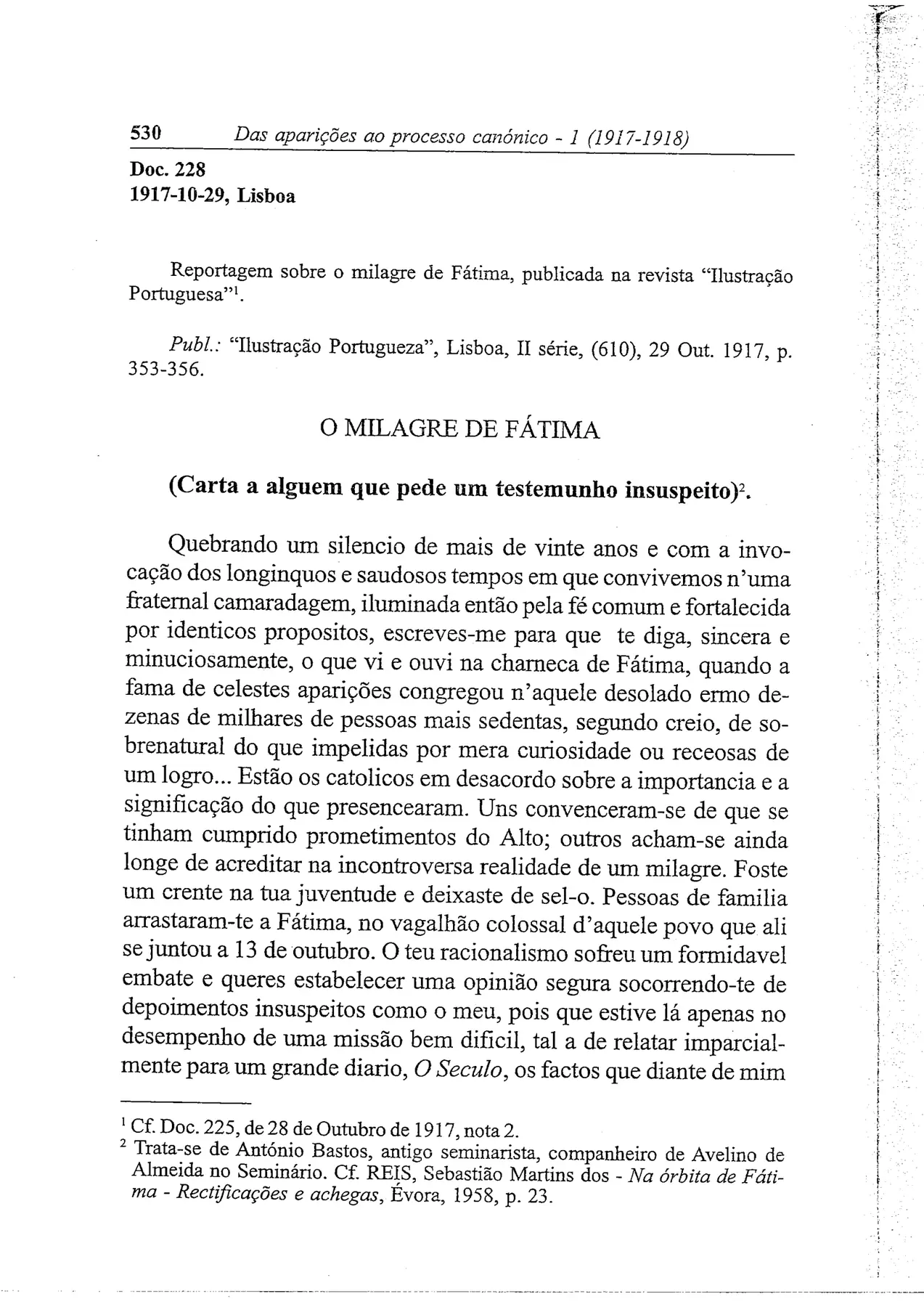
Avelino de Almeida (Pereira), born 1873 in Sintra (aged 43), a former seminarian and senior journalist of the anticlerical Lisbon daily O Século, sent as its special envoy to Fátima on 13 October 1917.
I saw extraordinary things which I shall tell you about later. There must have been some 40,000 people!!!
Vi coisas extraordinárias que depois te contarei. Estariam umas 40.000 pessoas!!!
On jumping down, after a long journey, at about sixteen hours yesterday, at the station of Chão de Maçãs5, where religious people who had come from distant parts to attend the “miracle” also alighted, I asked point-blank a young lad from the regular “char-à-banc” service whether he had already seen the Lady. With his sardonic smile and sidelong look, he did not hesitate to answer me:
— All I ever saw there was stones, carts, motor cars, beasts of burden and people!
Owing to an easy misunderstanding, the carriage that was to take us, Judah Ruah and me, to the town did not appear, and we decided bravely to tramp some two leagues7, since there was no room for us in the stagecoach and the hired gigs awaiting passengers had long since been taken. On the way we came upon the first bands of people heading in the direction [sic] of the holy place, more than twenty good kilometres away8. Men and women are almost all barefoot — the women with bags on their heads, topped by their heavy shoes; the men leaning on thick staves and cautiously provided with umbrellas too. One would say they were, in general, oblivious to what is going on around them, in great indifference to the landscape and to the other wayfarers, as if immersed in a dream, praying the rosary in a sad chant. A woman starts the first part of the Hail Mary, the salutation; her companions, in chorus, continue with the second part, the supplication. With a sure and measured step they tread the dusty road, between pine woods and olive groves, so as to reach the place of the apparition before night closes in, where, in the open air and under the cold light of the stars, they plan to sleep, keeping the first places next to the blessed holm oak — so as to see better today.
At the entrance to the town, women of the people, whom their surroundings have already infected with the virus of scepticism, comment mockingly on the affair of the day: — So you're going to see the saint tomorrow?
— Me, no. If she came here, now!
And they laugh heartily, while the devout go on indifferent to everything but the aim of their pilgrimage. In Ourem lodging9 is to be found only through extreme kindness. During the night the most varied vehicles gather in the town square carrying believers and the curious, not lacking old ladies dressed in dark clothes, already bowed under the weight of years, but with the burning fire of faith sparkling in their eyes, which spurred them to the courageous act [sic] of abandoning for one day the inseparable little corner of their home. At the break of dawn new bands appear intrepidly and cross, without stopping an instant, the township, whose silence they break with the harmony of the hymns that female voices, very much in tune, intone in violent contrast with the roughness of their types...
The sun rises, but the look of the sky threatens a storm. Black clouds pile up precisely over the Fátima side. Nothing, however, holds back those who converge there by every road, using every means of locomotion. Luxurious motor cars glide by at dizzying speed, sounding their horns; ox carts drag themselves slowly along one side of the road; the wagons, the victorias, the closed calèches, the carts in which seats have been improvised, are loaded to bursting. Almost all carry, along with the more or less modest provisions for Christian mouths, a ration of chaff for the irrational creatures that the "poverello" of Assisi called our brothers and who valiantly do their task... A harness bell jingles here and there, a little cart decked with box can be seen; nevertheless the festive air is discreet, manners are composed and order absolute... Little donkeys jog along the edge of the road, and the cyclists, very numerous, perform prodigies so as not to crash into the carts.
At about ten o'clock the sky becomes completely overcast and before long it began to rain in earnest. The ropes of water, driven by a harsh wind, lash the faces, soaking the macadam and drenching to the bone the walkers who have no hats or any other protection. But nobody grows impatient or gives up going on, and if some take shelter under the crowns of the trees, by the walls of the farms or in the scattered houses that lean out along the road, others continue the march with impressive endurance, among them some ladies whose dresses, clinging to their bodies under the force and persistence of the rain, outline their forms as if they had just come out of the bath!
\*
\ \
The spot on the heath of Fátima where the Virgin was said to have appeared to the little shepherds from the hamlet of Aljustrel is overlooked over a great stretch by the road that runs to Leiria, along which were drawn up the vehicles that had brought the pilgrims and onlookers there. Someone counted more than a hundred motor cars and more than a hundred bicycles, and it would be impossible to count the various carriages that blocked the road, one of them the motor omnibus from Torres Novas, inside which people of all social conditions mingled as brothers.
But the bulk of the pilgrims, thousands of creatures who had come from many leagues around and who were joined by faithful from various provinces, people from the Alentejo and the Algarve, from the Minho and the Beiras, gather around the little holm oak which, according to the little shepherds, the vision had chosen as its pedestal, and which could be regarded as the centre of a wide circle on whose rim other spectators and other devotees settle themselves. Seen from the road, the whole is simply fantastic. The prudent country folk, sheltering under their enormous umbrellas, many of them accompany the whittling-down of their meagre provisions with the spiritual fare of sacred hymns and decades of the rosary. There is nobody who fears sinking his feet into the sodden clay for the joy of seeing close up the holm oak over which they have raised a rough portico on which two lanterns sway... The groups singing the praises of the Virgin take turns, and a terrified hare, bolting out through the brush, diverts the attention of only half a dozen young shepherd lads, who catch it and lay it low with their cudgels...
And the little shepherds? Lucia, aged 10, the seer, and her little companions, Francisco, aged 9, and Jacinta, aged 7, have not yet arrived. Their presence is noticed perhaps half an hour before the hour given as that of the apparition. The little girls, crowned with garlands of flowers, are led to the place where the portico stands. The rain falls incessantly, but nobody despairs. Carriages with latecomers arrive on the road. Groups of the faithful kneel in the mud, and Lucia asks them, orders them to close their umbrellas. The order is passed on and is obeyed at once, without the least reluctance. There are people, many people, as if in ecstasy; people deeply moved, on whose dry lips prayer has frozen; people astounded, with hands joined and eyes brimming; people who seem to feel, to touch the supernatural... The child asserts that the Lady spoke to her once more, and the sky, still murky, suddenly begins to clear overhead; the rain stops and one senses that the sun is about to flood with light the landscape that the wintry morning made even sadder...
The old time is the one that governs for this crowd, which dispassionate estimates by educated people, wholly free of mystical influences, put at thirty or forty thousand creatures... The miraculous manifestation, the visible sign announced, is about to take place — many pilgrims assure us... And then one witnesses a spectacle unique and unbelievable to anyone who was not a witness of it. From the top of the road, where the carriages are crowded together and where many hundreds of people remain who lacked the courage to venture onto the muddy ground, one sees the whole immense crowd turn towards the sun, which appears free of clouds, at the zenith. The orb looks like a plate of dull silver, and it is possible to gaze at its disc without the least effort. It does not burn, it does not blind. One would say an eclipse was taking place. But behold, a colossal clamour arises, and from the specta-tors who are nearest one hears the cry:
— Miracle, miracle! A marvel, a marvel!
Before the dazzled eyes of that people, whose attitude trans-ports us to biblical times and who, pale with astonishment, bareheaded, gaze at the blue, the sun trembled, the sun made sudden movements never seen before, outside all cosmic laws — the sun “dan-ced”, in the typical expression of the peasants.. Perched on the step of the Torres Novas motor omnibus, an old man whose stature and whose features, at once gentle and energetic, recall those of Paul Déroulède10, recites, facing the sun, in a ringing voice, the Creed from beginning to end. I ask who he is and I am told he is Mr
João Maria Amado de Melo Ramalho da Cunha Vasconcelos12. I then see him turn to those around him who had kept their hats on, vehemently begging them to uncover their heads before so extraordinary a demonstration of the existence of God. Identical scenes are repeated at other points, and a lady cries out, bathed in anguished tears and almost choking:
— What a pity! There are still men who do not uncover their heads before so stupendous a miracle!13
And afterwards they ask one another whether they saw and what they saw. The greater number confess that they saw the trembling, the dancing of the sun; others, however, declare they saw the smiling face of the Virgin herself, swear that the sun spun round on itself like a firework wheel, that it came down almost to the point of burning the earth with its rays... There are those who say they saw it change colour successively...
\*
\ \
It is nearly fifteen hours.
The sky is swept clear of clouds and the sun follows its course with its usual splendour, which nobody dares to face directly. And the little shepherds? Lucia, the one who speaks with the Virgin, announces with theatrical gestures, in the arms of a man14 who carries her from group to group, that the war had ended and that our soldiers were going to come home... Such news, however, does not increase the jubilation of those who hear it. The heavenly sign was everything. There is an intense curiosity to see the two little girls with their garlands of roses; there are those who try to kiss the hands of the "little saints", one of whom, Jacinta, is closer to fainting than to dancing; but what everyone longed for — the sign from heaven — was enough to satisfy them, to root them in their simple charcoal-burner's faith. Street vendors offer portraits of the children on postcards, and other cards showing a soldier of the Portuguese Expeditionary Corps "thinking of the help of his protectress for the salvation of the Fatherland", and even an image of the Virgin as being the figure of the vision... That was good business, and certainly more centavos went into the vendors' pockets and into the alms box for the little shepherds than into the outstretched open hands of the lepers and the blind who, elbowing among the pilgrims, flung their piercing cries into the air...
The dispersal takes place quickly, without difficulty, without a shadow of disorder, without any need for a patrol of the guard to regulate it. The pilgrims who leave most quickly, hurrying off along the road, are those who arrived first, on foot and barefoot, with their shoes on their heads or hanging from their staves. They go, their souls in perpetual adoration, to carry the good news to the hamlets that had not been entirely emptied. And the priests? Some turned up at the spot, smiling, ranking themselves more with the curious spectators than with the pilgrims eager for heavenly favours. Perhaps one or two could not manage to hide the satisfaction that so often shows on the faces of the triumphant... It remains for the competent to have their say on the macabre dance of the sun which today, in Fátima, made hosannas burst from the breasts of the faithful and naturally left impressed — so trustworthy persons assured me — the freethinkers and other people without concerns of a religious nature who flocked to the now celebrated heath.
Ao saltar, após demorada viagem, pelas dezesseis horas de hontem, na estação de Chão de Maçãs5, onde se apearam também pessoas religiosas vindas de longes terras para assistir ao “milagre”, perguntei, de chofre, a um rapazote do “char-á-bancs” da carreira se já tinha visto a Senhora. Com seu sorriso sardónico e o olhar enviezado, não hesitou em responder-me:
— Eu cá só lá vi pedras, carros, automoveis, cavalgaduras e gente!
Por um facil equivoco, o trem que nos devia conduzir, a Judah Ruah e a mim, até á vila, não apareceu e decidimo-nos a calcorriar corajosamente cêrca de duas leguas7 por não haver lugar para nós na diligencia e estarem, desde muito, afreguezadas as cariotas que aguardavam passageiros. Pelo caminho, topámos os primeiros ranchos que seguiam em direção [sic] ao local santo, distante mais de vinte kilometros bem medidos8. Homens e mulheres vão quasi todos descalços — elas com saquiteis á cabeça, sobrepujados pelas sapatorras; eles abordoando-se a grossos vara-paus e cautelosamente munidos tambem de guarda-chuva. Dir-se-hiam, em geral, alheados do que se passa á sua volta, n'um desinteresse grande da paizagem e dos outros viandantes, como que imersos em sonho, rezando n'uma triste melopeia o terço. Uma mulher rompe com a primeira parte da ave--maria, a saudação; os companheiros, em côro, continuam com a segunda parte, a suplica. N'um passo certo e cadenciado, pisam a estrada poeirenta, entre pinhaes e olivedos, para chegarem antes que se cerre a noite ao sitio da aparição, onde, sob o relento e a luz fria das estrelas, projetam dormir, guardando os primeiros lugares junto da azinheira bem dita — para no dia de hoje verem melhor.
Á entrada da vila, mulheres do povo a quem o meio já infétou com o virus do ceticismo, comentam, em tom de troça, o caso do dia: — Então vaes vêr ámanhã a santa?
— Eu, não. Se ela ainda cá viesse!
E riem-se com gosto, enquanto os devotos proseguem indifferentes a tudo o que não seja o objetivo da sua romagem. Em Ourem só por uma amabilidade extrema se encontra aposentadoria9. Durante a noite, reúnem-se na praça da vila os mais variados veículos conduzindo crentes e curiosos sem que faltem velhas damas vestidas de escuro, vergadas já ao peso dos anos, mas faiscando-lhes nos olhos o lume ardente da fé que as animou ao ato [sic] corajoso de abandonar por um dia o inseparavel cantinho da sua casa. Ao romper d'alva, novos ranchos surgem intrepidamente e atravessam, sem pararem um instante, o povoado, cujo silencio quebram com a harmonia dos canticos que vozes femininas, muito afinadas, entoam n'um violento contraste com a rudeza dos tipos...
O sol nasce, mas o cariz do céu ameaça tormenta. As nuvens negras acastelam-se precisamente sobre as bandas de Fátima. Nada, todavia, detem os que por todos os caminhos e servindo-se de todos os meios de locomoção para lá confluem. Os automoveis luxuosos deslisam vertiginosamente, tocando as buzinas; os carros de bois arrastam-se com vagar a um lado da estrada; as galeras, as vitorias, os caleches fechados, as carroças nas quaes se improvisaram assentos vão ajoujados a mais não poderem. Quasi todos levam com os farneis, mais ou menos modestos, para as bocas cristãs a ração de folhelho para os irracionaes que o "poverelo" de Assis chamava nossos irmãos e que cumprem, valorosamente a sua tarefa... Tilinta uma ou outra guiseira, vê-se uma carrocinha adornada de buxo; no emtanto, o ar festivo é discreto, as maneiras são compostas e a ordem absoluta... Burrinhos choutam á margem da estrada e os ciclistas, numerosissimos, fazem prodigios para não esbarrar de encontro aos carros.
Pelas dez horas, o ceu tolda-se totalmente e não tardou que entrasse a chover a bom chover. As cordas de agua, batidas por um vento agreste, fustigam os rostos, encharcando o macadame e re-passando até os ossos os caminhantes desprovidos de chapeus e de quaesquer outros resguardos. Mas ninguem se impacienta ou desiste de proseguir e, se alguns se abrigam sob a copa das arvores, junto dos muros das quintas ou nas distanciadas casas que se debruçam ao longo do caminho, outros continuam a marcha com uma impressionante resistencia, notando-se algumas senhoras cujos vestidos colados aos corpos, por efeito do impeto e da pertinácia da chuva, lhes desenham as fórm as como se tivessem saído do banho!
\ \
O ponto da charneca de Fátima, onde se disse que a Virgem aparecera aos pastorinhos do logarejo de Aljustrel, é dominado n'uma enorme extensão pela estrada que corre para Leiria, e ao longo da qual se postaram os veículos que lá conduziram os peregrinos e os mirones. Mais de cem automoveis alguem contou e mais de cem bicicletas, e seria impossível contar os diversos carros que atravancaram a estrada, um d'eles o auto-omnibus de Torres Novas, dentro do qual se irmanavam pessoas de todas as condições sociaes.
Mas o grosso dos romeiros, milhares de creaturas que foram de muitas leguas ao redor e a que se juntaram fieis idos de varias províncias, alemtejanos e algarvios, minhotos e beirões, congregam-se em torno da pequenina azinheira que, no dizer dos pastorinhos, a visão escolhera para seu pedestal e que podia considerar-se como que o centro de um amplo circulo em cujo rebordo outros espectadores e outros devotos se acomodam. Visto da estrada, o conjunto é simplesmente fantastico. Os prudentes camponios, abarracados sob os chapeus enormes, acompanham, muitos d'eles, o desbaste dos parcos farneis com o conduto espiritual dos hinos sacros e das dezenas do rosario. Não ha quem tema enterrar os pés na argila empapada, para ter a dita de ver de perto a azinheira sobre a qual ergueram um tosco portico em que bamboleiam duas lanternas... Alteram-se os grupos que cantam os louvores da Virgem, e uma lebre, espavorida, que galga matagal em fóra, apenas desvia as atenções de meia duzia de zagaletes que a alcançam e prostram á cacetada...
E os pastorinhos? Lucia, de 10 anos, a vidente, e os seus pequenos companheiros, Francisco, de 9, e Jacinta, de 7, ainda não chegaram. A sua presença assinala-se talvez meia hora antes da indicada como sendo a da aparição. Conduzem as rapariguinhas, coroadas de capelas de flôres, ao sitio em que se levanta o portico. A chuva cae incessantemente mas ninguem desespera. Carros com retardatarios chegam á estrada. Grupos de fieis ajoelham na lama e a Lucia pede-lhes, ordena que fechem os chapeus. Transmite-se a ordem, que é obedecida de pronto, sem a minima relutancia. Ha gente, muita gente, como que em extase; gente comovida, em cujos labios secos a prece paralisou; gente pasmada, com as mãos postas e os olhos borbulhantes; gente que parece sentir, tocar o sobrenatural... A criança afirma que a Senhora lhe falou mais uma vez, e o céu, ainda caliginoso, começa, de subito, a clarear no alto; a chuva pára e presente-se que o sol vae inundar de luz a paizagem que a manhã invernosa tornou ainda mais triste...
A hora antiga é a que regula para esta multidão, que calculos desapaixonados de pessoas cultas e de todo o ponto alheias ás influencias misticas computam em trinta ou quarenta mil creaturas... A manifestação miraculosa, o sinal visivel anunciado está prestes a produzir-se — asseguram muitos romeiros... E assiste-se então a um espetaculo unico e inacreditavel para quem não foi testemunha d'ele. Do cimo da estrada, onde se aglomeram os carros e se conservam muitas centenas de pessoas, a quem escasseou valor para se meter á terra barrenta, vê-se toda a imensa multidão voltar-se para o sol, que se mostra liberto de nuvens, no zenit. O astro lembra uma placa de prata fosca e é possivel fitar-lhe o disco sem o minimo esforço. Não queima, não cega. Dir-se-hia estar-se realisando um eclipse. Mas eis que um alarido colossal se levanta, e aos espectado-res que se encontram mais perto se ouve gritar:
— Milagre, milagre! Maravilha, maravilha!
Aos olhos deslumbrados d'aquele povo, cuja atitude nos trans-porta aos tempos biblicos e que, palido de assombro, com a cabeça descoberta, encara o azul, o sol tremeu, o sol teve nunca vistos movimentos bruscos fóra de todas as leis cosmicas — o sol “bai-lou”, segundo a tipica expressão dos camponezes.. Empoleirado no estribo do auto-omnibus de Torres Novas, um ancião cuja estatura e cuja fisionomia, ao mesmo tempo doce e energica, lembram as de Paul Déroulède10, recita, voltado para o sol, em voz clamorosa, de principio a fim, o Credo. Pergunte quem é e dizem-me ser o sr.
João Maria Amado de Melo Ramalho da Cunha Vasconcelos12. Vejo-o depois dirigir-se aos que o rodeiam, e que se conservaram de chapeu na cabeça, suplicando-lhes, veementemente, que se descubram em face de tão extraordinária demonstração da existência de Deus. Cenas identicas repetem-se n'outros pontos e uma senhora clama, banhada em aflitivo pranto e quasi n'uma sufocação:
— Que lastima! Ainda ha homens que se não descobrem deante de tão estupendo milagre!13
E, a seguir, perguntam uns aos outros se viram e o que viram. O maior numero confessa que viu a tremura, o bailado do sol; outros, porém, declaram ter visto o rosto risonho da propria Virgem, juram que o sol girou sobre si mesmo como uma roda de fogo de artificio, que ele baixou quasi a ponto de queimar a terra com os seus raios... Ha quem diga que o viu mudar sucessivamente de côr...
\ \
São perto de quinze horas.
O ceu está varrido de nuvens e o sol segue o seu curso com o esplendor habitual que ninguem se atreve a encarar de frente. E os pastorinhos? Lucia, a que fala com a Virgem, anuncia, com ademanes teatraes, ao colo de um homem14, que a transporta de grupo em grupo, que a guerra terminára e que os nossos soldados iam regressar... Semelhante nova, todavia, não aumenta o jubilo de quem a escuta. O sinal celeste foi tudo. Ha uma intensa curiosidade em vêr as duas rapariguinhas com suas grinaldas de rosas, ha quem procure oscular as mãos das "santinhas", uma das quaes, a Jacinta, está mais para desmaiar do que para danças, mas aquilo por que todos anciavam — o sinal do ceu — bastou a satisfazê-los, a radical-os na sua fé de carvoeiro. Vendedores ambulantes oferecem os retratos das crianças em bilhetes postaes e outros bilhetes que representam um soldado do Corpo Expedicionario Portuguez "pensando no auxilio da sua protetora para salvação da Patria" e até uma imagem da Virgem como sendo a figura da visão... Bom negocio foi esse e decerto mais centavos entraram na algibeira dos vendedores e no tronco das esmolas para os pastorinhos do que nas mãos estendidas e abertas dos leprosos e dos cegos que, acotovelando-se com os romeiros, atiravam aos ares seus gritos lancinantes...
O dispersar faz-se rapidamente, sem dificuldades, sem sombra de desordem, sem que fosse mister que o regulasse qualquer patrulha da guarda. Os peregrinos que mais depressa se retiram, correndo estrada fóra, são os que primeiro chegaram, a pé e descalços com os sapatos á cabeça ou dependurados nos varapaus. Vão, com a alma em lausperene, levar a boa nova aos logarejos que não se despovoaram de todo. E os padres? Alguns compareceram no local, sorridentes, enfileirando mais com os espectadores curiosos do que com os romeiros avidos de favores celestiaes. Talvez um ou outro não lograsse dissimular a satisfação que no semblante dos triunfadores tantas vezes se traduz... Resta que os competentes digam de sua justiça sobre o macabro bailado do sol que hoje, em Fátima, fez explodir hossanas dos peitos dos fieis e deixou naturalmente impressionados — ao que me asseguraram sujeitos fidedignos os livres pensadores e outras pessoas sem preocupações de natureza religiosa que acorreram á já agora celebrada charneca.
4 Vila Nova de Ourém.
5 Also known as Fátima Station.
7 From Chão de Maçãs to Vila Nova de Ourém is 10 kilometres.
8 From Vila Nova de Ourém to Fátima is 13 kilometres.
9 Dona Maria Isabel de Barros e Sá Pereira Machado, of Vila Nova de Ourém, daughter of António José Pereira, at that time correspondent of "O Século" in Vila Nova de Ourém, says that she went to Fátima in her father's carriage, with Avelino de Almeida and his companion (Ruah). On learning of the events at Fátima, her father got in touch with the newspaper "O Século", which sent Avelino de Almeida and Ruah. They passed through Ourém, looked for the Administrator, who was not in, and set off for Fátima in a hired carriage.
10 French writer and politician, born in Paris on 2 September 1846. In 1882 he founded the “League of Patriots” and was its president. He was the author of Chant du Soldat (1872) and of Nouveaux Chants du Soldat (1875). He died in Nice on 30 January 1914.
12 According to information from Maria Elisa Cunha Serra, João Vasconcelos went to Fátima in the same carriage as Maria Raposo, herself and other people. Cf. Doc. 117, of 18 October 1917, note 4.
13 Dona Maria Isabel de Barros e Sá Pereira Machado says that at the moment of the miracle she was beside the carriage of the family of the Marquis of Foz. She heard the Marquis say a sentence very similar to this one: "There are still people who do not uncover their heads before so great a miracle".
14 This is Dr. Carlos de Azevedo Mendes (cf. DCF, vol. 1, Doc. 56, of p.13 October 1917, note 10).
4 Vila Nova de Ourém.
5 Também conhecida por Estação de Fátima.
7 De Chão de Maçãs a Vila Nova de Ourém são 10 kilómetros.
8 De Vila Nova de Ourém a Fátima são 13 kilómetros.
9 D. Maria Isabel de Barros e Sá Pereira Machado, de Vila Nova de Ourém, filha de António José Pereira, nessa altura correspondente de "O Século" em Vila Nova de Ourém, diz que foi a Fátima na carruagem de seu pai, com Avelino de Almeida e seu companheiro (Ruah). Ao ter conhecimento dos factos de Fátima, seu pai pôs-se em contacto com o jornal "O Século", que enviou Avelino de Almeida e Ruah. Estes passaram por Ourém, procuraram o Administrador que não estava e partiram para Fátima em carruagem alugada.
10 Escritor e político francês, nasceu em Paris a 2 de Setembro de 1846. Em 1882 fundou e foi o presidente da “Liga dos Patriotas”. Foi o autor de Chant du Soldat (1872) e de Nouveaux Chants du Soldat (1875). Faleceu, em Nice, a 30 de Janeiro de 1914.
12 Segundo informação de Maria Elisa Cunha Serra, João Vasconcelos foi a Fátima na mesma carruagem que Maria Raposo, ela própria e outras pessoas. Cf. Doc. 117, de 18 de Outubro de 1917, nota 4.
13 D. Maria Isabel de Barros e Sá Pereira Machado diz que no momento do milagre estava junto à carruagem da família do Marquês da Foz. Ouviu ao Marquês uma frase muito semelhante a esta: "Ainda há gente que não se descobre perante tão grande milagre".
14 Trata-se do Dr. Carlos de Azevedo Mendes (cf. DCF, vol. 1, Doc. 56, de p.13 de Outubro de 1917, nota 10).
Thus it was that, on the famous and long-awaited day, thousands upon thousands of people flocked to Fátima from near and far, braving all the obstacles and hardships of travel, some trudging leagues in sun and rain, others conveyed in the most varied vehicles, from the almost prehistoric to the most recent and marvellous models of motor car, and many more who endured the discomforts of the third-class carriages of the trains, in which, to cover what are today relatively short distances, long hours and even days and nights are lost! I saw groups of men and women, patiently, as if rapt in a dream, making their way on the eve towards the famous spot, singing sacred hymns and walking barefoot to their rhythm and to the cadenced recitation of the rosary (5 decades), without being troubled, deterred or driven to despair by the almost sudden change in the weather, when the downpours turned the dusty roads into deep mires and the mildness of autumn gave way, for a day, to the harshest rigours of winter... I saw the crowd, now pressed around the little tree of the miracle and stripping it of its branches to keep them as relics, now spread out over the vast heath which the Leiria road crosses and dominates and which the most picturesque and heterogeneous throng of carriages and people cluttered on that memorable day, awaiting the supernatural manifestations in the best of order, without fearing that the wintry weather would spoil them, diminishing their splendour and majesty... I saw that discouragement did not invade souls, that confidence remained alive and ardent despite the unexpected setbacks, that the composure of the crowd, in which country folk were in great abundance, was perfect, and that the children, privileged in their own estimation, were received with demonstrations of the most intense affection by that people, who knelt, uncovered their heads and prayed at their bidding as the hour of the "miracle" approached, the hour of the "perceptible sign", the mystic and longed-for hour of contact between heaven and earth...
And, when I no longer imagined that I would see anything more impressive than that noisy but peaceful crowd, animated by the same obsessive idea and moved by the same powerful yearning, what did I still see that was truly strange on the heath of Fátima? The rain, at the foretold hour, stops falling; the dense mass of clouds break apart, and the king of stars — a disc of dull silver — appear at full zenith and begin dancing in a violent and convulsive dance, which a great number of people imagined to be a serpentine dance, so beautiful and glittering were the colours that successively covered the surface of the sun...
A miracle, as the people cried; a natural phenomenon, as scholars say? I am not concerned now to know, but only to assure you of what I saw...
Foi assim que, no dia celebre e tão anciado, afluíram de perto e de longe a Fátima, arrostando com todos os embaraços e todas as durezas das viagens, milhares e milhares de pessoas, umas que palmilharam leguas ao sol e á chuva, outras que se transportaram em variadissimos vehiculos, desde os quasi pre-historicos até os mais recentes e maravilhosos modelos de automoveis, e ainda muitissimas que suportaram os incomodos das terceiras classes dos comboios, dentro dos quaes, para percorrer hoje relativamente pequenas distancias, se perdem longas horas e até dias e noites! Vi ranchos de homens e de mulheres, pacientemente, como enlevados n'um sonho, dirigirem-se, de vespera, para o sitio famoso, cantando hinos sacros e caminhando descalços ao ritmo d'eles é á recitação cadenciada do terço do Rosario, sem que os importunasse, os demovesse, os desesperasse, a mudança quasi repentina do tempo, quando as bategas de agua transformaram as estradas poeirentas em fundos lamaçães e ás doçuras do outono sucederam, por um dia, os asperrimos rigores do inverno... Vi a multidão, ora comprimida á volta da pequenina arvore do milagre e desbastando-a dos seus ramos para os guardar como reliquias, ora espreada pela vasta charneca que a estrada de Leiria atravessa e domina e que a mais pitoresca e heterogenea concorrência de carros e pessoas atravancou n'aquele dia memoravel, aguardar na melhor ordem as manifestações sobrenaturaes, sem temer que a invernía as prejudicasse, diminuindo-lhes o esplendor e a imponência... Vi que o desalento não invadiu as almas, que a confiança se conservou viva e ardente, a despeito das inesperadas contrariedades, que a compostura da multidão em que superabundavam os camponios foi perfeita e que as crianças, no seu entender privilegiadas, tiveram a acolhel-as as demonstrações do mais intenso carinho por parte d'aquele povo que ajoelhou, se descobriu e rezou a seu mandado ao aproximar-se a hora do "milagre", a hora do "sinal sensível", a hora mistica e suspirada do contacto entre o céu e a terra...
E, quando já não imaginava que via alguma coisa mais impressionante do que essa rumorosa mas pacifica multidão animada pela mesma obcessiva idéa e movida pelo mesmo poderoso anseio, que vi eu ainda de verdadeiramente estranho na charneca de Fátima? A chuva, á hora prenunciada, deixa de cair; a densa massa de nuvens romper-se e o astro-rei —disco de prata fosca— em pleno zenith aparecer e começar dançando n'um bailado violento e convulso, que grande numero de pessoas imaginava ser uma dança serpentina, tão belas e rutilantes côres revestiu sucessivamente a superfície solar...
Milagre, como gritava o povo; fenomeno natural, como dizem sabios? Não curo agora sabel-o, mas apenas de te afirmar o que vi...