Events /

13 June 1917

Second apparition. A few dozen onlookers.

57 passagesSaw it: 54Saw nothing: 1Present: 2Filter and search these →
13 May13 Jun13 Jul13 Aug13 Sep13 OctOther 1917First-handSaw itInterrogationFigures / visionsSeers' words overheard
English

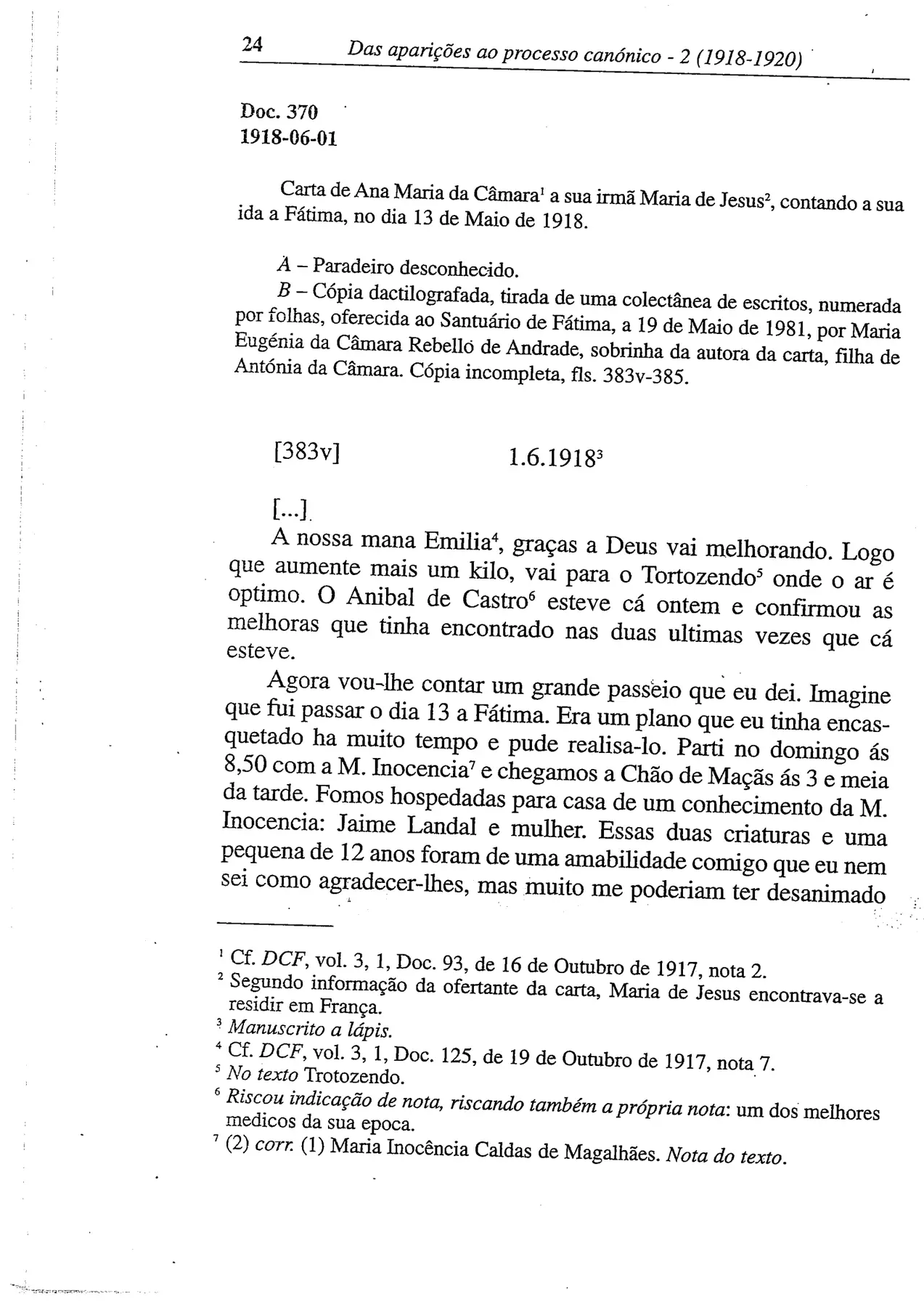
Several times I questioned the seer Jacinta, who always confirmed to me that she saw a Lady at the Cova da Iria on the thirteenth of each month from May to October nineteen hundred and seventeen, except on the thirteenth of August, when she was at the house of the municipal administrator*, but that in that month she saw Her on the following Sunday – the nineteenth – at the place called Valinho, where she was called by her brother João at Lúcia's request.

She said that she saw a very beautiful Lady, all dressed in white, in a garment with little gold cords, with a veil or mantle over her head, the size of F. – she points to a girl of average height, about fourteen years old – and that she had some very white beads hanging from her hands, held between the forefinger and thumb of both hands, which she held up at her waist and parted to about the width of her shoulders when she spoke to Lúcia.

When She spoke to Lúcia, she heard a very gentle, pious voice, but she does not remember hearing anything said except that they – the seers – would go to Heaven. In the several times I questioned her she never contradicted herself on essentials, although on incidental matters there were some contradictions, real or apparent. On one occasion – 21 August – I went to her parents' house with five ladies – Dona Maria de Jesus Raposo, of Torres Novas, and others from the Quinta da Cardiga – one of whom, about fifteen years of age, was dressed in white. On reaching the parents' house I called out... Jacinta came; she was alone, and on seeing the unexpected visitors she was embarrassed, as is natural in a child of the people, and in one who a few days earlier had been returned to her parents after being abducted. After a few words of encouragement, I said to her:

– Look, Jacinta, see whether it was one of these ladies you saw at the Cova da Iria, or whether there is one here who looks like the one you saw there.

She raises her little eyes, runs her gaze over all of them, from head to foot, and says:

– It wasn't any of these... the other one is much more beautiful.

I point out to her the one dressed in white, saying to her:

– Then wasn't it this Lady, dressed in white, so beautiful, that you saw up there?!

This Lady, she answered, is very beautiful, but She whom I saw there is much more beautiful.

We went to Lúcia's parents' house and, on finding her, I asked her the same question and got the same answer. Nor could I get her to reveal the secret to me; she only said that it – the secret – was not bad for them, the seers. She also said that the Lady appeared to her three more times: once on the day of the Ascension of the Lord, in the church during Mass, when she taught her to say the beads; another time, at night, above the trapdoor of the loft while the family was asleep; and once more under (or, if I am not mistaken, on top of) a table, without saying anything to her, until she, Jacinta, said to her mother: Look... don't you see the Lady I saw up there, there underneath?!... Look!!! As the mother herself stated to me.

Português (original)

Por várias vezes interroguei a vidente Jacinta que sempre me confirmou que viu uma Senhora na Cova da Iria, nos dias treze de maio a outubro de mil novecentos e dezassete, menos no dia treze de agosto em que se achava em casa do administrador do concelho, mas que nesse mês A viu no domingo seguinte – dia dezanove – no sítio chamado Valinho, onde foi chamada por seu irmão João, a pedido da Lúcia.

Disse que viu uma Senhora muito bonita, toda vestida de branco, com fato dourado aos cordõezinhos, com um véu ou manto pela cabeça, do tamanho de F. – indica uma rapariga de regular estatura e dos seus catorze anos – e que trazia umas contas muito branquinhas penduradas nas mãos e seguras entre os dedos indicador e polegar de ambas as mãos, que tinha erguidas à cintura, e que separava uma da outra, pouco mais ou menos à largura dos ombros, quando falava à Lúcia.

Quando Ela falava para a Lúcia, que ouvia uma voz muito piedosa, mas que não se lembra de ouvir dizer, senão que a gente – elas videntes – ia para o Céu. Pelas várias vezes que a interroguei nunca se contradisse no essencial, havendo todavia coisas acidentais, algumas contradições, verdadeiras ou aparentes. Em uma ocasião – dia 21 de agosto – dirigi-

-me a casa dos pais dela acompanhado de cinco senhoras – D. Maria de Jesus Raposo, de Torres Novas, e outras da Quinta da Cardiga – uma das quais, dos seus quinze anos de idade, ia vestida de branco. Ao chegar a casa dos pais chamei... Veio a Jacinta, que estava só, e que ao ver as inesperadas visitas, ficou embaraçada, como é próprio duma criança do povo e de quem poucos dias antes tinha sido restituída aos pais do rapto que lhe haviam feito. Depois de algumas palavras de animação, disse-lhe eu:

– Olha, Jacinta, vê se foi alguma destas senhoras que viste na Cova da Iria, ou se aqui está alguma parecida com A que lá viste.

Ela levanta os olhozitos, percorre-as todas com a vista, dos pés à cabeça, e diz:

– Não foi nenhuma destas... a outra é muito mais bonita.

Faço-lhe notar a que vinha vestida de branco, dizendo-lhe:

– Então não foi esta Senhora, vestida de branco, tão bonita que tu lá viste em cima?!

Esta Senhora, respondeu ela, é muito bonita, mas A que eu lá vi é muito mais bonita.

Dirigimo-nos a casa dos pais da Lúcia e ao encontrar esta, fiz-lhe a mesma pergunta obtendo idêntica resposta. A respeito do segredo também não consegui que me o revelasse; apenas disse que ele – segredo – não era mau para elas, videntes. Disse mais, que a Senhora lhe apareceu mais três vezes: uma no dia da Ascensão do Senhor na Igreja durante a missa e que lhe ensinou a rezar as contas; outra vez, à noite, sobre o alçapão do sótão estando a família a dormir; e mais uma, debaixo (ou salvo erro em cima) duma mesa, sem nada lhe dizer, até que ela, Jacinta, disse para a mãe: Olhe... não vê a Senhora, que lá vi em cima, ali debaixo?!... Olhe!!! Como a própria mãe me declarou.
13 JunFirst-handSaw itInterrogationFigures / visionsSeers' words overheard
English

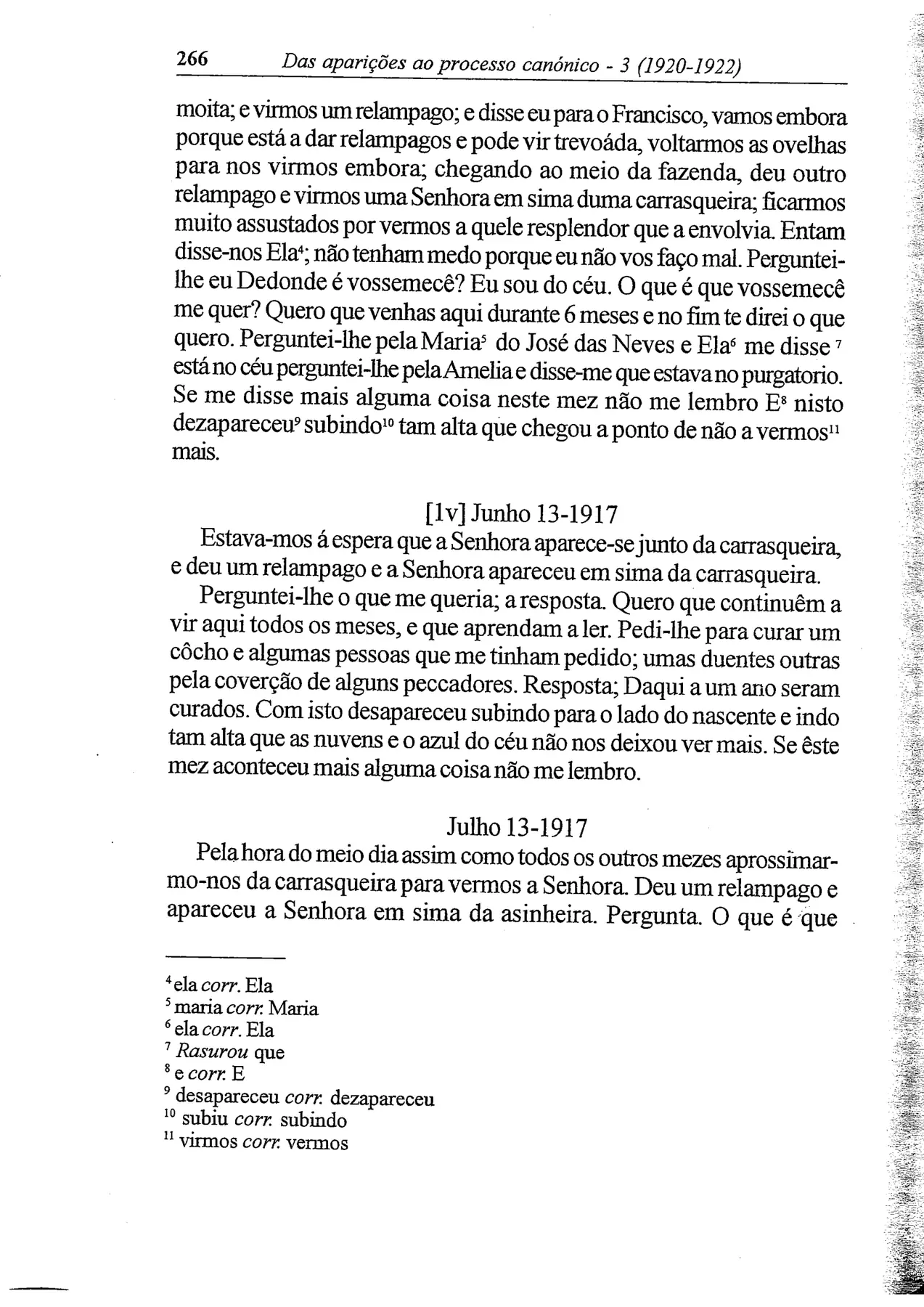
Soon after the thirteenth of June the girl Lúcia appeared before me at the parish residence, accompanied by her mother. I proceeded to question Lúcia, who told me that on the thirteenth of the current month of June, at about one o'clock in the afternoon, she went with her cousins Francisco and Jacinta to the Cova da Iria. When they got there she said the rosary with the people who were present. When the rosary was finished, the people were about to say the Litany*, and she, who had already seen the flash of lightning, said to them: don't begin, there's no time now.

That she goes closer to the holm-oak shrub and sees the Lady arrive, coming from the east. And she asks her:

– Well, what is it you want of me?
And the Lady answered:
– I want to tell you to come back here on the thirteenth of each month and to learn to read, so that I can tell you what I want.
– Then you want nothing more of me?
– I want nothing more of you.
And at once she began to rise and disappeared.

Português (original)

Logo após o dia treze de junho comparece na minha presença e residência paroquial, a menina Lúcia acompanhada de sua mãe. Procedi ao interrogatório da Lúcia, a qual me disse que no dia treze do corrente mês de junho, por cerca da uma hora da tarde, se dirigiu com seus primos Francisco e Jacinta para a Cova da Iria. Chegados lá, rezou o terço, com as pessoas que estavam presentes. Terminado o terço, iam as pessoas para rezar a Ladainha, e ela, que já tinha visto o relâmpago, lhes disse: não comecem que já não têm tempo.

Que vai mais para o pé da carrasqueira e vê chegar a Senhora, vindo do nascente. E lhe pergunta:

– Então o que é que me quer?
E a Senhora respondeu:
– Quero-te dizer que voltes cá nos dias treze e que aprendas a ler para te dizer o que quero.
– Então não me quer mais nada?
– Não te quero mais nada.
E logo se começou a elevar e desapareceu.
13 JunFirst-handSaw itInterrogationFigures / visionsSeers' words overheard
English

Lúcia says that she waited for a while, and during this time she was praying the rosary*; when they were about to pray the litany* she said: don't start, there's no time now — there were many people there — because she had already seen the lightning flash. She went to the holm-oak shrub with the people who were present; on arriving she made a bow, bending one knee, and at the same moment the Lady arrived, coming in an oblique line from the east, and Lúcia asked:
– Well then, what do you want of me?

– “I want to tell you to come back here on the 13th and to learn to read so that I can tell you what I want of you.”

– Then don't you want anything else?

– I want nothing more.

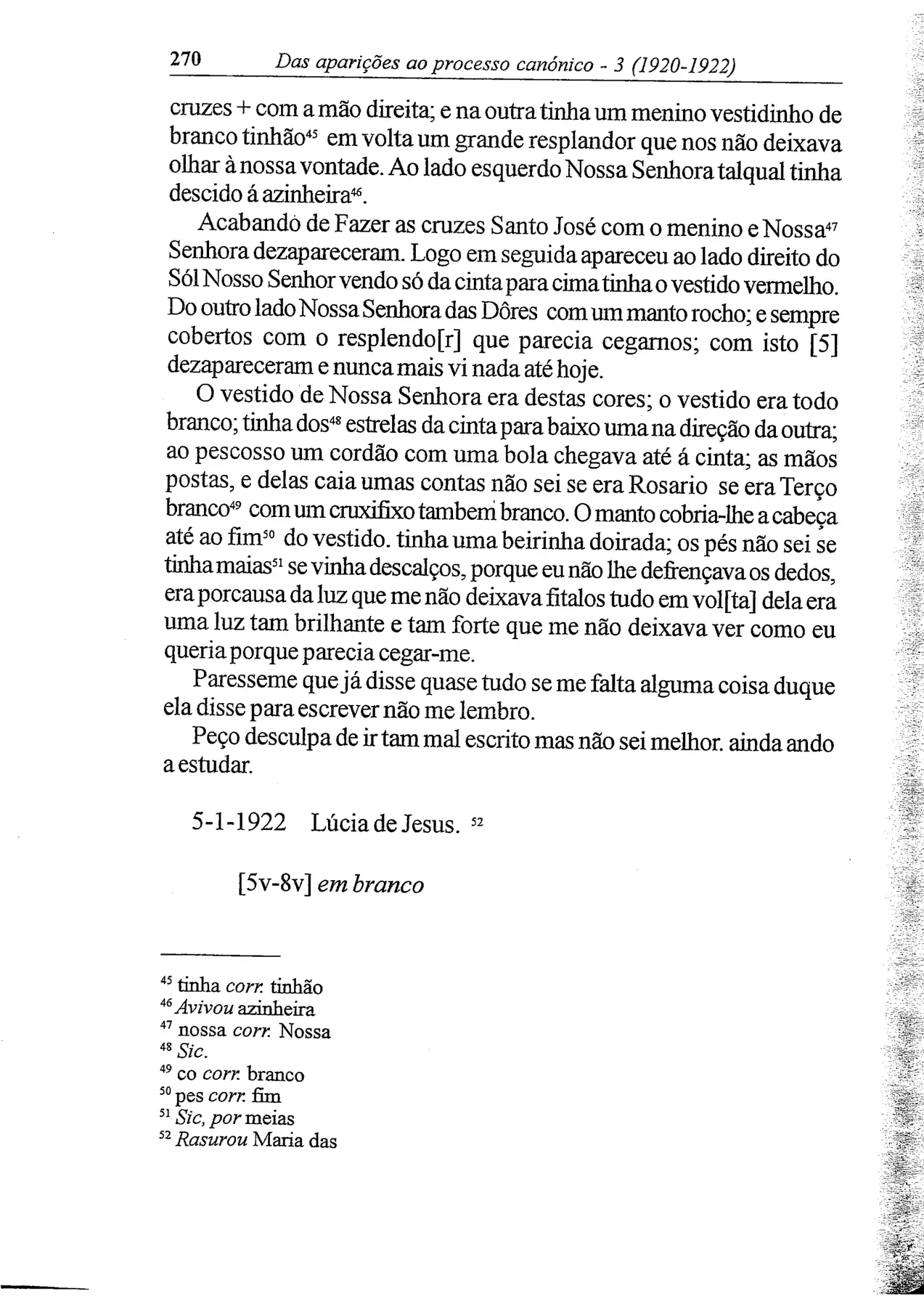
The dress was: a white mantle which reached from the head to the bottom of the skirt; it was gilded from the waist down, with cords running across and from top to bottom, and at the edges the gold was closer together. The skirt was all white and gilded with cords lengthwise and crosswise, but it reached only to the knee; a white jacket, not gilded, with only two or three cords at the cuffs; she had no shoes, she had white stockings, not gilded; round her neck she had a gold cord with a medal at the ends; she had her hands raised; in her ears she had some very tiny studs, very close to the ears; she parted her hands when she spoke; her eyes were black; she was of medium height.

Português (original)

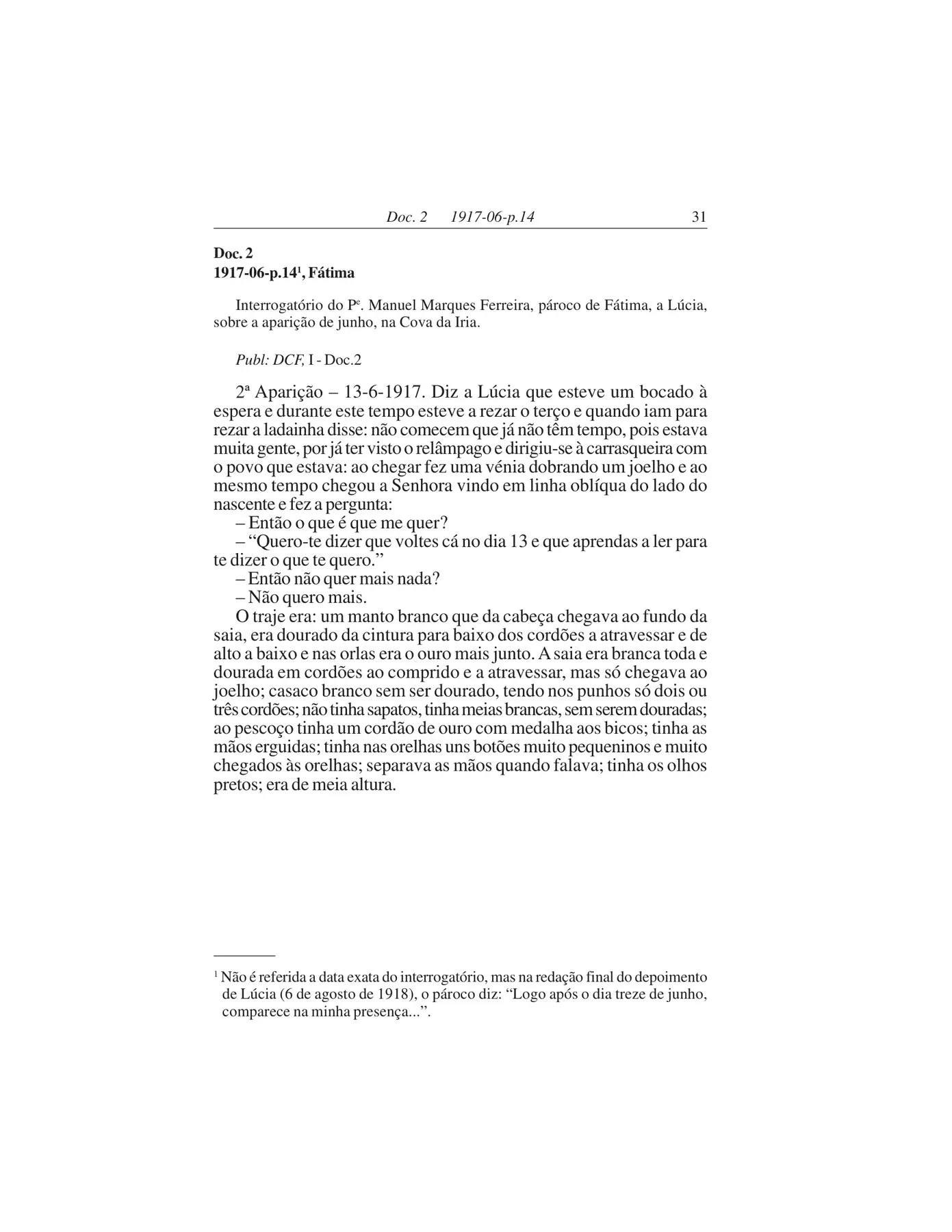
Diz a Lúcia que esteve um bocado à espera e durante este tempo esteve a rezar o terço e quando iam para rezar a ladainha disse: não comecem que já não têm tempo, pois estava muita gente, por já ter visto o relâmpago e dirigiu-se à carrasqueira com o povo que estava: ao chegar fez uma vénia dobrando um joelho e ao mesmo tempo chegou a Senhora vindo em linha oblíqua do lado do nascente e fez a pergunta:

– Então o que é que me quer?

– “Quero-te dizer que voltes cá no dia 13 e que aprendas a ler para te dizer o que te quero.”

– Então não quer mais nada?

– Não quero mais.

O traje era: um manto branco que da cabeça chegava ao fundo da saia, era dourado da cintura para baixo dos cordões a atravessar e de alto a baixo e nas orlas era o ouro mais junto. A saia era branca toda e dourada em cordões ao comprido e a atravessar, mas só chegava ao joelho; casaco branco sem ser dourado, tendo nos punhos só dois ou três cordões; não tinha sapatos, tinha meias brancas, sem serem douradas; ao pescoço tinha um cordão de ouro com medalha aos bicos; tinha as mãos erguidas; tinha nas orelhas uns botões muito pequeninos e muito chegados às orelhas; separava as mãos quando falava; tinha os olhos pretos; era de meia altura.

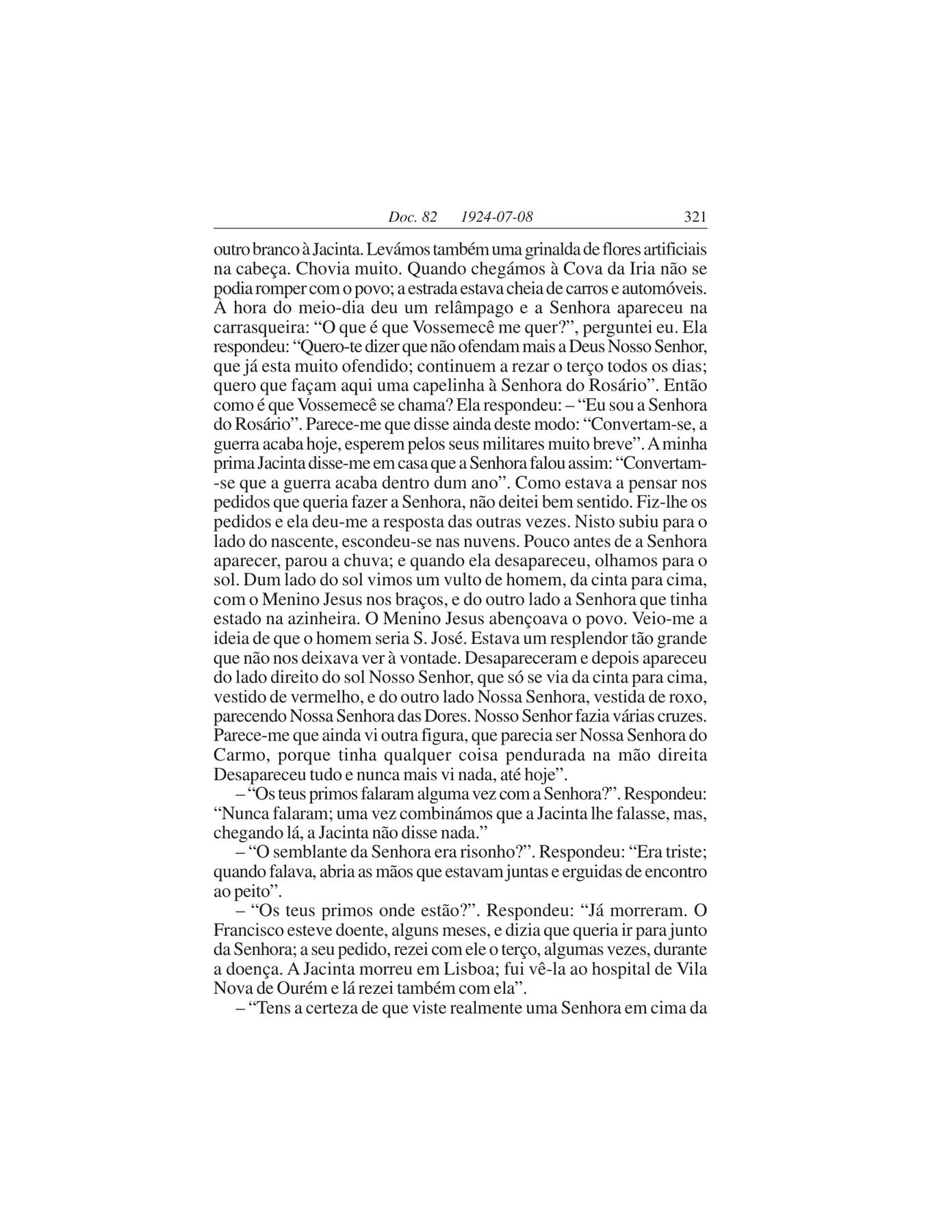
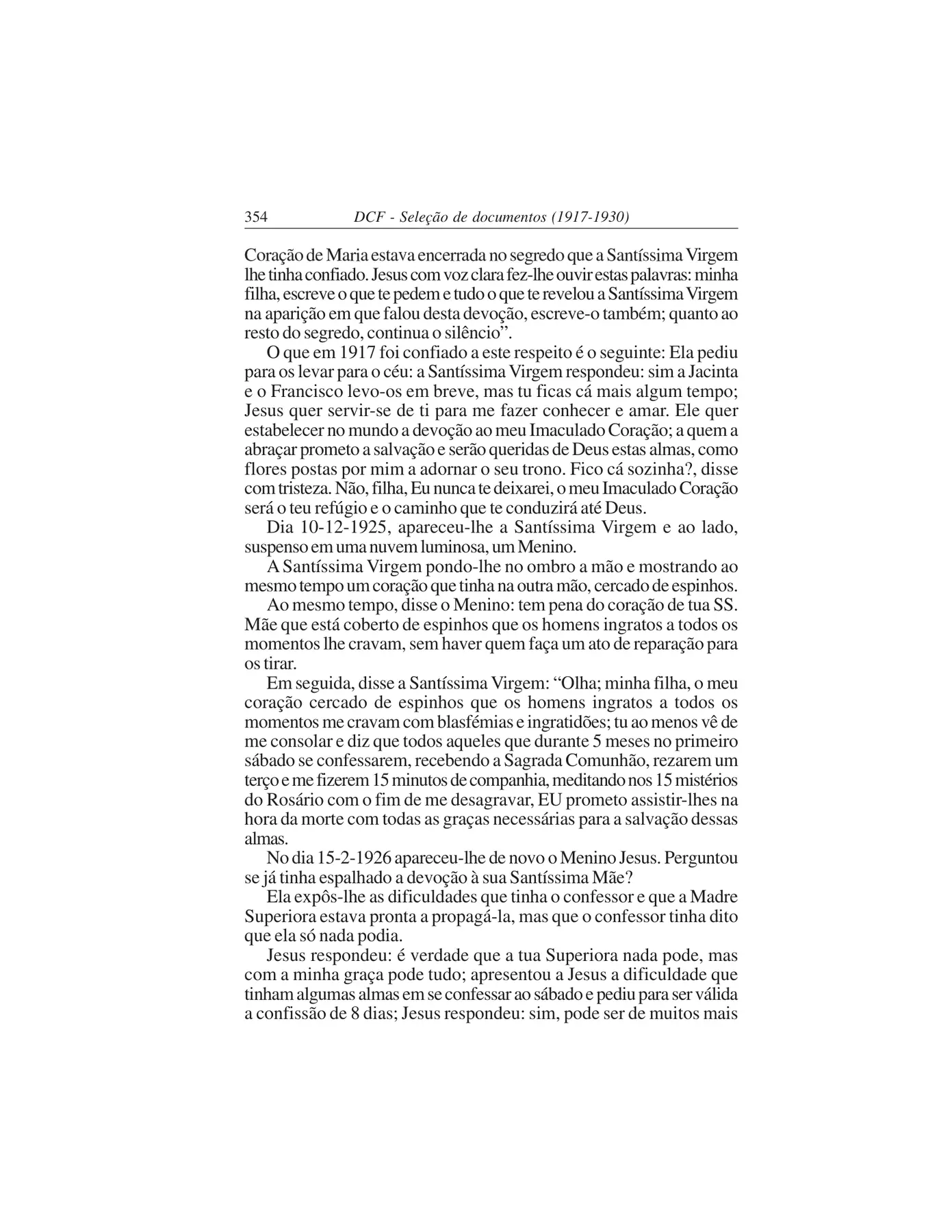
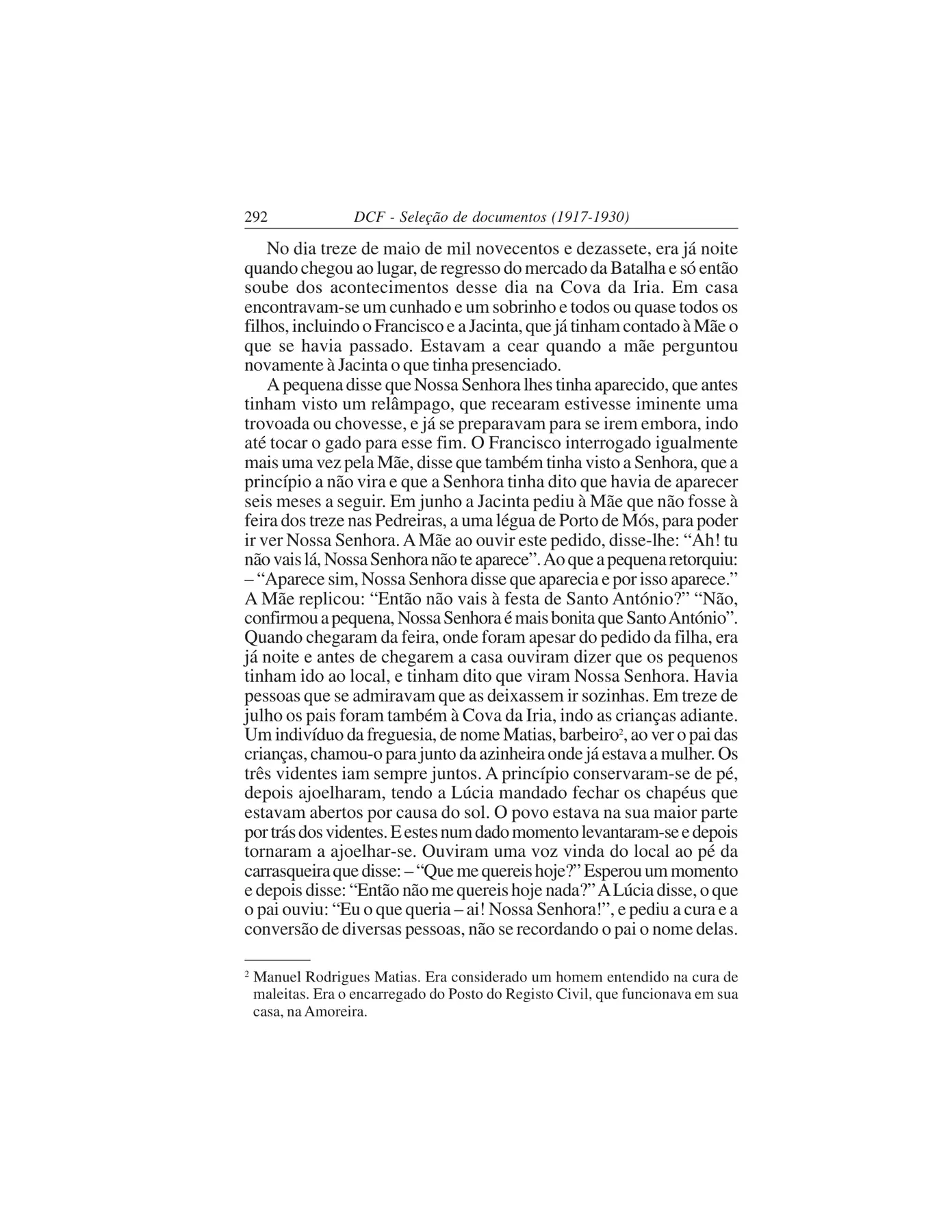
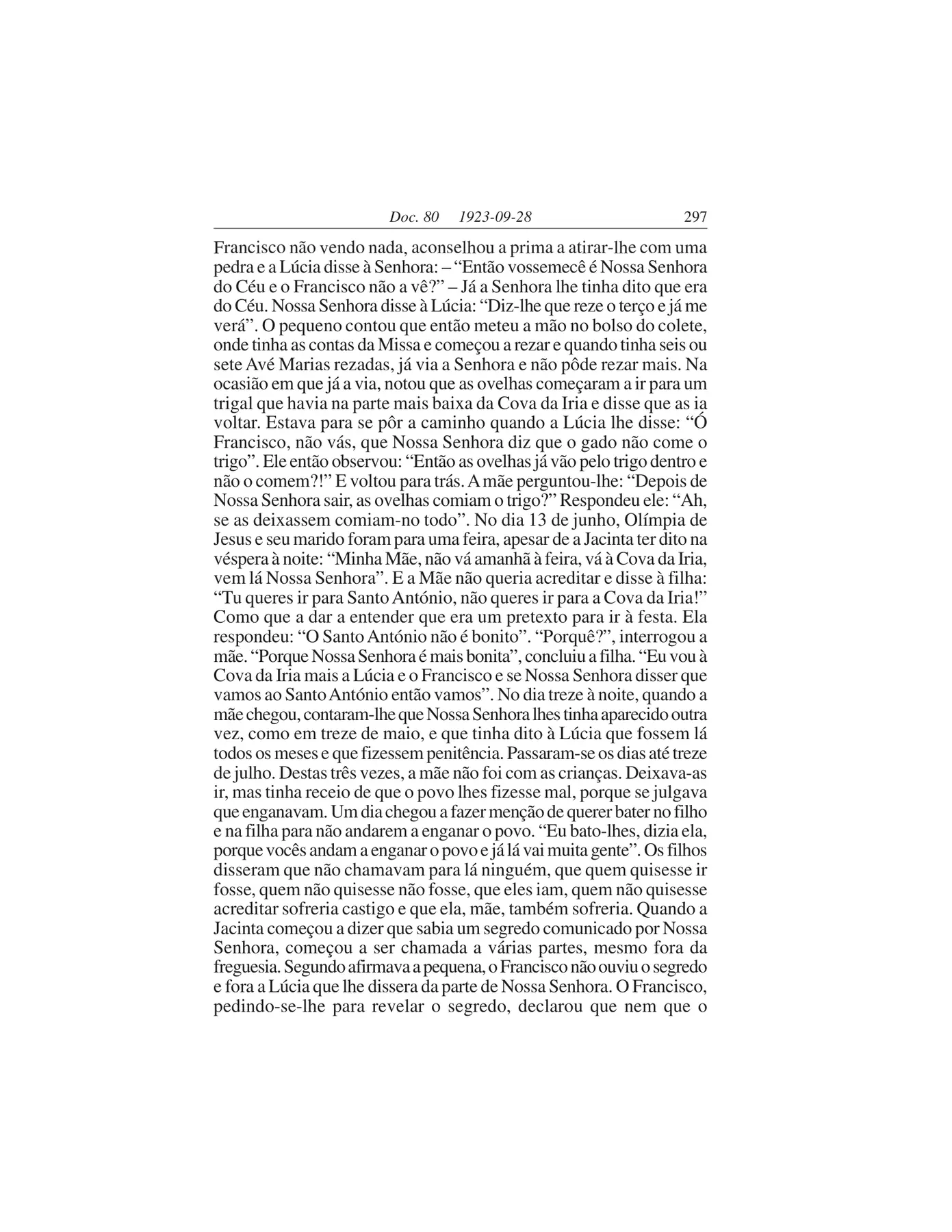
DCF Seleção, Doc. 2 (= DCF I, Doc. 2) · interrogation · after 14 Jun 1917 (1 day later)View scanLink
13 May13 Jun13 JulOther 1917First-handSaw itInterrogationFigures / visionsSeers' words overheard
English

On 14 July 1917 Jacinta, aged 7, daughter of Manuel Pedro Marto, came before me; questioned about the vision, she said:

That she had seen a small woman 4 times, once in her house at night and three times at the Cova da Iria at midday; she says she was the size of Albina, daughter of António Rosa of Casa Velha2; at home she saw her at the edge of the attic trapdoor, not saying anything; her mother and brothers and sisters were asleep and it was night; at the Cova da Iria she saw her standing on top of a holm-oak shrub3; she was dressed in white stockings and clothes all of gold; she wore no shoes; the skirt was white and all gold and came down to her knees; the gold was in cords running across, and on the cords in little points; a white jacket all of gold; a mantle over her head, white and all gold; her hands were raised to her waist and they opened, parting when she spoke to Lúcia; she did not hear her say anything, she heard her speak (now she says yes, now she says no); she did not hear her say how many times she would come here; as she left, the sky opened and her feet were left caught in it, with her body already hidden; she heard a very pious voice and remembers only hearing that we (they) were going to heaven; she says she saw lightning, but now she says it was once, now more than once, now before, now after; she had some white beads in her hands, held between the thumb and forefinger of both hands; she did not see earrings; she wore a thin gold chain around her neck.

Português (original)

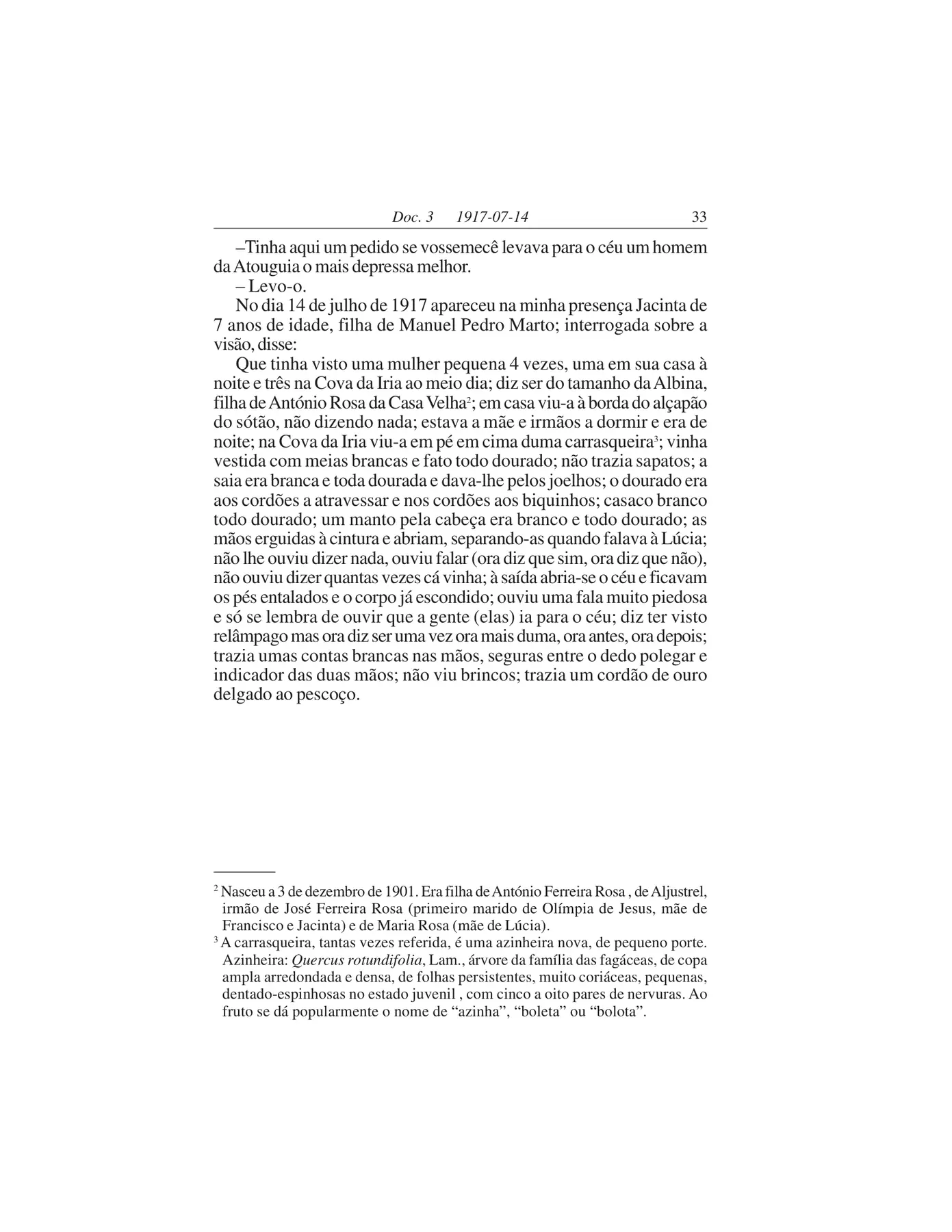
No dia 14 de julho de 1917 apareceu na minha presença Jacinta de 7 anos de idade, filha de Manuel Pedro Marto; interrogada sobre a visão, disse:

Que tinha visto uma mulher pequena 4 vezes, uma em sua casa à noite e três na Cova da Iria ao meio dia; diz ser do tamanho da Albina, filha de António Rosa da Casa Velha2; em casa viu-a à borda do alçapão do sótão, não dizendo nada; estava a mãe e irmãos a dormir e era de noite; na Cova da Iria viu-a em pé em cima duma carrasqueira3; vinha vestida com meias brancas e fato todo dourado; não trazia sapatos; a saia era branca e toda dourada e dava-lhe pelos joelhos; o dourado era aos cordões a atravessar e nos cordões aos biquinhos; casaco branco todo dourado; um manto pela cabeça era branco e todo dourado; as mãos erguidas à cintura e abriam, separando-as quando falava à Lúcia; não lhe ouviu dizer nada, ouviu falar (ora diz que sim, ora diz que não), não ouviu dizer quantas vezes cá vinha; à saída abria-se o céu e ficavam os pés entalados e o corpo já escondido; ouviu uma fala muito piedosa e só se lembra de ouvir que a gente (elas) ia para o céu; diz ter visto relâmpago mas ora diz ser uma vez ora mais duma, ora antes, ora depois; trazia umas contas brancas nas mãos, seguras entre o dedo polegar e indicador das duas mãos; não viu brincos; trazia um cordão de ouro delgado ao pescoço.

Editor's notes (2)

2 She was born on 3 December 1901. She was the daughter of António Ferreira Rosa, of Aljustrel, brother of José Ferreira Rosa (first husband of Olímpia de Jesus, mother of Francisco and Jacinta) and of Maria Rosa (Lúcia's mother).

3 The carrasqueira (holm-oak shrub), so often mentioned, is a young holm oak, of small size. Azinheira (holm oak): Quercus rotundifolia, Lam., a tree of the beech family (Fagaceae), with a broad, rounded and dense crown, and evergreen leaves, very leathery, small, toothed and spiny in the juvenile state, with five to eight pairs of veins. The fruit is popularly called "azinha", "boleta" or "bolota".

2 Nasceu a 3 de dezembro de 1901. Era filha de António Ferreira Rosa, de Aljustrel, irmão de José Ferreira Rosa (primeiro marido de Olímpia de Jesus, mãe de Francisco e Jacinta) e de Maria Rosa (mãe de Lúcia).

3 A carrasqueira, tantas vezes referida, é uma azinheira nova, de pequeno porte. Azinheira: Quercus rotundifolia, Lam., árvore da família das fagáceas, de copa ampla arredondada e densa, de folhas persistentes, muito coriáceas, pequenas, dentado-espinhosas no estado juvenil, com cinco a oito pares de nervuras. Ao fruto se dá popularmente o nome de “azinha”, “boleta” ou “bolota”.

DCF Seleção, Doc. 3 (= DCF I, Doc. 3) · interrogation · 14 Jul 1917 (2 months later)View scanLink
13 JunOther 1917First-handSaw itInterrogationFigures / visionsSeers' words overheard
English

On Saint Anthony's day (13 June). On this day there was a feast at Fátima which Lúcia's mother (and I do not know whether Francisco's and Jacinta's too) wanted them to attend, but in obedience to what the Lady had recommended to them the month before, they left the feast to go to the place of the apparition, where they met some people unknown to them and only some 3 or 4 they knew. At more or less the same hour as the month before, the same vision appears to them in the same way, and this time she told them to keep going there in the following months; to learn to read; and she told them a secret, which she forbade them to reveal to anyone whatsoever. – Some days later, being near the place of the apparition with their flock, the three of them thought of going to pray the rosary at the place of the apparition, but for that it was necessary either to leave the flock, with the risk of its going and damaging the nearby crops, or for at least one of them to stay on guard and not go to pray the rosary; they decided all to go and pray the rosary and leave the flock, which immediately went into a field of maize, cabbages, chickling peas and other vegetables. A woman who was nearby, seeing the sheep in that field, calls the shepherds, who did not answer her, so she herself went to turn the sheep out, but as soon as she turned her back they went straight back in. The rosary over, the three went to their flock, to turn it out of the place where it was and see the damage it had done, but great was their amazement when they saw that nothing had been damaged. This was confirmed by the owner himself, who, being told that the flock had been in his field, went the next day to see what damage there was, and found that it had done him no damage at all.

Português (original)

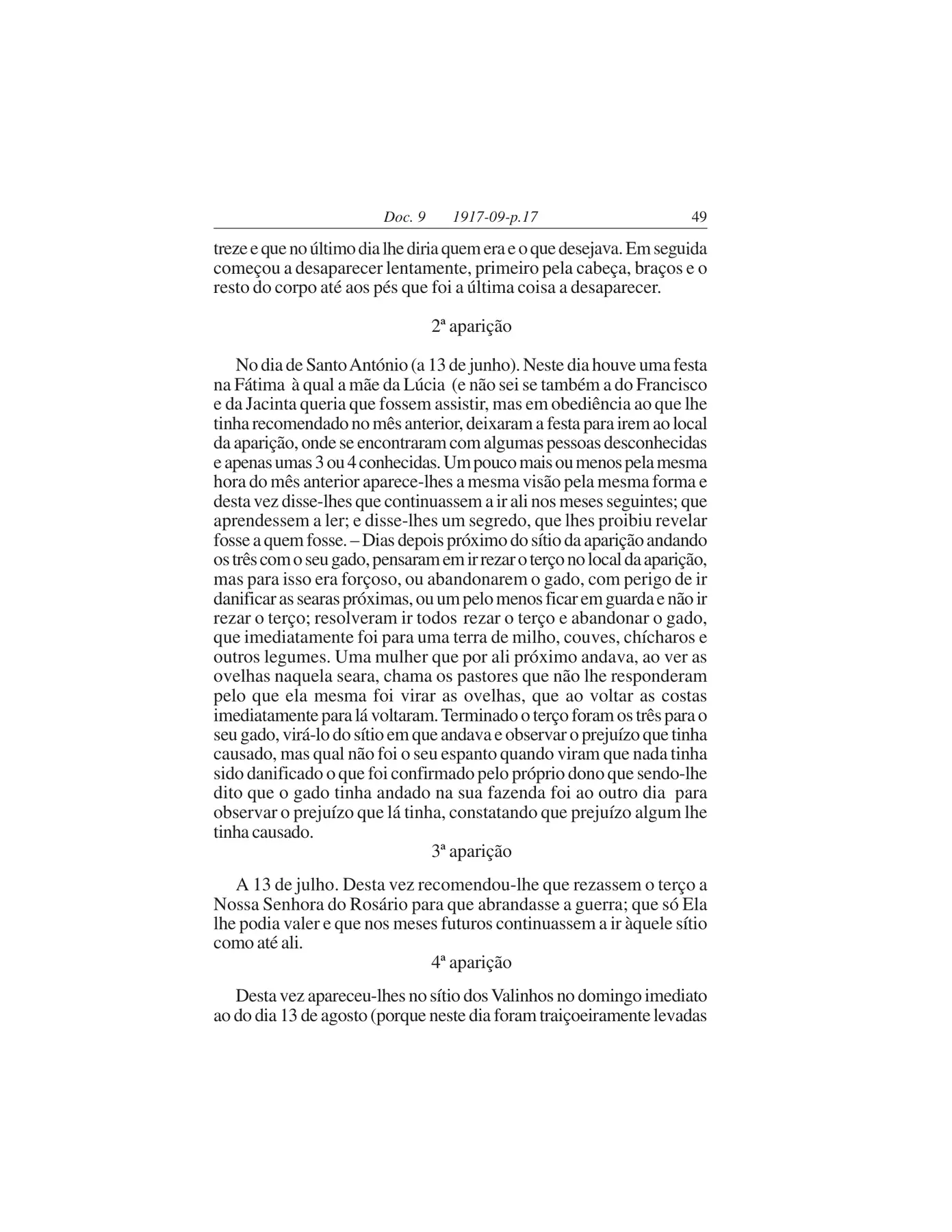
No dia de Santo António (a 13 de junho). Neste dia houve uma festa na Fátima à qual a mãe da Lúcia (e não sei se também a do Francisco e da Jacinta queria que fossem assistir, mas em obediência ao que lhe tinha recomendado no mês anterior, deixaram a festa para irem ao local da aparição, onde se encontraram com algumas pessoas desconhecidas e apenas umas 3 ou 4 conhecidas. Um pouco mais ou menos pela mesma hora do mês anterior aparece-lhes a mesma visão pela mesma forma e desta vez disse-lhes que continuassem a ir ali nos meses seguintes; que aprendessem a ler; e disse-lhes um segredo, que lhes proibiu revelar fosse a quem fosse. – Dias depois próximo do sítio da aparição andando os três com o seu gado, pensaram em ir rezar o terço no local da aparição, mas para isso era forçoso, ou abandonarem o gado, com perigo de ir danificar as searas próximas, ou um pelo menos ficar em guarda e não ir rezar o terço; resolveram ir todos rezar o terço e abandonar o gado, que imediatamente foi para uma terra de milho, couves, chícharos e outros legumes. Uma mulher que por ali próximo andava, ao ver as ovelhas naquela seara, chama os pastores que não lhe responderam pelo que ela mesma foi virar as ovelhas, que ao voltar as costas imediatamente para lá voltaram. Terminado o terço foram os três para o seu gado, virá-lo do sítio em que andava e observar o prejuízo que tinha causado, mas qual não foi o seu espanto quando viram que nada tinha sido danificado o que foi confirmado pelo próprio dono que sendo-lhe dito que o gado tinha andado na sua fazenda foi ao outro dia para observar o prejuízo que lá tinha, constatando que prejuízo algum lhe tinha causado.

DCF Seleção, Doc. 9 (= DCF I, Doc. 45) · interrogation · 17 Sep 1917 (3 months later)View scanLink
13 May13 Jun13 Jul13 Aug13 SepFirst-handSaw itInterrogationFigures / visions
English

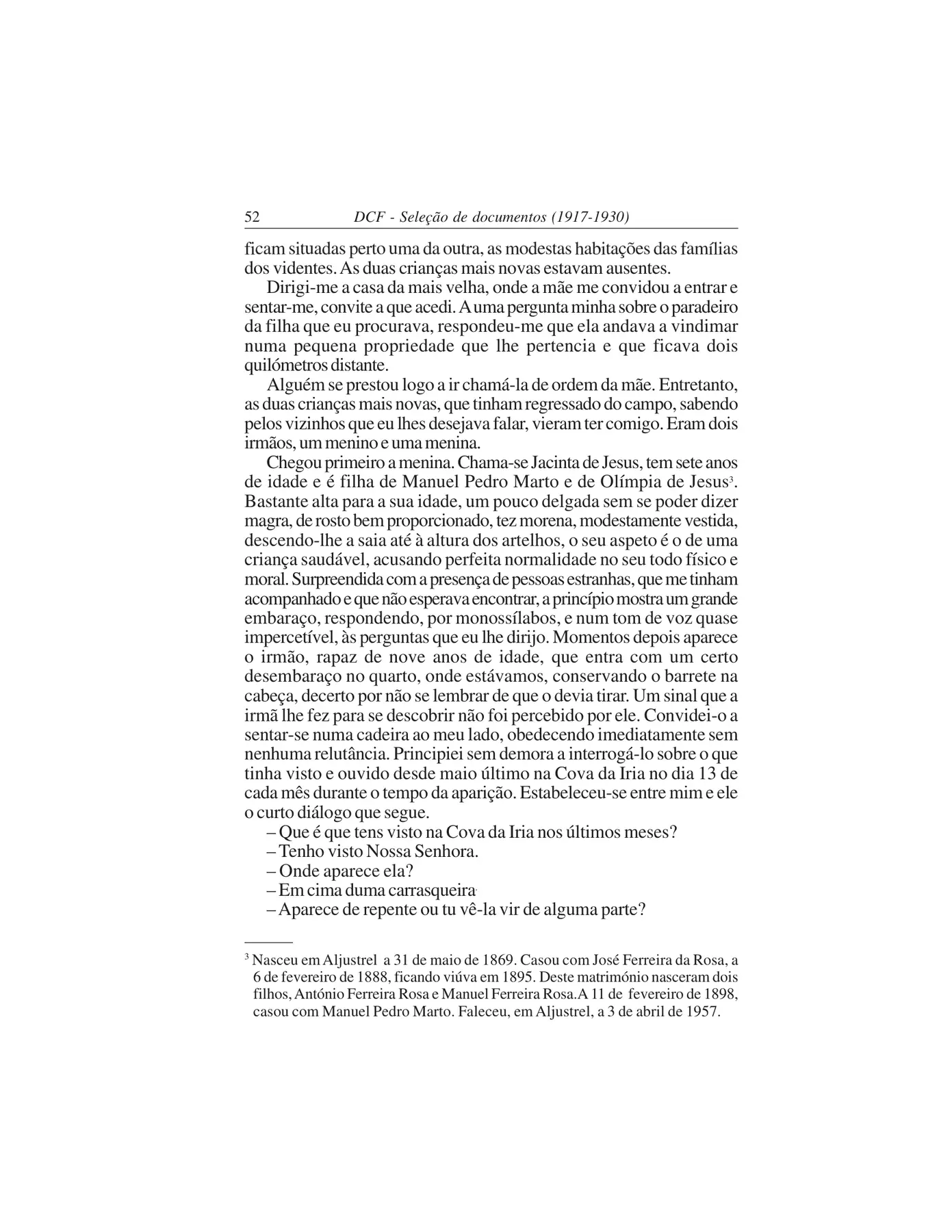
Without delay I began to question him about what he had seen and heard since the month of May last at the Cova da Iria on the thirteenth of each month during the time of the apparition.

Between him and me the following short dialogue took place:

- What have you seen at the Cova da Iria these last months?
- I have seen Our Lady.
- Where does she appear?
- On top of a holm-oak shrub.
- Does she appear suddenly or do you see her coming from somewhere?
- I see her coming from the side where the sun rises and placing herself on the holm-oak shrub.
- Does she come slowly or quickly?
- She always comes quickly.
- Do you hear what she says to Lucia?
- I don't hear.
- Have you ever spoken with the Lady? Has she ever addressed a word to you?
- No, I have never asked her anything; she speaks only with Lucia.
- Whom does she look at, at you and Jacinta too or only at Lucia?
- She looks at all three; but she looks longer at Lucia.
- Has she ever wept or smiled?
- Neither one thing nor the other; she is always serious.
- How is she dressed?
- She has a long dress and over it a mantle that covers her head and comes down to the bottom of the dress.
- What is the colour of the dress and the mantle?
- It is white, the dress having gold stripes.
- What is the Lady's attitude?

– That of someone praying. She has her hands joined at the height of her breast.

– Does she carry anything in her hands?

– She carries, between the palm and the back of her right hand, some beads that hang down over her dress.

– And what does she have on her ears?

– Her ears can't be seen, because they are covered by the mantle.

– What colour are the beads?

– They are white too.

– Is the Lady pretty?

– Yes, she is.

– Prettier than that girl you see there?

– Prettier.

– But there are ladies much prettier than that girl...

– She is prettier than anyone I have ever seen.

Português (original)

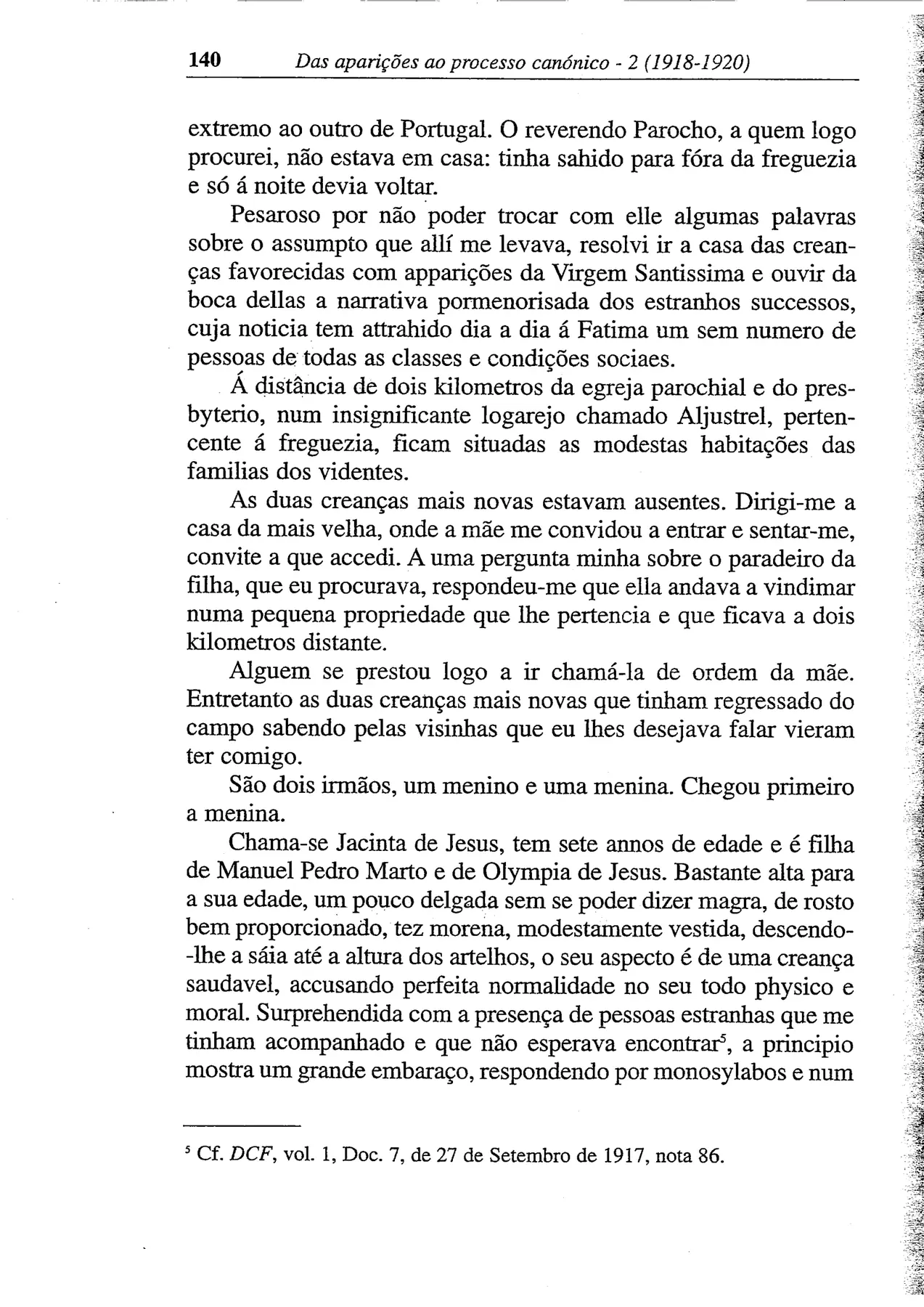
Principiei sem demora a interrogá-lo sobre o que tinha visto e ouvido desde o mez de Maio ultimo na Cova da Iria no dia treze de cada mez durante o tempo da apparição.

Entre mim e elle estabeleceu-se o curto dialogo que se segue:

- Que é que tens visto na Cova da Iria nos ultimos mezes?
- Tenho visto Nossa Senhora.
- Onde é que ella apparece?
- Em cima de uma carrasqueira.
- Apparece de repente ou tu vê-la vir de alguma parte?
- Vejo-a vir do lado onde nasce o sol e collocar-se sobre a carrasqueira.
- Vem devagar ou depressa?
- Vem sempre depressa.
- Ouves o que ella diz á Lucia?
- Não ouço.
- Fallaste alguma vez com a Senhora? Ella já te dirigiu a palavra?
- Não, nunca lhe perguntei nada; falla só com a Lucia.
- Para quem olha, tambem para ti e para a Jacinta ou só para a Lucia?
- Olha para todos tres; mas olha durante mais tempo para a Lucia.
- Já alguma vez chorou ou se sorriu?
- Nem uma cousa nem outra; está sempre séria.
- Como está vestida?
- Tem um vestido comprido e por cima um manto que lhe cobre a cabeça e desce até á extremidade do vestido.
- Qual é a côr do vestido e do manto?
- É branca, tendo o vestido riscos dourados.
- Qual é a attitude da Senhora?

– É a de quem está a rezar. Tem as mãos postas á altura do peito.

– Traz alguma coisa nas mãos?

– Traz entre a palma e as costas da mão direita umas contas que estão pendentes sobre o vestido.

– E nas orelhas o que tem?

– As orelhas não se vêem, porque estão cobertas com o manto.

– De que côr são as contas?

– São tambem brancas.

– A Senhora é bonita?

– É, sim.

– Mais bonita que aquella menina que tu alli vês?

– Mais.

– Mas ha senhoras muito mais bonitas que aquella menina...

– É mais bonita que qualquer pessoa que eu visse.

13 May13 Jun13 Jul13 Aug13 SepFirst-handSaw itInterrogationFigures / visionsSeers' words overheard
English

The questioning of Francisco concluded, I called Jacinta aside, who was playing in the street with other children, had her sit on a little stool beside me and subjected her too to an interrogation, succeeding in obtaining from her answers as complete and detailed as her brother's.

– Have you seen Our Lady on the thirteenth of each month since May?

– I have.

– Where does she come from?

– She comes from Heaven, from the side of the sun.

– How is she dressed?

– She has a white dress, trimmed with gold, and on her head a mantle, also white.

– What colour is her hair?

– Her hair can't be seen; it is covered by the mantle.

– Does she wear earrings?

– I don't know, because her ears can't be seen either

– What is the position of her hands?

– Her hands are joined at the height of her breast, with the fingers turned upwards.

– Are the beads in her right hand or her left?

To this question the child first answers that they were in the right hand, but then, owing to a deliberate and captious insistence on my part, she appears perplexed and confused, not knowing how to say precisely which of her own hands corresponded to the hand in which the Apparition held the rosary.

– What was it that Our Lady recommended to Lucia most earnestly?

– She told us to pray the rosary* every day.

– And do you pray it?

– I pray it every day with Francisco and Lucia.

Português (original)

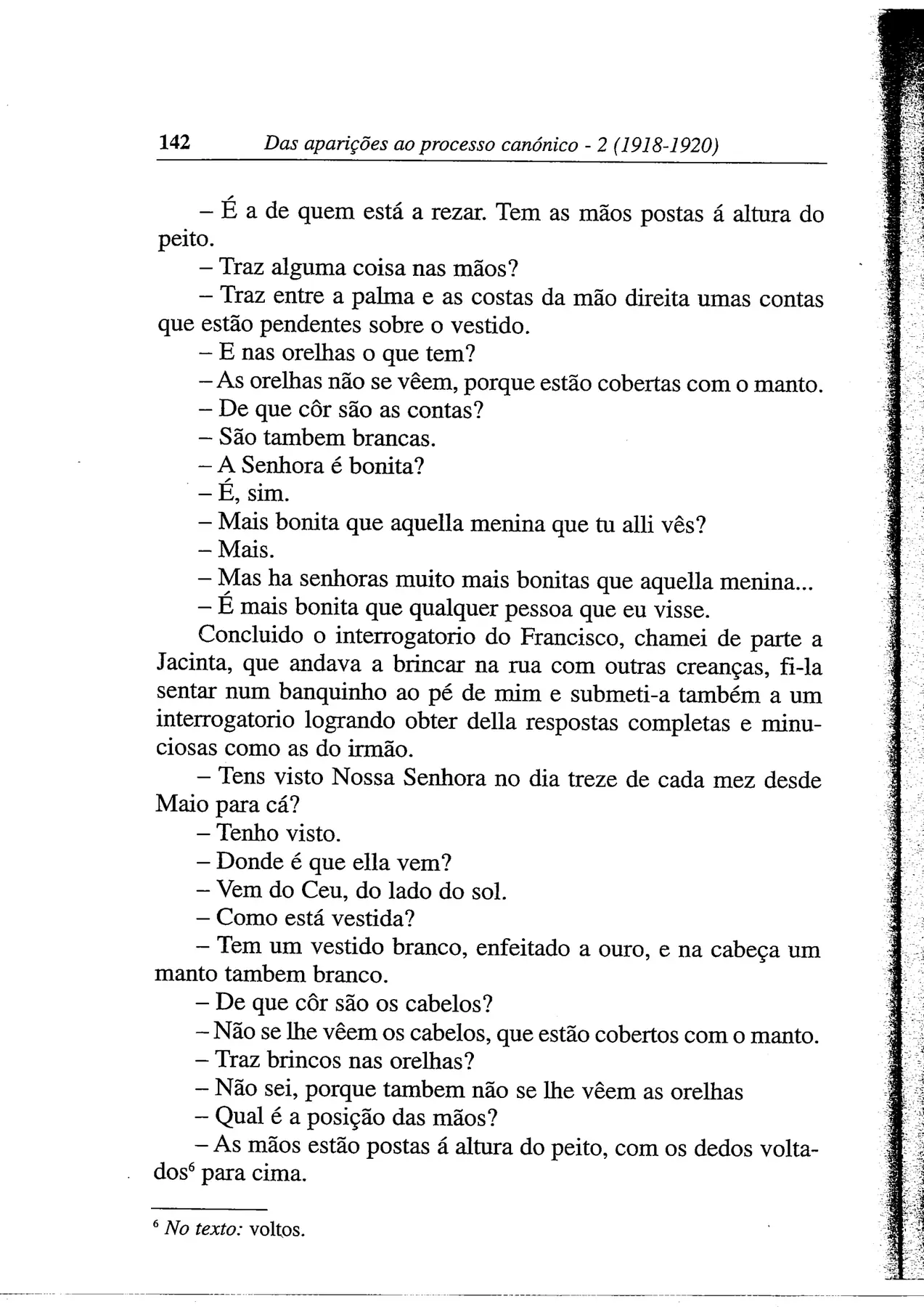
Concluido o interrogatorio do Francisco, chamei de parte a Jacinta, que andava a brincar na rua com outras creanças, fi-la sentar num banquinho ao pé de mim e submeti-a também a um interrogatorio logrando obter della respostas completas e minuciosas como as do irmão.

– Tens visto Nossa Senhora no dia treze de cada mez desde Maio para cá?

– Tenho visto.

– Donde é que ella vem?

– Vem do Ceu, do lado do sol.

– Como está vestida?

– Tem um vestido branco, enfeitado a ouro, e na cabeça um manto tambem branco.

– De que côr são os cabelos?

– Não se lhe vêem os cabelos, que estão cobertos com o manto.

– Traz brincos nas orelhas?

– Não sei, porque tambem não se lhe vêem as orelhas

– Qual é a posição das mãos?

– As mãos estão postas á altura do peito, com os dedos voltados para cima.

– As contas estão na mão direita ou na esquerda?

A esta pergunta a creança responde primeiro que estavam na mão direita, mas em seguida, devido a uma insistencia propositada e capciosa da minha parte, mostra-se perplexa e confusa, não sabendo precisar bem qual das suas mãos correspondia á mão que a Apparição segurava o rosario.

– O que foi que Nossa Senhora recommendou á Lucia com mais empenho?

– Mandou que rezassemos o terço todos os dias.

– E tu reza-lo?

– Rezo-o todos os dias com o Francisco e com a Lucia.

13 May13 Jun13 Jul13 Aug13 SepFirst-handSaw itInterrogationFigures / visions
English

What have you seen at the Cova da Iria in recent months?
- I have seen Our Lady.
- Where does she appear?
- On top of a holm-oak shrub
- Does she appear suddenly or do you see her come from somewhere?

– I see her come from the side where the sun rises and settle on the holm-oak shrub.

– Does she come slowly or quickly?

– She always comes quickly.

– Do you hear what she says to Lúcia?

– I don't.

– Have you ever spoken to the Lady? Has she ever spoken to you?

– No, I never asked her anything; she speaks only to Lúcia.

– Whom does she look at, at you and Jacinta too, or only at Lúcia?

– She looks at all three of us; but she looks longer at Lúcia.

Português (original)

Que é que tens visto na Cova da Iria nos últimos meses?
- Tenho visto Nossa Senhora.
- Onde aparece ela?
- Em cima duma carrasqueira
- Aparece de repente ou tu vê-la vir de alguma parte?

– Vejo-a vir do lado onde nasce o sol e colocar-se sobre a carrasqueira.

– Vem devagar ou depressa?

– Vem sempre depressa.

– Ouves o que ela diz à Lúcia?

– Não ouço.

– Falaste alguma vez com a Senhora? Ela já te dirigiu a palavra?

– Não, nunca lhe perguntei nada; fala só com a Lúcia.

– Para quem olha ela, também para ti e para a Jacinta, ou só para a Lúcia?

– Olha para todos três; mas olha durante mais tempo para a Lúcia.

Editor's notes (1)

3 Born at Aljustrel on 31 May 1869. She married José Ferreira da Rosa on 6 February 1888 and was widowed in 1895. Of this marriage two sons were born, António Ferreira Rosa and Manuel Ferreira Rosa. On 11 February 1898 she married Manuel Pedro Marto. She died at Aljustrel on 3 April 1957.

3 Nasceu em Aljustrel a 31 de maio de 1869. Casou com José Ferreira da Rosa, a 6 de fevereiro de 1888, ficando viúva em 1895. Deste matrimónio nasceram dois filhos, António Ferreira Rosa e Manuel Ferreira Rosa. A 11 de fevereiro de 1898, casou com Manuel Pedro Marto. Faleceu, em Aljustrel, a 3 de abril de 1957.

DCF Seleção, Doc. 10 (= DCF I, Doc. 7) · interrogation · 27 Sep 1917 (5 months later)View scans (2)Link
13 May13 Jun13 Jul13 Aug13 SepFirst-handSaw itInterrogationFigures / visionsSeers' words overheard
English

Have you seen Our Lady on the 13th of each month since May?

– I have.

– Where does she come from?

– She comes from Heaven, from the side of the sun.

– How is she dressed?

– She has a white dress, trimmed with gold, and on her head she has a mantle, also white. Round her waist there is a golden ribbon that comes down to the hem of the dress.

– Does she wear boots or shoes?

– She wears neither boots nor shoes.

– So she has only stockings on?

– It looks as if she has stockings, but perhaps her feet are so white that they look as if they had stockings on.

– What colour is her hair?

– You can't see her hair, it is covered by the mantle.

– Does she wear earrings?

– I don't know, because you can't see her ears either.

– What is the position of her hands?

– Her hands are joined on her breast, with the fingers pointing upwards.

– Are the beads in her right hand or her left hand?

– .....

To this question the child at first answers that they were in her right hand, but then, owing to insistence on my part, she shows herself perplexed and confused, unable to say precisely which of her own hands corresponded to the hand with which the Lady held the Rosary.

- What did the Lady most earnestly recommend to Lúcia?
- She told us to pray the rosary* every day.
- And do you pray it?
- I pray it every day with Francisco and Lúcia.

Português (original)

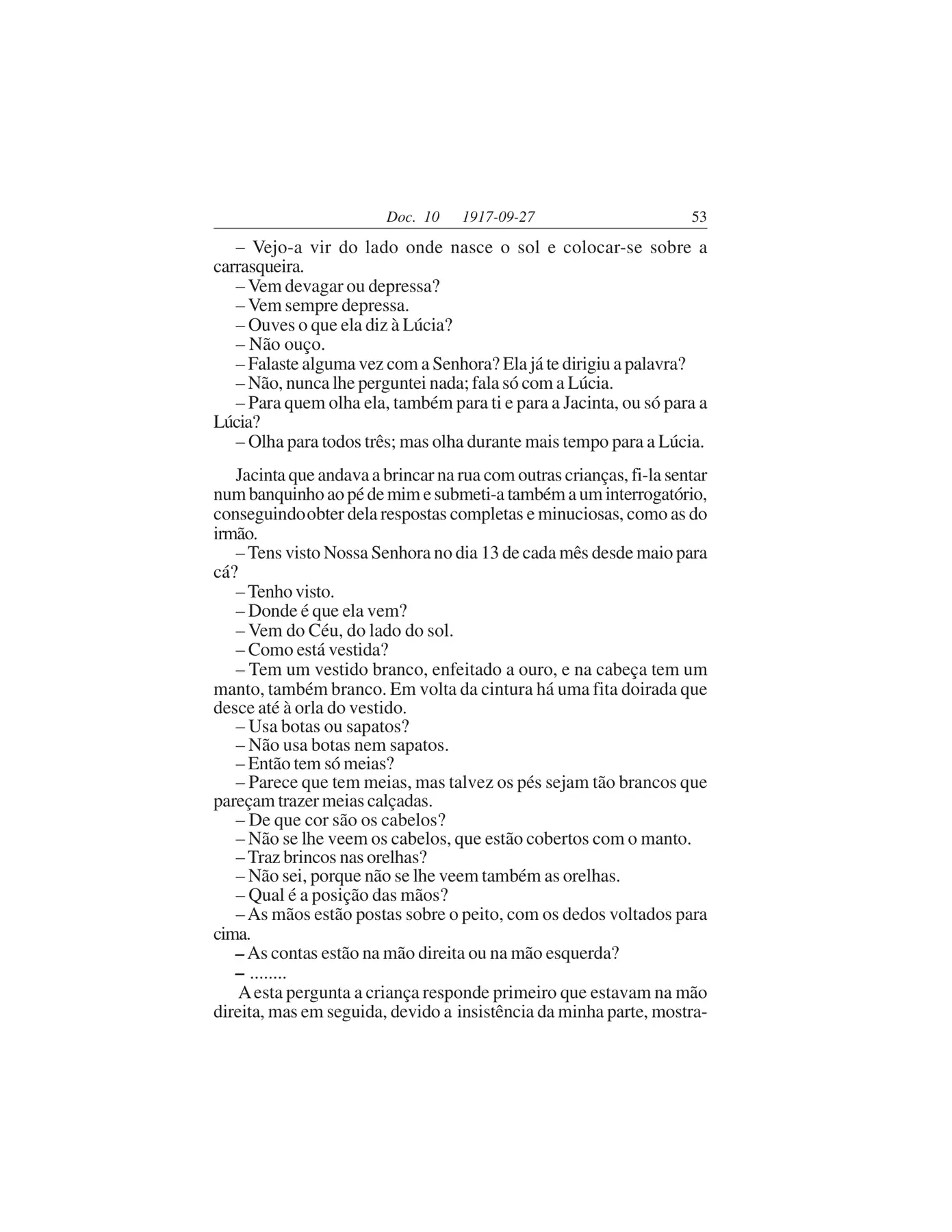
Tens visto Nossa Senhora no dia 13 de cada mês desde maio para cá?

– Tenho visto.

– Donde é que ela vem?

– Vem do Céu, do lado do sol.

– Como está vestida?

– Tem um vestido branco, enfeitado a ouro, e na cabeça tem um manto, também branco. Em volta da cintura há uma fita doirada que desce até à orla do vestido.

– Usa botas ou sapatos?

– Não usa botas nem sapatos.

– Então tem só meias?

– Parece que tem meias, mas talvez os pés sejam tão brancos que pareçam trazer meias calçadas.

– De que cor são os cabelos?

– Não se lhe veem os cabelos, que estão cobertos com o manto.

– Traz brincos nas orelhas?

– Não sei, porque não se lhe veem também as orelhas.

– Qual é a posição das mãos?

– As mãos estão postas sobre o peito, com os dedos voltados para cima.

– As contas estão na mão direita ou na mão esquerda?

– .....

A esta pergunta a criança responde primeiro que estavam na mão direita, mas em seguida, devido a insistência da minha parte, mostra-

-se perplexa e confusa, não sabendo precisar bem qual das suas mãos correspondia à mão com que a Senhora segurava o Rosário.

- O que é que a Senhora recomendou à Lúcia com mais empenho?
- Mandou que rezássemos o terço todos os dias.
- E tu reza-lo?
- Rezo-o todos os dias com o Francisco e a Lúcia.

DCF Seleção, Doc. 10 (= DCF I, Doc. 7) · interrogation · 27 Sep 1917 (5 months later)View scans (2)Link
13 May13 Jun13 Jul13 Aug13 SepFirst-handSaw itInterrogationFigures / visionsSeers' words overheard
English

Is it true that Our Lady has appeared to you at the place called Cova da Iria?

– It is true.

– How many times has she appeared to you already?

– Five times, once each month.

– On what day of the month?

– Always on the thirteenth, except in the month of August, when I was arrested and taken to the town (Vila Nova de Ourém) by the administrator*. That month I saw her only some days later, on the nineteenth, at the place called Valinhos.

– It is said that the Lady also appeared to you last year. What truth is there in this?

– Last year she never appeared to me (nor before May of this year); nor did I say that to anyone, because it was not true.

[…]

Where does she come from? From the east?
- I don't know; I don't see her come from anywhere; she appears over the holm-oak shrub, and it is when she withdraws that she goes off in the direction where the sun rises.
- How long does she stay? A long time or a short time?
- A short time.
- Long enough to say an Our Father and a Hail Mary, or more?
- More, quite a lot more, but not always the same length of time (perhaps not enough to pray the rosary).
- The first time you saw her, weren't you frightened?
- I was, so much so that I wanted to run away, with Jacinta and Francisco, but She told us not to be afraid, because she would not harm us. She said: "don't be afraid, for I won't harm you."
- How is she dressed?
- She has a white dress, which comes down to a little below the middle of the leg, and her head is covered by a mantle of the same colour and the same length as the dress.
- Has the dress no trimmings?
- On it, at the front, two golden cords can be seen, which come down from the neck and are joined by a tassel, also golden, at about the middle of the body.
- Does she have a belt or a ribbon?
- She doesn't.
- Does she wear earrings?
- She wears small yellow hoops.
- Which hand holds the beads?
- The right hand.
- Were they a five-decade rosary or a full rosary?
- I didn't notice properly.
- Did they end with a cross?
- They ended with a white cross, and the beads were white too. The chain was white too.
- Did you ever ask her who she was?
- I did, but she declared she would only say so on 13 October.
- Didn't you ask her where she came from?
- I asked where she was from, and she answered me that she was from Heaven.
- And when did you ask her that question?
- The second time, on the thirteenth of June.
- Did she ever smile or look sad?

- She never smiled nor looked sad, but was always serious.
- Did she urge you and your cousins to say any prayers?
- She urged us to pray the rosary in honour of Our Lady of the Rosary, in order to obtain peace for the world.
- Did she express a wish that many people should be present at the Cova da Iria on the thirteenth of each month?
- She said nothing about that.
- Is it true that she told you a secret, forbidding you to reveal it to anyone whatever?
- It is true.
- Does it concern only you or your companions too?
- All three of us.
- Can't you disclose it at least to your confessor?
(At this question she kept silent, seeming somewhat embarrassed, and I thought I should not insist by repeating the question).
- It is said that, to free yourself from the administrator's pestering on the day you were arrested, you told him something as if it were the secret when it was not, thus deceiving him, and afterwards boasted of having played that trick on him: is it true?
- It is not; the administrator really did want me to reveal the secret to him, but as I could not tell it to anyone, I did not tell him, even though he insisted with me a great deal to that end. What I did was to tell everything the Lady said to me, except the secret, and perhaps for that reason the administrator was left thinking that I had revealed the secret to him as well. I did not want to deceive him.
- Did the Lady tell you to learn to read?
- She did, yes, the second time she appeared.
- But if the Lady said she would take you to Heaven next October, what use would it be to you to learn to read?
- That is not true: the Lady never said she would take me to Heaven in October, and I never asserted that she had told me such a thing.
- What did the Lady declare should be done with the money the people leave at the Cova da Iria at the foot of the holm-oak shrub?
- She said we should put it on two litters* and carry them to the parish church: Jacinta, two more girls and I carrying one, and Francisco with three more boys the other. Part of that money would be for the worship and feast of Our Lady of the Rosary and the other part towards a new chapel.
- Where does she want the chapel to be built? At the Cova da Iria?
- I don't know: she didn't say.

- Are you very happy that Our Lady has appeared to you?
- I am.
- On the thirteenth of October will Our Lady come alone?
- St. Joseph will come too with the Child, and peace will be granted to the world.
- And did she make any other revelation?
- She declared that on the 13th she will make all the people believe that she really appears.
- Why do you quite often lower your eyes and stop gazing at the Lady?
- It's because she is sometimes dazzling.
- Did she teach you any prayer?
- She did; and she wants us to recite it after each mystery of the rosary*.
- Do you know that prayer by heart?
- I do.
- Say it then...
- O my Jesus, forgive us, deliver us from the fire of hell, take all the little souls to Heaven, especially those that most need it

Português (original)

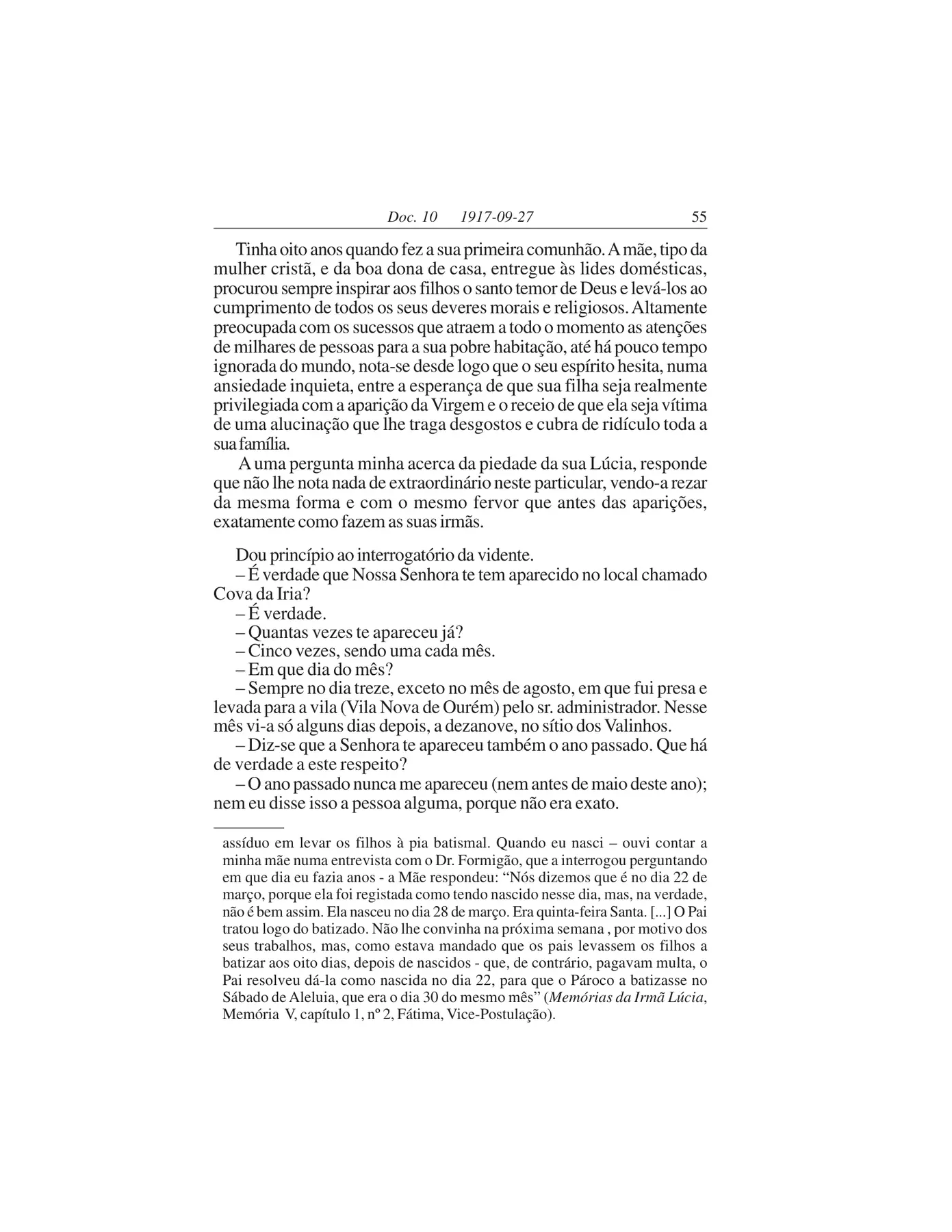
É verdade que Nossa Senhora te tem aparecido no local chamado Cova da Iria?

– É verdade.

– Quantas vezes te apareceu já?

– Cinco vezes, sendo uma cada mês.

– Em que dia do mês?

– Sempre no dia treze, exceto no mês de agosto, em que fui presa e levada para a vila (Vila Nova de Ourém) pelo sr. administrador. Nesse mês vi-a só alguns dias depois, a dezanove, no sítio dos Valinhos.

– Diz-se que a Senhora te apareceu também o ano passado. Que há de verdade a este respeito?

– O ano passado nunca me apareceu (nem antes de maio deste ano); nem eu disse isso a pessoa alguma, porque não era exato.

[…]

Donde é que ela vem? Das bandas do nascente?
- Não sei; não a vejo vir de parte alguma; aparece sobre a carrasqueira, e quando se retira é que toma a direção donde nasce o sol.
- Quanto tempo se demora? Muito ou pouco?
- Pouco tempo.
- O suficiente para se recitar um Padre Nosso e uma Avé Maria, ou mais?
- Mais, bastante mais, mas nem sempre o mesmo tempo (talvez não chegasse para rezar o terço).
- Da primeira vez que a viste não ficaste assustada?
- Fiquei, e tanto assim que quis fugir, com a Jacinta e o Francisco, mas Ela disse-nos que não tivéssemos medo, porque não nos faria mal. Disse: “não tenham medo que eu não vos faço mal.”
- Como é que está vestida?
- Tem um vestido branco, que desce até um pouco abaixo do meio da perna, e cobre-lhe a cabeça um manto, da mesma cor, e do mesmo comprimento que o vestido.
- O vestido não tem enfeites?
- Veem-se nele, na parte anterior, dois cordões dourados, que descem do pescoço e se reunem por uma borla, também dourada, à altura do meio do corpo.
- Tem algum cinto ou alguma fita?
- Não tem.
- Usa brincos nas orelhas?
- Usa umas argolas pequenas e de cor amarela.
- Qual das mãos segura as contas?
- A mão direita.
- Eram um terço ou um rosário?
- Não reparei bem.
- Terminavam por uma cruz?
- Terminavam por uma cruz branca, sendo as contas também brancas. A cadeia era também branca.
- Perguntaste-lhe alguma vez quem era?
- Perguntei, mas declarou que só o diria a 13 de outubro.
- Não lhe perguntaste de onde vinha?
- Perguntei de onde era, e ela respondeu-me que era do Céu.
- E quando foi que lhe fizeste essa pergunta?
- Da segunda vez, a treze de junho.
- Sorriu-se alguma vez ou mostrou-se triste?

- Nunca se sorriu nem se mostrou triste, mas sempre séria.
- Recomendou-te, e aos teus primos, que rezassem algumas orações?
- Recomendou-nos que rezássemos o terço em honra de Nossa Senhora do Rosário, a fim de se alcançar a paz para o mundo.
- Mostrou desejos de que no dia treze de cada mês estivessem presentes muitas pessoas na Cova da Iria?
- Não disse nada a esse respeito.
- É certo que te disse um segredo, proibindo que o revelasses a quem quer que fosse?
- É certo.
- Diz respeito só a ti ou também aos teus companheiros?
- A todos três.
- Não o podes manifestar ao menos ao teu confessor?
(A esta pergunta guardou silêncio, parecendo um tanto enleada e julguei não dever insistir, repetindo a pergunta).
- Consta que, para te veres livre das importunações do sr. administrador, no dia em que foste presa, lhe contaste, como se fosse o segredo uma coisa que o não era, enganando-o assim e gabando-te depois de lhe teres feito essa partida: é verdade?
- Não é; o sr. administrador quis realmente que eu lhe revelasse o segredo, mas como eu não o podia dizer a ninguém, não lhe disse, apesar de ter insistido muito comigo para esse fim. O que fiz foi contar tudo o que a Senhora me disse, exceto o segredo, e talvez por esse motivo o sr. administrador ficasse julgando que eu lhe tinha revelado também o segredo. Não o quis enganar.
- A Senhora mandou que aprendesses a ler?
- Mandou, sim, da segunda vez que apareceu.
- Mas se a Senhora disse que te levaria para o Céu no mês de outubro próximo, para que te serviria aprenderes a ler?
- Não é verdade isso: a Senhora nunca disse que me levaria para o Céu em outubro, e eu nunca afirmei que ela me tivesse dito tal coisa.
- O que declarou a Senhora que se devia fazer ao dinheiro que o povo deposita na Cova da Iria ao pé da carrasqueira?
- Disse que o devíamos colocar em dois andores, levando eu, a Jacinta e mais duas meninas um deles, e o Francisco, com mais três rapazes, o outro, para a igreja da freguesia. Parte desse dinheiro seria destinado ao culto e festa da Senhora do Rosário e a outra parte para ajuda de uma capela nova.
- Onde quer ela que seja edificada a capela? Na Cova da Iria?
- Não sei: ela não o disse.

- Estás muito contente por Nossa Senhora te ter aparecido?
- Estou.
- No dia treze de outubro Nossa Senhora virá só?
- Vem também S. José com o menino, e será concedida a paz ao mundo.
- E fez mais alguma revelação?
- Declarou que no dia 13 fará com que todo o povo acredite que ela realmente aparece.
- Por que razão não raro baixas os olhos deixando de fitar a Senhora?
- É que ela às vezes cega.
- Ensinou-te alguma oração?
- Ensinou; e quer que a recitemos depois de cada mistério do rosário.
- Sabes de cor essa oração?
- Sei.
- Diz lá...
- Ó meu Jesus, perdoai-nos, livrai-nos do fogo do inferno, levai as alminhas todas para o Céu, principalmente aquelas que mais dele precisarem

Manuel Gonçalves Júnior

Villagerson of Formigão's host at Montelo
13 Jun13 Jul13 AugOther 1917First-handSaw itInterrogationCloud / smoke columnColours on people & landscapeLight dimmingThunder / noiseSeers' words overheardCrowd scene
English

On 13 July some companions of his, with bad intent, got him drunk with the aim of leading him to commit some folly at the place of the apparitions. And indeed, although, as always, he let his daughter go to that place, he ordered the people to withdraw. He is the owner of the heath where the holm-oak shrub that serves as pedestal for the Apparition stands. The people, seeing him in a state of drunkenness, paid no heed to this order and a man pushed him, making him fall.

[…]

At first the people did not want to go to the Cova da Iria. Nobody believed the children. On the thirteenth of June, the day of the second apparition, there was a feast at the parish church in honour of St. Anthony. At the Cova da Iria there were only some sixty people at the time of the apparition. Francisco and Jacinta's parents had gone early in the morning to Porto de Mós to the fair called "of the thirteenth", in order to buy oxen, and got back after nightfall. In their absence their house filled with people who wanted to see the children and ask them questions. At present a large part of the people think the children are telling the truth. For my part, I am convinced of it.

[…]

The signs are many. In August almost all who were present saw those signs. A cloud came down to the holm-oak shrub. In July the same was noticed. There was no dust at the place. The cloud made the air dusty, so that it looked misty.

– Was there any other sign?

– In the sky, near the sun, white clouds are seen which turn successively bright red (blood-coloured), pink and yellow. The people take on this last colour. The light of the sun diminishes considerably in intensity.

A rumbling was also heard in July and in August.

[…]

She prays the rosary*. When she addresses the Lady, she speaks aloud.

I heard her myself in June, because I was nearby. Some people claim they hear the sound of the answers.

10a – Is the place of the apparitions also much visited on other days, by devout people or by the curious?

– It is much visited, above all on Sundays. The biggest crowds are at night. Many people go there, from far and near, and still more from outside the parish. They pray the rosary and sing hymns in honour of the Virgin.

Português (original)

No dia 13 de julho alguns companheiros dele, mal intencionados, embriagaram-no no intuito de o levarem a praticar desatinos no local das aparições. Efetivamente, embora, como sempre, deixasse ir a filha àquele local, mandou retirar o povo. Ele é o proprietário da charneca onde está a carrasqueira que serve de pedestal à Aparição. O povo, vendo-o em estado de embriaguez, não se importou com essa intimação e um homem empurrou-o, fazendo-o cair.

[…]

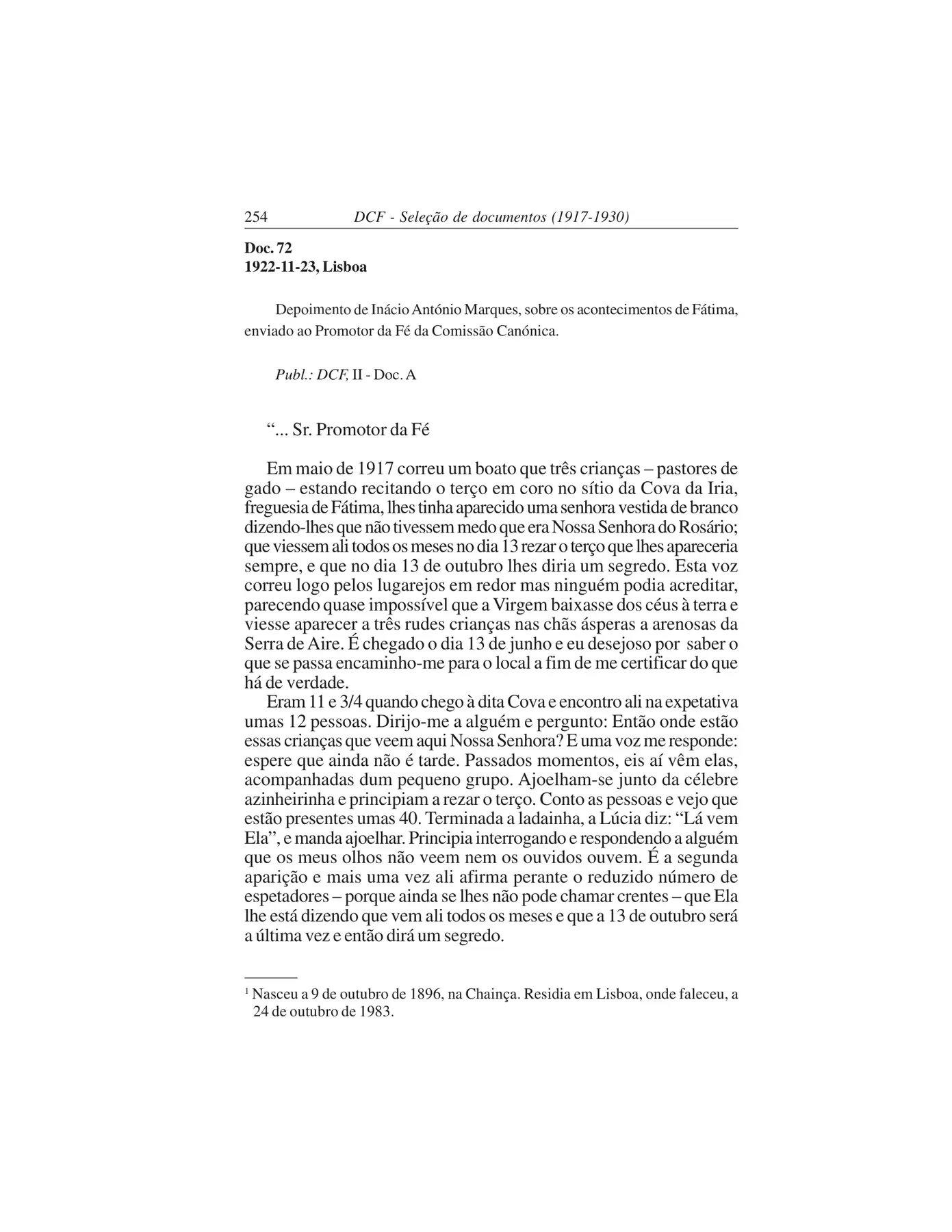
A princípio o povo não queria ir à Cova da Iria. Ninguém acreditava nas crianças. Em treze de junho, dia da segunda aparição, havia festa na igreja da freguesia em honra de Santo António. Na Cova da Iria estavam apenas, à hora da aparição, umas sessenta pessoas. Os pais do Francisco e da Jacinta tinham ido de manhã cedo para Porto de Mós à feira chamada dos treze, com o fim de comprar bois, e chegaram já de noite. Na sua ausência a residência encheu-se-lhes de gente, que queria ver as crianças e fazer-lhes perguntas. Presentemente uma grande parte do povo julga que as crianças falam verdade. Pela minha parte, estou convencido disso.

[…]

Os sinais são muitos. Em agosto quase todos os que estavam presentes viram esses sinais. Uma nuvem baixou até à carrasqueira. Em julho notou-se o mesmo. Não havia poeira no local. A nuvem empoou os ares, que pareciam enevoados.

– Houve mais algum sinal?

– Veem-se no céu, próximo do sol, umas nuvens brancas que se tornam sucessivamente vermelhas vivas (cor de sangue), cor de rosa e amarelas. O povo torna-se desta última cor. A luz do sol diminui bastante de intensidade.

Sentiu-se também um rumor em julho e em agosto.

[…]

Reza o terço. Quando se dirige à Senhora, fala alto.

Eu próprio a ouvi em junho, porque estava próximo. Algumas pessoas afirmam que ouvem o som das respostas.

10a – O local das aparições é muito frequentado também nos outros dias por pessoas piedosas ou por curiosos?

– É muito frequentado, sobretudo aos domingos. A maior concorrência é à noite. Vão ali muitas pessoas, de longe e de perto, e mais ainda de fora da freguesia. Rezam o terço e entoam cânticos em honra da Virgem.

DCF Seleção, Doc. 11 (= DCF I, Doc. 12) · interrogation · 11 Oct 1917 (4 months later)View scans (2)Link
13 May13 Jun13 Jul13 Aug13 SepFirst-handSaw itInterrogationFigures / visionsSeers' words overheard
English

You told me some days ago that Our Lady wanted the money offered by the people to be taken to the parish church on two litters*. How are they to get the litters, and when are they to be taken to the church?

– The litters are to be bought with the money offered and will be carried at the feasts of Our Lady of the Rosary.

2a – Do you know for certain in what spot Our Lady wishes a chapel to be built in her honour?

– I don't know for certain, but I think She wants the chapel at the Cova da Iria.

3a – What did She say she would do so that all the people would believe that she appeared?

– She said she would perform a miracle.

4a – When did she say that?

– She said it several times, but only once, at the time of the first apparition, did I ask her that question.

5a – Aren't you afraid the people will harm you if they don't see anything extraordinary on that day?

– I am not afraid at all.

6a – Do you feel within you something, some force that draws you to the Cova da Iria on the 13th of each month?

– I want to go there, and I would be sad if I didn't.

7a – Did you ever see the Lady cross herself, pray, or tell the beads of the Rosary?

– I didn't.

8a – Did she tell you to pray?

– She told me to pray several times.

9a – Did she tell you to pray for the conversion of sinners?

– She didn't; she only told me to pray to Our Lady of the Rosary for the war to end.

10a – Did you see the signs that other people say they have seen, such as a star, roses coming loose from the Lady's dress, etc.?

– I didn't see the star or other extraordinary signs.

11a – Did you hear any rumbling, thunder or earth tremor?

– I never did.

12a – Can you read?

– I can't.

13a – Are you learning to read?

– I'm not.

14a – How then do you fulfil the order the Lady gave you in that regard?

!.....

15a – When you tell the people to kneel and pray, is it the Lady who tells you to say so?

– It is not the Lady who tells me, it is I who want to.

16a – Whenever she appears, do you kneel?

- Sometimes I stay standing, other times I kneel.
16a – When she speaks, is her voice sweet and pleasant?
– It is.
17a – How old does the Lady seem to be?
– She seems to be about fifteen.
18a – What colour is the chain of the rosary?
– It is white.
19a – And that of the crucifix?
– The crucifix is white too.
20a – Does the veil cover the Lady's forehead?
– It doesn't. Her forehead can be seen clearly.
21a – Is the splendour that surrounds her beautiful?
– It is more beautiful than the light of the sun and very bright.
22a – Did the Lady never greet you with her head or her hands?
– Never.
23a – Did she never smile at you?
– No, not that either.
24a – Does she usually look at the people?
– I never saw her look at them.
25a – Do you hear the talk, noises and shouts of the people during the time you see the Lady?
– I don't.
26a – Did the Lady ask you in May to come back to the Cova da Iria every month until October?
– She said we should come back there month after month for six months, on the 13th.
27a – Did you hear your mother read the book called "Missão abreviada" where the story is told of the apparition of Our Lady to a boy and a girl?
– I did.
28a – Did you often think about that story and talk about it to other children?
– I didn't think about that story nor did I tell it to anyone.

Português (original)

Disseste-me há dias que Nossa Senhora queria que o dinheiro oferecido pelo povo fosse levado para a igreja da freguesia em dois andores. Como é que arranjam os andores e quando é que eles devem ser levados para a igreja?

– Os andores compram-se com o dinheiro oferecido e serão levados nas festas da Senhora do Rosário.

2a – Sabes com certeza em que sítio é que Nossa Senhora deseja que seja edificada uma capela em sua honra?

– Não sei ao certo, mas julgo que Ela quer a capela na Cova da Iria.

3a – O que é que Ela disse que havia de fazer para que todo o povo acreditasse que ela aparecia?

– Disse que havia de fazer um milagre.

4a – Quando foi que ela disse isso?

– Disse-o umas poucas de vezes, mas só uma vez, na ocasião da primeira aparição é que lhe fiz essa pergunta.

5a – Não tens medo de que o povo te faça mal se não vir nada de extraordinário nesse dia?

– Não tenho medo nenhum.

6a – Sentes dentro de ti alguma coisa, alguma força que te arraste para a Cova da Iria no dia 13 de cada mês?

– Sinto vontade de lá ir e ficava triste se não fosse.

7a – Viste alguma vez a Senhora benzer-se, rezar ou desfiar as contas do Rosário?

– Não vi.

8a – Mandou-te rezar?

– Mandou-me rezar umas poucas de vezes.

9a – Disse-te que rezasses pela conversão dos pecadores?

– Não disse; mandou-me só rezar a Nossa Senhora do Rosário para que acabasse a guerra.

10a – Viste os sinais que outras pessoas dizem ter visto, como uma estrela, rosas a despregarem-se do vestido da Senhora, etc.?

– Não vi a estrela nem outros sinais extraordinários.

11a – Ouviste algum rumor, trovão ou tremor de terra?

– Nunca ouvi.

12a – Sabes ler?

– Não sei.

13a – Andas a aprender a ler?

– Não ando.

14a – Como cumpres então a ordem que a Senhora te deu nesse sentido?

!.....

15a – Quando dizes ao povo que ajoelhe e reze, é a Senhora que manda que o digas?

– Não é a Senhora que manda, sou eu que quero.

16a – Sempre que ela aparece, tu ajoelhas?

- Às vezes fico de pé, outras vezes ajoelho-me.
16a – Quando fala, a sua voz é doce e agradável?
– É.
17a – Que idade parece ter a Senhora?
– Parece ter uns quinze anos.
18a – De que cor é o cadeado do rosário?
– É branco.
19a – E a do crucifixo?
– O crucifixo também é branco.
20a – O véu cobre a testa da Senhora?
– Não cobre. Vê-se-lhe a testa bem.
21a – O esplendor que a envolve é bonito?
– É mais bonito que a luz do sol e muito brilhante.
22a – A Senhora nunca te saudou com a cabeça ou com as mãos?
– Nunca.
23a – Nunca se sorriu para ti?
– Também não.
24a – Costuma olhar para o povo?
– Nunca a vi olhar para ele.
25a – Ouves as conversas, rumores e gritos do povo, durante o tempo que vês a Senhora?
– Não ouço.
26a – A Senhora pediu-te em maio que voltasses todos os meses até outubro à Cova da Iria?
– Disse que voltássemos lá de mês a mês durante seis meses, no dia 13.
27a – Ouviste ler a tua mãe o livro chamado “Missão abreviada” onde se conta a história da aparição de Nossa Senhora a um menino e uma menina?
– Ouvi.
28a – Pensavas muitas vezes nessa história e falavas dela a outras crianças?
– Não pensava nessa história nem a contei a ninguém.

Editor's notes (4)

5 The "Missão Abreviada" is a book by Father José Gonçalves Couto, which ran to 16 editions, with a total of more than 16 editions, with a total of more than 100 thousand copies, from 1859 to 1904. The "Apparition of Our Lady on the Mountain of La Salette" is published in the 2nd (1861) to 9th (1873) editions. The edition in Lúcia's family home was probably the 5th edition, Porto, 1867.

6 Manuel Gonçalves da Silva, living in Aljustrel, married to Maria dos Prazeres.

7 This may be Manuel Henriques, born in 1850, married to Maria Violante, then living in Fátima, or his son, also Manuel Henriques, born on 15 February 1891, who later married Maria dos Anjos.

8 Son of António Carreira Ribeiro and Rosa de Jesus Ribeiro. Born at Moita do Martinho, parish of S. Mamede, municipality of Batalha, on 19 November 1865. He married Maria da Cunha. He died on 18 January 1919. In the Rol dos Confessados* of 1917 there is no Francisco Rodrigues, but there is a Francisco Ribeiro. It must be a slip by the author.

5 Anastácio Vieira, de Aljustrel. Padrinho de batismo de Lúcia, casado, a 29 de novembro de 1882, com Teresa de Jesus, tia paterna e madrinha de batismo de António dos Santos, pai de Lúcia.

6 Manuel Gonçalves da Silva, residente em Aljustrel, casado com Maria dos Prazeres.

7 Pode tratar-se de Manuel Henriques, nascido em 1850, casado com Maria Violante, então residente em Fátima, ou de seu filho, também Manuel Henriques, nascido a 15 de fevereiro de 1891, que veio a casar com Maria dos Anjos.

8 Filho de António Carreira Ribeiro e de Rosa de Jesus Ribeiro. Nasceu na Moita do Martinho, freguesia de S. Mamede, concelho da Batalha, a 19 de novembro de 1865. Casou com Maria da Cunha. Faleceu a 18 de janeiro de 1919. No Rol dos Confessados de 1917, não consta nenhum Francisco Rodrigues, mas sim Francisco Ribeiro. Deve tratar-se de um lapso do autor.

DCF Seleção, Doc. 11 (= DCF I, Doc. 12) · interrogation · 11 Oct 1917 (5 months later)View scans (3)Link
13 May13 Jun13 SepFirst-handSaw itInterrogationFigures / visionsSeers' words overheard
English

Did the Lady recommend that you pray the rosary?
– She did.

2a – When?
– When she appeared the first time.
3a – Did you hear the secret too, or was it only Lúcia who heard it?
– I heard it too.
4a – When did you hear it?
– The second time, on St. Anthony's day.
5a – Is the secret for you to become rich?
– It isn't.
6a – Is it for you to be good and happy?
– It is. It is for the good of all three of us.
7a – Is it for you to go to Heaven?
– It isn't.
8a – Can't you reveal the secret?
– I can't.
9a – Why?
– Because the Lady said we were not to tell the secret to anyone.
10a – If the people knew the secret, would they be sad?
– They would.
11a – How did the Lady hold her hands?
– She held them raised.
12a – Always raised?
– Sometimes she turns her palms towards the sky.
13a – Did the Lady say in May that she wanted you to go to the Cova da Iria more times?
– She said she wanted us to go there for six months, month after month, until in October she would say what she wanted.
14a – Does she have any radiance about her head?
– She does.
15a – Can you look properly at her face?
– I can't, because it hurts the eyes.
16a – Did you always hear properly what the Lady said?
– The last time I didn't hear everything because of the noise the people were making.

Português (original)

A Senhora recomendou que rezassem o terço?
– Recomendou.

2a – Quando?
– Quando apareceu pela primeira vez.
3a – Ouviste também o segredo ou foi só a Lúcia que o ouviu?
– Eu também ouvi.
4a – Quando o ouviste?
– Da segunda vez, no dia de Santo António.
5a – Esse segredo é para serem ricos?
– Não é.
6a – É para serem bons e felizes?
– É. É para bem de todos três.
7a – É para irem para o Céu?
– Não é.
8a – Não podes revelar o segredo?
– Não posso.
9a – Porquê?
– Porque a Senhora disse que não disséssemos o segredo a ninguém.
10a – Se o povo soubesse o segredo, ficava triste?
– Ficava.
11a – Como tinha a Senhora as mãos?
– Tinha-as erguidas.
12a – Sempre erguidas?
– Às vezes volta as palmas para o céu.
13a – A Senhora disse em maio que queria que fossem à Cova da Iria mais vezes?
– Disse que queria que fôssemos lá durante seis meses, de mês a mês, até que em outubro dissesse o que queria.
14a – Ela tem na cabeça algum resplendor?
– Tem.
15a – Podes olhar bem para o rosto?
– Não posso, porque faz mal aos olhos.
16a – Ouviste sempre bem o que a Senhora disse?
– Da última vez não ouvi tudo por causa do barulho que o povo fazia.

DCF Seleção, Doc. 11 (= DCF I, Doc. 12) · interrogation · 11 Oct 1917 (5 months later)View scans (2)Link
13 May13 Jun13 Jul13 Aug13 SepFirst-handSaw itInterrogationFigures / visions
English

How old are you?
– I'm nine.
2a – Do you only see the Lady or do you also hear what She says?
– I only see her; I hear nothing of what She says.
4a – Does she have a glow around her head?

– She does.
5a – Can you look properly at her face?
– I can look, but only a little, because of the light.
6a – Does she have any trimmings on her dress?
– She has some gold cords.
7a – What colour is the crucifix of the rosary?
– It is white.
8a – And the chain of the rosary?
– It is white too.
9a – Would the people be sad if they knew the secret?
– They would.

Português (original)

Que idade é que tens?
– Tenho nove anos feitos.
2a – Só vês a Senhora ou ouves também o que Ela diz?
– Só a vejo, não ouço nada do que Ela diz.
4a – Tem algum clarão em volta da cabeça?

- Tem.
5a – Podes olhar bem para a cara dela?
- Posso olhar, mas pouco, por causa da luz.
6a – Tem alguns enfeites no vestido?
- Tem uns cordões de ouro.
7a – De que cor é o crucifixo do rosário?
- É branco.
8a – E a cadeia do rosário?
- Também é branca.
9a – O povo ficava triste se soubesse o segredo?
- Ficava.

DCF Seleção, Doc. 11 (= DCF I, Doc. 12) · interrogation · 11 Oct 1917 (5 months later)View scans (2)Link

Maria Rosa dos Santos

Seer's familyVillagermother of Lúcia
13 May13 Jun13 Jul13 Aug13 SepOther 1917First-handInterrogationSceptic2 km awayCrowd scene
English

How did you learn that the Lady appeared to your daughter the first time? Was it she who told you?

– I learned of it from the other children's family, because Lúcia advised her companions to say nothing for fear they would be scolded. Only after I questioned her did she say what she had seen.

3a – Did you never scold your daughter for going to the Cova da Iria? Did you always give her complete freedom to go there on the 13th of each month?

– I never forbade her to go to that place. Sometimes I asked her if she wanted to go and she answered yes, other times she herself said she would go, if I gave her leave.

4a – Do the three children usually go to the place of the apparitions alone or do they go accompanied by other children?

– They go alone. Other children almost always go too, but accompanied by their parents, and they stay beside them; they do not join Lúcia and her cousins.

5a – Did the children tend livestock? To whom did it belong?

– Lúcia tended a small flock of sheep and her cousins another. Those flocks belonged to their respective families. Sometimes they put the animals together, but only because they wanted to. The sheep Lúcia tended I have already sold.

6a – How have the children been dressed when they go?

– The first time they were shabbily turned out, as shepherds almost always are. The other times, on the 13th of each month, they go dressed in light-coloured clothes and wear a white kerchief on their heads.

[…]

When the children were arrested by the administrator* of Vila Nova de Ourém, did anyone go to demand that they be returned to their parents?

– A brother of Francisco and Jacinta went to talk to them at the administrator's house. The administrator's wife asked whether he had come to fetch the children, to which he answered no. The administrator himself brought them back to Fátima.

11a – Have many people come to see your daughter?

– Many people have come almost every day.

Português (original)

Como soube que a Senhora apareceu à sua filha da primeira vez? Foi ela que lhe contou?

– Tive conhecimento desse facto pela família das outras crianças, porque a Lúcia aconselhou os seus companheiros a não dizerem nada com receio de que lhes ralhassem. Só depois de interrogada por mim é que disse o que tinha visto.

3a – Nunca repreendeu sua filha por ir à Cova da Iria? Deu-lhe sempre inteira liberdade de lá ir, no dia 13 de cada mês?

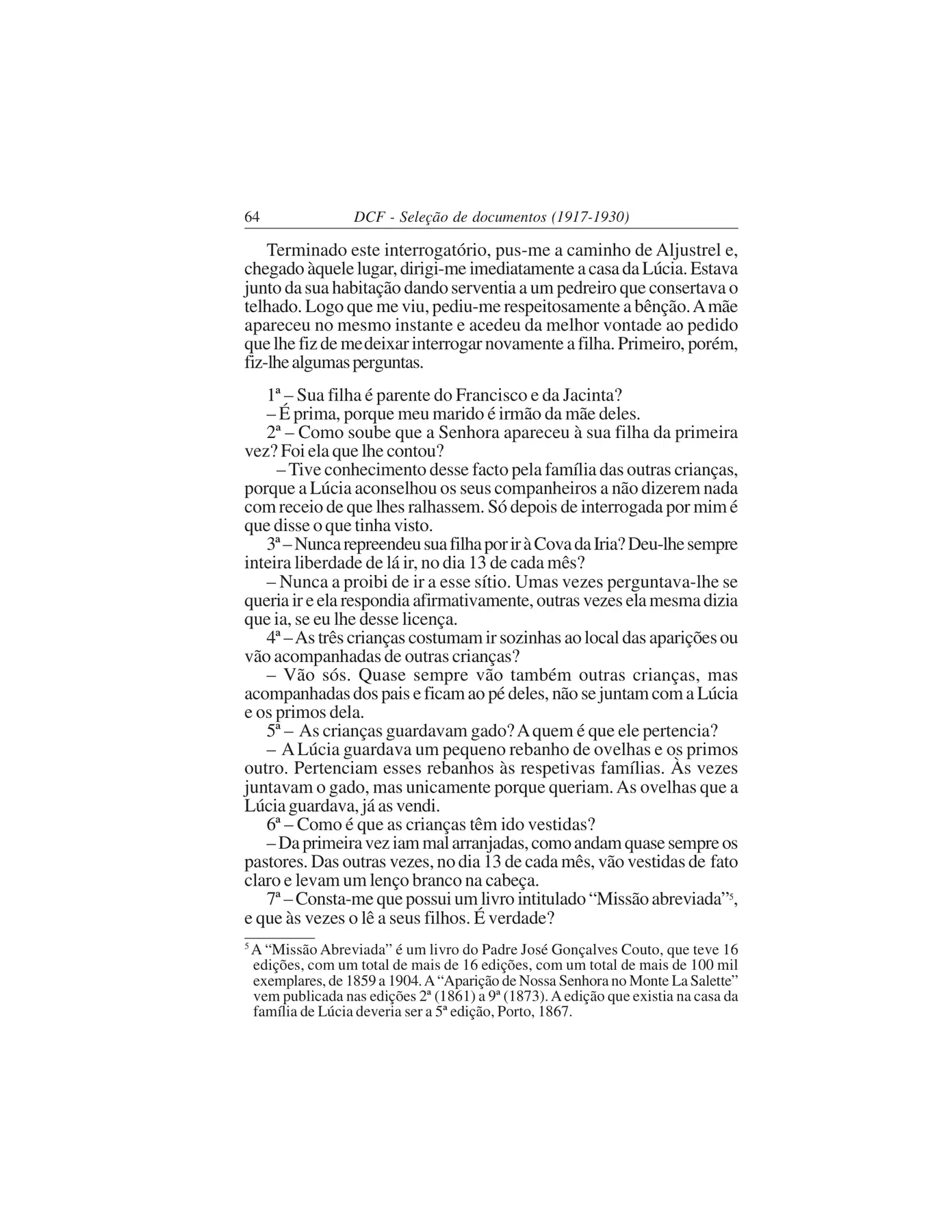
– Nunca a proibi de ir a esse sítio. Umas vezes perguntava-lhe se queria ir e ela respondia afirmativamente, outras vezes ela mesma dizia que ia, se eu lhe desse licença.

4a – As três crianças costumam ir sozinhas ao local das aparições ou vão acompanhadas de outras crianças?

– Vão sós. Quase sempre vão também outras crianças, mas acompanhadas dos pais e ficam ao pé deles, não se juntam com a Lúcia e os primos dela.

5a – As crianças guardavam gado? A quem é que ele pertencia?

– A Lúcia guardava um pequeno rebanho de ovelhas e os primos outro. Pertenciam esses rebanhos às respetivas famílias. Às vezes juntavam o gado, mas unicamente porque queriam. As ovelhas que a Lúcia guardava, já as vendi.

6a – Como é que as crianças têm ido vestidas?

– Da primeira vez iam mal arranjadas, como andam quase sempre os pastores. Das outras vezes, no dia 13 de cada mês, vão vestidas de fato claro e levam um lenço branco na cabeça.

[…]

Quando as crianças foram presas pelo administrador de Vila Nova de Ourém foi alguém reclamar que as restituissem aos pais?

– Um irmão do Francisco e da Jacinta foi falar com elas a casa do administrador. A senhora do administrador perguntou se ia buscar as crianças, ao que ele respondeu negativamente. O próprio administrador as veio trazer à Fátima.

11a – Tem vindo muita gente ver sua filha?

– Tem vindo muita gente quase todos os dias.

DCF Seleção, Doc. 11 (= DCF I, Doc. 12) · interrogation · 11 Oct 1917 (5 months later)View scans (2)Link
13 May13 JunFirst-handSaw itInterrogationFigures / visionsThunder / noiseSeers' words overheard
English

We questioned the children to learn how the first apparition had come about. They answered simply that on 13 May, when they were pasturing their flock at the Cova da Iria, there was a great thunderstorm. They were thinking of gathering the flock and going away, when out of a flash of lightning they saw a Lady appear. Frightened, they wanted to run away, but the apparition told them not to, for it would do them no harm. Before the thunderstorm began the children had been praying their rosary, and the apparition told them to pray the rosary to Our Lady of the Rosary so that the war would abate, and to come back there every month, for it would come there for six consecutive months. — The children went back there in June and say that the Lady appeared to them and this time told them to learn to read, which the children did not do at once, because there was not, and never had been, a teacher in Fatima. Now, without anyone having asked for one, a teacher from the mobile schools* turns up, appointed there for two years, and the children have already begun to attend school with considerable progress, above all Lucia.

Português (original)

Interrogámos as creanças, para saber como se tinha dado a primeira apparição. Responderam com simplicidade que no dia 13 de Maio, quando na Cova da Iria andavam apascentando o seu rebanho, fez uma grande trovoada. Pensavam em juntar o rebanho e irem-se embora, quando d’um relampago viram apparecer uma Senhora. Amedrontados, quizeram fugir, mas a apparição disse-lhes que não fugissem, pois nenhum mal lhes faria. Antes de começar a trovoada as creanças estavam rezando o seu terço, e a apparição recommendou-lhes que rezassem o terço á Senhora do Rosario, para abrandar a guerra, e que voltassem ali todos os mezes, pois durante seis mezes consecutivos ali viriam. — As creanças voltaram ali em junho e dizem ter-lhes apparecido a Senhora que d’esta vez lhes recommendou que aprendessem a lêr, o que as creanças não fizeram logo, porque não havia nem nunca houve professora na Fatima. Agora, sem que ninguem a reclamasse, apparece nomeada para ali, por dois annos uma professora das escolas moveis, e as creanças começaram já a frequentar a escola com bastante aproveitamento, sobretudo da Lucia.

DCF III-1, Doc. 129 · note · 19 Oct 1917 (5 months later)View scans (2)Link
13 May13 Jun13 Jul13 Sep13 OctFirst-handSaw itInterrogationFigures / visionsSeers' words overheard
English

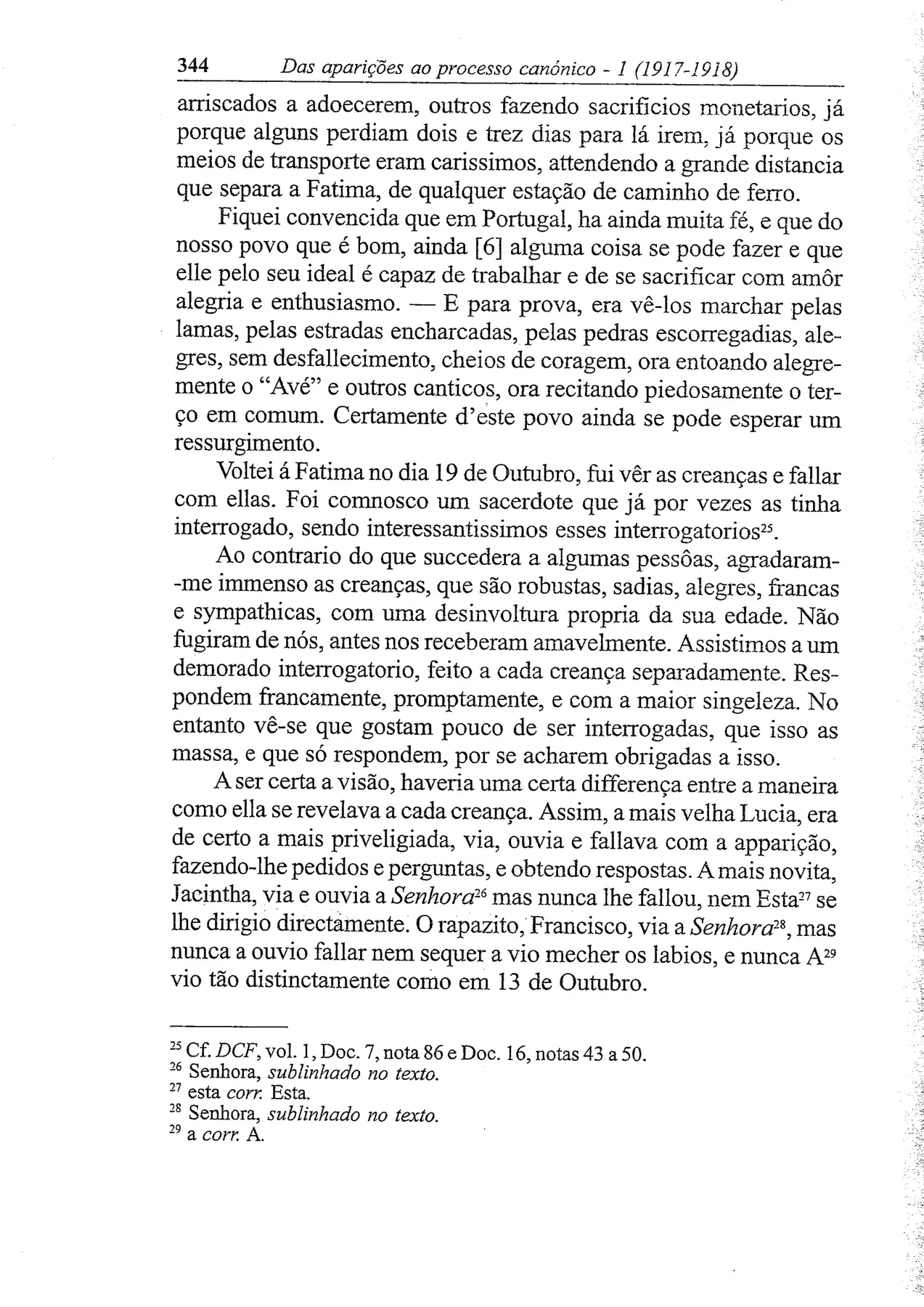
If the vision is genuine, there would seem to be a certain difference in the way it revealed itself to each child. Thus the eldest, Lucia, was certainly the most privileged; she saw, heard and spoke with the apparition, making requests and asking questions of it, and obtaining answers. The youngest, Jacintha, saw and heard the Lady but never spoke to her, nor did She address her directly. The little boy, Francisco, saw the Lady, but never heard her speak or even saw her move her lips, and never saw Her as distinctly as on 13 October.

[…]

The children went on their pious pilgrimage to the Cova da Iria on the 13th of every month, except in August, when they were arrested. They say they always saw the Lady, that Lucia always spoke with Her, that she asked her for some cures and conversions; that the Lady promised her to cure and convert some, and not others. That she always told them to pray the rosary, and told them that she wanted a little chapel in that place dedicated to Our Lady of the Rosary.

[…]

The children describe the apparition as being a Lady

very beautiful, the most beautiful they had ever seen, (their very words) with hands raised to Heaven, dressed all in white and gold, with a rosary all white hanging from her right arm.

Once Lucia asked the Lady: “Where are you from and where are you going?” and she says the Lady answered her: “I am from Heaven and I am going to Heaven”. And when Lucia asked her whether she, Jacintha and Francisco would also go to Heaven, the Lady answered that she and Jacintha would go, and that Francisco would go too, but would have to pray the rosary more. Since then the little boy has at times prayed ten rosaries a day!

Português (original)

A ser certa a visão, haveria uma certa differença entre a maneira como ella se revelava a cada creança. Assim, a mais velha Lucia, era de certo a mais priveligiada, via, ouvia e fallava com a apparição, fazendo-lhe pedidos e perguntas, e obtendo respostas. A mais novita, Jacintha, via e ouvia a Senhora mas nunca lhe fallou, nem Esta se lhe dirigio directamente. O rapazito, Francisco, via a Senhora, mas nunca a ouvio fallar nem sequer a vio mecher os labios, e nunca A vio tão distinctamente como em 13 de Outubro.

[…]

Lá foram as creanças na sua piedosa romaria todos os dias 13 de cada mez á Cova da Iria, excepto em Agosto, em que foram presas. Dizem que viram sempre a Senhora, que a Lucia fallou sempre com Ella, que lhe pedio algumas curas e conversões; que a Senhora lhe prometteu, curar e converter uns, outros não. Que lhes recommendou sempre que rezassem o terço, e lhes disse que queria n’aquelle sitio uma Capellinha dedicada á Senhora do Rosario.

[…]

s creanças descrevem a apparição, como sendo uma Senhora

muito linda, a mais linda que tivessem visto, (palavras textuaes) de mãos erguidas para o Ceu, toda vestida de branco e ouro, tendo pendente do braço direito um terço todo branco.

Uma vez, a Lucia perguntou á Senhora: “De onde é Vocemecê e para onde vae?” e diz que a Senhora lhe respondeu: “Sou do Céu e vou para o Céu”. E perguntando-lhe a Lucia se ella, a Jacintha e o Francisco tambem irião para o Céu, que a Senhora lhe respondera que ella e a Jacintha irião, e que o Francisco tambem iria, mas teria de rezar mais o terço. Desde então o pequeno, tem por vezes rezado dez terços por dia!

DCF III-1, Doc. 129 · note · 19 Oct 1917 (5 months later)View scans (4)Link
13 JunFirst-handSaw itInterrogationSeers' words overheard
English

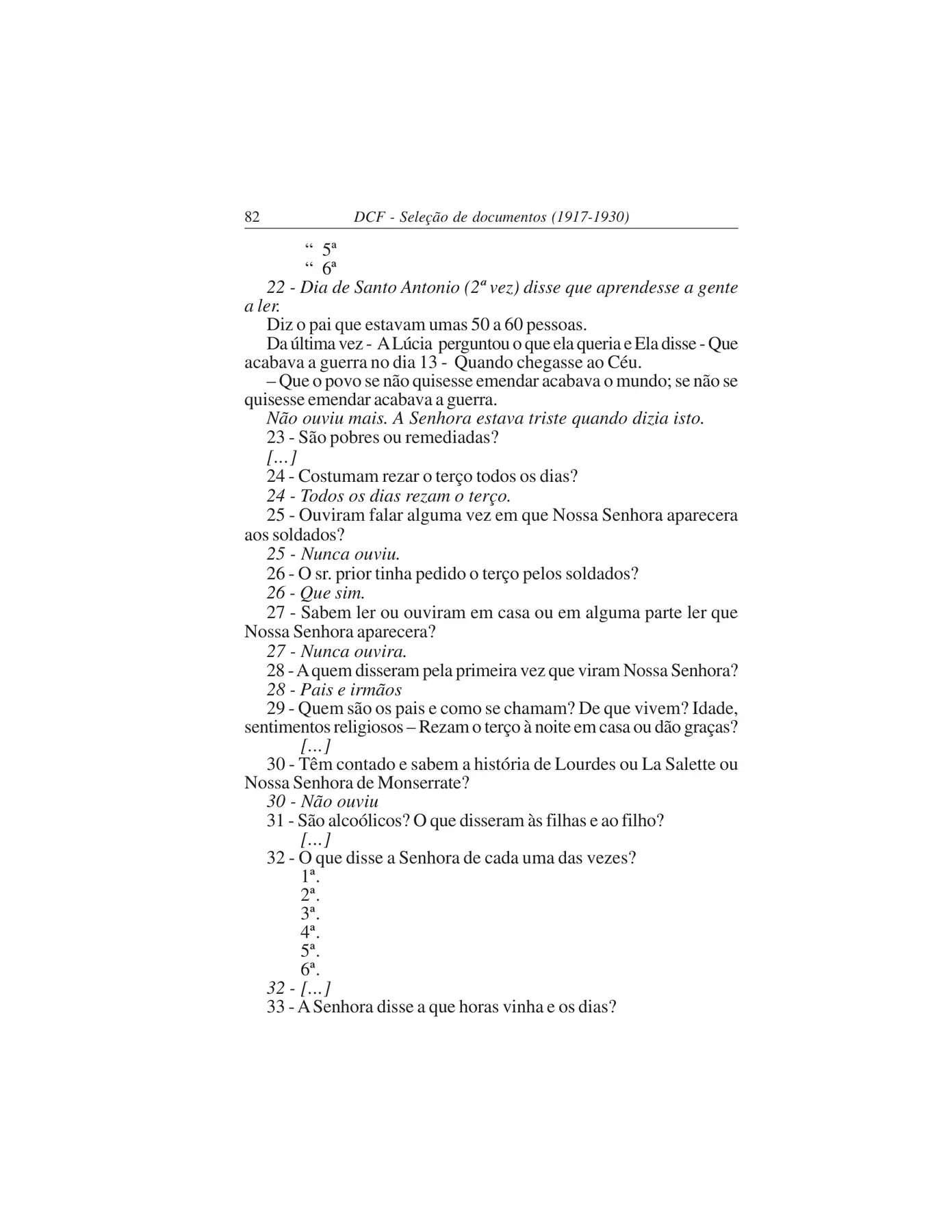
22 - On Saint Anthony's Day (2nd time) she said that we should learn to read.

Português (original)

22 - *Dia de Santo Antonio (2a vez) disse que aprendesse a gente a ler.

DCF Seleção, Doc. 15 (= DCF I, Doc. 46) · interrogation · 19 Oct 1917 (4 months later)View scanLink
13 May13 JunFirst-handSaw itInterrogationSeers' words overheardCrowd scene
English

33 - Did the Lady say at what time she was coming, and on which days?

33 - That she was coming at midday.

34 - The 2nd time, did people go to watch? What did they see?

34 - Some 50 people went.

35 - The 2nd

The 3rd

The 4th

The 5th

[...]

36 - What did the Lady want? Did she say what she came for?

36 - She never heard the Lady say what she came for. The Lady spoke slowly.

Português (original)

33 - A Senhora disse a que horas vinha e os dias?

33 - Que vinha ao meio dia.

34 - Da 2ª vez foi gente assistir? O que viram?

34 - Foram umas 50 pessoas.

35 - Da 2ª

Da 3ª

Da 4ª

Da 5ª

[...]

36 - O que queria a Senhora? Disse a que vinha?

36 - *Nunca ouviu dizer à Senhora a que vinha. A Senhora falava devagar.

DCF Seleção, Doc. 15 (= DCF I, Doc. 46) · interrogation · 19 Oct 1917 (5 months later)View scans (2)Link
13 JunFirst-handSaw itInterrogationSeers' words overheard
English

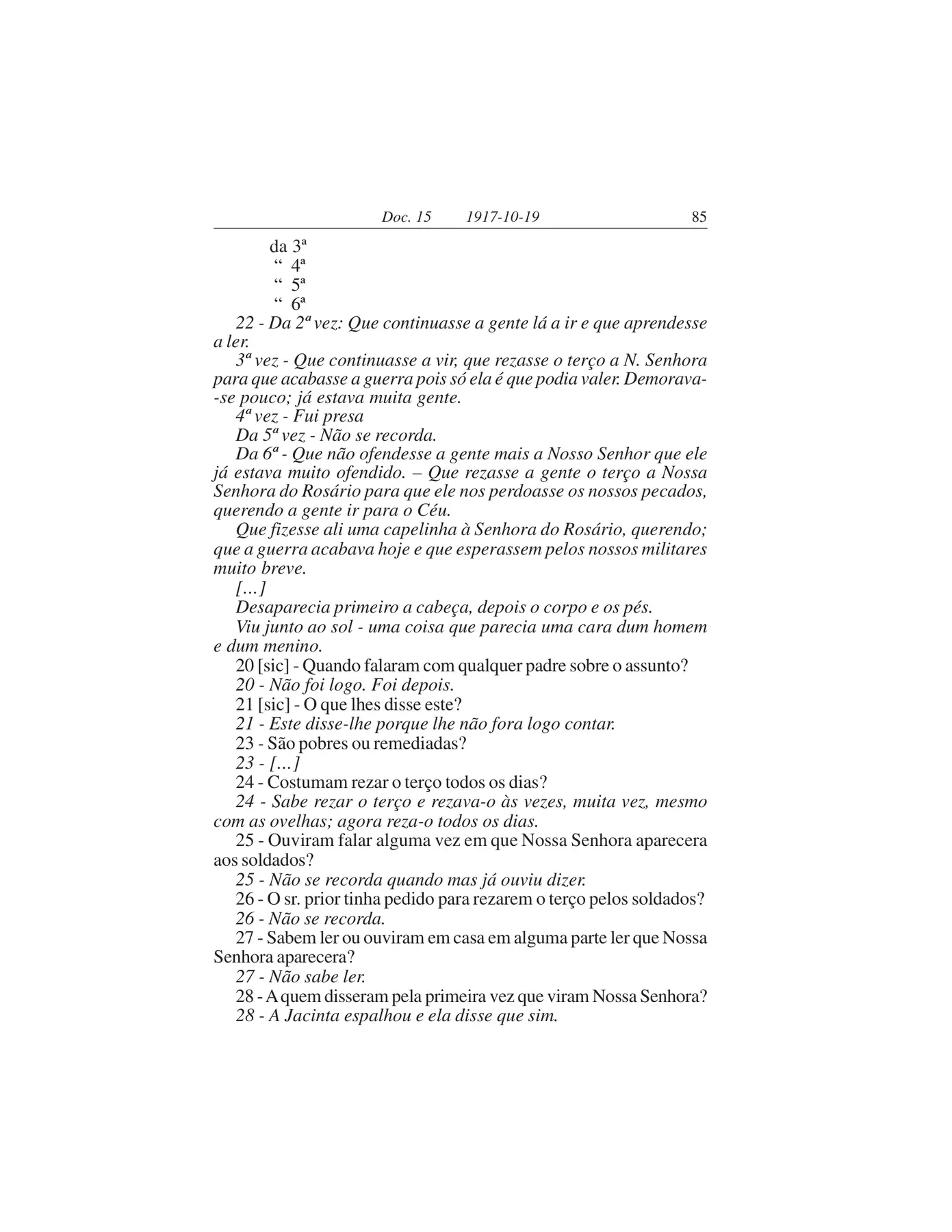
22 - The 2nd time: That we should keep going there and should learn to read.

Português (original)

22 - Da 2a vez: *Que continuasse a gente lá a ir e que aprendesse a ler.

DCF Seleção, Doc. 15 (= DCF I, Doc. 46) · interrogation · 19 Oct 1917 (4 months later)View scanLink
13 May13 Jun13 Jul13 Aug13 Sep13 OctFirst-handSaw itInterrogationSeers' words overheard
English

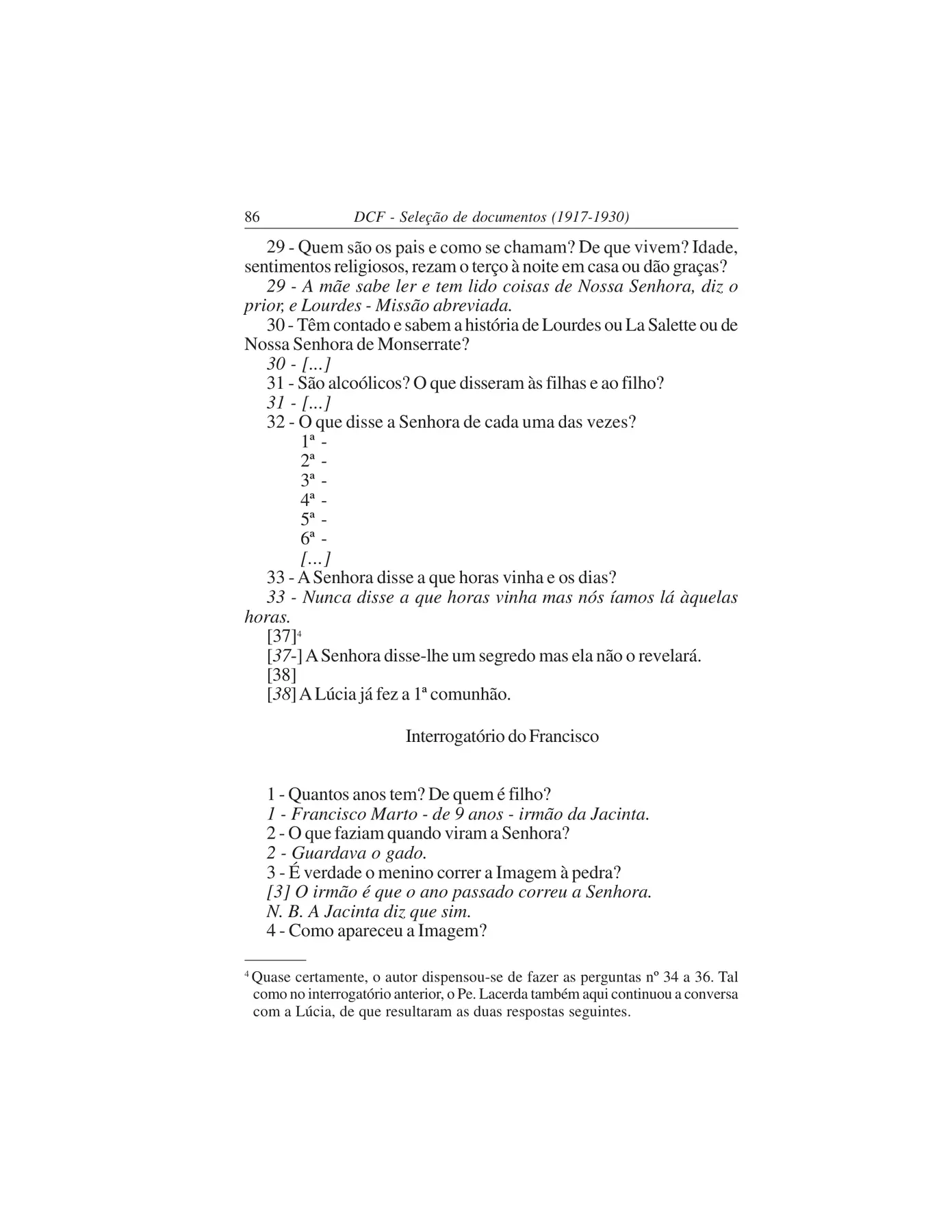
33 - She never said at what time she was coming, but we used to go there at that time.

[37]4

[37-] The Lady told her a secret but she will not reveal it.

Português (original)

33 - Nunca disse a que horas vinha mas nós íamos lá àquelas horas.

[37]4

[37-] A Senhora disse-lhe um segredo mas ela não o revelará.

Editor's notes (1)

4 Almost certainly, the author dispensed with asking questions nos. 34 to 36. Just as in the previous interrogation, Fr. Lacerda here too continued the conversation with Lúcia, which produced the following two answers.

4 Quase certamente, o autor dispensou-se de fazer as perguntas nº 34 a 36. Tal como no interrogatório anterior, o Pe. Lacerda também aqui continuou a conversa com a Lúcia, de que resultaram as duas respostas seguintes.

DCF Seleção, Doc. 15 (= DCF I, Doc. 46) · interrogation · 19 Oct 1917 (5 months later)View scanLink

Jacinto de Sousa Bento

Villagerman from Assentiz
13 Jun13 Jul13 Aug13 Sep13 OctFirst-handSaw itNoteCloud / smoke columnLight dimmingTemperature dropThunder / noiseSeers' words overheardCrowd scene
English

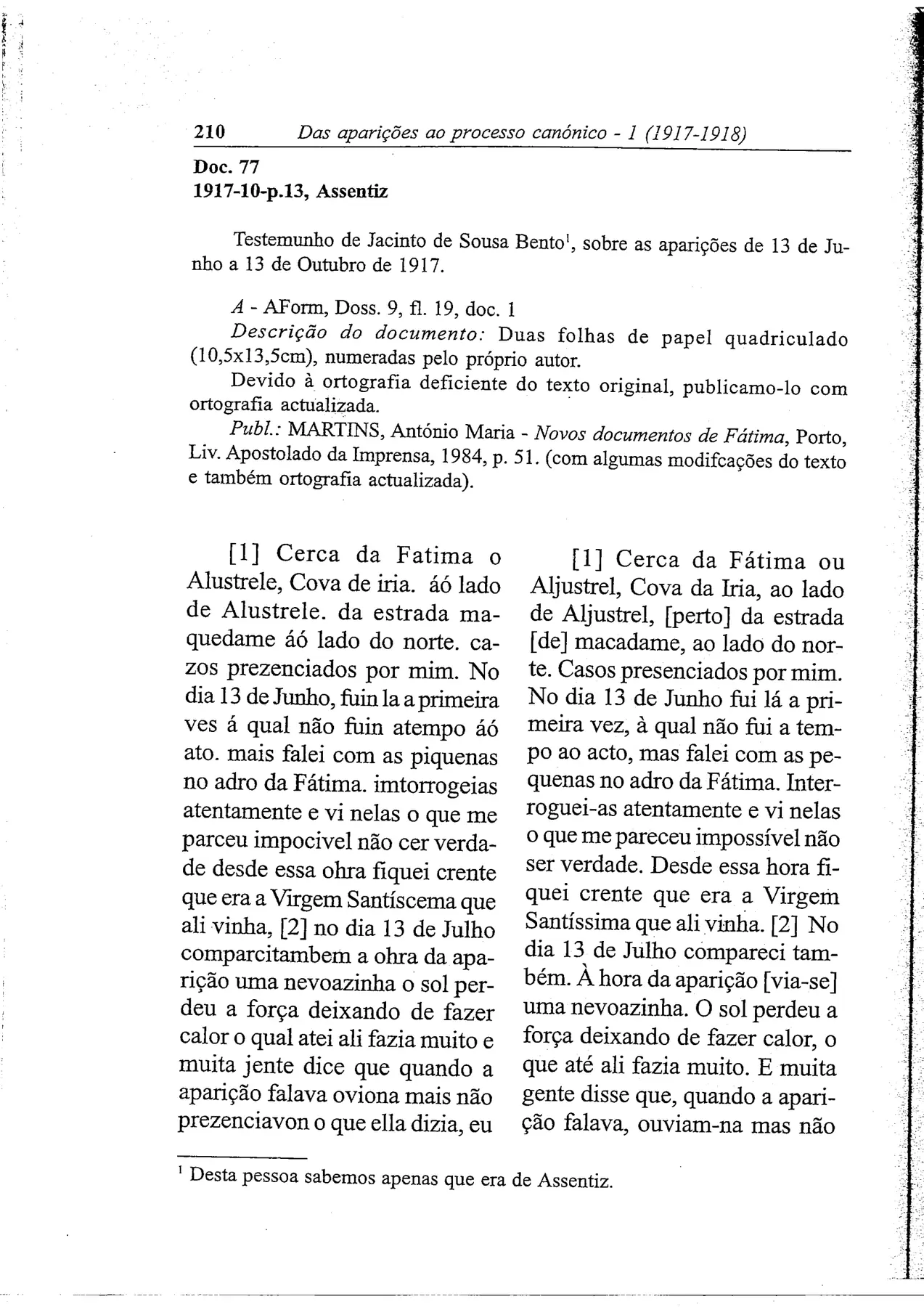
[1] Near Fátima or Aljustrel, Cova da Iria, beside Aljustrel, [near] the road [of] macadam, on the north side. Things I witnessed. On 13 June I went there for the first time, but did not arrive in time for the event; however, I spoke with the little girls in the churchyard at Fátima. I questioned them carefully and saw in them something that, it seemed to me, could not possibly be untrue. From that moment I believed that it was the Most Holy Virgin who came there. [2] On 13 July I was present too. At the hour of the apparition [there could be seen] a little mist. The sun lost its strength and stopped giving heat, though until then it had been very hot. And many people said that, when the apparition spoke, they heard her but did not

[…]

witness [make out] what She was saying. I only heard when Lúcia said: there She goes! I heard a roar in the air. It seemed like the beginning of a thunderclap. [3] On 13 August I was present too. The little girls and the boy had been arrested. There were a great many people. At the same hours as the apparition, the heavenly bodies and the sun did the same as on the other occasions; and there was a most extraordinary sign in the heavens. On 13 September I was present too. The sun and the heavenly bodies made the same display. The people were full of excitement, looking up into the air, some saying that they saw stars, others that they saw a dove, others that they saw stars running and swallows going along with them. Everyone was excited. Still others [said] that they saw flowers falling. [4] On 13 October it rained almost all morning. Close to the hour of the apparition it stopped raining. The extraordinary things that happened in the sun! Everyone saw them who had their eyes open; whoever closed them saw nothing. And perhaps there were some who saw and said they had not, so as not to give honour to the Mother of Heaven. Whatever mistake there may have been about the war*, the extraordinary [facts] that happened there are undeniable.

Português (original)

1] Cerca da Fátima ou Aljustrel, Cova da Iria, ao lado de Aljustrel, [perto] da estrada [de] macadame, ao lado do norte. Casos presenciados por mim. No dia 13 de Junho fui lá a primeira vez, à qual não fui a tempo ao acto, mas falei com as pequenas no adro da Fátima. Interroguei-as atentamente e vi nelas o que me pareceu impossível não ser verdade. Desde essa hora fiquei crente que era a Virgem Santíssima que ali vinha. [2] No dia 13 de Julho compareci também. À hora da aparição [via-se] uma nevoazinha. O sol perdeu a força deixando de fazer calor, o que até ali fazia muito. E muita gente disse que, quando a aparição falava, ouviam-na mas não

[…]

presenciavam [percebiam] o que Ela dizia. Eu só ouvi quando a Lúcia disse: lá vai Ela! Ouvi no ar um rugido. Parecia o princípio de um trovão. [3] No dia 13 de Agosto compareci também. As meninas e o menino foram presos. Estava muita gente. Às mesmas horas da aparição os astros e o sol representaram o mesmo das outras vezes; e um sinal extraordinaríssimo nos astros. No dia 13 de Setembro compareci também. O sol e os astros fizeram a mesma figura. O povo entusiasmado a olhar para o ar, dizendo uns que viam estrelas, outros que viam uma pomba, outros que viam estrelas a correr e andorinhas a acompanhar. Era um entusiasmo em todos. Ainda outros que viam flores a cair. [4] No dia 13 de Outubro choveu quase toda a manhã. À hora próxima à aparição deixou de chover. Os factos extraordinários que se deram no sol! Toda a gente presenciou: quem tinha os olhos abertos; quem os fechou não viu nada. E talvez houvesse quem visse e dissesse que não viu para não dar honras à Mãe do Céu. Haja o equívoco que houver com respeito à guerra, os [factos] extraordinários que lá houve são inegáveis.

DCF III-1, Doc. 77 · note · after 13 Oct 1917 (4 months later)View scans (2)Link
13 May13 Jun13 Jul13 Aug13 Sep13 OctFirst-handSaw itInterrogationFigures / visionsLight dimming
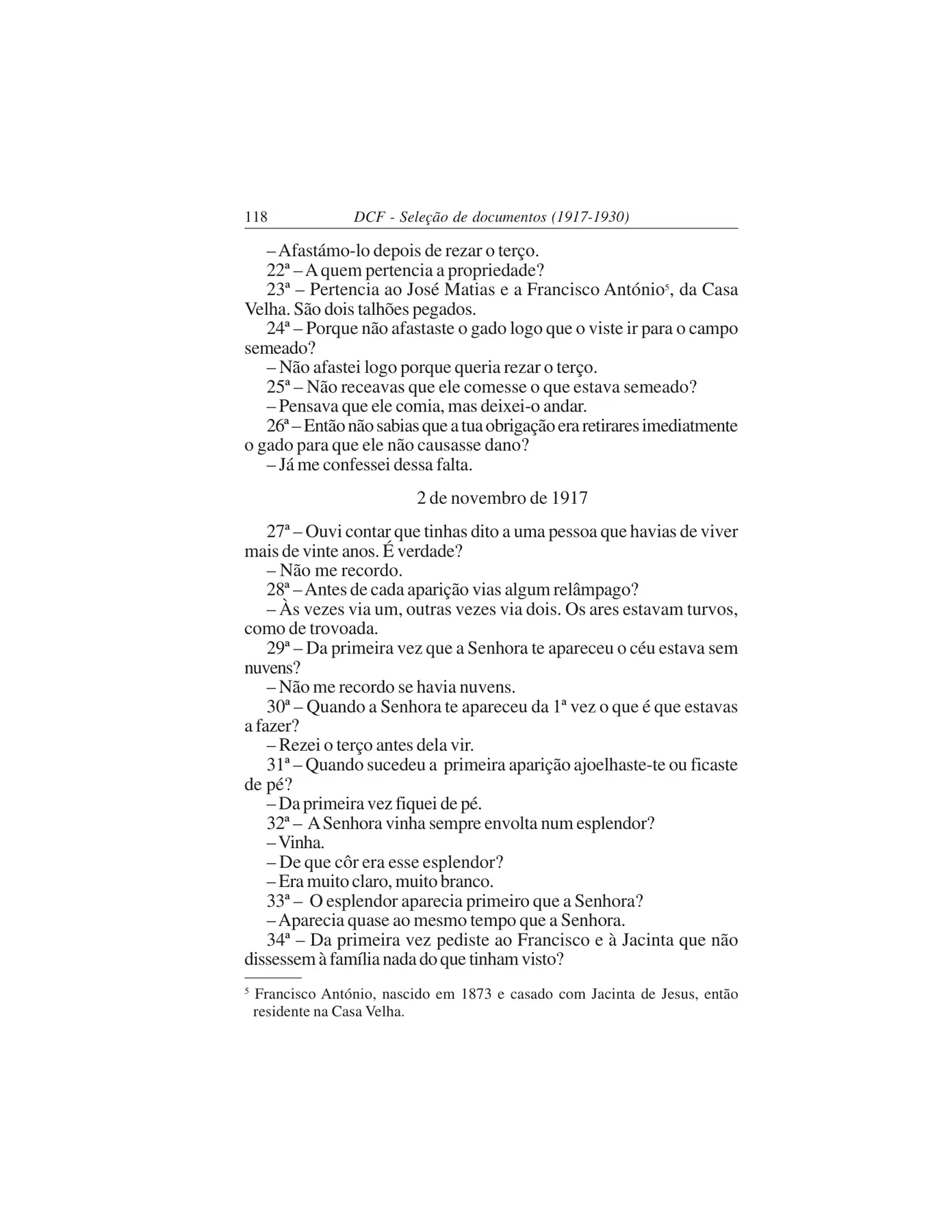
English

Before each apparition did you see any flash of lightning?

– Sometimes I saw one, other times I saw two. The air was murky, as before a thunderstorm.

29th – The first time the Lady appeared to you, was the sky cloudless?

– I don't remember whether there were clouds.

30th – When the Lady appeared to you the 1st time, what were you doing?

– I said the rosary before she came.

31st – When the first apparition happened, did you kneel or remain standing?

– The first time I remained standing.

32nd – Did the Lady always come surrounded by a radiance?

– She did.

– What colour was that radiance?

– It was very bright, very white.

33rd – Did the radiance appear before the Lady?

– It appeared almost at the same time as the Lady.

Português (original)

Antes de cada aparição vias algum relâmpago?

– Às vezes via um, outras vezes via dois. Os ares estavam turvos, como de trovoada.

29a – Da primeira vez que a Senhora te apareceu o céu estava sem nuvens?

– Não me recordo se havia nuvens.

30a – Quando a Senhora te apareceu da 1a vez o que é que estavas a fazer?

– Rezei o terço antes dela vir.

31a – Quando sucedeu a primeira aparição ajoelhaste-te ou ficaste de pé?

– Da primeira vez fiquei de pé.

32a – A Senhora vinha sempre envolta num esplendor?

– Vinha.

– De que côr era esse esplendor?

– Era muito claro, muito branco.

33a – O esplendor aparecia primeiro que a Senhora?

– Aparecia quase ao mesmo tempo que a Senhora.

DCF Seleção, Doc. 22 (= DCF I, Doc. 17) · interrogation · 2 Nov 1917 (6 months later)View scanLink
13 JunFirst-handSaw itInterrogationSeers' words overheardCure
English

What was it the Lady said in June?

– She said we were to keep going to the Cova da Iria and that we were to learn to read.

42nd – Did she say anything else?

– A son of Manuel Carreira, from Moita, was there, a poor boy crippled in his legs and back6. I asked the Lady whether she would cure him, and she said he would be cured within a year. His back has already got better little by little. I also asked the Lady if she would kindly convert a woman from Moita, and she said she would convert her within a year7.

43rd – What else did the Lady say?

– I don't remember anything else.

Português (original)

O que foi que disse a Senhora em junho?

– Disse que continuássemos a ir à Cova da Iria e que aprendêssemos a ler.

42a – Disse mais alguma coisa?

– Estava presente um filho do Manuel Carreira, da Moita, aleijadinho das pernas e das costas6. Perguntei à Senhora se o curava, e ela disse que seria curado dentro de um ano. Já se curou pouco a pouco das costas. Perguntei também se a Senhora era servida converter uma mulher da Moita e ela disse que a converteria dentro de um ano7.

43a – Que mais disse a Senhora?

– Não me recordo de mais nada.

Editor's notes (2)

6 João Carreira. Son of Manuel Carreira and of Maria Carreira or Maria dos Santos (Maria da Capelinha). He was born on 26 March 1901, at Moita. He was the guardian of the Chapel of the Apparitions. He died at the Shrine of Fátima on 6 April 1975.

7 It should be noted that these requests by Lúcia, said here to have been made in June, are placed in July in the first interrogations by the parish priest of Fátima. Moreover, here “a woman from Moita” is mentioned, whereas those interrogations speak of “a woman from Fátima”.

6 João Carreira. Filho de Manuel Carreira e de Maria Carreira ou Maria dos Santos (Maria da Capelinha). Nasceu a 26 de março de 1901, na Moita. Foi guardião da Capelinha das Aparições. Faleceu, no Santuário de Fátima, no dia 6 de abril de 1975.

7 Deve notar-se que estes pedidos da Lúcia, aqui referidos como tendo sido feitos em junho, aparecem nos primeiros interrogatórios do Pároco de Fátima, em julho. Por outro lado, aqui fala-se de “uma mulher da Moita”, enquanto naqueles se refere “uma mulher de Fátima”.

DCF Seleção, Doc. 22 (= DCF I, Doc. 17) · interrogation · 2 Nov 1917 (5 months later)View scanLink
13 JunFirst-handSaw itInterrogationSeers' words overheard
English

When was it that you asked the Lady what she would do so that the people would believe that it was she who appeared to you?

– I asked her quite a few times; the first time I asked I reckon was in June.

61st – When did she tell you the secret?

– I think it was the 2nd time.

Português (original)

Quando foi que perguntaste à Senhora o que é que fazia para que o povo acreditasse que era ela que te aparecia?

– Perguntei-lhe umas poucas de vezes; a primeira vez que perguntei cuido que foi em junho.

61a – Quando te disse o segredo?

– Parece-me que foi da 2a vez.

DCF Seleção, Doc. 22 (= DCF I, Doc. 17) · interrogation · 2 Nov 1917 (5 months later)View scanLink
13 May13 Jun13 Jul13 Aug13 Sep13 OctFirst-handSaw itInterrogationFigures / visions
English

What the Lady wore on her feet – were they stockings? Are you sure of that?

– I reckon they were stockings, but they might not have been.

4th – You have never told the secret, nor even said that the people would be sad if they knew it. Francisco and Jacinta say that they would be sad. If you cannot say that, neither could they say it. What do you think?

– I don't know whether they should or shouldn't say that the people would be sad. Our Lady said we were not to tell anything to anyone. That is why I can't say anything.

2nd – You once said that the Lady had white stockings. So were they stockings or were they her feet?

– If they were stockings, they were white, but I don't know for sure whether they were stockings or her feet.

3rd – Was the skirt always the same length?

– The last time the skirt seemed longer.

Português (original)

O que a Senhora trazia nos pés eram meias? Tens a certeza disso?

– Cuido que eram meias, mas podiam não ser.

4ª – Tu nunca disseste o segredo, nem mesmo disseste que o povo ficava triste se o soubesse. O Francisco e a Jacinta dizem que ficava triste. Se tu não podes dizer isso, também eles o não podiam dizer. Que te parece?

– Não sei se eles deviam ou não dizer, que o povo ficava triste. Nossa Senhora disse que não devíamos dizer nada a ninguém. Por isso não posso dizer nada.

2a – Tu disseste uma vez que a Senhora tinha meias brancas. Então eram as meias ou eram os pés?

– Se eram meias, eram brancas, mas eu não sei ao certo se eram meias ou se eram os pés.

3a – A saia era sempre do mesmo comprimento?

– A saia da última vez parecia mais comprida.

DCF Seleção, Doc. 22 (= DCF I, Doc. 17) · interrogation · 2 Nov 1917 (6 months later)View scans (2)Link
13 JunFirst-handSaw itInterrogationSeers' words overheard
English

What did the Lady say the second time, in June?

– Lúcia said: What do you want of me? The Lady answered: I want you to learn to read.

5th – Did Lúcia ask any more questions?

– She asked for the sick and for sinners, and the Lady said she would make some better and would convert them, and not others.

6th – Did the Lady say anything else?

– That day she said nothing else.

Português (original)

Que disse a Senhora da segunda vez, em junho?

– A Lúcia disse: O que me quer? A senhora respondeu: quero que aprendam a ler.

5a – A Lúcia fez mais alguma pergunta?

– Pediu pelos doentes e pecadores e a Senhora disse que melhorava uns e os convertia, outros não.

6a – A Senhora disse mais alguma coisa?

– Naquele dia não disse mais nada.

DCF Seleção, Doc. 22 (= DCF I, Doc. 17) · interrogation · 2 Nov 1917 (5 months later)View scanLink
13 May13 Jun13 Jul13 Aug13 Sep13 OctFirst-handSaw itInterrogationSeers' words overheard
English

When was it that the Lady taught you the prayer you were to say after each mystery*?

– I think it was in the third month.

2nd – How many people did the Lady promise to cure and convert?

– I asked for many and she said she would cure and convert some, and not others.

3rd – How many times did you make that request to her?

– I think it was five times, now for some people, now for others.

Português (original)

Quando foi que a Senhora te ensinou a oração que devias rezar depois de cada mistério?

– Parece-me que foi no terceiro mês.

2a – Quantas foram as pessoas que a Senhora prometeu curar e converter?

– Eu pedi por muitas e ela disse que curava e convertia umas, outras não.

3a – Quantas vezes lhe fizeste esse pedido?

– Parece-me que foi cinco vezes, ora por umas pessoas, ora por outras.

DCF Seleção, Doc. 22 (= DCF I, Doc. 17) · interrogation · 3 Nov 1917 (6 months later)View scanLink
13 May13 Jun13 Jul13 Aug13 Sep13 OctFirst-handSaw itInterrogationFigures / visions
English

I sit down beside him and begin my conversation: “Did you see Our Lady?” — “I did.” “How was she dressed?” — “All in white and gold.” “And didn't she have anything coloured?” — “No.” “And on her head?” — “A mantle.” “And nothing else?” — “Yes, she had a thing.” “What?” — “I don't know, a thing.” “And could her hair be seen?” — “No.” “And what colour were her eyes?” — “They were black.” These answers were given with an air of enormous naturalness, in a slightly drawling voice. All three children, whom I spoke to separately, change their tone when describing Our Lady's gaze. One can see that it was what impressed them most.

Português (original)

Sento-me ao pé dele e começo a minha conversa: “Viste Nossa Senhora?” — “Vi”. “Como vinha vestida?” — “Toda de branco e oiro.” “E não trazia nada de côr?” — “Não”. “E na cabeça?” — “Um manto.” “E mais nada?” — “Sim, trazia uma coisa.” “O quê?” — “Não sei, uma coisa.” “E via-se o cabelo?” — “Não”. “E os olhos de que côr eram?” — “Eram pretos.” Estas respostas eram dadas com um ar de uma naturalidade enorme, um pouco arrastadas. Todas as três crianças com quem falei separadamente, mudam de tom descrevendo o olhar de N. Senhora. Vê-se que foi o que mais as impressionou.

DCF III-2, Doc. 370 · letter · 13 May 1918 (12 months later)View scans (2)Link
13 May13 Jun13 Jul13 Aug13 Sep13 OctFirst-handSaw itInterrogationFigures / visionsSeers' words overheard
English

Lucia says of the eyes: “They were very dark.” “And the dress?” — “White and gold.”

“With a coloured belt?” — “No, with gold stars; look, she had one on her breast.” “And on her head?” — “A mantle and a thing, like this...” “But what?” — “I don't know, it was like a little basket thing” (a little basket). I did not even say the word crown, which came to my mind at once; I let the child ex-[384v]plain herself as best she could, and I confess I found the comparison delightful. “And could her hair be seen?” — “No.” “Tell me, was Our Lady laughing, cheerful?” — “No, she was serious.” “Cross?” — “No, serious.” “She had the beads, didn't she?” — “Yes, some white beads, and when she spoke she opened her hands, like this...” The child took the beads out of her pocket and explained what she had seen. At a certain point she tells me that Our Lady had a great deal of light. “Like the sun?” — “More than the sun.” A lady who was there says to her: “Why were you afraid at first? If I appeared to you, you wouldn't run away.” — “That's because you wouldn't blind me.” She says that Our Lady asks the people to mend their ways, to pray the rosary a great deal and to build a chapel to Our Lady of the Rosary. The child repeats many times: “The people don't mend their ways, the people don't mend their ways...”

Português (original)

A Lucia diz dos olhos: “Eram muito escuros.” “E o fato?” — “Branco e oiro.”

“Com cinto de côr?” — “Não, com estrelas de oiro; olhe, tinha uma no peito.” “E na cabeça?” — “Um manto e uma coisa, assim...” “Mas o quê?” — “Não sei, era assim um açafatico” (um açafatesinho). Eu nem disse a palavra corôa que me veio logo á ideia; deixar a pequena expli-[384v]car-se como sabe e confesso que achei de apetite a comparação. “E via-se o cabelo?” — “Não.” “Olha, N. Senhora estava a rir-se, alegre?” — “Não, estava séria.” “Zangada?” — “Não, séria.” “Trazia as contas, não trazia?” — “Sim, umas contas brancas e quando falava abria as mãos, assim...” A pequena tirou as contas da algibeira e explicou o que tinha visto: A certa altura diz-me que N. Senhora tinha muita luz. “Como o sol?” — “Mais do que o sol.” Uma senhora que ali estava, diz-lhe: “Porque tiveste medo ao principio? Se eu te aparecesse, tu não fugias.” — “É que a senhora não me cegava.” Diz que N. Senhora pede ao povo que se emende, que reze muito o terço e faça uma capela a N. Senhora do Rosario. A pequena repete muitas vezes: “O povo não se emenda, o povo não se emenda...”

DCF III-2, Doc. 370 · letter · 13 May 1918 (12 months later)View scans (4)Link
13 JunFirst-handSaw itLater recollectionFigures / visionsSeers' words overheard
English

We were waiting for the Lady to appear beside the holm-oak shrub, and there was a flash of lightning and the Lady appeared above the holm-oak shrub.

I asked her what she wanted of me; the answer: I want you to go on coming here every month, and to learn to read. I asked her to cure a lame man and some people who had asked me, some sick and others for the conversion of some sinners. Answer: In a year's time they will be cured. With that she disappeared, rising towards the east and going so high that the clouds and the blue of the sky didn't let us see her any more. If anything else happened this month I don't remember.

Português (original)

Estava-mos á espera que a Senhora aparece-se junto da carrasqueira, e deu um relampago e a Senhora apareceu em sima da carrasqueira.

Perguntei-lhe o que me queria; a resposta. Quero que continuêm a vir aqui todos os meses, e que aprendam a ler. Pedi-lhe para curar um côcho e algumas pessoas que me tinham pedido; umas duentes outras pela coverção de alguns peccadores. Resposta; Daqui a um ano seram curados. Com isto desapareceu subindo para o lado do nascente e indo tam alta que as nuvens e o azul do céu não nos deixou ver mais. Se êste mez aconteceu mais alguma coisa não me lembro.

DCF III-3, Doc. 685 · other · 5 Jan 1922 (5 years later)View scans (2)Link
13 May13 Jun13 Jul13 Aug13 Sep13 OctFirst-handSaw itLater recollectionFigures / visions
English

Our Lady's dress was of these colours: the dress was all white; it had two stars from the waist down, one in line with the other; round the neck a cord with a ball came down to the waist; the hands joined, and from them hung some beads, I don't know if it was a Rosary or a white Terço*, with a crucifix also white. The mantle covered her head down to the end of the dress. it had a little gold edge; the feet, I don't know if she had stockings on or came barefoot, because I couldn't make out her toes; it was because of the light that didn't let me fix my eyes on them; everything ar[ound] her was a light so bright and so strong that it didn't let me see as I wanted because it seemed to blind me.

I think I have already said almost everything if anything of what she told me to write is missing I don't remember.

Português (original)

O vestido de Nossa Senhora era destas cores; o vestido era todo branco; tinha dos estrelas da cinta para baixo uma na direção da outra; ao pescosso um cordão com uma bola chegava até á cinta; as mãos postas, e delas caia umas contas não sei se era Rosario se era Terço branco com um cruxifixo tambem branco. O manto cobria-lhe a cabeça até ao fim do vestido. tinha uma beirinha doirada; os pés não sei se tinha maias se vinha descalços, porque eu não lhe defrençava os dedos, era porcausa da luz que me não deixava fitalos tudo em vol[ta] dela era uma luz tam brilhante e tam forte que me não deixava ver como eu queria porque parecia cegar-me.

Paresseme que já disse quase tudo se me falta alguma coisa duque ela disse para escrever não me lembro.

DCF III-3, Doc. 685 · other · 5 Jan 1922 (5 years later)View scans (2)Link

Inácio António Marques

Villageryoung man of Chainça, later post-office employee in Lisbon
13 JunFirst-handSaw itLater recollectionScepticCrowd sceneSeers' words overheardCloud / smoke columnLight dimmingThunder / noise
English

The 13th of June arrives and I, eager to know what is going on, make my way to the place to find out how much truth there is in it.

It is a quarter to twelve when I reach the said Cova, and I find some 12 people waiting there. I turn to someone and ask: Well, where are these children who see Our Lady here? And a voice answers me: wait, it isn't late yet. A few moments later, here they come, accompanied by a small group. They kneel beside the famous little holm oak and begin to say the rosary. I count the people and see that some 40 are present. When the litany* is over, Lúcia says: "Here She comes", and tells them to kneel. She begins to question and answer someone whom my eyes cannot see nor my ears hear. It is the second apparition, and once again she states there, before the small number of spectators – for they cannot yet be called believers – that She is telling her that she will come there every month, that 13 October will be the last time, and that she will then tell a secret.

Lúcia turns her gaze across space as if following with her eyes someone who is rising, and as if in ecstasy she points out the direction she is taking until she is lost in the Infinite. As an unbeliever, I want to deny everything, even what I am seeing; but looking at the atmosphere I see that everything is clouded. It seems that two opposing currents of air are meeting there, raising a cloud of dust. The sky darkens and I seem to hear thunder underground. I feel that the temperature is almost supernatural, and I am afraid to be there. I return home thinking about this phenomenon and trying to find a way to interpret it. My mother asks me what I saw, to which I answered that I don't know, but I am certain that, although there is a mystery, it bodes no good. I do not want to believe, and I condemn this apparition everywhere.

Português (original)

É chegado o dia 13 de junho e eu desejoso por saber o que se passa encaminho-me para o local a fim de me certificar do que há de verdade.

Eram 11 e 3/4 quando chego à dita Cova e encontro ali na expetativa umas 12 pessoas. Dirijo-me a alguém e pergunto: Então onde estão essas crianças que veem aqui Nossa Senhora? E uma voz me responde: espere que ainda não é tarde. Passados momentos, eis aí vêm elas, acompanhadas dum pequeno grupo. Ajoelham-se junto da célebre azinheirinha e principiam a rezar o terço. Conto as pessoas e vejo que estão presentes umas 40. Terminada a ladainha, a Lúcia diz: “Lá vem Ela”, e manda ajoelhar. Principia interrogando e respondendo a alguém que os meus olhos não veem nem os ouvidos ouvem. É a segunda aparição e mais uma vez ali afirma perante o reduzido número de espetadores – porque ainda se lhes não pode chamar crentes – que Ela lhe está dizendo que vem ali todos os meses e que a 13 de outubro será a última vez e então dirá um segredo.

A Lúcia volve o olhar através do espaço como que a acompanhar com a vista alguém que se eleva e como extasiada vai indicando o rumo que ela leva até se perder no Infinito. Eu como descrente quero negar mesmo até tudo que estou vendo, mas contemplando a atmosfera, vejo que tudo se encontra turvado. Parece que duas correntes de ar opostas se vêm encontrar ali levantando uma nuvem de poeira. O tempo escurece e parece-me estar ouvindo um trovão subterrâneo. Sinto que a temperatura é quase sobrenatural e tenho medo de estar ali. Regresso a casa pensando em tal fenómeno e cogitando uma maneira de o interpretar. Minha mãe pergunta-me o que vi, ao que respondi que não sei, mas tenho a certeza que, embora haja mistério, não vem a ser bom. Não quero crer e condeno em toda a parte tal aparição.

Editor's notes (1)

1 He was born on 9 October 1896 at Chainça. He lived in Lisbon, where he died on 24 October 1983.

1 Nasceu a 9 de outubro de 1896, na Chainça. Residia em Lisboa, onde faleceu, a 24 de outubro de 1983.

DCF Seleção, Doc. 72 · deposition · 23 Nov 1922 (5 years later)View scans (2)Link

Maria Rosa dos Santos

Seer's familyVillagermother of the seer Lúcia
13 JunFirst-handSworn depositionSceptic2 km awayCrowd scene
English

But on the thirteenth of June people at once gathered to accompany her, and so she did not go. That day, among the people accompanying her were two women from Boleiros. She let her daughter go. She dressed her better because from there she was going to the feast of Saint Anthony at the parish church. The mother went to the feast to hear Mass. On the way she met a group of five or six people who were going from Fátima to Aljustrel. Thinking they wanted to go to the feast, she said to them: “You're mistaken, the feast is that way”. “We haven't come for the feast,” they retorted, “we've come in search of three children who say they have seen Our Lady”. She was surprised at the answer and asked them where they were from. They said they were from Carrascos. She did not admit to them that she was the mother of one of the children. They asked where the children were.

She answered that they were in Aljustrel and went on to Mass. She grew more and more thoughtful, thinking that she was doing wrong in not going to the place of the apparitions, because they might beat the children for lying, but she did not want to undergo the shame she would be exposed to if there was nothing. The children, as soon as it was all over, went to Fátima. When people were coming out of Mass they were already there, with many people around them.

Português (original)

Mas logo se ajuntou gente no dia treze de junho para a acompanhar e por isso não foi. Nesse dia, entre as pessoas que a acompanhavam estavam duas mulheres de Boleiros. Deixou ir a filha. Vestiu-a melhor porque ia dali para a festa de Santo António na igreja paroquial. A mãe foi para a festa para ouvir a missa. No caminho encontrou um grupo de cinco ou seis pessoas que iam de Fátima para Aljustrel. Julgando que queriam ir à festa, disse-lhes: “Os senhores estão enganados, a festa é para ali”. “Nós não vimos para a festa”, retorquiram eles, “vimos em cata de três crianças que dizem ter visto Nossa Senhora”. Admirou-se da resposta e perguntou-lhes de onde eram. Disseram que eram dos Carrascos. Não lhes confessou que era a mãe de uma das crianças. Eles perguntaram onde estavam as crianças.

Respondeu-lhes que estavam em Aljustrel e seguiu para a Missa. Ia cada vez mais pensativa, julgando que fazia mal em não ir ao local das aparições, porque podiam bater nas crianças por mentirem, mas não queria passar pela vergonha a que se expunha se não houvesse nada. As crianças, logo que tudo acabou, foram ter à Fátima. Quando saíam da missa já lá estavam, vendo-se muita gente em roda delas.

DCF Seleção, Doc. 80 (= DCF II, Doc. 4) · interrogation · 28 Sep 1923 (6 years later)View scans (2)Link

José Alves

Villagerresident of Moita, aged 58
13 Jun13 Jul13 Aug13 Sep13 OctFirst-handSaw nothingSworn depositionSceptic
English

Almost every month after May José Alves went there on the thirteenth and saw nothing; he only heard others say that they saw things in the sky. He did not hear the loud bang in August. He often heard it said that a little smoke appeared.

Português (original)

Quase todos os meses José Alves foi lá no dia treze depois de maio e não viu nada, só ouvia dizer aos outros que viam coisas no céu. Não ouviu o estrondo em agosto. Ouvia dizer muitas vezes que aparecia um fumozinho.

DCF Seleção, Doc. 80 (= DCF II, Doc. 4) · interrogation · 28 Sep 1923 (6 years later)View scanLink

Maria dos Santos

Villagerresident of Moita, later keeper of the chapel alms
13 JunFirst-handSaw itSworn depositionSeers' words overheardThunder / noiseCloud / smoke column
English

On the thirteenth of June, before noon, she went to the place of the apparitions, where she found nobody. She went to wait for the children on the road, having heard that they were coming that day. She did not know them, as they were small, but she knew the families. Before her arrival, some women from Boleiros had turned up, who had had to face the mockery of the people of their village. They all joined together, some people from the Torres Novas district coming with the children. They all went on to the place. There they asked Lúcia which was the holm oak on which the Lady had appeared and she pointed to it with her hand. Then they went into the shade of a large holm oak nearby, where they waited for some time. Shortly afterwards, when she was asked whether the Lady would be long, she answered no. A girl asked that they all pray the litany, Lúcia declaring that there was no longer time. Almost at the same moment she stood up and said that Our Lady was coming, for there had already been the flash of lightning. She ran to the holm oak, knelt down and everyone did as she did. Moments later she asked the Apparition: “You told me to come here; please tell me what you want of me”. She heard a buzzing that came from the holm oak, not understanding a single word of the answer. Lúcia was looking at the holm oak, as were the other two children, all of them with hands joined. The deponent did not quite understand what she then said to the Apparition, but the other people told her that the little girl had asked her whether she wanted anything more of her. Then she said: – “Look! Do you want to see her?... There she goes, there she goes!” Then a sort of whistling was heard, like a rocket gathering strength to rise. She looked and saw a cloud of smoke rising from the holm oak and moving off and rising towards the east, the little girl pointing to it. It was also seen very high and very far away. Finally it disappeared from sight. The cloud was a very light mist. The sun was shining and it was very hot, the sky being fairly clear.

Before the apparition, she saw the shoots of the holm oak fresh and very straight. After the apparition the shoots were as if bent over, in a little circle at the top, towards the east, as if the clothes had swept them in that direction. The people began to take twigs from the holm oak, Lúcia urging them not to take them from the top but from the bottom, and the people then took leaves and twigs from the lower part. Finally they performed a short devotion before withdrawing.

Português (original)

No dia treze de junho antes do meio-dia, dirigiu-se ao local das aparições onde não encontrou ninguém. Foi esperar ao caminho as crianças, por ouvir dizer que elas vinham nesse dia. Não as conhecia por serem pequenas, mas conhecia as famílias. Antes da sua chegada, apareceram algumas mulheres de Boleiros, que tiveram que arrostar com a troça das pessoas da sua terra. Juntaram-se todos, vindo com as crianças algumas pessoas do termo de Torres Novas. Seguiram todos até ao local. Ali perguntaram à Lúcia qual era a azinheira sobre a qual tinha aparecido a Senhora e ela indicou-a com a mão. Depois dirigiram-se para a sombra de uma azinheira grande que ficava próxima, onde estiveram algum tempo à espera. Pouco depois, tendo-lhe perguntado se a Senhora tardava muito tempo, respondeu que não. Uma rapariga pediu que rezassem todos a ladainha, declarando a Lúcia que já não havia tempo. Quase ao mesmo tempo levantou-se e disse que lá vinha Nossa Senhora, pois já tinha feito o relâmpago. Correu para o pé da azinheira, ajoelhou-se e todos fizeram como ela. Momentos depois perguntou à Aparição: “Vossemecê mandou-me aqui vir, faça favor de me dizer o que me quer”. Ouviu uma zunida que vinha da azinheira, não compreendendo uma só palavra da resposta. A Lúcia olhava para a azinheira, assim como as outras duas crianças, estando todos de mãos postas. A depoente não compreendeu bem o que ela depois disse à Aparição mas as outras pessoas disseram-lhe que a pequena lhe tinha perguntado se lhe queria mais alguma coisa. Em seguida disse: – “Olhem! Querem-na ver?... Lá vai ela, lá vai ela!” Ouviu-se então uma espécie de assobiar de foguete, quando ganha força para subir. Olhou e viu uma nuvem de fumo elevando-se da azinheira e dirigindo-se e subindo para o nascente, apontando a pequena para ela. Viu-se também muito alta e muito longe. Por fim desapareceu da vista. A nuvem era um nevoeiro muito leve. Fazia sol e muito calor, estando o tempo bastante descoberto.

Antes da aparição, viu os grelos da azinheira viçosos e muito direitos. Depois da aparição os grelos estavam como que inclinados, numa rodinha em cima, para o nascente como se os vestidos os tivessem tombado nessa direção. O povo começou a tirar raminhos da azinheira, recomendando a Lúcia que não tirassem de cima, mas de baixo, tirando então o povo folhas e raminhos da parte de baixo. Fizeram por fim uma pequena devoção antes de se retirarem.

DCF Seleção, Doc. 80 (= DCF II, Doc. 4) · interrogation · 28 Sep 1923 (6 years later)View scans (2)Link

Manuel Carreira

Villagerhusband of Maria dos Santos (Maria da Capelinha), of Moita
13 JunFirst-handSaw itSworn depositionSeers' words overheardThunder / noiseCloud / smoke column
English

On the thirteenth of June, before noon, she went to the place of the apparitions, where she found nobody. She went to wait for the children on the road, having heard that they were coming that day. She did not know them, as they were small, but she knew the families. Before her arrival, some women from Boleiros had turned up, who had had to face the mockery of the people of their village. They all joined together, some people from the Torres Novas district coming with the children. They all went on to the place. There they asked Lúcia which was the holm oak on which the Lady had appeared and she pointed to it with her hand. Then they went into the shade of a large holm oak nearby, where they waited for some time. Shortly afterwards, when she was asked whether the Lady would be long, she answered no. A girl asked that they all pray the litany, Lúcia declaring that there was no longer time. Almost at the same moment she stood up and said that Our Lady was coming, for there had already been the flash of lightning. She ran to the holm oak, knelt down and everyone did as she did. Moments later she asked the Apparition: “You told me to come here; please tell me what you want of me”. She heard a buzzing that came from the holm oak, not understanding a single word of the answer. Lúcia was looking at the holm oak, as were the other two children, all of them with hands joined. The deponent did not quite understand what she then said to the Apparition, but the other people told her that the little girl had asked her whether she wanted anything more of her. Then she said: – “Look! Do you want to see her?... There she goes, there she goes!” Then a sort of whistling was heard, like a rocket gathering strength to rise. She looked and saw a cloud of smoke rising from the holm oak and moving off and rising towards the east, the little girl pointing to it. It was also seen very high and very far away. Finally it disappeared from sight. The cloud was a very light mist. The sun was shining and it was very hot, the sky being fairly clear.

Before the apparition, she saw the shoots of the holm oak fresh and very straight. After the apparition the shoots were as if bent over, in a little circle at the top, towards the east, as if the clothes had swept them in that direction. The people began to take twigs from the holm oak, Lúcia urging them not to take them from the top but from the bottom, and the people then took leaves and twigs from the lower part. Finally they performed a short devotion before withdrawing.

This deposition was confirmed on oath by her husband, who arrived at the place of the apparitions shortly before the arrival of the three seers. That deponent, however, added nothing more – I mean, did not add anything more of note.

Português (original)

No dia treze de junho antes do meio-dia, dirigiu-se ao local das aparições onde não encontrou ninguém. Foi esperar ao caminho as crianças, por ouvir dizer que elas vinham nesse dia. Não as conhecia por serem pequenas, mas conhecia as famílias. Antes da sua chegada, apareceram algumas mulheres de Boleiros, que tiveram que arrostar com a troça das pessoas da sua terra. Juntaram-se todos, vindo com as crianças algumas pessoas do termo de Torres Novas. Seguiram todos até ao local. Ali perguntaram à Lúcia qual era a azinheira sobre a qual tinha aparecido a Senhora e ela indicou-a com a mão. Depois dirigiram-se para a sombra de uma azinheira grande que ficava próxima, onde estiveram algum tempo à espera. Pouco depois, tendo-lhe perguntado se a Senhora tardava muito tempo, respondeu que não. Uma rapariga pediu que rezassem todos a ladainha, declarando a Lúcia que já não havia tempo. Quase ao mesmo tempo levantou-se e disse que lá vinha Nossa Senhora, pois já tinha feito o relâmpago. Correu para o pé da azinheira, ajoelhou-se e todos fizeram como ela. Momentos depois perguntou à Aparição: “Vossemecê mandou-me aqui vir, faça favor de me dizer o que me quer”. Ouviu uma zunida que vinha da azinheira, não compreendendo uma só palavra da resposta. A Lúcia olhava para a azinheira, assim como as outras duas crianças, estando todos de mãos postas. A depoente não compreendeu bem o que ela depois disse à Aparição mas as outras pessoas disseram-lhe que a pequena lhe tinha perguntado se lhe queria mais alguma coisa. Em seguida disse: – “Olhem! Querem-na ver?... Lá vai ela, lá vai ela!” Ouviu-se então uma espécie de assobiar de foguete, quando ganha força para subir. Olhou e viu uma nuvem de fumo elevando-se da azinheira e dirigindo-se e subindo para o nascente, apontando a pequena para ela. Viu-se também muito alta e muito longe. Por fim desapareceu da vista. A nuvem era um nevoeiro muito leve. Fazia sol e muito calor, estando o tempo bastante descoberto.

Antes da aparição, viu os grelos da azinheira viçosos e muito direitos. Depois da aparição os grelos estavam como que inclinados, numa rodinha em cima, para o nascente como se os vestidos os tivessem tombado nessa direção. O povo começou a tirar raminhos da azinheira, recomendando a Lúcia que não tirassem de cima, mas de baixo, tirando então o povo folhas e raminhos da parte de baixo. Fizeram por fim uma pequena devoção antes de se retirarem.

Este depoimento foi confirmado com juramento pelo marido, que chegou ao local das aparições pouco antes da chegada dos três videntes. Esse depoente porém, acrescentou mais nada, digo, não acrescentou mais nada de notável.

DCF Seleção, Doc. 80 (= DCF II, Doc. 4) · deposition · 28 Sep 1923 (6 years later)View scans (2)Link
13 JunOther 1917First-handSaw itInterrogationFigures / visionsSeers' words overheardCrowd scene
English

Were you there on the thirteenth of the following month? She answered: "On the thirteenth of June it was the feast of Saint Anthony and my mother was not very willing to let me go to the Cova da Iria, because she wanted me to go to the feast of Saint Anthony, but some people who had heard of the Apparition came to fetch me and Jacinta and went with us to the holm-oak shrub, at around noon. Jacinta told her mother that at the Cova da Iria she had seen something very beautiful and, at her mother's insistence, told her what it was; I only told what had happened eight days later, when my mother asked me. That is how it became known.

When we reached the holm-oak shrub, we prayed; and, the prayer over, I saw a flash of lightning – it was a very hot day – and then the Lady appeared on top of the holm-oak shrub, dressed in the same fashion. I asked her: "What do you want of me?" Her answer was: – "I want you to keep coming here in the other months, to say the rosary every day and to learn to read". As I had been asked to, I asked the Lady to cure a cripple, and she answered that, if he was converted, he would be cured within a year. Then she rose towards the east and disappeared among the clouds and the blue of the sky".

– "Did the people present also see the Lady?" She answered: "The people asked me and I said what I saw, but I do not know whether anyone else saw; afterwards we said the rosary, sang, and went to the feast".

– "After that Apparition were you visited by people who questioned you about it?". She answered: "I was visited by many people, and among them some priests, who pressed me hard with questions and scolded me a great deal, and people in my family said that I was lying, and my mother even beat me with a broom handle".

Português (original)

Estiveste lá no dia treze do mês seguinte? Respondeu: “No dia treze de junho era festa de Santo António e a minha mãe não tinha muita vontade de me deixar ir à Cova da Iria, porque queria que eu fosse à festa de Santo António, mas algumas pessoas que tiveram conhecimento da Aparição foram buscar-me e à Jacinta e acompanharam-nos até à carrasqueira, aí pela volta do meio-dia. A Jacinta contou à mãe que na Cova da Iria tinha visto uma coisa muito bonita e, por insistência dela, disse-lhe o que foi; eu, só passados oito dias, a uma pergunta da minha mãe, disse o que se tinha passado. Foi assim que se soube.

Quando chegámos junto da carrasqueira, rezámos; e, terminada a oração, vi um relâmpago, estando um dia de muito calor, e a seguir apareceu a Senhora em cima da carrasqueira, vestida da mesma moda. Perguntei-lhe: “O que me quer Vossemecê?” A resposta dela foi: – “Quero que continuem a vir aqui nos outros meses, que rezem o terço todos os dias e que aprendam a ler”. Como me tinham recomendado, pedi à Senhora que curasse um entrevado, e ela respondeu que, se ele se convertesse, ficaria curado dentro dum ano. Depois subiu para o lado do nascente e desapareceu entre as nuvens e o azul do céu”.

– “As pessoas presentes também viram a Senhora?” Respondeu: “O povo perguntou-me e eu disse o que vi, mas não sei se mais alguém viu; depois rezámos o terço, cantámos e fomos para a festa”.

– “Depois dessa Aparição foste visitada por pessoas que te interrogassem sobre ela?”. Respondeu: “Fui visitada por muitas pessoas, e entre elas alguns sacerdotes, que me apertaram com perguntas e me ralharam muito, dizendo-me pessoas da minha família que eu mentia, e a minha mãe chegou a bater-me com o cabo duma vassoura”.

DCF Seleção, Doc. 82 (= DCF II, Doc. 8) · interrogation · 8 Jul 1924 (7 years later)View scans (2)Link
13 May13 Jun13 Jul13 Aug13 Sep13 OctFirst-handSaw itInterrogationFigures / visions
English

"Did your cousins ever speak with the Lady?". She answered: "They never spoke; once we agreed that Jacinta would speak to her, but, when we got there, Jacinta said nothing."

– "Was the Lady's countenance smiling?". She answered: "It was sad; when she spoke, she opened her hands, which were joined and raised against her breast".

[…]

"Are you certain that you really saw a Lady on top of the holm-oak shrub and that you were not mistaken?". She answered: "I am certain that I saw her and that I was not mistaken; even if they killed me, no one would make me say the contrary.

– "And who was this Lady?". She answered: "Before she said she was the Lady of the Rosary, I did not know who she was; now I am convinced she was Our Lady".

Português (original)

Os teus primos falaram alguma vez com a Senhora?”. Respondeu: “Nunca falaram; uma vez combinámos que a Jacinta lhe falasse, mas, chegando lá, a Jacinta não disse nada.”

– “O semblante da Senhora era risonho?”. Respondeu: “Era triste; quando falava, abria as mãos que estavam juntas e erguidas de encontro ao peito”.

[…]

Tens a certeza de que viste realmente uma Senhora em cima da carrasqueira e de que não te enganaste?”. Respondeu: “Tenho a certeza de que a vi e de que não me enganei; ainda que me matassem, ninguém me faria dizer o contrário.

– “E quem era essa Senhora?”. Respondeu: “Antes de ela dizer que era a Senhora do Rosário, não sabia quem era; agora estou convencida de que era Nossa Senhora”.

DCF Seleção, Doc. 82 (= DCF II, Doc. 8) · interrogation · 8 Jul 1924 (7 years later)View scans (2)Link
13 JunFirst-handSaw itLater recollectionSeers' words overheard
English

What was entrusted in 1917 on this subject is the following: She asked to be taken to heaven: the Most Holy Virgin answered: yes, Jacinta and Francisco I will take soon, but you are to stay here some time longer; Jesus wishes to make use of you to make me known and loved. He wishes to establish in the world devotion to my Immaculate Heart; to whoever embraces it I promise salvation, and these souls will be dear to God, like flowers placed by me to adorn his throne. Am I to stay here alone? she said sadly. No, daughter, I will never leave you; my Immaculate Heart will be your refuge and the way that will lead you to God.

Português (original)

O que em 1917 foi confiado a este respeito é o seguinte: Ela pediu para os levar para o céu: a Santíssima Virgem respondeu: sim a Jacinta e o Francisco levo-os em breve, mas tu ficas cá mais algum tempo; Jesus quer servir-se de ti para me fazer conhecer e amar. Ele quer estabelecer no mundo a devoção ao meu Imaculado Coração; a quem a abraçar prometo a salvação e serão queridas de Deus estas almas, como flores postas por mim a adornar o seu trono. Fico cá sozinha?, disse com tristeza. Não, filha, Eu nunca te deixarei, o meu Imaculado Coração será o teu refúgio e o caminho que te conduzirá até Deus.

DCF Seleção, Doc. 96 (= DCF V-1, Doc. 370) · letter · Dec 1927 (11 years later)View scanLink
13 May13 Jun13 Jul13 Aug13 Sep13 OctFirst-handSaw itInterrogationFigures / visionsSeers' words overheard
English

On a few different occasions I questioned Francisco, and he always told me that he saw a very beautiful Lady at the Cova da Iria and at Valinho on the same days his companions had given, and that she was dressed in white, but that he did not hear Her speak. As for the secret, I could not get him to reveal anything. When I told him that, since he did not hear the Lady, he had no secret at all, he answered that yes, he has; Lúcia told it to him. I told him that, since it was Lúcia who told it to him, he could tell me, because it is not a secret and Our Lady did not tell him not to tell it; he answered: I won't tell, it's a sin; Lúcia said that I shouldn't tell it, so I won't.

Português (original)

Algumas vezes e em diversas ocasiões interroguei o Francisco e sempre me disse que viu uma Senhora muito bonita na Cova da Iria e no Valinho nos mesmos dias que suas companheiras tinham indicado e que vinha vestida de branco, mas que não A ouvia falar. A respeito do segredo nada consegui que me revelasse. Dizendo-lhe eu que, não ouvindo ele a Senhora, não tinha segredo algum, respondeu que sim, tem, que lhe disse a Lúcia. Disse-lhe que, como foi a Lúcia que o disse, podia-me dizer, porque não é segredo nem Nossa Senhora lhe disse que o não dissesse, respondeu: não digo, que é pecado, que a Lúcia disse que o não dissesse eu, por isso não digo.

13 May13 Jun13 Jul13 Aug13 Sep13 OctSecond-handSaw itLetterFigures / visionsSeers' words overheard
As told by Manuel Nunes Formigão (Visconde de Montelo)
English

A. On page 11 I state that the apparition seems to be no more than 18 years old because once Lucia's mother, in the presence of her daughter and of other people, told me, when I asked how old the vision looked, that she looked like a girl from the hamlet of Aljustrel who was present and who was already 17. On page 90 I state [3] that Lucia said the Vision seemed to be about 15 years old, because she really did say so, although she was a simple, uneducated little girl, only 10 years old, and incapable of judging a person's age accurately. Besides, the difference between about fifteen years and no more than eighteen years is not great, and the expression I use on page 90 not only does not contradict or exclude the statement on page 11 but actually completes it and brings us closer to the truth.

Português (original)

R. A pag. 11 affirmo que a apparição parece não ter mais de 18 annos, porque uma vez a mãe da Lucia, na presença da filha e doutras pessoas, me disse, ao perguntar a edade da visão, que ella parecia ser como uma rapariga do logar de Aljustrel que estava presente e que já tinha completado 17 annos. A pag. 90 declaro [3] ter dito a Lucia que a Visão parecia ter uns 15 annos, porque realmente o disse, embora fosse uma pequena rude e ignorante, apenas com 10 annos de edade, e incapaz de calcular com exactidão a edade de uma pessoa. De resto, a differença entre uns quinze annos e não mais de dezoito annos não é grande e a expressão que emprego a pag. 90 não só não contradiz nem exclue a affirmação da pag. 11 senão que até a completa e permitte uma maior approximação da verda

13 May13 Jun13 Jul13 Aug13 Sep13 OctSecond-handSaw itLetterFigures / visionsSeers' words overheard
As told by Manuel Nunes Formigão (Visconde de Montelo)
English

But if I was relying on statements of the seers that I kept in my memory, it is utterly impossible for me to state precisely, after so many years, which of the children assured me that the cross of the rosary was, or looked like, gold. Was it Francisco? Was it Jacinta? I do not know. It must be stressed that Lucia, like her cousins, sometimes said that certain parts of the vision's body or certain items of its clothing were white because of the clear, brilliant light that surrounded it and almost blinded their eyes. Page 77, Lucia: "It's that [4] she sometimes blinds". Page 94, Francisco: "I can look at her face, but only a little, because of the light".

Português (original)

Mas se me reportava a declarações dos videntes que conservasse de memoria, é-me totalmente impossivel precisar, depois de tantos annos, qual das crianças me assegurou que a cruz do rosario era ou parecia de ouro. Teria sido o Francisco? Teria sido a Jacinta? Não sei. Importa acentuar que a Lucia, assim como os primos, ás vezes diziam ser brancas certas partes do corpo ou certas peças do vestuario da visão por causa da luz clara e brilhante que a envolvia e que quasi lhes cegava os olhos. Pag. 77, Lucia: "É que [4] ella ás vezes cega". Pag. 94, Francisco: "Posso olhar para a cara della, mas pouco, por causa da luz".

13 JunSecond-handSaw itSworn depositionFigures / visionsSeers' words overheard
As told by Manuel Pedro Marto (father of Francisco and Jacinta), sworn deposition to the canonical commission (Dr. Manuel Nunes Formigão, relator)
English

In June Jacinta asked her mother not to go to the fair of the thirteenth at Pedreiras, a league* from Porto de Mós, so that she could go and see Our Lady. Her mother, hearing this request, said to her: “Ah! you're not going there, Our Lady doesn't appear to you”. To which the little girl replied: – “Yes she does, Our Lady said she would appear and so she will appear.” Her mother retorted: “So you're not going to the feast of Saint Anthony*?” “No,” the little girl confirmed, “Our Lady is more beautiful than Saint Anthony”.

Português (original)

Em junho a Jacinta pediu à Mãe que não fosse à feira dos treze nas Pedreiras, a uma légua de Porto de Mós, para poder ir ver Nossa Senhora. A Mãe ao ouvir este pedido, disse-lhe: “Ah! tu não vais lá, Nossa Senhora não te aparece”. Ao que a pequena retorquiu: – “Aparece sim, Nossa Senhora disse que aparecia e por isso aparece.” A Mãe replicou: “Então não vais à festa de Santo António?” “Não, confirmou a pequena, Nossa Senhora é mais bonita que Santo António”.

13 JunSecond-handSaw itSworn depositionFigures / visionsSeers' words overheard
As told by Olímpia de Jesus (mother of Francisco and Jacinta), sworn deposition to the canonical commission (Dr. Manuel Nunes Formigão, relator)
English

On 13 June, Olímpia de Jesus and her husband went to a fair, although Jacinta had said the evening before: “Mother, don't go to the fair tomorrow, go to the Cova da Iria, Our Lady is coming there”. And her mother would not believe it and said to her daughter: “You want to go to Saint Anthony's, you don't want to go to the Cova da Iria!” As if to suggest that it was a pretext for going to the feast. She answered: “Saint Anthony isn't beautiful”. “Why?” the mother asked. “Because Our Lady is more beautiful,” the daughter concluded. “I'm going to the Cova da Iria with Lúcia and Francisco, and if Our Lady says we're to go to Saint Anthony's, then we'll go”.

Português (original)

No dia 13 de junho, Olímpia de Jesus e seu marido foram para uma feira, apesar de a Jacinta ter dito na véspera à noite: “Minha Mãe, não vá amanhã à feira, vá à Cova da Iria, vem lá Nossa Senhora”. E a Mãe não queria acreditar e disse à filha: “Tu queres ir para Santo António, não queres ir para a Cova da Iria!” Como que a dar a entender que era um pretexto para ir à festa. Ela respondeu: “O Santo António não é bonito”. “Porquê?”, interrogou a mãe. “Porque Nossa Senhora é mais bonita”, concluiu a filha. “Eu vou à Cova da Iria mais a Lúcia e o Francisco e se Nossa Senhora disser que vamos ao Santo António então vamos”.

13 JunSecond-handSaw itSworn depositionFigures / visionsSeers' words overheard
As told by Olímpia de Jesus (mother of Francisco and Jacinta), sworn deposition to the canonical commission (Dr. Manuel Nunes Formigão, relator)
English

On the evening of the thirteenth, when the mother arrived, they told her that Our Lady had appeared to them again, as on the thirteenth of May, and had told Lúcia that they should go there every month and do penance.

Português (original)

No dia treze à noite, quando a mãe chegou, contaram-lhe que Nossa Senhora lhes tinha aparecido outra vez, como em treze de maio, e que tinha dito à Lúcia que fossem lá todos os meses e que fizessem penitência.

13 JunSecond-handSaw itSworn depositionFigures / visionsSeers' words overheard
As told by Maria Rosa (mother of Lúcia), sworn deposition to the canonical commission (Dr. Manuel Nunes Formigão, relator)
English

When later I* was able to get near her, she asked her what she had seen. She answered that she had seen the same little woman as the other day. She asked her what she had said. She said that she had said that they should keep going there and that they should learn to read.

Português (original)

Quando mais tarde pude chegar ao pé dela, perguntou-lhe o que tinha visto. Respondeu que tinha visto a mesma mulherzinha do outro dia. Perguntou-lhe o que ela tinha dito. Disse que tinha dito que continuassem a ir lá e que aprendessem a ler.

13 JunSecond-handSaw itSworn depositionFigures / visionsSeers' words overheard
As told by Maria dos Santos (Maria da Capelinha, of Moita), sworn deposition to the canonical commission (Dr. Manuel Nunes Formigão, relator)
English

There they asked Lúcia which was the holm oak on which the Lady had appeared and she pointed to it with her hand. Then they went into the shade of a large holm oak nearby, where they waited for some time. Shortly afterwards, when she was asked whether the Lady would be long, she answered no. A girl asked that they all pray the litany, Lúcia declaring that there was no longer time. Almost at the same moment she stood up and said that Our Lady was coming, for there had already been the flash of lightning. She ran to the holm oak, knelt down and everyone did as she did. Moments later she asked the Apparition: “You told me to come here; please tell me what you want of me”. She heard a buzzing that came from the holm oak, not understanding a single word of the answer. Lúcia was looking at the holm oak, as were the other two children, all of them with hands joined. The deponent did not quite understand what she then said to the Apparition, but the other people told her that the little girl had asked her whether she wanted anything more of her. Then she said: – “Look! Do you want to see her?... There she goes, there she goes!”

Português (original)

Ali perguntaram à Lúcia qual era a azinheira sobre a qual tinha aparecido a Senhora e ela indicou-a com a mão. Depois dirigiram-se para a sombra de uma azinheira grande que ficava próxima, onde estiveram algum tempo à espera. Pouco depois, tendo-lhe perguntado se a Senhora tardava muito tempo, respondeu que não. Uma rapariga

[…]

pediu que rezassem todos a ladainha, declarando a Lúcia que já não havia tempo. Quase ao mesmo tempo levantou-se e disse que lá vinha Nossa Senhora, pois já tinha feito o relâmpago. Correu para o pé da azinheira, ajoelhou-se e todos fizeram como ela. Momentos depois perguntou à Aparição: “Vossemecê mandou-me aqui vir, faça favor de me dizer o que me quer”. Ouviu uma zunida que vinha da azinheira, não compreendendo uma só palavra da resposta. A Lúcia olhava para a azinheira, assim como as outras duas crianças, estando todos de mãos postas. A depoente não compreendeu bem o que ela depois disse à Aparição mas as outras pessoas disseram-lhe que a pequena lhe tinha perguntado se lhe queria mais alguma coisa. Em seguida disse: – “Olhem! Querem-na ver?... Lá vai ela, lá vai ela!”

13 May13 Jun13 JulSecond-handSaw itPress reportFigures / visionsSeers' words overheard
As told by Editor of Raio de Luz (Henrique dos Santos Silva)
English

This vision, with the appearance of a lady of extraordinary beauty, appears to them in the open country in the midst of a cloud, always at the same spot. It speaks to them, though the children say only that the Lady had asked the little boy of 3 to learn to say the rosary3*, and the two little girls to say it for the fatherland and for their family, adding that on 13 October she will tell them what more she wants of them.

Português (original)

Essa visão, com o aspecto d’uma senhora de extraordinaria beleza, aparece-lhes no campo em meio de uma nuvem, em logar fixo. Fala-lhes — limitando-se as creanças a dizer que a Senhora pedira ao pequenino de 3 annos que aprendesse a rezar o terço3, e ás duas pequenas que o rezassem pela patria e pela sua familia, acrescentando que em 13 de outubro lhes dirá o mais que d'ellas quer.

Editor's notes (3)

1 Monthly publication with the permission of the ecclesiastical authority. Publisher and director: Henrique dos Santos Silva.

2 This letter probably dates from shortly after 13 August, since it says: “A great deal of praying has been done at that place these last two months!...”, that is, since June 1917. The author is a subscriber to the magazine. The addressee must also have been a lady, a close friend of the author, since she calls her “daughter”, without this form of address meaning that she was her daughter, because later she says: “many people, among them my maids”, an expression that would make no sense if the addressee were her daughter. There is a letter from Branca Falcão de Sommer to Elisa Tavares Bonacho dos Anjos Martins, dated Monte Estoril, 6 October 1917 (Doc. 40, of 6 October 1917): “I received the “Raio de Luz” as well as your kind letter [...]. There is no doubt that the description of Fatima needs no signature. Reading the article is the same as listening to our enthusiastic neighbour!”. Branca de Sommer and Elisa Martins were neighbours in Lisbon (they lived respectively in Praça do Príncipe Real and Praça das Flores), and also in the provinces (respectively at Quinta da Cardiga, parish and municipality of Golegã, and at Quinta da Várzea, Riachos, Torres Novas). Therefore the two women's “enthusiastic neighbour”, the author of the letter, might also have lived in Lisbon, but we put forward the more probable hypothesis that she was Maria de Jesus Xavier de Figueiredo de Mello de Oriol Pena Raposo, living at Quinta de Carvalhais, between Riachos and Torres Novas, and so very close to Quinta da Várzea and Quinta da Cardiga.

3 The reference is undoubtedly to Francisco, who was 8 years old on 13 May 1917, since he had been born on 11 June 1908 (cf. DCF, vol. 1, Doc. 1, of c.27 May 1917, note 7).

1 Publicação mensal com permissão da autoridade eclesiástica. Editor e director: Henrique dos Santos Silva.

2 Esta carta, provavelmente, é pouco posterior a 13 de Agosto, pois diz: “Muito se tem rezado naquele sitio ha dois mezes para cá!...”, isto é, desde Junho de 1917. A autora é uma assinante da revista. A destinatária devia ser também uma senhora, da intimidade da autora, pois a trata por “filha”, sem que este tratamento signifique filiação, porque posteriormente refere: “muita gente, entre ella as minhas creadas”, expressão que não teria sentido se a destinatária fosse sua filha. Existe uma carta de Branca Falcão de Sommer a Elisa Tavares Bonacho dos Anjos Martins, datada de Monte Estoril, de 6 de Outubro de 1917 (Doc. 40, de 6 de Outubro de 1917): “Recebi o “Raio de Luz” assim como a sua amavel carta [...]. Não ha duvida, que a descripção da Fatima escusa de levar assignatura. Lêr o artigo é o mesmo que ouvir a nossa enthusiasta visinha!”. Branca de Sommer e Elisa Martins eram vizinhas em Lisboa (tinham residência respectivamente na Praça do Príncipe Real e Praça das Flores), e também na província (respectivamente na Quinta da Cardiga, freguesia e concelho da Golegã, e na Quinta da Várzea, Riachos, Torres Novas). Por isso, a “enthusiasta visinha” das duas, autora da carta, podia residir também em Lisboa, mas pomos a hipótese, mais provável, de se tratar de Maria de Jesus Xavier de Figueiredo de Mello de Oriol Pena Raposo, residente na Quinta de Carvalhais, entre Riachos e Torres Novas, muito próxima, portanto, da Quinta da Várzea e da Quinta da Cardiga.

3 A referência diz respeito, sem dúvida, ao Francisco, que tinha 8 anos em 13 de Maio de 1917, pois nascera a 11 de Junho de 1908 (cf. DCF, vol. 1, Doc. 1, de c.27 de Maio de 1917, nota 7).

DCF III-1, Doc. 20 · press · 1 Sep 1917 (4 months later)View scans (4)Link
13 May13 Jun13 Jul13 AugSecond-handSaw itLetterFigures / visionsSeers' words overheard
As told by Carlos de Azevedo Mendes
English

As I told you, I examined, or rather questioned, the three separately. They all say the same without the slightest variation. The main point that I deduced from everything they tell me is “– that the apparition wants the devotion of the Rosary to be spread –”. All the little ones always say that the one who appears to them is the Lady. They do not know who she is... Only after the 6 times, on 13 October, will she tell them who she is and what she wants!!... The naturalness and ingenuousness with which they speak and tell what they saw is admirable and impressive.

Lúcia sees the Lady, speaks with her and hears her. Jacinta sees the Lady, hears her, but does not speak with Her. Francisco sees the Lady, but neither speaks to her nor hears her!!!... This difference is interesting, don't you think, Prazeres??... But besides being interesting it even has a great deal of the extraordinary about it!!... To hear the little ones, to see them in their simplicity, to examine them as a whole, impresses us in an extraordinary way, and leads me to conclude that in everything they tell me there is something supernatural. Being with them strikes us with great intensity... Today, Prazeres, it is my conviction that there is an extraordinary fact which our reason cannot reach. What is it?... With still greater anxiety I await the coming 13th. What is certain is that we feel at ease with the little ones and even lose the sense of time. There is an attraction that I do not know how to explain... One of the children's most intense impressions is that of the Lady's beauty. The boy, to express his admiration, told me she was “ever so pretty”!!!... I showed him your portrait and asked: is she prettier? “Much prettier!!...”. The Lady comes all in white with gold. She does not wear any blue sash as was said. Whether she is Our Lady of Peace.... Do you remember what she said at the 2nd apparition?... That they should learn to read... Little Jacinta told me “that she was already on the row of A's”!!...

[…]

The prayer they say the Lady taught them is simple; it is as follows:

“O my Jesus, forgive me.

Deliver me from the fire of hell

Take all the little souls to heaven, especially those most in need.”

Could anything be simpler? I found it interesting that the Lady should have taught it but not recommended that they pray it.

Português (original)

Como te disse examinei ou antes interroguei os três em separado. Todos dizem o mesmo sem a mais leve alteração. A base principal, que de tudo o que me dizem, eu deduzi é “– que a aparição quer que se espalhe a devoção do Terço –”. Todos os pequenos dizem sempre, que, quem lhes aparece, é a Senhora. Não sabem quem é... Só depois das 6 vezes, no dia 13 de Outubro, lhes diz quem é e o que quer!!... A naturalidade e ingenuidade, com que falam e contam o que viram é admirável e impressionante.

A Lúcia vê a Senhora, fala com ela e ouve-a. A Jacinta vê a Senhora, ouve-a, mas não fala com Ela. O Francisco vê a Senhora, mas não lhe fala, nem a ouve!!!... É interessante esta diferença, não achas Prazeres??... Mas além de interessante tem até mesmo muito de extraordinário!!... Ouvir as petizas, vê-las na sua simplicidade, examinar-lhes o seu todo, impressiona-nos de uma maneira extraordinária, e leva-me a concluir, que em tudo o que me dizem, alguma coisa existe de sobrenatural. Estar com elas choca-nos com uma forte intensidade... Hoje, Prazeres, é convicção minha que há um facto extraordinário, que a nossa razão não alcança. Qual?... Com ansiedade mais crescente ainda espero o próximo dia 13. O que é certo, é que nos sentimos bem junto das pequenas e chegamos a perder a noção do tempo. Há uma atração, que não sei como explicar... Uma das impressões mais intensas das crianças é a da beleza da Senhora. O rapaz para exprimir a sua admiração dizia-me que era “muito bonitica”!!!... Mostrei-lhe o teu retrato e perguntei: é mais bonita? “Muito mais!!...”. A Senhora vem toda de branco com ouro. Não traz nenhuma faixa azul como se dizia. Se é a Senhora da Paz.... Já te recordaste, o que disse na 2ª aparição?... Que aprendessem a ler... Dizia-me a Jacintita “que já ia na carreira do A”!!...

[…]

A oração, que dizem a Senhora lhes ensinou é simples, é a seguinte:

“Ó meu Jesus perdoai-me.

Livrai-me do fogo do inferno

Levai as alminhas todas para o céu, principalmente as que mais precisarem.”

Queres maior simplicidade? Achei interessante que a Senhora a tivesse ensinado, mas não lhe recomendasse que a rezassem.

DCF Seleção, Doc. 7 (= DCF I, Doc. 55) · letter · 7 Sep 1917 (4 months later)View scans (3)Link
13 May13 Jun13 JulSecond-handSaw itNoteFigures / visionsSeers' words overheard
As told by Leonor de Avelar e Silva Constâncio, from the Prior of Fátima (Pe. Manuel Marques Ferreira)
English

Only there did we learn that the three children, natives of Aljustrel, a small village in the parish of Fatima, said that a Lady appeared to them on the 13th of each month, spoke with them, answered their questions, and urged them to pray the rosary and offer it to Our Lady of the Rosary.

Português (original)

Só ali soubemos, que as trez creanças, naturaes de Aljustrel, pequena povoação da freguezia da Fatima, diziam que uma Senhora lhes apparecia no dia 13 de cada mez, fallava com ellas, respondia ás suas perguntas, e lhes recommendava que rezassem o terço e o offerecessem á Senhora do Rosario.

DCF III-1, Doc. 129 · note · after 19 Oct 1917 (5 months later)View scans (2)Link

Lúcia, Francisco and Jacinta

SeerGroupseers (the two girls, Lúcia and Jacinta)
13 May13 Jun13 Jul13 Aug13 Sep13 OctSecond-handSaw itPress reportFigures / visions
As told by Anna Maria dos Santos, of Caneiro
English

We went on with the journey, and when we reached Fatima the Ex.mo Mr Pedro asked after the little girls, who just then were coming out of school; then, at the schoolmistress's bidding, the girls came up to the carriage and spoke with other people who were there, and we asked them about Our Lady, and they always affirmed the same thing: that they saw her, heard her and spoke with her.

Português (original)

Seguimos a viagem e quando chegámos á Fatima o Ex.mo Snr. Pedro perguntou pelas pequenas, onde ellas então vinham a sair da escola e depois por mandado da Sn.a professora as meninas chegaram ao pé do carro e falaram com mais pessoas que ali estavam, onde lhe perguntámos com respeito a N. Senhora e ellas afirmaram sempre a mesma cousa, que a viram, ouviram e falaram com ella:

DCF III-1, Doc. 322 · press · 6 Nov 1917 (6 months later)View scans (2)Link
13 May13 Jun13 Jul13 Aug13 Sep13 OctSecond-handSaw itNoteFigures / visionsSeers' words overheard
As told by Canonical commission report (Dr. Manuel Nunes Formigão, relator)
English

The account of the apparitions is reproduced here in summary.

The Lady says that her place is Heaven, promises eternal happiness to the three children, tells them a secret that they may reveal to no one, teaches them a short prayer4, recommends to Lúcia that they learn to read, commands that everyone pray the rosary so that the war may end, announces the appearance of Our Lord, of St Joseph with the Child Jesus, and of Our Lady under the titles of the Rosary, of Carmel and of Sorrows, again recommends the recitation of the rosary, declares that the war would end soon, and on the last day states that Our Lord is very angry at the sins of men, begs that they offend Him no more, insists once again that they pray the rosary, declares that she is the Lady of the Rosary and orders that a chapel be built there in her honour. Jacinta's deposition confirms, in a general way, Lúcia's deposition, as does that of Francisco, who however only saw the Lady and heard nothing of what she said to his cousin.

Português (original)

Reproduz-se aqui, em resumo, o relato das aparições.

A Senhora diz que o seu lugar é o Céu, promete a felicidade eterna às três crianças, comunica-lhes um segredo que a ninguém poderão revelar, ensina-lhes uma pequena oração4, recomenda a Lúcia que aprendam a ler, manda que todos rezem o terço, para que a guerra acabe, anuncia o aparecimento de Nosso Senhor, de S. José com o Menino Jesus, de Nossa Senhora sob as invocações do Rosário, do Carmo e das Dores, recomenda de novo a recitação do terço, declara que a guerra acabava brevemente e no último dia afirma que Nosso Senhor está muito irritado com os pecados dos homens, suplica que não O ofendam mais, insiste mais uma vez em que rezem o terço, declara que ela é a Senhora do Rosário e ordena que se edifique ali uma capela em sua honra. O depoimento da Jacinta confirma, dum modo geral, o depoimento da Lúcia, assim como o do Francisco, que contudo só via a Senhora, não ouvindo nada do que ela dizia a sua prima.

Editor's notes (1)

4 Ejaculatory prayer: O my Jesus, forgive us...

4 Jaculatória: Ó Meu Jesus perdoai-nos...

13 May13 Jun13 Jul13 Aug13 Sep13 OctSecond-handSaw itNoteFigures / visionsSeers' words overheard
As told by Manuel Nunes Formigão (summarising the parish inquiry of Fr. Manuel Marques Ferreira)
English

Franc. died on 4 April 1919. He received the last sacr. with great lucidity and piety [19] And confirmed that he had seen a Lady at the Cova da Iria and Vallinho

Português (original)

O Franc. morreu no dia 4 de abril de 1919. Recebeu os ult. sac. com grande lucidez e piedade [19] E confirmou que tinha visto uma Senhora na Cova da Iria e Vallinho

DCF III-2, Doc. 485 · note · 3 Apr 1919 (23 months later)View scans (2)Link
13 May13 Jun13 Jul13 Aug13 Sep13 OctSecond-handSaw itNoteFigures / visions
As told by Manuel Marques Ferreira (addendum to the parish inquiry)
English

Francisco – the seer – died at ten o'clock at night on the 4th of this April, the victim of a long, 5-month ordeal with the pneumonic influenza*, having received the Sacraments with great lucidity and piety – And he confirmed that he had seen a Lady at the Cova da Iria and Valinho*.

Português (original)

O Francisco – vidente – faleceu às dez horas da noite, do dia 4 de abril corrente, vitimado por uma prolongada ralação de 5 meses da pneumónica tendo recebido os Sacramentos com grande lucidez e piedade – E confirmou que tinha visto uma Senhora na Cova da Iria e Valinho.

DCF Seleção, Doc. 44 (= DCF I, Doc. 36) · official · 18 Apr 1919 (24 months later)View scanLink
13 May13 Jun13 Jul13 Aug13 Sep13 OctSecond-handSaw itPress reportFigures / visionsSeers' words overheard
As told by Manuel Nunes Formigão (Visconde de Montelo), interviewed by A Guarda
English

Two little shepherd girls and a little shepherd boy asserted that a lady of incomparable beauty appeared to them on the thirteenth of each month from May to October of that year, making various communications to them, some of them secret. The Vision, according to the testimony of the three children, promised to say on the thirteenth of October who she was and to perform a prodigy that day so that everyone would believe her words, and at the same time asked for a chapel to be built in her honour at the place of the apparitions.

Several times she declared that God was greatly offended by the sins of men and that grave punishments threatened them; she recommended to all that they do penance, advised the frequent recitation of the rosary, and lastly said that she was the Lady of the Rosary.

Português (original)

Duas pastorinhas e um zagalete afirmaram que uma senhora de incomparavel beleza lhes aparecia no dia treze de cada mês desde Maio a Outubro dêsse ano, fazendo-lhes diversas comunicações, algumas delas de caracter secreto. A Visão, segundo o testemunho das tres creanças, prometeu dizer no dia treze de Outubro quem era e operar nesse dia um prodigio, para que todos acreditassem nas suas palavras, pedindo ao mesmo tempo que erigissem uma capela em sua honra no local das aparições.

Por varias vezes declarou que Deus estava muito ofendido com os pecados dos homens e que graves castigos os ameaçavam, recomendou a todos que fizessem penitencia, aconselhou a recitação frequente do terço e por ultimo disse que era a Senhora do Rosário.

DCF III-3, Doc. 775 · press · 13 Mar 1922 (5 years later)View scans (2)Link
13 May13 Jun13 Jul13 Aug13 Sep13 OctSecond-handSaw itLetterFigures / visionsSeers' words overheard
As told by José Alves Correia da Silva, Bishop of Leiria
English

On 13 May 1917, three children of the parish of Fátima, in the vicariate* of Ourém, in this Diocese, were pasturing a small flock in a place called Cova da Iria, which was then deserted.

The eldest, Lúcia de Jesus, was 10 years old, Francisco nine and Jacinta sixa. The two younger ones were brother and sister, and the eldest was their cousin.

None of them could read or write.

It was getting on towards noon, and the children, according to the custom of their region, prayed the rosary* of Our Lady.

The prayer finished, they were amusing themselves building a tiny house out of loose stones when, suddenly, a flash of lightning, of vivid and brilliant light,

a Jacinta was already seven years old. Jacinta's official date of birth is 11 March 1910.

furrowed the sky. Although the sky was clear and cloudless, the children, fearing a thunderstorm, gathered the flock and were about to leave. But as they reach a point near the spot where the water fountains now stand, another flash of lightning blazes out and, a few paces away, standing on a small holm oak at the place where the tiny, humble Chapel of the Apparitions now stands, they see with amazement the figure of a Lady of incomparable beauty, clothed in a dress of the purest white; a mantle edged with gold covers her head and most of her body. Her face, of a heavenly, supernatural beauty, appeared serene, grave and clouded by a slight shadow of sadness. From her hands, joined at the height of her breast, hung a beautiful rosary ending in a cross.

From the whole figure, surrounded by a splendour brighter than the sun, beams of light radiated.

The children drew near, and a dialogue took place between the Lady and the eldest; the Lady invited them to come there on the 13th of each month until October.

According to the testimony of the children and of many people, there were six apparitions, all on the 13th of the month, except in August, when the apparition took place a few days later because the administrative authority* was holding the children prisoner in Ourém.

The Lady told them that her place is in heaven, entrusted them with a secret that they may reveal to no one, taught them a short prayer, recommended the recitation of the Rosary, advised Lúcia to learn to read, insisted on the need for prayer and penance for the war to end, said that Our Lord is very angry at the sins of men and above all at the sin of the flesh, ordered a chapel to be built there in her honour, and declared that she is the Lady of the Rosary...

Português (original)

A 13 de maio de 1917, três crianças da freguesia da Fátima, vigararia de Ourém, desta Diocese, apascentavam um pequeno rebanho num lugar, então ermo, chamado Cova da Iria.

A mais velha, Lúcia de Jesus, tinha 10 anos de idade, Francisco nove e Jacinta seisa. Estes eram irmãos e a primeira prima deles.

Nenhum sabia ler nem escrever.

Aproximava-se o meio dia e as crianças, conforme o costume da sua terra, rezaram o terço do Rosário de Nossa Senhora.

Terminada a oração, entretinham-se a fazer uma pequenina casa com pedras soltas quando, de repente, um relâmpago, de luz viva e brilhante,

a Jacinta tinha já sete anos. A data oficial do nascimento de Jacinta é 11 de março de 1910.

sulcou o espaço. Apesar de o céu estar diáfano e sem nuvens, as crianças, com receio de alguma trovoada, juntaram o gado e iam retirar-se. Ao chegarem, porém, perto do ponto onde se encontram atualmente as bicas de água, fuzila novo relâmpago e, a poucos passos de distância, de pé sobre uma pequena azinheira no sítio onde está a pequenina e pobre Capela das Aparições, veem, com espanto, o vulto duma Senhora de incomparável formosura, envolvida num vestido de alvura puríssima; um manto, orlado de ouro, cobre-lhe a cabeça e a maior parte do corpo. O rosto, duma beleza celeste, sobrenatural, apresentava-se sereno, grave e toldado duma leve sombra de tristeza. Das mãos, juntas à altura do peito, pendia-lhe, rematado por uma cruz, um lindo rosário.

De todo o vulto, circundado dum esplendor mais brilhante que o sol, irradiavam feixes de luz.

As crianças aproximaram-se, travou-se um diálogo entre a Senhora e a mais velha, convidando-os a irem ali todos os dias 13 de cada mês até outubro.

Como consta do testemunho das crianças e de muitas pessoas, as aparições foram seis, todas no dia 13 de cada mês, exceto em agosto que se realizou alguns dias depois por a autoridade administrativa ter as crianças presas em Ourém.

A Senhora disse-lhes que o seu lugar é o céu, confiou-lhes um segredo que a ninguém poderão revelar, ensinou-lhes uma pequena jaculatória, recomendou a recitação do Rosário, aconselhou a Lúcia a aprender a ler, insistiu na necessidade de oração e penitência para a guerra acabar, afirmou que Nosso Senhor está muito irritado com os pecados dos homens e sobretudo com o pecado da carne, ordenou que se edifique ali uma capela em sua honra e declara que é a Senhora do Rosário...

Editor's notes (3)

15 Mat VII, 15.

16 Mat VII, 16, 18.

17 John X, 37, 38.

15 Mat VII, 15.

16 Mat VII, 16, 18.

17 Jo X, 37, 38.

DCF Seleção, Doc. 133 (= DCF II, Doc. 11) · official · 13 Oct 1930 (13 years later)View scans (2)Link