Witnesses /

Lúcia de Jesus

Seer

Lúcia de Jesus (dos Santos), born March 1907 (aged 10 in 1917), shepherd girl of Aljustrel and the eldest of the three seers; cousin of Francisco and Jacinta Marto.

One of the three seersFrom Aljustrel, FátimaFátima parish (locals)Attitude beforehand: Believer124 passages · 13 May 1917, 13 June 1917, 13 July 1917, 13 August 1917, 13 September 1917, 13 October 1917, Other 1917 events
13 MaySecond-handSaw itPress reportFigures / visionsSeers' words overheard
As told by José do Vale (O Mundo, anticlerical daily)
English

Three children — Lucia, aged 10, Francisco, aged 8, and Jacinta, aged 7 — living at Aljustrel, were on the vast plain of the Cova de Santa Iria grazing docile sheep when a lady appeared to them, all dressed in white, says Lucia. The lady told the little shepherds that they should learn to read and write and that on the 13th of each month she would appear to them at the same spot, beside an oak. On 13 October she would come down from heaven to earth for the last time to make peace in the world — and put an end to the war. All the people who did not believe in her work would be punished.

[…]

And she insists that she keeps a secret which she can reveal only on 13 October.

Português (original)

Três creanças — Lucia, de 10 anos, Francisco, de 8 e Jacinta, de 7 - residentes em Aljustrel, andavam na vasta planice da Cova de Santa Iria a apascentar doceis ovelhas, quando lhes apareceu uma senhora, toda vestida de branco, diz a Lucia. A senhora disse aos pastorinhos que deviam aprender a ler e a escrever e que no dia 13 de cada mês lhes apareceria no mesmo sitio, junto a uma carvalheira. No dia 13 de outubro desceria pela ultima vez do ceu á terra para fazer a paz no mundo — e acabar com a guerra. Todas as pessoas que não acreditassem na sua obra seriam castigadas.

[…]

E insiste em que conserva um segredo que só poderá revelar no dia 13 de outubro.

DCF III-1, Doc. 10 · press · 19 Aug 1917View scans (2)Link
13 May13 Jun13 Jul13 Aug13 Sep13 OctFirst-handSaw itInterrogationFigures / visionsSeers' words overheard
English

Lucia says of the eyes: “They were very dark.” “And the dress?” — “White and gold.”

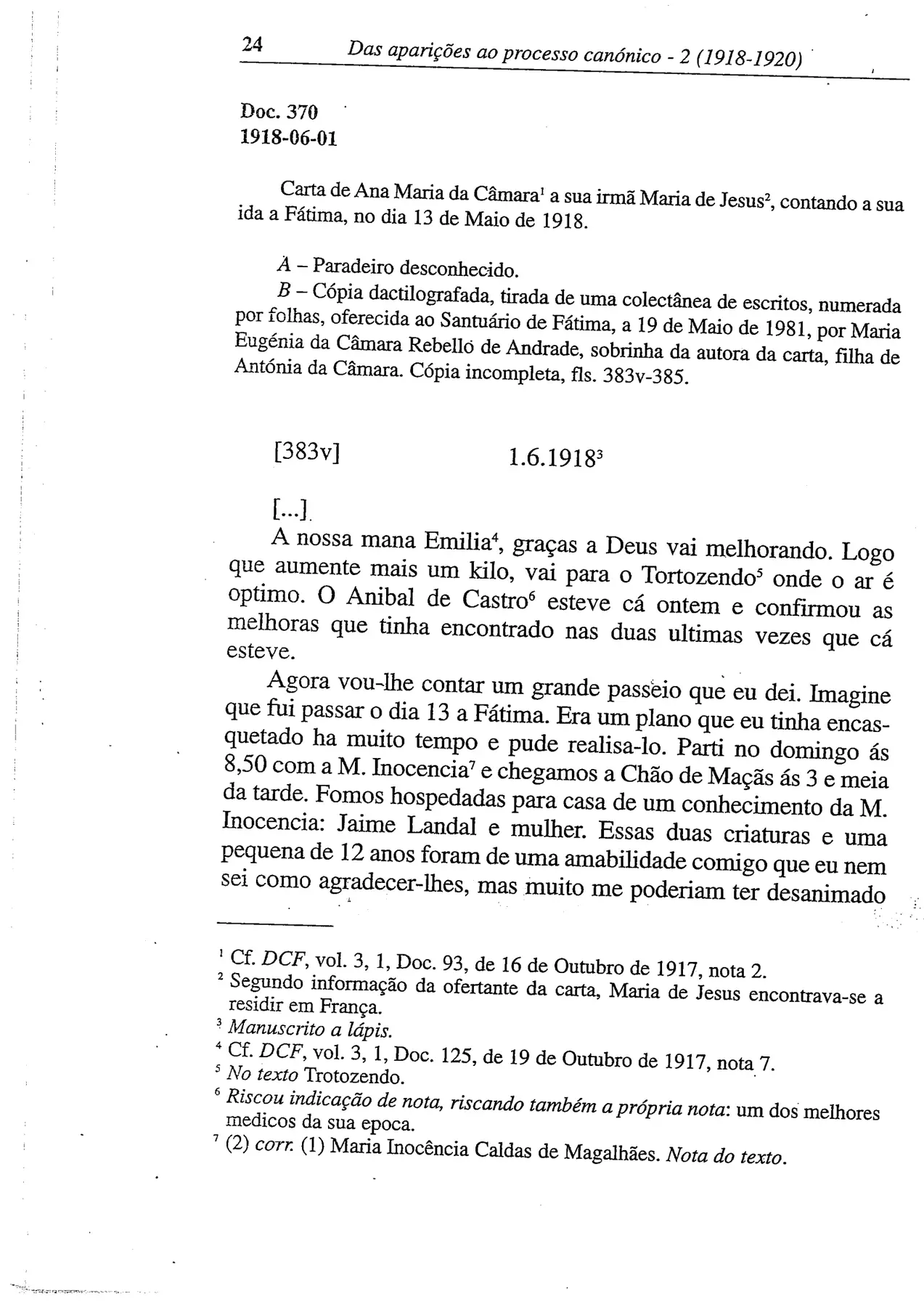
“With a coloured belt?” — “No, with gold stars; look, she had one on her breast.” “And on her head?” — “A mantle and a thing, like this...” “But what?” — “I don't know, it was like a little basket thing” (a little basket). I did not even say the word crown, which came to my mind at once; I let the child ex-[384v]plain herself as best she could, and I confess I found the comparison delightful. “And could her hair be seen?” — “No.” “Tell me, was Our Lady laughing, cheerful?” — “No, she was serious.” “Cross?” — “No, serious.” “She had the beads, didn't she?” — “Yes, some white beads, and when she spoke she opened her hands, like this...” The child took the beads out of her pocket and explained what she had seen: At a certain point she tells me that Our Lady had a great deal of light. “Like the sun?” — “More than the sun.” A lady who was there says to her: “Why were you afraid at first? If I appeared to you, you wouldn't run away.” — “That's because you wouldn't blind me.” She says that Our Lady asks the people to mend their ways, to pray the rosary (5 decades) a great deal and to build a chapel to Our Lady of the Rosary. The child repeats many times: “The people don't mend their ways, the people don't mend their ways...”

Português (original)

A Lucia diz dos olhos: “Eram muito escuros.” “E o fato?” — “Branco e oiro.”

“Com cinto de côr?” — “Não, com estrelas de oiro; olhe, tinha uma no peito.” “E na cabeça?” — “Um manto e uma coisa, assim...” “Mas o quê?” — “Não sei, era assim um açafatico” (um açafatesinho). Eu nem disse a palavra corôa que me veio logo á ideia; deixar a pequena expli-[384v]car-se como sabe e confesso que achei de apetite a comparação. “E via-se o cabelo?” — “Não.” “Olha, N. Senhora estava a rir-se, alegre?” — “Não, estava séria.” “Zangada?” — “Não, séria.” “Trazia as contas, não trazia?” — “Sim, umas contas brancas e quando falava abria as mãos, assim...” A pequena tirou as contas da algibeira e explicou o que tinha visto: A certa altura diz-me que N. Senhora tinha muita luz. “Como o sol?” — “Mais do que o sol.” Uma senhora que ali estava, diz-lhe: “Porque tiveste medo ao principio? Se eu te aparecesse, tu não fugias.” — “É que a senhora não me cegava.” Diz que N. Senhora pede ao povo que se emende, que reze muito o terço e faça uma capela a N. Senhora do Rosario. A pequena repete muitas vezes: “O povo não se emenda, o povo não se emenda...”

DCF III-2, Doc. 370 · letter · 13 May 1918 (12 months later)View scans (4)Link
13 MayFirst-handSaw itLater recollectionFigures / visionsSeers' words overheard
English

I was minding the sheep in the cova de Iria with my cousin Francisco and Jacinta, playing at building a wall round a bush; and we saw a flash of lightning; and I said to Francisco, let's go home because there's lightning and a thunderstorm may come, we turned the sheep round to go home; when we got to the middle of the field, there was another flash of lightning and we saw a Lady above a holm-oak shrub; we were very frightened to see that brightness that surrounded her. Then She said to us; don't be afraid because I won't do you any harm. I asked her Where are you from? I am from heaven. What do you want of me? I want you to come here for 6 months and at the end I will tell you what I want. I asked her about Maria of José das Neves and She told me she is in heaven I asked her about Amelia and she told me that she was in purgatory. If she told me anything else this month I don't remember And with that she disappeared rising so high that it came to the point where we didn't see her any more.

Português (original)

Andava guardando as ovelhas na cova de Iria na companhia do meu primo Francisco e da Jacinta, brincando fazendo um muro á volta duma moita; e vimos um relampago; e disse eu para o Francisco, vamos embora porque está a dar relampagos e pode vir trevoáda, voltarmos as ovelhas para nos vimos embora; chegando ao meio da fazenda, deu outro relampago e vimos uma Senhora em sima duma carrasqueira; ficarmos muito assustados por vermos a quele resplendor que a envolvia. Entam disse-nos Ela; não tenham medo porque eu não vos faço mal. Perguntei-lhe eu Dedonde é vossemecê? Eu sou do céu. O que é que vossemecê me quer? Quero que venhas aqui durante 6 meses e no fim te direi o que quero. Perguntei-lhe pela Maria do José das Neves e Ela me disse está no céu perguntei-lhe pela Amelia e disse-me que estava no purgatorio. Se me disse mais alguma coisa neste mez não me lembro E nisto dezapareceu subindo tam alta que chegou a ponto de não a vermos mais.

Editor's notes (1)

2 The present document was written by the seer Lúcia at the request of her confessor at the Asilo de Vilar, Fr. Manuel Pereira Lopes, as can be gathered from a letter he addressed to Dom João Pereira Venâncio on 26 July 1961: “I was very pleased to be included among the priests who, at the behest of His Excellency Dom José, the late lamented Bishop of Leiria, attended her deposition at the first session of the Official Process of the Apparitions of Fátima (cf. DCF, vol. 2, Doc. 8, of 8 July 1924). What I heard from her then, and what is recorded in the process, confirmed an account which she, at my request, had written about those apparitions. A simple description, with spelling mistakes, which gave off a sweet fragrance of spontaneity and sincerity. Unfortunately I lent that original, which I held in great esteem, to someone who did not return it to me. Certainly it took nothing away from and added nothing to her later deposition” (AEL, Documentos de Fátima, J-29). It was in the possession of Dr. Sebastião dos Reis, who published it and handed it to Fr. António Maria Martins, and after the latter's death it was handed over by the Portuguese Province of the Society of Jesus to the Sanctuary of Fátima.

2 O presente documento foi escrito pela vidente Lúcia a pedido do seu confessor, no Asilo de Vilar, Pe. Manuel Pereira Lopes, como se depreende de uma carta dirigida pelo mesmo a D. João Pereira Venâncio a 26 de Julho de 1961: “Tive grande satisfação em ser incluído no número dos sacerdotes que, por incumbência do Ex.º Sr. Dom José saudoso Bispo de Leiria, assistiram aos depoimento della na primeira sessão do Processo Oficial das Aparições de Fátima (cf. DCF, vol. 2, Doc. 8, de 8 de Julho de 1924). O que então lhe ouvi e consta do processo, confirmou uma narração que ela, a meu pedido tinha escrito sobre essas aparições. Descrição simples, com incorrecções ortográficas, que exalava um suave perfume de espontaneidade e sinceridade. Infelizmente esse original que eu tinha em grande apreço, emprestei-o a alguém que não me restituiu. Decerto, nada tirava nem acrescentava ao seu depoimento posterior” (AEL, Documentos de Fátima, J-29). Esteve em poder do Dr. Sebastião dos Reis que o publicou e entregou ao Pe. António Maria Martins e que, após a morte deste, foi entregue, pela Província Portuguesa da Companhia de Jesus, ao Santuário de Fátima.

DCF III-3, Doc. 685 · other · 5 Jan 1922 (5 years later)View scans (4)Link
13 May13 Jun13 Jul13 Aug13 Sep13 OctFirst-handSaw itLater recollectionFigures / visions
English

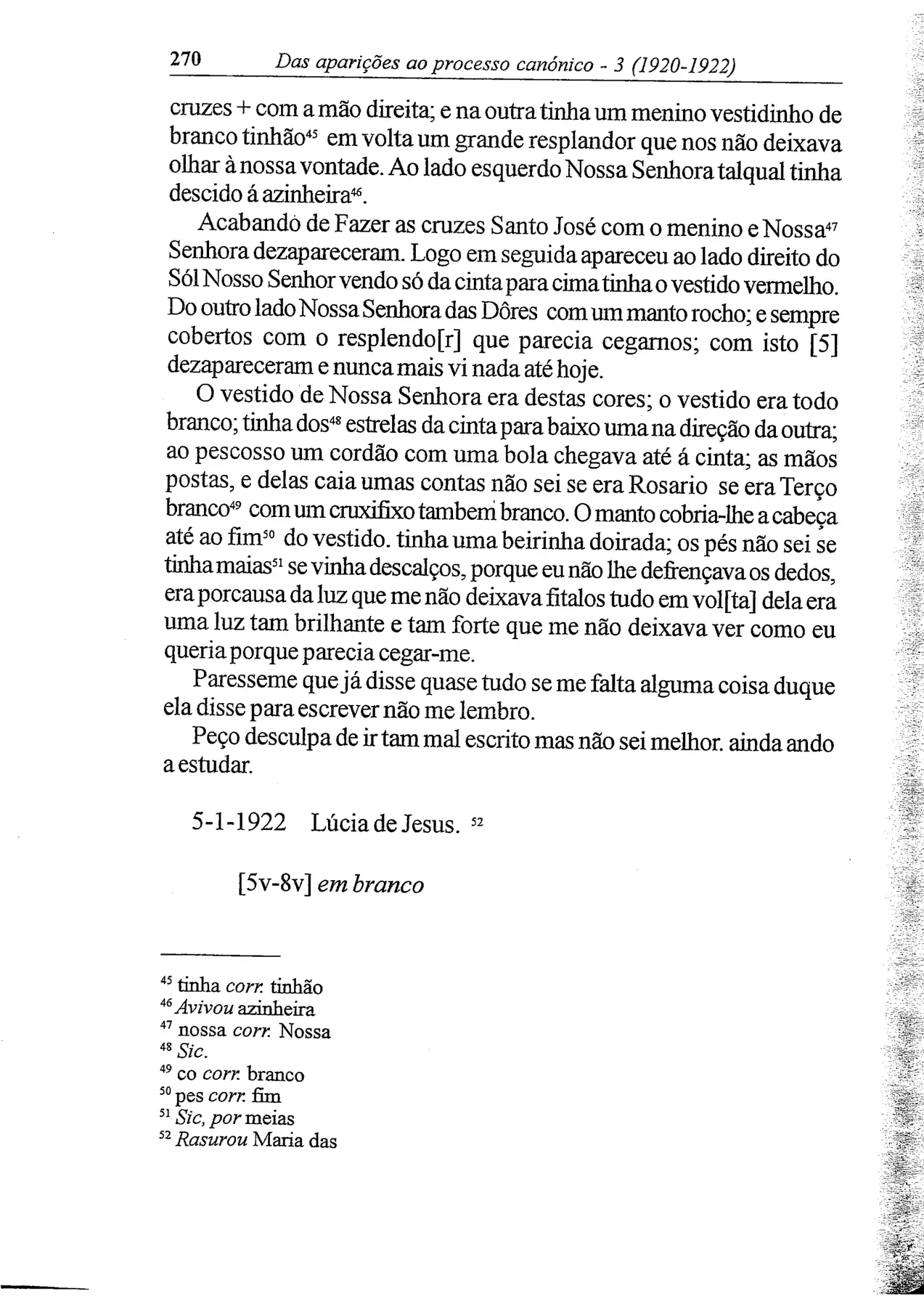
Our Lady's dress was of these colours; the dress was all white; it had two stars from the waist down one in line with the other; round the neck a cord with a ball came down to the waist; the hands joined, and from them hung some beads I don't know if it was a Rosary or a white Terço with a crucifix also white. The mantle covered her head down to the end of the dress. it had a little gold edge; the feet I don't know if she had stockings on or came barefoot, because I couldn't make out her toes, it was because of the light that didn't let me fix my eyes on them everything ar[ound] her was a light so bright and so strong that it didn't let me see as I wanted because it seemed to blind me.

I think I have already said almost everything if anything of what she told me to write is missing I don't remember.

Português (original)

O vestido de Nossa Senhora era destas cores; o vestido era todo branco; tinha dos estrelas da cinta para baixo uma na direção da outra; ao pescosso um cordão com uma bola chegava até á cinta; as mãos postas, e delas caia umas contas não sei se era Rosario se era Terço branco com um cruxifixo tambem branco. O manto cobria-lhe a cabeça até ao fim do vestido. tinha uma beirinha doirada; os pés não sei se tinha maias se vinha descalços, porque eu não lhe defrençava os dedos, era porcausa da luz que me não deixava fitalos tudo em vol[ta] dela era uma luz tam brilhante e tam forte que me não deixava ver como eu queria porque parecia cegar-me.

Paresseme que já disse quase tudo se me falta alguma coisa duque ela disse para escrever não me lembro.

DCF III-3, Doc. 685 · other · 5 Jan 1922 (5 years later)View scans (2)Link
13 May13 Jun13 Jul13 Aug13 Sep13 OctSecond-handSaw itLetterFigures / visions
As told by Dr. Manuel Nunes Formigão (Visconde de Montelo)
English

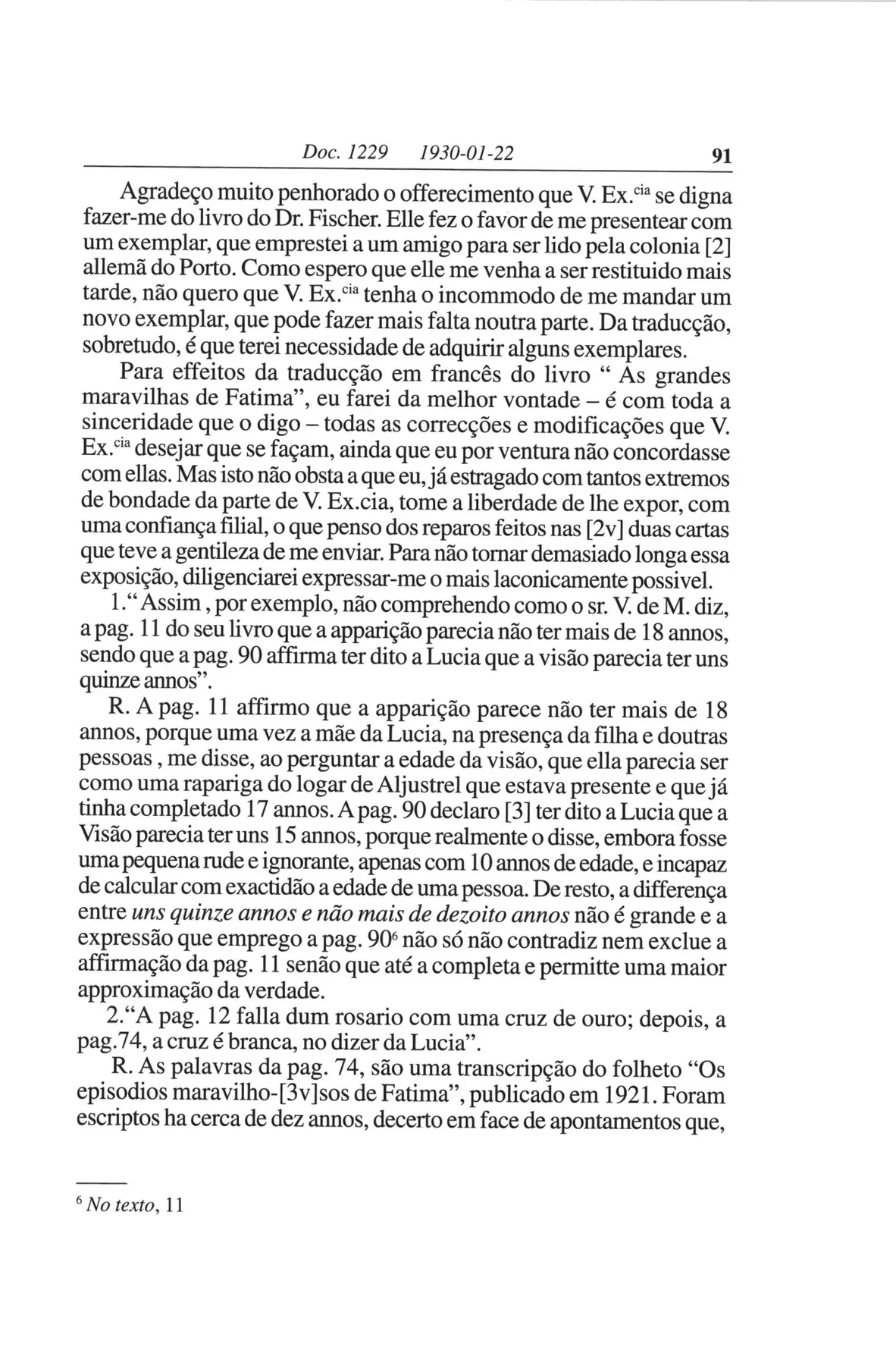
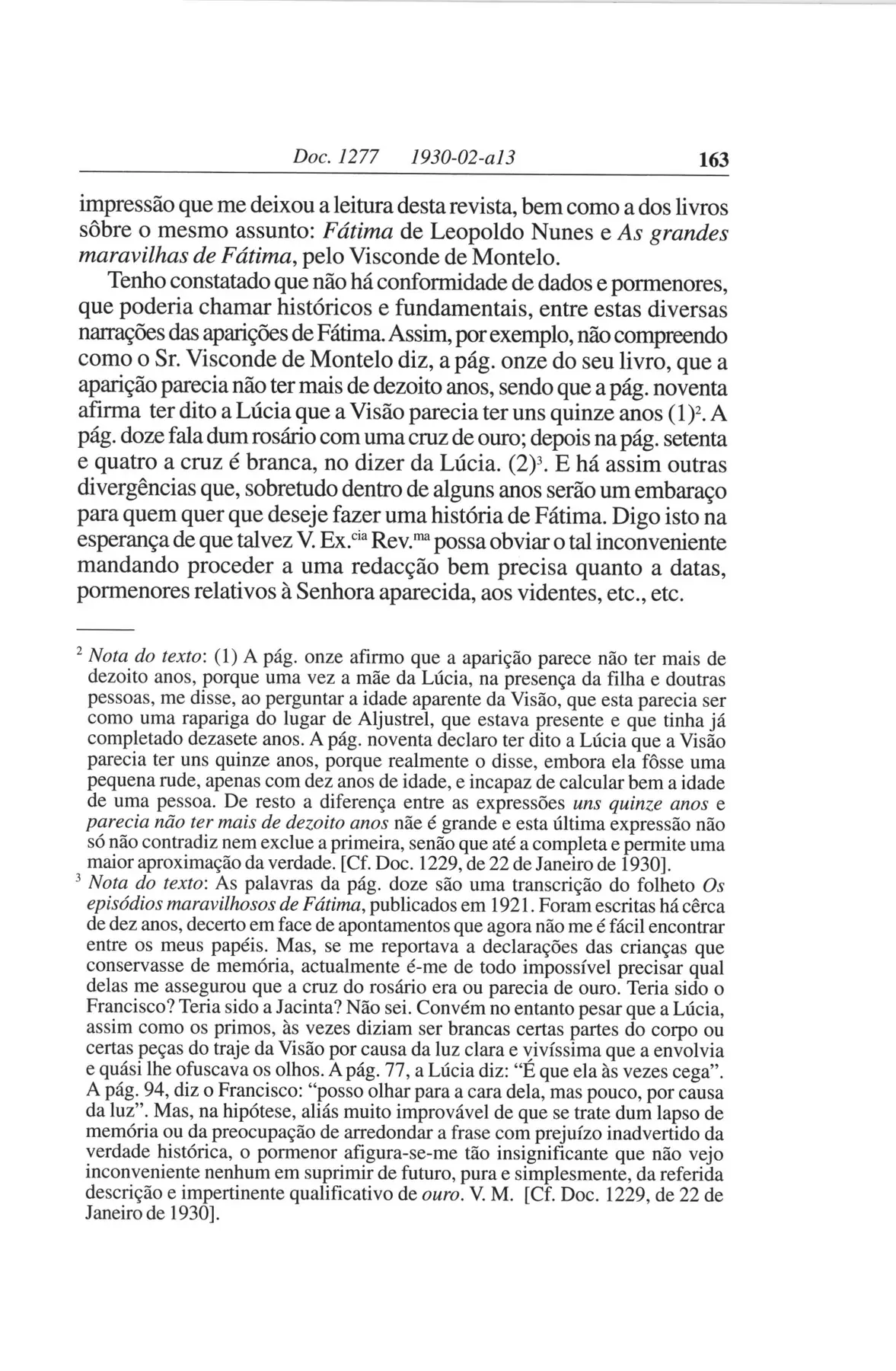
A. On page 11 I state that the apparition seems to be no more than 18 years old because once Lucia's mother, in the presence of her daughter and of other people, told me, when I asked the age of the vision, that she seemed to be like a girl from the hamlet of Aljustrel who was present and who had already turned 17. On page 90 I declare [3] that Lucia said the Vision seemed to be about 15 years old, because she really did say so, although she was a rough and ignorant little girl, only 10 years of age, and incapable of calculating a person's age accurately. Besides, the difference between about fifteen years and no more than eighteen years is not great, and the expression I use on page 90 not only does not contradict or exclude the statement on page 11 but actually completes it and allows a closer approximation to the truth.

Português (original)

R. A pag. 11 affirmo que a apparição parece não ter mais de 18 anos, porque uma vez a mãe da Lucia, na presença da filha e doutras pessoas, me disse, ao perguntar a idade da visão, que ella parecia ser como uma rapariga do lugar de Aljustrel que estava presente e que já tinha completado 17 anos. A pag. 90 declaro [3] ter dito a Lucia que a Visão parecia ter uns 15 anos, porque realmente o disse, embora fosse uma pequena rude e ignorante, apenas com 10 anos de idade, e incapaz de calcular com exactidão a idade de uma pessoa. De resto, a differença entre uns quinze anos e não mais de dezoito anos não é grande e a expressão que emprego a pag. 90 não só não contradiz nem exclue a affirmação da pag. 11 senão que até a completa e permite uma maior aproximação da verdade.

13 May13 Jun13 Jul13 Aug13 Sep13 OctSecond-handSaw itPress reportFigures / visions
As told by Dr. Manuel Nunes Formigão (Visconde de Montelo)
English

On page eleven I state that the apparition seems no more than eighteen years old because once Lúcia's mother, in the presence of her daughter and other people, told me, when I asked the apparent age of the Vision, that she seemed like a girl from the place of Aljustrel who was present and who had already turned seventeen. On page ninety I state that Lúcia said the Vision seemed about fifteen years old, because she really did say so, although she was an unpolished little girl only ten years of age, and incapable of judging a person's age well. Besides, the difference between the expressions about fifteen years old and seemed no more than eighteen years old is not great, and the latter expression not only does not contradict or exclude the former, but even completes it and allows a closer approximation to the truth.

Português (original)

A pág. onze afirmo que a aparição parece não ter mais de dezoito anos, porque uma vez a mãe da Lúcia, na presença da filha e outras pessoas, me disse, ao perguntar a idade aparente da Visão, que esta parecia ser como uma rapariga do lugar de Aljustrel, que estava presente e que tinha já completado dezasete anos. A pág. noventa declaro ter dito a Lúcia que a Visão parecia ter uns quinze anos, porque realmente o disse, embora ela fôsse uma pequena rude, apenas com dez anos de idade, e incapaz de calcular bem a idade de uma pessoa. De resto a diferença entre as expressões uns quinze anos e parecia não ter mais de dezoito anos nãe é grande e esta última expressão não só não contradiz nem exclue a primeira, senão que até a completa e permite uma maior aproximação da verdade.

13 MayFirst-handSaw itInterrogationFigures / visionsSeers' words overheard
English

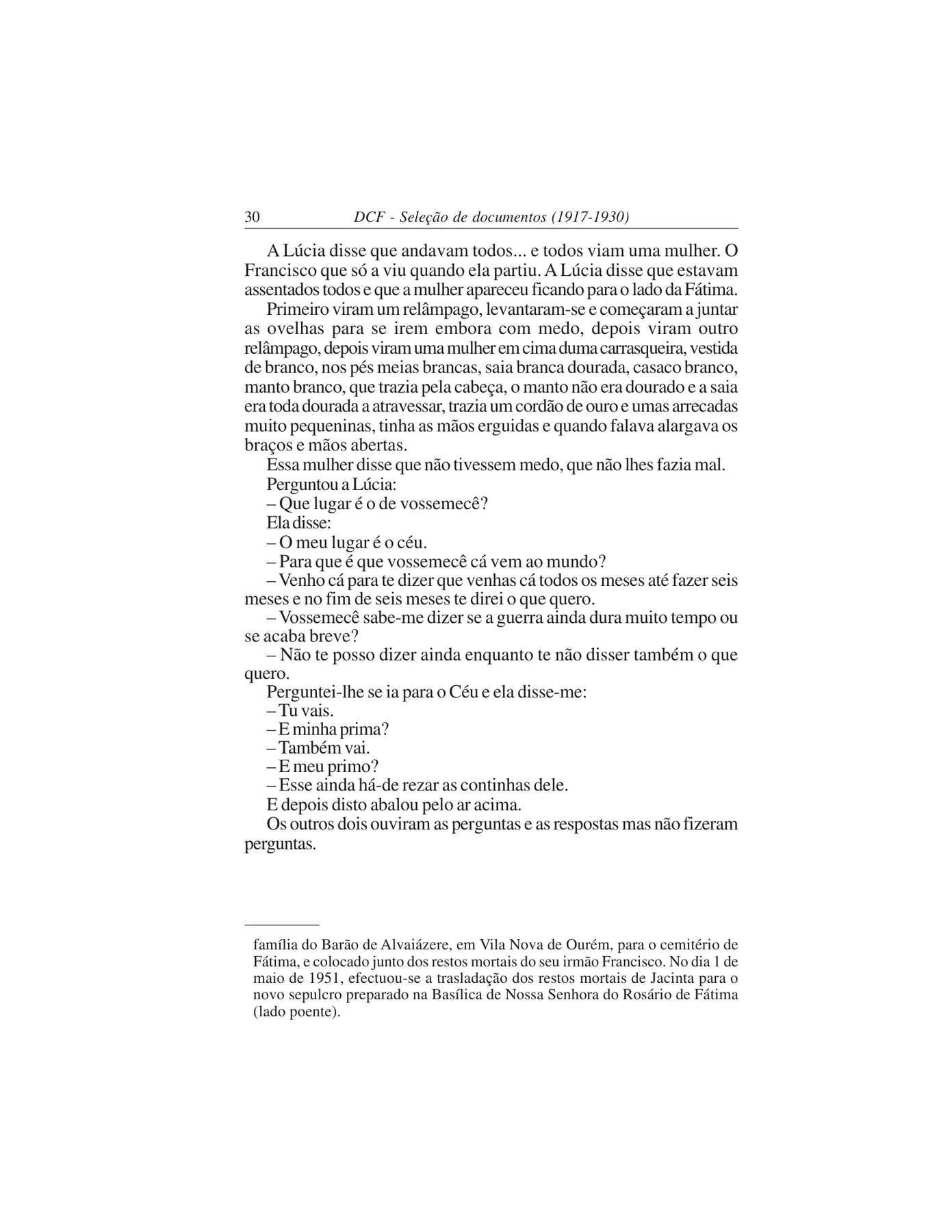
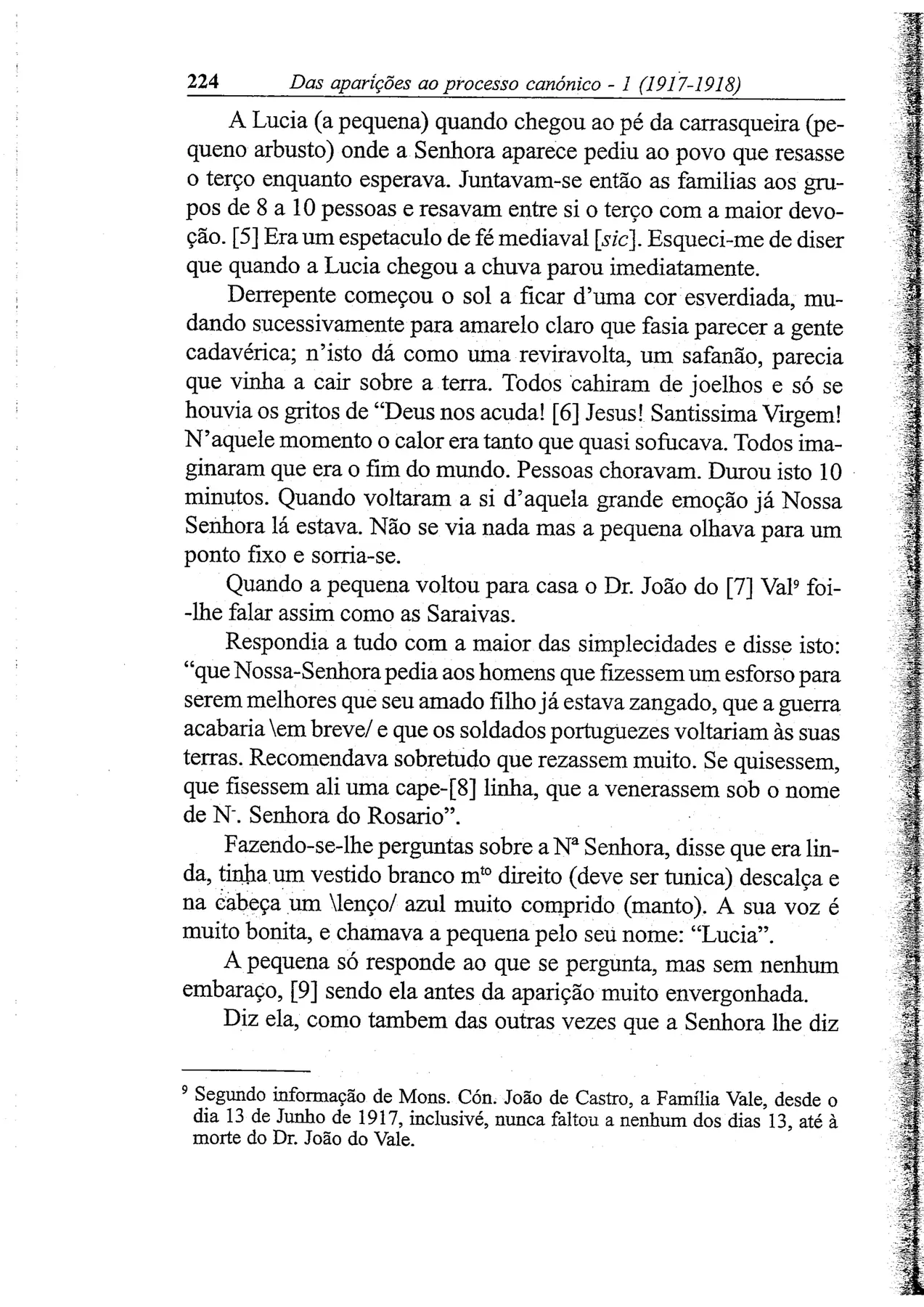
Lúcia said that they were all walking... and they all saw a woman. Francisco, that he only saw her when she was leaving. Lúcia said that they were all sitting down and that the woman appeared, standing towards the side of Fátima.

First they saw a flash of lightning, got up and began to gather the sheep to go away, afraid; then they saw another flash of lightning; then they saw a woman on top of a holm-oak shrub, dressed in white, white stockings on her feet, a white skirt with gold, a white jacket, a white mantle which she wore over her head; the mantle was not golden and the skirt was all golden running across; she wore a gold cord and some very tiny earrings; she had her hands raised and when she spoke she opened out her arms and her hands open.

This woman said that they should not be afraid, that she would do them no harm.

Lúcia asked:

– Where are you from?

She said:

– My place is heaven.

– What do you come here into the world for?

– I come here to tell you to come here every month until six months have passed, and at the end of six months I will tell you what I want.

– Can you tell me whether the war will go on a long time yet or whether it will end soon?

– I cannot tell you yet, until I also tell you what I want.

I asked her if I was going to Heaven and she told me:

– You are.

– And my cousin?

– She is too.

– And my cousin?

– He still has to say his beads.

And after this she went off up through the air.

The other two heard the questions and the answers but did not ask questions.

Português (original)

A Lúcia disse que andavam todos... e todos viam uma mulher. O Francisco que só a viu quando ela partiu. A Lúcia disse que estavam assentados todos e que a mulher apareceu ficando para o lado da Fátima.

Primeiro viram um relâmpago, levantaram-se e começaram a juntar as ovelhas para se irem embora com medo, depois viram outro relâmpago, depois viram uma mulher em cima duma carrasqueira, vestida de branco, nos pés meias brancas, saia branca dourada, casaco branco, manto branco, que trazia pela cabeça, o manto não era dourado e a saia era toda dourada a atravessar, trazia um cordão de ouro e umas arrecadas muito pequeninas, tinha as mãos erguidas e quando falava alargava os braços e mãos abertas.

Essa mulher disse que não tivessem medo, que não lhes fazia mal.

Perguntou a Lúcia:

– Que lugar é o de vossemecê?

Ela disse:

– O meu lugar é o céu.

– Para que é que vossemecê cá vem ao mundo?

– Venho cá para te dizer que venhas cá todos os meses até fazer seis meses e no fim de seis meses te direi o que quero.

– Vossemecê sabe-me dizer se a guerra ainda dura muito tempo ou se acaba breve?

– Não te posso dizer ainda enquanto te não disser também o que quero.

Perguntei-lhe se ia para o Céu e ela disse-me:

– Tu vais.

– E minha prima?

– Também vai.

– E meu primo?

– Esse ainda há-de rezar as continhas dele.

E depois disto abalou pelo ar acima.

Os outros dois ouviram as perguntas e as respostas mas não fizeram perguntas.

DCF Seleção, Doc. 1 (= DCF I, Doc. 1) · interrogation · 27 May 1917 (2 weeks later)View scanLink
13 MayFirst-handSaw itInterrogationFigures / visionsSeers' words overheard
English

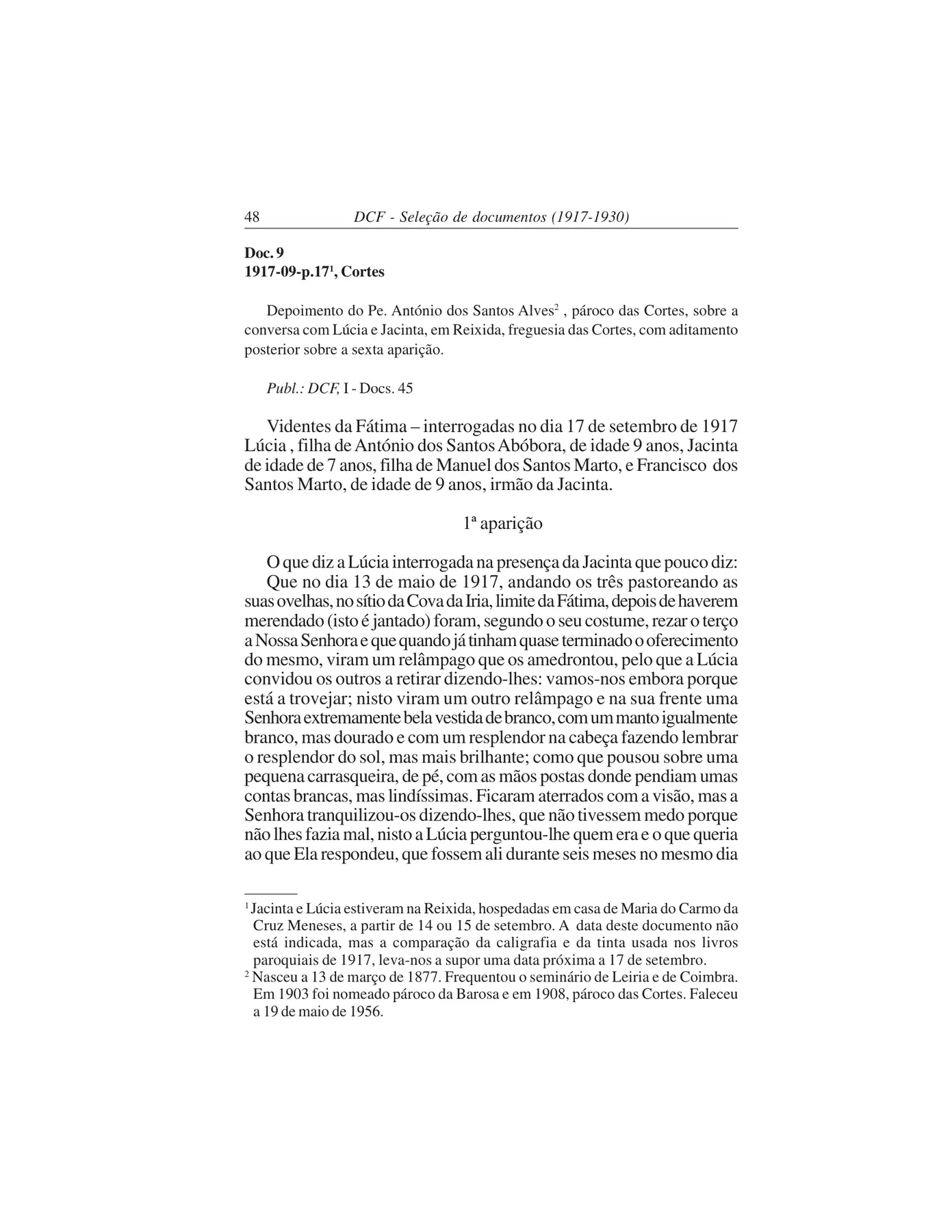
What Lúcia says, questioned in the presence of Jacinta, who says little: That on 13 May 1917, while the three of them were pasturing their sheep at the spot called Cova da Iria, within the bounds of Fátima, after having had their merenda (that is, their midday meal), they went, according to their custom, to pray the rosary to Our Lady, and that when they had almost finished the offering of it, they saw a flash of lightning which frightened them, so that Lúcia invited the others to leave, saying to them: let's go away because it's thundering; at this they saw another flash of lightning and in front of them an extremely beautiful Lady dressed in white, with a mantle likewise white, but gilded, and with a radiance about her head recalling the radiance of the sun, but more brilliant; she as it were alighted on a small holm-oak shrub, standing, with her hands joined, from which hung some white beads, most lovely. They were terrified by the vision, but the Lady reassured them, telling them not to be afraid because she would do them no harm; at this Lúcia asked her who she was and what she wanted, to which She answered that they should come there for six months on the same day, the thirteenth, and that on the last day she would tell them who she was and what she desired. Then she began to disappear slowly, first the head, then the arms and the rest of the body down to the feet, which were the last thing to disappear.

Português (original)

O que diz a Lúcia interrogada na presença da Jacinta que pouco diz: Que no dia 13 de maio de 1917, andando os três pastoreando as suas ovelhas, no sítio da Cova da Iria, limite da Fátima, depois de haverem merendado (isto é jantado) foram, segundo o seu costume, rezar o terço a Nossa Senhora e que quando já tinham quase terminado o oferecimento do mesmo, viram um relâmpago que os amedrontou, pelo que a Lúcia convidou os outros a retirar dizendo-lhes: vamos-nos embora porque está a trovejar; nisto viram um outro relâmpago e na sua frente uma Senhora extremamente bela vestida de branco, com um manto igualmente branco, mas dourado e com um resplendor na cabeça fazendo lembrar o resplendor do sol, mas mais brilhante; como que pousou sobre uma pequena carrasqueira, de pé, com as mãos postas donde pendiam umas contas brancas, mas lindíssimas. Ficaram aterrados com a visão, mas a Senhora tranquilizou-os dizendo-lhes, que não tivessem medo porque não lhes fazia mal, nisto a Lúcia perguntou-lhe quem era e o que queria ao que Ela respondeu, que fossem ali durante seis meses no mesmo dia treze e que no último dia lhe diria quem era e o que desejava. Em seguida começou a desaparecer lentamente, primeiro pela cabeça, braços e o resto do corpo até aos pés que foi a última coisa a desaparecer.

Editor's notes (2)

1 Jacinta and Lúcia were at Reixida, staying at the house of Maria do Carmo da Cruz Meneses, from 14 or 15 September. The date of this document is not indicated, but comparison of the handwriting and of the ink used in the parish registers of 1917 leads us to suppose a date close to 17 September.

2 Born on 13 March 1877. He attended the seminary of Leiria and of Coimbra. In 1903 he was appointed parish priest of Barosa and in 1908 parish priest of Cortes. He died on 19 May 1956.

1 Jacinta e Lúcia estiveram na Reixida, hospedadas em casa de Maria do Carmo da Cruz Meneses, a partir de 14 ou 15 de setembro. A data deste documento não está indicada, mas a comparação da caligrafia e da tinta usada nos livros paroquiais de 1917, leva-nos a supor uma data próxima a 17 de setembro.

2 Nasceu a 13 de março de 1877. Frequentou o seminário de Leiria e de Coimbra. Em 1903 foi nomeado pároco da Barosa e em 1908, pároco das Cortes. Faleceu a 19 de maio de 1956.

DCF Seleção, Doc. 9 (= DCF I, Doc. 45) · interrogation · 17 Sep 1917 (4 months later)View scans (2)Link
13 May13 Jun13 Jul13 Aug13 SepOther 1917First-handSaw itInterrogationFigures / visionsSeers' words overheard
English

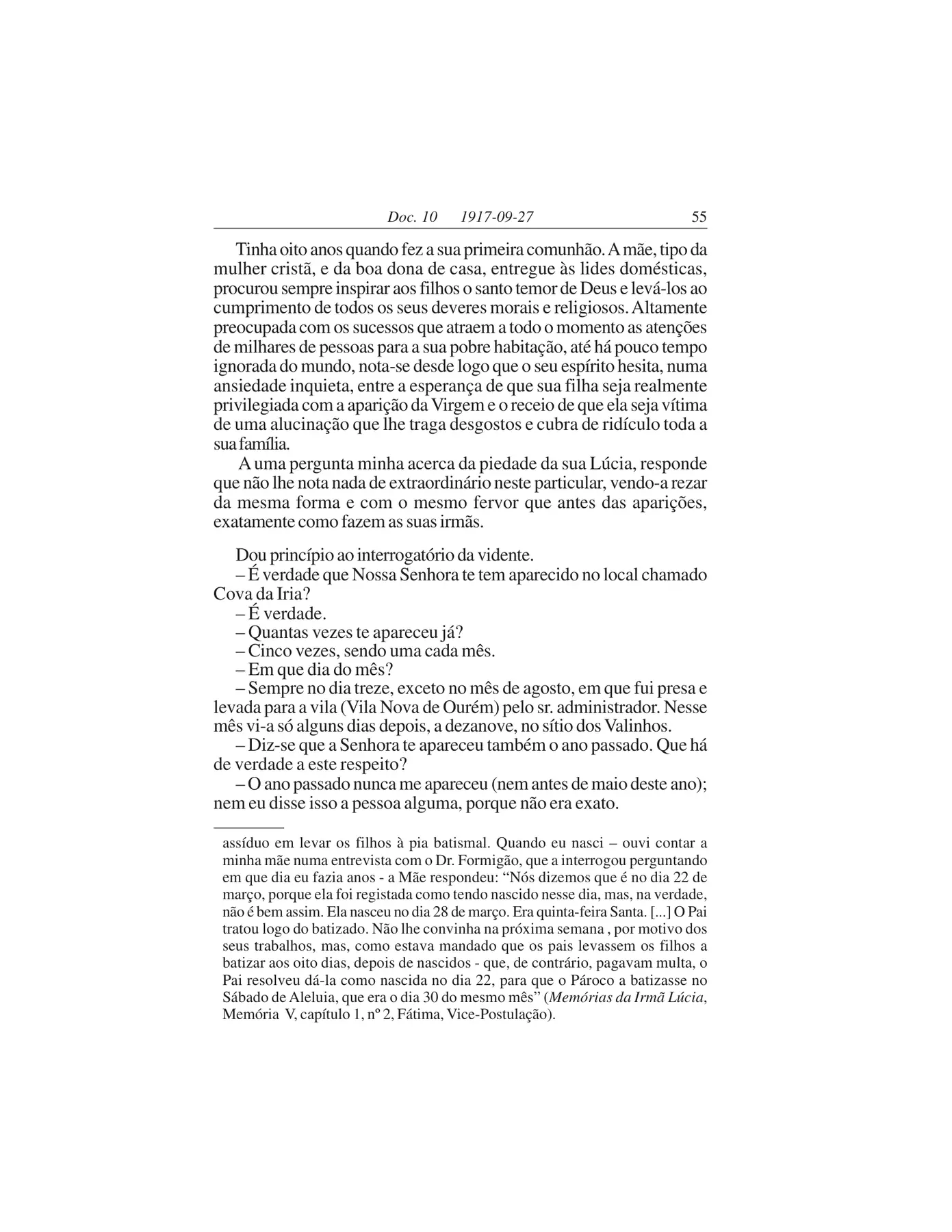
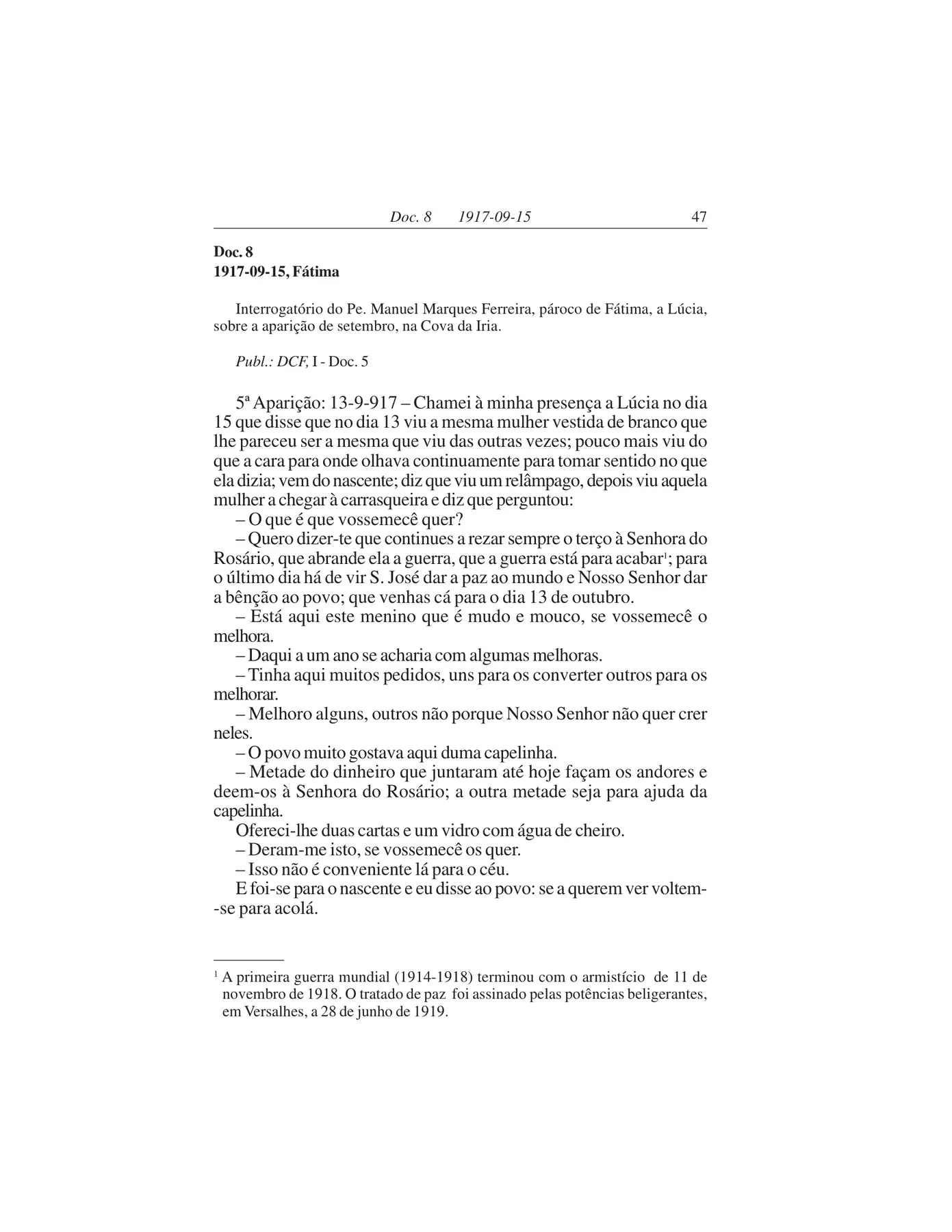
Is it true that Our Lady has appeared to you at the place called Cova da Iria?

– It is true.

– How many times has she appeared to you already?

– Five times, once each month.

– On what day of the month?

– Always on the thirteenth, except in the month of August, when I was arrested and taken to the town (Vila Nova de Ourém) by the administrator. That month I saw her only some days later, on the nineteenth, at the place called Valinhos.

– It is said that the Lady also appeared to you last year. What truth is there in this?

– Last year she never appeared to me (nor before May of this year); nor did I say that to anyone, because it was not true.

[…]

Where does she come from? From the east?
- I don't know; I don't see her come from anywhere; she appears over the holm-oak shrub, and it is when she withdraws that she goes off in the direction where the sun rises.
- How long does she stay? A long time or a short time?
- A short time.
- Long enough to say an Our Father and a Hail Mary, or more?
- More, quite a lot more, but not always the same length of time (perhaps not enough to pray the rosary).
- The first time you saw her, weren't you frightened?
- I was, so much so that I wanted to run away, with Jacinta and Francisco, but She told us not to be afraid, because she would not harm us. She said: "don't be afraid, for I won't harm you."
- How is she dressed?
- She has a white dress, which comes down to a little below the middle of the leg, and her head is covered by a mantle of the same colour and the same length as the dress.
- Does the dress have no trimmings?
- On it, at the front, two golden cords can be seen, which come down from the neck and are joined by a tassel, also golden, at the level of the middle of the body.
- Does she have a belt or a ribbon?
- She doesn't.
- Does she wear earrings?
- She wears small rings, yellow in colour.
- Which hand holds the beads?
- The right hand.
- Were they a five-decade rosary or a full rosary?
- I didn't notice properly.
- Did they end with a cross?
- They ended with a white cross, and the beads were white too. The chain was white too.
- Did you ever ask her who she was?
- I did, but she declared she would only say so on 13 October.
- Didn't you ask her where she came from?
- I asked where she was from, and she answered me that she was from Heaven.
- And when did you ask her that question?
- The second time, on the thirteenth of June.
- Did she ever smile or look sad?

-
- She never smiled nor looked sad, but was always serious.
- Did she recommend you and your cousins to say any prayers?
- She recommended us to pray the rosary in honour of Our Lady of the Rosary, in order to obtain peace for the world.
- Did she express a wish that many people should be present at the Cova da Iria on the thirteenth of each month?
- She said nothing about that.
- Is it true that she told you a secret, forbidding you to reveal it to anyone whatever?
- It is true.
- Does it concern only you or your companions too?
- All three of us.
- Can't you disclose it at least to your confessor?
- (At this question she kept silent, seeming somewhat perplexed, and I thought I should not insist by repeating the question).
- It is said that, to rid yourself of the administrator's importunities, on the day you were arrested, you told him, as if it were the secret, something that was not, thus deceiving him and boasting afterwards of having played that trick on him: is it true?
- It is not; the administrator really did want me to reveal the secret to him, but as I could not tell it to anyone, I did not tell him, even though he insisted with me a great deal to that end. What I did was to tell everything the Lady said to me, except the secret, and perhaps for that reason the administrator was left thinking that I had revealed the secret to him as well. I did not want to deceive him.
- Did the Lady tell you to learn to read?
- She did, yes, the second time she appeared.
- But if the Lady said she would take you to Heaven next October, what use would it be to you to learn to read?
- That is not true: the Lady never said she would take me to Heaven in October, and I never asserted that she had told me such a thing.
- What did the Lady declare should be done with the money the people leave at the Cova da Iria at the foot of the holm-oak shrub?
- She said we should put it on two litters, I, Jacinta and two more girls carrying one of them, and Francisco, with three more boys, the other, to the parish church. Part of that money would be for the worship and feast of Our Lady of the Rosary and the other part towards a new chapel.
- Where does she want the chapel to be built? At the Cova da Iria?
- I don't know: she didn't say.

- Are you very happy that Our Lady has appeared to you?
- I am.
- On the thirteenth of October will Our Lady come alone?
- St. Joseph will come too with the Child, and peace will be granted to the world.
- And did she make any other revelation?
- She declared that on the 13th she will make all the people believe that she really appears.
- Why do you quite often lower your eyes and stop gazing at the Lady?
- It is because she sometimes dazzles.
- Did she teach you any prayer?
- She did; and she wants us to recite it after each mystery of the rosary.
- Do you know that prayer by heart?
- I do.
- Say it then...
- O my Jesus, forgive us, deliver us from the fire of hell, take all the little souls to Heaven, especially those that most need it

Português (original)

É verdade que Nossa Senhora te tem aparecido no local chamado Cova da Iria?

– É verdade.

– Quantas vezes te apareceu já?

– Cinco vezes, sendo uma cada mês.

– Em que dia do mês?

– Sempre no dia treze, exceto no mês de agosto, em que fui presa e levada para a vila (Vila Nova de Ourém) pelo sr. administrador. Nesse mês vi-a só alguns dias depois, a dezanove, no sítio dos Valinhos.

– Diz-se que a Senhora te apareceu também o ano passado. Que há de verdade a este respeito?

– O ano passado nunca me apareceu (nem antes de maio deste ano); nem eu disse isso a pessoa alguma, porque não era exato.

[…]

Donde é que ela vem? Das bandas do nascente?
- Não sei; não a vejo vir de parte alguma; aparece sobre a carrasqueira, e quando se retira é que toma a direção donde nasce o sol.
- Quanto tempo se demora? Muito ou pouco?
- Pouco tempo.
- O suficiente para se recitar um Padre Nosso e uma Avé Maria, ou mais?
- Mais, bastante mais, mas nem sempre o mesmo tempo (talvez não chegasse para rezar o terço).
- Da primeira vez que a viste não ficaste assustada?
- Fiquei, e tanto assim que quis fugir, com a Jacinta e o Francisco, mas Ela disse-nos que não tivéssemos medo, porque não nos faria mal. Disse: “não tenham medo que eu não vos faço mal.”
- Como é que está vestida?
- Tem um vestido branco, que desce até um pouco abaixo do meio da perna, e cobre-lhe a cabeça um manto, da mesma cor, e do mesmo comprimento que o vestido.
- O vestido não tem enfeites?
- Veem-se nele, na parte anterior, dois cordões dourados, que descem do pescoço e se reúnem por uma borla, também dourada, à altura do meio do corpo.
- Tem algum cinto ou alguma fita?
- Não tem.
- Usa brincos nas orelhas?
- Usa umas argolas pequenas e de cor amarela.
- Qual das mãos segura as contas?
- A mão direita.
- Eram um terço ou um rosário?
- Não reparei bem.
- Terminavam por uma cruz?
- Terminavam por uma cruz branca, sendo as contas também brancas. A cadeia era também branca.
- Perguntaste-lhe alguma vez quem era?
- Perguntei, mas declarou que só o diria a 13 de outubro.
- Não lhe perguntaste de onde vinha?
- Perguntei de onde era, e ela respondeu-me que era do Céu.
- E quando foi que lhe fizeste essa pergunta?
- Da segunda vez, a treze de junho.
- Sorriu-se alguma vez ou mostrou-se triste?

-
- Nunca se sorriu nem se mostrou triste, mas sempre séria.
- Recomendou-te, e aos teus primos, que rezassem algumas orações?
- Recomendou-nos que rezássemos o terço em honra de Nossa Senhora do Rosário, a fim de se alcançar a paz para o mundo.
- Mostrou desejos de que no dia treze de cada mês estivessem presentes muitas pessoas na Cova da Iria?
- Não disse nada a esse respeito.
- É certo que te disse um segredo, proibindo que o revelasses a quem quer que fosse?
- É certo.
- Diz respeito só a ti ou também aos teus companheiros?
- A todos três.
- Não o podés manifestar ao menos ao teu confessor?
- (A esta pergunta guardou silêncio, parecendo um tanto enleada e julguei não dever insistir, repetindo a pergunta).
- Consta que, para te veres livre das importunações do sr. administrador, no dia em que foste presa, lhe contaste, como se fosse o segredo uma coisa que o não era, enganando-o assim e gabando-te depois de lhe teres feito essa partida: é verdade?
- Não é; o sr. administrador quis realmente que eu lhe revelasse o segredo, mas como eu não o podia dizer a ninguém, não lhe disse, apesar de ter insistido muito comigo para esse fim. O que fiz foi contar tudo o que a Senhora me disse, exceto o segredo, e talvez por esse motivo o sr. administrador ficasse julgando que eu lhe tinha revelado também o segredo. Não o quis enganar.
- A Senhora mandou que aprendesses a ler?
- Mandou, sim, da segunda vez que apareceu.
- Mas se a Senhora disse que te levaria para o Céu no mês de outubro próximo, para que te serviria aprenderes a ler?
- Não é verdade isso: a Senhora nunca disse que me levaria para o Céu em outubro, e eu nunca afirmei que ela me tivesse dito tal coisa.
- O que declarou a Senhora que se devia fazer ao dinheiro que o povo deposita na Cova da Iria ao pé da carrasqueira?
- Disse que o devíamos colocar em dois andores, levando eu, a Jacinta e mais duas meninas um deles, e o Francisco, com mais três rapazes, o outro, para a igreja da freguesia. Parte desse dinheiro seria destinado ao culto e festa da Senhora do Rosário e a outra parte para ajuda de uma capela nova.
- Onde quer ela que seja edificada a capela? Na Cova da Iria?
- Não sei: ela não o disse.

- Estás muito contente por Nossa Senhora te ter aparecido?
- Estou.
- No dia treze de outubro Nossa Senhora virá só?
- Vem também S. José com o menino, e será concedida a paz ao mundo.
- E fez mais alguma revelação?
- Declarou que no dia 13 fará com que todo o povo acredite que ela realmente aparece.
- Por que razão não raro baixas os olhos deixando de fitar a Senhora?
- É que ela às vezes cega.
- Ensinou-te alguma oração?
- Ensinou; e quer que a recitemos depois de cada mistério do rosário.
- Sabes de cor essa oração?
- Sei.
- Diz lá...
- Ó meu Jesus, perdoai-nos, livrai-nos do fogo do inferno, levai as alminhas todas para o Céu, principalmente aquelas que mais dele precisarem

13 May13 Jun13 Jul13 Aug13 SepFirst-handSaw itInterrogationFigures / visionsSeers' words overheard
English

You told me some days ago that Our Lady wanted the money offered by the people to be taken to the parish church on two litters. How are the litters to be got and when are they to be taken to the church?

– The litters are to be bought with the money offered and will be carried at the feasts of Our Lady of the Rosary.

2a – Do you know for certain in what spot Our Lady wishes a chapel to be built in her honour?

– I don't know for certain, but I think She wants the chapel at the Cova da Iria.

3a – What did She say she would do so that all the people would believe that she appeared?

– She said she would perform a miracle.

4a – When did she say that?

– She said it quite a few times, but only once, at the time of the first apparition, did I ask her that question.

5a – Aren't you afraid the people will harm you if they don't see anything extraordinary on that day?

– I am not afraid at all.

6a – Do you feel within you something, some force that draws you to the Cova da Iria on the 13th of each month?

– I feel like going there and I would be sad if I didn't go.

7a – Did you ever see the Lady cross herself, pray, or tell the beads of the Rosary?

– I didn't.

8a – Did she tell you to pray?

– She told me to pray quite a few times.

9a – Did she tell you to pray for the conversion of sinners?

– She didn't; she only told me to pray to Our Lady of the Rosary for the war to end.

10a – Did you see the signs that other people say they have seen, such as a star, roses coming loose from the Lady's dress, etc.?

– I didn't see the star or other extraordinary signs.

11a – Did you hear any rumbling, thunder or earth tremor?

– I never did.

12a – Can you read?

– I can't.

13a – Are you learning to read?

– I'm not.

14a – How then do you fulfil the order the Lady gave you in that regard?

!.....

15a – When you tell the people to kneel and pray, is it the Lady who tells you to say so?

– It is not the Lady who tells me, it is I who want to.

16a – Whenever she appears, do you kneel?

- Sometimes I stay standing, other times I kneel.
16a – When she speaks, is her voice sweet and pleasant?
– It is.
17a – How old does the Lady seem to be?
– She seems to be about fifteen.
18a – What colour is the chain of the rosary?
– It is white.
19a – And that of the crucifix?
– The crucifix is white too.
20a – Does the veil cover the Lady's forehead?
– It doesn't. Her forehead can be seen clearly.
21a – Is the splendour that surrounds her beautiful?
– It is more beautiful than the light of the sun and very bright.
22a – Did the Lady never greet you with her head or her hands?
– Never.
23a – Did she never smile at you?
– No, not that either.
24a – Does she usually look at the people?
– I never saw her look at them.
25a – Do you hear the talk, noises and shouts of the people during the time you see the Lady?
– I don't.
26a – Did the Lady ask you in May to come back to the Cova da Iria every month until October?
– She said we should come back there month after month for six months, on the 13th.
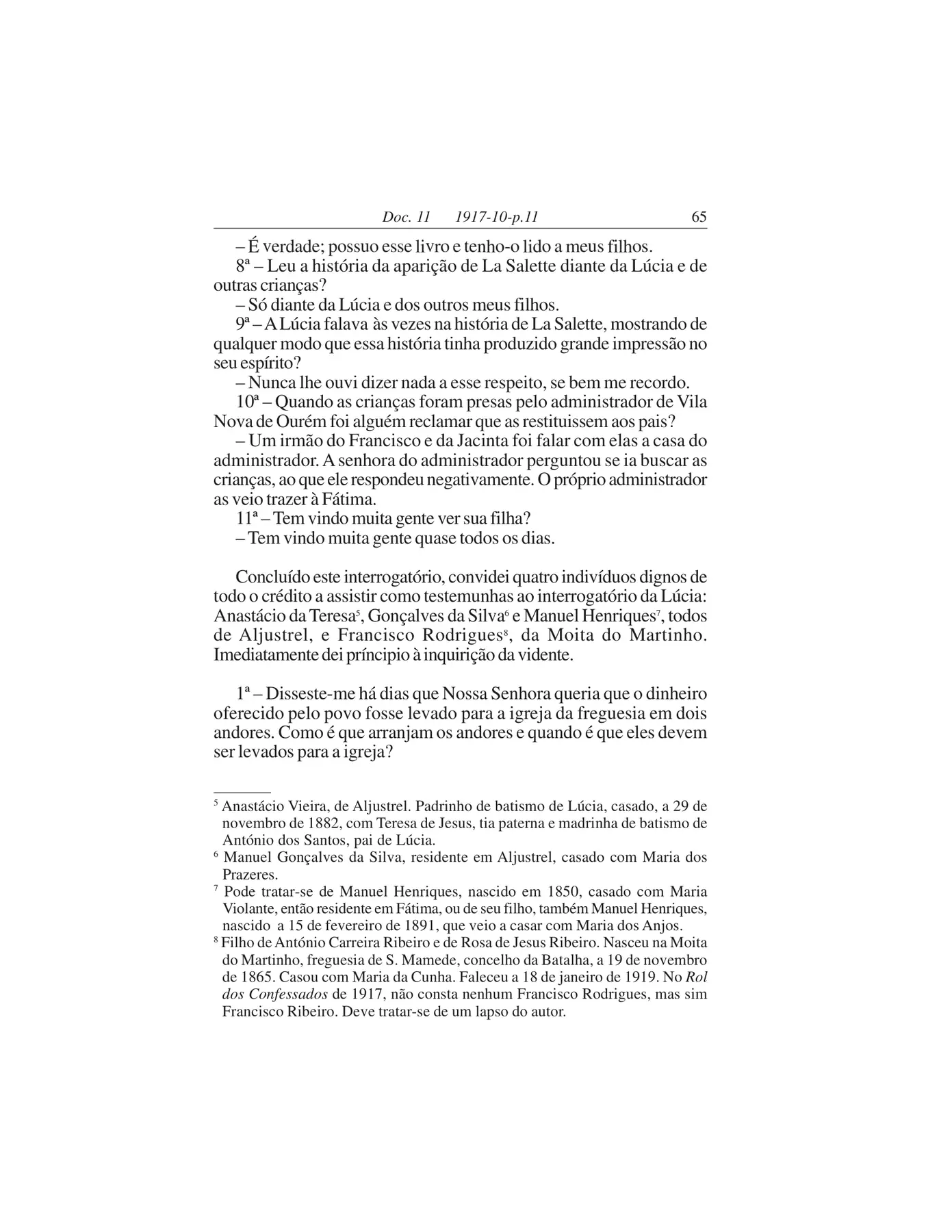
27a – Did you hear your mother read the book called "Missão abreviada" where the story is told of the apparition of Our Lady to a boy and a girl?
– I did.
28a – Did you often think about that story and talk about it to other children?
– I didn't think about that story nor did I tell it to anyone.

Português (original)

Disseste-me há dias que Nossa Senhora queria que o dinheiro oferecido pelo povo fosse levado para a igreja da freguesia em dois andores. Como é que arranjam os andores e quando é que eles devem ser levados para a igreja?

– Os andores compram-se com o dinheiro oferecido e serão levados nas festas da Senhora do Rosário.

2a – Sabes com certeza em que sítio é que Nossa Senhora deseja que seja edificada uma capela em sua honra?

– Não sei ao certo, mas julgo que Ela quer a capela na Cova da Iria.

3a – O que é que Ela disse que havia de fazer para que todo o povo acreditasse que ela aparecia?

– Disse que havia de fazer um milagre.

4a – Quando foi que ela disse isso?

– Disse-o umas poucas de vezes, mas só uma vez, na ocasião da primeira aparição é que lhe fiz essa pergunta.

5a – Não tens medo de que o povo te faça mal se não vir nada de extraordinário nesse dia?

– Não tenho medo nenhum.

6a – Sentes dentro de ti alguma coisa, alguma força que te arraste para a Cova da Iria no dia 13 de cada mês?

– Sinto vontade de lá ir e ficava triste se não fosse.

7a – Viste alguma vez a Senhora benzer-se, rezar ou desfiar as contas do Rosário?

– Não vi.

8a – Mandou-te rezar?

– Mandou-me rezar umas poucas de vezes.

9a – Disse-te que rezasses pela conversão dos pecadores?

– Não disse; mandou-me só rezar a Nossa Senhora do Rosário para que acabasse a guerra.

10a – Viste os sinais que outras pessoas dizem ter visto, como uma estrela, rosas a despregarem-se do vestido da Senhora, etc.?

– Não vi a estrela nem outros sinais extraordinários.

11a – Ouviste algum rumor, trovão ou tremor de terra?

– Nunca ouvi.

12a – Sabes ler?

– Não sei.

13a – Andas a aprender a ler?

– Não ando.

14a – Como cumpres então a ordem que a Senhora te deu nesse sentido?

!.....

15a – Quando dizes ao povo que ajoelhe e reze, é a Senhora que manda que o digas?

– Não é a Senhora que manda, sou eu que quero.

16a – Sempre que ela aparece, tu ajoelhas?

- Às vezes fico de pé, outras vezes ajoelho-me.
16a – Quando fala, a sua voz é doce e agradável?
– É.
17a – Que idade parece ter a Senhora?
– Parece ter uns quinze anos.
18a – De que cor é o cadeado do rosário?
– É branco.
19a – E a do crucifixo?
– O crucifixo também é branco.
20a – O véu cobre a testa da Senhora?
– Não cobre. Vê-se-lhe a testa bem.
21a – O esplendor que a envolve é bonito?
– É mais bonito que a luz do sol e muito brilhante.
22a – A Senhora nunca te saudou com a cabeça ou com as mãos?
– Nunca.
23a – Nunca se sorriu para ti?
– Também não.
24a – Costuma olhar para o povo?
– Nunca a vi olhar para ele.
25a – Ouves as conversas, rumores e gritos do povo, durante o tempo que vês a Senhora?
– Não ouço.
26a – A Senhora pediu-te em maio que voltasses todos os meses até outubro à Cova da Iria?
– Disse que voltássemos lá de mês a mês durante seis meses, no dia 13.
27a – Ouviste ler a tua mãe o livro chamado “Missão abreviada” onde se conta a história da aparição de Nossa Senhora a um menino e uma menina?
– Ouvi.
28a – Pensavas muitas vezes nessa história e falavas dela a outras crianças?
– Não pensava nessa história nem a contei a ninguém.

Editor's notes (4)

5 The "Missão Abreviada" is a book by Father José Gonçalves Couto, which ran to 16 editions, with a total of more than 16 editions, with a total of more than 100 thousand copies, from 1859 to 1904. The "Apparition of Our Lady on the Mountain of La Salette" is published in editions 2a (1861) to 9a (1873). The edition that existed in Lúcia's family home was probably the 5a edition, Porto, 1867.

6 Manuel Gonçalves da Silva, living in Aljustrel, married to Maria dos Prazeres.

7 This may be Manuel Henriques, born in 1850, married to Maria Violante, then living in Fátima, or his son, also Manuel Henriques, born on 15 February 1891, who later married Maria dos Anjos.

8 Son of António Carreira Ribeiro and Rosa de Jesus Ribeiro. Born at Moita do Martinho, parish of S. Mamede, council of Batalha, on 19 November 1865. He married Maria da Cunha. He died on 18 January 1919. In the Roll dos Confessados of 1917 there is no Francisco Rodrigues, but there is a Francisco Ribeiro. It must be a slip by the author.

5 Anastácio Vieira, de Aljustrel. Padrinho de batismo de Lúcia, casado, a 29 de novembro de 1882, com Teresa de Jesus, tia paterna e madrinha de batismo de António dos Santos, pai de Lúcia.

6 Manuel Gonçalves da Silva, residente em Aljustrel, casado com Maria dos Prazeres.

7 Pode tratar-se de Manuel Henriques, nascido em 1850, casado com Maria Violante, então residente em Fátima, ou de seu filho, também Manuel Henriques, nascido a 15 de fevereiro de 1891, que veio a casar com Maria dos Anjos.

8 Filho de António Carreira Ribeiro e de Rosa de Jesus Ribeiro. Nasceu na Moita do Martinho, freguesia de S. Mamede, concelho da Batalha, a 19 de novembro de 1865. Casou com Maria da Cunha. Faleceu a 18 de janeiro de 1919. No Roll dos Confessados de 1917, não consta nenhum Francisco Rodrigues, mas sim Francisco Ribeiro. Deve tratar-se de um lapso do autor.

DCF Seleção, Doc. 11 (= DCF I, Doc. 12) · interrogation · 11 Oct 1917 (5 months later)View scans (3)Link
13 MayFirst-handSaw itInterrogationFigures / visionsSeers' words overheard
English

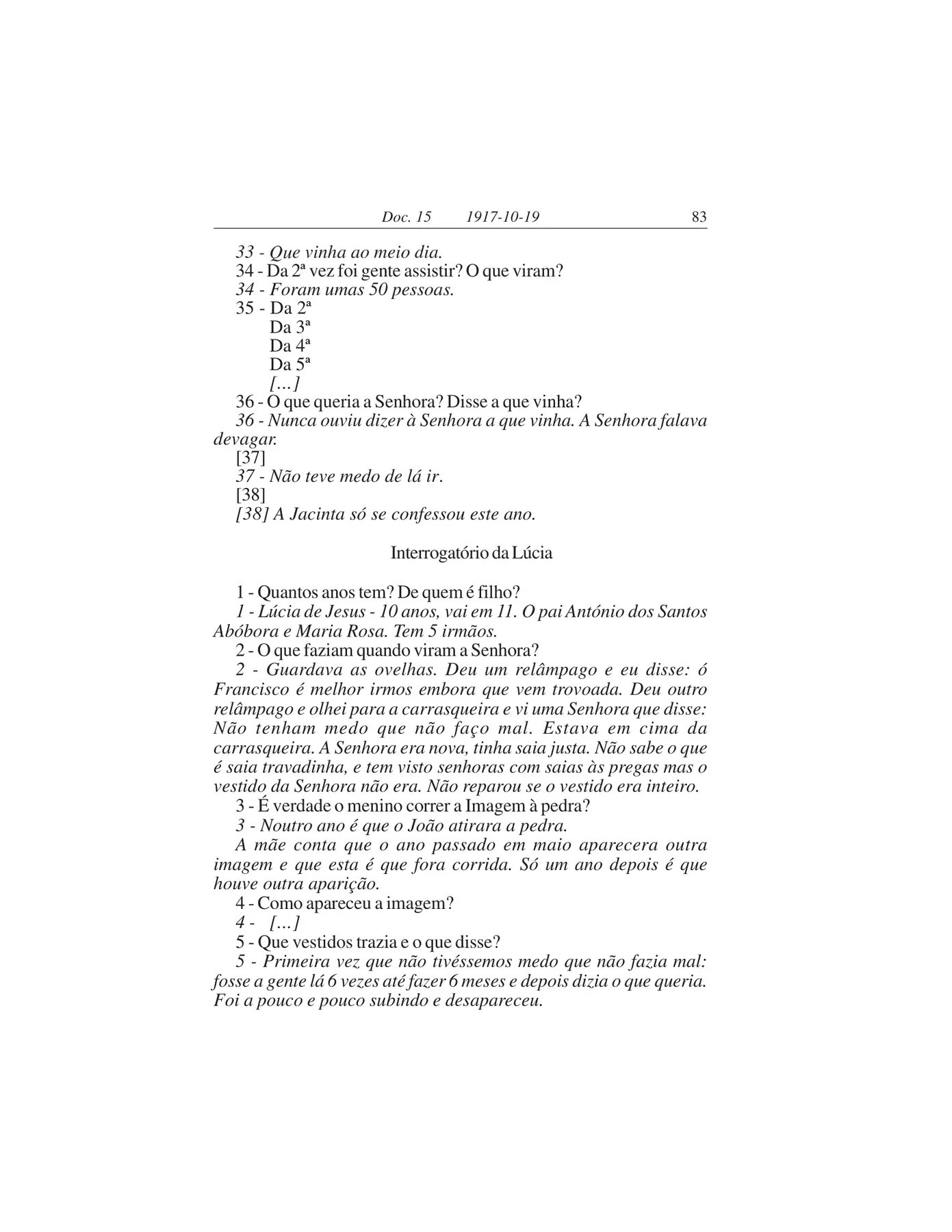
What were they doing when they saw the Lady?*

2 - I was minding the sheep. There was a flash of lightning and I said: Francisco, we'd better go home, there's a thunderstorm coming. There was another flash of lightning and I looked at the holm-oak shrub and saw a Lady who said: Don't be afraid, I won't do you any harm. She was on top of the holm-oak shrub. The Lady was young, she had a tight skirt. She does not know what a hobble skirt is, and she has seen ladies with pleated skirts, but the Lady's dress was not like that. She did not notice whether the dress was all in one piece.

3 - Is it true that the boy chased the Image away with stones?

3 - It was in another year that João had thrown the stone.

Her mother relates that last year in May another image had appeared and that it was this one that had been chased away. Only a year later was there another apparition.

4 - How did the image appear?

4 - [...]

5 - What clothes was she wearing and what did she say?

5 - The first time, that we should not be afraid, that she would do no harm: that we should go there 6 times until 6 months were up, and then she would say what she wanted. Little by little she went rising and disappeared.

- 6 - Did they all hear?
6 - [...] [...]
7 - Had they been to Mass the previous Sunday? And where?
7 - She had been to Mass, as it was Sunday at the 1st apparition. She appeared at midday.
8 - Where do they usually go to Mass?
8 - [...] [...]
9 - How is the Image dressed in the chapel where they usually go to Mass?
9 - That in the Church there is the Lady of the Rosary, but she has a child, a mantle and has no beads, and that one had beads.
10 - Had they heard any sermon or homily about Our Lady of Lourdes?
10 - She did not know the story of Lourdes, but a parish priest has now told it.
11 - Did they often go to Mass, even on weekdays?
11 - Sometimes.
12 - What did they do after seeing the Lady?
12 - They came away and she told nothing. She had seen the previous year and had told her mother and she scolded her. The first time she saw was at a place called the Estrumeiras.
13 - What clothes did she wear the first time and the other times?
13 - She always wore the same clothes.
14 - Did she say why she came on the 13th?
14 - See no. 5.
15 - Did they always see the spots on the sun?
15 - I never saw anything in the sun because I only looked at the Lady.
16 - How was she on the Holm oak? Was she smiling or was she sad?
16 - She was serious
17 - What colour was her dress and how did she hold her arms?
17 - White - arms raised.
18 - Were they afraid when they saw the Lady?
18 - They were afraid the first time.
19 - Whom did they tell that they had seen her?
19 - This one did not tell. It was Jacinta who spread it.
20 - When did they speak to any priest about the matter?
20 - She did not tell straight away, but later.
21 - What did he say to them?
21 - *He asked questions and said nothing.

Português (original)

O que faziam quando viram a Senhora?*

2 - Guardava as ovelhas. Deu um relâmpago e eu disse: ó Francisco é melhor irmos embora que vem trovoada. Deu outro relâmpago e olhei para a carrasqueira e vi uma Senhora que disse: Não tenham medo que não faço mal. Estava em cima da carrasqueira. A Senhora era nova, tinha saia justa. Não sabe o que é saia travadinha, e tem visto senhoras com saias às pregas mas o vestido da Senhora não era. Não reparou se o vestido era inteiro.

3 - É verdade o menino correr a Imagem à pedra?

3 - Noutro ano é que o João atirara a pedra.

A mãe conta que o ano passado em maio aparecera outra imagem e que esta é que fora corrida. Só um ano depois é que houve outra aparição.

4 - Como apareceu a imagem?

4 - [...]

5 - Que vestidos trazia e o que disse?

5 - Primeira vez que não tivéssemos medo que não fazia mal: fosse a gente lá 6 vezes até fazer 6 meses e depois dizia o que queria. Foi a pouco e pouco subindo e desapareceu.

- 6 - Ouviram todos?
6 - [...] [...]
7 - Tinham ido à missa no domingo anterior? E onde?
7 - Tinha ido à missa que era domingo na 1ª aparição. Apareceu ao meio-dia.
8 - Onde costumam ir à missa?
8 - [...] [...]
9 - Que veste a Imagem da capela onde costumam ir à missa?
9 - Que na Igreja há a Senhora do Rosário, mas tem um menino, um manto e não tem contas e aquela tinha contas.
10 - Tinham ouvido algum sermão sobre Nossa Senhora de Lourdes ou prática?
10 - Não sabia da história de Lourdes, mas um sr. prior contou-a agora.
11 - Costumavam ir muitas vezes à missa mesmo de semana?
11 - Às vezes.
12 - O que fizeram depois de verem a Senhora?
12 - Vieram embora e não contou nada. Tinha visto o outro ano e tinha contado à mãe e ela ralhou-lhe. A primeira vez que vira foi num sítio chamado as Estrumeiras.
13 - Que fatos trazia ela da primeira e das outras vezes?
13 - Trazia sempre o mesmo fato.
14 - Disse porque vinha no dia 13?
14 - Vid. nº 5.
15 - Viram sempre as manchas no sol?
15 - Nunca vi nada no sol porque só olhava para a Senhora.
16 - Como estava ela na Azinheira? Ria-se ou estava triste?
16 - Estava séria
17 - De que cor era o vestido e como trazia os braços?
17 - Branco - braços erguidos.
18 - Tiveram medo quando viram a Senhora?
18 - Tiveram medo da primeira vez.
19 - A quem disseram que a tinham visto?
19 - Esta não disse. A Jacinta é que espalhou.
20 - Quando falaram com qualquer padre sobre o assunto?
20 - Não contou logo, mas sim mais tarde.
21 - O que lhes disse este?
21 - *Fez perguntas e não disse nada.

DCF Seleção, Doc. 15 (= DCF I, Doc. 46) · interrogation · 19 Oct 1917 (5 months later)View scans (2)Link
13 May13 Jun13 Jul13 Aug13 Sep13 OctFirst-handSaw itInterrogationSeers' words overheard
English

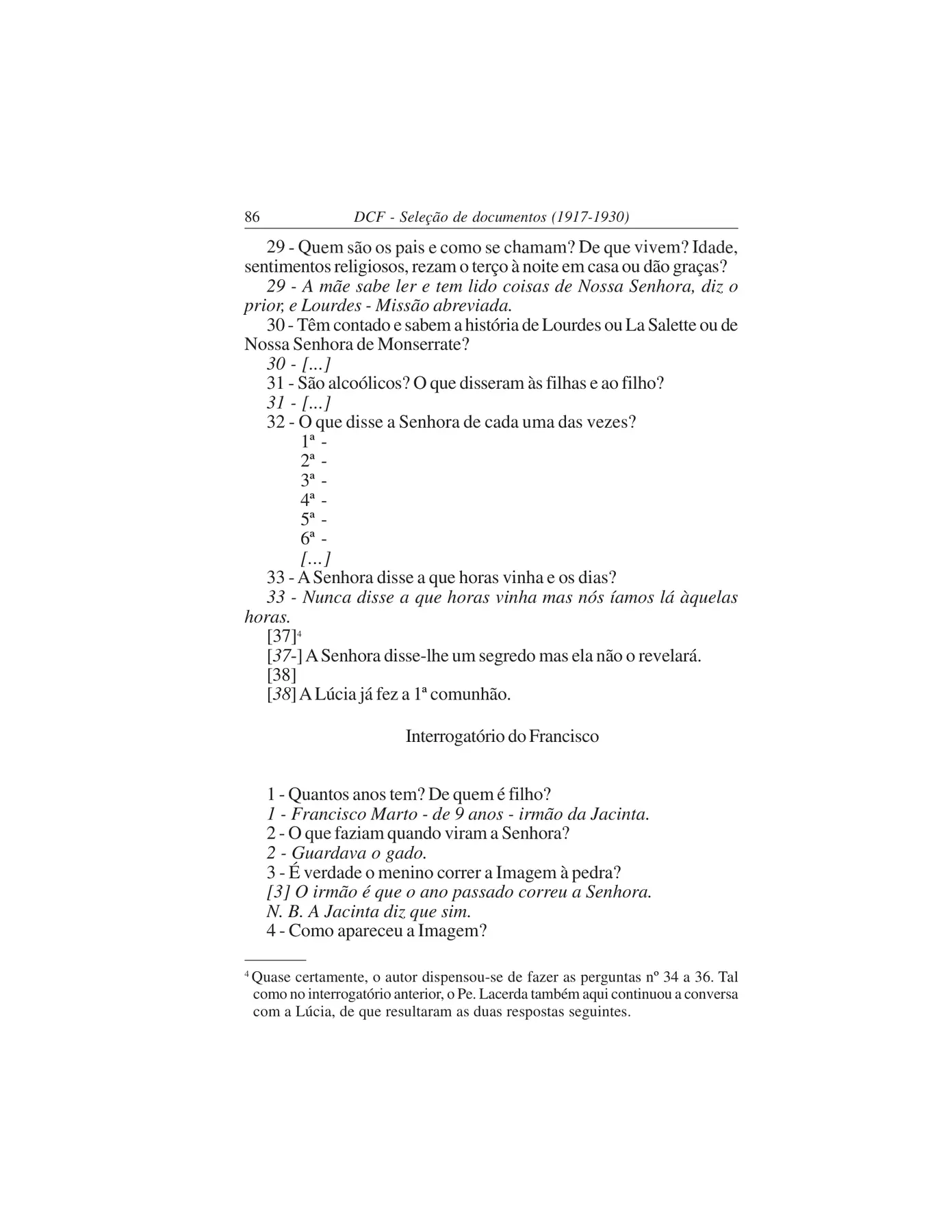
33 - She never said at what time she was coming, but we used to go there at that time.

[37]4

[37-] The Lady told her a secret but she will not reveal it.

Português (original)

33 - Nunca disse a que horas vinha mas nós íamos lá àquelas horas.

[37]4

[37-] A Senhora disse-lhe um segredo mas ela não o revelará.

Editor's notes (1)

4 Almost certainly, the author dispensed with asking questions nos. 34 to 36. Just as in the previous interrogation, Fr. Lacerda here too continued the conversation with Lúcia, which produced the following two answers.

4 Quase certamente, o autor dispensou-se de fazer as perguntas nº 34 a 36. Tal como no interrogatório anterior, o Pe. Lacerda também aqui continuou a conversa com a Lúcia, de que resultaram as duas respostas seguintes.

DCF Seleção, Doc. 15 (= DCF I, Doc. 46) · interrogation · 19 Oct 1917 (5 months later)View scanLink
13 MayOther 1917First-handSaw itInterrogation
English

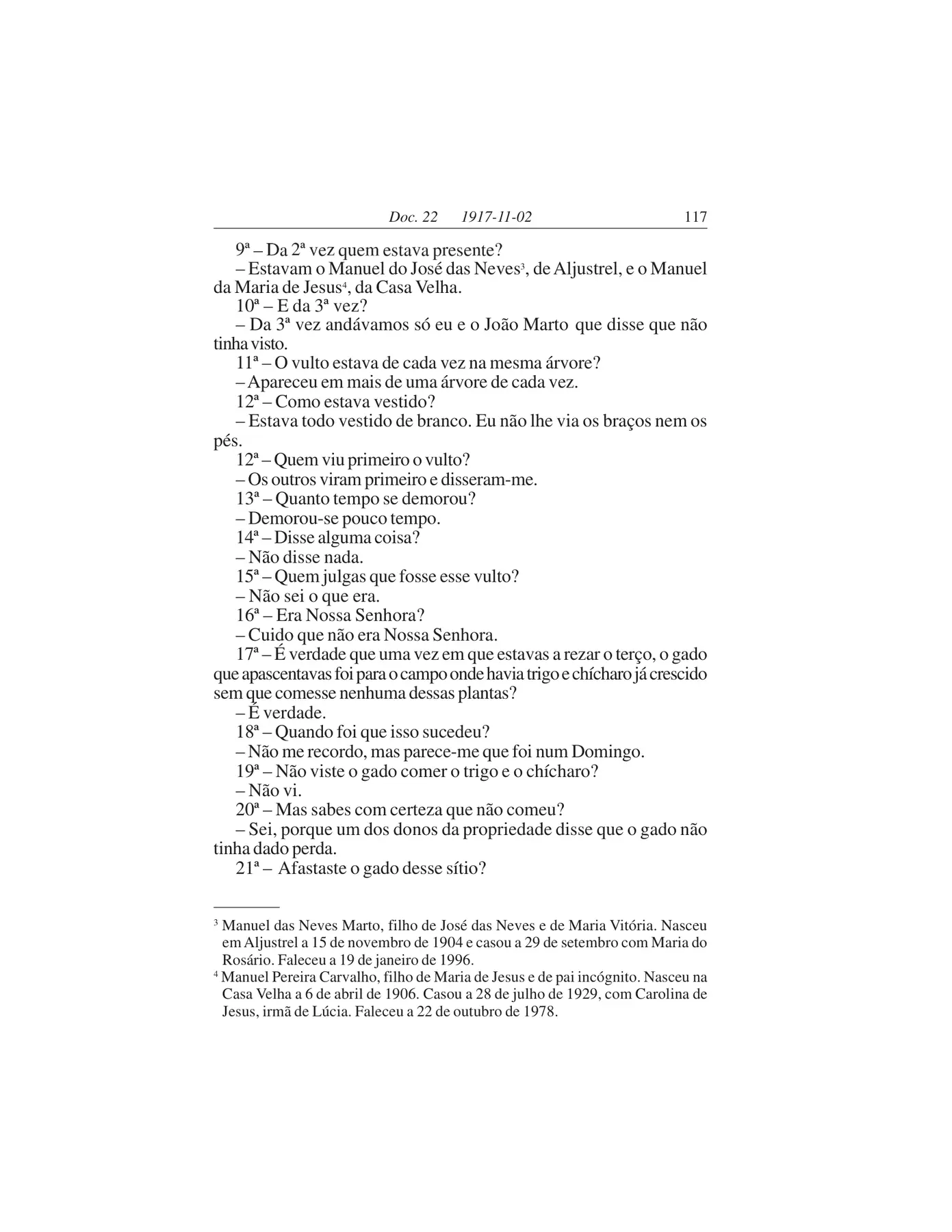
Is it true that once, when you were saying the rosary, the flock you were grazing went into the field where there was wheat and chickling peas already grown, without eating any of those plants?
– It is true.
- 18th – When did that happen?
– I don't remember, but I think it was on a Sunday.
- 19th – Didn't you see the flock eat the wheat and the chickling peas?
– I didn't.
- 20th – But do you know for certain that it didn't eat them?
– I know, because one of the owners of the property said the flock had done no damage.
- 21st – Did you drive the flock away from that place?

---

– We drove it away after saying the rosary.

22nd – Whom did the property belong to?

23rd – It belonged to José Matias and to Francisco António5, of Casa Velha. They are two adjoining plots.

24th – Why didn't you drive the flock away as soon as you saw it going into the sown field?

– I didn't drive it away at once because I wanted to say the rosary.

25th – Weren't you afraid it would eat what had been sown?

– I thought it was eating it, but I let it be.

26th – So didn't you know that it was your duty to take the flock away immediately so that it would cause no damage?

– I have already confessed that fault.

Português (original)

É verdade que uma vez em que estavas a rezar o terço, o gado que apascentavas foi para o campo onde havia trigo e chícharo já crescido sem que comesse nenhuma dessas plantas?
– É verdade.
- 18a – Quando foi que isso sucedeu?
– Não me recordo, mas parece-me que foi num Domingo.
- 19a – Não viste o gado comer o trigo e o chícharo?
– Não vi.
- 20a – Mas sabes com certeza que não comeu?
– Sei, porque um dos donos da propriedade disse que o gado não tinha dado perda.
- 21a – Afastaste o gado desse sítio?

– Afastámo-lo depois de rezar o terço.

22a – A quem pertencia a propriedade?

23a – Pertencia ao José Matias e a Francisco António5, da Casa Velha. São dois talhões pegados.

24a – Porque não afastaste o gado logo que o viste ir para o campo semeado?

– Não afastei logo porque queria rezar o terço.

25a – Não receavas que ele comesse o que estava semeado?

– Pensava que ele comia, mas deixei-o andar.

26a – Então não sabias que a tua obrigação era retirares imediatamente o gado para que ele não causasse dano?

– Já me confessei dessa falta.

Editor's notes (3)

3 Manuel das Neves Marto, son of José das Neves and of Maria Vitória. He was born in Aljustrel on 15 November 1904 and married Maria do Rosário on 29 September. He died on 19 January 1996.

4 Manuel Pereira Carvalho, son of Maria de Jesus and of an unknown father. He was born at Casa Velha on 6 April 1906. He married Carolina de Jesus, Lúcia's sister, on 28 July 1929. He died on 22 October 1978.

5 Francisco António, born in 1873 and married to Jacinta de Jesus, then living at Casa Velha.

3 Manuel das Neves Marto, filho de José das Neves e de Maria Vitória. Nasceu em Aljustrel a 15 de novembro de 1904 e casou a 29 de setembro com Maria do Rosário. Faleceu a 19 de janeiro de 1996.

4 Manuel Pereira Carvalho, filho de Maria de Jesus e de pai incógnito. Nasceu na Casa Velha a 6 de abril de 1906. Casou a 28 de julho de 1929, com Carolina de Jesus, irmã de Lúcia. Faleceu a 22 de outubro de 1978.

5 Francisco António, nascido em 1873 e casado com Jacinta de Jesus, então residente na Casa Velha.

DCF Seleção, Doc. 22 (= DCF I, Doc. 17) · interrogation · 2 Nov 1917 (6 months later)View scans (2)Link
13 May13 Jun13 Jul13 Aug13 Sep13 OctFirst-handSaw itInterrogationFigures / visionsLight dimming
English

Before each apparition did you see any flash of lightning?

– Sometimes I saw one, other times I saw two. The air was murky, as before a thunderstorm.

29th – The first time the Lady appeared to you, was the sky cloudless?

– I don't remember whether there were clouds.

30th – When the Lady appeared to you the 1st time, what were you doing?

– I said the rosary before she came.

31st – When the first apparition happened, did you kneel or remain standing?

– The first time I remained standing.

32nd – Did the Lady always come surrounded by a radiance?

– She did.

– What colour was that radiance?

– It was very bright, very white.

33rd – Did the radiance appear before the Lady?

– It appeared almost at the same time as the Lady.

Português (original)

Antes de cada aparição vias algum relâmpago?

– Às vezes via um, outras vezes via dois. Os ares estavam turvos, como de trovoada.

29a – Da primeira vez que a Senhora te apareceu o céu estava sem nuvens?

– Não me recordo se havia nuvens.

30a – Quando a Senhora te apareceu da 1a vez o que é que estavas a fazer?

– Rezei o terço antes dela vir.

31a – Quando sucedeu a primeira aparição ajoelhaste-te ou ficaste de pé?

– Da primeira vez fiquei de pé.

32a – A Senhora vinha sempre envolta num esplendor?

– Vinha.

– De que côr era esse esplendor?

– Era muito claro, muito branco.

33a – O esplendor aparecia primeiro que a Senhora?

– Aparecia quase ao mesmo tempo que a Senhora.

DCF Seleção, Doc. 22 (= DCF I, Doc. 17) · interrogation · 2 Nov 1917 (6 months later)View scanLink
13 MayFirst-handSaw itInterrogationSeers' words overheardFigures / visions
English

The first time, did you ask Francisco and Jacinta not to tell their family anything of what they had seen?

---

– I did.

35th – Why?

– Because last year my mother scolded me when I told her I had seen the white figure, and told me I was lying.

36th – Did your mother learn of the 1st apparition from you?

– No; it was through Francisco and Jacinta, or through people they had told what they saw.

37th – Tell me what you heard the Lady say in May.

– In May the Lady said we were not to be afraid because she would do us no harm. I asked her where she was from and she told me she was from Heaven. I asked her what she wanted and she answered that we were to go there every month, month after month, and at the end of six months she would say what she wanted.

38th – Why did you go to the place of the apparitions from then on on the 13th and not on another day of each month?

– I went on the 13th because it made a month. I understood that I should go on the 13th, because the day of the first apparition was the 13th.

39th – Did you ask her any more questions?

– I asked whether we were going to Heaven and the Lady said yes, but that Francisco must say his beads.

40th – Did the Lady say anything else?

– Perhaps she said something else, but I don't remember.

Português (original)

Da primeira vez pediste ao Francisco e à Jacinta que não dissessem à família nada do que tinham visto?

– Pedi.

35a – Porquê?

– Porque o ano passado minha mãe ralhou-me, quando eu lhe disse que tinha visto o vulto branco, e disse-me que eu andava a mentir.

36a – Tua mãe soube por ti da 1a aparição?

– Não; foi pelo Francisco e pela Jacinta ou por pessoas a quem eles tivessem contado o que viram.

37a – Conta-me o que ouviste dizer à Senhora em maio.

– Em maio a Senhora disse que não tivéssemos medo porque não nos fazia mal. Perguntei-lhe donde era e ela disse-me que era do Céu. Perguntei-lhe o que que queria e ela respondeu que fôssemos lá todos os meses de mês a mês e ao fim de seis meses dizia o que queria.

38a – Porque foste daí em diante ao local das aparições no dia 13 e não noutro dia de cada mês?

– Fui no dia 13 porque fazia um mês. Entendi que devia ir no dia 13, porque o dia da primeira aparição era 13.

39a – Fizeste-lhe mais algumas perguntas?

– Perguntei se íamos para o Céu e a Senhora disse que sim, mas que o Francisco devia rezar as contas.

40a – A Senhora disse mais alguma coisa?

– Talvez dissesse mais alguma coisa, mas não me lembro.

Editor's notes (1)

5 Francisco António, born in 1873 and married to Jacinta de Jesus, then living at Casa Velha.

5 Francisco António, nascido em 1873 e casado com Jacinta de Jesus, então residente na Casa Velha.

DCF Seleção, Doc. 22 (= DCF I, Doc. 17) · interrogation · 2 Nov 1917 (6 months later)View scans (2)Link
13 May13 Jun13 Jul13 Aug13 Sep13 OctFirst-handSaw itInterrogationFigures / visions
English

What the Lady had on her feet, were they stockings? Are you sure of that?

– I reckon they were stockings, but they might not have been.

4th – You have never told the secret, nor even said that the people would be sad if they knew it. Francisco and Jacinta say that they would be sad. If you cannot say that, neither could they say it. What do you think?

– I don't know whether they should or shouldn't say that the people would be sad. Our Lady said we were not to tell anything to anyone. That is why I can't say anything.

2nd – You once said that the Lady had white stockings. So were they stockings or were they her feet?

– If they were stockings, they were white, but I don't know for sure whether they were stockings or her feet.

3rd – Was the skirt always the same length?

– The last time the skirt seemed longer.

Português (original)

O que a Senhora trazia nos pés eram meias? Tens a certeza disso?

– Cuido que eram meias, mas podiam não ser.

4ª – Tu nunca disseste o segredo, nem mesmo disseste que o povo ficava triste se o soubesse. O Francisco e a Jacinta dizem que ficava triste. Se tu não podes dizer isso, também eles o não podiam dizer. Que te parece?

– Não sei se eles deviam ou não dizer, que o povo ficava triste. Nossa Senhora disse que não devíamos dizer nada a ninguém. Por isso não posso dizer nada.

2a – Tu disseste uma vez que a Senhora tinha meias brancas. Então eram as meias ou eram os pés?

– Se eram meias, eram brancas, mas eu não sei ao certo se eram meias ou se eram os pés.

3a – A saia era sempre do mesmo comprimento?

– A saia da última vez parecia mais comprida.

DCF Seleção, Doc. 22 (= DCF I, Doc. 17) · interrogation · 2 Nov 1917 (6 months later)View scans (2)Link
13 May13 Jun13 Jul13 Aug13 Sep13 OctFirst-handSaw itInterrogationSeers' words overheard
English

When was it that the Lady taught you the prayer you were to say after each mystery?

– I think it was in the third month.

2nd – How many people did the Lady promise to cure and convert?

– I asked for many and she said she would cure and convert some, and not others.

3rd – How many times did you make that request to her?

– I think it was five times, now for some people, now for others.

Português (original)

Quando foi que a Senhora te ensinou a oração que devias rezar depois de cada mistério?

– Parece-me que foi no terceiro mês.

2a – Quantas foram as pessoas que a Senhora prometeu curar e converter?

– Eu pedi por muitas e ela disse que curava e convertia umas, outras não.

3a – Quantas vezes lhe fizeste esse pedido?

– Parece-me que foi cinco vezes, ora por umas pessoas, ora por outras.

DCF Seleção, Doc. 22 (= DCF I, Doc. 17) · interrogation · 3 Nov 1917 (6 months later)View scanLink
13 MayFirst-handSaw itInterrogationFigures / visionsSeers' words overheard
English

That done, I proceeded to question the daughter – the said seer Lúcia – who said that on the thirteenth of the current month of May she was pasturing the sheep with her cousins Francisco and Jacinta at the place called Cova da Iria – it lies two kilometres north-west of this Parish Church of Fátima, beside the road that goes to Batalha – at about one o'clock in the afternoon – solar time – and that, having just finished saying the beads – the rosary – (which she did often), she saw a flash of lightning which frightened her very much; she at once began to gather the sheep and to tell her cousins to gather them so they could go away – home –, saying that a thunderstorm was coming, but she saw no clouds. Suddenly she saw another flash of lightning and then a Lady, of medium height and extraordinary beauty, on top of a holm-oak shrub – a small holm oak – who said to her:

– Do not be afraid, I will not harm you.

And that, at once losing all fear, she asked Her:

– Where are you from?

And the Lady answered her:

– My place is Heaven.

– What have you come here to the world to do?

– I have come here to tell you to come here every month until six months are done, and at the end of the six months I will tell you what I want.

– Can you tell me whether the war will last a long time yet or whether it will end soon?

– I cannot tell you yet, until I have also told you what I want.

- Can you tell me whether I am going to Heaven?
- You are.
- And my girl cousin?
- She is.
- And my boy cousin?
- He still has to say his beads...
- That, having said this, the Lady began to rise in the air, moving towards the east until she disappeared.

The vision

Lúcia said that the Lady whom she and her cousins saw was a little more or less than a metre tall and was dressed in white. The skirt was white and gilded with little cords running lengthwise and across, and it was short, that is, it did not come down to the feet. The jacket was white, not gilded. A white mantle, which went from the head to the hem of the skirt, gilded with little cords from top to bottom and across; at the edges the gold was closer together. The jacket had two or three little gilded cords at the cuffs. She had no belt, ribbon or sash at the waist. She had her hands joined, a little above the waist, and from them hung a white rosary. Every time she spoke she separated her hands, more or less to the width of the shoulders. She had black eyes, and her face was so lovely, as she had never seen in any lady. Her beauty almost blinded her, and she never tired of looking at Her.

It seemed to her that she wore white stockings, not gilded, but she could not be sure because she hardly looked at anything but the face. Indeed, on one occasion in my presence, when Jacinta was there too, she turned to her and asked her whether She was wearing stockings, because she had not noticed.

Português (original)

Posto isto, procedi ao interrogatório da filha – a dita vidente Lúcia – a qual disse que no dia treze do corrente mês de maio, andava pastoreando as ovelhas, com os primos Francisco e Jacinta, no sítio chamado Cova da Iria – fica a dois quilómetros a noroeste desta Igreja Paroquial de Fátima, junto à estrada que segue para a Batalha – por cerca de uma hora da tarde – hora solar – e que tendo acabado de rezar as contas – o terço – (o que fazia muitas vezes), viu um relâmpago de que teve muito medo; começou logo a ajuntar as ovelhas e a mandar os primos ajuntá-las para se irem embora, – para casa –, dizendo que vinha lá trovoada, mas não via nuvens. De repente, viu outro relâmpago e logo uma Senhora, de mediana estatura e extraordinária beleza, em cima de uma carrasqueira – azinheira pequena – e que lhe disse:

– Não tenhas medo que te não faço mal.

E que ficando logo sem medo algum Lhe perguntou:

– Que lugar é o de Vossemecê?

E a Senhora lhe respondeu:

– O meu lugar é o Céu.

– O que vem Vossemecê cá fazer ao mundo?

– Venho cá para te dizer que venhas aqui todos os meses até fazer seis meses, e no fim dos seis meses te digo o que quero.

– Vossemecê sabe-me dizer se a guerra ainda dura muito tempo ou se acaba breve?

– Não te posso dizer ainda, enquanto te não disser também o que quero.

- Sabe-me dizer se eu vou para o Céu?
- Tu vais.
- E a minha prima?
- Vai.
- E o meu primo?
- Esse ainda há de rezar as contas dele...
- Dito isto que a Senhora se começou a elevar, no ar, seguindo para o nascente até desaparecer.

A visão

Disse a Lúcia que a Senhora, que ela e seus primos viram, tinha um pouco mais ou menos de um metro de altura e vinha vestida de branco. A saia era branca e dourada aos cordõezinhos ao comprido e a atravessar e era curta, isto é não descia até aos pés. O casaco era branco não dourado. Manto branco, que ia da cabeça até à orla da saia, dourado aos cordõezinhos de alto a baixo e a atravessar, nas orlas o ouro era mais junto. O casaco tinha dois ou três cordõezinhos dourados nos punhos. Não tinha cinto, fita, faixa à cintura. Tinha as mão postas, um pouco acima da cintura e delas pendia um terço branco. Todas as vezes que falava, separava as mãos, pouco mais ou menos, à distância dos ombros. Tinha os olhos pretos, e era tão linda no rosto, como nunca tinha visto Senhora alguma. Quase a cegava a sua beleza, e nunca se cansava de olhar para Ela.

Parecia-lhe que tinha meias brancas, não douradas, mas que não dava a certeza porque para pouco mais olhava do que para o rosto. Até mesmo em uma ocasião na minha presença, estando também a Jacinta, ela volta-se para esta e pergunta-lhe se Ela trazia meias, porque não tinha reparado.

DCF Seleção, Doc. 36 (= DCF I, Doc. 31) · official · 28 May 1917 (2 weeks later)View scans (2)Link
13 MaySecond-handSaw itSworn depositionFigures / visionsSeers' words overheard
As told by Olímpia de Jesus (mother of Francisco and Jacinta), sworn deposition to the canonical commission (Dr. Manuel Nunes Formigão, relator)
English

Lúcia said that she saw a very beautiful woman, with a radiance about her head that was blinding.

Português (original)

A Lúcia disse que via uma mulher muito bonita, com um resplendor ao cabo da cabeça, que cegava.

13 MaySecond-handSaw itSworn depositionFigures / visionsSeers' words overheard
As told by Maria Rosa (mother of Lúcia), sworn deposition to the canonical commission (Dr. Manuel Nunes Formigão, relator)
English

Her two daughters, Maria dos Anjos and Carolina, questioned Lúcia about the events of the previous day and went home and said that their sister really had seen something. Finally, the mother too asked her what she had seen. She said that she saw a very beautiful little woman; that the dress she wore was all white, that to the question – “where she was from” – she had pointed to Heaven saying she was from there, and that, when she asked her whether Francisco, Jacinta and she, Lúcia, would not go to Heaven, the apparition answered yes. The Mother, on hearing these words, exclaimed: “How lucky you are!” The Lady said that she wanted them to go there six months running and that at the end she would say what she wanted.

Português (original)

As duas filhas, Maria dos Anjos e Carolina, interrogaram a Lúcia sobre os acontecimentos da véspera e foram para casa e disseram que realmente a irmã tinha visto alguma coisa. Por fim, a mãe perguntou-lhe também o que vira. Ela disse que via uma mulherzinha muito bonita; que o vestido que trazia era todo branco, que à pergunta” – “de onde era” – apontara para o Céu dizendo que era de lá, e que tendo-lhe perguntado se não iam para o Céu o Francisco, a Jacinta e ela Lúcia, a aparição respondeu que sim. A Mãe, ao ouvir estas palavras exclamou: “Que felizes que vocês são!”. Disse a Senhora que queria que fossem lá seis meses a fio e que por fim diria o que queria.

DCF Seleção, Doc. 80 (= DCF II, Doc. 4) · deposition · 14 May 1917 (1 day later)View scanLink
13 MaySecond-handSaw itSworn depositionFigures / visions
As told by Maria dos Santos (Maria da Capelinha, of Moita), sworn deposition to the canonical commission (Dr. Manuel Nunes Formigão, relator)
English

She learned from her husband and from other people that Lúcia was saying that Our Lady had appeared to her on the thirteenth of May nineteen hundred and seventeen, as well as to her cousins Francisco and Jacinta, around the hour of solar noon.

Português (original)

Soube pelo marido e por outras pessoas que a Lúcia dizia que lhe tinha aparecido Nossa Senhora no dia treze de maio de mil novecentos e dezassete, assim como a seus primos Francisco e Jacinta, pela hora do meio dia solar.

DCF Seleção, Doc. 80 (= DCF II, Doc. 4) · deposition · May 1917 (2 days later)View scanLink
13 MaySecond-handSaw itSworn depositionFigures / visionsSeers' words overheard
As told by Manuel António de Paula of Boleiros (relaying Maria Rosa), sworn deposition to the canonical commission (Dr. Manuel Nunes Formigão, relator)
English

The mother answered that her daughter, after the first apparition, came home at night and told her that she had seen Our Lady at the Cova da Iria. She would not believe it, because her daughter was not what she wished her to be, with merits enough to see Our Lady. She wanted to beat her. Lúcia, afraid of her, began to tell people outside what was happening and would not tell her mother anything more. When her mother found out, she said to her: “So you go around telling people outside that Our Lady appears to you, and you tell me nothing?” The little girl answered: “Well, mother, you wanted to beat me!” Then she asked her daughter how big the Lady was. She said she compared her to a girl from there of fifteen. She was of such beauty that she had never seen the like.

Português (original)

A mãe respondeu que a filha depois da primeira aparição foi para casa à noite e que lhe disse ter visto Nossa Senhora na Cova da Iria. Não quis acreditar porque a filha não era o que ela desejava que fosse, com méritos para ver Nossa Senhora. Quis bater-lhe. A Lúcia com medo dela, começou a dizer por fora o que se passava e não queria contar à mãe mais nada. Como a mãe soubesse, disse-lhe: “Então tu andas a dizer por fora, que Nossa Senhora te aparece e a mim não me dizes nada?” A pequena respondeu: “Então a minha mãe queria-me bater!” Depois perguntou à filha que tamanho a Senhora tinha. Ela disse que a comparava com uma menina dali de quinze anos. Era de uma beleza tal que nunca tinha visto igual.

DCF Seleção, Doc. 80 (= DCF II, Doc. 4) · deposition · 13 Sep 1917 (4 months later)View scans (2)Link
13 MayFirst-handSaw itInterrogationFigures / visionsSeers' words overheard
English

Did anything important happen to you at the Cova da Iria? She answered: the following happened to me: On the thirteenth of May of nineteen hundred and

--- seventeen, I was minding the flock at the place called Cova da Iria, in the parish of Fátima, together with my cousins Francisco Marto and Jacinta Marto; after saying the rosary, as usual, we began to play, building a wall around a bush, when we saw a flash of lightning towards the east, and, fearing a thunderstorm was coming, although the weather was fine, I told Francisco it was better for us to go home and gather the flock; when we reached the middle of the field there was another flash, and, two steps further on, we saw on top of a holm-oak shrub, which would have been about a metre high, a very beautiful Lady, with the appearance of a young woman, perhaps eighteen to twenty-two years old, wrapped in a light brighter than the sun. We were very frightened at seeing that radiance which surrounded her, but the Lady, in a low but quite intelligible voice, said to us: "Do not be afraid, for I will not do you any harm". I asked her: "where are you from?" to which she answered: – "I am from Heaven" – "What do you want of me?" She answered: – "I want you to come here for six months, and at the end I will tell you what I want". I asked her about Maria, José das Neves's daughter, and she told me she was in heaven; I asked her about Amélia, and she told me she was in purgatory. Whether she told me anything else in this month, I do not remember. Then she disappeared, rising very high towards the east".

– "How was the Lady dressed?". She answered: "She was dressed in white, covered from her head to the hem of her dress by a mantle edged with gold braid, fastened with a golden cord ending in a tassel, also golden, with nothing on her head except the mantle; the sleeves of the dress came down to her hands, which were joined at the height of her breast and from which hung some white beads ending in a cross, also white; it seems to me she was not barefoot, but I cannot say for sure because she was standing on leaves wrapped in light and because I did not look closely at her feet; a little of her ears could be seen, but I cannot say for certain whether she had earrings or not, though it seemed to me she had a little gold chain".

– "What was your age and that of your cousins at that time?". She answered: – "At that time I was ten, Francisco nine and Jacinta six".

– "Did your cousins also see and speak with this Lady?". She said: – "My cousins did not ask questions, but Jacinta said she had heard her, and Francisco saw her but did not hear her".

---

– "And do you not remember anything else that happened that day?". She said: "Now I remember this: when the Lady told me that she was from Heaven, I asked her whether I would go to Heaven, and she said yes; whether Jacinta would go, and she said yes; whether Francisco would go, and she said yes, but that he must say the rosary; I also remember that, after the Lady disappeared, a man came to say that the sheep had got into the chickpeas and that he had already thrown stones at them and that the chickpeas would be eaten; he went over there to look so as to warn the owner, and afterwards told the owner, José Matias, that the sheep had got into the chickpeas, but that they had not been eaten".

– "Did the Apparition last a long time? Were you afraid during it? Did you tell anyone what you saw?". She said: "The Apparition lasted a short time and during it I was not frightened at all; as we were going home, I agreed with my cousins not to say anything to anyone, and on the following days we would go, when we could, with the sheep to the Cova da Iria, or we would pass by there when bringing in the flock, saying a Hail Mary there".

Português (original)

Aconteceu-te alguma coisa importante na Cova da Iria? Respondeu: aconteceu-me o seguinte: No dia treze de maio de mil novecentos e dezassete, andava eu a guardar o gado no sítio da Cova da Iria, da freguesia de Fátima, na companhia dos meus primos Francisco Marto e Jacinta Marto; depois de rezarmos o terço, como de costume, começámos a brincar, fazendo um muro à volta duma moita, quando vimos um relâmpago para o lado do nascente, e, receando que viesse trovoada, embora estivesse bom tempo, eu disse ao Francisco que era melhor irmos para casa recolher o gado quando chegámos ao meio da fazenda, deu outro relâmpago, e, dois passos adiante, vimos em cima duma carrasqueira, que teria um metro de altura aproximadamente, uma Senhora muito formosa, com aparências de nova, talvez de dezoito a vinte e dois anos, envolta num clarão mais brilhante que o sol. Ficámos muito assustados por vermos aquele resplendor que a envolvia, mas a Senhora a meia voz, mas bem inteligível, disse-nos: “Não tenham medo, porque eu não vos faço mal”. Eu perguntei-lhe: “donde é Vossemecê?” ao que ela respondeu: – “Eu sou do Céu” – “O que é que Vossemecê me quer?” Ela respondeu: – “Quero que venhas aqui durante seis meses, e no fim te direi o que quero”. Perguntei-lhe pela Maria, do José das Neves, e ela disse-me que estava no céu; perguntei-lhe pela Amélia, e disse-me que estava no purgatório. Se me disse mais alguma coisa neste mês, não me lembro. Nisto, desapareceu, subindo muito alto para o lado do nascente”.

– “Como estava vestida a Senhora?”. Respondeu: “Estava vestida de branco, coberta desde a cabeça até à extremidade do vestido com um manto galoado a ouro, preso com um cordão dourado, terminado por uma borla também dourada, nada tendo sobre a cabeça além do manto; as mangas do vestido chegavam até às mãos postas à altura do peito e donde pendiam umas contas brancas, terminadas por uma cruz também branca; parece-me que não vinha descalça, mas não posso determinar bem porque pousava sobre folhas envoltas em luz e porque não reparei bem nos pés; via-se um pouco das orelhas, mas não posso precisar se tinha brincos ou não, parecendo-me contudo que tinha um fiozinho de ouro”.

– “Qual era a tua idade e a dos teus primos nessa ocasião?”. Respondeu: – “Eu nesse tempo tinha dez anos, o Francisco nove e a Jacinta seis”.

– “Os teus primos também viram e falaram com essa Senhora?”. Disse: – “Os meus primos não fizeram perguntas, mas a Jacinta dizia tê-la ouvido e o Francisco via-a, mas não a ouvia”.

– “E não te lembras de mais nada que acontecesse nesse dia?”. Disse: “Agora lembra-me isto: quando a Senhora me disse que ela era do Céu, eu perguntei-lhe se eu ia para o Céu, e ela disse que sim; se ia a Jacinta e ela disse que sim; se ia o Francisco e ela disse que sim, mas que ele devia rezar o terço; também me lembro que, depois de desaparecer a Senhora, veio um homem dizer que as ovelhas tinham ido para os chícharos e que já lhes tinha atirado com pedras e que os chícharos estariam comidos; foi por lá ver para avisar o dono, e depois disse ao dono, José Matias, que as ovelhas tinham ido para os chícharos, mas que eles não estavam comidos”.

– “A Aparição durou muito tempo? Tiveste medo durante ela? Contaste a alguém o que viste?”. Disse: “A Aparição durou pouco tempo e durante ela não tive susto nenhum; ao irmos para casa, combinei com os meus primos não dizer nada a ninguém, e nos dias seguintes íamos, quando podíamos com as ovelhas para a Cova da Iria, ou passaríamos lá ao recolher o gado, rezando aí uma Avé Maria”.

Editor's notes (2)

1 António Rodrigues Pena. He was parish priest of Fátima between 1909 and 1914.

2 Jacinta was already seven.

1 António Rodrigues Pena. Foi pároco de Fátima entre 1909 e 1914.

2 Jacinta tinha já sete anos.

DCF Seleção, Doc. 82 (= DCF II, Doc. 8) · interrogation · 8 Jul 1924 (7 years later)View scans (3)Link
13 May13 Jun13 Jul13 Aug13 Sep13 OctFirst-handSaw itInterrogationFigures / visions
English

Did your cousins ever speak with the Lady?". She answered: "They never spoke; once we agreed that Jacinta would speak to her, but, when we got there, Jacinta said nothing."

– "Was the Lady's countenance smiling?". She answered: "It was sad; when she spoke, she opened her hands, which were joined and raised against her breast".

[…]

Are you certain that you really saw a Lady on top of the holm-oak shrub and that you were not mistaken?". She answered: "I am certain that I saw her and that I was not mistaken; even if they killed me, no one would make me say the contrary.

– "And who was this Lady?". She answered: "Before she said she was the Lady of the Rosary, I did not know who she was; now I am convinced she was Our Lady".

Português (original)

Os teus primos falaram alguma vez com a Senhora?”. Respondeu: “Nunca falaram; uma vez combinámos que a Jacinta lhe falasse, mas, chegando lá, a Jacinta não disse nada.”

– “O semblante da Senhora era risonho?”. Respondeu: “Era triste; quando falava, abria as mãos que estavam juntas e erguidas de encontro ao peito”.

[…]

Tens a certeza de que viste realmente uma Senhora em cima da carrasqueira e de que não te enganaste?”. Respondeu: “Tenho a certeza de que a vi e de que não me enganei; ainda que me matassem, ninguém me faria dizer o contrário.

– “E quem era essa Senhora?”. Respondeu: “Antes de ela dizer que era a Senhora do Rosário, não sabia quem era; agora estou convencida de que era Nossa Senhora”.

DCF Seleção, Doc. 82 (= DCF II, Doc. 8) · interrogation · 8 Jul 1924 (7 years later)View scans (2)Link
13 JunFirst-handSaw itLater recollectionFigures / visionsSeers' words overheard
English

We were waiting for the Lady to appear beside the holm-oak shrub, and there was a flash of lightning and the Lady appeared above the holm-oak shrub.

I asked her what she wanted of me; the answer. I want you to go on coming here every month, and to learn to read. I asked her to cure a lame man and some people who had asked me; some sick and others for the conversion of some sinners. Answer; In a year's time they will be cured. With that she disappeared rising towards the east and going so high that the clouds and the blue of the sky didn't let us see any more. If anything else happened this month I don't remember.

Português (original)

Estava-mos á espera que a Senhora aparece-se junto da carrasqueira, e deu um relampago e a Senhora apareceu em sima da carrasqueira.

Perguntei-lhe o que me queria; a resposta. Quero que continuem a vir aqui todos os meses, e que aprendam a ler. Pedi-lhe para curar um côcho e algumas pessoas que me tinham pedido; umas duentes outras pela coverção de alguns peccadores. Resposta; Daqui a um ano serem curados. Com isto desapareceu subindo para o lado do nascente e indo tam alta que as nuvens e o azul do céu não nos deixou ver mais. Se êste mez aconteceu mais alguma coisa não me lembro.

DCF III-3, Doc. 685 · other · 5 Jan 1922 (5 years later)View scans (2)Link
13 JunFirst-handSaw itInterrogationFigures / visionsSeers' words overheard
English

Lúcia says that she waited a while and during this time she was praying the rosary, and when they were about to pray the litany she said: don't start, for there isn't time now, since there were many people there, because she had already seen the lightning flash; and she went to the holm-oak shrub with the people who were there: on arriving she made a bow, bending one knee, and at the same time the Lady arrived, coming in an oblique line from the east side, and she asked the question:

– Well then, what do you want of me?

– “I want to tell you to come back here on the 13th and to learn to read so that I can tell you what I want of you.”

– Then don't you want anything else?

– I want nothing more.

The dress was: a white mantle which reached from the head to the bottom of the skirt; it was gilded from the waist down, with cords running across and from top to bottom, and at the edges the gold was closer together. The skirt was all white and gilded with cords lengthwise and crosswise, but it reached only to the knee; a white jacket, not gilded, with only two or three cords at the cuffs; she had no shoes, she had white stockings, not gilded; round her neck she had a gold cord with a medal at the ends; she had her hands raised; in her ears she had some very tiny studs, very close to the ears; she parted her hands when she spoke; she had black eyes; she was of medium height.

Português (original)

Diz a Lúcia que esteve um bocado à espera e durante este tempo esteve a rezar o terço e quando iam para rezar a ladainha disse: não comecem que já não têm tempo, pois estava muita gente, por já ter visto o relâmpago e dirigiu-se à carrasqueira com o povo que estava: ao chegar fez uma vénia dobrando um joelho e ao mesmo tempo chegou a Senhora vindo em linha oblíqua do lado do nascente e fez a pergunta:

– Então o que é que me quer?

– “Quero-te dizer que voltes cá no dia 13 e que aprendas a ler para te dizer o que te quero.”

– Então não quer mais nada?

– Não quero mais.

O traje era: um manto branco que da cabeça chegava ao fundo da saia, era dourado da cintura para baixo dos cordões a atravessar e de alto a baixo e nas orlas era o ouro mais junto. A saia era branca toda e dourada em cordões ao comprido e a atravessar, mas só chegava ao joelho; casaco branco sem ser dourado, tendo nos punhos só dois ou três cordões; não tinha sapatos, tinha meias brancas, sem serem douradas; ao pescoço tinha um cordão de ouro com medalha aos bicos; tinha as mãos erguidas; tinha nas orelhas uns botões muito pequeninos e muito chegados às orelhas; separava as mãos quando falava; tinha os olhos pretos; era de meia altura.

DCF Seleção, Doc. 2 (= DCF I, Doc. 2) · interrogation · 14 Jun 1917 (1 day later)View scanLink
13 JunOther 1917First-handSaw itInterrogationFigures / visionsSeers' words overheard
English

On Saint Anthony's day (13 June). On this day there was a feast at Fátima which Lúcia's mother (and I do not know whether Francisco's and Jacinta's too) wanted them to attend, but in obedience to what she had recommended to them the month before, they left the feast to go to the place of the apparition, where they met some people unknown to them and only some 3 or 4 they knew. At more or less the same hour as the month before, the same vision appears to them in the same way, and this time she told them to keep going there in the following months; to learn to read; and she told them a secret, which she forbade them to reveal to anyone whatsoever. – Some days later, being near the place of the apparition with their flock, the three of them thought of going to pray the rosary at the place of the apparition, but for that it was necessary either to leave the flock, with the risk of its going and damaging the nearby crops, or for at least one of them to stay on guard and not go to pray the rosary; they decided all to go and pray the rosary and leave the flock, which immediately went into a field of maize, cabbages, chickling peas and other vegetables. A woman who was nearby, seeing the sheep in that field, calls the shepherds, who did not answer her, so she herself went to turn the sheep, which, as soon as she turned her back, immediately went back there. The rosary over, the three went to their flock, to turn it from the place where it was and see the damage it had done, but great was their amazement when they saw that nothing had been damaged, which was confirmed by the owner himself, who, being told that the flock had been in his field, went the next day to see the damage there, and found that no damage at all had been done to him.

Português (original)

No dia de Santo António (a 13 de junho). Neste dia houve uma festa na Fátima à qual a mãe da Lúcia (e não sei se também a do Francisco e da Jacinta queria que fossem assistir, mas em obediência ao que lhe tinha recomendado no mês anterior, deixaram a festa para irem ao local da aparição, onde se encontraram com algumas pessoas desconhecidas e apenas umas 3 ou 4 conhecidas. Um pouco mais ou menos pela mesma hora do mês anterior aparece-lhes a mesma visão pela mesma forma e desta vez disse-lhes que continuassem a ir ali nos meses seguintes; que aprendessem a ler; e disse-lhes um segredo, que lhes proibiu revelar fosse a quem fosse. – Dias depois próximo do sítio da aparição andando os três com o seu gado, pensaram em ir rezar o terço no local da aparição, mas para isso era forçoso, ou abandonarem o gado, com perigo de ir danificar as searas próximas, ou um pelo menos ficar em guarda e não ir rezar o terço; resolveram ir todos rezar o terço e abandonar o gado, que imediatamente foi para uma terra de milho, couves, chicharos e outros legumes. Uma mulher que por ali próximo andava, ao ver as ovelhas naquela seara, chama os pastores que não lhe responderam pelo que ela mesma foi virar as ovelhas, que ao voltar as costas imediatamente para lá voltaram. Terminado o terço foram os três para o seu gado, virá-lo do sítio em que andava e observar o prejuízo que tinha causado, mas qual não foi o seu espanto quando viram que nada tinha sido danificado o que foi confirmado pelo próprio dono que sendo-lhe dito que o gado tinha andado na sua fazenda foi ao outro dia para observar o prejuízo que lá tinha, constatando que prejuízo algum lhe tinha causado.

DCF Seleção, Doc. 9 (= DCF I, Doc. 45) · interrogation · 17 Sep 1917 (3 months later)View scanLink
13 JunFirst-handSaw itInterrogationSeers' words overheardCure
English

What was it the Lady said in June?

– She said we were to keep going to the Cova da Iria and that we were to learn to read.

42nd – Did she say anything else?

– A son of Manuel Carreira, from Moita, was present, a poor cripple in his legs and back6. I asked the Lady whether she would cure him, and she said he would be cured within a year. He has already got better little by little in his back. I also asked whether the Lady would be pleased to convert a woman from Moita, and she said she would convert her within a year7.

43rd – What else did the Lady say?

– I don't remember anything else.

Português (original)

O que foi que disse a Senhora em junho?

– Disse que continuássemos a ir à Cova da Iria e que aprendêssemos a ler.

42a – Disse mais alguma coisa?

– Estava presente um filho do Manuel Carreira, da Moita, aleijadinho das pernas e das costas6. Perguntei à Senhora se o curava, e ela disse que seria curado dentro de um ano. Já se curou pouco a pouco das costas. Perguntei também se a Senhora era servida converter uma mulher da Moita e ela disse que a converteria dentro de um ano7.

43a – Que mais disse a Senhora?

– Não me recordo de mais nada.

Editor's notes (2)

6 João Carreira. Son of Manuel Carreira and of Maria Carreira or Maria dos Santos (Maria da Capelinha). He was born on 26 March 1901, at Moita. He was the guardian of the Chapel of the Apparitions. He died at the Shrine of Fátima on 6 April 1975.

7 It should be noted that these requests of Lúcia's, referred to here as having been made in June, appear in the first interrogations by the Parish Priest of Fátima, in July. On the other hand, here “a woman from Moita” is spoken of, whereas in those “a woman from Fátima” is mentioned.

6 João Carreira. Filho de Manuel Carreira e de Maria Carreira ou Maria dos Santos (Maria da Capelinha). Nasceu a 26 de março de 1901, na Moita. Foi guardião da Capelinha das Aparições. Faleceu, no Santuário de Fátima, no dia 6 de abril de 1975.

7 Deve notar-se que estes pedidos da Lúcia, aqui referidos como tendo sido feitos em junho, aparecem nos primeiros interrogatórios do Pároco de Fátima, em julho. Por outro lado, aqui fala-se de “uma mulher da Moita”, enquanto naqueles se refere “uma mulher de Fátima”.

DCF Seleção, Doc. 22 (= DCF I, Doc. 17) · interrogation · 2 Nov 1917 (5 months later)View scanLink
13 JunFirst-handSaw itInterrogationSeers' words overheard
English

When was it that you asked the Lady what she would do so that the people would believe that it was she who appeared to you?

– I asked her quite a few times; the first time I asked I reckon was in June.

61st – When did she tell you the secret?

– I think it was the 2nd time.

Português (original)

Quando foi que perguntaste à Senhora o que é que fazia para que o povo acreditasse que era ela que te aparecia?

– Perguntei-lhe umas poucas de vezes; a primeira vez que perguntei cuido que foi em junho.

61a – Quando te disse o segredo?

– Parece-me que foi da 2a vez.

DCF Seleção, Doc. 22 (= DCF I, Doc. 17) · interrogation · 2 Nov 1917 (5 months later)View scanLink
13 JunFirst-handSaw itInterrogationFigures / visionsSeers' words overheard
English

Soon after the thirteenth of June the girl Lúcia appeared before me at the parish residence, accompanied by her mother. I proceeded to question Lúcia, who told me that on the thirteenth of the current month of June, at about one o'clock in the afternoon, she went with her cousins Francisco and Jacinta to the Cova da Iria. When they got there she said the rosary with the people who were present. When the rosary was finished, the people were about to say the Litany, and she, who had already seen the flash of lightning, said to them: don't begin, there's no time now.

That she goes closer to the holm-oak shrub and sees the Lady arrive, coming from the east. And she asks her:

– Well, what is it you want of me?
And the Lady answered:
– I want to tell you to come back here on the thirteenth and to learn to read so that I can tell you what I want.
– Then you want nothing more of me?
– I want nothing more of you.
And at once she began to rise and disappeared.

Português (original)

Logo após o dia treze de junho comparece na minha presença e residência paroquial, a menina Lúcia acompanhada de sua mãe. Procedi ao interrogatório da Lúcia, a qual me disse que no dia treze do corrente mês de junho, por cerca da uma hora da tarde, se dirigiu com seus primos Francisco e Jacinta para a Cova da Iria. Chegados lá, rezou o terço, com as pessoas que estavam presentes. Terminado o terço, iam as pessoas para rezar a Ladainha, e ela, que já tinha visto o relâmpago, lhes disse: não comecem que já não têm tempo.

Que vai mais para o pé da carrasqueira e vê chegar a Senhora, vindo do nascente. E lhe pergunta:

– Então o que é que me quer?
E a Senhora respondeu:
– Quero-te dizer que voltes cá nos dias treze e que aprendas a ler para te dizer o que quero.
– Então não me quer mais nada?
– Não te quero mais nada.
E logo se começou a elevar e desapareceu.

DCF Seleção, Doc. 36 (= DCF I, Doc. 31) · official · 14 Jun 1917 (1 day later)View scans (2)Link
13 JunFirst-handSaw itInterrogationSeers' words overheard
English

Here I recall that Lúcia had once told me that the Lady only gave her leave, or told her, to tell it to Francisco and Jacinta.

Português (original)

Aqui recordo-me que a Lúcia em certa ocasião me havia dito que Senhora só lhe deu licença ou mandou que o dissesse ao Francisco e à Jacinta.

13 JunSecond-handSaw itLetterSeers' words overheardFigures / visions
As told by Inácio António Marques (bystander, letter to the Promotor da Fé, 1922)
English

When the litany is over, Lúcia says: "Here She comes", and tells them to kneel. She begins asking questions of and answering someone whom my eyes do not see nor my ears hear. It is the second apparition, and once again she states there, before the small number of spectators – for they cannot yet be called believers – that She is telling her that she will come there every month and that 13 October will be the last time, and then she will tell a secret.

---

Lúcia turns her gaze across space as if following with her eyes someone who is rising, and as if in ecstasy she points out the direction she is taking until she is lost in the Infinite.

Português (original)

Terminada a ladainha, a Lúcia diz: “Lá vem Ela”, e manda ajoelhar. Principia interrogando e respondendo a alguém que os meus olhos não veem nem os ouvidos ouvem. É a segunda aparição e mais uma vez ali afirma perante o reduzido número de espetadores – porque ainda se lhes não pode chamar crentes – que Ela lhe está dizendo que vem ali todos os meses e que a 13 de outubro será a última vez e então dirá um segredo.

A Lúcia volve o olhar através do espaço como que a acompanhar com a vista alguém que se eleva e como extasiada vai indicando o rumo que ela leva até se perder no Infinito.

Editor's notes (1)

1 He was born on 9 October 1896 at Chainça. He lived in Lisbon, where he died on 24 October 1983.

1 Nasceu a 9 de outubro de 1896, na Chainça. Residia em Lisboa, onde faleceu, a 24 de outubro de 1983.

13 JunSecond-handSaw itSworn depositionFigures / visionsSeers' words overheard
As told by Maria Rosa (mother of Lúcia), sworn deposition to the canonical commission (Dr. Manuel Nunes Formigão, relator)
English

When later I was able to get near her, she asked her what she had seen. She answered that she had seen the same little woman as the other day. She asked her what she had said. She said that she had said that they should keep going there and that they should learn to read.

Português (original)

Quando mais tarde pude chegar ao pé dela, perguntou-lhe o que tinha visto. Respondeu que tinha visto a mesma mulhertinha do outro dia. Perguntou-lhe o que ela tinha dito. Disse que tinha dito que continuassem a ir lá e que aprendessem a ler.

13 JunSecond-handSaw itSworn depositionFigures / visionsSeers' words overheard
As told by Maria dos Santos (Maria da Capelinha, of Moita), sworn deposition to the canonical commission (Dr. Manuel Nunes Formigão, relator)
English

There they asked Lúcia which was the holm oak on which the Lady had appeared and she pointed to it with her hand. Then they went into the shade of a large holm oak nearby, where they waited for some time. Shortly afterwards, when she was asked whether the Lady would be long, she answered no. A girl asked that they all pray the litany, Lúcia declaring that there was no longer time. Almost at the same moment she stood up and said that Our Lady was coming, for there had already been the flash of lightning. She ran to the holm oak, knelt down and everyone did as she did. Moments later she asked the Apparition: “You told me to come here; please tell me what you want of me”. She heard a buzzing that came from the holm oak, not understanding a single word of the answer. Lúcia was looking at the holm oak, as were the other two children, all of them with hands joined. The deponent did not quite understand what she then said to the Apparition, but the other people told her that the little girl had asked her whether she wanted anything more of her. Then she said: – “Look! Do you want to see her?... There she goes, there she goes!”

Português (original)

Ali perguntaram à Lúcia qual era a azinheira sobre a qual tinha aparecido a Senhora e ela indicou-a com a mão. Depois dirigiram-se para a sombra de uma azinheira grande que ficava próxima, onde estiveram algum tempo à espera. Pouco depois, tendo-lhe perguntado se a Senhora tardava muito tempo, respondeu que não. Uma rapariga

[…]

pediu que rezassem todos a ladainha, declarando a Lúcia que já não havia tempo. Quase ao mesmo tempo levantou-se e disse que lá vinha Nossa Senhora, pois já tinha feito o relâmpago. Correu para o pé da azinheira, ajoelhou-se e todos fizeram como ela. Momentos depois perguntou à Aparição: “Vossemecê mandou-me aqui vir, faça favor de me dizer o que me quer”. Ouviu uma zunida que vinha da azinheira, não compreendendo uma só palavra da resposta. A Lúcia olhava para a azinheira, assim como as outras duas crianças, estando todos de mãos postas. A depoente não compreendeu bem o que ela depois disse à Aparição mas as outras pessoas disseram-lhe que a pequena lhe tinha perguntado se lhe queria mais alguma coisa. Em seguida disse: – “Olhem! Querem-na ver?... Lá vai ela, lá vai ela!”

13 JunOther 1917First-handSaw itInterrogationFigures / visionsSeers' words overheardCrowd scene
English

Were you there on the thirteenth of the following month? She answered: "On the thirteenth of June it was the feast of Saint Anthony and my mother was not very willing to let me go to the Cova da Iria, because she wanted me to go to the feast of Saint Anthony, but some people who had heard of the Apparition came to fetch me and Jacinta and went with us to the holm-oak shrub, at around noon. Jacinta told her mother that at the Cova da Iria she had seen something very beautiful and, at her mother's insistence, told her what it was; I only told what had happened eight days later, when my mother asked me. That is how it became known.

When we reached the holm-oak shrub, we prayed; and, the prayer over, I saw a flash of lightning, though it was a very hot day, and then the Lady appeared on top of the holm-oak shrub, dressed in the same fashion. I asked her: "What do you want of me?" Her answer was: – "I want you to keep coming here in the other months, to say the rosary every day and to learn to read". As I had been asked to, I asked the Lady to cure a cripple, and she answered that, if he was converted, he would be cured within a year. Then she rose towards the east and disappeared among the clouds and the blue of the sky".

– "Did the people present also see the Lady?" She answered: "The people asked me and I said what I saw, but I do not know whether anyone else saw; afterwards we said the rosary, sang, and went to the feast".

– "After that Apparition were you visited by people who questioned you about it?". She answered: "I was visited by many people, and among them some priests, who pressed me hard with questions and scolded me a great deal, and people in my family said that I was lying, and my mother even beat me with a broom handle".

Português (original)

Estiveste lá no dia treze do mês seguinte? Respondeu: “No dia treze de junho era festa de Santo António e a minha mãe não tinha muita vontade de me deixar ir à Cova da Iria, porque queria que eu fosse à festa de Santo António, mas algumas pessoas que tiveram conhecimento da Aparição foram buscar-me e à Jacinta e acompanharam-nos até à carrasqueira, aí pela volta do meio-dia. A Jacinta contou à mãe que na Cova da Iria tinha visto uma coisa muito bonita e, por insistência dela, disse-lhe o que foi; eu, só passados oito dias, a uma pergunta da minha mãe, disse o que se tinha passado. Foi assim que se soube.

Quando chegámos junto da carrasqueira, rezámos; e, terminada a oração, vi um relâmpago, estando um dia de muito calor, e a seguir apareceu a Senhora em cima da carrasqueira, vestida da mesma moda. Perguntei-lhe: “O que me quer Vossemecê?” A resposta dela foi: – “Quero que continuem a vir aqui nos outros meses, que rezem o terço todos os dias e que aprendam a ler”. Como me tinham recomendado, pedi à Senhora que curasse um entrevado, e ela respondeu que, se ele se convertesse, ficaria curado dentro dum ano. Depois subiu para o lado do nascente e desapareceu entre as nuvens e o azul do céu”.

– “As pessoas presentes também viram a Senhora?” Respondeu: “O povo perguntou-me e eu disse o que vi, mas não sei se mais alguém viu; depois rezámos o terço, cantámos e fomos para a festa”.

– “Depois dessa Aparição foste visitada por pessoas que te interrogassem sobre ela?”. Respondeu: “Fui visitada por muitas pessoas, e entre elas alguns sacerdotes, que me apertaram com perguntas e me ralharam muito, dizendo-me pessoas da minha família que eu mentia, e a minha mãe chegou a bater-me com o cabo duma vassoura”.

DCF Seleção, Doc. 82 (= DCF II, Doc. 8) · interrogation · 8 Jul 1924 (7 years later)View scans (2)Link
13 JunFirst-handSaw itLater recollectionSeers' words overheard
English

What was entrusted in 1917 on this subject is the following: She asked to be taken to heaven: the Most Holy Virgin answered: yes, Jacinta and Francisco I will take soon, but you are to stay here some time longer; Jesus wishes to make use of you to make me known and loved. He wishes to establish in the world devotion to my Immaculate Heart; to whoever embraces it I promise salvation, and these souls will be dear to God, like flowers placed by me to adorn his throne. Am I to stay here alone?, she said sadly. No, daughter, I will never leave you; my Immaculate Heart will be your refuge and the way that will lead you to God.

Português (original)

O que em 1917 foi confiado a este respeito é o seguinte: Ela pediu para os levar para o céu: a Santíssima Virgem respondeu: sim a Jacinta e o Francisco levo-os em breve, mas tu ficas cá mais algum tempo; Jesus quer servir-se de ti para me fazer conhecer e amar. Ele quer estabelecer no mundo a devoção ao meu Imaculado Coração; a quem a abraçar prometo a salvação e serão queridas de Deus estas almas, como flores postas por mim a adornar o seu trono. Fico cá sozinha?, disse com tristeza. Não, filha, Eu nunca te deixarei, o meu Imaculado Coração será o teu refúgio e o caminho que te conduzirá até Deus.

DCF Seleção, Doc. 96 (= DCF V-1, Doc. 370) · letter · Dec 1927 (11 years later)View scanLink
13 JulSecond-handSaw itPress reportFigures / visionsSeers' words overheard
As told by Unnamed woman pilgrim from Meia Via, via the O Século correspondent
English

Various people put many questions to one of them, the one who had the privilege of hearing and seeing the saint, to which she replied saying that she saw a kind of very pretty doll, which spoke to her. It had, she said, a radiance around its head and called her to its side in a very thin and melodious voice. Among many things it told her, the main one was to announce its reappearance on the 13th a month hence and in the same place, with yet one more appearance after that, to declare the reason why it had come into the world.

Português (original)

A uma d’elas, a que tinha o privilegio de ouvir e vêr a santa, fizeram varias pessoas muitas perguntas, ás quaes respondia dizendo que via uma especie de boneca muito bonita, que lhe falava. Tinha, dizia, um resplendor em torno da cabeça e chamava-a para junto de si, n’uma voz muito fininha e melodiosa. Entre muitas coisas que lhe disse, a principal foi anunciar-lhe a sua reaparição do dia 13 a um mez e no mesmo sitio, aparecendo ainda mais outra, para declarar o motivo por que tinha vindo ao mundo.

DCF III-1, Doc. 3 · press · 13 Jul 1917View scans (2)Link
13 Jul13 OctSecond-handSaw itLetterSeers' words overheard
As told by Maria de Jesus d'Oriol Pena Raposo
English

But Lucia says, and maintained, that she did not remember either Our Ly having said it to her or her having repeated it. But the fact is that several other trustworthy people who were beside her affirm it. I believe the little girl gets confused, from being so exhausted and tired.

What she confirms is that Our Ly told her that the war would end that day when She reached Heaven and that very soon the soldiers would return to their families. [3] She says she is not quite sure whether Our Ly told her she was Our Ly of the Rosary or whether she wanted the Chapel to Our Ly of the Rosary; it was one of the two.

The secret: she did not tell her to tell it to anyone, and they continue as tenacious as ever in keeping it.

Português (original)

Mas a Lucia diz e sustentou que se não lembrava, nem de N. Sa lh'o ter dito, nem de ella o têr repetido. Mas o facto é que mais pessoas fidedignas que estavam ao pé d'ella o affirmam. Eu creio que a pequena se perturba, à força de exgotada e cansada.

O que ella confirma é ter-lhe N. Sa dito que a guerra acabava n'aquelle dia quando Ella chegasse ao Céu e que muito breve os militares voltariam para as suas famílias. [3] Diz que não está bem certa se N. Sa lhe disse que era N. Sa Rosario ou se queria a Capella a N. Sa do Rosario, que foi uma das cousas.

O segredo, não lhe disse que o dissesse a ninguem e continuam na mesma tenacidade em o guardar.

DCF III-1, Doc. 198 · letter · 26 Oct 1917 (4 months later)View scans (2)Link
13 Jul13 OctSecond-handSaw itLetterFigures / visionsSeers' words overheard
As told by Maria da Conceição Stokler Parente
English

Yesterday we went to interview the seers. Lucia, who is the only one who speaks with Our Lady, was in the church, where she had gone with her mother to hear

Mass and receive communion. She made her first communion at 7. She is very gentle. She told us — all the while playing with our hands or our lorgnettes — that Our Lady wants the rosary to be prayed every day; that we should ask much pardon for our sins, because Our Lord is very much offended; and that a little chapel should be raised to her in that place. She presents herself under the invocation of Our Lady of the Rosary. She is dressed in white; barefoot; a white mantle on her head and some beads, also white, in her right hand. She announced the end of the war as imminent — the seer says “today” — and that our soldiers are coming back soon. Our Lady told her a secret, which she has been urged to divulge but persists in not telling. She answered a man: — Our Lady told me not to tell anyone; and you are someone.

Português (original)

Fômos hontem entrevistar os videntes. A Lucia que é a unica que falla com Nossa Senhora, estava na igreja, onde tinha ido com a mãe para ouvir missa e commungar. Recebeu a primeira communhão aos 7 annos. É muito meiga. Disse-nos — a brincar sempre com as nossas mãos ou os nossos lorgnons — que Nossa Senhora quer que se reze o terço todos os dias; que peçamos muito perdão dos nossos peccados, porque Nosso Senhor está muito offendido; e que se lhe levante n'aquelle logar uma capellinha. Apresenta-se sob a invocação de Nossa Senhora do Rosario. Veste de branco; descalça; manto branco na cabeça e umas contas tambem brancas na mão direita. Annunciou para já — a vidente diz “hoje” — a cessação da guerra, e que os nossos militares veem brevemente. Nossa Senhora disse-lhe um segredo, que ella tem sido instada a divulgar, mas que persiste em não dizer. Respondeu a um homem: — Nossa Senhora disse-me que não dissesse a ninguem; e vocemecê é alguem.

Editor's notes (2)

5 The author must be referring to José Rino and Capitolina Guimarães Rino, of Alcobaça, who were at the Cova da Iria that day and recounted the phenomena of 13 September 1917, with the same details, to Luís Vasconcelos, later baron of Alvaiázere (Cf. DCF, vol. 1, Doc. 28, of 30 December 1917, note 25).

6 We believe this refers to José Rino's "limousine" (cf. DCF, vol. 1, Doc. 28, of 30 December 1917, note 27).

5 A autora deve referir-se a José Rino e Capitolina Guimarães Rino, de Alcobaça, que estiveram na Cova da Iria, nesse dia, e contaram, com os mesmos pormenores, a Luís Vasconcelos, depois barão de Alvaiazere, os fenómenos de 13 de Setembro de 1917 (Cf. DCF, vol. 1, Doc. 28, de 30 de Dezembro de 1917, nota 25).

6 Cremos que se trata da "limousine" de José Rino (cf. DCF, vol. 1, Doc. 28, de 30 de Dezembro de 1917, nota 27).

DCF III-1, Doc. 211 · press · 15 Oct 1917 (3 months later)View scans (4)Link
13 JulFirst-handSaw itSworn depositionSeers' words overheard
English

When they had finished saying it, Lucia said: "let whoever can kneel". Then I heard her ask some questions. Among other things she said: "A person in Pedrogam asks the Lady to cure her or take her to Heaven". She also asked for the conversion of a family from Athouguia and of another from Fatima. Finally I heard these words from her: "The Lady said that she would work a miracle so that all the people will believe"

Português (original)

Quando acabaram de o rezar, a Lucia disse: “ajoelhe quem puder”. Em seguida ouvi-lhe fazer algumas perguntas. Entre outras cousas disse: “Uma creatura no Pedrogam pede á Senhora que a cure ou a leve para o Ceu”. Pediu tambem a conversão de uma familia de Athouguia e de outra da Fatima. Por ultimo ouvi-lhe estas palavras: “A Senhora disse que havia de fazer um milagre com que todo o povo acredite”

13 JulFirst-handSaw itSworn depositionSeers' words overheard
English

The little girl asked: "What do you wish, my Lady, that I can do?" Then she added: "There is a person at Pedrogam who asks you to convert the family of the house. There is a woman at Fatima who asks you for the grace of converting her whole family. And there is a man at Athouguia who asks Our Lady to take him to Heaven, the sooner the better. And I ask Our Lady to make the lame better." At the end of each question and each request she waited a little. Then she said that Our Lady had said [3] that she would make them better and if she did not make them better she would give them help so that they could manage. While Lucia was listening to the answer I seemed to hear a buzzing (a buzz) like that of a guitar. When she got up, she said: "Turn that way if you want to see her."

I forgot [to] say that she also asked the Lady to work a miracle so that all the people would believe."

Português (original)

A pequena perguntou: “O que deseja, minha Senhora, que eu possa fazer.” Em seguida acrescentou: “Está uma pessoa no Pedrogam que pede que lhe converta a familia da casa. Está uma mulher na Fatima que lhe pede a graça de converter a familia toda. E está um homem na Athouguia que pede a Nossa Senhora que o leve para o Ceu quanto mais depressa melhor. E peço a Nossa Senhora que melhore os coxos.” No fim de cada pergunta e de cada pedido esperava um pouco. Depois disse que Nossa Senhora tinha dito [3] que os melhorava e se os não melhorasse lhes daria auxilio para que se governassem. Emquanto a Lucia estava a ouvir a resposta parecia-me sentir um zunido (uma zunida) como de uma guitarra. Quando ella se levantou, disse: “Voltem-se para alli se a querem ver.”

[…]

Esquecia-me [de] dizer que tambem pediu á Senhora que fizesse um milagre com que o povo todo acreditasse.”

DCF III-1, Doc. 292 · deposition · 13 Jul 1917View scans (2)Link
13 JulFirst-handSaw itSworn depositionSeers' words overheard
English

Then she spoke and said that whoever could should kneel. Next she asked: "What is it that my Mother wants of me?" A little later she asked again: "Then you don't want anything more of me?" Then she made several requests to her for people from Pedrogam, Athouguia and Aljustrel, asking for cures and conversions" She also asked whether she could not work a miracle so that all the people would believe. After listening to the answer she said: "Goodbye! Everyone turn that way!" An hour later, when the child was with me, she told me that the Lady had said that on the last day she would work a miracle so that all the people would believe.

Português (original)

Falou então e disse que ajoelhasse quem pudesse. Em seguida perguntou: “O que é que minha Mãe me quer?” D’ahi a pouco perguntou de novo: “Então não me quer mais nada?” Depois fez-lhe varios pedidos por pessoas do Pedrogam, da Athouguia e de Aljustrel, pedindo curas e conversões” Perguntou tambem se ella não era capaz de fazer um milagre com que todo o povo acreditasse. Depois de escutar a resposta disse: “Adeus! Virem-se todos para alli!” Uma hora depois, estando a creança comigo, disse-me que a Senhora tinha dito que no ultimo dia faria um milagre para que todo o povo acreditasse.

DCF III-1, Doc. 293 · deposition · 13 Jul 1917View scans (2)Link
13 JulFirst-handSaw itLater recollectionFigures / visionsSeers' words overheard
English

Around noon just like all the other months we went up close to the holm-oak shrub to see the Lady. There was a flash of lightning and the Lady appeared above the holm oak. Question. What do you want of me today? Answer. I want you to go on to to come here for the rest of the months [2] Do you want to learn a prayer Yes we do, it is this one. O my Jesus forgive us, deliver us from the fire of hell and take all the little souls to heaven especially those that most need it.

Then she confided some little words to us; telling us. Don't tell this to anyone you can only tell it to Francisco. I want to ask you for some people who asked me to ask you for them; some blind others crippled others dumb. In a year's time some will be cured.

And with that she went up to heaven as in all the other months.

Português (original)

Pela hora do meio dia assim como todos os outros mezes apossimarmos-nos da carrasqueira para vermos a Senhora. Deu um relampago e apareceu a Senhora em sima da asinheira. Pergunta. O que é que vosseme-se me quer hoje? Resposta. Quero que continuem a a vir aqui o resto dos mezes [2] Querem aprender uma oração Queremos sim, é a seguinte. Ó meu Jesus perdoai-nos, livrae-nos do fogo do inferno e levai as alminhas todas para o céu pricipalmente aquelas que mais d'ele precisarem.

Em seguida confiou-nos algumas palavrinhas; disendo-nos. Não digão histo a ninguem só o podem dizer ao Francisco. Quero-lhe pedir por algumas pessoas que me pediram para eu lhe pedir por elas; umas cégas outras aleijadas outras mudas. Daqui a um ano algumas serem curadas.

E nisto subio ao céu como todos os outros mezes.

DCF III-3, Doc. 685 · other · 5 Jan 1922 (4 years later)View scans (2)Link
13 JulFirst-handSaw itInterrogationFigures / visionsSeers' words overheard
English

On 14-7-1917 Lúcia, aged 10, came before me; she said that she left home on the 13th at about eleven o'clock, called Jacinta and we reached the new road: we ran all the way there; people told us to go slowly and we said that our legs didn't get tired, so why go slowly. We arrived and found my sister there and she told me to ask for the rosary (5 decades); I asked for it and we prayed it; we were there a tiny while, there was a flash of lightning and the Lady came. I got up, told people to move back a little and that those who could and wanted to should kneel; I knelt down again and asked her:

– What is it you want of me?

– I want to tell you to come back here on the 13th.

And she said more:

– "Pray the rosary (5 decades) to Our Lady of the Rosary that she may ease the war, for only she can help."

I said more:

– I have here as a request whether you will convert a woman from Pedrógão and one from Fátima and whether you will make a little boy from Moita1 better.

She said that she would convert them and make him better within a year.

I said:

– Perform a miracle so that everyone will believe.

– Three months from now I shall then make everyone believe.

– Don't you want anything more of me?

– "No, for my part I don't want anything more of you now."

I said to her:

– Well, for my part I don't want anything more either.

Then she went off towards the east and I said to the people:

– Look over there to see her, towards where she was going.

The people turned round.

She was exactly the same one she had seen the other times.

[…]

–I had here a request, whether you would take to heaven a man from Atouguia, the sooner the better.

–I shall take him.

Português (original)

No dia 14-7-1917 veio à minha presença Lúcia de 10 anos, disse que saiu de casa no dia 13 pelas onze horas, chamou a Jacinta e chegámos à estrada nova: fomos a correr até lá, a gente dizia que fôssemos devagar e nós dizíamos que não nos cansavam as pernas para irmos devagar. Chegámos e encontrámos lá minha irmã e ela mandou-me pedir o terço, eu pedi-o e rezámo-lo; estivemos um nadita, deu um relâmpago e veio a Senhora. Levantei-me, disse que se chegassem para trás alguma coisa e que ajoelhassem os que pudessem e quisessem, tornei a joelhar e perguntei-lhe:

– O que é que me quer?

– Quero-te dizer que voltem cá no dia 13.

E disse mais:

– “Rezem o terço a Nossa Senhora do Rosário que abrande a guerra que só ela é que lhe pode valer.”

Eu disse mais:

– Tenho aqui por pedido se vossemecê converte uma mulher do Pedrógão e uma da Fátima e se melhora um menino da Moita1.

Ela disse que os convertia e melhorava entre um ano.

Eu disse:

– Faça um milagre para que todos se acreditem.

– Daqui a três meses farei então com que todos acreditem.

– Não me quer mais nada?

– “Não, eu por mim agora não te quero mais nada.”

Eu disse-lhe:

– Pois eu por mim também não quero mais nada.

Depois ela foi-se para o lado do nascente e eu disse ao povo:

– Olhem para ali para a ver, para o lado onde ela ia.

O povo voltou-se.

Era exatamente a mesma que tinha visto das outras vezes.

[…]

Tinha aqui um pedido se vossemecê levava para o céu um homem da Atouguia o mais depressa melhor.

–Levo-o.

Editor's notes (1)

1 João Carreira. Son of Manuel Carreira and of Maria dos Santos, or Maria Carreira ("Maria da Capelinha"). He was born on 26 March 1901, at Moita Redonda,

1 João Carreira. Filho de Manuel Carreira e de Maria dos Santos, ou Maria Carreira (“Maria da Capelinha”). Nasceu a 26 de março de 1901, na Moita Redonda,

DCF Seleção, Doc. 3 (= DCF I, Doc. 3) · interrogation · 14 Jul 1917 (1 day later)View scans (2)Link
13 JulFirst-handSaw itInterrogationSeers' words overheard
English

On 13 July. This time she recommended to her that they pray the rosary to Our Lady of the Rosary so that the war might abate; that only She could help them, and that in the coming months they should keep going to that place as before.

Português (original)

A 13 de julho. Desta vez recomendou-lhe que rezassem o terço a Nossa Senhora do Rosário para que abrandasse a guerra; que só Ela lhe podia valer e que nos meses futuros continuassem a ir àquele sítio como até ali.

DCF Seleção, Doc. 9 (= DCF I, Doc. 45) · interrogation · 17 Sep 1917 (2 months later)View scanLink
13 JulFirst-handSaw itInterrogationSeers' words overheardCrowd scene
English

3rd time - That we should keep coming, that we should pray the rosary (5 decades) to Our Lady so that the war would end, for only she could help. She stayed only a short while; there were already many people.

Português (original)

3a vez - *Que continuasse a vir, que rezasse o terço a N. Senhora para que acabasse a guerra pois só ela é que podia valer. Demorava-se pouco; já estava muita gente.

DCF Seleção, Doc. 15 (= DCF I, Doc. 46) · interrogation · 19 Oct 1917 (3 months later)View scanLink
13 JulFirst-handSaw itInterrogationSeers' words overheard
English

What did the Lady say in July?

– She said we were to keep going to the Cova da Iria and to say the rosary to Our Lady of the Rosary so that the war would ease, for only she could help. I asked the Lady for the cure of sick people and the conversion of sinners who had been recommended to me, and she told me she would make some better and not others, and would convert some and not others.

45th – Did she say anything else?

– I don't remember her saying anything else that day.

Português (original)

Que disse a Senhora em julho?

– Disse que continuássemos a ir à Cova da Iria e que rezássemos o terço a Nossa Senhora do Rosário para que abrandasse a guerra, que só ela lhe poderia valer. Pedi à Senhora a cura de enfermos e a conversão de pecadores que me tinham recomendado e ela disse-me que melhoraria uns, outros não, e converteria uns, outros não.

45a – Disse mais alguma coisa?

– Não me recordo que tivesse dito mais nada nesse dia.

DCF Seleção, Doc. 22 (= DCF I, Doc. 17) · interrogation · 2 Nov 1917 (4 months later)View scanLink
13 JulFirst-handSaw itInterrogationFigures / visionsSeers' words overheard
English

On the fourteenth of the month of July the seer Lúcia appeared before me at the parish residence, accompanied by her mother.

I proceeded to the questioning, and she – the seer Lúcia – said that on the thirteenth of this month of July she went with her cousins Francisco and Jacinta, at the usual hour, to the Cova da Iria, and that when they got there she led the rosary – that is, she presided over its recitation – saying it with the people (estimated at two thousand persons) –. When the rosary was finished she waited a little while, and then she saw the flash of lightning and after that the Lady came. She stood up – she had been kneeling – and tells the people to move back a little; that those who can and wish to should kneel, and kneeling again she asks the Lady:

– What is it you want of me today?
And the Lady answered:
– I want to tell you to come back here on the thirteenth: Say the rosary to Our Lady of the Rosary that she may ease the war, for only She can help it.
– I have a request here, whether you will convert a woman from Pedrógão and one from Fátima, and whether you will make a little boy from Moita better?
And that the Lady answered her that she would convert them and make him better within a year.

– I have a request here, whether you will take a man from Atouguia to Heaven as soon as possible.

And She answered:

– I will, but... (here I do not know what else she said).
– Work a miracle so that everyone will believe!?

And the Lady answered:

– Three months from now I will then make everyone believe.
– You want nothing more of me?!
– I want nothing more of you.

That, having said this, she rose as on the other occasions, moving towards the east, and disappeared.

Português (original)

No dia catorze do mês de julho, compareceu na minha presença e residência paroquial, a vidente Lúcia, vindo acompanhada de sua mãe.

Procedi ao interrogatório, e ela, – a vidente Lúcia – disse que no dia treze deste mês de julho, se dirigiu com os seus primos, Francisco e Jacinta, à hora do costume, para a Cova da Iria, e que chegados lá pediu o terço – isto é, presidiu à sua recitação, – rezando-o com o povo (calculado em duas mil pessoas) –. Terminado o terço esperou um bocadito, e logo viu o relâmpago e em seguida veio a Senhora. Levantou-se, estava ajoelhada, e diz ao povo que se chegue para trás alguma coisa; que ajoelhem os que puderem e quiserem, e tornando a ajoelhar pergunta à Senhora:

– O que é que me quer hoje?
E a Senhora respondeu:
– Quero-te dizer que voltes cá no dia treze: Rezem o terço a Nossa Senhora do Rosário que abrande a guerra que só Ela é que lhe pode valer.
– Tenho aqui por pedido se Vossemecê converte uma mulher do Pedrógão e uma de Fátima, e se melhora um menino da Moita?
E que a Senhora lhe respondeu que os convertia e melhorava dentro de um ano.

– Tenho aqui por pedido se Vossemecê leva um homem da Atouguia para o Céu o mais depressa melhor.

E Ela respondeu:

– Levo mas... (aqui não sei que mais disse).
– Faça um milagre para que todos acreditem!?

E a Senhora respondeu:

– Daqui a três meses faço então com que todos acreditem.
– Não me quer mais nada?!
– Não te quero mais nada.

Dito isto, que se elevou como das outras vezes seguindo para o nascente e desapareceu.

DCF Seleção, Doc. 36 (= DCF I, Doc. 31) · official · 14 Jul 1917 (1 day later)View scanLink
13 JulSecond-handSaw itSworn depositionSeers' words overheardFigures / visions
As told by Jacinto de Almeida Lopes (bystander), sworn deposition to Pe. Manuel Marques Ferreira
English

They arrived, decorated the holm-oak shrub, knelt, prayed the rosary (five decades), stood up and then, after a short while, knelt again, and, all on their knees, Lúcia begins, as if speaking with someone, turned towards the holm-oak shrub on which she had fixed her gaze:

– Well, what is it that You want of me?

After this question, a little while in silence, the time of a brief answer. And during this silence he heard, as if coming from the holm-oak shrub, a very faint voice, like, he says, the buzzing of a bee, but without making out a single word.

– Then Lúcia says: – I have a request to make of You here: It was whether You would make a cripple from Aljustrel better; whether You would convert a woman from Pedrógão; whether You would convert a woman from Fátima and her children; whether You would make a man from Atouguia better or take him to Heaven as soon as possible1.

This said... there is a short silence, as of someone awaiting an answer, and he hears the same voice, which he did not hear while Lúcia was speaking.

– Could You not – Lúcia continues – make these people be converted?

---

Silence... after the time of a brief answer, she says – as if confirming what she had heard:

– Yes, the rosary must be prayed!... the rosary must be prayed!... yes... everything will be done.

And while she spoke thus she accompanied her words with nods of the head.

– Well then, could You not make all these people believe?

Silence...

Then she says: – Do You want nothing more of me?

She waits... and then says:

– Nor I either.

This said, she gets up instantly and, turning towards the east, said:

– Do you want to see Our Lady?!!

And she points in the same direction.

Português (original)

Chegaram, ornamentaram a carrasqueira, ajoelharam, rezaram o terço, levantaram-se e logo, com pouco tempo de demora, tornaram a ajoelhar, e, todos de joelhos, começa a Lúcia, como que estando a falar com alguém voltada para a carrasqueira onde tinha fixada a vista:

– Então o que é que me quereis?

A esta pergunta um bocadito em silêncio, tempo de uma breve resposta. E durante este silêncio ouviu ele, como que vindo da carrasqueira, uma voz muito sumida semelhante, diz, ao zumbir de uma abelha, mas sem distinguir palavra alguma.

– Em seguida diz a Lúcia: – Tenho aqui um pedido a fazer-Vos: Era se Vossemecê melhorava um aleijado de Aljustrel; se convertia uma mulher do Pedrógão; se convertia uma mulher de Fátima e seus filhos; se melhorava um homem da Atouguia ou o levava para o Céu o mais depressa melhor1.

Dito isto... há um curto silêncio, como quem espera resposta, e ouve a mesma voz, que não ouvia enquanto a Lúcia falava.

– Vossemecê, – continua a Lúcia – não poderá fazer com que esta gente se converta?

Silêncio... depois de tempo de uma breve resposta, diz, – como que confirmando o que ouvira:

– Sim, que se reze o terço!... que se reze o terço!... sim... tudo se fará.

E enquanto assim falava fazia acompanhar as palavras com acenos de cabeça.

– Então e Vossemecê não poderá fazer com que esta gente toda acredite?

Silêncio...

Em seguida diz: – Não me quereis mais nada?

Espera... e logo diz:

– Eu também não.

Dito isto, que se levanta instantaneamente e voltando-se para o nascente disse:

– Querem ver Nossa Senhora?!!

E aponta na mesma direção.

Editor's notes (1)

1 “The man from Atouguia” has been identified as Manuel da Silva Reis, unmarried, landowner, of Atouguia, council of Vila Nova de Ourém, a well-liked person, a firm believer, who died at the age of 85 on 18 February 1924.

1 “O homem da Atouguia” tem sido identificado como sendo Manuel da Silva Reis, solteiro, proprietário, da Atouguia, concelho de Vila Nova de Ourém, pessoa estimada, muito crente, que veio a falecer com 85 anos de idade, no dia 18 de fevereiro de 1924.

13 JulSecond-handSaw itSworn depositionSeers' words overheardFigures / visions
As told by Teresa de Jesus (Lúcia's sister), sworn deposition to Pe. Manuel Marques Ferreira
English

After a few minutes she noticed that her sister felt so strong a shock that it made her exclaim: Oh!! Our Lady..., and, turned towards the holm-oak shrub, she was speaking, asking questions and waiting for answers, like someone talking to another person.

She also declared that the questions were: 1st What it was that she wanted of her. – 2nd That there was a lame man there to be made better. – 3rd That she asked for a woman from Pedrógão to be made better. – 4th That she asked for a woman and family from Fátima to be converted. – 5th That she asked her to work a miracle so that the people would believe. When these questions had been asked, Lúcia suddenly stood up and, turned towards the east, pointed, saying: Turn that way, if you want to see Our Lady...

Português (original)

Passados poucos minutos, notou que sua irmã sentiu um tão forte abalo que a fez exclamar: Ai!! Nossa Senhora..., e voltada para a carrasqueira esteve falando, fazendo perguntas e esperando respostas como quem está a falar com outrem.

Declarou também que as perguntas foram: 1ª O que é que lhe queria. – 2ª Que havia ali um coxo para melhorar. – 3ª Que pedia para melhorar uma mulher do Pedrógão. – 4ª Que pedia para converter uma mulher e família de Fátima. – 5ª Que pedia para fazer um milagre a fim de o povo acreditar. Feitas estas perguntas que a Lúcia se levantou repentinamente e, voltada para o nascente, apontou dizendo: Voltem-se para acolá, se querem ver Nossa Senhora...

13 JulSecond-handSaw itSworn depositionFigures / visionsSeers' words overheard
As told by Manuel Pedro Marto (father of Francisco and Jacinta), sworn deposition to the canonical commission (Dr. Manuel Nunes Formigão, relator)
English

Lúcia said, and the father heard it: “What I wanted – oh! Our Lady!”, and asked for the cure and conversion of various people, the father not remembering their names.

[…]

Lúcia then added: “she says that not all of them will get better, because some are wicked”. She further declared that the Lady had said that they should all pray the rosary and that the war would soon end. The children were then kneeling; Lúcia got up quickly, her dress billowing out like a balloon, and said, pointing: “Look over there, if you want to see her” – and immediately added: “You're already too late”. She was facing almost to the west and turned towards the east to point to the Lady, who was withdrawing.

Português (original)

A Lúcia disse, o que o pai ouviu: “Eu o que queria – ai! Nossa Senhora!”, e pediu a cura e a conversão de diversas pessoas, não se recordando o pai o nome delas.

[…]

A Lúcia depois acrescentou: “diz que nem todas melhoram, porque algumas são más”. Declarou ainda que a Senhora tinha dito que rezassem todos o terço e que a guerra em breve ia acabar. Estavam então as crianças de joelhos, a Lúcia levantou-se rapidamente, ficando o vestido em balão, e disse apontando: “Olhem para acolá, se a querem ver” – e acrescentou logo: “Já não vão a tempo”. Ela estava voltada quase ao poente e voltou-se para o nascente a indicar a Senhora que se retirava.

13 JulSecond-handSaw itSworn depositionSeers' words overheard
As told by Maria Rosa (mother of Lúcia), sworn deposition to the canonical commission (Dr. Manuel Nunes Formigão, relator)
English

The little girl said that the Lady had told her a secret that she could not tell anyone, and that she had asked for some sick people, and that she thinks the Lady said that some would get better and others not.

Português (original)

Dizia a pequena, que a Senhora lhe tinha dito um segredo que não podia dizer a ninguém e que ela tinha pedido por alguns doentes e que lhe parece que a Senhora dizia que uns melhoravam outros não.

DCF Seleção, Doc. 80 (= DCF II, Doc. 4) · deposition · Jul 1917 (2 days later)View scanLink
13 JulSecond-handSaw itSworn depositionFigures / visionsSeers' words overheard
As told by Maria dos Santos (Maria da Capelinha, of Moita), sworn deposition to the canonical commission (Dr. Manuel Nunes Formigão, relator)
English

When Lúcia said that the Lady was coming, her son slipped and fell. She asked them to pray for him, to which she said that the Lady had said she would make him better or give him the means to earn his living, and that he should always pray the rosary to Our Lady with his family. They were all kneeling. Lúcia said: “Our Lady is coming now”. The same buzzing was heard when she spoke, and the same rocket-like whistle at her departure. Before the apparition they prayed the rosary. Her husband said that she looked at the Lady and from time to time to the side, and that he asked her why she did that, to which she answered that it was because the radiance she had blinded her eyes. Lúcia asked for the recovery of a person from Pedrógão, for the conversion of a family from Fátima, and for a man from Atouguia who had asked her that Our Lady should take him to Heaven as soon as possible. Afterwards the deponent heard that the little girl had stated that Our Lady had said he should not be in a hurry, for she knew very well when she would take him.

Lúcia also stated that the Lady had told her the secret. At the time of the apparition an ai was heard, and the little girl was frightened. After that day many people came looking for her and asked her the secret. One day some ladies came and one of them asked her whether the secret was good or bad, and she said that for some it was good, for others it was bad, and for her and her cousins it was good.

Português (original)

Quando a Lúcia disse que vinha a Senhora, o filho escorregou e caiu. Pediu-lhes que rezassem por ele, ao que ela disse que a Senhora tinha dito que o melhorava ou que lhe daria meios de se governar e que rezasse sempre o terço a Nossa Senhora com a família. Estavam todos ajoelhados. Disse a Lúcia: “Já lá vem Nossa Senhora”. Ouviu-se a mesma zunida

[…]

quando falava e o mesmo assobio de foguete à partida. Antes da aparição rezaram o terço. O marido disse que ela olhava para a Senhora e de vez em quando para o lado e que lhe perguntou porque fazia isso, ao que ela respondeu que era porque cegava a vista com o esplendor que tinha. Pediu a Lúcia pelas melhoras duma pessoa de Pedrógão, pela conversão duma família de Fátima, e por um homem da Atouguia que lhe pedira que Nossa Senhora o levasse para o Céu quanto antes. Depois a depoente ouviu dizer que a pequena tinha afirmado que Nossa Senhora dissera que não tivesse pressa, porque bem sabia quando o havia de levar.

[…]

Afirmou também a Lúcia que a Senhora lhe tinha dito o segredo. Na ocasião da aparição ouviu-se um ai, ficando a pequena assustada. Depois desse dia muitas pessoas a procuravam e lhe perguntavam o segredo. Um dia vieram umas senhoras e uma delas perguntou-lhe se o segredo era bom ou mau, e ela disse que para uns era bom, para outros era mau, e para ela e para os primos era bom.

13 JulFirst-handSaw itInterrogationFigures / visionsSeers' words overheard
English

Did you go back to the Cova da Iria in the month of July?". She answered: "I went back on the thirteenth of July, as the Lady had asked; there were a good many people there, around noon. We said the Rosary at the foot of the holm-oak shrub; after finishing, while we were standing, there was a flash of lightning, and the Lady appeared on top of the holm oak. And I asked her: what do you want of me today? The Lady answered: – "I want you to keep coming here for the rest of the months and to keep saying the rosary". Then the Lady said: "Would you like to learn a prayer?". "Yes, we would", I answered. And the Lady taught it like this: – "O my Jesus, forgive us, deliver us from the fire of hell and take all the little souls to Heaven, especially those who are most in need".

Next, she confided some little words to me and to Jacinta, telling us not to tell them to anyone, being allowed to tell them only to Francisco. As I had been asked, I asked the Lady for the cure of some people, some blind, others crippled and others dumb, and she said that within a year some would be cured. And then she rose up to Heaven as on the other occasions".

Português (original)

Voltaste a Cova da Iria no mês de julho?”. Respondeu: “Voltei no dia treze de julho, como a Senhora recomendara; estava lá bastante gente, pela hora do meio dia. Rezámos o Terço ao pé da carrasqueira; depois de acabar, estando de pé, deu um relâmpago, e apareceu a Senhora em cima da azinheira. E eu perguntei-lhe: o que é que Vossemecê me quer hoje? A Senhora respondeu: – “Quero que continuem a vir aqui o resto dos meses e continuem a rezar o terço”. Depois a Senhora disse: “Querem aprender uma oração?”. “Queremos sim”, respondi. E a Senhora ensinou assim: – “Ó meu Jesus, perdoai-nos, livrai-nos do fogo do inferno e levai as alminhas todas para o Céu, principalmente aquelas que mais precisarem”.

Em seguida, confiou a mim e à Jacinta algumas palavrinhas, recomendando-nos que não as disséssemos a ninguém, só as podendo dizer ao Francisco. Como me tinham pedido, pedi à Senhora a cura de algumas pessoas, umas cegas, outras aleijadas e outras mudas, e ela disse que dentro dum ano algumas seriam curadas. E nisto subiu ao Céu como das outras vezes”.

DCF Seleção, Doc. 82 (= DCF II, Doc. 8) · interrogation · 8 Jul 1924 (7 years later)View scanLink
13 JulSecond-handSaw itInterrogationSeers' words overheard
As told by Canonical commission report (Dr. Manuel Nunes Formigão, relator)
English

On folio five of the parish inquiry, in the interrogation about the third apparition, which took place on the thirteenth of July, nineteen hundred and seventeen, Lúcia testifies that, when she had said to the Lady: "Work a miracle so that everyone will believe!", the Lady answered: "Three months from now I will then make everyone believe".

Português (original)

A folhas cinco do inquérito paroquial, no interrogatório sobre a terceira aparição, que se verificou a treze de julho de mil novecentos e dezassete, a Lúcia depõe que, tendo dito a Senhora: “Faça um milagre para que todos acreditem!”, esta respondeu: “Daqui a três meses faço então com que todos acreditem”.

13 AugFirst-handSaw itLater recollection2 km awayFigures / visionsSeers' words overheard
English

When we got home we went straight off to pasture the sheep at a place called Valinho; I was with Francisco and João, Jacinta had stayed at home; then I suspected that our Lady might pay us a visit and by inspiration of our Lady, I asked João to go home and call Jacinta and as he didn't want to go I promised to give him a vintém I had; then he went; when Jacinta arrived there was a flash of lightning and the Lady appeared above a holm-oak shrub.

So what do you want of me today? I want you to go on [going] the rest of the months to the cova de Iria; If you hadn't been taken away the miracle wouldn't be so [3v] well known. The woman who has the money sends to ask what you want done with that money. I want them to make two litters for the day of the feast of our Lady of the Rosary; one Francisco carries with three more little boys the other the girls carry with two more. I want to ask you for some people who asked me for the Lady to cure them; in a year's time some Will be cured. And with that she went up as in all the other months leaning towards the east.

Português (original)

Chegando a nossa casa formos logo pastar as ovelhas para um sitio chamado Valinho; andando na companhia do Francisco e do João a Jassinta tinha ficado em casa; então eu desconfiava que nossa Senhora nos fise-se alguma vesita e por inspiração de nossa Senhora, pedi ao João que fosse a casa chamar a Jassinta e como êle não quise-se ir prometi dar-lhe um vintem que tinha; então êle foi; chegando a Jassinta deu um relampago e apareceu a Senhora em sima du-ma carrasqueira.

Então o que é que vosse-messe me quer hoge? Quero que continuem a [ir] o resto dos meses á cova de Iria; Se não tivessem ido embora o milagre não era tam [3v] conhessido. A mulher que tem o dinheiro manda perguntar o que é que quer que se faça á quele dinheiro. Quero que façam dois andores no dia da festa de nossa Senhora do Rosario; um leva-o o Francisco com mais três rapazitos outro levano as meninas com mais duas. Quero lhe pedir por algumas peçôas que me pediram para a Senhora as curar; daqui a um ano algumas Seram curadas. E nisto subio como todos os outros mezes inclinada para o lado do nascente.

DCF III-3, Doc. 685 · other · 5 Jan 1922 (4 years later)View scans (2)Link
13 AugFirst-handSaw itInterrogation2 km awayFigures / visionsSeers' words overheard
English

Lúcia said that she saw Our Lady on the Sunday following the 13th2 at the place called Valinho3; first she saw the air as it usually appeared; she saw Our Lady coming from the east, then she alighted on top of the holm-oak shrub.

I bowed to her, stood up again and asked her:

– What do you want of me?

– “I want to tell you to go back there to the Cova da Iria; if they had not made off with you to the Aldeia4 the Miracle would have been better known; St. Joseph was to come with the Child Jesus to give peace to the world, and Our Lord was to come to bless the people; Our Lady of the Rosary was coming with an angel on each side, and Our Lady with an arch of flowers around her.”

I asked:

– That money that you have, what do you want done with it?

– With that money make two little litters, very small ones; you carry one, with three other girls like you, and go dressed in white; the other Francisco carries, with three other boys like him; let them wear a white cape; carry it to the Lady of the Rosary and apply it to her. Then she went off up through the air and I said goodbye.

I asked her the 1st or 2nd time who she was, and she said that she would tell me on the last day.

Português (original)

Disse Lúcia que viu Nossa Senhora no domingo a seguir ao dia 132 no sítio do Valinho3; primeiro viu os ares como costumavam aparecer; viu vir Nossa Senhora do lado do nascente, depois pousou em cima da carrasqueira.

Fiz-lhe uma vénia, levantei-me outra vez e perguntei-lhe:

– O que é que vossemecê me quer?

– “Quero dizer-te que voltes lá à Cova da Iria; se não tivessem abalado contigo para a Aldeia4 seria o Milagre mais conhecido; havia de vir S. José com o Menino Jesus dar a paz ao mundo e havia de vir Nosso Senhor benzer o povo, vinha Nossa Senhora do Rosário com um anjo de cada lado e Nossa Senhora com um arco de flores à roda.”

Perguntei:

– Aquele dinheiro que vossemecê tem, o que é que vossemecê quer feito dele?

– Aquele dinheiro façam dois andorzinhos pequeninos; um leva-o tu mais três meninas como tu e vão de branco; o outro leva-o o Francisco e mais três meninos como ele; levem uma capa branca, levem-no à Senhora do Rosário e apliquem-no a ela. Depois abalou pelo ar acima e eu disse adeus.

Perguntei-lhe da 1a ou 2a vez quem era e ela disse que no último dia me dizia.

Editor's notes (3)

2 19 August.

3 Now Valinhos, about 400 metres north-west of Lúcia's house.

4 Aldeia da Cruz, former name of Vila Nova de Ourém, now Nossa Senhora da Piedade.

2 Dia 19 de agosto.

3 Atualmente Valinhos, a cerca de 400 metros a noroeste da casa de Lúcia.

4 Aldeia da Cruz, antigo nome de Vila Nova de Ourém, atualmente Nossa Senhora da Piedade.

DCF Seleção, Doc. 5 (= DCF I, Doc. 4) · interrogation · 21 Aug 1917 (8 days later)View scanLink
13 AugFirst-handSaw itInterrogation2 km awayFigures / visionsSeers' words overheard
English

This time she appeared to them at the spot called Valinhos on the Sunday immediately after 13 August (because on that day they were treacherously taken to Ourém by the administrator of the council, who deceived them, saying that he himself would take them in his carriage to the place of the apparition). On this day she told her that if on the 13th they had not been taken away by the administrator, the miracle (for the people) would not have been so well known. Lúcia made various requests to her that she convert certain people and make some sick people better, to which She answered that some would be converted and get better, but others not, because they did not believe, and some not even in her Son.

Português (original)

Desta vez apareceu-lhes no sítio dos Valinhos no domingo imediato ao do dia 13 de agosto (porque neste dia foram traiçoeiramente levadas para Ourém, pelo respetivo administrador que as enganou, dizendo que ele mesmo as levava no seu carro para o local da aparição). Neste dia disse-lhe que se elas no dia 13 não tivessem sido levadas pelo administrador, o milagre (para o povo) não teria sido tão conhecido. Fez-lhe a Lúcia vários pedidos para que convertesse certas pessoas e melhorasse alguns doentes ao que Ela respondeu que se converteriam e melhorariam alguns, mas outros não porque não acreditavam e alguns nem sequer em seu Filho.

DCF Seleção, Doc. 9 (= DCF I, Doc. 45) · interrogation · 17 Sep 1917 (5 weeks later)View scans (2)Link
13 Aug13 Sep13 OctFirst-handSaw itInterrogationSeers' words overheardFigures / visionsPale / silver disc
English

On the thirteenth of this month did Our Lady say that the war would end that very day? What were the words she used?

– She said this: “The war ends this very day; expect your soldiers here very soon”.

2nd – Did she say: “expect your military men here” or “expect your soldiers here”?

– She said: “expect the military men here”.

3rd – But look, the war is still going on!... The newspapers report that there has been fighting after the thirteenth!... How is this to be explained, if Our Lady said that the war ended on that day?

– I don't know. I only know that I heard her say the war would end on the 13th. I don't know anything more.

4th – Some people assert that they heard you say on that day that Our Lady had declared that the war would end soon. Is that true?

– I said it just exactly as Our Lady had said it.

5th – On the 27th of last month I went to your house to talk with you, do you remember?

– I remember seeing you here.

6th – Well, on that day you told me that Our Lady had said that on 13 October St Joseph and the Child Jesus would also come, and that after that the war would soon end, not on that day.

– I don't remember well now how She said it. She could have said that; I don't know. Perhaps I didn't understand the Lady properly.

7th – On the thirteenth of this month did you tell the people to look at the sun?

– I don't remember doing that.

8th – Did you tell them to close their umbrellas?

– The month before I did. The last time I don't remember telling them.

9th – Did you know when the sign in the sun was due to begin?

– No.

10th – Did you look at it?

– I did; it seemed to be the moon.

11th – Why did you look at the sun?

– I looked because all those people said to look at the sun.

12th – Did Our Lady say she would pray to her Divine Son for the souls of the soldiers killed in the war?

– No, sir.

13th – Did she say the people would be punished if they did not amend their sins?

– I don't remember if She said it. I think not.

14th – On the 13th you had no doubts, as you do now, about what the Lady said. How are your doubts today to be understood?

– On that day I remembered better; it had been a shorter time before.

15th – What did you see about a year ago? Your mother says that you and other children saw a wrapped-up figure that did not let its face be seen. Why did you tell me last month that it was nothing?

– !...

16th – That time, did you run away?

– I think I ran away.

17th – On the eleventh of this month you would not tell me that on the thirteenth of this month Our Lord blessing the people and Our Lady of Sorrows were to appear. Was it for fear that I would make fun of you, as other people had already done, saying it was impossible? Or was it because many strangers were present and you were shy of saying it in front of so many people? Look, Jacinta has told me everything...

– !...

18th – When did Our Lady tell you that those apparitions would take place on the thirteenth of October?

– It was on the day she appeared at Valinhos or on the other thirteenth. I don't know exactly.

19th – Did you also see Our Lord?

– I saw a figure that seemed to be a man; it looked like Our Lord.

20th – Where was that figure?

– It was beside the sun.

21st – Did you see it bless the people?

– I didn't see; but Our Lady had said that Our Lord would come to bless the people.

22nd – If the people knew the secret that Our Lady revealed to you, would they be sad?

– I think they would be as they are, almost the same.

Português (original)

No dia treze do corrente Nossa Senhora disse que a guerra acabava nesse mesmo dia? Quais foram as palavras que empregou?

– Disse assim: “A guerra acaba ainda hoje; esperem cá pelos seus militares muito em breve”.

2a – Ela disse: “esperem cá pelos seus militares” ou “esperem cá pelos vossos soldados”?

– Disse: “esperem cá pelos militares”.

3a – Mas olha que a guerra ainda continua!... Os jornais noticiam que tem havido combates depois do dia treze!... Como se explica isto, se Nossa Senhora disse que a guerra acabou nesse dia?

– Não sei. Só sei que lhe ouvi dizer que a guerra acabava no dia 13. Não sei mais nada.

4a – Algumas pessoas afirmam que te ouviram dizer nesse dia que Nossa Senhora tinha declarado que a guerra acabava brevemente. É verdade?

– Disse tal e qual como Nossa Senhora tinha dito.

5a – No dia 27 do mês passado fui a tua casa falar contigo, lembra-te?

– Lembro-me de o ver cá.

6a – Pois nesse dia disseste-me que Nossa Senhora tinha dito que no dia 13 de outubro vinham também S. José e o Menino Jesus e que depois disso brevemente acabaria a guerra, não nesse dia.

– Não me recordo já bem como Ela disse. Podia ter dito isso; não sei. Talvez não entendesse bem a Senhora.

7a – No dia treze do corrente mandaste ao povo que olhasse para o sol?

– Não me lembro de assim fazer.

8a – Mandaste fechar os chapéus?

– No outro mês atrás mandei. Da última vez não me lembro de mandar.

9a – Sabias quando devia começar o sinal no sol?

– Não.

10a – Olhaste para ele?

– Olhei; parecia que era a lua.

11a – Porque foi que olhaste para o sol?

– Olhei, porque toda aquela gente disse que olhassem para o sol.

12a – Nossa Senhora disse que pediria a seu Divino Filho pelas almas dos soldados mortos na guerra?

– Não, senhor.

13a – Disse que o povo seria castigado se não se emendasse dos seus pecados?

– Não me lembro se Ela o disse. Parece-me que não.

14a – No dia 13 não tinhas dúvidas como agora acerca do que a Senhora disse. Como se compreendem as tuas dúvidas de hoje?

– Nesse dia lembrava-me melhor, tinha sido há menos tempo.

15a – O que viste há cerca de um ano? Tua mãe diz que tu e outras crianças viram um vulto embrulhado, que não deixava ver o rosto. Porque foi que me disseste o mês passado que não foi nada?

– !...

16a – Dessa vez fugiste?

– Cuido que fugi.

17a – No dia onze deste mês não me quiseste dizer que no dia treze do corrente haviam de aparecer Nosso Senhor abençoando o povo e Nossa Senhora das Dores. Foi com receio de que eu fizesse troça de ti, como outras pessoas já tinham feito, dizendo que isso era impossível? Ou era porque estavam presentes muitas pessoas estranhas e tiveste acanhamento de dizer isso diante e tanta gente? Olha que a Jacinta disse-me tudo...

– !...

18a – Quando foi que Nossa Senhora te disse que se haviam de dar essas aparições no dia treze de outubro?

– Foi no dia em que apareceu nos Valinhos ou no outro dia treze. Não sei bem.

19a – Viste também Nosso Senhor?

– Vi uma figura que parecia ser um homem; parecia Nosso Senhor.

20a – Onde estava essa figura?

– Estava ao lado do sol.

21a – Viste-a abençoar o povo?

– Não vi; mas Nossa Senhora tinha dito que Nosso Senhor viria abençoar o povo.

22a – Se o povo soubesse o segredo que Nossa Senhora te revelou ficava triste?

– Cuido que ficava como está, quase à mesma.
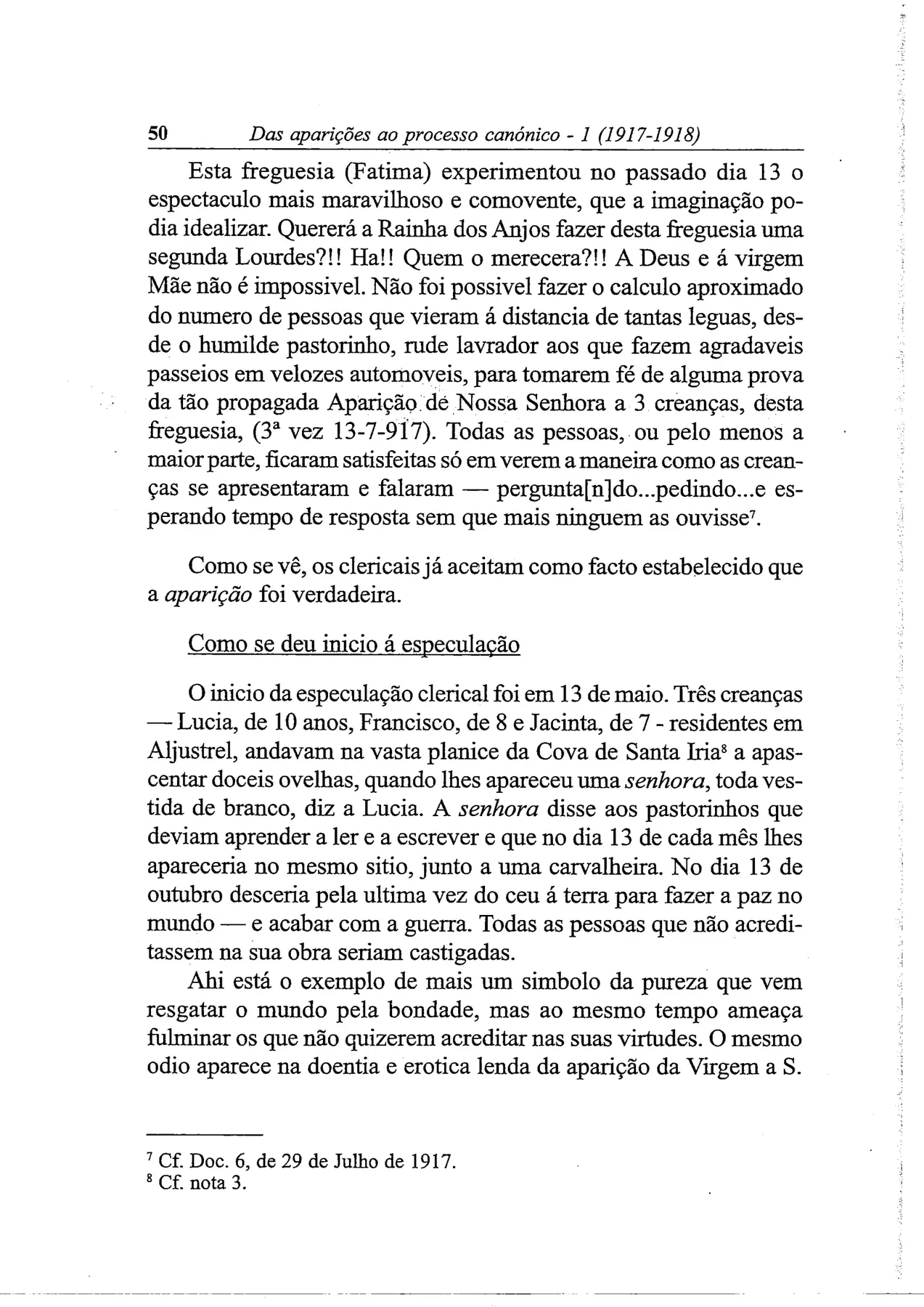
DCF Seleção, Doc. 18 (= DCF I, Doc. 16) · interrogation · 19 Oct 1917 (2 months later)View scans (2)Link
13 AugFirst-handSaw itInterrogation2 km awaySeers' words overheard
English

What did the Lady say in August?

– In August I didn't go there.

47th – But what did she say the following Sunday when she appeared to you at the place called Valinhos?

– At Valinhos she said that if we had not been arrested the miracle would not be so well known, and that St. Joseph would have come with the Child to give peace to the world, and Our Lord to give the blessing to the people.

48th – What else did She say?

– I asked her what should be done with the money that had been collected and she said we were to take it on two litters to Our Lady of the Rosary, on the days of the feast of Our Lady of the Rosary.

49th – Was it you who thought of asking that question?

– No; it was the person who had the money who told me to ask that question.

50th – Did the Lady say nothing more?

– I asked again for the sick and the sinners who had been recommended, and she said that some would be made better and others converted within a year.

That day I didn't ask her anything else.

Português (original)

Que disse a Senhora em agosto?

– Em agosto não fui lá.

47a – Mas que disse ela no domingo seguinte quando te apareceu no sítio dos Valinhos?

– Nos Valinhos disse que se não tivéssemos sido presas não seria o milagre tão conhecido e que teriam vindo S. José com o Menino dar a paz ao mundo e Nosso Senhor dar a bênção ao povo.

48a – Que mais disse Ela?

– Perguntei-lhe o que devia fazer ao dinheiro que se tinha juntado e ela disse que o levássemos em dois andores à Senhora do Rosário, nos dias das festas da Senhora do Rosário.

49a – Foste tu que te lembraste de fazer essa pergunta?

– Não; quem tinha o dinheiro é que me mandou fazer essa pergunta.

50a – A Senhora não disse mais nada?

– Tornei a pedir pelos doentes e pecadores recomendados e ela disse que uns seriam melhorados e outros convertidos dentro de um ano.

Nesse dia não lhe perguntei mais nada.

DCF Seleção, Doc. 22 (= DCF I, Doc. 17) · interrogation · 2 Nov 1917 (3 months later)View scanLink
13 AugSecond-handSaw itInterrogation2 km awaySeers' words overheard
As told by João Marto (brother of Francisco and Jacinta), questioned by Dr. Manuel Nunes Formigão
English

What was it Lúcia said to the Lady?
– She asked her what she had come here to do.
14th – Did you hear the Lady's answer?
– I didn't, but Lúcia waited a little while.
15th – Did Lúcia ask more questions?
– She did. She spoke again, but I don't remember what she said, except for the last question, which was whether she would bring my Manuel back here.
16th – Didn't Lúcia tell you afterwards what the Lady had said to her?
– She told me the same day near the holm-oak shrub, straight away on the way back, that if she had not been taken to the town (Vila Nova de Ourém) on the 13th, the miracle would not be so well known.

Português (original)

O que foi que a Lúcia disse à Senhora?
– Perguntou-lhe o que é que ela cá vinha fazer.
14a – Ouviste a resposta da Senhora?
– Não ouvi, mas a Lúcia esteve um bocadito à espera.
15a – A Lúcia fez mais perguntas?
– Fez. Tornou a falar, mas não me lembro do que disse, a não ser da última pergunta que foi se ela trazia cá o meu Manuel.
16a – A Lúcia não te contou depois o que a Senhora lhe tinha dito?
– Disse-me no mesmo dia ao pé da carrasqueira, logo de caminho, que, se não fosse levada para a aldeia (Vila Nova de Ourém) no dia 13, o milagre não seria tão conhecido.

DCF Seleção, Doc. 22 (= DCF I, Doc. 17) · interrogation · 2 Nov 1917 (3 months later)View scanLink
13 AugFirst-handInterrogation2 km awaySeers' words overheard
English

When I asked the girl Lúcia who had taught her to say what she has been saying, she answers that it was that Lady she saw at the Cova da Iria. When I tell her that whoever tells lies that cause as much harm as what she says causes – if it is a lie, since so many people come deceived – goes to hell, she answers that, if those who tell lies go to hell, she will not go to hell on that account, because she does not tell lies but only says what she saw and what the Lady said to her, and that if the people come it is because they want to, for she has not yet called anyone. I ask her whether the Lady had told her a secret. She answers yes, but that she will not tell it to me. After several questions about it, she answers: Look!... if you like... I'll go up there and ask the Lady whether She gives me leave to tell the secret, and if She gives me leave, then I'll tell you.

Português (original)

Ao interrogar a menina Lúcia sobre quem lhe tinha ensinado a dizer o que tem dito; responde que foi aquela Senhora que viu na Cova da Iria. Ao dizer-lhe que vai para o inferno quem diz mentiras que causam tanto prejuízo como o que causa o que ela diz – se fôr mentira, por tanta gente vir enganada – responde, que, se quem diz mentiras vai para o inferno, ela que não vai para o inferno por causa disso, porque não diz mentiras, mas só diz o que viu e o que a Senhora lhe disse, e que se o povo vem é porque quer, que ainda não chamou ninguém. Pergunto-lhe se a Senhora lhe tinha dito algum segredo. Responde que sim; mas, que me o não diz. Feitas várias interrogações sobre ele, responde: Olhe!... se quer... vou lá acima e pergunto à Senhora se Ela me dá licença para eu dizer o segredo e se Ela me der licença, então digo-lhe.

13 AugFirst-handSaw itInterrogation2 km awayFigures / visionsSeers' words overheard
English

On the twenty-first the girl Lúcia appeared before me and said that on the thirteenth, when she was taken by the administrator to Vila Nova de Ourém, where she stayed in the administrator's house until the fifteenth, she saw nothing extraordinary. On the nineteenth, which was a Sunday, she was pasturing the sheep at the place called Valinho with her cousin Francisco and a brother of his called João, older than Francisco, and seeing the air look like it did when they used to see the Lady, she asks her cousin João, offering him a vintém, to go and call Jacinta, who was at her parents' house. And as soon as she arrived the Lady appeared to them on top of a holm-oak shrub; that they all saw her except her cousin João, the brother of Francisco and Jacinta. And then she asked her:

– Well, what is it you want of me?

And the Lady answered her:

– I want to tell you to go back there to the Cova da Iria: if they had not made off with you to the Town (Vila Nova de Ourém), the miracle would be better known. Saint Joseph would have come with the Child Jesus to give peace to the world. Our Lord would have come to bless the people. Our Lady of the Rosary would come with a little angel on each side. Our Lady of Sorrows would come with an arch of flowers around her.

– That money you have, what do you want done with it? (It is the money from the alms offered.)

When this question had been asked, the Lady answered:

– That money... make two little litters; you carry one with three other girls like you, and go dressed in white, and let Francisco carry the other with three other boys like him; let them wear a white cape; take them to Our Lady of the Rosary and apply them to Her.

Having said this, she disappeared, rising up through the air. The first or second time she appeared to her, she asked her who she was – and the Lady answered that she would tell her on the last day. She also said that the second or third time she appeared to her, she taught her a prayer which she is in the habit of saying between the mysteries of the rosary when she says it at the Cova da Iria. – The prayer is: O my Jesus, forgive us and deliver us from the fire of hell:

take all the little souls to Heaven, especially those who most need it.

Português (original)

No dia vinte e um compareceu na minha presença a menina Lúcia e disse que no dia treze em que foi levada pelo administrador para Vila Nova de Ourém, e onde esteve, na casa do mesmo administrador, até ao dia quinze, não viu nada de extraordinário. No dia dezanove, que fôra domingo, andava a pastorear as ovelhas, no sítio do Valinho, com o primo Francisco e um irmão deste chamado João, mais velho que o Francisco, e vendo os ares semelhantes àqueles em que costumavam ver a Senhora, pede ao primo João, oferecendo-lhe um vintém, para ir chamar a Jacinta que estava em casa dos pais. E logo que esta chegou lhes apareceu a Senhora em cima de uma carrasqueira; que todos a viram, menos o primo João, irmão do Francisco e da Jacinta. E então que lhe perguntou:

– Então o que é que Vossemecê me quer?

E a Senhora lhe respondeu:

– Quero dizer-te que voltes lá à Cova da Iria: se não tivessem abalado contigo para a Aldeia (Vila Nova de Ourém), o milagre seria mais conhecido. Havia de vir S. José com o Menino Jesus dar a paz ao mundo. Havia de vir Nosso Senhor benzer o povo. Vinha Nossa Senhora do Rosário com um anjinho de cada lado. Vinha Nossa Senhora das Dores com um arco de flores à roda.

– Aquele dinheiro que Vossemecê tem, o que é que Vossemecê quer feito dele? (É o dinheiro das esmolas oferecidas).

Feita esta pergunta, a Senhora respondeu:

– Aquele dinheiro... façam dois andorzinhas; um leva-o tu e mais três meninas como tu e vão de branco, e outro leve-o o Francisco e mais três meninos como ele, levem uma capa branca, levem-nos à Senhora do Rosário e apliquem-nos a Ela.

Dito isto, desapareceu, elevando-se pelo ar acima. Da primeira ou segunda vez que lhe apareceu perguntou-lhe quem era, – e a Senhora respondeu que lho dizia no último dia. Disse também que da segunda vez ou terceira vez que lhe apareceu, lhe ensinou uma oração que costuma rezar, entre os mistérios do terço quando o reza, na Cova da Iria. – A oração é: Ó meu Jesus, perdoai-nos e livrai-nos do fogo do inferno:
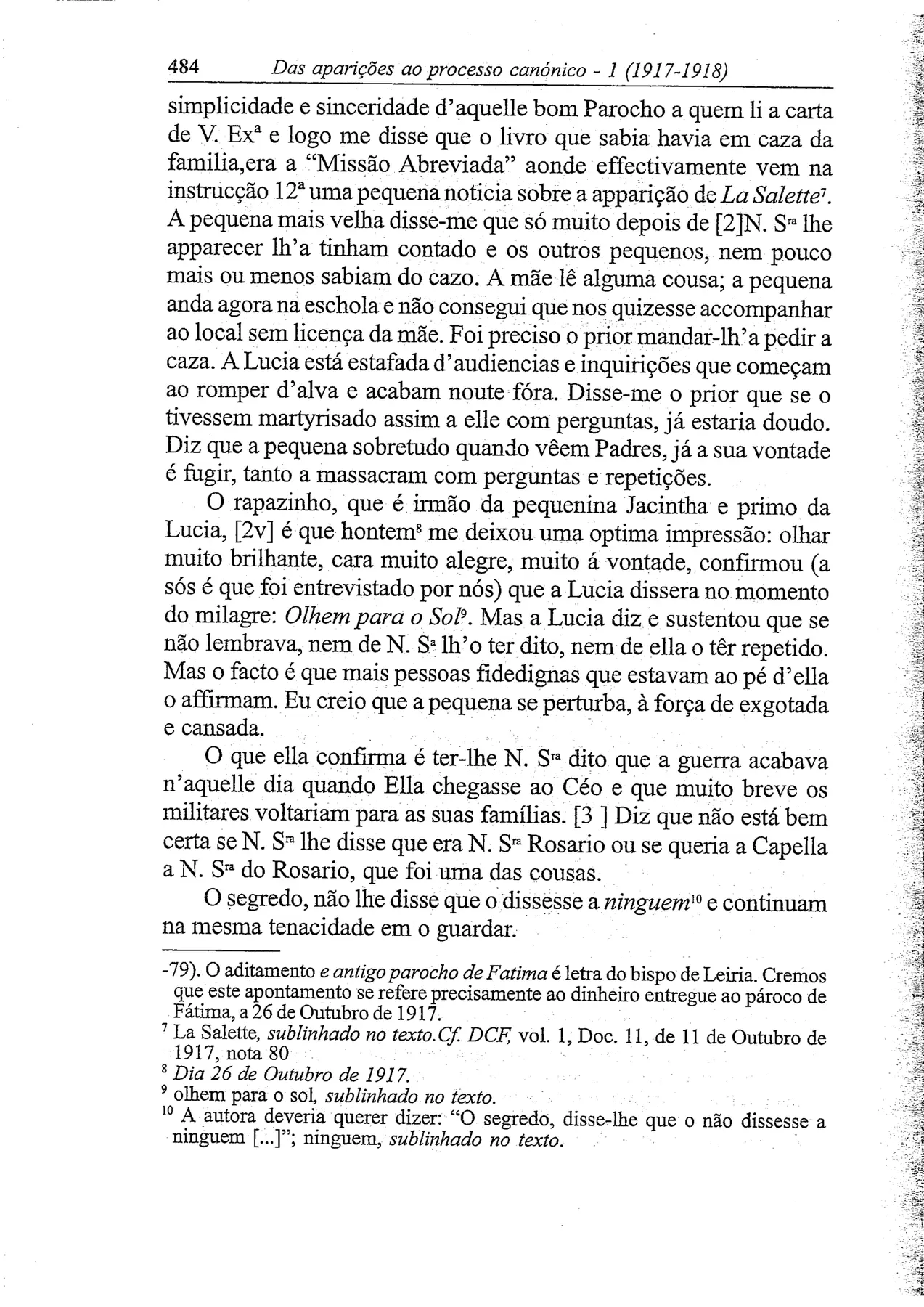
levai as alminhas todas para o Céu, principalmente aquelas que mais dele precisarem.

DCF Seleção, Doc. 36 (= DCF I, Doc. 31) · official · 21 Aug 1917 (8 days later)View scans (2)Link
13 AugSecond-handSaw itSworn deposition2 km awaySeers' words overheard
As told by Olímpia de Jesus (mother of Francisco and Jacinta), sworn deposition to the canonical commission (Dr. Manuel Nunes Formigão, relator)
English

Then the boy declared that Lúcia had told him that she was already seeing the signs in the Sky, that Our Lady was also appearing that day and that she wanted Jacinta to be there too.

Português (original)

Então o pequeno declarou que a Lúcia lhe dissera que já via os sinais no Céu, que Nossa Senhora também aparecia nesse dia e que queria que a Jacinta também lá estivesse.

DCF Seleção, Doc. 80 (= DCF II, Doc. 4) · deposition · 19 Aug 1917 (6 days later)View scanLink
13 AugSecond-handSaw itSworn deposition2 km awayFigures / visionsSeers' words overheard
As told by Maria Rosa (mother of Lúcia), sworn deposition to the canonical commission (Dr. Manuel Nunes Formigão, relator)
English

On the nineteenth, Lúcia came home at night carrying a little branch of holm oak in her hand and said that Our Lady had appeared to her a little before sunset, around the middle of the afternoon, at four o'clock, she having been at home with the cattle at noon. The mother took the branch and noticed that it smelled very sweet. The scent could not be compared with any other scent. She was unbelieving and was somewhat shaken, a little more convinced. Her daughter said that the Lady had said that they should keep going to the Cova da Iria and that she would work a miracle in October at the Cova da Iria, that the soldiers would come back from the war, that Our Lady of Sorrows would come, and other things besides.

Português (original)

No dia dezanove, a Lúcia chegou a casa à noite, trazendo na mão um raminho de azinheira e disse que Nossa Senhora lhe tinha aparecido um pouco antes do sol posto, aí pelo meio da tarde, às quatro horas, tendo estado ao meio-dia com o gado em casa. A mãe pegou no ramo e notou que cheirava muito bem. O cheiro não se podia comparar com nenhum outro cheiro. Ela era descrente e ficou um pouco quebrada, um pouco mais convencida. Disse a filha que a Senhora tinha dito que continuassem a ir à Cova da Iria e que havia de fazer um milagre em outubro na Cova da Iria, que os militares haviam de vir da guerra, que havia de vir Nossa Senhora das Dores e outras coisas mais.

DCF Seleção, Doc. 80 (= DCF II, Doc. 4) · deposition · 19 Aug 1917 (6 days later)View scanLink
13 Aug13 SepSecond-handSaw itSworn depositionSeers' words overheard
As told by Maria dos Santos (Maria da Capelinha, of Moita), sworn deposition to the canonical commission (Dr. Manuel Nunes Formigão, relator)
English

When the children went back to the Cova da Iria, she told them to ask the Lady what was to be done with the money. At Valinhos, when the apparition took place there on the nineteenth of the same month, the little girl did indeed put that question to the Lady, and the Lady said that they should make two litters and take them to the church of Our Lady of the Rosary. Many people were sorry that the money was not to be spent on something to be made at the place, and they told Lúcia to ask permission to build a chapel at the place, permission which the Lady gave on the thirteenth of September, on condition that half of the money on hand be given to Our Lady of the Rosary of Fátima. The sum of thirteen thousand five hundred and forty was collected by the thirteenth of September. And what the Lady ordered was carried out.
Português (original)

Quando as crianças voltaram à Cova da Iria, disse-lhes que perguntassem à Senhora o que havia de fazer ao dinheiro. Nos Valinhos, quando se deu ali a aparição, a dezanove do mesmo mês, a pequena fez realmente à Senhora essa pergunta e a Senhora disse que fizessem dois andores e os levassem para a igreja de Nossa Senhora do Rosário. Muitas pessoas ficaram com pena de que o dinheiro não se aplicasse em alguma coisa a fazer no local e disseram à Lúcia que pedisse autorização para fazer uma ermida no local, autorização que a Senhora deu em treze de setembro, com a condição de darem metade do dinheiro existente para a Senhora do Rosário da Fátima. Reuniu-se a quantia de treze mil quinhentos e quarenta, em treze de setembro. E cumpriu-se o que a Senhora ordenou.
13 AugOther 1917First-handSaw itInterrogation12 km away
English

In the month of August, did everything happen in the same way?". She answered: "In the month of August it was different. Before the 13th of August, my cousins and I were summoned to the Administration; my uncle did not take his children there, but I went with my father. The Administrator questioned me and insisted that I reveal the Lady's secret to him, which I did not do; after writing, he sent me away. On the thirteenth we were going to the place of the holm-oak shrub, when we were told that we first had to go to the parish priest's house. So we went, going up onto the veranda of the house. After we had been waiting for some time, the Administrator appeared and told us to get into a carriage, saying that we would get to the Cova da Iria faster that way.

My father said that we would go on foot, but the Administrator insisted it was better for us to go in the carriage, because we would be free of the crowd. Then, on my father's orders, I got into the carriage with my cousins. The carriage turned round and set off in the direction of Vila Nova de Ourém. "It isn't this way", I said, but the Administrator answered that we were going to Ourém to the parish priest's house and that we would still come back in time because we would be coming by motor car. When we reached Ourém, they shut us in a room and said that we would not leave there until we declared the secret that the Lady had confided to us. The next day3, an elderly lady questioned us about the secret; then they took us to the Administration, where we were questioned again, being offered gold coins to reveal the secret. We went back to the Administrator's house, where we had stayed the previous night, and in the afternoon we were questioned again about the secret. They took us to the jail, and threatened that we would stay there if we did not tell it. We went back to the Administration, and since we did not tell the secret, they promised they would fry us in oil. The Administrator had us taken out and told a man to get a cauldron of hot oil ready. Then he called Jacinta, saying she was the first to be burned. She went at once, without saying goodbye. They questioned her and put her in a room. Next they called Francisco; they told him that Jacinta had already been burned and that he would have the same fate if he did not declare the secret. They questioned him and sent him to the same room. Then it was my turn; they said that my cousins had already been burned and that I would have the same fate if I did not tell the secret. Although I thought it was true, I was not afraid. They sent me to join my cousins, and a man said that it would not be long before all three of us were burned. They took us to the Administrator's house, and there we spent that night in the same room. The next day4, it was almost the same thing: interrogations morning and afternoon, with many promises and threats. On the sixteenth5, we went again to the Administration at about ten o'clock, but they got nothing out of us, as on the other occasions. Then the Administrator had us get into a carriage, and left us at the parish priest's house, on the veranda.

Português (original)

No mês de agosto, passou-se tudo da mesma maneira?”. Respondeu: “No mês de agosto foi diferente. Antes do dia 13 de agosto, eu e meus primos fomos chamados à Administração; o meu tio não levou lá os filhos, mas eu fui com meu pai. O senhor Administrador interrogou-me, quis insistentemente que eu lhe revelasse o segredo da Senhora, o que eu não fiz; depois de escrever mandou-me embora. No dia treze iamos para o sítio da carrasqueira, quando nos disseram que primeiro tínhamos de ir a casa do Senhor Prior. Lá fomos, subindo para a varanda da casa. Depois de estarmos algum tempo à espera, apareceu o Senhor Administrador que nos mandou entrar para um carro, dizendo que assim íamos mais depressa para a Cova da Iria.

Meu pai disse que nós iamos a pé, mas o Senhor Administrador teimou que era melhor irmos no carro, porque íamos livres do povo. Então, por ordem de meu pai, subi para o carro com os meus primos. O carro deu uma volta e seguiu na direção de Vila Nova de Ourém. “Não é para este lado”, disse eu, mas o Senhor Administrador respondeu que íamos a Ourém a casa do Senhor Prior e que ainda viríamos a tempo porque vínhamos de automóvel. Quando chegámos a Ourém, fecharam-nos num quarto e disseram que não sairíamos dali enquanto não declarássemos o segredo que a Senhora nos confiou. No dia seguinte3, uma senhora de idade interrogou-nos sobre o segredo; depois levaram-

-nos para a Administração, onde fomos de novo interrogados, oferecendo-nos peças de ouro para revelarmos o segredo. Voltámos para casa do Senhor Administrador, onde tínhamos ficado na noite anterior e de tarde fomos outra vez interrogados sobre o segredo. Levaram-nos à cadeia, e ameaçaram-nos de lá ficar, se o não disséssemos. Tornámos para a Administração, e como não disséssemos o segredo, prometeram que nos iam fritar com azeite. O Senhor Administrador mandou-nos retirar e disse a um homem que aprontasse uma caldeira com azeite quente. Chamou depois a Jacinta, dizendo que era a primeira a ser queimada. Ela foi prontamente, sem se despedir. Interrogaram-na e meteram-na num quarto. Chamaram a seguir o Francisco; disseram-lhe que a Jacinta já estava queimada e que ele teria a mesma sorte se não declarasse o segredo. Interrogaram-no e mandaram-no para o mesmo quarto. Foi depois a minha vez; disseram que os meus primos já estavam queimados e que eu teria a mesma sorte, se não dissesse o segredo. Embora pensasse que era certo, não tive medo. Mandaram-me para ao pé dos meus primos, e um homem disse que não tardaria a sermos queimados todos três. Levaram-nos para casa do Administrador, e lá ficámos aquela noite no mesmo quarto. No dia seguinte4, foi quase a mesma coisa: interrogatórios de manhã e à tarde, com muitas promessas e ameaças. No dia dezasseis5, fomos outra vez à Administração pelas dez horas, mas nada conseguiram de nós, como das outras vezes. Então o Senhor Administrador mandou-nos subir para um carro, e deixou-nos em casa do Senhor Prior, na varanda.

Editor's notes (3)

3 14 August.

4 15 August.

5 Lúcia mistakenly adds a day. The return to Fátima was on 15 August, a holiday, the Assumption of Our Lady.

3 Dia 14 de agosto.

4 Dia 15 de agosto.

5 Lúcia acrescenta, por engano, um dia. O regresso a Fátima foi no dia 15 de agosto, feriado, Assunção de Nossa Senhora.

DCF Seleção, Doc. 82 (= DCF II, Doc. 8) · interrogation · 8 Jul 1924 (7 years later)View scans (2)Link
13 AugOther 1917First-handSaw itInterrogationFigures / visionsSeers' words overheard
English

When we got home, we went straight away with the sheep to a place called Valinho together with Francisco and João. Jacinta had stayed at home. There was a flash of lightning, and I sent João, her brother, to fetch Jacinta. João did not want to go, and I promised him two vinténs to go. When Jacinta arrived, I told her there had been a flash of lightning and that the Lady was probably going to appear. We went down by a short cut, and saw the Lady on top of a holm oak. "What do you want of me?", I asked. She said: – "I want you to keep going to the Cova da Iria for the rest of the months until October and to say the Rosary". I asked further: "What is to be done with the money that was at the Cova da Iria?" Maria do Rosário, from Moita6, had taken charge of it and since neither my parents nor my cousins' parents wanted to keep it, she told me to ask the Lady what should be done with that money. The Lady answered: "Make two litters, for the day of the feast of Our Lady of the Rosary; Francisco is to carry one with three other boys, and the two of you are to carry the other with two other girls". I asked her for the cure of some people, and She said that within a year some would be cured. I also asked her for a miracle so that the people would believe, and She said that in the last month she would make a sign in the sun, so that everyone would believe; that the Child Jesus would come with Saint Joseph to give the blessing to the world, and Our Lady of the Rosary, Our Lady of Sorrows; that Our Lord would come to give peace to the world. Then she disappeared as in the other months towards the east."

– "Did all of you see the Lady?" – She answered: – "Jacinta and I saw and heard; Francisco, as on the other occasions, saw her but did not hear what she said, and João neither saw nor heard anything"

– "Did many people come to your house asking about the Lady?". She answered: "many people came, and even many priests, some of whom called me a fraud".

Português (original)

Chegando a nossa casa, fomos logo com as ovelhas para um sítio chamado Valinho na companhia do Francisco e do João. A Jacinta tinha ficado em casa. Deu um relâmpago, e eu mandei chamar a Jacinta pelo João, irmão dela. O João não queria ir, e eu prometi-lhe dois vinténs para ele ir. Quando chegou a Jacinta, disse-lhe que tinha dado um relâmpago e que provavelmente a Senhora ia aparecer. Descemos por um atalho, e vimos a Senhora em cima duma azinheira. “O que é que Vossemecê me quer?”, perguntei eu. Ela disse: – “Quero que continuem a ir à Cova da Iria o resto dos meses até outubro e que rezem o Terço”. Perguntei mais: “O que se há de fazer ao dinheiro que estava na Cova da Iria?” A Maria do Rosário, da Moita6, tinha tomado conta dele e como nem os meus pais nem os dos meus primos quisessem ficar com ele, disse-me a mim que perguntasse à Senhora o que se havia de fazer desse dinheiro. A Senhora respondeu: “Façam dois andores, no dia da festa da Senhora do Rosário; um leve-o o Francisco com mais três rapazitos, o outro levem-no as duas com mais duas meninas”. Pedi-lhe a cura de algumas pessoas, e Ela disse que dentro dum ano algumas seriam curadas. Pedi-lhe também um milagre para o povo acreditar e Ela disse que no último mês fazia um sinal no sol, que todos haviam de acreditar; que com São José viria o Menino Jesus dar a bênção ao mundo, e Nossa Senhora do Rosário, Nossa Senhora das Dores; que Nosso Senhor viria dar a paz ao mundo. Depois desapareceu como nos outros meses para o lado do nascente.”

– “Viram todos a Senhora?” – Respondeu: – “Eu e a Jacinta vimos e ouvimos; o Francisco como das outras vezes viu-a, mas não ouviu o que ela disse, e o João não viu nem ouviu nada”

– “Foi muita gente a tua casa perguntar pela Senhora?”. Respondeu: “foi muita gente, e até muitos sacerdotes, alguns dos quais me trataram de intrujona”.

Editor's notes (4)

3 14 August.

4 15 August.

5 Lúcia mistakenly adds a day. The return to Fátima was on 15 August, a holiday, the Assumption of Our Lady.

6 This is Maria dos Santos or Maria Carreira, from Moita.

3 Dia 14 de agosto.

4 Dia 15 de agosto.

5 Lúcia acrescenta, por engano, um dia. O regresso a Fátima foi no dia 15 de agosto, feriado, Assunção de Nossa Senhora.

6 Trata-se de Maria dos Santos ou Maria Carreira, da Moita.

DCF Seleção, Doc. 82 (= DCF II, Doc. 8) · interrogation · 8 Jul 1924 (7 years later)View scans (2)Link
13 AugOther 1917Second-handSaw itNote12 km away
As told by Canonical commission report (Dr. Manuel Nunes Formigão, relator)
English

As soon as they arrived at Ourém, the children were shut in a room and told that they would not leave it until they declared the secret that the Lady had confided to them. The next day, after being questioned by a lady, they were taken to the council administration and questioned again, someone even offering them gold pieces to reveal the secret. In the afternoon they were again questioned about the secret. They were taken to the jail and threatened that they would be made to stay there if they did not tell it. As they would not tell it, they were threatened that they would be fried in oil. At that point, in the presence of the children, the administrator told an individual who was nearby to get ready a cauldron of hot oil. He then called Jacinta, saying that she was the first to be burned. She went promptly, and Lúcia, in her deposition, adds ingenuously that she went without saying goodbye. They questioned her and put her in a room. Next they called Francisco and told him that Jacinta was already burned and that he would suffer the same fate if he did not declare the secret. They questioned him and sent him to the same room. Then it was Lúcia's turn. They told her that her cousins were already burned and that she would suffer the same fate if she did not tell the secret. Although she thought it was true, the seer was not afraid, as she herself declares. They sent her to join her cousins, and a man said that it would not be long before all three were burned. They were taken [28v] to the administrator's house, and there they spent one more night in the same room. The next day almost the same thing happened: interrogations morning and afternoon, with many promises and threats. On the sixteenth they went again to the administration, at about ten o'clock, but nothing was obtained from the seers, as on the other occasions, until finally the administrator went to take them to the parish residence of Fátima.

Português (original)

Logo que chegaram a Ourém, as crianças são fechadas num quarto e dizem-lhes que não sairiam dali, enquanto não declarassem o segredo que a Senhora lhes tinha confiado. No dia seguinte, depois de interrogadas por uma senhora, são conduzidas à administração do concelho e novamente interrogadas, havendo quem lhes ofereça peças de ouro para revelarem o segredo. À tarde foram outra vez interrogadas sobre o segredo. Levaram-nas à cadeia e ameaçaram-nas de lá as fazerem ficar, se o não dissessem. Como elas o não quisessem dizer, ameaçaram que as iam fritar em azeite. Nessa altura, na presença das crianças, o administrador disse a um indivíduo que estava próximo que aprontasse uma caldeira com azeite quente. Chamou depois a Jacinta, dizendo que era a primeira a ser queimada. Ela foi prontamente, e a Lúcia, no seu depoimento, acrescenta ingenuamente que foi sem se despedir. Interrogaram-na e meteram-na num quarto. Chamaram em seguida o Francisco, disseram-lhe que a Jacinta já estava queimada e que ele teria a mesma sorte, se não declarasse o segredo. Interrogaram-no e mandaram-no para o mesmo quarto. Foi depois a vez da Lúcia. Disseram-lhe que os primos já estavam queimados e que ela teria a mesma sorte, se não dissesse o segredo. Embora pensasse que era certo, a vidente não teve medo, como ela própria declara. Mandaram-na para junto dos primos e um homem disse que não tardariam a ser queimados todos três. Levaram-nos [28v] para casa do administrador e lá ficaram mais uma noite no mesmo quarto. No dia seguinte, sucedeu quase a mesma coisa: interrogatórios de manhã e de tarde, com muitas promessas e ameaças. No dia dezasseis foram outra vez à administração, pelas dez horas, mas nada conseguiram dos videntes, como das outras vezes, até que por fim o administrador os foi levar à residência paroquial de Fátima.

Editor's notes (2)

21 The writer of the report meant to refer to the 1st National Eucharistic Congress, held in Braga from 2 to 6 July 1924.

22 Three months (May, June and July).

21 O relator queria referir-se ao 1º Congresso Eucarístico Nacional, realizado em Braga, de 2 a 6 de julho de 1924.

22 Três meses (maio, junho e julho).

DCF Seleção, Doc. 120 (= DCF II, Doc. 9) · official · 8 Jul 1924 (7 years later)View scans (2)Link
13 Aug13 SepSecond-handSaw itNoteSeers' words overheard
As told by Canonical commission report (Dr. Manuel Nunes Formigão, relator)
English

On the sixteenth of August, the day of the fourth apparition, after the sad episodes at Ourém, Lúcia asked the Lady for a miracle so that the people would believe, and She said that in the last month she would make a sign in the sun and that everyone would believe. After what had happened in the seat of the council, and in the face of the doubts that so many people expressed about the reality and supernatural character of the apparitions, it was natural that Lúcia should think of asking the Lady for evident proof that she was not a liar, as many claimed. If she did not think of it, someone would certainly have advised her to make that request. On the thirteenth of September Lúcia pressed for the fulfilment of the promise. Here are the exact words that appear in the report on fol. 526: "I asked again [29] that she would work a miracle for the people to believe, because they said I was a humbug who ought to be hanged and burned. The Lady gave me the same answer as the other time".

Português (original)

A dezasseis de agosto, dia da quarta aparição, depois dos tristes episódios de Ourém, a Lúcia pediu à Senhora um milagre para que o povo acreditasse, e Ela disse que no último mês faria um sinal no sol e que todos haviam de acreditar. Depois do que se passara na sede do concelho e em face das dúvidas que tantas pessoas manifestavam acerca da realidade e sobrenaturalidade das aparições, era natural que a Lúcia se lembrasse de pedir à Senhora uma prova evidente de que ela não era mentirosa, como muitos pretendiam. Se não se lembrou, decerto alguém a aconselharia a fazer esse pedido. No dia treze de setembro, a Lúcia insistiu pelo cumprimento da promessa. Eis as palavras textuais que constam do relatório a fls. 526: “Pedi outra vez [29] que fizesse um milagre para o povo acreditar, porque diziam que eu era uma intrujona que devia ser enforcada e queimada. A Senhora deu-me a mesma resposta da outra vez”.

Editor's notes (1)

26 This is the interrogation of Lúcia on 8 July 1924 (cf. Doc. 82).

26 Trata-se do interrogatório a Lúcia, no dia 8 de julho de 1924 (cf. Doc. 82).

DCF Seleção, Doc. 120 (= DCF II, Doc. 9) · official · 8 Jul 1924 (7 years later)View scanLink
13 SepFirst-handSaw itLater recollectionFigures / visionsSeers' words overheard
English

Around noon there we were waiting for the Lady to come. Then there was a flash of lightning and the Lady appeared. What do you want of me today? I want you to go on coming here the rest of the months and to go on praying the rosary every day; I want to ask you to work a miracle so that all the people will believe; in the last month I will make a sign in the sun so that they believe; and Saint Joseph will come with the [4] child Jesus to give the blessing to the world. Our Lady of the Rosary. Then Our Lady of Sorrows and Our Lord. I want to ask you for some people who asked me; for the Lady to cure them some lame others dumb others blind and others sick in a year's time some will be cured. If she told me more things this month I don't remember. She went up towards the east as in all the other months.

Português (original)

Pela hora do meio dia lá estávamos á espera que a Senhora viesse. Deu então um relampago e apareceu a Senhora. O que é que vossemece me quer hoje? Quero que continuem a vir aque o resto dos meses e que continuem a rezar o terço todos os dias; quero lhe pedir para fazer um milagre para que todo o povo aquerdite; no ultimo mez farei um sinal no sol para que aquerditem; e vira Santo José com o [4] menino Jesus dar a bença ao mundo. Nossa Senhora do Rosario. Depois Nossa Senhora das Dôres e Nosso Senhor. Quero lhe pedir por algumas peçoas que me pediram; para a Senhora as curar umas cochas outras mudas outras cega e outras duensas daqui a um ano alguma serem curadas. Se me disse mais coizas neste mez não me lembro. Subio para o lado do nascente como todos os outros mezes.

DCF III-3, Doc. 685 · other · 5 Jan 1922 (4 years later)View scans (2)Link
13 SepFirst-handSaw itInterrogationFigures / visionsSeers' words overheard
English

5th Apparition: 13-9-917 – I called Lúcia before me on the 15th, and she said that on the 13th she saw the same woman dressed in white who seemed to her to be the same one she saw the other times; she saw little more than the face, at which she looked continually so as to pay attention to what she was saying; she comes from the east; she says she saw a flash of lightning, then she saw that woman arrive at the holm-oak shrub, and she says that she asked:

– What is it you want?

– I want to tell you to go on always saying the rosary to Our Lady of the Rosary, that she may ease the war, for the war is about to end1; on the last day Saint Joseph will come to give peace to the world and Our Lord to give the blessing to the people; that you come here for 13 October.

– Here is this little boy who is dumb and deaf, will you make him better.

– A year from now he would find himself somewhat better.

– I had many requests here, some for you to convert them, others for you to make them better.

– I will make some better, others not, because Our Lord does not want to believe in them.

– The people would very much like a little chapel here.

– With half the money they have collected up to today let them make the litters and give them to Our Lady of the Rosary; let the other half be to help with the little chapel.

I offered her two letters and a glass of scented water.

– They gave me this, do you want them.

– That is not fitting for up in heaven.

And she went off towards the east, and I said to the people: if you want to see her, turn that way.

Português (original)

5ª Aparição: 13-9-917 – Chamei à minha presença a Lúcia no dia 15 que disse que no dia 13 viu a mesma mulher vestida de branco que lhe pareceu ser a mesma que viu das outras vezes; pouco mais viu do que a cara para onde olhava continuamente para tomar sentido no que ela dizia; vem do nascente; diz que viu um relâmpago, depois viu aquela mulher a chegar à carrasqueira e diz que perguntou:

– O que é que vossemecê quer?

– Quero dizer-te que continues a rezar sempre o terço à Senhora do Rosário, que abrande ela a guerra, que a guerra está para acabar1; para o último dia há de vir S. José dar a paz ao mundo e Nosso Senhor dar a bênção ao povo; que venhas cá para o dia 13 de outubro.

– Está aqui este menino que é mudo e mouco, se vossemecê o melhora.

– Daqui a um ano se acharia com algumas melhoras.

– Tinha aqui muitos pedidos, uns para os converter outros para os melhorar.

– Melhoro alguns, outros não porque Nosso Senhor não quer crer neles.

– O povo muito gostava aqui duma capelinha.

– Metade do dinheiro que juntaram até hoje façam os andores e deem-os à Senhora do Rosário; a outra metade seja para ajuda da capelinha.

Ofereci-lhe duas cartas e um vidro com água de cheiro.

– Deram-me isto, se vossemecê os quer.

– Isso não é conveniente lá para o céu.

E foi-se para o nascente e eu disse ao povo: se a querem ver voltem-se para acolá.

Editor's notes (1)

1 The First World War (1914-1918) ended with the armistice of 11 November 1918. The peace treaty was signed by the belligerent powers at Versailles on 28 June 1919.

1 A primeira guerra mundial (1914-1918) terminou com o armistício de 11 de novembro de 1918. O tratado de paz foi assinado pelas potências beligerantes, em Versalhes, a 28 de junho de 1919.

DCF Seleção, Doc. 8 (= DCF I, Doc. 5) · interrogation · 15 Sep 1917 (2 days later)View scanLink
13 SepFirst-handSaw itInterrogationSeers' words overheard
English

She told them that she would appear in October, first under the representation of Our Lady of Sorrows and then under that of Our Lady of the Rosary. She recommended that they pray the rosary to Our Lady of the Rosary so that the war, which was about to end, might abate. She also told them that in October Saint Joseph would come too, with the Child Jesus, to give peace to the world, and her Divine Son to give the blessing to the people.

Português (original)

Disse-lhes que apareceria em outubro primeiro sob a representação de Nossa Senhora das Dores e depois sob a de Nossa Senhora do Rosário. Recomendou-lhes que rezassem o terço a Nossa Senhora do Rosário para que abrandasse a guerra que estava para acabar. Disse-lhes também que em outubro viria também S. José com o Menino Jesus para dar a paz ao mundo e seu Divino Filho para dar a bênção ao povo.

DCF Seleção, Doc. 9 (= DCF I, Doc. 45) · interrogation · 17 Sep 1917 (4 days later)View scanLink
13 SepFirst-handSaw itInterrogationSeers' words overheard
English

What did the Lady say in September?

– I don't remember what She said.

Perhaps it was that day that she said that on 13 October St. Joseph would come with the Child, and Our Lord to give the blessing to the people, and Our Lady of the Rosary with a little angel on each side, and Our Lady of Sorrows with an arch of flowers.

Português (original)

O que disse a Senhora em setembro?

– Não me recordo do que Ela disse.

Talvez fôsse nesse dia que disse que em 13 de outubro havia de vir S. José com o Menino e Nosso Senhor dar a bênção ao povo e Nossa Senhora do Rosário com um anjinho de cada lado e Nossa Senhora das Dores com um arco de flores.

DCF Seleção, Doc. 22 (= DCF I, Doc. 17) · interrogation · 2 Nov 1917 (7 weeks later)View scanLink
13 SepFirst-handSaw itInterrogationFigures / visionsSeers' words overheard
English

On the fifteenth of the month of September the seer Lúcia appeared before me at the parish residence, accompanied by her mother. I proceeded to the questioning. She said that on the thirteenth of the current month of September she went with her cousins Francisco and Jacinta to the place called Cova da Iria, and at the usual hour she saw a flash of lightning and then saw the Lady arrive whom she had seen the other times; that she seemed the same to her, dressed in white, but that she hardly looked at anything but the face, so as to pay attention to what She was saying. And she asked her:

– What is it you want of me?

And the Lady answered:

– I want to tell you to go on saying the rosary always to Our Lady of the Rosary, that She may ease the war; for the war is about to end. On the last day Saint Joseph will come with the Child Jesus to give peace to the world, and Our Lord to give the blessing to the people. And that you come here for the thirteenth of October.

Here is this little girl who is dumb and deaf, will you make her better?! Lúcia said to her. And that the Lady answered her, saying that a year from now she would find some improvement.

I have many requests here – some for conversion and others for healing!...

And the Lady answered her:

– I will make some better, others not, because Our Lord does not want to believe in them.

– The people would very much like a little chapel here!

– With half the money they have collected up to today let them make the litters and take them to Our Lady of the Rosary, and let the other half be to help with the Little Chapel – the Lady answered her.

Lúcia further said that she offered her two letters and a glass – a small flask – of scented water, which had been given to her by a man from the parish of Olival, and that when she offered them she said to her:

– They gave me this... do you want them?!...

And the Lady answered:

– That is not fitting for up in Heaven.

That, having said this, she rose, going towards the east.

And then she – Lúcia – turned to the people and says: if you want to see Her, turn that way. – And she points to where She was going.

Português (original)

No dia quinze do mês de setembro, compareceu na minha presença e residência paroquial a vidente Lúcia acompanhada de sua mãe. Procedi ao interrogatório. A qual disse que no dia treze do corrente mês de setembro, se dirigiu com seus primos, Francisco e Jacinta, ao sítio chamado Cova da Iria, e à hora do costume viu um relâmpago e logo viu chegar a Senhora que tinha visto das outras vezes; que lhe parecia a mesma vestida de branco, mas que para pouco mais olhava do que para o rosto, para tomar sentido no que Ela dizia. E lhe perguntou:

– O que é que Vossemecê me quer?

E a Senhora respondeu:

– Quero-te dizer que continues a rezar o terço sempre à Senhora do Rosário, que abrande Ela a guerra; que a guerra está para acabar. Para o último dia há-de vir S. José com o Menino Jesus dar a paz ao mundo e Nosso Senhor dar a bênção ao povo. E que venhas cá para o dia treze de outubro.

Está aqui esta menina que é muda e mouca, se Vossemecê a melhora?! Lhe disse a Lúcia. E que a Senhora lhe respondeu, dizendo que daqui a um ano acharia algumas melhoras.

Tenho aqui muitos pedidos – uns para converter e outros para os melhorar!...

E a Senhora lhe respondeu:

– Melhoro uns, outros não, porque Nosso Senhor não quer crer neles.

– O povo muito gostava aqui duma capelinha!

– Metade do dinheiro que ajuntaram até hoje façam os andores e levem-nos à Senhora do Rosário, e outra metade seja para ajuda da Capelinha – lhe respondeu a Senhora.

Disse mais a Lúcia que lhe ofereceu duas cartas e um vidro – pequeno frasco – com água de cheiro, que lhe foram apresentadas por um homem da freguesia do Olival, e que quando lhas oferecia lhe disse:

– Deram-me isto... se Vossemecê as quer?!...

E a Senhora respondeu:

– Isso não é conveniente lá para o Céu.

Dito isto, que se elevou indo para o lado do nascente.

E então ela – a Lúcia – que se voltou para o povo e que diz: se A querem ver voltem-se para acolá. – E aponta para onde Ela ia.

DCF Seleção, Doc. 36 (= DCF I, Doc. 31) · official · 15 Sep 1917 (2 days later)View scanLink
13 SepSecond-handSaw itSworn depositionSeers' words overheard
As told by Olímpia de Jesus (mother of Francisco and Jacinta), sworn deposition to the canonical commission (Dr. Manuel Nunes Formigão, relator)
English

She thinks she heard Lúcia say that the Lady had advised her to learn to read.

Português (original)

Parece-lhe ter ouvido à Lúcia que a Senhora lhe tinha recomendado que aprendesse a ler.

13 SepSecond-handSaw itSworn depositionSeers' words overheard
As told by Maria dos Santos (Maria da Capelinha, of Moita), sworn deposition to the canonical commission (Dr. Manuel Nunes Formigão, relator)
English

On the thirteenth of September the deponent went back to the place again. At Valinhos Lúcia asked the Lady, at the deponent's request, whether Our

Lady had appeared to anyone else at the Cova da Iria, and the Lady answered that it was not she but an angel, the figure that Carolina, the deponent's youngest daughter, aged twelve, and a little girl of seven from Espite saw on the twenty-eighth of July near the holm oak, of small stature, very beautiful, with fair hair, a figure which Carolina afterwards saw on top of the holm oak.

Português (original)

Em treze de setembro, a depoente voltou de novo ao local. Nos Valinhos perguntou a Lúcia à Senhora, a pedido da depoente, se Nossa

Senhora tinha aparecido a mais alguém na Cova da Iria, e a Senhora respondeu que não era ela, mas sim um anjo, o vulto que a Carolina, filha mais nova da depoente, de doze anos, e uma pequena de sete anos, de Espite, viram a vinte e oito de julho junto da azinheira, de pequena estatura, muito lindo, de cabelo loiro, vulto que depois a Carolina viu em cima da azinheira.

13 SepFirst-handSaw itInterrogationFigures / visionsSeers' words overheard
English

Did you go to the Cova da Iria in the month of September?". She answered: – "I went there several times because every so often people came to ask us to go there and say the rosary with them. On the thirteenth I also went there, accompanied by a great crowd; my cousins were already there with many people. At around noon there was a flash of lightning and the Lady appeared as on the other occasions. I asked: "What do you want of me?". She answered: – "I want you to come here next month and to keep saying the Rosary". At the suggestion of Maria do Rosário6, I asked whether She wanted them to build a little chapel there, and She said they should build a little chapel there in honour of Our Lady of the Rosary. I asked for the conversion and cure of some people and She answered that within a year some would be cured and others not.

– "And in the month of September did nothing else happen?". She answered: – "I asked again that she work a miracle so that the people would believe, because they were saying I was a fraud who ought to be hanged and burned. The Lady gave me the same answer as the other time; she withdrew as usual".

Português (original)

Foste à Cova da Iria no mês de setembro?”. Respondeu: – “Fui lá várias vezes porque a cada passo algumas pessoas nos vinham pedir para lá irmos rezar com elas o terço. No dia treze também lá fui acompanhada por muito povo; já lá estavam os meus primos com muita gente. Pela hora do meio dia deu um relâmpago e a Senhora apareceu como das outras vezes. Eu perguntei: “O que é que Vossemecê me quer?”. Ela respondeu: – “Quero que venham aqui no mês seguinte e que continuem a rezarem o Terço”. Por lembrança da Maria do Rosário6, perguntei se Ela queria que fizessem ali uma capelinha, e Ela disse que fizessem ali uma capelinha em honra de Nossa Senhora do Rosário. Pedi a conversão e a cura de algumas pessoas e Ela respondeu que dentro dum ano algumas seriam curadas e outras não.

– “E no mês de setembro não aconteceu mais nada?”. Respondeu: – ”Pedi outra vez que fizesse um milagre para o povo acreditar, porque diziam que eu era uma intrujona que devia ser enforcada e queimada. A Senhora deu-me a mesma resposta da outra vez; retirou-se como de costume”.

Editor's notes (1)

6 This is Maria dos Santos or Maria Carreira, from Moita.

6 Trata-se de Maria dos Santos ou Maria Carreira, da Moita.

DCF Seleção, Doc. 82 (= DCF II, Doc. 8) · interrogation · 8 Jul 1924 (7 years later)View scanLink
13 Sep13 OctSecond-handSaw itNoteSeers' words overheard
As told by Canonical commission report (Dr. Manuel Nunes Formigão, relator)
English

Lúcia de Jesus Santos, the principal protagonist of the apparitions of Fátima, stated on the twenty-seventh of September, nineteen hundred and seventeen, that shortly after the following thirteenth of October peace would be granted to the world. On the 13th of October she declared that the Apparition had assured her that the war would end that very day. When a priest asked the seer, shortly after the apparition, whether the Lady had said that the great European conflict would end soon, and not on that day, she contradicted him, insisting that the Vision had stated that the war would end on that very thirteenth, because she had used the word today. "She said that the war ends today, today" were the seer's exact words.

Português (original)

Lúcia de Jesus Santos, a principal protagonista das aparições de Fátima afirmou no dia vinte e sete de setembro de mil novecentos e dezassete que pouco depois do dia treze de outubro seguinte seria concedida a paz ao mundo. No dia 13 de outubro declarou que a Aparição assegurara que a guerra acabava nesse mesmo dia. Tendo um sacerdote perguntado à vidente, pouco depois da aparição, se a Senhora dissera que o grande conflito europeu terminaria brevemente, e não naquele dia, ela contestou, insistindo em que a Visão havia afirmado que a guerra acabava nesse mesmo dia treze, porque empregara a palavra hoje. “Ela disse que a guerra acaba hoje, hoje” foram as palavras textuais da vidente.

DCF Seleção, Doc. 120 (= DCF II, Doc. 9) · official · 13 Oct 1917 (4 weeks later)View scanLink
13 SepSecond-handSaw itNoteSeers' words overheard
As told by Canonical commission report (Dr. Manuel Nunes Formigão, relator)
English

On the twenty-seventh of September, nineteen hundred and seventeen, and therefore sixteen days in advance, the seer Lúcia de Jesus declared to the author of the pamphlet "Os Episódios Maravilhosos de Fátima", in the presence of several people, among them Dona Adelaide Braamcamp de Melo Breyner and Dona Maria de Jesus do Rosário, of Santarém, in the seer's own dwelling house in Aljustrel, that the Lady who appeared to her had said that on the thirteenth of October she would make a sign so that all the people would believe that she really appeared.

Português (original)

No dia vinte e sete de setembro de mil novecentos e dezassete, e portanto com dezasseis dias de antecedência, a vidente Lúcia de Jesus declarou ao autor do folheto “Os Episódios Maravilhosos de Fátima”, na presença de várias pessoas, entre elas as senhoras D. Adelaide Braamcamp de Melo Breyner e D. Maria de Jesus do Rosário, de Santarém, na própria casa de habitação da vidente, em Aljustrel, que a Senhora que lhe aparecia tinha dito que no dia treze de outubro faria um sinal para que todo o povo acreditasse que ela realmente aparecia.

DCF Seleção, Doc. 120 (= DCF II, Doc. 9) · official · 27 Sep 1917 (2 weeks later)View scanLink
13 SepSecond-handNote
As told by Canonical commission report (Dr. Manuel Nunes Formigão, relator)
English

On the thirteenth of September, after the apparition, a Spanish gentleman who was present offered Lúcia a small medal of white metal of little value, which at first she did not want to accept, supposing it was a silver coin.

Português (original)

A treze de setembro, depois da aparição, um cavaleiro espanhol, que estava presente, ofereceu a Lúcia uma pequena medalha de metal branco de pouco valor que ela a princípio não queria aceitar, supondo que era uma moeda de prata.

13 OctFirst-handSaw itNoteFigures / visionsSeers' words overheard
English

The eldest little girl, Lucia, [2v] aged 10, asks the Virgin aloud: who are you, ma'am? What do you want, ma'am? The answers are not heard, but when the sun resumes its usual course the child turns to the people and, held up by a man7 who holds her in his arms, repeats the words of the Lady

I am the Virgin of the Rosary; I want a chapel to be built for me here.

Tell the people to mend their ways and stop offending God; tell them that peace is made today and that your soldiers will come back

The two other children, Francisco and Jacyntha, see the Virgin but do not speak to her.

Português (original)

A pequena mais velha, Lucia, [2v] de 10 anos, pergunta a Virgem em voz alta quem é vocês-mecê? Vocês-mecê o que quer? As respostas não se ouvem, mas quando o sol retoma o seu curso habitual a creança volta-se para o povo e ao colo de um homem7 que a segura nos braços repete as palavras da Senhora

Eu sou a Virgem do Rosario quero que me edifiquem aqui uma capella.

Diz ao povo que se emende de attentar contra Deus diz-lhe que hoje se faz a paz e que os vossos militares hão de voltar

As duas outras creanças Francisco e Jacyntha, vêem a Virgem mas não lhe falam.

Editor's notes (1)

7 This is Dr. Carlos de Azevedo Mendes (cf. DCF, vol. 1, Doc. 56, of p.13 October 1917, note 10, and DCF, vol. 2, Doc. B, of 13 September 1927).

7 Trata-se do Dr. Carlos de Azevedo Mendes (cf. DCF, vol. 1, Doc. 56, de p.13 de Outubro de 1917, nota 10 e DCF, vol. 2, Doc. B, de 13 de Setembro de 1927).

13 OctSecond-handSaw itLetter2 km awayFigures / visionsSeers' words overheard
As told by Maria Francisca d'Assis, from what Ana and Ermelinda Saraiva (and Dr João do Vale) heard
English

When the little girl went back home, Dr. João do [7] Val9 went to speak to her, as did the Saraivas.

She answered everything with the greatest simplicity and said this: “that Our Lady was asking men to make an effort to be better, for her beloved son was already angry, that the war would end soon and that the Portuguese soldiers would return to their homes. Above all she recommended that they pray a great deal. If they wished, they should build a little cha-[8] pel there, and venerate her under the name of Oura Lady of the Rosary”.

When questions were put to her about Oura Lady, she said that she was lovely, had a white dress veryto straight (it must be a tunic), barefoot, and on her head a very long blue kerchief (mantle). Her voice is very beautiful, and she called the little girl by her name: “Lucia”.

The little girl only answers what she is asked, but without any embarrassment, [9] though before the apparition she was very shy.

She says, as on the other occasions too, that the Lady tells her a secret, which she tells no one, not even her mother.

Português (original)

Quando a pequena voltou para casa o Dr. João do [7] Val9 foi-lhe falar assim como as Saraivas.

Respondia a tudo com a maior das simplecidades e disse isto: “que Nossa-Senhora pedia aos homens que fizessem um esforso para serem melhores que seu amado filho já estava zangado, que a guerra acabaria em breve e que os soldados portuguezes voltariam às suas terras. Recomendava sobretudo que rezassem muito. Se quisessem, que fisessem ali uma cape-[8] linha, que a venerassem sob o nome de Na. Senhora do Rosario”.

Fazendo-se-lhe perguntas sobre a Na Senhora, disse que era linda, tinha um vestido branco mto direito (deve ser tunica) descalça e na cabeça um lenço azul muito comprido (manto). A sua voz é muito bonita, e chamava a pequena pelo seu nome: “Lucia”.

A pequena só responde ao que se pergunta, mas sem nenhum embaraço, [9] sendo ela antes da aparição muito envergonhada.

Diz ela, como tambem das outras vezes que a Senhora lhe diz um segredo, que ela não diz a ninguem, nem mesmo à mãe.

Editor's notes (1)

9 According to information from Mgr. Canon João de Castro, the Vale family, from 13 June 1917 inclusive, never missed a single one of the 13ths, until the death of Dr. João do Vale.

9 Segundo informação de Mons. Cón. João de Castro, a Família Vale, desde o dia 13 de Junho de 1917, inclusivé, nunca faltou a nenhum dos dias 13, até à morte do Dr. João do Vale.

DCF III-1, Doc. 83 · letter · 13 Oct 1917View scans (2)Link
13 OctSecond-handSaw itLetterSeers' words overheard
As told by Maria Assunção Sampaio
English

the blessed girl shouts to the people that our Lady said all the people should look at the sun after it was all over the blessed girl Lucia says [2v] that our lady said the war was going to end and that the flags of peace were already in sight (miracle), but our Lady also recommended that she tell the people that they should all pray the rosary every day and build a Church to her at that spot.

Português (original)

a ditosa menina grita ao pôvo que a nossa Senhora disse que todo o povo olhe para o sól

[…]

depois de tudo passado diz a ditosa menina Lucia [2v] que nossa senhora disse que ia acabar a guerra e que já estavam as bandeiras da páz á vista (milagre) mas tambem a nossa Senhora recomendou que dissesse ao povo para que todos rezassem o terço todos os dias e que lhe fizessem uma Igreja n'aquele sitio.

DCF III-1, Doc. 85 · letter · 13 Oct 1917View scans (2)Link
13 OctSecond-handSaw itLetterSeers' words overheard
As told by Joaquim Ramos Pinto
English

But how do the unbelievers explain the fact that that child, seconds before the phenomenon was produced, said “Look at the sun. It's now”

[…]

P.S. There is one inaccuracy in the Seculo. The child did not say that the war had ended but that it was going to end and soon the soldiers would return to Portugal.

Português (original)

Mas como explicam os descrentes o facto d’aquela creança, segundos antes do fenomeno se produzir, ter dito “Olhem para o sol. É agora”

[…]

P.S. Uma inexactidão ha no Seculo. A creança não disse que a guerra tinha terminado mas sim ia terminar e brevemente os soldados regressariam a Portugal.

DCF III-1, Doc. 86 · letter · 13 Oct 1917View scans (2)Link
13 OctSecond-handSaw itPress reportSeers' words overheard
As told by Avelino de Almeida (O Século)
English

The child asserts that the Lady spoke to her once more,

[…]

Lucia, the one who speaks with the Virgin, announces with theatrical gestures, in the arms of a man14 who carries her from group to group, that the war had ended and that our soldiers were going to come home...

Português (original)

A criança afirma que a Senhora lhe falou mais uma vez,

[…]

Lucia, a que fala com a Virgem, anuncia, com ademanes teatraes, ao colo de um homem14, que a transporta de grupo em grupo, que a guerra terminára e que os nossos soldados iam regressar...

Editor's notes (1)

14 This is Dr. Carlos de Azevedo Mendes (cf. DCF, vol. 1, Doc. 56, of p.13 October 1917, note 10).

14 Trata-se do Dr. Carlos de Azevedo Mendes (cf. DCF, vol. 1, Doc. 56, de p.13 de Outubro de 1917, nota 10).

DCF III-1, Doc. 87 · press · 13 Oct 1917View scans (4)Link
13 OctSecond-handSaw itLetterFigures / visionsSeers' words overheard
As told by Adelaide de Sousa Holstein
English

Our Lady said that she was the Lady of the Rosary, who came to bring peace, that [3] the war would end this very year and that we would soon have our soldiers back here. That a Chapel should be made for her there, that we should pray the rosary (5 decades) a great deal, and that we should mend our ways because we have greatly offended God!!!

Português (original)

N. S. disse que era a Senhora do Rosario que vinha trazer a paz, que [3] ainda este anno acabava a guerra e que breve cá tínhamos os nossos soldados. Que se lhe fizesse ali uma Capella, que rezássemos muito o terço, e que nos emendássemos porque temos ofendido muito a Deus!!!

DCF III-1, Doc. 92 · letter · 13 Oct 1917View scans (2)Link
13 OctSecond-handSaw itLetterFigures / visionsSeers' words overheard
As told by Maria de Jesus d'Oriol Pena Raposo
English

Do you know that this time the Holy Family appeared? And that the phenomenon of the Sun took place when Our L.y said to the little girl: “Tell the people to look at the sun”?! — I have not heard that any further apparition has been announced, but I shall not hold out long without going to speak with the fortunate children. The child answered a priest who asked her why she did not keep looking at the vision all the time and lowered her eyes: “No, because She blinds”! Thus explaining the brilliance and beauty of the Lady.

It is certain that Our L.y ordered them to go on praying the rosary a great deal. It seems she has made this recommendation every time. She said she wanted a Chapel there, and that the war would end very soon, which she had already promised on the other occasions. But she also said [2] that if after this sign, this warning, the people did not mend their ways, a great punishment would come upon Portugal.

[…]

[2v ] Our L.y always appeared grave, without smiling, and the two little girls, separately, described this vision in exactly the same way: Our L.y with the white rosary, on the left St. Joseph, and the child Jesus between the two.

Português (original)

Sabe que d'esta vez appareceu a Sagrada Família? E que o phenomeno do Sol se deu, quando N.S.a disse à pequenita: “Manda o povo olhar para o sol”?! — Não me consta que haja mais nenhuma apparição anunciada, mas não resistirei muito tempo sem ir fallar com as ditosas creanças. A criança respondeu a um padre que lhe perguntava porque é que ella não estava sempre a olhar para a visão e abaixava os olhos: “Não, que Ella cega”! Explicando assim o brilho e a belleza da Senhora.

É certo N.S.a ter mandado que continuassem rezando muito o terço. Parece que de todas as vezes tem feito esta recomendação. Disse que queria alli uma Capella, que a guerra acabaria muito breve, o que já tinha promettido das outras vezes. Mas também disse [2]que se depois d'este signal, d'este aviso, o povo se não emendas-se, um grande castigo viria a Portugal.

[…]

v] N.S.a appareceu sempre séria, sem sorrir e as duas pequenas em separado, fizeram a descripção d'esta visão, perfeitamente da mesma forma: N. S.a com o rosario branco, á esquerda S. José e o menino Jesus entre os dois.

Editor's notes (1)

1 She lived in Torres Novas. She died on 8 June 1932, leaving a son: José Maria P. Sousa d'Alte Espargosa. Cf. Doc. 20, of 1 September 1917, note 2.

1 Vivia em Torres Novas. Faleceu a 8 de Junho de 1932, deixando um filho: José Maria P. Sousa d'Alte Espargosa. Cf. Doc. 20, de 1 de Setembro de 1917, nota 2.

DCF III-1, Doc. 105 · letter · 13 Oct 1917View scans (2)Link
13 OctSecond-handSaw itLetterFigures / visionsSeers' words overheard
As told by Teresa de Melo Breyner (Condessa de Vila Real), summarising a letter of Maria de Jesus Raposo
English

She learned afterwards that the little girl had told them that Our Lady. had said to her: "tell the people to look at the sun".

[…]

When the apparition was over, the little girls related that Our Lady. had appeared to them with St Joseph and the Child Jesus on her right, and had told them that she wanted a small chapel to be erected to her there, that those apparitions were a [3] proof that she protected Portugal, but that it was necessary for everyone to pray and do penance, because otherwise a great punishment would fall upon Portugal. That the war would end soon, but on this point the letter is a little confused, so I cannot repeat to you what it says. She also said that she was Our Lady of the Rosary. All this the little girl repeated in a clear, measured voice, without showing the slightest embarrassment at finding herself surrounded by thousands of people.

Português (original)

Soube depois que a pequena lhes tinha dito que N. Sra. lhe dissera: "manda o povo olhar para o sol".

[…]

Acabada a apparição, as pequenas contaram que N. Sra. lhes tinha apparecido com S. José e o Menino Jesus à direita, e lhes tinha dito que queria que alli lhe erigissem uma pequena capella, que aquellas apparições eram uma [3] prova de que protegia Portugal, mas que era preciso que todos rezassem e fizessem penitencia, porque senão uma grande castigo cairia sobre Portugal. Que a guerra acabaria em breve, mas sobre este ponto a carta é um pouco confusa, por isso não te posso repetir o que ella diz. Disse tambem que era N. Sra do Rozario. Tudo isto a pequena repetio em voz sonora e pausada, sem mostrar o menor embaraço por se ver rodeada de milhares de pessoas.

DCF III-1, Doc. 107 · letter · 13 Oct 1917View scans (2)Link
13 OctSecond-handSaw itLetterFigures / visionsSeers' words overheard
As told by Maria Joaquina Garrett, from a letter of Maria de Jesus d'Oriol Pena Raposo
English

Snra Dona Maria de Jesus Alte Espargosa8 writes to me and tells me that St. Joseph and the Child Jesus also appeared to the children, the latter being between Our Lady and St. Joseph. And that Our Lady had ordered Lucia to tell the people to look at the sun, and that if Portugal did not amend [2v] its sins a great punishment would come upon it

Português (original)

A Snra D. Maria de Jesus Alte Espargosa8 escreve-me e diz-me, que ás creanças appareceu também São José e o Menino Jesus estando este entre N. Senhora e S. José. E que N. Senhora ordenara á Lucia que dissesse ao povo que olhasse para o sol e que se Portugal se não emendasse [2v] dos seus pecados viria sobre elle um grande castigo

Editor's notes (1)

8 Maria de Jesus d'Oriol de Pena Raposo. Cf. Doc. 105, of 17 October 1917, note 1.

8 Maria de Jesus d’Oriol de Pena Raposo. Cf. Doc. 105, de 17 de Outubro de 1917, nota 1.

DCF III-1, Doc. 114 · letter · 13 Oct 1917View scans (2)Link
13 OctSecond-handSaw itLetterScepticSeers' words overheard
As told by João Maria Lúcio Serra (school inspector, Torres Novas)
English

It should also be noted that, the vision over, on the 13th, Lúcia, one of the three children who claim that the Virgin appeared to them, at a given moment turned to the people and tells them that the Virgin had ordered them to look at the sun, where the announced sign was going to be produced.

Português (original)

Há ainda a notar que, terminada a visão, no dia 13, a Lúcia uma das três crianças que afirmam ter-lhes a Virgem aparecido, em dado momento voltou-se para o povo e diz-lhe que a Virgem mandara que olhassem para o sol onde ia produzir-se o sinal anunciado.

DCF III-1, Doc. 117 · letter · 13 Oct 1917View scans (2)Link
13 OctSecond-handSaw itLetterSeers' words overheard
As told by Ana Maria da Câmara, via Antónia (Antoninha) da Câmara and Dr Carlos de Azevedo Mendes
English

Antoninha10 manages to see one of the little girls, very flushed, bathed in tears, in the arms of a man, and later that same man, a doctor11, repeats to her the little girl's words: O. Ldy asks that people should not offend [4] Our Lord any more, that they should do penance. She promises the end of the war soon. Mothers are to pray and trust that the soldiers are coming back. She blesses all the people and asks for a little chapel under the invocation of O. Ldy of the Rosary.

Português (original)

A Antoninha10 consegue vêr uma das pequenas, muito córada, lavada em lagrimas, ao cólo d’um homem e mais tarde esse mesmo homem, um medico11, repete-lhe as palavras da pequenita: N. Sra pede que não offendam mais [4] a N. S., que façam penitencia. Promette para breve o fim da guerra. As mães que rezem e tenham confiança que os soldados estão a voltar. Abençôa todo o povo e pede uma capellinha debaixo da invocação de N. Sra do Rosario.

Editor's notes (2)

10 This must be Antónia Rafaela da Câmara. Cf. Doc. 259, of 3 November 1917.

11 This is Dr. Carlos de Azevedo Mendes, who was not a physician but a lawyer.

10 Deve tratar-se de Antónia Rafaela da Câmara. Cf. Doc. 259, de 3 de Novembro de 1917.

11 Trata-se do Dr. Carlos de Azevedo Mendes, que não era médico, mas sim advogado.

DCF III-1, Doc. 125 · letter · 13 Oct 1917View scans (2)Link
13 OctSecond-handSaw itLetterFigures / visionsSeers' words overheard
As told by Maria Caminha
English

Little Lucia said it was the Lady of the Rosary, who wants a church built to her there, and announced that God is much offended with the people and that he was showing his power so that they might be converted and be saved; if they gain nothing from this manifestation of his power he will send a punishment.

[4] I neither heard nor spoke with the child, but all this seems natural to me.

She said many more things, but I don't know everything yet.

[…]

Our Lady told Lucia that Saint Joseph came to bless the people, and that all the believers \(\text{present there}) were forgiven up to that moment.

That place was blessed; people and animals, everything was blessed.

Português (original)

A pequenita Lucia disse ser a Senhora do Rosario, que quer lhe façam alli uma egreja, e annunciou que Deus está muito offendido com o povo e que mostrava o seu poder a fim de que se convertessem e se salvem se não aproveitarem nada com esta manifestação do seu poder mandará um castigo.

[4] Eu não ouvi nem falei com a criança, mas parece-me natural tudo isto.

Disse muito mais coisas, mas ainda não sei tudo.

[…]

Nossa Senhora disse à Lucia que São José veio abençoar o povo, e que todos os crentes \(\text{alli presentes}) ficavam perdoados até áquelle momento.

Aquelle logar ficou bento, pessoas e animaes, tudo foi benzido.

13 OctFirst-handSaw itInterrogationSeers' words overheard
English

Lúcia, after saying that she made several requests and that Our Lady answered her that she would grant some and not others, added: "I made no particular request because at that time I was still there making requests".

Português (original)

Lúcia, depois de dizer que fez vários pedidos e que Nossa Senhora lhe respondeu que despacharia uns, outros não, acrescentou: "Não fiz nenhum pedido em particular porque então ainda lá estava a fazer pedidos".

DCF III-1, Doc. 156 · letter · 16 Oct 1917 (3 days later)View scans (2)Link
13 OctSecond-handSaw itLetterSeers' words overheard
As told by Maria Clara Gândara e Silva
English

I received your esteemed little letter4, for which I thank you very much.

I am anxiously awaiting the graces promised by Our dear Mother in heaven

Português (original)

Recebi a sua pressada cartinha4 que muito lhe agradeço.

Aguardo ansiosa as graças; prometidas pela Nossa querida Mãe do ceo

Editor's notes (1)

4 Lúcia must have answered the letter from the same author of a.13 October 1917 with a letter written after the apparition of 13 October 1917.

4 Lúcia terá respondido à carta da mesma autora de a.13 de Outubro de 1917 com uma carta escrita depois da aparição de 13 de Outubro de 1917.

DCF III-1, Doc. 156 · letter · Oct 1917 (2 days later)View scans (2)Link
13 OctSecond-handSaw itPress reportSeers' words overheard
As told by Pe. José António Marques da Cruz Curado, from Pe. António Augusto Cardoso (Portalegre)
English

And that impression grew stronger when the Rev. Cardoso, of Portalegre4, who during the vision was beside the little shepherd girls, told us that the eldest, while still on her knees beside the holm-oak shrub, said to all who surrounded her: — Look at the sun now! — the solar phenomenon following immediately.

Português (original)

E essa impressão subiu de ponto, quando o rev. Cardoso, de Portalegre4, que durante a visão esteve junto das pastorinhas, nos contou que a mais velha, estando ainda de joelhos junto da carrasqueira, disse para todos que a cercavam: — Olhem agora para o sol! — seguindo-se immediatamente o phenomeno solar.

Editor's notes (1)

4 Fr. António Augusto Cardoso, of the diocese of Portalegre. He was nicknamed "Fr. Pistols". According to a statement by Dona Maria de Lourdes Malato Correia, of Portalegre, of 14 November 2000, this priest went to Fátima on 13 October 1917, accompanied by Maria Francisca Mergulhão, Deodata Amélia Malato, Emília Malato de Noronha and a niece of theirs, then aged twenty-seven, Maria da Encarnação Malato Correia, mother of the author of the statement, married to Joaquim da Cruz Correia.

4 Pe. António Augusto Cardoso, da diocese de Portalegre. Tinha por alcunha "Pe. Pistolas". Segundo um depoimento de D. Maria de Lourdes Malato Correia, de Portalegre, de 14 de Novembro de 2000, este padre foi a Fátima no dia 13 de Outubro de 1917, acompanhado de Maria Francisca Mergulhão, Deodata Amélia Malato, Emília Malato de Noronha e uma sobrinha delas, então com vinte e sete anos, Maria da Encarnação Malato Correia, mãe da autora do depoimento, casada com Joaquim da Cruz Correia.

13 OctFirst-handSaw itPress reportFigures / visionsSeers' words overheard
English

This agrees with the answer she gave me when I asked her whether the apparition had taken place during the phenomenon. "No," she answered; "the Lady had already disappeared".

Português (original)

Isto condiz com a resposta que ella me deu, quando lhe perguntei se a aparição tivera logar durante o phenomeno. "Não, respondeu ella; a Senhora já tinha desaparecido".

13 OctSecond-handSaw itLetterSeers' words overheard
As told by Maria Eugénia da Câmara, relaying what her daughter Adelaide da Câmara Villar heard from the seer
English

My Adelaide4, who managed to speak to the little girl, heard her say that Our Lady had told her that she was the Lady of the Rosary, that she wanted a chapel built to her there, that people should repent because [3v] because they were offending God very much, that the war would end soon and that they should wait for our soldiers, who are coming back soon! — That is all I know. The little girl is ugly, not very likeable and of a very simple-minded disposition; but she speaks very firmly and never contradicts herself.

Português (original)

A minha Adelaide4 que conseguio fallar á pequena, ouvio-lhe dizer que Nossa Senhora lhe tinha dicto que era a Senhora do Rozario, que queria lhe fizéssem ali uma capella que se arrependessem porque [3v] porque estavam offendendo muito a Deus, que a guerra acabava breve e que esperassem pelos nossos soldados que voltam breve! — Eis tudo o que sei é pequena é feia, pouco sympatica e com um feitio muito simplório; mas falla muito firme e nunca se desdiz.

Editor's notes (1)

4 Adelaide da Câmara Villar, daughter of the author of the letter.

4 Adelaide da Câmara Villar, filha da autora da carta.

DCF III-1, Doc. 196 · letter · 13 Oct 1917View scans (2)Link
13 OctSecond-handSaw itLetterFigures / visions
As told by Beatriz Gorjão (letter copied verbatim by Anita)
English

The eldest girl and the little boy whom we met later gave us the same explanation.

[…]

The eldest little girl, before leaving for Ourem, also spoke to us of St. Joseph and the Child Jesus.

Português (original)

A mesma explicação nos deu a mais velha e o pequenito que depois encontramos.

[…]

A pequena mais velha antes de partir para Ourem tambem nos fallou de S. José e do Menino Jesus.

DCF III-1, Doc. 197 · letter · Oct 1917 (2 days later)View scans (4)Link
13 OctFirst-handSaw itLetterFigures / visionsSeers' words overheard
English

Meanwhile the Miracle ends and the children rise from prayer and, carried in the arms of various individuals, the eldest says to the People: Our Lady, who spoke with me for the last time, charges me to tell you: that Peace is made today; that you should go home untroubled, for the rain will not wet you on the way back; that you should pray to Our Lord, whom you have offended much, and that soon the soldiers will come from France, and that she wishes a chapel to be built for her at the place.

[…]

Within the luminous globe a group of persons could be observed moving, which the child says was St Joseph announcing Peace to men; His blessed Son giving him the blessing, and Our Lady of Sorrows.

Within the luminous globe a group of persons could be seen moving, which the child afterwards explained was St Joseph announcing Peace to men, his blessed Son blessing the People, and Our Lady of Sorrows.

Português (original)

Entretanto o Milagre finda e as crianças erguem-se da oração e levadas ao colo de varios individuos a mais velha diz ao Povo: N. Senhora que falou pela ultima vez comigo encarrega-me de dizer-

-vos: que a Paz se faz hoje; que vão descansados para suas Casas que a chuva os não molhará no regresso; que orem a N Senhor quem teem ofendido muito e que em breve virão os soldados da França e que deseja lhe façam uma capela no local.

[…]

Dentro do globo luminoso observava-se um grupo de pessoas que se moviam e que a criança diz ser S. Jose a anunciar a Paz aos homens; Seu bendito Filho a lançar-lhe a benção e N. Senhora das Dôres.

Dentro do globo luminoso viam-se um grupo de pessoas que se moviam, e que depois a criança explicou ser S. José a anunciar a Paz aos homens, seu bendito Filho a abençoar o Povo e N. Senhora das Dôres.

Editor's notes (2)

14 Above e there is another e.

22 supor que is followed by es, probably the beginning of the word está.

14 Por cima de e, encontra-se outro e.

22 supor que está seguido de es, provavelmente o início da palavra está.

DCF III-1, Doc. 243 · letter · 13 Oct 1917View scans (2)Link
13 OctFirst-handSaw itSworn depositionFigures / visionsSeers' words overheard
English

Suddenly Lucia told him to look at the holm-oak shrub. The little girl's face became lovelier than it was, turning rosy, and her lips grew thinner. Then I heard her ask this question: What is it you want? You said that today, which is 13 October, you would tell me what you wanted. She was silent for a moment and then added: “Very well, but if you don't work some mira-[3]cle the people will say it is a lie.” Then she was silent for a little. Next she said: “But what am I to ask? I would ask you to save all these people and take them to Heaven and to cure these sick people.” At that moment many people were asking. I do not know whom the little girl was referring to. She also said the following: “I have come here to speak a good few times now and I never asked you what your name was”. After hearing the answer she said: “it is the Lady of the Rosary.” Then, leaning towards her mother, who was nearby, but without turning towards the people, she said more loudly: “**Our Lady says to look at the sun, that she wants to manifest herself in the heavenly bodies.

Português (original)

De repente a Lucia disse-lhe que olhasse para a carrasqueira. O rosto da menina fez-se mais lindo do que era, tornando-se corada e adelgaçando-se-lhe os beiços. Em seguida ouvi-lhe fazer esta pergunta: O que é que vocemecê quer? Vocemecê disse que no dia de hoje que é 13 de Outubro me diria o que queria. Calou-se um momento e logo acrescentou: “Pois sim, mas se vocemecê não fizer al-[3] gum milagre o povo diz que é mentira.” Depois calou-se por um pouco. Em seguida disse: “Mas o que hei-de eu pedir? Pedia que vocemecê salvasse este povo todo e o levasse para o Ceu e que curasse estes enfermos.” Nesta occasião estava muita gente a pedir. Não sei a quem se referia a pequena. Disse mais o seguinte: “Já aqui vim fallar umas poucas de vezes e nunca lhe perguntei como se chamava”. Depois de ouvir a resposta disse: “é a Senhora do Rosario.” Inclinando-se depois para a mãe, que estava proximo, mas sem se voltar para o povo, disse mais alto: “**Diz Nossa Senhora que olhem para o sol, que ella se quer manifestar nos astros.

DCF III-1, Doc. 294 · deposition · 13 Oct 1917View scans (2)Link
13 OctSecond-handSaw itPress reportSeers' words overheard
As told by Boletim Popular, relaying an interview by a Porto family (apparently drawn from the A Ordem letter, Doc. 211)
English

To a family from Porto who interviewed the eldest little seer, she replied that Our Lady wanted the rosary (five decades) to be prayed every day, that much forgiveness should be asked for sins because Our Lord was very offended, and that a chapel should be raised to her at that place. Moreover she announced the end of the war as imminent and that our soldiers would come home very soon.

Português (original)

A uma familia do Porto que entrevistou a pequena vidente mais velha, respondeu que N. Senhora queria que se resasse o terço todos os dias, que se pedisse muito perdão dos peccados porque Nosso Senhor estava muito offendido e que se lhe levantasse n’aquelle lugar uma capella. Demais annunciou para já o fim da guerra e que os nossos soldados viriam dentro em breve.

DCF III-1, Doc. 353 · press · 15 Oct 1917 (2 days later)View scans (2)Link
13 OctFirst-handSaw itLetterFigures / visionsSeers' words overheard
English

Suddenly, Lucia's voice:

– There She is, on the Holm-oak shrub.

An eternal, supernatural sensation, that of knowing the Mother of God to be near us!

Prostrate on the ground, hands raised in [2v] supplication, in the fervent contrition of human wretchedness before the divine greatness, the holiness of Holinesses!

Then I distinctly heard this sentence from Lucia: – Won't you work the miracle today that you promised me? –

And then these simple words of that predestined child, from whom I heard the sentence that destroys all doubts, clears up all the hesitation with which the learned seek to confuse the supernatural with a phenomenon of nature, an illusion that has disturbed the firmness of so many believers!

[3] Look at the Sun –

And only after that exclamation of Lucia's, like an order from Heaven, did the Queen of Angels cause that prodigious miracle to appear, that glorious Sun which illuminated her Apparition with a light that no Christian soul will ever be able to extinguish!

Four more sentences I affirm I heard: – Don't you want anything more of me today? –

And, after the question, as if repeating syllables and words which the Mother of Christ was murmuring to her from Heaven: – Cha - Chapel or Church here? –

[3v] And, for the first time, with a radiant face, and clapping her hands.

– It's Our Lady of the Rosary –

Turning again to Jacintha, and lowering her head from right to left, as if following the same direction as the Immaculate Virgin, she exclaimed:

– She went that way.

Português (original)

De repente, a voz de Lucia:

– Lá está Ella, na Carrasqueira.

Sensação eterna, sobrenatural a de saber a Mãe de Deus, junto de nós!

De rôjo, no chão, mãos erguidas, na [2v] supplica, na contrição fervorosa, da miseria humana, perante a grandeza divina, a santidade das Santidades!

Então distinctamente ouvi esta phrase da Lucia: – Vocemecê não faz hoje o milagre que me prommeteu? –

E a seguir estas singelas palavras dessa creança predestinada, á que ouvi a phrase que destróe todas as duvidas, esclarece toda a hesitação com que os sabios pretendem confundir o sobrenatural, como um phenomeno da natureza, illusão que perturbou a firmeza de tantos crentes!

[3] Olhem para o Sol –

E só depois, dessa exclamação de Lucia, como uma ordem do Céu, é que a Rainha dos Anjos, fez surgir esse prodigioso milagre, esse Sol glorioso que illuminou a sua Apparição, com uma luz, que nenhuma alma christã, poderá apagar!

Mais quatro phrases ainda affirmo ter escutado: – Vocemecê não manda hoje mais nada de mim? –

E, após a pergunta, como que repetindo syllabas e palavras, que, do Céu, lhe murmurava a Mãe de Christo: – Ca - Capella ou Egreja aqui? –

[3v] E, pela primeira vez, com physionomia, radiante, e batendo as mãos.

– É Nossa Senhora do Rosario –

Voltando-se novamente para a Jacintha, e baixando a cabeça da direita para a esquerda, como seguindo a mesma direcção, que a Virgem Immaculada, exclamou:

– Foi para ali.

DCF III-2, Doc. 383 · letter · 13 Oct 1917View scans (2)Link
13 OctSecond-handSaw itPress reportSeers' words overheard
As told by Dr. Gonçalo Xavier de Almeida Garrett
English

Immediately after this apparition, the child Jacintha declared to many people that the Virgin of the Rosary had told her, regarding the European war, the following:

– The war ended today.

Português (original)

Logo depois d'esta aparição, a creança Jacintha declarou a muitas pessoas que a Virgem do Rosario lhe disséra, ácerca da guerra europeia, o seguinte:

– A guerra acabou hoje.

13 OctFirst-handSaw itLater recollectionFigures / visionsSeers' words overheard
English

As in all the other months we went to the foot of the holm-oak shrub to see the Lady. There was a flash of lightning; and the Lady appeared. What do you want of me today? I want to tell you that they must not offend God our Lord any more because he is already much offended and that they must go on praying the rosary every day and I want them to build a little Chapel here to the Lady of the Rosary. Then what is your name? I am the Lady of the Rosary. Now I understood that she said it like this. When I get to heaven the war ends today. But my cousin Jacinta said that she had said it this way. If the people mend their ways the war ends today. For this reason I cannot [4v] cannot state in which way she pronounced these words. I want to ask you for those people who asked me for the Lady to cure them; some lame others blind others dumb others sick; some I will cure others not.

and With that she went up towards the east as in all the other months; going to such a height that the blue of the sky and the clouds didn't let us see any more. When she had hidden herself we looked at the sun and we saw on the right side of the sun a man from the waist up, with a child in his arms making crosses + with his right hand; and in the other he had a little child dressed in white they had all round them a great brightness that didn't let us look as much as we wanted. On the left side Our Lady just as she had come down to the holm oak.

When they finished Making the crosses Saint Joseph with the child and Our Lady disappeared. Straight afterwards Our Lord appeared on the right side of the Sun seen only from the waist up he had a red garment. On the other side Our Lady of Sorrows with a purple mantle; and always covered with the brightnes[s] that seemed to blind us; with that [5] they disappeared and I have never seen anything again up to today.

Português (original)

Como todos os outros mezes derigirmo-nos ao pé da carrasqueira para vermos a Senhora. Deu um relampago; e apareceu a Senhora. O que é que vocêsmece me quer hoje? Quero te dizer que não ofendam mais a Deus nosso Senhor porque já está muito ofendido e que continuem a rezar o terço todos os dias e quero que fação aque uma Capelinha á Senhora do Rosario. Então como é que vossemece se chama? Eu sou a Senhora do Rosario. Agora eu compriendi que ela disse assim. Quando Eu chegar ao céu a guerra acaba hoje. Mas a minha prima Jacinta disse que ela tinha dicto deste modo. Se o povo se imendar a guera acaba hoje. Por isto não [4v] não posso afirmar de qual foi o modo que ela pronunciou estas palavras. Quero-lhe pedir por a quelas pessoas que me pediram para a Senhora as curar; umas cochas outras cegas outras mudas outras duentes; umas curo outras não.

e Nisto subio para o lado do nascente como todos os outros mezes; indo a tal altura que o azul do céu e as nuvens não nos deixaram ver mais. Tendo-se escondido olharmos para o sol e virmos ao lado direito do sol um homem da cinta para cima, com um menino ao colo fazendo cruzes + com a mão direita; e na outra tinha um menino vestidinho de branco tinhão em volta um grande resplendor que nos não deixava olhar à nossa vontade. Ao lado esquerdo Nossa Senhora talqual tinha descido á azinheira.

Acabandó de Fazer as cruzes Santo José com o menino e Nossa Senhora dezapareceram. Logo em seguida apareceu ao lado direito do Sól Nosso Senhor vendo só da cinta para cima tinha o vestido vermelho. Do outro lado Nossa Senhora das Dôres com um manto rocho; e sempre cobertos com o resplendo[r] que parecia cegarnos; com isto [5] dezapareceram e nunca mais vi nada até hoje.

DCF III-3, Doc. 685 · other · 5 Jan 1922 (4 years later)View scans (4)Link
13 OctFirst-handSaw itInterrogationSeers' words overheard
English

She told them that she was Our Lady of the Rosary; that the war was ending that day; that our soldiers would soon come back; that they should build at the place of the apparition a chapel to Our Lady of the Rosary, and that the people should amend their sins, which have greatly offended her Son.

Português (original)

Disse-lhes que era Nossa Senhora do Rosário; que a guerra acabava naquele dia; que os nossos soldados em breve, viriam; que construissem no sítio da aparição uma capela a Nossa Senhora do Rosário e que o povo se emendasse de seus pecados que muito têm ofendido a seu Filho.

13 OctFirst-handSaw itInterrogationFigures / visionsSeers' words overheard
English

6th Apparition – 13-10-1917 – On 16 October I summoned Lúcia before me and, when questioned, she said that she first saw a flash of lightning, which has always happened: I told the people to be quiet, that the flash had already come; I turned towards the east and saw Our Lady coming down through the air and I said to the people: be quiet, Our Lady is coming now – Do you see her! Do you see her!

The Lady came and settled on top of the roses and silk ribbons that were covering the stumps of the holm-oak shrub.

I asked:

– What do you want of me?

– I want to tell you that you should not offend1 Our Lord any more; that they should pray the rosary to Our Lady; that they should make a little chapel here to the Lady of the Rosary (Lúcia is in doubt whether it was so or whether it was: make a little chapel here, I am the Lady of the Rosary); the war ends this very day; wait for your soldiers here, very soon. All this, Lúcia said, the Lady had said in answer to the 1st question.

– I have many requests, will you grant them all or not?

– Some I will grant, others not.

I did not make any particular request, because at that time I was still there making requests.

– Do you want anything more of me?

– I want nothing more now.

Then she went away, returning by the same path and in the same direction, and I said to the people: look, there she goes! There she goes! There she goes!

The Lady disappeared, and it seems to me it was because my sight could not see any further, but without clouds to hide her.

Then she says that she looked at the sun and that she saw Saint Joseph to the left of the sun, and the Child Jesus; of St. Joseph she only saw from the waist up; he was dressed

--- in white and the Child Jesus was dressed in red. The Child Jesus she saw whole, and he was seated on St. Joseph's left arm. St. Joseph was making crosses with his right hand; she thinks he made some 3 or 4, then disappeared; after St. Joseph disappeared everything was yellow; Our Lord came, but it seemed that she could make out only a dress with a cape; I only saw him from the waist up; the beard was short and the hair I did not see; I did not get to see the hands, I saw only the breast.

Next to Our Lord there was a Lady standing on Our Lord's right, and Our Lord was to the right of the sun. Both had a yellow radiance; she had no child; this Lady was dressed in white and had a blue mantle over her head; she had her hands on her breast, palms towards the breast, one below the other. The skirt was white and long and reached her feet; it seems to her that the white skirt and jacket were not golden; she did not see her as well in the sun as when she was on the holm-oak shrub; then she disappeared.

Together with St. Joseph I saw another image or Lady who was on the right side of the sun; I saw her all dressed in red, the mantle was blue, edged at the neck; she had her hands at her waist with the fingers interlaced; she had no child, she had a yellow radiance; she disappeared with St. Joseph.

At the moment when I was seeing this image the people were shouting: look! look! how lovely!

And I also looked, telling the people to look over there, that St. Joseph was there and afterwards Our Lord.

The Lady of the Holm-Oak Shrub came dressed in white exactly as on the other occasions; I saw neither less nor more; the skirt I think was short as on the other occasions; she said that the money was for a chapel but not all of it, because some should be for a litter; she said she had no idea who should build the chapel or take charge of it.

Português (original)

6ª Aparição – 13-10-1917 – No dia 16 de outubro chamei à minha presença Lúcia e interrogada disse que viu primeiro um relâmpago, o que se tem dado sempre: disse ao povo que se calasse que já tinha dado o relâmpago; voltei-me para o nascente e vi vir Nossa Senhora pelo ar abaixo e disse ao povo: calem-se que já lá vem Nossa Senhora – Veem-na! Veem-na!

A Senhora veio e pôs-se em cima das rosas e fitas de seda que estavam a cobrir os troços da carrasqueira.

Eu perguntei:

– O que é que vossemecê me quer?

– Quero-te dizer que não ofendas1 mais a Nosso Senhor; que rezem o terço a Nossa Senhora; façam aqui uma capelinha à Senhora do Rosário (Lúcia tem dúvida se foi assim se foi: façam aqui uma capelinha, eu sou a Senhora do Rosário); a guerra acaba ainda hoje; esperem cá pelos seus militares, muito breve. Tudo isto disse a Lúcia que a Senhora havia dito em resposta à 1ª pergunta.

– Tenho muitos pedidos, se a Senhora mos despacha todos ou não?

– Uns despacharei, outros não.

Não fiz nenhum pedido em particular porque então ainda lá estava a fazer pedidos.

– Ainda me quer mais alguma coisa?

– Já não quero mais nada.

Depois ela foi-se embora voltando pelo mesmo caminho e na mesma direção e eu disse ao povo: olhem, lá vai ela! Lá vai ela! Lá vai ela!

A Senhora desapareceu e parece-me que foi por a minha vista já não ver mais, mas sem nuvens que a ocultassem.

Depois diz que olhou para o sol e que viu São José à esquerda do sol e o Menino Jesus; de S. José só viu da cintura para cima, vinha vestido de branco e o Menino Jesus vinha vestido de encarnado. O Menino Jesus, viu-o todo e estava assentado no braço esquerdo de S. José. S. José estava a fazer cruzeiros com a mão direita; julga que fez umas 3 ou 4, depois desapareceu; depois de S. José desaparecer estava tudo amarelo; chegou Nosso Senhor mas parecia que não divisava senão um vestido com capa; só o vi da cintura para cima; as barbas eram pequenas e o cabelo não o vi; não cheguei a ver as mãos, vi só o peito.

Junto de Nosso Senhor estava uma Senhora em pé ao lado direito de Nosso Senhor, e Nosso Senhor estava à direita do sol. Ambos tinham resplendor amarelo, não tinha menino; esta Senhora estava vestida de branco e tinha um manto azul pela cabeça; tinha as mãos sobre o peito, de palmas para o peito por baixo uma da outra. A saia era branca e comprida e chegava aos pés; parece-lhe que a saia e casaco brancos não eram dourados; não a via tão bem no sol como quando estava na carrasqueira; depois desapareceu.

Junto com S. José vi outra imagem ou Senhora que estava ao lado direito do sol; vi-a toda vestida de encarnado, o manto era azul debruado ao pescoço; tinha as mãos à cintura com os dedos entrelaçados; não tinha menino, tinha resplendor amarelo; desapareceu com S. José.

Na ocasião em que estava a ver esta imagem estava o povo a gritar: olhem! olhem! tão bonito!

E eu também olhei a dizer ao povo que olhassem para lá, que estava S. José e depois Nosso Senhor.

A Senhora da Carrasqueira vinha vestida de branco exatamente como das outras vezes; não vi nem menos, nem mais; a saia julgo que era curta como das mais vezes; disse que o dinheiro era para uma capela mas não todo, porque algum deve ser para um andor; disse que não tinha ideia de quem devia fazer a capela ou tomar a direção.

Editor's notes (1)

1 In the final draft of this deposition, dated 6 August 1918, it says: “they offend”.

1 Na redação final deste depoimento, datada de 6 de agosto de 1918, diz-se: “ofendam”.

DCF Seleção, Doc. 14 (= DCF I, Doc. 6) · interrogation · 16 Oct 1917 (3 days later)View scans (2)Link
13 OctFirst-handSaw itInterrogationSeers' words overheardFigures / visions
English

The 6th - That people should not offend Our Lord any more, for he was already much offended. – That people should pray the rosary (5 decades) to Our Lady of the Rosary so that he would forgive us our sins, if we want to go to Heaven.

That a little chapel should be made there to the Lady of the Rosary, if we wished; that the war would end today and that they should expect our soldiers very soon.

[...]

First the head disappeared, then the body and the feet.

She saw next to the sun - something that looked like the face of a man and of a child.

Português (original)

Da 6a - Que não ofendesse a gente mais a Nosso Senhor que ele já estava muito ofendido. – Que rezasse a gente o terço a Nossa Senhora do Rosário para que ele nos perdoasse os nossos pecados, querendo a gente ir para o Céu.

Que fizesse ali uma capelinha à Senhora do Rosário, querendo; que a guerra acabava hoje e que esperassem pelos nossos militares muito breve.

[...]

Desaparecia primeiro a cabeça, depois o corpo e os pés.

*Viu junto ao sol - uma coisa que parecia uma cara dum homem e dum menino.

DCF Seleção, Doc. 15 (= DCF I, Doc. 46) · interrogation · 19 Oct 1917 (6 days later)View scanLink
13 OctFirst-handSaw itInterrogationSeers' words overheardFigures / visions
English

On the thirteenth of October did you see the little angels and the arch of flowers?

– I didn't see them, I didn't notice, when the Lady appeared beside the sun.

52nd – What did the Lady say in October?

– I asked her what she wanted of me. She said that people were not to offend God Our Lord any more, for He was already much offended, that they were to say the rosary to Our Lady of the Rosary, that she would forgive them their sins (sic), if they wanted to go to Heaven, and she also said that she wanted them to build a little chapel there to Our Lady of the Rosary, or that she was Our Lady of the Rosary. I don't know whether she said “to Our Lady of the Rosary” or “I am Our Lady of the Rosary”.

53rd – What else did she say?

– I told her I had many requests for cures and conversions and she said she would make better and convert some, and not others.

54th – Did she say nothing else?

– She said: “the war ends today, and expect your soldiers back here very soon”.

55th – Didn't she say that the war would end as soon as she reached Heaven?

– I don't remember whether she said it would be as soon as she reached Heaven.

56th – That day did you tell the people to close their umbrellas?

– I don't remember saying so.

57th – Did you let out a cry telling the people to look at the sun?

– I don't remember letting out any such cry.

58th – Is it true that the Lady pointed to the sun?

– I don't remember her doing so.

59th – What colour was Our Lady's clothing beside the sun?

– The mantle was blue and the dress white.

– And Our Lord's, St. Joseph's and the Child's?

– St. Joseph's was red, and Our Lord's and the Child's I think were also red.

Português (original)

A treze de outubro viste os anjinhos e o arco de flores?

– Não vi, não reparei, quando a Senhora apareceu ao pé do sol.

52a – O que disse a Senhora em outubro?

– Perguntei-lhe o que me queria. Disse que não ofendessem mais a Deus Nosso Senhor, que já estava muito ofendido, que rezassem o terço a Nossa Senhora do Rosário que lhes perdoasse os pecados (sic), querendo ir para o Céu, e disse também que queria que fizessem ali uma capelinha à Senhora do Rosário ou que ela era a Senhora do Rosário. Eu não sei se ela disse “à Senhora do Rosário” ou “eu sou a Senhora do Rosário”.

53a – Que mais disse ela?

– Eu disse-lhe que tinha muitos pedidos de curas e conversões e ela disse que melhoraria e converteria uns, outros não.

54a – Não disse mais nada?

– Disse: “a guerra acaba hoje e esperem cá pelos seus militares muito breve”.

55a – Não disse que a guerra acabava logo que chegasse ao Céu?

– Não me recordo se disse que era logo que chegasse ao Céu.

56a – Nesse dia disseste ao povo que fechasse os chapéus?

– Não me recordo que o dissesse.

57a – Soltaste um grito dizendo ao povo que olhasse para o sol?

– Não me recordo que soltasse tal grito.

58a – É verdade que a Senhora apontou para o sol?

– Não me recordo que o tivesse feito.

59a – De que cor era o traje de Nossa Senhora ao pé do sol?

– O manto era azul e o vestido branco.

– E o de Nosso Senhor, o de S. José e o do Menino?

– O de S. José era encarnado, e o de Nosso Senhor e o do Menino penso que também eram encarnados.

DCF Seleção, Doc. 22 (= DCF I, Doc. 17) · interrogation · 2 Nov 1917 (3 weeks later)View scans (2)Link
13 OctSecond-handSaw itBookSeers' words overheard
As told by Maria Augusta Saraiva Vieira de Campos (pilgrim present on 13 Oct)
English

Little Lúcia said that Our Lady had asked her that a chapel be built there under the invocation of Our Lady of the Rosary; that the war was going to end; that the Portuguese soldiers would soon return to their homes; that the Portuguese should unite and do penance, for God was tired of so many offences; that they should pray the Rosary, in order to avert the punishments that would weigh upon Portugal if the Portuguese did not amend their ways.

Português (original)

A pequena Lúcia disse que Nossa Senhora lhe pedira que fizessm ali uma capela com a invocação da Senhora do Rosário; que a guerra ia terminar; que os soldados portugueses em breve regressariam a suas casas; que se unissem os portugueses e fizessem penitência, pois Deus estava cansado de tantas ofensas; que rezassem o Rosário, a fim de evitar os castigos que pesariam sobre Portugal, se os portugueses se não emendassem.

13 OctFirst-handSaw itSworn depositionSeers' words overheard
English

Francisco Brás das Neves, curate of the parish of Freixianda, in this Patriarchate of Lisbon, declares: that, having interviewed on the twentieth of October of the current year the two little girls of the parish of Fátima who say that Our Lady appeared to them at the place called Cova da Iria, in the same parish, on the 13th of the months from May to October inclusive, also of the current year, the elder, named Lúcia, had stated to him that Our Lady, when she appeared to her on 13 October, had promised her that the war would end on that very day. He likewise declares: that, meeting her, Lúcia, again on the eighth of the current month of December, and the observation being made to her that the war had not ended on the day indicated, nor indeed up to that date, she answered that perhaps she had been mistaken, since her companion Jacinta had said that Our Lady had said, for her part, that the war would end, yes, but if the people mended their ways.

Português (original)

Francisco Brás das Neves, coadjutor da freguesia da Freixianda, deste Patriarcado de Lisboa, declara: que, tendo entrevistado no dia vinte de outubro, do corrente ano, as duas meninas da freguesia da Fátima, que dizem ter-lhes aparecido Nossa Senhora no sítio da Cova da Iria, da mesma freguesia, no dia 13 dos meses de maio a outubro, inclusive, também do corrente ano, a mais velha, de nome Lúcia, lhe afirmara que Nossa Senhora, quando lhe apareceu no dia 13 de outubro, lhe prometera que a guerra havia de terminar naquele mesmo dia. Outrossim declara: que, encontrando-se de novo com ela, Lúcia, no dia oito do corrente mês de dezembro, e sendo-lhe feita a observação de que a guerra não tinha acabado no dia designado nem tão pouco até àquela data, pela mesma foi respondido que talvez se tivesse enganado, pois que a sua companheira Jacinta dissera que Nossa Senhora havia dito por sua vez que a guerra acabaria, sim, mas se o povo se emendasse.

DCF Seleção, Doc. 30 (= DCF I, Doc. 26) · deposition · 20 Oct 1917 (7 days later)View scanLink
13 OctFirst-handSaw itSworn depositionSeers' words overheardFigures / visions
English

Little Lúcia, the one to whom the Virgin appeared, was talking some distance away with some strangers. We waited for them to leave her and went up to her. She was a child of about twelve, with coarse features and a very sallow complexion. She was poorly dressed, in country fashion, with a small red paper flower on her breast and in her hands a small box in which some coins jingled. They had a sad and sombre air. She told us of the apparition of the Virgin in the way already known to all. That the Virgin had told her "that we had greatly offended God and that we should amend our lives". "That we should build a little chapel there and that it should be given the name of the Lady of the Rosary". "That the war would soon end". When my sister asked her what she had seen in the sun at the time of the miracle, she answered "that she had seen St. Joseph". I also asked her whether she had not feared that the miracle would not happen, since the people might kill her thinking she was deceiving everyone; she told me with some energy "that she knew the miracle would happen and that for that reason she had not even thought of such a danger". She also told us she had previously heard tell of the miracles of Our Lady of Lourdes.

Português (original)

A pequena Lúcia, aquela a quem a Virgem aparecia, conversava a certa distância com alguns forasteiros. Esperámos que estes a deixassem e aproximámo-nos dela. Esta era uma criança dos seus doze anos, de feições grosseiras e de cor muito macilenta. Estava vestida pobremente, à moda do campo, tendo ao peito uma pequena flor de papel vermelho e nas mãos um pequeno cofre, onde tilintavam algumas moedas. Tinham um ar tristonho e sombrio. Narrou-nos a aparição da Virgem da forma que já é de todos conhecida. Que a Virgem lhe dissera “que nós tínhamos ofendido muito a Deus e que nos emendássemos”. “Que fizessemos ali uma capelinha e que lhe pusessem o nome da Senhora do Rosário”. “Que a guerra acabaria em breve”. Perguntando-lhe minha irmã o que vira ela no sol na ocasião do milagre, respondeu “que vira S. José”. Perguntei-lhe também se ela não tinha receado que se não desse o milagre pois que o povo a poderia matar julgando que ela estivesse enganando todos, disse-me com certa energia “que sabia que o milagre se daria e que por isso nem em tal perigo tinha pensado”. Disse-nos também que já tinha anteriormente ouvido contar os milagres da Senhora de Lourdes.

DCF Seleção, Doc. 32 (= DCF I, Doc. 28) · deposition · Nov 1917 (5 weeks later)View scanLink
13 OctFirst-handSaw itInterrogationFigures / visionsSeers' words overheardColours on people & landscape
English

On the sixteenth of the current month of October the seer Lúcia appeared before me at the parish residence, accompanied by her mother. I proceeded to question Lúcia, who said that on the thirteenth of the current month, having gone with her cousins Francisco and Jacinta to the place called Cova da Iria, once there she saw at the same hour as the other times a flash of lightning – which has always happened on the thirteenth of each month since May – that she turned towards the east, having told the people to be quiet because the lightning had already come, and then she saw Our Lady come down through the air; and that she said again to the people: be quiet... Our Lady is coming now! Look!... Do you see Her... do you see Her... do you see Her?... And the Lady came and placed her feet on top of the silk ribbons and rose flowers that were covering the little stumps of the holm-oak shrub.

And then she asked Her:

– What is it you want of me?

And the Lady answered:

– I want to tell you that they must not offend Our Lord any more, for he is much offended; that they should say the rosary to Our Lady. Build a Little Chapel here to Our Lady of the Rosary (Lúcia is in doubt whether it was as stated or whether it was: build a Little Chapel here – I am the Lady of the Rosary). The war ends this very day; expect your soldiers here very soon.

– I have many requests, will you grant them all or not?!

– Some I will grant, others not.

– You want nothing more of me now?

– I want nothing more of you now – answered the Lady.

– And I want nothing more of You either. Having said this, the Lady went off by the same way and in the same direction as the other times. And then she turned to the people and said to them:

– Look... there She goes – there She goes – there She goes!... And that she went on rising until she disappeared from sight. Once she was lost from sight, she looked at the sun – but not because She told her to – and saw Saint Joseph, from the waist up, dressed in white, with the child seated on his left arm. Saint Joseph was to the left of the sun and was blessing the people with his right hand. It seems to her that he made three or four signs of the cross over the people. The Child Jesus she saw full-length, dressed in red. And she saw, on the right side of the sun, Our Lady, full-length, dressed in red with a blue mantle over her head, fastened with a brooch at the neck, and her hands at her waist with the fingers interlaced.

This vision disappeared, she says, and everything became yellow for a few moments – and then she saw Our Lord appear, from the waist up, dressed in white, to the right of the Sun; and to the right of Our Lord she saw Our Lady, full-length, standing, dressed in white, with a blue mantle over her head, and her hands on her breast with the palms inwards, one beside the other in a horizontal position. The mantle was not fastened with a brooch like that of the first vision. In none of these visions did Our Lady appear with the Child. All these visions had a yellow radiance, except that of Saint Joseph.

At the moment when she was seeing these representations the people were shouting: Look... Look... Look... how beautiful!!! Lúcia further stated that at this moment she also told the people to look there – at the sun – for Saint Joseph was there – and – afterwards Our Lord. Being asked what is to be done with the money, she said it is for a Chapel; and as to who is to build the Chapel and take charge of the work, she said she did not know because the Lady had not told her. And being also asked when Our Lady would appear to her again, or when she hoped to see her again, she said she was not expecting Her any more, because she had promised her only six months or six times – and these have now come – and that now she only hopes to see her again in Heaven.

Português (original)

No dia dezasseis do corrente mês de outubro compareceu na minha presença, e residência paroquial a vidente Lúcia acompanhada de sua mãe. Procedi ao interrogatório da Lúcia, a qual disse que no dia treze do mês corrente tendo-se dirigido, com seus primos, Francisco e Jacinta, para o local chamado Cova da Iria, uma vez ali viu à mesma hora das outras vezes um relâmpago – o que sempre se tem dado nos dias treze desde maio, – que se voltou para o nascente, tendo dito ao povo que se calasse que já se tinha dado o relâmpago, e logo viu descer Nossa Senhora pelo ar abaixo; e que disse outra vez ao povo: calem-se... que já lá vem Nossa Senhora! Olhem!... Veem-nA... veem-nA... veem-nA?... E a Senhora veio e se pôs com os pés em cima das fitas de seda e flores de rosa, que estavam a cobrir os troncozinhos da carrasqueira.

E então que Lhe perguntou:

– O que é que Vossemecê me quer?

E a Senhora respondeu:

– Quero-te dizer que não ofendam mais a Nosso Senhor que está muito ofendido; que rezem o terço a Nossa Senhora. Façam aqui uma Capelinha à Senhora do Rosário (a Lúcia tem dúvida se foi assim como fica dito ou se foi: façam aqui uma Capelinha – Sou a Senhora do Rosário). A guerra acaba ainda hoje, esperem cá pelos seus militares muito breve.

– Tenho muitos pedidos, se Vossemecê os despacha todos ou não?!

– Uns despacharei, outros não.

– Já me não quer mais nada?

– Já te não quero mais nada – respondeu a Senhora.

– E eu também Lhe não quero mais nada. Dito isto, a Senhora abalou pelo mesmo caminho e na mesma direção das outras vezes. E então se voltou para o povo e lhe disse:

– Olhem... lá vai Ela – lá vai Ela – lá vai Ela!... E que foi subindo até desaparecer da vista. Uma vez perdida de vista, olhou para o sol – mas não por Ela mandar – e viu S. José, a meio corpo, vestido de branco, com o menino assentado no braço esquerdo. S. José estava à esquerda do sol e abençoava o povo com a mão direita. Parece-lhe que fez três ou quatro cruzeiros sobre o povo. O Menino Jesus, viu-O a todo o corpo, vestido de encarnado. E viu, ao lado direito do sol, Nossa Senhora, a todo o corpo, vestida de encarnado com um manto azul pela cabeça, brochado ao pescoço e as mãos à cintura com os dedos entrelaçados.

Desapareceu esta visão, diz ela, e ficou tudo amarelo por alguns instantes – e logo viu aparecer Nosso Senhor, a meio corpo, vestido de branco, à direita do Sol; e à direita de Nosso Senhor viu Nossa Senhora, a todo o corpo, de pé, vestida de branco, com um manto azul pela cabeça, e as mãos sobre o peito de palmas para dentro, uma ao lado da outra em posição horizontal. O manto não era brochado como o da primeira visão. Nossa Senhora em nenhuma destas visões se apresentou com o Menino. Todas estas visões tinham resplendor amarelo, exceto a de S. José.

Na ocasião em que estava a ver estas representações o povo gritava: Olhem... Olhem... Olhem... tão bonito!!! Declarou mais a Lúcia que neste momento também disse ao povo que olhasse para lá – para o sol – que estava lá S. José – e – depois Nosso Senhor. Sendo interrogada sobre o que se há de fazer ao dinheiro, disse que é para uma Capela; e sobre quem há de fazer a Capela e tomar a direção da obra, disse que não sabia porque a Senhora lhe o não tinha dito. E sendo também interrogada sobre quando Nossa Senhora lhe tornava a aparecer, ou esperava tornar a vê-la, disse que não esperava mais por Ela, porque lhe não tinha prometido senão para seis meses ou seis vezes, – e estas já vieram – e que agora só espera tornar a vê-la no Céu.

DCF Seleção, Doc. 36 (= DCF I, Doc. 31) · official · 16 Oct 1917 (3 days later)View scans (2)Link
13 OctSecond-handSaw itSworn depositionFigures / visionsSeers' words overheard
As told by Manuel Pedro Marto (father of Francisco and Jacinta), sworn deposition to the canonical commission (Dr. Manuel Nunes Formigão, relator)
English

He heard Jacinta shout that they should not crush her. Lúcia said: “She's here!” The people asserted that they saw colours in the sun and in the sky. The sun did not hurt the eyes at all. He heard no voice. He heard it said, either by Lúcia or by other people, that Our Lady wanted Our Lord not to be offended any more, since He was very much offended, and that the war was going to end.

Português (original)

Ouviu a Jacinta gritar que não a apertassem. A Lúcia disse: “Já cá está!” O povo afirmava ver cores no sol e no céu. O sol não fazia nenhuma impressão à vista. Não ouviu voz nenhuma. Ouviu dizer ou à Lúcia ou a outras pessoas que Nossa Senhora queria que não se ofendesse mais a Nosso Senhor, o qual estava muito ofendido e que a guerra ia acabar.

13 OctSecond-handSaw itSworn depositionFigures / visionsSeers' words overheard
As told by Olímpia de Jesus (mother of Francisco and Jacinta), sworn deposition to the canonical commission (Dr. Manuel Nunes Formigão, relator)
English

Lúcia drew breath twice, like someone short of air. Then she said: “What do you want of me today?” A few moments later Lúcia said further: “I would like you to make my sick people better.” Then she declared: “Our Lady said she could not make them all better, that they were very wicked”. After a few moments she stood up very quickly and said: “If you want to see her, turn towards the east”. But immediately afterwards she exclaimed: “You can't see her any more”.

Português (original)

A Lúcia tomou a respiração por duas vezes, como pessoa a quem faltasse o ar. Em seguida disse: “Que é que me quereis hoje?”. Daí a poucos momentos, a Lúcia disse mais: “Queria que me melhorasse os doentes.” Depois declarou: “Nossa Senhora disse que os não podia melhorar todos, que eram muito maus”. Passados alguns momentos levantou-se muito rapidamente e disse: “Se a quiserem ver voltem-se para o nascente”. Mas logo a seguir exclamou: “Já a não veem”.

13 OctSecond-handSaw itSworn depositionFigures / visionsSeers' words overheard
As told by Maria Rosa (mother of Lúcia), sworn deposition to the canonical commission (Dr. Manuel Nunes Formigão, relator)
English

All three at once gave a cry, an “ai!” Lúcia said: “Here she comes! Be quiet, there's been a flash of lightning”. It had been raining all morning. The holm oak was decorated with ribbons and roses; you could hardly see any of it.

Then Lúcia said: “She's here now”. She spoke aloud. The mother saw nothing. She only noticed the same scent as the little branch from Valinhos, when her daughter said: “She's here now!” Lúcia asked: “What do you want of me today?” She fell silent for a little and then seemed to ask her for a miracle so that all those people would believe. Then she was silent again. A few moments later she told her that she had many requests from many sick people to make to her. She was standing, with hands joined, facing the holm oak. The others were in the same position. Jacinta was in the middle. The other two children said nothing. Lúcia from time to time made as if to raise her eyes and lowered them at once, and when the parish priest later asked her why she did that, she said it was because it was blinding. The two little girls were dressed in a light blue dress and a white veil and had on their heads a garland of white artificial paper flowers. It all lasted a short time. Lúcia finally said: “There she goes, there she goes!... Do you see her?... Look over there!”, pointing with her arm towards the east, which was the direction she was facing and had faced the whole time. Then, naturally when she lost sight of her, she turned her back to the holm oak and, addressing the people behind, said: “Listen, Our Lady said that people should mend their ways and stop offending God, who was already very much offended, and that the war was going to end”. And her sister-in-law Olímpia said: “Oh Lúcia, didn't you ask Our Lady to work a miracle so that all the people would believe?” To this Lúcia answered: “Well, do you want a greater miracle than the war ending?” Lúcia said further that Our Lady had said that they should build a little chapel there, that she was the Lady of the Rosary, that the war would end as soon as she reached Heaven. She turned round again and repeated: “There she is!... Do you see her?... She's just about to arrive” (The little girl does not remember having told the people to look up, I mean, at the sky, at the sun).

Português (original)

Todos três a um tempo deram um grito, um ai! A Lúcia disse: “Lá vem ela! Calem-se que já deu um relâmpago”. Tinha estado a chover toda a manhã. A azinheira estava enfeitada com fitas e rosas, quase não se via nada dela.

[…]

Depois a Lúcia disse: “Já cá está”. Falava alto. A mãe não via nada. Só notou o mesmo cheiro do raminho dos Valinhos, quando a filha disse: “Já cá está!” A Lúcia perguntou: “O que me quer hoje?” Calou-se por um pouco e em seguida parece que lhe pediu um milagre para que todo aquele povo acreditasse. Depois ficou outra vez calada. Daí a momentos disse-lhe que tinha muitos pedidos de muitos doentes para lhe fazer. Ela estava de pé, de mãos postas, voltada para a azinheira. As outras estavam na mesma posição. A Jacinta ficava no meio. As outras duas crianças não diziam nada. A Lúcia de vez em quando ia para levantar os olhos e baixava-os logo, e perguntando-lhe o senhor Prior mais tarde porque fazia isso, disse que era porque cegava. Estavam as duas meninas vestidas com um vestido azul claro e um véu branco e tinham na cabeça uma grinalda de flores brancas artificiais de papel. Durou tudo pouco tempo. A Lúcia por fim disse: “Lá vai ela, lá vai ela!... Veem-na?... Olhem para acolá!”, apontando com o braço na direção do nascente para onde estava e esteve sempre voltada durante todo o tempo. Depois, naturalmente quando a perdeu de vista, voltou as costas para a azinheira e dirigindo-se ao povo que estava atrás disse: “Olhem que Nossa Senhora disse que se emendassem de ofender a Deus, que já estava muito ofendido e que a guerra ia acabar”. E a cunhada Olímpia disse: “Ó Lúcia, então tu não pediste a Nossa Senhora que fizesse um milagre para todo o povo acreditar?” A isto a Lúcia respondeu: “Então ainda querem maior milagre do que é a guerra acabar?”. Disse mais a Lúcia que Nossa Senhora tinha dito que fizessem ali uma capelinha, que ela era a Senhora do Rosário, que a guerra ia acabar logo que chegasse ao Céu. Tornou-se a virar e repetiu: “Já lá está!... Veem-na?... Já lá vai a

[…]

chegar” (A pequena não se lembra de ter mandado o povo olhar para cima, digo, para o céu, para o sol).

13 OctSecond-handSaw itSworn depositionFigures / visionsSeers' words overheardSun spinning
As told by Maria dos Santos (Maria da Capelinha, of Moita), sworn deposition to the canonical commission (Dr. Manuel Nunes Formigão, relator)
English

After the thirteenth of September she told Lúcia to ask the Lady who she was. The holm oak shook a great deal when she said that the Lady was coming. She heard Lúcia ask: “You gave permission to build the little chapel; now say under what title we are to worship you”. When she stood up after the apparition, she asked her what title she had said, and the little girl said that it was Our Lady of the Rosary. That day Lúcia also said: “Now close your umbrellas,” for Saint Joseph is already coming into the sun, and the Child, to give the blessing, as soon as Our Lady reaches Heaven”. After she said this the sun danced.

Português (original)

Depois de treze de setembro disse à Lúcia que perguntasse à Senhora quem ela era. A azinheira abanava muito quando ela disse que vinha a Senhora. Ouviu a Lúcia perguntar: “A Senhora deu licença para fazer a capelinha, agora diga com que título havemos de a adorar”. Quando ela se levantou, depois da aparição, perguntou-lhe que título ela tinha dito e a pequena disse que era Nossa Senhora do Rosário. Nesse dia a Lúcia disse também: “Agora fechem os chapéus”, que já vem S. José ao sol e o Menino deitar a bênção, em bem Nossa Senhora chegando ao Céu”. Depois que ela disse isto o sol bailou.

13 OctFirst-handSaw itInterrogationFigures / visionsSeers' words overheardRain stoppingCrowd scene
English

Did you go to the Cova da Iria on the thirteenth of October?". She answered: – "The people came to fetch us. I was already at my cousins' house when a lady appeared with a blue dress and wanted me to wear it; she gave

--- a white one to Jacinta. We also wore a garland of artificial flowers on our heads. It was raining hard. When we reached the Cova da Iria it was impossible to get through the crowd; the road was full of carriages and motor cars. At noon there was a flash of lightning and the Lady appeared on the holm-oak shrub: "What do you want of me?", I asked. She answered: "I want to tell you that they must not offend God Our Lord any more, for he is already much offended; keep saying the rosary every day; I want a little chapel built here to the Lady of the Rosary". Then what is your name? She answered: – "I am the Lady of the Rosary". It seems to me she also said this: "Be converted, the war ends today, expect your soldiers very soon". My cousin Jacinta told me at home that the Lady spoke like this: "Be converted, for the war will end within a year". As I was thinking about the requests I wanted to make to the Lady, I did not pay close attention. I made my requests to her and she gave me the answer of the other times. Then she rose towards the east and hid in the clouds. Shortly before the Lady appeared, the rain stopped; and when she disappeared, we looked at the sun. On one side of the sun we saw the figure of a man, from the waist up, with the Child Jesus in his arms, and on the other side the Lady who had been on the holm oak. The Child Jesus was blessing the people. The idea came to me that the man would be St. Joseph. There was such a great radiance that it did not let us see properly. They disappeared and then Our Lord appeared on the right side of the sun, seen only from the waist up, dressed in red, and on the other side Our Lady, dressed in purple, looking like Our Lady of Sorrows. Our Lord was making several crosses. It seems to me I also saw another figure, which seemed to be Our Lady of Mount Carmel, because she had something hanging from her right hand. Everything disappeared and I have never seen anything again, up to today".

Português (original)

Foste à Cova da Iria no dia treze de outubro?”. Respondeu: – “O povo veio buscar-nos. Eu já estava em casa dos primos, quando uma senhora apareceu com um vestido azul e quis que eu o levasse; deu outro branco à Jacinta. Levámos também uma grinalda de flores artificiais na cabeça. Chovia muito. Quando chegámos à Cova da Iria não se podia romper com o povo; a estrada estava cheia de carros e automóveis. À hora do meio-dia deu um relâmpago e a Senhora apareceu na carrasqueira: “O que é que Vossemecê me quer?”, perguntei eu. Ela respondeu: “Quero-te dizer que não ofendam mais a Deus Nosso Senhor, que já esta muito ofendido; continuem a rezar o terço todos os dias; quero que façam aqui uma capelinha à Senhora do Rosário”. Então como é que Vossemecê se chama? Ela respondeu: – “Eu sou a Senhora do Rosário”. Parece-me que disse ainda deste modo: “Convertam-se, a guerra acaba hoje, esperem pelos seus militares muito breve”. A minha prima Jacinta disse-me em casa que a Senhora falou assim: “Convertam-se que a guerra acaba dentro dum ano”. Como estava a pensar nos pedidos que queria fazer a Senhora, não deitei bem sentido. Fiz-lhe os pedidos e ela deu-me a resposta das outras vezes. Nisto subiu para o lado do nascente, escondeu-se nas nuvens. Pouco antes de a Senhora aparecer, parou a chuva; e quando ela desapareceu, olhamos para o sol. Dum lado do sol vimos um vulto de homem, da cinta para cima, com o Menino Jesus nos braços, e do outro lado a Senhora que tinha estado na azinheira. O Menino Jesus abençoava o povo. Veio-me a ideia de que o homem seria S. José. Estava um resplendor tão grande que não nos deixava ver à vontade. Desapareceram e depois apareceu do lado direito do sol Nosso Senhor, que só se via da cinta para cima, vestido de vermelho, e do outro lado Nossa Senhora, vestida de roxo, parecendo Nossa Senhora das Dores. Nosso Senhor fazia várias cruzes. Parece-me que ainda vi outra figura, que parecia ser Nossa Senhora do Carmo, porque tinha qualquer coisa pendurada na mão direita. Desapareceu tudo e nunca mais vi nada, até hoje”.

Editor's notes (1)

6 This is Maria dos Santos or Maria Carreira, from Moita.

6 Trata-se de Maria dos Santos ou Maria Carreira, da Moita.

DCF Seleção, Doc. 82 (= DCF II, Doc. 8) · interrogation · 8 Jul 1924 (7 years later)View scans (2)Link
13 OctSecond-handSaw itInterrogationSeers' words overheard
As told by Canonical commission report (Dr. Manuel Nunes Formigão, relator)
English

In the interrogation to which Lúcia was subjected at eighteen years of age30, when she was a boarder at the Asilo de Vilar in Porto, the seer says, word for word, the following: "it seems to me that the Lady also told me in this way: "be converted, the war ends today, expect your soldiers very soon. My cousin Jacinta told me at home that the Lady had spoken thus: "be converted, for the war will end within a year. As I was thinking about the requests I wanted to make to the Lady, I did not pay close attention".

Português (original)

No interrogatório que foi feito a Lúcia, aos dezoito anos da sua idade30, quando estava internada no Asilo de Vilar no Porto, a vidente diz textualmente o seguinte: “parece-me que a Senhora me disse ainda deste modo: “convertam-se, a guerra acaba hoje, esperem pelos seus militares muito breve. Minha prima Jacinta disse-me em casa que a Senhora falara assim: “convertam-se, que a guerra acaba dentro dum ano. Como estava a pensar nos pedidos que queria fazer a Senhora, não deitei bem sentido”.

Editor's notes (1)

30 Lúcia was only 17 years old. She was born on 22 (28) March 1907.

30 Lúcia tinha apenas 17 anos. Nasceu a 22 (28) de março de 1907.

DCF Seleção, Doc. 120 (= DCF II, Doc. 9) · official · 8 Jul 1924 (7 years later)View scanLink
13 OctSecond-handSaw itNoteFigures / visions
As told by Canonical commission report (Dr. Manuel Nunes Formigão, relator)
English

According to the statements of the seer Lúcia de Jesus, who had prophesied months in advance a threefold apparition of the Most Holy Virgin for the thirteenth of October, nineteen hundred and seventeen, the Queen of Heaven manifested herself on that memorable day successively under three different titles, that of the Rosary, that of Sorrows and that of Carmel.

Português (original)

Segundo as declarações da vidente Lúcia de Jesus, profetizara com meses de antecedência uma tríplice aparição da Santíssima Virgem, no dia treze de outubro de mil novecentos e dezassete, a Rainha do Céu manifestou-se nesse dia memorável sucessivamente sob três invocações diferentes, a do Rosário, a das Dores e a do Carmo.

Other 1917First-handLater recollection
English

We were on our way to the place of the holm-oak shrub and they told us that first we had to go to the Parish Priest's house; we went thinking that he wanted something of us; when we got there we went up onto the veranda waiting [2v] for the orders they would give us; nobody wanted us for anything.

Then they said to us. Get into this carriage so that you get to the place more quickly; first my father said that we would go on foot; but the Administrator told us to get into the carriage again saying that going in the carriage we would be free of the crowd. So on my father's orders I got into the carriage and my cousins instead of going with us to the cova de Iria went to Vila Nova de Ourem. I said this isn't the way over here; but the Administrator answered saying that we were going to Ourem to the Parish Priest's house and afterwards we would come in an automobile and would still get here in time; And as soon as we got to Ourem he locked us in a room promising us that we would not leave there until we told the secret that the [3] Lady had confided to us; and so three days went by threatening us with various punishments and promising us some gold coins but they got nothing out of us. Then they came and put us at the Parish Priest's house.

Português (original)

Ea-mos a caminho para o sitio da carrasqueira e disséram-nos que primeiro tinha-mos de ir a casa do Senhor Prior; formos pençando que êle nos queria alguma coisa; chegando lá subir-mos para a baranda esperando [2v] pelas ordens que nos davam; ninguem nos queria para nada.

Disseram-nos então. Subam para este carro para que cheguem mais de pressa lá ao sitio; primeiro meu pai disse que nós ia mos a pé; mas o Senhor Admenistrador mandou-nos subir de novo para o carro dizendo que indo no carro iamos livres do povo. Então por ordem do meu pai subi para o carro e os meus primos em vez de irem com nosco para a cova de Iria foram para Vila Nova de Ourem. Disse eu não é para aqui para êste lado; mas o Senhor Admenistrador respondeu dizendo que nós iamós a Ourem a casa do Senhor Prior e depois vinhamós num altemovel que ainda cá chegávamos a tempo; E assim que chegamos a Ourem fichou-nos dentro dum quarto prometendu-nos não sair-mos da-li enquanto não dissésse-mos o segredo que a [3] Senhora nos tinha cofiado; e assim se passaram trez dias amiacando-nos com diversos castigos e prometendu-nos algumas peças de oiro mas nada conseguiram de nós. Entam vieram-nos por em casa do Senhor Prior.

Other 1917Second-handNote2 km away
As told by Canonical commission report (Dr. Manuel Nunes Formigão, relator)
English

In the inquiry to which she was subjected when she was a pupil at the Asilo de Vilar, in Porto, Lúcia de Jesus declared that, after the first apparition, she was visited by many people, and among them some priests, who pressed her with questions and scolded her a great deal, the people of her family telling her that she was lying and [22] her own mother even beating her with a broom handle. She also declared, at another point in the interrogation, that after the thirteenth of August some priests who went to her house to speak to her called her a humbug.

Português (original)

No inquérito a que foi submetida, quando era educanda do Asilo de Vilar, no Porto, Lúcia de Jesus declarou que, depois da primeira aparição, foi visitada por muitas pessoas, e entre elas alguns sacerdotes, que a apertaram com perguntas e lhe ralharam muito, dizendo-lhe pessoas da sua família que ela mentia e [22] chegando a própria mãe a bater-lhe com o cabo duma vassoura. Declarou também, noutra altura do interrogatório, que, depois do dia treze de agosto, alguns sacerdotes que foram a casa dela para lhe falar a trataram de intrujona.