Witnesses /

Jacinta Marto

Seer

Jacinta Marto, born 11 March 1910 (aged 7 in 1917), youngest of the three seers, sister of Francisco and cousin of Lúcia; she died on 20 February 1920.

One of the three seersFrom Aljustrel, FátimaFátima parish (locals)Attitude beforehand: Believer34 passages · 13 May 1917, 13 June 1917, 13 July 1917, 13 August 1917, 13 September 1917, Other 1917 events, 13 October 1917
13 MaySecond-handSaw itLetterFigures / visionsSeers' words overheard
As told by Beatriz Gorjão (letter copied verbatim by Anita)
English

We asked her what Our Lady looked like and how she was dressed: and the little girl, without the slightest hesitation and wanting to show it in person, stood up and said that Our [3] Lady was her own height; she drew her skirt in a little at the bottom to explain that Our Lady wore her dress a little narrower at the bottom, then with great efforts she tried to make her little skirt reach her feet, showing that the dress was long.

She then explained that Our Lady wore no veil, but a mantle that fell from her head down to, going by the little one's gesture, 3 or 4 fingers above the tunic; she was all in white (without the blue sash), her hands raised; the little girl, to explain better, took the rosary from my hands, threading it into her own little hand between the thumb, raised her hands imitating the gesture of Our Lady of Lourdes and, parting them a little, then [3v] said: when she spoke she was like this: She had on her head something of many colours. The eldest girl and the little boy whom we met later gave us the same explanation. A poor little woman asked her whether, among so many ladies as she saw on the 13th and among so many who have visited her, she had found any as beautiful as the lady from Heaven; the little girl said she had never seen any so beautiful, and the little boy, whom we later asked the same thing, said: that there was none so beautiful in the world. We asked her to tell us how the first apparition had been: The little one explained that they were minding the she-[4]ep that belong to the family of Lucia (the other seer) on Tio Abobora's land; suddenly they saw a flash of lightning and were afraid, very afraid; when they were on their knees praying, they saw the Lady on the Holm Oak, and at once another flash of lightning; the flock went into the chickling peas and the woman who owned them shouted from afar — “turn those sheep back for me” — but the lady said: (the little girl tried to make her voice sweeter) “don't turn the sheep back, for they won't eat anything.

Then Lucia asked: “Who are you?” — “I am the Mother of Heaven” — “What do you want of us?” - “That you come here on this day for 6 months; at the end of the 6 months I will say what I want. Say the rosary.” — [4v]

Then the owner of the chickling peas appeared, whom his wife had gone to fetch; he came to scold because he is very nasty, but he didn't scold at all because he saw that the chickling peas had not been eaten.

Português (original)

Perguntamos-lhe como era e como estava vestida N. Senhora: e a pequena sem a mais pequena exitação e querendo explicar ao vivo, põe-se em pé e diz que N. [3] Senhora era da sua altura; aperta um pouco a saia em baixo para explicar que N. Senhora trazia o vestido um pouco mais estreito em baixo, depois com grandes esforços tenta chegar a saita d'ella aos pés mostrando que o vestido era comprido.

Explica depois que N. Senhora não trazia veu, mas um manto que lhe cahia da cabeça até, segundo o gesto da pequenita, a 3 ou 4 dedos acima da tunica; estava toda de branco (sem a facha azul) as mãos erguidas a pequena para melhor explicar, tirou-me o terço das mãos enfiando-o na mãozita d'ella entre o dedo pulgar, levantou as mãos imitando o gesto de N. Senhora de Lourdes e separando-as um pouco en-[3v]seguida disse: quando fallava ficava assim: Tinha na cabeça uma coisa de muitas côres. A mesma explicação nos deu a mais velha e o pequenito que depois encontramos. Uma mulherzita perguntou-lhe se em tantas senhoras que viu no dia 13 e entre tantas que a teem visitado, encontrou alguma tão bonita como a senhora do Ceu, a pequena disse que tão bonita nunca viu nenhuma, e o pequeno a quem depois perguntamos o mesmo disse: que tão bonita não havia nenhuma no mundo. Pedimos que nos contasse como tinha sido a primeira apparição: A pequenita explicou que andavam a guardar as ove-[4]lhas que pertencem à familia da Lucia (a outra vidente) na terra do Tio Abobora de repente viram um relampago e tiveram medo, muito mêdo, quando estavam de joelhos a rezar, viram a Senhora na Azinheira e logo outro relampago, o rebanho foi para os chicharros e a dona d'elles gritava de longe — “volta-me essas ovelhas” — mas a senhora disse: (a pequena tentou tornar a vóz mais doce) “não voltem as ovelhas que ellas não comem nada.

Então a Lucia perguntou: “Quem é Vocemecê?” — “Eu sou a Mãe do Céu” — “O que quer à gente?” - “Que aqui vanham n'este dia durante 6 mezes, no fim dos 6 mezes direi o que quero. Rezem o terço.” — [4v]

Depois appareceu o dono dos chicharros, que a mulher foi chamar, vinha ralhar porque é muito mau, mas não ralhou nada porque viu que os chicharos não estavam comidos.
DCF III-1, Doc. 197 · letter · Oct 1917 (5 months later)View scans (4)Link
13 MaySecond-handSaw itLetterFigures / visions
As told by Olímpia de Jesus (the Marto children's mother), as reported by Beatriz Gorjão
English

She also told us that one day the little ones came into her house saying they had seen the Lady from Heaven; when she answered that they were dreaming and that they were not worthy [7v] of that, the little girl insisted and described to her Mother what she had seen, and told what she had already told us on the way!

Português (original)

Contou-nos mais, que os pequenos um dia lhe entraram em casa dizendo que tinham visto a Senhora do Ceu; respondendo ella que elles estavam a sonhar e que não eram dignos [7v] d’isso a pequena insistindo, fez à Mãe a discripção do que tinha visto, e contou o que já nos tinha dito no caminho!

DCF III-1, Doc. 197 · letter · Oct 1917 (5 months later)View scans (2)Link
13 May13 Jun13 Jul13 Aug13 SepFirst-handSaw itInterrogationFigures / visionsSeers' words overheard
English

The questioning of Francisco concluded, I called Jacinta aside, who was playing in the street with other children, had her sit on a little stool beside me and subjected her too to an interrogation, succeeding in obtaining from her answers as complete and detailed as her brother's.

– Have you seen Our Lady on the thirteenth of each month since May?

– I have.

– Where does she come from?

– She comes from Heaven, from the side of the sun.

– How is she dressed?

– She has a white dress, trimmed with gold, and on her head a mantle, also white.

– What colour is her hair?

– Her hair can't be seen; it is covered by the mantle.

– Does she wear earrings?

– I don't know, because her ears can't be seen either

– What is the position of her hands?

– Her hands are joined at the height of her breast, with the fingers turned upwards.

– Are the beads in her right hand or her left?

To this question the child first answers that they were in the right hand, but then, owing to a deliberate and captious insistence on my part, she appears perplexed and confused, not knowing how to say precisely which of her own hands corresponded to the hand in which the Apparition held the rosary.

– What was it that Our Lady recommended to Lucia most earnestly?

– She told us to pray the rosary (five decades) every day.

– And do you pray it?

– I pray it every day with Francisco and Lucia.

Português (original)

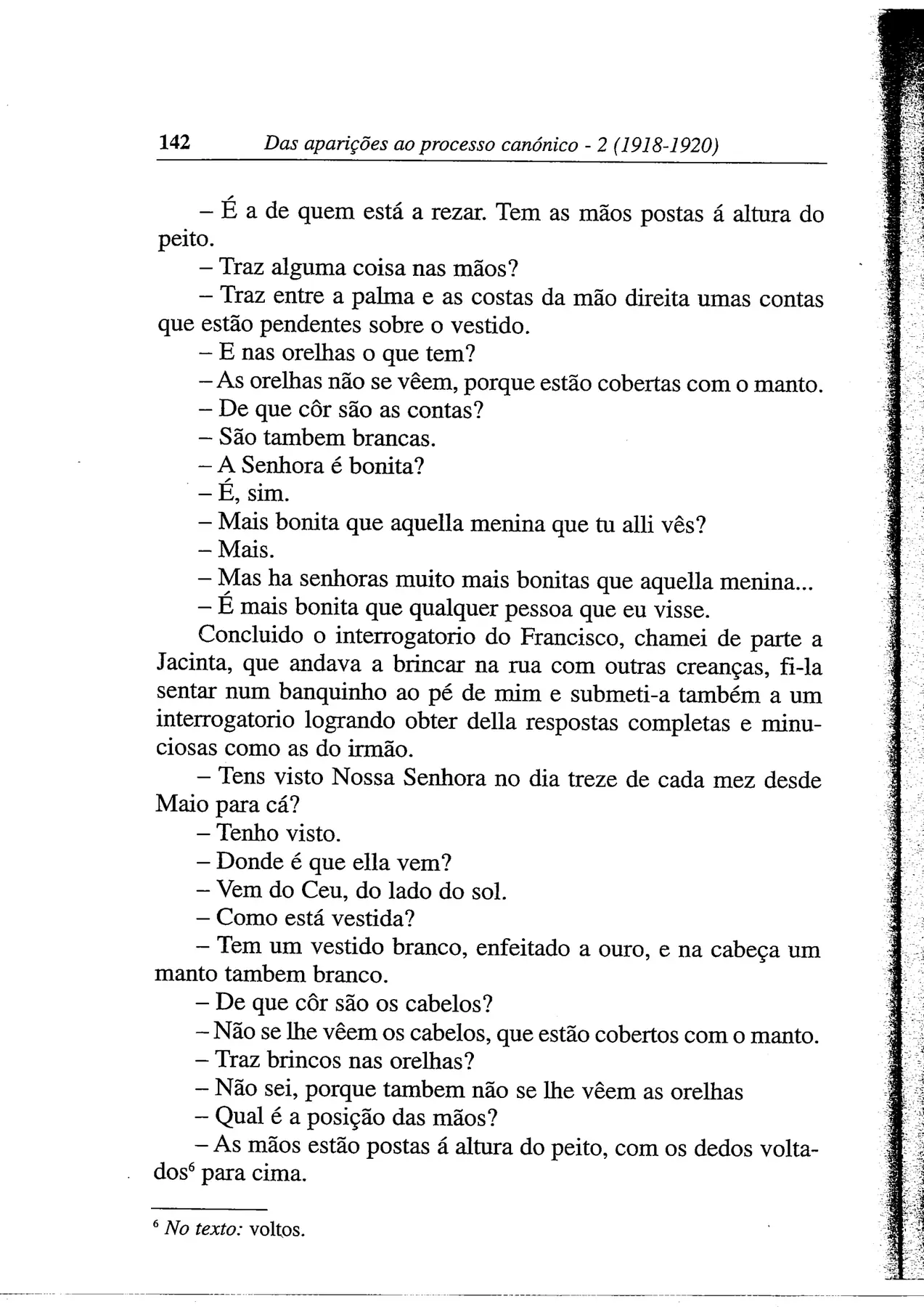
Concluido o interrogatorio do Francisco, chamei de parte a Jacinta, que andava a brincar na rua com outras creanças, fi-la sentar num banquinho ao pé de mim e submeti-a tambem a um interrogatorio logrando obter della respostas completas e minuciosas como as do irmão.

– Tens visto Nossa Senhora no dia treze de cada mez desde Maio para cá?

– Tenho visto.

– Donde é que ella vem?

– Vem do Ceu, do lado do sol.

– Como está vestida?

– Tem um vestido branco, enfeitado a ouro, e na cabeça um manto tambem branco.

– De que côr são os cabelos?

– Não se lhe vêem os cabelos, que estão cobertos com o manto.

– Traz brincos nas orelhas?

– Não sei, porque tambem não se lhe vêem as orelhas

– Qual é a posição das mãos?

– As mãos estão postas á altura do peito, com os dedos voltados para cima.

– As contas estão na mão direita ou na esquerda?

A esta pergunta a creança responde primeiro que estavam na mão direita, mas em seguida, devido a uma insistencia propositada e capciosa da minha parte, mostra-se perplexa e confusa, não sabendo precisar bem qual das suas mãos correspondia á mão que a Apparição segurava o rosario.

– O que foi que Nossa Senhora recommendou á Lucia com mais empenho?

– Mandou que rezassemos o terço todos os dias.

– E tu reza-lo?

– Rezo-o todos os dias com o Francisco e com a Lucia.

13 May13 Jun13 JulOther 1917First-handSaw itInterrogationFigures / visionsSeers' words overheard
English

On 14 July 1917 Jacinta, aged 7, daughter of Manuel Pedro Marto, appeared before me; questioned about the vision, she said:

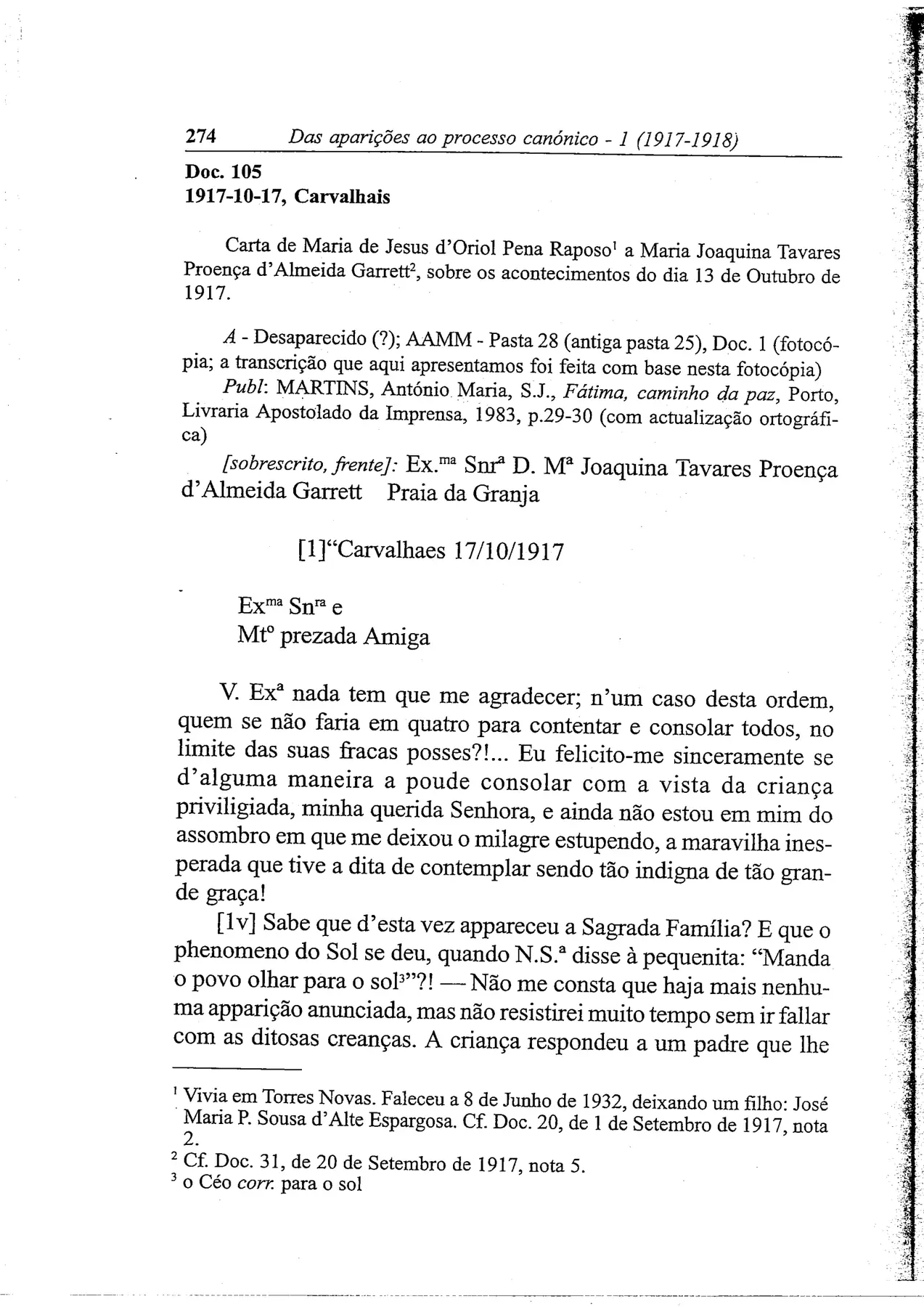
That she had seen a small woman 4 times, once in her house at night and three times at the Cova da Iria at midday; she says she was the size of Albina, daughter of António Rosa of Casa Velha2; at home she saw her at the edge of the attic trapdoor, not saying anything; her mother and brothers and sisters were asleep and it was night; at the Cova da Iria she saw her standing on top of a holm-oak shrub3; she was dressed in white stockings and clothes all of gold; she wore no shoes; the skirt was white and all gold and came down to her knees; the gold was in cords running across, and on the cords in little points; a white jacket all of gold; a mantle over her head was white and all gold; her hands raised to her waist, and they opened, parting them when she spoke to Lúcia; she did not hear her say anything, she heard her speak (now she says yes, now she says no); she did not hear her say how many times she would come here; on leaving, the sky opened and her feet stayed caught and her body already hidden; she heard a very pious voice and remembers only hearing that people (they) would go to heaven; she says she saw lightning, but now she says it was once, now more than once, now before, now after; she had some white beads in her hands, held between the thumb and forefinger of both hands; she did not see earrings; she wore a thin gold chain around her neck.

Português (original)

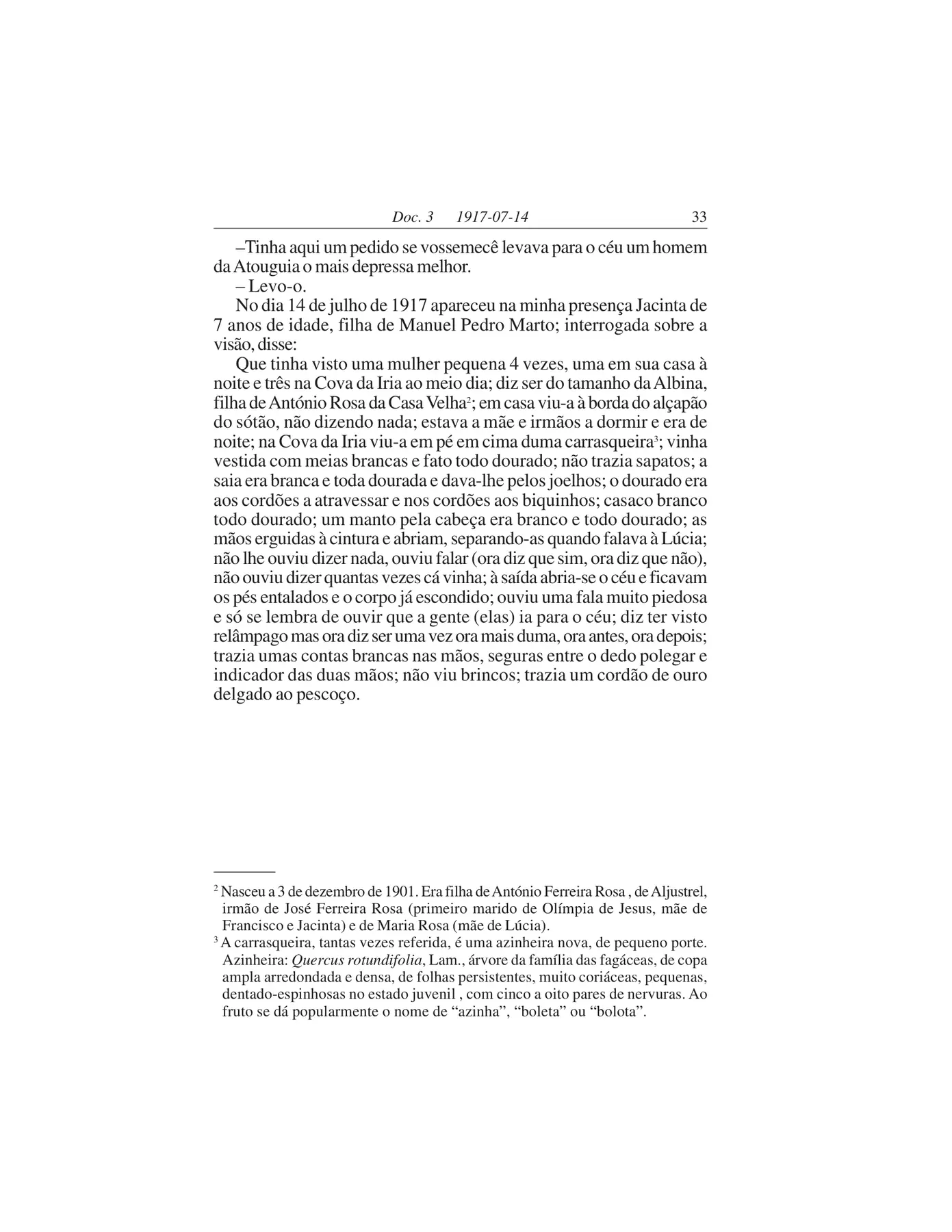
No dia 14 de julho de 1917 apareceu na minha presença Jacinta de 7 anos de idade, filha de Manuel Pedro Marto; interrogada sobre a visão, disse:

Que tinha visto uma mulher pequena 4 vezes, uma em sua casa à noite e três na Cova da Iria ao meio dia; diz ser do tamanho da Albina, filha de António Rosa da Casa Velha2; em casa viu-a à borda do alçapão do sótão, não dizendo nada; estava a mãe e irmãos a dormir e era de noite; na Cova da Iria viu-a em pé em cima duma carrasqueira3; vinha vestida com meias brancas e fato todo dourado; não trazia sapatos; a saia era branca e toda dourada e dava-lhe pelos joelhos; o dourado era aos cordões a atravessar e nos cordões aos biquinhos; casaco branco todo dourado; um manto pela cabeça era branco e todo dourado; as mãos erguidas à cintura e abriam, separando-as quando falava à Lúcia; não lhe ouviu dizer nada, ouviu falar (ora diz que sim, ora diz que não), não ouviu dizer quantas vezes cá vinha; à saída abria-se o céu e ficavam os pés entalados e o corpo já escondido; ouviu uma fala muito piedosa e só se lembra de ouvir que a gente (elas) ia para o céu; diz ter visto relâmpago mas ora diz ser uma vez ora mais duma, ora antes, ora depois; trazia umas contas brancas nas mãos, seguras entre o dedo polegar e indicador das duas mãos; não viu brincos; trazia um cordão de ouro delgado ao pescoço.

Editor's notes (2)

2 She was born on 3 December 1901. She was the daughter of António Ferreira Rosa, of Aljustrel, brother of José Ferreira Rosa (first husband of Olímpia de Jesus, mother of Francisco and Jacinta) and of Maria Rosa (Lúcia's mother).

3 The carrasqueira (holm-oak shrub), so often mentioned, is a young holm oak, of small size. Azinheira (holm oak): Quercus rotundifolia, Lam., a tree of the beech family (Fagaceae), with a broad, rounded and dense crown, and evergreen leaves, very leathery, small, toothed and spiny in the juvenile state, with five to eight pairs of veins. The fruit is popularly called "azinha", "boleta" or "bolota".

2 Nasceu a 3 de dezembro de 1901. Era filha de António Ferreira Rosa, de Aljustrel, irmão de José Ferreira Rosa (primeiro marido de Olímpia de Jesus, mãe de Francisco e Jacinta) e de Maria Rosa (mãe de Lúcia).

3 A carrasqueira, tantas vezes referida, é uma azinheira nova, de pequeno porte. Azinheira: Quercus rotundifolia, Lam., árvore da família das fagáceas, de copa ampla arredondada e densa, de folhas persistentes, muito coriáceas, pequenas, dentado-espinhosas no estado juvenil, com cinco a oito pares de nervuras. Ao fruto se dá popularmente o nome de “azinha”, “boleta” ou “bolota”.

DCF Seleção, Doc. 3 (= DCF I, Doc. 3) · interrogation · 14 Jul 1917 (2 months later)View scanLink
13 May13 Jun13 Jul13 Aug13 SepFirst-handSaw itInterrogationFigures / visionsSeers' words overheard
English

Have you seen Our Lady on the 13th of each month since May?

– I have.

– Where does she come from?

– She comes from Heaven, from the side of the sun.

– How is she dressed?

– She has a white dress, trimmed with gold, and on her head she has a mantle, also white. Round her waist there is a golden ribbon that comes down to the hem of the dress.

– Does she wear boots or shoes?

– She wears neither boots nor shoes.

– So she has only stockings on?

– It looks as if she has stockings, but perhaps her feet are so white that they look as if they had stockings on.

– What colour is her hair?

– You can't see her hair, it is covered by the mantle.

– Does she wear earrings?

– I don't know, because you can't see her ears either.

– What is the position of her hands?

– Her hands are joined on her breast, with the fingers pointing upwards.

– Are the beads in her right hand or her left hand?

– .....

To this question the child at first answers that they were in her right hand, but then, owing to insistence on my part, she shows herself perplexed and confused, unable to say precisely which of her own hands corresponded to the hand with which the Lady held the Rosary.

- What did the Lady most earnestly recommend to Lúcia?
- She told us to pray the rosary every day.
- And do you pray it?
- I pray it every day with Francisco and Lúcia.

Português (original)

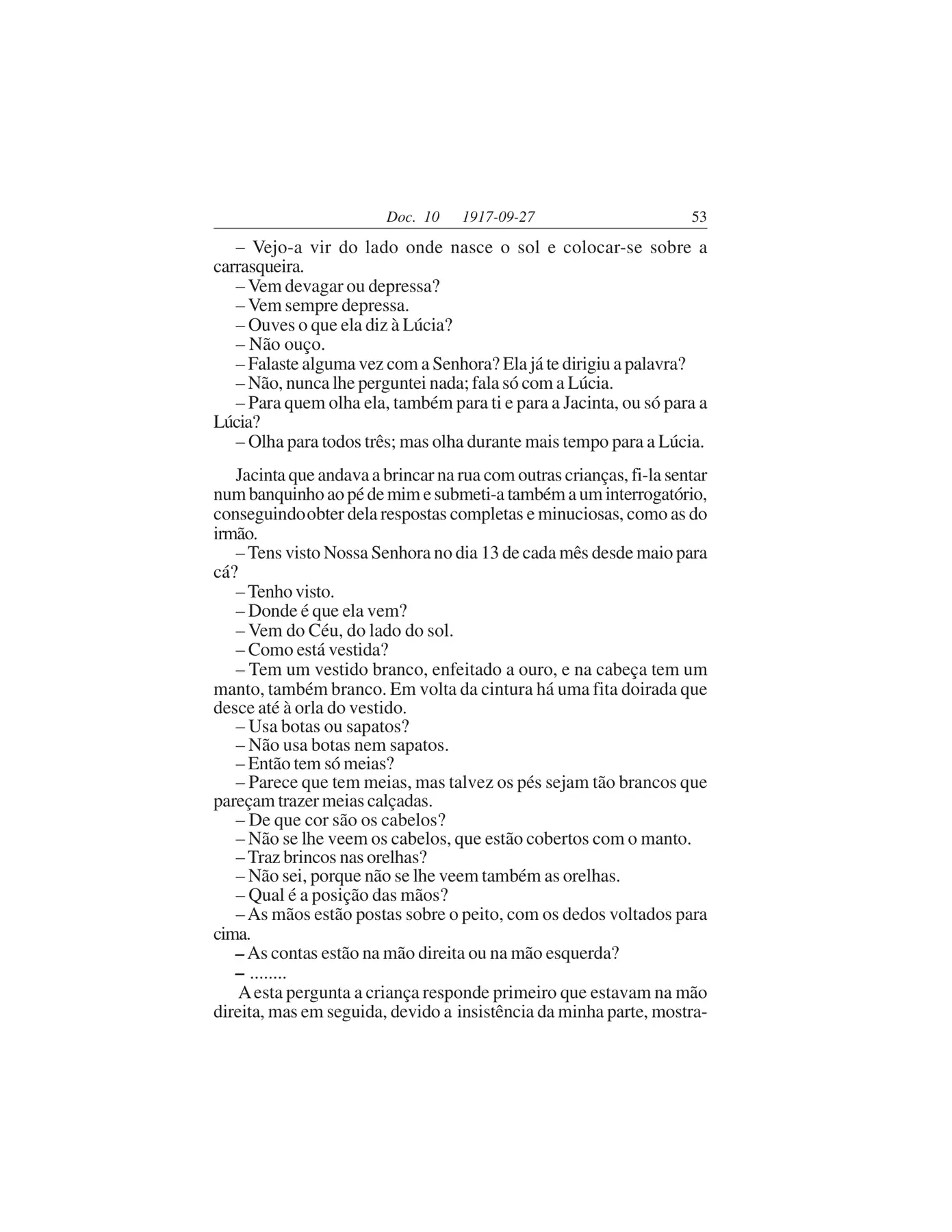
Tens visto Nossa Senhora no dia 13 de cada mês desde maio para cá?

– Tenho visto.

– Onde é que ela vem?

– Vem do Céu, do lado do sol.

– Como está vestida?

– Tem um vestido branco, enfeitado a ouro, e na cabeça tem um manto, também branco. Em volta da cintura há uma fita doirada que desce até à orla do vestido.

– Usa botas ou sapatos?

– Não usa botas nem sapatos.

– Então tem só meias?

– Parece que tem meias, mas talvez os pés sejam tão brancos que pareçam trazer meias calçadas.

– De que cor são os cabelos?

– Não se lhe veem os cabelos, que estão cobertos com o manto.

– Traz brincos nas orelhas?

– Não sei, porque não se lhe veem também as orelhas.

– Qual é a posição das mãos?

– As mãos estão postas sobre o peito, com os dedos voltados para cima.

– As contas estão na mão direita ou na mão esquerda?

– .....

A esta pergunta a criança responde primeiro que estavam na mão direita, mas em seguida, devido a insistência da minha parte, mostra-

-se perplexa e confusa, não sabendo precisar bem qual das suas mãos correspondia à mão com que a Senhora segurava o Rosário.

- O que é que a Senhora recomendou à Lúcia com mais empenho?
- Mandou que rezássemos o terço todos os dias.
- E tu reza-lo?
- Rezo-o todos os dias com o Francisco e a Lúcia.

DCF Seleção, Doc. 10 (= DCF I, Doc. 7) · interrogation · 27 Sep 1917 (5 months later)View scans (2)Link
13 May13 Jun13 SepFirst-handSaw itInterrogationFigures / visionsSeers' words overheard
English

Did the Lady recommend that you pray the rosary?
– She did.

- 2a – When?
– When she appeared the first time.
3a – Did you hear the secret too or was it only Lúcia who heard it?
– I heard it too.
4a – When did you hear it?
– The second time, on St. Anthony's day.
5a – Is that secret for you to be rich?
– It isn't.
6a – Is it for you to be good and happy?
– It is. It is for the good of all three of us.
7a – Is it for you to go to Heaven?
– It isn't.
8a – Can't you reveal the secret?
– I can't.
9a – Why?
– Because the Lady said we were not to tell the secret to anyone.
10a – If the people knew the secret, would they be sad?
– They would.
11a – How did the Lady hold her hands?
– She held them raised.
12a – Always raised?
– Sometimes she turns her palms towards the sky.
13a – Did the Lady say in May that she wanted you to go to the Cova da Iria more times?
– She said she wanted us to go there for six months, month after month, until in October she would say what she wanted.
14a – Does she have any radiance about her head?
– She does.
15a – Can you look well at her face?
– I can't, because it hurts the eyes.
16a – Did you always hear well what the Lady said?
– The last time I didn't hear everything because of the noise the people were making.

Português (original)

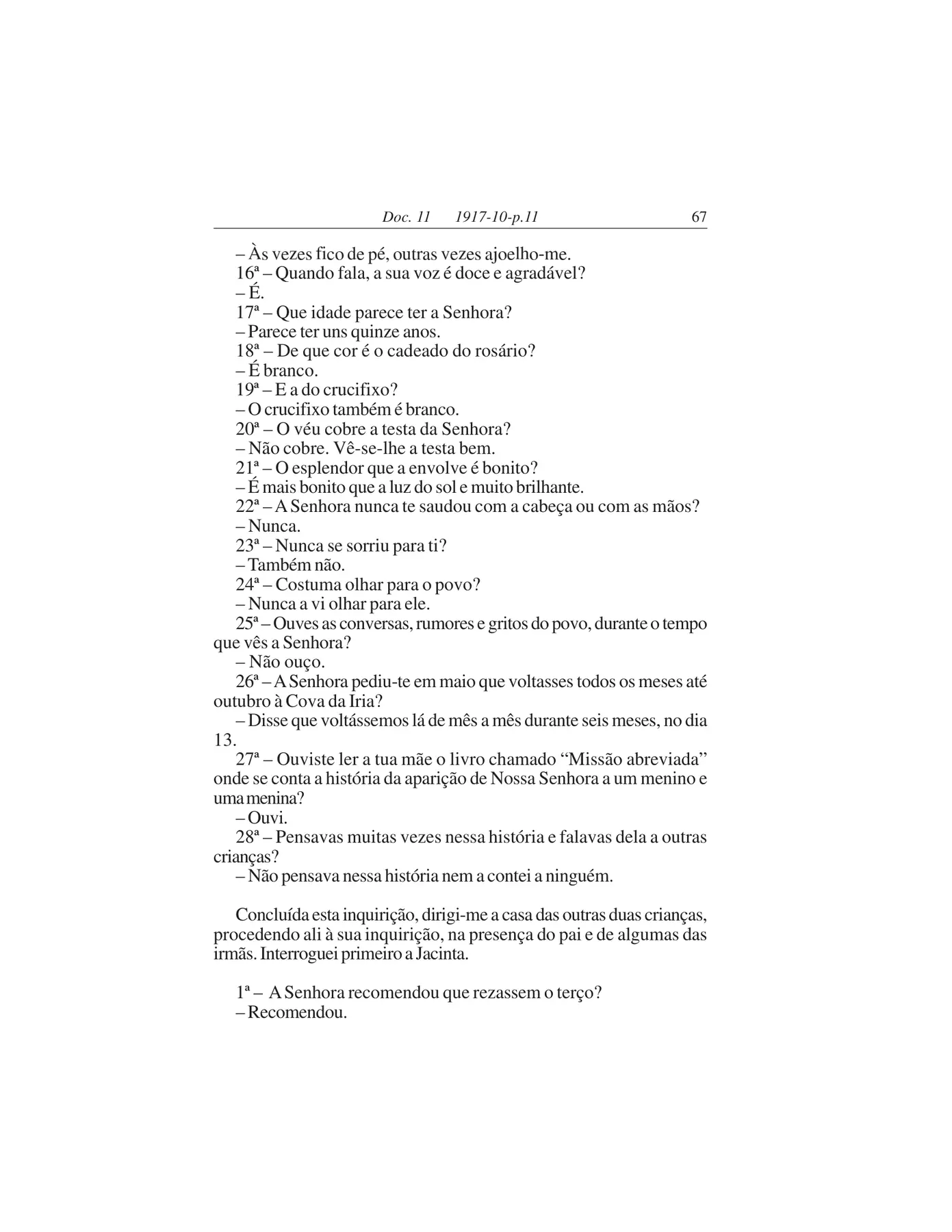
A Senhora recomendou que rezassem o terço?
– Recomendou.

- 2a – Quando?
– Quando apareceu pela primeira vez.
3a – Ouviste também o segredo ou foi só a Lúcia que o ouviu?
– Eu também ouvi.
4a – Quando o ouviste?
– Da segunda vez, no dia de Santo António.
5a – Esse segredo é para serem ricos?
– Não é.
6a – É para serem bons e felizes?
– É. É para bem de todos três.
7a – É para irem para o Céu?
– Não é.
8a – Não podes revelar o segredo?
– Não posso.
9a – Porquê?
– Porque a Senhora disse que não disséssemos o segredo a ninguém.
10a – Se o povo soubesse o segredo, ficava triste?
– Ficava.
11a – Como tinha a Senhora as mãos?
– Tinha-as erguidas.
12a – Sempre erguidas?
– Às vezes volta as palmas para o céu.
13a – A Senhora disse em maio que queria que fossem à Cova da Iria mais vezes?
– Disse que queria que fôssemos lá durante seis meses, de mês a mês, até que em outubro dissesse o que queria.
14a – Ela tem na cabeça algum resplendor?
– Tem.
15a – Podes olhar bem para o rosto?
– Não posso, porque faz mal aos olhos.
16a – Ouviste sempre bem o que a Senhora disse?
– Da última vez não ouvi tudo por causa do barulho que o povo fazia.

DCF Seleção, Doc. 11 (= DCF I, Doc. 12) · interrogation · 11 Oct 1917 (5 months later)View scans (2)Link
13 May13 OctFirst-handSaw itInterrogationFigures / visionsSeers' words overheard
English

2 - What were they doing when they saw the Lady?

3 - Is it true that the boy chased the Image away with stones?

4 - How did the Image appear?

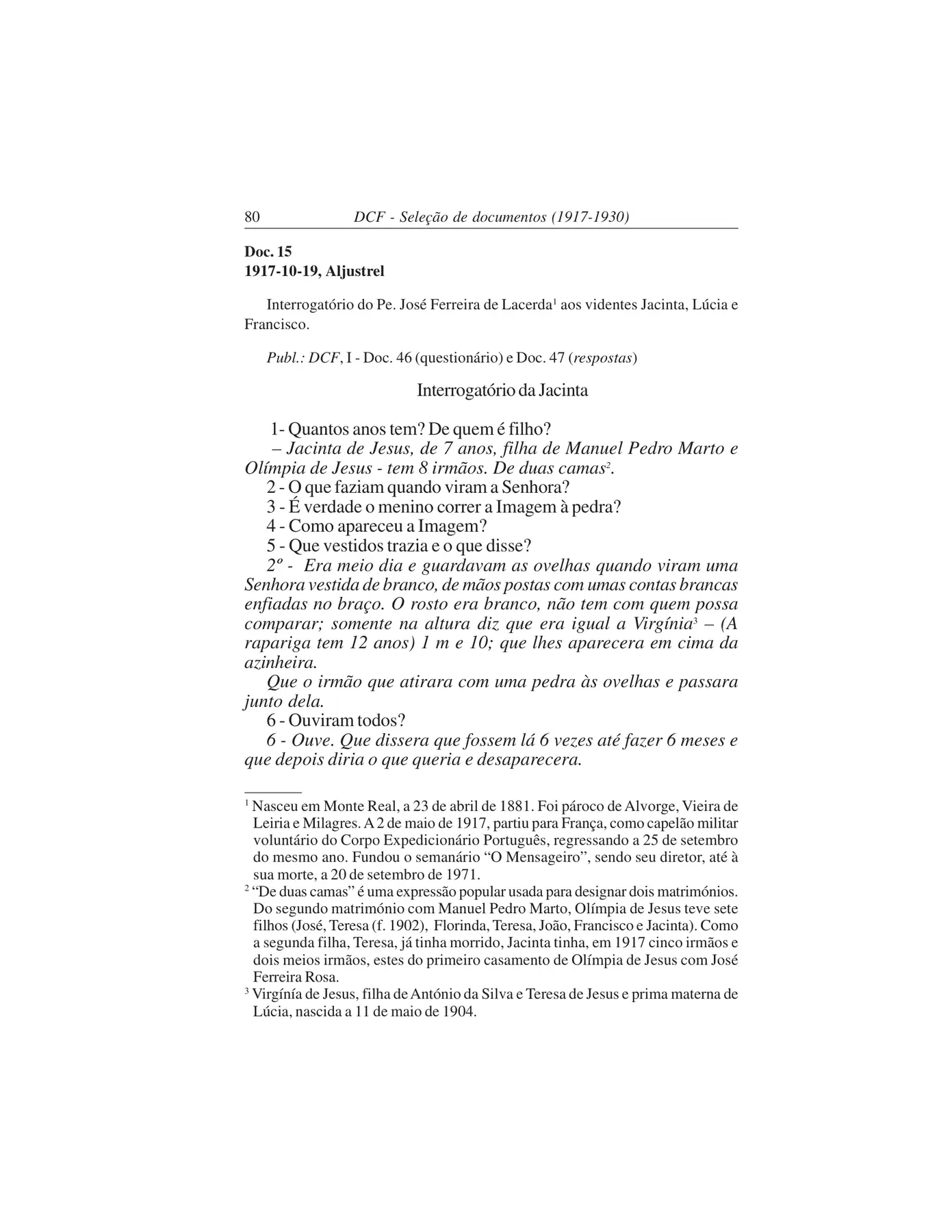
5 - What clothes was she wearing and what did she say?

2nd - It was midday and they were minding the sheep when they saw a Lady dressed in white, with her hands joined, with some white beads strung over her arm. Her face was white; she has nothing to compare it with; only in height she says she was the same as Virgínia3 – (The girl is 12 years old) 1 m 10; that she had appeared to them on top of the holm oak.

That her brother had thrown a stone at the sheep and had passed close to her.

6 - Did they all hear?

6 - She hears. That she had said they should go there 6 times, until 6 months were up, and that afterwards she would say what she wanted, and she had disappeared.

-
- 7 - Had they been to Mass the previous Sunday? And where?
- 7 - She goes to Mass every Sunday; the day of the apparition was a weekday and she had not been to Mass.
- 8 - Where do they usually go to Mass?
- 8 - She goes to Mass at Fátima
- 9 - How is the Image dressed in the chapel where they usually go to Mass?
- 9 - That she knows that in the church there is the Lady of the Rosary, but she has no beads, nor does she have a white dress.
- 10 - Had they heard any sermon or homily about Our Lady of Lourdes?
- 10 - She does not know.
- 11 - Did they often go to Mass, even on weekdays?
- 11 - She goes to Mass only on Sunday, because her mother does not let her.
- 12 - What did they do after seeing the Lady?
- 12 - They came home only at night and said that they had seen the Lady from Heaven, for that is what she had called herself.
- 13 - What clothes did she wear the 1st time and the other times?
- 13 - Always the same dress.
- 14 - Did she say why she came on the 13th?
- [...]
- 15 - Did they always see the spots on the sun?
- 15 - Only the last time did they see the Child Jesus and Saint Joseph and Our Lady in the sun. But Lúcia saw better.
- 16 - How was she on the Holm oak? Was she smiling or was she sad?
- 16 - She was serious.
- 17 - What colour was her dress and how did she hold her arms?
- 17 - Dress all white, tight at the bottom, hands raised.
- 18 - Were they afraid when they saw the Lady?
- 18 - She was afraid the 1st time; she said that she should not be afraid, that she would do no harm.
- 19 - Whom did they tell that they had seen her?
- 19 - She told her father and brother that she had seen the Lady.
- 20 - When did they speak to any priest about the matter?
- 20 - She did not say.
- 21 - What did he say to them?
- 21 - *She does not remember.

Português (original)

2 - O que faziam quando viram a Senhora?

3 - É verdade o menino correr a Imagem à pedra?

4 - Como apareceu a Imagem?

5 - Que vestidos trazia e o que disse?

2º - Era meio dia e guardavam as ovelhas quando viram uma Senhora vestida de branco, de mãos postas com umas contas brancas enfiadas no braço. O rosto era branco, não tem com quem possa comparar; somente na altura diz que era igual a Virgínia3 – (A rapariga tem 12 anos) 1 m e 10; que lhes aparecera em cima da azinheira.

Que o irmão que atirara com uma pedra às ovelhas e passara junto dela.

6 - Ouviram todos?

6 - Ouve. Que dissera que fossem lá 6 vezes até fazer 6 meses e que depois diria o que queria e desaparecera.

-
- 7 - Tinham ido à missa no domingo anterior? E onde?
- 7 - Vai todos os domingos à missa; no dia da aparição era de semana e não tinha ido à missa.
- 8 - Onde costumam ir à missa?
- 8 - Vai à missa à Fátima
- 9 - Que veste a Imagem da capela onde costumam ir à missa?
- 9 - Que sabe que na igreja existe a Senhora do Rosário mas não tem contas, nem tem um vestido branco.
- 10 - Tinham ouvido algum sermão sobre Nossa Senhora de Lourdes ou prática?
- 10 - Não sabe.
- 11 - Costumavam ir muitas vezes à missa mesmo de semana?
- 11 - Vai à missa só ao domingo; porque a mãe não a deixa.
- 12 - O que fizeram depois de verem a Senhora?
- 12 - Só à noite vieram para casa e disseram que tinham visto a Senhora do Céu, pois assim ela se chamara.
- 13 - Que fatos trazia ela da 1ª vez e das outras vezes?
- 13 - Sempre o mesmo vestido.
- 14 - Disse porque vinha no dia 13?
- [...]
- 15 - Viram sempre as manchas no sol?
- 15 - Só na última vez é que viram no sol o Menino Jesus e São José e Nossa Senhora. Mas a Lúcia viu melhor.
- 16 - Como estava ela na Azinheira? Ria-se ou estava triste?
- 16 - Estava séria.
- 17 - De que cor era o vestido e como trazia os braços?
- 17 - Vestido todo branco, em baixo apertado, mãos erguidas.
- 18 - Tiveram medo quando viram a Senhora?
- 18 - Teve medo da 1ª vez; ela disse que não tivesse medo, que não fazia mal.
- 19 - A quem disseram que a tinham visto?
- 19 - Disse ao pai e irmão que tinha visto a Senhora.
- 20 - Quando falaram com qualquer padre sobre o assunto?
- 20 - Não disse.
- 21 - O que lhes disse este?
- 21 - *Não se lembra.

Editor's notes (3)

1 He was born at Monte Real on 23 April 1881. He was parish priest of Alvorge, Vieira de Leiria and Milagres. On 2 May 1917 he left for France as a volunteer military chaplain with the Portuguese Expeditionary Corps, returning on 25 September of the same year. He founded the weekly "O Mensageiro", and was its director until his death on 20 September 1971.

2 "De duas camas" (from two beds) is a popular expression used to indicate two marriages. From her second marriage, to Manuel Pedro Marto, Olímpia de Jesus had seven children (José, Teresa (d. 1902), Florinda, Teresa, João, Francisco and Jacinta). As the second daughter, Teresa, had already died, in 1917 Jacinta had five brothers and sisters and two half-brothers, the latter from Olímpia de Jesus's first marriage to José Ferreira Rosa.

3 Virgínia de Jesus, daughter of António da Silva and Teresa de Jesus and maternal cousin of Lúcia, born on 11 May 1904.

1 Nasceu em Monte Real, a 23 de abril de 1881. Foi pároco de Alvorge, Vieira de Leiria e Milagres. A 2 de maio de 1917, partiu para França, como capelão militar voluntário do Corpo Expedicionário Português, regressando a 25 de setembro do mesmo ano. Fundou o semanário “O Mensageiro”, sendo seu diretor, até à sua morte, a 20 de setembro de 1971.

2 “De duas camas” é uma expressão popular usada para designar dois matrimónios. Do segundo matrimónio com Manuel Pedro Marto, Olímpia de Jesus teve sete filhos (José, Teresa (f. 1902), Florinda, Teresa, João, Francisco e Jacinta). Como a segunda filha, Teresa, já tinha morrido, Jacinta tinha, em 1917 cinco irmãos e dois meios irmãos, estes do primeiro casamento de Olímpia de Jesus com José Ferreira Rosa.

3 Virgínia de Jesus, filha de António da Silva e Teresa de Jesus e prima materna de Lúcia, nascida a 11 de maio de 1904.

DCF Seleção, Doc. 15 (= DCF I, Doc. 46) · interrogation · 19 Oct 1917 (5 months later)View scans (2)Link
13 May13 JunFirst-handSaw itInterrogationSeers' words overheardCrowd scene
English

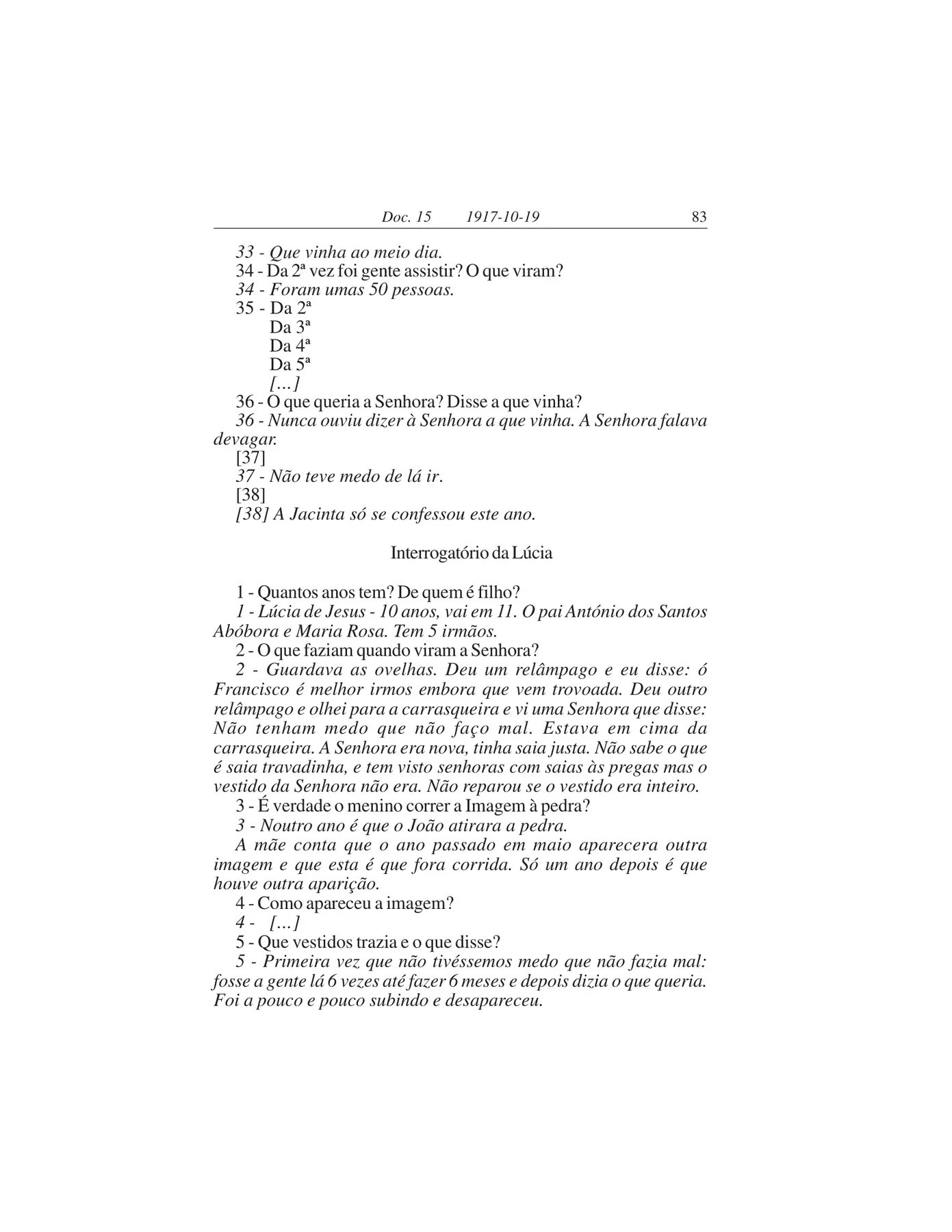
33 - That she was coming at midday.

34 - The 2nd time, did people go to watch? What did they see?

34 - Some 50 people went.

35 - The 2nd

The 3rd

The 4th

The 5th

[...]

36 - What did the Lady want? Did she say what she came for?

36 - She never heard the Lady say what she came for. The Lady spoke slowly.

Português (original)

33 - Que vinha ao meio dia.

34 - Da 2ª vez foi gente assistir? O que viram?

34 - Foram umas 50 pessoas.

35 - Da 2ª

Da 3ª

Da 4ª

Da 5ª

[...]

36 - O que queria a Senhora? Disse a que vinha?

36 - *Nunca ouviu dizer à Senhora a que vinha. A Senhora falava devagar.

DCF Seleção, Doc. 15 (= DCF I, Doc. 46) · interrogation · 19 Oct 1917 (5 months later)View scanLink
13 MayOther 1917First-handSaw itInterrogationSeers' words overheard
English

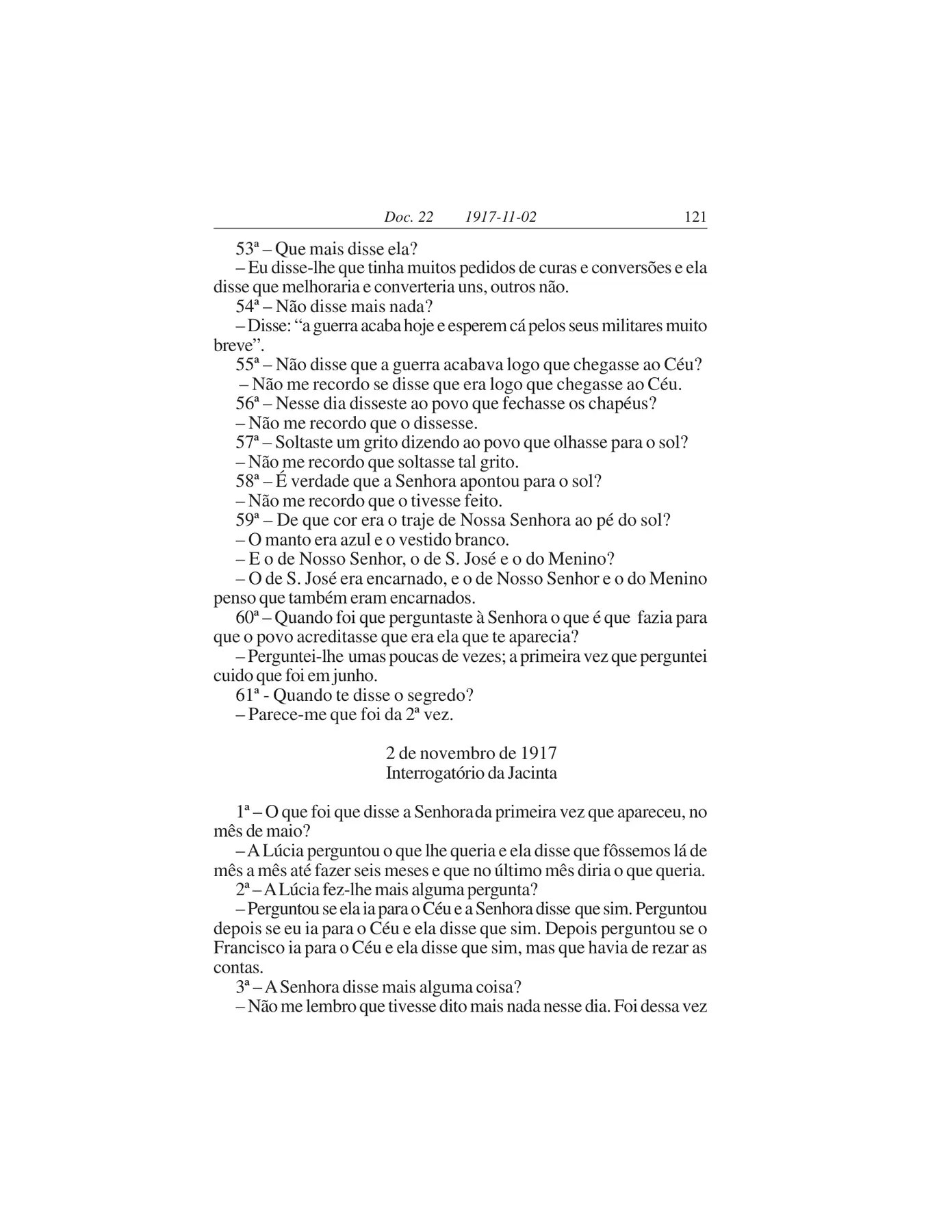
What was it the Lady said the first time she appeared, in the month of May?

– Lúcia asked what she wanted of her and she said we were to go there month after month until it made six months, and that in the last month she would say what she wanted.

2nd – Did Lúcia ask her any more questions?

– She asked whether she was going to Heaven and the Lady said yes. Then she asked whether I was going to Heaven and she said yes. Then she asked whether Francisco was going to Heaven and she said yes, but that he would have to say his beads.

3rd – Did the Lady say anything else?

– I don't remember her saying anything else that day. It was that time that the flock went into the chickling peas.

Português (original)

O que foi que disse a Senhora da primeira vez que apareceu, no mês de maio?

– A Lúcia perguntou o que lhe queria e ela disse que fôssemos lá de mês a mês até fazer seis meses e que no último mês diria o que queria.

2a – A Lúcia fez-lhe mais alguma pergunta?

– Perguntou se ela ia para o Céu e a Senhora disse que sim. Perguntou depois se eu ia para o Céu e ela disse que sim. Depois perguntou se o Francisco ia para o Céu e ela disse que sim, mas que havia de rezar as contas.

3a – A Senhora disse mais alguma coisa?

– Não me lembro que tivesse dito mais nada nesse dia. Foi dessa vez que o gado foi para os chicharos.

DCF Seleção, Doc. 22 (= DCF I, Doc. 17) · interrogation · 2 Nov 1917 (6 months later)View scans (2)Link
13 May13 Jun13 Jul13 Aug13 Sep13 OctFirst-handSaw itInterrogationFigures / visionsSeers' words overheard
English

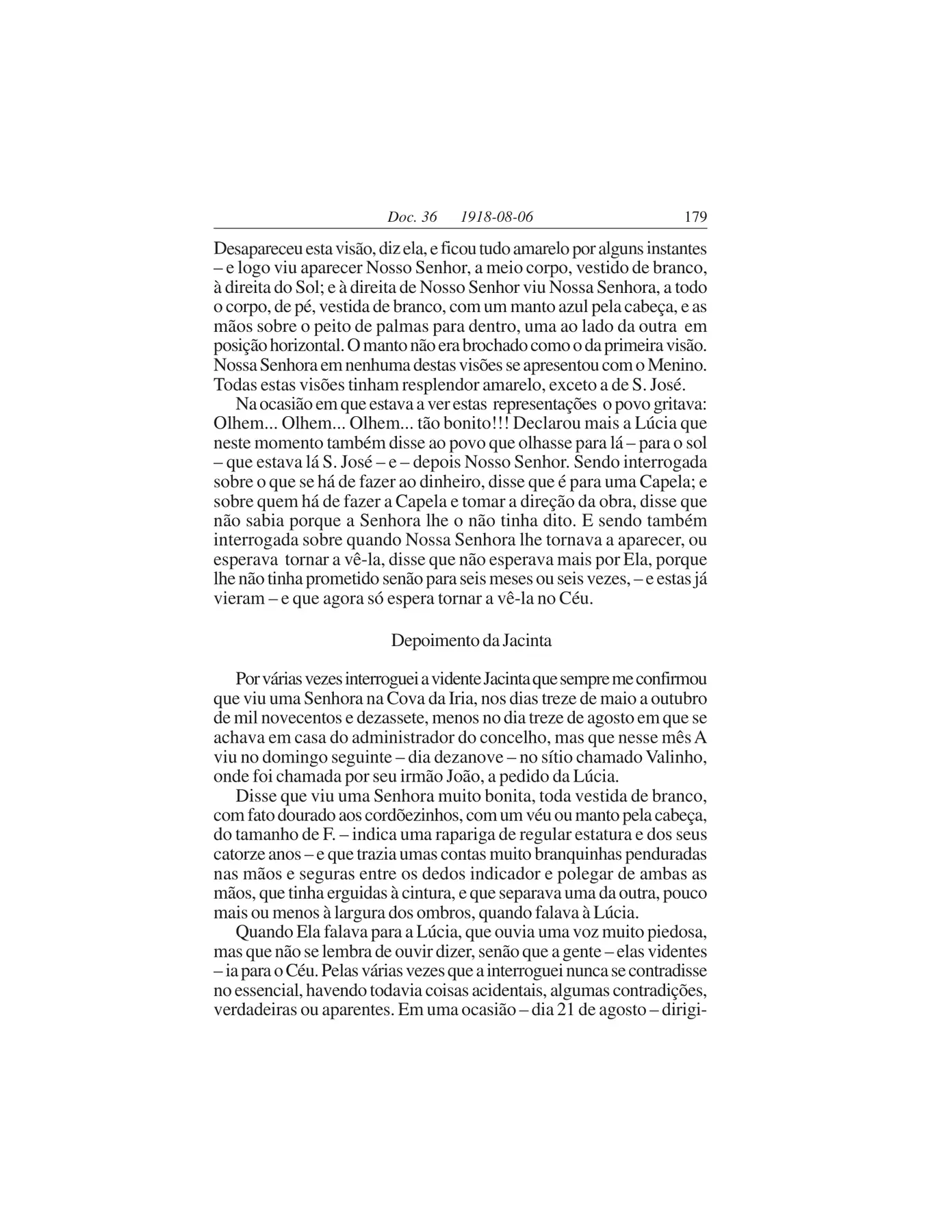
Several times I questioned the seer Jacinta, who always confirmed to me that she saw a Lady at the Cova da Iria on the thirteenth of each month from May to October nineteen hundred and seventeen, except on the thirteenth of August, when she was at the house of the administrator of the council, but that in that month she saw Her on the following Sunday – the nineteenth – at the place called Valinho, where she was called by her brother João at Lúcia's request.

She said that she saw a very beautiful Lady, all dressed in white, with a garment gilded with little cords, with a veil or mantle over her head, the size of F. – she points to a girl of average height, about fourteen years old – and that she had some very white beads hanging from her hands and held between the forefinger and thumb of both hands, which she held raised at her waist, and which she separated from each other, more or less to the width of the shoulders, when she spoke to Lúcia.

When She spoke to Lúcia, she heard a very devout voice, but she does not remember hearing anything said except that they – the seers – were going to Heaven. In the several times I questioned her she never contradicted herself in essentials, though there were, in incidental matters, some contradictions, real or apparent. On one occasion – 21 August – I went to her parents' house accompanied by five ladies – Dona Maria de Jesus Raposo, of Torres Novas, and others from the Quinta da Cardiga – one of whom, about fifteen years of age, was dressed in white. On reaching the parents' house I called... Jacinta came, who was alone, and on seeing the unexpected visitors she was embarrassed, as is natural in a child of the people and one who a few days earlier had been returned to her parents from the abduction carried out on her. After a few words of encouragement, I said to her:

– Look, Jacinta, see whether it was one of these ladies that you saw at the Cova da Iria, or whether there is one here like Her whom you saw there.

She raises her little eyes, runs her gaze over all of them, from head to foot, and says:

– It wasn't any of these... the other one is much more beautiful.

I point out to her the one dressed in white, saying to her:

– Then wasn't it this Lady, dressed in white, so beautiful, that you saw up there?!

This Lady, she answered, is very beautiful, but She whom I saw there is much more beautiful.

We went to Lúcia's parents' house and on finding her I asked her the same question, obtaining an identical answer. As regards the secret, I also could not get her to reveal it to me; she only said that it – the secret – was not bad for them, the seers.

Português (original)

Por várias vezes interroguei a vidente Jacinta que sempre me confirmou que viu uma Senhora na Cova da Iria, nos dias treze de maio a outubro de mil novecentos e dezassete, menos no dia treze de agosto em que se achava em casa do administrador do concelho, mas que nesse mês A viu no domingo seguinte – dia dezanove – no sítio chamado Valinho, onde foi chamada por seu irmão João, a pedido da Lúcia.

Disse que viu uma Senhora muito bonita, toda vestida de branco, com fato dourado aos cordõezinhos, com um véu ou manto pela cabeça, do tamanho de F. – indica uma rapariga de regular estatura e dos seus catorze anos – e que trazia umas contas muito branquinhas penduradas nas mãos e seguras entre os dedos indicador e polegar de ambas as mãos, que tinha erguidas à cintura, e que separava uma da outra, pouco mais ou menos à largura dos ombros, quando falava à Lúcia.

Quando Ela falava para a Lúcia, que ouvia uma voz muito piedosa, mas que não se lembra de ouvir dizer, senão que a gente – elas videntes – ia para o Céu. Pelas várias vezes que a interroguei nunca se contradisse no essencial, havendo todavia coisas acidentais, algumas contradições, verdadeiras ou aparentes. Em uma ocasião – dia 21 de agosto – dirigi-

-me a casa dos pais dela acompanhado de cinco senhoras – D. Maria de Jesus Raposo, de Torres Novas, e outras da Quinta da Cardiga – uma das quais, dos seus quinze anos de idade, ia vestida de branco. Ao chegar a casa dos pais chamei... Veio a Jacinta, que estava só, e que ao ver as inesperadas visitas, ficou embaraçada, como é próprio duma criança do povo e de quem poucos dias antes tinha sido restituída aos pais do rapto que lhe haviam feito. Depois de algumas palavras de animação, disse-lhe eu:

– Olha, Jacinta, vê se foi alguma destas senhoras que viste na Cova da Iria, ou se aqui está alguma parecida com A que lá viste.

Ela levanta os olhozitos, percorre-as todas com a vista, dos pés à cabeça, e diz:

– Não foi nenhuma destas... a outra é muito mais bonita.

Faço-lhe notar a que vinha vestida de branco, dizendo-lhe:

– Então não foi esta Senhora, vestida de branco, tão bonita que tu lá viste em cima?!

Esta Senhora, respondeu ela, é muito bonita, mas A que eu lá vi é muito mais bonita.

Dirigimo-nos a casa dos pais da Lúcia e ao encontrar esta, fiz-lhe a mesma pergunta obtendo idêntica resposta. A respeito do segredo também não consegui que me o revelasse; apenas disse que ele – segredo – não era mau para elas, videntes.

DCF Seleção, Doc. 36 (= DCF I, Doc. 31) · official · 21 Aug 1917 (3 months later)View scans (2)Link
13 MaySecond-handSaw itSworn depositionFigures / visions
As told by Manuel Pedro Marto (father of Francisco and Jacinta), sworn deposition to the canonical commission (Dr. Manuel Nunes Formigão, relator)
English

They were having supper when the mother asked Jacinta again what she had witnessed.

The little girl said that Our Lady had appeared to them, that before that they had seen a flash of lightning, that they feared a thunderstorm was imminent or that it would rain, and they were already getting ready to go away, even going to drive the cattle for that purpose.

Português (original)

Estavam a cear quando a mãe perguntou novamente à Jacinta o que tinha presenciado.

A pequena disse que Nossa Senhora lhes tinha aparecido, que antes tinham visto um relâmpago, que recearam estivesse iminente uma trovoada ou chovesse, e já se preparavam para se irem embora, indo até tocar o gado para esse fim.

13 MaySecond-handSaw itSworn depositionFigures / visionsSeers' words overheard
As told by Manuel Pedro Marto (father of Francisco and Jacinta), sworn deposition to the canonical commission (Dr. Manuel Nunes Formigão, relator)
English

In June Jacinta asked her Mother not to go to the fair of the thirteenth at Pedreiras, a league from Porto de Mós, so that she could go and see Our Lady. The Mother, hearing this request, said to her: “Ah! you're not going there, Our Lady doesn't appear to you”. To which the little girl replied: – “Yes she does, Our Lady said she would appear and so she will appear.” The Mother retorted: “So you're not going to the feast of Saint Anthony?” “No,” the little girl confirmed, “Our Lady is more beautiful than Saint Anthony”.

Português (original)

Em junho a Jacinta pediu à Mãe que não fosse à feira dos treze nas Pedreiras, a uma légua de Porto de Mós, para poder ir ver Nossa Senhora. A Mãe ao ouvir este pedido, disse-lhe: “Ah! tu não vais lá, Nossa Senhora não te aparece”. Ao que a pequena retorqui: – “Aparece sim, Nossa Senhora disse que aparecia e por isso aparece.” A Mãe replicou: “Então não vais à festa de Santo António?” “Não, confirmou a pequena, Nossa Senhora é mais bonita que Santo António”.

DCF Seleção, Doc. 80 (= DCF II, Doc. 4) · deposition · 12 Jun 1917 (4 weeks later)View scanLink
13 MaySecond-handSaw itSworn depositionFigures / visionsSeers' words overheard
As told by Olímpia de Jesus (mother of Francisco and Jacinta), sworn deposition to the canonical commission (Dr. Manuel Nunes Formigão, relator)
English

When she got home Jacinta, very happy, threw her arms around her, which she did not usually do, and said: “Oh mother, today I saw Our Lady at the Cova da Iria”. The mother retorted: “I don't believe it; you're a fine saint to be seeing Our Lady”. The little girl looked a little sad and insisted: “Believe it, mother”. She was then seven years old. This took place still in the street at the door of the house. They went in and at once she said: “Mother, I'm going to pray the rosary with Francisco, because that is what Our Lady told us to do”. To a question from the parents on this point, the little girl answered that Our Lady had said that they should go there for six months on the thirteenth and she would appear to them, and that they should pray the rosary. The seers understood that this recitation should be done every day. Our Lady said that they should pray the rosary, that they should spread it throughout the world and that God was very much offended. Francisco said that he saw the Lady moving her lips, opening her hands and closing them, but did not hear her words. Jacinta said that the Lady spoke only with Lúcia.

Português (original)

Ao chegar a casa a Jacinta, muito alegre abraçou-se a ela, o que não costumava fazer e disse: “Ó minha mãe, vi hoje Nossa Senhora na Cova da Iria”. A mãe retorquiu: “Não acredito; és uma boa santa para veres Nossa Senhora”. A pequena mostrou-se um pouco triste e insistiu: “Acredite, minha mãe”. Tinha então sete anos. Isto passou-se ainda na rua à porta de casa. Entraram e logo ela disse: “Minha Mãe, vou rezar o terço com o Francisco, que foi o que Nossa Senhora mandou que nós fizéssemos”.

[…]

A uma pergunta dos pais nesse sentido, a pequena respondeu que Nossa Senhora tinha dito, que fossem lá durante seis meses no dia treze que ela lhes apareceria, e que rezassem o terço. Os videntes compreenderam que essa recitação devia ser feita todos os dias. Dizia Nossa Senhora que rezassem o terço, que o espalhassem pelo mundo e que Deus estava muito ofendido. O Francisco disse que via a Senhora a mexer os beiços, abrir as mãos e fechá-las, mas não ouvia as suas palavras. Disse a Jacinta que a Senhora só falava com a Lúcia.

13 MaySecond-handSaw itSworn depositionFigures / visionsSeers' words overheard
As told by Olímpia de Jesus (mother of Francisco and Jacinta), sworn deposition to the canonical commission (Dr. Manuel Nunes Formigão, relator)
English

On 13 June, Olímpia de Jesus and her husband went to a fair, although Jacinta had said the evening before: “Mother, don't go to the fair tomorrow, go to the Cova da Iria, Our Lady is coming there”. And the Mother would not believe it and said to her daughter: “You want to go to Saint Anthony's, you don't want to go to the Cova da Iria!” As if to suggest that it was a pretext for going to the feast. She answered: “Saint Anthony isn't beautiful”. “Why?” the mother asked. “Because Our Lady is more beautiful,” the daughter concluded. “I'm going to the Cova da Iria with Lúcia and Francisco, and if Our Lady says we're to go to Saint Anthony's, then we'll go”.

Português (original)

No dia 13 de junho, Olímpia de Jesus e seu marido foram para uma feira, apesar de a Jacinta ter dito na véspera à noite: “Minha Mãe, não vá amanhã à feira, vá à Cova da Iria, vem lá Nossa Senhora”. E a Mãe não queria acreditar e disse à filha: “Tu queres ir para Santo António, não queres ir para a Cova da Iria!” Como que a dar a entender que era um pretexto para ir à festa. Ela respondeu: “O Santo António não é bonito”. “Porquê?”, interrogou a mãe. “Porque Nossa Senhora é mais bonita”, concluiu a filha. “Eu vou à Cova da Iria mais a Lúcia e o Francisco e se Nossa Senhora disser que vamos ao Santo António então vamos”.

DCF Seleção, Doc. 80 (= DCF II, Doc. 4) · deposition · 12 Jun 1917 (4 weeks later)View scanLink
13 JunFirst-handSaw itInterrogationSeers' words overheard
English

What did the Lady say the second time, in June?

– Lúcia said: What do you want of me? The lady answered: I want you to learn to read.

5th – Did Lúcia ask any more questions?

– She asked for the sick and for sinners, and the Lady said she would make some better and would convert them, and not others.

6th – Did the Lady say anything else?

– That day she said nothing else.

Português (original)

Que disse a Senhora da segunda vez, em junho?

– A Lúcia disse: O que me quer? A senhora respondeu: quero que aprendam a ler.

5a – A Lúcia fez mais alguma pergunta?

– Pediu pelos doentes e pecadores e a Senhora disse que melhorava uns e os convertia, outros não.

6a – A Senhora disse mais alguma coisa?

– Naquele dia não disse mais nada.

DCF Seleção, Doc. 22 (= DCF I, Doc. 17) · interrogation · 2 Nov 1917 (5 months later)View scanLink
13 Jul13 OctSecond-handSaw itLetterFigures / visionsSeers' words overheard
As told by Beatriz Gorjão (letter copied verbatim by Anita)
English

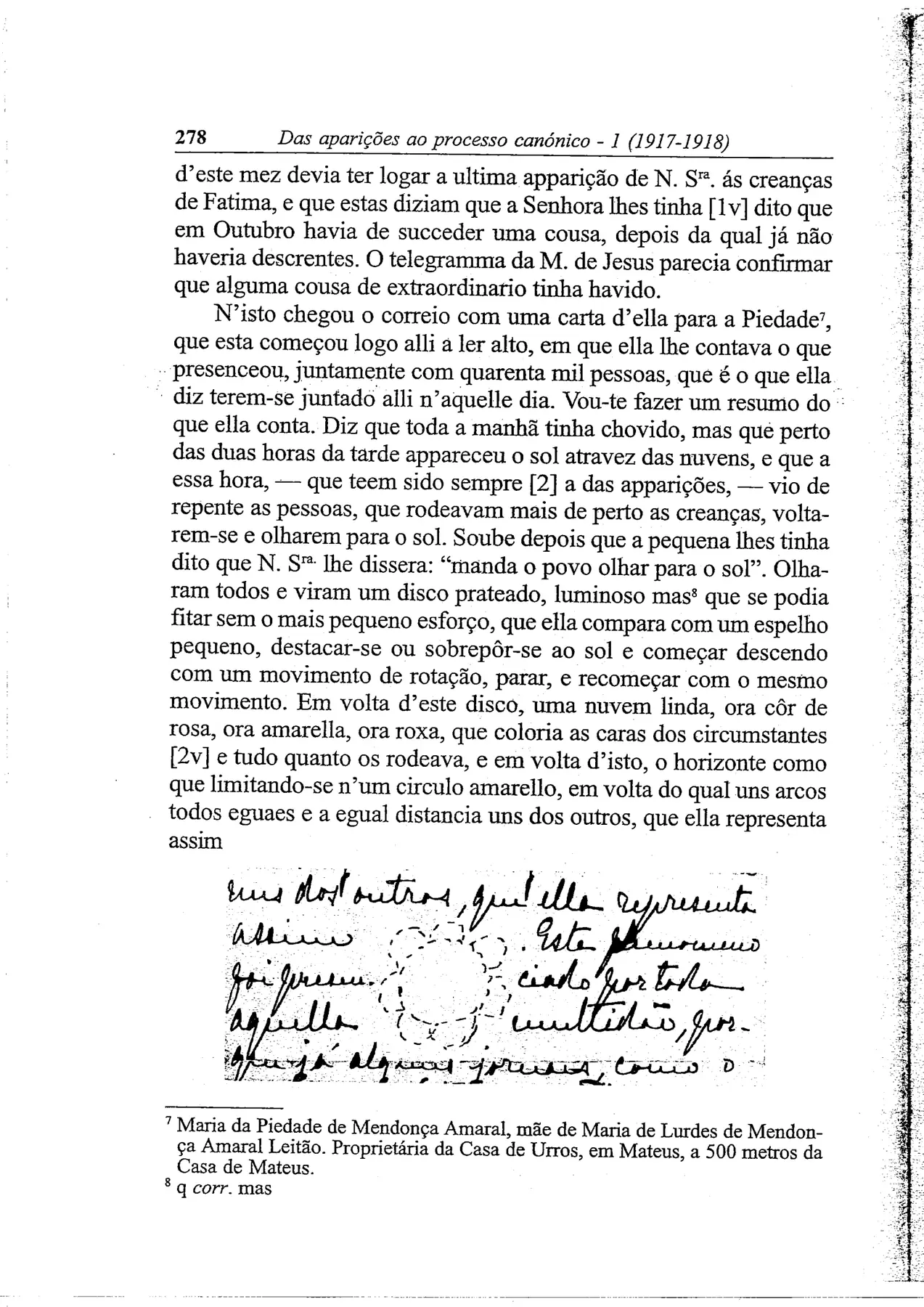
The little girl then speaks of the end of the war and of the end of the world if there were no faith (don't be alarmed, there is still plenty). It is these two points that I find doubtful; would Our Lady really have spoken of the end of the war and of the world, or were the children confused by so many questions as they have been asked? — Our Lady [5v] told them a secret. The mothers, poor things, ignorant as they are, have done everything possible to find it out. According to what they say, the administrator has already promised 20.000 if they told it to him, but there is no way of wresting the secret from them. I heard the little boy say that not even if they were given the whole world would they tell it. When they are asked whether it is bad, they say it is good for everyone. — On the last day Our Lady also said that she was the Virgin of the Rosary, and that she wanted the people to build her a chapel there — But this is far from being the most important part; imagine our impression when the little one, carrying on talking, [6] tells us that on the last day (13 October) St. Joseph and the Child Jesus appeared to her!! So it was the Holy Family. Our first impression was one of doubt and alarm: was everything going to collapse from the foundations?! But some neighbours who were there told us that the 3 children had several times already spoken of St. Joseph and the Child Jesus. — The little one then explained that St. Joseph had come to give peace to the world, and with her hand she made the sign of the cross many times, imitating the gesture of Bishops when they walk along blessing the faithful. She told us that the Child Jesus and St. Joseph were just like some little holy images she had at home.

[…]

the little one says she had some pictures at home, but she didn't even look at them: she went to a box and took out a group of the Holy family, saying: “see?” St. Joseph and the Child Jesus were as they are here: but here St. Joseph has his eyes closed, and there he had his eyes open. — Wanting to see whether she would get muddled, we told her that since St. Joseph and the Child were as they are there, Our Lady on the last day must also have been like that one, with a veil and a coloured mantle; we asked this several times, and she always answered that Our Lady was not like th-[fl. 8]at one, but in white and with the rosary. We further said that, being the Holy family, they must all have been together, to which she always answered no. Our Lady was on the holm oak, and St. Joseph and the Child Jesus near the Sun. — We made the same experiment with the little boy, who always answered like his sister. — It is therefore beyond doubt that the 6 apparitions of Our Lady can be confirmed without confirming that of the Holy Family. The eldest little girl, before leaving for Ourem, also spoke to us of St. Joseph and the Child Jesus.

Português (original)

A pequena falla depois do fim da guerra e do fim do mundo caso não houvesse fé (não te assustes ainda ha muita). São estes dois pontos que eu acho duvidoso[s]; fallaria realmente N. Senhora no fim da guerra e do mundo, ou estariam as creanças confundidas com tantas perguntas que lhes têem feito? — N. Senhora [5v] disse-lhes um segredo. As mães, coitadas como ignorantes que são, têem feito todo o possivel para o saber. Segundo dizem, o administrador já prometeu 20.000 se lh'o dissessem, mas não ha meio de lhes arrancar o segredo. Ao pequeno ouvi dizer que nem que lhe dessem o mundo inteiro o diriam. Quando lhes perguntam se é mau, dizem que é bom para todos. — N. Senhora no ultimo dia disse mais ser a Virgem do Rosario, e querendo o povo lhe eregisse alli uma capella — Mas isto está bem longe de ser a parte mais importante; calcula a nossa impresssão quando a pequenita continuando a conversar [6] nos diz que no ultimo dia (13 Outubro) lhe appareceu S. José e o Menino Jesus!! Tratava-se portanto da Sagrada Familia. A nossa primeira impressão foi de duvida e de susto, iria cahir tudo pela base?! Mas umas vizinhas que alli estavam, disseram-nos que as 3 creanças já por vezes tinham fallado em S. José e no Menino Jesus. — A pequenita então explicou que S. José tinha vindo dar a paz ao mundo, e com a mão repetiu muitas vezes o signal da cruz, imitando o gesto dos Bispos quando vão andando e abençoando os fieis. Disse-nos que o Menino Jesus e S. José eram eguaes a uns santinhos que tinha em casa.

[…]

a pequenita diz que tinha em casa uns quadros, mas nem para elles olhou: foi a uma caixa e tirou um grupo da Sagrada familia dizendo: “vêem?” S. José e o Menino Jesus estavam como estão aqui: mas aqui S. José está com os olhos fechados, e lá estávam com os olhos abertos. — Querendo nós ver se ella se atrapalhava, dissemos-lhe que uma vez que o S. José e o Menino estavam como alli estão, N. Senhora no ultimo dia tambem devia estar como aquella de veu e manto de côres; perguntamos isto varias vezes, respondendo ella sempre que N. Senhora não estava como a-[fl. 8]quella, mas sim de branco e com o terço. Dissemos mais que sendo a Sagrada familia devia estar toda junta, ao que ella respondia sempre que não. N. Senhora estava na azinheira, e S. José e o Menino Jesus, perto do Sol. — A mesma experiencia fizemos com o pequeno respondendo sempre como a irmã. — É portanto fóra de duvida que se póde confirmar as 6 aparições de N. Senhora, sem se confirmar a da S. Familia. A pequena mais velha antes de partir para Ourem tambem nos fallou de S. José e do Menino Jesus.

DCF III-1, Doc. 197 · letter · Oct 1917 (3 months later)View scans (4)Link
13 Jul13 OctFirst-handSaw itInterrogationFigures / visions
English

On which side was the Child Jesus when you saw him on the thirteenth of October beside the sun?

– The Child Jesus was in the middle, on St. Joseph's right side, with Our Lady being on the right side of the sun.

2nd – Was the lady you saw beside the sun different from the one you saw on the holm-oak shrub?

– The Lady who was beside the sun had a white dress and a blue mantle; the one I saw at the holm-oak shrub had a white dress and mantle.

3rd – What colour were the feet of the Lady who appeared on the holm-oak shrub?

– The Lady's feet were white; I reckon she was wearing stockings.

4th – What colour were St. Joseph's clothes and the Child's?

– St. Joseph's were red, and the Child's I think were also red.

5th – When was it that the Lady revealed the secret?

– I reckon it was in July.

Português (original)

De que lado estava o Menino Jesus quando o viste no dia treze de outubro ao pé do sol?

– O Menino Jesus estava no meio, ao lado direito de S. José, ficando Nossa Senhora do lado direito do sol.

2ª – A senhora que viste ao lado do sol era diferente da que viste sobre a carrasqueira?

– A Senhora que estava ao pé do sol tinha fato branco e manto azul, a que eu vi ao pé da carrasqueira tinha o fato e o manto brancos.

3ª – De que cor eram os pés da Senhora que apareceu na carrasqueira?

– Os pés da Senhora eram brancos, cuido que ela trazia meias.

4ª – De que cor era o fato de S. José e o do Menino?

– O de S. José era encarnado, e o do Menino parece-me que era também encarnado.

5ª – Quando foi que a Senhora revelou o segredo?

– Cuido que foi em julho.

DCF Seleção, Doc. 22 (= DCF I, Doc. 17) · interrogation · 2 Nov 1917 (4 months later)View scanLink
13 JulSecond-handSaw itSworn depositionSeers' words overheardFigures / visions
As told by Teresa de Jesus (Lúcia's sister), sworn deposition to Pe. Manuel Marques Ferreira
English

She further declared that Lúcia, after beginning the supposed dialogue with Our Lady, was prompted by Jacinta, who was at her side,

--- to answer the Lady, saying to her: Don't you see the Lady is already speaking?!

Português (original)

Declarou mais que a Lúcia depois de ter principiado o suposto diálogo com Nossa Senhora, foi advertida pela Jacinta, que estava a seu lado, para responder à Senhora, dizendo-lhe: Não vês que a Senhora já está a falar?!

Editor's notes (1)

1 Teresa de Jesus was born on 22 May 1893, so she was about to turn 26

1 Teresa de Jesus nasceu a 22 de maio de 1893, portanto ia fazer 26 anos

13 JulSecond-handSaw itSworn depositionFigures / visionsSeers' words overheard
As told by Manuel Pedro Marto (father of Francisco and Jacinta), sworn deposition to the canonical commission (Dr. Manuel Nunes Formigão, relator)
English

The father picked Jacinta up in his arms to get through the crowd more easily. She said she had seen Our Lady again. Some days later, the eldest daughter, Florinda, said that Jacinta had said to Lúcia: “Speak to her, Lúcia, she's already talking”.

Português (original)

O pai pegou na Jacinta ao colo para atravessar mais facilmente por entre a multidão. Ela disse ter visto outra vez Nossa Senhora. Passados dias, a filha mais velha, Florinda, disse que a Jacinta tinha dito para a Lúcia: “Fala-lhe, Lúcia, que ela já está a falar”.

13 JulSecond-handSaw itSworn depositionSeers' words overheard
As told by Olímpia de Jesus (mother of Francisco and Jacinta), sworn deposition to the canonical commission (Dr. Manuel Nunes Formigão, relator)
English

When Jacinta began to say that she knew a secret communicated by Our Lady, she began to be called to various places, even outside the parish. According to what the little girl said, Francisco did not hear the secret, and it was Lúcia who had told it to him on behalf of Our Lady.

Português (original)

Quando a Jacinta começou a dizer que sabia um segredo comunicado por Nossa Senhora, começou a ser chamada a várias partes, mesmo fora da freguesia. Segundo afirmava a pequena, o Francisco não ouviu o segredo e fora a Lúcia que lhe dissera da parte de Nossa Senhora.

13 JulSecond-handSaw itSworn depositionSeers' words overheard
As told by Olímpia de Jesus (mother of Francisco and Jacinta), sworn deposition to the canonical commission (Dr. Manuel Nunes Formigão, relator)
English

Once some very rich ladies came to their house and offered Jacinta various jewels they were wearing if she would tell them the secret. Jacinta said she would not tell it for anything, not even if they gave her the whole world. Even during her last illness her mother would say to her: “I'll despise you and want nothing to do with you if you don't tell me the secret”. And the daughter would reply that she could not tell it. “At least you must tell me whether it's good or bad,” the mother insisted. She would answer that it was good for those who were willing to believe. “Believe in what?” the mother would ask. “In God,” the daughter would conclude. And she added that it was bad for those who would not believe.

Português (original)

Uma vez foram a casa deles umas senhoras muito ricas e ofereceram à Jacinta várias jóias que traziam para ela lhes dizer o segredo. A Jacinta disse que por coisa nenhuma o diria, nem que lhe dessem o mundo inteiro. Mesmo durante a última doença a mãe lhe dizia: “Eu desprezo-te e não quero saber de ti se não me disseres o segredo”. E a filha replicava que não o podia dizer. “Ao menos hás de me dizer se é bom ou mau”, insistia a mãe. Ela respondia que era bom para quem quisesse acreditar. “Acreditar no quê?”, perguntava a mãe. “Em Deus”, concluía a filha. E acrescentava que era mau para quem não quisesse acreditar.

13 JulSecond-handSaw itSworn depositionSeers' words overheardFigures / visions
As told by José Alves of Moita (relaying his wife), sworn deposition to the canonical commission (Dr. Manuel Nunes Formigão, relator)
English

His wife said one day to Jacinta, in his absence, telling him about it afterwards: “Oh Jacinta, tell me the secret and I'll give you my gold chain”. Francisco was not present; if anyone was, it was Lúcia. Francisco never stayed at his house and went there only once or twice. Jacinta said: “if you give me that holy picture, I'll tell you”. His wife replied: “I can't give it to you, it isn't mine, it's my niece's”. The niece said: “Oh Jacinta, do tell me the secret and I'll give it to you”. To which she answered: “Not even if you gave me the whole world”. Once, when his wife was at their house asking Lúcia questions, Jacinta joined in the conversation and said: “Our Lady came from there (and she pointed to the east) and went there (and she pointed in the direction of the Cova da Iria).”

Português (original)

A mulher disse um dia à Jacinta, na sua ausência, tendo-lhe contado depois: “Ó Jacinta diz-me o segredo que eu dou-te o meu cordão”. O Francisco não estava presente; se estava era a Lúcia. O Francisco nunca ficou em sua casa e foi lá só uma vez ou duas. A Jacinta disse: “se você me dá aquele santinho, eu digo-lhe”. A mulher retorquiou-lhe: “Eu não te posso dar, que ele não é meu, é da minha sobrinha”. A sobrinha disse: “Ó Jacinta mas diz-me o segredo, que eu dou-te”. Ao que ela respondeu: “Nem que vossemecê me desse o mundo inteiro”. Uma vez estando a mulher em sua casa a fazer perguntas à Lúcia, a Jacinta meteu-se na conversa e disse: “Nossa Senhora vinha dali (e apontou para o nascente) e foi para ali (e apontou para a direção da Cova da Iria).

13 AugFirst-handSaw itInterrogation2 km awaySeers' words overheard
English

What did the Lady say in August?

– In August we didn't go there.

8th – Will you tell me what it was the Lady said the following Sunday at Valinhos?

– Lúcia asked the Lady whether she would bring back my Manuel8 (a brother of Jacinta's who is serving in the army in Cape Verde) and she said she would bring them all back here.

9th – What else did the Lady say?

– She said that, if we had not been carted off to Ourém, St. Joseph and the Child would come to give peace to the world, and Our Lady of the Rosary with two little angels, one on each side.

10th – What else did she say?

– She said we were to make two litters and take them to the feast of Our Lady of the Rosary, that I, Lúcia and two more little girls dressed in white were to carry one, and Francisco with three boys was to carry the other.

11th – Did she say anything else?

– She said nothing.

Português (original)

O que disse a Senhora em agosto?

– Em agosto não fomos lá.

8a – Queres dizer o que foi que a Senhora disse no domingo seguinte nos Valinhos?

– A Lúcia perguntou à Senhora se trazia o meu Manuel8 (um irmão da Jacinta que está servindo no exército em Cabo Verde) e ela disse que trazia cá todos.

9a – Que mais disse a Senhora?

– Disse que, se não abalássemos para Ourém, viria S. José e o Menino dar a paz ao mundo e Nossa Senhora do Rosário com dois anjinhos, um de cada lado.

10a – Que mais disse?

– Disse que fizéssemos dois andores e que os levássemos à festa da Senhora do Rosário, que eu, a Lúcia e mais duas meninas vestidas de branco levássemos um e o Francisco com três rapazes levasse o outro.

11a – Disse mais alguma coisa?

– Não disse nada.

Editor's notes (1)

8 Manuel dos Santos Rosa, son of José Ferreira da Rosa and of Olímpia de Jesus, was born on 10 May 1895. He married Josefina de Jesus on 3 November 1922. He died on 6 February 1976

8 Manuel dos Santos Rosa, filho de José Ferreira da Rosa e de Olímpia de Jesus, nasceu a 10 de maio de 1895. Casou com Josefina de Jesus, a 3 de novembro de 1922. Faleceu a 6 de fevereiro de 1976

DCF Seleção, Doc. 22 (= DCF I, Doc. 17) · interrogation · 2 Nov 1917 (3 months later)View scanLink
13 AugSecond-handSaw itSworn deposition2 km awayFigures / visionsSeers' words overheard
As told by Manuel Pedro Marto (father of Francisco and Jacinta), sworn deposition to the canonical commission (Dr. Manuel Nunes Formigão, relator)
English

His wife and Jacinta arrived and he asked his daughter what had happened, and she said that Our Lady had appeared; that those who had gone with the cattle were João, Lúcia and Francisco, that João had called her and that, as soon as she got there, Our Lady appeared, and that Our Lady of Sorrows (so it seems to him), Our Lady of the Rosary, Saint Joseph and the Child Jesus would appear.

Português (original)

Chegaram a mulher e a Jacinta e ele perguntou à filha o que havia, tendo ela dito que Nossa Senhora tinha aparecido; que quem ia com o gado eram o João, a Lúcia e o Francisco, que o João chamou-a e que, logo que ela lá chegou apareceu Nossa Senhora, e que haviam de aparecer Nossa Senhora das Dores, (segundo lhe parece), Nossa Senhora do Rosário, S. José e o Menino Jesus.

DCF Seleção, Doc. 80 (= DCF II, Doc. 4) · deposition · 19 Aug 1917 (6 days later)View scanLink
13 OctSecond-handSaw itLetterFigures / visions
As told by Maria de Jesus d'Oriol Pena Raposo
English

Our L.y always appeared grave, without smiling, and the two little girls, separately, described this vision in exactly the same way: Our L.y with the white rosary, on the left St. Joseph, and the child Jesus between the two.

Português (original)

N.S.a appareceu sempre séria, sem sorrir e as duas pequenas em separado, fizeram a descripção d'esta visão, perfeitamente da mesma forma: N. S.a com o rosario branco, á esquerda S. José e o menino Jesus entre os dois.

DCF III-1, Doc. 105 · letter · 13 Oct 1917View scans (2)Link
13 OctSecond-handSaw itLetterSeers' words overheard
As told by Teresa de Melo Breyner (Condessa de Vila Real), summarising a letter of Maria de Jesus Raposo
English

And the smallest one, who is six years old, even when separated from the other, said exactly the same thing, without contradicting herself on a single point.

Português (original)

E a mais pequena, que tem seis annos, mesmo separada da outra, disse exactamente a mesma cousa, sem se desdizer n'um só ponto.

DCF III-1, Doc. 107 · letter · 13 Oct 1917View scans (2)Link
13 OctFirst-handSaw itSworn depositionFigures / visionsSeers' words overheard
English

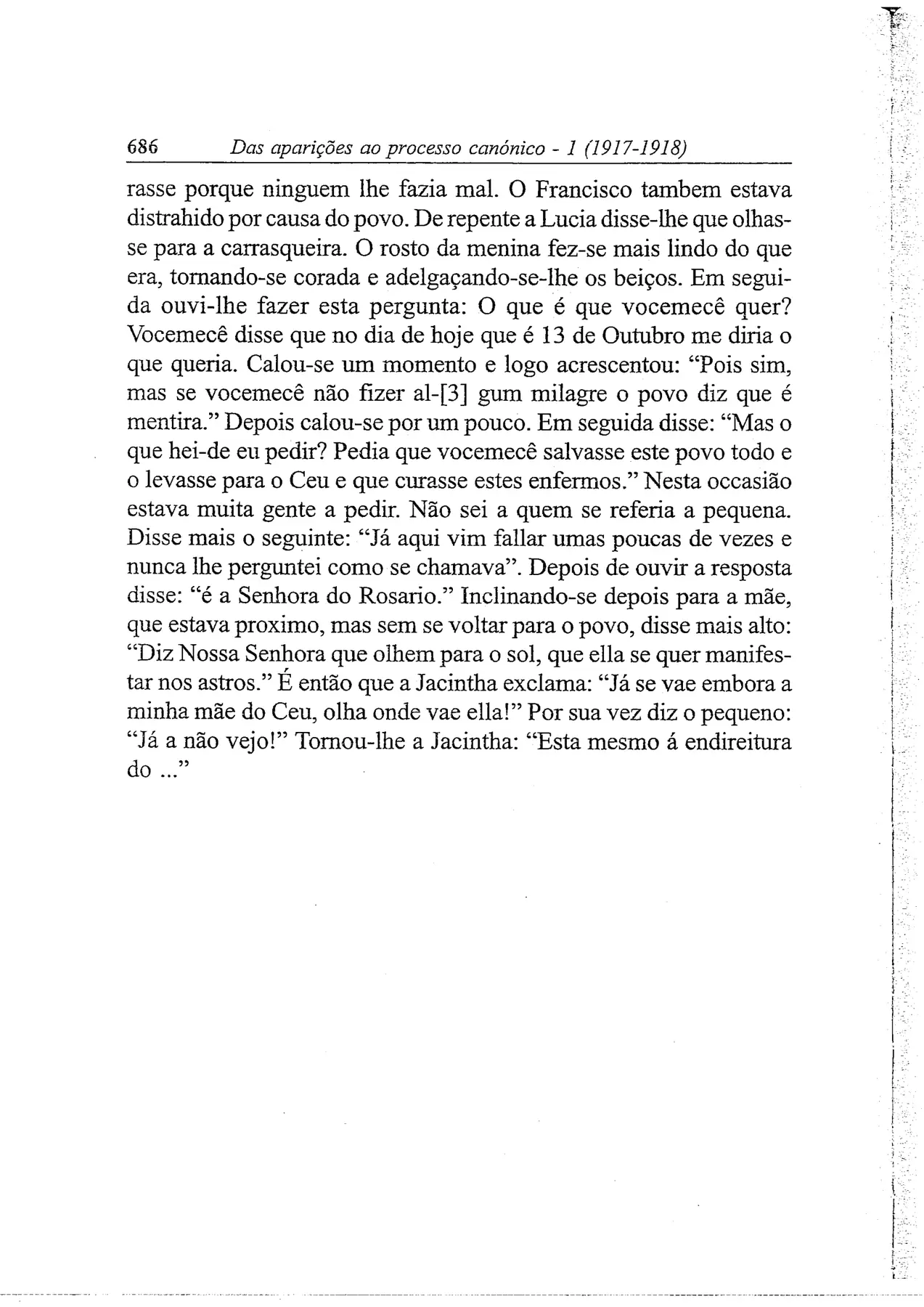
It is then that Jacintha exclaims: “My mother from Heaven is going away now, look where she's going!” The little boy in turn says: “I can't see her any more! ” Jacintha answered him: “**She's right straight in line with the

Português (original)

É então que a Jacintha exclama: “Já se vae embora a minha mãe do Ceu, olha onde vae ella!” Por sua vez diz o pequeno: “Já a não vejo!” Tornou-lhe a Jacintha: “**Esta mesmo á endireitura do

DCF III-1, Doc. 294 · deposition · 13 Oct 1917View scans (2)Link
13 OctSecond-handSaw itInterrogationSeers' words overheard
As told by Lúcia de Jesus (interrogation of 8 Jul 1924, quoted in editor's footnote)
English

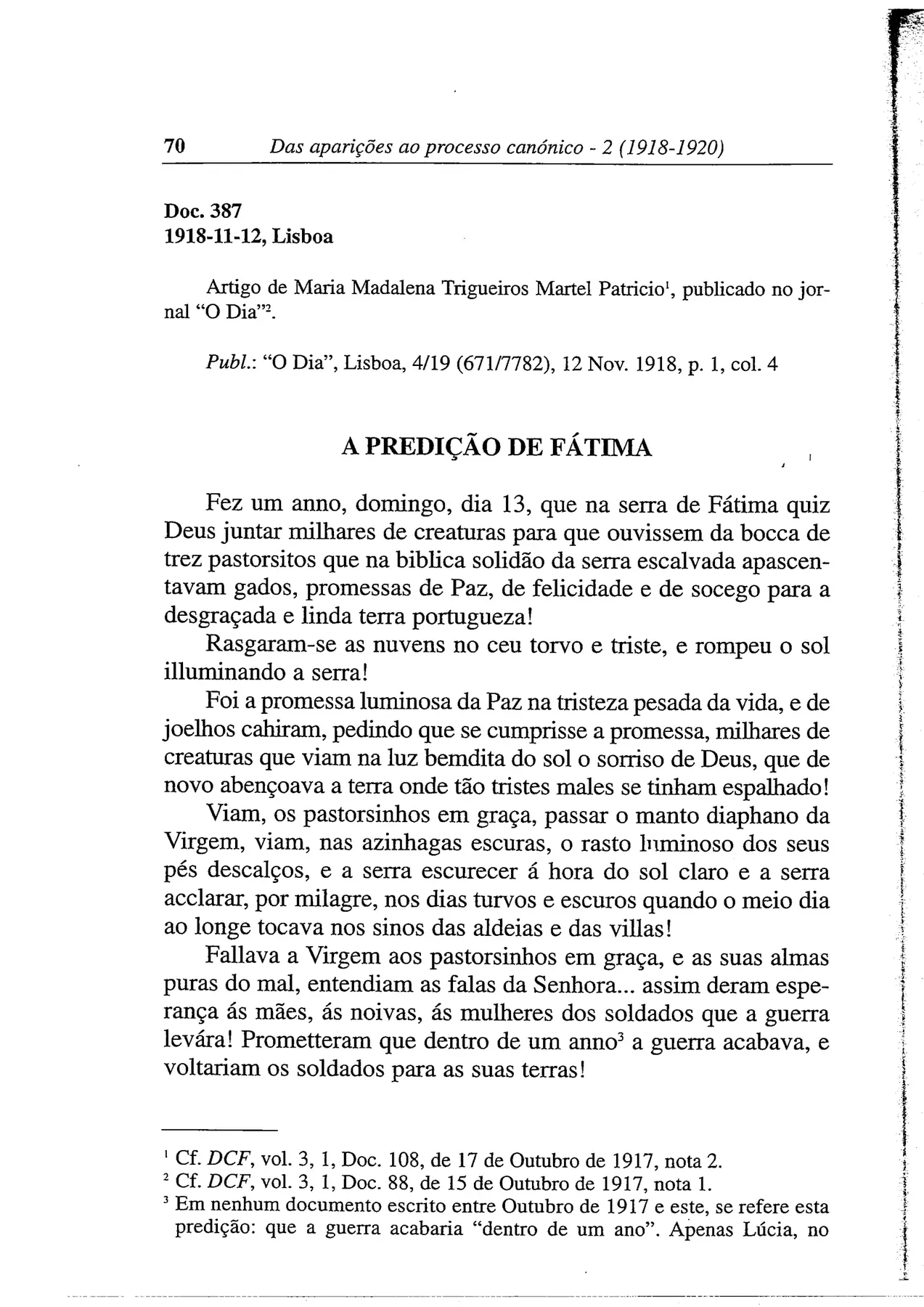
my cousin Jacinta told me at home that the Lady spoke like this: be converted, for the war ends within a year"

Português (original)

a minha prima Jacinta disse-me em casa que a Senhora falou assim: convertam-se que a guerra acaba dentro de um ano"

DCF III-2, Doc. 387 · press · 8 Jul 1924 (7 years later)View scans (2)Link
13 OctFirst-handSaw itInterrogationSeers' words overheardFigures / visions
English

The last time - Lúcia asked what she wanted and She said - That the war would end on the 13th - When she reached Heaven.

– That if the people would not mend their ways the world would end; if they would not mend their ways the war would end.

She heard no more. The Lady was sad when she said this.

Português (original)

Da última vez - A Lúcia perguntou o que ela queria e Ela disse - Que acabava a guerra no dia 13 - Quando chegasse ao Céu.

– Que o povo se não quisesse emendar acabava o mundo; se não se quisesse emendar acabava a guerra.

*Não ouviu mais. A Senhora estava triste quando dizia isto.

DCF Seleção, Doc. 15 (= DCF I, Doc. 46) · interrogation · 19 Oct 1917 (6 days later)View scanLink
13 OctFirst-handSaw itInterrogationFigures / visionsSun spinningSun changing colourSeers' words overheard
English

On the thirteenth of this month did you see near the sun Our Lord, Our Lady of Sorrows and Our Lady of Carmel?

– I didn't see them.

2nd – But on the eleventh of this month you told me they were to appear.

– I did. It was Lúcia who saw another Lady, not me.

3rd – Did you see St Joseph?

– I did. Lúcia said St Joseph was giving peace.

4th – Did you look at the sun?

– I did.

5th – And what did you see?

– I saw the sun red, green and other colours, and I saw that it was going round.

6th – Did you hear Lúcia tell the people to look at the sun?

– I did. She said in a very loud voice to look at the sun. The sun was already going round.

7th – Was it the Lady who told her to tell the people?

– The Lady didn't say anything.

8th – What did the Lady say this last time?

– She said: I come here to tell you that they should not offend Our Lord any more, for he was very much offended; that if the people amended their lives the war would end, if they did not amend the world would end. Lúcia heard what the Lady said better than I did.

9th – Did she say the war would end that day or that it would end soon?

– Our Lady said that when she got to Heaven the war would end.

10th – But the war hasn't ended yet!...

– It'll end, it'll end.

11th – But then when will it end?

– I think it ends on Sunday.

Português (original)

No dia treze do corrente viste ao pé do sol Nosso Senhor, a Senhora das Dores e a Senhora do Carmo?

– Não vi.

2a – Mas a onze deste mês disseste-me que deviam aparecer.

– Disse. A Lúcia é que viu outra Senhora, eu não.

3a – Viste S. José?

– Vi. A Lúcia disse que S. José estava dando a paz.

4a – Olhaste para o sol?

– Olhei.

5a – E o que é que viste?

– Vi o sol encarnado, verde e de outras cores e vi que andava à roda.

6a – Ouviste a Lúcia a avisar o povo para que olhasse para o sol?

– Ouvi. Ela disse numa voz muito alta que olhassem para o sol. O sol já andava à roda.

7a – Foi a Senhora que a mandou avisar o povo?

– A Senhora não disse anda.

8a – O que disse a Senhora desta última vez?

– Disse: Venho aqui para te dizer que não ofendam mais a Nosso Senhor, que estava muito ofendido, que se o povo se emendasse acabava a guerra, se não se emendasse acabava o mundo. A Lúcia ouviu melhor do que eu o que a Senhora disse.

9a – Disse que a guerra acabava nesse dia ou que acabava brevemente?

– Nossa Senhora disse que quando chegasse ao Céu acabava a guerra.

10a – Mas a guerra ainda não acabou!...

– Acaba, acaba.

11a – Mas então quando acaba?

– Cuido que acaba no Domingo.

DCF Seleção, Doc. 18 (= DCF I, Doc. 16) · interrogation · 19 Oct 1917 (6 days later)View scans (2)Link
13 OctFirst-handSaw itInterrogationSeers' words overheard
English

What did the Lady say in October?

– Lúcia said: “What do you want of me”? The Lady answered: “do not offend Our Lord any more, for he was much offended”. She said she would forgive [sic] our sins, if we wanted to go to Heaven. She also said that people were to say the rosary. She said they were to expect the soldiers back here very soon and that the war would end that day. She said people were to build a chapel there, and I don't know whether she said “to Our Lady of the Rosary” or that “she was Our Lady of the Rosary”.

Português (original)

Que disse a Senhora em outubro?

– A Lúcia disse: “Que me quer”? A Senhora respondeu: “não ofendam mais a Nosso Senhor que estava muito ofendido”. Disse que perdoava [sic] os nossos pecados, querendo ir para o Céu. Disse também que rezasse a gente o terço. Disse que esperassem cá os militares muito breve e que acabava a guerra naquele dia. Disse que fizesse a gente lá uma capela e não sei se disse “à Senhora do Rosário” ou que “ela era a Senhora do Rosário”.

DCF Seleção, Doc. 22 (= DCF I, Doc. 17) · interrogation · 2 Nov 1917 (3 weeks later)View scanLink
13 OctSecond-handSaw itSworn depositionSeers' words overheard
As told by Pe. Francisco Brás das Neves (curate of Freixianda), via Lúcia
English

He likewise declares: that, meeting her, Lúcia, again on the eighth of the current month of December, and the observation being made to her that the war had not ended on the day indicated, nor indeed up to that date, she answered that perhaps she had been mistaken, since her companion Jacinta had said that Our Lady had said, for her part, that the war would end, yes, but if the people mended their ways.

Português (original)

Outrossim declara: que, encontrando-se de novo com ela, Lúcia, no dia oito do corrente mês de dezembro, e sendo-lhe feita a observação de que a guerra não tinha acabado no dia designado nem tão pouco até àquela data, pela mesma foi respondido que talvez se tivesse enganado, pois que a sua companheira Jacinta dissera que Nossa Senhora havia dito por sua vez que a guerra acabaria, sim, mas se o povo se emendasse.

DCF Seleção, Doc. 30 (= DCF I, Doc. 26) · deposition · 8 Dec 1917 (8 weeks later)View scanLink
13 OctSecond-handSaw itSworn depositionFigures / visionsSeers' words overheard
As told by Olímpia de Jesus (mother of Francisco and Jacinta), sworn deposition to the canonical commission (Dr. Manuel Nunes Formigão, relator)
English

Jacinta, as the mother heard, after they had said that Our Lady had already appeared, nudged Lúcia with her elbow and said to her: “Speak to her, Lúcia, Our Lady is already there”. Once at home Jacinta said to her mother: “Oh mother, I saw her go into Heaven”, and added that it had seemed to her, when she saw her go into Heaven, that her feet were getting caught.

Português (original)

A Jacinta, como a mãe ouviu, depois de dizerem que Nossa Senhora já tinha aparecido, acotovelou a Lúcia e disse-lhe: “Fala-lhe Lúcia, que Nossa Senhora já lá está”.

[…]

Já em casa a Jacinta disse à mãe: “Ó minha mãe, eu vi-a entrar no Céu”, e acrescentou que se lhe representara quando a viu entrar no Céu, que os pés se lhe entalavam.