Witnesses /
Francisco Marto
Seer
Francisco Marto, born 11 June 1908 (aged 9 by October 1917), one of the three seers, brother of Jacinta and cousin of Lúcia; he died on 4 April 1919.
One of the three seersFrom Aljustrel, FátimaFátima parish (locals)Attitude beforehand: Believer18 passages
See also: Francisco and Jacinta Marto (2 passages, together) · Lúcia, Francisco and Jacinta (33 passages, together) · Jacinta Marto (34 passages) · Lúcia de Jesus (119 passages)
13 May 1917 11 passages
13 MaySecond-handSaw itSworn depositionFigures / visionsSeers' words overheard As told by Manuel Pedro Marto (father of Francisco and Jacinta), sworn deposition to the canonical commission (Dr. Manuel Nunes Formigão, relator)
English
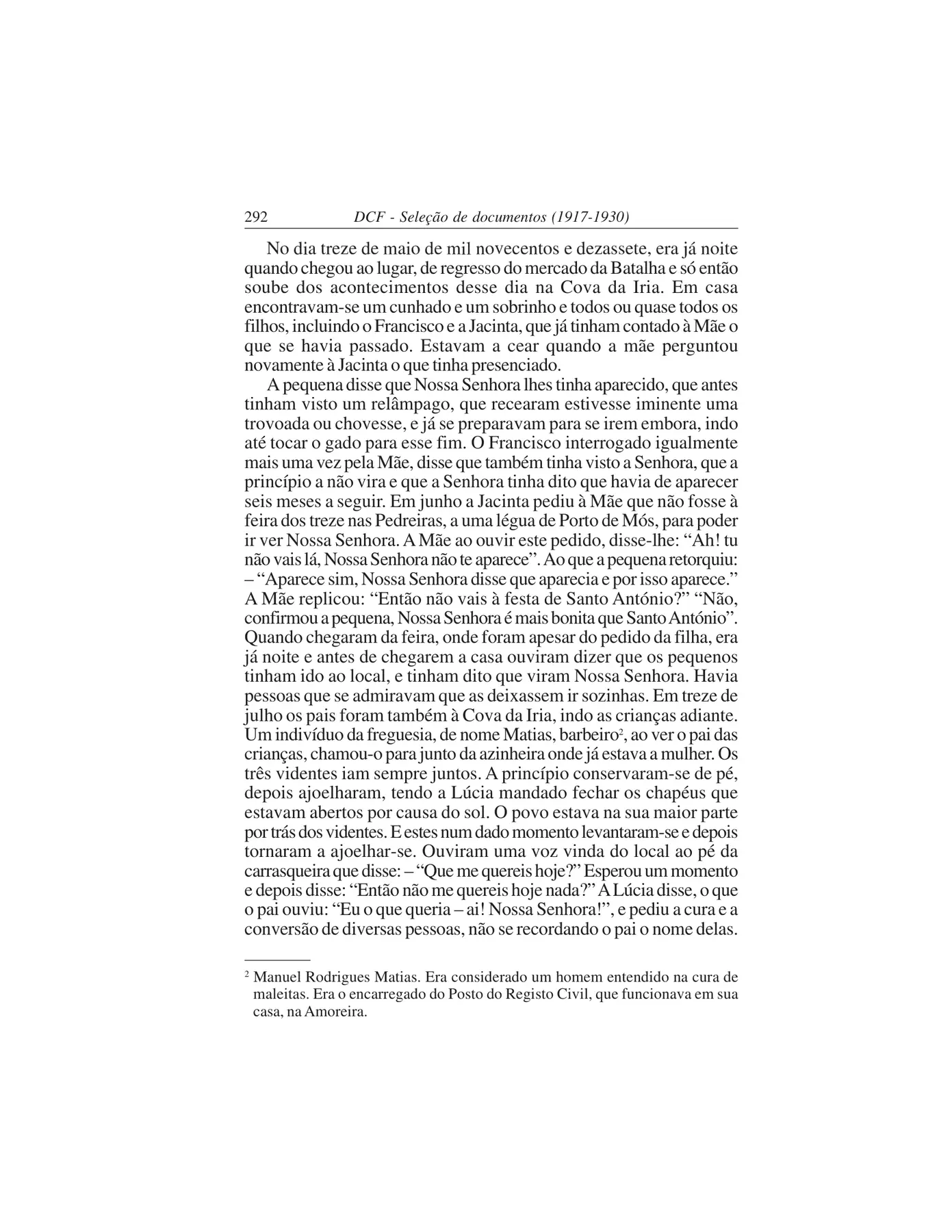
Francisco, likewise questioned once more by his mother, said that he too had seen the Lady, that at first he had not seen her, and that the Lady had said she would appear for six months in succession.
Português
O Francisco interrogado igualmente mais uma vez pela Mãe, disse que também tinha visto a Senhora, que a princípio a não vira e que a Senhora tinha dito que havia de aparecer seis meses a seguir.
English
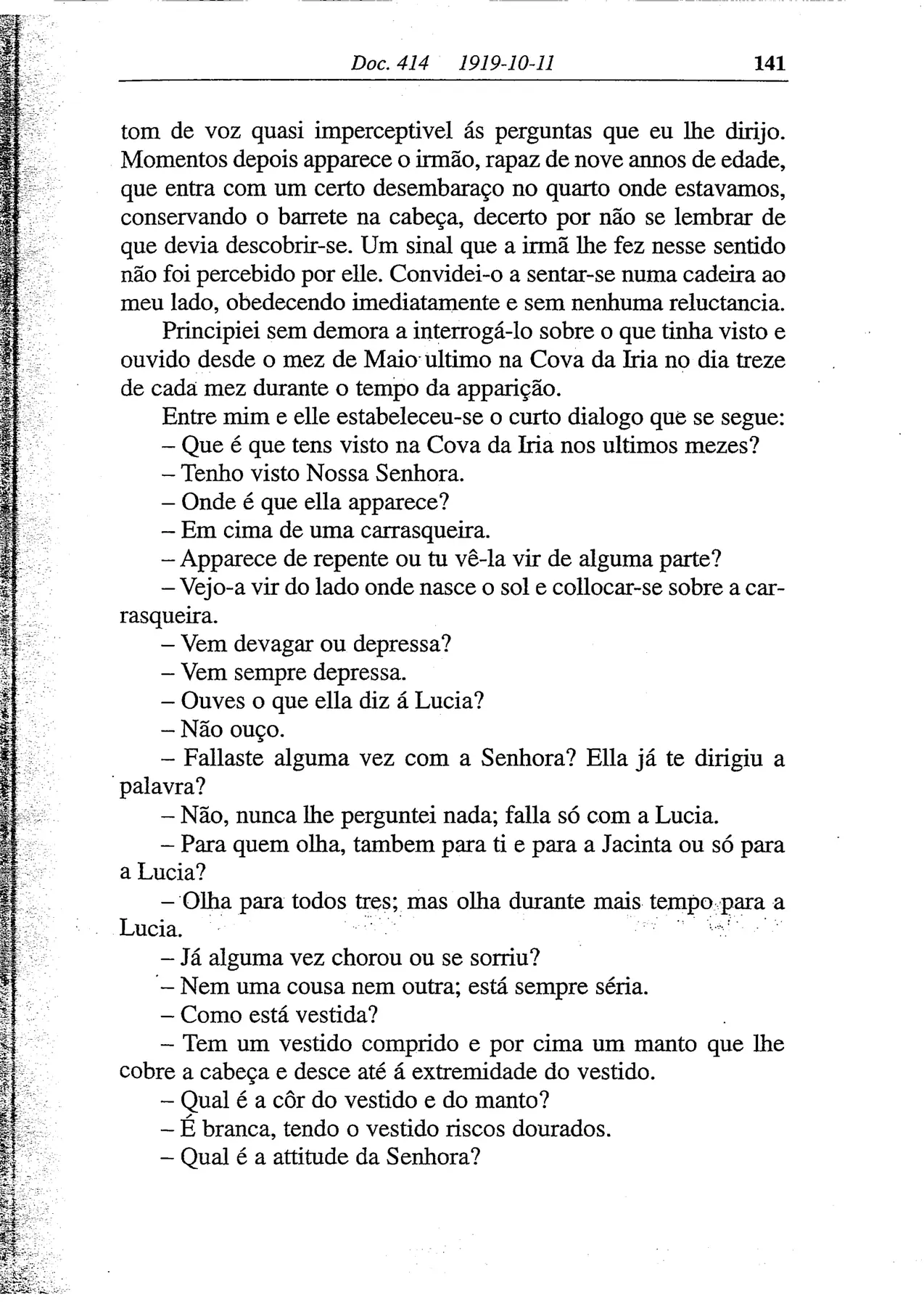
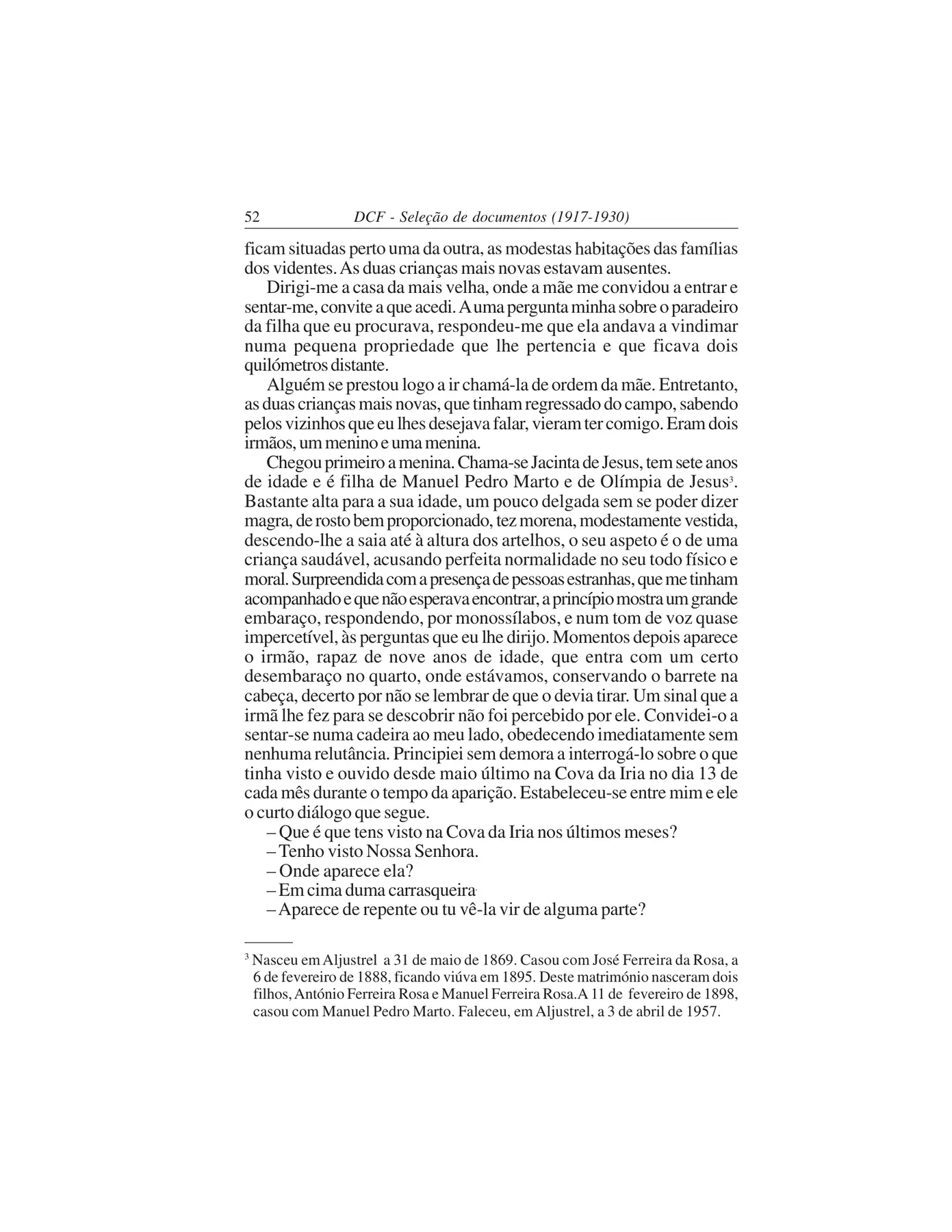
Without delay I began to question him about what he had seen and heard since the month of May last at the Cova da Iria on the thirteenth of each month during the time of the apparition.
Português
Principiei sem demora a interrogá-lo sobre o que tinha visto e ouvido desde o mez de Maio ultimo na Cova da Iria no dia treze de cada mez durante o tempo da apparição.
Between him and me the following short dialogue took place:
Entre mim e elle estabeleceu-se o curto dialogo que se segue:
- What have you seen at the Cova da Iria these last months?
- I have seen Our Lady.
- Where does she appear?
- On top of a holm-oak shrub.
- Does she appear suddenly or do you see her coming from somewhere?
- I see her coming from the side where the sun rises and placing herself on the holm-oak shrub.
- Does she come slowly or quickly?
- She always comes quickly.
- Do you hear what she says to Lucia?
- I don't hear.
- Have you ever spoken with the Lady? Has she ever addressed a word to you?
- No, I have never asked her anything; she speaks only with Lucia.
- Whom does she look at, at you and Jacinta too or only at Lucia?
- She looks at all three; but she looks longer at Lucia.
- Has she ever wept or smiled?
- Neither one thing nor the other; she is always serious.
- How is she dressed?
- She has a long dress and over it a mantle that covers her head and comes down to the bottom of the dress.
- What is the colour of the dress and the mantle?
- It is white, the dress having gold stripes.
- What is the Lady's attitude?
- Que é que tens visto na Cova da Iria nos ultimos mezes?
- Tenho visto Nossa Senhora.
- Onde é que ella apparece?
- Em cima de uma carrasqueira.
- Apparece de repente ou tu vê-la vir de alguma parte?
- Vejo-a vir do lado onde nasce o sol e collocar-se sobre a carrasqueira.
- Vem devagar ou depressa?
- Vem sempre depressa.
- Ouves o que ella diz á Lucia?
- Não ouço.
- Fallaste alguma vez com a Senhora? Ella já te dirigiu a palavra?
- Não, nunca lhe perguntei nada; falla só com a Lucia.
- Para quem olha, tambem para ti e para a Jacinta ou só para a Lucia?
- Olha para todos tres; mas olha durante mais tempo para a Lucia.
- Já alguma vez chorou ou se sorriu?
- Nem uma cousa nem outra; está sempre séria.
- Como está vestida?
- Tem um vestido comprido e por cima um manto que lhe cobre a cabeça e desce até á extremidade do vestido.
- Qual é a côr do vestido e do manto?
- É branca, tendo o vestido riscos dourados.
- Qual é a attitude da Senhora?
– That of someone praying. She has her hands joined at the height of her breast.
– É a de quem está a rezar. Tem as mãos postas á altura do peito.
– Does she carry anything in her hands?
– Traz alguma coisa nas mãos?
– She carries, between the palm and the back of her right hand, some beads that hang down over her dress.
– Traz entre a palma e as costas da mão direita umas contas que estão pendentes sobre o vestido.
– And what does she have on her ears?
– E nas orelhas o que tem?
– Her ears can't be seen, because they are covered by the mantle.
– As orelhas não se vêem, porque estão cobertas com o manto.
– What colour are the beads?
– De que côr são as contas?
– Prettier than that girl you see there?
– Mais bonita que aquella menina que tu alli vês?
– But there are ladies much prettier than that girl...
– Mas ha senhoras muito mais bonitas que aquella menina...
– She is prettier than anyone I have ever seen.
– É mais bonita que qualquer pessoa que eu visse.
English
What have you seen at the Cova da Iria in recent months?
- I have seen Our Lady.
- Where does she appear?
- On top of a holm-oak shrub
- Does she appear suddenly or do you see her come from somewhere?
Português
Que é que tens visto na Cova da Iria nos últimos meses?
- Tenho visto Nossa Senhora.
- Onde aparece ela?
- Em cima duma carrasqueira
- Aparece de repente ou tu vê-la vir de alguma parte?
– I see her come from the side where the sun rises and settle on the holm-oak shrub.
– Vejo-a vir do lado onde nasce o sol e colocar-se sobre a carrasqueira.
– Does she come slowly or quickly?
– Vem devagar ou depressa?
– She always comes quickly.
– Do you hear what she says to Lúcia?
– Ouves o que ela diz à Lúcia?
– Have you ever spoken to the Lady? Has she ever spoken to you?
– Falaste alguma vez com a Senhora? Ela já te dirigiu a palavra?
– No, I never asked her anything; she speaks only to Lúcia.
– Não, nunca lhe perguntei nada; fala só com a Lúcia.
– Whom does she look at, at you and Jacinta too, or only at Lúcia?
– Para quem olha ela, também para ti e para a Jacinta, ou só para a Lúcia?
– She looks at all three of us; but she looks longer at Lúcia.
– Olha para todos três; mas olha durante mais tempo para a Lúcia.
Editors' notes (1)
3 Born at Aljustrel on 31 May 1869. She married José Ferreira da Rosa on 6 February 1888 and was widowed in 1895. Of this marriage two sons were born, António Ferreira Rosa and Manuel Ferreira Rosa. On 11 February 1898 she married Manuel Pedro Marto. She died at Aljustrel on 3 April 1957.
3 Nasceu em Aljustrel a 31 de maio de 1869. Casou com José Ferreira da Rosa, a 6 de fevereiro de 1888, ficando viúva em 1895. Deste matrimónio nasceram dois filhos, António Ferreira Rosa e Manuel Ferreira Rosa. A 11 de fevereiro de 1898, casou com Manuel Pedro Marto. Faleceu, em Aljustrel, a 3 de abril de 1957.
English
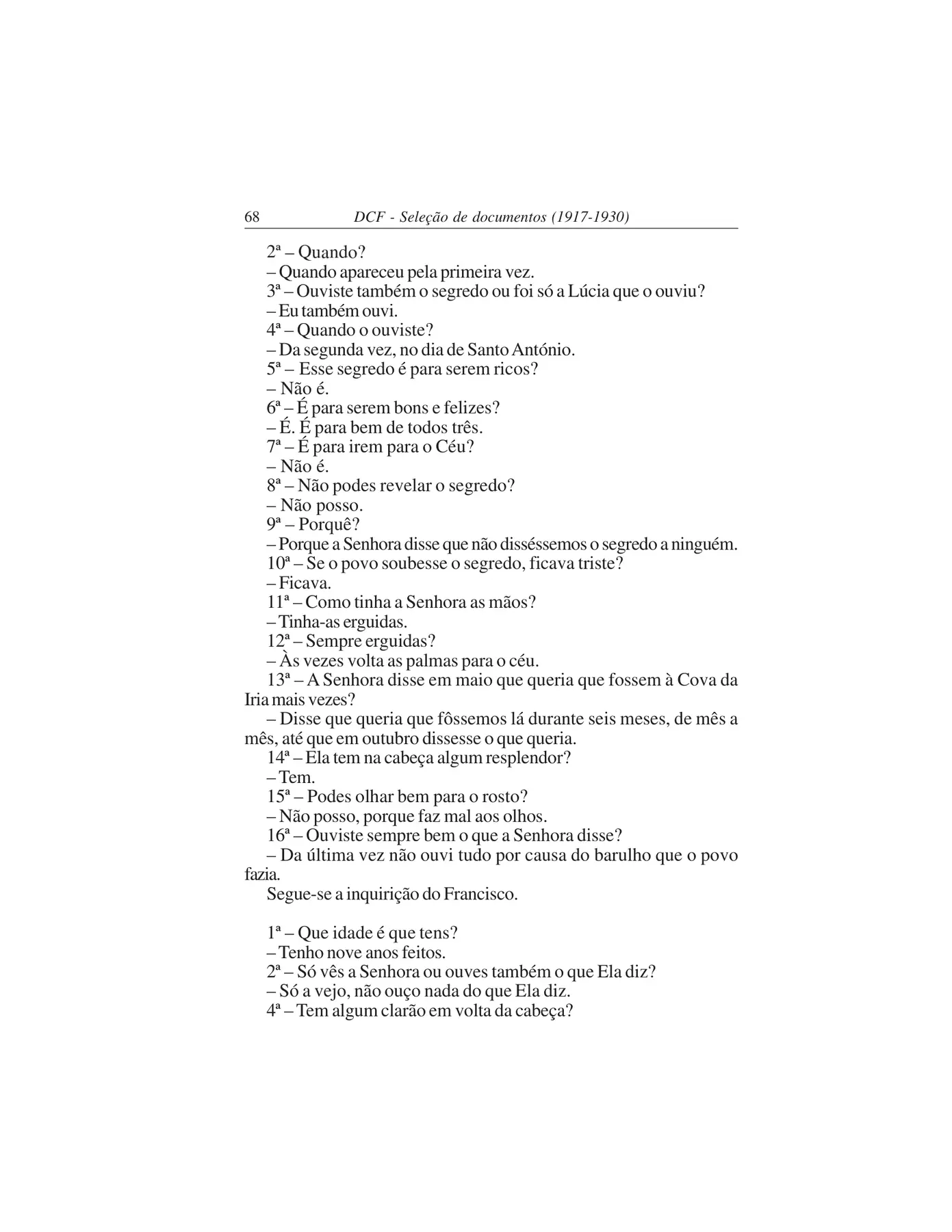
How old are you?
– I'm nine.
2a – Do you only see the Lady or do you also hear what She says?
– I only see her; I hear nothing of what She says.
4a – Does she have a glow around her head?
Português
Que idade é que tens?
– Tenho nove anos feitos.
2a – Só vês a Senhora ou ouves também o que Ela diz?
– Só a vejo, não ouço nada do que Ela diz.
4a – Tem algum clarão em volta da cabeça?
– She does.
5a – Can you look properly at her face?
– I can look, but only a little, because of the light.
6a – Does she have any trimmings on her dress?
– She has some gold cords.
7a – What colour is the crucifix of the rosary?
– It is white.
8a – And the chain of the rosary?
– It is white too.
9a – Would the people be sad if they knew the secret?
– They would.
- Tem.
5a – Podes olhar bem para a cara dela?
- Posso olhar, mas pouco, por causa da luz.
6a – Tem alguns enfeites no vestido?
- Tem uns cordões de ouro.
7a – De que cor é o crucifixo do rosário?
- É branco.
8a – E a cadeia do rosário?
- Também é branca.
9a – O povo ficava triste se soubesse o segredo?
- Ficava.
13 May13 OctFirst-handSaw itInterrogationFigures / visionsSeers' words overheard English
What were they doing when they saw the Lady?
Português
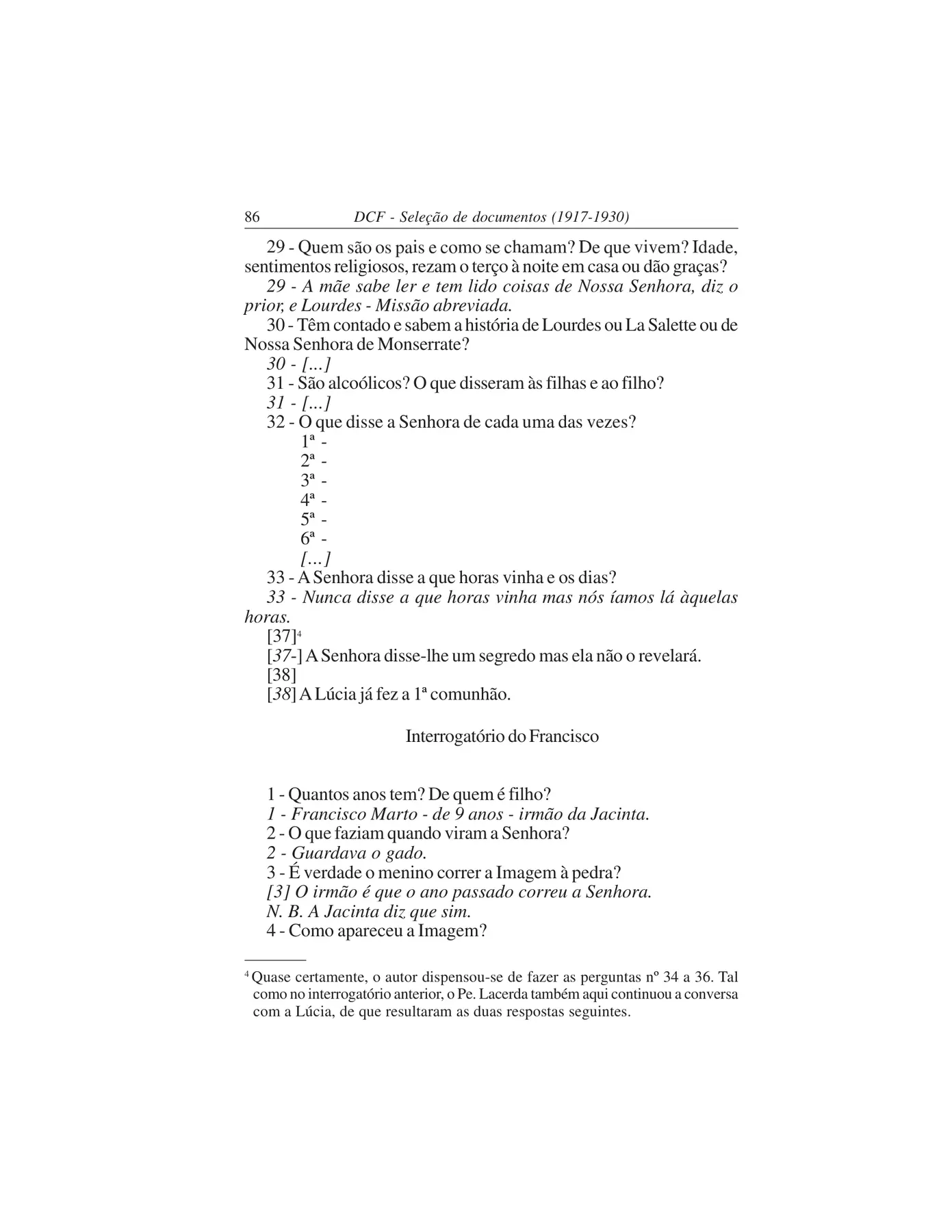
O que faziam quando viram a Senhora?
2 - He was minding the flock.
3 - Is it true that the boy chased the Image away with stones?
3 - É verdade o menino correr a Imagem à pedra?
[3] It was his brother who chased the Lady away last year.
[3] O irmão é que o ano passado correu a Senhora.
N. B. A Jacinta diz que sim.
4 - How did the Image appear?
4 - Como apareceu a Imagem?
5 - What clothes was she wearing and what did she say?
5 - Que vestidos trazia e o que disse?
4 - It was sunny, they were passing by and he saw a woman dressed in white. He did not see lightning; it was Lúcia who saw it. The sheep were running off into the chickling peas and the maize, but the Lady said they should not worry, that the sheep would not knock anything down, nor eat. After the apparition they ate.
4 - Fazia sol, vinham a passar e viu uma mulher vestida de branco. Não viu relâmpagos; a Lúcia é que viu. As ovelhas fugiam para os chícharos e milho mas a Senhora disse que não se importassem que as ovelhas não tombavam, nem comiam. Depois da aparição comiam.
Lúcia says that the Lady did not say anything, unless it was to Jacinta, because she had already appeared to her.
A Lúcia diz que a Senhora não disse nada, só se foi à Jacinta porque ela lhe tinha já aparecido.
He (Francisco) saw the Image.
Via (Francisco) a Imagem.
She wore a mantle on her head and her dress was all white.
Trazia um manto na cabeça e o vestido era todo branco.
13 - What clothes did she wear the 1st time and the other times?
13 - Que fatos trazia ela da 1ª vez e das outras vezes?
[13 -] She always wore the same clothes; she was beautiful.
[13 -] Trazia sempre o mesmo fato, ela era bonita.
[...] 15 - Did they always see the spots on the sun?
[...] 15 - Viram sempre as manchas no sol?
[15 -] He saw St. Joseph and the Child Jesus in the sun.
[15 -] Viu S. José e o Menino Jesus no sol.
[...] 22- What did Our Lady say the 1st time?
[...] 22- O que disse N. Senhora da 1ª vez?
[22 -] He never heard her speak.
[22 -] Nunca a ouviu falar.
Editors' notes (1)
4 Almost certainly, the author dispensed with asking questions nos. 34 to 36. Just as in the previous interrogation, Fr. Lacerda here too continued the conversation with Lúcia, which produced the following two answers.
4 Quase certamente, o autor dispensou-se de fazer as perguntas nº 34 a 36. Tal como no interrogatório anterior, o Pe. Lacerda também aqui continuou a conversa com a Lúcia, de que resultaram as duas respostas seguintes.
13 MaySecond-handSaw itSworn depositionFigures / visionsSeers' words overheard As told by Olímpia de Jesus (mother of Francisco and Jacinta), sworn deposition to the canonical commission (Dr. Manuel Nunes Formigão, relator)
English
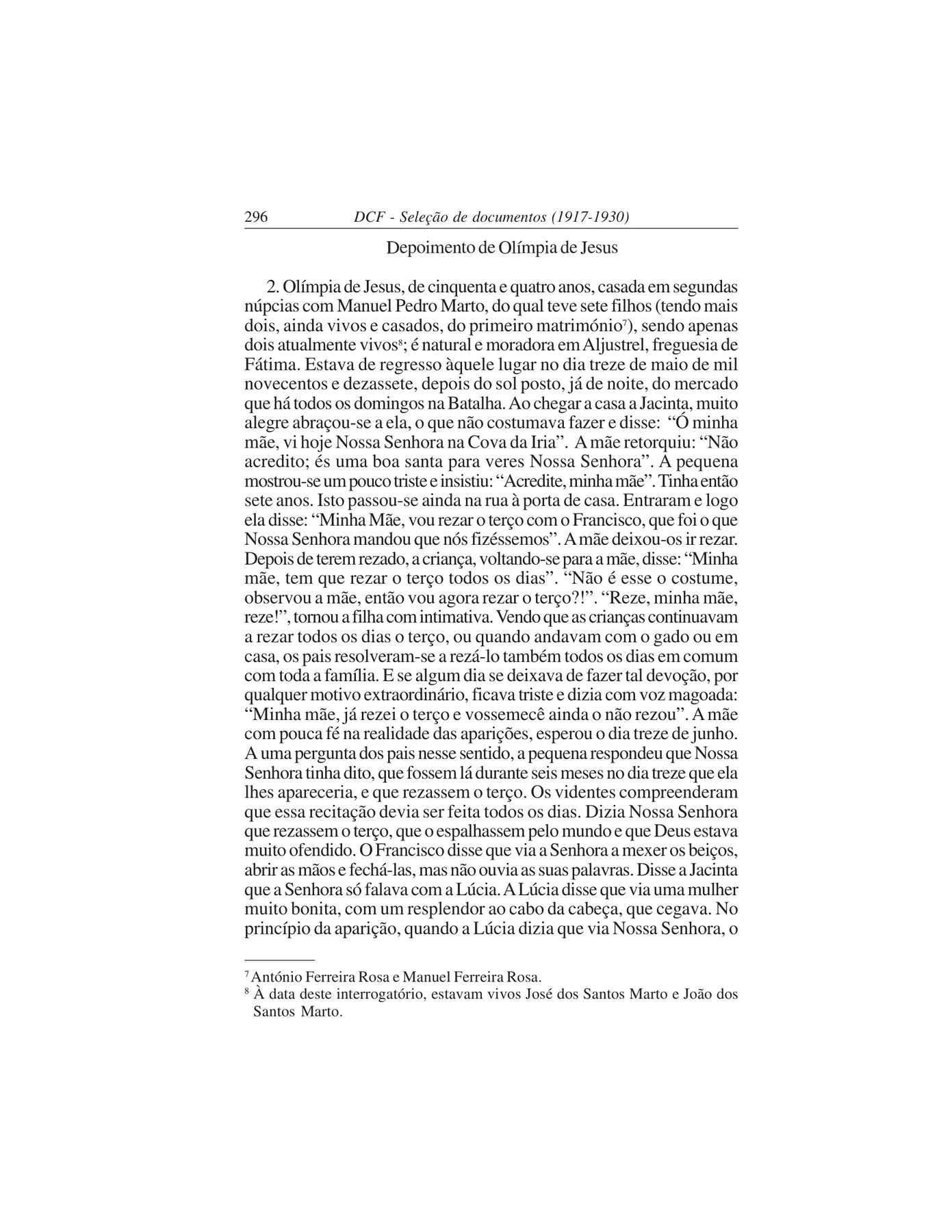
Francisco said that he saw the Lady moving her lips, opening her hands and closing them, but did not hear her words. At the beginning of the apparition, when Lúcia said she was seeing Our Lady,
Português
O Francisco disse que via a Senhora a mexer os beiços, abrir as mãos e fechá-las, mas não ouvia as suas palavras.
[…]
No princípio da aparição, quando a Lúcia dizia que via Nossa Senhora, o
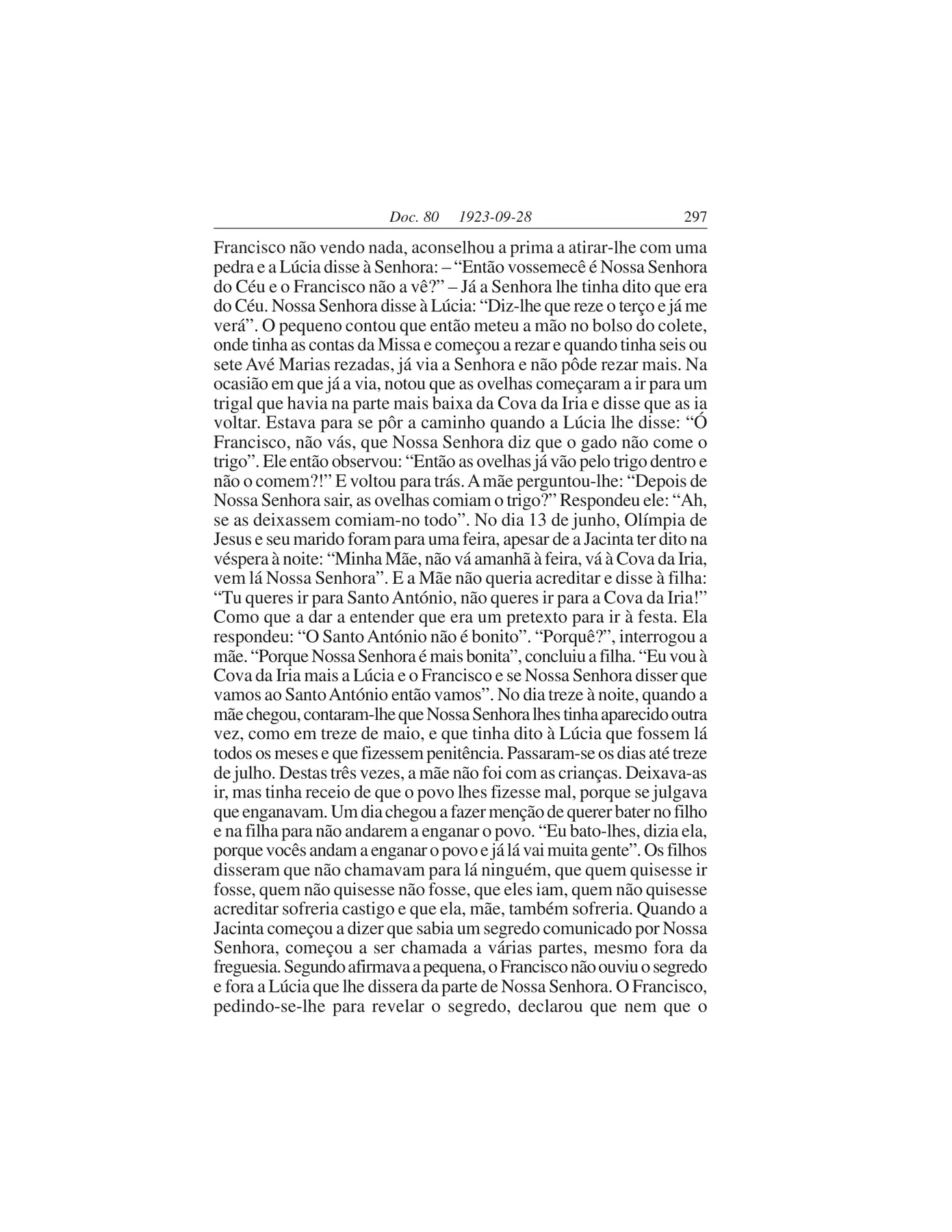
Francisco, seeing nothing, advised his cousin to throw a stone at it, and Lúcia said to the Lady: – “So you are Our Lady from Heaven and Francisco doesn't see you?” – The Lady had already told her that she was from Heaven. Our Lady said to Lúcia: “Tell him to pray the rosary and he will see me”. The boy told how he then put his hand into his waistcoat pocket, where he had the beads he used at Mass, and began to pray, and when he had prayed six or seven Hail Marys he could already see the Lady and could pray no more. At the moment when he could already see her, he noticed that the sheep were starting to go into a wheat field in the lowest part of the Cova da Iria and said he was going to turn them back. He was about to set off when Lúcia said to him: “Oh Francisco, don't go, because Our Lady says the flock won't eat the wheat”. He then observed: “So the sheep are going right into the wheat and not eating it?!” And he came back. His mother asked him: “After Our Lady left, did the sheep eat the wheat?” He answered: “Ah, if they'd let them, they would have eaten it all”.
Francisco não vendo nada, aconselhou a prima a atirar-lhe com uma pedra e a Lúcia disse à Senhora: – “Então vossemecê é Nossa Senhora do Céu e o Francisco não a vê?” – Já a Senhora lhe tinha dito que era do Céu. Nossa Senhora disse à Lúcia: “Diz-lhe que reze o terço e já me verá”. O pequeno contou que então meteu a mão no bolso do colete, onde tinha as contas da Missa e começou a rezar e quando tinha seis ou sete Avé Marias rezadas, já via a Senhora e não pôde rezar mais. Na ocasião em que já a via, notou que as ovelhas começaram a ir para um trigal que havia na parte mais baixa da Cova da Iria e disse que as ia voltar. Estava para se pôr a caminho quando a Lúcia lhe disse: “Ó Francisco, não vás, que Nossa Senhora diz que o gado não come o trigo”. Ele então observou: “Então as ovelhas já vão pelo trigo dentro e não o comem?!” E voltou para trás. A mãe perguntou-lhe: “Depois de Nossa Senhora sair, as ovelhas comiam o trigo?” Respondeu ele: “Ah, se as deixassem comiam-no todo”.
Editors' notes (2)
7 António Ferreira Rosa and Manuel Ferreira Rosa.
8 At the date of this interrogation, José dos Santos Marto and João dos Santos Marto were alive.
7 António Ferreira Rosa e Manuel Ferreira Rosa.
8 À data deste interrogatório, estavam vivos José dos Santos Marto e João dos Santos Marto.
13 MaySecond-handSaw itSworn depositionFigures / visionsSeers' words overheard As told by José Alves of Moita (relaying his wife), sworn deposition to the canonical commission (Dr. Manuel Nunes Formigão, relator)
English
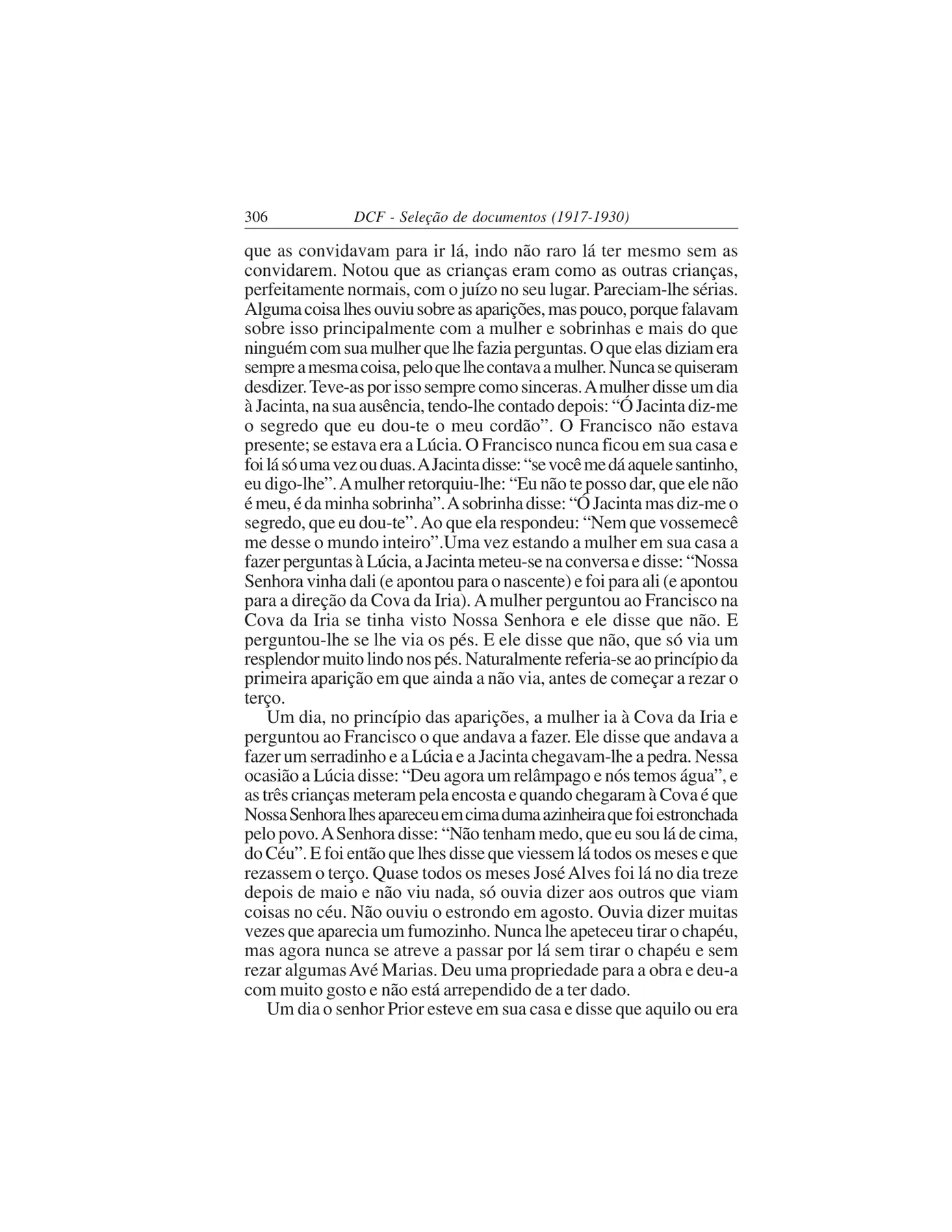
His wife asked Francisco at the Cova da Iria whether he had seen Our Lady and he said no. And she asked him whether he saw her feet. And he said no, that he only saw a very lovely radiance at her feet. Presumably he was referring to the beginning of the first apparition, when he did not yet see her, before he began to pray the rosary.
Português
A mulher perguntou ao Francisco na Cova da Iria se tinha visto Nossa Senhora e ele disse que não. E perguntou-lhe se lhe via os pés. E ele disse que não, que só via um resplendor muito lindo nos pés. Naturalmente referia-se ao princípio da primeira aparição em que ainda a não via, antes de começar a rezar o terço.
English
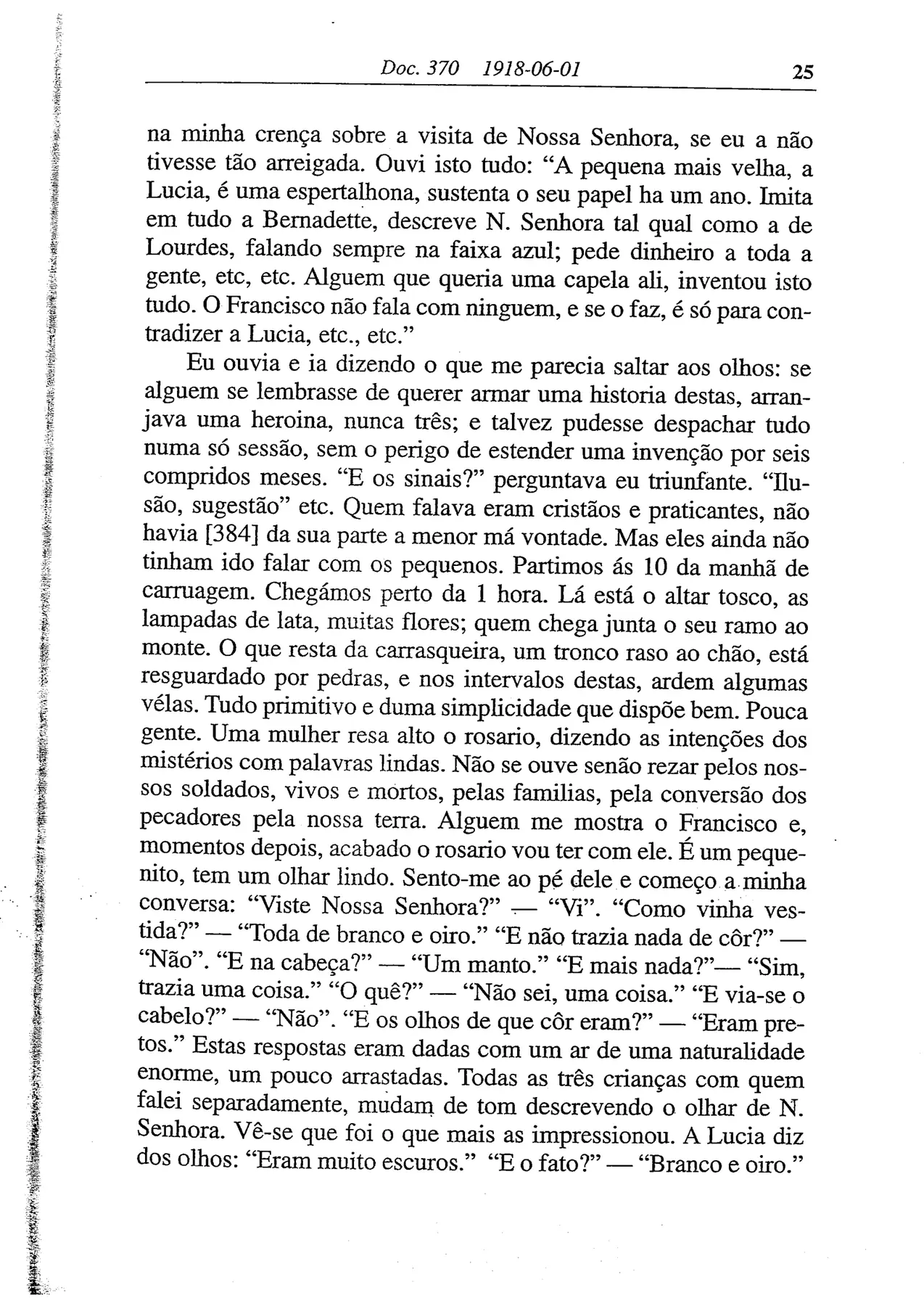
I sit down beside him and begin my conversation: “Did you see Our Lady?” — “I did.” “How was she dressed?” — “All in white and gold.” “And didn't she have anything coloured?” — “No.” “And on her head?” — “A mantle.” “And nothing else?” — “Yes, she had a thing.” “What?” — “I don't know, a thing.” “And could her hair be seen?” — “No.” “And what colour were her eyes?” — “They were black.” These answers were given with an air of enormous naturalness, in a slightly drawling voice. All three children, whom I spoke to separately, change their tone when describing Our Lady's gaze. One can see that it was what impressed them most.
Português
Sento-me ao pé dele e começo a minha conversa: “Viste Nossa Senhora?” — “Vi”. “Como vinha vestida?” — “Toda de branco e oiro.” “E não trazia nada de côr?” — “Não”. “E na cabeça?” — “Um manto.” “E mais nada?” — “Sim, trazia uma coisa.” “O quê?” — “Não sei, uma coisa.” “E via-se o cabelo?” — “Não”. “E os olhos de que côr eram?” — “Eram pretos.” Estas respostas eram dadas com um ar de uma naturalidade enorme, um pouco arrastadas. Todas as três crianças com quem falei separadamente, mudam de tom descrevendo o olhar de N. Senhora. Vê-se que foi o que mais as impressionou.
English
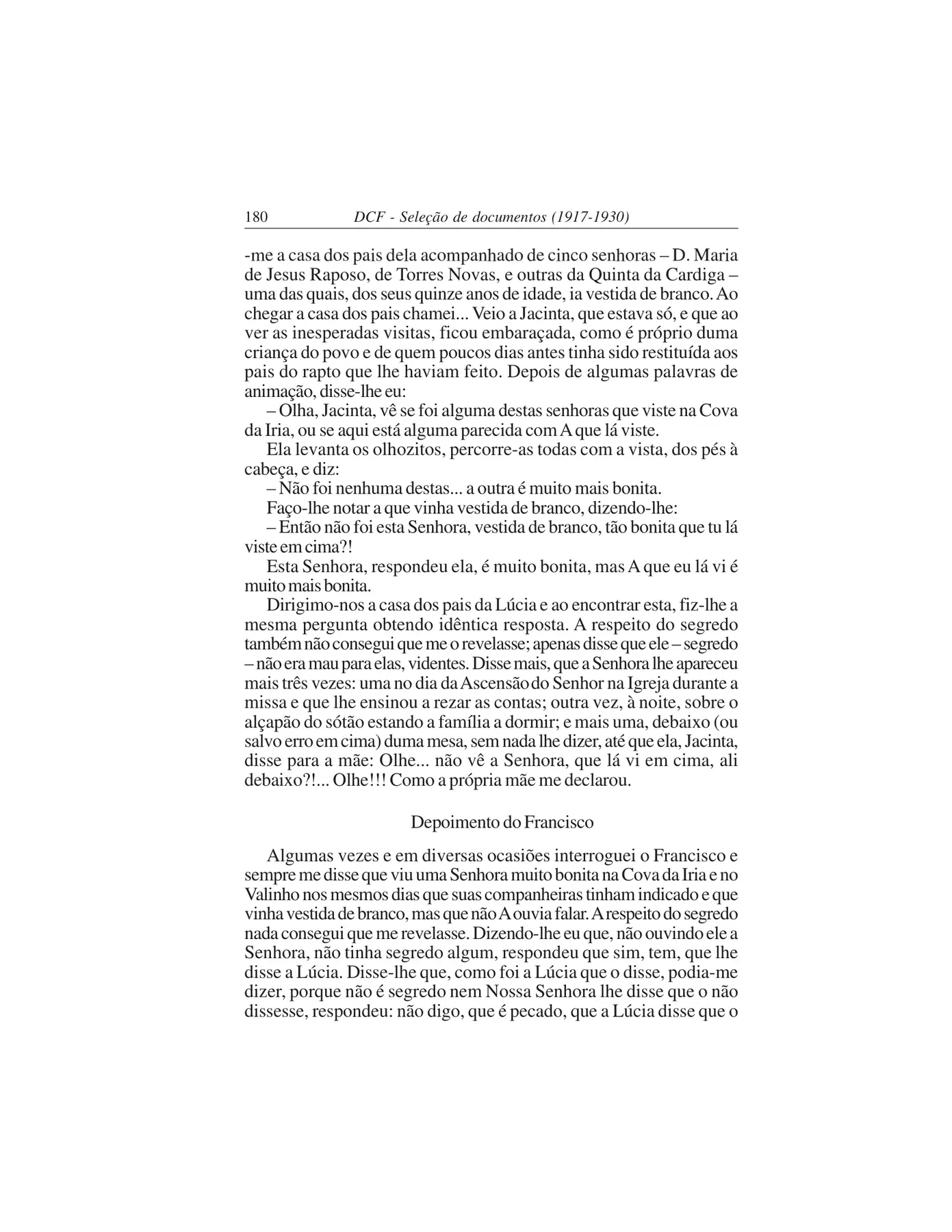
On a few different occasions I questioned Francisco, and he always told me that he saw a very beautiful Lady at the Cova da Iria and at Valinho on the same days his companions had given, and that she was dressed in white, but that he did not hear Her speak. As for the secret, I could not get him to reveal anything. When I told him that, since he did not hear the Lady, he had no secret at all, he answered that yes, he has; Lúcia told it to him. I told him that, since it was Lúcia who told it to him, he could tell me, because it is not a secret and Our Lady did not tell him not to tell it; he answered: I won't tell, it's a sin; Lúcia said that I shouldn't tell it, so I won't.
Português
Algumas vezes e em diversas ocasiões interroguei o Francisco e sempre me disse que viu uma Senhora muito bonita na Cova da Iria e no Valinho nos mesmos dias que suas companheiras tinham indicado e que vinha vestida de branco, mas que não A ouvia falar. A respeito do segredo nada consegui que me revelasse. Dizendo-lhe eu que, não ouvindo ele a Senhora, não tinha segredo algum, respondeu que sim, tem, que lhe disse a Lúcia. Disse-lhe que, como foi a Lúcia que o disse, podia-me dizer, porque não é segredo nem Nossa Senhora lhe disse que o não dissesse, respondeu: não digo, que é pecado, que a Lúcia disse que o não dissesse eu, por isso não digo.
As told by Manuel Nunes Formigão (summarising the parish inquiry of Fr. Manuel Marques Ferreira)
English
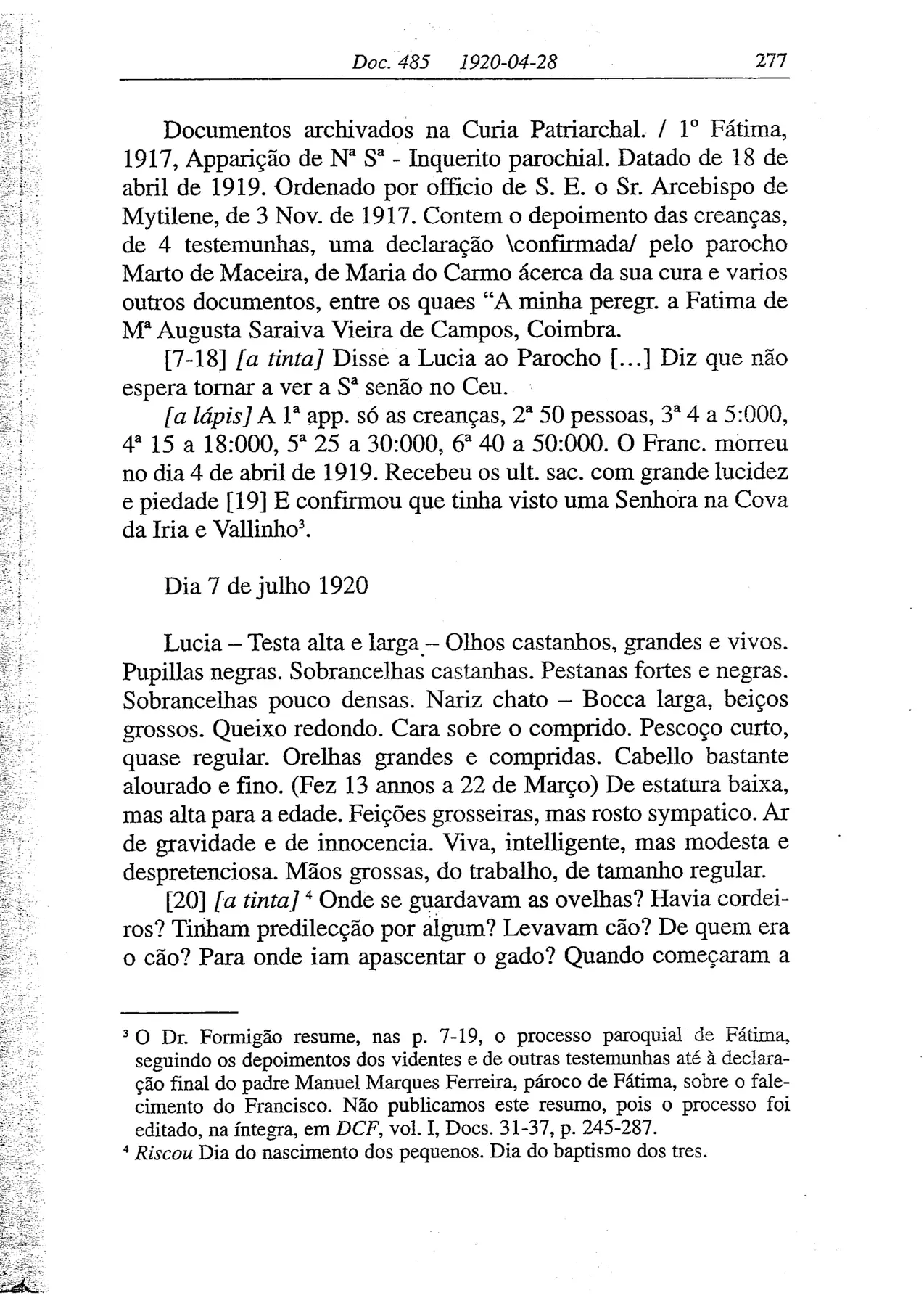
Franc. died on 4 April 1919. He received the last sacr. with great lucidity and piety And confirmed that he had seen a Lady at the Cova da Iria and Vallinho3.
Português
O Franc. morreu no dia 4 de abril de 1919. Recebeu os ult. sac. com grande lucidez e piedade E confirmou que tinha visto uma Senhora na Cova da Iria e Vallinho3.
Editors' notes (1)
3 Dr. Formigão summarises, on pp. 7-19, the parish process of Fátima, following the depositions of the seers and of other witnesses up to the final declaration of Fr. Manuel Marques Ferreira, parish priest of Fátima, on the death of Francisco. We do not publish this summary, as the process has been published in full in DCF, vol. I, Docs. 31-37, pp. 245-287.
3 O Dr. Formigão resume, nas p. 7-19, o processo paroquial de Fátima, seguindo os depoimentos dos videntes e de outras testemunhas até à declaração final do padre Manuel Marques Ferreira, pároco de Fátima, sobre o falecimento do Francisco. Não publicamos este resumo, pois o processo foi editado, na íntegra, em DCF, vol. I, Docs. 31-37, p. 245-287.
As told by Manuel Marques Ferreira (addendum to the parish inquiry)
English
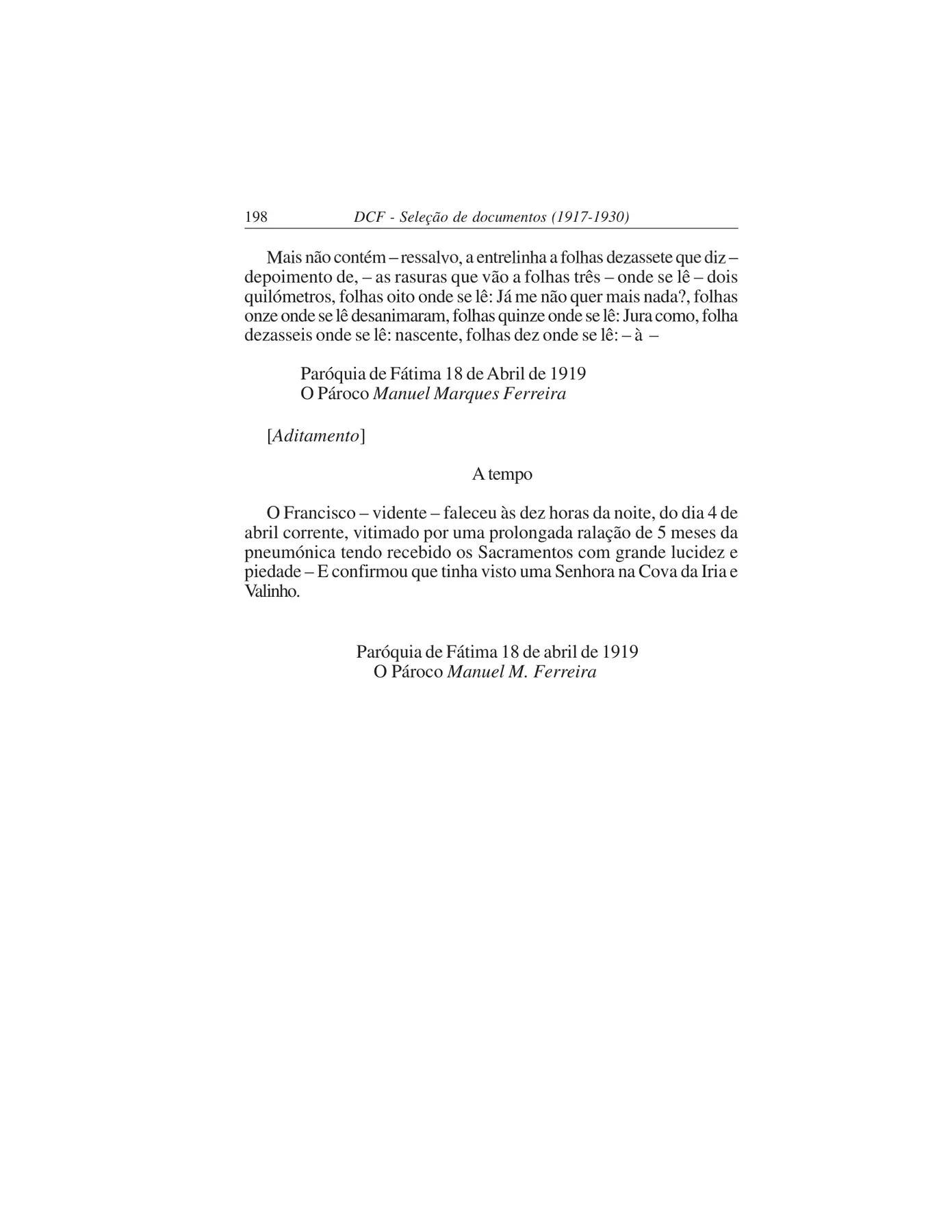
Francisco – the seer – died at ten o'clock at night on the 4th of this April, the victim of a long, 5-month ordeal with the pneumonic influenza*, having received the Sacraments with great lucidity and piety – And he confirmed that he had seen a Lady at the Cova da Iria and Valinho*.
Português
O Francisco – vidente – faleceu às dez horas da noite, do dia 4 de abril corrente, vitimado por uma prolongada ralação de 5 meses da pneumónica tendo recebido os Sacramentos com grande lucidez e piedade – E confirmou que tinha visto uma Senhora na Cova da Iria e Valinho.
13 July 1917 4 passages
As told by Maria de Jesus d'Oriol Pena Raposo
English
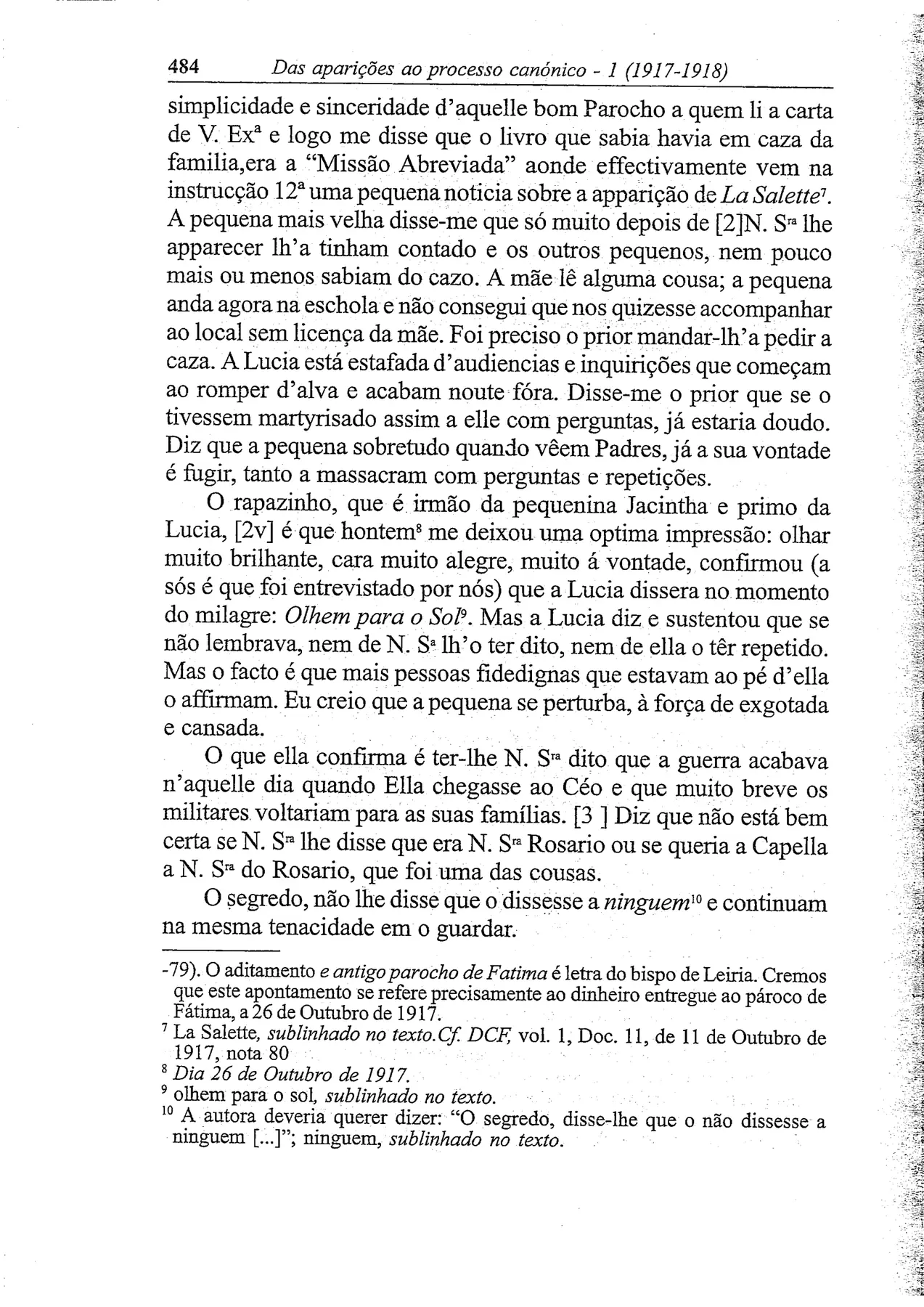
It was the little boy, who is the brother of little Jacintha and cousin of Lucia, who yesterday8 left me an excellent impression: very bright eyes, a very cheerful face, very much at ease. He confirmed (we interviewed him on his own) that at the moment of the miracle Lucia had said: Look at the Sun.
Português
O rapazinho, que é irmão da pequenina Jacintha e primo da Lucia, é que hontem8 me deixou uma optima impressão: olhar muito brilhante, cara muito alegre, muito á vontade, confirmou (a sós é que foi entrevistado por nós) que a Lucia dissera no momento do milagre: Olhem para o Sol
[…]
The little boy, when the people with me offered him everything they could think of, refused it all and ended by saying very enthusiastically: "Not even if you gave me the world".
[…]
O pequeno, offerecendo-lhe as pessoas que iam commigo tudo quanto se lembraram, e recusando tudo, acabou por dizer muito enthusiasmado: "Nem que me dêem o mundo".
Editors' notes (1)
8 Dia 26 de Outubro de 1917.
13 Jul13 OctSecond-handSaw itLetterFigures / visionsSeers' words overheard As told by Beatriz Gorjão (letter copied verbatim by Anita)
English
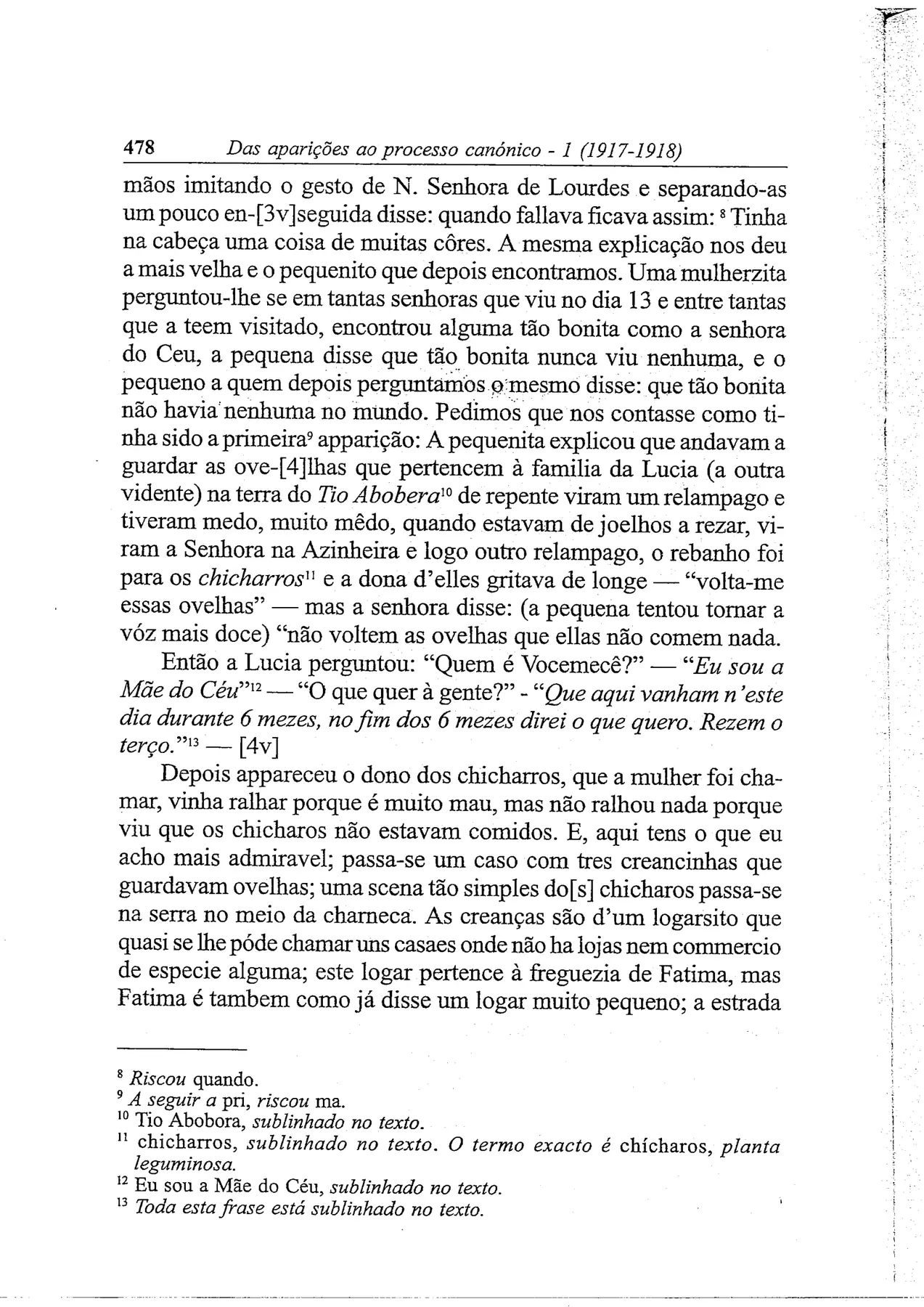
The eldest girl and the little boy whom we met later gave us the same explanation. A humble little woman asked her whether, among all the ladies she saw on the 13th and all those who have visited her, she had found any as beautiful as the lady from Heaven; the little girl said she had never seen one so beautiful, and the little boy, whom we later asked the same thing, said: that there was none so beautiful in the world.
Português
A mesma explicação nos deu a mais velha e o pequenito que depois encontramos. Uma mulherzita perguntou-lhe se em tantas senhoras que viu no dia 13 e entre tantas que a teem visitado, encontrou alguma tão bonita como a senhora do Ceu, a pequena disse que tão bonita nunca viu nenhuma, e o pequeno a quem depois perguntamos o mesmo disse: que tão bonita não havia nenhuma no mundo.
[…]
I heard the little boy say that not even if they were given the whole world would they tell it. When they are asked whether it is bad, they say it is good for everyone.
[…]
Ao pequeno ouvi dizer que nem que lhe dessem o mundo inteiro o diriam. Quando lhes perguntam se é mau, dizem que é bom para todos.
[…]
We made the same experiment with the little boy, who always answered like his sister.
[…]
A mesma esperiencia fizemos com o pequeno respondendo sempre como a irmã.
13 JulSecond-handSworn depositionSeers' words overheard As told by Olímpia de Jesus (mother of Francisco and Jacinta), sworn deposition to the canonical commission (Dr. Manuel Nunes Formigão, relator)
English
Francisco, when asked to reveal the secret, declared that even if they killed him he could not tell it. It happened several times that they were questioned and offered riches to tell it, and they answered that even if they were offered the whole world they could not tell it.
Português
O Francisco, pedindo-se-lhe para revelar o segredo, declarou que nem que o matassem o poderia dizer. Aconteceu por várias vezes serem interrogados e oferecerem-lhes riquezas para o dizerem e eles respondiam que nem que lhes oferecessem o mundo inteiro o poderiam dizer.
13 JulSecond-handNoteSeers' words overheard As told by Manuel Nunes Formigão (notes of what Francisco's mother, Olímpia de Jesus, told him)
English
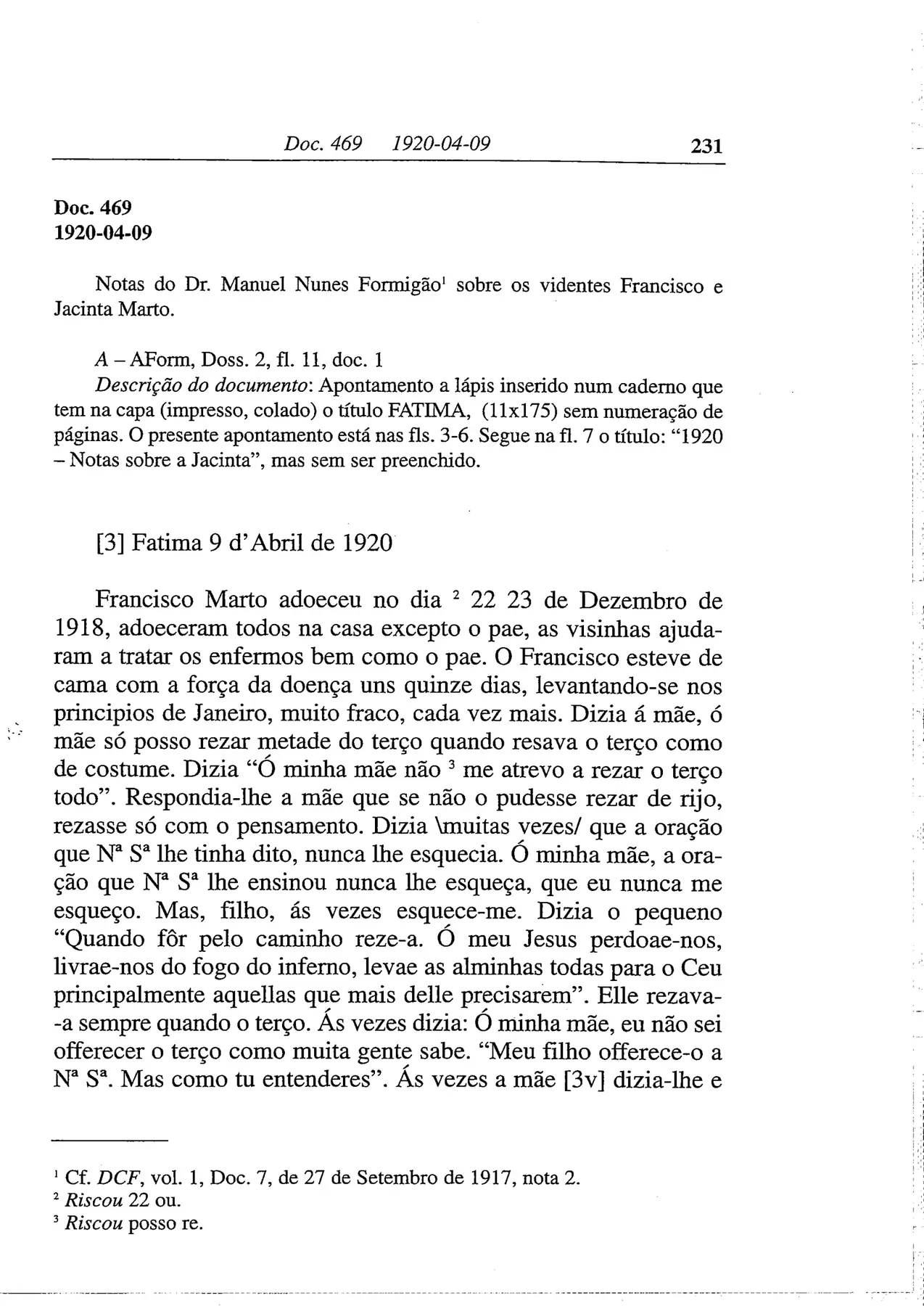
He said many times that he never forgot the prayer that Our Lady had told him. Oh mother, never forget the prayer that Our Lady taught, for I never forget it. But, son, sometimes I forget it. The little boy would say “When you are walking along the road, pray it. O my Jesus, forgive us, save us from the fire of hell, take all the little souls to Heaven, especially those most in need of it”.
Português
Dizia muitas vezes que a oração que Na Sa lhe tinha dito, nunca lhe esquecia. Ó minha mãe, a oração que Na Sa lhe ensinou nunca lhe esqueça, que eu nunca me esqueço. Mas, filho, ás vezes esquece-me. Dizia o pequeno “Quando fôr pelo caminho reze-a. Ó meu Jesus perdoae-nos, livrae-nos do fogo do inferno, levae as alminhas todas para o Ceu principalmente aquellas que mais delle precisarem”.
13 October 1917 3 passages
13 OctFirst-handSaw itInterrogationFigures / visionsSeers' words overheard English
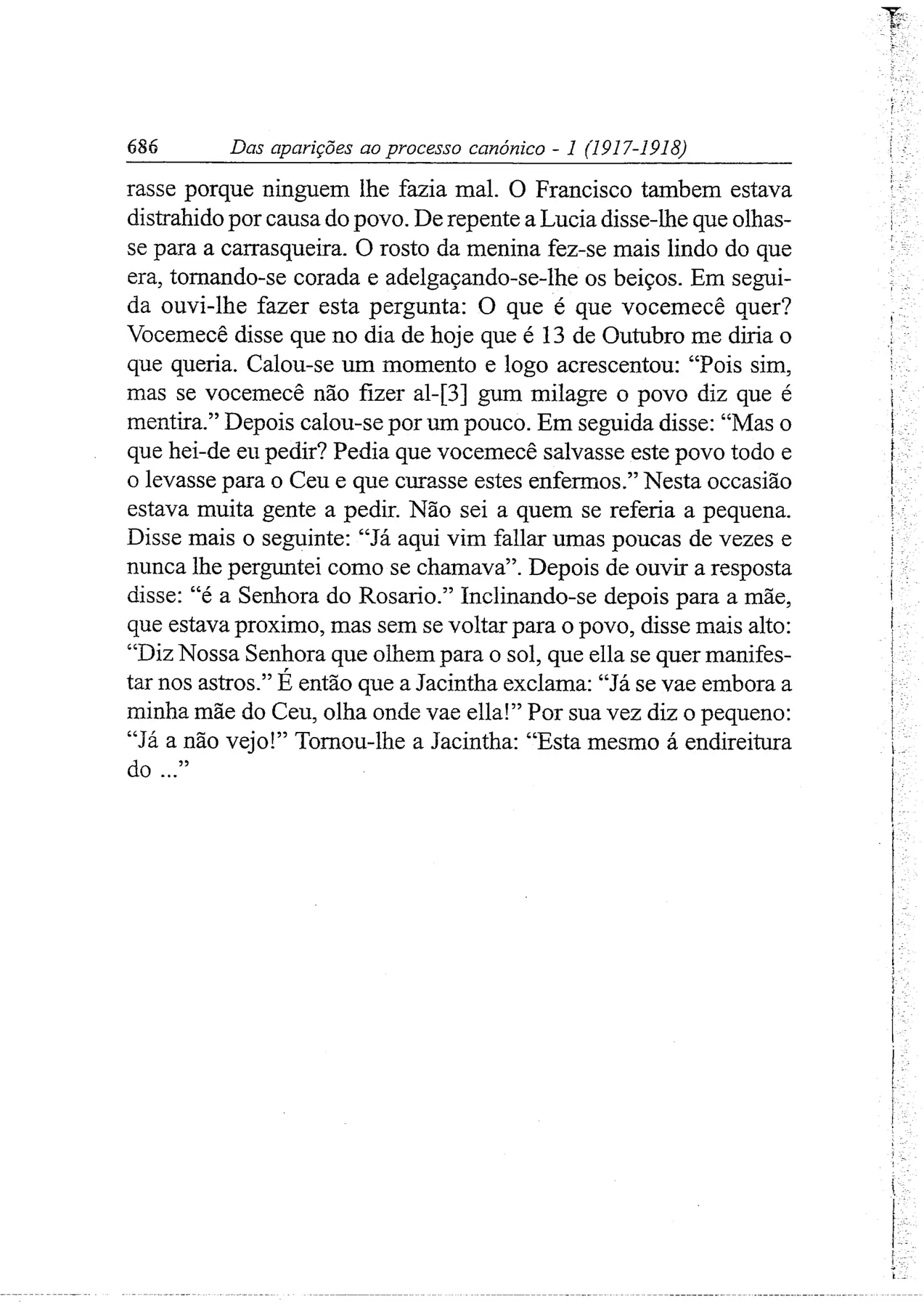
The little boy in turn says: “I can't see her any more! ”
Português
Por sua vez diz o pequeno: “Já a não vejo!”
13 OctFirst-handSaw itInterrogationFigures / visionsSun spinningSun changing colourSeers' words overheard English
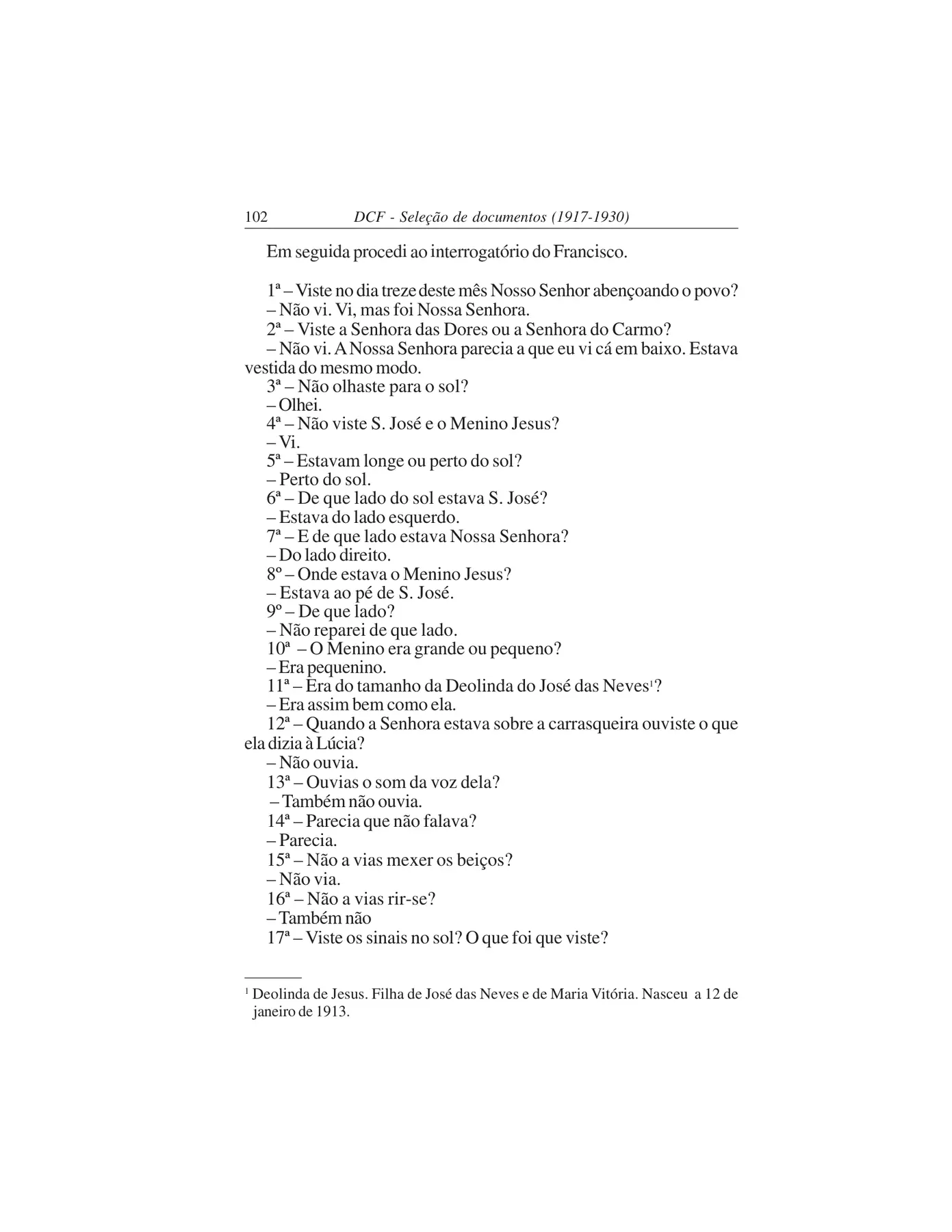
On the thirteenth of this month did you see Our Lord blessing the people?
– No, I didn't. I did see, but it was Our Lady.
2nd – Did you see Our Lady of Sorrows* or Our Lady of Carmel*?
– No, I didn't. Our Lady looked like the one I saw down here. She was dressed in the same way.
3rd – Didn't you look at the sun?
– I did.
4th – Didn't you see St Joseph and the Child Jesus?
– I did.
5th – Were they far from the sun or near it?
– Near the sun.
6th – On which side of the sun was St Joseph?
– He was on the left side.
7th – And on which side was Our Lady?
– On the right side.
8th – Where was the Child Jesus?
– He was next to St Joseph.
9th – On which side?
– I didn't notice which side.
10th – Was the Child big or small?
– He was tiny.
11th – Was he the size of José das Neves's Deolinda1?
– He was just about her size.
12th – When the Lady was on the holm-oak shrub did you hear what she was saying to Lúcia?
– I didn't hear.
13th – Did you hear the sound of her voice?
– I didn't hear that either.
14th – Did it seem that she wasn't speaking?
– It did.
15th – Didn't you see her move her lips?
– I didn't.
16th – Didn't you see her laugh?
– No, not that either
17th – Did you see the signs in the sun? What did you see?
Português
Viste no dia treze deste mês Nosso Senhor abençoando o povo?
– Não vi. Vi, mas foi Nossa Senhora.
2a – Viste a Senhora das Dores ou a Senhora do Carmo?
– Não vi. A Nossa Senhora parecia a que eu vi cá em baixo. Estava vestida do mesmo modo.
3a – Não olhaste para o sol?
– Olhei.
4a – Não viste S. José e o Menino Jesus?
– Vi.
5a – Estavam longe ou perto do sol?
– Perto do sol.
6a – De que lado do sol estava S. José?
– Estava do lado esquerdo.
7a – E de que lado estava Nossa Senhora?
– Do lado direito.
8o – Onde estava o Menino Jesus?
– Estava ao pé de S. José.
9o – De que lado?
– Não reparei de que lado.
10a – O Menino era grande ou pequeno?
– Era pequenino.
11a – Era do tamanho da Deolinda do José das Neves1?
– Era assim bem como ela.
12a – Quando a Senhora estava sobre a carrasqueira ouviste o que ela dizia à Lúcia?
– Não ouvia.
13a – Ouvias o som da voz dela?
– Também não ouvia.
14a – Parecia que não falava?
– Parecia.
15a – Não a vias mexer os beiços?
– Não via.
16a – Não a vias rir-se?
– Também não
17a – Viste os sinais no sol? O que foi que viste?
– I looked and saw that the sun was going round. It looked like a firework wheel.
– Olhei e vi que o sol andava à roda. Parecia uma roda de fogo.
18th – When did the signs appear, before or after the Lady disappeared from the holm-oak shrub?
18a – Quando foi que apareceram os sinais, antes ou depois da Senhora desaparecer da carrasqueira?
– It was when the Lady disappeared.
– Foi quando a Senhora desapareceu.
19th – Did you hear Lúcia tell the people to look at the sun?
19a – Ouviste a Lúcia avisar o povo para que olhasse para o sol?
– I did. She gave a shout for the people to look at the sun.
– Ouvi. Deu um grito que olhasse o povo para o sol.
20th – Was it the Lady who told her to tell the people to look at the sun?
20a – Foi a Senhora que a mandou avisar o povo para que olhasse para o sol?
– It was. The Lady pointed with her finger towards where the sun is.
– Foi. A Senhora apontou com o dedo para a banda onde está o sol.
21st – And when did she do that?
21a – E quando foi que fez isso?
– It was when she disappeared.
– Foi quando desapareceu.
22nd – Did the signs in the sun begin at once?
22a – Os sinais no sol começaram logo?
23rd – What colours did you see in the sun?
23a – Quais foram as cores que viste no sol?
– I saw very pretty colours, blue, yellow and others.
– Vi cores muito bonitas, azul, amarelo e outras.
Editors' notes (1)
1 Deolinda de Jesus. Daughter of José das Neves and Maria Vitória. Born on 12 January 1913.
1 Deolinda de Jesus. Filha de José das Neves e de Maria Vitória. Nasceu a 12 de janeiro de 1913.
13 OctFirst-handSaw itInterrogationFigures / visions English
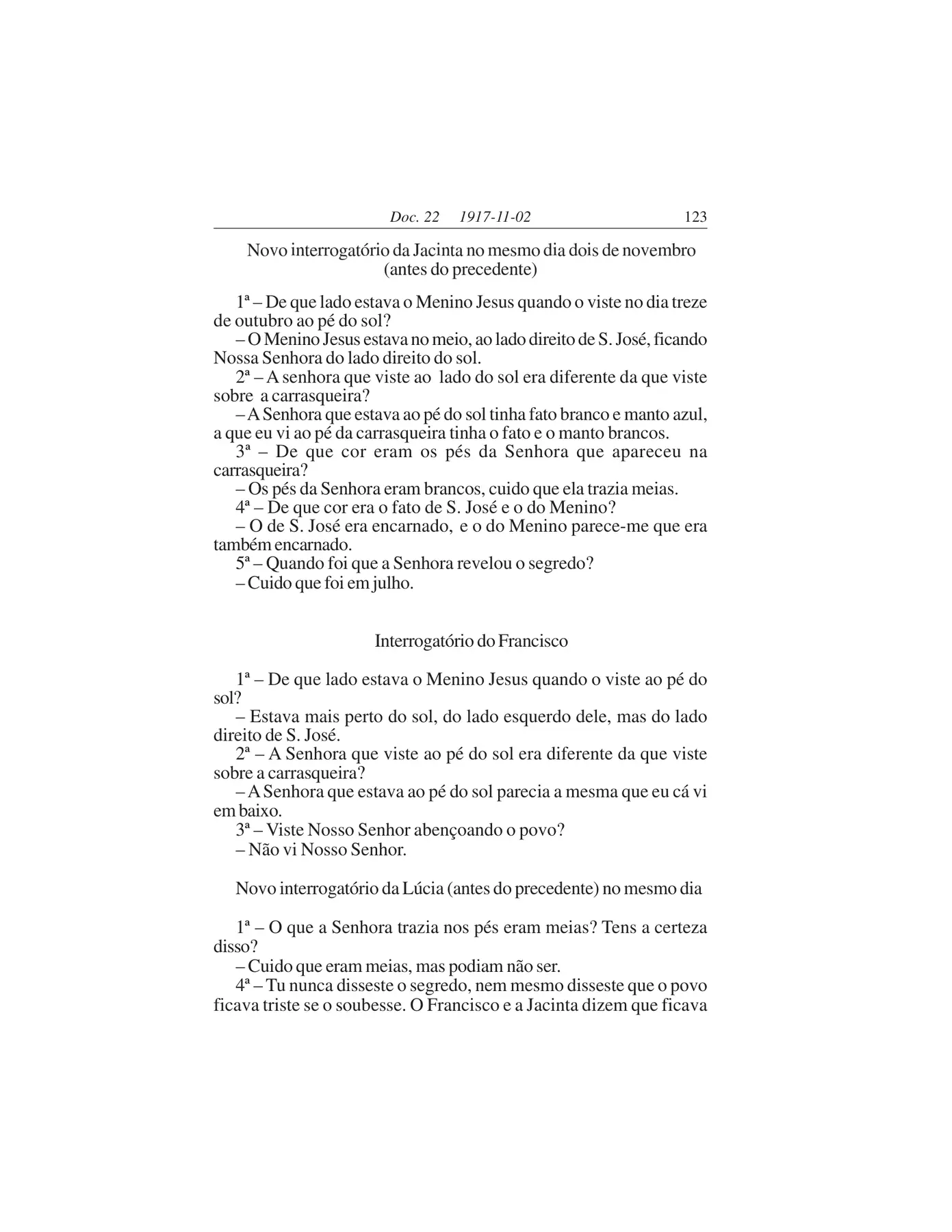
On which side was the Child Jesus when you saw him beside the sun?
Português
De que lado estava o Menino Jesus quando o viste ao pé do sol?
– He was nearer the sun, on its left side, but on St. Joseph's right side.
– Estava mais perto do sol, do lado esquerdo dele, mas do lado direito de S. José.
2nd – Was the Lady you saw beside the sun different from the one you saw on the holm-oak shrub?
2ª – A Senhora que viste ao pé do sol era diferente da que viste sobre a carrasqueira?
– The Lady who was beside the sun looked like the same one I saw down here.
– A Senhora que estava ao pé do sol parecia a mesma que eu cá vi em baixo.
3rd – Did you see Our Lord blessing the people?
3ª – Viste Nosso Senhor abençoando o povo?