Witnesses /

Lúcia, Francisco and Jacinta

SeerGroup

The three seers of Aljustrel, Fátima parish: Lúcia de Jesus (aged 10 in 1917) and her cousins Francisco Marto (born June 1908, aged 9) and Jacinta Marto (born March 1910, aged 7). Passages under this name report what the children said together.

One of the three seersFrom Aljustrel, FátimaFátima parish (locals)Attitude beforehand: Believer33 passages · 13 May 1917, 13 June 1917, 13 July 1917, 13 September 1917, 13 October 1917, 13 August 1917, Other 1917 events
13 May13 Jun13 JulSecond-handSaw itPress reportFigures / visionsSeers' words overheard
As told by Editor of Raio de Luz (Henrique dos Santos Silva)
English

This vision, with the appearance of a lady of extraordinary beauty, appears to them in the open country in the midst of a cloud, always at the same spot. It speaks to them, though the children say only that the Lady had asked the little boy of 3 to learn to say the rosary3*, and the two little girls to say it for the fatherland and for their family, adding that on 13 October she will tell them what more she wants of them.

Português (original)

Essa visão, com o aspecto d’uma senhora de extraordinaria beleza, aparece-lhes no campo em meio de uma nuvem, em logar fixo. Fala-lhes — limitando-se as creanças a dizer que a Senhora pedira ao pequenino de 3 annos que aprendesse a rezar o terço3, e ás duas pequenas que o rezassem pela patria e pela sua familia, acrescentando que em 13 de outubro lhes dirá o mais que d'ellas quer.

Editor's notes (3)

1 Monthly publication with the permission of the ecclesiastical authority. Publisher and director: Henrique dos Santos Silva.

2 This letter probably dates from shortly after 13 August, since it says: “A great deal of praying has been done at that place these last two months!...”, that is, since June 1917. The author is a subscriber to the magazine. The addressee must also have been a lady, a close friend of the author, since she calls her “daughter”, without this form of address meaning that she was her daughter, because later she says: “many people, among them my maids”, an expression that would make no sense if the addressee were her daughter. There is a letter from Branca Falcão de Sommer to Elisa Tavares Bonacho dos Anjos Martins, dated Monte Estoril, 6 October 1917 (Doc. 40, of 6 October 1917): “I received the “Raio de Luz” as well as your kind letter [...]. There is no doubt that the description of Fatima needs no signature. Reading the article is the same as listening to our enthusiastic neighbour!”. Branca de Sommer and Elisa Martins were neighbours in Lisbon (they lived respectively in Praça do Príncipe Real and Praça das Flores), and also in the provinces (respectively at Quinta da Cardiga, parish and municipality of Golegã, and at Quinta da Várzea, Riachos, Torres Novas). Therefore the two women's “enthusiastic neighbour”, the author of the letter, might also have lived in Lisbon, but we put forward the more probable hypothesis that she was Maria de Jesus Xavier de Figueiredo de Mello de Oriol Pena Raposo, living at Quinta de Carvalhais, between Riachos and Torres Novas, and so very close to Quinta da Várzea and Quinta da Cardiga.

3 The reference is undoubtedly to Francisco, who was 8 years old on 13 May 1917, since he had been born on 11 June 1908 (cf. DCF, vol. 1, Doc. 1, of c.27 May 1917, note 7).

1 Publicação mensal com permissão da autoridade eclesiástica. Editor e director: Henrique dos Santos Silva.

2 Esta carta, provavelmente, é pouco posterior a 13 de Agosto, pois diz: “Muito se tem rezado naquele sitio ha dois mezes para cá!...”, isto é, desde Junho de 1917. A autora é uma assinante da revista. A destinatária devia ser também uma senhora, da intimidade da autora, pois a trata por “filha”, sem que este tratamento signifique filiação, porque posteriormente refere: “muita gente, entre ella as minhas creadas”, expressão que não teria sentido se a destinatária fosse sua filha. Existe uma carta de Branca Falcão de Sommer a Elisa Tavares Bonacho dos Anjos Martins, datada de Monte Estoril, de 6 de Outubro de 1917 (Doc. 40, de 6 de Outubro de 1917): “Recebi o “Raio de Luz” assim como a sua amavel carta [...]. Não ha duvida, que a descripção da Fatima escusa de levar assignatura. Lêr o artigo é o mesmo que ouvir a nossa enthusiasta visinha!”. Branca de Sommer e Elisa Martins eram vizinhas em Lisboa (tinham residência respectivamente na Praça do Príncipe Real e Praça das Flores), e também na província (respectivamente na Quinta da Cardiga, freguesia e concelho da Golegã, e na Quinta da Várzea, Riachos, Torres Novas). Por isso, a “enthusiasta visinha” das duas, autora da carta, podia residir também em Lisboa, mas pomos a hipótese, mais provável, de se tratar de Maria de Jesus Xavier de Figueiredo de Mello de Oriol Pena Raposo, residente na Quinta de Carvalhais, entre Riachos e Torres Novas, muito próxima, portanto, da Quinta da Várzea e da Quinta da Cardiga.

3 A referência diz respeito, sem dúvida, ao Francisco, que tinha 8 anos em 13 de Maio de 1917, pois nascera a 11 de Junho de 1908 (cf. DCF, vol. 1, Doc. 1, de c.27 de Maio de 1917, nota 7).

DCF III-1, Doc. 20 · press · 1 Sep 1917 (4 months later)View scans (4)Link
13 May13 Jun13 JulSecond-handSaw itNoteFigures / visionsSeers' words overheard
As told by Leonor de Avelar e Silva Constâncio, from the Prior of Fátima (Pe. Manuel Marques Ferreira)
English

Only there did we learn that the three children, natives of Aljustrel, a small village in the parish of Fatima, said that a Lady appeared to them on the 13th of each month, spoke with them, answered their questions, and urged them to pray the rosary and offer it to Our Lady of the Rosary.

Português (original)

Só ali soubemos, que as trez creanças, naturaes de Aljustrel, pequena povoação da freguezia da Fatima, diziam que uma Senhora lhes apparecia no dia 13 de cada mez, fallava com ellas, respondia ás suas perguntas, e lhes recommendava que rezassem o terço e o offerecessem á Senhora do Rosario.

DCF III-1, Doc. 129 · note · after 19 Oct 1917 (5 months later)View scans (2)Link
13 May13 JunFirst-handSaw itInterrogationFigures / visionsThunder / noiseSeers' words overheard
English

We questioned the children to learn how the first apparition had come about. They answered simply that on 13 May, when they were pasturing their flock at the Cova da Iria, there was a great thunderstorm. They were thinking of gathering the flock and going away, when out of a flash of lightning they saw a Lady appear. Frightened, they wanted to run away, but the apparition told them not to, for it would do them no harm. Before the thunderstorm began the children had been praying their rosary, and the apparition told them to pray the rosary to Our Lady of the Rosary so that the war would abate, and to come back there every month, for it would come there for six consecutive months. — The children went back there in June and say that the Lady appeared to them and this time told them to learn to read, which the children did not do at once, because there was not, and never had been, a teacher in Fatima. Now, without anyone having asked for one, a teacher from the mobile schools* turns up, appointed there for two years, and the children have already begun to attend school with considerable progress, above all Lucia.

Português (original)

Interrogámos as creanças, para saber como se tinha dado a primeira apparição. Responderam com simplicidade que no dia 13 de Maio, quando na Cova da Iria andavam apascentando o seu rebanho, fez uma grande trovoada. Pensavam em juntar o rebanho e irem-se embora, quando d’um relampago viram apparecer uma Senhora. Amedrontados, quizeram fugir, mas a apparição disse-lhes que não fugissem, pois nenhum mal lhes faria. Antes de começar a trovoada as creanças estavam rezando o seu terço, e a apparição recommendou-lhes que rezassem o terço á Senhora do Rosario, para abrandar a guerra, e que voltassem ali todos os mezes, pois durante seis mezes consecutivos ali viriam. — As creanças voltaram ali em junho e dizem ter-lhes apparecido a Senhora que d’esta vez lhes recommendou que aprendessem a lêr, o que as creanças não fizeram logo, porque não havia nem nunca houve professora na Fatima. Agora, sem que ninguem a reclamasse, apparece nomeada para ali, por dois annos uma professora das escolas moveis, e as creanças começaram já a frequentar a escola com bastante aproveitamento, sobretudo da Lucia.

DCF III-1, Doc. 129 · note · 19 Oct 1917 (5 months later)View scans (2)Link
13 May13 Jun13 Jul13 Sep13 OctFirst-handSaw itInterrogationFigures / visionsSeers' words overheard
English

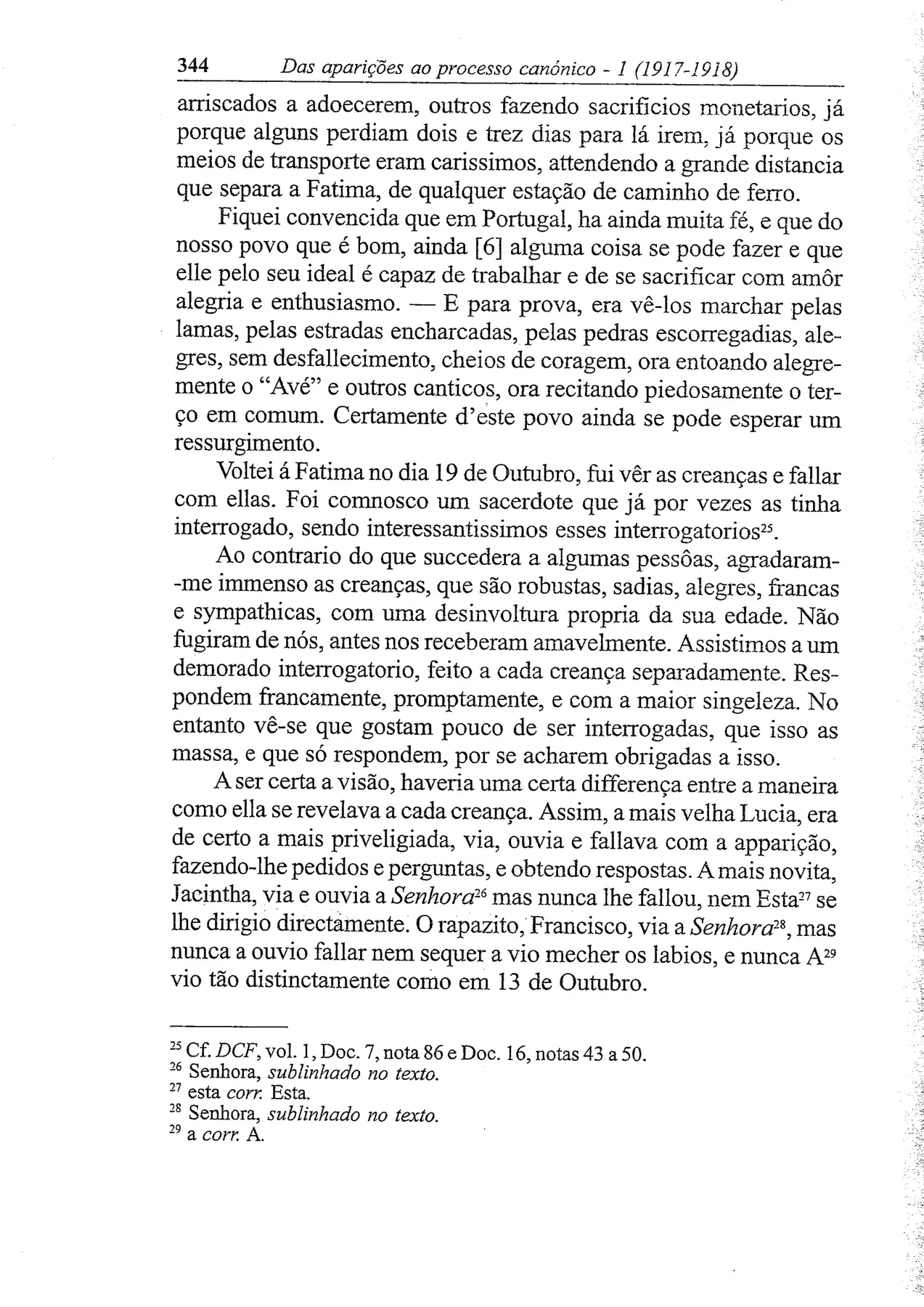
If the vision is genuine, there would seem to be a certain difference in the way it revealed itself to each child. Thus the eldest, Lucia, was certainly the most privileged; she saw, heard and spoke with the apparition, making requests and asking questions of it, and obtaining answers. The youngest, Jacintha, saw and heard the Lady but never spoke to her, nor did She address her directly. The little boy, Francisco, saw the Lady, but never heard her speak or even saw her move her lips, and never saw Her as distinctly as on 13 October.

[…]

The children went on their pious pilgrimage to the Cova da Iria on the 13th of every month, except in August, when they were arrested. They say they always saw the Lady, that Lucia always spoke with Her, that she asked her for some cures and conversions; that the Lady promised her to cure and convert some, and not others. That she always told them to pray the rosary, and told them that she wanted a little chapel in that place dedicated to Our Lady of the Rosary.

[…]

The children describe the apparition as being a Lady

very beautiful, the most beautiful they had ever seen, (their very words) with hands raised to Heaven, dressed all in white and gold, with a rosary all white hanging from her right arm.

Once Lucia asked the Lady: “Where are you from and where are you going?” and she says the Lady answered her: “I am from Heaven and I am going to Heaven”. And when Lucia asked her whether she, Jacintha and Francisco would also go to Heaven, the Lady answered that she and Jacintha would go, and that Francisco would go too, but would have to pray the rosary more. Since then the little boy has at times prayed ten rosaries a day!

Português (original)

A ser certa a visão, haveria uma certa differença entre a maneira como ella se revelava a cada creança. Assim, a mais velha Lucia, era de certo a mais priveligiada, via, ouvia e fallava com a apparição, fazendo-lhe pedidos e perguntas, e obtendo respostas. A mais novita, Jacintha, via e ouvia a Senhora mas nunca lhe fallou, nem Esta se lhe dirigio directamente. O rapazito, Francisco, via a Senhora, mas nunca a ouvio fallar nem sequer a vio mecher os labios, e nunca A vio tão distinctamente como em 13 de Outubro.

[…]

Lá foram as creanças na sua piedosa romaria todos os dias 13 de cada mez á Cova da Iria, excepto em Agosto, em que foram presas. Dizem que viram sempre a Senhora, que a Lucia fallou sempre com Ella, que lhe pedio algumas curas e conversões; que a Senhora lhe prometteu, curar e converter uns, outros não. Que lhes recommendou sempre que rezassem o terço, e lhes disse que queria n’aquelle sitio uma Capellinha dedicada á Senhora do Rosario.

[…]

s creanças descrevem a apparição, como sendo uma Senhora

muito linda, a mais linda que tivessem visto, (palavras textuaes) de mãos erguidas para o Ceu, toda vestida de branco e ouro, tendo pendente do braço direito um terço todo branco.

Uma vez, a Lucia perguntou á Senhora: “De onde é Vocemecê e para onde vae?” e diz que a Senhora lhe respondeu: “Sou do Céu e vou para o Céu”. E perguntando-lhe a Lucia se ella, a Jacintha e o Francisco tambem irião para o Céu, que a Senhora lhe respondera que ella e a Jacintha irião, e que o Francisco tambem iria, mas teria de rezar mais o terço. Desde então o pequeno, tem por vezes rezado dez terços por dia!

DCF III-1, Doc. 129 · note · 19 Oct 1917 (5 months later)View scans (4)Link
13 May13 Jun13 Jul13 Aug13 Sep13 OctSecond-handSaw itPress reportFigures / visions
As told by Anna Maria dos Santos, of Caneiro
English

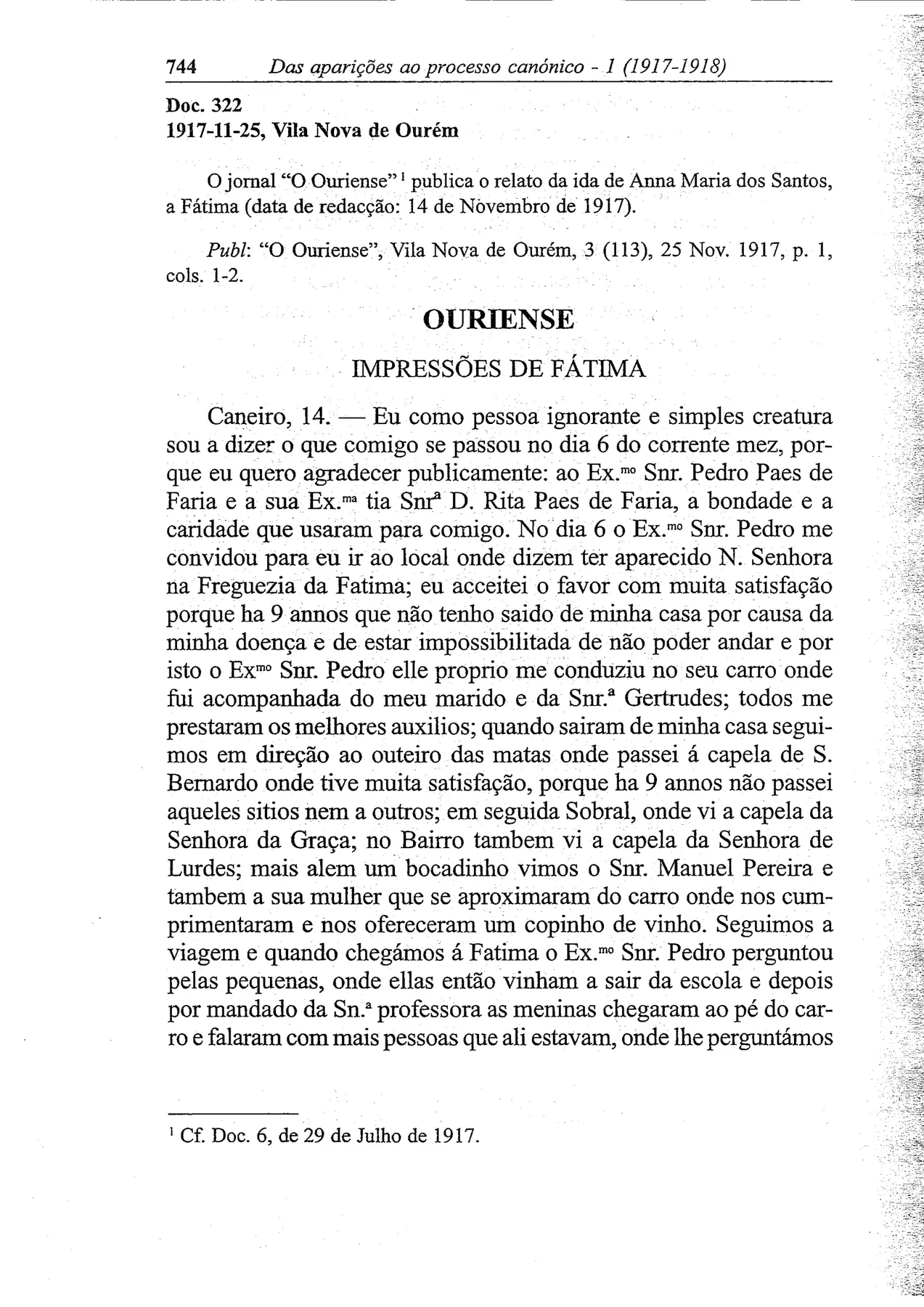
We went on with the journey, and when we reached Fatima the Ex.mo Mr Pedro asked after the little girls, who just then were coming out of school; then, at the schoolmistress's bidding, the girls came up to the carriage and spoke with other people who were there, and we asked them about Our Lady, and they always affirmed the same thing: that they saw her, heard her and spoke with her.

Português (original)

Seguimos a viagem e quando chegámos á Fatima o Ex.mo Snr. Pedro perguntou pelas pequenas, onde ellas então vinham a sair da escola e depois por mandado da Sn.a professora as meninas chegaram ao pé do carro e falaram com mais pessoas que ali estavam, onde lhe perguntámos com respeito a N. Senhora e ellas afirmaram sempre a mesma cousa, que a viram, ouviram e falaram com ella:

DCF III-1, Doc. 322 · press · 6 Nov 1917 (6 months later)View scans (2)Link
13 May13 Aug13 OctSecond-handSaw itBookFigures / visionsSeers' words overheard
As told by Manuel Nunes Formigão (Visconde de Montelo)
English

On the morning of the thirteenth of May 1917 a boy and two girls were grazing, as was their custom, a small flock of sheep belonging to their families, on a property in the Serra de Minde, in the parish of Fátima, municipality of Villa Nova d'Ourem, district of Leiria.

[…]

That day it was nearly noon by the sun*. As was their custom, the three children, after spending a good while at their innocent games, began to pray the rosary*, a devotion very dear to the inhabitants of that parish. They had scarcely finished when they suddenly saw the dazzling brightness of a flash of lightning shine in the air a short distance from them and, almost at the same moment, above the crown of a small holm oak, the radiant and enchanting figure of a [8] woman of extraordinary beauty appeared. Frightened by so unusual and so unexpected an occurrence, they thought of running away, but they were at once completely reassured by the kindly manner of the Apparition, who in the sweetest voice promised that she would do them no harm at all.

The Apparition seemed to be no more than eighteen years old. Her dress was of the purest snow-white, as was the mantle, edged with gold, that covered her head and most of her body. Her face, of flawless nobility of line, with an indefinable something supernatural and divine about it, was serene and grave, as if clouded by a slight shadow of sadness. From her hands, joined at the height of her breast, hung a beautiful rosary ending in a gold cross, whose beads, white as ermine, looked like pearls. From her whole figure, surrounded by a splendour brighter than the sun's, beams of light radiated, above all from her face, whose beauty was impossible to describe and incomparably superior to any human beauty.

A dialogue took place between the Apparition and Lucia, lasting about ten minutes.

Jacinta saw the Apparition and clearly heard the words she spoke to Lucia, but she never spoke to her, nor did the Apparition ever address a word to her. Francisco only saw the Apparition and never heard what she said to Lucia, although he was at the same distance and had excellent hearing.

[…]

The Apparition insistently urged everyone to do penance and pray the rosary. She told the children a secret, which they could not reveal to anyone. She promised them Heaven.

She asked for a chapel to be built in her honour at that spot and declared that on the thirteenth of October she would perform a miracle so that all the people would believe that she had really appeared there. On the thirteenth of August, moments before the time of the apparition, the children were abducted by a trick by the administrator of the municipality*, who kept them in his house for two days, threatening them with death if they did not retract or at least reveal the secret the Apparition had entrusted to them.

That month the apparition took place on the nineteenth, at the spot called Vallinhos, when the children no longer expected it until the following month.

Português (original)

Na manhã do dia treze de Maio de 1917 um menino e duas meninas andavam apascentando, como era seu costume, um pequeno rebanho de ovelhas, pertencente a suas familias, numa propriedade da serra de Minde, situada na freguezia de Fátima, concelho de Villa Nova d’Ourem, districto de Leiria.

[…]

Approximava-se naquelle dia a hora do meio-dia astronomico. Segundo o seu costume, as tres creanças, depois de se terem occupado durante bastante tempo nos seus innocentes divertimentos, puzeram-se a rezar o terço do Rosario, devoção muito querida dos habitantes daquella freguezia. Apenas tinham acabado de o recitar, quando viram de repente brilhar no espaço, a pequena distancia dellas, a claridade fulgurante de um relampago e apparecer quasi simultaneamente, sobre a copa de uma pequena azinheira, um vulto radioso e encantador de [8] mulher de extraordinaria belleza. Assustadas comum successo tão insolito e tão inesperado, pensaram em fugir, mas logo as tranquilisou completamente a ttitude benevola da Apparição, que numa voz dulcissima prometteu que não lhes faria mal algum.

A Apparição parecia não ter mais de dezoito annos de edade. O vestido era de uma alvura purissima de neve, assim como o manto, orlado de ouro, que lhe cobria a cabeça e a maior parte do corpo. O rosto, de uma nobreza de linhas irreprehensivel e que tinha um não sei quê de sobrenatural e divino, apresentava-se sereno e grave e como que toldado de uma leve sombra de tristeza. Das mãos, juntas á altura do peito, pendia-lhe, rematado por uma cruz de ouro, um lindo rosario, cujas contas, brancas de arminho, pareciam perolas. De todo o seu vulto, circumdado de um esplendor mais brilhante que o do sol, irradiavam feixes de luz, especialmente do rosto, de uma formusura impossivel de descrever e incomparavelmente superior a qualquer belleza humana.

Entre a Apparição e a Lucia estabeleceu-se um dialogo, que durou cerca de dez minutos.

A Jacinta via a Apparição e ouvia distinctamente as palavras que ella pronunciava dirigindo-se á Lucia, mas nunca lhe fallou nem a Apparição lhe dirigiu a palavra. O Francisco só via a Apparição, não ouvindo nunca o que ella dizia á Lucia, apesar de se encontrar á mesma distancia e de possuir um excellente ouvido.

[…]

A Apparição recommendou insistentemente que todos fizessem penitencia e rezassem o terço do Rosario. Communicou ás creanças um segredo, que não podiam revellar a ninguem. Prometeu-lhe o Ceu.

Pediu que naquelle local se erigisse uma capella em sua honra e declarou que no dia treze de Outubro havia de fazer um milagre para que todo o povo acreditasse que elle realmente tinha alli apparecido. Em treze de Agosto, momentos antes da hora da apparição, as creanças foram ardilosamente raptadas pelo administrador do concelho, que as reteve em sua casa durante dois dias, ameaçando-as de morte se não se desdissessem ou pelo menos não revelassem o segredo que a Apparição lhe tinha confiado.

Nesse mês a apparição teve logar no dia dezanove, no sitio chamado dos Vallinhos, quando as creanças já não pensavam que ella se verificasse senão no mês seguinte.

Editor's notes (1)

1 This chapter, with slight alterations, would later be published in Visconde de Montelo - Os acontecimentos de Fatima, Guarda, Empresa Veritas, 1923, p. 7-10; cf. also DCF, vol. 2, Doc. 9, of 13 April 1930, p. 161-162 (reworded text). From p. 162 to p. 164, the text is entirely new, written for the Report of the Canonical Commission

1 Este capítulo, com ligeiras alterações, viria a ser publicado em Visconde de Montelo - Os acontecimentos de Fatima, Guarda, Empresa Veritas, 1923, p. 7-10; cf. também DCF, vol. 2, Doc. 9, de 13 de Abril de 1930, p. 161-162 (texto reformulado). A partir da p. 162 até à p. 164, o texto é inteiramente novo, escrito para o Relatório da Comissão Canónica

DCF III-3, Doc. 621 · book · 10 Jun 1921 (4 years later)View scans (4)Link
13 May13 Jun13 Jul13 Aug13 Sep13 OctSecond-handSaw itPress reportFigures / visionsSeers' words overheard
As told by Manuel Nunes Formigão (Visconde de Montelo), interviewed by A Guarda
English

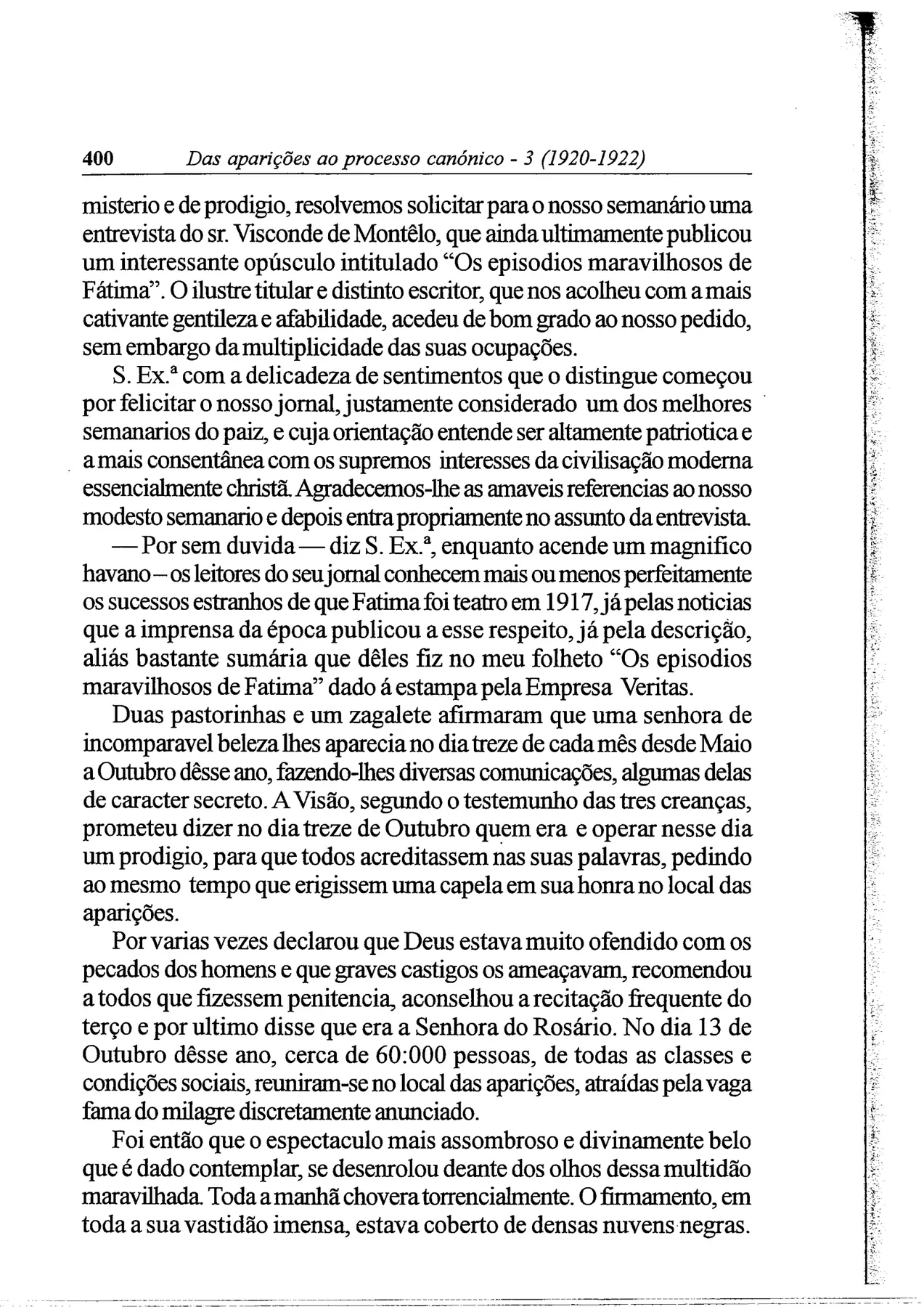
Two little shepherd girls and a little shepherd boy asserted that a lady of incomparable beauty appeared to them on the thirteenth of each month from May to October of that year, making various communications to them, some of them secret. The Vision, according to the testimony of the three children, promised to say on the thirteenth of October who she was and to perform a prodigy that day so that everyone would believe her words, and at the same time asked for a chapel to be built in her honour at the place of the apparitions.

Several times she declared that God was greatly offended by the sins of men and that grave punishments threatened them; she recommended to all that they do penance, advised the frequent recitation of the rosary, and lastly said that she was the Lady of the Rosary.

Português (original)

Duas pastorinhas e um zagalete afirmaram que uma senhora de incomparavel beleza lhes aparecia no dia treze de cada mês desde Maio a Outubro dêsse ano, fazendo-lhes diversas comunicações, algumas delas de caracter secreto. A Visão, segundo o testemunho das tres creanças, prometeu dizer no dia treze de Outubro quem era e operar nesse dia um prodigio, para que todos acreditassem nas suas palavras, pedindo ao mesmo tempo que erigissem uma capela em sua honra no local das aparições.

Por varias vezes declarou que Deus estava muito ofendido com os pecados dos homens e que graves castigos os ameaçavam, recomendou a todos que fizessem penitencia, aconselhou a recitação frequente do terço e por ultimo disse que era a Senhora do Rosário.

DCF III-3, Doc. 775 · press · 13 Mar 1922 (5 years later)View scans (2)Link
13 May13 Jun13 Jul13 Aug13 Sep13 OctSecond-handSaw itLetterFigures / visionsSeers' words overheard
As told by Manuel Nunes Formigão (Visconde de Montelo)
English

But if I was relying on statements of the seers that I kept in my memory, it is utterly impossible for me to state precisely, after so many years, which of the children assured me that the cross of the rosary was, or looked like, gold. Was it Francisco? Was it Jacinta? I do not know. It must be stressed that Lucia, like her cousins, sometimes said that certain parts of the vision's body or certain items of its clothing were white because of the clear, brilliant light that surrounded it and almost blinded their eyes. Page 77, Lucia: "It's that [4] she sometimes blinds". Page 94, Francisco: "I can look at her face, but only a little, because of the light".

Português (original)

Mas se me reportava a declarações dos videntes que conservasse de memoria, é-me totalmente impossivel precisar, depois de tantos annos, qual das crianças me assegurou que a cruz do rosario era ou parecia de ouro. Teria sido o Francisco? Teria sido a Jacinta? Não sei. Importa acentuar que a Lucia, assim como os primos, ás vezes diziam ser brancas certas partes do corpo ou certas peças do vestuario da visão por causa da luz clara e brilhante que a envolvia e que quasi lhes cegava os olhos. Pag. 77, Lucia: "É que [4] ella ás vezes cega". Pag. 94, Francisco: "Posso olhar para a cara della, mas pouco, por causa da luz".

13 May13 Jun13 Jul13 AugSecond-handSaw itLetterFigures / visionsSeers' words overheard
As told by Carlos de Azevedo Mendes
English

As I told you, I examined, or rather questioned, the three separately. They all say the same without the slightest variation. The main point that I deduced from everything they tell me is “– that the apparition wants the devotion of the Rosary to be spread –”. All the little ones always say that the one who appears to them is the Lady. They do not know who she is... Only after the 6 times, on 13 October, will she tell them who she is and what she wants!!... The naturalness and ingenuousness with which they speak and tell what they saw is admirable and impressive.

Lúcia sees the Lady, speaks with her and hears her. Jacinta sees the Lady, hears her, but does not speak with Her. Francisco sees the Lady, but neither speaks to her nor hears her!!!... This difference is interesting, don't you think, Prazeres??... But besides being interesting it even has a great deal of the extraordinary about it!!... To hear the little ones, to see them in their simplicity, to examine them as a whole, impresses us in an extraordinary way, and leads me to conclude that in everything they tell me there is something supernatural. Being with them strikes us with great intensity... Today, Prazeres, it is my conviction that there is an extraordinary fact which our reason cannot reach. What is it?... With still greater anxiety I await the coming 13th. What is certain is that we feel at ease with the little ones and even lose the sense of time. There is an attraction that I do not know how to explain... One of the children's most intense impressions is that of the Lady's beauty. The boy, to express his admiration, told me she was “ever so pretty”!!!... I showed him your portrait and asked: is she prettier? “Much prettier!!...”. The Lady comes all in white with gold. She does not wear any blue sash as was said. Whether she is Our Lady of Peace.... Do you remember what she said at the 2nd apparition?... That they should learn to read... Little Jacinta told me “that she was already on the row of A's”!!...

[…]

The prayer they say the Lady taught them is simple; it is as follows:

“O my Jesus, forgive me.

Deliver me from the fire of hell

Take all the little souls to heaven, especially those most in need.”

Could anything be simpler? I found it interesting that the Lady should have taught it but not recommended that they pray it.

Português (original)

Como te disse examinei ou antes interroguei os três em separado. Todos dizem o mesmo sem a mais leve alteração. A base principal, que de tudo o que me dizem, eu deduzi é “– que a aparição quer que se espalhe a devoção do Terço –”. Todos os pequenos dizem sempre, que, quem lhes aparece, é a Senhora. Não sabem quem é... Só depois das 6 vezes, no dia 13 de Outubro, lhes diz quem é e o que quer!!... A naturalidade e ingenuidade, com que falam e contam o que viram é admirável e impressionante.

A Lúcia vê a Senhora, fala com ela e ouve-a. A Jacinta vê a Senhora, ouve-a, mas não fala com Ela. O Francisco vê a Senhora, mas não lhe fala, nem a ouve!!!... É interessante esta diferença, não achas Prazeres??... Mas além de interessante tem até mesmo muito de extraordinário!!... Ouvir as petizas, vê-las na sua simplicidade, examinar-lhes o seu todo, impressiona-nos de uma maneira extraordinária, e leva-me a concluir, que em tudo o que me dizem, alguma coisa existe de sobrenatural. Estar com elas choca-nos com uma forte intensidade... Hoje, Prazeres, é convicção minha que há um facto extraordinário, que a nossa razão não alcança. Qual?... Com ansiedade mais crescente ainda espero o próximo dia 13. O que é certo, é que nos sentimos bem junto das pequenas e chegamos a perder a noção do tempo. Há uma atração, que não sei como explicar... Uma das impressões mais intensas das crianças é a da beleza da Senhora. O rapaz para exprimir a sua admiração dizia-me que era “muito bonitica”!!!... Mostrei-lhe o teu retrato e perguntei: é mais bonita? “Muito mais!!...”. A Senhora vem toda de branco com ouro. Não traz nenhuma faixa azul como se dizia. Se é a Senhora da Paz.... Já te recordaste, o que disse na 2ª aparição?... Que aprendessem a ler... Dizia-me a Jacintita “que já ia na carreira do A”!!...

[…]

A oração, que dizem a Senhora lhes ensinou é simples, é a seguinte:

“Ó meu Jesus perdoai-me.

Livrai-me do fogo do inferno

Levai as alminhas todas para o céu, principalmente as que mais precisarem.”

Queres maior simplicidade? Achei interessante que a Senhora a tivesse ensinado, mas não lhe recomendasse que a rezassem.

DCF Seleção, Doc. 7 (= DCF I, Doc. 55) · letter · 7 Sep 1917 (4 months later)View scans (3)Link
13 MaySecond-handSaw itSworn depositionFigures / visionsSeers' words overheard
As told by José Alves of Moita (relaying his wife), sworn deposition to the canonical commission (Dr. Manuel Nunes Formigão, relator)
English

One day, at the beginning of the apparitions, his wife was going to the Cova da Iria and asked Francisco what he was doing. He said he was making a little wall, and Lúcia and Jacinta were handing him the stones. On that occasion Lúcia said: “There's just been a flash of lightning and we're going to have rain”, and the three children went down the slope, and it was when they reached the Cova that Our Lady appeared to them on top of a holm oak which the people later stripped bare. The Lady said: “Do not be afraid, for I am from up there, from Heaven”. And it was then that she told them to come there every month and to pray the rosary.

Português (original)

Um dia, no princípio das aparições, a mulher ia à Cova da Iria e perguntou ao Francisco o que andava a fazer. Ele disse que andava a fazer um serradinho e a Lúcia e a Jacinta chegavam-lhe a pedra. Nessa ocasião a Lúcia disse: “Deu agora um relâmpago e nós temos água”, e as três crianças meteram pela encosta e quando chegaram à Cova é que Nossa Senhora lhes apareceu em cima duma azinheira que foi estronchada pelo povo. A Senhora disse: “Não tenham medo, que eu sou lá de cima, do Céu”. E foi então que lhes disse que viessem lá todos os meses e que rezassem o terço.

13 MaySecond-handSaw itNoteFigures / visionsSeers' words overheard
As told by Canonical commission report (Dr. Manuel Nunes Formigão, relator)
English

On the morning of the thirteenth of May, nineteen hundred and seventeen, about two and a half kilometres west of the parish church of Fátima, in the council* of Vila Nova de Ourém, district of Santarém, at the edge of the district road, in a place commonly called "Cova da Iria", three children were grazing a small flock. They were two girls and a boy. The elder of the girls, who was ten years old, was called Lúcia de Jesus, and the younger, only six years old1, Jacinta Marto. The boy, nine years old, was named Francisco Marto. They lived in Aljustrel, one of the forty hamlets of the vast parish of Fátima, and one of those nearest to the church and the presbytery. Francisco and Jacinta were brother and sister, and Lúcia was their first cousin. Her parents were António dos Santos, who died the following year2, and Maria Rosa dos Santos, and theirs were Manuel Pedro Marto and Olímpia de Jesus Marto. The children had a very rudimentary religious instruction, only Lúcia having made her first Communion. None of them could read or write. The hour of solar noon was approaching. The most cherished devotion in that region is the recitation of the rosary*. There are few families whose head does not pray the rosary with his household at night, after the work in the fields, before supper, which is the main meal. The three children, as was their custom, prayed the rosary together, and then set about building a miniature house, using for it the loose stones that were very plentiful in the place, as they are almost everywhere in the serra de Aire*. Suddenly a flash of lightning, of vivid and brilliant light, streaked across the sky. The children stopped their pas-[4]time and looked up in astonishment. The sky was clear and cloudless, not the slightest breeze was blowing, and the sun was shining at its full zenith. Nevertheless, Lúcia invited her cousins to go home without delay, fearing that a thunderstorm might break out. They agreed without reluctance, and all three began to drive the animals down the slope. On reaching the spot where the first fountain now stands, they saw another flash of lightning and, a few paces away, standing on a small holm oak at the place where the chapel of the apparitions was later built, the figure of a Lady, still quite young and of incomparable beauty. Frightened by the unexpected apparition, the children wanted to flee and were getting ready to do so, but a sign from the Lady held them back; she told them not to be afraid, for she would do them no harm. The Apparition seemed no more than eighteen years old. Her dress was of the purest snow-white, as was the mantle, edged with gold, that covered her head and most of her body. Her face, of irreproachable nobility of line and with an indefinable something supernatural and divine about it, was serene and grave and as if clouded by a slight shadow of sadness. From her hands, joined at the height of her breast, hung a beautiful rosary ending in a cross, whose beads, white as ermine, looked like pearls. From her whole figure, surrounded by a splendour brighter than that of the sun, beams of light radiated, especially from her face, of a beauty impossible to describe and incomparably superior to any human beauty. Between the Apparition and Lúcia there took place a dia-[4v]logue that lasted about ten minutes. The Apparition invited the children to return there every month, on the thirteenth, until the following October, assuring them that on the last day she would tell them who she was and what she wanted.

Português (original)

Na manhã do dia 13 de maio de mil novecentos e dezassete, a cerca de dois quilómetros e meio da igreja paroquial de Fátima, concelho de Vila Nova de Ourém, distrito de Santarém, na direção do oeste, a margem da estrada distrital, num sítio vulgarmente chamado “Cova da Iria”, três crianças apascentavam um pequeno rebanho. Eram duas meninas e um rapaz. A mais velha das meninas, que tinha dez anos de idade, chamava-se Lúcia de Jesus e a mais nova, apenas com seis anos1, Jacinta Marto. O nome do rapaz, de nove anos, era Francisco Marto. Moravam em Aljustrel, uma das quarenta aldeias da vasta freguesia de Fátima, e uma das mais próximas da igreja e do presbitério. O Francisco e a Jacinta eram irmãos e a Lúcia sua prima coirmã. Os pais desta foram António dos Santos, que faleceu no ano seguinte2, e Maria Rosa dos Santos, e os daqueles Manuel Pedro Marto e Olímpia de Jesus Marto. As crianças possuíam uma instrução religiosa muito rudimentar, tendo só a Lúcia feito a sua primeira Comunhão. Nenhuma delas sabia ler e escrever. Aproximava-se a hora do meio-dia solar. A devoção mais querida naquela região é a recitação do terço do Rosário. É rara a família, cujo chefe, à noite, depois da lida dos campos, não reze o terço juntamente com os seus, antes da ceia que é a refeição principal. As três crianças, como era seu costume, rezaram o terço em comum, e depois puseram-se a fazer uma casa em miniatura, servindo-se para isso das pedras soltas que havia em grande abundância no local, como há quase por toda a parte na serra de Aire. De repente, um relâmpago, de luz viva e brilhante, sulcou o espaço. As crianças suspenderam o seu entre-[4]tenimento e olharam admiradas para as alturas. O céu estava diáfano e sem nuvens, não soprava a mais leve brisa e o sol brilhava em pleno zénite. Não obstante, a Lúcia convidou os primos a retirarem-se sem demora para casa, com o receio de que se desencadeasse alguma trovoada. Eles acederam sem relutância e todos três puseram-se a tocar o gado pela encosta abaixo. Ao chegarem ao ponto, onde se encontra atualmente a primeira fonte, veem fuzilar um novo relâmpago e, a poucos passos de distância, de pé sobre uma pequena azinheira, no sítio onde mais tarde foi erigida a capela das aparições, um vulto de Senhora bastante nova, de incomparável formosura. Assustadas com a inesperada aparição, as crianças tiveram vontade de fugir e preparavam-se para isso, mas conteve-as um sinal da Senhora, que disse que não tivessem medo, porque não lhes fazia mal. A Aparição parecia não ter mais de dezoito anos de idade. O vestido era duma alvura puríssima de neve, assim como o manto, orlado de ouro, que lhe cobria a cabeça e a maior parte do corpo. O rosto, duma nobreza de linhas irrepreensível e que tinha um não sei quê de sobrenatural e divino, apresentava-se sereno e grave e como que toldado duma leve sombra de tristeza. Das mãos, juntas à altura do peito, pendia-lhe, rematado por uma cruz, um lindo rosário, cujas contas, brancas de arminho, pareciam pérolas. De todo o seu vulto, circundado dum esplendor mais brilhante que o do sol, irradiavam feixes de luz, especialmente do rosto, duma formosura impossível de descrever e incomparavelmente superior a qualquer beleza humana. Entre a Aparição e a Lúcia travou-se um diá-[4v]logo que durou cerca de dez minutos. A Aparição convidou as crianças a voltarem lá todos os meses, no dia treze, até outubro seguinte, assegurando que no último dia lhes diria quem era e o que queria.

Editor's notes (2)

1 Jacinta was already seven years old (she was born on 11 March 1910, the official date; cf. Doc. 1, note 5).

2 António dos Santos died two years later, on 31 July 1919.

1 Jacinta tinha já sete anos (nasceu a 11 de março de 1910, data oficial; cf. Doc. 1, nota 5).

2 António dos Santos faleceu, dois anos depois, a 31 de julho de 1919.

13 May13 Jun13 Jul13 Aug13 Sep13 OctSecond-handSaw itNoteFigures / visionsSeers' words overheard
As told by Canonical commission report (Dr. Manuel Nunes Formigão, relator)
English

The account of the apparitions is reproduced here in summary.

The Lady says that her place is Heaven, promises eternal happiness to the three children, tells them a secret that they may reveal to no one, teaches them a short prayer4, recommends to Lúcia that they learn to read, commands that everyone pray the rosary so that the war may end, announces the appearance of Our Lord, of St Joseph with the Child Jesus, and of Our Lady under the titles of the Rosary, of Carmel and of Sorrows, again recommends the recitation of the rosary, declares that the war would end soon, and on the last day states that Our Lord is very angry at the sins of men, begs that they offend Him no more, insists once again that they pray the rosary, declares that she is the Lady of the Rosary and orders that a chapel be built there in her honour. Jacinta's deposition confirms, in a general way, Lúcia's deposition, as does that of Francisco, who however only saw the Lady and heard nothing of what she said to his cousin.

Português (original)

Reproduz-se aqui, em resumo, o relato das aparições.

A Senhora diz que o seu lugar é o Céu, promete a felicidade eterna às três crianças, comunica-lhes um segredo que a ninguém poderão revelar, ensina-lhes uma pequena oração4, recomenda a Lúcia que aprendam a ler, manda que todos rezem o terço, para que a guerra acabe, anuncia o aparecimento de Nosso Senhor, de S. José com o Menino Jesus, de Nossa Senhora sob as invocações do Rosário, do Carmo e das Dores, recomenda de novo a recitação do terço, declara que a guerra acabava brevemente e no último dia afirma que Nosso Senhor está muito irritado com os pecados dos homens, suplica que não O ofendam mais, insiste mais uma vez em que rezem o terço, declara que ela é a Senhora do Rosário e ordena que se edifique ali uma capela em sua honra. O depoimento da Jacinta confirma, dum modo geral, o depoimento da Lúcia, assim como o do Francisco, que contudo só via a Senhora, não ouvindo nada do que ela dizia a sua prima.

Editor's notes (1)

4 Ejaculatory prayer: O my Jesus, forgive us...

4 Jaculatória: Ó Meu Jesus perdoai-nos...

13 May13 Jun13 Jul13 Aug13 Sep13 OctSecond-handSaw itLetterFigures / visionsSeers' words overheard
As told by José Alves Correia da Silva, Bishop of Leiria
English

On 13 May 1917, three children of the parish of Fátima, in the vicariate* of Ourém, in this Diocese, were pasturing a small flock in a place called Cova da Iria, which was then deserted.

The eldest, Lúcia de Jesus, was 10 years old, Francisco nine and Jacinta sixa. The two younger ones were brother and sister, and the eldest was their cousin.

None of them could read or write.

It was getting on towards noon, and the children, according to the custom of their region, prayed the rosary* of Our Lady.

The prayer finished, they were amusing themselves building a tiny house out of loose stones when, suddenly, a flash of lightning, of vivid and brilliant light,

a Jacinta was already seven years old. Jacinta's official date of birth is 11 March 1910.

furrowed the sky. Although the sky was clear and cloudless, the children, fearing a thunderstorm, gathered the flock and were about to leave. But as they reach a point near the spot where the water fountains now stand, another flash of lightning blazes out and, a few paces away, standing on a small holm oak at the place where the tiny, humble Chapel of the Apparitions now stands, they see with amazement the figure of a Lady of incomparable beauty, clothed in a dress of the purest white; a mantle edged with gold covers her head and most of her body. Her face, of a heavenly, supernatural beauty, appeared serene, grave and clouded by a slight shadow of sadness. From her hands, joined at the height of her breast, hung a beautiful rosary ending in a cross.

From the whole figure, surrounded by a splendour brighter than the sun, beams of light radiated.

The children drew near, and a dialogue took place between the Lady and the eldest; the Lady invited them to come there on the 13th of each month until October.

According to the testimony of the children and of many people, there were six apparitions, all on the 13th of the month, except in August, when the apparition took place a few days later because the administrative authority* was holding the children prisoner in Ourém.

The Lady told them that her place is in heaven, entrusted them with a secret that they may reveal to no one, taught them a short prayer, recommended the recitation of the Rosary, advised Lúcia to learn to read, insisted on the need for prayer and penance for the war to end, said that Our Lord is very angry at the sins of men and above all at the sin of the flesh, ordered a chapel to be built there in her honour, and declared that she is the Lady of the Rosary...

Português (original)

A 13 de maio de 1917, três crianças da freguesia da Fátima, vigararia de Ourém, desta Diocese, apascentavam um pequeno rebanho num lugar, então ermo, chamado Cova da Iria.

A mais velha, Lúcia de Jesus, tinha 10 anos de idade, Francisco nove e Jacinta seisa. Estes eram irmãos e a primeira prima deles.

Nenhum sabia ler nem escrever.

Aproximava-se o meio dia e as crianças, conforme o costume da sua terra, rezaram o terço do Rosário de Nossa Senhora.

Terminada a oração, entretinham-se a fazer uma pequenina casa com pedras soltas quando, de repente, um relâmpago, de luz viva e brilhante,

a Jacinta tinha já sete anos. A data oficial do nascimento de Jacinta é 11 de março de 1910.

sulcou o espaço. Apesar de o céu estar diáfano e sem nuvens, as crianças, com receio de alguma trovoada, juntaram o gado e iam retirar-se. Ao chegarem, porém, perto do ponto onde se encontram atualmente as bicas de água, fuzila novo relâmpago e, a poucos passos de distância, de pé sobre uma pequena azinheira no sítio onde está a pequenina e pobre Capela das Aparições, veem, com espanto, o vulto duma Senhora de incomparável formosura, envolvida num vestido de alvura puríssima; um manto, orlado de ouro, cobre-lhe a cabeça e a maior parte do corpo. O rosto, duma beleza celeste, sobrenatural, apresentava-se sereno, grave e toldado duma leve sombra de tristeza. Das mãos, juntas à altura do peito, pendia-lhe, rematado por uma cruz, um lindo rosário.

De todo o vulto, circundado dum esplendor mais brilhante que o sol, irradiavam feixes de luz.

As crianças aproximaram-se, travou-se um diálogo entre a Senhora e a mais velha, convidando-os a irem ali todos os dias 13 de cada mês até outubro.

Como consta do testemunho das crianças e de muitas pessoas, as aparições foram seis, todas no dia 13 de cada mês, exceto em agosto que se realizou alguns dias depois por a autoridade administrativa ter as crianças presas em Ourém.

A Senhora disse-lhes que o seu lugar é o céu, confiou-lhes um segredo que a ninguém poderão revelar, ensinou-lhes uma pequena jaculatória, recomendou a recitação do Rosário, aconselhou a Lúcia a aprender a ler, insistiu na necessidade de oração e penitência para a guerra acabar, afirmou que Nosso Senhor está muito irritado com os pecados dos homens e sobretudo com o pecado da carne, ordenou que se edifique ali uma capela em sua honra e declara que é a Senhora do Rosário...

Editor's notes (3)

15 Mat VII, 15.

16 Mat VII, 16, 18.

17 John X, 37, 38.

15 Mat VII, 15.

16 Mat VII, 16, 18.

17 Jo X, 37, 38.

DCF Seleção, Doc. 133 (= DCF II, Doc. 11) · official · 13 Oct 1930 (13 years later)View scans (2)Link
13 May13 Aug13 OctOther 1917Second-handSaw itBookFigures / visionsSeers' words overheardCrowd scene
As told by Manuel Nunes Formigão (Visconde de Montelo)
English

On the morning of the thirteenth of May 1917, a little boy and two little girls were pasturing, as was their custom, a small flock of sheep belonging to their families, on a property in the Serra de Minde hills, in the parish of Fátima, municipality of Vila Nova de Ourém, diocese of Leiria.

The eldest of the three children, named Lúcia de Jesus, was the daughter of António dos Santos, who died the following year1, and of Maria Rosa dos Santos, and was ten years old. The boy and the other girl, who were brother and sister, were called Francisco and Jacinta, the former being nine years old and the latter seven. Their parents were Manuel Pedro Marto and Olímpia de Jesus Marto. They were Lúcia's cousins. The houses of the two families, which, though not rich, nevertheless possessed some means, stood close to each other in the hamlet of Aljustrel, about a kilometre from the parish church of Fátima. None of the children could read or write. Their religious instruction was still very rudimentary. Only Lúcia had made her first communion.

On that memorable day the hour of astronomical noon was approaching. Following their custom, the three children, after spending a good while in innocent games, began to pray the rosary*, a devotion very dear to the inhabitants of that parish. They had only just finished reciting it when they suddenly saw the dazzling brightness of a flash of lightning shine in the air a short distance from them, and almost simultaneously there appeared, above the crown of a small holm oak, the radiant and enchanting figure of a [8] woman of extraordinary beauty. Frightened by so unusual and unexpected an occurrence, they thought of running away, but they were at once completely reassured by the kindly attitude of the Apparition, who in a most sweet voice promised that she would do them no harm whatever.

The Apparition seemed to be no more than eighteen years old. Her dress was of the purest snowy whiteness, as was the mantle, edged with gold, that covered her head and most of her body. Her face, of an irreproachable nobility of line and with something supernatural and divine about it, appeared serene and grave and as if clouded by a slight shadow of sadness. From her hands, joined at the height of her breast, hung a lovely rosary finished with a gold cross, whose beads, ermine-white, looked like pearls. From her whole figure, surrounded by a splendour brighter than that of the sun, beams of light radiated, especially from her face, of a loveliness impossible to describe and incomparably superior to any human beauty.

A dialogue took place between the Apparition and Lúcia, which lasted about ten minutes.

Jacinta saw the Apparition and heard distinctly the words she spoke when addressing Lúcia, but she never spoke to her, nor did the Apparition address a word to her. Francisco only saw the Apparition, never hearing what she said to Lúcia, although he was at the same distance and had excellent hearing.

That day the Apparition invited the three little shepherds to return every month on the thirteenth, for six consecutive months, to that spot, commonly known by the name of Cova da Iria and situated a little more than two kilometres from the parish church of Fátima, beside the district road from Vila Nova de Ourém to Batalha.

[…]

The Apparition insistently recommended that everyone should do penance and pray the rosary. She communicated to the children a secret, which they could reveal to no one. She promised them Heaven.

She asked that a chapel be built in her honour on that spot and declared that on the thirteenth of October she would perform a miracle so that all the people would believe that she had really appeared there. On the thirteenth of August, moments before the hour of the apparition, the children were craftily abducted by the municipal administrator*, who kept them in his house for two days, threatening them with death if they did not recant or at least reveal the secret the Apparition had entrusted to them.

That month the apparition took place on the nineteenth, at the spot called Valinhos, when the children no longer thought it would happen until the following month. On the thirteenth of October, with about seventy thousand people present from all classes and social conditions and from every part of the country, once the dialogue between Lúcia and the Apparition was over (the Apparition having declared to her that she was the Lady of the Rosary), the seer urged the bystanders to look at the sun.

Português (original)

Na manhã do dia treze de maio de 1917, um menino e duas meninas andavam apascentando, como era seu costume, um pequeno rebanho de ovelhas pertencentes a suas famílias, numa propriedade da serra de Minde situada na freguesia de Fátima, concelho de Vila Nova de Ourém, diocese de Leiria.

A mais velha das três crianças, de nome Lúcia de Jesus, era filha de António dos Santos, que faleceu no ano seguinte1, e de Maria Rosa dos Santos, e contava dez anos de idade. O menino e a outra menina, que eram irmãos, chamavam-se Francisco e Jacinta, tendo aquele nove anos e esta sete anos de idade. Foram seus pais Manuel Pedro Marto e Olímpia de Jesus Marto. Eram primos da Lúcia. As habitações das duas famílias, que, não sendo ricas, possuíam contudo alguns bens de fortuna, ficavam próximas uma da outra, no lugar de Aljustrel, cerca de um quilómetro da igreja paroquial de Fátima. Nenhuma das crianças sabia ler nem escrever. A sua instrução religiosa era ainda muito rudimentar. Só a Lúcia tinha feito a primeira comunhão.

Aproximava-se naquele memorável dia a hora do meio-dia astronómico. Segundo o seu costume, as três crianças, depois de se terem ocupado durante bastante tempo em inocentes divertimentos, puseram-se a rezar o terço do Rosário, devoção muito querida dos habitantes daquela freguesia. Apenas tinham acabado de o recitar, quando viram de repente brilhar no espaço, a pequena distância delas, a claridade fulgurante de um relâmpago e aparecer quase simultaneamente, sobre a copa de uma pequena azinheira, um vulto radioso e encantador de [8] mulher, de extraordinária beleza. Assustadas com um sucesso tão insólito e tão inesperado, pensaram em fugir, mas logo as tranquilizou completamente a atitude benévola da Aparição, que numa voz dulcíssima prometeu que não lhes faria mal algum.

A Aparição parecia não ter mais de dezoito anos de idade. O vestido era de uma alvura puríssima de neve, assim como o manto, orlado de ouro, que lhe cobria a cabeça e a maior parte do corpo. O rosto, de uma nobreza de linhas irrepreensível e que tinha o que quer que fosse de sobrenatural e divino, apresentava-se sereno e grave e como que toldado de uma leve sombra de tristeza. Das mãos, juntas à altura do peito, pendia-lhe, rematado por uma cruz de ouro, um lindo rosário, cujas contas, brancas de arminho, pareciam pérolas. De todo o seu vulto, circundado de um esplendor mais brilhante que o do sol, irradiavam feixes de luz, especialmente do rosto, de uma formosura impossível de descrever e incomparavelmente superior a qualquer beleza humana.

Entre a Aparição e a Lúcia estabeleceu-se um diálogo, que durou cerca de dez minutos.

A Jacinta viu a Aparição e ouvia distintamente as palavras que ela pronunciava, dirigindo-se à Lúcia, mas nunca lhe falou nem a Aparição lhe dirigiu a palavra. O Francisco só via a Aparição, não ouvindo nunca o que ela dizia à Lúcia, apesar de se encontrar à mesma distância e possuir um excelente ouvido.

A Aparição convidou nesse dia os três pastorinhos a voltarem todos os meses no dia treze, durante seis meses consecutivos, àquele local, vulgarmente conhecido pelo nome de Cova da Iria e situado a pouco mais de dois quilómetros da igreja paroquial de Fátima, ao lado da estrada distrital de Vila Nova de Ourém à Batalha.

[…]

A Aparição recomendou insistentemente que todos fizessem penitência e rezassem o terço do Rosário. Comunicou às crianças um segredo, que não podiam revelar a ninguém. Prometeu-lhes o Céu.

Pediu que naquele local se erigisse uma capela em sua honra e declarou que no dia treze de outubro havia de fazer um milagre para que todo o povo acreditasse que ela realmente tinha ali aparecido. Em treze de agosto, momentos antes da hora da aparição, as crianças foram ardilosamente raptadas pelo administrador do concelho, que as reteve em sua casa durante dois dias, ameaçando-as de morte se não se desdissessem ou se pelo menos não revelassem o segredo que a Aparição lhes tinha confiado.

Nesse mês a aparição teve lugar no dia dezanove, no sítio chamado dos Valinhos, quando as crianças já não pensavam que ela se verificasse senão no mês seguinte. No dia treze de outubro, estando presentes cerca de setenta mil pessoas de todas as classes e condições sociais e de todos os pontos do país, terminado o diálogo entre a Lúcia e a Aparição, que lhe declarou ser a Senhora do Rosário, a vidente recomendou aos circunstantes que olhassem para o sol.
Editor's notes (1)

1 António dos Santos died on 31 July 1919.

1 António dos Santos faleceu a 31 de julho de 1919.

13 JunSecond-handSaw itSworn depositionFigures / visionsSeers' words overheard
As told by Olímpia de Jesus (mother of Francisco and Jacinta), sworn deposition to the canonical commission (Dr. Manuel Nunes Formigão, relator)
English

On the evening of the thirteenth, when the mother arrived, they told her that Our Lady had appeared to them again, as on the thirteenth of May, and had told Lúcia that they should go there every month and do penance.

Português (original)

No dia treze à noite, quando a mãe chegou, contaram-lhe que Nossa Senhora lhes tinha aparecido outra vez, como em treze de maio, e que tinha dito à Lúcia que fossem lá todos os meses e que fizessem penitência.

13 JulSecond-handSaw itSworn depositionFigures / visions
As told by Olímpia de Jesus (mother of Francisco and Jacinta), sworn deposition to the canonical commission (Dr. Manuel Nunes Formigão, relator)
English

On the thirteenth of July they went there and told how Our Lady had appeared as in the previous months.

Português (original)

Em treze de julho foram lá e contaram que Nossa Senhora tinha aparecido como nos meses anteriores.

13 AugSecond-handSaw itNoteFigures / visionsSeers' words overheard
As told by Leonor de Avelar e Silva Constâncio
English

We learned afterwards that the children, set free on the 15th, said that on the 19th they had been favoured with a new apparition, not at the Cova da Iria but at Valinhos, where they were pasturing the flock. That the Lady had again urged them to pray the rosary in honour of Our Lady of the Rosary so that the war would abate, and that because they had been arrested on the 13th the same signs would not be seen the following month, and that the miracle would be better known. But that She would come on 13 September to the Cova da Iria, and that the children should go there too.

Português (original)

Soubemos depois, que, as creanças postas em liberdade no dia 15, diziam ter sido no dia 19 favorecidas com nova apparição, não na Cova da Iria, mas nos Valinhos, onde andavam apascentando o gado. Que a Senhora lhes recommendára novamente que rezassem o terço em honra da Senhora do Rosario para abrandar a guerra, e que por terem sido presas no dia 13 não se veriam no proximo mez, os mesmos signaes, e que o milagre seria mais conhecido. Mas que Ella viria no dia 13 de Setembro à Cova da Iria, e que fossem as creanças tambem lá.

DCF III-1, Doc. 129 · note · after 19 Oct 1917 (2 months later)View scans (4)Link
13 AugSecond-handSaw itLetterFigures / visionsSeers' words overheard
As told by Maria da Conceição Stokler Parente
English

On the 19th* Our Lady appeared to the said children in another place, telling them that because they had been imprisoned the miracle had been more visible. That is exactly how I heard them put it.

Português (original)

No dia 19 appareceu Nossa Senhora ás ditas creanças n'outro logar, dizendo-lhes que por estarem presas tinha sido mais visivel o milagre. Foi assim mesmo que as ouvi expressar-se.

DCF III-1, Doc. 211 · press · 15 Oct 1917 (2 months later)View scans (2)Link
13 AugSecond-handSworn deposition
As told by Manuel Pedro Marto (father of Francisco and Jacinta), sworn deposition to the canonical commission (Dr. Manuel Nunes Formigão, relator)
English

What is certain, however, is that on the way back from Ourém he had already told the children that he would arrest them again if they went to the Cova da Iria once more.

When the administrator took the road to Ourém, Lúcia and Jacinta told him that the Cova da Iria was not in that direction, to which he replied in these terms: “I'm taking you to the house of the parish priest of Ourém who wants to question you, and afterwards you'll come by motor car, you'll still arrive in time”. As soon as they arrived, they asked him to take them to the parish priest's house, but the administrator said that first they must eat, to which they agreed.

Português (original)

O que é certo porém, é que pelo caminho, no regresso de Ourém, já tinha dito às crianças que tornaria a prendê-las se fossem outra vez à Cova da Iria.

Quando o administrador tomou a direção de Ourém, a Lúcia e a Jacinta disseram-lhe que a Cova da Iria não era para aquele lado, retorquindo ele nestes termos: “levo-as a casa do senhor Prior de Ourém

[…]

que as quer interrogar e depois vêm em automóvel, que ainda chegam a tempo”. Logo que chegaram, pediram-lhe que as levasse a casa do senhor Prior, mas o administrador disse que primeiro haviam de comer, ao que elas se prestaram.

DCF Seleção, Doc. 80 (= DCF II, Doc. 4) · deposition · Aug 1917 (2 days later)View scans (2)Link
13 AugSecond-handSworn deposition
As told by Maria Rosa (mother of Lúcia), sworn deposition to the canonical commission (Dr. Manuel Nunes Formigão, relator)
English

The children seemed as cheerful as before and ready to play, saying that they had been asked many questions and that a doctor had come to examine them.

Português (original)

As crianças mostraram-se como dantes contentes e prontas para brincar, dizendo que lhes tinham feito muitas perguntas e que tinha ido um médico examiná-las.

DCF Seleção, Doc. 80 (= DCF II, Doc. 4) · deposition · 15 Aug 1917 (2 days later)View scanLink
13 SepFirst-handSaw itLetterSeers' words overheard
English

Does that man not know that the children said Our Lady would give a sign so that all the people would believe that it was She who was appearing?

On 27 September I heard that prediction from the mouths of the children and on 13 October I saw the sign and saw that all the people believed.

Português (original)

Pois aquelle homem não saberá que as creanças diziam que Nossa Senhora havia de fazer um signal com que todo o povo acreditasse que era Ella que apparecia.

Em 27 de Setembro ouvi essa predição da bocca das creanças e a 13 de Outubro vi o signal e vi que todo o povo acreditou.

DCF III-1, Doc. 166 · letter · 27 Sep 1917 (2 weeks later)View scans (2)Link
13 SepSecond-handSaw itLetterSeers' words overheard
As told by Maria da Conceição Stokler Parente
English

Then came the 13th of September; and on that day, after the apparition, the children said that on the 13th of October Our Lady would work a miracle so great that it could leave no one in doubt.

Português (original)

Seguiu-se o 13 de setembro; e n'este, depois da apparição, disseram as creanças que a 13 de outubro faria Nossa Senhora um milagre tão grande que a ninguem poderia deixar duvidas.

DCF III-1, Doc. 211 · press · 16 Oct 1917 (5 weeks later) · also in DCF III-1, Doc. 353View scans (2)Link
13 SepSecond-handSaw itSworn depositionSeers' words overheard
As told by Manuel Pedro Marto (father of Francisco and Jacinta), sworn deposition to the canonical commission (Dr. Manuel Nunes Formigão, relator)
English

He heard the children say that Our Lady would say in October what she wanted and would work a miracle so that all the people would believe.

Português (original)

Ouviu dizer às crianças que Nossa Senhora havia de dizer em outubro o que é que queria e havia de fazer um milagre para que todo o povo acreditasse.

13 OctSecond-handSaw itLetterFigures / visionsSeers' words overheard
As told by Manuel Pereira da Silva (parish priest of Monte Redondo)
English

The little girls said that Our Lady of the Rosary appeared. Then (when the sun gave the sign) St. Joseph appeared. The little girls said that he had said that today, or soon, the flag of peace would be raised16; that they should say the rosary, for soon they would have our troops back here*; that they should do penance and change their lives because otherwise the world would come to an end.

Português (original)

As pequenas disseram que apareceu N. Senhora do Rosario. Depois apareceu (quando o sol deu signal) S. José. As pequenas disseram que este dissera que hoje, ou breve, seria arvorada a bandeira da paz16; que resassem o terço que em breve cá teriam as nossas tropas; que fizessem penitencia, que mudassem de vida porque, de contrario, se acabaria o mundo.

Editor's notes (3)

7 The question marks are in the text.

10 C reads Acabado êle, perguntaram as pequenas ('When it was over, the little girls asked'). As can be seen, the author refers to the seers Lúcia, Francisco and Jacinta sometimes as as pequenas ('the little girls') and sometimes as os pequenos ('the little ones', masculine), an imprecision repeated further on. Equally imprecise is the plural perguntaram (preguntaram), 'they asked', since only Lúcia spoke with the apparition.

16 Fr. Manuel Pereira da Silva again shows how shaky his source of information was when he attributes the news of the end of the war to St. Joseph (este dissera, 'he had said'). The reader should also note the hesitation over the date. He writes: "today or soon". Evidently, on that very day, 13 October, different versions were already going around.

7 As interrogações são do texto.

10 C Acabado êle, perguntaram as pequenas. Como se vê, o Autor trata os videntes, Lúcia, Francisco e Jacinta, ora por as pequenas ora por os pequenos, imprecisão que se repete adiante. Igualmente impreciso é o plural perguntaram (preguntaram), pois só Lúcia falava com a aparição.

16 O Pe. Manuel Pereira da Silva volta a mostrar como era precária a sua fonte de informação, quando atribui a S. José (este dissera) a notícia do fim da guerra. Note também o leitor a hesitação sobre a data. Escreve: "hoje ou em breve". Vê-se que, no mesmo dia 13 de Outubro, corriam já versões diferentes.

DCF III-1, Doc. 55 · letter · 13 Oct 1917View scans (4)Link
13 OctSecond-handSaw itNoteSeers' words overheard
As told by Manuel Pereira Crespo da Costa Brites
English

The girls said that Our Lady said that the war was ending, and that she wanted a chapel there.

Português (original)

As meninas disseram que N. Senhora que disse que a guerra que acabava, e que queria ali uma capela.

13 OctSecond-handSaw itPress reportSeers' words overheard
As told by unnamed Diário de Notícias correspondent at Vila Nova de Ourém
English

The children got up, smiling, and explained to their eager listeners that the “Lady” had told them that peace would come soon and that our brave soldiers, who are fighting heroically in France, would not be long in coming home.

Português (original)

As crianças levantaram-se, sorridentes, e explicaram aos seus anciosos ouvintes que a “Senhora” lhes dissera que a paz viria breve e que não tardaria o regresso dos nossos bravos soldados que em França se batem heroicamente.

DCF III-1, Doc. 89 · press · 13 Oct 1917View scans (2)Link
13 OctSecond-handSaw itLetterFigures / visionsSeers' words overheard
As told by Adelaide de Sousa Holstein
English

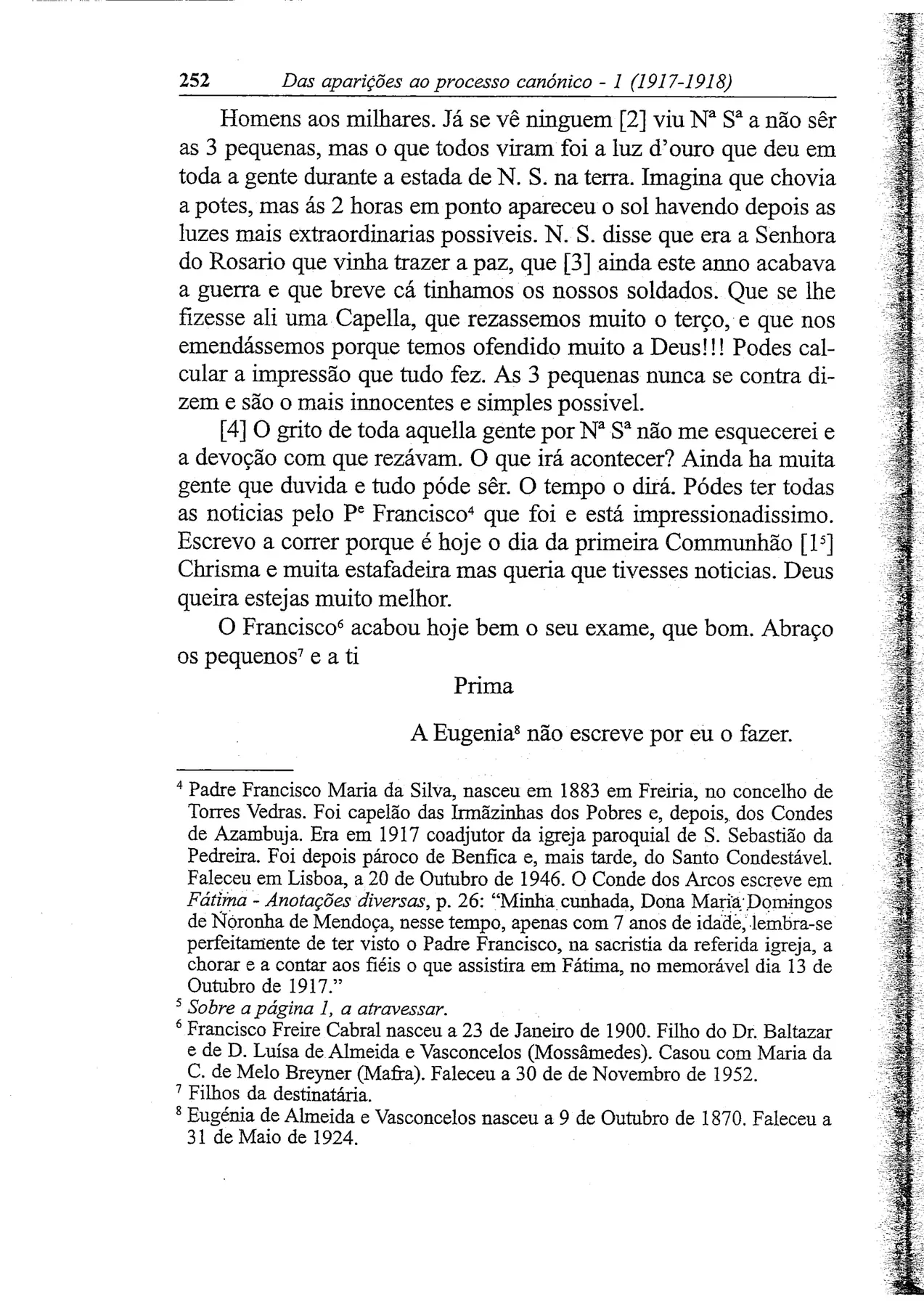
Our Lady said that she was the Lady of the Rosary, who came to bring peace, that [3] the war would end this very year and that we would soon have our soldiers* back here. That a chapel should be built for her there, that we should pray the rosary a great deal, and that we should mend our ways because we have greatly offended God!!!

Português (original)

N. S. disse que era a Senhora do Rosario que vinha trazer a paz, que [3] ainda este anno acabava a guerra e que breve cá tínhamos os nossos soldados. Que se lhe fizesse ali uma Capella, que rezassemos muito o terço, e que nos emendássemos porque temos ofendido muito a Deus!!!

DCF III-1, Doc. 92 · letter · 16 Oct 1917 (3 days later)View scans (2)Link
13 OctSecond-handSaw itPress reportFigures / visionsSeers' words overheard
As told by Domingos Pinto Coelho (A Ordem), from unnamed trustworthy people who heard the children
English

Three little shepherds (a boy and two girls) say that a Lady of extreme beauty appears to them. The visions have occurred on the 13th of each month since May.

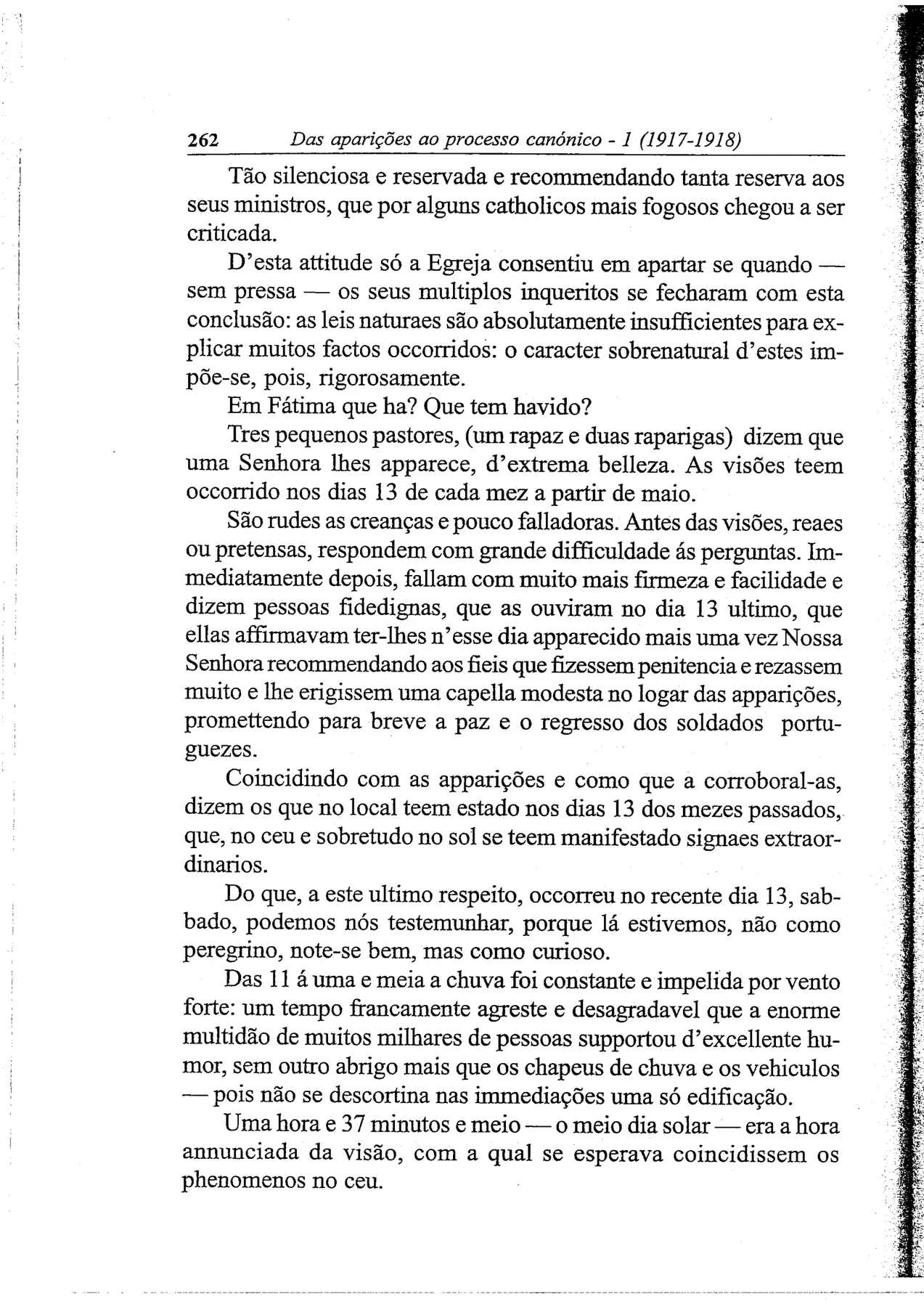
The children are unpolished and not very talkative. Before the visions, real or alleged, they answer questions with great difficulty. Immediately afterwards they speak with much more firmness and ease. Trustworthy persons who heard them on the 13th just past say that the children declared that Our Lady had appeared to them once more that day, urging the faithful to do penance, to pray a great deal and to build her a modest chapel at the place of the apparitions, and promising peace soon and the return of the Portuguese soldiers*.

Português (original)

Tres pequenos pastores, (um rapaz e duas raparigas) dizem que uma Senhora lhes apparece, d'extrema belleza. As visões teem occorrido nos dias 13 de cada mez a partir de maio.

São rudes as creanças e pouco falladoras. Antes das visões, reaes ou pretensas, respondem com grande difficuldade ás perguntas. Immediatamente depois, fallam com muito mais firmeza e facilidade e dizem pessoas fidedignas, que as ouviram no dia 13 ultimo, que ellas affirmavam ter-lhes n'esse dia apparecido mais uma vez Nossa Senhora recommendando aos fieis que fizessem penitencia e rezassem muito e lhe erigissem uma capella modesta no logar das apparições, promettendo para breve a paz e o regresso dos soldados portuguezes.

DCF III-1, Doc. 97 · press · 16 Oct 1917 (3 days later)View scans (2)Link
13 OctSecond-handSaw itLetterFigures / visionsSeers' words overheard
As told by Carlos Silva (letter to O Mensageiro)
English

One of the little girls says: Our Lady is there already! Close your umbrellas and pray...

[…]

Shortly afterwards the little girls told what Our Lady had said to them:

— The war is ending any day now; soon our soldiers will return to Portugal; people must be good to one another; pray the rosary and build a chapel, for I am the Lady of the Rosary.

Português (original)

Diz uma das meninas: *Já lá está Nossa Senhora! Fechem os chapeus e resem...

[…]

Pouco depois as meninas disseram o que Nossa Senhora lhes tinha dito:

— *A guerra acaba por estes dias; brevemente os nossos soldados regressam a Portugal; os homens devem ser bons uns para os outros; rezem o terço e façam uma capela pois que sou a Senhora do Rosario.

DCF III-1, Doc. 122 · press · 18 Oct 1917 (5 days later) · also in DCF III-2, Doc. 390AView scans (2)Link
13 OctSecond-handSaw itLetterFigures / visionsSeers' words overheard
As told by Laura Avellar (resident of Fátima), relayed by Maria de Jesus d'Oriol Pena Raposo
English

The little girls do not expect Our Lady to appear again.

She told them to pray the rosary a great deal to make amends to her Son, who was much offended.

Our Lady stood on the holm-oak shrub and not on clouds.

She had her hands joined and opened them to speak (like Our Lady of Graces*), with a rosary hanging from her hands. It was after Our Lady disappeared, when they looked at the Sun, that they saw Her there with St. Joseph blessing the people, and the child Jesus. But only half-length and in different colours.

Português (original)

As pequenas não esperam que N. Sra. torne a apparecer.

Mandou rezar muito o terço para desaggravar o seu filho que estava muito offendido.

N. Sra pousava sobre a carrasqueira e não sobre nuvens.

Trazia as mãos postas e abria-as para fallar (como N. Sra. das Graças) Pendendo-lhe das mãos um terço. Depois de N. Sra. desapparecer, quando olharam para o Sol é que lá A viram com S. José abençoando o povo, e o menino Jesus. Mas só em meio corpo e de differentes côre

DCF III-1, Doc. 198 · letter · Oct 1917 (2 days later)View scans (2)Link
13 OctSecond-handSaw itLetterFigures / visionsSeers' words overheard
As told by unnamed lady subscriber of Raio de Luz
English

I was with the two little girls, who were dressed in white with very simple little crowns on their little heads. They told me that Our Lady appeared to them with St. Joseph and the Child beside her; she said that she was the Lady of the Rosary, that they should pray it a great deal, that this was a warning, but that if they did not repent and went on offending her Divine Son, He would send a great punishment on Portugal.

The two little girls, separately, described the vision in the same way; and Lucia, who at her young age might have been expected to lose her head amid all the commotion around her, kept telling everyone in a clear, calm voice, as she passed by (in her father's arms) — what Our Lady had said to her

Português (original)

Estive com as duas pequenitas que iam vestidinhas de branco com umas corôasinhas muito singelas nas cabecinhas. Disséram-me que Nossa Senhora lhes apareceu com S. José e o Menino ao pé, disse que era a Senhora do Rosario, que o rezassem muito, que isto era um aviso mas que se se não arrependessem e continuassem a offender o seu Divino Filho, Este mandaria um grande castigo a Portugal.

As duas pequenas em separado, fizeram a descripção da visão da mesma fórma e a Lucia, que, dado a sua pouca edade deveria estar doida no meio d'aquelle alvoroço de que se via rodeada, ia dizendo a todos em voz clara e sem se alterar, á medida que ia passando (ao collo do pae) — o que Nossa Senhora lhe disséra

DCF III-1, Doc. 250 · press · Oct 1917 (2 days later)View scans (2)Link
13 OctSecond-handSaw itArticle by witnessFigures / visionsSeers' words overheard
As told by Maria José de Lemos Queirós (pilgrim present on 13 Oct)
English

Lúcia, aged 10 or 11, is the one who speaks; the others, Jacinta, the youngest, and Francisco, who are brother and sister and cousins of Lúcia, said they had seen a very beautiful Lady, dressed all in white, with a cloud at her feet.

[…]

Their aspiration was more modest; in very simple words they now merely stated that they had seen a very beautiful Lady, with hands joined and dressed in white, who told them that at that place they should have a chapel built there named after Our Lady of the Rosary; that people should stop offending God, who was already too much offended! That the war was going to end, and that our soldiers would come home.

Previously, the same Lady had told them something that the little shepherdess Lucia cannot reveal.

Português (original)

Lúcia, de 10 a 11 anos, é que fala; os outros, Jacinta, a mais nova, e Francisco, irmãos um do outro e primos de Lúcia, diziam ter visto uma Senhora muito linda, toda vestida de branco com uma nuvem aos pés.

[…]

A sua aspiração era mais modesta; apenas em muito simples palavras agora afirmavam terem visto uma Senhora muito linda, de mãos postas e vestida de branco, que lhes disse que deviam naquele local mandar construir uma capela com a denominação de Nossa Senhora do Rosário; que se deixassem de ofender a Deus, que já estava de mais ofendido! Que a guerra ia acabar, e que viriam os nossos soldados.

Anteriormente, a mesma Senhora lhes dissera uma coisa que a pastorinha Lucia não pode revelar.

DCF Seleção, Doc. 23 (= DCF I, Doc. 41) · press · 30 Oct 1917 (2 weeks later)View scans (3)Link
13 OctSecond-handSaw itSworn depositionSeers' words overheard
As told by Luís António Vieira de Magalhães e Vasconcelos, via Emílio Infante da Câmara
English

Almost as we were leaving I met my friend Emílio Infante da Câmara, who told me he had gone to see the shepherd girls and that they had said that the war would end soon, or that it would end in eight days' time (I cannot say which). He also told me they were dressed in first-Communion “toiletes”*.

Português (original)

Quase no momento da partida encontrei o meu amigo Emílio Infante da Câmara que me disse ter ido ver as pastoras e que estas tinham dito: que a guerra acabaria brevemente, ou que acabaria de ali a oito dias (não posso precisar). Disse-me também que elas estavam vestidas com “toiletes” de primeira Comunhão.

DCF Seleção, Doc. 32 (= DCF I, Doc. 28) · deposition · 30 Dec 1917 (3 months later)View scanLink