English
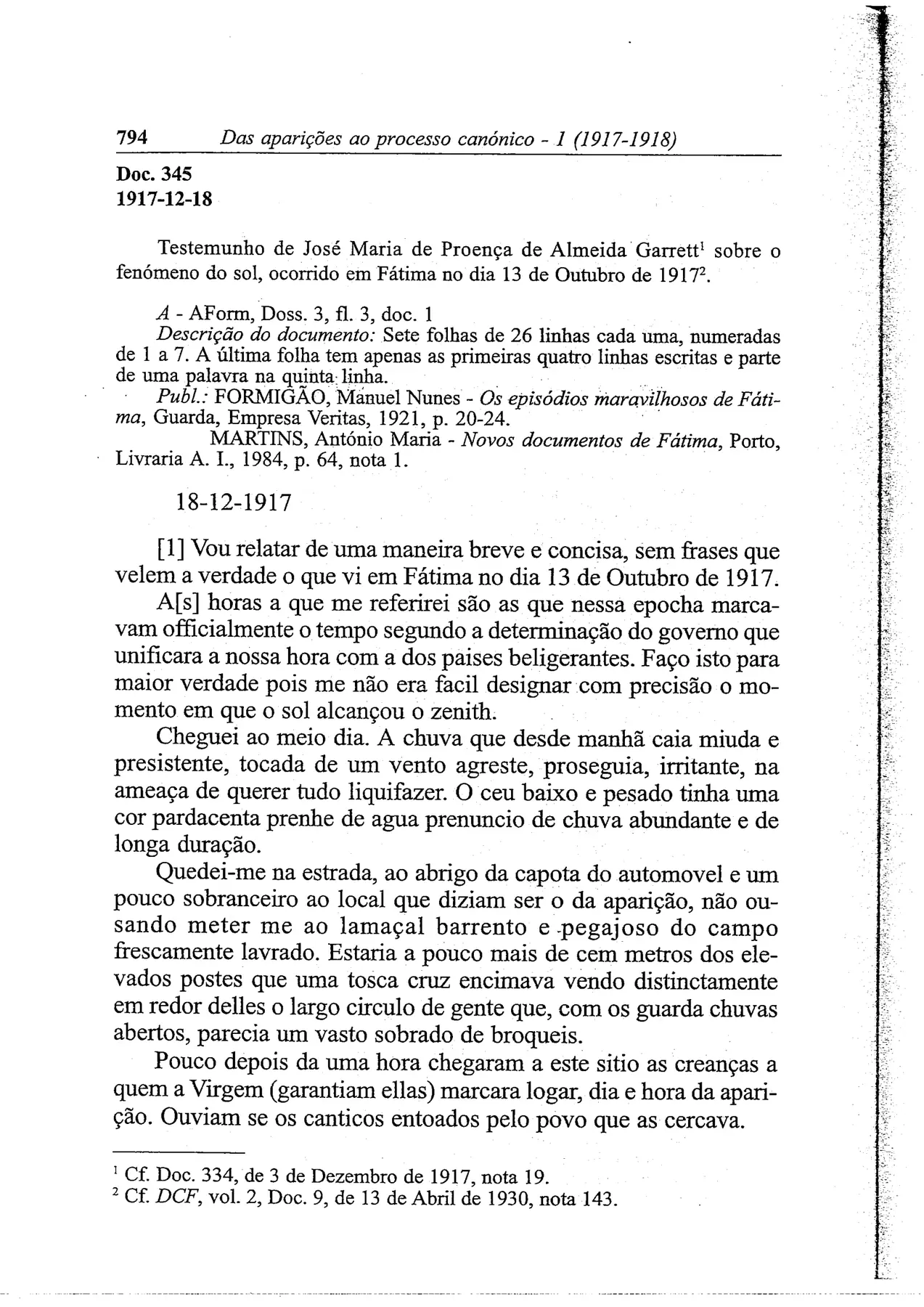
I shall relate briefly and concisely, without phrases that veil the truth, what I saw at Fátima on 13 October 1917.
The times I shall refer to are those which at that period officially marked the time according to the decision of the government that had unified our time with that of the belligerent countries. I do this for greater truthfulness, since it was not easy for me to indicate precisely the moment at which the sun reached the zenith.
I arrived at noon. The rain, which since morning had been falling fine and persistent, driven by a harsh wind, went on, irritatingly, threatening to turn everything to liquid. The low, heavy sky had a greyish colour, pregnant with water, a presage of abundant and long-lasting rain.
I stayed on the road, sheltered by the hood of the motor car and a little above the place said to be that of the apparition, not daring to venture into the clayey, sticky mire of the freshly ploughed field. I would have been a little over a hundred metres from the tall posts topped by a rough cross, seeing distinctly around them the wide circle of people who, with their umbrellas open, looked like a vast floor of shields.
Shortly after one o'clock the children arrived at this spot, the children to whom the Virgin (so they assured) had appointed the place, day and hour of the apparition. The hymns sung by the people surrounding them could be heard.
At a certain moment this wide mass, confused and compact, closed its umbrellas and uncovered its heads in a ges-[2]ture that must have been one of humility or respect, but which left me su[r]prised and amazed, because the rain, [in] blind continuity, was now wetting heads, drenching and soaking them. I was told afterwards that these people, who ended by kneeling in the mud, had obeyed the voice of a child.
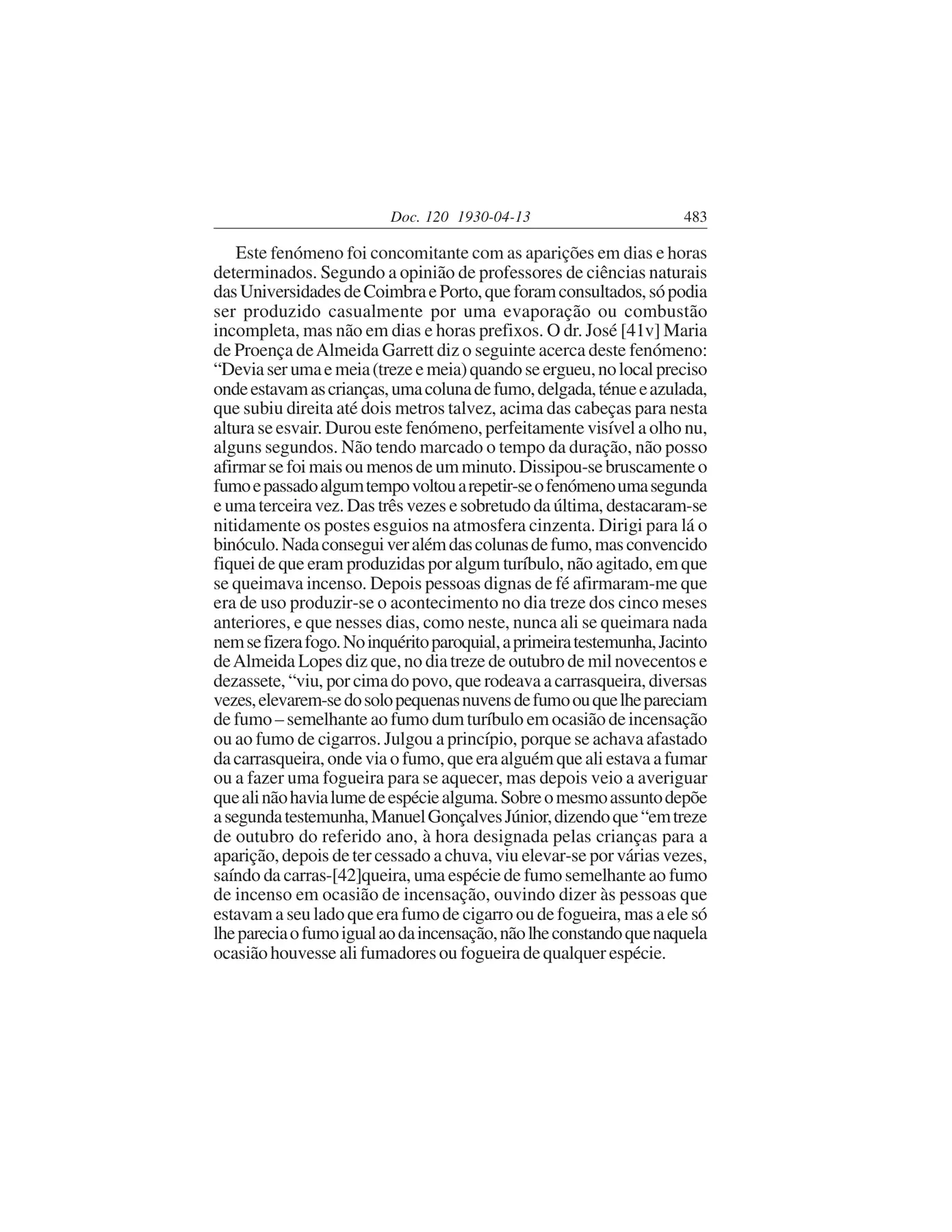
It must have been half past one (14 h and a half) when there rose up, at the precise spot where the children were, a column of smoke, thin, tenuous and bluish, which went straight up to perhaps two metres above the heads, to vanish at that height. This phenomenon, perfectly visible to the naked eye, lasted a few seconds. Not having timed its duration, I cannot state whether it was more or less than a minute. The smoke dissipated abruptly, and after some time the phenomenon was repeated a second and a third time. On all three occasions, and above all on the last, the slender shafts stood out sharply in the grey atmosphere.
I turned my binoculars there. I could see nothing apart from the columns of smoke, but I was convinced that they were produced by some thurible, not being swung, in which incense was burning. Afterwards persons worthy of credence assured me that it had been usual for the occurrence to take place on the 13th of [the] five previous months, and that on those days, as on this one, nothing had ever been burned there nor any fire lit.
As I went on looking at the place of the apparition in calm and cool expectation, and with a curiosity that was slackening [3] because the time had passed long and slow without anything to stir my attention, I heard the hubbub of thousands of voices and saw that multitude, spread across the wide field that stretched at my feet, or concentrated in compact waves around the raised timbers, or on the low terraces that held back the soil, turn their backs on the point towards which their desires and yearnings had until then converged, and look at the sky on the opposite side.
It was almost two o'clock.
Moments before, the sun had broken triumphantly through the dense layer of clouds that had kept it hidden, to shine clearly and inte[n]sely.
I turned towards this magnet that drew all eyes, and I could see it, like a disc with a sharp rim and a keen edge, luminous and shining, but without hurting.
The comparison, which I heard made at Fatima itself, with a disc of dull silver did not seem right to me. It was a lighter, more active and richer colour, with shifting tints, having, as it were, the orient of a pearl. It in no way resembled the moon on a clear and pure night, because one saw and felt it to be a living star. It was not spherical like the moon, and it did not have the same tonality nor the light and shade. It looked like a burnished wafer cut from the mother-of-pearl of a shell. This is not a banal comparison of cheap poetry. My eyes saw it so. Nor could it be confused with the sun seen through [the] fog (of which, besides, there was none at that time), because it was not opaque, diffuse and veiled. At Fatima it had [4] light and heat, and it stood out sharply, with its rim cut in an edge like a gaming board.
The vault of heaven was clouded with light cirrus, with chinks of blue here and there, but the sun at times stood out in patches of clear sky. The clouds that ran swiftly from west to east did not dim the light (which did not hurt) of the sun, giving the easily understandable and explicable impression of passing behind it, but at times those flakes, which came white, seemed to take on, as they glided before the sun, a pink or diaphanous blue tonality.
What is marvellous is that for a long time one could stare at the star, a blaze of light and an ember of heat, without pain in the eyes and without a blinding dazzle on the retina.
This phenomenon, with two brief interruptions in which the fierce sun hurled out its most flashing and refulgent rays, which forced us to look away, must have lasted about ten minutes.
This nacreous disc had the giddiness of movement. It was not the twinkling of a star in full life. It was spinning on itself at a headlong speed.
Suddenly a clamour is heard, like a cry of anguish from all that people. The sun, keeping up the speed of its rotation, detaches itself from the firmament and, blood-red, advances upon the earth, threatening to crush us with the weight of its fiery and huge millstone. These are seconds of terrifying impression.
[5] During the solar occurrence that I have been describing in detail, there were coloured shifting tints in the atmosphere. I cannot state the moment exactly because two months have now passed and I did not take notes. I remember that it was not right at the beginning; rath[er], I believe it was towards the end.
While staring at the sun I noticed that everything around me was growing dark. I looked at what was near and cast my gaze far out to the extreme horizon and saw everything the colour of amethyst. Objects, the sky and the layer of atmosphere had the same colour. A purplish oak that rose in front of me cast a heavy shadow on the ground. Fearing I had suffered an affection of the retina, an unlikely hypothesis because in that case I should not have seen things in purple, I turned round, closed my eyelids and held them shut with my hands to block out all light. Still with my back turned, I opened my eyes and recognised that, as before, the landscape and the air were still the same purple colour.
The impression one had was not that of an eclipse. I saw the eclipse of '08, which at Viseu, where I was, was total. As the moon moves to hide the sun, the light grows ashen until everything becomes dull and black. The eye reaches a small circle beyond which objects become more and more confused until they are lost in the blackness. \The temperature drops considerably and one would say that life on earth had died. At Fatima, [the] atmosphere, although purple, remained transparent/10 [6] to the edge of the horizon, which could be distinguished and seen clearly, and I did not have the sensation of a halt in the universal energy.
Continuing to look at the sun I noticed that the surroundings had brightened. Immediately afterwards I heard a countryman who was near me saying in a voice of amazement: this lady is yellow. Indeed, everything had now changed, near and far, taking on the colour of old yellow damask. People looked sickly and jaundiced. I smiled to find them frankly ugly and unbecoming. Laughter was heard. My hand had the same yellow tone.
Some days later I tried the experiment of staring at the sun for a few brief moments. On looking away I saw, after a few moments, yellow patches, irregular in shape. One does not see everything in a uniform colour, as if a topaz had been volatilised in the air, but blotches or spots that shift with the movement of the gaze.
All these phenomena that I have mentioned and described I observed calmly and serenely, without emotion or alarm. It is for others to explain or interpret them.
To conclude, I must make the statement that never, either before or after 13 October, have I seen similar phenomena, solar or atmospheric.
Português (original)
Vou relatar de uma maneira breve e concisa, sem frases que velem a verdade o que vi em Fátima no dia 13 de Outubro de 1917.
A[s] horas a que me referirei são as que nessa epocha marcavam oficialmente o tempo segundo a determinação do governo que unificara a nossa hora com a dos países beligerantes. Faço isto para maior verdade pois me não era facil designar com precisão o momento em que o sol alcançou o zenith.
Cheguei ao meio dia. A chuva que desde manhã caia miuda e presistente, tocada de um vento agreste, proseguia, irritante, na ameaça de querer tudo liquifazer. O ceu baixo e pesado tinha uma cor pardacenta prenhe de agua prenuncio de chuva abundante e de longa duração.
Quedei-me na estrada, ao abrigo da capota do automovel e um pouco sobranceiro ao local que diziam ser o da aparição, não ousando meter me ao lamaçal barrento e pegajoso do campo frescamente lavrado. Estaria a pouco mais de cem metros dos elevados postes que uma tosca cruz encimava vendo distinctamente em redor delles o largo circulo de gente que, com os guarda chuvas abertos, parecia um vasto sobrado de broqueis.
Pouco depois da uma hora chegaram a este sitio as creanças a quem a Virgem (garantiam ellas) marcara logar, dia e hora da aparição. Ouviam se os canticos entoados pelo povo que as cercava.
Numa determinada altura esta larga massa, confusa e compacta, fechou os guarda chuvas e descobriu se num ges-[2]to que devia ser de humildade ou respeito mas que me deixou su[r]preso e admirado porque a chuva, [n]uma continuidade cega, molhava agora cabeças, encharcava e ensopava. Disseram me depois que esta gente, que acabou por ajoelhar na lama, tinha obedecido a voz de uma creança.
Devia ser uma e meia (14 h e meia) quando se ergueu, no local preciso onde estavam as creanças, uma columna de fumo, delgada, tenue e azulada que subiu direita ate dois metros, talvez, acima das cabeças para se nesta altura se esvair. Durou este phenomeno, perfeitamente visivel a olho nu, alguns segundos. Não tendo marcado o tempo de duração não posso affirmar se foi mais ou menos de um minuto. Dissipou se bruscamente o fumo e passado algum tempo voltou a repetir se o phenomeno uma segunda e uma terceira vez. Das trez vezes, e sobretudo da ultima, destacaram-se nitidamente os fustes esguios na atmosphaera cinzenta.
Diriji para lá o binoculo. Nada consegui ver alem das columnas de fumo mas convencido fiquei de que eram produzidas por algum thuribulo, não agitado, em que queimava insenso. Depois pessoas dignas de fé affirmaram me que era de uso produzir se o acontecimento no dia 13 do[s] cinco mezes anteriores e que nesses dias, como neste, nunca ali se queimara nada nem se fizera fogo.
Continuando a olhar o logar da aparição numa espetativa serena e fria e com uma curiosidade que ia amolecendo [3] porque o tempo decorrera longo e vagaroso sem que nada activasse a minha atenção, ouvi o bruhaha de milhares de vozes e vi aquella multidão, espreada, pelo largo campo que se estendia a meus pez, ou concentrada em vagas compactas, em redor dos madeiros erguidos, ou sobre os baixos socalcos que retinham as terras, voltar as costas ao ponto que até então convergira os desejos e ancias e olhar o ceu do lado oposto.
Eram quasi duas horas.
O sol momentos antes tinha rompido ovante, a densa camada de nuvens que o tivera escondido, para brilhar clara e inte[n]samente.
Voltei me para este iman que attrahia todos os olhares e pude ve lo semelhante a um disco de bordo nitido e aresta viva luminosa e luzente mas sem maguar.
Não me pareceu bem a comparação, que ainda em Fatima ouvi fazer, de um disco de prata fosca. Era uma cor mais clara, activa e rica, e com cambiantes, tendo como que o oriente de uma perola. Em nada se assemelhava á lua em noite transparente e pura porque se via e sentia se ser um astro vivo. Não era como a lua esferica e não tinha a mesma tonalidade nem os claros-escuros. Parecia uma rodela brunida cortada no nacar de uma concha. Isto não é uma comparação banal de poesia barata. Os meus olhos viram assim. Tambem se não confundia com o sol encarado atravez [do] nevoeiro (que aliaz não havia áquelle tempo) porque não era opaco, difuso e velado. Em Fatima tinha [4] luz e calor e desenhava se nitido e com a borda cortada em aresta como uma tabela de jogo.
A abobada celeste estava enevoadas de cirros leves, tendo frestas de azul aqui e acola, mas o sol algumas vezes se destacou em rasções de ceu limpo. As nuvens que corriam ligeiras de poente para oriente não empanavam a luz (que não feria) do sol dando a impressão facilmente comprehensivel e explicavel de passar por detraz mas por vezes esses flocos, que vinham brancos, pareciam tomar, deslisando ante o sol, uma tonalidade rosa ou azul diafana.
Maravilhoso é que, durante longo tempo, se pudesse fixar o astro labareda de luz e braza de calor, sem uma dor nos olhos e sem um deslumbramento na retina, que cegasse.
Este phenomeno com duas breves interrupções em que o sol bravio arremessou os seus raios mais coruscantes e refulgentes, e que obrigaram a desviar o olhar, devia ter durado cerca de dez minutos.
Este disco nacarado tinha a vertigem do movimento. Não era a scintilação de um astro em plena vida. Girava sobre si mesmo numa velocidade arrebatada.
De repente ouve se um clamor como que um grito de angustia de todo aquelle povo. O sol, conservando a celeridade da sua rotação, destaca se do firmamento e sanguinio avança sobre a terra ameaçando esmagar nos com o pezo da sua ignea e ingente mó. São segundos de impressão terrifica.
[5] Durante o acidente solar, que detalhadamente tenho vindo a descrever, houve na atmospha coloridos cambiantes. Não posso precisar bem a occasião porque já lá vão dois mezes passados e eu não tomei notas. Lembro me que não foi logo no principio e ante[s] creio que foi para o fim.
Estando a fixar o sol notei que tudo escurecia a minha volta. Olhei o que estava perto e alonguei a vista para o largo ate ao extremo horisonte e vi tudo cor de amethysta. Os objectos, o ceu e a camada atmospherica tinham a mesma cor. Uma carvalheira arroheada que se erguia na minha frente lançava sobre a terra uma sombra carregada. Receando ter soffrido uma afecção da retina, hypothese pouco provavel porque dado este caso não devia ver as coisas em rocho, voltei me, cerrei as palpebras e retive as com as mãos para interceptar toda a luz. Ainda de costas abri os olhos e reconheci que, como antes, a paisagem e o ar continuavam da mesma cor rocha.
A impressão que se tinha não era de eclipse. Vi o eclipse de 8 que em Viseu, onde estava, foi total. Á medida que a lua marcha a esconder o sol a luz vai se acinsentando ate que tudo se torna basso e negro. A vista alcança um pequeno circulo para la do qual os objectos se vão tornando cada vez mais confusos ate que se perdem no negrume. \Baixa a temperatura consideravelmente e dir se ha que a vida na terra morreu. Em Fatima, [a] atmospha, embora rocha, permaneceu transparente/10 [6] ate ao confim do horisonte, que se distingue e ve claramente, e eu não tive a sensação de uma paragem na energia universal.
Continuando a olhar o sol reparei que o ambiente tinha aclarado. Logo depois ouvi um camponio que cerca de mim estava [a]
dizer com voz de pasmo: esta senhora esta amarella. De facto tudo agora mudara, perto e distante, tomando a cor de velhos damascos amarellos. As pessoas pareciam doentias e com i[c]tericia. Sorri me de as achar francamente feias e desairosas. Ouviram se risos. A minha mão tinha o mesmo tom amarello.
Dias depois fiz a experiencia de fixar o sol uns breves instantes. Retirada a vista vi, apoz alguns momentos, manchas amarellas irregulares na forma. Não se ve tudo de uma cor uniforme, como se no ar se tivesse volatilisado um topasio, mas nodoas ou malhas que com o movimento do olhar se deslocam.
Todos estes phenomenos que citei e descrevi observei os eu socegado e serenamente sem uma emoção ou sobresalto. A outros cumpre explica los ou interpreta los.
Para terminar devo fazer a affirmação, que nunca, nem antes nem depois do dia 13 de outubro, vi eguaes phenomenos, solares ou atmosphericos.