I, Maria Luisa Garrett Corrêa, my sister Maria Garrett Corrêa, my sister-in-law and other friends who were with us affirm that we were witnesses of what I shall now briefly describe3
Nearly sixty thousand people are waiting for the hour foretold by the children: the hour at which, as the Virgin had announced to them, a prodigy visible to all who came to that holy place on 13 October would take place.
It is the old time4 that people go by. At the half-hour5, more or less, by solar time, the sun, which until then had been hidden by dense black clouds (since eight in the morning the rain, driven by a stormy wind, had not stopped for a moment), suddenly [1v] appears free of clouds, at the zenith; the rain stops; the sun looks like a plate of dull silver that one can stare at without the slightest effort. Before the astonished eyes of the crowd, while the child who is speaking to the Virgin tells them to kneel and bare their heads, the sun spins on itself in a dizzying movement, giving off blasts of heat like a lit oven that has been opened. The sun seems to approach the earth in abrupt, rapid movements and successively changes colour, and [2] the landscape turns yellow, then purplish, according to the colours the sun takes on. This phenomenon lasts approximately 10 minutes, during which the crowd, on their knees with hands joined, cried out for pardon and mercy.
From the place where the Virgin speaks to the little children there rose a white, transparent smoke, forming a sort of little cloud that envelops the spot between two small oaks6 where the children await the apparition. The eldest little girl, Lucia, [2v] aged 10, asks the Virgin aloud: who are you, ma'am? What do you want, ma'am? The answers are not heard, but when the sun resumes its usual course the child turns to the people and, from the arms of a man7 who is holding her up, repeats the words of the Lady
I am the Virgin of the Rosary; I want a chapel to be built for me here.
Tell the people to mend their ways and stop offending God; tell them that peace is made today and that your soldiers* will come back
The two other children, Francisco and Jacyntha, see the Virgin but do not speak to her.
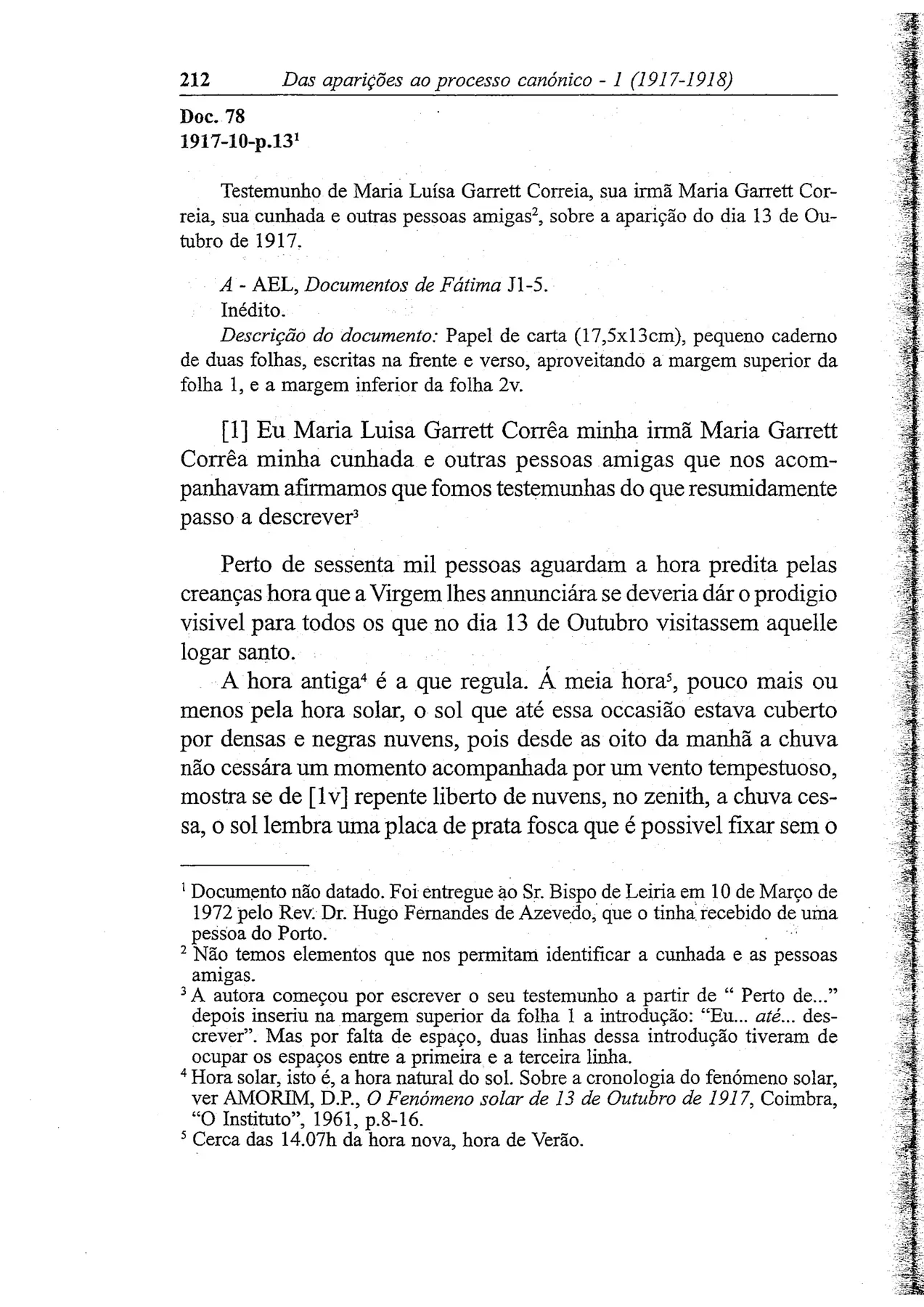
Eu Maria Luisa Garrett Corrêa minha irmã Maria Garrett Corrêa minha cunhada e outras pessoas amigas que nos acompanhavam afirmamos que fomos testemunhas do que resumidamente passo a descrever3
Perto de sessenta mil pessoas aguardam a hora predita pelas creanças hora que a Virgem lhes anunciára se deveria dar o prodígio visível para todos os que no dia 13 de Outubro visitassem aquele lugar santo.
A hora antiga4 é a que regula. Á meia hora5, pouco mais ou menos pela hora solar, o sol que até essa ocasião estava cuberto por densas e negras nuvens, pois desde as oito da manhã a chuva não cessára um momento acompanhada por um vento tempestuoso, mostra-se de [1v] repente liberto de nuvens, no zenith, a chuva cessa, o sol lembra uma placa de prata fosca que é possível fixar sem o mínimo esforço, e aos olhos espantados da multidão, em quanto a creança, que se dirige á Virgem, manda que se ajoelhem e se descubram, o sol gira sobre si mesmo n'um movimento vertiginoso lançando bafaradas de calor como um forno acceso que se houvera aberto, o sol parece aproximar-se da terra em movimentos bruscos e rápidos sucessivamente muda de côr, e [2] a paisagem torna-se amarela depois torna-se arroxeada segundo as côres revestidas pelo sol. Este fenómeno dura aproximadamente 10 minutos durante os quais a multidão de joelhos e de mãos postas clamava perdão e misericórdia.
Do lugar aonde a Virgem falla ás creancinhas elevava-se um fumo branco transparente que forma como uma nuvensinha que envolve o lugar entre dois pequenos carvalhos6 aonde as creanças aguardam a aparição. A pequena mais velha, Lucia, [2v] de 10 anos, pergunta a Virgem em voz alta quem é vocês-mecê? Vocês-mecê o que quer? As respostas não se ouvem, mas quando o sol retoma o seu curso habitual a creança volta-se para o povo e ao colo de um homem7 que a segura nos braços repete as palavras da Senhora
Eu sou a Virgem do Rosario quero que me edifiquem aqui uma capella.
Diz ao povo que se emende de attentar contra Deus diz-lhe que hoje se faz a paz e que os vossos militares hão de voltar
As duas outras creanças Francisco e Jacyntha, vêem a Virgem mas não lhe falam.
Editor's notes (7)
1 Undated document. It was handed to the Bishop of Leiria on 10 March 1972 by the Rev. Dr. Hugo Fernandes de Azevedo, who had received it from a person in Porto.
2 We have no information that would allow us to identify the sister-in-law and the friends.
3 The author began by writing her testimony from "Nearly..."; she then inserted the introduction in the top margin of sheet 1: "I... to... describe". But for lack of space, two lines of that introduction had to occupy the spaces between the first and third lines.
4 Solar time, that is, the natural time of the sun. On the chronology of the solar phenomenon, see AMORIM, D.P., O Fenómeno solar de 13 de Outubro de 1917, Coimbra, "O Instituto", 1961, pp.8-16.
5 About 14.07 by the new time, that is, summer time.
6 According to the existing documentation these were not oaks, but small holm oaks or holm-oak shrubs
7 This is Dr. Carlos de Azevedo Mendes (cf. DCF, vol. 1, Doc. 56, dated after 13 October 1917, note 10, and DCF, vol. 2, Doc. B, of 13 September 1927).
1 Documento não datado. Foi entregue ao Sr. Bispo de Leiria em 10 de Março de 1972 pelo Rev. Dr. Hugo Fernandes de Azevedo, que o tinha recebido de uma pessoa do Porto.
2 Não temos elementos que nos permitam identificar a cunhada e as pessoas amigas.
3 A autora começou por escrever o seu testemunho a partir de "Perto de..." depois inseriu na margem superior da folha 1 a introdução: "Eu... até... descrever". Mas por falta de espaço, duas linhas dessa introdução tiveram de ocupar os espaços entre a primeira e a terceira linha.
4 Hora solar, isto é, a hora natural do sol. Sobre a cronologia do fenómeno solar, ver AMORIM, D.P., O Fenómeno solar de 13 de Outubro de 1917, Coimbra, "O Instituto", 1961, p.8-16.
5 Cerca das 14.07h da hora nova, hora de Verão.
6 Pela documentação existente não se tratava de carvalhos, mas de pequenas azinheiras ou carrasqueiras
7 Trata-se do Dr. Carlos de Azevedo Mendes (cf. DCF, vol. 1, Doc. 56, de p.13 de Outubro de 1917, nota 10 e DCF, vol. 2, Doc. B, de 13 de Setembro de 1927).