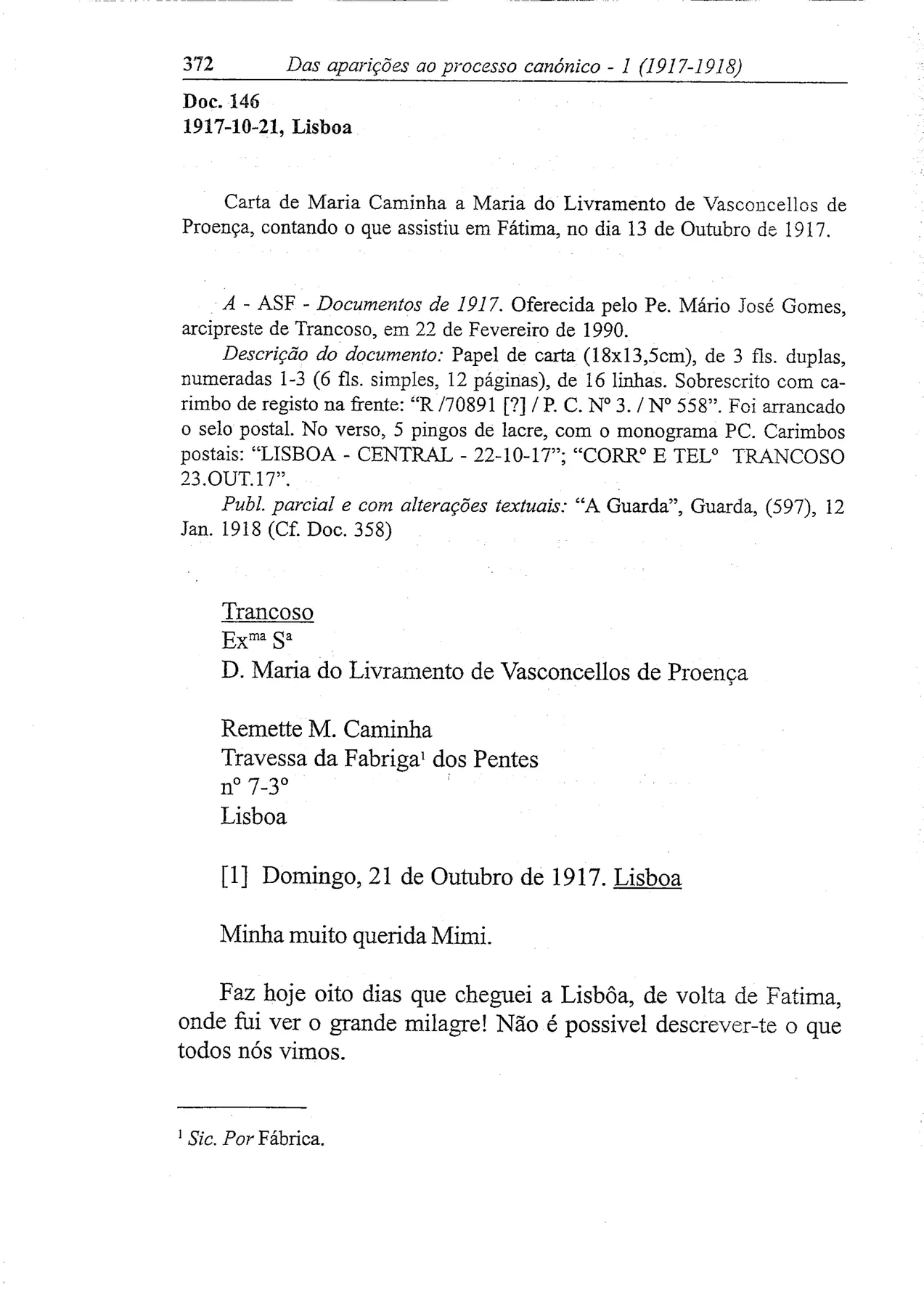
Maria Caminha
It is a week today since I got back to Lisbon from Fatima, where I went to see the great miracle! It is impossible to describe to you what we all saw.
[…]
It was raining torrentially and everyone stood their ground until 2 o'clock, or solar noon, the moment when the clouds drew apart to the sides leaving the sun uncovered, and immediately rolls of very light clouds began to pass in front of the sun, yellow as gold, purple, carnation-coloured, etc.
At this the sun seemed to come loose and came down [2] all all of a sudden; a moment of terror.
At this it began a rotating movement with an incalculable speed.
Suddenly it is the moon that is there, but that is only a moment; it turns into the Sacred Host, even the cross being visible as if hollowed into that opaque matter the colour of very white wheat flour.
I saw it like that in the void and around it a marvellous crown of those clouds in various colours. A spectacle of astounding beauty, you cannot imagine the delicacy of the tones, with what tenderness God looked upon our land at that moment; we felt ourselves loved to boundless extremes.
Everyone saw it, close on 100 thousand people.
[2v] People took on the colours of the clouds, it was interesting to see; the sun with its light behind seemed to pass its brightness as if through coloured glass.
All this was happening while Our Lady was coming down to earth to speak to little Lucia.
All three children (1 little boy and 2 little girls) see, but only the eldest, 10 years old, speaks.
Our Lady became visible to some people; I was not favoured with that grace; I did not need it in order to believe.
[…]
Around the valley chosen for so many marvels, as a simple ornament and with the greatest symmetry, there followed one after another some patches in the the three preferred colours
[…]
I was enormously moved when I saw so great and so holy a manifestation of faith. What courage and persistence to face such a storm without drawing back, without wine; admirable, in short. There was not one policeman, there was nothing, nothing, but the respect and the holy contentment with which everyone was filled.
At one moment when it was raining [4v] hard, the little girl said to close the umbrellas; the umbrellas were closed and the rain stopped.
Our Lady told Lucia that Saint Joseph came to bless the people, and that all the believers \(\text{present there}) were forgiven up to that moment.
That place was blessed; people and animals, everything was blessed.
At that moment there was a great brightness.
Faz hoje oito dias que cheguei a Lisbôa, de volta de Fatima, onde fui ver o grande milagre! Não é possível descrever-te o que todos nós vimos.
[…]
Chovia torrencialmente e todos a pé firme se conservaram até ás 2 horas ou meio dia solar, momento em que as nuvens se afastaram para os lados deixando o sol a descoberto, e immediatamente começam a passar por diante do sol rolos de nuvens muito leves e amarellas como oiro, rouxas, côr de cravo, etc.
N'isto o sol pareceu desprender-se e desceu [2] de de repente; momento de pavor.
N'isto começa n'um movimento rotatorio com uma rapidez incalculavel.
De repente é a lua que está mas isso é um momento, transforma-se na Sagrada Hostia vendo-se até a cruz como que cavada n'aquella materia opaca côr de farinha de trigo muito alva.
Eu vi assim no vacuo e em roda uma maravilhosa corôa das taes nuvens em varias cores. Espectaculo de espantosa belleza, não imaginas qual era a delicadeza dos tons, com que carinho Deus olhou para a nossa terra n'aquelle momento, sentiamos-nos amados com extremos sem limites.
Todos viram, perto de 100 mil pessoas.
[2v] As pessoas ficavam das cores das nuvens era interessante de ver, o sol com a sua luz por detraz parecia passar a claridade como que atravez de vidros de côres.
Tudo isto se passava em quanto a Nossa Senhora descia á terra a fallar á pequena Lucia.
Todas as trez crianças (1 rapazito e 2 pequenas) veêm, mas só falla a mais velha, 10 annos.
Nossa Senhora tornou-se visivel para algumas pessoas, eu não fui contemplada com essa graça, não me era necessaria para crer.
[…]
Em roda do valle escolhido para tantas maravilhas, succediam-se como simples ornamento e com a maior simetria umas manchas com as as trez côres preferidas
[…]
Tive uma comoção enorme quando vi uma tão grande e tão santa manifestação de fé. Que coragem e persistencia para arrostar com uma tempestade d'aquellas sem recuar, sem vinho, emfim admiravel. Não havia um policia, não houve nada, nada, que não fosse o respeito e o santo contentamento de que todos estavam possuidos.
N'um certo momento em que chovia [4v] muito, a pequenita disse que fechassem os chapeus, fecharam-se os chapeus e a chuva parou.
Nossa Senhora disse à Lucia que São José veio abençoar o povo, e que todos os crentes \(\text{alli presentes}) ficavam perdoados até áquelle momento.
Aquelle logar ficou bento, pessoas e animaes, tudo foi benzido.
N'esse momento houve uma grande claridade.
Editor's notes (6)
2 This must be Regina Ferreira, referred to in Doc. 69, of 13 October 1917, note 19.
3 In Doc. 69, of 13 October 1917, fol. 5, an Emília is mentioned immediately after Regina. It is the same person: Father Francisco dos Santos Costa, a native of Rodrigos, assures us that she was Emília and not Emiliania. It was therefore an error by the author of this letter. Emília was a housemaid of Isabel da Nóbrega Machado, a friend of Fernanda Guiot Correia Basto.
4 Rita, sister of Bettina Basto, two years older, who later died in Porto in 1969 (cf. Doc. 69, of 13 October 1917, note 24).
5 Sister of Rita, author of Doc. 69, of 13 October 1917 (Cf. note 2 of Doc. 69).
6 Rodrigos (cf. Doc. 69, of 13 October 1917, note 14).
15 From the text of Doc. 69, of 13 October 1917 and Doc. 104, of 17 October 1917, it cannot be gathered that Bettina Basto saw Our Lady, but in Doc. 69 (fol. 10v) she drew a drawing with a silhouette which, in 1978, she explained to us was the figure of Our Lady as she imagined it.
2 Deve tratar-se de Regina Ferreira, referida no Doc. 69, de 13 de Outubro de 1917, nota 19.
3 No Doc. 69, de 13 de Outubro de 1917, fl. 5, refere-se uma Emília, imediatamente a seguir a Regina. Trata-se da mesma pessoa: o Padre Francisco dos Santos Costa, natural de Rodrigos, certifica-nos que era Emília e não Emiliania. Foi portanto um erro da autora desta carta. Emília era criada de servir de Isabel da Nóbrega Machado, amiga de Fernanda Guiot Correia Basto.
4 Rita, irmã de Bettina Basto, dois anos mais velha, que veio veio a falecer no Porto em 1969 (cf. Doc. 69, de 13 de Outubro de 1917, nota 24).
5 Irmã de Rita, autora do Doc. 69, de 13 de Outubro de 1917 (Cf. nota 2, do Doc. 69).
6 Rodrigos (cf. Doc. 69, de 13 de Outubro de 1917, nota 14).
15 Do texto do Doc. 69, de 13 de Outubro de 1917 e Doc. 104, de 17 de Outubro de 1917, não se depreende que Bettina Basto tenha visto Nossa Senhora, mas no Doc. 69 (fl. 10v), ela desenhou um desenho com uma silhueta que, em 1978, nos explicou ser o vulto de Nossa Senhora como ela o imaginou.