Witnesses /

Domingos Pinto Coelho

ProfessionalJournalist

Lawyer born 1855 in Lisbon (aged 62), legitimist monarchist leader and Catholic writer for A Ordem under the pen-name 'A. de F.'; he went 'as a curious observer, not a pilgrim' and wrote critically of the events. Later senator under Sidónio Pais.

From LisboaTravelled from afarAttitude beforehand: Sceptic9 passages · 13 October 1917, Other 1917 events
13 OctFirst-handSaw itArticle by witnessScepticTravelled from afarCrowd sceneRain stoppingSun changing colourSun spinningSun fallingHeat
English

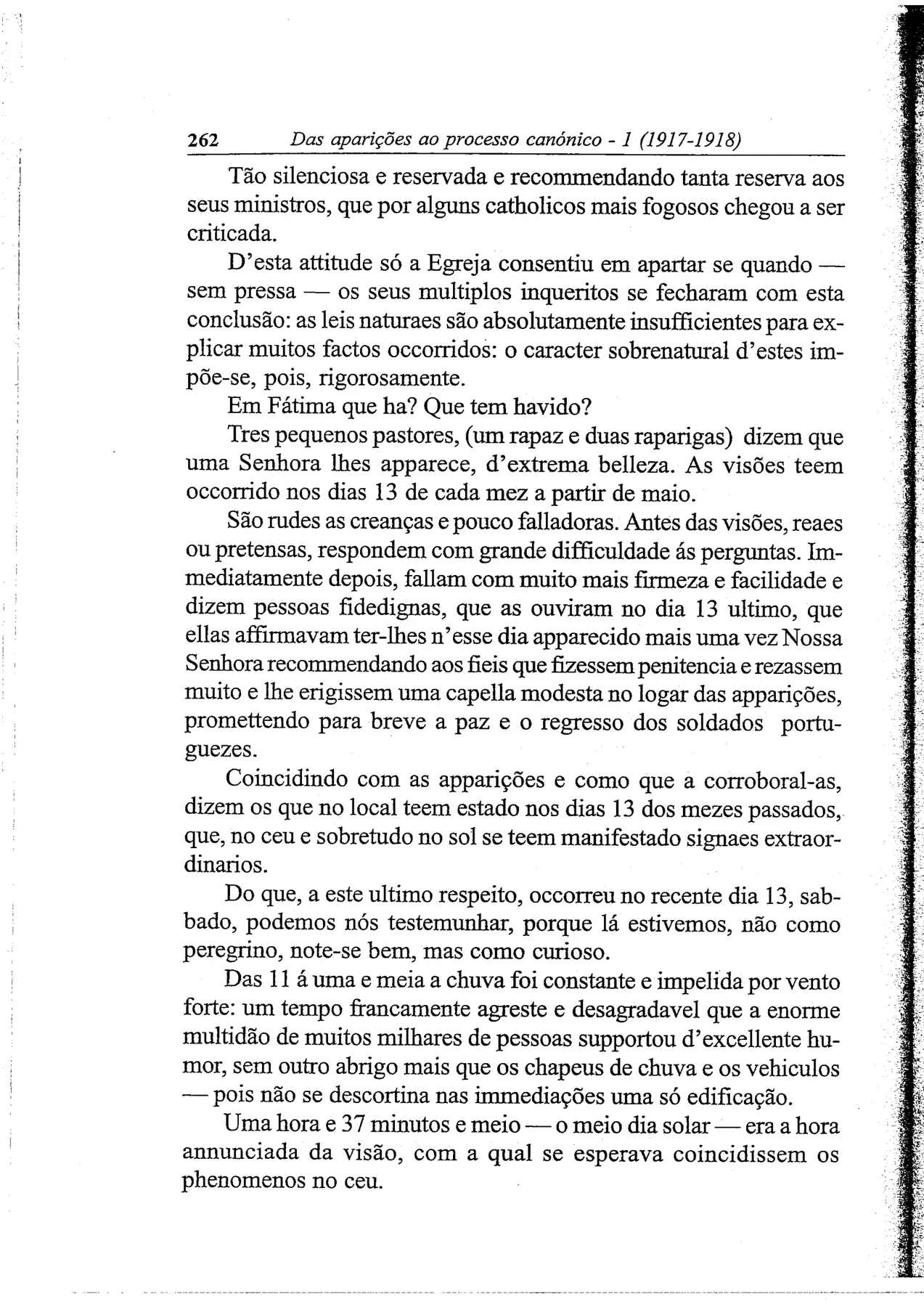
As to what, in this last respect, occurred on the recent 13th, a Saturday, we can bear witness, because we were there, not as a pilgrim, be it well noted, but as a curious onlooker.

From 11 to half past one the rain was constant and driven by a strong wind: frankly rough and unpleasant weather, which the enormous multitude of many thousands of people bore in excellent humour, with no other shelter than umbrellas and vehicles — for not a single building is to be seen in the vicinity.

One hour 37 and a half minutes — solar noon — was the announced hour of the vision, with which the phenomena in the sky were expected to coincide.

At that hour it was still raining.

Minutes later the rain lessened, and when it was a quarter to two it stopped completely.

The sun, hidden until then, showed itself between clouds that were moving with some speed. And as their density varied, so the veil they drew over the king of stars was more or less transparent.

Like all that multitude, we then looked at the sun with sustained attention and, through the clouds, we saw it with new aspects: new to us, be it well noted.

Sometimes surrounded by blood-red flames, at other times haloed with softened yellow or purple, at other times seeming to be animated by a very swift rotary motion, at other times again appearing to break away from the sky, to approach the earth and to radiate a strong heat.

Why deny it? These phenomena, which we had never seen, impressed us strongly. In multitudes a collective psychology takes hold. And, broadly speaking, a great wave of faith passed over that multitude, which was deeply moving.

[…]

In short, we came back from Fátima in the same state of mind in which we had gone there - in doubt.

Português (original)

Do que, a este ultimo respeito, occorreu no recente dia 13, sabbado, podemos nós testemunhar, porque lá estivemos, não como peregrino, note-se bem, mas como curioso.

Das 11 á uma e meia a chuva foi constante e impelida por vento forte: um tempo francamente agreste e desagradavel que a enorme multidão de muitos milhares de pessoas supportou d'excelente humor, sem outro abrigo mais que os chapeus de chuva e os vehiculos — pois não se descortina nas immediações uma só edificação.

Uma hora e 37 minutos e meio — o meio dia solar — era a hora annunciada da visão, com a qual se esperava coincidirem os phenomenos no ceu.

A essa hora continuava chovendo.

Minutos depois, a chuva diminuiu e quando era uma e tres quartos cessou por completo.

O sol, até então encoberto, mostrou-se entre nuvens que corriam com certa velocidade. E como era variavel a densidade d'estas, mais ou menos diaphano era o veu que ellas punham sobre o astro-rei.

Como toda aquella multidão, olhámos então para o sol com atenção sustentada e, atravez das nuvens, vimol-o com aspectos novos: novos para nós, note-se bem.

Umas vezes rodeado de chammas encarniçadas, outras vezes aureolado de amarello ou roxo esbatido, outras vezes parecendo animado de velocissimo movimento de rotação, outras vezes, ainda, apparentando destacar-se do ceu, approximar-se da terra e irradiar um forte calor.

Para quê, negal-o? Estes phenomenos que jámais tínhamos visto, impressionaram-nos fortemente. Estabelece-se, nas multidões, uma psychologia colectiva. E, na sua grande generalidade, sobre aquella multidão perpassava uma grande onda de fé, que fortemente commovia.

[…]

Em summa, voltámos de Fátima n'aquelle mesmo estado d'espírito em que para lá fôramos - na duvida.
DCF III-1, Doc. 97 · press · 16 Oct 1917 (3 days later) · also in DCF III-1, Doc. 273View scans (4)Link
13 OctOther 1917First-handSaw itArticle by witnessScepticTravelled from afarRain stopping
English

Now what did we say about the Fátima affair? That we, the obscure author of these lines, had not observed any fact that would lead us to suppose the supernatural. But not only is this a personal and unauthoritative point of view; we also have no wish whatever to dispute the observations, different from ours, that other people may have made.

We would desire nothing more than to witness facts to which no natural explanation could be fitted.

Great was our disappointment when on Sunday, as we said, we ascertained the emptiness of what had seemed marvellous to us the day before: all the more so as we had been greatly impressed by the coincidence of the rain, after three consecutive hours, stopping almost exactly at the hour when the children were praying, the sun then appearing among the clouds.

Português (original)

Ora que dissémos nós ácerca do caso de Fátima? Que nós, obscuramente auctor d’estas linhas, não tínhamos observado facto algum que nos levasse a suppôr o sobrenatural. Mas não só se trata d’um modo de vêr pessoal e desautorizado, senão que, por fórma alguma, queremos contestar as observações que outras pessoas tenham feito, diversas das nossas.

Nada desejariamos mais do que presenciar factos a que nenhuma explicação natural se ajustasse.

Grande foi o desapontamento, quando no domingo, como dissémos, verificámos a inanidade do que na véspera nos parecera maravilhoso: tanto mais quanto grandemente nos impresionára a coincidência de ter a chuva, de três horas consecutivas, cessado quasi precisamente á hora em que as crianças oravam, aparecendo então o sol entre as nuvens.

Editor's notes (4)

3 French philosopher and politician. Born in 1753. He was a propagator of the doctrine of theophilanthropy. He was a member of the Directory in 1795. He died in 1824.

4 A board of five members to which the French Constitution entrusted executive power between 1795 and 1799.

5 Charles Maurice de Talleyrand-Périgors. Born in Paris in 1754. He was Bishop of Autun when the Revolution broke out in 1789. He embraced the new ideas and was elected deputy to the States General. In 1792 he abandoned the ecclesiastical life, going to England as France's diplomatic representative. He returned in 1796 and was chosen as Minister of the Directory. He played a prominent role at the Congress of Vienna (1814-1815), at which he managed to prevent the dismemberment of France. He was president of the Council for a few months (1815), then withdrew from politics until 1830. In that year he was appointed ambassador in London, remaining there until his death in 1838, reconciled with the Church.

6 Cf. De Civ. Dei, XXII, 8. ML 41, 760.

3 Filósofo e político francês. Nasceu em 1753. Era propagador da doutrina da teofilanropia. Foi membro do Directório em 1795. Faleceu em 1824.

4 Junta de cinco membros a que a Constituição Francesa entregou o poder executivo entre 1795 e 1799.

5 Charles Maurice de Talleyrand-Périgors. Nasceu em Paris em 1754. Era Bispo de Autun, quando surgiu a Revolução, em 1789. Adere às novas ideias e é eleito deputado dos Estados Gerais. Em 1792 abandona a vida eclesiástica, indo para Inglaterra como representante diplomático da França. Regressa em 1796 e é escolhido para Ministro do Directório. Desempenhou um papel de relevo no Congresso de Viena (1814-1815), no qual consegue evitar o desmembramento da França. Foi presidente do Conselho alguns meses (1815), afastando-se depois da política até 1830. Nesse ano foi nomeado embaixador em Londres, conservando-se ali até morrer, em 1838, reconciliado com a Igreja.

6 Cf. De Civ. Dei, XXII, 8. ML 41, 760.

DCF III-1, Doc. 109 · press · 17 Oct 1917 (4 days later)View scans (4)Link
13 OctOther 1917First-handSaw nothingArticle by witnessScepticTravelled from afar
English

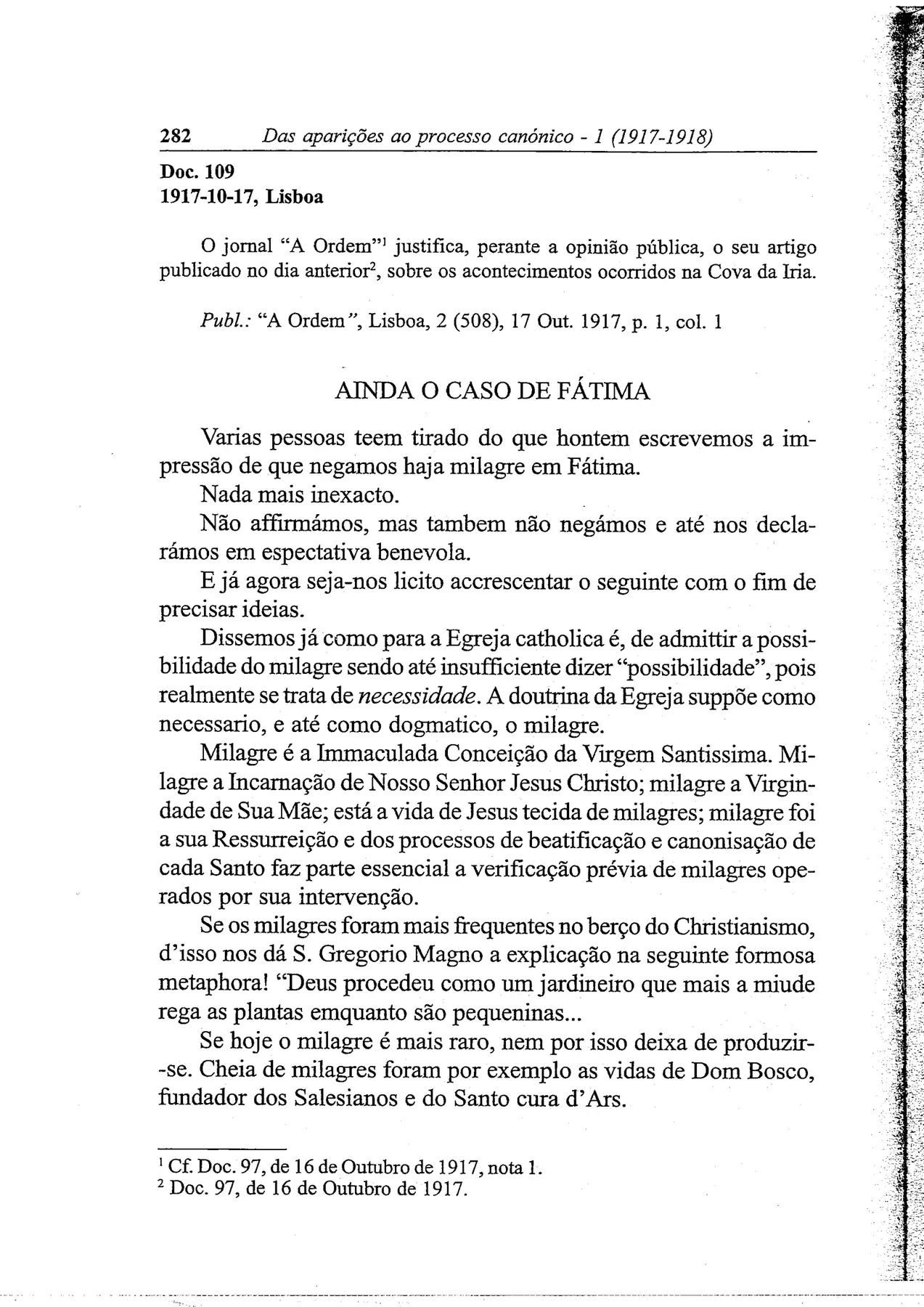
"Now what did we say about the Fátima affair? That we, obscure author of these lines, had not observed any fact that would lead us to suppose the supernatural. But not only is it a personal and unauthoritative point of view, but in no way do we wish to dispute the observations that other people may have made, different from our own".

The transcription is verbatim.

[…]

In my article of Tuesday, after narrating the second observation I had made, on the Sunday, of the appearance of the sun seen through clouds, I added the warning, given me by a doctor, that it was dangerous to stare at the sun, cases of blindness produced by that imprudence not being rare.

Português (original)

Ora o que dissémos nós ácerca do caso de Fátima? Que nós, obscuro auctor d'estas linhas, não tínhamos observado facto algum que nos levasse a suppôr o sobrenatural. Mas não só se trata d'um modo de vêr pessoal e desautorizado, senão que por fórma alguma, queremos contestar as observações que outras pessoas tenham feito, diversas das nossas".

É textual a transcrição.

[…]

No meu artigo de terça-feira, depois de narrar a segunda observação que fizera, no domingo, sobre os aspectos do sol visto atravez de nuvens, accrescentei a prevenção, que um medico me fizera, de que era perigoso fitar o sol, não sendo raros os casos de cegueira produzidos por essa imprudencia.

Editor's notes (1)

1 This is Domingos Pinto Coelho. Cf. Doc. 97, of 16 October 1917, note 3.

1 Trata-se do Domingos Pinto Coelho. Cf. Doc. 97, de 16 de Outubro de 1917, nota 3.

DCF III-1, Doc. 162 · press · 23 Oct 1917 (10 days later)View scans (4)Link
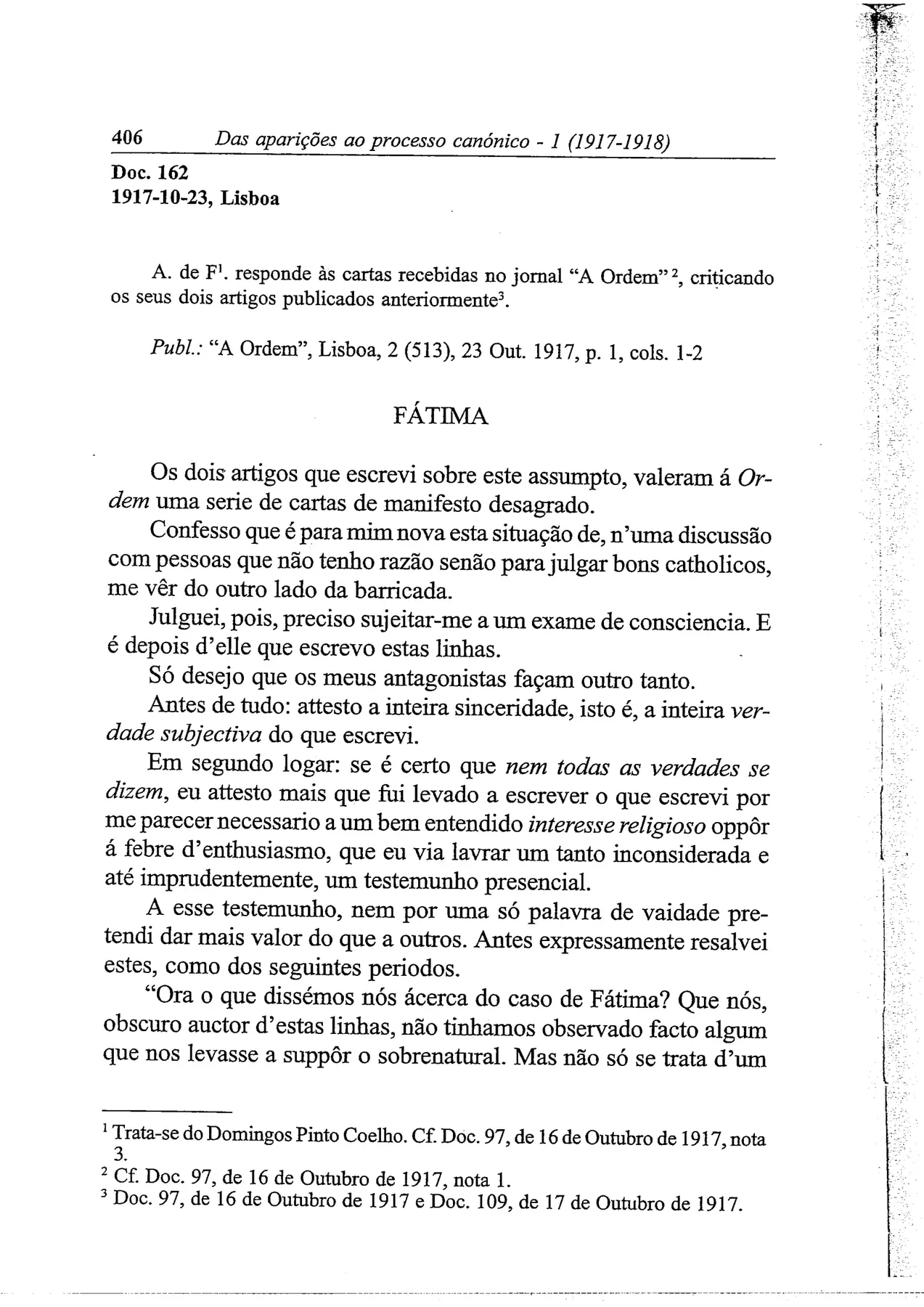
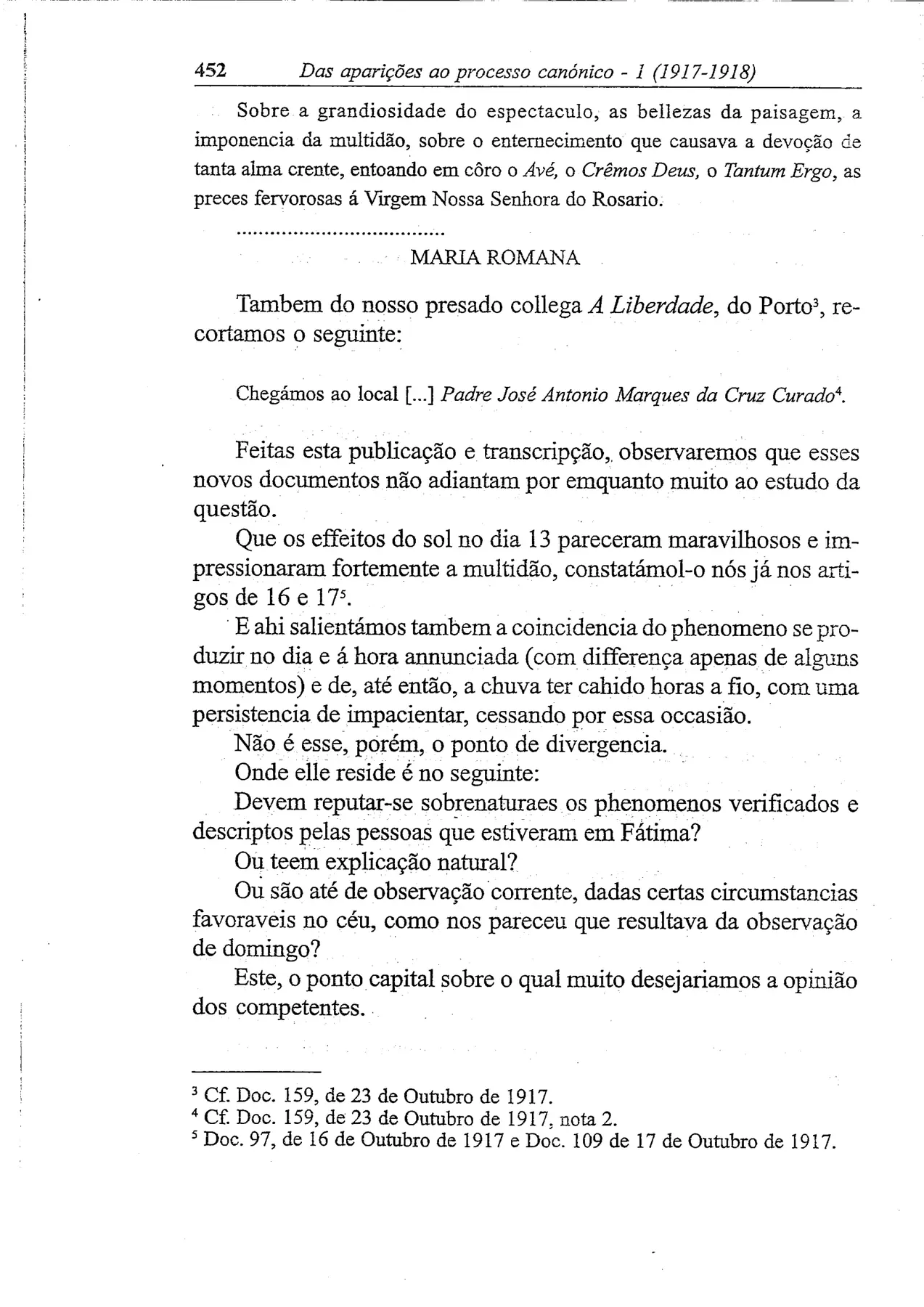
13 OctOther 1917First-handSaw itArticle by witnessScepticTravelled from afarRain stoppingCrowd scene
English

That the effects of the sun on the 13th seemed marvellous and strongly impressed the multitude, we already noted in the articles of the 16th and 17th.

And there we also pointed out the coincidence of the phenomenon taking place on the day and at the hour announced (with a difference of only a few moments), and of the rain, which until then had been falling for hours on end with a persistence fit to try one's patience, stopping at that moment.

[…]

Or are they even commonly observed, given certain favourable circumstances in the sky, as seemed to us to result from Sunday's observation?

Português (original)

Que os effeitos do sol no dia 13 pareceram maravilhosos e impressionaram fortemente a multidão, constatámol-o nós já nos artigos de 16 e 17.

E ahi salientámos tambem a coincidencia do phenomeno se produzir no dia e á hora annunciada (com differença apenas de alguns momentos) e de, até então, a chuva ter cahido horas a fio, com uma persistencia de impacientar, cessando por essa occasião.

[…]

Ou são até de observação corrente, dadas certas circumstancias favoraveis no céu, como nos pareceu que resultava da observação de domingo?

DCF III-1, Doc. 184 · press · 25 Oct 1917 (12 days later)View scans (2)Link
Other 1917Second-handSaw itLetterScepticTravelled from afar
As told by Leonor das Dores Salema Manoel
English

Of all these, only the Pintos Coelhos raise doubts or exaggerated prudence, Domingos even coming out and writing in the "Ordem" that the following day he saw the same thing in the sun!

Português (original)

De tudo isto, só põe duvidas ou prudencias exageradas os Pintos Coelhos, sahindo até o Domingos a escrever na "Ordem" que no dia seguinte vio a mesma coisa no sol!

DCF III-1, Doc. 93 · letter · 16 Oct 1917View scans (2)Link
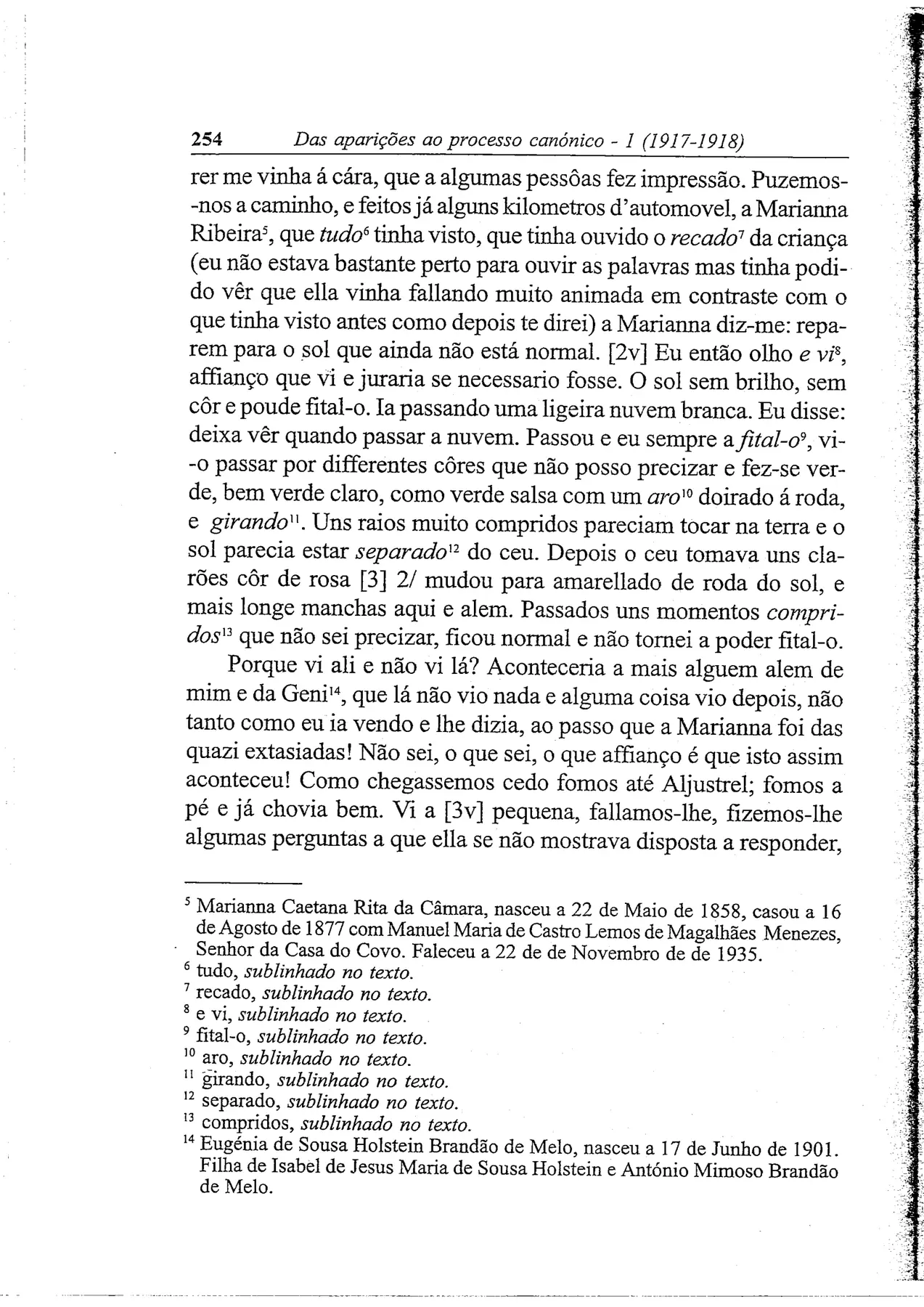
Other 1917First-handSaw itArticle by witnessScepticTravelled from afarSun changing colourSun spinning
English

One doubt remained to us, however.

Was what we had seen in the sun something exceptional? Or would it be reproduced in analogous circumstances?

Now precisely this analogy of circumstances presented itself to us yesterday. We were able to see the sun half veiled by clouds, as on Saturday. And sincerely: — we saw the same successions of colours, the same rotary movement, etc.

Português (original)

Uma duvida nos restava, porém.

O que viramos no sol era cousa excepcional? Ou reproduzir-se-hia em circumstancias analogas?

Ora precisamente esta analogia de circumstancias proporcionou-se-nos hontem. Pudemos ver o sol meio toldado de nuvens, como no sabbado. E sinceramente: — vimos as mesmas successões de cores, o mesmo movimento rotativo, etc.

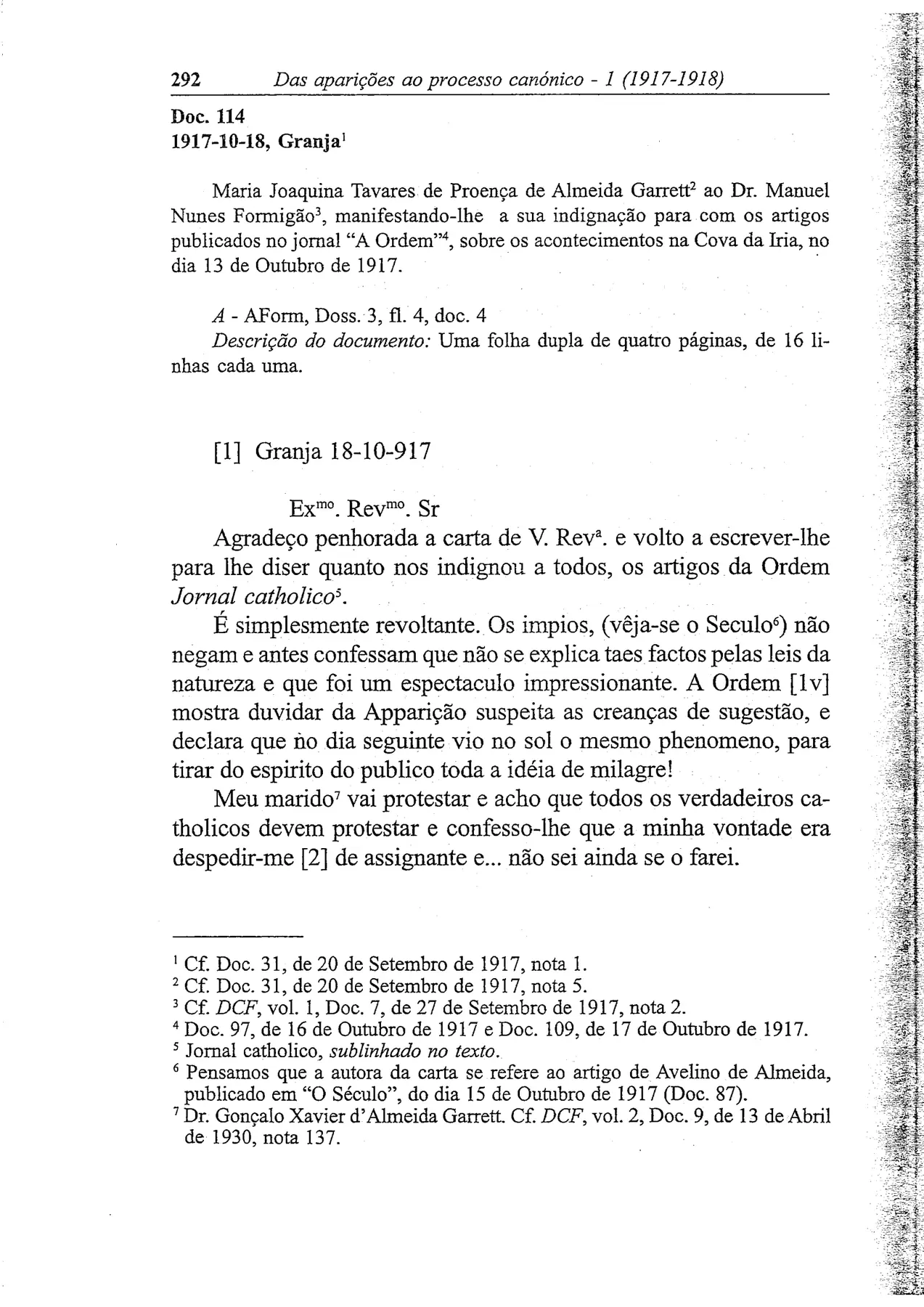
Other 1917Second-handSaw itLetterScepticTravelled from afar
As told by Maria Joaquina Tavares de Proença de Almeida Garrett
English

The Ordem [1v] shows doubt about the Apparition, suspects the children of suggestion, and declares that on the following day it saw the same phenomenon in the sun, in order to remove from the public mind any idea of a miracle!

Português (original)

A Ordem [1v] mostra duvidar da Apparição suspeita as creanças de sugestão, e declara que no dia seguinte vio no sol o mesmo phenomeno, para tirar do espirito do publico toda a idéia de milagre!

DCF III-1, Doc. 114 · letter · 18 Oct 1917View scans (2)Link
Other 1917Second-handSaw itPress reportScepticTravelled from afar120 km away
As told by O Mensageiro (editorial)
English

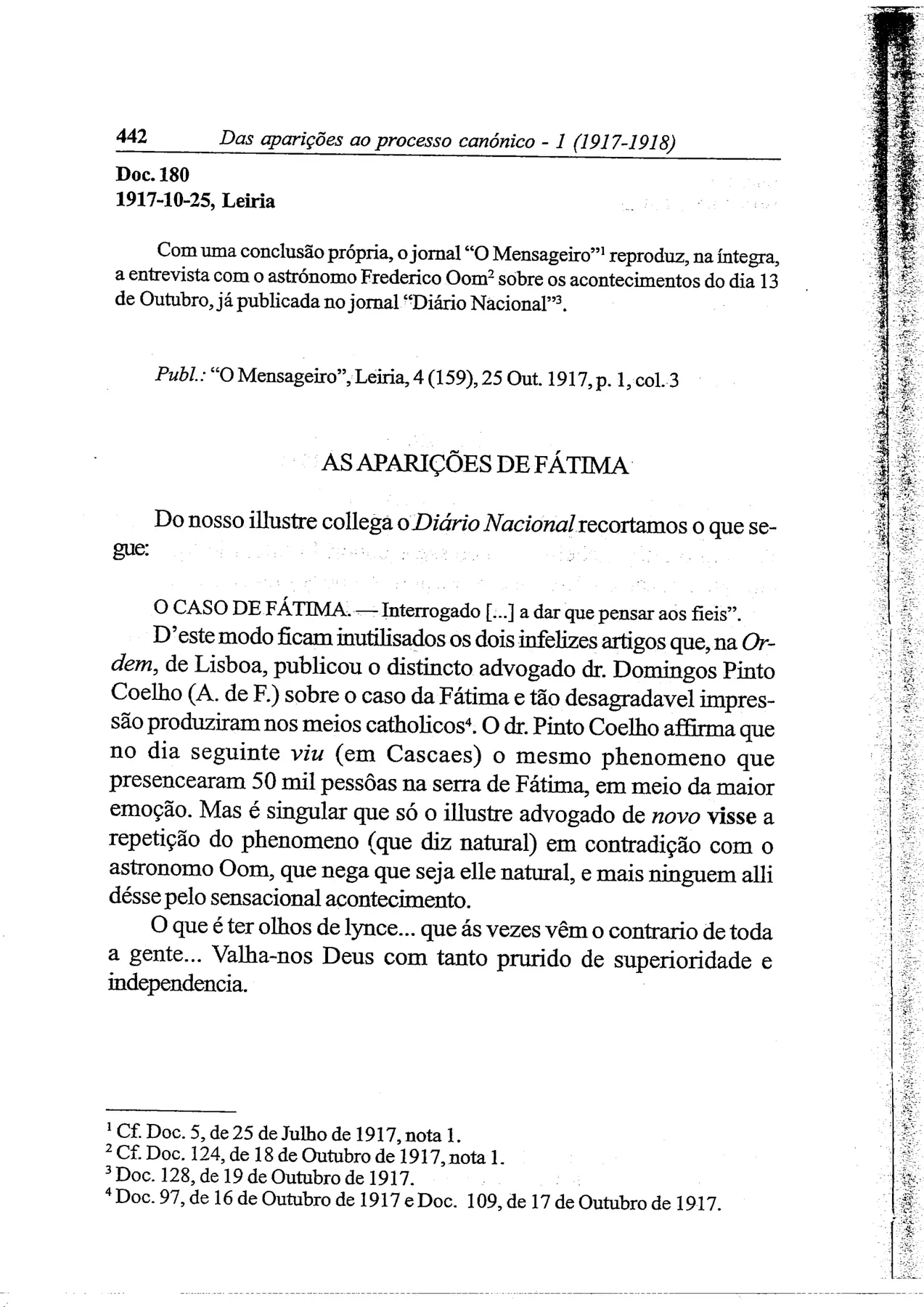
Dr. Pinto Coelho asserts that on the following day he saw (at Cascaes) the same phenomenon that 50 thousand people witnessed in the hills of Fátima amid the greatest emotion. But it is singular that only the illustrious lawyer should see the repetition of the phenomenon (which he says is natural) anew, in contradiction with the astronomer Oom, who denies that it is natural, and that nobody else there should have noticed the sensational occurrence.

Português (original)

O dr. Pinto Coelho afirma que no dia seguinte viu (em Cascaes) o mesmo phenomeno que presencearam 50 mil pessôas na serra de Fátima, em meio da maior emoção. Mas é singular que só o illustre advogado de novo visse a repetição do phenomeno (que diz natural) em contradição com o astronomo Oom, que nega que seja elle natural, e mais ninguem alli désse pelo sensacional acontecimento.

Other 1917Second-handSaw itPress reportScepticTravelled from afar
As told by Pe. João Vacondeus
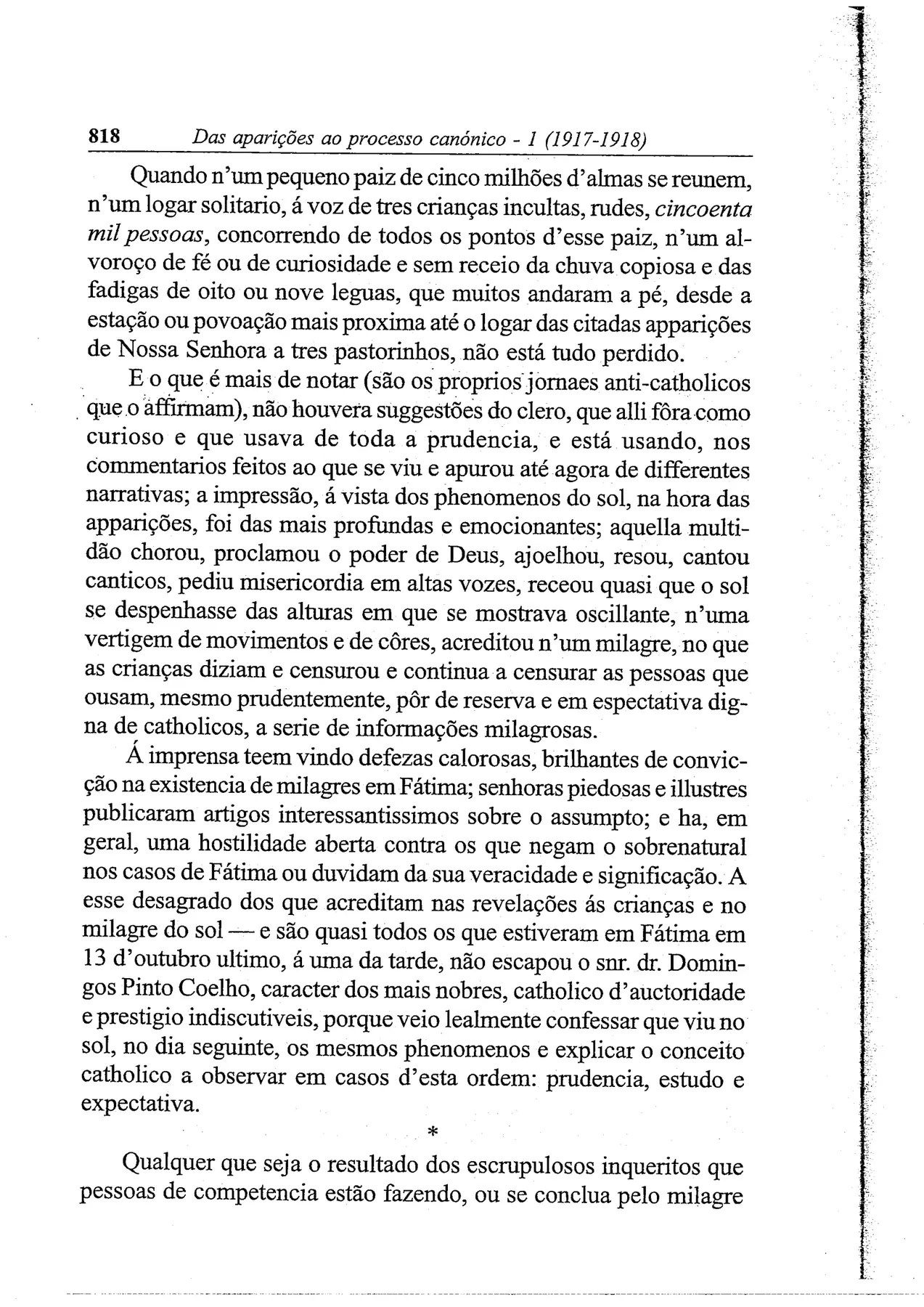
English

This displeasure of those who believe in the revelations to the children and in the miracle of the sun — and they are almost all of those who were at Fátima on the 13th of October last, at one in the afternoon — was not escaped by Mr Dr. Domingos Pinto Coelho, a man of the noblest character, a Catholic of indisputable authority and prestige, because he came forward loyally to confess that he saw the same phenomena in the sun on the following day, and to explain the Catholic attitude to be observed in cases of this kind: prudence, study and expectation.

Português (original)

A esse desagrado dos que acreditam nas revelações ás crianças e no milagre do sol — e são quasi todos os que estiveram em Fátima em 13 d'outubro ultimo, á uma da tarde, não escapou o snr. dr. Domingos Pinto Coelho, caracter dos mais nobres, catholico d'auctoridade e prestigio indiscutíveis, porque veio lealmente confessar que viu no sol, no dia seguinte, os mesmos phenomenos e explicar o conceito catholico a observar em casos d'esta ordem: prudencia, estudo e expectativa.