The hamlets, the villages, the nearby towns were emptied of people.
Along the roads, already on the eve, groups of pilgrims were travelling on their way to Fátima.
Fishermen from Vieira4 left their houses of black wood set above the sea, and the labours of stowing away the catch. Through the pinewoods, where the crowberries look like drops of dew in the greenery, across the sands where the sails of the windmills turn, they came on foot, woollen leggings on their muscular legs, warm skirts over their shoulders, on their heads the bag with their provisions, with the short, swaying step that made the hems of their skirts swirl and set fluttering the orange kerchiefs on which their black hats sat. Workmen from Marinha5, farmers from Monte Real6, from Córtes7, from Marrazes8, hill women from far away — from the hills of Soubio9, of Minde10, of Lourçal11, people from everywhere the voice of the miracle had reached, left their houses and fields and came along on horseback, by cart or on foot, crossing the roads, going over hills and through pinewoods, on the long trek along the roads, which for two days were enlivened by the rolling of carts, the jog-trot of donkeys and the clamour of the groups of pilgrims.
Autumn was reddening the harvested vineyards. The north-east wind, cold and cutting, heralding winter, made the transparent poplars on the riverbanks tremble as they paled, longing for the sun, in the yellow tones of old lace.
On the sands the white sails of the windmills were turning. In the pinewoods the green tops of the pines bent in the wind.
The clouds were gradually covering the sky. The mist was piling up in light, soft flakes.
The sea, in the vastness of the beach at Vieira, foamed, roared, rolled itself into high waves, and across the fields its voice could be heard in a sinister clamour!
All night, all the early morning, it rained, a fine, persistent rain that soaked the fields, that saddened the earth, that went on piercing to the bone, with a cold damp, the women, the children, the men and the animals crossing the muddy roads in their hurried march towards the Hill of the Miracle.
The rain fell and fell, soft and stubborn.
The thick skirts of serge and striped cotton dripped and weighed like lead on the waistbands. The caps and the broad hats streamed water onto the new jackets of the Sunday-best suits. The bare feet of the women and the hobnailed boots of the men splashed in the wide puddles of the muddy roads.
But the rain seemed not to wet them; it seemed they did not feel the rain!
They walked on and on, climbing the hill, lit up by faith, in eager longing for the miracle that Our Lady had promised, on the 13th, at one o'clock, by the hour of the Sun, to the simple and pure souls of three children who grazed flocks!
Left behind, lost in the mist, blurred in the transparency of the rain, were pines, poplars, oak shrubs, red patches of vineyards, farmsteads, ploughed fields of dark earth... The fields were deserted. The houses were shut!
There was a strange silence in the fields, deserted of people and flocks; there was an air of expectation and emotion in the attitude of things, of the poor houses as though asleep in the silence, their windows and doors shut to the light!
The hill was high, but it seemed to the walkers that the climb did not tire them!
The hill was sad, ever sadder, with hollowed, black stones, without the cheerfulness of a tree's greenery, but the walkers did not feel the striking and tragic torment of that landscape of sorrow!
The rain began to thin out. It was now only a very light veil of mist that was gradually dissolving, and little by little the hill was growing brighter.
A murmur was drawing near, coming down from the hill. A murmur that seemed like the distant voice of the sea, which had fallen silent in the silence of the fields...
It was hymns taking shape, sung by thousands of mouths.
On the plateau of the hill, covering the slope, filling a valley, one could see an enormous, shifting mass of thousands and thousands of God's creatures, thousands and thousands of souls in prayer!
With raised hands and eyes in ecstasy, they came in the ardent faith of belief. They came to ask Our Lady for the miracle, to ask for the redemption of sins, to ask for a blessing on the bitterness of life!
At one o'clock in the afternoon, by the hour of the sun, the rain stopped.
The sky had a greyish tone of pearl, and a strange brightness lit up the biblical and tragic vastness of the sad landscape, ever sadder...
The sun had something like a veil of transparent gauze, so that eyes could look at it. The grey tone of mother-of-pearl turned as if into a gleaming silver plate, which kept breaking open until the clouds were torn apart and the silvery sun, wrapped in the same grey lightness of gauze, was seen to rotate, spinning round within the circle of the parted clouds!
It was a single cry from every mouth; the thousands and thousands of God's creatures whom faith was lifting up to heaven fell to their knees on the soaked ground!
The light turned blue, an exquisite blue, as if it came through the stained-glass windows of an immense cathedral to spread through that gigantic nave, given its pointed arches by the hands raised in the air...
The blue slowly died away, so that the light seemed filtered through yellow stained glass.
Yellow patches now fell on faces, on white kerchiefs, on the dark, poor serge skirts. They were patches repeated endlessly on the low holm oaks, on the stones, on the hillside.
Everyone was weeping, everyone was praying, hat in hand, under the grandiose and unique impression of the awaited miracle!
They were seconds, they were instants that seemed like hours, so intensely were they lived!
Clouds passed over the vague grey brightness that veiled the sun!
The souls in prayer, whose life had been suspended for a few instants, came back to life.
The clouds were torn to shreds; blue patches of sky appeared. The sun, in the impassive serenity of all time, vaguely lit up the bare hill where Our Lady, through the mouths of three children who grazed flocks, had gathered thousands and thousands of God's creatures!
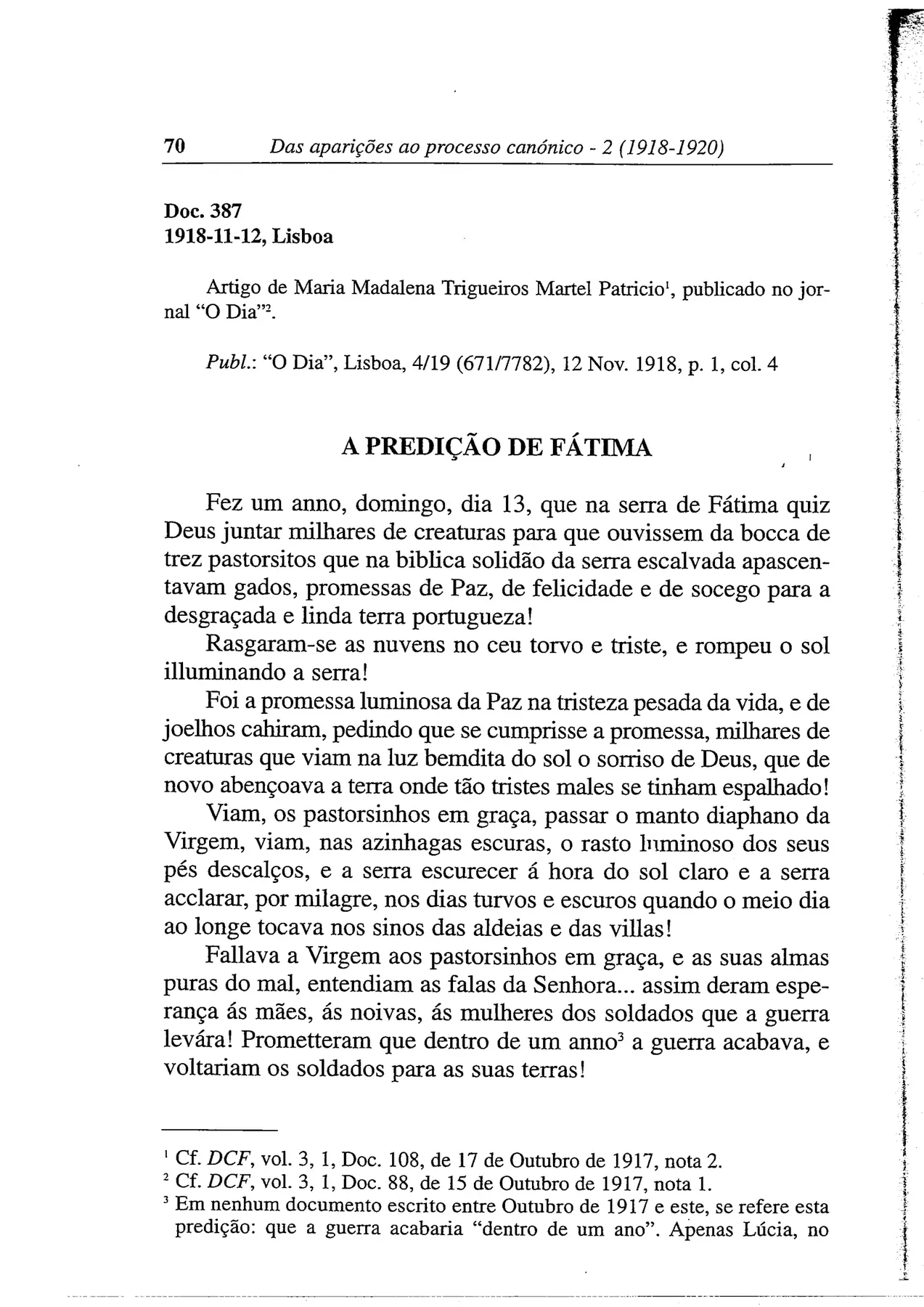
Despovoaram-se os lugares, as aldeias, as cidades proximas.
Pelas estradas, já nas vespas, seguiam grupos de romeiros a caminho de Fátima.
Pescadores da Vieira4 deixaram as casa de madeira negra assentes sobre o mar, as lides da arrumação da pescaria. Pelos pinhaes, onde as camarinhas parecem gotas de orvalho na verdura, pelos areaes onde giram as vellas dos moinhos, vieram a pé, os coturnos de lã nas pernas musculosas, saias de agazálho sobre as costas, á cabeça o sáco com o farnel, no passo meúdo e meneado, que lhes fazia voltar a rodaria das saias, e agitar os lenços alaranjados onde assentavam os chapeus pretos. Operarios da Marinha5, lavradores de Monte Real6, das Córtes7, dos Marrazes8, serranas de longe — das serras do Soubio9, de Minde10, do Lourçal11, gentes de toda a parte onde chegasse a voz do milagre, deixavam as casas e os campos, e vinham por ahi fóra a cavalo, de carro ou a pé, cruzando as estradas, atravessando montes e pinhaes, de longada pelos caminhos, que durante dois dias se animaram do rodar dos carros, do chouto dos jumentos, do vozear dos grupos dos romeiros.
O outomno avermelhava as vinhas vindimadas. O vento do nordeste, frio e cortante, anunciando o inverno, fazia tremer os choupos transparentes das bordas dos rios, que desmaiavam saúdosos do sol, em tons amarelos de rendas antigas.
Nos areaes giravam as vellas brancas dos moinhos. Nos pinhaes curvavam-se ao vento os cimos verdes dos pinheiros.
As nuvens iam cobrindo o ceu. Amontoava-se o nevoeiro em flócos leves e macios.
O mar, na vastidão da praia da Vieira, espumava, bramia, enrolava-se em ondas altas, e pelos campos ia-se ouvindo, n'um clamor sinistro, a sua voz!
Toda a noite, toda a madrugada choveu, uma chuva miudinha, persistente, que encharcava os campos, que entristecia a terra, que ia trespassando até aos ossos, de uma humidade fria, as mulheres, as creanças, os homens e os animaes, que cruzavam as estradas lamacentas, no caminhar apressado para a Serra do Milagre.
A chuva cahia, cahia, macia e teimosa.
As saias grossas d'estamenha e riscadilho pingavam, pezavam como chumbo, nas fitas das cinturas. Os barretes e os chapeus largos escorriam agua sobre as jaquetas novas dos fatos de vêr a Deus. Os pés descalços das mulheres, as botas ferradas dos homens, chapinhavam nas poças largas do lodaçal das estradas.
Mas a chuva parecia que não molhava, parecia que não sentiam a chuva!
Caminhavam sempre, subindo a serra, illuminados de fé, na ancia do milagre que Nossa Senhora promettera, no dia 13, pela uma hora, a hora do Sol, ás almas simples e puras de trez creanças que apascentavam gados!
Iam ficando para traz, perdidos na nevoa, esfumados na transparencia da chuva, pinheiros, choupos, carvalheiras, manchas vermelhas de vinhas, casaes, campos lavrados de terra escura... Os campos eram desertos. As casas eram fechadas!
Havia um silencio estranho nos campos desertos, de gentes e de gados, havia um ar de espera e de emoção na attitude das cousas, das casas pobres como adormecidas no silencio, janellas e portas fechadas á luz!
A serra era alta, mas parecia aos caminhheiros que os não cançava a subida da serra!
A serra era triste, cada vez mais triste, de pedras escavadas e negras sem a alegria da verdura de uma arvore, mas os caminhheiros não sentiam a tortura impressionante e tragica da paisagem de dôr!
A chuva começou a rarear. Era agora só um veu de nevoa muito leve que se ia desfazendo a pouco e pouco, e pouco a pouco a serra ia aclarando.
Approximava-se um murmurio que vinha descendo do monte. Murmurio que parecia a voz longinqua do mar, que se tinha calado no silencio dos campos...
Eram canticos que se definiam, entoados por milhares de boccas.
No planalto da serra, cobrindo o monte, enchendo um valle, via-se uma mancha enorme e movediça de milhares e milhares de creaturas de Deus, milhares e milhares d'almas em prece!
Mãos erguidas, olhos em extase, vinham na fé ardente da crença. Vinham pedir o milagre a Nossa Senhora, pedir a redempção dos peccados, pedir a benção para as amarguras da vida!
Á uma hora da tarde, hora do sol, parou a chuva.
O céu tinha um tom acinzentado de perola e uma claridade estranha illuminava a vastidão biblica e tragica da paisagem triste, cada vez mais triste...
O sol tinha como um véu de gaze transparente para que os olhos o pudéssem olhar. O tom cinzento da madreperola transformava-se como n'uma chapa de prata luzidia, que se ia rompendo até que as nuvens se rasgaram e o sol prateado, envolvido na mesma leveza cinzenta de gaze, viu-se rodar, a girar em volta do circulo das nuvens afastadas!
Foi um grito só em todas as boccas; cahiram de joelhos na terra encharcada, os milhares e milhares de creaturas de Deus que a fé levantava até ao céu!
A luz azulava-se n'um azul exquisito, como se viesse, atravez dos vitraes de uma cathedral immensa, espalhar-se n'aquella nave gigantesca ogivada pelas mãos que se ergueram no ar...
O azul extinguiu-se lentamente para a luz parecer coada por vitraes amarellos.
Manchas amarellas cahiam agora sobre as caras, sobre os lenços brancos, sobre as saias escuras e pobres das estamenhas. Eram manchas que se repetiam indefinidamente sobre as azinheiras rasteiras, sobre as pedras, sobre a serra.
Tudo chorava, tudo rezava, de chapeu na mão, na impressão grandiosa e unica do milagre esperado!
Foram segundos, foram instantes que pareceram horas, tão vivídos foram!
Passaram nuvens sobre a claridade vaga e cinzenta que velava o sol!
As almas em prece, que tiveram por instantes a vida suspensa, á vida voltaram.
Esfarraparam-se as nuvens, appareceram bocados azues do céu. O sol, na serenidade impassivel de todo o sempre, illuminou vagamente a serra escalvada, onde Nossa Senhora fez juntar, pela bocca de trez creanças que apascentavam gados, milhares e milhares de creaturas de Deus!
Editor's notes (9)
3 This article was later published in PATRICIO, Maria Magdalena Martel - Impressões de arte e de tristeza, Porto, Oficinas da Empreza Lit e Typographia, 1918, p. 63-68
4 Vieira de Leiria, village and parish in the council of Marinha Grande, district of Leiria.
5 Marinha Grande, a council in the district of Leiria.
6 Village and parish in the council and district of Leiria.
7 Village and parish in the council and district of Leiria.
8 Village and parish in the council and district of Leiria.
9 We have not identified this locality.
10 Locality in the council of Alcanena, district of Santarém.
11 Parish in the council of Pombal, district of Coimbra.
3 Este artigo viria a ser publicado em PATRICIO, Maria Magdalena Martel - Impressões de arte e de tristeza, Porto, Oficinas da Empreza Lit e Typographia, 1918, p. 63-68
4 Vieira de Leiria, lugar e freguesia do concelho de Marinha Grande, distrito de Leiria.
5 Marinha Grande, concelho do distrito de Leiria.
6 Lugar e freguesia do concelho e distrito de Leiria.
7 Lugar e freguesia do concelho e distrito de Leiria.
8 Lugar e freguesia do concelho e distrito de Leiria.
9 Não identificámos esta localidade.
10 Localidade do concelho de Alcanena, distrito de Santarém.
11 Freguesia do concelho de Pombal, distrito de Coimbra.