Invited by Dona Maria de Jesus, who with an exquisite refinement of kindness perhaps also wished to give a supposed unbeliever the opportunity to put his belief to the test, I went to Fátima, a place of Moorish tradition, on the 13th of this month, on which, as had long been announced, there was to be produced the great sign which would have the power to turn unbelievers into believers. The day, unlike those preceding it, dawned rainy and cold.
And my enthusiasm, which was cold too, because it was not stirred by the warmth of an inner conviction, would have yielded to the obstacle [1v] which the harsh and inclement weather set against the journey, had it not occurred to me that withdrawing might hurt Dona Maria de Jesus, who with such obliging kindness had wished to reserve for me one of the much-coveted places4.
The rain, which had given us a truce from our departure from Tôrres, at 9 o'clock, until we got near Vila Nova de Ourem, began to lash us driven by the wind that blew hard, soaking us and chilling us to the bone, all the way to Fátima, in whose parish priest's house we took shelter to dry our clothes and have something to restore us.
Do not think that we were the only ones thus so courageously facing the inclemency of the weather and the fury of the gale without showing any sign of cowardice or weakness. Tens, hundreds, thousands of people of all classes and social conditions did we meet along the long road, using every variety of means of transport, from the downcast donkey with drooping ears to the luxurious and comfortable motor car. In all of them faith in the unknown gave strength and courage, without a cry of revolt, without a gesture of discouragement. The gravity and composure to be seen on every face were a sure guarantee of the fervent belief that drove many, and of the respect that this naive and pure belief imposed on all.
[2] Restored by the comforts and warm welcome of the hospitable home of the good Parish Priest, we went on to the theatre of the sensational and stupendous events, which is a good two kilometres from Fátima.
Meanwhile the rain went on relentlessly and the wind blew hard, and all one could see moving across the sky were the enchanted castles of dense black clouds. On reaching the place, by now memorable, I had the impression of a vast encampment where thousands of people were sheltering in huts roofed with slate. Such was the effect of thousands of open umbrellas...
As the road was flooded with the rain that was falling heavily, we did not get out of the car, and stayed there, where hundreds of carriages and motor cars were lined up over a distance of about a kilometre.
The distance separating us from the famous Holm-oak shrub, which seems to have served as a throne, as it were, for the heavenly Vision, would not have been a hundred metres, and did not hinder observation of what was happening beside it. The multitude, reckoned at many thousands of people, was gathered with an order, a respect, a reverence that made a vivid impression on the minds of the spectators. Voices could be heard even where we were, distinct echoes of religious hymns in which the multitude was strengthening its faith while the solemn hour had not yet come.
[2v] The three children had just arrived, the uncouth and rough protagonists of the grandest and most extraordinary spectacle I have ever been given to witness. On the car's clock the hand pointed to two o'clock: the august moment was approaching for which thousands of hearts rich in faith were yearning. The rain, which had eased off, then stopped altogether; and to the north I make out, in a gap in the sky, the clear blue breaking through the leaden clouds.
To my mind, already moved by what I was witnessing, it occurred that it might well happen that that rainy morning, with its sky laden with greyish clouds, was the mis-en-scène of a grand spectacle about to take place. The hand showed 2h 5m, then 2h 10m, and on earth the silence was broken only by faint echoes repeating the prayers being said beside the Holm-oak shrub. While the multitude awaited in anxious recollection the marvellous event that was to reinvigorate its faith, I was thinking of the most graceful way of extricating myself from the ridicule that the mockery of my friends and everyday companions would not spare me.
Already in some pious souls the fear was arising that the resounding event announced would not happen \take place, when suddenly that whole immense multitude stirred and, with a telling hubbub of amazement and astonishment, raised their heads [3] to the sky, where thousands of eyes contemplated, aghast, the sun in the full blue, visible to all, without the intensity of its rays wounding the retina and hindering vision, crowned with various colours in a movement of swift rotation, which in the picturesque phrase of some recalled a little firework wheel.
The spectators, looking at one another, appeared to each other yellow in colour, and on the reddish-orange horizon, wherever the eyes were fixed, shafts of soft light were seen, seeming to be placed at equal distances, and reflecting on the earth.
Such was the surprising phenomenon that everyone had occasion to observe, and which drew from some a sincere confession of ardent faith, and threw others, in whom the scorching wind of scepticism had withered the flower of belief, into a benevolent expectation.
There were unbelievers there, and some even with traces of atheism, who declared themselves won over before the power that worked such a prodigy.
There you have, my good Isabelinha, what I observed, and with me thousands of people.
[…]
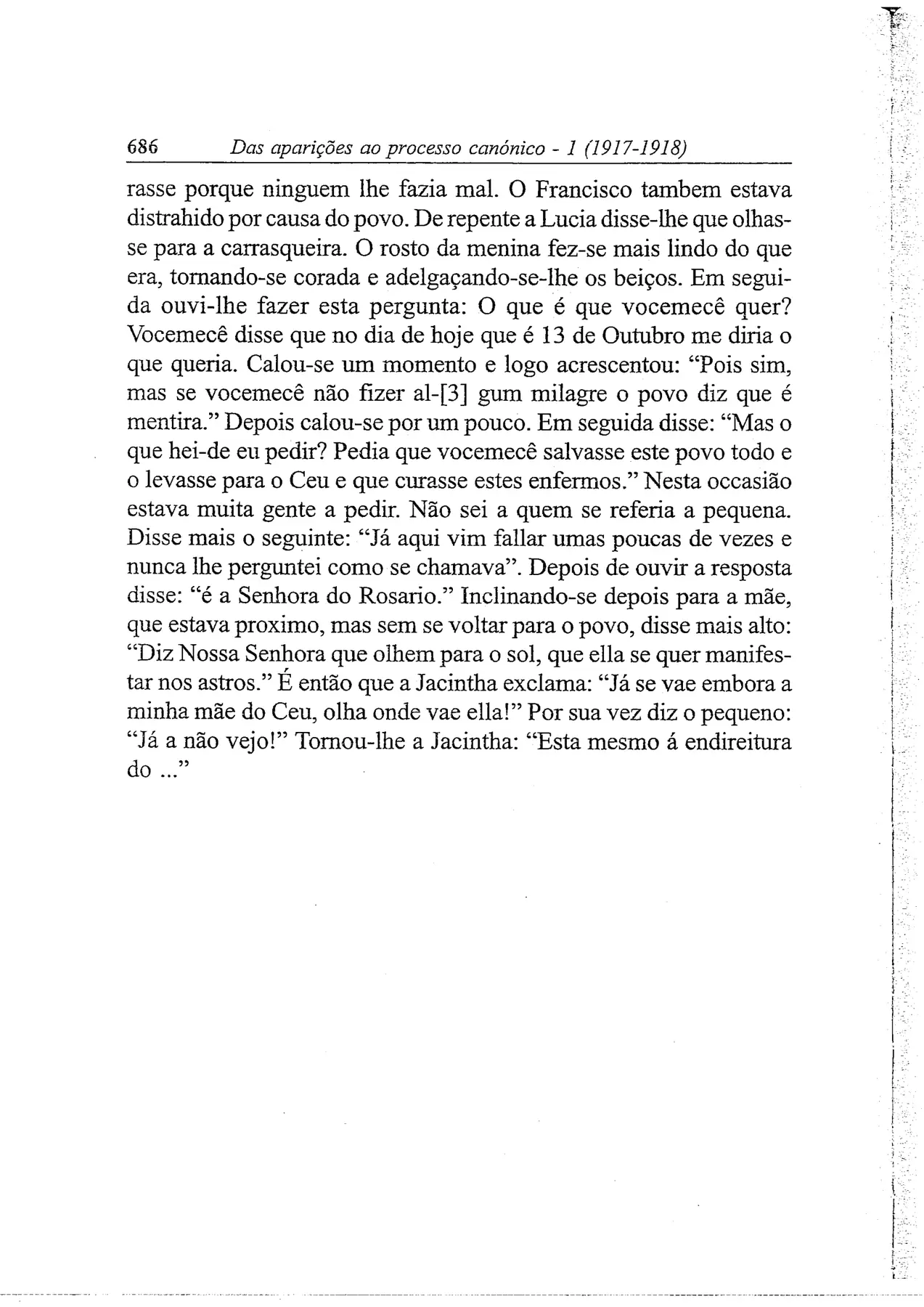
It should also be noted that, the vision over, on the 13th, Lúcia, one of the three children who claim that the Virgin appeared to them, at a given moment turned to the people and tells them that the Virgin had ordered them to look at the sun, where the announced sign was going to be produced. Immediately the sun, which until then had remained covered, appears and shows itself in the manner described.
Convidado pela Senhora D. Maria de Jesus, que num requesito de extremada gentileza quiz tambem por ventura proporcionar a um suposto descrente ensejo para lhe pôr á prova a sua crença, fui á Fátima, lugar de tradição moirisca, no dia 13 do corrente, em que, conforme estava de há muito anunciado, se devia produzir o grande sinal que teria o condão de converter em crentes os descrentes. O dia, ao contrário dos que o antecederam, amanheceu chuvoso e frio.
E o meu entusiasmo, que frio também era porque o não estimulava o calor de uma convicção íntima, teria cedido à contrariedade [1v] que a jornada opunha o tempo agreste e inclemente, se a mente não me acudisse que a desistência poderia magoar a Senhora D. Maria de Jesus que com tão penhorante amabilidade quiz reservar-me um dos muito cobiçados lugares4.
A chuva que nos dera treguas desde a nossa partida de Tôrres, às 9 horas, até chegarmos perto de Vila Nova de Ourem, começou de fustigar-nos batida do vento que soprava rijo, encharcando-nos e enregelando-nos, até à Fátima, em casa de cujo prior nos recolhemos para enxugarmos a roupa e tomarmos alguma coisa que nos confortasse.
Não julgues que éramos nós só que assim tão corajosamente afrontávamos sem dar mostras de cobardia ou fraqueza a intemperie do tempo e a fúria do vendaval. Dezenas, centenas, milhares de pessoas de todas as classes e condições sociais encontrámos nós pelo longo caminho utilizando todos os variados meios de transporte, desde o burro cabisbaixo e de orelhas caídas até ao automóvel luxuoso e cómodo. A todos a fé no desconhecido dava alento e coragem, sem um grito de revolta, sem um gesto de desânimo. A gravidade e a compostura que em todos os rostos se descobria era garantia segura da crença fervorosa que impelia muitos, e do respeito que essa crença ingênua e pura a todos impunha.
[2] Reconfortados com os cómodos e gasalhado do lar hospitaleiro do bom do Prior, seguimos para o teatro dos sensacionais e estupendos acontecimentos, que da Fátima dista uns bons dois quilómetros.
Entretanto a chuva continuava impertinente e o vento soprava rijo, apenas se vendo correr na atmosfera os castelos encantados de nuvens densas e negras. Ao chegarmos ao sítio já agora memorável, eu tive a impressão de um vastíssimo acampamento onde milhares de pessoas se acolhiam em barracas cobertas de ardósia. Tal o efeito de milhares de chapeus de chuva abertos...
Como a estrada estava alagada da chuva que caía abundante, não saímos do auto, e ficámos ali, onde centenas de carros e automóveis estavam alinhados numa extensão aproximada de um quilómetro.
A distância que nos separava da famosa Carrasqueira, que parece ter servido como que de trono à celeste Visão, não mediria cem metros, e não prejudicava a observação do que junto dela se passava. A multidão, em muitos milhares de pessoas computada, aglomerava-se numa ordem, num respeito, num acatamento que impressionavam vivamente o espírito dos espectadores. Até nós vozes se ouviam, distintos ecos de cânticos religiosos em que a multidão retemperava a fé enquanto não chegava a hora solene.
[2v] Acabavam de chegar as três crianças, boçais e rudes protagonistas do espectáculo mais grandioso e extraordinário que ainda me foi dado presenciar. No relógio do auto o ponteiro marcava duas horas: aproximava-se o momento augusto por que milhares de corações ricos de fé anciavam. A chuva, que tinha abrandado, deixou-nos então de todo; e para o norte diviso numa nesga de céu o azul límpido rompendo as nuvens plumbeas.
Ao meu espírito já então comovido com o que presenciava ocorreu que bem poderia suceder que aquela manhã chuvosa, de céu carregado de nuvens pardacentas, fôsse a mis-en-scène de um espectáculo grandioso que estivesse para dar-se. O ponteiro indicou 2h e 5m, depois 2h e 10m e na terra o silêncio era apenas cortado por ecos mal distintos que repetem as orações que junto à Carrasqueira se fazem. Enquanto a multidão aguardava em ansioso recolhimento o acontecimento maravilhoso que havia de revigorar-lhe a fé, eu pensava no modo mais airoso de me sair do ridículo a que não me pouparia a mofa dos meus amigos companheiros de todos os dias.
Já em algumas almas piedosas surgia o receio de que facto estrondoso anunciado não se désse \realizasse, quando de repente toda aquela imensa multidão se agitou e num brouhaha significativo de espanto e assombro levantou a cabeça [3] para o ceu, aonde milhares de olhos contemplaram estarrecidos o sol em pleno azul, visível a todos, sem a intensidade dos raios a ferirem a retina e a dificultarem a visão, coroado de côres várias num movimento de veloz rotação, que na frase pitoresca de alguns lembrava uma rodinha de fogo.
Os espectadores, entreolhando-se, apresentavam-se uns aos outros de côr amarela, e no horizonte vermelho-alaranjado onde quer que os olhos se fitavam viam-se fachos de luz esbatida, parecendo colocados a igual distancia, e reflectindo-se na terra.
Tal foi o fenómeno surpreendente que todos tiveram ocasião de observar, e que a uns arrancou a confissão sincera de fé ardente, e a outros a quem o vento adusto do scepticismo crestou a flôr da crença, lançou n'uma expectativa benévola.
Descrentes lá houve, e alguns até com resaibos de ateísmo, que se declararam rendidos perante o poder que tal prodígio operava.
Aqui tens, minha boa Isabelinha, o que eu observei, e comigo milhares de pessoas.
[…]
Há ainda a notar que, terminada a visão, no dia 13, a Lúcia uma das três crianças que afirmam ter-lhes a Virgem aparecido, em dado momento voltou-se para o povo e diz-lhe que a Virgem mandara que olhassem para o sol onde ia produzir-se o sinal anunciado. Imediatamente o sol, que até então se conservára encoberto, aparece e mostra-se pela fôrma que fica dito.
Editor's notes (3)
1 Born in Castelo Branco. He was a school inspector in Torres Novas. He was invited by Maria de Jesus Raposo to go to Fátima, since she wanted a responsible and trustworthy person with her. He died on 23 November 1919.
2 Isabel de Maria Amado Jara de Carvalho, niece of Lúcio Serra's wife, and therefore his niece by marriage. Daughter of João Maria Amado de Melo Ramalho Pimentel de Almeida da Cunha e Vasconcelos Matamouros and of Isabel Maria de Figueiredo Azevedo Velez Dantas Pereira.
4 The following people went in the motor car: Mariana Dantas, João Amado da Cunha Vasconcelos, Josefina da Cunha Serra, the author's wife, Maria Ermelinda de Vilhena Barbosa and her Mother, Branca Lobo de Moura Vilhena Barbosa, Dr. Formigão, João Serra's daughter, Maria Elisa da Cunha Serra, and the author of this letter.
1 Nasceu em Castelo Branco. Foi Inspector escolar em Torres Novas. Foi convidado por Maria de Jesus Raposo para ir a Fátima, pois ela queria ter consigo uma pessoa responsável e de confiança. Faleceu a 23 de Novembro de 1919.
2 Isabel de Maria Amado Jara de Carvalho, sobrinha da esposa de Lúcio Serra, portanto sua sobrinha, por afinidade. Filha de João Maria Amado de Melo Ramalho Pimentel de Almeida da Cunha e Vasconcelos Matamouros e de Isabel Maria de Figueiredo Azevedo Velez Dantas Pereira.
4 Foram no automóvel as seguintes pessoas: Mariana Dantas, João Amado da Cunha Vasconcelos, Josefina da Cunha Serra, esposa do autor, Maria Ermelinda de Vilhena Barbosa e sua Mãe, Branca Lobo de Moura Vilhena Barbosa, o Dr. Formigão, a filha de João Serra, Maria Elisa da Cunha Serra e o autor desta carta.