English
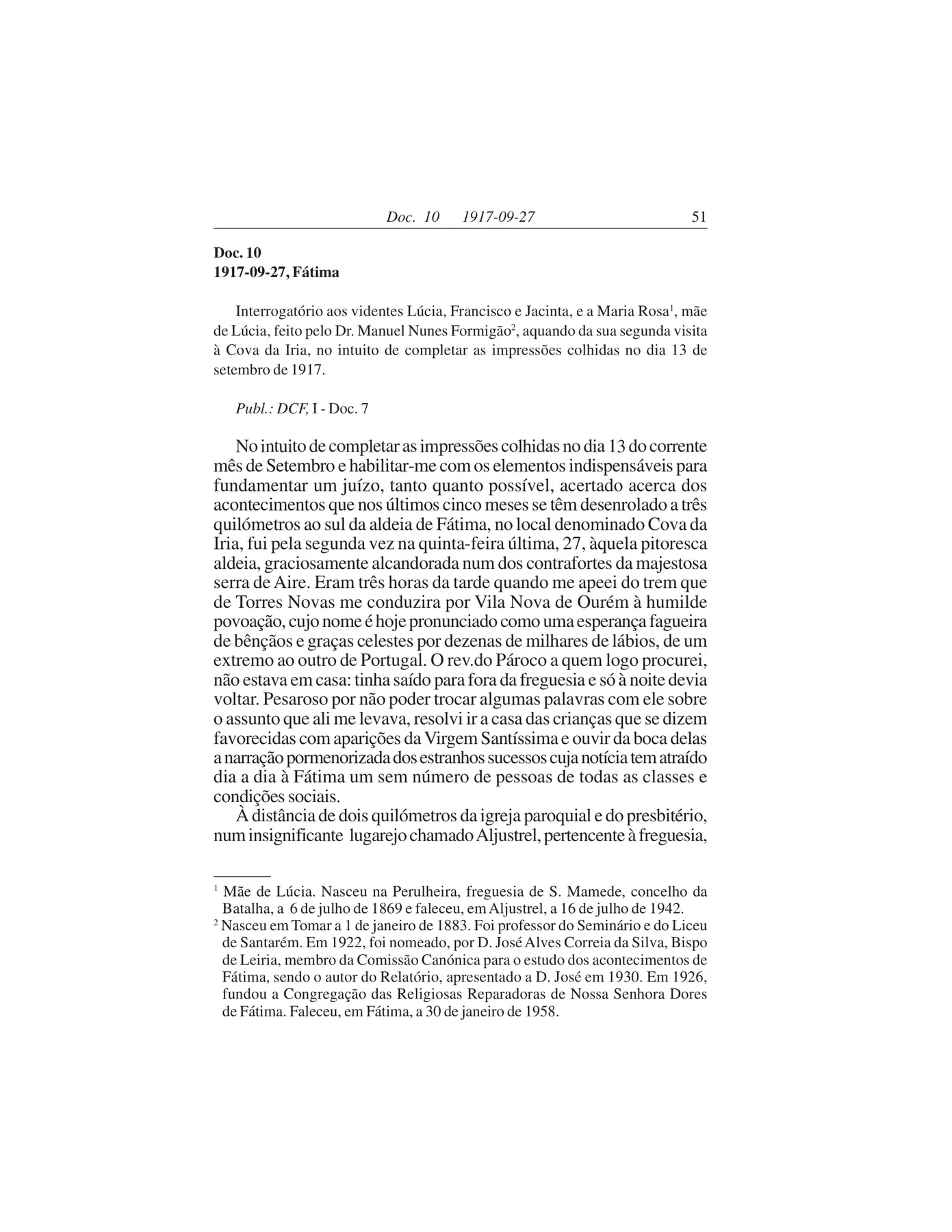
With the aim of completing the impressions gathered on the 13th of this month of September and of equipping myself with the elements indispensable for grounding a judgement, as sound as possible, on the events that over the last five months have been unfolding three kilometres south of the village of Fátima, at the place called Cova da Iria, I went for the second time last Thursday, the 27th, to that picturesque village, gracefully perched on one of the spurs of the majestic Serra de Aire. It was three o'clock in the afternoon when I alighted from the carriage that had brought me from Torres Novas, by way of Vila Nova de Ourém, to the humble settlement whose name is today uttered as a sweet hope of heavenly blessings and graces by tens of thousands of lips, from one end of Portugal to the other. The Rev. Parish Priest, whom I sought out at once, was not at home: he had gone out of the parish and was not due back until the evening. Sorry not to be able to exchange a few words with him on the matter that had brought me there, I decided to go to the home of the children who say they have been favoured with apparitions of the Most Holy Virgin and to hear from their own mouths the detailed account of the strange events, the news of which has drawn to Fátima, day after day, countless people of every class and social condition.
Two kilometres from the parish church and the presbytery, in an insignificant little hamlet called Aljustrel, belonging to the parish,
--- the modest dwellings of the seers' families stand close to one another. The two younger children were away.
I went to the home of the eldest, where her mother invited me to come in and sit down, an invitation I accepted. To a question of mine about the whereabouts of the daughter I was looking for, she replied that she was out picking grapes on a small property belonging to her, two kilometres away.
Someone at once offered to go and fetch her at the mother's bidding. Meanwhile, the two younger children, who had come back from the fields, learning from the neighbours that I wished to speak to them, came to me. They were brother and sister, a boy and a girl.
The girl arrived first. Her name is Jacinta de Jesus, she is seven years old and is the daughter of Manuel Pedro Marto and Olímpia de Jesus3. Rather tall for her age, somewhat slender without being thin, with a well-proportioned face and a dark complexion, modestly dressed, her skirt coming down to her ankles, she has the look of a healthy child, showing perfect normality in her whole physical and moral make-up. Taken aback by the presence of strangers, who had accompanied me and whom she did not expect to find, at first she shows great embarrassment, answering the questions I put to her in monosyllables and in an almost inaudible voice. A few moments later her brother appears, a boy of nine, who enters the room where we were with a certain self-assurance, keeping his cap on his head, no doubt because he did not remember that he ought to take it off. A sign his sister made to him to uncover his head went unnoticed by him. I invited him to sit on a chair beside me, and he obeyed at once without any reluctance. I began without delay to question him about what he had seen and heard since last May at the Cova da Iria on the 13th of each month during the time of the apparition. The following short dialogue took place between him and me.
[…]
Half an hour after the interrogation of Jacinta de Jesus had ended, Lúcia de Jesus appears. She was coming, as I said, from a small property of her family's, two kilometres away, where she had been picking grapes. Taller and better nourished than the other two children, of fairer complexion, sturdy and healthy, she presents herself before me with an ease that contrasts singularly with Jacinta's bashfulness and excessive timidity. Simply dressed like her, her attitude does not betray, nor does her face express, any feeling of vanity or of confusion.
Sitting down, at a nod from me, on a chair beside me, she most willingly lends herself to being questioned about the events of which she is the chief protagonist, notwithstanding that she feels visibly tired and dejected, owing to the incessant visits she receives and the repeated and prolonged inquiries to which she is subjected.
Daughter of António dos Santos4, aged 50, and of Maria Rosa, aged 48, she has one brother and four sisters, all older than she: Maria5, 26, already married, Teresa6, 24, Manuel7, 22, Glória8, 20, and Carolina9, 15. She turned ten on 22 March of this year10.
---
She was eight years old when she made her first communion. Her mother, the type of the Christian woman and good housewife, devoted to her domestic chores, has always sought to instil in her children the holy fear of God and to bring them to fulfil all their moral and religious duties. Deeply preoccupied by the events that at every moment draw the attention of thousands of people to her poor dwelling, until recently unknown to the world, one notices at once that her mind wavers, in restless anxiety, between the hope that her daughter is really privileged with the apparition of the Virgin and the fear that she is the victim of a hallucination that will bring her sorrow and cover her whole family with ridicule.
To a question of mine about her Lúcia's piety, she replies that she notices nothing extraordinary about her in this respect, seeing her pray in the same way and with the same fervour as before the apparitions, exactly as her sisters do.
Português (original)
No intuito de completar as impressões colhidas no dia 13 do corrente mês de Setembro e habilitar-me com os elementos indispensáveis para fundamentar um juízo, tanto quanto possível, acertado acerca dos acontecimentos que nos últimos cinco meses se têm desenrolado a três quilómetros ao sul da aldeia de Fátima, no local denominado Cova da Iria, fui pela segunda vez na quinta-feira última, 27, àquela pitoresca aldeia, graciosa alcandorada num dos contrafortes da majestosa serra de Aire. Eram três horas da tarde quando me apeei do trem que de Torres Novas me conduziu por Vila Nova de Ourém à humilde povoação, cujo nome é hoje pronunciado como uma esperança fagueira de bênçãos e graças celestes por dezenas de milhares de lábios, de um extremo ao outro de Portugal. O rev.do Pároco a quem logo procurei, não estava em casa: tinha saído para fora da freguesia e só à noite devia voltar. Pesaroso por não poder trocar algumas palavras com ele sobre o assunto que ali me levava, resolvi ir a casa das crianças que se dizem favorecidas com aparições da Virgem Santíssima e ouvir da boca delas a narração pormenorizada dos estranhos sucessos cuja notícia tem atraído dia a dia à Fátima um sem número de pessoas de todas as classes e condições sociais.
À distância de dois quilómetros da igreja paroquial e do presbitério, num insignificante lugarejo chamado Aljustrel, pertencente à freguesia, ficam situadas perto uma da outra, as modestas habitações das famílias dos videntes. As duas crianças mais novas estavam ausentes.
Dirigi-me a casa da mais velha, onde a mãe me convidou a entrar e sentar-me, convite a que acedi. A uma pergunta minha sobre o paradeiro da filha que eu procurava, respondeu-me que ela andava a vindimar numa pequena propriedade que lhe pertencia e que ficava dois quilómetros distante.
Alguém se prestou logo a ir chamá-la de ordem da mãe. Entretanto, as duas crianças mais novas, que tinham regressado do campo, sabendo pelos vizinhos que eu lhes desejava falar, vieram ter comigo. Eram dois irmãos, um menino e uma menina.
Chegou primeiro a menina. Chama-se Jacinta de Jesus, tem sete anos de idade e é filha de Manuel Pedro Marto e de Olímpia de Jesus3. Bastante alta para a sua idade, um pouco delgada sem se poder dizer magra, de rosto bem proporcionado, tez morena, modestamente vestida, descendo-lhe a saia até à altura dos artelhos, o seu aspeto é o de uma criança saudável, acusando perfeita normalidade no seu todo físico e moral. Surpreendida com a presença de pessoas estranhas, que me tinham acompanhado e que não esperava encontrar, a princípio mostra um grande embaraço, respondendo, por monossílabos, e num tom de voz quase impercetível, às perguntas que eu lhe dirijo. Momentos depois aparece o irmão, rapaz de nove anos de idade, que entra com um certo desembaraço no quarto, onde estávamos, conservando o barrete na cabeça, decerto por não se lembrar de que o devia tirar. Um sinal que a irmã lhe fez para se descobrir não foi percebido por ele. Convidei-o a sentar-se numa cadeira ao meu lado, obedecendo imediatamente sem nenhuma relutância. Principiei sem demora a interrogá-lo sobre o que tinha visto e ouvido desde maio último na Cova da Iria no dia 13 de cada mês durante o tempo da aparição. Estabeleceu-se entre mim e ele o curto diálogo que segue.
[…]
Meia hora depois de terminado o interrogatório de Jacinta de Jesus, aparece Lúcia de Jesus. Vinha, como disse de uma pequena propriedade de sua família, situada a dois quilômetros de distância, onde tinha estado a vindimar. Mais alta e mais nutrida que as outras duas crianças, de tez mais clara, robusta e saudável, apresenta-se diante de mim com um desembaraço que contrasta singularmente com o acanhamento e a timidez excessiva da Jacinta. Singelamente vestida como esta, a sua atitude não denota e o seu rosto não traduz nenhum sentimento de vaidade nem de confusão.
Sentando-se, a um aceno meu, numa cadeira, ao meu lado, presta-se da melhor vontade a ser interrogada sobre os acontecimentos de que ela é a principal protagonista, sem embargo de se sentir visivelmente fatigada e abatida, mercê das visitas incessantes que recebe e dos inquéritos repetidos e prolongados a que é submetida.
Filha de António dos Santos4, de 50 anos de idade, e de Maria Rosa, de 48 anos, tem um irmão e quatro irmãs, todos mais velhos do que ela: Maria5, de 26 anos, já casada, Teresa6, de 24, Manuel7, de 22, Glória8, de 20, e Carolina9, de 15. Completou dez anos de idade em 22 de março do corrente ano10.
Tinha oito anos quando fez a sua primeira comunhão. A mãe, tipo da mulher cristã, e da boa dona de casa, entregue às lides domésticas, procurou sempre inspirar aos filhos o santo temor de Deus e levá-los ao cumprimento de todos os seus deveres morais e religiosos. Altamente preocupada com os sucessos que atraem a todo o momento as atenções de milhares de pessoas para a sua pobre habitação, até há pouco tempo ignorada do mundo, nota-se desde logo que o seu espírito hesita, numa ansiedade inquieta, entre a esperança de que sua filha seja realmente privilegiada com a aparição da Virgem e o receio de que ela seja vítima de uma alucinação que lhe traga desgostos e cubra de ridículo toda a sua família.
A uma pergunta minha acerca da piedade da sua Lúcia, responde que não lhe nota nada de extraordinário neste particular, vendo-a rezar da mesma forma e com o mesmo fervor que antes das aparições, exatamente como fazem as suas irmãs.