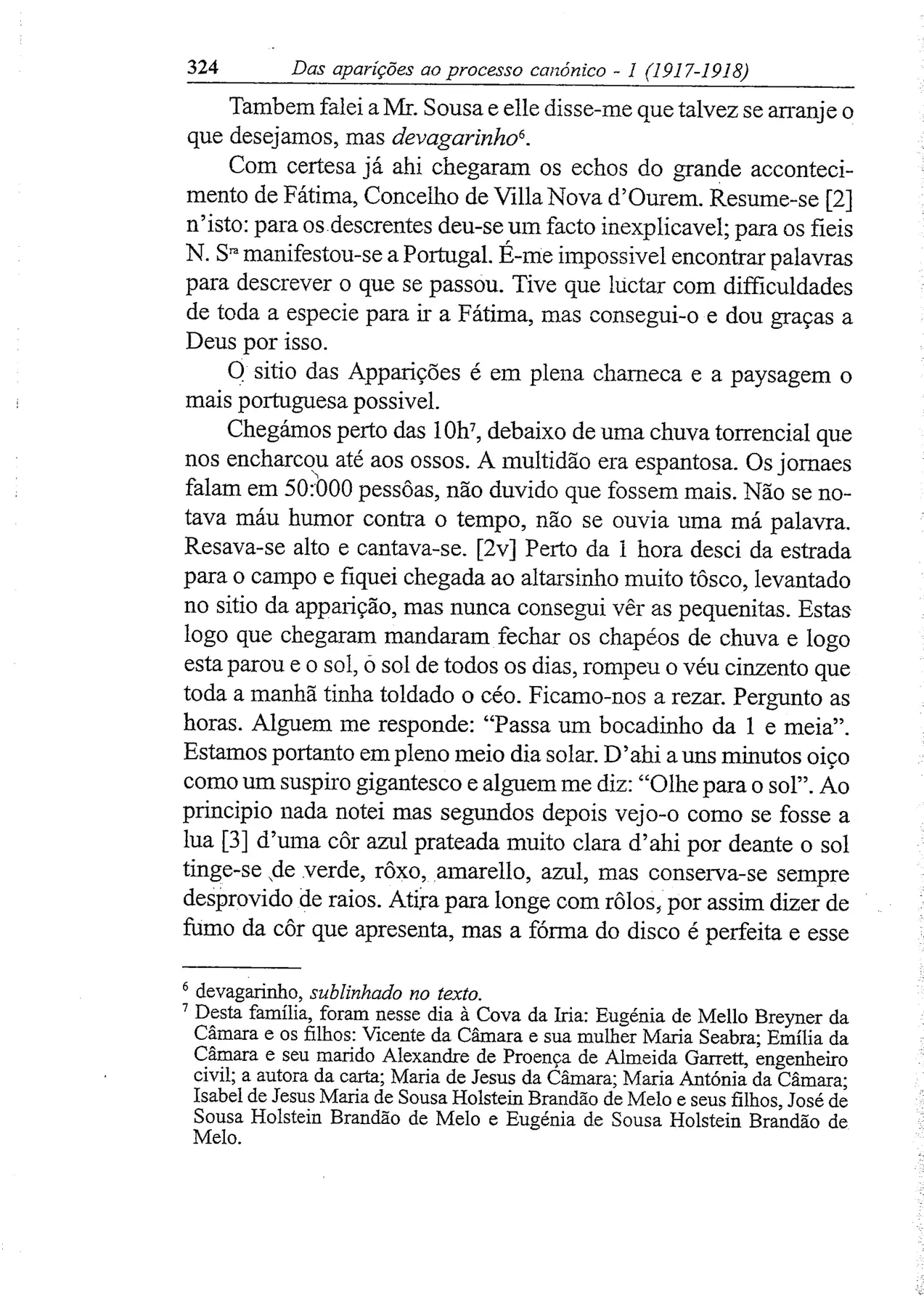
I cannot find words to describe what happened. I had to struggle with difficulties of every kind to go to Fátima, but I managed it and I thank God for it.
The site of the Apparitions is in the middle of the heath, and the landscape is as Portuguese as can be.
We arrived towards 10 o'clock7, under torrential rain that soaked us to the bone. The crowd was astounding. The newspapers speak of 50:000 people; I do not doubt there were more. There was no ill humour noticeable about the weather; not a bad word was heard. People were praying aloud and singing. [2v] Towards 1 o'clock I went down from the road into the field and stood close to the very rough little altar set up at the place of the apparition, but I never managed to see the little girls. As soon as they arrived they ordered the umbrellas to be closed, and at once the rain stopped and the sun, the everyday sun, broke through the grey veil that had overcast the sky all morning. We stayed praying. I ask the time. Someone answers me: “It's a little past half past 1”. So we are right at solar noon. A few minutes later I hear something like a gigantic sigh and someone says to me: “Look at the sun”. At first I noticed nothing, but seconds later I see it as if it were the moon, [3] of a very pale silvery blue colour; from then on the sun is tinged green, purple, yellow, blue, but it always remains devoid of rays. It throws off far away rolls, so to speak, of smoke of the colour it is showing, but the shape of the disc is perfect and that disc spins in a dizzying way, and at a certain point the sun came down. Later it shows itself further to the right and then further to the left, or vice versa. At one moment the disc takes on a vivid rose colour; behind each hill there rises something like a veil of the same colour. Fields and crowd, everything reflects it.
There are no words to describe such splendour. I have thought a great deal [3v] about the words of the Church: “Who is she that cometh forth as the morning rising?” And the people? The people weep, shout, implore Our Lady and Jesus in the Blessed Sacrament. There is a mixture of confidence, joy and fear. I feel, like everyone, that we are in the very midst of the supernatural, and I can only say like the others: “Our Lady, help us”. I do not know how long it lasted, but I heard 4 minutes mentioned. It seemed to me much longer.
[…]
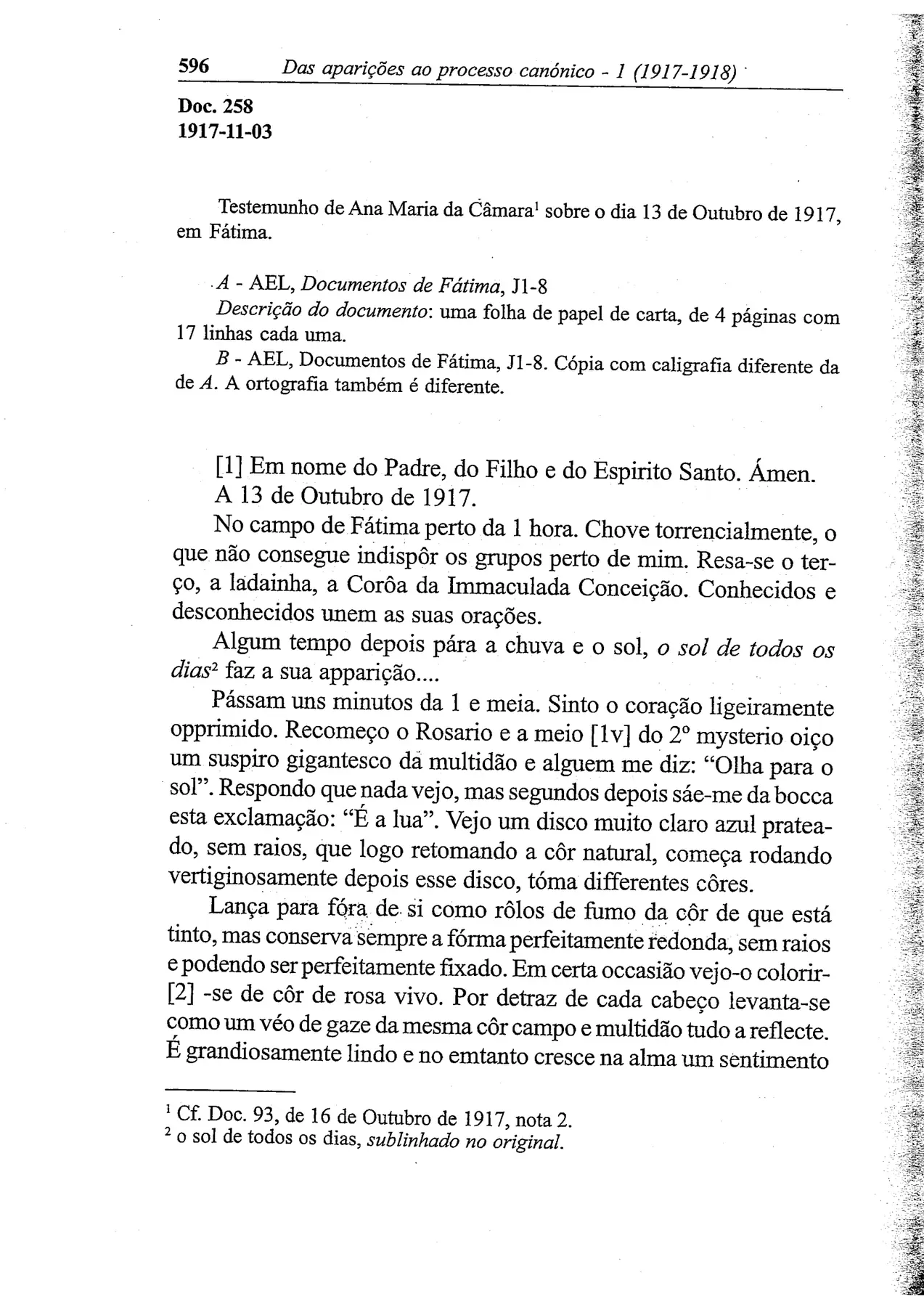
At the moment when the sun came down, the clamour of the crowd was much greater; so everyone saw at the same time, and near me a man was exclaiming in terror: "Most Hy Virgin, help us, for we are all dying here. Forgive our sins!"
É-me impossivel encontrar palavras para descrever o que se passou. Tive que luctar com difficuldades de toda a especie para ir a Fátima, mas consegui-o e dou graças a Deus por isso.
O sitio das Apparições é em plena charneca e a paysagem o mais portuguesa possivel.
Chegámos perto das 10h7, debaixo de uma chuva torrencial que nos encharcou até aos ossos. A multidão era espantosa. Os jornaes falam em 50:000 pessôas, não duvido que fossem mais. Não se notava máu humor contra o tempo, não se ouvia uma má palavra. Resava-se alto e cantava-se. [2v] Perto da 1 hora desci da estrada para o campo e fiquei chegada ao altarsinho muito tôsco, levantado no sitio da apparição, mas nunca consegui vêr as pequenitas. Estas logo que chegaram mandaram fechar os chapéos de chuva e logo esta parou e o sol, o sol de todos os dias, rompeu o véu cinzento que toda a manhã tinha toldado o céo. Ficamo-nos a rezar. Pergunto as horas. Alguem me responde: “Passa um bocadinho da 1 e meia”. Estamos portanto em pleno meio dia solar. D’ahi a uns minutos oiço como um suspiro gigantesco e alguem me diz: “Olhe para o sol”. Ao principio nada notei mas segundos depois vejo-o como se fosse a lua [3] d’uma côr azul prateada muito clara d’ahi por deante o sol tinge-se de verde, rôxo, amarello, azul, mas conserva-se sempre desprovido de raios. Atira para longe com rôlos, por assim dizer de fumo da côr que apresenta, mas a fórma do disco é perfeita e esse disco gira de uma maneira vertiginosa e a certa altura o sol desceu. Mais tarde mostra-se mais á direita e depois mais á esquerda, ou vice versa. N’um momento o disco tóma uma côr de rosa vivo; por traz de cada monte levanta-se como um véu da mesma côr. Campos e multidão tudo a reflecte.
Não ha palavras para descrever semelhante esplendor. Muito tenho pensado [3v] nas palavras da Egreja: “Quem é esta que vem raiando como a nascente aurora?” E o povo? O povo chóra, grita, implora N. Senhora e Jesus Sacramentado. Ha uma mistura de confiança, alegria e temor. Sinto como todos que estamos em pleno sobrenatural e só posso dizer como os outros: “Nossa Senhora valei--nos”. Não sei quanto tempo durou, mas ouvi falar em 4 minutos. Pareceu-me muito mais.
[…]
No momento em que o sol desceu, o clamor da multidão foi muito maior; logo, todos viram ao mesmo tempo e perto de mim um homem exclamava aterrorisado: "Virgem SSma valei-nos que morremos aqui todos. Perdoae os nosso pecados!"
Editor's notes (1)
7 From this family, the following went to the Cova da Iria that day: Eugénia de Mello Breyner da Câmara and her children: Vicente da Câmara and his wife Maria Seabra; Emília da Câmara and her husband Alexandre de Proença de Almeida Garrett, civil engineer; the author of the letter; Maria de Jesus da Câmara; Maria Antónia da Câmara; Isabel de Jesus Maria de Sousa Holstein Brandão de Melo and her children, José de Sousa Holstein Brandão de Melo and Eugénia de Sousa Holstein Brandão de Melo.
7 Desta família, foram nesse dia à Cova da Iria: Eugénia de Mello Breyner da Câmara e os filhos: Vicente da Câmara e sua mulher Maria Seabra; Emília da Câmara e seu marido Alexandre de Proença de Almeida Garrett, engenheiro civil; a autora da carta; Maria de Jesus da Câmara; Maria Antónia da Câmara; Isabel de Jesus Maria de Sousa Holstein Brandão de Melo e seus filhos, José de Sousa Holstein Brandão de Melo e Eugénia de Sousa Holstein Brandão de Melo.