Witnesses /

Manuel Marques Ferreira

Clergy

Fr Manuel Marques Ferreira, born 22 March 1880 at Casal Menino (Espite, Ourém), aged 37, parish priest (prior) of Fátima from 1914 to 1919. He questioned the seers, was accused by the crowd of complicity when the administrator carried them off on 13 August 1917, kept away from the Cova on the 13ths, and later compiled the parish inquiry.

From FátimaFátima parish (locals)Attitude beforehand: Neutral6 passages · 13 August 1917, Other 1917 events
13 AugFirst-handLetter3 km away
English

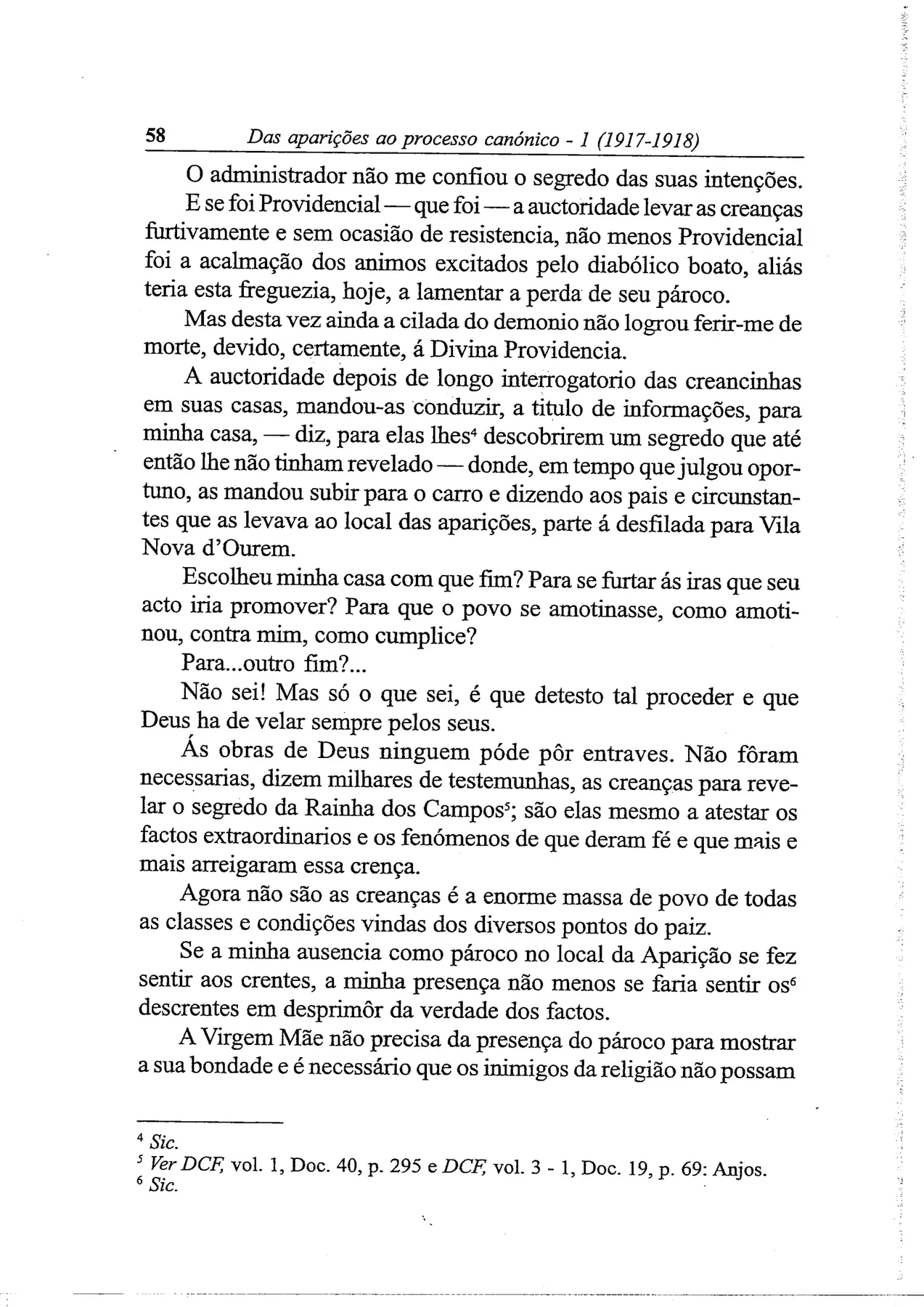
The official, after questioning the little children at length in their homes, had them brought to my house, for the purpose of inquiries — so he says, so that they would disclose to them a secret they had not until then revealed to him — and from there, at a moment he thought opportune, he had them get into the carriage and, telling the parents and bystanders that he was taking them to the place of the apparitions, sets off at full gallop for Vila Nova d'Ourem.

With what aim did he choose my house? To escape the wrath his act would provoke? So that the people would rise up, as they did rise up, against me as an accomplice?

Português (original)

A auctoridade depois de longo interrogatorio das creancinhas em suas casas, mandou-as conduzir, a titulo de informações, para minha casa, — diz, para elas lhes descobrirem um segredo que até então lhe não tinham revelado — donde, em tempo que julgou oportuno, as mandou subir para o carro e dizendo aos pais e circunstantes que as levava ao local das aparições, parte á desfilada para Vila Nova d'Ourem.

Escolheu minha casa com que fim? Para se furtar ás iras que seu acto iria promover? Para que o povo se amotinasse, como amotinou, contra mim, como cumplice?

DCF III-1, Doc. 12 · letter · 14 Aug 1917 (1 day later) · also in DCF III-1, Doc. 19View scans (2)Link
13 AugFirst-handLetter3 km away
English

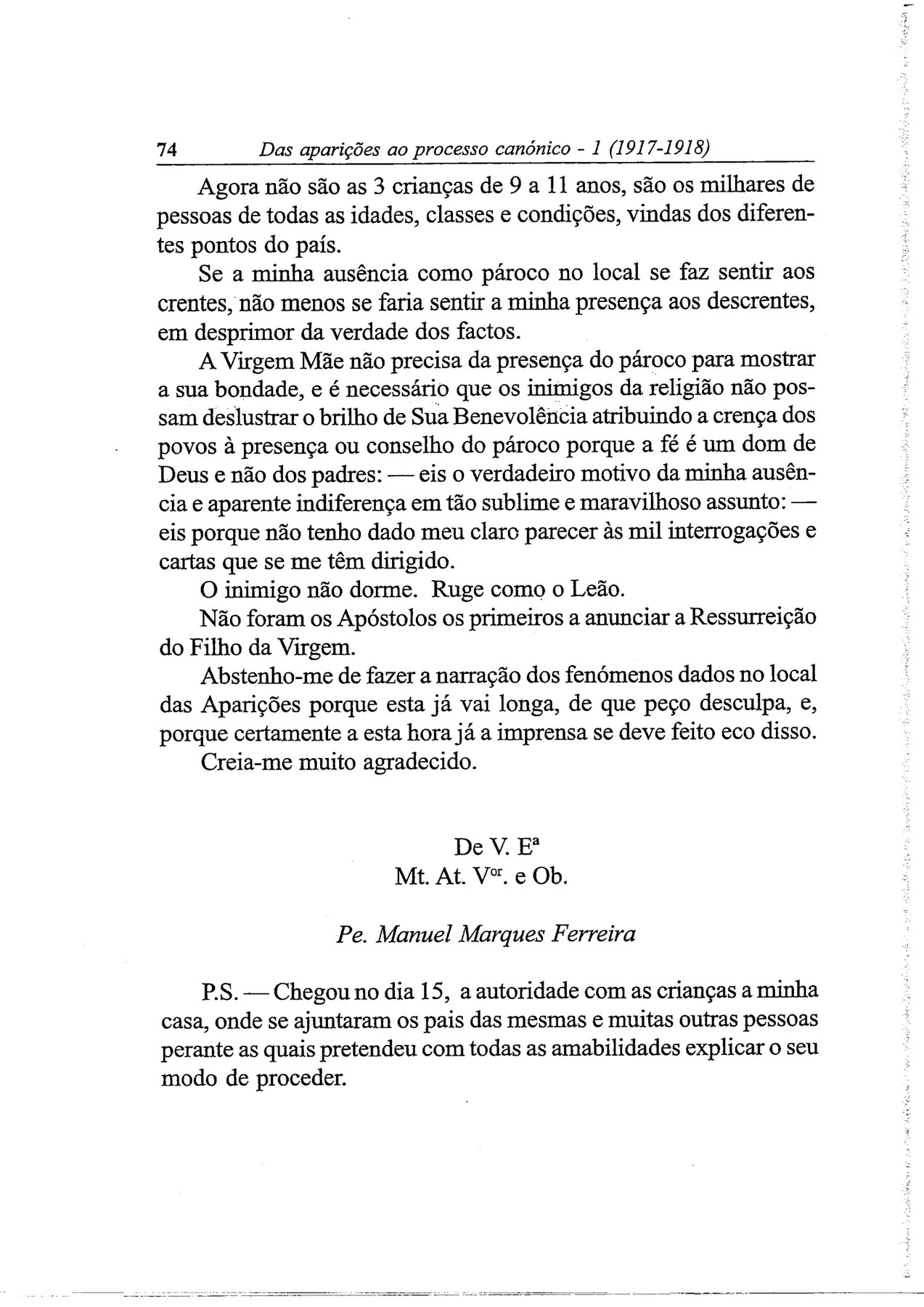
P.S. — On the 15th the official arrived with the children at my house, where their parents and many other people gathered, and before them he tried, with every courtesy, to explain his conduct.

Português (original)

P.S. — Chegou no dia 15, a autoridade com as crianças a minha casa, onde se juntaram os pais das mesmas e muitas outras pessoas perante as quais pretendeu com todas as amabilidades explicar o seu modo de proceder.

DCF III-1, Doc. 19 · letter · before 1 Sep 1917 (3 weeks later)View scans (2)Link
13 AugFirst-handSworn deposition2 km awayCrowd scene
English

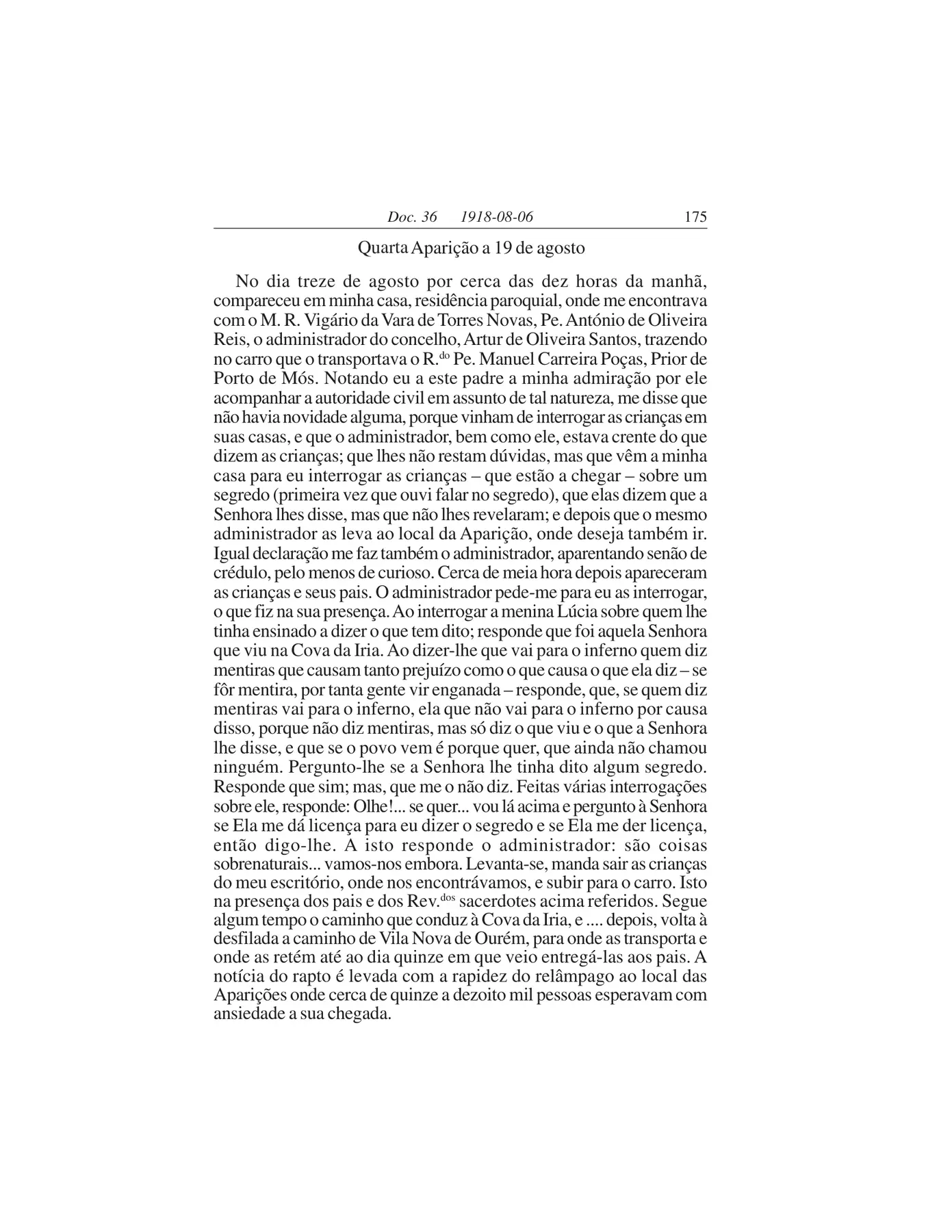
On the thirteenth of August, at about ten o'clock in the morning, the municipal administrator*, Artur de Oliveira Santos, came to my house, the parish residence, where I was with the Very Reverend Vicar Forane* of Torres Novas, Fr. António de Oliveira Reis. In the carriage that carried him he brought the Rev. Fr. Manuel Carreira Poças, Parish Priest of Porto de Mós. When I expressed to this priest my surprise that he should be accompanying the civil authority in a matter of this kind, he told me there was nothing amiss, because they had just come from questioning the children at their homes, and that the administrator, like himself, believed what the children say; that they have no doubts left, but that they are coming to my house so that I may question the children – who are about to arrive – about a secret (the first time I heard of the secret), which the children say the Lady told them but which they have not revealed to them; and that afterwards the administrator would take them to the place of the Apparition, where he also wishes to go. The administrator makes the same statement to me, appearing, if not a believer, at least curious. About half an hour later the children and their parents appeared. The administrator asks me to question them, which I did in his presence. When I asked the girl Lúcia who had taught her to say what she has been saying, she answered that it was the Lady she saw at the Cova da Iria. When I told her that people who tell lies that do as much harm as hers does – if it is a lie, with so many people coming here deceived – go to hell, she answered that if liars go to hell, she will not go to hell for that, because she does not tell lies; she only says what she saw and what the Lady told her; and if the people come, it is because they want to, for she has not called anyone. I asked her whether the Lady had told her a secret. She answered that she had, but that she would not tell it to me. After several questions about it, she answered: Look!... if you like... I'll go up there and ask the Lady whether She gives me leave to tell the secret, and if She gives me leave, then I'll tell you. To this the administrator replies: these are supernatural things... let's go. He gets up and orders the children out of my study, where we were, and into the carriage. All this in the presence of the parents and of the reverend priests mentioned above. He follows the road that leads to the Cova da Iria for a while, and .... then turns back at full speed towards Vila Nova de Ourém*, where he takes them and keeps them until the fifteenth, when he came to hand them back to their parents. The news of the abduction is carried with the speed of lightning to the place of the Apparitions, where some fifteen to eighteen thousand people were anxiously awaiting their arrival.

A few minutes later a motor car and some excited cyclists arrive at the door of the parish residence, bringing word of the indignation of the great mass of people at the Cova da Iria, who were demanding that I be lynched as an accomplice in the outrage of carrying off the children. I declare my innocence, and indeed my indignation at such an act. And thanks to the Most Holy Virgin I was not abused, apart from some offensive remarks made by a parishioner of this parish.

Português (original)

No dia treze de agosto por cerca das dez horas da manhã, compareceu em minha casa, residência paroquial, onde me encontrava com o M. R. Vigário da Vara de Torres Novas, Pe. António de Oliveira Reis, o administrador do concelho, Artur de Oliveira Santos, trazendo no carro que o transportava o R.do Pe. Manuel Carreira Poças, Prior de Porto de Mós. Notando eu a este padre a minha admiração por ele acompanhar a autoridade civil em assunto de tal natureza, me disse que não havia novidade alguma, porque vinham de interrogar as crianças em suas casas, e que o administrador, bem como ele, estava crente do que dizem as crianças; que lhes não restam dúvidas, mas que vêm a minha casa para eu interrogar as crianças – que estão a chegar – sobre um segredo (primeira vez que ouvi falar no segredo), que elas dizem que a Senhora lhes disse, mas que não lhes revelaram; e depois que o mesmo administrador as leva ao local da Aparição, onde deseja também ir. Igual declaração me faz também o administrador, aparentando senão de crédulo, pelo menos de curioso. Cerca de meia hora depois apareceram as crianças e seus pais. O administrador pede-me para eu as interrogar, o que fiz na sua presença. Ao interrogar a menina Lúcia sobre quem lhe tinha ensinado a dizer o que tem dito; responde que foi aquela Senhora que viu na Cova da Iria. Ao dizer-lhe que vai para o inferno quem diz mentiras que causam tanto prejuízo como o que causa o que ela diz – se fôr mentira, por tanta gente vir enganada – responde, que, se quem diz mentiras vai para o inferno, ela que não vai para o inferno por causa disso, porque não diz mentiras, mas só diz o que viu e o que a Senhora lhe disse, e que se o povo vem é porque quer, que ainda não chamou ninguém. Pergunto-lhe se a Senhora lhe tinha dito algum segredo. Responde que sim; mas, que me o não diz. Feitas várias interrogações sobre ele, responde: Olhe!... se quer... vou lá acima e pergunto à Senhora se Ela me dá licença para eu dizer o segredo e se Ela me der licença, então digo-lhe. A isto responde o administrador: são coisas sobrenaturais... vamos-nos embora. Levanta-se, manda sair as crianças do meu escritório, onde nos encontrávamos, e subir para o carro. Isto na presença dos pais e dos Rev.dos sacerdotes acima referidos. Segue algum tempo o caminho que conduz à Cova da Iria, e .... depois, volta à desfilada a caminho de Vila Nova de Ourém, para onde as transporta e onde as retém até ao dia quinze em que veio entregá-las aos pais. A notícia do rapto é levada com a rapidez do relâmpago ao local das Aparições onde cerca de quinze a dezoito mil pessoas esperavam com ansiedade a sua chegada.

Passados poucos minutos, chegam à porta da residência paroquial um automóvel e alguns ciclistas exaltados, dando parte da indignação da grande massa de povo que se achava na Cova da Iria, reclamando o meu linchamento como cúmplice no atentado do arrebatamento das crianças. Apresento a minha inculpabilidade, e até indignação por tal ato. E graças à Virgem Santíssima não fui enxovalhado, a não ser por algumas inconveniências proferidas por um paroquiano desta freguesia.
DCF Seleção, Doc. 36 (= DCF I, Doc. 31) · official · 6 Aug 1918 (12 months later)View scans (2)Link
13 AugFirst-handLetter2 km awayCrowd scene
English

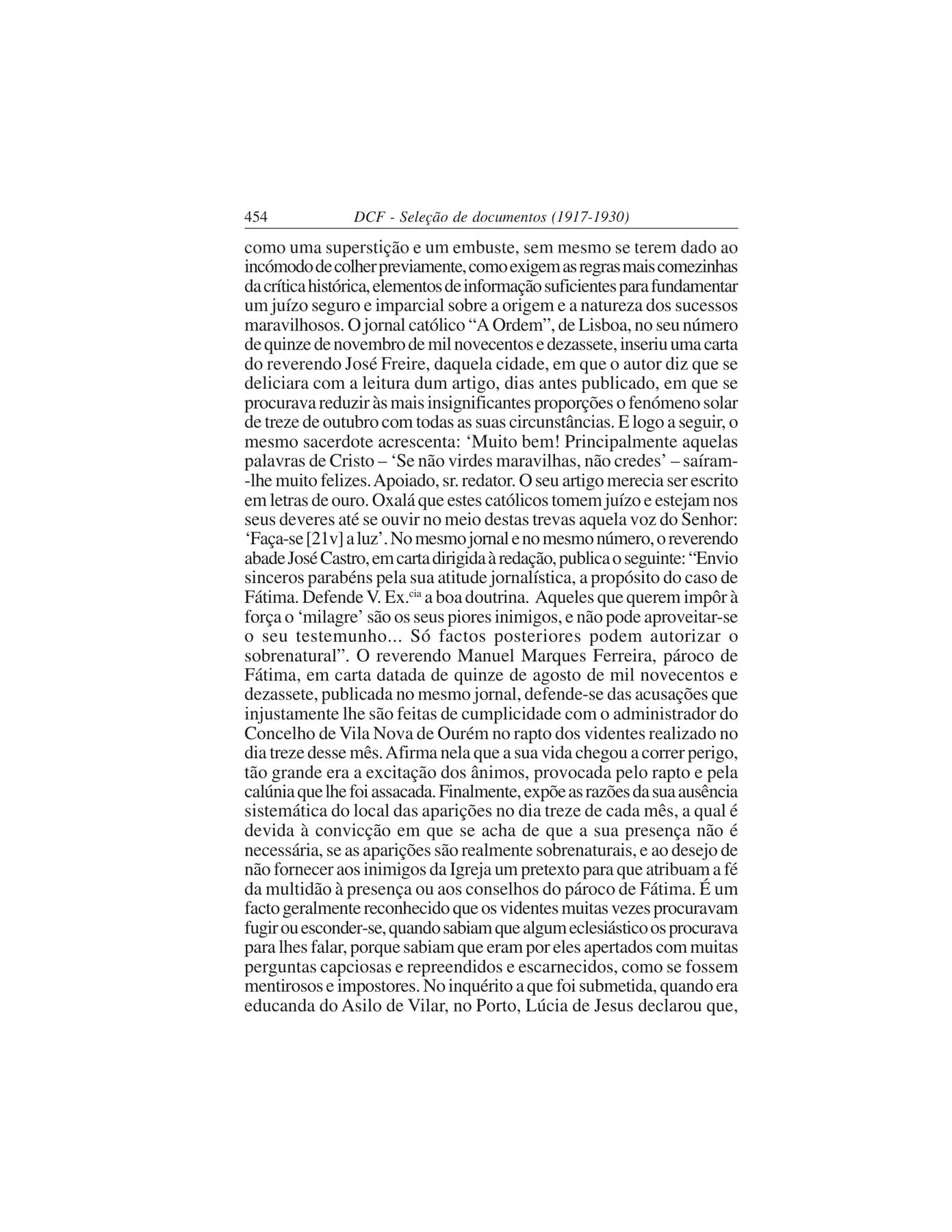
The Reverend Manuel Marques Ferreira, parish priest of Fátima, in a letter dated the fifteenth of August, nineteen hundred and seventeen, published in the same newspaper, defends himself against the accusations unjustly made against him of complicity with the municipal administrator of Vila Nova de Ourém in the abduction of the seers carried out on the thirteenth of that month. He states in it that his life was even in danger, so great was the excitement of feeling provoked by the abduction and by the calumny imputed to him. Finally, he sets out the reasons for his systematic absence from the place of the apparitions on the thirteenth of each month, which is due to his conviction that his presence is not necessary if the apparitions are really supernatural, and to his wish not to give the enemies of the Church a pretext for attributing the faith of the crowd to the presence or the counsels of the parish priest of Fátima.

Português (original)

O reverendo Manuel Marques Ferreira, pároco de Fátima, em carta datada de quinze de agosto de mil novecentos e dezassete, publicada no mesmo jornal, defende-se das acusações que injustamente lhe são feitas de cumplicidade com o administrador do Concelho de Vila Nova de Ourém no rapto dos videntes realizado no dia treze desse mês. Afirma nela que a sua vida chegou a correr perigo, tão grande era a excitação dos ânimos, provocada pelo rapto e pela calúnia que lhe foi assacada. Finalmente, expõe as razões da sua ausência sistemática do local das aparições no dia treze de cada mês, a qual é devida à convicção em que se acha de que a sua presença não é necessária, se as aparições são realmente sobrenaturais, e ao desejo de não fornecer aos inimigos da Igreja um pretexto para que atribuam a fé da multidão à presença ou aos conselhos do pároco de Fátima.

DCF Seleção, Doc. 120 (= DCF II, Doc. 9) · official · 15 Aug 1917 (2 days later)View scanLink
Other 1917First-handSworn depositionSeers' words overheard
English

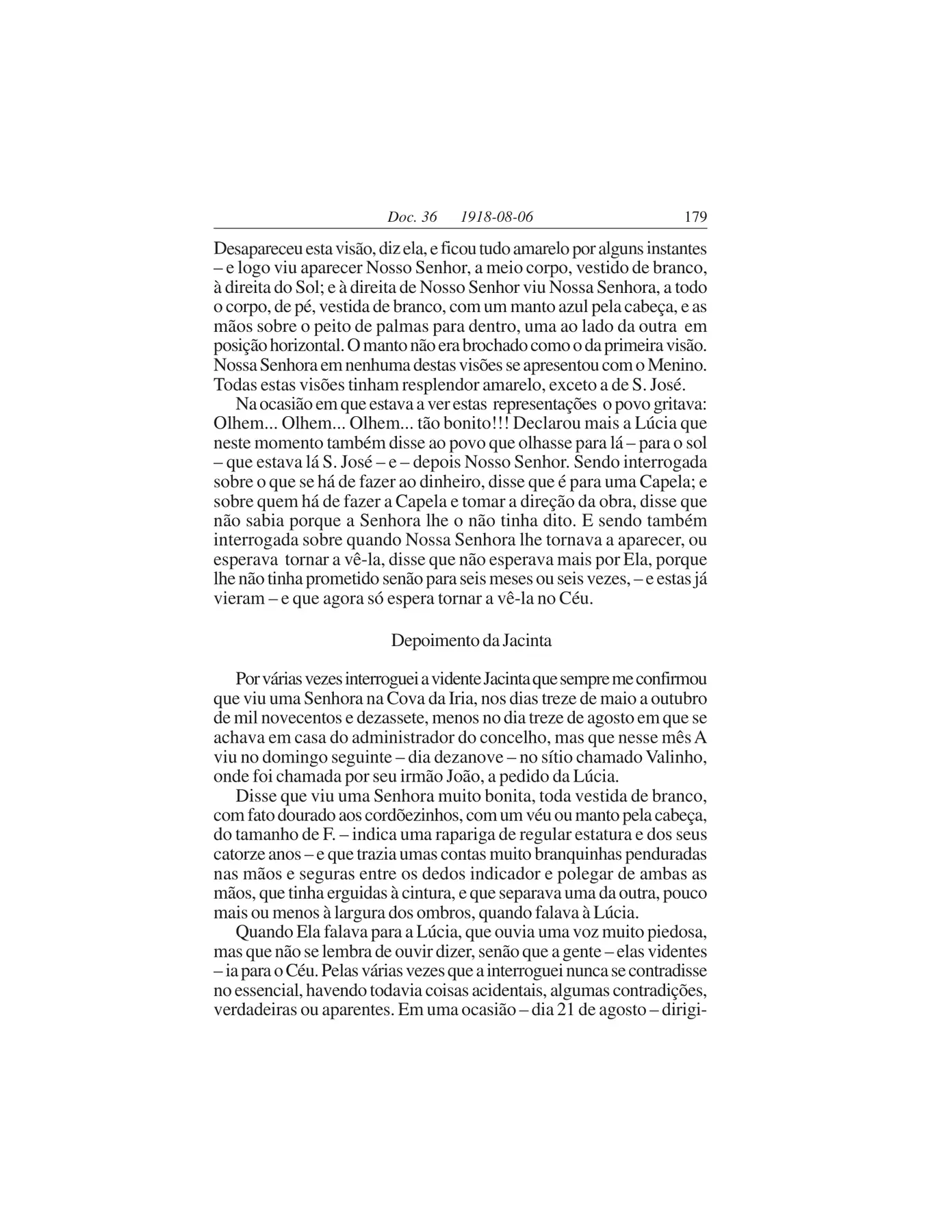
On one occasion – 21 August – I went to her parents' house with five ladies – Dona Maria de Jesus Raposo, of Torres Novas, and others from the Quinta da Cardiga – one of whom, about fifteen years of age, was dressed in white. On reaching the parents' house I called out... Jacinta came; she was alone, and on seeing the unexpected visitors she was embarrassed, as is natural in a child of the people, and in one who a few days earlier had been returned to her parents after being abducted. After a few words of encouragement, I said to her:

– Look, Jacinta, see whether it was one of these ladies you saw at the Cova da Iria, or whether there is one here who looks like the one you saw there.

She raises her little eyes, runs her gaze over all of them, from head to foot, and says:

– It wasn't any of these... the other one is much more beautiful.

I point out to her the one dressed in white, saying to her:

– Then wasn't it this Lady, dressed in white, so beautiful, that you saw up there?!

This Lady, she answered, is very beautiful, but She whom I saw there is much more beautiful.

We went to Lúcia's parents' house and, on finding her, I asked her the same question and got the same answer.

Português (original)

Em uma ocasião – dia 21 de agosto – dirigi-

-me a casa dos pais dela acompanhado de cinco senhoras – D. Maria de Jesus Raposo, de Torres Novas, e outras da Quinta da Cardiga – uma das quais, dos seus quinze anos de idade, ia vestida de branco. Ao chegar a casa dos pais chamei... Veio a Jacinta, que estava só, e que ao ver as inesperadas visitas, ficou embaraçada, como é próprio duma criança do povo e de quem poucos dias antes tinha sido restituída aos pais do rapto que lhe haviam feito. Depois de algumas palavras de animação, disse-lhe eu:

– Olha, Jacinta, vê se foi alguma destas senhoras que viste na Cova da Iria, ou se aqui está alguma parecida com A que lá viste.

Ela levanta os olhozitos, percorre-as todas com a vista, dos pés à cabeça, e diz:

– Não foi nenhuma destas... a outra é muito mais bonita.

Faço-lhe notar a que vinha vestida de branco, dizendo-lhe:

– Então não foi esta Senhora, vestida de branco, tão bonita que tu lá viste em cima?!

Esta Senhora, respondeu ela, é muito bonita, mas A que eu lá vi é muito mais bonita.

Dirigimo-nos a casa dos pais da Lúcia e ao encontrar esta, fiz-lhe a mesma pergunta obtendo idêntica resposta.

Other 1917First-handLater recollection2 km away
English

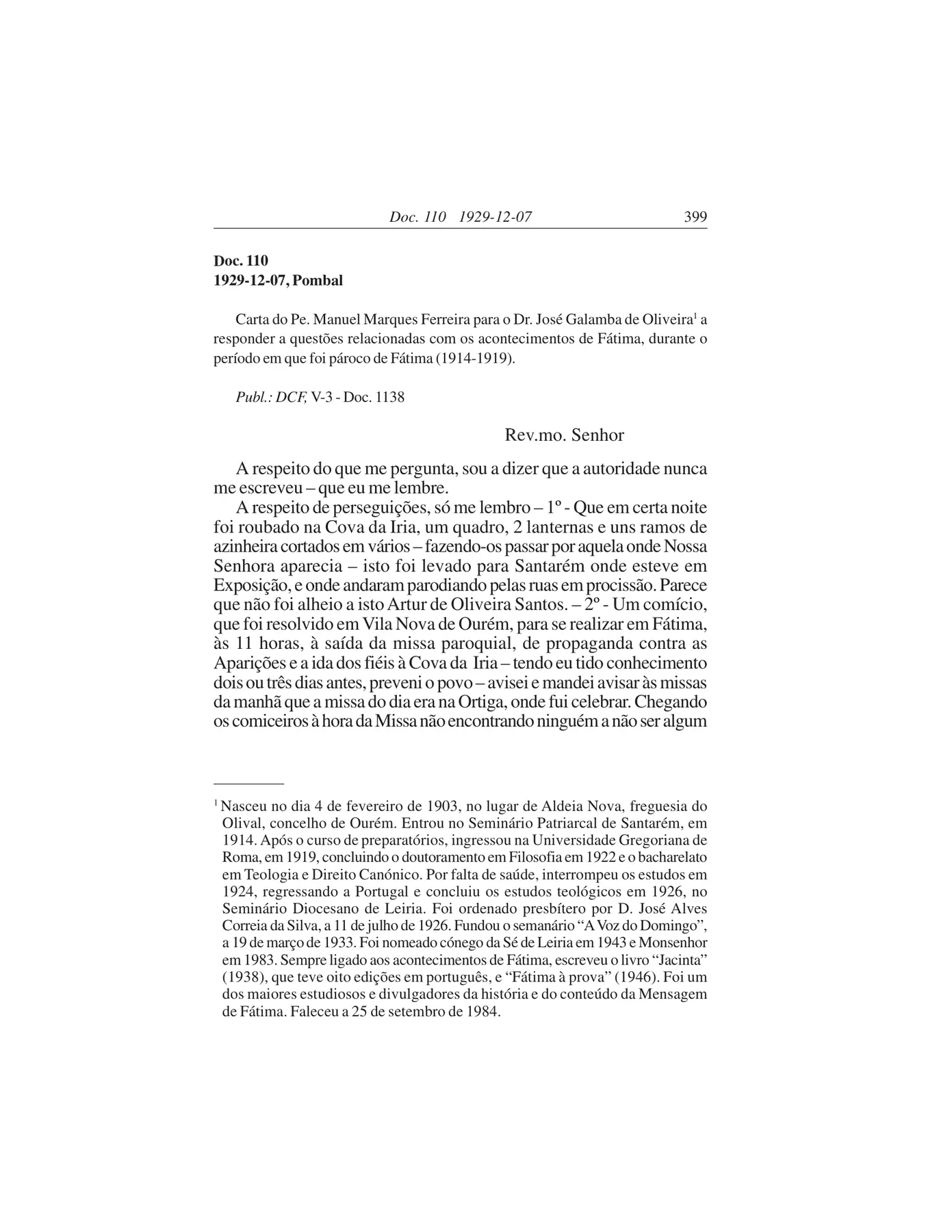
Regarding persecutions, I remember only the following. 1st - That one night a picture, 2 lanterns and some holm-oak branches cut from various trees were stolen at the Cova da Iria – they passed them off as the one on which Our Lady appeared – and this was taken to Santarém, where it was put on exhibition, and where they paraded it through the streets in a mock procession. It seems that Artur de Oliveira Santos* was not unconnected with this. – 2nd - A rally of propaganda against the Apparitions and against the faithful going to the Cova da Iria, decided on in Vila Nova de Ourém, was to be held in Fátima at 11 o'clock, as people came out of the parish Mass. Having learned of it two or three days beforehand, I forewarned the people – I announced, and had it announced at the morning Masses, that the Mass of the day would be at Ortiga*, where I went to celebrate it. When the rally organisers arrived at the time of the Mass, finding no one except the odd onlooker or someone sent by me, they stormed about, asking for me; they had the residence watched by guards, and because I did not go back home that day, they did not find me nor did I see them; – it seems that the house where I took shelter that night was also prowled around at night, by order or with the connivance of Francisco da Silva, who was the local Democrat*, and I believe regedor* too. I do not remember whether Artur de Oliveira Santos was administrator* at that time; I believe he was. – 3rd - I received an anonymous letter, from a friendly person, warning me that it had been decided at the political den in Santarém (or, I do not remember, in Torres Novas) to abduct me and the seers by night. So I gave notice that I would not go out at night, on account of the traps that were being laid for me, except in extreme cases when called by persons of recognised trust; and I warned the seers' parents to be on their guard and not to hand their children over to strangers, or to anyone not accompanied by me or sent on my instructions.

Português (original)

A respeito de perseguições, só me lembro – 1º - Que em certa noite foi roubado na Cova da Iria, um quadro, 2 lanternas e uns ramos de azinheira cortados em vários – fazendo-os passar por aquela onde Nossa Senhora aparecia – isto foi levado para Santarém onde esteve em Exposição, e onde andaram parodiando pelas ruas em procissão. Parece que não foi alheio a isto Artur de Oliveira Santos. – 2º - Um comício, que foi resolvido em Vila Nova de Ourém, para se realizar em Fátima, às 11 horas, à saída da missa paroquial, de propaganda contra as Aparições e a ida dos fiéis à Cova da Iria – tendo eu tido conhecimento dois ou três dias antes, preveni o povo – avisei e mandei avisar às missas da manhã que a missa do dia era na Ortiga, onde fui celebrar. Chegando os comiceiros à hora da Missa não encontrando ninguém a não ser algum mirone ou alguém enviado meu, barafustaram, perguntando por mim, mandaram vigiar, por guardas, a residência, e porque naquele dia não voltei a casa, não me encontraram nem eu os vi; – parece que a casa onde me recolhi aquela noite também foi, de noite, rondada às ordens ou complacência de Francisco da Silva, que era o democrático da terra, creio que Regedor também. Não me lembro se nesta altura era administrador Artur de Oliveira Santos, creio que sim. – 3º - Recebi uma carta anónima, de pessoa amiga, avisando-me que foi resolvido na chafarica em Santarém (ou não me recordo, em Torres Novas) sequestrar-me de noite e aos videntes, pelo que avisei que não saía de noite, em virtude das ciladas, que me estavam armando, a não ser em casos extremos quando chamado por pessoas de reconhecida confiança e aos pais dos videntes preveni-os de que se acautelassem e não entregassem seus filhos a pessoas desconhecidas ou que não fossem acompanhadas por mim, ou por minha indicação.

Editor's notes (1)

1 He was born on 4 February 1903, in the hamlet of Aldeia Nova, parish of Olival, council of Ourém. He entered the Patriarchal Seminary of Santarém in 1914. After the preparatory course, he went to the Gregorian University in Rome in 1919, completing his doctorate in Philosophy in 1922 and his baccalaureate in Theology and Canon Law. Because of ill health, he interrupted his studies in 1924, returning to Portugal, and completed his theological studies in 1926 at the Diocesan Seminary of Leiria. He was ordained priest by Dom José Alves Correia da Silva on 11 July 1926. He founded the weekly "A Voz do Domingo" on 19 March 1933. He was appointed canon of Leiria Cathedral in 1943 and Monsignor in 1983. Always connected with the events of Fátima, he wrote the book "Jacinta" (1938), which had eight editions in Portuguese, and "Fátima à prova" (1946). He was one of the greatest scholars and popularisers of the history and content of the Message of Fátima. He died on 25 September 1984.

1 Nasceu no dia 4 de fevereiro de 1903, no lugar de Aldeia Nova, freguesia do Olival, concelho de Ourém. Entrou no Seminário Patriarcal de Santarém, em 1914. Após o curso de preparatórios, ingressou na Universidade Gregoriana de Roma, em 1919, concluindo o doutoramento em Filosofia em 1922 e o bacharelato em Teologia e Direito Canónico. Por falta de saúde, interrompeu os estudos em 1924, regressando a Portugal e concluiu os estudos teológicos em 1926, no Seminário Diocesano de Leiria. Foi ordenado presbítero por D. José Alves Correia da Silva, a 11 de julho de 1926. Fundou o semanário “A Voz do Domingo”, a 19 de março de 1933. Foi nomeado cónego da Sé de Leiria em 1943 e Monsenhor em 1983. Sempre ligado aos acontecimentos de Fátima, escreveu o livro “Jacinta” (1938), que teve oito edições em português, e “Fátima à prova” (1946). Foi um dos maiores estudiosos e divulgadores da história e do conteúdo da Mensagem de Fátima. Faleceu a 25 de setembro de 1984.