Luís António Vieira de Magalhães e Vasconcelos
Some weeks later I went back to the place of the apparitions to interview the shepherd girls. I wished to meet these children. I was accompanied by my mother, the Baroness of Alvaiázere9, my sister, Maria Celeste10, and my close friend the Count of Juncal11, and his Ex.ma Wife, who were then our guests. Near the Church of Fátima we stopped and asked to be told where the little shepherd girls were. We were told they must be at the place of the apparitions and that the little shepherd boy who went with them, and to whom the Virgin also appeared, was close by and that they would go and call him. A little later he appeared. He was a child of ten to twelve, dressed in country fashion, quite cheerful and carefree, it seemed. We invited the boy to come with us, which he at once agreed to, jumping, smiling, into the motor car that was taking us. We asked him several questions, but he smiled more than he spoke, appearing much dazzled by the various parts of the car. Near the spot, in front of a rather old wooden table on which a Crucifix had been placed, several people were praying. There was the trunk of the cut-down holm oak and the wooden posts I mentioned, from which hung two tin lanterns. We knelt and prayed too.
---
Little Lúcia, the one to whom the Virgin appeared, was talking some distance away with some strangers. We waited for them to leave her and went up to her. She was a child of about twelve, with coarse features and a very sallow complexion. She was poorly dressed, in country fashion, with a small red paper flower on her breast and in her hands a small box in which some coins jingled. They had a sad and sombre air. She told us of the apparition of the Virgin in the way already known to all. That the Virgin had told her "that we had greatly offended God and that we should amend our lives". "That we should build a little chapel there and that it should be given the name of the Lady of the Rosary". "That the war would soon end". When my sister asked her what she had seen in the sun at the time of the miracle, she answered "that she had seen St. Joseph". I also asked her whether she had not feared that the miracle would not happen, since the people might kill her thinking she was deceiving everyone; she told me with some energy "that she knew the miracle would happen and that for that reason she had not even thought of such a danger". She also told us she had previously heard tell of the miracles of Our Lady of Lourdes. A woman who said she was her aunt helped her at times with the answers and made various remarks about a secret they had and revealed to no one, although they had already been made various tempting promises and had even been threatened that they would be thrown into a well or burned if they did not reveal it. They also told us that the alms they received were for building a chapel and that another woman who was there was the custodian of these alms. We were also told there that the little girl was extremely tired by the constant series of questions that everyone asked her. The said little girl sometimes seemed to me absorbed, at other times distracted. I must state that the impression she left on me was not good, or at least was very different from what I had expected. A child full of logic, coherence and perspicacity would also have been cause for suspicion. Whether, despite these appearances, there stood a creature chosen by God for so astounding a revelation, I cannot say. On the way back, we stopped again near the Church of Fátima; there we managed to speak to the other little girl, whose name I do not remember. She climbed onto the running board of the motor car that was taking us, but we could not get a word out of her, however hard we tried. She had a very jovial look and expressive eyes. She must have been seven or eight years old.
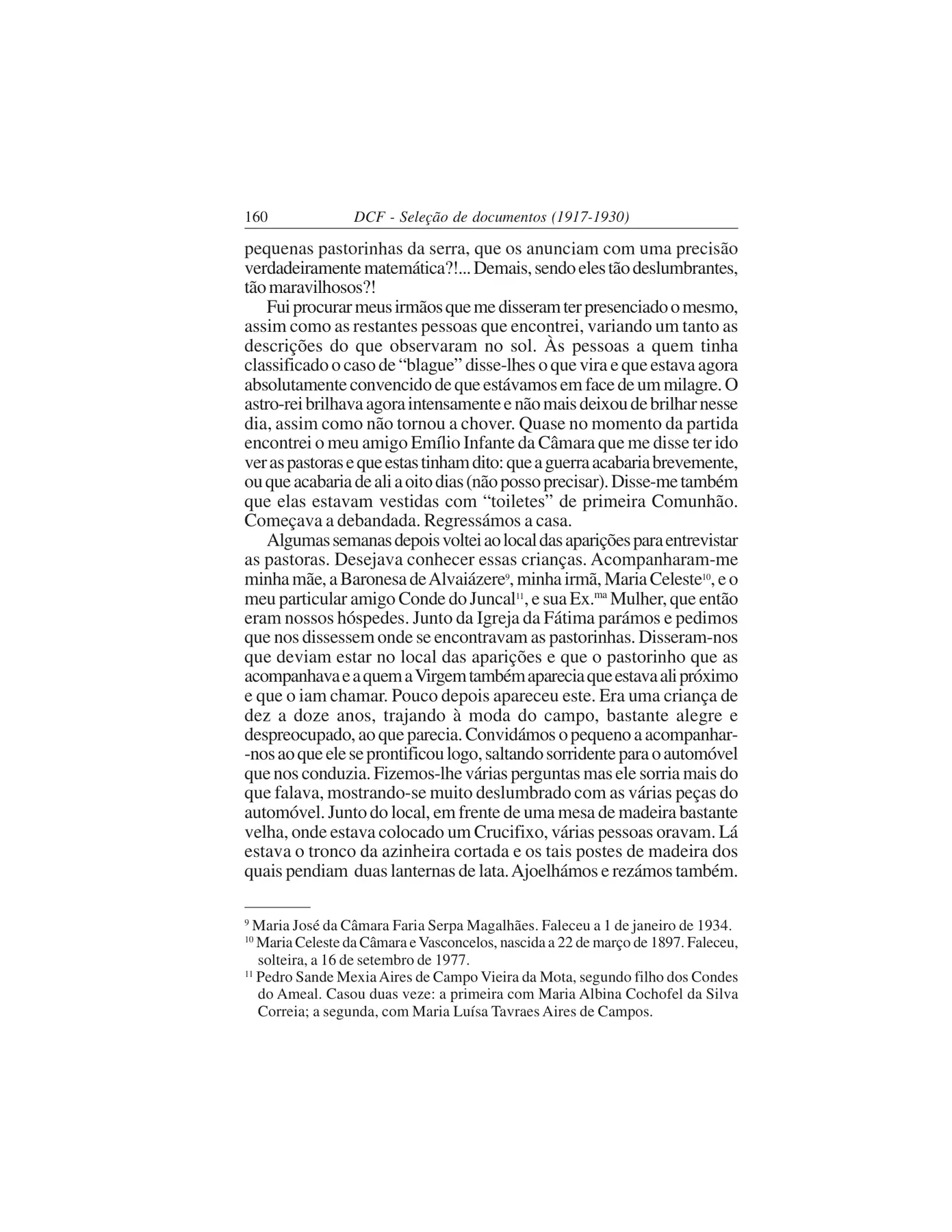
Algumas semanas depois voltei ao local das aparições para entrevistar as pastoras. Desejava conhecer essas crianças. Acompanharam-me minha mãe, a Baronesa de Alvaiázere9, minha irmã, Maria Celeste10, e o meu particular amigo Conde do Juncal11, e sua Ex.ma Mulher, que então eram nossos hóspedes. Junto da Igreja da Fátima parámos e pedimos que nos dissessem onde se encontravam as pastorinhas. Disseram-nos que deviam estar no local das aparições e que o pastorinho que as acompanhava e a quem a Virgem também aparecia que estava ali próximo e que o iam chamar. Pouco depois apareceu este. Era uma criança de dez a doze anos, trajando à moda do campo, bastante alegre e despreocupado, ao que parecia. Convidámos o pequeno a acompanhar-nos ao que ele se prontificou logo, saltando sorridente para o automóvel que nos conduzia. Fizemos-lhe várias perguntas mas ele sorria mais do que falava, mostrando-se muito deslumbrado com as várias peças do automóvel. Junto do local, em frente de uma mesa de madeira bastante velha, onde estava colocado um Crucifixo, várias pessoas oravam. Lá estava o tronco da azinheira cortada e os tais postes de madeira dos quais pendiam duas lanternas de lata. Ajoelhamos e rezámos também.
A pequena Lúcia, aquela a quem a Virgem aparecia, conversava a certa distância com alguns forasteiros. Esperámos que estes a deixassem e aproximámo-nos dela. Esta era uma criança dos seus doze anos, de feições grosseiras e de cor muito macilenta. Estava vestida pobremente, à moda do campo, tendo ao peito uma pequena flor de papel vermelho e nas mãos um pequeno cofre, onde tilintavam algumas moedas. Tinham um ar tristonho e sombrio. Narrou-nos a aparição da Virgem da forma que já é de todos conhecida. Que a Virgem lhe dissera “que nós tínhamos ofendido muito a Deus e que nos emendássemos”. “Que fizessemos ali uma capelinha e que lhe pusessem o nome da Senhora do Rosário”. “Que a guerra acabaria em breve”. Perguntando-lhe minha irmã o que vira ela no sol na ocasião do milagre, respondeu “que vira S. José”. Perguntei-lhe também se ela não tinha receado que se não desse o milagre pois que o povo a poderia matar julgando que ela estivesse enganando todos, disse-me com certa energia “que sabia que o milagre se daria e que por isso nem em tal perigo tinha pensado”. Disse-nos também que já tinha anteriormente ouvido contar os milagres da Senhora de Lourdes. Uma mulher que dizia ser tia dela auxiliava-a algumas vezes nas respostas e fazia várias considerações sobre um segredo que elas tinham e que a ninguém o revelavam embora já lhes tivessem feito vários prometimentos sedutores e até as tivessem ameaçado de que as deitariam a um poço ou de que as queimariam se elas o não revelassem. Disseram-nos ainda que as esmolas que recebiam eram para a construção de uma capela e que dessas esmolas era depositária outra mulher que ali se encontrava. Informaram-nos também ali que a pequena se encontrava fatigadíssima com a constante série de perguntas que toda a gente lhe fazia. A referida pequena, umas vezes me parecia concentrada, outras vezes me parecia distraída. Devo declarar que a impressão que me deixou não foi boa, ou foi pelo menos muito diferente da que eu esperava. Uma criança cheia de lógica, de coência e de perspicácia seria também de recear. Se apesar dessas aparências estava ali uma criatura escolhida por Deus para uma tão assombrosa revelação, não posso eu dizê-lo. No regresso, parámos novamente junto da Igreja da Fátima; ali conseguimos falar à outra pequena, cujo nome não me recorda. Subiu ao estribo do automóvel que nos conduzia mas não conseguimos arrancar-lhe uma palavra por mais diligências que empregámos para esse fim. Tinha este aspeto muito jovial e uns olhos expressivos. Devia ter sete ou oito anos de idade.
Editor's notes (3)
9 Maria José da Câmara Faria Serpa Magalhães. She died on 1 January 1934.
10 Maria Celeste da Câmara e Vasconcelos, born on 22 March 1897. She died, unmarried, on 16 September 1977.
11 Pedro Sande Mexia Aires de Campo Vieira da Mota, second son of the Counts of Ameal. He married twice: first to Maria Albina Cochofel da Silva Correia; second, to Maria Luísa Tavraes Aires de Campos.
9 Maria José da Câmara Faria Serpa Magalhães. Faleceu a 1 de janeiro de 1934.
10 Maria Celeste da Câmara e Vasconcelos, nascida a 22 de março de 1897. Faleceu, solteira, a 16 de setembro de 1977.
11 Pedro Sande Mexia Aires de Campo Vieira da Mota, segundo filho dos Condes do Ameal. Casou duas veze: a primeira com Maria Albina Cochofel da Silva Correia; a segunda, com Maria Luísa Tavraes Aires de Campos.