As in the month just ended, this month too I went to Fátima on the 13th, but this time without expecting to, because it was not easy and I had no intention of going there.
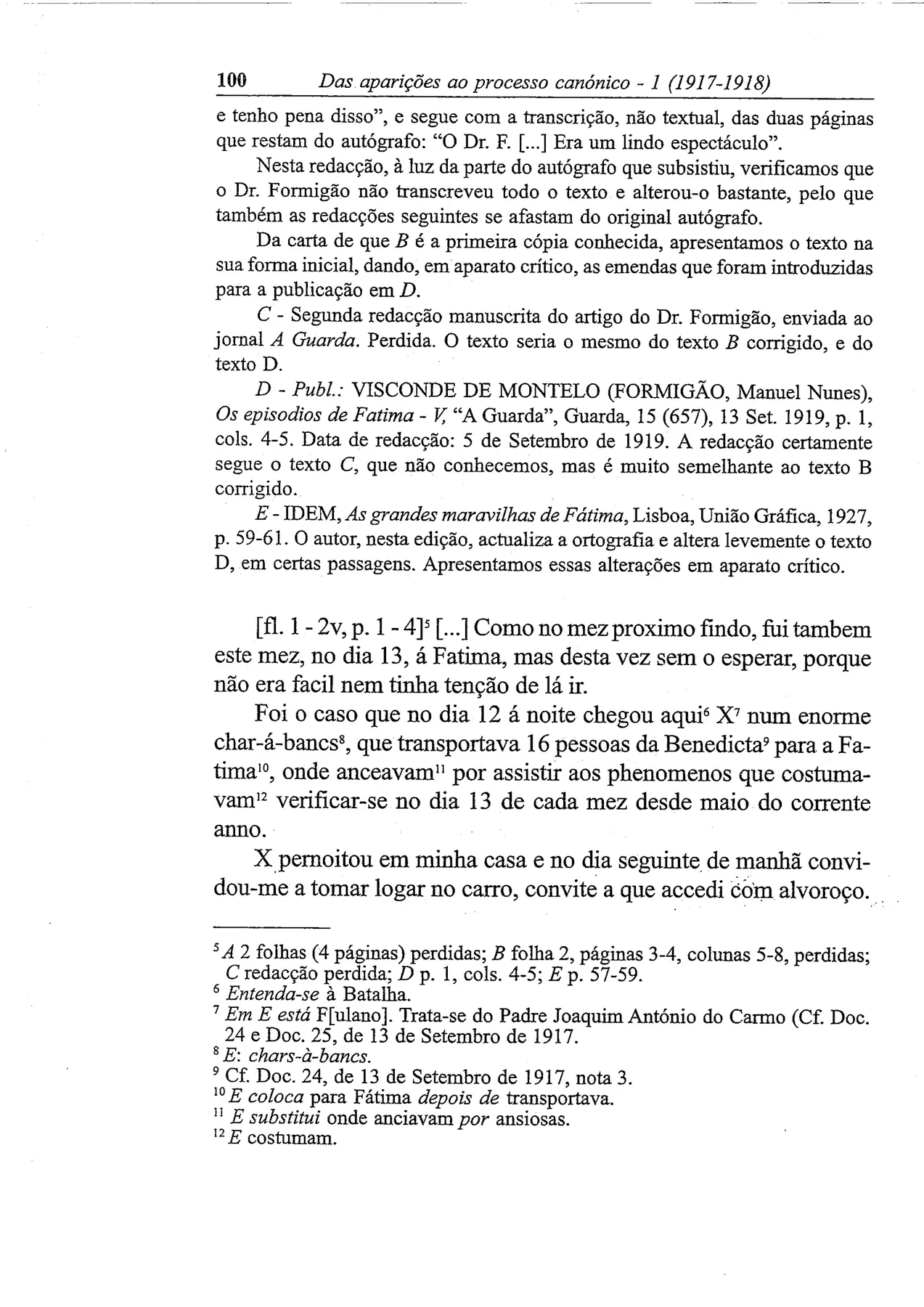
Como no mez proximo findo, fui tambem este mez, no dia 13, á Fatima, mas desta vez sem o esperar, porque não era facil nem tinha tenção de lá ir.
X spent the night at my house and the next morning invited me to take a seat in the carriage, an invitation I accepted with excitement.
X pernoitou em minha casa e no dia seguinte de manhã convidou-me a tomar logar no carro, convite a que accedi com alvoroço.
On the day before, real crowds of people had passed through this village, coming from the direction of the sea, a great number of them having slept here. At the appointed hour we got into the carriage and set off. During the journey I was immensely moved, and more than once tears came to my eyes as I saw the faith and ardent piety of so many thousands of pilgrims. The roads and short cuts were full of people.
Na vespera tinham passado por esta povoação verdadeiros bandos de pessoas, que vinham dos lados do mar, tendo dormido aqui grande numero dellas. Á hora aprazada subimos para o carro e partimos. Durante a jornada commovi-me immenso e por mais duma vez me assomaram as lagrimas aos olhos ao constatar a fé e piedade ardente de tantos milhares de romeiros. Os caminhos e atalhos iam cheios de gente.
There was no track, however small, that did not bring people to the road. It was a pilgrimage that truly made one weep with emotion. Never in all my life had I been given to witness so great and so touching a manifestation of faith. Nothing was seen or heard that betrayed the slightest sense of frivolity or even an intention of innocent amusement. The accordion, indispensable at all pilgrimages and village feasts, was conspicuous by its absence. There was none of the free-and-easy manner typical of young country folk, not even the usual harmless jokes and banter accompanied by shrill guffaws. It was almost ten o'clock when we reached the end of our journey. The crowd, which by that hour was already enormous, approached the place of the apparitions full of respect. The men took off their hats. Almost all the people knelt and prayed fervently. As soon as we arrived, X and I went to the children's house, photographed them and talked with them. That was the scene that impressed me most. I was positively enchanted. That angelic simplicity and that complete lack of concern which they show cannot lie. They do not have the shyness typical of the rough children of the fields and hills in the presence of strangers. It is all the same to them whether they talk with one stranger or with many. The answers are always the same. They seem like adults in their way of expressing themselves. From the children's house we went on to the parish residence, where, besides the parish priest, there were some friends of mine and of X, with whom we exchanged impressions on the subject of the day. After half an hour we set off for the place of the apparitions.
Não havia carreiro, por mais pequeno que fosse, que não trouxesse pessoas á estrada. Era uma peregrinação que verdadeiramente fazia chorar de commoção. Nunca me fora dado presencear em toda a minha vida uma tão grande e tão tocante manifestação de fé. Não se via nem se ouvia cousa alguma que traduzisse o mais imperceptivel sentimento de leviandade ou mesmo um proposito de divertimento innocente. O harmonio, indispensavel em todas as romarias e festas de aldeia, brilhava na sua ausencia. Não havia a desenvoltura propria da gente moça do campo nem ao menos as costumadas graças e chalaças inofensivas, acompanhadas de estridentes gargalhadas. Eram quasi dez horas quando atingimos o termo da nossa jornada. A multidão, que áquella hora já era enorme, aproximava-se cheia de respeito do local das apparições. Os homens descobriram-se. Quasi todas as pessoas se ajoelhavam e rezavam com fervor. Logo que chegámos, X e eu dirigimo-nos a casa das creanças, photographámo-las e conversámos com ellas. Foi essa a scena que mais me impressionou. Fiquei positivamente encantado. Aquella simplicidade angelica e aquella absoluta despreocupação que ellas manifestam não podem mentir. Não teem o acanhamento proprio das creanças rudes dos campos e das serras na presença de pessoas desconhecidas. Tanto se lhes dá fallar com uma pessoa estranha como com muitas. As respostas são sempre as mesmas. Parecem adultos na maneira de se exprimir. De casa das creanças seguimos para a residencia parochial, onde estavam, alem do parocho, alguns amigos meus e de X com os quaes trocámos impressões sobre o assumpto do dia. Passada meia hora, puzemo-nos a caminho do local das apparições.
At noon exactly — astronomical time* — the sun began to lose its brightness. There was no one who did not notice this fact, which since the previous May had always recurred on the 13th of each month at the same hour. Shortly afterwards the eldest of the seers told the bystanders to pray.
Ao meio dia em ponto — hora astronomica, — o sol começou a perder o brilho. Não houve quem não notasse este facto, que desde maio precedente se repetia sempre no dia 13 de cada mez á mesma hora. Pouco depois a mais velha das videntes mandou aos circunstantes que rezassem.
I shall never forget the violent impression I felt on seeing so many thousands of the faithful fall to their knees, who, weeping, prayed aloud and, full of trust, implored the maternal protection of the Queen of Heaven27.
Nunca esquecerei a violenta impressão que senti ao ver cahir de joelhos tantos milhares de fieis que chorando rezavam em voz alta e imploravam cheios de confiança a protecção maternal da Rainha do Ceu27.
It was at this moment that many people saw an oval, of a vivid30 and brilliant colour, with its widest part turned downwards, describe a long straight line in the firmament. Some people saw this phenomenon for a longer time, others for a shorter. I did not see it and I am sorry about it. Mr Dr. Figueirêdo35 and many people from here saw it36. There are some people from here, and very serious ones, who saw a kind of flowers that came from above but did not touch the ground37. — The atmosphere took on a yellowish colour, perhaps because of the darkening of the sun. — What happened in that swift quarter of an hour is never forgotten and also is not easy to describe; I shall tell you more later, so as not to bore you, Canon, with so tedious a letter; nor did I intend to write a description like this, hardly shorter than last month's; Dr. Formigão* (whom I did not manage to see there) and Dr. Figueirêdo will tell you much better than I what took place.
Foi neste momento que muitas pessoas viram uma oval, de côr viva30 e brilhante, com a parte mais larga voltada para baixo, descrever uma comprida linha recta no firmamento. Algumas pessoas viram esse phenomeno por mais, outras por menos tempo. Eu não o vi e tenho pena disso. O Snr. Dr. Figueirêdo35 e muitas pessôas d'aqui viram36. Ha algumas pessôas e seriissimas d'aqui que viram uma especie de flôres que vinham de cima mas que não tocavam no chão37. — A atmosphéra tomou uma côr amarellada, talvez por causa do obscurecimento do sol. — O que se passou n'este rapido quarto d'hora nunca se esquece e tambem não é facil de descrever; depois direi mais algumas coisas para não estar a massar o Snr. Conego com uma carta tão enfadonha; nem eu tinha tenção de fazer uma tal descripção que não fica muito atraz da do mez passado; o Snr. Dr. Formigão (que eu lá não fui capaz de ver) e o Snr. Dr. Figueirêdo dirão bem melhor que eu o que houve.
[…]
As soon as the sun recovered its usual light the children withdrew, and with them the first waves of people, who little by little dispersed45. The lowest estimates gave 15 to 17,000 people, and there were those who claimed there were well over 20,000. I give no opinion of my own, but I believe I have never seen so many people. It was a beautiful spectacle.
[…]
Logo que o sol recuperou a luz habitual as creanças retiraram e com ellas as primeiras levas de pôvo que a pouco e pouco dispersou45. Os calculos mais reduzidos davam 15 a 17.000 pessôas, havendo quem afirmasse estarem muito mais de 20.000. Eu não dou a minha opinião mas creio que nunca vi tanta gente. Era um lindo espectaculo.
Editors' notes (8)
6 That is, to Batalha.
7 In E it reads F[ulano] ("So-and-so"). This is Father Joaquim António do Carmo (Cf. Doc. 24 and Doc. 25, of 13 September 1917).
27 The text from the beginning of this document ("As in the month ended") up to "Queen of Heaven" is found only in D and E.
30 B: "of a vivid colour" corrected to "little larger than an egg, of a vivid white colour". D and E: "little larger than an egg, of a vivid white colour".
35 B and D: corrected to "F."; E: corrected to "B."
This is Fr. António Maria de Figueiredo. He was born in the hamlet of Mata, parish of Santa Eufémia, municipality of Torres Novas, on 11 July 1879. He took doctorates in Philosophy and Theology and a bachelor's degree in Canon Law at the University of Sant'Apollinare in Rome. He was ordained priest on 19 December 1902, and went on to serve as prefect and teacher of Philosophy, Dogmatic Theology and Latin at the Seminary of Santarém. He was parish priest of Vale de Santarém, Várzea, Abitureiras, S. Nicolau of Santarém, S. Nicolau of Lisbon, and S. Jorge de Arroios. He was a canon of Lisbon Cathedral. He died on 5 May 1963.
36 B and D: "many of my fellow townsmen state that they also saw it". E: "Dr. B and many of my fellow townsmen state that they also saw it".
37 B: "some of these, whose seriousness it is not permissible to doubt, assure us that they caught sight of a kind of flowers, which were falling from Heaven, but which did not touch the ground, disappearing when they reached a certain height", corrected to "Some of these, whose seriousness it is not permissible to call into doubt, assure us that they distinguished a kind of flowers, which were falling from the sky, but did not touch the ground, disappearing when they reached a certain height". D reproduces the corrected text of B, changing only "distinguido" (distinguished) to "percebido" (perceived) and "tocavam" to "tocaram" (a change of tense). E reproduces text D, changing "tocaram" back to "tocavam".
45 B added the following text, after correction: "the usual light, the three children, who had stayed all the time beside the holm-oak shrub and who declared that the Most Holy Virgin had appeared to them for the fifth time, withdrew to their homes, and at the same time the first waves of people departed, which little by little dispersed". D and E reproduce text B, only adding sua ("its") before "usual light" and removing tres ("three") before "children".
6 Entenda-se à Batalha.
7 Em E está F[ulano]. Trata-se do Padre Joaquim António do Carmo (Cf. Doc. 24 e Doc. 25, de 13 de Setembro de 1917).
27 Desde o princípio deste documento Como no mez findo até Rainha do Ceu só se encontra em D e E.
30 B de côr viva corr. pouco mais volumosa que um ovo, de côr branca, viva. D e E pouco mais volumosa que um ôvo, de côr branca, viva.
35 B e D corr. F.; E corr. B.
Trata-se do Pe. António Maria de Figueiredo. Nasceu no lugar da Mata, freguesia de Santa Eufémia, concelho de Torres Novas, a 11 de Julho de 1879. Doutorou-se em Filosofia e Teologia e bacharelou-se em Direito Canónico, pela Universidade de Santo Apolinário, em Roma. Foi ordenado presbítero a 19 de Dezembro de 1902, ficando a desempenhar as funções de prefeito e professor de Filosofia, Teologia Dogmática e Latinidade, no Seminário de Santarém. Foi pároco de Vale de Santarém, Várzea, Abitureiras, S. Nicolau, de Santarém, S. Nicolau, de Lisboa, e S. Jorge de Arroios. Foi cónego da Sé de Lisboa. Faleceu a 5 de Maio de 1963.
36 B e D muitos patricios meus affirmam que tambem o viram. E o dr. B e muitos patricios meus afirmam que também o viram.
37 B alguns destes, de cuja seriedade não é lícito duvidar, asseguram ter avistado uma especie de flores, que cahiam do Ceu, mas que não tocavam no chão, desappareciam ao chegarem a certa altura. corr. Alguns destes, cuja seriedade não é licito pôr em duvida, asseguram ter distinguido uma especie de flores, que cahiam do ceu, mas não tocavam no chão desapparecendo ao chegarem a certa altura. D reproduz o texto B corrigido, modificando apenas distinguido para percebido e tocavam para tocaram. E reproduz o texto D, modificando de novo tocaram para tocavam.
45 B acrescentou o seguinte texto, depois de corrigido: a luz habitual as tres creanças que se conservaram sempre junto da carrasqueira e que declararam ter-lhes apparecido pela quinta vez a Virgem Santissima, retiraram para suas casas e ao mesmo tempo partiram as primeiras levas de povo que pouco a pouco dispersou. D e E reproduzem o texto B acrescentando apenas sua [luz habitual] e eliminando tres [creanças].