Witnesses /

Joel de Deus Magno

ClergyStudent

Seminarian of the Santarém seminary, born 11 October 1894 at Vermelha (Cadaval), aged 22, on holiday at Batalha in summer 1917; later ordained, he held several posts at the same seminary.

From BatalhaThe surrounding regionAttitude beforehand: Believer4 passages · 13 August 1917, 13 September 1917

Also written as: Joel Deus Magno

13 AugFirst-handPartlyLetterCrowd scene
English

After resting a little I walked slowly to the place of the apparition. When I got there many people were praying and singing verses to Our Lady around the small shrub where the apparitions take place; it is a small cork oak4 which has already been reduced to its trunk, so many branches have been taken from it. I began talking with some people from here whom I saw there; by this time there were already a lot of people there; it was not long before some seminarians arrived, who came straight over to me, and we were not parted again. They were António Ferreira5, Manuel dos Santos6, Penna7, Caetano from Thomar8, who did the 1st year, Pereira9, who is actually from here, and later António Poças10 arrived \and Marques Vieira11 with a brother12. We went into some shade and stayed there a long time. It was then that the great influx of people began; it came from all sides, but [2v] on either side of the road it was a real flood. Carts followed one after another, people on horseback, on foot and on bicycles; just the sight of the carts scattered over the slope and the animals in the shade, a string of motor cars on the road and veritable heaps of bicycles was interesting. At about noon (old time)13, the exact hour of the apparitions, there were many thousands of people at the place. I am no good at estimates, but those who gave the lowest figure spoke of 5000 people. — The children were already late when Poças arrived with the sad news that the administrator of Ourem had told the children's parents at whose house he was that he would take them in his trap to the spot \but that he had run off with them to Ourem. And so it was: that wicked and cowardly man thus betrayed all those people, but in this there seems indeed to have been an intervention of God, because that place where a great many [3] people were constantly passing was deserted, the only witnesses de visu being the Parish Priest, the Vicar of Torres Novas19 and Fr. Manuel Poças20, who were on his veranda

(the parish priest's), as they themselves told me afterwards. When the people found out they were extremely indignant and I, as it was already about 3 o'clock, went to Fátima with some of the seminarians to find out about the affair. I was so angry that I no longer know what I said there; no doubt those priests called me ... a fool or something of the sort... We were at this when some men turned up, very happy, saying that Our Lady had appeared. I at once took leave of the priests and went back up. The roads were already full of those people commenting on the resounding event. I asked each group what they had seen and in less than no time I found myself surrounded by all those people, who with a great deal of shouting told me that they had heard a clap of thunder and everyone had run away; then, coming back, they saw a cloud come down, blue and white, [3v] which shortly rose and disappeared. Others said they had seen a flash of lightning, and there was a poor little woman who, with tears in her eyes, said, utterly convinced, that she had seen Our Lady; in short, everyone was satisfied and from what I heard from the people of Ourem the administrator seems to have put his life at great risk with that abduction.

Português (original)

Depois de descansar um pouco fui andando devagar para o logar da aparição. Quando lá cheguei estavam muitas pessoas rezando e cantando versos a N. Senhora de roda do pequeno arbusto onde se dão as aparições; é uma pequena sobreira4 que está já reduzida ao tronco, tantos ramos lhe teem tirado. Comecei a fallar com algumas pessoas d’aqui que lá vi; já a esta hora lá estava muita gente; não tardaram a chegar alguns seminaristas que logo se dirigiram a mim e nunca mais nos separámos. Eram o António Ferreira5, o Manuel dos Santos6, o Penna7, o Caetano de Thomar8, que fez o 1º anno, o Pereira9 que é mesmo d'aqui e mais tarde chegou o António Poças10 \e o Marques Vieira11 com um irmão12. Fomo-nos para uma sombra e ali estivemos muito tempo. Então é que começou a grande affluencia de pòvo; era de todos os lados mas [2v] d'um lado e d'outro da estrada é que era uma verdadeira enchente. Os carros succediam-se, gente a cavallo, a pé e de bicicleta; só a vista dos carros espalhados pela encosta e animaes á sombra, uma enfiada de automoveis na estrada e verdadeiros montes de bicicletas era interessante. Pelo meio dia (antigo)13, hora certa das aparições, estavam muitos milhares de pessôas no lugar. Eu não presto para calculos, mas os que lhe davam menos fallavam em 5000 pessôas. — Já tardavam as creanças quando chegou o Poças com a triste noticia de que o administrador de Ourem dissera aos paes das creanças em cuja casa estava que as levava na sua charrete para o sitio \mas que fugira com ellas para Ourem. E assim foi, aquelle homem mau e cobarde atraçouou assim tôdo aquelle pòvo, mas n'isto parece bem ter havido intervenção de Deus por que aquelle lugar em que passava constantemente muita [3] gente estava deserto, sendo unicas testemunhas de visu o Prior, o Snr. Vigário de Torres Novas19 e o Pe. Manuel Poças20 que estavam na varanda d'elle

(priôr), còmo elles mesmos depois me disseram. O pòvo quando soube ficou indignadissimo e eu, còmo já eram umas 3 horas, fui á Fátima com alguns dos seminaristas saber do caso. Fiquei tão zangado que já nem sei o que lá disse; naturalmente aquelles padres chamaram-me ... tonto ou coisa que o valha... Estavamos n'isto quando apparecêram uns homens muito contentes dizendo que N. Senhora tinha apparecido. Despedi-me logo dos padres e fui para cima. Vinham já as estradas cheias d'aquelle pòvo que comentava o estrondoso facto. A cada grupo eu perguntava o que tinham visto e em menos de um phosphoro via-me cercado de tôda aquelle gente que em grande gritaria me contavam que ouviram um trovão e tôda a gente fugira; voltando depois, viram descer uma nuvem, azul e branca [3v] que brevemente se levantára e desaparecêra. Outros que tinham visto um relampago e havia mulhersinha que com as lagrimas nos olhos dizia convencidissima que vira N. Senhora; emfim tôdos ficáram satisfeitos e pelo que ouvi aos de Ourem o administrador parece ter arriscado muito a vida com o tal rapto.

Editor's notes (15)

1 Born in Vermelha (Cadaval) on 11 October 1894. He entered the Seminary of Santarém on 8 October 1907. Ordained a priest, he held various posts in the same Seminary. He was perpetual secretary of Canon Francisco Maria Félix. He died on 8 May 1962.

2 Born on 11 February 1874 in Óbidos. Ordained a priest on 9 August 1896, he held various posts in the Seminary of Santarém, of which he was rector from 1 August 1921. He died on 5 June 1970.

3 It was probably the Parish Priest of Fátima, Fr. Manuel Marques Ferreira, who looked after his bicycle and gave him a little wine.

4 In his transcriptions of this letter for Os Episódios Maravilhosos de Fátima - IV, "A Guarda", 15 (655), 30 Aug. 1919, and for As Grandes Maravilhas de Fátima, Lisbon, União Gráfica, 1927, p. 49-52, Dr. Formigão corrects this error, using the term "azinheta".

5 Born in Santa Catarina da Serra on 18 July 1899. He was ordained a priest on 27 June 1924. He died in Barcelos on 9 August 1970. Cf. "A Voz do Domingo", Leiria, 38 (1950), 16 Aug. 1970, p. 8, col. 1.

6 A native of Torres Novas. He was not ordained.

7 A native of Torres Novas. He was not ordained.

8 José Caetano da Silva, of Tomar. He was not ordained.

9 Francisco Pereira dos Reis, of Fátima. He died of the pneumonic influenza in 1918-1919.

10 This may be Fr. António Carreira Poças. Born in Reguengo, Batalha, on 3 November 1892. He died in Belas, Sintra.

11 João Marques Vieira, of Olival (?).

12 Abílio Marques Vieira, of Olival (?).

13 Solar time.

19 Fr. António de Oliveira Reis, born in Montelo, Fátima, on 22 January 1874. He was ordained a priest on 28 June 1901. He died on 22 June 1962.

20 Born on 13 January 1881, in Reguengo, Batalha. He was a fellow student of Fr. Joel and parish priest of S. João de Porto de Mós from 1908 to 15 November 1939. He died on 8 August 1944. According to what Mr Marto told Dr. Fischer, Fr. Manuel Carreira Poças questioned the children eight or nine days before 13 October. Cf. FISCHER, Ludwig - Die Botschaft unserer Lieben Frau von Fátima, Bamberg, Fátima-Verlag, 1937, p. 147. Cf. DCF, vol. 1, Doc. 54, of 13-15 August 1917, note 7.

1 Nasceu em Vermelha (Cadaval), a 11 de Outubro de 1894. Entrou no Seminário de Santarém no dia 8 de Outubro de 1907. Ordenado sacerdote, exerceu diversos cargos no mesmo Seminário. Foi secretário perpétuo do Cón. Francisco Maria Félix. Faleceu a 8 de Maio de 1962.

2 Nasceu no dia 11 de Fevereiro de 1874, em Óbidos. Ordenado sacerdote a 9 de Agosto de 1896, exerceu diversos cargos no Seminário de Santarém de que foi reitor desde 1 de Agosto de 1921. Faleceu no dia 5 de Junho de 1970.

3 Provavelmente terá sido o Pároco de Fátima, Pe. Manuel Marques Ferreira, que lhe guardou a bicicleta e lhe deu um pouco de vinho.

4 Nas suas transcrições desta carta para Os Episódios Maravilhosos de Fátima - IV, “A Guarda”, 15 (655), 30 Ago. 1919, e para As Grandes Maravilhas de Fátima, Lisboa, União Gráfica, 1927, p. 49-52, o Dr. Formigão corrige este erro, usando o termo “azinheta”.

5 Nasceu em Santa Catarina da Serra a 18 de Julho de 1899. Foi ordenado sacerdote a 27 de Junho de 1924. Faleceu em Barcelos a 9 de Agosto de 1970. Cf. “A Voz do Domingo”, Leiria, 38 (1950), 16 Ago. 1970, p. 8, col. 1.

6 Natural de Torres Novas. Não se ordenou.

7 Natural de Torres Novas. Não se ordenou.

8 José Caetano da Silva, de Tomar. Não se ordenou.

9 Francisco Pereira dos Reis, de Fátima. Faleceu devido à pneumónica em 1918-1919.

10 Poderá tratar-se do Pe. António Carreira Poças. Nasceu no Reguengo, Batalha, a 3 de Novembro de 1892. Faleceu em Belas, Sintra.

11 João Marques Vieira, do Olival (?).

12 Abílio Marques Vieira, do Olival (?).

13 Hora solar.

19 Pe. António de Oliveira Reis, nasceu em Montelo, Fátima, no dia 22 de Janeiro de 1874. Foi ordenado sacerdote a 28 de Junho de 1901. Faleceu a 22 de Junho de 1962.

20 Nasceu a 13 de Janeiro de 1881, no Reguengo, Batalha. Foi condiscípulo do Pe. Joel e pároco de S. João de Porto de Mós, de 1908 a 15 de Novembro de 1939. Faleceu a 8 de Agosto de 1944. Segundo referiu o Sr. Marto ao Dr. Fischer, o Pe. Manuel Carreira Poças interrogou as crianças oito ou nove dias antes de 13 de Outubro. Cf. FISCHER, Ludwig - Die Botschaft unserer Lieben Frau von Fátima, Bamberg, Fátima-Verlag, 1937, p. 147. Cf. DCF, vol. 1, Doc. 54, de 13-15 de Agosto de 1917, nota 7.
DCF III-1, Doc. 7 · letter · Aug 1917 (2 days later)View scans (4)Link
13 AugFirst-handSaw nothingLetterCrowd sceneThunder / noiseCloud / smoke column
English

"After resting a little, I walked slowly to the place of the apparitions. When I got there, many people were praying and singing verses to Our Lady around the bush where the apparitions take place. This bush is a small holm oak that is already reduced to its trunk, so many are the branches that have been taken from it. I spent a few moments chatting with various acquaintances of mine. Many people could already be seen there at that hour.

Some friends of mine, who had meanwhile arrived and come to join me, and I went and sat in the shade of a tree, and there we stayed for quite some time. It was then that a vast crowd began to pour in. Innumerable people were coming from every direction, but it was above all from both sides of the district road that there was a real flood.

Vehicles of all sizes and all shapes followed one another without interruption. People came on foot, on horseback and by bicycle. The sight of the carts scattered over the slope, of the animals grazing in the shade, of the long line of motor cars on the road, of the gigantic heaps of bicycles, made an extremely interesting spectacle. Around astronomical noon, the exact hour of the apparitions, some thousands of people were crowded together at that place.

I am not versed in the science of calculation, but it seemed to me, and that was the general opinion, that more than five thousand souls were present. They were all anxiously awaiting the arrival of the children, who were already late.

Meanwhile a lad turns up with the sad news that the administrator of Vila Nova de Ourém, after telling the parents of the children, whom he had gone to visit, that he would gladly take them in his trap to the place of the apparitions, had wretchedly tricked them, putting the children in the trap and fleeing with them to Ourém. That is indeed what had happened. That wicked and cowardly man had betrayed all those people. There seems, however, to have been a special intervention of providence in all this, because that place, through which many people constantly pass, was almost deserted at that hour, the only eyewitnesses being the parish priest of Fatima and some friends who were on the veranda of the parish residence and with whom the administrator had been talking shortly before. The people, when they learned what had happened, were most indignant. Some friends and I went straight back to the village of Fatima. There we informed ourselves in detail of how things had happened. A few moments later some men arrived, very happy, saying that Our Lady had appeared. I immediately made for the place in all haste. The roads were already full of people commenting on the astonishing fact. I asked each group what they had seen. All with one voice said that they had heard a clap of thunder and seen, near the holm-oak shrub, a flash of lightning and a most beautiful cloud that rose into the air and shortly disappeared. In a word, everyone had been satisfied, and from what I heard various individuals from Vila Nova de Ourém say, the administrator seems to have put his life at great risk by abducting the children. Some educated and level-headed people told me that, although mysterious signs had been observed, there was not sufficient proof of a supernatural character.

Others assured me that they had noticed nothing abnormal.

Others finally proclaimed that, after one had spoken with the children, one could not doubt the reality of the apparitions”.

Português (original)

Depois de descansar um pouco, fui andando devagar para o local das aparições. Quando lá cheguei, estavam muitas pessoas rezando e cantando versos a Nossa Senhora em torno do arbusto, onde se verificam as aparições. Esse arbusto é uma pequena azinheira que está já reduzida ao tronco, tantos são os ramos que lhe teem tirado. Entretive-me alguns momentos a conversar com diversas pessoas das minhas relações. Já lá se via a essa hora muita gente.

Eu e alguns amigos meus, que entretanto chegaram e vieram juntar-se comigo, fômos sentar-nos á sombra de uma arvore e alli nos conservámos bastante tempo. Então é que começou a affluir imenso povo. De todas as direcções vinham innumeráveis pessoas, mas principalmente dos dois lados da estrada districtal é que era uma verdadeira enchente.

Vehiculos de todos os tamanhos e de todos os feitios succediam-se uns aos outros sem interrupção. Vinha gente a pé, a cavallo e de bicycleta. A vista dos carros espalhados pela encosta, do gado a pastar á sombra, da longa serie de automoveis na estrada, dos montes gigantescos de bicycletes, constituia um espectaculo sobremodo interessante. Pelo meio dia astronomico, hora certa das aparições, comprimiam-se nesse local alguns milhares de pessoas.

Eu não sou versado na sciencia do calculo, mas parecia-me e era essa a opinião geral, que se achavam presentes mais de cinco mil almas. Estavam todos aguardando anciosamente a chegada das creanças, que já tardavam.

Entretanto apparece um rapaz com a triste noticia de que o administrador de Villa Nova d'Ourem, depois de ter dito aos paes das creanças a quem tinha ido visitar, que as levava de boa vontade na sua charrete para o local das aparições, os ludibriara miseravelmente, metendo as creanças na charrete e fugindo com ellas para Ourem. Com effeito, assim tinha succedido. Esse homem, perverso e cobarde, atraçoara todo aquelle povo. Parece, porém, ter havido em tudo isto uma intervenção especial da providencia, porque aquelle lugar, em que passa constantemente muita gente, estava quasi deserto aquella hora, sendo unicas testemunhas oculares o prior de Fatima e alguns amigos que estavam na varanda da residencia parochial e com quem pouco antes o administrador estivera conversando. O povo, quando soube o que se tinha passado, ficou indignadissimo. Eu e alguns amigos voltámos logo para a povoação de Fatima. Alli informamo-nos minuciosamente do modo como as cousas se tinham passado. D'ahi a poucos momentos chegaram uns homens muito contentes dizendo que Nossa Senhora tinha apparecido. Dirigi-me immediatamente a toda a pressa para o local. As estradas vinham já cheias de gente que commentava o assombroso facto. A cada grupo perguntava o que tinham visto. Todos a uma voz diziam que tinham ouvido um trovão e visto junto da carrasqueira um relampago e uma nuvem formosissima que se elevou nos ares e a breve trecho desapareceu. Numa palavra, todos tinham ficado satisfeitos e pelo que ouvi dizer a varios individuos de Villa Nova d'Ourem o administrador parece ter arriscado muito a vida com o rapto das creanças. Algumas pessoas instruidas e ponderadas disseram-me que, embora se tivessem verificado signaes mysteriosos, não havia prova sufficiente de sobrenaturalidade.

Outras asseguravam que não haviam notado nada de anormal.

Outras finalmente proclamavam que, depois de se ter fallado com as creanças, não se podia duvidar da realidade das aparições”.

DCF III-2, Doc. 406 · press · 17 Sep 1917 (5 weeks later)View scans (4)Link
13 SepFirst-handLater recollection2 km away
English

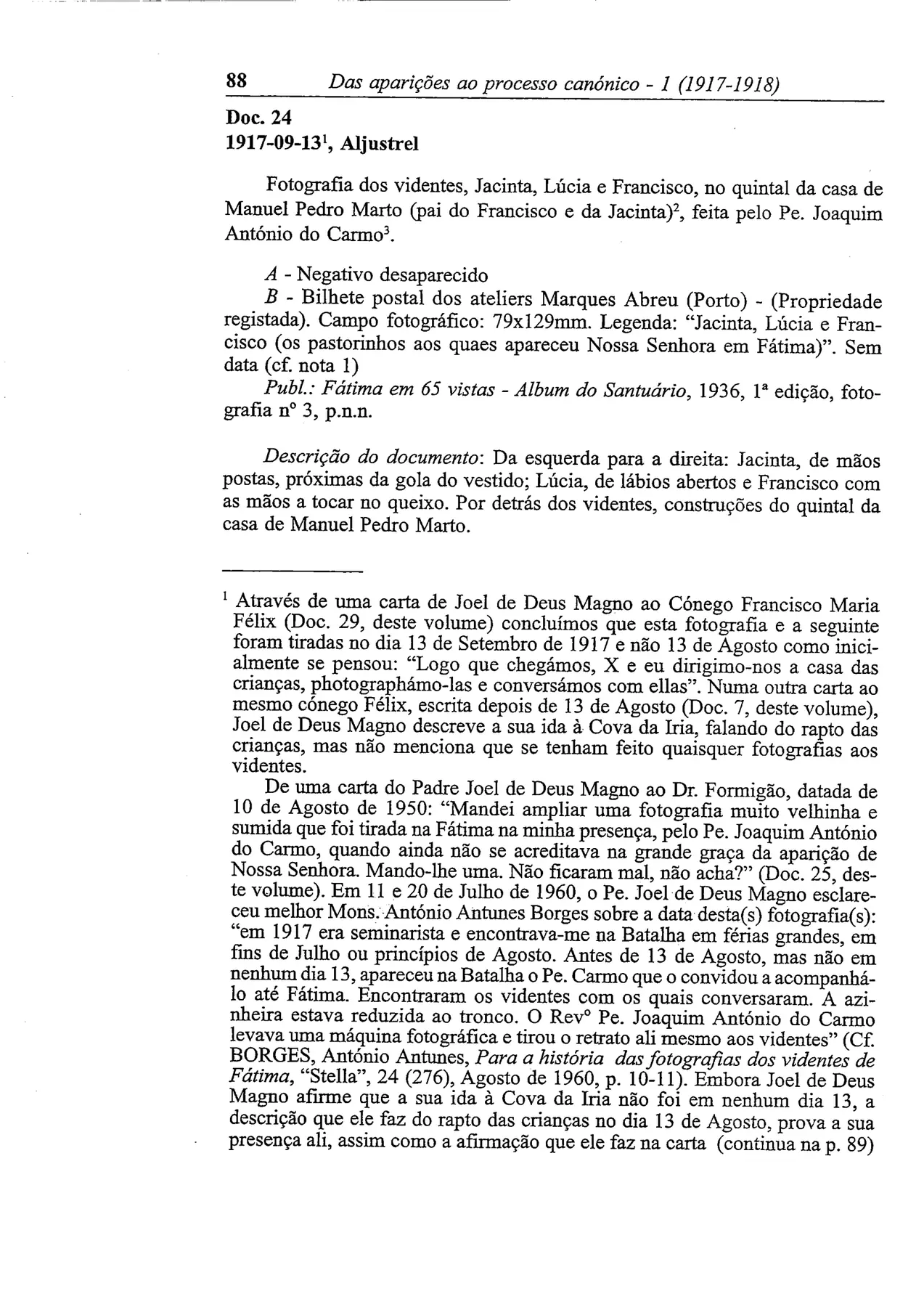
in 1917 he was a seminarian and was at Batalha on the long holidays, at the end of July or beginning of August. Before 13 August, but not on any 13th, Fr. Carmo turned up at Batalha and invited him to go with him to Fátima. They found the seers, with whom they talked. The holm oak had been reduced to its trunk. Rev. Fr. Joaquim António do Carmo had a camera with him and took the portrait of the seers right there"

Português (original)

em 1917 era seminarista e encontrava-me na Batalha em férias grandes, em fins de Julho ou princípios de Agosto. Antes de 13 de Agosto, mas não em nenhum dia 13, apareceu na Batalha o Pe. Carmo que o convidou a acompanhá-lo até Fátima. Encontraram os videntes com os quais conversaram. A azinheira estava reduzida ao tronco. O Revº Pe. Joaquim António do Carmo levava uma máquina fotográfica e tirou o retrato ali mesmo aos videntes"

DCF III-1, Doc. 24 · photo · Jul 1960 (43 years later)View scans (2)Link
13 SepFirst-handPartlyLetterCrowd sceneLight dimmingColours on people & landscape
English

As in the month just ended, this month too I went to Fátima on the 13th, but this time without expecting to, because it was not easy and I had no intention of going there.

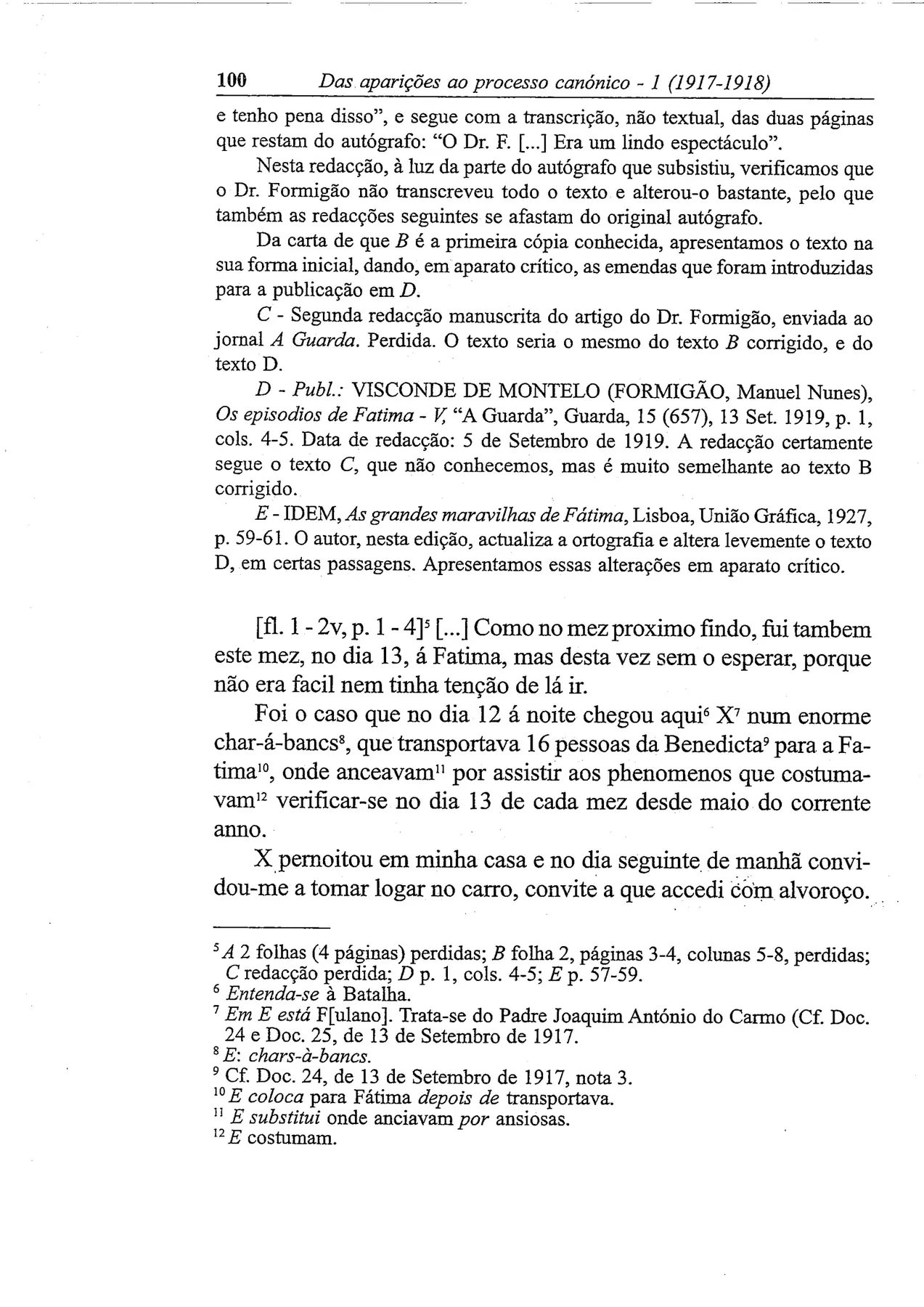
What happened was that on the night of the 12th X7 arrived here6 in an enormous char-à-bancs, which was carrying 16 people from Benedita to Fátima, where they longed to witness the phenomena that had been occurring on the 13th of each month since May of the current year.

X spent the night at my house and the next morning invited me to take a seat in the carriage, an invitation I accepted with excitement.

On the day before, real crowds of people had passed through this village, coming from the direction of the sea, a great number of them having slept here. At the appointed hour we got into the carriage and set off. During the journey I was immensely moved, and more than once tears came to my eyes as I saw the faith and ardent piety of so many thousands of pilgrims. The roads and short cuts were full of people.

There was no track, however small, that did not bring people to the road. It was a pilgrimage that truly made one weep with emotion. Never in all my life had I been given to witness so great and so touching a manifestation of faith. Nothing was seen or heard that betrayed the slightest sense of frivolity or even an intention of innocent amusement. The accordion, indispensable at all pilgrimages and village feasts, was conspicuous by its absence. There was none of the free-and-easy manner typical of young country folk, not even the usual harmless jokes and banter accompanied by shrill guffaws. It was almost ten o'clock when we reached the end of our journey. The crowd, which by that hour was already enormous, approached the place of the apparitions full of respect. The men took off their hats. Almost all the people knelt and prayed fervently. As soon as we arrived, X and I went to the children's house, photographed them and talked with them. That was the scene that impressed me most. I was positively enchanted. That angelic simplicity and that complete lack of concern which they show cannot lie. They do not have the shyness typical of the rough children of the fields and hills in the presence of strangers. It is all the same to them whether they talk with one stranger or with many. The answers are always the same. They seem like adults in their way of expressing themselves. From the children's house we went on to the parish residence, where, besides the parish priest, there were some friends of mine and of X, with whom we exchanged impressions on the subject of the day. After half an hour we set off for the place of the apparitions.

At noon exactly — astronomical time — the sun began to lose its brightness. There was no one who did not notice this fact, which since the previous May had always recurred on the 13th of each month at the same hour. Shortly afterwards the eldest of the seers told the bystanders to pray.

I shall never forget the violent impression I felt on seeing so many thousands of the faithful fall to their knees, who, weeping, prayed aloud and, full of trust, implored the maternal protection of the Queen of Heaven27.

It was at this moment that many people saw an oval, of a vivid and brilliant colour, with its widest part turned downwards, describe a long straight line in the firmament. Some people saw this phenomenon for a longer time, others for a shorter. I did not see it and I am sorry about it. [fl. 3, p. 5] Mr Dr. Figueirêdo and

[…]

many people from here saw it36. There are some people from here, and very serious ones, who saw a kind of flowers that came from above but did not touch the ground 37. — The atmosphere took on a yellowish colour, perhaps because of the darkening of the sun. — What happened in that swift quarter of an hour is never forgotten39 and also is not easy to describe; later I shall say a few more things, so as not to bore you, Mr Canon, with so tedious a letter; nor did I intend to write such a description, which falls not far short of last month's; Mr Dr. Formigão (whom I was not able to see there) and Mr Dr. Figueirêdo will tell much better than I what took place.

[…]

As soon as the sun recovered its usual light the children withdrew, and with them the first waves of people, who little by little dispersed45. The lowest estimates gave 15 to 17,000 people, and there were those who claimed there were well over 20,00046. I give no opinion of my own, but I believe I have never seen so many people47. It was a beautiful spectacle

Português (original)

Como no mez proximo findo, fui tambem este mez, no dia 13, á Fátima, mas desta vez sem o esperar, porque não era facil nem tinha tenção de lá ir.

Foi o caso que no dia 12 á noite chegou aqui6 X7 num enorme char-á-bancs, que transportava 16 pessoas da Benedicta para a Fátima, onde anceavam por assistir aos phenomenos que costumavam verificar-se no dia 13 de cada mez desde maio do corrente anno.

X pernoitou em minha casa e no dia seguinte de manhã convidou-me a tomar logar no carro, convite a que accedi com alvoroço.

Na vespéra tinham passado por esta povoação verdadeiros bandos de pessoas, que vinham dos lados do mar, tendo dormido aqui grande numero dellas. Á hora aprazada subimos para o carro e partimos. Durante a jornada commovi-me immenso e por mais duma vez me assomaram as lagrimas aos olhos ao constatar a fé e piedade ardente de tantos milhares de romeiros. Os caminhos e atalhos iam cheios de gente.

Não havia carreiro, por mais pequeno que fosse, que não trouxesse pessoas á estrada. Era uma peregrinação que verdadeiramente fazia chorar de commoção. Nunca me fora dado presenciar em toda a minha vida uma tão grande e tão tocante manifestação de fé. Não se via nem se ouvia cousa alguma que traduzisse o mais imperceptível sentimento de leviandade ou mesmo um proposito de divertimento innocente. O harmonio, indispensavel em todas as romarias e festas de aldeia, brilhava na sua ausencia. Não havia a desenvoltura propria da gente moça do campo nem ao menos as costumadas graças e chalaças inofensivas, acompanhadas de estridentes gargalhadas. Eram quasi dez horas quando atingimos o termo da nossa jornada. A multidão, que áquella hora já era enorme, aproximava-se cheia de respeito do local das aparições. Os homens descobriram-se. Quasi todas as pessoas se ajoelhavam e rezavam com fervor. Logo que chegámos, X e eu dirigimo-nos a casa das creanças, photographámo-las e conversámos com ellas. Foi essa a scena que mais me impressionou. Fiquei positivamente encantado. Aquella simplicidade angelica e aquella absoluta despreocupação que ellas manifestam não podem mentir. Não teem o acanhamento proprio das creanças rudes dos campos e das serras na presença de pessoas desconhecidas. Tanto se lhes dá fallar com uma pessoa estranha como com muitas. As respostas são sempre as mesmas. Parecem adultos na maneira de se exprimir. De casa das creanças seguimos para a residencia parochial, onde estavam, alem do parocho, alguns amigos meus e de X com os quaes trocámos impressões sobre o assumpto do dia. Passada meia hora, puzemo-nos a caminho do local das aparições.

Ao meio dia em ponto — hora astronomica, — o sol começou a perder o brilho. Não houve quem não notasse este facto, que desde maio precedente se repetia sempre no dia 13 de cada mez á mesma hora. Pouco depois a mais velha das videntes mandou aos circunstantes que rezassem.

Nunca esquecerei a violenta impressão que senti ao ver cahir de joelhos tantos milhares de fieis que chorando rezavam em voz alta e imploravam cheios de confiança a protecção maternal da Rainha do Ceu27.

Foi neste momento que muitas pessoas viram uma oval, de côr viva e brilhante, com a parte mais larga voltada para baixo, descrever uma comprida linha recta no firmamento. Algumas pessoas viram esse phenomeno por mais, outras por menos tempo. Eu não o vi e tenho pena disso. O [fl. 3, p. 5] Snr. Dr. Figueirêdo e

[…]

muitas pessôas d'aqui viram36. Ha algumas pessôas e seriissimas d'aqui que viram uma especie de flôres que vinham de cima mas que não tocavam no chão37. — A atmosphéra tomou uma côr amarellada, talvez por causa do obscurecimento do sol. — O que se passou n'este rapido quarto d'hora nunca se esquece39 e tambem não é facil de descrever; depois direi mais algumas coisas para não estar a massar o Snr. Conego com uma carta tão enfadonha; nem eu tinha tenção de fazer uma tal descripção que não fica muito atraz da do mez passado; o Snr. Dr. Formigão (que eu lá não fui capaz de ver) e o Snr. Dr. Figueirêdo dirão bem melhor que eu o que houve.

[…]

Logo que o sol recuperou a luz habitual as creanças retiraram e com ellas as primeiras levas de pôvo que a pouco e pouco dispersou45. Os calculos mais reduzidos davam 15 a 17.000 pessôas, havendo quem afirmasse estarem muito mais de 20.00046. Eu não dou a minha opinião mas creio que nunca vi tanta gente47. Era um lindo espectáculo

Editor's notes (9)

6 That is, to Batalha.

7 In E it is F[ulano]. This is Father Joaquim António do Carmo (Cf. Doc. 24 and Doc. 25, of 13 September 1917).

27 From the beginning of this document, As in the month ended, as far as Queen of Heaven, is found only in D and E.

36 B and D many fellow-countrymen of mine state that they also saw it. E Dr. B and many fellow-countrymen of mine state that they also saw it.

37 B some of these, whose seriousness it is not permissible to doubt, assure us that they caught sight of a kind of flowers, which were falling from Heaven, but which did not touch the ground, disappearing when they reached a certain height. corr. Some of these, whose seriousness it is not permissible to call into doubt, assure us that they distinguished a kind of flowers, which were falling from the sky, but did not touch the ground, disappearing when they reached a certain height. D reproduces the corrected text B, changing only distinguished to perceived and did not touch to have not touched. E reproduces text D, changing have not touched back to did not touch.

39 B, D and E what happened in that swift quarter of an hour one never forgets.

45 B added the following text, after correction: its usual light the three children, who had stayed all the time beside the holm-oak shrub and who declared that the Most Holy Virgin had appeared to them for the fifth time, withdrew to their homes, and at the same time the first waves of people departed, which little by little dispersed. D and E reproduce text B, adding only its [usual light] and removing three [children].

46 B and D modify this sentence as follows: The lowest estimates put the people present at the moment of the apparition at 15 to 17,000. There were, however, those who were of the view that there were more than 20,000. E reproduces text D, with only the following change: those who were of the opinion instead of those who were of the view.

47 B, D and E I do not give my view, but what is certain is that I have never seen so many people together.

6 Entenda-se à Batalha.

7 Em E está F[ulano]. Trata-se do Padre Joaquim António do Carmo (Cf. Doc. 24 e Doc. 25, de 13 de Setembro de 1917).

27 Desde o princípio deste documento Como no mez findo até Rainha do Ceu só se encontra em D e E.

36 B e D muitos patricios meus affirmam que tambem o viram. E o dr. B e muitos patricios meus afirmam que também o viram.

37 B alguns destes, de cuja seriedade não é lícito duvidar, asseguram ter avistado uma especie de flores, que cahiam do Ceu, mas que não tocavam no chão, desapareciam ao chegarem a certa altura. corr. Alguns destes, cuja seriedade não é lícito pôr em duvida, asseguram ter distinguido uma especie de flores, que cahiam do ceu, mas não tocavam no chão desaparecendo ao chegarem a certa altura. D reproduz o texto B corrigido, modificando apenas distinguido para percebido e tocavam para tocaram. E reproduz o texto D, modificando de novo tocaram para tocavam.

39 B, D e E o que se passou nesse rapido quarto d'hora nunca esquece.

45 B acrescentou o seguinte texto, depois de corrigido: a luz habitual as tres creanças que se conservaram sempre junto da carrasqueira e que declararam ter-lhes apparecido pela quinta vez a Virgem Santissima, retiraram para suas casas e ao mesmo tempo partiram as primeiras levas de povo que pouco a pouco dispersou. D e E reproduzem o texto B acrescentando apenas sua [luz habitual] e eliminando tres [creanças].

46 B e D modificam esta frase do seguinte modo Os calculos mais reduzidos avaliavam em 15 a 17.000 as pessoas presentes no momento da apparição. Havia, porem, quem opinasse que estavam mais de 20.000. E reproduz o texto D, apenas com a seguinte alteração quem fosse de opinião em vez de quem opinasse.

47 B, D e E Não dou o meu parecer, mas o certo é que nunca vi tanta gente junta.

DCF III-1, Doc. 29 · letter · Sep 1917 (2 days later) · also in DCF III-2, Doc. 409, DCF III-2, Doc. 407View scans (6)Link