Witnesses /

Maria Rosa

Seer's familyVillager

Maria Rosa, mother of the seer Lúcia, born 1869 at Perulheira (São Mamede, Batalha) and living in Aljustrel; she doubted her daughter's account.

From Aljustrel, FátimaFátima parish (locals)Attitude beforehand: Sceptic7 passages · 13 May 1917, 13 June 1917, 13 July 1917, 13 August 1917, 13 September 1917, Other 1917 events, 13 October 1917

Also written as: Maria Rosa dos Santos

13 May13 Jun13 Jul13 Aug13 SepOther 1917First-handInterrogationSceptic2 km awayCrowd scene
English

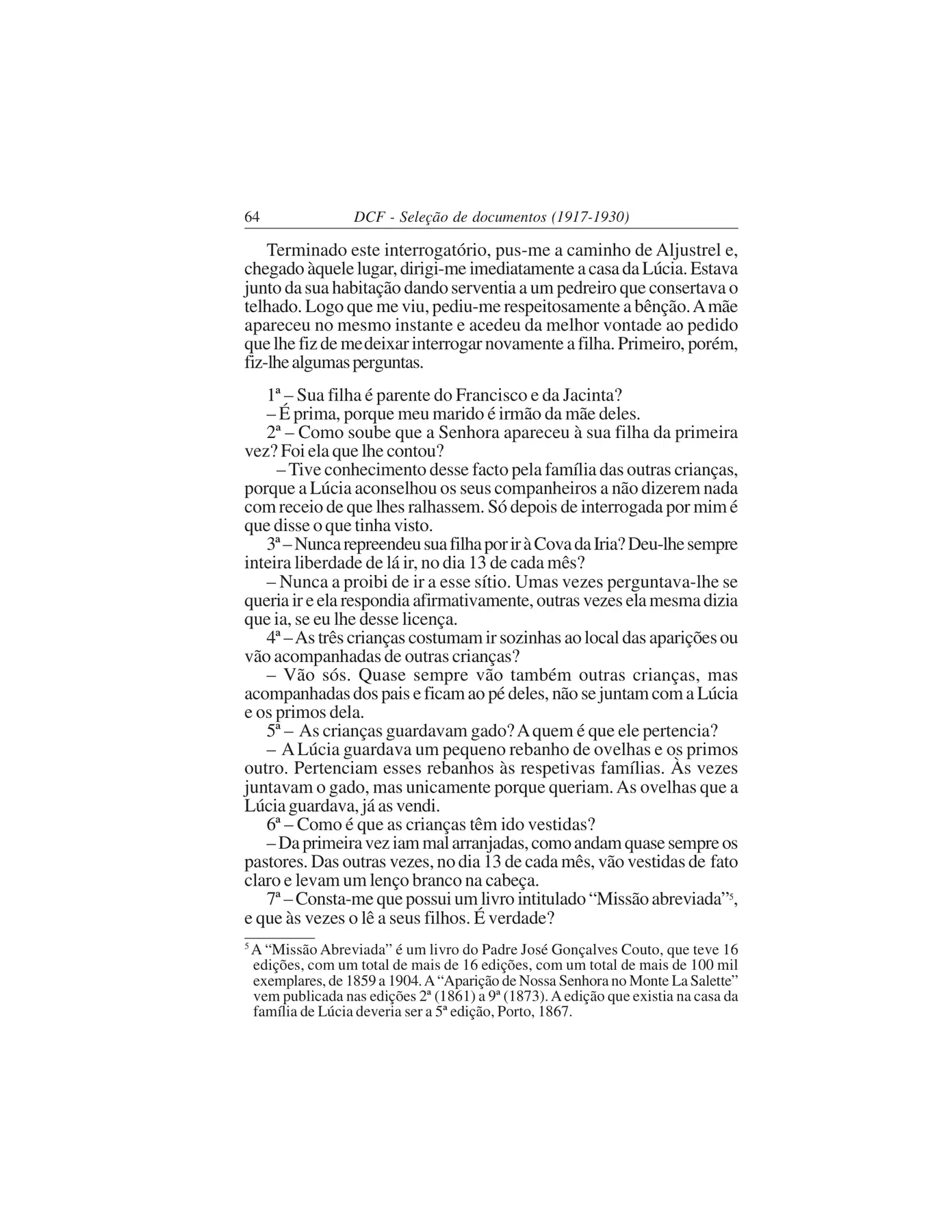
How did you learn that the Lady appeared to your daughter the first time? Was it she who told you?

– I came to know of that fact through the family of the other children, because Lúcia advised her companions to say nothing for fear they would be scolded. Only after being questioned by me did she say what she had seen.

3a – Did you never scold your daughter for going to the Cova da Iria? Did you always give her complete freedom to go there on the 13th of each month?

– I never forbade her to go to that place. Sometimes I asked her if she wanted to go and she answered yes, other times she herself said she would go, if I gave her leave.

4a – Do the three children usually go to the place of the apparitions alone or do they go accompanied by other children?

– They go alone. Other children almost always go too, but accompanied by their parents, and they stay beside them; they do not join Lúcia and her cousins.

5a – Did the children tend livestock? To whom did it belong?

– Lúcia tended a small flock of sheep and her cousins another. Those flocks belonged to their respective families. Sometimes they put the animals together, but only because they wanted to. The sheep Lúcia tended I have already sold.

6a – How have the children been dressed when they go?

– The first time they were shabbily turned out, as shepherds almost always are. The other times, on the 13th of each month, they go dressed in light-coloured clothes and wear a white kerchief on their heads.

[…]

When the children were arrested by the administrator of Vila Nova de Ourém, did anyone go to demand that they be returned to their parents?

– A brother of Francisco and Jacinta went to talk to them at the administrator's house. The administrator's wife asked whether he had come to fetch the children, to which he answered no. The administrator himself brought them back to Fátima.

11a – Have many people come to see your daughter?

– Many people have come almost every day.

Português (original)

Como soube que a Senhora apareceu à sua filha da primeira vez? Foi ela que lhe contou?

– Tive conhecimento desse facto pela família das outras crianças, porque a Lúcia aconselhou os seus companheiros a não dizerem nada com receio de que lhes ralhassem. Só depois de interrogada por mim é que disse o que tinha visto.

3a – Nunca repreendeu sua filha por ir à Cova da Iria? Deu-lhe sempre inteira liberdade de lá ir, no dia 13 de cada mês?

– Nunca a proibi de ir a esse sítio. Umas vezes perguntava-lhe se queria ir e ela respondia afirmativamente, outras vezes ela mesma dizia que ia, se eu lhe desse licença.

4a – As três crianças costumam ir sozinhas ao local das aparições ou vão acompanhadas de outras crianças?

– Vão sós. Quase sempre vão também outras crianças, mas acompanhadas dos pais e ficam ao pé deles, não se juntam com a Lúcia e os primos dela.

5a – As crianças guardavam gado? A quem é que ele pertencia?

– A Lúcia guardava um pequeno rebanho de ovelhas e os primos outro. Pertenciam esses rebanhos às respetivas famílias. Às vezes juntavam o gado, mas unicamente porque queriam. As ovelhas que a Lúcia guardava, já as vendi.

6a – Como é que as crianças têm ido vestidas?

– Da primeira vez iam mal arranjadas, como andam quase sempre os pastores. Das outras vezes, no dia 13 de cada mês, vão vestidas de fato claro e levam um lenço branco na cabeça.

[…]

Quando as crianças foram presas pelo administrador de Vila Nova de Ourém foi alguém reclamar que as restituissem aos pais?

– Um irmão do Francisco e da Jacinta foi falar com elas a casa do administrador. A senhora do administrador perguntou se ia buscar as crianças, ao que ele respondeu negativamente. O próprio administrador as veio trazer à Fátima.

11a – Tem vindo muita gente ver sua filha?

– Tem vindo muita gente quase todos os dias.
DCF Seleção, Doc. 11 (= DCF I, Doc. 12) · interrogation · 11 Oct 1917 (5 months later)View scans (2)Link
13 May13 AugOther 1917Second-handNoteSceptic2 km away
As told by Canonical commission report (Dr. Manuel Nunes Formigão, relator)
English

It was from the family of the other two seers, Francisco and Jacinta, her nephew and niece, that she learned that Our Lady had appeared to her daughter the first time, because Lúcia had advised her companions to say nothing, for fear of being scolded. Lúcia only said what she had seen after being questioned by her mother. At first she did not believe in the children's sincerity. Faced with the crowds flocking to the Cova da Iria on the thirteenth of each month, her wish was to prevent her daughter from going to that place on those days. Only with great reluctance, and guided by the advice of people of authority, who counselled her to leave her daughter free to do as she pleased, did she bring herself to allow her to go. Fearing that her daughter was deceiving the people with false statements, although she did not take her for a liar, she severely reproached her for her conduct, threatening her several times with a beating, and on one occasion, in one of the first months of the apparitions, she even struck her with a slipper, calling her an impostor.

[…]

Lúcia's mother, when she was told that her daughter had been arrested, answered: "If it was from God, God will protect them; if they lied, they won't keep it up!...". And while many people wept with pity or indignation, she kept the serenity of a truly Christian soul.

Português (original)

Foi pela família dos outros dois videntes, Francisco e Jacinta, seus sobrinhos, que ela soube que Nossa Senhora tinha aparecido à filha da primeira vez, porque a Lúcia aconselhou os seus companheiros a não dizerem nada, com receio de que lhes ralhassem. Esta, só depois de interrogada pela mãe, é que disse o que tinha visto.

[…]

A princípio não acreditava na sinceridade das crianças. Perante a concorrência das multidões à Cova da Iria nos dias treze, o seu desejo era obstar a ida de sua filha a esse local em tais dias. Só a muito custo e guiando-se pelos conselhos de pessoas de autoridade, que a aconselhavam a dar liberdade à filha para fazer o que lhe aprouvesse, é que se resolvia a permitir a sua partida. Temendo que a filha andasse a enganar o povo com falsas declarações, embora não a tivesse por mentirosa, exprobava-lhe severamente o seu procedimento, ameaçando-a várias vezes com pancadas, e uma ocasião, num dos primeiros meses das aparições, chegou até a bater-lhe com um chinelo, tratando-a de impostora.

[…]

A mãe da Lúcia, quando lhe disseram que a filha tinha sido presa, respondeu: “Se foi por Deus, Deus os guardará, se mentiram, não continuam!...”. E, enquanto muitas pessoas choravam de pena ou de indignação, ela conservava a serenidade duma alma verdadeiramente cristã.

13 JunFirst-handSworn depositionSceptic2 km awayCrowd scene
English

But on the thirteenth of June people at once gathered to accompany her, and so she did not go. That day, among the people accompanying her were two women from Boleiros. She let her daughter go. She dressed her better because from there she was going to the feast of Saint Anthony at the parish church. The mother went to the feast to hear Mass. On the way she met a group of five or six people who were going from Fátima to Aljustrel. Thinking they wanted to go to the feast, she said to them: “You're mistaken, the feast is that way”. “We haven't come for the feast,” they retorted, “we've come in search of three children who say they have seen Our Lady”. She was surprised at the answer and asked them where they were from. They said they were from Carrascos. She did not admit to them that she was the mother of one of the children. They asked where the children were.

She answered that they were in Aljustrel and went on to Mass. She grew more and more thoughtful, thinking that she was doing wrong in not going to the place of the apparitions, because they might beat the children for lying, but she did not want to undergo the shame she would be exposed to if there was nothing. The children, as soon as it was all over, went to Fátima. When people were coming out of Mass they were already there, with many people around them.

Português (original)

Mas logo se ajuntou gente no dia treze de junho para a acompanhar e por isso não foi. Nesse dia, entre as pessoas que a acompanhavam estavam duas mulheres de Boleiros. Deixou ir a filha. Vestiu-a melhor porque ia dali para a festa de Santo António na igreja paroquial. A mãe foi para a festa para ouvir a missa. No caminho encontrou um grupo de cinco ou seis pessoas que iam de Fátima para Aljustrel. Julgando que queriam ir à festa, disse-lhes: “Os senhores estão enganados, a festa é para ali”. “Nós não vimos para a festa”, retorquiram eles, “vimos em cata de três crianças que dizem ter visto Nossa Senhora”. Admirou-se da resposta e perguntou-lhes de onde eram. Disseram que eram dos Carrascos. Não lhes confessou que era a mãe de uma das crianças. Eles perguntaram onde estavam as crianças.

Respondeu-lhes que estavam em Aljustrel e seguiu para a Missa. Ia cada vez mais pensativa, julgando que fazia mal em não ir ao local das aparições, porque podiam bater nas crianças por mentirem, mas não queria passar pela vergonha a que se expunha se não houvesse nada. As crianças, logo que tudo acabou, foram ter à Fátima. Quando saíam da missa já lá estavam, vendo-se muita gente em roda delas.

DCF Seleção, Doc. 80 (= DCF II, Doc. 4) · interrogation · 28 Sep 1923 (6 years later)View scans (2)Link
13 AugSecond-handSaw itSworn depositionSceptic2 km away
As told by Olímpia de Jesus
English

At her sister-in-law's house, when they heard the people shouting, she said: “What can be going on there?” Lúcia's mother looked at the sun and said: “The sun looks different”.

Português (original)

Em casa da cunhada quando ouviram o povo a gritar, disse: “O que irá por lá?” A mãe da Lúcia olhou para o sol e disse: “O sol está diferente”.

DCF Seleção, Doc. 80 (= DCF II, Doc. 4) · interrogation · 28 Sep 1923 (6 years later)View scanLink
13 AugOther 1917First-handSworn depositionSceptic2 km awayCrowd scene
English

On the thirteenth of August Lúcia went out in the morning with the sheep, and when she came back the house was already full of people. She meant to go to the Cova da Iria, as in the previous months, but the administrator took her to Ourém, the news of the arrest being told to the mother by her sister-in-law, who, on her way to the Cova da Iria, heard that the administrator had made off with the children. Lúcia's mother was hurt but did not fret, because she knew they would not eat the children, thinking at the same time that if they were lying they deserved some punishment, and that if they were telling the truth Our Lady would defend them. Afterwards, in the afternoon, many people came trying to comfort her, saying that they were now going away more believing, because it was the first day on which the signs appeared. Jacinta's brothers went by bicycle to see what was going on in Ourém and came back saying that they had seen the children playing on the administrator's veranda, and that he was treating them well. The administrator came to bring them back to Fátima on the fifteenth in a carriage and put them on the parish priest's veranda. Lúcia's mother, who was there, came home with her daughter. The children seemed as cheerful as before and ready to play, saying that they had been asked many questions and that a doctor had come to examine them. The administrator said that the people had an illness from having seen signs, and her brother-in-law Marto told him that in that case a great many people were ill.

Português (original)

Em treze de agosto a Lúcia saiu pela manhã com as ovelhas e quando veio já estava a casa cheia de gente. Estava com tenção de ir à Cova da Iria, como nos meses anteriores, mas o administrador levou-a para Ourém, tendo sido a notícia da prisão comunicada à mãe pela cunhada que, indo para a Cova da Iria, ouviu dizer que o administrador tinha abalado com as crianças. A mãe da Lúcia ficou magoada, mas não se apoquentou porque sabia que não comiam as crianças, pensando ao mesmo tempo que se elas mentiam, mereciam algum castigo e que se diziam a verdade, Nossa Senhora as defenderia. Vieram depois, à tarde muitas pessoas que procuravam confortá-la, dizendo que iam agora mais crentes, porque foi o primeiro dia em que apareceram os sinais. Os irmãos de Jacinta foram de bicicleta observar o que se passava em Ourém e vieram dizer que tinham visto as crianças a brincar na varanda do administrador, que os tratava bem. O administrador veio trazê-los à Fátima no dia quinze num carro e foi pô-las na varanda do senhor Prior. A mãe da Lúcia, que estava lá, veio com a filha para casa. As crianças mostraram-se como dantes contentes e prontas para brincar, dizendo que lhes tinham feito muitas perguntas e que tinha ido um médico examiná-las. O administrador disse que o povo estava com uma doença por ter visto sinais, e o cunhado Marto disse-lhe que então estava muita gente doente.

DCF Seleção, Doc. 80 (= DCF II, Doc. 4) · interrogation · 28 Sep 1923 (6 years later)View scanLink
13 AugFirst-handSworn depositionSceptic
English

On the nineteenth, Lúcia came home at night carrying a little branch of holm oak in her hand and said that Our Lady had appeared to her a little before sunset, around the middle of the afternoon, at four o'clock, she having been at home with the cattle at noon. The mother took the branch and noticed that it smelled very sweet. The scent could not be compared with any other scent. She was unbelieving and was somewhat shaken, a little more convinced.

Português (original)

No dia dezanove, a Lúcia chegou a casa à noite, trazendo na mão um raminho de azinheira e disse que Nossa Senhora lhe tinha aparecido um pouco antes do sol posto, aí pelo meio da tarde, às quatro horas, tendo estado ao meio-dia com o gado em casa. A mãe pegou no ramo e notou que cheirava muito bem. O cheiro não se podia comparar com nenhum outro cheiro. Ela era descrente e ficou um pouco quebrada, um pouco mais convencida.

DCF Seleção, Doc. 80 (= DCF II, Doc. 4) · interrogation · 28 Sep 1923 (6 years later)View scanLink
13 OctFirst-handSaw itSworn depositionScepticSeers' words overheardSun spinningSun fallingPale / silver discCrowd scene
English

On the thirteenth of October the mother went to the place for the first time, despite the parish priest's advice to the contrary. They went to dress the little girls at her sister-in-law's house, because a lady from Pombalinho brought some dresses, veils and garlands. Lúcia's mother went with the children. But, as there were so many people going, she lost sight of them. At the Cova da Iria she pushed her way through and ended up right next to them. As people were saying that they would kill them, that they would cut them to pieces, and as on the other hand she would be so sorry if everything ended and she saw nothing, she decided to go. The children said what time the apparition would take place and wanted to go so as to be there at that time. On the last occasion they waited a quarter of an hour by the holm oak before the apparition began. All three were standing. Jacinta's mother was close by. People behind were saying that there would be nothing, because the hour was passing and nothing extraordinary was happening. All three at once gave a cry, an “ai!” Lúcia said: “Here she comes! Be quiet, there's been a flash of lightning”. It had been raining all morning. The holm oak was decorated with ribbons and roses; you could hardly see any of it.

Then Lúcia said: “She's here now”. She spoke aloud. The mother saw nothing. She only noticed the same scent as the little branch from Valinhos, when her daughter said: “She's here now!” Lúcia asked: “What do you want of me today?” She fell silent for a little and then seemed to ask her for a miracle so that all those people would believe. Then she was silent again. A few moments later she told her that she had many requests from many sick people to make to her. She was standing, with hands joined, facing the holm oak. The others were in the same position. Jacinta was in the middle. The other two children said nothing. Lúcia from time to time made as if to raise her eyes and lowered them at once, and when the parish priest later asked her why she did that, she said it was because it was blinding. The two little girls were dressed in a light blue dress and a white veil and had on their heads a garland of white artificial paper flowers. It all lasted a short time. Lúcia finally said: “There she goes, there she goes!... Do you see her?... Look over there!”, pointing with her arm towards the east, which was the direction she was facing and had faced the whole time. Then, naturally when she lost sight of her, she turned her back to the holm oak and, addressing the people behind, said: “Listen, Our Lady said that people should mend their ways and stop offending God, who was already very much offended, and that the war was going to end”. And her sister-in-law Olímpia said: “Oh Lúcia, didn't you ask Our Lady to work a miracle so that all the people would believe?” To this Lúcia answered: “Well, do you want a greater miracle than the war ending?” Lúcia said further that Our Lady had said that they should build a little chapel there, that she was the Lady of the Rosary, that the war would end as soon as she reached Heaven. She turned round again and repeated: “There she is!... Do you see her?... She's just about to arrive” (The little girl does not remember having told the people to look up, I mean, at the sky, at the sun). It was then that the people began to look up. Lúcia's mother looked and saw the sun three times spinning and coming down, and one could look at it. All the people were looking and shouting. The people were saying: “Look, look!” Lúcia's mother even feared that the children might be ill-treated. A doctor from Torres Novas9 picked her daughter up in his arms and made off with her towards the road. The mother did not know whether it was for good or ill. She came to her sister-in-law's house, the house filling with people, and then went to her own house.

Português (original)

Em treze de outubro a mãe foi ao local pela primeira vez, apesar da recomendação em contrário do senhor Prior. Foram vestir as pequenas para casa da cunhada, porque uma senhora do Pombalinho trouxe uns vestidos, uns véus e umas grinaldas. A mãe da Lúcia foi com as crianças. Mas, como ia muito povo, perdeu-as de vista. Na Cova da Iria furou e ficou mesmo ao pé delas. Como diziam que as matavam, que as faziam em postas, e como por outro lado ficava com tanta pena de tudo acabar e não ver nada, resolveu ir. As crianças diziam a hora em que se dava a aparição e queriam ir para estar a essa hora. Da última vez demoraram-se um quarto de hora junto da azinheira antes de começar a aparição. Estavam todos três de pé. A mãe da Jacinta estava perto. O povo dizia por trás que não haveria nada, porque ia a passar a hora e não se estava dando nada de extraordinário. Todos três a um tempo deram um grito, um ai! A Lúcia disse: “Lá vem ela! Calem-se que já deu um relâmpago”. Tinha estado a chover toda a manhã. A azinheira estava enfeitada com fitas e rosas, quase não se via nada dela.

Depois a Lúcia disse: “Já cá está”. Falava alto. A mãe não via nada. Só notou o mesmo cheiro do raminho dos Valinhos, quando a filha disse: “Já cá está!” A Lúcia perguntou: “O que me quer hoje?” Calou-se por um pouco e em seguida parece que lhe pediu um milagre para que todo aquele povo acreditasse. Depois ficou outra vez calada. Daí a momentos disse-lhe que tinha muitos pedidos de muitos doentes para lhe fazer. Ela estava de pé, de mãos postas, voltada para a azinheira. As outras estavam na mesma posição. A Jacinta ficava no meio. As outras duas crianças não diziam nada. A Lúcia de vez em quando ia para levantar os olhos e baixava-os logo, e perguntando-lhe o senhor Prior mais tarde porque fazia isso, disse que era porque cegava. Estavam as duas meninas vestidas com um vestido azul claro e um véu branco e tinham na cabeça uma grinalda de flores brancas artificiais de papel. Durou tudo pouco tempo. A Lúcia por fim disse: “Lá vai ela, lá vai ela!... Veem-na?... Olhem para acolá!”, apontando com o braço na direção do nascente para onde estava e esteve sempre voltada durante todo o tempo. Depois, naturalmente quando a perdeu de vista, voltou as costas para a azinheira e dirigindo-se ao povo que estava atrás disse: “Olhem que Nossa Senhora disse que se emendassem de ofender a Deus, que já estava muito ofendido e que a guerra ia acabar”. E a cunhada Olímpia disse: “Ó Lúcia, então tu não pediste a Nossa Senhora que fizesse um milagre para todo o povo acreditar?” A isto a Lúcia respondeu: “Então ainda querem maior milagre do que é a guerra acabar?”. Disse mais a Lúcia que Nossa Senhora tinha dito que fizessem ali uma capelinha, que ela era a Senhora do Rosário, que a guerra ia acabar logo que chegasse ao Céu. Tornou-se a virar e repetiu: “Já lá está!... Veem-na?... Já lá vai a chegar” (A pequena não se lembra de ter mandado o povo olhar para cima, digo, para o céu, para o sol). Foi então que o povo começou a olhar para cima. A mãe da Lúcia olhou e viu o sol três vezes a desandar e a descer, podendo olhar--se para ele. Todo o povo olhava e gritava. Dizia o povo: “Olhem, olhem!” A mãe da Lúcia chegou a recear que as crianças fossem maltratadas. Um senhor doutor de Torres Novas9, pegou na filha ao colo e abalou com ela para a estrada. A mãe não sabia se era para bem ou para mal. Veio para casa da cunhada, enchendo-se a casa de gente e depois para sua casa.

Editor's notes (1)

9 Dr. Carlos de Azevedo Mendes.

9 Dr. Carlos de Azevedo Mendes.

DCF Seleção, Doc. 80 (= DCF II, Doc. 4) · interrogation · 28 Sep 1923 (6 years later)View scans (3)Link